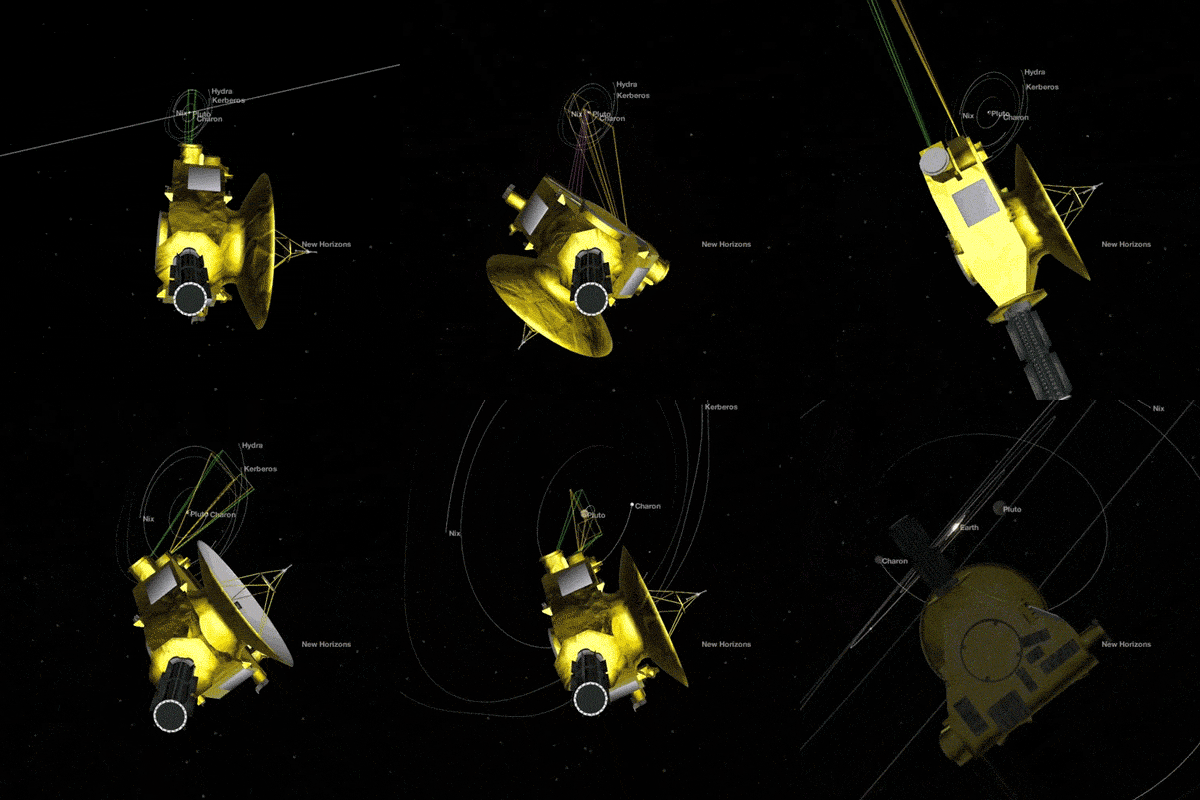
Sequence of events as New Horizons approaches Pluto, July 13th and 14th, 2015. Closest approach is at 11:50 UTC on July 14th. Lines extending from the spacecraft indicate operation and field of view of the imaging instruments.
Sequence of events as New Horizons approaches Pluto, July 13th and 14th, 2015. Closest approach is at 11:50 UTC on July 14th. Lines extending from the spacecraft indicate operation and field of view of the imaging instruments.
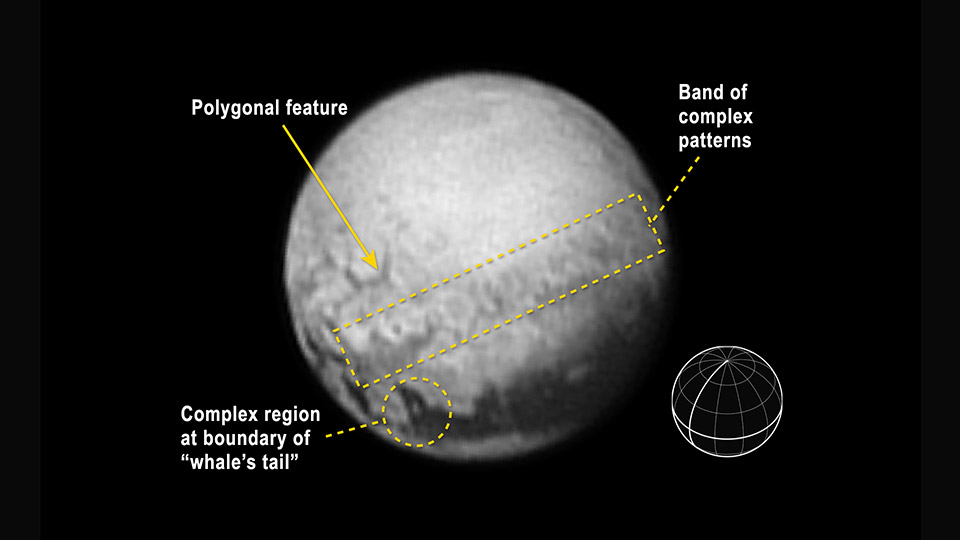 As the New Horizons probe gets closer to Pluto, the pictures its cameras capture also get clearer. Take for example the black-and-white image above: it's no longer just a blob or an extremely blurry circle. Sure, it's not as sharp as we'd all like it...

|
|
This artist's impression shows exoplanet GJ 436b, which is surrounded by a massive gas cloud that streams behind the planet like a comet's tail for millions of miles. Credit: Mark Garlick/University of Warwick |
A Neptune-size planet appears to be masquerading as a comet, with a gargantuan stream of gas flowing behind it like a comet's tail.
The bizarre find is the first of its kind ever discovered by astronomers. The strange, cometlike planet, known as GJ 436b, is orbiting a red dwarf star and is about 22 times as massive as Earth. Astronomers detected the giant gas cloud around the planet using NASA's Hubble Space Telescope and Chandra X-ray Observatory.
"I was astonished by the mere size of the cloud of gas escaping from the planet," said study lead author David Ehrenreich, an astronomer at the observatory of the University of Geneva in Switzerland. [The Strangest Alien Planets]
Alien Planet Quiz: Are You an Exoplanet Expert?
Astronomers have confirmed more than 800 planets beyond our own solar system, and the discoveries keep rolling in. How much do you know about these exotic worlds?

0 of 10 questions complete
GJ 436b, located about 33 light-years from Earth in the constellation Leo, is a kind of world known as a warm Neptune. Such planets, at about 10 to 20 times the mass of Earth, are about the mass of "cold Neptunes" such as Uranus — and, naturally, Neptune — but they are as close, or closer, to their stars than Mercury is to our sun. With an orbit of only about 3 million miles (4.8 million kilometers), "GJ 436b is 33 times closer to its star than Earth is to the sun, and 13 times closer than Mercury," Ehrenreich told Space.com.
The cloud of gas around GJ 436b, made up mostly of hydrogen, has a circular head that surrounds GJ 436b, and a tail trailing behind the planet. The diameter of the head is about 1.8 million miles (3 million km), or five times the width of the host star, which is about half that of the sun, Ehrenreich said. The length of the tail is uncertain, because the research team's observations do not cover it entirely, but their computer models suggest it could be about 9.3 million miles (15 million km) long.
Although prior research has predicted that other gas giants should be blowing off cometlike tails, based on how hot they must be due to their proximity to their stars, "GJ 436b is the first planet for which a cometlike tail is confidently detected," Ehrenreich said. (A previous study revealed indirect evidence of a rocky world that appears to be disintegrating around its host star, creating a cometlike tail of material behind the planet. That study used data from NASA's Kepler space telescope, which observed scattering of the light from the planet's host star.)
The scientists estimated that GJ 436b is currently blowing off up to 1,000 tons of gas per second. This means that GJ 436b is currently losing about 0.1 percent of its atmosphere every billion years, which is far too slow a rate to deplete its atmosphere in the lifetime of its parent red dwarf star. However, when the star was more active in its infancy, the researchers estimated that GJ 436b could have lost 10 percent or more of its atmosphere during its first billion years.
Recently, another team of researchers suggested that GJ 436b might possess a helium-rich sky depleted of hydrogen. "However, in order to be really hydrogen-poor and helium-rich, the atmosphere of GJ 436b should have represented a very small fraction of the planet['s] initial mass, around one-thousandth," Ehrenreich said. "In such a case, the whole atmosphere would have been gone today, which as we measure is not the case."
Ehrenreich noted that the Kepler spacecraft, as well as NASA's upcoming TESS space mission and the European Space Agency's future CHEOPS and PLATO spacecraft "are poised to find thousands of system like GJ 436 in the coming years." This suggests that many other planets with cometlike tails could soon be discovered.

The scientists now plan to investigate less massive planets, such as "super-Earths" and "mini-Neptunes" to see if they might also have puffy atmospheres and cometlike tails.
"We're going to study one such object in the course of next year with Hubble, and have proposed to observe several more," Ehrenreich said.
The scientists detailed their findings online today (June 24) in the journal Nature.
Follow us @Spacedotcom, Facebook and Google+. Original article on Space.com.
Discover the cosmos! Each day a different image or photograph of our fascinating universe is featured, along with a brief explanation written by a professional astronomer.
2015 July 7

Explanation: That is not our Moon. It's Dione, and its a moon of Saturn. The robotic Cassini spacecraft took the featured image during a flyby of Saturn's cratered Moon last month. Perhaps what makes this image so interesting, though, is the background. First, the large orb looming behind Dione is Saturn itself, faintly lit by sunlight first reflected from the rings. Next, the thin lines running diagonally across the image are the rings of Saturn themselves. The millions of icy rocks that compose Saturn's spectacular rings all orbit Saturn in the same plane, and so appear surprisingly thin when seen nearly edge-on. Front and center, Dione appears in crescent phase, partially lit by the Sun that is off to the lower left. A careful inspection of the ring plane should also locate the moon Enceladus on the upper right.
Tomorrow's picture: open space < | Archive | Submissions | Index | Search | Calendar | RSS | Education | About APOD | Discuss | >
Authors & editors:
Robert Nemiroff
(MTU) &
Jerry Bonnell (UMCP)
NASA Official: Phillip Newman
Specific rights apply.
NASA Web
Privacy Policy and Important Notices
A service of:
ASD at
NASA /
GSFC
& Michigan Tech. U.
Discover the cosmos! Each day a different image or photograph of our fascinating universe is featured, along with a brief explanation written by a professional astronomer.
2015 July 10

Explanation: Often imaged but rarely mentioned, Messier 43 is a large star forming region in its own right. It's just part of the star forming complex of gas and dust that includes the larger, more famous neighboring Messier 42, the Great Orion Nebula. In fact, the Great Orion Nebula itself lies off the lower edge of this scene. The close-up of Messier 43 was made while testing the capabilities of a near-infrared instrument with one of the twin 6.5 meter Magellan telescopes at Las Campanas Observatory in the Chilean Andes. The composite image shifts the otherwise invisible infrared wavelengths to blue, green, and red colors. Peering into caverns of interstellar dust hidden from visible light, the near-infrared view can also be used to study cool, brown dwarf stars in the complex region. Along with its celebrity neighbor, Messier 43 lies about 1,500 light-years away, at the edge of Orion's giant molecular cloud. At that distance, this field of view spans about 5 light-years.
Tomorrow's picture: light-weekend < | Archive | Submissions | Search | Calendar | RSS | Education | About APOD | Discuss | >
Authors & editors:
Robert Nemiroff
(MTU) &
Jerry Bonnell (UMCP)
NASA Official: Phillip Newman
Specific rights apply.
NASA Web
Privacy Policy and Important Notices
A service of:
ASD at
NASA /
GSFC
& Michigan Tech. U.
Discover the cosmos! Each day a different image or photograph of our fascinating universe is featured, along with a brief explanation written by a professional astronomer.
2015 July 9

Explanation: An image snapped on July 7 by the New Horizons spacecraft while just under 5 million miles (8 million kilometers) from Pluto is combined with color data in this most detailed view yet of the Solar System's most famous world about to be explored. The region imaged includes the tip of an elongated dark area along Pluto's equator already dubbed "the whale". A bright heart-shaped region on the right is about 1,200 miles (2,000) kilometers across, possibly covered with a frost of frozen methane, nitrogen, and/or carbon monoxide. The view is centered near the area that will be seen during New Horizons much anticipated July 14 closest approach to a distance of about 7,750 miles (12,500 kilometers).
Tomorrow's picture: in the shadow of M42 < | Archive | Submissions | Search | Calendar | RSS | Education | About APOD | Discuss | >
Authors & editors:
Robert Nemiroff
(MTU) &
Jerry Bonnell (UMCP)
NASA Official: Phillip Newman
Specific rights apply.
NASA Web
Privacy Policy and Important Notices
A service of:
ASD at
NASA /
GSFC
& Michigan Tech. U.
Adam Victor BrandizziI don't like Star Wars but this panel is really cool.
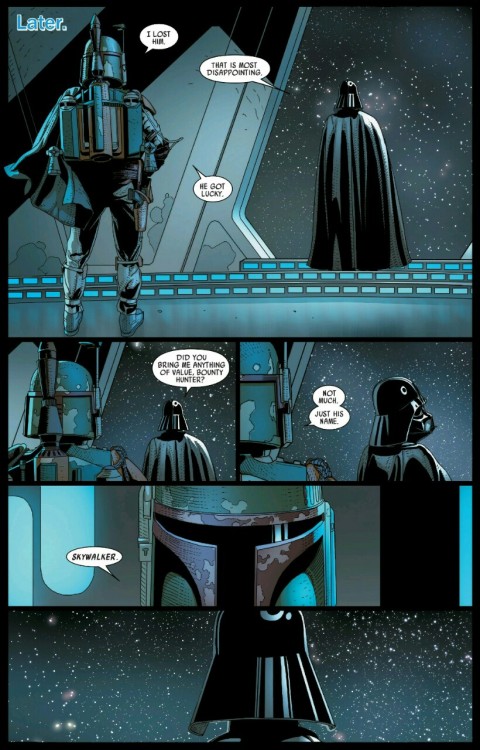

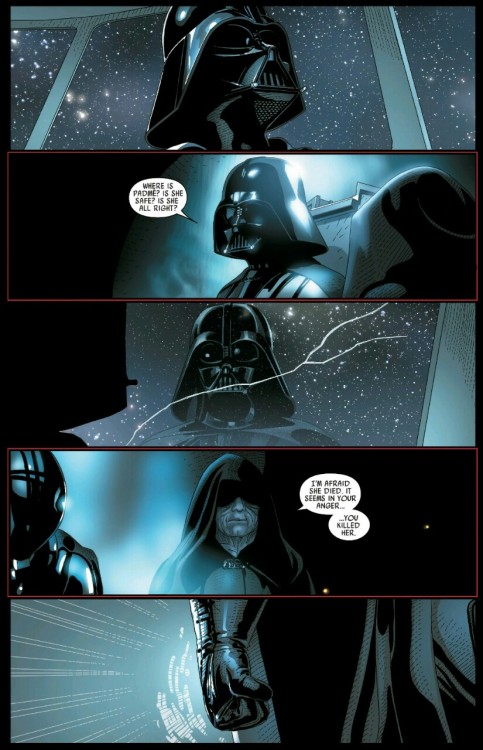
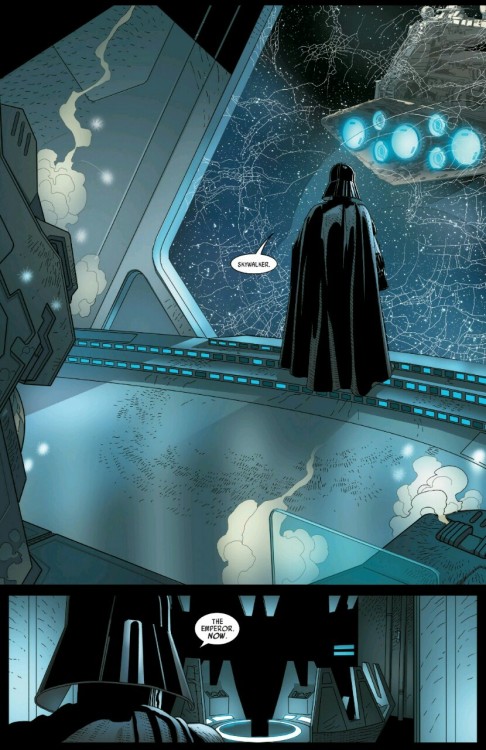

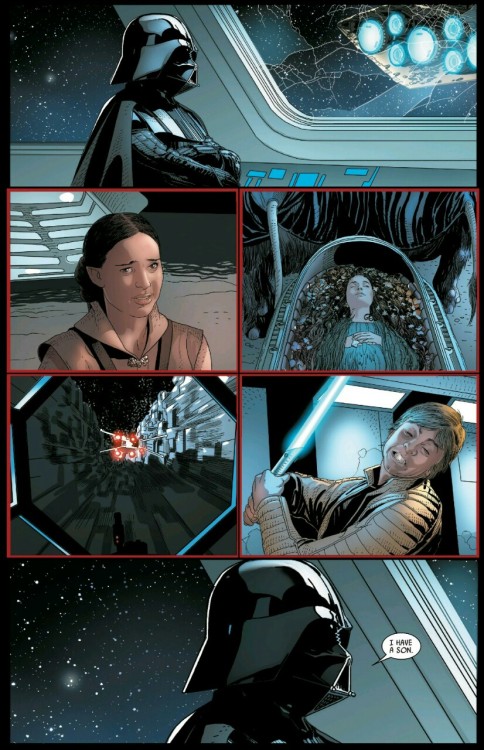
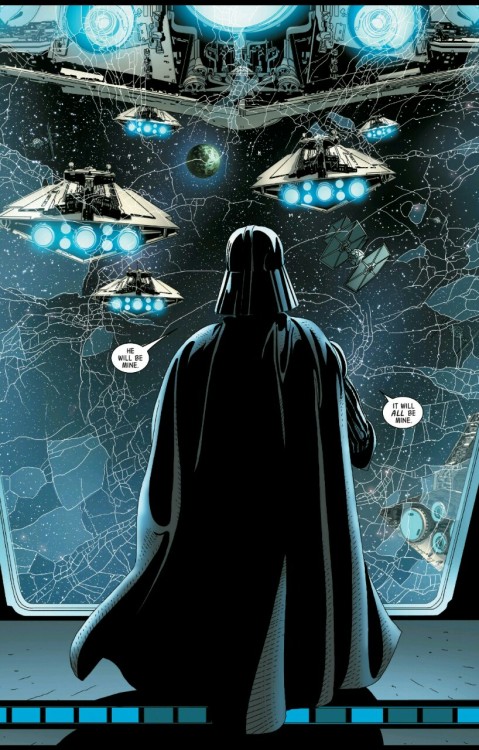
This is, unquestionably, the greatest moment I’ve ever read in any piece of Star Wars media. It shook me to the core going through this panel-by-panel on ComiXology. Holy. Shit. So. Good.
What if Star Wars was written by people who knew how to write

|
|
Adam Victor Brandizzi"Hopefully we'll get a better look come next week."
Better names as well, I hope.

Using images taken by New Horizons between June 27 and July 3, this is the latest NASA map informally named the Whale and the Donut. Now, use your imagination here (because space!). The dark area on left is the whale, representing about 1,860 miles of length, and the tail in the left corner is cupping the donut.
Hopefully we'll get a better look come next week. I'm guessing they're an actual whale and donut. But I'm no scientist.

Problem: Compiled code isn't interpreted code, even if it compiles to interpreted code. Solution: Grunt watch Problem: Promises Solution: IOUs Problem: Javascript is a toy language that was tied to a document markup and somehow this has become the universal runtime of the internet. Problem: At this point, the ecosystem around Javascript is so densely layered and frequently changing that maintenance of any project over any significant period of time is going to be a nightmare. — javascript cube-drone miloslav
Share Url: http://cube-drone.com/comics/c/relentless-persistence

‘One algorithm had to cope with pairs of romantically attached doctors who wanted two job offers in the same city’
When it comes to finding the perfect match, nobody wants to be left on the shelf but the Arunta — a polygamous aboriginal tribe from the area around Alice Springs — used to take things to extremes. As described by anthropologists in the 1920s, the father of a newborn Arunta boy would get together with the father of a newborn girl to arrange a future marriage. The betrothal was not between the two babies, of course — that would be leaving things far too late. Instead, the engagement was between the baby boy and the first daughter that the baby girl had when she became a mother herself.
This astonishing process is called “market unravelling”, and it is not limited to the Arunta. As described in Alvin Roth’s new book, Who Gets What — and Why, hospitals make early offers to untried junior doctors. Law firms make early offers to law student freshers. Oxford and Cambridge make offers many months before the students in question sit their exams.
This is not a sensible situation because if everybody could agree to wait, then more information would emerge, allowing more compatible matches. Yet there is an incentive to break ranks and make early “exploding” offers. If those time-limited offers are any good, then students will often accept them rather than take the risk of waiting. The logic of the situation pulls these early offers ever earlier, sometimes absurdly so. Everybody loses but no individual can change things.
One response is to agree a rule banning early offers. That is what the US National Association for Law Placement did in the 1980s: it ruled that any job offer made to a first-semester law student had to remain open until the end of that semester. It wasn’t long before the lawyers had found the loophole: mediocre offers paired with massive time-limited signing bonuses.
Another possibility is to use a central clearing house. That is what the Boston school system did. Parents listed at least three schools in order of preference, and the clearing house put every child into their first choice school where possible. Any schools with spare places would then admit students who’d listed the school as second choice, then third choice, and so on. Four out of five students got their first choice, yet parents hated the system. Why?
The problem was that parents had just one shot at a good school. Popular schools filled instantly, making second choices almost irrelevant. Parents who didn’t understand the game might apply for several popular schools and get nothing. Those who understood the problem found themselves second-guessing the clearing house, using their precious first choice on a compromise school rather than the high-risk approach of saying what they truly wanted. The system produced cynical, alienated parents.
The problem is easier to describe than to solve. But there is a way to fix unravelling markets: call Alvin Roth. An engineer by training — albeit one with a Nobel Memorial Prize in economics — Roth designs markets with an engineer’s practical mentality. With his colleagues, Roth has designed stable clearing houses for doctors, fixed the school application systems in Boston and in New York City, and even created kidney donation networks.
At the heart of many well-functioning clearing houses is something called the deferred acceptance algorithm. The algorithm begins with the following input: each student submits a list of their preferred schools, from first choice to last, and each school submits a ranked list of their preferred students. Armed with these rankings, a computer can swiftly handle the rest. First, each school provisionally fills its places with the top students on its list; then each student provisionally accepts the best offer she has received and rejects the others; each school then extends further offers to fill the spaces that these rejections opened up. The process continues (inside the computer) with each student keeping only the best offer received so far, and with each school working down the list of students and making fresh offers as the rejections come in.
There are two important features of the deferred acceptance algorithm. The first is that people can safely tell the truth about their favourite schools — there is no disadvantage to aiming high. The second is that the algorithm’s allocation is stable. There will never be a pair of school and student who wish they were matched to each other but whom the algorithm sent elsewhere. This matters because if such pairs exist, they have an incentive to strike side deals, undermining the whole system.
The deferred acceptance algorithm is just the start of a successful market design, because details matter. In New York City, there are different application procedures for certain specialised schools. When assigning hospital residencies, the US National Resident Matching Program needed to cope with pairs of romantically attached doctors who wanted two job offers in the same city. These complexities sometimes mean there is no perfect matching algorithm, and the challenge is to find a system that is good enough to work.
Economists such as Alvin Roth are like engineers or doctors. They cannot settle for understanding a system in theory; they must solve practical problems too. It’s a hopeful direction for economics — and an essential one, if economists aren’t to be left on the shelf themselves.
Also published at ft.com.

O mestrado me empurrou ladeira abaixo do "Mount Stupid" em muita coisa que eu achava que "sabia" (o sumiço do blog é, em parte, consequência disso). É muito difícil encontrar algo pra falar sobre um assunto que: i.você domina bem a ponto de saber que o básico já foi dito em outro lugar, ii. você não tem conhecimento suficiente para dizer algo que passe pelo seu novo filtro de autocrítica e, iii. você sabe de um monte de gente que escreveria melhor e com mais propriedade. Outra dificuldade associada é descer do nível de rigor e abstração que a academia impõe, que em grande medida não serve para o tal "mundo real" (i.e., a maioria dos empregos), nem para tocar um blog de público mais amplo. Acho que com o tempo vou achando um novo equilíbrio e me soltando, mas quando eu desandar a falar muito sobre qualquer coisa, tenham em mente que é mais provável que eu esteja no topo do tal Mount Stupid.
Outras observações mais leves e, talvez, mais úteis (vou completando ao longo do tempo):
—A academia americana é muito mais generosa do que eu imaginava, pelo menos para quem consegue passar do portão. A grande maioria dos professores está disposta a gastar muito tempo com alunos, seja abrindo espaço na agenda para reuniões, respondendo e-mails ou compartilhando papers, bases de dados, códigos, etc. Um paraíso comparado ao clima de torre de marfim que predomina em alguns departamentos aqui no Brasil. Claro que alguns egos são de fato enormes e subindo na cadeia alimentar o clima talvez não seja assim tão amistoso, mas, no geral, até os professores mais famosos são acessíveis e dispostos a colaborar. No fim das contas, acho que tudo aquilo depende de uma troca incessante de ideias, e quem se isola tende a sair perdendo.
—Os trade-offs saber fazer conta/ter bom raciocínio lógico e analítico x escrever bem/ser criativo/ser articulado não existem (isso eu já deveria saber). A separação dessas habilidades é coisa da preguiça intelectual daqui, ou: dá para negligenciar totalmente um lado se você for um artista genial ou um teórico brilhante, mas para nós, mortais, é muito melhor quando os dois lados se completam.
—Muitas conclusões "definitivas" e pseudocientíficas são tiradas a partir de amostras muito pequenas. Identificação causal em ciências sociais é um pesadelo.
—A boa política pública, aprendemos, deve ser tecnicamente correta, administrativamente factível e politicamente apoiável (esta é a santíssima trindade da Kennedy School). Calculem aí o quanto é difícil fazer isso em contextos de falta de mão de obra qualificada, interesses de pequenos grupos infiltrados há séculos na política e falta de capacidade de implementação do estado. Vivemos condenados a um mundo de "second" (ou "third", "fourth"...) bests.
—Microeconomia é muito mais legal (e difícil) do que eu sempre achei—cortesia tanto da minha ignorância quanto de uma horrenda geração de professores da FEA-USP.
—E, já que é pra falar mal da alma mater: é incrível notar como a USP transforma(va?) uma geração de bons estudantes (privilegiados, claro, mas tantos outros privilegiados não passavam no vestibular) em vagabundos desinteressados, e como uma universidade excelente faz algo totalmente diferente. A maioria dos meus colegas da Poli e da FEA não é menos "inteligente" que meus colegas de Harvard, mas a maioria teve trajetórias acadêmicas medíocres e enormes potenciais frustrados ou adiados, em grande medida, creio, por um sistema de incentivos que não leva o aluno a querer aprender e perseguir seus interesses. Também é chocante notar que é muito mais fácil encontrar alunos negros em Harvard do que em algumas das unidades da USP.
Tenho um monte de outras observações de caipira brasileiro deslumbrado com os EUA, mas vou poupá-los delas. Em um post futuro, falarei mais sobre o programa de mestrado que cursei.
No meu prédio em Nova York, vivem duas senhoras libanesas. Imigraram no começo da Guerra Civil do Líbano, nos anos 1970. Uma veio estudar medicina. A outra veio trabalhar na ONU. Converso muito com ambas, que ainda tem na memória uma Beirute cosmopolita sem similar no mundo hoje. Literalmente, um lugar que, como Smyrna e Alexandria, reunia o melhor do Ocidente e do Oriente.
Neste domingo, elas trouxeram uma amiga síria. Uma senhora elegante, que facilmente poderia ser confundida com alguém do Leblon, de Higienópolis ou dos Jardins. Parecia uma sócia do clube Harmonia de São Paulo ou do Country no Rio. Mas ela, na verdade, ela é de Aleppo. E, assim como as libanesas, deixou seu país por causa da Guerra Civil. A diferença é que, no caso dela, o conflito ainda está longe de terminar.
Aleppo, para quem não sabe, foi um dos grandes centros comerciais da humanidade, no corredor que une a Ásia e a Europa. É uma cidade milenar. E uma metrópole do século 21. Até 2011, tinha suas qualidades e defeitos. Diferentemente de Damasco, a capital, Aleppo era mercantil. Sempre teve uma classe média educada e multireligiosa. Os judeus, por séculos, fizeram parte do caldeirão religioso desta cidade, onde ainda convivem cristãos ortodoxos, assírios, armênios, muçulmanos sunitas, alauítas e drusos.
No começo da Guerra da Síria, Aleppo estava como Damasco – uma espécie de bolha em um país em guerra. Em 2013, porém, a guerra chegou forte a Aleppo, como um tsunami. Hoje a cidade se divide entre a área controlada pelo regime e a área controlada pelos rebeldes, muitos deles ligados à Al Qaeda. Grande parte foi destruída, incluindo a cidade velha, que era uma das mais bem preservadas do mundo com seus suqs (mercados). O governo bombardeia seus inimigos, que respondem com atentados terroristas.
Centenas de milhares de moradores de Aleppo fugiram. Os que tiveram mais sorte, para o exterior. Outros, para a costa mediterrânea ou Damasco, ambas controladas pelo regime de Bashar al Assad. Muitos, porém, tiveram que permanecer em uma cidade em guerra.
A senhora de Aleppo, em 2013, quando a guerra chegou à sua cidade, se mudou com o marido para o Cairo. Engenheiro mecânico, ele conseguiu um bom emprego na capital egípcia. Mas o Egito também está em crise. Depois de seis meses sem receber salário, deixou o emprego e voltou para a Síria. Hoje, segundo a mulher, ele tem de se esconder no corredor do prédio quando escuta os bombardeios.
Ela está temporariamente nos EUA, mas recentemente esteve na Síria visitando o marido e os filhos. Viajou para Beirute, pegou um táxi para Damasco e, de lá, um ônibus para Aleppo – é a forma mais segura de chegar à cidade, antes ligada por avião a várias capitais europeias. Na sua visão, absolutamente todos os lados envolvidos no conflito são ruins e não existe perspectiva nenhuma. Sua única torcida é para a guerra acabar e Aleppo se reconstruir, assim como Beirute depois de ser arrasada nos anos 1980.
Como a senhora de Aleppo, há milhões de sírios. Até 2011, eles viviam em uma nação estável, por incrível que pareça. Tanto que era para a Síria que os iraquianos, especialmente os cristãos, fugiram depois da invasão americana em 2003. Ela ainda tem a sorte de poder vir aos EUA. Mas seu marido e outros milhões são prisioneiros da maior Guerra Civil do século 21.
Guga Chacra, comentarista de política internacional do Estadão e do programa Globo News Em Pauta em Nova York, é mestre em Relações Internacionais pela Universidade Columbia. Já foi correspondente do jornal O Estado de S. Paulo no Oriente Médio e em NY. No passado, trabalhou como correspondente da Folha em Buenos Aires
Comentários islamofóbicos, antissemitas, anticristãos e antiárabes ou que coloquem um povo ou uma religião como superiores não serão publicados. Tampouco são permitidos ataques entre leitores ou contra o blogueiro. Pessoas que insistirem em ataques pessoais não terão mais seus comentários publicados. Não é permitido postar vídeo. Todos os posts devem ter relação com algum dos temas acima. O blog está aberto a discussões educadas e com pontos de vista diferentes. Os comentários dos leitores não refletem a opinião do jornalista
Acompanhe também meus comentários no Globo News Em Pauta, na Rádio Estadão, na TV Estadão, no Estadão Noite no tablet, no Twitter @gugachacra , no Facebook Guga Chacra (me adicionem como seguidor), no Instagram e no Google Plus
Adam Victor BrandizziMANO, NÃO

by @uaiHebert






 |
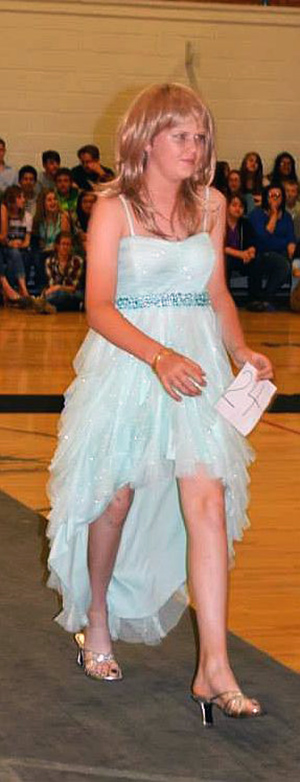
| Wearing Nine West |

 |
| Michel Epalza Betancourt |


 Expanded from



 Expanded from


 In English there is the phrase "