Shared posts

28 Aug 12:51

Hattori Hanzō Katana (Kill Bill) build (video)

by Jessica

Cool video from AWE me on forging the sword from Kill Bill.

Every other Monday, our team of blacksmiths and craftsman will be building some of your favorite weapons, and some weapons that you’ve never seen before. This week, we’re using traditional techniques to forge Hattori Hanzō’s Katana wielded by Black Mamba in Kill Bill.

Read more.

06 Aug 18:26

Ippei Gyoubu | Japanesque

by Ernesto Iniesta

Ippei Gyoubu es un fantástico ilustrador y diseñador gráfico japonés, que combina de una manera única la ilustración contemporánea japonesa y el mundo de los videojuegos.

2010-09-15-324493 tumblr_mjcrlfDS961r7dtpmo4_1280

El mismo Ippei Gyoubu denomina su estilo de ilustración como “Japanesque” combinando un toque de manga con otro tanto de pop art.

477f3847b086d7b110d7aea3732a0fa7 2012-07-11-513931

Ippei Gyoubu nació en 1974, el dibujo siempre fue su medio de expresión, tomando como base los dibujos animados y cómics que leía de niños.

7b55a2ab915c3c8e048c994d08bc026ca050902e_m ippei_gyoubu1

Su carrera comienza cuando inicia a diseñar personajes  para una compañía de videojuegos, gracias a estas ilustraciones comenzó a ganarse un nombre dentro de la industria.El proceso de Ippei es el de dibujar sus bocetos o dummys para después escanearlas e ilustrarlas a nivel digital.

tumblr_mjcrlfDS961r7dtpmo1_1280 tumblr_mjcrlfDS961r7dtpmo10_1280

Los personajes de Ippei suelen ser chicas para denotar mas sensualidad, que el color sea más intenso, la composición sea mas armónica y la ilustración más detallada.

monkey1du8 tumblr_mjcrlfDS961r7dtpmo6_500 tumblr_mjcrlfDS961r7dtpmo7_1280

Con un estilo muy occidental para el publico oriental y bastante oriental para el occidente, Ippei Gyoubu queda en el punto perfecto de establecerse a nivel mundial gracias a su fantástico trabajo.

2012-07-11-513933 drpepperadv2byippeigyoubu2 ippeigyoubu81

Si tu deseas conocer más acerca de Ippei Gyoubu te invito a dar clic en su página web para que conozcas mas de sus obras.

Página Web


Texto por: Ernesto Iniesta

05 Aug 06:12

The rewards for working hard are too big for Keynes’s vision

by Tim Harford
Undercover Economist

The economist was right in that we are better off but at the cost of our free time

Working long hours pays off in monetary terms, but it means there is less time for pursuits

If John Maynard Keynes is looking down upon me now — he might make a good guardian angel for economists — then he is wondering why I am writing this column instead of lounging by the pool.

“Three hours a day is quite enough,” he pronounced in his 1930 essay Economic Possibilities for our Grandchildren. The essay offers two famous speculations: that people in 2030 will be eight times better off than people in 1930; and that as a result we will all be working 15-hour weeks and wondering how to fill our time.

Keynes was half right. Barring some catastrophe in the next 15 years, his rosy-seeming forecasts of global growth will be an underestimate. The three-hour workday, however, remains elusive. (Keynes was childless, but NPR’s Planet Money show recently tracked down his sister’s grandchildren and asked them if they were working just 15 hours a week. They were not.)

So where did Keynes go wrong? Two answers immediately spring to mind — one noble, and one less so. The noble answer is that we rather like some kinds of work. We enjoy spending time with our colleagues, intellectual stimulation or the feeling of a job well done. The ignoble answer is that we work hard because there is no end to our desire to outspend each other.

Keynes considered both of these possibilities, but perhaps he did not take them seriously enough. He would not have been able to anticipate more recent research suggesting that the experience of being unemployed is miserable out of all proportion to its direct effect on income.

Perhaps Keynes also failed to appreciate that there is more to keeping up with the Joneses than conspicuous consumption. We want to live in pleasant areas with good schools and easy access to dynamic employers. As a result, we find ourselves in ferocious competition for a limited supply of desirable houses.

There are subtler explanations for Keynes’s error. As the late Gary Becker observed in an essay with Luis Rayo, Keynes may have been led astray by contemplating the leisured elite of the 1920s. The income flowing to the “1 per cent” was not much different back then, but they owned much more of the wealth. A gentleman in 1920s Bloomsbury drawing income from capital was just as wealthy as a partner at a 21st-century New York law firm billing at a vast hourly rate. Yet it is no mystery that the gentleman spent his time at the club while the lawyer is working her socks off.

A few years ago, the economists Mark Aguiar and Erik Hurst published a survey of how American work and leisure had evolved between 1965 and 2005. Both men and women had more leisure time — although nothing like as much as Keynes had expected. But some people defied this trend. The best educated and the highest earners, both men and women, had less free time than ever. Starting in the mid 1980s, this elite began to drop everything and work ­furiously.

Perhaps the real story, then, is that we are trying to keep up not with the Joneses but with our work colleagues. By pulling the longest hours and taking the least leave, we climb the corporate ladder. It may be no coincidence that the collapse in leisure time began in the 1980s, at a time when inequality at the top of that ladder was surging. The rewards for working hardest are large.

We are still 15 years away from the world that Keynes imagined. If we are to live up to his laid-back expectations, much will have to change. We’ll need plentiful access to nice schools and neighbourhoods, and less of a rat-race culture in the office.

That sounds welcome. But perhaps the fundamental truth is that many of us enjoy working hard on something that feels worthwhile, or aspire to such work. John Maynard Keynes was a wealthy man, but that did not stop him working himself to death.

Written for and first published at ft.com.

05 Aug 06:06

A Proton Arc Over Lake Superior

Discover the cosmos! Each day a different image or photograph of our fascinating universe is featured, along with a brief explanation written by a professional astronomer.

2015 August 3
See Explanation.  Clicking on the picture will download
 the highest resolution version available.

A Proton Arc Over Lake Superior
Image Credit & Copyright: Ken Williams

Explanation: The setting had been picked out -- all that was needed was an aurora. And late last August, forecasts predicted that an otherwise beautiful night sky would be lit up with auroral green. Jumping into his truck, the astrophotographer approached his secret site -- but only after a five hour drive across the rural Upper Peninsula of Michigan. What he didn't know was that his luck was just beginning. While setting up for the image, a proton arc -- a rare type of aurora -- appeared. The red arc lasted only about 15 minutes, but that was long enough to capture in a 30-second exposure. As the name indicates, proton arcs are caused not by electrons but by more massive protons that bombard the Earth's atmosphere following an energetic event on the Sun. In the featured image, the yellow lights on the horizon are the city lights of Marquette, Michigan, USA. The blue and yellow rocks in the Lake Superior foreground are lit by a LED flashlight. Also captured, to the left of the red proton arc, was the band of our Milky Way Galaxy.

APOD Editor to Speak: Saturday, August 8 at Keweenaw Science & Engineering Festival
Tomorrow's picture: galaxies cluster < | Archive | Submissions | Index | Search | Calendar | RSS | Education | About APOD | Discuss | >

Authors & editors: Robert Nemiroff (MTU) & Jerry Bonnell (UMCP)
NASA Official: Phillip Newman Specific rights apply.
NASA Web Privacy Policy and Important Notices
A service of: ASD at NASA / GSFC
& Michigan Tech. U.

Expanded from APOD by Feed Readabilitifier.
05 Aug 01:09

Worming our way to the truth

by Tim Harford
Undercover Economist

‘Why does such a large policy push need to be based on a handful of clinical trials?’

It was one of the most influential economics studies to have been published in the past 20 years, with a simple title, “Worms”. Now, its findings are being questioned in an exchange that somehow manages to be encouraging and frustrating all at once. Development economics is growing up, and getting acne.

The authors of “Worms”, economists Edward Miguel and Michael Kremer, studied a deworming project in an area of western Kenya where parasitic intestinal worms were a serious problem in 1998. The project was a “cluster randomisation”, meaning that the treatment for worms was randomised between entire schools rather than between children within each school.

Miguel and Kremer concluded three things from the randomised trial. First, deworming treatments produced not just health benefits but educational ones, because healthier children were able to attend school and flourish while in class. Second, the treatments were cracking value for money. Third, there were useful spillovers: when a school full of children was treated for worms, the parasites became less prevalent, so infection rates in nearby schools also fell.

The “Worms” study was influential in two very different ways. Activists began to campaign for wider use of deworming treatments, with some success. Development economists drew a separate lesson: that running randomised trials was an excellent way to figure out what worked.

In this, they were following in the footsteps of epidemiologists. Yet it is the epidemiologists who are now asking the awkward questions. Alexander Aiken and three colleagues from the London School of Hygiene and Tropical Medicine have just published a pair of articles in the International Journal of Epidemiology that examine the “Worms” experiment, test it for robustness and find it wanting.

Their first article follows the original methodology closely and uncovers some programming errors. Most are trivial but one of them calls into question the key claim that deworming produces spillover benefits. Their second article uses epidemiological methods rather than the statistical techniques preferred by economists. It raises the concern that the central “Worms” findings may be something of a fluke.

Everyone agrees that there were some errors in the original paper; such errors aren’t uncommon. There’s agreement, too, that it’s very useful to go back and check classic study results. All sides of the debate praise each other for being open and collegial with their work.

But on the key questions, there is little common ground. Miguel and Kremer stoutly defend their findings, arguing that the epidemiologists have gone through extraordinary statistical contortions to make the results disappear. Other development economists support them. After reviewing the controversy, Berk Ozler of the World Bank says: “I find the findings of the original study more robust than I did before.”

Yet epidemiologists are uneasy. The respected Cochrane Collaboration, an independent network of health researchers, has published a review of deworming evidence, which concludes that many deworming studies are of poor quality and produce rather weak evidence of benefits.

What explains this difference of views? Partly this is a clash of academic best practices. Consider the treatment of spillover effects. To Miguel and Kremer, these were the whole point of the cluster study. Aiken, however, says that an epidemiologist is trained to think of such effects as “contamination” — an undesirable source of statistical noise. Miguel believes this may explain some of the disagreement. The epidemiologists fret about the statistical headaches the spillovers cause, while the economists are enthused by the prospect that these spillovers will help improve childhood health and education.

Another cultural difference is this: epidemiologists have long been able to run rigorous trials but, with big money sometimes at stake, they have had to defend the integrity of those trials against the possibility of bias. They place a high value on double-blind methodologies, where neither subjects nor researchers know who has received the treatment and who is in the control group.

Economists, by contrast, are used to having to make the best of noisier data. Consider a century-old intervention, when John D Rockefeller funded a programme of hookworm eradication county by county across the American south. A few years ago, the economist Hoyt Bleakley teased apart census data from the early 20th century to show that this programme had led to big gains in schooling and in income. To an economist, that is clever work. To an epidemiologist, it’s a curiosity and of limited scientific value.

As you might expect, my sympathies lie with the economists. I suspect that the effects that Miguel and Kremer found are quite real, even if their methods do not quite match the customs of epidemiologists. But the bigger question is why so large a policy push needs to be based on a handful of clinical trials. It is absolutely right that we check existing work to see if it stands up to scrutiny but more useful still is to run more trials, producing more information about how, where and why deworming treatments work or do not work.

This debate is a sign that development policy wonks are now serious about rigorous evidence. That’s good news. Better news will be when there are so many strong studies that none of them will be indispensable, and nobody will need to care much about what exactly happened in western Kenya in 1998.

Written for and first published at ft.com.

05 Aug 00:19

Photo


05 Aug 00:17

rgr-pop: chickenshit: real birds tweet on twitter me too


rgr-pop:

chickenshit:

real birds tweet on twitter

me too

05 Aug 00:16

oh my gdO CAN YOU DRAW GODZILLA MOMMA CARRYING LIKE A HUNDRED LIZARD BABIES ON HER BACK FOR TAKE YOUR CHILD (lizard) TO WORK DAY

oh SHOOT well i cant swing 100 but how bout

image
image
image
image
image
image
image
image
05 Aug 00:15

speciesbarocus: Illustrations to the Book of Revelation...


speciesbarocus:

Illustrations to the Book of Revelation (1909).

The stile follows the early 17th century’s Old Believers’ manuscript tradition [x]

05 Aug 00:13

gifak-net: Video:  Videobomb Scares Reporter

05 Aug 00:07

A 17th-Century Stanchi Painting Reveals the Rapid Change in Watermelons through Selective Breeding [Updated]

by Christopher Jobson

painting-1
Giovanni Stanchi (Rome c. 1645-1672). Oil on canvas. 38 5/8 x 52½ in. (98 x 133.5 cm.) / Courtesy Christie’s

watermelon-1

Old master work paintings are frequently cited for their depiction of historical events, documentation of culture, or portraiture of significant people, but there’s one lesser known use of some paintings for those with a keen eye: biology. One such instance is this Renaissance still life of various fruits on a table by Giovanni Stanchi painted sometime in the 1600s that shows a nearly unrecognizable watermelon before it was selectively bred for meatier red flesh.

Horticulture professor James Nienhuis at the University of Wisconsin tells Vox that he’s fascinated by old still life paintings that often contain the only documentation of various fruits and vegetables before we transformed them forever into something more desirable for human use. You can read a bit more about the science behind the changes in watermelons over the last 350 years here. (via Kottke)

Update: Greg Cato writes: “The painting depicts a rare outcome of sub-par growing conditions, known as ‘starring.’ It’s perfectly normal, still happens, and is not the result of selective breeding (although it would be cool if it were).” You can see an example here.

05 Aug 00:04

The pen

by PIDJIN.NET

The post The pen appeared first on Fredo and Pidjin. The Webcomic..

04 Aug 23:55

Bem vindo a Corruptolândia

04 Aug 14:53

Photographer Captures Shots of Hawks Exchanging Food in Midair

by Michael Zhang

Food Exchange

Photographer Phoo Chan was shooting in Coyote Hills Regional Park in Fremont, California, recently when he spotted hawks doing food exchanges in midair. The photo above is a 5-shot composite showing a male Northern Harrier passing a small bird it caught to one of its three offspring.

Here’s a crop of the image (you can see a higher-res shot here):

Coyote Hills

Coyote Hills

Chan also captured this photo of a male Northern Harrier dropping a freshly caught squirrel to one of its mates:

TheFlying Squirrel

The photo was shot using a Canon 7D Mark II with a Canon 600mm on a 2x teleconverter. The effective focal length was 1920mm, which “too much of a reach when the subjects are too close,” Chan says.

He writes that male Northern Harriers can have as many as five mates at once, and since the males are the main bread- meat-winners in the “families,” they’re constantly busy trying to provide for their mates and offspring.

By the way, Chan is the same photographer that snapped that photo of a crow riding a bald eagle earlier this month.

(via Phoo Chan via 500px ISO)


Image credits: Photographs by Phoo Chan and used with permission

04 Aug 14:51

O bordão da Valdirene

by noreply@blogger.com (Permafrost)
Não sei si vcs sabem, mas nosso epistrófico doutor acha a maior graça de bate-boca político. Pq, pô, né? Si um cacho de jacas cair num fosso de víboras, elas terão uma discussão mais inteligente sobre as causa e conseqüência da jacagate do q ouve-se em qqer foro político de humanos.

Olha esta aqui, dum tal de Arnaldo Jabordão da Valdirene:

«O Brasil pode tar ä beira dum colapso econômico, talvez irreversível.»

HAHAHAHAHAHAHAHAHAHAHAHA

É verdade. O cara disse isso mesmo. Tem até um vídeo com ele mesmo dizendo isso, aparentemente na maior sinça.

Q um cara seja pago pra dizer isso, até vai, né, pois emprego tem uma variedade q não acaba mais neste planeta. Vejam só, tem até um cara q desentope privada enfiando a mão. Mas uma coisa é vc ver uma comédia e dar risada; outra, é sair ACREDITANDO naquilo tudo. Pq, pô, né? Hipoplausivirol é tarja preta, mas não é tão caro.

Interpretar frase não é difícil. Basta vc prestar atenção no q as palavra significam. Vejam:

«O Brasil pode…» Pode q sim, mas tbm pode q não. Quem diz ‘pode’ ao falar do futuro, é pq não sabe bulhufas de quê tá falando. Dizer ‘pode’ é dizer ‘quase talvez’: “Meu nariz pode ser roubado ano q vem por uma raça microscópica de alienígenas.” Pode, ué. ¿Quem sabe?

«…pode tar ä beira…» O mundo todo tá o tempo todo ä beira de algo. Então ¿qual é a novidade qdo um país PODE tar ä beira de algo? ¿Quem é q se expõe ao ridículo dizendo “meu nariz pode tar ä beira dum espirro”?

«…ä beira dum colapso …» Aí a coisa ficou séria, hem? Tá quase prendendo a atenção do doutor.

«…dum colapso econômico…» HAHAHAHAHAHAHAHAHAHAHAHAHAHA
Jabordão, meu filho, tu tá lendo muito livro de buraco negro. Si te pedir pra definir ‘colapso econômico’, tu começa à gaguejar. Si te pedir pra descrever o processo todo de como é q botar uns corrupto da Petrobrás na cadeia colapsaria uma economia com 200 milhões de integrantes, tu pedia permissão pra ir ao banheiro secar o suor na nuca.

«…talvez…» ¡uuUÔpa! …pode … ä beira … talvez … aiaiaiaiai ¿Cadê q onde é q isso é um coisa, Jabordão?

A probabilidade dum evento futuro expressada por certas palavra é um dado subjetivo bastante preciso. Segundo exaustivas pesquisa do Instituto de Plausibilática de Talynn:
• ‘pode’ é uns 10%
• ‘ä beira’ é uns 20%
• ‘talvez’ é uns 5%
Isso dá uns 0,1%. Ou seja, o Jabordão tá dando o alarme prum perigo de 0,1%. Hmm. Vejamos então sobre quê ele quer nos alertar com tanta… com tanto… ãã… com tanto anti-clímax.

«…talvez irreversível.»

HAHAHAHAHAHAHAHAHAHAHA

¿É isso mesmo, Jabordão? Tipo assim, ¿uma entidade q se define essencialmente tbm por sua economia (O Brasil) tem 10% de chance (pode) de tar 20% encaminhada (tar ä beira) pruma paralisia total (dum colapso) de sua própria definição entitária (econômico), e o paralítico resultante tem 5% de chance (talvez) de jamais voltar à mexer um único músculo novamente (irreversível) em todo o resto da eternidade?

¿Tu não PENSA no q fala, Jabordão? ¿Alguém com o nariz no lugar diria “meu nariz pode tar ä beira de espirrar meu pulmão, talvez eternamente”?

HAHAHAHAHAHAHAHAHAHAHAHA
04 Aug 14:37

Photo


04 Aug 14:37

Photo


04 Aug 14:36

4gifs: [unedited] Directed by Michael Bay.


4gifs:

[unedited]

Directed by Michael Bay.

04 Aug 14:29

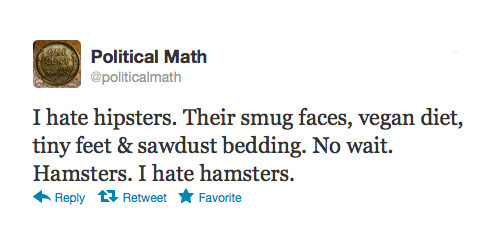
tastefullyoffensive: [@politicalmath]

04 Aug 14:27

the gothest sentence in existence

04 Aug 14:13

Today’s ice cream is a scientific miracle

It’s one of the most complex food products you’ll ever consume: a thermodynamic miracle that contains all three states of matter—solid, liquid, and gas—at the same time. And yet no birthday party, beach trip, or Fourth of July celebration is complete without a scoop or two.

That’s right—in this episode of Gastropod, we serve up a big bowl of delicious ice cream, topped with the hot fudge sauce of history and a sprinkling of science. Grab your spoons and join us as we bust ice-cream origin myths, dig into the science behind brain freeze, and track down a chunk of pricey whale poo in order to recreate the earliest published ice cream recipe.

Contrary to popular myth, ice cream was not brought to Italy from China by Marco Polo, and then introduced to France by Catherine de Medici. In fact, it is a delicious love-child, born of the union between a culinary tradition of custards and burnt creams in medieval Northern Europe, and the fruity, floral, sherbets (sharbat in Persian) that were typically served over ice as a refreshing drink in the Middle East.

For millennia, humankind has gathered and stored natural ice and snow in order to preserve food and chill drinks—snow was sold in the markets of Athens in the fifth century, and wealthy Romans, inspired by Middle Eastern sherbets, recklessly disobeyed the medical advice of their day by mixing ice chips to their wine. But simply adding ice is not enough to freeze sherbet into sorbet: to do that required the creation of a substance that was colder than ice. Scientists are developing an entirely new vocabulary of ice cream textures, from fizzy to stretchy. 

That scientific breakthrough occurred in Naples, when Giambattista della Porta, a Renaissance-era polymath who had already invented a new cryptographic system and perfected the camera obscura, decided to turn his attention to the science of freezing.

By combining snow with saltpeter (potassium nitrate, which was manufactured in bulk as an explosive for military use) in a bucket, he managed to make a mixture that was cold enough that a sealed bottle of water submerged in it would turn to ice. It worked because the saltpeter draws the frozen water in the snow out from its crystalline structure, causing it to melt. The phase change from solid to liquid requires energy in the form of heat, lowering the temperature of the resulting salty slush to about 0ºF—plenty cold enough to freeze water.

Della Porta immediately tried his new technique out on a decanter of wine, which didn’t freeze solid because of ethanol’s low freezing point. Nonetheless, according to food writer Jeri Quinzio, his wine slushies were “a big hit on Italian banquet tables” of the late 1500s and early 1600s. By the 1620s, however, scientists and then cooks had worked out that della Porta’s technique worked even better using salt, rather than saltpeter, and that 0ºF was cold enough to freeze the perfumed sherbets of the Middle East into the first sorbets. Wine slushies were “a big hit on Italian banquet tables” of the late 1500s and early 1600s. 

Before too long, an anonymous confectioner had the bright idea to see whether the same trick worked with a custard mix—and ice cream was born.

The first recorded recipe comes from an unpublished cookbook written by an Englishwoman, Lady Anne Fanshawe, in 1665. Quinzio speculates that Fanshawe first encountered what she called “Icy Cream” in Spain, where her husband served as ambassador. In her recipe, she suggests flavoring it with orange-flower water (in a nod to its Middle Eastern roots), mace (a cousin of nutmeg), or ambergris—a greasy, odorous lump of fossilized squid beaks, mucus, and compacted fecal matter formed in the intestines of some sperm whales that, for thousands of years, has been prized as a perfume, spice, and even medicine. In the episode, historical gastronomist Sarah Lohman scored some wildly expensive and technically illegal ambergris in order to recreate Lady Anne Fanshawe’s ice cream; listen in to hear our verdict on the taste.

Let them eat ice cream

Those early ice creams were a luxury item, found only on the tables of the aristocracy. Ice cream’s journey to becoming America’s favorite dessert involved several more steps, including the repeal of heavy salt taxes, the huge reduction in the price of sugar brought about by the Atlantic slave trade, and even the French Revolution—as their aristocratic masters met the guillotine, fancy confectioners spread out across Europe, bringing the secrets of ice cream-making with them. Many opened cafes and restaurants, making ice cream accessible to the masses.

But the real breakthrough in the democratization of ice cream came thanks to Frederick Tudor, a Bostonian who had the brilliant idea of turning New England’s wealth of natural ice into a business.

Harvesting ice today, using tools developed in Tudor’s era.(Photograph by Nicola Twilley)

His first shipment set sail from Boston harbor in February 1806, bound for Martinique. Amazingly, a fair amount of his ice survived the journey—but upon arrival at the port of St. Pierre, Tudor encountered another challenge. There were no ice houses in Martinique, and the locals had no idea what to do with the lumps of melting ice that this peculiar American was trying to sell them. In desperation, Tudor used a large portion of his cargo to make ice cream—which was a huge hit, earning him the equivalent of $30,000 today.  In desperation, Tudor used a large portion of his melting cargo to make ice cream. 

By the mid-1800s, Tudor had perfected the art of harvesting, storing, and shipping ice, and the resulting economies of scale made it affordable for the majority of Americans. Meanwhile, in Philadelphia, a woman named Nancy Johnson took the next great leap in ice cream technology, by inventing the first hand-cranked ice cream-maker.

Previously, making ice cream was a tedious and fiddly process that involved fishing the pot of custard out of the bucket of freezing brine at regular intervals during the freezing process, in order to pry off the lid and stir it. Johnson’s patented device had a crank on the outside of the barrel, attached to a churn on the inside, with the salty slush enclosed in a slim gap between the two. The ability to churn the ice cream without removing it from the bucket was a significant step forward in both convenience and quality, allowing for a smoother texture, and Johnson’s machine quickly caught on. With the addition of a motor to power the churn and an even colder chemical inside the barrel walls, today’s ice cream-makers still work exactly the same way.

The new Golden Age of ice cream

In the twentieth century, ice cream had its ups, including the invention of the popsicle and the Eskimo Pie, but also its downs, as industrial cost-cutting drove a reduction in the quality of ingredients.

Today, however, ice cream is entering a new golden age. A new generation of artisanal ice cream-makers is experimenting with adventurous and unusual flavor combinations: listeners wrote in to tell us about poutine-flavored ice cream in Portland, chocolate-chile in Boston, and sweet corn with blackberry swirl in Cleveland. Meanwhile, scientists are developing an entirely new vocabulary of ice cream textures, from fizzy to stretchy. Listen to this episode to learn more—and to get to the bottom of the mystery of the first ice cream cone, as well as learn how ice cream escaped the confines of summer to become a year-round treat (hint: it involves breakfast cereal).

This post has been adapted from Gastropod. Listen to this episode of Gastropod with Cynthia and Nicola for more on the history and science of ice cream through the ages.

We welcome your comments at ideas@qz.com.

Bookmarked at brandizzi Delicious' sharing tag and expanded by Delicious sharing tag expander.
04 Aug 14:02

creepingmuse: mewbutts: internetexplorers: when i die i want to be buried wearing a pair of...

creepingmuse:

mewbutts:

internetexplorers:

when i die i want to be buried wearing a pair of sunglasses so that a few decades down the line i will also be a cool skeleton

26,473 notes. 26,473 people identified with this statement. if even half that many people actually did this, can you imagine how confused future archaeologists would be

We believe the dark glasses may be a sign that the deceased wished to hide their guilty eyes from St. Peter, who guarded the gates of heaven. Their true ritualistic use is unknown. 

04 Aug 01:24

Comic for August 01, 2015

04 Aug 01:23

Saturday Morning Breakfast Cereal - Exam Nightmare

by admin@smbc-comics.com
04 Aug 01:21

robbed!

by Lunarbaboon

Thanks for supporting the Kickstarter Jason!

30 Jul 00:18

Great Aspirations

by Grant

This comic appears in the Summer 2015 issue of The Southampton Review. Thanks to editor Lou Ann Walker!
30 Jul 00:00

Today’s Gender of the day is: the white purity of God (source)


Today’s Gender of the day is: the white purity of God

(source)

29 Jul 23:59

Photo


29 Jul 23:42

The Aging Rock

29 Jul 12:14

Tumblr | 27b.png

27b.png