THEY DID IT AGAIN
I just imagine mom coming home and seeing this


Edison Veiga
03 agosto 2015 | 13:22
Nos anos 1970, estudantes criaram nomes de logradouros inusitados de São Paulo

Foto: Dirceu Rodrigues/ Acervo Pessoal
Era um problema bastante peculiar aquele da São Paulo do início dos anos 1970. Com o crescimento desordenado da cidade, sobretudo da periferia, que vinha de décadas anteriores, quase 20 mil das 45 mil ruas estavam sem nome. Eram denominadas por letras ou números, uma confusão. Em 1975, a Prefeitura criou o Projeto Cadastro de Logradouros, com o objetivo de criar um banco de nomes – com 25 mil verbetes – para ser usado então nas ruas.
Três consultores foram designados para elaborar o projeto: o arquiteto e urbanista Benedito Lima de Toledo, o linguista Flávio di Giorgi (1933-2012) e o jornalista Lauro Machado Coelho. “Realizávamos seminários prévios com o levantamento de bibliografia a respeito de algumas características da história de São Paulo”, recorda-se Toledo.
“É possível perceber que há uma divisão em temas, como botânica, literatura, história”, diz o historiador Maurílio Ribeiro, chefe da Seção de Denominação de Logradouros Públicos, do Arquivo Histórico Municipal.

Foto: Dirceu Rodrigues/ Acervo Pessoal
Para fazer a lista, foram recrutados estagiários. Eram estudantes de diversas áreas, sobretudo de Humanas. “Éramos em 30. Quinze de manhã e quinze à tarde”, lembra o jornalista Dirceu Rodrigues, de 62 anos, um dos membros da equipe – atualmente ele é assessor de comunicação da Secretaria de Estado do Meio Ambiente. Eles ocupavam uma sala no último andar de um prédio na Avenida Senador Queirós, no centro.
“Para cada cem nomes que bolássemos, ganhávamos um dia de folga”, recorda-se ele. “Colocamo-nos então a criar todo tipo de nome. Saía de tudo: passarinhos, qual não tem? E lá íamos pesquisar passarinhos. E assim foi. Durante uns dois meses só fazíamos isso, pois quanto mais bolássemos, mais dias ficaríamos de folga.” O estímulo funcionou. “Chegávamos até a ir para a biblioteca atrás de livros que nos inspirassem novos nomes”, diz o publicitário Celso Rodrigues, de 61 anos.
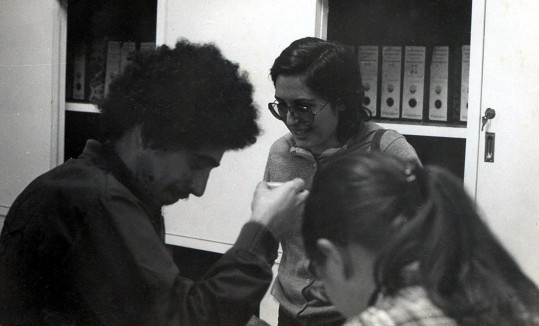
Foto: Dirceu Rodrigues/ Acervo Pessoal
Já se tornou famosa a história de que São Paulo tem uma rua chamada Borboletas Psicodélicas, no Jabaquara. Há também a Charanga do Circo, no Rio Pequeno, a Soneto da Fidelidade, no Jardim São Luís e, na verdade, um sem-número de outros logradouros públicos de alcunha, digamos, quase bizarra. Em comum: todas as vias públicas foram batizadas graças ao Banco de Nomes. “Outra das ruas que saíram de nossas mentes jovens e criativas foi a Rua Estilo Barroco, no Brooklin. Quem morava lá? Jânio Quadros. Só podia”,diz Dirceu.
“Mas a nossa ideia era que os nomes fossem agrupados e cada tema concentrado em um mesmo bairro, o que deixaria cada região bastante interessante”, conta o publicitário José Tadeu da Fonseca, de 64 anos, que na época era estudante de Turismo. “O problema é que a denominação escapou do nosso controle e aí virou circo. Antes tivessem respeitado nosso padrão.”

Foto: Dirceu Rodrigues/ Acervo Pessoal
Fã de música, Tadeu é responsável por boa parte das referências musicais na malha viária – como as citadas Borboletas Psicodélicas, trecho de obra musical, e Charanga do Circo, nome de peça para piano. “Claro que havia uma triagem e, às vezes, algum nome que sugeríamos era vetado”, diz Celso.
Pesquisa de campo. “Nosso trabalho não era apenas criar os nomes. Também pegávamos mapas e íamos a campo conferi-los, porque havia uma discrepância entre os registros oficiais e as localidades de fato”, lembra o jornalista Gerson de Faria, de 62 anos – na época, estudante de Cinema.
“Debruçávamos sobre aquelas cópias imensas de mapas e ficávamos riscando as ruas confirmadas”, diz a produtora cultural Sandra Lacal, de 62 anos, então estudante de Letras. “Geralmente, era muito difícil localizar, na vida real, as ruazinhas dos mapas”, diz Tadeu. “Íamos em uma Kombi cinza da Prefeitura, com o brasão da cidade estampado na porta, sempre em dupla.”
“Foi uma experiência de vida. Esse trabalho proporcionou a nós todos a formação de um grupo muito legal. Somos amigos até hoje”, diz a costureira Vera Moraes, de 62 anos – que, na época, era estudante de Jornalismo.

Foto: Dirceu Rodrigues/ Acervo Pessoal
Adam Victor BrandizziSó falta ter block agora.

Last week we rolled out a new setting that allows users to hide their shared posts from anybody besides approved followers. Setting it up is as easy as opening settings, clicking on the social tab, and clicking that first checkbox.
We’ve had lots of requests for this functionality and are excited to roll it out. Please keep those requests coming and thanks for using The Old Reader!
It was the first week of April, 2015, and New York’s Chelsea Market, typically packed with hordes of noisy tourists, was quiet. It was close to midnight, but five stories above, things were tense. The building is a former cookie factory, and the outlines of ovens still scar the brick walls. In their place, a vast array of screens are now mounted, each tuned to a live video feed. Joe Inzerillo and his team had their eyes glued to the glass, hard at work trying to wrangle the internet into doing something it was not built for.
The launch of HBO Now was just a few days away, but the product wasn’t finished. With both HBO and Apple promoting it heavily, the team had no idea how many people might tune in that first day. "The stakes were high," says Inzerillo. "It was not lost on anybody here how important this was for our company, but also for this industry. Because if HBO Now had come out and face planted, there would be a lot of naysayers who turned around and said, ‘See, this is why the adults need to handle television.’"
"Game of Thrones is our World Cup."
Six months earlier, HBO had announced it was cutting the cord, finally offering consumers access to their programming without signing up for cable or satellite television. But the in-house streaming service it had previously built, HBO Go, had experienced high-profile outages during the season four finale of Game of Thrones and the premiere of True Detective. HBO Now was set to launch alongside the newest season of GoT, and it had to be perfect. "Game of Thrones is our World Cup," says Bernadette Aulestia, who runs HBO’s digital distribution.
And so HBO went to the company that set new records for online streaming during the 2014 World Cup, a strange tech startup hidden inside of a sports league, Major League Baseball Advanced Media, or BAM for short. BAM began as the in-house IT department for the league’s 30 teams, a small handful of employees originally tasked with building websites for teams and clubs. But over the last 15 years, BAM has emerged as the most talented and reliable name in streaming video, a skill set suddenly in very high demand.
BAM competes for clients with streaming tech companies like NeuLion and Imagine Communications, as well as big telecommunication outfits like Verizon. But, says Dan Rayburn, a streaming industry analyst, "there really isn’t anybody who does the true end-to-end solution like MLB does, especially at scale, out in the market."
"Their technical chops are the best, bar none," he adds. "They set the standard."
"The internet, as a technology, was never designed to do something like this."
HBO didn’t give BAM much time. "It was a full-on sprint for the three and half months that we had," says Inzerillo. As the clock ticked down, the crew from BAM ran through countless disaster scenarios. "What people forget is that the internet, as a technology, was never designed to do something like this — deliver flawless video simultaneously to millions of people." Inzerillo explains. "I liken it to trying to live on Mercury. The planet is completely inhospitable. Every day all you’re doing is [fighting] a battle for survival in a place that really does not want you. Streaming video on the internet is sort of like that."
On April 12th, a pair of fire-breathing dragons unleashed their fury across the internet — the Game of Thrones season five premiere, as well as the launch of HBO Now, were flawless. Today, BAM cemented its status as one of the most important players at the intersection of sports, media, and technology, announcing that it will be powering the mobile, web, and television offerings from the National Hockey League. It’s the first time BAM has been fully embraced by another major league.
"When you have HBO going over the top and Bob Iger’s talking about ESPN going over the top, Viacom’s networks are being kicked off cable, we had a real gut check," says John Collins, the NHL’s chief operating officer. "BAM can help us dictate what happens to our content in a time when this media landscape is going through a lot of change."
Like the deal with HBO, BAM will power the league’s streaming services. But the deal goes even further — BAM will be a rights holder of NHL content they can package and sell to an online audience. "It’s groundbreaking to have two leagues doing a rights deal," says Collins. BAM recently forged a similar arrangement with the PGA. The new approach moves BAM beyond just a white label service provider, putting them in position to become an ESPN of the internet age, competing against the likes of Netflix, Hulu, and Amazon with the one thing all those services lack: live sports.
There’s just one catch. To make it all work, BAM has to grow beyond baseball.
The announcement of BAM's partnership with the NHL. From left to right: NHL Chief Operating Officer John Collins, NHL Commissioner Gary Bettman, MLB Commissioner Rob Manfred, MLB President, Business, Bob Bowman.
In late July, I met Bob Bowman, BAM’s CEO, in the company’s office above Chelsea Market. We sat in a small conference room past a wall of trophies and a social media center blasting out baseball highlights across Twitter, Snapchat, Facebook, and YouTube. Bowman has CEO-caliber hair, swept up and to the right, in a dignified grey; he dresses in banker casual — khakis, boat shoes, and collared shirt unbuttoned at the top. On the whiteboard behind him, scrawled in black marker, was a warning: "INVESTORS GET FED! PIGS GET SLAUGHTERED."
Bowman is a man with 31 bosses and a client base that both uses and competes with MLB’s technical abilities. He has to navigate between traditional broadcasters, cable companies, and fans who want their game on any screen with an internet connection. He has perfected the art of partnerships that hinge on give and take. When I ask him the significance of the quote, he says it’s a reminder not to build your own business at the expense of people who pay you.
"INVESTORS GET FED! PIGS GET SLAUGHTERED!"
For years, BAM was a name known only to industry insiders, a sharpshooter organization called in to make sure the big game or series premiere streamed without fail. Over time, it forged long-term deals with clients like WWE and Sony Playstation’s Vue network. Now it’s moving from powering the platform to co-owning the content as well.
But it’s increasingly clear that to really capture the opportunity in front of it, BAM needs to become more independent. BAM doesn’t run like a startup — it doesn’t have equity to share with employees, causing it to lose out on talented engineers and developers that want upside beyond a salary. It also can’t easily raise outside capital to compete against rising competitors like Twitch or Ooyala while it’s still a central part of baseball’s day-to-day operations.
The idea of spinning BAM out to create a new company has been floated for years, but in the last few months it has hardened into a certainty. Today’s announcement that the NHL will invest in this new venture makes it a fact. Lawyers and bankers are finalizing the details, and Bowman is in active discussions with other potential investors, poised to run a new company with a valuation north of $5 billion.
"As everyone thinks about going over the top, about building out a global business, we are looking for a partner to help us double or triple this business," says Bowman. "Things have been going fine, but to not move on this now, we lose the opportunity to get really, really big."
When baseball’s then commissioner, Bud Selig, created BAM back in 2000, he had relatively modest goals in mind. The unit would be in charge of creating websites for each of the teams and consolidating MLB’s digital rights. By pooling resources, he would prevent the bigger teams from outpacing their smaller market rivals. And to keep the division honest and efficient, BAM would operate as its own company. The teams agreed to contribute a combined $120 million to the venture, $1 million each over the first four years, with each taking an equal ownership stake.
It was a painful lesson. From then on, BAM would build its own tech
The group they assembled wasn’t a Silicon Valley dream team, more like tech’s version of Bad News Bears: a minor league beat writer, a former state treasurer, and assorted AV nerds from around the league. This was the height of the dot-com boom, and excitement about the internet was at an all-time high. Right out of the gate, BAM decided to pay a fancy consulting firm a huge chunk of its annual budget to help it create the MLB.com website. Unfortunately the website barely worked. BAM had to scrap it and start from scratch. It was a painful lesson. From then on, BAM would build its own tech.
In 2001, Ichiro Suzuki came over from Japan to play for the Seattle Mariners. Already an icon in his home country, he now had a full-time press corps of several dozen Japanese reporters covering his every move. BAM decided to experiment with streaming live audio of his games, giving his fanatical followers a way to keep up in real time. The company spent several million dollars building and advertising the product. "I don’t think we ever got to 1,000 subscribers," says Bowman with a chuckle.
By the middle of 2002, heavy expenditures on these early projects had left the company strapped for cash. But when it consolidated the league’s digital rights, the MLB also gave BAM control over ticketing. BAM turned those rights into leverage. It made TicketMaster an offer: partner with us or you don’t sell baseball. The company gave BAM a $10 million advance, which it used to cover payroll as it pushed forward with its next big bet: video.
The first video stream "looked more like a flip book."
On August 26th of 2002, BAM produced an online broadcast of a game between the Texas Rangers and New York Yankees. This was well before high-speed internet was ubiquitous and three years before the launch of YouTube. The game streamed to around 30,000 fans at a now glacial 280 kilobits per second. "The technology existed to do it, but of course, that doesn’t mean it was good," says Bowman. The first video stream "looked more like a flip book."
Still, fans responded to the new offering and BAM kept experimenting. Two weeks later, it launched the first paid streaming video product, a pennant race package of nine games with postseason implications. Later that fall, it sold a $19.95 postseason package. MLB.tv launched alongside spring training in 2003, offering a full season package for $79.95. In the first year, over 100,000 customers signed up. The new revenue stabilized BAM’s finances; it only ended up taking $77 million of funding from the team owners before it began paying them a dividend out of its profits. And the unique challenge of live streaming baseball started to shape BAM into the industry powerhouse it is today.
Watching sports online has always had one major complication: regional blackouts prevent you from streaming a game in the same territory as a television broadcaster who owns local rights. That meant BAM had to figure out where a customer was and whether or not they could legally watch the stream. In fact, BAM’s very first post-season package wasn’t even broadcast live in the United States or Japan. Fox owned the national broadcast rights to the pennant race, so BAM’s first big broadcast took place in Europe. From the beginning, BAM had to perfect live video streaming on a global scale.
"Before anyone else was even thinking about these issues, BAM figured out compression, geofencing, and multi-application delivery at scale," says Rick Heitzman, a venture capitalist who has worked with BAM over the years. "Like many pioneers, they took their fair share of arrows, but have emerged as the leading digital platform." Bowman puts it a little differently. "We made all the same mistakes everyone else makes," he says. "We just had the advantage of making them first."
"Before anyone else was even thinking about these issues, BAM figured out compression, geofencing, and multi-application delivery at scale."
Take syncing between devices. This is a great feature to have with a service like HBO Now, but with a baseball game, it’s absolutely critical. The last thing you want is a fan watching on their PC, pausing to head to the bathroom, pulling the game up on a phone, and suddenly it’s an inning later and the score has changed. BAM learned to do this with each game, and even with the stats a fan can pull up alongside the video for a deeper dive.
Inzerillo joined BAM in 2003 and began work on what would become MLB.tv. He had started his career as a cameraman with the White Sox, moved on to direct video operations for the league, and then ran the tech department at Chicago’s newly created United Center. In 2000, he left baseball to work at a startup that was developing digital television. When the dot-com boom went bust, he fell back in with his old company, and brought along a wealth of knowledge about the intersection of TV and the internet.
"The thing about broadcast television is, today people probably think of it as stodgy old engineers with big beer bellies and a pocket protector," says Inzerillo. "But the truth is that there are a lot of things about the way they do it, the technology and the philosophy, that make it incredibly stable and scalable." Inzerillo set out to fuse those two worlds, creating a platform with the agility of a web startup and the reliability of a broadcast network.
BAM’s early entrance to the world of streaming video gave it a big advantage in developing technology, but it also gave the group a head start at the process of deploying infrastructure. Great web streaming requires "points of presence" spread across the globe near population centers. For 15 years, BAM has been building out data centers and high-speed fiber connections, forging intimate relationships with the companies that control the guts of the internet.
That head start gives BAM a massive advantage in both speed and cost. "We looked at what it would take to build in-house, and compared that to what BAM could deliver," said George Barrios, WWE's chief strategy and financial officer. "In the end it made a lot more sense to let them bring their technology expertise to bear, and focus on what we do best, which is creating great content and connecting with wrestling fans."
When HBO originally set out to create HBO Now, the project was reportedly expected to take three years and cost $900 million. BAM turned the same project around in three and half months for less than $50 million. "We see a lot of things that are repeatable," says Kenny Gersh, the head of business development, who helped BAM close deals with ESPN, Sony, and the NHL. "We applied the learnings from MLB.tv to WWE, and we applied the learnings from WWE to HBO."
By the time the iPhone rolled out in 2007, BAM was ready
Just as it was early to video, BAM made a smart bet on mobile starting in 2005. That year, it built the MLB.com mobile site, which served up news and scores, and negotiated agreements with the four major US carriers to prominently feature a link to the site. A year later it launched its first mobile app, "MLB.com Gameday," across Verizon, AT&T, and Sprint. The application included a scoreboard, Gameday pitch by pitch, and Live Gameday Audio — advanced features considering smartphone capabilities at the time.
By the time the iPhone rolled out in 2007, BAM was ready. MLB was onstage for the unveiling of the App Store, the beginning of a deep relationship with Apple that would see it grace the stage at the launch of the iPad and Apple Watch.
And it’s not just Apple that trusts BAM. Behind a locked door in its New York City headquarters, the company has a gadget geek’s fantasy trove: the latest smartphones, tablets, and consoles, all being tested months before they are publicly released. "On the iPhone, Roku, Playstation 3, Xbox 360, Apple TV, our infrastructure was always the first live streaming technology on those devices," says Matthew Gould, BAM’s head of communications. "Now people come to us to ensure that when their hardware is released, there won’t be any issues."
It’s easy to get lost wandering through BAM’s headquarters. Hallways loop back on themselves and there are half floors wedged in between whole ones. Bobble heads and figurines line the partitions between desks; entire walls are crammed floor to ceiling with monitors where color codes flash onscreen: green for live, yellow for standby, red as a warning about a problem. Young men and women stand, chatting, never turning their gaze from the live feeds, a position known around the office as "eye to the glass."
BAM has become a weird tech octopus
As Gould leads me on a tour, I realize what a weird tech octopus BAM has become; a unique mix of startup and IT department. The core competency and biggest revenue stream is technology for streaming living video. But it still builds and maintains websites for most MLB teams, created and manages the system that sells the league’s tickets, and constructs its mobile apps and games. Hell, BAM even powers instant replay for the league. On game day, an umpire comes and sits in a windowless room above Chelsea Market to review footage, calling whether a runner was safe at the plate or not.
The latest expression of this boundless initiative is Statcast, a big data approach to sports that only a major league nerd could love. High-speed cameras and radar installed in every stadium capture the game in three dimensions and allow for real-time tracking and tabulation of each motion a player makes on the field. Fans watching an amazing replay of a diving catch can learn exactly how fast that outfielder’s first step was, if he broke in the right direction, and how that compares to his historical average.
A promotional video explaining the technology behind MLB’s Statcast system
"My dad and I would go to Yankees games, and there would always be these arguments around Bernie Williams, how good an outfielder he was," explains Gregg Klayman, who runs product development and content strategy. "My dad, right or wrong, he would always say, Bernie breaks the wrong way, his first step is really slow, but he makes all these great catches, diving to the turf or bouncing off the wall. If he made the right step, it would have been easy."
"Was he a good player or just a very gifted athlete? ...Now I could know for sure."
Back then it was one of those friendly fan debates that would never get resolved. Today Klayman could simply call up the play on his smartphone and ask Statcast for the answer. "Was he a good player or just a very gifted athlete? Back then we had our opinions. Now I could know for sure."
Not every attempt at a new tech project is a success. When 2K, the publisher of licensed baseball games on the Xbox, decided against publishing a new title for 2015, BAM stepped in and created an entire console game from scratch in a year and a half. The result earned withering reviews, perhaps no surprise given that a team of a few dozen was tasked with a job usually done by hundreds of more experienced professionals over a much longer period of time.
If BAM can pull off its plan to spin out as a stand-alone tech company, it could step away from such projects and focus on its core capabilities. "All the things that are related to baseball that aren’t streaming would stay behind at MLB," says Bowman. Instead of the utility infielder juggling a dozen different jobs, BAM Tech would focus solely on the streaming business, trying to stake a major claim in the rapidly shifting media market.
A few weeks ago, Bowman sat down in a small studio at BAM’s headquarters to record a conversation with Rich Greenfield, an investment analyst and consigliere who works at the collision of media, technology, and television. Greenfield had recently helped guide the partnership between Vice and AMC, and was lobbing Bowman questions as an audience of bankers, venture capitalists, and potential investors tuned in.
BAM has been flirting with the idea of a spinoff since 2005, when it made the rounds with investors and bankers. But its revenue at the time was under $250 million, and streaming video was still far from mainstream. A decade later, BAM is on pace to earn $900 million, and says it’s been turning a steady profit. Add in a roster of high-profile clients and a massive media shift from pay TV to online streaming, and suddenly it seems silly not to look beyond baseball.
Suddenly it seems silly not to look beyond baseball
The NHL is the first public investor in BAM tech, but it's also talking with partners like HBO’s parent, Time Warner, and ESPN’s overlord, Disney, who could help sharpen its skills at producing and distributing original content. "While sports is often a leader in new forms of distribution, from VHS to DVD to streaming, the long tail here is entertainment," Bowman says. "And not just the standard formats. We want to be flexible enough to create new content that is specifically over the top."
Bowman has some wild ideas for how BAM’s expertise could be tapped to create new genres. "Every night in clubs around the country, people are telling hundreds of jokes. Some of those are duds, but some are really funny." The BAM team already has experience ingesting petabytes of live footage from dozens of games and quickly cutting together highlights. "What if we could do that for comedy?"
BAM has already taken a step toward creating its own content by buying production and distribution rights for digital content from the PGA and NHL. Just as cable and ESPN provided a home for sporting events that didn’t match the business model of broadcast television, BAM is bundling sports to sell a la carte on the internet, creating a new opportunity, and perhaps a way forward as pay TV slowly dwindles. "The media space has always been built on over time, the platforms taking more control of content. It was true on cable with ESPN, and in streaming with Netflix. So it’s natural," says Greenfield.
BAM is bundling sports to sell a la carte on the internet, creating a new opportunity
The idea of helping to produce and perhaps even create new content is intriguing, but also risky. BAM would find itself competing directly with its own clients, like ESPN and HBO. A big part of the company’s success was its ability to work with companies and leagues traditionally viewed as competitors. "Media companies are not good at tech and really struggle with large scale," says Greenfield. "They don’t trust companies like Google or Amazon, who want to displace them. BAM is seen as friendly." If it spins out and starts making its own shows, that dynamic may change. And while it’s a world class technology company, so far it has little track record in creating original content outside baseball.
As consumers cut the cord on cable, BAM and its clientele are navigating treacherous waters. "It’s more complex than ever for media companies," says Bowman. "You need to honor your existing partners, your existing contracts, while also figuring out new ways to reach fans who live beyond the traditional formats." So far BAM has managed to bridge the gap between television and the internet. And Bowman is bullish on the future. "The fact that you can now deliver games on demand 24/7 to 4 billion devices around the globe, you couldn’t write heaven for a sports fan better than that."


It’s Happy Bear, bringer of happiness.
Adam Victor BrandizziFor all injustices plaguing the world, this is an unavoidable point as well.
President Obama has warned that ATMs and airport check-in kiosks are contributing to high unemployment. Sen. Marco Rubio said that the central challenge of our times is "to ensure that the rise of the machines is not the fall of the worker." A cover story in the Atlantic asked us to ponder the problems of a world without work. And in the New York Times, Barbara Ehrenrich warns that "the job-eating maw of technology now threatens even the nimblest and most expensively educated."
The good news is that these concerns are wrong. None of the recent problems in the American economy are due to robots — or, to be more specific about it, due to an accelerating pace of automation. Moreover, even if the pace of automation does speed up in the future, there's no real reason to believe that it will be a problem.
The bad news is that these concerns are wrong. Rather than an accelerating pace of automation, we've actually been living through a slowdown in the pace of productivity growth. And that slowdown is a huge problem. Unless it reverses, we'll be waking up soon to find ourselves in a depressing world of longer working years, unmanageable health-care needs, higher taxes, and a public sector starved of needed infrastructure resources.
In other words, don't worry that the robots will take your job. Be terrified that they won't.
When people hear about robots, they think of science fiction — the Johnny Cab taxi from Total Recall, chrome maid Rosie from The Jetsons, or the thinking, talking computer that powers the starship Enterprise. All this and more may come to pass some day (who knows?) but the reality of day-to-day change is more mundane.
Machines have been replacing humans for hundreds of years. And when it happens to you, it stinks. It stank for small business owners whose photo development shops were driven out of business by digital cameras. It stank for analog graphic designers like my mother who were disemployed by desktop publishing software in the late 1980s. It stank for stevedores who were put out of work by container ships. It stank for weavers put out of work by the spinning jenny. It stank for railroad engineers put out of work by the automobile.
But for society as a whole, these were huge leaps forward. Specific individuals did in fact lose jobs and oftentimes ended up with lower wages. But on average, job growth continued and living standards rose.
The techno-pessimists often admit this. The problem, they say, is if technology reduces the need for human labor really, really fast, then society won't have time to adjust, and there will be broad unemployment.
Well, again, we can look to the past. Despite the cliché that technology today is progressing faster than ever, the per-worker output of the American economy actually increased at its fastest-ever rate in the quarter century between 1948 and 1973.
This is the period in which the spread of refrigerators put milkmen out of work, while the initial adoption of machines to wash clothing and dishes rendered full-time household servants superfluous for the middle class. This was a time when television displaced live theater, and when truck-based delivery upended product distribution networks and rendered many neighborhood retailers obsolete. New interstates bypassed old towns and rail depots. Automatic telephone switches put operators out of work. New fertilizer products derived from wartime research increased per-acre crop yields and reduced the number of laborers needed.
So what happened?
Well, people worked less. In 1950 (the first year for which we have records), the average employed person in the United States worked about 1,909 hours. By 1973, that had fallen to 1,797 hours. That's a decline of about 6 percent. It's the equivalent of going from having two weeks of paid vacation per year to having five weeks. Or of going from working 9 to 5 every day to working 9:30 to 5 every day.
But there was no overall collapse in employment. The total number of employed people grew by more than 50 percent during this period, keeping up with population growth. Wages rose steadily at a pace of about 2.23 percentage points faster than inflation in the average year.
And the growth was widely shared. There were rich people and poor people, of course, but the share of overall national income accruing to the very wealthy was modest and generally falling. The fast pace of automation did not mean the only people who could get ahead were those clever enough to invent the new machines or lucky enough to earn them. Individual people lost out at particular moments in time, but on average, the tide rose rapidly and lifted the vast majority of the boats.
Today it appears to most people that we are living in a period of immense technological change. A rather small device that I carry in my pocket replaces the telephone that used to sit in my bedroom, the Walkman in my pocket, the TI-85 calculator in my backpack, every single book I've ever owned, the Sega Genesis on the shelf, the alarm clock on my bedside table, and even, to some extent, my television. And yet it doesn't only replicate the functions of those devices. In most cases it far surpasses them.
But despite the techno-hype and the national obsession with disruption, the pace of productivity growth has slowed down. The American economy has grown, but largely by adding workers rather than by workers equipping themselves with powerful new machines to multiply their capabilities. And the number of hours worked per worker has stayed relatively flat, even while other countries have continued to enhance their leisure.
If robots were taking our jobs, the productivity of the workers who still have jobs — the total amount of work that gets done divided by the total number of people who are employed — would be going up rapidly. But it's not. It is rising, but it's rising slower than it did in the past.
And the slowing rate of productivity growth is an important source of the wage slowdown that people have been worrying about.
The 2015 Economic Report of the President calculated that if productivity growth had continued at its 1948–1973 pace for the past 40 years, the average household's income would be $30,000 higher today. By contrast, had inequality stayed at its 1973 level for the same period, Obama's Council of Economic Advisers calculates that the average household's income would be only $9,000 higher.
The productivity issue is bigger than inequality, in other words. And yet it's much less discussed.
In fact, it's almost anti-discussed due to the obsession in media and political circles with the alleged rise of the robots. We're so busy worrying about how to counteract an imaginary, robot-driven productivity surge that we're barely paying attention to the real story of the productivity slowdown.
But what about the bounty of digital technology that is in evidence all around us? Almost 30 years ago, the great economist Robert Solow quipped, "You can see the computer age everywhere but in the productivity statistics."
An answer to the riddle might be that digital technology has transformed a handful of industries in the media/entertainment space that occupy a mindshare that's out of proportion to their overall economic importance. The robots aren't taking our jobs; they're taking our leisure.
Data from the American Time Use Survey, for example, suggests that on average Americans spend about 23 percent of their waking hours watching television, reading, or gaming. With Netflix, HDTV, Kindles, iPads, and all the rest, these are certainly activities that look drastically different in 2015 than they did in 1995 and can easily create the impression that life has been revolutionized by digital technology.
What's more, the media industry itself has been turned upside down by the internet and has spent the last decade telling anyone who will listen how complete and wrenching the transformation has been. That further amplifies a narrative about rapid change.
But clearly the media and entertainment industries don't comprise anything close to 23 percent of the workforce or the total economic output of the United States. Most other job categories have been impacted by digital technology, but only in relatively superficial ways. Something like 9 percent of all private sector jobs are in the food service industry. These days people are perhaps more likely to book a reservation or order a takeout meal with an app rather than a phone call, but the core work of serving and preparing food has seen very little progress.
At the higher end of the salary spectrum, we still don't have robot doctors who can treat patients in lieu of costly and inconvenient human ones. Indeed, we can't even get medical records digitized properly.
As it becomes clearer and clearer over time that smartphones and the internet simply aren't economic game changers on the same scale as air conditioning, jet planes, container ships, and televisions, it's become increasingly fashionable in Silicon Valley to simply retreat into denial.
"There is a lack of appreciation for what’s happening in Silicon Valley," Google's chief economist, Hal Varian, told the Wall Street Journal, "because we don’t have a good way to measure it."
The article states that Varian believes a "problem with the government’s productivity measure" is that "it is based on gross domestic product, the tally of goods and services produced by the U.S. economy."
But this is not a measurement error. This is the definition of economic productivity. When people can create more goods and services for sale in the market economy, their productivity goes up. When they cannot, it does not. It is obviously true that there are things in life that matter that are not monetized in this way. I, personally, derive enormous pleasure from daily jokes on Twitter. That said, Silicon Valley hardly invented the idea that the best things in life are free. The joy that my infant son's smile brings to my face isn't in the GDP numbers either. Nor is the sadness I feel when reflecting on the fact that my late mother didn't live to meet him.
But if you want to put a roof over your baby's head, to keep him in diapers and formula, and to buy some plane tickets so he can go with you to visit his grandparents, then you are going to need some money. And money derives from monetized economic activity.
The productivity slowdown began decades ago and initially corresponded with bad news from abroad about oil prices. It persisted through a sharp recession that broke the back of inflation, and continued through the Reagan recovery. In the mid- to late 1990s things briefly turned around, and it momentarily looked like the Solow Paradox was gone. Walmart and other big-box stores learned to use computers to better control their inventories and greatly improved the productivity of the retail sector.
As is typical with periods of rapid technological change, this led to some displacement and suffering and heartburn. But even though the late '90s were a terrible time to be the owner of a mom-and-pop hardware store, on average it was a period of low unemployment and rising wages.
But as Paul Krugman has written, "We did not, it turned out, get a sustained return to rapid economic progress. Instead, it was more of a one-time spurt, which sputtered out around a decade ago."
In the most recent years, it's actually gotten worse than ever.
This extreme slowdown has coincided with a period of weak demand, high unemployment, and agonizingly slow wage growth. That all adds up to an environment in which managers have little budget to invest in new equipment due to weak sales, and little incentive to give raises due to poor worker bargaining power.
Rather than hot business trends relating to new equipment that allows workers to deliver more value than ever before, one of the signal trends of our time has been a proliferation of online services that reduce the friction associated with having people get in their car and bring you things. Washio, for example, will send someone to my house to pick up my dry cleaning. Seamless will ping a restaurant and tell it to deliver takeout to my door. Postmates will send someone to get a takeout dinner from a restaurant that doesn't offer delivery. Homejoy will send someone to clean my house. These startups are okay business ideas, but they are not doing anything to advance the efficiency with which clothing is laundered, meals are cooked, or houses are cleaned.
The main industry in which productivity is accelerating rapidly is the information technology industry itself. We are getting better and better at making smartphones, apps, cloud services, and all the rest. Those things just aren't driving change in the larger economy. Indeed, the way modern digital technology blurs the lines between entertainment devices and productivity devices in some ways works to undermine the productivity of the modern office worker. Email means you can stay in touch with remote colleagues, but it also means you can send a note to your dad during business hours. It's clear from the analytics at Vox.com and every other website that America's white-collar workforce is doing a lot of Facebook updates, tweeting, and casual web browsing during business hours. It's surely not a coincidence that 2015's hottest office productivity tool is a group chat service called Slack.
This may make life more pleasant in some respects (and annoying in others, as family dinners are now interrupted by random work emails), but it adds up to a remarkably modest impact on the overall health of the economy.
Of course, all this might change. The power of Moore's Law — which states that the power of computer chips doubles roughly every two years — is such that the next five years' worth of digital progress will involve bigger leaps in raw processor power than the previous five years. It's at least possible that we really will have a massive leap forward in productivity someday soon that starts substantially reducing the amount of human labor needed to drive the economy forward.
But robots are never going to take all the jobs. The problem with trying to envision "a world without work" is that it asks us to envision an unrealistically large change.
The more likely outcome is a world with less work. And that's a world we should welcome rather than fear. It's a world in which we can make some policy decisions we want to make, rather than decisions we really don't want to make.
The "normal" Social Security retirement age in the United States used to be 65. Currently it is moving up to 67. Many prominent politicians, from Jeb Bush and Christ Christie to the bipartisan Simpson-Bowles commission on deficit reduction, say that to keep the system solvent we need to move it up even further, to 70. In a world of more productivity and less work, instead of doing that, we might move it back down to 65. Or maybe even cut it back to 62.
Some more ideas:
These are just illustrative ideas, of course, not a comprehensive program. But they go to show that given decent public policy, an automation-driven productivity surge is nothing to be afraid of. For any given item on that list, the natural objection will be that "we can't afford it." If productivity accelerated, we could easily afford it — and more — reducing the total amount of human toil while still maintaining the basic life-cycle concept of a career.
The real threat is precisely the opposite — that the per-hour productivity of the American worker won't increase at a more rapid rate.
If you've ever heard a dreary lecture about the "entitlement crisis," that is the world they are talking about. The American population is aging and is projected to continue aging. In other words, the ratio of working-age people to retired people is falling. That means that we will have to either reduce the living standards of the elderly by cutting their benefits, or reduce the living standards of the non-elderly by raising their taxes or cutting spending on programs they depend on.
By the same token, the proposition that "health-care costs" will bury the country is essentially the proposition that technology won't dramatically increase the productivity of the health-care sector. That means, again, some combination of reduced benefits for the sick and higher premiums and taxes for the healthy.
Most likely, we'll keep doing a little bit of both.
Unless, that is, some robots come along to help us out.
Adam Victor BrandizziIt kind of scares me but sounds like a good plan.
 Though it's called the "world wide web," the US Commerce Department has held the keys to the internet since its inception in the '90s. Last year, it agreed to hand them over to worldwide bodies and asked ICANN, the group that manages internet addre...
Adam Victor BrandizziLiterary analysis and criticism, statistics and r programming: what a wonderful world!
Semiotics, Bauhaus design, New Criticism, poststructuralism: all have been put to corporate and government use. What's next? The digital humanities
from bostonreview.net

Cover detail from Electronic Computers, by S. H. Holligdale and G. C. Tootill (1965). Image: Penguin Press.
Distant Reading
Franco Moretti
Verso, $29.95 (paper)
The Bourgeois: Between History and Literature
Franco Moretti
Verso, $19.95 (paper)
Macroanalysis: Digital Methods and Literary History
Matthew Jockers
University of Illinois Press, $30 (paper)
Text Analysis with R for Students of Literature
Matthew Jockers
Springer, $49.99 (cloth)
For some years, humanities scholars have sought to integrate computing technology into their research. These efforts—the “digital humanities”—have inspired public debate well out of proportion to the number of researchers involved or the scope of their findings. P.T. Barnums and Chicken Littles have proclaimed that computation will mark the end of humanistic inquiry. Actual literary research in this vein suggests otherwise.
Much of this work is driven by tools rather than by questions; when scholars have the means to manipulate large bodies of text, they will fiddle with the data and see what happens. To the extent that digital projects do have clear goals, they tend to yield recognizably humanist products, such as a new edition of a book, a map of the places discussed in a narrative, or attribution of authorship to a formerly anonymous text.
The literary scholar Franco Moretti and his colleagues, most notably Matthew Jockers, are exceptions: their project of “distant reading,” developed steadily over more than a decade, has an ambitious, nontraditional goal. In its strongest formulation, it seeks to explain long-term patterns of literary stability and change through the quantitative study of all surviving literary texts. Forms of change include large developments, such as the rise and fall of novel genres, already recognized by critics, but also many small shifts, such as changes in sentence structure, the gradual emergence of themes, or the increased use of locative prepositions, which are readily detected with statistics but mostly unnoticeable to a human reader. Jockers’s nascent work on novel plots, which suggests that nearly all novels conform to a half dozen basic structures, derives from many small measurements concerning the emotional sentiment of individual sentences.
This is an unmistakably scientific aspiration. Unfortunately, few scientists, or social scientists, have taken notice of this body of work, while humanists have responded to it in a remarkably partisan fashion. The main difficulty is that two distinct issues have been blurred. The first is legitimate disagreement about the goals of humanistic inquiry. But both critics and proponents tend to jump straight to a second, larger conflict about the transformation of the university and the proper place of the humanities in education and intellectual life. These are important value questions; however, the work of these digital humanists should not be expected to answer them.
The results of this earnest scientific project are mixed. Moretti and Jockers are obviously enthusiastic, and in many cases their findings are interesting and surprising. (As a frequent reader of academic social science, I wish more scholars could make statistics seem so exciting.) But there are serious conceptual difficulties. While this work presents extensive new descriptions of literary change, it has not persuasively explained the causes of that change. The evidence available—published texts—is not sufficient to explain it. The statistics used in these works are mainly descriptive, and the faith placed in these descriptions is limited. A table or graph is treated as an object to be interpreted. In this and many other respects, distant reading remains a recognizably humanistic practice.
• • •
The premise of distant reading is simple: most literary scholars know only a couple of dozen works well, and are familiar with perhaps a couple hundred in total. But extant works from a given period in a given language—say, nineteenth-century English literature—may number in the tens of thousands. This corpus may differ markedly from the works that have held the attention of scholars; indeed, because critical attention is directed toward books according to their perceived significance, the difference between an excellent book and a mediocre book may be considerable. If the goal is to track change over time or discover plot patterns, the common run of books may reveal what excellent ones cannot. So, too, may attention to textual units smaller than the whole book. A scholar cannot read thousands of books, or millions of sentences, but can describe some of their properties with statistics. Thinking about books in this way can prompt scholars to approach texts differently; some of Moretti’s most interesting findings do not require a computer at all.
In the digital humanities, the data itself is an object to be 'read' as though it were a text.
In many cases computational techniques confirm what more traditional scholarship has already concluded. In the paper “Style, Inc.,” Moretti uses a catalog of 7,000 books to show that eighteenth-century novels had cumbersome titles. Jockers, equipped with the full text of thousands of novels, finds that Moby-Dick is mainly about life on a whale ship. In fact, a fair part of Jockers’s Macroanalysis seeks to prove that computational techniques can reproduce the judgments made by a trained reader. One chapter, for instance, establishes that his techniques can accurately identify the genres to which chunks of novels belong. Such seemingly trivial findings have led critics such as Adam Kirsch to scoff, but Jockers modestly suggests that replication of known findings is a scientific virtue. Moreover, if computational methods could not confirm what we already know to be true, there would be little reason to entertain more adventurous claims.
Moretti and Jockers do produce new claims. “The Slaughterhouse of Literature,” an essay that marks Moretti’s “new beginning” as an empirical scholar, sets out to explain why Arthur Conan Doyle survived as the preeminent mystery writer from a period when the genre was especially popular. In a memorable bit of investigation, Moretti groups mystery stories according to their use of clues. The winning formula, he finds, provides clues that are visible and comprehensible to the reader and necessary to the resolution of the mystery. (Many other mystery writers were surprisingly inept in their use of clues.) In “Network Theory, Plot Analysis,” Moretti draws a network of the social connections between all the characters in Hamlet. The complex, bloody conclusion of the play, he finds, arises from a simple network structure: the characters who die are those who have interacted with both Hamlet and Claudius. Jockers also has plenty to contribute. In his own specialty, Irish literature, he shows that many well-established critical beliefs about Irish-American literature—and the Irish experience in the United States—derive from scholars’ focus on texts that are mostly about life in eastern cities. The picture changes in light of a large but mostly ignored set of works about the Irish experience in the American West.
As Macroanalysis proceeds, the complexity of Jockers’s statistical techniques and the scope of their application steadily increase. In his final empirical chapter, “Influence,” he gives a sense of what these tools can do in concert. For each of 3,346 novels from the eighteenth and nineteenth centuries, he computes the values of 578 variables, including the frequencies of thematically related words (“topics”) and stylistic features such as sentence length, kinds of grammatical clauses, and use of punctuation. The differences between books along each of these dimensions can be understood as distance in an abstract space. On the “Native Americans” topic, for example, James Fenimore Cooper’s The Deerslayer would score high, while Jane Austen’s Mansfield Park would score low, making them distant along this dimension. Distance across all 578 dimensions yields a complex measure of the similarity between books. Jockers then organizes the books by their date of publication, producing an approximation of literary influence: an influential work is close to another one in the abstract space and preceded it in time.
Some of the results are unsurprising. Authors of the same gender tend to write similar works, and novels written at about the same time tend to be similar. Works a human reader would find similar do indeed cluster together: nearMoby-Dick are several other works by Melville, along with novels from James Fenimore Cooper and Edgar Allan Poe’s The Narrative of Arthur
Pym of Nantucket. Other results are provocative. The most influential works according to this measure—Laurence Sterne’s Tristram Shandy, George Gissing’s The Whirlpool, and Benjamin Disraeli’s Venetia—are not ones scholars have deemed decisive in the development of the English novel. Jockers acknowledges this puzzling result. I suggest a partial explanation: the analysis here cannot address the possibility that many authors might independently adopt a new set of themes. The first to do so will seem influential by Jockers’s measures but may only be prescient in addressing a topic that will later become important or quick to write about a historical event, such as the French Revolution, that has recently occurred.
• • •
So Moretti and Jockers can reproduce some basic critical findings and yield new results that appear plausible and meaningful. But much is missing.
For one thing, there are simply not enough trained scholars to pursue a more systematic investigation using digital techniques. For this reason Jockers’s textbook, Text Analysis with R for Students of Literature, may prove to be of more enduring importance than Macroanalysis. Given the controversy about computation in the humanities, a successful programming textbook cannot simply teach programming; Text Analysis, though modest in scope, displays a sound psychological understanding. Jockers appreciates that scholars who wish to dabble with programming may not want to sign up for a revolution, so he stresses the many ways that computation complements traditional humanistic inquiry and assures his audience that computers will never supplant expert readers. Furthermore, Jockers understands how daunting it can be to learn computer programming and statistics and designs the book accordingly. Readers with no programming experience will be able to follow along. They will also receive near-instant gratification: starting with the second chapter, the exercises help students produce meaningful results about real works of literature.
Any introductory work must scant something, especially if it is addressed to learners who have doubts about the value of the enterprise. In this case, the main omission is a discussion of the statistical methods being employed. Though Jockers possesses a good grasp of the relevant statistics, the omission here is consistent with broader weaknesses in computational studies of literature. Works from Moretti and others associated with Stanford’s Literary Lab place surprisingly little faith in statistics, a point that becomes particularly clear when reading the lab’s freely accessible pamphlet series. The common approach might be called “describe and interpret.” That is, the data will be used to produce a descriptive summary in the form of a graph or figure, which is then treated as an object to be “read” by the investigator as though it were a text. (Indeed, in a 2011 issue of Victorian Studies, members of the Literary Lab talk about “learning to read” statistical data in a manner analogous to the interpretation of literary text.) These descriptive representations are often informative, but critical intuitions, rather than inferential statistical methods, are used to draw the conclusions.
When Moretti and colleagues do pay attention to the quantitative measures produced by their studies, they often take note of the wrong one: statistical significance. Roughly speaking, significance refers to a low probability that an observed pattern in the data would arise by chance. However, in large data sets, many observed patterns will be significant according to standard measures. As a result, patterns may be statistically significant but substantively trivial: the magnitude of the differences (the “effect size”) may be extremely small, or it could disappear entirely if the researcher tweaks the model.
In many disciplines there is growing criticism of research that concerns itself with significance measures at the expense of the concrete meaning of the results or the coherence of the study design. The editors of the Journal of Graduate Medical Education, addressing medical researchers who use statistics of this kind, put it bluntly: “the effect size is the main finding of a quantitative study.” The journal Basic and Applied Social Psychology has banned significance testing entirely, on the grounds that it has contributed to a ruinously high level of unreproducible studies in social psychology. Because numerical results, including effect sizes, are usually not reported in computational literary research, it is difficult to judge the soundness of many of the findings.
The point is that scholars who are serious about explaining—rather than merely describing—patterns of literary development still have to resolve a number of methodological questions: How should certain techniques be employed, and what do the results mean? What constitutes an important, as opposed to a statistically significant, finding? How can we make causal inferences about influence or the emergence of a new genre? These are questions that do not, as yet, have definite answers, and there is active debate in the social sciences about how computational techniques should be used to study cultural products such as literary texts. Both sides would benefit if literary scholars such as Moretti were part of the social scientific conversation.
At the same time, these are questions that cannot be resolved merely by contemplating the nature of causal inference. The issue would become much more tractable if the computational study of literature was working from a theory. By this I mean, broadly, a provisional general explanation for how and why literature develops, along with some specific claims or predictions that could be explored using data.
Moretti and Jockers are hindered because they make halfhearted use of two kinds of explanation: evolution and social change. The digital humanities have produced crudely evolutionist theories such as literary Darwinism, which views literary creation as an evolved human behavior. Moretti and Jockers are much more thoughtful. They use concepts from biological evolution to describe changes in literary texts and genres, not the humans who create them. Moretti writes an entire chapter, “Evolution, World-Systems, Weltliteratur,” that likens stylistic changes to the formation of biological species. Jockers, after a page-long caveat questioning evolutionary analogies, says he “cannot resist the great temptation to liken these data to the genome.” He often says that literature “evolves.” This is the signal weakness of evolutionary explanations: books do not self-reproduce as biological organisms do; they are artifacts of deliberate human activity. Evolutionary reasoning sometimes produces striking descriptions, as in Moretti’s discussion of clues. However, to the extent that this view of literature excludes human actors, there is a great deal that it cannot explain. Texts are not self-caused. They are written, read, and interpreted by humans, and a persuasive explanation of historical change in literature will require some account of the social side of literature, including matters such as practices of authorship, institutions of publishing, and the experience of reading. In short, distant reading wants for a theory.
A more promising approach examines literary development in light of changes in the societies that produce the literature. Explanations of this kind have the virtue of connecting literature to the agents that produce and consume it. Moretti and Jockers both show, for example, that the lifespan of novel genres is broadly in line with generational boundaries. Certain genres that rise and fall more quickly, such as the Jacobin and Anti-Jacobin novel, correspond to major historical events. It seems plausible that demographic change could account for many patterns of literary development, at least at the large scale. Jockers, in his chapters “Style” and “Nationality,” suggests that genre and language are, in some ways, stronger than authors, apt to constrain what they write. This, he offers, is the reason why statistical regularities exist in the first place.
Of course, these larger features of social structure say little about the meaning literature holds for the people who read and write it. It is on this point that literary scholars have a decided advantage over social scientists. Large social theories about culture are at their weakest when addressing the content of literary works or the subjective experience of composition and reading. Many computational techniques are avowedly indifferent to meaning or experience: if a model produces a serviceable prediction, it scarcely matters why.
Critics have much to offer on this point. Moretti suggests that his The Bourgeois, a book published more or less simultaneously with Distant Reading, represents a very different, more traditional project. I respectfully disagree. The Bourgeois is an interpretive study of nineteenth-century European literature that pays particular attention to keywords, sentiments, and innovations in prose. It is nonetheless an attempt to explain the emergence of the modern middle classes and their effect on literature. Though The Bourgeois uses a different kind of evidence, its spirit is not so different from that of Distant Reading. This kind of expert knowledge would undoubtedly play a key role in producing a strong explanation of how literature has changed over time, especially when broad trends must be connected to particular groups, authors, or works.
• • •
In some ways, my criticism of the program of distant reading is unfair. What I point to as weaknesses—the problems of making causal claims, relating data to subjective experiences, explaining the extent to which individual action is constrained, connecting large-scale and small-scale phenomena—are also core theoretical challenges that have dogged American sociology for the last half-century. These are stock objections that would be raised in any graduate seminar. But the difficulties are real and will become more pressing as computational literary research gains the wider attention it deserves.
I have tabled the value questions humanists have raised, but I wish to conclude with a serious value question: Who stands to benefit most from the success of this research? At its core, this enterprise is about using computers to understand how humans use language, including what that language means to people and how it persuades. Just down the road from Stanford is an enormous industry whose profitability depends on understanding this. Academia and Silicon Valley are converging in this territory: technology firms are eager to hire researchers who can help them turn large volumes of human-generated text into money and eager to collaborate with scholars in order to reap the practical benefit of academic knowledge. And an enormous surveillance apparatus, in the United States and abroad, is similarly interested in extracting meaning and predictions from volumes of text. In both cases, the problem is not assembling the data, which has already been acquired even though the people surveilled often don’t know it. The problem is making sense of it, which requires social scientists and humanists.
As the empirical project of distant reading enjoys greater success, it cannot be innocent about the outside parties that will take an interest. Jockers is surely aware of this: he helped write an influential amicus brief for Authors Guild, Inc. v. HathiTrust (2014), a major copyright victory for digital humanities scholars and academic libraries, but also for Google. Of course, this wouldn’t be the first time private industry and intelligence agencies have found uses for humanistic enterprises. Peircean semiotics, Bauhaus design, New Criticism, the Iowa Writers’ Workshop, and post-structuralism have all been put to corporate and government ends. Intellectuals are always eager to point out that ideas have real, high stakes. In the case of the digital humanities, they are certainly right.
A Guerra da Síria possui quatro lados relevantes, conforme escrevi aqui uma série de vezes, mas vou repetir para dar contexto.
1. Primeiro, claro, tem o regime de Bashar al Assad. Embora na defensiva neste momento, ainda controla praticamente todos os grandes centros populacionais da Síria, incluindo Damasco, Homs, Hama, grande parte de Aleppo, Latakia e Tartus. Nestas áreas, segue sólido no poder.
2. Segundo, tem o ISIS (Grupo Estado Islâmico ou Daesh), localizado mais perto da fronteira com o Iraque, controlando apenas uma capital de Província síria – Raqaa
3. Terceiro, há a federação de milícias ultra extremistas apoiadas pela Arábia Saudita, Turquia e Qatar, incluindo a Frente Nusrah, ligada à Al Qaeda, que controla áreas mais perto da fronteira com a Turquia e também em uma série de focos ao redor da Síria, incluindo os subúrbios de Damasco.
4. Por último, temos os grupos curdos sírios, também localizadas nas regiões mais próximas da fronteira turca.
Cada um destes quatro “lados” na Guerra da Síria possui dezenas de milhares de combatentes. O regime de Assad é, disparado, o mais bem armado, inclusive por ser o único que tem Força Aérea. Além disso, conta com o apoio do Hezbollah, do Irã, da Rússia e de milícias xiitas iraquianas.
E os rebeldes apoiados pelos EUA, conhecidos como “Divisão 30”? Ao todo, somam cerca de 60 (sessenta) pessoas, quase não tem armas, seus líderes foram sequestrados pela Frente Nusrah e não controlam nem 0,1% do território sírio.
Alguns argumentarão que o ideal seria aumentar o apoio aos rebeldes. Mas eu retrucaria dizendo que os EUA enviaram centenas de milhares de soldados para o Iraque, gastaram trilhões para formar um Exército com outras centenas de milhares de iraquianos e hoje o ISIS é mais poderoso no Iraque do na Síria. Sem falar que, no Iraque, há apenas um inimigo – o ISIS. Na Síria, os “rebeldes” apoiados pelos EUA teriam de lutar contra as poderosas forças de Assad e também contra a federação de milícias extremistas.
Qual, portanto, é a melhor estratégia para os EUA na Guerra da Síria? Não se envolver militarmente. Como em quase todas as guerras civis, há um ciclo que nenhuma força externa consegue impedir. Como escrevi aqui, na do Líbano, foram 15 anos. No Iraque, são 12. No Afeganistão, já somam 36, desde a invasão soviética.
Guga Chacra, comentarista de política internacional do Estadão e do programa Globo News Em Pauta em Nova York, é mestre em Relações Internacionais pela Universidade Columbia. Já foi correspondente do jornal O Estado de S. Paulo no Oriente Médio e em NY. No passado, trabalhou como correspondente da Folha em Buenos Aires
Comentários islamofóbicos, antissemitas, anticristãos e antiárabes ou que coloquem um povo ou uma religião como superiores não serão publicados. Tampouco são permitidos ataques entre leitores ou contra o blogueiro. Pessoas que insistirem em ataques pessoais não terão mais seus comentários publicados. Não é permitido postar vídeo. Todos os posts devem ter relação com algum dos temas acima. O blog está aberto a discussões educadas e com pontos de vista diferentes. Os comentários dos leitores não refletem a opinião do jornalista
Acompanhe também meus comentários no Globo News Em Pauta, na Rádio Estadão, na TV Estadão, no Estadão Noite no tablet, no Twitter @gugachacra , no Facebook Guga Chacra (me adicionem como seguidor), no Instagram e no Google Plus
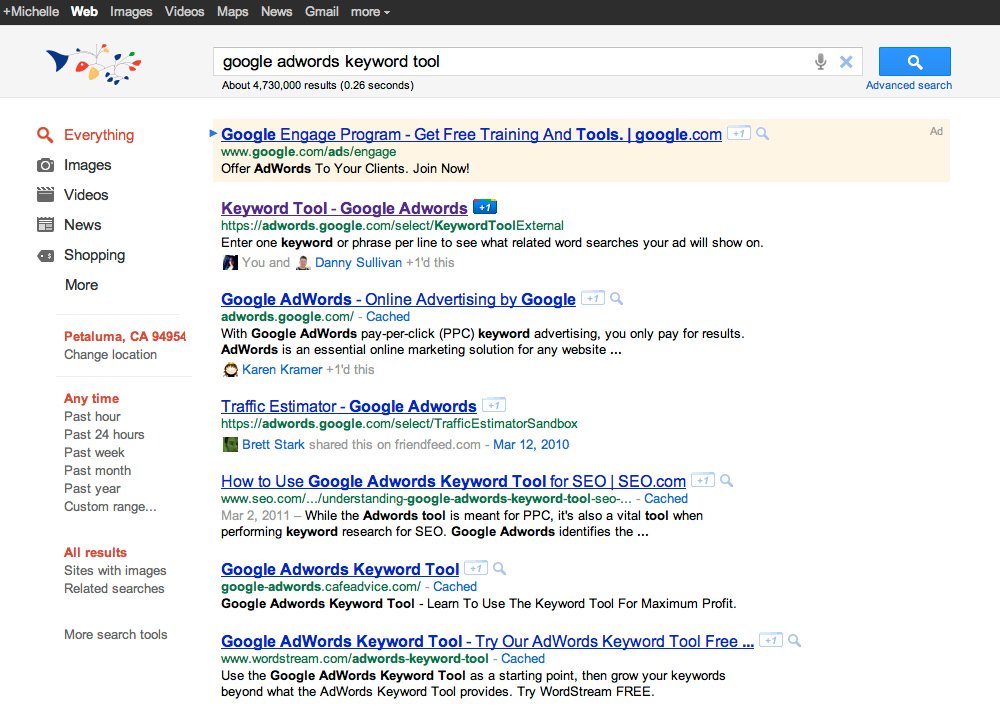
The very first wave of Google+, before the Google+ site even existed: Google added "+1" buttons to search results.

The very first wave of Google+, before the Google+ site even existed: Google added "+1" buttons to search results.
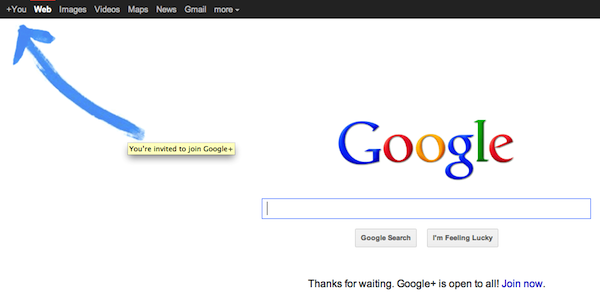
When Google+ launched, it got a huge ad on the Google homepage. Yes, that obnoxious blue arrow was real.

You could share things directly from Google.com.
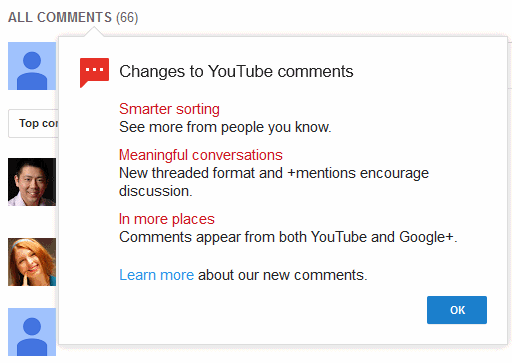
YouTube's comments were merged with Google+.

If you didn't convert your YouTube account to a Google+ account, you weren't allowed to comment.
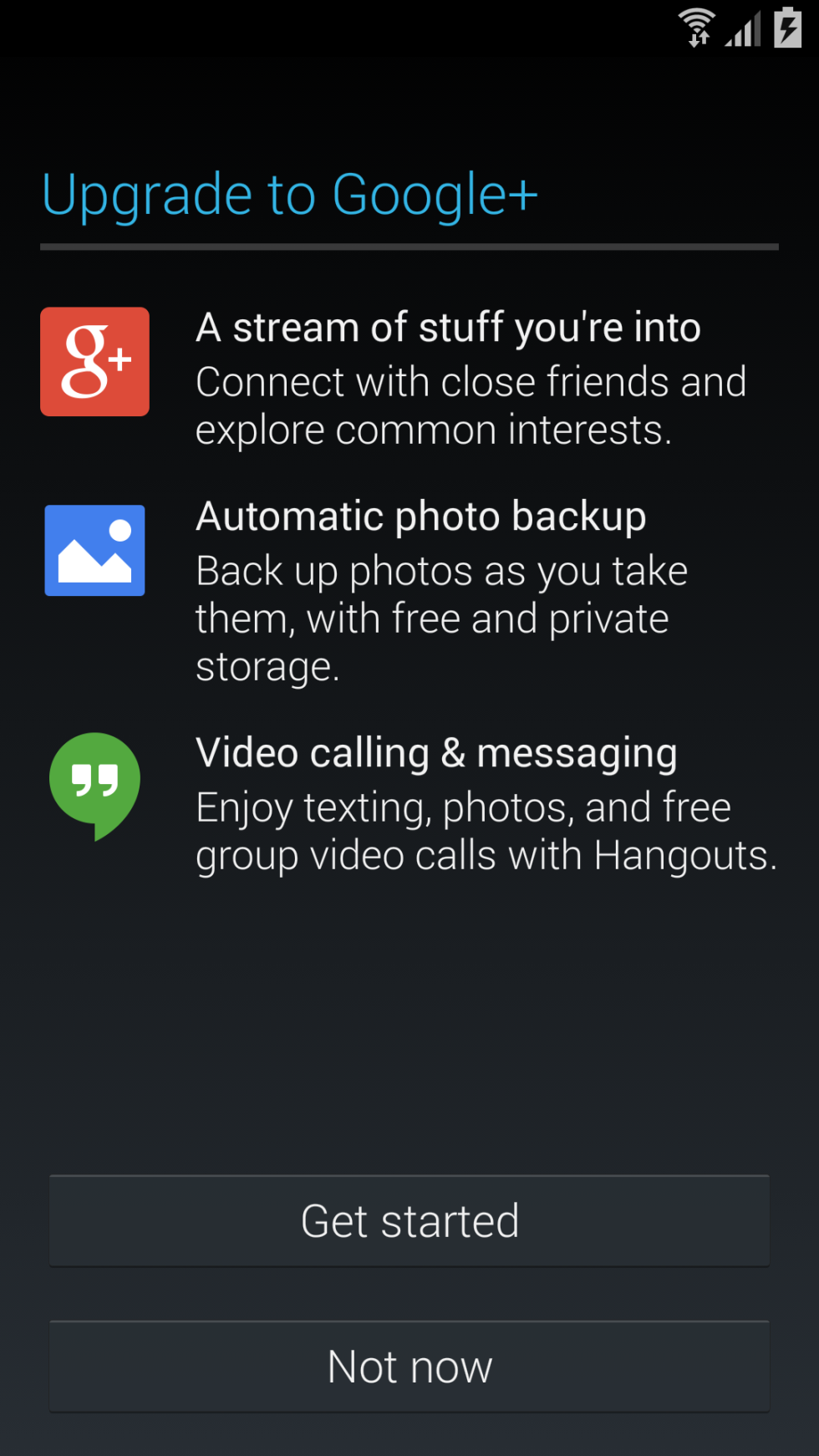
A Google+ promotion in Android 4.0's setup flow. Android used Google+ for photo backup and the user's profile picture.
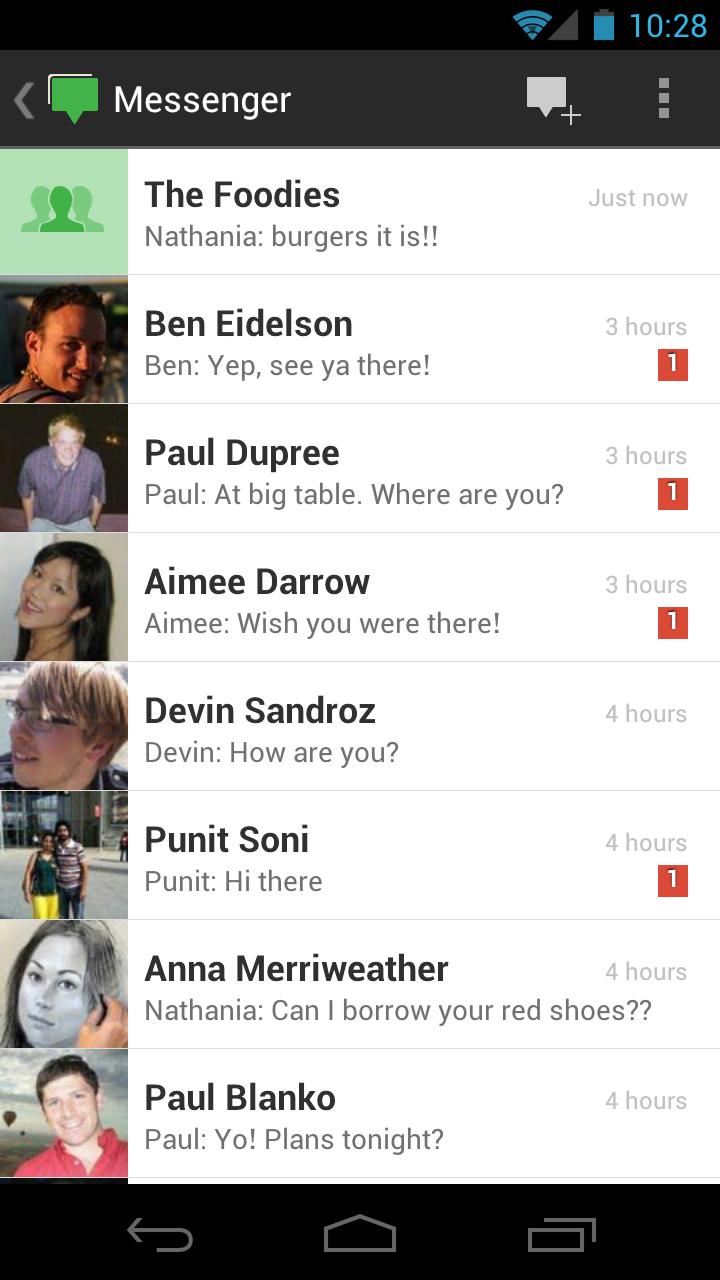
Google+ Messenger was an IM client for Google+. It was shut down after Hangouts was released.
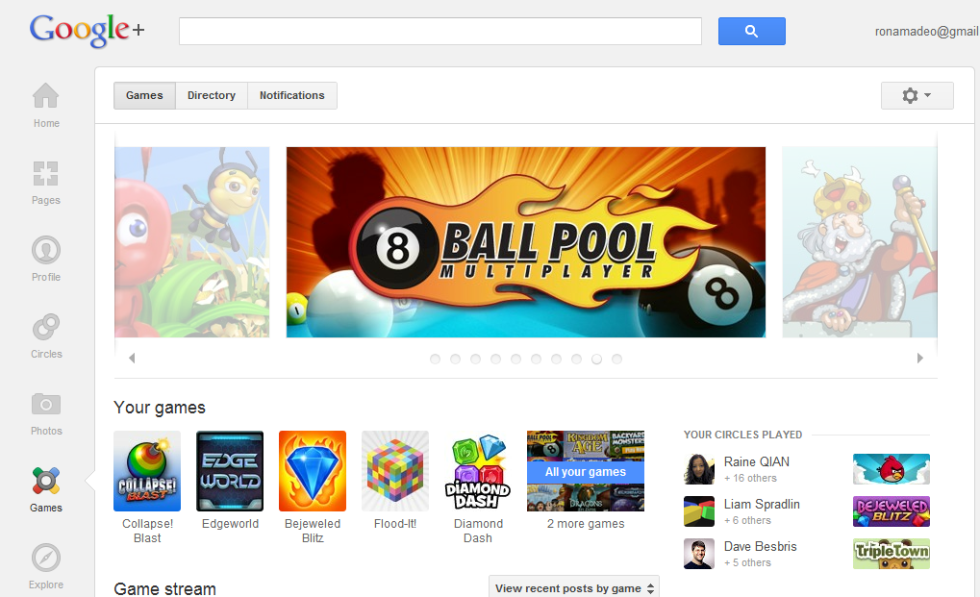
Another canceled feature: Google+ Games.

Google Maps used Google+ Local for businesses and points of interest on the map. If you wanted to leave a review, you needed a Google+ account.
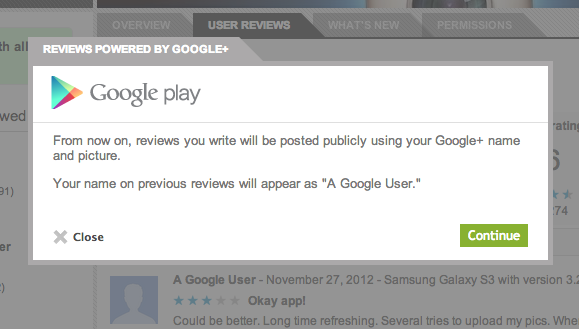
Google+ accounts are still needed to leave a review on Google Play.
The Great Google+ Purge is officially underway. The social network isn't dead, but the plan to make Google+ the "social backbone" of Google is. After integrating Google+ with just about everything in the Google Ecosystem, Google's social strategy has "pivoted" and Google+ will now be de-integrated out of everything. Google+ will be left to stand alone as a (probably niche) social stream.
Google+ was, in a word, "forced." It was forced not only into products and on users but onto the rest of the company, too. In 2011, for instance, Larry Page famously tied all employee bonuses to the company's success in social. It was easy to see why Page decided to do this at the time: Facebook was big and growing and scary. What if people stopped using search and just asked their friends for websites and product recommendations?
With a fear-powered, top-down mandate and every employee having a vested interest in Google+, the social network got shoehorned into every Google product. Google+ showed up in Search, Android, Google Maps, YouTube, Google Play, and many others.
Google+ certainly isn't the first social Google product, but it is the latest in a long line of social failures that the company still doesn't seem to have learned from. It's not that Google can't build great social products—it can—it just continually misjudges which of its social products are good (or even which of its products are social) and therefore deserve the company's focus. Google's social past seems to follow a pattern: throw resources behind social products few people want and try to compel adoption, while neglecting the social products people do want.
Google+ was a continuation of the strategy that Google first pioneered with Google Buzz: generate the "network effect" with brute force. The company took something users were already using—Gmail—and integrated it with Google Buzz. Overnight, Google had millions of "Buzz users," which must look like a big win for a numbers-obsessed manager.
Google Buzz, besides being a social network itself, was supposed to be a social media content aggregator. It would take a firehose of tweets and Facebook posts and funnel them into a single feed. Buzz was supposed to be able to pick out the "interesting" social updates, so rather than an endless flood of posts, only the best would be curated by algorithm.
Buzz made some crazy assumptions about user privacy during initial setup, and it never really recovered from the backlash. Buzz would detect your top e-mail contacts and auto-follow them, giving these people access to shared Google Reader items and public Picasa photos. Not every e-mail contact is a "friend," though, so this had a lot of predictably terrible side effects. Bosses got access to things employees would rather they didn't see, and one woman even had Buzz connect with her abusive ex-husband.
Google killed Buzz after about two years.
Contrast Buzz with Google Reader—the Web-based RSS reader that Google murdered in 2013. This was sort of a social network. At least, it was in 2011 before all the social features were gutted in favor of Google+. There were profiles and a friends list. You could share things, make lists, and follow people. You could comment on new stories, and there was even a "Like" button. The site felt like Twitter but with full news articles instead of just links. Some users had more than 7,500 followers.
Dear Google: taking away my Google Reader functionality will not make me use Google+. It will only make me mad. Kthxbai. Love, Megan
— Megan McArdle (@asymmetricinfo) October 31, 2011
People loved Google Reader. Today, when Internet companies make people mad they sign petitions from the comfort of their computer desk. For Google Reader, there were literal protesters with picket signs outside of Google's offices.
Google understood it needed the network effect to make Google+ successful, but somehow the company twisted that into the idea that "only this social network can exist" and all others inside Google must be destroyed or Borged into the Google+ collective. The network effect relies on people actually liking the service.
Google doesn't always seem to get the "choice" part of social networking. Google doesn't get to pick the social networks, the users do, and if social is important to the company, it needs to listen, react, and improve the social networks people actually like.
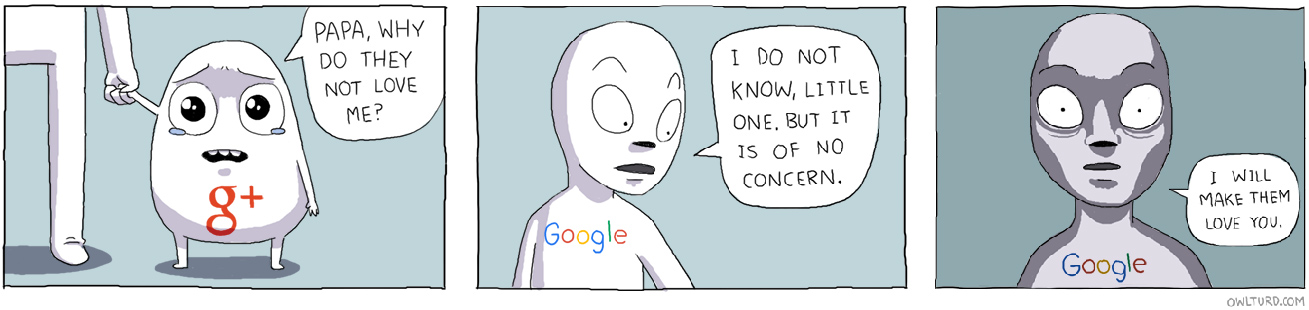
With Google+, Google lost sight of the big picture. The company was so preoccupied with killing other social features to make way for Google+ that it never stopped to think about the damage it was doing. Now that the "social backbone" strategy has failed, Google doesn't have either a successful social platform or any of the social products it killed to make way for Google+. In social, the company is probably worse off than before Google+ started.
Instant messaging is the hottest area of social networking right now. Facebook knows it—the social leader acquired the instant messaging client WhatsApp for an astounding $16 billion last year, and that was just to augment its existing instant messaging lineup. While WhatsApp is the most popular instant messaging client out there with 700 million users, Facebook Messenger is the second most popular with 600 million users. Snapchat, another instant messaging app, was recently valued at $15 billion dollars. If you're into social, instant messaging is the place to be.
Even with the pivot of Google+, Google continues to demonstrate it has no idea how to build a social presence or correctly allocate resources to products users actually want to use. Google has an instant messaging client. It's called Google Hangouts. For many people Hangouts is their most-used application. On Android it not only handles Google's Hangouts-to-Hangouts communication, but it can send SMSes, too. Like Reader, it's social, and users love it—or at least want to love it. While everyone else on Earth seems to realize how important instant messaging is, and thus throws tons of resources and billions of dollars behind IM, Google's in-house solution feels like one of the most unimportant and poorly backed products at the company.
Google Hangouts is so poorly supported that making fun of it has practically become a meme in the Android community. The app was one of the last to get a Material redesign, and users regularly complain about the lack of features and integration with other Google products. Google regularly releases Hangouts features on iOS first, leaving Android users to question which device has the better Google ecosystem. As of this writing, Google Hangouts' more recent "big version" update—4.0—has been exclusive to iOS for a full month. In fact, iOS has already updated a second time, to version 4.1, while Google's Android users are stuck on 3.3. Google only says Hangouts 4.0 is coming for Android "soon."
One engineer on the Hangouts team even acknowledged the team's reputation in the community, writing on reddit, "Unlike what the /r/Android subreddit says, the Hangouts team does come to work every morning." This is how bad Hangouts has gotten—Android users publicly question if a full-time Hangouts team even exists. Meanwhile, leading social networking companies are pouring billions and billions of dollars into competing IM platforms.
Imagine if Google threw the resources that Google+ had at Hangouts or invested anything close to the ~$16 billion everyone else thinks instant messaging is worth? Hangouts should be a flagship Google product on par with Search, Chrome, or Android. There should be a massive development team that constantly releases new features, responds to user feedback, and maintains world-class clients for every imaginable platform. It should be a pillar of the Google ecosystem. Hangouts is the social product from Google that people actually want, but Google refuses to invest in it.
Google seems to desperately want to succeed at social, and watching it completely mismanage what could be a social juggernaut has been frustrating for users. There's clear demand for a good product here. Even the Hangouts complaints are a sign of passion; you don't complain about a product you don't use. Yet the improvements never really come. Feedback rarely seems taken into consideration.
Google's social future looks more unclear than ever. Google+ isn't dead; the company has said it will be kept around as a standalone social stream, but the site seems like it will never grow beyond a niche service. Does Google try to take another big swing at social with a third "social first" service? Does it try to buy one of the established sites, like Twitter? Does Google even feel it needs to be in social anymore?
You can never "make" people like your social site, so hopefully Google's next foray into social will begin with improving the services people actually like and use already.
Listing image by eCreative IM Blog
Adam Victor BrandizziAs ilustrações são realmente excelentes.
(Mas eu acho que "palegg" poderia ser traduzido como "spead")
These breath-taking photographs reveal the everyday lives of animals living in the wild. The incredible images were taken by wildlife photographer Wim van den Heever, from Pretoria, South Africa, during trips to locations including Japan, Botswana and Svalbard. The 43-year-old has been photographing wildlife since he was a young boy and turned his passion for animals into a career and set up ODP Safaris in 2006.

This cheetah closes in on a springbok in the set of stunning wildlife photographs by Wim van Den Heever. (Wim van Den Heever / Mercury Press / The Daily Mail)

It’s difficult to tell whether this is a serious fight or just some fooling around by a pair of polar bears. (Wim van Den Heever / Mercury Press / The Daily Mail)

A pack of elephants wander the plains with the backdrop of a truly enchanting red sky above. (Wim van Den Heever / Mercury Press / The Daily Mail)

This group of dolphins decide to have some fun in the surf, and of course the stunning scene was captured by Wim. (Wim van Den Heever / Mercury Press / The Daily Mail)

Eagles put on a somewhat aggressive show for the photographer, talons at the ready. (Wim van Den Heever / Mercury Press / The Daily Mail)

The lion is usually the hunter, but in this scene it’s the prey that seems to have the upper hand. (Wim van Den Heever / Mercury Press / The Daily Mail)

This shot of a seal bull swinging an octopus around is something you won’t see everyday. (Wim van Den Heever / Mercury Press / The Daily Mail)

The grey of the rhino shimmers in the waters in a spectacular night shot. (Wim van Den Heever / Mercury Press / The Daily Mail)

This old bull elephant dust baths on an open plain. It’s easy to see why photographer Wim has turned his passion for animals into a career. (Wim van Den Heever / Mercury Press / The Daily Mail)

The humpback whale thrusts its head out of the water in an enchanting photograph. (Wim van Den Heever / Mercury Press / The Daily Mail)

The incredible images were taken by wildlife photographer Wim van den Heever, from Pretoria, South Africa, during trips to locations including Japan, Botswana and Svalbard. (Wim van Den Heever / Mercury Press / The Daily Mail)

Wim has travelled across the globe to photograph wild animals – from lions and tigers, to elephants, dolphins and eagles and leopards, such as this. (Wim van Den Heever / Mercury Press / The Daily Mail)

The outline of the elephant shimmers in the water, only interrupted by the beautiful sunset. (Wim van Den Heever / Mercury Press / The Daily Mail)

A baby elephant takes a tumble in the mud, but thankfully there are enough other elephants to help out. (Wim van Den Heever / Mercury Press / The Daily Mail)

It’s thirsty work being a lion in the wild, with this group of five having a drink of water together. (Wim van Den Heever / Mercury Press / The Daily Mail)

Zebras crossing! This animal looks as thought it’s spotted the camera and so gives Wim his best look. (Wim van Den Heever / Mercury Press / The Daily Mail)

The cheetah takes aim as it closes in on dinner of springbok on the plain. (Wim van Den Heever / Mercury Press / The Daily Mail)

Wim captures an amazing image of a dolphin silhouetted against a rough sea. (Wim van Den Heever / Mercury Press / The Daily Mail)

The 43-year-old has been photographing wildlife since he was a young boy and turned his passion for animals into a career and set up ODP Safaris in 2006. (Wim van Den Heever / Mercury Press / The Daily Mail)

Wim set up ODP Safaris which specialises in photographic travel to a hand-picked selection of international destinations. (Wim van Den Heever / Mercury Press / The Daily Mail)

The photographer describes his profession as being more of a lifestyle than a hobby, taking in some truly wondrous sights. (Wim van Den Heever / Mercury Press / The Daily Mail)
Via The Daily Mail

We need a unisex word that means what 'diva' does, although if we give it 20 years at our current levels of smug self-importance, 'programmer' will probably take on that connotation. — interlude
Share Url: http://cube-drone.com/comics/c/software-by-composition
Na semana passada, dois atentados terroristas cometidos por israelenses chocaram Israel e a comunidade internacional. Em um deles, um homem, recém libertado da prisão, esfaqueou seis pessoas na parada gay de Jerusalém. Uma menina de 16 anos morreu. No outro, a casa de uma família palestina foi incendiada na Cisjordânia. Um bebê morreu queimado em um ato classificado como terrorismo pelo premiê Benjamin Netanyahu.
O primeiro ataque foi aparentemente um episódio isolado de um homem com um histórico complicado. Israel é uma das nações mais tolerantes com homossexuais no mundo. Claro, sempre haverá, violência contra gays.
O segundo atentado terrorista, porém, entra no contexto dos chamados ataques “price tags”. Embora pouco conhecidas para quem não acompanha o conflito entre israelenses e palestinos, estas ações têm crescido nos últimos anos. E levantam algumas perguntas
O que são os ataques “price tags”?
São ações terroristas cometidas normalmente por colonos israelenses. Podem ser o incêndio de Igrejas, de mesquitas, de carros, destruição de plantação de oliveiras e de casas de palestinos. Muitas vezes, os ataques envolvem pichações racistas islamofóbicas, anti-árabes, anti-palestinas e anti-cristãs. Algumas vezes, mesmo propriedades judaicas e das Forças Armadas de Israel também são alvejadas. Em raros casos envolve a morte de pessoas. Neste ano, além do incêndio da casa da família palestina, uma escola bilíngue árabe-hebraica e um seminário cristão grego ortodoxo foram atacados pelos terroristas israelenses, segundo a Anti-Defamation League, principal organização em defesa dos judeus dos EUA.
Por que eles realizam estes atentados?
Estes ataques costumam ser uma resposta a ações do governo de Israel para desmantelar os “postos avançados”, como são conhecidos os assentamentos na Cisjordânia considerados ilegais inclusive pela administração israelense – não confundam com assentamento como Ariel, por exemplo, que, embora ilegais para toda a comunidade internacional, incluindo todos os governos dos EUA, são financiados por Israel. Também ocorrem atentados, em alguns casos, como reação a ações terroristas cometidas por palestinos.
Quando começaram os atentados de price tags?
Alguns analistas afirmam que há cerca de dez anos, quando o governo de Israel desmantelou os assentamentos judaicos na Cisjordânia. Mas alguns vão mais longe e dizem que o assassinato do premiê israelense, Yitzhak Rabin, cometido por um extremista judeu contrário às negociações com os palestinos, possui características similares
O que o governo de Israel faz para combater?
Há uma unidade da polícia de Israel apenas para combater os ataques cometidos pelos terroristas israelenses. Muitos são presos e ataques são evitados. Críticos, porém, afirmam que as penas para terroristas palestinos costumam ser muito mais severas do que as para terroristas israelenses. No documentário The Gatekeeper, no qual seis ex-comandantes do Shin Bet (serviço de segurança interna de Israel) são entrevistados, alguns afirmam que os price tags são uma das principais ameaças à segurança de Israel e da Palestina.
Os terroristas israelenses do Price Tag têm apoio da população de Israel?
Não, a maior parte da população israelense condena este terrorismo e grandes manifestações já foram realizadas ao longo dos anos. Os principais líderes políticos do país também classificam como terrorismo. Mas o apoio é um pouco maior entre os colonos israelenses na Cisjordânia, que costumam ser mais radicais
Guga Chacra, comentarista de política internacional do Estadão e do programa Globo News Em Pauta em Nova York, é mestre em Relações Internacionais pela Universidade Columbia. Já foi correspondente do jornal O Estado de S. Paulo no Oriente Médio e em NY. No passado, trabalhou como correspondente da Folha em Buenos Aires
Comentários islamofóbicos, antissemitas, anticristãos e antiárabes ou que coloquem um povo ou uma religião como superiores não serão publicados. Tampouco são permitidos ataques entre leitores ou contra o blogueiro. Pessoas que insistirem em ataques pessoais não terão mais seus comentários publicados. Não é permitido postar vídeo. Todos os posts devem ter relação com algum dos temas acima. O blog está aberto a discussões educadas e com pontos de vista diferentes. Os comentários dos leitores não refletem a opinião do jornalista
Acompanhe também meus comentários no Globo News Em Pauta, na Rádio Estadão, na TV Estadão, no Estadão Noite no tablet, no Twitter @gugachacra , no Facebook Guga Chacra (me adicionem como seguidor), no Instagram e no Google Plus
Adam Victor BrandizziEu realmente achava que eram trilhas de produtos químicos até uns 20 anos. (Algum adulto me tinha dito que eram produtos lancados para causar chuva.)

Never let optimism keep you down, old timer.
Adam Victor BrandizziNem sabia que isso existia.
I did a bunch of research on proxy-browsers for a few projects I worked on. Rather than sitting on it all, I figured I’d write a series of posts sharing what I learned in case it’s helpful to anyone else. This first post looks at the general architecture of proxy browsers with a performance focus.
In the original story of the Wizard of Oz, the Emerald City isn’t actually green nor made entirely of emeralds. All of that came later. In the original story, before entering the city each person had to put on a pair of glasses. These glasses, they were told, would protect them from the bright glow of all the emeralds that would surely damage their sight. These glasses were attached and never removed. You wore them while eating, while going to the bathroom, while walking outside—you wore them everywhere and all the time.
This was all a ruse. The glow of the city wouldn’t damage anybody’s sight because there was no glow. That all came from the glasses which just happened to be tinted green. Through the lens of those glasses, everything glowed. The lens through which those people viewed their world shaped their perception of it.
I’d venture to say that most developers and designers are not big fans of proxy browsers—assuming they pay attention to them at all. They don’t behave in ways a typical browser does, which leads to frustration as we see our carefully created sites fall apart for seemingly no reason at all. And frankly, most of us don’t really need to use them on a day-to-day basis. Through the lens we view the web, proxy browsers are merely troublesome relics of a time before the idea of a “smartphone” was anything other than a pipedream.
But our view of the web is not the only view of the web. People all over the world face challenges getting online—everything from the cost of data and poor connectivity to religious and political obstacles. In these environments proxy browsers are far from troublesome; they are essential.
So while most of us building for the web have never used a proxy browser (outside of the quick spot check in Opera Mini, perhaps), they remain incredibly popular globally. Opera Mini, the most popular of all proxy browsers, boasts more than 250 million users. UC, another popular proxy browser, boasts 100 million daily active users and is the most popular mobile browser in India, China and Indonesia.
These browsers perform optimizations and transcoding that can provide significant improvements. Several proxy browsers claim up to 90% data savings when compared to a typical browser. That’s the difference between a 2MB site and a 200kb site—nothing to sneeze at.
To understand how they accomplish this—and why they behave the way they do—we first need to revisit what we know about how browsers work.
A typical modern browser goes through a series of steps to go from the URL you enter in your address bar to the page you ultimately see on your screen. It must:
That’s a very simplified list and some of them can happen in parallel, but it’s a good enough representation for the purpose of highlighting how proxy browser architecture differs.
We can break these steps out into two general buckets. Steps 1-3 are all network constrained. How quickly they happen, and the cost, depends mostly on the characteristics of the network: the bandwidth, latency, cost of data, etc.
Steps 4-8 are device constrained. How quickly these steps happen depends primarily on the characteristics of the device and browser: the processor, memory, etc.
Proxy browsers intercede on behalf of the user in an attempt to reduce the impact of one, or both, of these buckets. You can broadly classify them into two categories: browsers with proxy services, and remote browsers.
The first category of proxy browsers are really just your plain-old, everyday browser that happens to offer a proxy service. These browsers alter the typical browser behavior only slightly, and as a result they provide the least benefit for end users as well as—usually—the least noticeable impact on the display and behavior of a web site. (While not really tied to a browser, look at Google’s search transcoding service for an example of how substantially a proxy service could alter the display of a page.)
Instead of requests being routed directly from the client to the web server, they are first routed through some intermediary layer of servers (Google’s servers, UC’s servers, Opera’s servers, etc). This intermediary layer provides the proxy service. It routes the request to the web server on behalf of the client. Upon receipt of the request, it sees if there are any optimizations it can provide (such as minification, image compression, etc) before passing back the potentially altered response to the client.
The browser-specific behavior (steps 4-8) remains the same as the typical browsers you’re used to testing on. All of the optimizations that take place focus primarily on the reducing the impact on the network (1-3).
There are many examples but at the moment of writing some of the more popular options in this category are Google’s Data Compression tool (Flywheel), UC Web’s Cloud Boost, and Opera Turbo.
Remote browsers push the limits a bit more. They aggressively optimize as much as possible providing a much larger benefit for the end user, but also a lot more trouble for developers. (If that bothers you try to remember that the proxy browsers exist because users need them, not because developers do.) These are the browsers you more typically think of when hearing the term “proxy browser”. With the increase in browsers offering proxy services, I think referring to these as remote browsers can be a helpful way of distinguishing them.
Unlike their more conservative brethren, remote browsers are not content to merely make a few optimizations on the network side of things. They’ve got more ambitious goals.
When a website is requested through a remote browser, the request is routed through an intermediary server first before being forwarded on to the web server. Sounds familiar right? But here’s where remote browsers start to break away from the traditional browser model.
As that request returns to the server, instead of the intermediary server routing it back to the client, it proceeds to request all the subsequent resources needed to display the page as well. It then performs all parsing, rendering, layout and paint on the intermediary server. Finally, when all of that is taken care of, it sends back some sort of snapshot of that page to the client. This snapshot does not consist of HTML, CSS and JavaScript—it’s a proprietary format determined by whatever the browser happens to be.
That’s why calling them “remote browsers” makes so much sense. The browser as we know it is really contained on the server. The application on the phone or tablet is nothing more than a thin-client that is capable of serving up some proprietary format. It just so happens that when it serves that format up, it looks like a web page.
The most important thing to remember for remote browsers is that because all they are doing is displaying a snapshot of a page, anything that might change the display of that page requires a trip back to the server so an updated snapshot can be generated. We’ll discuss that in more detail in a later post as the implications are huge and the source of most proxy browser induced headaches.
There are many options, but Opera Mini, UC Mini and Puffin are some of the more popular.
Understanding the basic architecture of proxy browsers makes testing on them so much easier and far more predictable. It’s the key to understanding all of the atypical behavior that causes so many developers to cringe whenever they have to fire up a proxy browser for testing.
With the foundation laid, we can spend the next several posts digging deeper into the specific optimizations the two categories of proxy browsers make as well as consider the implications for developers.

 Expaded from Oglaf's feed by Oglaf comic's expander.
Adam Victor BrandizziBom artigo, mesmo não mencionando o que o Google+ tem mais que as outras redes sociais.
Create a social network or risk everything.
That was the original pitch for Google's Facebook rival, Google+, a refrain hammered over and over by the social network's chief architect, Vic Gundotra, in meetings with the company's top brass.
Gundotra, described by colleagues we spoke with as charismatic and politically-savvy, eventually persuaded Larry Page, the Google cofounder who returned as CEO at the beginning of 2011 after a decade behind the scenes, to turn the company upside down for this cause.
"Vic was just this constant bug in Larry's ear: 'Facebook is going to kill us. Facebook is going to kill us,'" says a former Google executive. "I am pretty sure Vic managed to frighten Larry into action. And voila: Google+ was born."
It was 2010 and Google didn't exactly look like a company at risk of being overtaken by anyone or anything. It had long since dominated online search and was quickly becoming a major player in the smartphone era thanks to Android. Google had mapped much of the world, indexed millions of books and was just getting started on building self-driving cars.
For all that success, the Internet giant just couldn't seem to figure out social. A simple Google search reveals the long list of failures and false starts: Orkut, launched days before Facebook in 2004 and quickly overtaken; Reader, a cult favorite RSS feed launched in 2005 and killed in 2013; Wave, its head-scratching communication platform; and, of course, Buzz, that ill-fated social network built on the back of Gmail which imploded fast in early 2010 after a catastrophic privacy issue.

Vic Gundotra, the former head of Google+, welcomes attendees at the Google IO Developers Conference in San Francisco, Tuesday, May 10, 2011.
Image: Marcio Jose Sanchez/Associated Press
As Google stumbled and failed and stumbled again, Facebook grew larger and more influential. By 2010, Facebook was privately valued at $14 billion and approaching 500 million users — accounts with real names, birthdays, photos, a network of connections and vibrant news feeds. Google was far larger, with a market capitalization of around $200 billion, but missing much of this data. Worse still: Facebook was poaching more and more Google employees.
"There was a bit of a fallout from Google Buzz — how did we get it so wrong and what do we do now? Facebook is still this existential threat," says Paul Adams, a former member of the Google+ user experience team who helped inspire the idea for Circles and later went to work for Facebook.
Google's effort to build a social network to rival Facebook began with a bold, company-wide yell. Now Google appears to be winding down Google+ with barely a whimper.
This week, four years and one month after launching Google+ with the stated mission to "fix" online sharing, Google announced it would eliminate a much-criticized requirement to use a Google+ account when signing on to other Google services like YouTube. The move is the clearest indication yet that Google is ditching its playbook of trying to push everyone in the world use its social network.
Google earlier this year began to spin out the service's most popular features, like Photos and Hangouts. What's left is being re-worked (or pivoted, as Google+ chief Bradley Horowitz said in his latest blog post) to find a salvageable kernel of a social experience that might still be built up to appeal to a large audience. Google+ launched with big aspirations but no well-defined purpose for users; now, very belatedly, Google is trying find some purpose for the social network as those aspirations shrink.
Google+ has become a favorite punchline in the technology industry, but the objective was deadly serious. Interviews with more than a dozen Google insiders and analysts in recent months, many speaking on condition of anonymity for fear of retribution, paint the Google of 2010-2011 as increasingly fearful of Facebook snatching away users, employees and advertisers. Google tried to mobilize itself quickly, but approached the task with all the clumsiness of a giant trying to dance with a younger, nimble startup.

Google CEO Larry Page speaks at a news conference at the Google offices in New York, Monday, May 21, 2012.
Image: Seth Wenig/Associated Press
Google launched Plus without a clear plan to differentiate the service from Facebook. It bet on a charismatic leader with a flawed vision, ignored troubling indications about the social network's traction (or lack thereof) with users and continued throwing features at the wall long after many had written Google+ off for dead.
The slow demise of Google+ sheds light on how a large technology company tries and often fails to innovate when it feels threatened. The Google+ project did lead to inventive new services and created a more cohesive user identity that continues to benefit Google, but the social network itself never truly beat back existing rivals. Facebook is now larger than ever, with 1.4 billion users and a market capitalization more than half of Google's. It continues to poach Google employees. Facebook and Twitter are also slowly chipping away at Google's dominance in display ad revenue.
"Google+ built a seamless identity and a social graph that rolled out to all Google products so they could log on using the same identity," says Punit Soni, a former Google product manager who worked on Plus and is now chief product officer at Flipkart. Finally, Soni says, "Google knew who you were."
"What it could not do is give Google another destination to consume stuff," he adds. That's where Facebook continues to win.
Kent Walker, Google's general counsel, was even more candid in his remarks about Google+ during a meeting with business leaders and antitrust regulators in Germany this March. He referred to the social network as part of a "painfully long list of unsuccessful Google products."

Google+ tried to differentiate itself from Facebook with Circles, a feature to better customize who you share content with. Facebook later introduced a similar option.
Image: Screenshot, Mashable
The massive Google+ launch effort had all the hallmarks of a technology corporation: a code name ("Emerald Sea"), an artificial timeline (100 days to launch!), a dedicated secret building (with the CEO relocated there) and a full PR blitz once completed.
“We’re transforming Google itself into a social destination at a level and scale that we’ve never attempted — orders of magnitude more investment, in terms of people, than any previous project,” Gundotra told Wired in a 2011 interview to promote the launch of Google+.
Gundotra did not respond to multiple email requests for comment. Google declined to comment for this story beyond the blog posts put out on Monday.
"It was absolute madness," one former Google+ employee says of the speed and "intensity" of the work during the crucial early months. "The best way to succeed in Vic's ecosystem is to be speedy. He has a bias for action. He may need to do more work on strategy."

Google co-founder Sergey Brin demonstrates Project Glass. Google's misfires have haunted the company and have caused engineers to drive themselves even harder.
Image: Kim Kulish/Corbis/Corbis
For those elsewhere in the company, Google's approach to Plus represented a radical departure. Most Google projects started small and grew organically in scale and importance. Buzz, the immediate predecessor to Plus, had barely a dozen people on staff. Plus, by comparison, had upwards of 1,000, sucked up from divisions across the company. One employee on a different team recalled thinking at this time, "Where have our engineers gone?"
Google ripped out its elaborate internal video conferencing system and forced employees to use the Google+ Hangouts video chat feature in Plus, which one employee described as "janky." It tied employee bonuses to the success of Google+. The secrecy and special treatment, largely unheard of before, and the proximity to the CEO — all of it created what another Googler describes as the sense of "something set apart."
The final product, released on June 28, 2011, had several novel features: Circles, for grouping contacts to customize who you share what with; Hangouts, for group video chats; and Photos, which included decent photo-editing tools. Yet, members of the media, users and even some Google employees concluded Plus looked like Facebook, perhaps with a little Twitter sprinkled in for good measure.
"When it launched we were like, 'This looks just like Facebook. What was the big deal? It's just a social network,'" a former Google employee not on the team recalls thinking after seeing the product for the first time. Says another Google exec who did work on the team: "All this fanfare and then we developed something that in the end was quite ordinary."

Google+ lost some cred by looking too much like Facebook.
Hindsight is always 20/20, but many on the Google+ team claim early data showed the new social network's struggles.
Simply by virtue of Google's reach, it could quickly attract millions of users to a new service. "It was clear if you looked at the per user metrics, people weren’t posting, weren't returning and weren’t really engaging with the product," says one former employee. "Six months in, there started to be a feeling that this isn’t really working."
Some lay the blame on the top-down structure of the Google+ department and a leadership team that viewed success as the only option for the social network. Failures and disappointing data were not widely discussed.
"The belief was that we were always just one weird feature away from the thing taking off," says the same employee. Throughout the next couple years, Google improved its video hangout service and added smart, algorithmic photo-editing and search features, the latter of which earned plenty of praise, but did little to improve the overall reputation of Google+.
In retrospect, multiple employees and analysts say, there were plenty of features and approaches that could have helped Google+ stand out, including a strong focus on mobile and messaging, two areas Facebook had not yet figured out. A suite of standalone apps, rather than a single social destination, might have worked as well. Unfortunately this wasn't the original proposal. The plan was essentially to out-Facebook Facebook.
“What people failed to understand was Facebook had network effects," says Adams, the former Google+ user experience employee. "It’s like you have this grungy night club and people are having a good time and you build something next door that’s shiny and new, and technically better in some ways, but who wants to leave? People didn't need another version of Facebook."

Vic Gundotra, Google's former Senior Vice President of Engineering, talks about Google Plus at the Google I/O conference in San Francisco, Wednesday, June 27, 2012. (AP Photo/Paul Sakuma)
Image: Paul Sakuma/Associated Press
Chris Wetherell, the founder of Google Reader, one of the company's earlier social efforts, pins the shortfall of Google+ to something more fundamental. "It wasn’t going to be why Google existed unlike the way it was for Twitter or Facebook," he says. "It was the wrong company at the wrong time."
By early 2014, less than three years after its big launch, the Google+ team had moved out of its coveted building to a spot on campus further from Page. Gundotra announced his departure from the company that April — in a Google+ post, of course — to pursue "a new journey."
Throughout Gundotra's tenure running social at Google, he alternately inspired and polarized his own employees and irritated other departments by encroaching on their fiefdoms with various Google+ efforts, according to multiple sources who worked with him. Gundotra's proximity to Page may have shielded him, but that could only last so long with the Google+ "ghost town" narrative and user backlash from the forced integration with YouTube.
More than a year after leaving Google, Gundotra has yet to announce that next stop on his journey. Two former colleagues say Gundotra is still mostly traveling and relaxing. "He's too young to retire," one associate says. "He'll go on to do something else."
David Besbris, who helped launch the social network with Gundotra, took over as head of Google+ and claimed that Google was committed to "social... for the long haul." Six months after making that statement, he was replaced in the top spot by Bradley Horowitz, a longtime Google executive.
The buried news in the Horowitz announcement: Google had begun referring to its social operations as "Google Photos and Streams." In Horowitz's blog post this week, that name expanded to "Streams, Photos, and Sharing." By rebranding in this way, Google can separate the failure of "Streams" — the feed activity that most associate with a social network — from the more successful features bundled with it.

Google Photos organizes your entire photo collection into a single mobile app.
Image: Mashable, Pete Pachal
"I’ve concluded that it’s time for a 'pivot'... or more precisely time to talk more openly about a pivot that’s been underway for some time (and in fact is reflected in the name of the new team)," Horowitz wrote on Monday, announcing the end of requiring a Google+ account to use Google products. "Google+ can now focus on doing what it’s already doing quite well: helping millions of users around the world connect around the interest they love. Aspects of the product that don’t serve this agenda have been, or will be, retired."
Translation: Google+ is shifting from a Facebook clone to more of a Pinterest lookalike to see if it can build momentum. At the same time, Google is investing resources to build more standalone social products like the Photos app, which has generated plenty of positive press.
"I don't think that owning a pure-play social network is important for Google at this point, but having a connection to social is important," says Brian Blau, an analyst who covers Internet companies for Gartner.
If and when the Google+ brand is phased, as many we spoke with expect, Google won't need to say it killed Google+. Several years from now, when nobody is paying attention, a Google employee can just publish a long list of features that have been done away with as part of a routine spring cleaning. Halfway down that list, an astute reader will see the word "Streams."
Adam Victor BrandizziAté gostei do visual, mas... http://poorlydrawnlines.com/comic/authentic-present/

“I love wearing pieces with a story: pieces that remind me of what I have done, where I have been, or of my loved ones. Now I’m wearing a skirt that I found at the Fruitvale BART station while waiting for a friend so that we could go to a woman’s studio to dance with her snakes, a top that used to be owned by a belly dancer, earrings that my lover found at the flea market, a necklace that I made with bones from an owl pellet, and Docs because every lady needs a pair of kick-ass boots.”
Adam Victor BrandizziRevista Capricho comentando draft da Unicode Consortium. Que coisa espetacular
Mas a ideia não surgiu do nada! A Unicode levou em conta as solitações de internautas, em comunidades online, que sentiam falta dos itens da lista abaixo. As "figurinhas" devem ser incluídas no teclado de emojis na atualização número 9.0.

Confira abaixo a lista completa:
- Caubói
- Cara de palhaço
- Cara enjoada
- Bonequinho rolando de rir no chão
- Cara babando
- Cara à la Pinóquio, com o nariz comprido
- Sinal de hang-loose vertical
- Sinal para "selfie"
- Sinal de "toca aqui!"
- Punho fechado apontado para a esquerda
- Punho fechado apontado para a direita
- Aperto de mãos
- Sinal de figa
- Mulher grávida
- Cara de decepção ('facepalm")
- Cara de "tanto faz"
- Homem dançando, para fazer companhia para o emoji da mulher bailando
- Príncipe, para fazer companhia à princesa
- Homem de fraque, para fazer companhia à noiva
- Mamãe Noel, para fazer companhia ao Papai Noel
- Flor murcha (à la rosa de A Bela e a Fera)
- Patinete
- Lambreta
- Sinal octagonal vermelho
- Tim-tim com taças de champanhe, para complementar o tim-tim com canecos de choppe
- Coração preto
- Croissant
- Abacate
- Pepino
- Bacon (!!!)
- Batata
- Cenoura
- Raposa
- Águia
- Pato
- Morcego
- Tubarão (!!!²)
- Coruja
E aí, qual desses novos emojis é o mais esperado por você?


 Shared by










 Expanded from


