Shared posts

28 Oct 19:33

Long Read: “In Cold War, U.S. Spy Agencies Used 1,000 Nazis”

by Anne Laurie

@MarkAmesExiled My extended twitter essay on this is now in one convenient spot on storify: https://t.co/IUXj0B8oDk

— Jeet Heer (@HeerJeet) October 27, 2014

As Lily Tomlin said, “I try to be cynical, but you just can’t keep up.” From today’s NYTimes:

In the decades after World War II, the C.I.A. and other United States agencies employed at least a thousand Nazis as Cold War spies and informants and, as recently as the 1990s, concealed the government’s ties to some still living in America, newly disclosed records and interviews show.

At the height of the Cold War in the 1950s, law enforcement and intelligence leaders like J. Edgar Hoover at the F.B.I. and Allen Dulles at the C.I.A. aggressively recruited onetime Nazis of all ranks as secret, anti-Soviet “assets,” declassified records show. They believed the ex-Nazis’ intelligence value against the Russians outweighed what one official called “moral lapses” in their service to the Third Reich.

The agency hired one former SS officer as a spy in the 1950s, for instance, even after concluding he was probably guilty of “minor war crimes.” …

Evidence of the government’s links to Nazi spies began emerging publicly in the 1970s. But thousands of records from declassified files, Freedom of Information Act requests and other sources, together with interviews with scores of current and former government officials, show that the government’s recruitment of Nazis ran far deeper than previously known and that officials sought to conceal those ties for at least a half-century after the war…

Some spies for the United States had worked at the highest levels for the Nazis.

One SS officer, Otto von Bolschwing, was a mentor and top aide to Adolf Eichmann, architect of the “Final Solution,” and wrote policy papers on how to terrorize Jews.

Yet after the war, the C.I.A. not only hired him as a spy in Europe, but relocated him and his family to New York City in 1954, records show. The move was seen as a “a reward for his loyal postwar service and in view of the innocuousness of his [Nazi] party activities,” the agency wrote.

His son, Gus von Bolschwing, who learned many years later of his father’s ties to the Nazis, sees the relationship between the spy agency and his father as one of mutual convenience forged by the Cold War.

“They used him, and he used them,” Gus von Bolschwing, now 75, said in an interview. “It shouldn’t have happened. He never should have been admitted to the United States. It wasn’t consistent with our values as a country.”…

The wide use of Nazi spies grew out of a Cold War mentality shared by two titans of intelligence in the 1950s: Mr. Hoover, the longtime F.B.I. director, and Mr. Dulles, the C.I.A. director.

Mr. Dulles believed “moderate” Nazis might “be useful” to America, records show. Mr. Hoover, for his part, personally approved some ex-Nazis as informants and dismissed accusations of their wartime atrocities as Soviet propaganda.

In 1968, Mr. Hoover authorized the F.B.I. to wiretap a left-wing journalist who wrote critical stories about Nazis in America, internal records show. Mr. Hoover declared the journalist, Charles Allen, a potential threat to national security.

John Fox, the bureau’s chief historian, said: “In hindsight, it is clear that Hoover, and by extension the F.B.I., was shortsighted in dismissing evidence of ties between recent German and East European immigrants and Nazi war crimes. It should be remembered, though, that this was at the peak of Cold War tensions.”

The C.I.A. declined to comment for this article…

FacebookTwitterGoogle+Share


This space reserved for your ad.

24 Oct 18:38

Long Read: “How Obama Transformed the Judiciary”

by Anne Laurie

The accretion of numeric detail is nice, but it’s the last couple of paragraphs in his article that are liable to spark arguments, assuming any Media Villagers read that far. Jeffrey Toobin, in the New Yorker:

When President Obama took office, the full D.C. Circuit had six judges appointed by Republican Presidents, three named by Democrats, and two vacancies. By the time of the Halbig decision, Obama had placed four judges on the D.C. court, which shifted its composition to seven Democratic appointees and four Republicans. In light of this realignment, the Obama Administration asked the full D.C. Circuit to vacate the panel’s decision and rehear the Halbig case en banc—that is, with all the court’s active judges participating. The full court promptly agreed with the request, and the decision that would have crippled Obamacare is no longer on the books. Oral argument before the full court is now set for December.

The transformation of the D.C. Circuit has been replicated in federal courts around the country. Obama has had two hundred and eighty judges confirmed, which represents about a third of the federal judiciary. Two of his choices, Sonia Sotomayor and Elena Kagan, were nominated to the Supreme Court; fifty-three were named to the circuit courts of appeals, two hundred and twenty-three to the district courts, and two to the Court of International Trade. When Obama took office, Republican appointees controlled ten of the thirteen circuit courts of appeals; Democratic appointees now constitute a majority in nine circuits. Because federal judges have life tenure, nearly all of Obama’s judges will continue serving well after he leaves office.

Obama’s judicial nominees look different from their predecessors. In an interview in the Oval Office, the President told me, “I think there are some particular groups that historically have been underrepresented—like Latinos and Asian-Americans—that represent a larger and larger portion of the population. And so for them to be able to see folks in robes that look like them is going to be important. When I came into office, I think there was one openly gay judge who had been appointed. We’ve appointed ten.”

The statistics affirm Obama’s boast. Sheldon Goldman, a professor at the University of Massachusetts at Amherst and a scholar of judicial appointments, said, “The majority of Obama’s appointments are women and nonwhite males.” Forty-two per cent of his judgeships have gone to women. Twenty-two per cent of George W. Bush’s judges and twenty-nine per cent of Bill Clinton’s were women. Thirty-six per cent of President Obama’s judges have been minorities, compared with eighteen per cent for Bush and twenty-four per cent for Clinton. Obama said that the new makeup of the federal bench “speaks to the larger shifts in our society, where what’s always been this great American strength—this stew that we are—is part and parcel of every institution, both in the public sector as well as in the private sector.”…

Obama has stopped pretending that he has much respect for Congress. He had minimal tolerance for legislative horse-trading even when he was a legislator. Now, after six years of implacable Republican opposition to everything he has proposed, he sounds fed up.

“Because Congress is not working the way it’s supposed to, there’s both pressure on administrative agencies and pressure on the courts to sort through, interpret, and validate or not validate decisions that in a better-functioning democracy would be clearer and less ambiguous,” Obama said…

As Marine One thundered overhead, about to land on the White House lawn and take Obama to a series of political fund-raisers, I asked him if, like William Howard Taft, he entertained thoughts of serving as a judge later in his career. “When I got out of law school, I chose not to clerk,” he said. “Partly because I was an older student, but partly because I don’t think I have the temperament to sit in a chamber and write opinions.” But he sounded tempted by the idea.

“I love the law, intellectually,” Obama went on. “I love nutting out these problems, wrestling with these arguments. I love teaching. I miss the classroom and engaging with students. But I think being a Justice is a little bit too monastic for me. Particularly after having spent six years and what will be eight years in this bubble, I think I need to get outside a little bit more.”

Yeah, he didn’t say NO…

FacebookTwitterGoogle+Share


This space reserved for your ad.
24 Oct 14:36

How to Understand a New Technology's Place in Your Life

by Scott Meyer

For the record, when I sent this comic out to the subscriber list I received several e-mails defending smartwatches. Every single one of the people who wrote owned a Pebble smartwatch.

As always, thanks for using my Amazon Affiliate links (USUKCanada).

24 Oct 14:05

Running Out The Clock

Robert.mccowen

We've reached a point where Republican candidates--that is, people offering to help run the government--include advocacy of violent resistance to the government as part of their campaigns.

It's the logical endpoint of 50 years of Goldwater/Reagan style insistence that government is always the problem, and it's utterly insane.

Joni Ernst, career crackpot, veteran juggler of pig testicles, and determined foe of Agenda 21, the secret UN plot to steal all our golfs, seems to have gone into a kind of delay game as she edges toward the Senate election in Iowa. First, she's stopped doing almost any interviews with the editorial boards of Iowa's newspapers. Or even local TV. Perhaps she's down in the root cellar, stocking up the canned goods and keeping the crystal set in trim.

"I have a beautiful little Smith & Wesson, 9 millimeter, and it goes with me virtually everywhere," Ernst said at the NRA and Iowa Firearms Coalition Second Amendment Rally in Searsboro, Iowa. "But I do believe in the right to carry, and I believe in the right to defend myself and my family -- whether it's from an intruder, or whether it's from the government, should they decide that my rights are no longer important."

23 Oct 17:50

Urban Raccoons

by Erik Loomis
Robert.mccowen

Shared because I wanted an excuse to post this for general entertainment: https://www.scribd.com/doc/244022349/2-14-cv-02518-13

Four plaintiffs in Kansas are suing officials over the state's suddenly very confused policy on issuing marriage licenses to same-sex couples. The link is to a motion by a "traditionally" married couple to intervene as defendants; if you search carefully among the typo-ridden word salad, you'll find a Fifth Amendment claim that they are being deprived of property without due process.

That is, they are LITERALLY arguing that gay people are stealing their marriage.

Evidently, raccoons in the city are smarter than rural raccoons because the city teaches them so much, primarily how to get at food.

Personally, I fear they will ally with the monkeys and robots to enslave us.


23 Oct 16:26

Job Interviews at Academic Conferences

by Erik Loomis
Robert.mccowen

This is actually a huge thing. The university covers travel, lodging, and typically meals for the faculty performing the interviews; the applicants have to pay their own way, and it can easily run over $1000 for people who are making, optimistically, $20,000 per year.

And then you add on the fact that typically the "long list" at an academic conference might be 12-15 people, of whom 3 are typically invited for a campus visit, and it gets worse.

And then you add on the fact that there's essentially nothing about the interview process that can't be easily replicated via conference call or videoconference, and it gets worse.

And then you start looking into the back side of the process and realize that the ordering/ranking of candidates rarely changes as a result of the interviews, and it really IS indefensible.

Forcing impoverished graduate students and adjunct faculty to travel to a random expensive city for 30 minute first round job interview is one of the least morally defensible parts of academia. Professional associations need to stop it.

[SL] Make sure to click through and read this as well. Even before the age of Skype this practice was absolutely indefensible; the application materials and perhaps a phone call are perfectly sufficient for a preliminary interview process. It’s just a bigger disgrace now.


20 Oct 17:22

Where Do Birds Go

Robert.mccowen

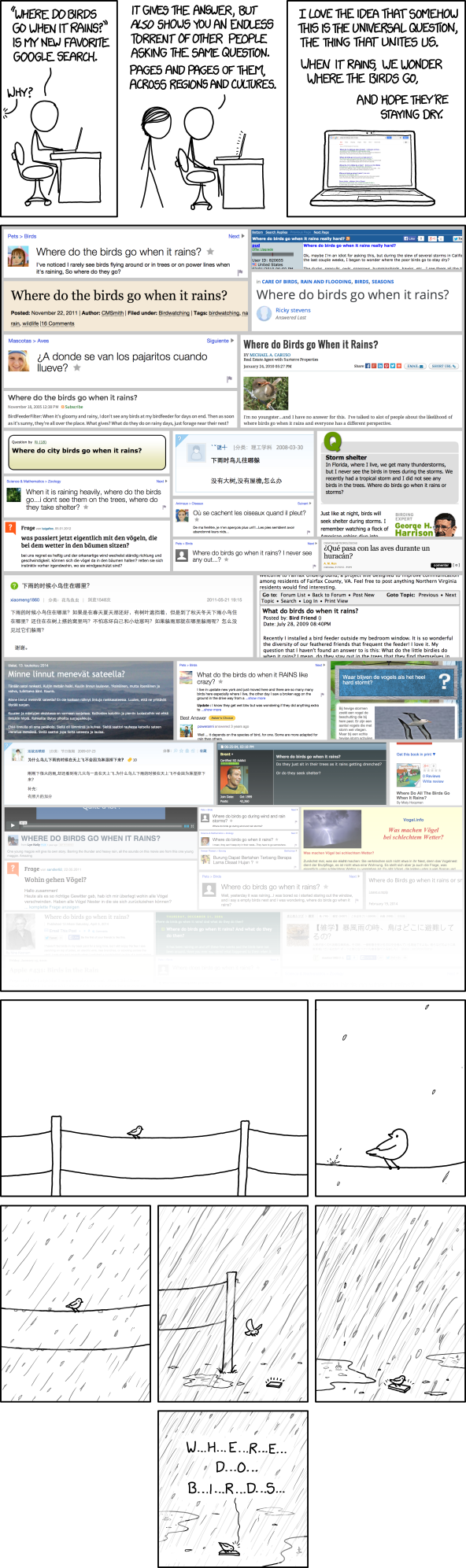
I assume the bird is posting the question on Twitter.

Water/ice has a lot of weird phases. Maybe asking 'where do birds go when it rains' is like asking 'where does Clark Kent go whenever Superman shows up?'
20 Oct 17:04

Oh Special Happy Day

by Erik Loomis
Robert.mccowen

Mudslinging and deeply personal attacks on electoral opponents, 18th-century-style.

Also turned out to be true, of course.

13 Oct 18:49

Voter ID laws: partisan, but also really, really racist

by Tim F.
Robert.mccowen

If only I knew a civil rights attorney, I would forward this along to him and make sure he knew that if he wanted or needed any assistance teasing apart the conclusions and implications of the study linked at the Post, I would be more than willing to help.

Voter ID laws offer a classic case of Republican win-win for Republicans in that they both help the party win elections and they hurt minorities. Now insofar as it reflects basic machiavellian calculation you can sort of understand the GOP trying to tip the rules of the game in their favor. On the other hand raw fear and hate of different people is just shameful and self-destructive.

Fortunately social science has a great protocol for testing a large group for different kinds of bias. Take for example gender bias in science. Everyone knows that women have a harder time getting high-profile postdocs, securing faculty positions and winning grants but nobody had a solid handle on why. To resolve that a research team sent one identical resumé to over a hundred different research faculty and asked them to rank the candidate on various metrics. The one and only difference on the applications was the name – half had a male name on the top and the other half was female.

Responses showed a startling and highly significant disparity. On average the female candidate scored lower in competence. Faculty ranked the identical female application as less hireable, they were less interested in mentoring her and they proposed paying her an average of $4,000 less*. Female faculty showed just as much bias as men.

The scientific sting works well because it is easy and cheap. It works because people have no idea they are even taking part in a study so you can’t just lie like people do to a phone survey. You can never point a finger at any one single person since it only studies how a group behaves, but in a number of ways that works out for the better. You know that good feeling that you get when someone singles out a bad actor? That feels good because it lets people tell themselves the problem is over there, in those bad people. A study is a lot more effective when it speaks for everyone. In the study I linked science collectively fell on its face. I can tell you that study shook a lot of us quite deeply. Making us all second guess our own snap judgment will ultimately do a lot more good than it does to put any person in the pillory and hand the rest of us rotten fruit.

Group data also matters a lot more to the person who does not have power. More than any single bad actor a young scientist or a black/hispanic person voting mostly wants to knwo what kind of headwind he or she will face when they apply for a job, give an interview or show up to vote (bolding mine).

USC researchers developed a novel real-world field experiment to test bias among state legislators. In the two weeks prior to the 2012 election, they sent e-mail correspondence to a total of 1,871 state legislators in 14 states.

Hello (Representative/Senator NAME),

My name is (voter NAME) and I have heard a lot in the news lately about identification being required at the polls. I do not have
driver’s license. Can I still vote in November? Thank you for your help.

Sincerely,
(voter NAME)

[...] One group of legislators received e-mail from a voter who identified himself as “Jacob Smith.” The other received email from “Santiago Rodriguez.”

[...] Crucially, in each state in the study, legislators really could have simply responded with a “yes” — drivers’ licenses were not required in any of the states in order to vote…[L]egislators who had supported voter ID laws were much more likely to respond to “Jacob Smith” than to “Santiago Rodriguez.”

It should come as zero surprise that Republicans were a lot more motivated to help Mr. Smith vote. The Washington Post breaks down the data in graph form, but they do it in a weird way.

voter-id1

People who did not co-sponsor voter ID laws answered Santiago Rodriguez more often than sponsors did, but that list includes both Republicans and Democrats. If you take those black bars representing the disparity between answering Mr. Rodriguez and Mr. Smith and split up the data like the original authors did, the data makes a bit more sense.

asfd

Shockingly, Republicans who sponsored voter ID laws really do not want hispanic people to vote. Republicans who did not sponsor the laws still feel a little oogy about hispanics but much less so and Democrats showed no bias at all (actually 1.8% in favor of Mr. Santiago, but far within the margin of error).

Consider this another edition of things we already know, proved by science.

(*) This last point is a really big deal. I have worked in science for those salaries, and a person can at least make do on the average salary proposed for a male applicant. The proposed female salary was on par with what graduate students make, which is pretty close to starvation wages for a young professional. I would have considered walking away from science if that was the best I could get.

FacebookTwitterGoogle+Share

10 Oct 21:38

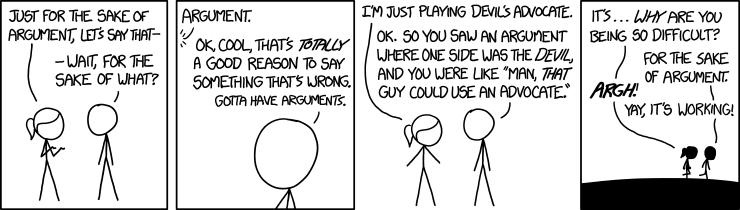
The Sake of Argument

Robert.mccowen

Like.

I see this shit all the time online, in both politics and gaming: "For the sake of argument, let's say that [absurd premise that this person has been unable to demonstrate]."

I don't understand why so many people find it hard to distinguish between a premise and evidence, or between a logical argument and an opinion.

'It's not actually ... it's a DEVICE for EXPLORING a PLAUSIBLE REALITY that's not the one we're in, to gain a broader understanding about it.' 'oh, like a boat!' '...' 'Just for the sake of argument, we should get a boat! You can invite the Devil, too, if you want.'
10 Oct 20:54

Have we had an asshole of the day yet?

by SEK
Robert.mccowen

I was trying to remember why the name Todd Kincannon sounded familiar, and his Wikipedia page reminded me: about this time last year, he tweeted that transgender people should "all be put in a camp". Apparently he's so radioactive that even in South Carolina the GOP doesn't want anything to do with him anymore.

If not, I’m gonna nominate this guy.


08 Oct 20:28

Mary’s Monday Metazoan: Stridulator

by PZ Myers
07 Oct 15:55

Reading, Writing, Ransacking

Robert.mccowen

I try not to link to Charlie Pierce too often, because I find him funny and insightful he can also be incendiary.

But incendiary is exactly what's called for when it comes to school "reformers" whose idea of reform boils down to union-busting in service of slashing budgets, especially when all the money that gets saved mysteriously vanishes into the political aether.

Schools should be welcoming and well-run places. They should be staffed by people who are paid well--ideally well enough to attract smart, ambitious kids coming out of college, but at least well enough so that teaching isn't a penance performed primarily by people who failed out of other degree programs.

The idea that the real problem with schools right now is that they're wasting too much money on teachers is a bizarre artifact of "bipartisan" reform, for which Obama has never been sufficiently held to account.

These are tough times for education "reformers," those well-meaning, usually wealthy dilettantes who are only making their comfortable living working "for the kids." Michelle Rhee, their warrior queen, has been exposed as an intellectual three-card monte dealer, and has been forced to hand over her sword and buckler to Campbell Brown, a forgettable former CNN anchor Muppet whose dedication to democracy and "transparency" is, well, eccentric at best, as she crusades against teacher tenure so that local school boards -- like the one presently embarrassing itself in Colorado -- can make sure no inconvenient thinking manages to leach into the subject population being experimented upon by the people who pay Brown her salary. Whoever they are. The charter school movement increasingly looks like a Trojan Horse for the corporate education complex -- demanding a complete lack of accountability and ending up, in many cases, as the pedagogical equivalent of a Texas fertilizer plant. This barely concealed strain of authoritarianism -- the lack of accountability, the delicately eliminationist rhetoric aimed at public school teachers, the shadowy donors whom people like Brown decline to reveal, the kleptocratic reliance on corporate money -- is more than sufficiently similar to the way corporations generally have looted the commonwealth to make you wonder if public education isn't headed the way of the country's manufacturing base. But you won't see a clearer example of all of this than the shenanigans that went on in Philadelphia yesterday.

In a closed-door session that lasted 17 minutes and that included a single public comment, the Philadelphia School Reform Commission -- more about them later -- unilaterally blew up the contract under which the Philadelphia teachers union had been operating. In addition to socking the city's teachers for their own health care, the commission also cut off the benefits being paid to retired teachers, most of them elderly, and all of them having worked for years to earn these benefits that yesterday vanished without even the pretense of debate. If this reminds you of what happened to the pensions of firemen in New Jersey, and public workers in Wisconsin, and manufacturing grunts almost everywhere in the private sector, you are unusually sharp this morning and do not need that second cup of coffee. Anyway, the estimable Will Bunch of the Philadelphia Daily News has gone into orbit, and rightly so. As he points out, the SRC has been after doing this kind of thing for a long while.


05 Oct 18:24

Monty Python Was There First

by John Cole +0
Robert.mccowen

Linked a few places, and shared here just because.

Serious question: do state legislatures think there's any chance laws like this will be held to be constitutional when they're challenged--as they will inevitably be? If the answer is yes, why do people keep electing majorities who are either terminally deluded or literally insane? If the answer is no, how is the massive expenditure of time, effort, and expense even remotely justified?

Republicans and libertarians claim to hate big government, but they actually love it when it is in your uterus:

A new Alabama regulation, the most radical parental consent law in the country, puts minors seeking abortions virtually on trial, appoints a guardian for their fetus, and could drag family, friends, and acquaintances into court. The law, currently under challenge by the ACLU, went into effect on July 1. It allows the court to appoint the embryo or fetus a “guardian ad litem,” which is a person, usually a lawyer, tasked with advocating for the embryo’s interests in court. It also requires that the district attorney appear to represent the interests of the state — which the law explicitly says are “to protect unborn life.” And the DA can call the young woman’s friends, family members, teachers or employers as witnesses if he deems it necessary.

Are all DA’s referred to as “he,” even if they are female? Serious question.

FacebookTwitterGoogle+Share

01 Oct 23:19

Why Don’t Religious People Know More About Religion?

by Jay Livingston, PhD
Robert.mccowen

The quiz makes me... exhausted. I took the online version and got 14/15 (I missed the question about the Biblical character known for remaining faithful and obedient to God despite his suffering).

And apparently getting 14/15 right puts me in the 97th percentile of Americans...? IT WASN'T A HARD QUIZ. A high school course in world religions would do it, or a modicum of curiosity about the world as an adult. Apparently 97% of the country has neither of those things.

Economist Robin Hanson has an “it isn’t about” list. It begins:

  • Food isn’t about Nutrition
  • Clothes aren’t about Comfort

Also on the list is:

  • Church isn’t about God

Maybe church isn’t about religious ideas either.

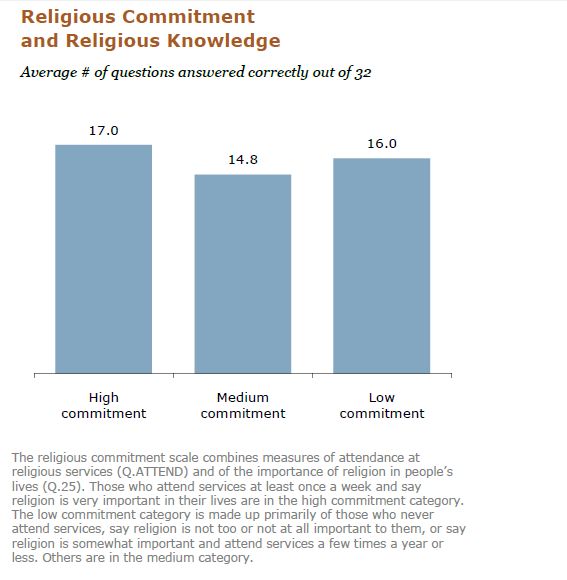
I was reminded of this recently when I followed a link to a Pew quiz on religious knowledge. It’s a lite version of the 32-item quiz Pew used with a national sample in 2010.  One of the findings from that survey (the full report is here) was that people who went to church regularly and who said that religion was important in their lives didn’t do much better on the quiz than did those who had a weak attachment to church and religion.

2

The strongly committed averaged 17 correct answers out of the 32 questions; the uncommitted, 16.  This same pattern was repeated in the more recent 15-question quiz.

3

The committed may derive many things from their church attendance and faith, but knowledge of religion isn’t one of them.

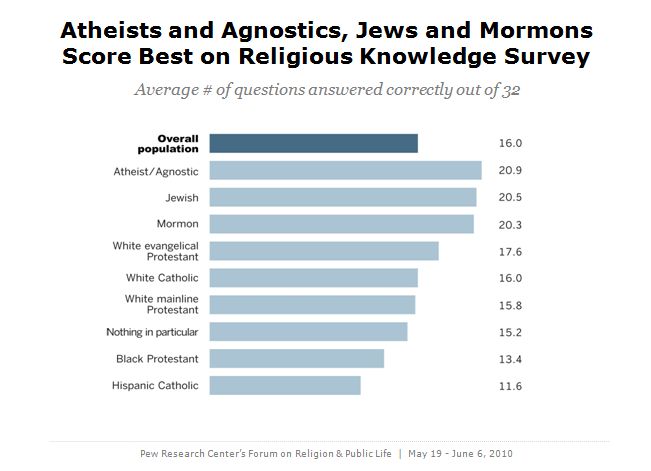
To be fair, the quiz covers many religions, and people do know more about their own religion than they do about others.  “What was Joseph Smith’s religion?” Only about half the population gets that one right, but 93% of the Mormons nailed it. Mormons also knew more about the Ten Commandments. Catholics did better than others on the transubstantiation question.  But when it came to knowing who inspired the Protestant Reformation, Protestants got outscored by Jews and atheists.

Overall, nonbelievers, Jews, and Mormons did much better than did Protestants and Catholics.

4

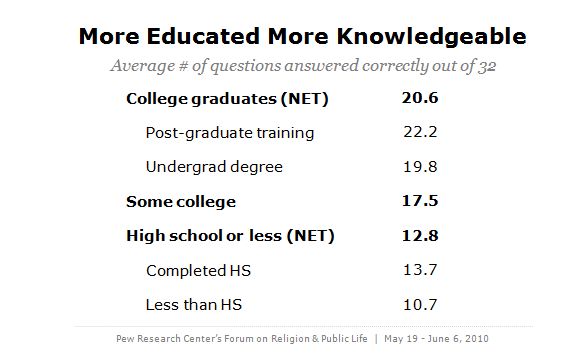
One reason for their higher scores might be education – college graduates outscore high school or less by nearly 8 points out of 32.

11

It may be that nonbelievers, Jews, and Mormons are more likely to have finished college. Unfortunately, the Pew report does not give data that controls for education.

But another reason that these groups scored higher may be their position as religious minorities. Jews and Mormons have to explain to the flock how their ideas are different from those of the majority. Atheists and agnostics too, in their questioning and even rejecting,  have probably devoted more thought to religion, or more accurately, religions. On the questions about Shiva and Nirvana, they leave even the Jews and Mormons far behind.

For Protestants and Catholics, by contrast, learning detailed information about their religion is not as crucial. Just as White people in the US rarely ask what it means to be White, Christians need not worry about their differences from the mainstream. They are the mainstream. So going to church or praying can be much more about feelings – solidarity, transcendence, peace, etc.  That variety of religious experience need not include learning the history or even the tenets of the religion itself. As Durkheim said, the central element in religion is ritual – especially the feelings a ritual generates in the group. Knowing the actual beliefs might be a nice addition, but it’s not crucial.

Jay Livingston is the chair of the Sociology Department at Montclair State University. You can follow him at Montclair SocioBlog or on Twitter.

(View original at http://thesocietypages.org/socimages)

29 Sep 22:30

Open Thread: The Vampire Squid Pwns Its (Supposed) Regulators

by Anne Laurie
Robert.mccowen

This is as depressing as it is unsurprising.

For me, the biggest failure of the Obama presidency will be that his Justice Department didn't treat the corporate officers of "too big to fail" banks the same way it treated Bernie Madoff.

Well, I joked first thing this morning about a Friday doc-dump, and (as commentor Cat pointed out) then this happened, per Annie Lowrey at NYMag:

ProPublica and “This American Life” are out with a blockbuster story, so blockbuster they got none other than Michael Lewis to tease it. It is the tale of one Carmen Segarra, a former regulator for the Federal Reserve Bank of New York. A compliance specialist, Segarra was embedded in Goldman Sachs to ensure that the megabank followed the rules.

For instance, in an incident that seems to have contributed to Segarra’s firing less than a year after she started on the job, she questioned whether Goldman had an adequate conflict-of-interest policy, ultimately determining that it did not. Her superiors pressured her to change her finding. Soon after, they canned her.

Of course, Goldman strongly disputes Segarra’s version of events, as does the New York Fed. And of course, Segarra is not an impartial observer — she’s a disgruntled former employee. But the brilliant thing is that we do not have to take her word for any of it. Shocked by what she saw, Segarra snuck a recording device into work. There are two days’ worth of tape supporting her version of events…

There will, I hope, be a lot more discussion about this over the weekend and into next week…
***********
Apart from confirming all our worst fears about the new Gilded Age, what’s on the agenda for the start of the weekend?

FacebookTwitterGoogle+Share

26 Sep 17:13

Lysistrata Was A Documentary…

by Tom Levenson

…Or so it could be, in John Scalzi’s retelling. [h/t PZ Myers]

I want to drink in that bar.

Barking_Up_the_Wrong_Tree_by_Francis_William_Edmonds_-_BMA

All of which makes this a give-Rush-Limbaugh-a-feminazi-sad open thread.

Image: Francis William Edmonds Barking up the Wrong Treebetween 1850 and 1855.

FacebookTwitterGoogle+Share


This space reserved for your ad.

26 Sep 14:21

An Anti-Feminist Walks Into a Bar: A Play in Five Acts

by John Scalzi
Robert.mccowen

The RSS version omits an important image from the Prologue: someone with the twitter handle "@MaximumTrent" posted "It's very simple, I and a growing number of men will not date feminists. Ladies, make your choices."

It's not that there's no one who will line up to be treated like shit by this guy and his "growing number of men", because people are weird like that. It's that there's an almost tragic level of hubris in assuming that some feminist out there will think "I used to believe women were human beings with agency and value, but then I discovered that men who disagreed wouldn't want to have sex with me!"

PROLOGUE

And thus did the number of women calling themselves "feminist" rocket. RT @DawnHFoster: LADIES. MAKE YOUR CHOICES. pic.twitter.com/512S3JAYeE

— John Scalzi (@scalzi) September 25, 2014

ACT I

GUY: I WILL NOT DATE YOU IF YOU ARE A FEMINIST Woman: Great! Thank you. GUY: YOU ARE NOT SUPPOSED TO REACT THAT WAY Woman: Oh, but I AM.

— John Scalzi (@scalzi) September 25, 2014

ACT II

GUY: OH HEY THERE BABY YOU LOOK LIKE YOU COULD USE COMPA- Woman: I'm a feminist. GUY: NOOOO THE BURNING MAKE IT STOP (flees) (Woman smiles)

— John Scalzi (@scalzi) September 25, 2014

ACT III

GUY: HEY THERE BAB- Woman: Feminist. GUY: LIKE A REAL FEMINIST OR ARE YOU JUST TRYING TO GET RID OF ME Women: Why not both?

— John Scalzi (@scalzi) September 25, 2014

ACT IV

GUY: HI THER- Women: Feminist. GUY: THIS WHOLE BAR CAN'T BE FULL OF FEMINISTS (Every women in bar nods) GUY: HAS THE WORLD GONE MAD

— John Scalzi (@scalzi) September 25, 2014

ACT V

GUY: I STRUCK OUT AT THE BAR BUT I HAVE THIS LOTION AND MY HAND Guy's Hand: Feminist. GUY: OH COME ON Lotion: Me too. GUY: NOOOOOOOO

— John Scalzi (@scalzi) September 25, 2014

fin


26 Sep 14:05

Late Night Fun Read: Our Guy, Barney Frank

by Anne Laurie
Robert.mccowen

Make sure you click through to the image on Twitter. Honestly I sort of think Congress needs more Barney Franks, because I'm pretty firmly convinced that sustained ridicule is the right solution to the current outbreak of Tea Party nutcases in the House.

This colorful language from @bterris's great Barney Frank in today's print WaPo is now gone from the online version. pic.twitter.com/J9H1SDzxuK

— Alec MacGillis (@AlecMacGillis) September 25, 2014

Even after the bowdlerizers got there, it’s still a fun article, for those of us who remember Rep. Frank fondly:

After retiring from Congress at the end of 2012, Barney Frank sat down to write a political memoir. As one of the first openly gay members of Congress and a lifelong fighter for LGBT rights, the former Massachusetts Democratic representative had plenty of material to work with. The only problem was his inability to use a computer.

“I usually use dictation and have someone else transcribe,” Frank, 74, said in his studio apartment in Newton, Mass. “I had to learn how to use the computer. But I was so ­club-fingered that I kept accidentally shutting the machine down.”…

“Apprasebtly, none of my Dem,crstic occllesagues fesred tghat my p;rom ince wouild cause a problem for the pastry,” he wrote of rising up the ranks in the Democratic Party. “I very much boibut that this eould have been true for an openly gay leader of a very prominent committee tnwtey years esrleir.”

It’s going to take until next spring to get this book edited and out onto shelves. Frank said he will also record the audio version, so fans can hear him narrate in his authoritative mumble.

But in the meantime, a group of about 46 bright young minds get the opportunity to hear Frank’s stories once a week firsthand. This speakeasy, a fun-yet-garbled combination of personal history, legislative battles and slightly off-color jokes, can be found Wednesday nights at the Harvard Kennedy School of Government…

“The major thing is I don’t flinch when the phone rings anymore,” Frank said in the interview from the apartment that he has been renting for the past 15 years… He spends most of his time away from this bachelor pad up in Maine with his husband. “My nerve endings were raw. When the phone rang, it was a problem I had to help resolve. I was just worn out by the end.”…

Frank may be remembered for any number of things: for being a witty, irascible debater (once he told a woman that trying to talk to her was like trying to have a debate with a dining-room table), for his work on the financial reform bill, or for his work on the gay rights movement. So what is it that he hopes he will be remembered for?

“Being smart enough to not answer a question like that,” he said.

FacebookTwitterGoogle+Share

25 Sep 14:13

The Persistence of the Old Regime

by Kieran Healy

This afternoon I ended up reading this Vox story about an effort to rank US Universities and Colleges carried out in 1911 by a man named Kendric Charles Babcock. On Twitter, Robert Kelchen remarks that the report was “squashed by Taft” (an unpleasant fate), and he links to the report itself, which is terrific. Babcock divided schools into four Classes, beginning with Class I:

And descending all the way to Class IV:

Babcock’s discussion of his methods is admirably brief (the snippet above hints at the one sampling problem that possibly troubled him), so I recommend you read the report yourself.

University reputations are extremely sticky, the conventional wisdom goes. I was interested to see whether Babcock’s report bore that out. I grabbed the US News and World Report National University Rankings and National Liberal Arts College Rankings and made a quick pass through them, coding their 1911 Babcock Class. The question is whether Mr Babcock, should he return to us from the grave, would be satisfied with how his rankings had held up—more than a century of massive educational expansion and alleged disruption notwithstanding.

It turns out that he would be quite pleased with himself.

Here is a dotplot of the 2014 USNWR National University Ranking, where the dots are color-coded for Babcock Class. There are two panels, one on the left for Private Universities, and one on the right for Public Universities. USNWR’s highest-ranked school at the moment is Princeton, and it is at the top of the dotplot. You read down the ranking from there.

You can get a larger image or a PDF version of the figure if you want a closer look at it.

As you can see, for private universities, especially, the 1911 Babcock Classification tracks prestige in 2014 very well indeed. The top fifteen or so USNWR Universities that were around in 1911 were regarded as Class 1 by Babcock. Class 2 Privates and a few Class 1 stragglers make up the next chunk of the list. The only serious outliers are the Stevens Institute of Technology and the Catholic University of America.

The situation for public universities is also interesting. The Babcock Class 1 Public Schools have not done as well as their private peers. Berkeley (or “The University of California” as was) is the highest-ranked Class I public in 2014, with UVa and Michigan close behind. Babcock sniffily rated UNC a Class II school. I have no comment about that, other than to say he was obviously right. Other great state flagships like Madison, Urbana, Washington, Ohio State, Austin, Minnesota, Purdue, Indiana, Kansas, and Iowa are much lower-ranked today than their Class I designation by Babcock in 1911 would have led you to believe. Conversely, one or two Class 4 publics—notably Georgia Tech—are much higher ranked today than Babcock would have guessed. So rankings are sticky, but only as long as you’re not public.

I also did the same figure for Liberal Arts Colleges, almost all of which are private, so this time there’s just the one panel:

You can get a larger image or a PDF version of the figure if you want a closer look at it.

Again, there is a substantial degree of stability over the course of the century. Here we see a bit more evidence of some movement up by colleges that Babcock put in Class II—Swarthmore, for example, as well as Middlebury and Pomona. The Class I schools that seem to have fallen from favor most are Knox, Lake Forest, and Goucher colleges.

Now, some caveats. First, because I was more or less coding this stuff while eating my lunch, I have not attempted to connect schools which Babcock did rate with their current institutional descendants. So, for example, some technical, liberal arts, or agricultural schools that he classified grew into or were absorbed by major state universities in the 20th century. These are not on the charts above. We are only looking at schools that existed under their current name (more or less—there are one or two exceptions) in 1911 and now. Second, higher Education in the U.S. really has changed a lot since 1911. In particular the postwar expansion of public education introduced many new and excellent public universities, and over the course of the twentieth century even some decent private ones emerged and came to prominence (such as my own, which competes with a nearby Class II school). This biases things in favor of the seeming stability of the rankings, because in his own data Babcock had the luxury of not having to classify schools that did not yet exist.

We can add these in a final, rather large, chart for the National University data.

You can get a larger image or a PDF version of the figure if you want a closer look at it.

Now the coding includes the pink “None” category, which adds universities that appear in the USNWR rankings but which are not in Babcock, either because they did not exist at all in 1911, or had not yet taken their present names. In fairness to him, the new additions still leave Babcock’s classification looking pretty good. On the private side, Duke, Caltech, and Rice are added to the upper end of the list, and a number of new private schools further down.

Meanwhile on the public side you can see the appearance of the 20th century schools, most notably the whole California system. The UC System is an astonishing achievement, when you look at it, as it propelled five of its campuses into the upper third of the table to join Berkeley. But the status ordering that was—take your pick; these data can’t settle the question—observed, intuited, or invented by Babcock a century ago remains remarkably resilient. The old regime persists.

Note: Updated August 8th to correct some coding errors.

24 Sep 22:12

Open Thread: Terrible People with Terrible Ideas

by Anne Laurie
Robert.mccowen

Add "history of mercenary armies" to the things about which Bill O'Reilly is entirely ignorant, I guess.

Media Matters, with the nut graph:

… On the September 22 edition of his show, O’Reilly claimed that the only credible plan to defeat the Islamic State had to include a mercenary force of 25,000 “English-speaking” fighters that would be recruited and trained by the United States. O’Reilly explained that his mercenary army would be comprised of “elite fighters who would be well-paid, well-trained to defeat terrorists all over the world.”…

(Video at the link, in case you don’t believe them.)

Steve Benen is beyond dubious:

… For some reason, CBS was impressed enough with O’Reilly’s idea that the Fox News host appeared on “CBS This Morning” today where he touted his mercenary approach all over again. “It’s going to happen,” O’Reilly said this morning. “This anti-terror army is going to happen.”

I really doubt that.

In fact, after unveiling his preferred approach, O’Reilly sought an assessment from U.S. Naval War College Professor Tom Nichols. The guest responded, with a polite tone, “Well, Bill, I understand your frustration. I really do. But this is a terrible idea, a terrible idea not just as a practical matter but a moral matter. It’s a morally corrosive idea to try to outsource our national security. This is something Americans are going to have to deal for themselves. We’re not going to solve this problem by creating an army of Marvel Avengers or the Guardians of the Galaxy.”…

.@billmon1 Pretty sure I liked this plan better when it involved marionettes. AMERICA: FUCK YEAH.

— Doctor Memory (@Dr_Memory) September 23, 2014

FacebookTwitterGoogle+Share


This space reserved for your ad.

24 Sep 03:40

Because I Love You All So Much

by John Cole +0

I really wish I could describe how much I like this, but here are iconic portraits throughout history recreated with John Malkovich:

Gordon_Parks___American_Gothic_Washington_D.C._date_2014

Sounds great! Who the fuck is John Malkovich?

FacebookTwitterGoogle+Share


This space reserved for your ad.

23 Sep 19:21

NERDS.

by PZ Myers

Ancient nerds. Look at this: an icosahedral die from somewhere between 30 and 300 BCE. Egyptians were throwing d20s back before Jesus worshippers founded the cult that would eventually call D&D satanic.

icosahedraldice

“You’ll have to roll a θ to hit that lemure, dude.”

22 Sep 19:46

Friday Recipe Exchange: Apples, Bourbon and Caramel

by Anne Laurie
Robert.mccowen

Shared, again, for easy access. I want to start using my skillet for more things, in part because it's versatile enough to do stovetop and oven, and partly because it's the best piece of cookware I own.

tamara caramel-apple-crisp

From our Food Goddess, TaMara:

We have a city apple orchard. I’ve cycled by it for years, didn’t give it much thought except to wonder what the city did with them every year. This year I found out. Seems the weather has created a bumper crop so the city put out a reminder that these apples were there for everyone, they were pesticide free and please, please, please come pick some because there were so many they were breaking branches.
tamara applepicking2upb1

Photo from City of Longmont

We headed over and picked a few last weekend and I decided that apples would make the perfect topic for tonight’s recipe exchange. I’ve got some old favorites and some old favorites with a new twist, including tonight’s featured recipe, Caramel Apple Crisp, pictured at top.

Let’s start with one that is perfect around this time of year when mini chocolates abound, Baked Snicker Apples, recipe here.

Mouth-watering is the only way to describe, Mrs. J’s Famous Apple Pie, click here.

I have bourbon, I have apples, seems I need to make some Bourbon Bake Apples, recipe here.

Totally not apple related, the weekly menu this week was Spaghetti and Meat Sauce, recipes and shopping list here.

What’s on your menu? Now that the weekend means autumn is official, what are some of your favorite fall recipes?

For tonight’s featured recipe, I wondered what would happen if I added caramels to my favorite apple crisp. It was amazing. Great flavor without being too sweet. I reduced the sugars to adjust for the caramels. I’ll do this one again:
tamara apple-crisp-cast-iron
Cast Iron Caramel Apple Crisp
2 lbs apples – mix of sweet and tart (about 3 apples)
2 tbsp butter
1 tbsp granulated sugar
dash of salt, cinnamon, nutmeg and ginger to taste
10 caramels, unwrapped
2 tbsps of cream

Topping:
1/3 cup brown sugar
1/2 cup butter, melted
1 cup rolled oats (not instant)
1 cup flour
10 inch cast iron skillet and small mixing bowl

Core and cut apples into small pieces (about 1/2 inch). Peeling is optional, but with this method the peels cook nice and soft, so it isn’t necessary.

Melt butter in skillet, add apples and sugar, stir until apples are well coated. Cover and cook on medium heat until apple mixture is soft and caramelized, stirring occasionally. About 20-30 minutes.

While the apples are cooking, melt the caramels and cream over medium heat, stirring until smooth. If you spray the pan with cooking oil before melting caramels, cleanup is easier. Pour over apples just before adding crumble mixture.
tamara caramel-apples
In mixing bowl, stir together butter, sugar, flour and oats, mix until crumbly. Crumble over the apple mixture. Bake for 10-15 minutes in a 400 degree oven, just until top is crispy golden brown. Let cool 10 minutes and serve warm.

What makes this so good is that because the apples are cooked on the stovetop, you can use a much higher heat in the oven and get a good, crisp top without drying the whole mixture out or under cooking the apples. Really, this is one of the best apple crisps I’ve made.

Alternately, if you don’t have an oven-proof skillet, you can transfer the cooked apple mixture to a glass baking dish, add topping and bake that way.

No Bixby Diary this week, I’ll make up for it next week. Until then….TaMara

FacebookTwitterGoogle+Share


This space reserved for your ad.
21 Sep 13:14

Sack

by Erik Loomis
Robert.mccowen

For those who don't pay attention to football, in brief: Michael Sams is the first out gay player in the NFL, and Johnny Manziel is a self-aggrandizing moron. And that's a damn fine sack.

19 Sep 14:25

Annals of Choot-Spa

by Betty Cracker
Robert.mccowen

So let me get this straight:

(1) Cliven Bundy believes that he is not obligated to pay the state when using federal property as pastureland.

(2) Cliven Bundy also believes that the state is responsible for maintenance of fences on the federal property he uses as pastureland.

(3) In the event that maintenance fails and allows a cow--a heavy and terminally stupid obstacle--to wander across an interstate highway, he not only believes he's not responsible for making good on the damages but believes that he is entitled to redress for the death of his livestock.

Someone please explain to me again how the right wing is all about taking personal responsibility rather than accepting handouts and blaming others, because I think I must have lost the thread here.

Welfare rancher Cliven Bundy not only demands that the gubmint provide free pastureland for his cattle because freedom, he expects the feds to maintain fences to keep his mendicant moo-cows off the gubmint interstate:

A Las Vegas woman has sued Cliven Bundy after she crashed into one of his cows on Interstate 15.

Danielle Beck was riding in a car that collided with the animal April 14, two days after federal authorities backed down from an armed confrontation with the scofflaw rancher and his supporters in a dispute over unpaid grazing fees, reported the Las Vegas Review-Journal.

The cow was killed [:(], and the 40-year-old Beck suffered broken bones and other injuries when her boyrfiend crashed into the livestock and drove over an embankment about 10 miles from Bundy’s ranch in Bunkerville.

[snip]

“It’s a state problem, it’s not our problem,” Bundy said. “We really feel bad when it happens. We sure don’t want it to happen, but we’re not liable.”

[snip]

Bundy said he was within his rights to make a claim against Beck for the loss of his livestock.

“The person whose car hit that cow is liable to me,” Bundy said.

That cow might be alive today if the feds hadn’t backed down. (Or it might be a pot roast.) Anyway, can this fucking mooooocher finally go to jail now?

Christ, I can only imagine the reception I’d get if I refused to pay taxes for 20 years and then demanded that the government shoo my chickens out of the street. I guess I need moar guns!

FacebookTwitterGoogle+Share

17 Sep 17:11

Friday Recipe Exchange: Chicken Buttermilk Biscuit Pie

by Anne Laurie
Robert.mccowen

Shared so I can easily find it later. I intend to make this later this week; it seems like a cramped-schedule-friendly version of chicken pot pie, which I adore.

tamara chicken-biscuit-pie_snapseed1

From our Food Goddess, TaMara:

They were predicting snow today, it did not show up, but it’s unseasonably cold. SNOW. I am not ready. But it does put me in the mood for cool weather recipes. Soups and tonight’s featured recipe, easy Chicken and Buttermilk Biscuit Pot Pie.

Life has been hectic, I’ve been busy with house hunting, work and of course the puppy, so I’ve kept meals simple. I haven’t linked to it in a while, but I have a bunch of tips for keeping meals quick, easy and full of flavor right here, which may come in handy now that school and activities are back in full swing.

For the dog lovers, Bixby updates are here and here. He’s now 33 34 lbs and so smart, he’s been a breeze to train.

On to the recipes. Soup is what I miss most in summer, so as soon as the temperatures dip, I break out the soup recipes. Here are three for you:

Cream of Chicken Soup (recipe here).

Spicy Black Bean Soup (recipe and full dinner menu here)

Chicken Tortilla Soup (recipe here)

What’s the weather like in corner of the planet? What’s on your plate for the weekend? Hit the comments and share some of your favorite fall recipes.

For tonight’s featured recipe, I brought together some of my favorite comfort foods into one dish. If you don’t have an oven-safe skillet, you can transfer the chicken mixture to a baking dish and top with biscuits.
tamara chicken-and-biscuits_snapseed2

Chicken and Buttermilk Biscuit Pot Pie

2 boneless chicken breasts, cut into 1 inch pieces
2 boneless chicken thighs, cut into 1 inch pieces
Salt & pepper
1 tablespoon olive oil
1 tablespoons butter
1/2 small onion, diced
2 stalks celery, diced
2 cups sliced carrots (frozen ok)
2 tsp crushed garlic
¼ cup all-purpose flour
2 cups chicken stock or canned low-sodium chicken broth
2 large Yukon Gold Potatoes, scrubbed and diced
1 1/2 tsp poultry seasoning
1/2 cup peas (frozen ok)

Set a 10-inch cast-iron skillet over medium-high heat

In a large bowl, combine the chicken with salt, pepper and olive oil. Sear chicken in pan, stirring occasionally, until the chicken begins to brown, 3 to 4 minutes. Remove the chicken and set aside in a separate bowl. Add butter to the pan and, when melted, add the onion, carrot, celery, and garlic, stirring occasionally, until lightly caramelized, 4 to 5 minutes. Add the flour and cook, stirring for 1 minute. Add the stock, browned chicken, potatoes, and spices.

Bring the liquid to a boil, reduce heat so that the sauce just simmers, and cook, stirring occasionally, until the chicken and potatoes are tender…about 25-35 minutes.

While it simmers, prepare Buttermilk Biscuits, below.

Just before adding biscuits, fold peas into chicken mixture and then remove the pan from the heat.

Preheat oven to 450 degrees.

Place the biscuits on top of the chicken and gravy, with 6 biscuits around the edge of the pan and the remaining 4 biscuits in the center (if you have a left over biscuit or two, bake on a separate baking sheet). Be sure the biscuits do not touch, so they cook thoroughly. Brush the tops of the biscuits with the melted butter and bake until the biscuits are golden brown and flaky…14 to 15 minutes. Allow the pot pie to cool briefly before serving. Makes 4-6 servings.

Buttermilk Biscuits:
2 cups flour
3 tsp baking powder
¼ tsp baking soda
1/3 cup shortening
¾ cup milk
4 tbsp powdered buttermilk
2 tbsp melted butter to brush on formed biscuits

Mix dry ingredients, make a center hole in the dry ingredients and add in shortening and milk. Blend together, then knead 10-12 strokes on a floured surface, roll out to ½” thick, cut into 8-10 biscuits.

That’s it for this week. Have great weekend. – TaMara

FacebookTwitterGoogle+Share

17 Sep 15:18

Long Read: “The Last Amazon”

by Anne Laurie

Diana Prince fans, represent! My heart will always be with the “controversial” womyn’s-libber WW of my teenage years, primed by fuzzy memories of reprints of the 1940s Nazi-fighting WW. But Wonder Woman’s history, and her creator’s, is a lot stranger than I ever knew. Historian Jill LePore, in the New Yorker, on “Wonder Woman’s Secret Past“:

… The much cited difficulties regarding putting Wonder Woman on film—Wonder Woman isn’t big enough, and neither are Gal Gadot’s breasts—aren’t chiefly about Wonder Woman, or comic books, or superheroes, or movies. They’re about politics. Superman owes a debt to science fiction, Batman to the hardboiled detective. Wonder Woman’s debt is to feminism. She’s the missing link in a chain of events that begins with the woman-suffrage campaigns of the nineteen-tens and ends with the troubled place of feminism a century later. Wonder Woman is so hard to put on film because the fight for women’s rights has gone so badly…

Wonder Woman’s origin story comes straight out of feminist utopian fiction. In the nineteenth century, suffragists, following the work of anthropologists, believed that something like the Amazons of Greek myth had once existed, a matriarchy that predated the rise of patriarchy. “The period of woman’s supremacy lasted through many centuries,” Elizabeth Cady Stanton wrote in 1891. In the nineteen-tens, this idea became a staple of feminist thought. The word “feminism,” hardly ever used in the United States before 1910, was everywhere by 1913. The suffrage movement had been founded on a set of ideas about women’s supposed moral superiority. Feminism rested on the principle of equality. Suffrage was a single, elusive political goal. Feminism’s demand for equality was far broader. “All feminists are suffragists, but not all suffragists are feminists,” as one feminist explained. They shared an obsession with Amazons…

In 1917, when motion pictures were still a novelty and the United States had only just entered the First World War, Sanger starred in a silent film called “Birth Control”; it was banned. A century of warfare, feminism, and cinema later, superhero movies—adaptations and updates of mid-twentieth-century comic books whose plots revolve around anxieties about mad scientists, organized crime, tyrannical super-states, alien invaders, misunderstood mutants, and world-ending weapons—are the super-blockbusters of the last superpower left standing. No one knows how Wonder Woman will fare onscreen: there’s hardly ever been a big-budget superhero movie starring a female superhero. But more of the mystery lies in the fact that Wonder Woman’s origins have been, for so long, so unknown. It isn’t only that Wonder Woman’s backstory is taken from feminist utopian fiction. It’s that, in creating Wonder Woman, William Moulton Marston was profoundly influenced by early-twentieth-century suffragists, feminists, and birth-control advocates and that, shockingly, Wonder Woman was inspired by Margaret Sanger, who, hidden from the world, was a member of Marston’s family…

Marston was also what we’d now call a polyamorist:

In 1915, Marston married Elizabeth Holloway, who’d just graduated from Mount Holyoke, where she studied Greek, read Sappho, and became a feminist. Her hero was Mary Woolley, who lived for fifty-five years with Jeannette Marks, an English professor and an ardent suffragist. “Feminism is not a prejudice,” Woolley explained. “It is a principle.”…

… [I]n 1925, he fell in love with one of his students: [Sanger's sister and co-protestor] Ethel Byrne’s daughter Olive…

In 1926, Olive Byrne, then twenty-two, moved in with Marston and Holloway; they lived as a threesome, “with love making for all,” as Holloway later said. Olive Byrne is the mother of two of Marston’s four children; the children had three parents. “Both Mommies and poor old Dad” is how Marston put it…

While their relationship was never officially public (“The whys and wherefores of the family arrangements were never discussed with the kids—ever,” [son] Pete says.”), it was open enough to eventually destroy Marston’s academic career in psychology. Holloway provided the growing family with a steady income working for an insurance agency; Byrne took care of the children and the household, supplemented by writing for magazines; Marston bounced from short-term teaching assignments to projects in most of the available pop-cult media (public lectures, the last of the vaudeville circuit, silent movies). And then…

In 1940, M. C. Gaines, who published Superman, read an article in Family Circle by Olive Byrne. She’d been worried by reading in the papers that comic books were dangerous, and that Superman was a Fascist. “With terrible visions of Hitlerian justice in mind,” she wrote in Family Circle, “I went to Dr. Marston.”…

Gaines decided to hire Marston as a consultant. Marston convinced Gaines that what he needed, to counter the critics, was a female superhero. The idea was for her to become a member of the Justice Society of America, a league of superheroes that held its first meeting in All-Star Comics No. 3, in the winter of 1940: “Each of them is a hero in his own right, but when the Justice Society calls, they are only members, sworn to uphold honor and justice!” Wonder Woman’s début appeared in December, 1941, in All-Star Comics No. 8. On the eve of the Second World War, she flew her invisible plane to the United States to fight for peace, justice, and women’s rights. To hide her identity, she disguised herself as a secretary named Diana Prince and took a job working for U.S. Military Intelligence… Drawn by an artist named Harry G. Peter, who, in the nineteen-tens, had drawn suffrage cartoons, she looked like a pinup girl. She’s Eleanor Roosevelt; she’s Betty Grable. Mostly, she’s Margaret Sanger…

Much, much more at the link….including eighty-three-year old Byrne Holloway Marston’s suggestion for today’s big-screen Wonder Woman.

FacebookTwitterGoogle+Share


This space reserved for your ad.

12 Sep 19:35

Togo in Retrospect

by Robert Farley
Robert.mccowen

Possibly of interest to Adam.

I have a piece up on the National Interest on the legacies of the Russo-Japanese War:

The Russo-Japanese War commenced 110 years ago this February, lasting eighteen months before a US-brokered truce mercifully put it to rest. The war killed upwards of 125,000 people, and sharply limited Russian influence in Northeast Asia. Japan gained control of Korea, and gained a long-term foothold for influencing events in Manchuria and China.

Writers have ascribed many legacies to the conflict, some of which we can set aside. Victory against Japan probably would not have prevented the collapse of Imperial Russia and the founding of the Soviet Union; the Revolution happened for other reasons. Moreover, the conflict did not give the Central Powers a “window of opportunity” for defeating Russia in Europe; we now know that Vienna and Berlin over-estimated, rather than under-estimated, Russian power in 1914. Defeat might conceivably have broken Japanese militarism for a time, but the weakness of China and of the European colonial empires would likely have proven too tempting for Tokyo in any case.


06 Sep 19:36

Open Thread

by Soonergrunt
Robert.mccowen

Okay, so first: obviously this is horrible, and I'm not sure why the governor hasn't done something--not sure about the legality, but wouldn't it be possible to do something like call in state police to manage the crisis?

But second, I think it actually IS pretty revealing that the usual Second Amendment... "advocates" is a more polite term than "fetishists", I suppose... aren't lending their voices to people currently being actually oppressed by an actual government paramilitary force.

The list of things about our country's politics that can't be explained in large part by racism is a depressingly short one.

At the Bundy ranch, white anti-government militia wanna-bes pointed loaded firearms at federal employees and law enforcement officers in the support of a criminal, and nothing happened.

In Ferguson, MO, a young African American was killed by a police officer for jaywalking, and the city and county police have attacked the mostly African American citizens with baton rounds, tear gas, armored vehicles, and riot gear while threatening them with automatic rifles.

Where are all the 2nd Amendment open carry zealots to defend people who are actually under attack by an out of control government?

Yeah, I thought so.

I’ll just note that Ferguson PD and St. Louis County PD brought heavier gear to a civil protest than I had to fight the Taliban and Iraqi insurgents.  My troops however, were better trained and disciplined.  Most of the Vets that I’ve been tweeting with back and forth throughout the day and evening are shocked at the police tactics throughout the day. We were taught to diffuse tensions when dealing with agitated civilians and civil disturbance and the actions of local law enforcement in in the Ferguson area seem geared to inflame the situation.

Ryan J. Reilly, who was arrested and released earlier this evening reports that a peaceful protest is currently taking place across the street from the main police station in Ferguson.

Anyway, open thread.


UPDATE: Governor Jay Nixon (D-MO) has finally issued a statement.

FacebookTwitterGoogle+Share


This space reserved for your ad.