Robert.mccowen
Shared posts
18 Apr 13:54
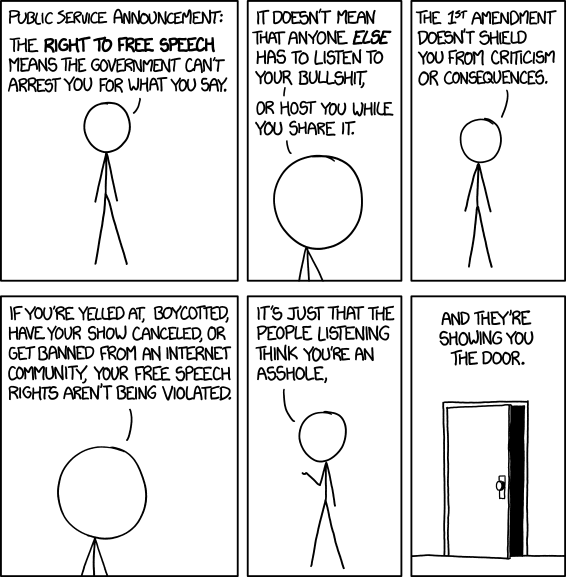
Free Speech
Robert.mccowenIs there any way we can have this permanently tattooed on the back of Sarah Palin's hand? You know, as a handy reference for her?
16 Apr 21:59
This space reserved for your ad.
Completely Out of Control
by evolved beyond the fist mistermix
Robert.mccowenSpeaking of Heartbleed, and also of our apparently out-of-control intelligence community:
The U.S. National Security Agency knew for at least two years about a flaw in the way that many websites send sensitive information, now dubbed the Heartbleed bug, and regularly used it to gather critical intelligence, two people familiar with the matter said. [...]
Putting the Heartbleed bug in its arsenal, the NSA was able to obtain passwords and other basic data that are the building blocks of the sophisticated hacking operations at the core of its mission, but at a cost. Millions of ordinary users were left vulnerable to attack from other nations’ intelligence arms and criminal hackers.
“It flies in the face of the agency’s comments that defense comes first,” said Jason Healey, director of the cyber statecraft initiative at the Atlantic Council and a former Air Force cyber officer. “They are going to be completely shredded by the computer security community for this.”
At some point the NSA’s computer security mission should trump their eavesdropping mission. I would have though that point would be have been when the bulk of our networking and finance infrastructure is exposed to every hacker in the world. Since that wasn’t the case in one of the most serious and real security breaches in the history of the Internet, the obvious conclusion is that the NSA puts absolute primacy on their ability to eavesdrop, the security of US citizens and corporations be damned.


This space reserved for your ad.
10 Apr 23:07


Texas’ Pathetic War Record
by Erik Loomis
Robert.mccowenInteresting article… now I sort of want to set an RPG campaign in the Republic of Texas.
The Texas Republic was really terrible at war.
But the idea of Texas being born from military achievement is variously true and also blown out of all proportion to reality. With the exception of the coup at San Jacinto, Texas’s early military history was a series of overlooked disasters, led by men who blundered their way into defeats. It’s also a fascinating overview of how warfare—especially when canonized—is almost invariably a series of tragedies and screw-ups.
Texas has plenty of both.
This isn’t even controversial. More than a decade ago, Texas Monthly declared the suicidal decision to defend the Alamo against vastly superior Mexican forces “a military mistake of mythic proportions” and that its “contribution to the strategy of the Texas Revolution was nil or negative.”
In its brief, 10-year existence as an independent state, Texas would launch two failed invasions—one in southern Texas and another in New Mexico. It also failed to stop two more Mexican invasions. And then the Lone Star state would fight several minor wars with itself and almost come to blows with the United States.
Of course, the ability of Texans to lead the U.S. in war since it joined the nation has never been questioned.
    
|
08 Apr 03:20

Monday Morning Open Thread: Nancy Smashing
by Anne Laurie
Robert.mccowen"…most people didn't know what that meant, so it didn't matter." Oh, SNAP!
(via Washington Post)
Over the weekend, the NYTimes fashion section decided to do one of their “power luncheon” interviews with Julia Louis-Dreyfus (star of VEEP, returning for its third season) and Nancy Pelosi (House minority leader). It’s instructive to see how far we’ve come, and how far we have yet to go:
…[NYT interviewer] Philip Galanes: Why do you think shows about Washington politics are so popular right now? “Veep,” “Scandal,” “House of Cards” …
Julia Louis-Dreyfus: Well, politics has become more contentious than ever. Maybe people need to see that played out, comedically or dramatically, as a sort of a cultural catharsis. That sounds lofty. But there are such extreme points of view these days, and dialogue doesn’t seem to be happening.
Nancy Pelosi: Not since President Obama was elected. We [Democrats] actually worked well with President Bush. We disagreed with him on a number of issues — the Iraq War, privatizing Social Security — but we still got things done. Now the level of obstruction is stunning. But let me say something else about these shows: Women have emerged so much. The prospect of a woman president, a woman speaker, more women in Congress — still not enough, don’t get me wrong…
*****
NP: I can remember, in the beginning, going to these huge congressional dinners, and there would be two tiny tables of women. Then as we started getting more numbers, the men were like, “What’s going on here?” And when I ran for leadership, it was worse. The men said, “Who said she could run?”JLD: Did anybody actually say that?
NP: Yeah, “Who said she can run?” They said to me: “Why don’t you just tell us the things you want changed, and we’ll do them.” I thought: I don’t think so!
PG: Here’s something you have in common: People think they’ve got you pegged, but you exceed the peg every time. Nancy was supposed to be this ultraliberal dilettante, but you whip the votes better than anyone, and –
NP: Yeah, they said I was a dilettante, but most people didn’t know what that meant, so it didn’t matter. They said, “Does that mean you’re a debutante?” I said, “No, it doesn’t.”…
NP: You have to remember, generationally, I come to this as a confident mother of five, chairman of the [California Democratic] Party. But when I came to Congress to be sworn in, my colleagues said: “Don’t talk. Just say ‘yes’ when they say, ‘Do you solemnly swear?’ ” So after I was sworn in, the speaker said, “Does the fine lady, our newest member, wish to address the House?” Everybody said, “Don’t.” But I went to the podium, and I acknowledged my father, who had been a member of Congress, my family and constituents, and I said, “I told my constituents when I came here, I was coming to fight against H.I.V. and AIDS.” Period, end of speech. So I sit down and look over to all these people, thinking: That was short, right? They’re going: “Ugh!”
PG: That was bold in 1987.NP: Given what was going on in our district [in San Francisco], I knew I had a big mission with H.I.V./AIDS. But what was even bigger than the scientific challenges was the attitude, the discrimination.
JLD: But when you got the response you got, was there a moment when you thought: Uh-oh?
NP: Not at all. It was the easiest thing in the world. I thought: “Good thing I’m here. We have important work to do.” So, in a way, talking about AIDS trumped being a woman…
Let’s take a moment to think about that: Twenty years from “Who said she could run?” to “Congratulations, Madame Speaker”. Nancy, in every sense of the word, smashing!
**********
And so… What’s on the agenda for the start of another week?
07 Apr 17:05
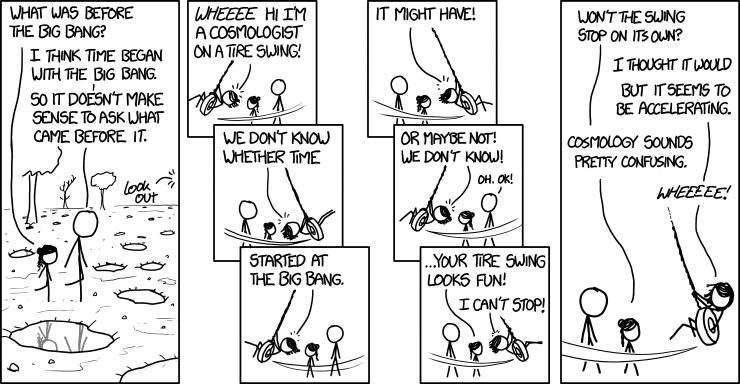
Cosmologist on a Tire Swing
Robert.mccowenI understood the gravity (heh) of the recent BICEP2 experiment better than almost anyone I know… which doesn't mean I understood it very well.
Alvetica, Seth Koenig and 8 others like this
04 Apr 16:48
This space reserved for your ad.
Slouching Toward Plutocracy…
by Betty Cracker
Robert.mccowenMcCutcheon v Federal Election Commission: http://www.supremecourt.gov/opinions/13pdf/12-536_e1pf.pdf
Is there any kind of pressure Obama can put on Kennedy to retire?
Via the NYT, breaking news:
WASHINGTON — The Supreme Court on Wednesday issued a major campaign finance decision, striking down limits on federal campaign contributions for the first time. The ruling, issued near the start of a campaign season, will change and most likely increase the role money plays in American politics.
Aaaand wait for it:
The decision, by a 5-to-4 vote along ideological lines…
The ways of the Flying Spaghetti Monster are mysterious, but if He could see fit to, as a BJ commenter once suggested, smite a certain corpulent jurist via Fettuccine Alfredo within the next year or so, it would be an exquisitely well-timed deus ex pastana.
This space reserved for your ad.
03 Apr 20:43
This space reserved for your ad.
LPD
by John Cole
The whole concept of the Libertarian Police Department is so awesome that I was afraid this piece would not live up to my expectations. I was wrong:
was shooting heroin and reading “The Fountainhead” in the front seat of my privately owned police cruiser when a call came in. I put a quarter in the radio to activate it. It was the chief.
“Bad news, detective. We got a situation.”
“What? Is the mayor trying to ban trans fats again?”
“Worse. Somebody just stole 474 million dollars’ worth of bitcoins.”
The heroin needle practically fell out of my arm. “What kind of monster would do something like that? Bitcoins are the ultimate currency: virtual, anonymous, stateless. They represent true economic freedom, not subject to arbitrary manipulation by any government. Do we have any leads?”
“Not yet. But mark my words: we’re going to figure out who did this and we’re going to take them down… provided someone pays us a fair market rate to do so.”
“Easy, chief,” I said, “Any rate the market offers is, by definition, fair.”
He laughed. “That’s why you’re the best I got, Lisowski. Now you get out there and find those bitcoins.”
“Don’t worry,” I said. “I’m on it.”
I put a quarter in the siren. Ten minutes later, I was on the scene. It was a normal office building, strangled on all sides by public sidewalks. I hopped over them and went inside.
“Home Depot™ presents The Police!®” I said, flashing my badge and my gun and a small picture of Ron Paul. “Nobody move unless you want to!” They didn’t.
The only thing missing was a leather coat or Fonzi reference.
(via Gary Farber)
This space reserved for your ad.
03 Apr 12:30


Other People's Pathologies
by Ta-Nehisi Coates
Robert.mccowenLong read; worth it.
Over the past week or so, Jonathan Chait and I have enjoyed an ongoing debate over the rhetoric the president employs when addressing African Americans. Here is my initial installment, Chait's initial rebuttal, my subsequent reply, and Chait's latest riposte. Initially Chait argued that President Obama's habit of speaking about culture before black audiences was laudable because it would "urge positive habits and behavior" that are presumably found especially wanting in the black community.
Chait argued that this lack of sufficient "positive habits and behaviors" stemmed from cultural echoes of past harms, which now exist "independent" of white supremacy. Chait now concedes that this assertion is unsupportable and attempts to recast his original argument:
I attributed the enduring culture of poverty to the residue of slavery, terrorism, segregation, and continuing discrimination.
Not quite (my emphasis):
The argument is that structural conditions shape culture, and culture, in turn, can take on a life of its own independent of the forces that created it. It would be bizarre to imagine that centuries of slavery, followed by systematic terrorism, segregation, discrimination, a legacy wealth gap, and so on did not leave a cultural residue that itself became an impediment to success.
The phrase "culture of poverty" doesn't actually appear in Chait's original argument. Nor should it—the history he cites was experienced by all variety of African Americans, poor or not. Moreover, the majority of poor people in America have neither the experience of segregation nor slavery in their background. Chait is conflating two different things: black culture—which was shaped by, and requires, all the forces he named; and "a culture of poverty," which requires none of them.
That conflation undergirds his latest column. Chait paraphrases my argument that "there is no such thing as a culture of poverty." His evidence of this is quoting me attacking the "the notion that black culture is part of the problem." This evidence only works if you believe "black culture" and "a culture of poverty" are somehow interchangeable.
Making no effort to distinguish the two, Chait examines a piece I wrote in 2010 entitled "A Culture of Poverty" in which I sought to explain the difficulty of navigating culture in two different worlds—one in which "Thou shalt not be punked" was a commandment, and another where violence was best left to the authorities:
I think one can safely call that an element of a kind of street culture. It's also an element which—once one leaves the streets—is a great impediment. "I ain't no punk" may shield you from neighborhood violence. But it can not shield you from algebra, when your teacher tries to correct you. It can not shield you from losing hours, when your supervisor corrects your work. And it would not have shielded me from unemployment, after I cold-cocked a guy over a blog post.
Chait calls this one of the most "memorable essays" he's ever read. This is too kind—both to my writing and to his memory. Chait reads the piece as evidence of having "grown up around cultural norms that inhibited economic success." In fact, my behavior was the result of having grown up around cultural norms that enabled my survival. I said as much in the original piece:
The problem is that rarely do such critiques ask why anyone would embrace such values. Moreover, they tend to assume that there's something uniquely "black" about those values, and their the embrace. If you are a young person living in an environment where violence is frequent and random, the willingness to meet any hint of violence with yet more violence is a shield.
I repeated the same thing two years later:
Using the wrong tool for the job is a problem that extends beyond the dining room. The set of practices required for a young man to secure his safety on the streets of his troubled neighborhood are not the same as those required to place him on an honor roll, and these are not the same as the set of practices required to write the great American novel. The way to guide him through this transition is not to insult his native language.
And then again last May:
For black men like us, the feeling of having something to lose, beyond honor and face, is foreign. We grew up in communities—New York, Baltimore, Chicago—where the Code of the Streets was the first code we learned. Respect and reputation are everything there. These values are often denigrated by people who have never been punched in the face. But when you live around violence there is no opting out. A reputation for meeting violence with violence is a shield. That protection increases when you are part of a crew with that same mind-set. This is obviously not a public health solution, but within its context, the Code is logical. Outside of its context, the Code is ridiculous.
The point has obviously eluded Chait. Instead of considering that I may well have been responding to my actual lived circumstances, Chait chooses to assume that I was responding to some inscrutable call of the wild:
When the imprint of this culture was nearly strong enough to derail the career of a writer as brilliant as Coates, we are talking about a powerful force, indeed.
What's missed here is that the very culture Chait derides might well be the reason why I am sitting here debating him in the first place. That culture contained a variety of values and practices. "I ain't no punk" was one of them. "Know your history" was another. "Words are beautiful" was another still. The key is cultural dexterity—understanding when to emphasize which values, and when to employ which practices.
Chait endorses a blunter approach:
The circa-2008 Ta-Nehisi Coates was neither irresponsible nor immoral. Rather, he had grown up around cultural norms that inhibited economic success. People are the products of their environment. Environments are amenable to public policy. Some of the most successful anti-poverty initiatives, like the Harlem Children’s Zone or the KIPP schools, are designed around the premise that children raised in concentrated poverty need to be taught middle class norms.
No, they need to be taught that all norms are not transferable into all worlds. In my case, physical assertiveness might save you on the street but not beyond it. At the same time, other values are transferrable and highly useful. The "cultural norms" of my community also asserted that much of what my country believes about itself is a lie. In the spirit of Frederick Douglass, Ida B. Wells, and Malcolm X, it was my responsibility to live, prosper, and attack the lie. Those values saved me on the street, and they sustain me in this present moment.
People who take a strict binary view of culture ("culture of privilege = awesome; culture of poverty = fail") are afflicted by the provincialism of privilege and thus vastly underestimate the dynamism of the greater world. They extoll "middle-class values" to the ignorance and exclusion of all others. To understand, you must imagine what it means to confront algebra in the morning and "Shorty, can I see your bike?" in the afternoon. It's very nice to talk about "middle-class values" when that describes your small, limited world. But when your grandmother lives in one hood and your coworkers live another, you generally need something more than "middle-class values." You need to be bilingual.
In 2008, I was living in central Harlem, an area of New York whose demographics closely mirrored the demographics of my youth. The practices I brought to bear in that tent were not artifacts. I was not under a spell of pathology. I was employing the tools I used to navigate the everyday world I lived. It just so happened that the world in which I worked was different. As I said in that original piece, "There is nothing particularly black about this." I strongly suspect that white people who've grown up around entrenched poverty and violence will find that there are certain practices that safeguard them at home but not so much as they journey out. This point is erased if you believe that "black culture" is simply another way of saying "culture of poverty."
This elision is not particular to Chait. In the 1960s, when 20 percent of black children were found to be born out of wedlock, progressives went to war over the "tangle of pathologies" choking black America. Today, 30 percent of white children are being born out of wedlock. The reaction to this shift has been considerably more muted. This makes sense if you believe that pathology is something reserved for black people. When The New Republic wanted to dramatize the evils of AFDC, there was really no doubt about whose portrait they'd pick.
Accepting the premise that "black culture" and "a culture of poverty" are interchangeable also has the benefit of making the president's rhetoric much more understandable. One begins to get why the president would address a group of graduates from an elite black college on the tendency of young men in the black community to make "bad choices." Or why the president goes before black audiences and laments the fact that the proportion of single-parent households has doubled, and carry no such message to white audiences—despite the fact that single parenthood is growing fastest among whites. And you can understand how an initiative that began with the killing of a black boy who was not poor, and who had a loving father, becomes fuel for the assertion that "nothing keeps a young man out of trouble like a father." In his best work, Chait mercilessly dissects this kind of intellectual slipperiness. Now we find him applauding it and reifying it.
"Culture is hard, though not impossible, to quantify," writes Chait. "Which does not mean it doesn’t exist." Indeed. I have done my best to identify specific cultural practices and outline how they work in different worlds. Much of that evidence is built on memoir, and thus necessarily subject to an uncomfortable vagueness.
But quantifying the breadth and effect of white supremacy suffers no such drawbacks. Some of our most celebrated scholarship—Battle Cry of Freedom, Reconstruction, The Making of the Second Ghetto, The Warmth of Other Suns, At the Hands of Persons Unknown, Family Properties, Confederate Reckoning, Black Wealth/White Wealth, American Apartheid, Crabgrass Frontier, The Origins of the Urban Crisis, When and Where I Enter, When Affirmative Action Was White—is directed toward, with great specificity, outlining the reach and effects of white supremacy.
It is not wholly surprising that Barack Obama tends not to focus on this literature, whatever its merits. I do not expect the president of the United States to make a habit of speaking unvarnished and uncomfortable truths. (Though he is often brilliant when he does.) Of course removing white supremacy from the equation puts Barack Obama in the odd position of focusing on that which is hardest to evidence, while slighting that which is clearly known.
Jonathan Chait is not a politician. He needs neither to assemble a 60-vote majority nor worry about his words affecting the midterms. I'm happy that Chait decided to engage me here on a subject that he, himself, confesses is hard to quantify. I wish I'd had his input over the past few months when I was poring over redlining maps and grappling with the racism implicit in the New Deal. I wish I'd had his input when I was attempting to understand what it meant that in 1860 this country's most valuable asset was enslaved human beings. I think had we engaged each other then, he might well not have written something like this:
It is hard to explain how the United States has progressed from chattel slavery to emancipation to the end of lynching to the end of legal segregation to electing an African-American president if America has “rarely” been the ally of African-Americans and “often” its nemesis. It is one thing to notice the persistence of racism, quite another to interpret the history of black America as mainly one of continuity rather than mainly one of progress.
This certainly is a specimen of progress—much like the ill-tempered man might "progress" from shooting at his neighbors to clubbing them and then finally settle on simply robbing them. His victims, bloodied, beaten, and pilfered, might view his "progress" differently. Effectively Chait's rendition of history amounts to, "How can you say I have a history of violence given that I've repeatedly stopped pummeling you?"
Chait's jaunty and uplifting narrative flattens out the chaos of history under the cheerful rubric of American progress. The actual events are more complicated. It's true, for instance, that slavery was legal in the United States in 1860 and five years later it was not. That is because a clique of slaveholders greatly overestimated its own power and decided to go to war with its country. Had the Union soundly and quickly defeated the Confederacy, it's very likely that slavery would have remained. Instead the war dragged on, and the Union was forced to employ blacks in its ranks. The end result—total emancipation—was more a matter of military necessity than moral progress.
Our greatest president, assessing the contribution of black soldiers in 1864, understood this:
We can not spare the hundred and forty or fifty thousand now serving us as soldiers, seamen, and laborers. This is not a question of sentiment or taste, but one of physical force which may be measured and estimated as horse-power and steam-power are measured and estimated. Keep it and you can save the Union. Throw it away, and the Union goes with it.
The United States of America did not save black people; black people saved the United States of America. With that task complete, our "ally" proceeded to repay its debt to its black citizens by pretending they did not exist. In 1875, Mississippi's provisional governor, Adelbert Ames, watched as the majority-black state's nascent democracy "progressed" from terrorism to anarchy and then apartheid. Taking in regular reports of blacks being murdered, whipped, and intimidated by the Ku Klux Klan, Ames wrote the administration of President Ulysses Grant begging for aid. The Grant Administration declined:
The whole public are tired of these autumnal outbreaks in the South, and the great majority are ready now to condemn any interference on the part of the government.
A horrified and exasperated Ames told his wife that blacks in Mississippi
... are to be returned to a condition of serfdom—an era of second slavery .... The nation should have acted but it was “tired of the annual autumnal outbreaks in the South” .... The political death of the negro will forever release the nation from the weariness from such “political outbreaks.” You may think I exaggerate. Time will show you how accurate my statements are.
Ames was totally accurate. For the next century, the United States legitimized the overthrow of legal governments, the reduction of black people to forced laborers, and the complete alienation—at gunpoint—of black people in the South from the sphere of politics.
Chait's citation of the end of lynching as evidence of America serving as an "ally" is especially bizarre. The United States never passed anti-lynching legislation, a disgrace so great that it compelled the Senate to apologize—in 2005.
"There may be no other injustice in American history," said Louisiana Senator Mary Landrieu, "for which the Senate so uniquely bears responsibility." Even then, a half century after Emmett Till's murder, the sitting senators from Mississippi—the state with the most lynchings—declined to endorse the apology.
"You don't stick a knife in a man's back nine inches," said Malcolm X, "and then pull it out six inches and say you're making progress."
The notion that black America's long bloody journey was accomplished through frequent alliance with the United States is an assailant's-eye view of history. It takes no note of the fact that in 1860, most of this country's exports were derived from the forced labor of the people it was "allied" with. It takes no note of this country electing senators who, on the Senate floor, openly advocated domestic terrorism. It takes no note of what it means for a country to tolerate the majority of the people living in a state like Mississippi being denied the right to vote. It takes no note of what it means to exclude black people from the housing programs, from the GI Bills, that built the American middle class. Effectively it takes no serious note of African-American history, and thus no serious note of American history.
You see this in Chait's belief that he lives in a country "whose soaring ideals sat uncomfortably aside an often cruel reality." No. Those soaring ideals don't sit uncomfortably aside the reality but comfortably on top of it. The "cruel reality" made the "soaring ideals" possible.
From Daniel Walker Howe's Pulitzer Prize-winning What God Hath Wrought:
By giving the United States its leading export staple, the workers in the cotton fields enabled the country not only to buy manufactured goods from Europe but also to pay interest on its foreign debt and continue to import more capital to invest in transportation and industry. Much of Atlantic civilization in the nineteenth century was built on the back of the enslaved field hand.
From Edmund Morgan's foundational American Slavery, American Freedom:
In the republican way of thinking as Americans inherited it from England, slavery occupied a critical, if ambiguous, position: it was the primary evil that men sought to avoid for society as a whole by curbing monarchs and establishing republics. But it was also the solution to one of society’s most serious problems, the problem of the poor. Virginians could outdo English republicans as well as New England ones, partly because they had solved the problem: they had achieved a society in which most of the poor were enslaved.
White supremacy does not contradict American democracy—it birthed it, nurtured it, and financed it. That is our heritage. It was reinforced during 250 years of bondage. It was further reinforced during another century of Jim Crow. It was reinforced again when progressives erected an entire welfare state on the basis of black exclusion. It was reinforced again when the intellectual progeny of the same people who excluded black women from welfare turned around and inveighed against it through caricaturization of black women.
Jonathan Chait is arguably the sharpest political writer of his generation. If even he subscribes to a sophomoric feel-good rendering of his country's past, what does that say about the broader American imagination?
And none of this is even new:
The record is there for all to read. It resounds all over the world. It might as well be written in the sky. One wishes that–Americans—white Americans—would read, for their own sakes, this record and stop defending themselves against it. Only then will they be enabled to change their lives. The fact that they have not yet been able to do this—to face their history to change their lives—hideously menaces this country. Indeed, it menaces the entire world.
James Baldwin was not being cute here. If you can not bring yourself to grapple with that which literally built your capitol, then you are not truly grappling with your country. And if you are not truly grappling with your country, then your beliefs in its role in the greater world (exporter of democracy, for instance) are built on sand. Confronting the black experience means confronting the limits of America, and perhaps, humanity itself. That is the confrontation that graduates us out of the ranks of national cheerleading and into the school of hard students.
Chait thinks this view is "fatalistic." I think God is fatalistic. In the end, we all die. As do most societies. As do most states. As do most planets. If America is fatally flawed, if white supremacy does truly dog us until we are no more, all that means is that we were unexceptional, that we were not favored by God, that we were flawed—as are all things conceived by mortal man.
I find great peace in that. And I find great meaning in this struggle that was gifted to me by my people, that was gifted to me by culture.
02 Apr 14:23
Drip Drip Drip
by evolved beyond the fist mistermix
The leaks of the Senate Intelligence Committee’s report on CIA torture are starting:
A report by the Senate Intelligence Committee concludes that the CIA misled the government and the public about aspects of its brutal interrogation program for years — concealing details about the severity of its methods, overstating the significance of plots and prisoners, and taking credit for critical pieces of intelligence that detainees had in fact surrendered before they were subjected to harsh techniques.
The report, built around detailed chronologies of dozens of CIA detainees, documents a long-standing pattern of unsubstantiated claims as agency officials sought permission to use — and later tried to defend — excruciating interrogation methods that yielded little, if any, significant intelligence, according to U.S. officials who have reviewed the document.
It’s probably just my nihilistic cynicism talking, but I’ll be surprised if any CIA management is ever held accountable for what they did.
24 Mar 18:56


More on the Contraception Non-Mandate
by Scott Lemieux
Robert.mccowenThe very first link is a good one.
I'm not even really sure why the SC is hearing this case, and the fact that at least four justices were convinced to grant certiorari concerns me.
Before tomorrow’s oral arguments,let me note again that people interested in the latest ad hoc legal challenge to the ACA should definitely look at Marty Lederman’s series of posts, helpfully collected here. We’ve already discussed one of his crucial points, namely that there is no contraception “mandate.” Hobby Lobby is not legally required to compensate its employees with health insurance at all. The regulations imposed by the ACA are on insurance plans, not on the corporations per se. What is erroneously described as a “mandate” simply means that if corporations choose to take advantage of the tax benefits for compensating employees in health insurance rather than wages, the insurance has to meet minimum coverage standards. As is often the case with specious religious freedom arguments, the corporation wants it both ways, to get the tax benefits without providing the full benefits to employees. And if the corporation wanted to argue they have no practical choice but to offer coverage, then according to the logic of their own arguments, the religion of the managers is not being burdened; they’re not paying for the contraception or making the decision to include it in insurance plans.
From his contribution to the SCOTUSblog forum, the lack of precedent on behalf of the challenge is also worth noting:
The plaintiffs in these cases are seeking a type of religious exemption that has virtually no precedent in the history of free exercise and RFRA adjudication.
In their scores of briefs, the plaintiffs and their many amici fail to cite a single case, apart from the current contraception coverage litigation, in which a court has held that either the Free Exercise Clause or RFRA entitled a for-profit commercial enterprise to an exemption from a generally applicable law by virtue of a burden on the religious exercise of the employer or its owners, managers, or directors. And whenever such a case has reached the Supreme Court – including Braunfeld v. Brown (1961), Newman v. Piggie Park Enterprises, Inc. (1968), and United States v. Lee (1982) – the Court has overwhelmingly or unanimously rejected it. (Moreover, even apart from RFRA and the Free Exercise Clause, Congress has rarely, if ever, extended specifically religious exemptions to for-profit enterprises.)
This unbroken history is hardly surprising, given that in virtually every such case – and even in cases where nonprofit commercial enterprises seek religious exemptions, such as Tony & Susan Alamo Foundation v. Secretary of Labor (1985), another unanimous decision – a religious exemption would require customers, employees, or competitors to bear a heavy cost in the service of another’s religion, something the Court has understandably been loath to sanction.
Picking up on this last point, Walter Dellinger notes that while the burden “imposed” by the non-mandate on employers is trivial-to-non-existent, the burden accepting this unprecedented legal argument would have on employees is not:
The Supreme Court has held that any accommodation of religion “must be measured so that it does not override other significant interests,” especially those of third parties. The exemption being sought in these cases would do just that. Giving legal force to corporations’ objections to covering the use of contraceptives by their employees would deny to thousands of women affordable access to the most effective methods of birth control — a benefit that those women, or the female dependents of employees, earn as part of their employment compensation package.
In these cases, the shifting of a burden to third parties is not merely a matter of economics. More than half of all American women experience an unintended pregnancy, according to a 2008 study, and 40 percent of those pregnancies end in abortion. Improved access to the most reliable methods of contraception would significantly reduce both unintended pregnancy and the need for abortion. For all women, denying practical access to the method of contraception that is right for their health and life circumstances, as well as the well-being of their families, can represent a serious incursion into their individual moral autonomy.
Selectively denying insurance coverage for contraceptive methods an employer considers sinful effectively makes the employer a party to a woman’s medical consultations. An understanding of the importance of access to the full range of contraception options should lead the court to reject claims of religious entitlement that so greatly burden the interests of others.
As we’re also seeing with gay and lesbian rights, accepting the argument would wreak havoc with civil rights law. Of course, to many proponents of the litigation, this is a feature, not a bug.
|
|
24 Mar 02:58
The Anti-National Park Party
by Erik Loomis
Robert.mccowenThis is one of the clearest indications yet that the only raison d'être remaining for the House Republican Caucus is to prevent Obama from taking any action at all.

22 Mar 03:55
Worse Than Shirtsleeves in the Oval Office
by evolved beyond the fist mistermix
Robert.mccowenI chuckled.

19 Mar 20:53
This space reserved for your ad.
Tuesday Evening Open Thread: Enjoy Your Meal!
by Anne Laurie
Robert.mccowenTo quote eminent scientist Jeff Goldblum: "Life… finds a way."
Appears US agribusiness is taking every mistake made with antibiotics & repeating them with GM crops: http://t.co/sACE5kIu0z
Of course.
— billmon (@billmon1) March 18, 2014
From the Wired article:
… Until Bt corn was genetically altered to be poisonous to the pests, rootworms used to cause billions of dollars in damage to U.S. crops. Named for the pesticidal toxin-producing Bacillus thuringiensis gene it contains, Bt corn now accounts for three-quarters of the U.S. corn crop. The vulnerability of this corn could be disastrous for farmers and the environment…
First planted in 1996, Bt corn quickly became hugely popular among U.S. farmers. Within a few years, populations of rootworms and corn borers, another common corn pest, had plummeted across the midwest. Yields rose and farmers reduced their use of conventional insecticides that cause more ecological damage than the Bt toxin.
By the turn of the millennium, however, scientists who study the evolution of insecticide resistance were warning of imminent problems. Any rootworm that could survive Bt exposures would have a wide-open field in which to reproduce; unless the crop was carefully managed, resistance would quickly emerge.
Key to effective management, said the scientists, were refuges set aside and planted with non-Bt corn. Within these fields, rootworms would remain susceptible to the Bt toxin. By mating with any Bt-resistant worms that chanced to evolve in neighboring fields, they’d prevent resistance from building up in the gene pool.
But the scientists’ own recommendations — an advisory panel convened in 2002 by the EPA suggested that a full 50 percent of each corn farmer’s fields be devoted to these non-Bt refuges — were resisted by seed companies and eventually the EPA itself, which set voluntary refuge guidelines at between 5 and 20 percent. Many farmers didn’t even follow those recommendations…
Distinguished Professor C. Northcote Parkinson, back around the end of the 1960s, wrote a book about the new-fangled science of ecology. He blamed our primate evolution for the root of most of our long-term problems, short- term solutions psychology: Our monkey brains are incurably convinced that anything we can’t see — that has dropped out of the tree — has by all reasonable measures disappeared. And for those once-in-a-monkey’s-lifetime problems that don’t drop away into the void (fruit failure, snake incursions), the sensible solution is just to move on to another tree. Professor Parkinson’s neurobiology may have been weak, but his understanding of social psychology was unimpeachable.

This space reserved for your ad.
19 Mar 16:37


The First World Problems of a 12-year-old boy
by Kerry
Robert.mccowenIs it awesome or pitiful that this 12-year-old has the same understanding of civics as the average Republican member of the House…?
Writes Peter in the UK: ”My 12-year-old son is angry we won’t let him buy and Xbox One, mostly because he spends too much time online already. On the day this discussion happened, we found this note on the computer. (Clearly he has learned about different government systems from the newspaper, not in school…)”
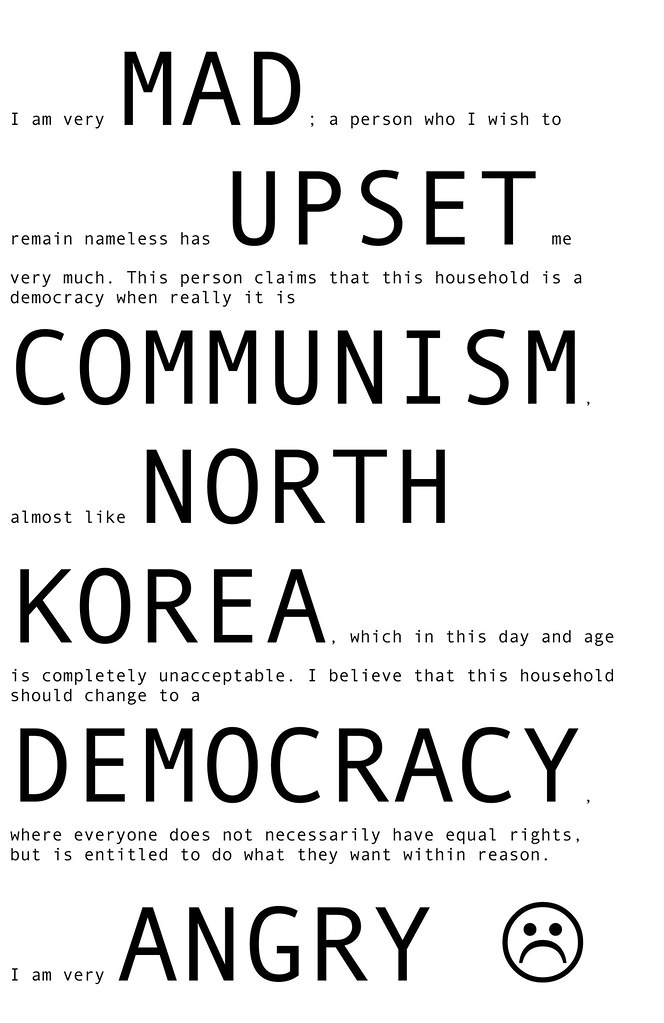
P.S. Peter, perhaps your little millennial Adrian Mole would be better of spending some time with this instead?
related: Emily declares freedom!
18 Mar 17:21
The Most Exciting Sentence I’ve Read This Decade…
by Tom Levenson
…Would be this one:
We find an excess of B -mode power over the base lensed- CDM expectation in the range 30 < ` < 150, inconsistent with the null hypothesis at a significance of > 5 δ.
That’s from the abstract to this paper, released yesterday, in which the team using the BICEP microwave detector at the South Pole reports on their analysis of three years of data taken from 2010-2012.
So what’s that all about? It’s the best evidence yet that a fundamental pillar of Big Bang cosmology is correct, that a concept named inflation does in fact describe what happened within the first instant of the formation of our universe. Here’s how Alan Guth, the inventor of the idea describes it:
This theory is a new twist on big bang theory, proposing a novel picture of ho the universe behaved for the first minuscule fraction of a second of its existence.
The central feature of the theory is a brief period of extraordinary rapid expansion, of inflation, which lasted for a time interval perhaps as short as 10^-30 seconds. During this period the universe expanded by at least a factor of 10^25, and perhaps a great deal more. [Alan Guth, The Inflationary Universe, p. 14.]
Guth’s initial version of inflation theory has been refined significantly since its origins in the late 1970s, and in its modern form inflation has become part of the basic toolkit of cosmological investigation. The universe we observe doesn’t make sense unless something occurred to explain, for just one example, the way the universe looks basically the same everywhere, when viewed on the largest scale. Inflation as the idea has evolved has become the best available explanation (though there have been competing models) for this and other observed cosmological properties. But the challenge has been to find some tell-tale sign that shows* that inflation actually happened.
It’s been clear for a long time where such signs might lie: in the cosmic microwave background (CMB), a snapshot of the cosmos taken at a moment called “recombination,” when the universe cooled down enough to permit electrons and protons to come together to form (mostly) neutral hydrogen atoms. Photons — light — that up till that moment had been embraced in electromagnetic dances with charged particles were then unshackled to fly freely through space, carrying with them the traces of where they’d been just before that liberation — which came just 380,000 years after the big bang.

Over time (13.8 billion years), that extremely hot (energetic) spray of light has cooled to 2.7 Kelvins — 2.7 degrees above absolute zero — and is now detectable as those very long wavelengths of light called microwaves. This microwave background was identified in 1965 as a generalized blur covering the entire sky; increasingly sophisticated measurements have revealed more and more detail. Over the last twenty fiveyears those observations have turned into a probe of what happened between the big bang and the flash of the CMB itself: each newly precise measurement constrains the possible physics that gave rise to the details thus revealed. Step by step, each new level of detail narrow the options for what could have occurred during the big bang era — and the chain of events that lead from cosmic origins to us becomes increasingly clear.
In the 1990s, improving resolution of CMB images revealed spots on the sky where there is slightly more energy in that microwave background — corresponding to regions in the early universe with slightly more matter-energy than surrounding regions. Such variations account for why there are lots of galaxies full of stars in some places, and vast voids in other: over millions and billions of years, gravity can work on very slight variations in initial density to sort matter into that kind of pattern.
With the advance of both space and ground based microwave imagers, it’s become possible to sample the CMB in vastly greater detail, and thus uncover much more than the simple (easy for me to say) evolution of structure in the universe. For example, CMB researchers have identified several acoustic peaks in the background — literally, the ringing of the early universe, pressure waves produced by the interaction of light and matter in the very early universe. The particular properties of those peaks reveal basic facts about the universe — and help distinguish between different theories about how we get the cosmos we inhabit from the big bang whose traces we see in the CMB.
Before today, the state of play was that CMB results were most consistent with the predictions of inflation, compared with other candidate ideas. At the same time though, observations that are consistent-with are not the same as direct observations of the cosmological equivalent of the miscreant’s fingerprints on the knife. That’s what the BICEP results deliver.
In simplest terms: modern theories of cosmic inflation say that immediately after some tiny perturbation occurs that marks the birth of a universe, it gets pulled apart by inflation — which you can think of as negative gravity, a gravitational field that stretches space-time. The inflationary episode is so powerful that it expands the infant universe by orders of magnitude in fractions of a second — as some say, inflation provides the bang in the big bang — and it’s so violent that as space-time undergoes such wild tugs, ripples form. Those ripples are gravitational waves — predicted by Albert Einstein, inferred from the behavior of pulsars, but never detected directly. An observation of such primordial fluctuations, variations in the strength of the gravitational field from point to point in the early universe, would offer the first direct glimpse of traces of an inflationary episode marking the birth of our cosmos.
And that’s what BICEPs results contain: the team led by John Kovac at the Harvard – Smithsonian Center for Astrophysics, Clem Pryke at the University of Minnesota, Jamie Bock at Caltech/JPL, and Chao-Lin Kuo of Stanford and SLAC report the detection of the signature of gravity waves in the CMB with the properties corresponding to those predicted to be produced by inflation.
In slightly more detail, the BICEP experiment observed a particular pattern of polarization in the light (microwaves) of the CMB that inflation would be expected to produce. (Many more details: web resources from the BICEP team and partner institutions; quick semi-technical gloss on the results from Sean B. Carroll; Matt Strassler’s take; Dennis Overbye’s account in the NYT.)
One key caveat before the wind up: this is one result from one group. It is reported with great confidence (that five sigma claim). But something this big needs independent confirmation — data from the Planck satellite for example, or more ground based observations from other microwave detectors. This isn’t yet a done deal.
Such confirmation (or disproof) will come fairly quickly — a few years at most.
In the meantime, assuming the data do hold up, what would that mean (forgive me) more cosmically?
At the very least: that we now understand in previously unattainable detail how our current habitat emerged from nothing (or better, “nothing”). That the idea of a multiverse — other patches of space time that underwent an inflationary episode to form island universes of their own — has now gained a boost (if one patch of space-time can inflate, so could others)….
…or to put in mythic terms: there is grandeur in this view of life (the cosmos). Paraphrasing an old friend, astronomer Sandra Faber, with this new, richer, more fully realized picture of the birth of the universe we have once again enriched that creation story that only science tells, the one that connects the earth we inhabit today with a process of cosmic evolution that we now can trace back all the way to just the barest instant this side of the point of origin.
A good day.
*To a close approximation — this is physics. You want certainty, become a mathematician.
[Thanks to Dr Katherine J. Mack of the University of Melbourne, aka @AstroKatie, who helped make sure no egregious errors slipped through. Any mistakes, major or minor, that remain are mine, all mine.]
Image: J. W. M. Turner, The Beacon Light, c. 1840
PS: Bonus video showing one of the founding architects of inflation theory receiving news of the result:
13 Mar 01:09
This space reserved for your ad.
Senators vs Spies, Feinstein vs CIA
by Anne Laurie
Diane Feinstein: "You know, maybe this whole surveillance state thing isn't as kosher as I thought…"
http://t.co/rdPIXYCK2o
— billmon (@billmon1) March 12, 2014
Senator Feinstein has always been known as a prominent defender of the National Security State “protecting America“. Per the NYTimes:
Ms. Feinstein has proved to be a bulwark for intelligence agencies in recent years: publicly defending the National Security Agency’s telephone and Internet surveillance activities, the C.I.A.’s authority over drone strikes and the F.B.I.’s actions under the Patriot Act against a growing bipartisan chorus of critics.
Which is why her floor speech yesterday is raising so many eyebrows… because this time, it’s personal. From Roll Call:
The chairwoman of the Senate Intelligence Committee torched the CIA in a floor speech Tuesday, charging the agency with spying on her committee’s computers in a possibly illegal search she said has been referred to the Department of Justice for possible prosecution.
The on-the-record allegations by Sen. Dianne Feinstein shook the Senate, with lawmakers in both parties warning of serious fallout if proved true. And her speech put the Department of Justice and the White House in an awkward spot between CIA Director John O. Brennan, who later denied the allegation of spying, and Feinstein, who has been a strong backer of the intelligence community generally and of President Barack Obama.
During her speech, the California Democrat said she learned from Brennan in a Jan. 15 meeting that the CIA improperly searched committee computer files as the committee neared the end of its yearslong investigation of the CIA’s interrogation and detainee practices, confirming several media reports. She said the incident has been referred to the Department of Justice. But Feinstein was also riled by a separate referral by the CIA to Justice suggesting that committee staff had improperly received classified information.
The California Democrat called that referral “a potential effort to intimidate this staff” and called the matter “a defining moment” for whether the Congress would be able to provide oversight of the intelligence community…
“I have grave concerns that the CIA’s search may well have violated the separation of powers principles embodied in the United States Constitution, including the speech and debate,” she said…
There’s video of Feinstein’s speech at the link, but it won’t embed without autoplaying. Transcript, via the Boston Globe, is here.
It’s complicated, because the separate parties are talking about their conflicting interpretations of millions of pages of materials that are not available for independent review. The NYTimes, last week, had the clearest explanation I’ve seen so far. Amy Davidson, at the New Yorker, is less blandly non- judgmental:
… This all goes back to the first years after September 11th. The C.I.A. tortured detainees in secret prisons. It also videotaped many of those sessions. Those records should have been handed over, or at least preserved, under the terms of certain court orders. Instead, in November, 2005, a C.I.A. official named Jose Rodriguez had ninety-two videotapes physically destroyed. “Nobody wanted to make a decision that needed to be made,” he told me when I interviewed him in 2012. (He also said, “I really resent you using the word ‘torture’ time and time again.”)
Feinstein, in her speech, said that the C.I.A.’s “troubling” destruction of the tapes put the current story in motion. Michael Hayden, then director of the C.I.A., had offered the committee cables that he said were just as descriptive as the tapes. “The resulting staff report was chilling,” Feinstein said. The committee voted to begin a broader review. The terms were worked out in 2009, and staff members were given an off-site facility with electronic files, on computers supposedly segregated from the C.I.A.’s network, that added up to 6.2 million pages—“without any index, without any organizational structure. It was a true document dump,” Feinstein said. In the years that followed, staff members turned that jumble into a six-thousand-page report, still classified, on the C.I.A.’s detention practices. By all accounts, it is damning.
But, Feinstein said, odd things happened during the course of the committee members’ work. Documents that had been released to them would suddenly disappear from the main electronic database, as though someone had had second thoughts—and they knew they weren’t imagining it, “Gaslight”-style, because, in some cases, they’d printed out hard copies or saved the digital version locally. When they first noticed this, in 2010, Feinstein objected and was apologized to, “and that, as far as I was concerned, put the incidents aside.” Then, after the report was completed, the staff members noticed that at some point hundred of pages of documents known as the “Panetta review” had also, Feinstein said, been “removed by the C.I.A.”…
This is where the C.I.A. seems to have lost its bearings and its prudence. As Feinstein noted, there have been comments to the press suggesting that the only way the committee staff members could have had the Panetta review is if they’d stolen it. The pretense for the search of the committee’s computers—where the staff kept its own work, too—was that there had been some kind of security breach. Feinstein says that this is simply false: maybe the C.I.A. hadn’t meant for the Panetta review to be among the six million pieces of paper they’d swamped the Senate with, but it was there. (Maybe a leaker had even tucked it in.)…
There were crimes, after September 11th, that took place in hidden rooms with video cameras running. And then there were coverups, a whole series of them, escalating from the destruction of the videotapes to the deleting of documents to what Feinstein now calls “a defining moment” in the constitutional balance between the legislature and the executive branch, and between privacy and surveillance. Senator Patrick Leahy said afterward that he could not remember a speech he considered so important. Congress hasn’t minded quite enough that the rest of us have been spied on. Now Feinstein and her colleagues have their moment; what are they going to make of it?
Or, as David Corn puts it in the Mother Jones report linked in the tweet at the top of this post:
… [S]ince the founding of the national security state in the years after World War II, there have been numerous occasions when the spies, snoops, and secret warriors of the US government have not informed the busybodies on Capitol Hill about all of their actions. In the 1970s, after revelations of CIA assassination programs and other outrageous intelligence agency misdeeds, Congress created what was supposed to be a tighter system of congressional oversight. But following that, the CIA and other undercover government agencies still mounted operations without telling Congress. (See the Iran-Contra scandal.) Often the spies went to imaginative lengths to keep Congress in the dark. More recently, members of the intelligence community have said they were not fully in the know about the NSA’s extensive surveillance programs. Of course, there was a countervailing complaint from the spies. Often when a secret program becomes public knowledge, members of Congress proclaim their shock, even though they had been told about it.
Overall, the system of congressional oversight has hardly (as far as the public can tell) been stellar. And it has raised doubts about the ability of a democratic government to mount secret ops and wage secret wars in a manner consistent with the values of accountability and transparency. What was essential to decent governance on this front was the delicate relationship between congressional overseers and the intelligence agencies. The intelligence committees have to be forceful and fierce in monitoring the spooks (a responsibility often not met), and the spies have to be cooperative and forthcoming (again, a responsibility often not met). There has to be trust. The committees have to hold faith that the agencies are indeed coming clean, for there is no way a handful of congressional investigators can fully track all the operations of the massive intelligence establishment, and the agencies have to be assured that secrets they shared with the investigators will not be leaked for political purposes. And at the end of the day, elected representatives have to be able to come to the public and say, “We’re keeping a close eye on all this secret stuff, and we are satisfied that we know what is happening and that these activities are being conducted in an appropriate manner.” If such credible assurances cannot be delivered, the system doesn’t work—and the justification for allowing secret government within an open democracy is in tatters….
My God, CIA bugged the Senate Intelligence Committee. I am sure nothing like that has ever happened before.
— Richard M. Nixon (@dick_nixon) March 11, 2014
Waiting for CIA to tell Feinstein if she had problems with their spying, she shoulda taken it up with proper authorities, not gone public.
— billmon (@billmon1) March 12, 2014
This space reserved for your ad.
07 Mar 20:32


Black Boy Interrupted
by Ta-Nehisi Coates
I got up at 5 a.m. today in hopes of making the gym before my train to D.C. I handled business and with some time to spare, walked over to my favorite bakery for a touch of that summer love, now lost to my life upon these shores. The waitress addressed me in a familiar accent. I asked, Vous êtes française? She smiled and said, Oui, Monsieur, and memory of the changes washed over me like a wave.
I ordered in French. I was flustered because I did not know how to order a latte. Was it feminine or masculine? Is latte even French? Isn't it just café au lait? I know more than I can say, though very often, I say much more than I actually know. I am brutal with the language. I am a 6-foot-4, 230-pound baby, bumbling through the museum. My Je vous en prie might shatter an ancient vase, scar the work of old masters. Meanwhile, the French just dance. They speak delicately, as though they barely have a tongue. I can hear everything that is wrong with my diction, but I don't yet have the muscle memory to fix it. It's an old feeling. When I was 19, all I wanted was to write like black people sang, and I could see everything wrong but could do nothing to fix it. Ten years later I had muscle memory. And then in 10 more I had the faith to put a piece down, come back, hammer at it again, and repeat because I believed in the inevitability of work.
I'll be 39 in September, and it has taken all 39 of those years to learn how to learn. I never considered myself particularly smart. I've always learned things at a fairly slow clip. But I was insanely curious, and I've learned to not panic at my slowness, at the creaking gears in my head. I've learned to live in the curiosity, to just sit there and wait. I told the waitress I'd like "une latte." I don't even know why. Probably because I am brutal with the language, and have not yet learned to dance. But I have learned to sit and wait. I have learned so much, just in the past five years. That is to say I have gone through all kinds of changes, and I think this is a luxury.
The face of Trayvon Martin is always with me, trapped in the amber of youth. What is bracing about these regular deaths is how easily I can slot myself into the same circumstance. Follow me in a Jeep, then follow me on foot and we might come to blows. Demand that I turn down my music, at 17, and you might well not like my response. And I do not think this is a fact of black magic, of pathologies, of my culture. I think it is product of 17. I ride the trains in New York and I see boys of all colors who are very loud, because they finally can be, and no one can stop them. I see them and smile, and remember my own days back in Baltimore, my first freedoms, talking shit and being out in the world.
I finished my café au lait—I believe that's what it was. I was now late, because I am still a little young, and punctuality is not yet among the changes. I hailed a cab. The cab barreled down Broadway, past the Applejack Diner, and I thought of my twenties. I used to pass this restaurant with Kenyatta. Samori was barely one. We were broke and in trouble. I remembered getting off the train for couples counseling. I remember thinking I couldn't even buy my girl breakfast. My Dad used to visit us and leave cash. I remember thinking he was insane. We were ridiculous. How privileged are we to now see the changes?
I made my train, and it is from here that I now send this kite to you. I am sitting here watching the frozen hills run by, and I am thinking of all the changes that so many black boys never see, for the death tax which their country has long levied upon them:
That we shall die, we know. 'Tis but the time,
And drawing days out, that men stand upon.
But some are given more days than others, and I think of dying at 17, in my loudness, in my vanity, which is to say in my human youth, and I tremble. I was barely anything. I understood barely anything. When Michael Dunn killed Jordan Davis, he obliterated a time-stream, devastated an open range of changes. And somewhere on that American jury, someone thought this was justice, someone believed in the voodoo of shotguns and teleportation. Michael Dunn killed a boy, and too robbed a man of his chance to be.
And this will happen again, must happen again, because our policy is color-blind, but our heritage isn't. An American courtroom claiming it can be colorblind denies its rightful inheritance. An American courtroom claiming it can be colorblind is a drug addict claiming he can walk away after just one more hit. Law and legacy are at war. Legacy is winning. Legacy will always win. And our legacy is to die in this land where time is unequal, and deeded days are unequal, and blessed is the black man who lives to learn other ways, who lives to see other worlds, who lives to bear witness before the changes.
07 Mar 20:24


The Majoritarian Difficulty: Same-Sex Marriage Edition
by Scott Lemieux
Robert.mccowenSo 59% of Americans support marriage equality, and 41% oppose (from different polls, but conveniently adding up to 100%); that 41% are divided between 16% who understand they're in a minority, and 25% who STILL THINK THEIR SIDE IS WINNING.
I don't know if that's horrifying or sad.
Good news all around:
Half of all Americans believe that gay men and lesbians have a constitutional right to marry, according to a new Washington Post-ABC News poll in which a large majority also said businesses should not be able to deny serving gays for religious reasons.
Fifty percent say the U.S. Constitution’s guarantee of equal protection gives gays the right to marry, while 41 percent say it does not.
Beyond the constitutional questions, a record-high 59 percent say they support same-sex marriage, while 34 percent are opposed, the widest margin tracked in Post-ABC polling.
The boldfaced part is particularly encouraging; Damon Linker’s concern trolling notwithstanding, using embarrassingly specious “religious freedom” arguments as a pretext to continue the longstanding conservative war on civil rights doesn’t appear to be fooling anybody. But here’s one reason they’re riding this dead Thurmond so hard:
According to a new survey by the Public Religion Research Institute, only 41 percent of Americans oppose allowing same-sex couples to marry. But that same 41 percent has a highly skewed perception of where the rest of the country stands: nearly two-thirds of same-sex marriage opponents erroneously think most Americans agree with them. And only two in 10 same-sex marriage opponents realize that the majority of Americans support marriage equality.
Schiavo II: Electric Boogaloo. Only in 2004, I think the media was much more likely to take conservative overestimation of their own support at face value.
|
|
03 Mar 19:57
This space reserved for your ad.
Good Changes From the FDA
by John Cole

Having spent the last couple of weeks reading food labels more than anything else, I can tell you that these changes are very welcome indeed:
The Food and Drug Administration for the first time in two decades will propose major changes to nutrition labels on food packages, putting calorie counts in large type and adjusting portion sizes to reflect how much Americans actually eat.
It would be the first significant redrawing of the nutrition information on food labels since the federal government started requiring them in the early 1990s. Those labels were based on eating habits and nutrition data from the 1970s and ’80s, before portion sizes expanded significantly, and federal health officials argued that the changes were needed to bring labels into step with the reality of the modern American diet.
“It’s an amazing transformation,” said Dr. Margaret A. Hamburg, commissioner of the F.D.A. “Things like the size of a muffin have changed so dramatically. It is important that the information on the nutrition fact labels reflect the realities in the world today.”
The proposed changes include what experts say will be a particularly controversial item: a separate line for sugars that are manufactured and added to food, substances that many public health experts say have contributed substantially to the obesity problem in this country. The food industry has argued against similar suggestions in the past.
“The changes put added sugars clearly in the cross hairs,” said Dr. David A. Kessler, who was commissioner during the original push for labels in the 1990s. “America has the sweetest diet in the world. You can’t get to be as big as we’ve gotten without added sweeteners.” Millions of Americans pay attention to food labels, and the changes are meant to make them easier to understand — a critical step in an era when more than one-third of adults are obese, public health experts say. The epidemic has caused rates of diabetes to soar, and has increased risks for cancer, heart disease and stroke.
I wish they would just make the damned labels BIGGER. Or, I could finally break down and go to the eye doctor and get bifocals instead of holding things up to the light and maneuvering my glasses and squinting. What I really wish they would do is give every product a qr code that would take you to detailed lists of the product, the ingredients and what they are- who the hell knows what acesulfame potassium is…
This space reserved for your ad.
03 Mar 13:58
The Future Is Unevenly Distributed
by David Silbey
Robert.mccowenClick through for images--not sure why they're not showing up for RSS, but it's worth looking at the page and thinking about the intersection of politics and economics in this case.
This map:

reminded me of this map:

The first is US economic output split 50/50, showing how concentrated much of the US economy is. The second map is the concentration of British population pre- and post-Industrial Revolution. The 1911 part of it, seen on the right, illustrates how concentrated the British people (and as a proxy, their economic activity) became as a result of the revolution. The William Gibson quote applies extremely well: “The future is already here – it’s just not very evenly distributed.”
It’s an obvious point, but the economy that those in the northeast megalopolis or southern California or the Miami axis experience is a completely different one than most of the rest of the United States. This is just as true as the point that the economy of those who lived in London or Liverpool/Manchester in 1890 was completely different than that of the rest of Great Britain.
As with the economy, so too the politics. It’s interesting to note that the areas where American economic activity is so concentrated come largely in Democratic states (Democratic on a Presidential level, at least): the Northeast, Illinois, Michigan, California, Oregon, Wisconsin, and Washington. More than that, the actual cities themselves are highly Democratic. There’s not a major city in the northeast corridor that went Republican, not a city over 500,000 in the whole country, in fact, that went Republican. The cities most advanced in this economic revolution – New York, Chicago, and Los Angeles – gave Obama a margin of victory of 3.2 million votes, roughly equal to his entire national margin of victory.[1] The echo with Britain comes here as well. The nascent British Labor party, born around the turn of the century, was nurtured in the economic foci of the new economy, and it would rise to displace the more broadly based Liberal party in the 1920s. The industrial revolution remade the cities of Britain, the cities remade the politics, and the politics remade the country. I think that the same thing is happening to the United States.
[1] Used figures from here.
28 Feb 20:18
This space reserved for your ad.
Don’t Stand So Close To Me
by evolved beyond the fist mistermix
Robert.mccowenApparently most of the buildings on the Kansas State University campus have signs requesting that people not carry firearms when they enter. I'm eagerly looking forward to considering some of the same questions addressed in Dr. Hampikian's Times piece.
Greg Hampikian, who teaches Biology at Boise State, has a good question for the Idaho State Legislature:
In light of the bill permitting guns on our state’s college and university campuses, which is likely to be approved by the state House of Representatives in the coming days, I have a matter of practical concern that I hope you can help with: When may I shoot a student?
I am a biology professor, not a lawyer, and I had never considered bringing a gun to work until now. But since many of my students are likely to be armed, I thought it would be a good idea to even the playing field.
I have had encounters with disgruntled students over the years, some of whom seemed quite upset, but I always assumed that when they reached into their backpacks they were going for a pencil. Since I carry a pen to lecture, I did not feel outgunned; and because there are no working sharpeners in the lecture hall, the most they could get off is a single point. But now that we’ll all be packing heat, I would like legal instruction in the rules of classroom engagement.
Not only is this guy pretty funny, he’s also the director of the Idaho Innocence Project. That DNA stuff is probably a little too quantitative for Nick Kristof, but here’s a guy who’s engaged in public debate and also applying his scientific knowledge for the public good.
(via TPM)
This space reserved for your ad.
26 Feb 15:12
An Armed Society, Not So Polite As Terrified?
by Anne Laurie
The estimable Dahlia Lithwick, on “How America Has Become a ‘Stand Your Ground’ Nation”:
… [I]t’s not unreasonable to argue that, in America, you can be shot and killed, without consequences for the shooter, for playing loud music, wearing a hoodie, or shopping at a Walmart. The question is whether the wave of “stand your ground” legislation is to blame.
Let’s first define terms: “Stand your ground” laws are different from the Castle Doctrine, which has its roots in centuries-old British common law and allows you to use force to protect yourself in your home. “Stand your ground” essentially provides that you can bring your castle wherever you go. The rule allows you to shoot first, not just in your home, but anyplace you have a right to be and is a much newer, and more controversial, proposition. (The first “stand your ground” law was enacted in Florida in 2005.) Historically, United States self-defense laws have followed British common law by imposing a duty to retreat, requiring those in a dangerous situation to try to withdraw (if they could do so safely) before resorting to killing. (Under the Castle Doctrine there is no duty to retreat because you’re already home, in your safe haven.) “Stand your ground” by design cancels out the duty to retreat and, in sum, allows you to shoot first if you feel your life is in danger, just like you can do at home….
The fact that “stand your ground” defenses have been staggeringly successful in Florida in recent years (one study shows it’s been invoked more than 200 times since being enacted in 2005 and used successfully in 70 percent of the cases) suggests that it’s been embedded into more than just jury instructions. Perhaps unsurprisingly, a Tampa Bay Times study from 2012 shows that “as ‘stand your ground’ claims have increased, so too has the number of Floridians with guns. Concealed weapons permits now stand at 1.1 million, three times as many as in 2005 when the law was passed.” Put bluntly: As Floridians sense that other Floridians plan to shoot first, they buy more guns… The gun lobby has single-handedly made certain that the very definition of what one might reasonably expect from an altercation at a Walmart, a movie theater, or a gas station has changed. By seeking to arm everyone in America, the NRA has in fact changed our reasonable expectation of how fights will end, into a self-fulfilling prophecy about how fights will end. It should surprise you not at all to learn that of the 10 states with the most lenient gun laws in America, seven support “stand your ground.” In those jurisdictions shooting first isn’t merely “reasonable.” It borders on sensible…
… “Stand your ground” laws, or at least the public conception of what they do, are changing the way the rest of us think about self- protection. This is, of course, exactly the world the NRA dreams of constructing: Everyone armed and paranoid that everyone else is armed. But the old canard that an armed society is a polite society is pretty much bunk. Ours is not a polite society; we are rude and hotheaded and terrified. Now we have guns to help us sort it all out.
24 Feb 05:47
News from the Vibrant Free Market
by evolved beyond the fist mistermix
Robert.mccowenPossibly of interest, given the recent discussion--and Adam's decision to go with FiOS.
The cheeseburger in paradise that is our wired and wireless broadband market consistently rewards our faith in the unfettered, unregulated free market. First, wireless: we pay more for less speed:
[...] In fact, out of the 40 countries with the most LTE tests in 2013, the US offered slower speeds than all of them, with the exception of the Puerto Rico, the Philippines, and India. Japan didn’t fare much better, just one slot faster than the US.
But it’s the cost that makes these speeds particularly painful to swallow. On average, Verizon charged roughly $4.05 per Mbps of LTE download speed in 2013, compared to just $2.25 for UK carrier EE. In fact, out of the major international carriers we compared, all of them except Japan’s NTT Docomo were about half as expensive as Verizon. [...]
Similarly, the wired Internet is not faring any better, where Cogent, Netflix’ Internet provider, and Verizon are battling:
There are about 11 Cogent/Verizon peering connections in major cities around the country. When peering partners aren’t fighting, they typically upgrade the connections (or “ports”) when they’re about 50 percent full, Cogent says. They can do this by adding ports, adding capacity to ports, or peering in new locations.
[...]
“Once a port hits about 85 percent throughput, you’re going to begin to start to drop packets,” he said. “Clearly when a port is at 120 or 130 percent [as the Cogent/Verizon ones are] the packet loss is material.”The congestion isn’t only happening at peak times, he said. “These ports are so over-congested that they’re running in this packet dropping state 22, 24 hours a day. Maybe at four in the morning on Tuesday or something there might be a little bit of headroom,” he said.
[...]
In some cases, Verizon has actually purchased and installed the necessary equipment to upgrade ports, but not turned it on, according to Schaeffer. “They actually put it in, so they spent the money, but they just politically have not been willing to turn it on in order to ensure that Netflix will not work as well as Redbox,” he said.
Redbox is Verizon’s video service, which I’m sure runs great on Verizon’s network, unlike Netflix. But that’s the price of competition: Verizon is competing with Netflix on a level playing field, and if your Verizon service slows to a crawl (because it’s not only Netflix that runs on Cogent’s network), that’s just the price you pay for freedom.
22 Feb 14:27


Lincoln and Marx
by Robert Farley
From Daniel Little:
Robin Blackburn has assembled a fascinating book drawing out some surprising connections between Abraham Lincoln and Karl Marx, An Unfinished Revolution: Karl Marx and Abraham Lincoln. Since both thinkers are highly original in their thinking about the worlds they inhabited, I’ve found the book to be absorbing. It consists of a brilliant hundred-page historical essay by Blackburn that draws out the themes in political theory that were of concern to both thinkers and demonstrates some surprising parallels. The book then provides several relevant speeches by Lincoln, several pieces of journalism by Marx about slavery and the American Civil War, letters by Marx including the centerpiece, a letter from Marx to Lincoln on behalf of the International Workingmen’s Association; and several miscellaneous short articles by other people about Marx and Lincoln.
|
|
21 Feb 17:37
This space reserved for your ad.
USA! USA!
by evolved beyond the fist mistermix

Here’s a reason to give a shit about hockey even if you don’t give a shit about hockey.
This space reserved for your ad.
20 Feb 21:37


The Life of Jordan Davis
by Ta-Nehisi Coates
Robert.mccowenI know it's kind of cliche, but having a kid makes it all too easy to imagine really losing him as a teenager--simply because he angered someone who had the power to hurt him. I don't want to live in that kind of society.
Here is a short piece from yesterday's Morning Edition with a conversation between Steve Inskeep, Gene Demby, Jamelle Bouie, and myself. Embedded below is a much longer conversation covering Stand Your Ground, the logic of twice as good, and a little misquoting of King Lear. I wish Jamelle's ruminations on the work of Tony Judt had made it in. But this is still very good. It was also very therapeutic. This blog has been dressed in all black for some months now. I'm starting to get used to it.
20 Feb 18:40


Ukraine
by Erik Loomis
If you are like me, you know basically nothing about Ukraine and the protests going on there. This was tremendously useful. In part:
More subtly, what this campaign does is attempt to reduce the social tensions in a complex country to a battle of symbols about the past. Ukraine is not a theater for the historical propaganda of others or a puzzle from which pieces can be removed. It is a major European country whose citizens have important cultural and economic ties with both the European Union and Russia. To set its own course, Ukraine needs normal public debate, the restoration of parliamentary democracy, and workable relations with all of its neighbors. Ukraine is full of sophisticated and ambitious people. If people in the West become caught up in the question of whether they are largely Nazis or not, then they may miss the central issues in the present crisis.
In fact, Ukrainians are in a struggle against both the concentration of wealth and the concentration of armed force in the hands of Viktor Yanukovych and his close allies. The protesters might be seen as setting an example of courage for Americans of both the left and the right. Ukrainians make real sacrifices for the hope of joining the European Union. Might there be something to be learned from that among Euroskeptics in London or elsewhere? This is a dialogue that is not taking place.
The history of the Holocaust is part of our own public discourse, our agora, or maidan. The current Russian attempt to manipulate the memory of the Holocaust is so blatant and cynical that those who are so foolish to fall for it will one day have to ask themselves just how, and in the service of what, they have been taken in. If fascists take over the mantle of antifascism, the memory of the Holocaust will itself be altered. It will be more difficult in the future to refer to the Holocaust in the service of any good cause, be it the particular one of Jewish history or the general one of human rights.
|
|
20 Feb 15:50
How to Understand Reality (Shows)
by Scott Meyer
Robert.mccowenIt's funny because it's painfully, painfully true.
On a slightly related note, we did our taxes this morning, and now I REALLY need a drink.


18 Feb 02:17
FOLLOW THROUGH
by Ed
Robert.mccowenThis writer is both cynical and sometimes so hyperbolic that even I struggle to read it--but sometimes he manages a really incisive piece (which is why it's still on my reading list). This is one of the latter.
Hey! Remember that entire session of Congress – hell, practically an entire calendar year – the GOP spent threatening to force the country to default on its debt and cause a global financial crisis the likes of which the world has never seen? Boy that sure was entertaining, at least to the Teabagger moneymen and the media that covered it breathlessly around the clock.
Well, on Tuesday the House GOP proposed a clean debt limit increase. That is, they did the exact opposite of what they spent a year claiming they would do (and, importantly, exactly what they did for George W. Bush nineteen times). The fact that it's an election year certainly has something to do with it. The fact that they obviously had no intention whatsoever of ever following through on their we'll-kill-the-hostages threat probably has a lot more to do with it.
The troubling thing is that the series of threats, grandstanding, and political Kabuki theater that defined the non-crisis throughout 2013 was front page, screaming headline news. The complete and total surrender that Tuesday's vote represents was barely a blip. Maybe a paragraph on Page 10. We're too busy talking about ice and dead actors. It would seem worthwhile and newsworthy, one would think, to tell viewers and readers, "So it turns out that all of that sound and fury last year was complete, unvarnished bullshit." Maybe that could even be followed up with something like, "Next time they pull this, likely in 2015, we should remember that they're liars and charlatans. While we're at it keep in mind that if you keep electing these people, one day there might be enough lunatics to go through with it."
That wouldn't be Fair and Balanced, though. Both Sides, bipartisanship, compromise, blah blah blah.
This is among the most serious problems with a for-profit media addicted to Breaking News: there is no follow through whatsoever. The first wave of alarmist and often incorrect coverage is all we get. After 72 hours they've moved on to something else and we never hear, for example, "Oh by the way, remember that Benghazi thing? Turned out to be total bullshit. None of that orgy of speculation and accusation turned out to be true." That would be useful to know, right? Instead we have a political and media environment wherein the only thing that matters is making the accusation; eventually you'll be exposed, but the first part is all anyone will hear.
14 Feb 22:18
Another one bites the dust, and another one down…
by Sarah, Proud and Tall
Just over a month ago, I posted about Judge Robert Shelby’s erudite decision in Kitchen v Herbert which overturned Utah’s constitutional ban on same-sex marriages. In that post, I mentioned that the same sex couples, in their stay submissions, provided a listing of 25 current state and federal lawsuits, covering fifteen states, challenging state laws banning same sex marriage.
Amongst them were the cases of Bourke v. Beshear in Kentucky and Bostic v. McDonnell in Virginia, both of which have been decided in the last two days.
In Kentucky on February 12, Judge John G. Heyburn of the US District Court Western District of Kentucky (appointed by Dubya Daddy Bush, for those who are keeping score) found (pdf) that the provisions of the Kentucky constitution and statute which which provided that the state could not, and need not, recognise same sex marriages solemnised outside Kentucky violated the Fourteenth Amendment, and were therefore invalid.
Mark Joseph Stern at Slate notes that Judge Heyburn’s decision is similar in many ways to Shelby’s, not least because Heyburn gets a good’un or two in on Tony Scalia, the betoqued-for-pomp-and-circuses Cassandra of the Supreme Court.
Heyburn (on page 13, if you want to revel) mimics Scalia’s schtick in Windsor of rewriting Tony Kennedy’s majority judgment to show how, with a few proper nouns and adjectives swapped in for others, Windsor is clearly authority for the proposition that same sex marriage bans of all kinds demean gay people, and that their only basis is that some random goatherder thought his god wanted to have a chat about the evils of shrimp, boils and bumsex.
On the next page, Heyburn cites Scalia’s comment in Lawrence that:
“‘preserving the traditional institution of marriage’ is just a kinder way of describing the State’s moral disapproval of same-sex couples.”
It’s all in good fun, at least until Fat Tony gets his anger on and ruptures a tube.
Stern says that, aside from giving Tony the finger, Heyburn’s decision is “fairly predictable” and “follows the emerging pattern of these kinds of rulings: He wavers on the scrutiny question, finds that the law was driven by anti-gay animus, and strikes it on Equal Protection grounds.”
This does a considerable disservice to Heyburn, whose decision is elegantly argued, compassionate and forthright.
In essence he says that the same sex marriage bans in the probably fail heightened scrutiny, and might perhaps be driven by animus against gay and lesbian people, but neither of those things actually matter. They don’t matter because the laws also fail the much less onerous test of rational scrutiny – that is, that they must be rationally related to a legitimate government purpose – by reason of, and here’s the tricky bit, not actually being rational or in any way related to a legitimate government purpose.
Judge Heyburn, one might think, is quite mindful that there is every chance Justice Kennedy will read his decision. He carefully outlines each of Kennedy’s judgments which advanced rights for non-heterosexuals, Kennedy’s arguments as they build to their logical conclusion – Kennedy writing a majority judgment overturning gay marriage bans nationwide.
So, as one can readily see, judicial thinking on this issue has evolved ever so slowly. That is because courts [sic] usually answer only the questions that come before it. Judge Oliver Wendell Holmes aptly described this process: “[J]udges do and must legislate, but they can do so only interstitially; they are confined from molar to molecular motions.” S. Pac. Co. v. Jensen, 244 U.S. 205, 221 (1917) (Holmes, J., dissenting). In Romer, Lawrence, and finally, Windsor, the Supreme Court has moved interstitially, as Holmes said it should, establishing the framework of cases from which district judges now draw wisdom and inspiration. Each of these small steps has led to this place and this time, where the right of same-sex spouses to the state-conferred benefits of marriage is virtually compelled.
Before that fine ending, however, Heyburn does something even more important, as noted by Lyle Denniston at SCOTUSblog:
A noteworthy part of Judge Heyburn’s opinion was a studied effort to explain to those who would be offended by his ruling, especially on the basis of their religious or cultural beliefs, why he was led to his decision as a constitutional matter. That section of the ruling read very much like a basic civics lesson about the way that the Constitution’s protection of individual rights may sometimes override traditional moral and political preferences, and even trump the expressed wishes of a political majority.
The whole decision (pdf) is well worth a read, but pages 18 to 23 would arm anyone to politely and calmly argue down even the most determined godbotherer.
I have gone on, and left myself little room for the more recent decision – that of Judge Arenda L. Wright Allen, an Obama appointee from the District Court for the Eastern District of Virginia.
Hmmm. Crikey it’s a dry old read. When it’s not being purple, that is. Don’t get me wrong, it’s an impeccable decision, concisely (if such a term can be applied to any 41 page document) rebutting every possible argument against same sex marriage.
The lovely bit though? The bit that makes me think that Judge Arenda Wright Allen is my kind of gal?
Her decision opens with this.

Cut. Print. This baby is done.