Advanced Functional Materials, EarlyView.
Kang Chen
Shared posts
14 Jul 06:50
Interplay of Structural and Optoelectronic Properties in Formamidinium Mixed Tin–Lead Triiodide Perovskites
by Elizabeth S.
Parrott
,
Thomas
Green
,
Rebecca L.
Milot
,
Michael B.
Johnston
,
Henry J.
Snaith
,
Laura M.
Herz
xiaodaibudai, xululu91 and 2 others like this
09 Jul 06:37
Highly Efficient and Stable Perovskite Solar Cells Using a Dopant‐Free Inexpensive Small Molecule as the Hole‐Transporting Material
by Yong
Li
,
Kyle R.
Scheel
,
Robert G.
Clevenger
,
Wan
Shou
,
Heng
Pan
,
Kathleen V.
Kilway
,
Zhonghua
Peng
Advanced Energy Materials, Volume 8, Issue 23, August 16, 2018.
07 Jul 07:26
 Open Access
   This article is licensed under a Creative Commons Attribution-NonCommercial 3.0 Unported Licence.

Large area efficient interface layer free monolithic perovskite/homo-junction-silicon tandem solar cell with over 20% efficiency

Energy Environ. Sci., 2018, 11,2432-2443
DOI: 10.1039/C8EE00689J, Paper
DOI: 10.1039/C8EE00689J, Paper
Open Access  This article is licensed under a Creative Commons Attribution-NonCommercial 3.0 Unported Licence.
Jianghui Zheng, Cho Fai Jonathan Lau, Hamid Mehrvarz, Fa-Jun Ma, Yajie Jiang, Xiaofan Deng, Anastasia Soeriyadi, Jincheol Kim, Meng Zhang, Long Hu, Xin Cui, Da Seul Lee, Jueming Bing, Yongyoon Cho, Chao Chen, Martin A. Green, Shujuan Huang, Anita W. Y. Ho-Baillie
A simple and scalable interface-layer free monolithic perovskite/silicon tandem has been demonstrated achieving over 20% efficiency on a large area.
The content of this RSS Feed (c) The Royal Society of Chemistry
A simple and scalable interface-layer free monolithic perovskite/silicon tandem has been demonstrated achieving over 20% efficiency on a large area.
The content of this RSS Feed (c) The Royal Society of Chemistry
Cloris2017, Xuepeng Liu and 5 others like this
07 Jul 07:20
Impact of excess PbI2 on the structure and the temperature dependent optical properties of methylammonium lead iodide perovskites

J. Mater. Chem. C, 2018, 6,7512-7519
DOI: 10.1039/C8TC02237B, Paper
DOI: 10.1039/C8TC02237B, Paper
Tobias Meier, Tanaji P. Gujar, Andreas Schönleber, Selina Olthof, Klaus Meerholz, Sander van Smaalen, Fabian Panzer, Mukundan Thelakkat, Anna Köhler
Excess PbI2 in MAPbI3 thin films has no direct impact on the electronic structure but changes the temperature dependence of the exciton binding energy and the phase transition behaviour.
The content of this RSS Feed (c) The Royal Society of Chemistry
Excess PbI2 in MAPbI3 thin films has no direct impact on the electronic structure but changes the temperature dependence of the exciton binding energy and the phase transition behaviour.
The content of this RSS Feed (c) The Royal Society of Chemistry
07 Jul 07:19
Open Access
  This article is licensed under a Creative Commons Attribution-NonCommercial 3.0 Unported Licence.
Enhancing the hydrophobicity of perovskite solar cells using C18 capped CH3NH3PbI3 nanocrystals

J. Mater. Chem. C, 2018, 6,7149-7156
DOI: 10.1039/C8TC01939H, Paper
DOI: 10.1039/C8TC01939H, Paper
Open Access  This article is licensed under a Creative Commons Attribution-NonCommercial 3.0 Unported Licence.
Isabella Poli, Xinxing Liang, Robert Baker, Salvador Eslava, Petra J. Cameron
The stability of perovskite solar cells towards moisture and humidity is improved by using C18 capped MAPI nanocrystals at the interface.
The content of this RSS Feed (c) The Royal Society of Chemistry
The stability of perovskite solar cells towards moisture and humidity is improved by using C18 capped MAPI nanocrystals at the interface.
The content of this RSS Feed (c) The Royal Society of Chemistry
09 Jun 03:06
Strategy to modulate the [small pi]-bridged units in bis(4-methoxyphenyl)amine-based hole-transporting materials for improvement of perovskite solar cell performance

J. Mater. Chem. C, 2018, 6,6816-6822
DOI: 10.1039/C8TC01891J, Paper
DOI: 10.1039/C8TC01891J, Paper
Hongyuan Liu, Xiaorui Liu
A strategy to modulate the [small pi]-bridged units in bis(4-methoxyphenyl)amine-based molecules for improving the performance of perovskite solar cells was provided.
The content of this RSS Feed (c) The Royal Society of Chemistry
A strategy to modulate the [small pi]-bridged units in bis(4-methoxyphenyl)amine-based molecules for improving the performance of perovskite solar cells was provided.
The content of this RSS Feed (c) The Royal Society of Chemistry
traveler likes this
08 Jun 03:54
Open Access
   This article is licensed under a Creative Commons Attribution 3.0 Unported Licence.

How the formation of interfacial charge causes hysteresis in perovskite solar cells

Energy Environ. Sci., 2018, 11,2404-2413
DOI: 10.1039/C8EE01447G, Paper
DOI: 10.1039/C8EE01447G, Paper
Open Access  This article is licensed under a Creative Commons Attribution 3.0 Unported Licence.
Stefan A. L. Weber, Ilka M. Hermes, Silver-Hamill Turren-Cruz, Christopher Gort, Victor W. Bergmann, Laurent Gilson, Anders Hagfeldt, Michael Graetzel, Wolfgang Tress, Rüdiger Berger
In this study, we use time-resolved Kelvin probe force microscopy to investigate current–voltage hysteresis in a hybrid lead-halide perovskite solar cell.
The content of this RSS Feed (c) The Royal Society of Chemistry
In this study, we use time-resolved Kelvin probe force microscopy to investigate current–voltage hysteresis in a hybrid lead-halide perovskite solar cell.
The content of this RSS Feed (c) The Royal Society of Chemistry
xiaodaibudai, Lucy and 5 others like this
08 Jun 03:53
Abnormal Synergetic Effect of Organic and Halide Ions on the Stability and Optoelectronic Properties of a Mixed Perovskite via In Situ Characterizations
by Mingzhu
Long
,
Tiankai
Zhang
,
Mingzhen
Liu
,
Zefeng
Chen
,
Chen
Wang
,
Weiguang
Xie
,
Fangyan
Xie
,
Jian
Chen
,
Gang
Li
,
Jianbin
Xu
Advanced Materials, EarlyView.
xiaodaibudai, xululu91 and 2 others like this
02 Jun 09:07
Dimethyl-sulfoxide-assisted improvement in the crystallization of lead-acetate-based perovskites for high-performance solar cells

J. Mater. Chem. C, 2018, 6,6705-6713
DOI: 10.1039/C8TC01570H, Paper
DOI: 10.1039/C8TC01570H, Paper
Yawen Liu, Zhihai Liu, Eun-Cheol Lee
We used dimethyl sulfoxide as a solvent additive which significantly improved the performance of Pb(Ac)2-based perovskite solar cells.
The content of this RSS Feed (c) The Royal Society of Chemistry
We used dimethyl sulfoxide as a solvent additive which significantly improved the performance of Pb(Ac)2-based perovskite solar cells.
The content of this RSS Feed (c) The Royal Society of Chemistry
Xuepeng Liu likes this
18 May 06:33
Perovskite Solar Cells: A New Perspective on the Role of A‐Site Cations in Perovskite Solar Cells (Adv. Energy Mater. 14/2018)
by Chang Woo
Myung
,
Jeonghun
Yun
,
Geunsik
Lee
,
Kwang S.
Kim
Advanced Energy Materials, Volume 8, Issue 14, May 15, 2018.
xiaodaibudai, shuhui and 5 others like this
18 May 06:31
The Impact of Device Polarity on the Performance of Polymer–Fullerene Solar Cells
by Mengmeng
Li
,
Junyu
Li
,
Dario
Di Carlo Rasi
,
Fallon J. M.
Colberts
,
Junke
Wang
,
Gaël H. L.
Heintges
,
Baojun
Lin
,
Weiwei
Li
,
Wei
Ma
,
Martijn M.
Wienk
,
René A. J.
Janssen
Advanced Energy Materials, Volume 8, Issue 22, August 6, 2018.
mryulongwang@163.com, maojie and 11 others like this
02 May 02:32
Solar Cells: Diffraction‐Grated Perovskite Induced Highly Efficient Solar Cells through Nanophotonic Light Trapping (Adv. Energy Mater. 12/2018)
by Yang
Wang
,
Peng
Wang
,
Xue
Zhou
,
Chang
Li
,
Huizeng
Li
,
Xiaotian
Hu
,
Fengyu
Li
,
Xiaoping
Liu
,
Mingzhu
Li
,
Yanlin
Song
Advanced Energy Materials, Volume 8, Issue 12, April 25, 2018.
02 Apr 06:13
Carrier Interfacial Engineering by Bismuth Modification for Efficient and Thermoresistant Perovskite Solar Cells
Advanced Energy Materials, EarlyView.
18 Mar 07:57
Efficient device engineering for inverted non-fullerene organic solar cells with low energy loss

J. Mater. Chem. C, 2018, 6,4457-4463
DOI: 10.1039/C8TC00705E, Paper
DOI: 10.1039/C8TC00705E, Paper
Jingyang Xiao, Ziming Chen, Guichuan Zhang, Qing-Ya Li, Qingwu Yin, Xiao-Fang Jiang, Fei Huang, Yun-Xiang Xu, Hin-Lap Yip, Yong Cao
We have systematically investigated the synergistic effect of thermal annealing and interlayer modification on improving the performance of inverted non-fullerene organic solar cells.
The content of this RSS Feed (c) The Royal Society of Chemistry
We have systematically investigated the synergistic effect of thermal annealing and interlayer modification on improving the performance of inverted non-fullerene organic solar cells.
The content of this RSS Feed (c) The Royal Society of Chemistry
pengyuhaopeng, CSZ and 3 others like this
18 Mar 07:31

Thermodynamically Self-Healing 1D–3D Hybrid Perovskite Solar Cells
by Jiandong Fan, Yunping Ma, Cuiling Zhang, Chong Liu, Wenzhe Li, Ruud E. I. Schropp, Yaohua Mai
Abstract
Thermal degradation in perovskite solar cells is still an unsettled issue that limits its further development. In this study, 2-(1H-pyrazol-1-yl)pyridine is introduced into lead halide 3D perovskites, which allows 1D–3D hybrid perovskite materials to be obtained. The heterostructural 1D–3D perovskites are proved to be capable of remarkably prolonging the photoluminescence decay lifetime and suppressing charge carrier recombination in comparison to conventional 3D perovskites. The intrinsic properties of thermodynamically stable yet kinetically labile 1D materials allow the system to alleviate the lattice mismatch and passivate the interface traps of heterojunction region of 1D–3D hybrid perovskites that may occur during the crystal growth process. Importantly, the as-fabricated 1D–3D perovskite solar cells display a thermodynamic self-healing ability, which is induced through blocking the ion-migration channels of A-site ions by the flexible 1D perovskite with less densely close-packed structure. Particularly, the power conversion efficiency of as-fabricated unencapsulated 1D–3D perovskite solar cells is demonstrated to be reversible under temperature cycling (25–85 °C) at 55% relative humidity, which largely outperforms the pure 3D perovskite solar cell. The present study provides a facile approach to fabricate 1D–3D perovskite solar cells with high efficiency and long-term stability.

1D–3D hybrid perovskite is applied as absorber in a solar cell for the first time with remarkable thermodynamic self-healing capability. The power conversion efficiency of as-fabricated unencapsulated 1D–3D perovskite solar cells is demonstrated to be reversible under temperature cycling (25–85 °C) at 55% relative humidity, which largely outperforms the pure 3D perovskite solar cell.
Hi, xiaodaibudai and 2 others like this
05 Mar 08:20

Selective growth of layered perovskites for stable and efficient photovoltaics

Energy Environ. Sci., 2018, 11,952-959
DOI: 10.1039/C7EE03513F, Paper
DOI: 10.1039/C7EE03513F, Paper
Kyung Taek Cho, Giulia Grancini, Yonghui Lee, Emad Oveisi, Jaehoon Ryu, Osbel Almora, Manuel Tschumi, Pascal Alexander Schouwink, Gabseok Seo, Sung Heo, Jucheol Park, Jyongsik Jang, Sanghyun Paek, Germa Garcia-Belmonte, Mohammad Khaja Nazeeruddin
We achieved improvement in performance and stability of PSCs by growing 2D perovskite layer on top of 3D perovskite films.
The content of this RSS Feed (c) The Royal Society of Chemistry
We achieved improvement in performance and stability of PSCs by growing 2D perovskite layer on top of 3D perovskite films.
The content of this RSS Feed (c) The Royal Society of Chemistry
05 Mar 08:18

Iodine chemistry determines the defect tolerance of lead-halide perovskites
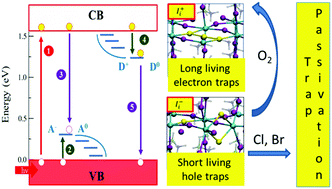
Energy Environ. Sci., 2018, 11,702-713
DOI: 10.1039/C8EE00124C, Paper
DOI: 10.1039/C8EE00124C, Paper
Daniele Meggiolaro, Silvia G. Motti, Edoardo Mosconi, Alex J. Barker, James Ball, Carlo Andrea Riccardo Perini, Felix Deschler, Annamaria Petrozza, Filippo De Angelis
Electron/hole traps related to interstitial iodine defects show the typical features of iodine photo-electrochemistry, inducing MAPbI3 defect tolerance.
The content of this RSS Feed (c) The Royal Society of Chemistry
Electron/hole traps related to interstitial iodine defects show the typical features of iodine photo-electrochemistry, inducing MAPbI3 defect tolerance.
The content of this RSS Feed (c) The Royal Society of Chemistry
wjzmy1994 likes this
05 Mar 07:55

Reinforcing the Built-In Field for Efficient Charge Collection in Polymer Solar Cells
by Jong-Hoon Lee, Song Yi Jeong, Geunjin Kim, Byoungwook Park, Junghwan Kim, Seyoung Kee, Bongseong Kim, Kwanghee Lee
Abstract
The collection efficiency of photogenerated charges in polymer solar cells (PSCs) is strongly influenced by the built-in field (Ein) that develops across the photoactive materials. Here, by investigating the Ein-development regimes in PSCs by introducing two types of interlayers, electric dipole layers (EDLs) and charge transport layers (CTLs), the device architecture is optimized to result in a larger Ein. By incorporating a pair of EDLs on both sides of the photoactive layer, the Ein is modulated by shifting the vacuum energy at each metal–semiconductor interface, providing a larger Ein than that in conventional PSCs using typical CTLs, such as metal oxides and/or conducting polymers. These devices using paired EDLs exhibit an average PCE of 9.8%, which far surpasses the average PCE of ≈8.5% for paired CTLs.

Polymer solar cells with a new device architecture for reinforcing built-in electric field is demonstrated. A pair of strong electric dipole layers on both sides of the photoactive layer maximizes internal electric field in the operating state under short circuit condition, which permits an efficient “sweep out” of photo generated charges compared to those of typical charge transport layers.
hailul, Fiona-moon and 9 others like this
05 Mar 07:51

Fully High-Temperature-Processed SnO2 as Blocking Layer and Scaffold for Efficient, Stable, and Hysteresis-Free Mesoporous Perovskite Solar Cells
by Liangbin Xiong, Minchao Qin, Cong Chen, Jian Wen, Guang Yang, Yaxiong Guo, Junjie Ma, Qi Zhang, Pingli Qin, Songzhan Li, Guojia Fang
Abstract
Planar perovskite solar cells (PSCs) based on low-temperature-processed (LTP) SnO2 have demonstrated excellent photovoltaic properties duo to the high electron mobility, wide bandgap, and suitable band energy alignment of LTP SnO2. However, planar PSCs or mesoporous (mp) PSCs based on high-temperature-processed (HTP) SnO2 show much degraded performance. Here, a new strategy with fully HTP Mg-doped quantum dot SnO2 as blocking layer (bl) and a quite thin SnO2 nanoparticle as mp layer are developed. The performances of both planar and mp PSCs has been greatly improved. The use of Mg-SnO2 in planar PSCs yields a high-stabilized power conversion efficiency (PCE) of close to 17%. The champion of mp cells exhibits hysteresis free and stable performance with a high-stabilized PCE of 19.12%. The inclusion of thin mp SnO2 in PSCs not only plays a role of an energy bridge, facilitating electrons transfer from perovskite to SnO2 bl, but also enhances the contact area of SnO2 with perovskite absorber. Impedance analysis suggests that the thin mp layer is an “active scaffold” selectively collecting electrons from perovskite and can eliminate hysteresis and effectively suppress recombination. This is an inspiring advance toward high-performance PSCs with HTP mp SnO2.

A fully high-temperature (HT)-processed Mg-incorporated quantum dot (QD) SnO2 blocking layer (bl)/mesoporous (mp) SnO2 layer is used for the fabrication of perovskite solar cells (PSCs). Optimized fully HT mp SnO2 PSCs can be achieved using an Mg-incorporated QD SnO2 bl/100-nm-thick mp SnO2 layer and its champion cell harvests a high stabilized power conversion efficiency of 19.2% with hysteresis free and stable performance.
29 Jan 07:50

Mechanically-stacked perovskite/CIGS tandem solar cells with efficiency of 23.9% and reduced oxygen sensitivity

Energy Environ. Sci., 2018, 11,394-406
DOI: 10.1039/C7EE02627G, Paper
DOI: 10.1039/C7EE02627G, Paper
Heping Shen, The Duong, Jun Peng, Daniel Jacobs, Nandi Wu, Junbo Gong, Yiliang Wu, Siva Krishna Karuturi, Xiao Fu, Klaus Weber, Xudong Xiao, Thomas P. White, Kylie Catchpole
A perovskite/CIGS tandem configuration is an attractive and viable approach to achieve an ultra-high efficiency and cost-effective all-thin-film solar cell.
The content of this RSS Feed (c) The Royal Society of Chemistry
A perovskite/CIGS tandem configuration is an attractive and viable approach to achieve an ultra-high efficiency and cost-effective all-thin-film solar cell.
The content of this RSS Feed (c) The Royal Society of Chemistry
Fiona-moon, xululu91 and one other like this
29 Jan 07:50

New-generation integrated devices based on dye-sensitized and perovskite solar cells

Energy Environ. Sci., 2018, 11,476-526
DOI: 10.1039/C7EE03165C, Review Article
DOI: 10.1039/C7EE03165C, Review Article
Sining Yun, Yong Qin, Alexander R. Uhl, Nick Vlachopoulos, Min Yin, Dongdong Li, Xiaogang Han, Anders Hagfeldt
New-generation integrated devices based on dye-sensitized and perovskite solar cells for energy harvesting and storage are significantly important for self-powering systems and portable/wearable electronics.
The content of this RSS Feed (c) The Royal Society of Chemistry
New-generation integrated devices based on dye-sensitized and perovskite solar cells for energy harvesting and storage are significantly important for self-powering systems and portable/wearable electronics.
The content of this RSS Feed (c) The Royal Society of Chemistry
xululu91, Fiona-moon and 3 others like this
29 Jan 07:40

Design and understanding of encapsulated perovskite solar cells to withstand temperature cycling

Energy Environ. Sci., 2018, 11,144-150
DOI: 10.1039/C7EE02564E, Paper
DOI: 10.1039/C7EE02564E, Paper
Rongrong Cheacharoen, Nicholas Rolston, Duncan Harwood, Kevin A. Bush, Reinhold H. Dauskardt, Michael D. McGehee
Perovskite solar cells retain their performance with temperature cycling using a compliant, ethylene vinyl acetate encapsulant.
The content of this RSS Feed (c) The Royal Society of Chemistry
Perovskite solar cells retain their performance with temperature cycling using a compliant, ethylene vinyl acetate encapsulant.
The content of this RSS Feed (c) The Royal Society of Chemistry
xululu91 likes this
29 Jan 07:39

Revisiting lifetimes from transient electrical characterization of thin film solar cells; a capacitive concern evaluated for silicon, organic and perovskite devices

Energy Environ. Sci., 2018, 11,629-640
DOI: 10.1039/C7EE03155F, Paper
DOI: 10.1039/C7EE03155F, Paper
David Kiermasch, Andreas Baumann, Mathias Fischer, Vladimir Dyakonov, Kristofer Tvingstedt
Here we re-evaluate previously assigned carrier lifetimes as being severely influenced by the decay rate of spatially separated charge carriers.
The content of this RSS Feed (c) The Royal Society of Chemistry
Here we re-evaluate previously assigned carrier lifetimes as being severely influenced by the decay rate of spatially separated charge carriers.
The content of this RSS Feed (c) The Royal Society of Chemistry
wjzmy1994, Yu-Qing Yao and 3 others like this
16 Jan 13:22

Origin of low electron-hole recombination rate in metal halide perovskites

Energy Environ. Sci., 2018, 11,101-105
DOI: 10.1039/C7EE01981E, Communication
DOI: 10.1039/C7EE01981E, Communication
Francesco Ambrosio, Julia Wiktor, Filippo De Angelis, Alfredo Pasquarello
Isodensity representation of the hole and the electron in the excitonic state of CH3NH3PbI3 showing spatial separation of the polaronic charges.
The content of this RSS Feed (c) The Royal Society of Chemistry
Isodensity representation of the hole and the electron in the excitonic state of CH3NH3PbI3 showing spatial separation of the polaronic charges.
The content of this RSS Feed (c) The Royal Society of Chemistry
16 Jan 13:19

The role of fullerenes in the environmental stability of polymer:fullerene solar cells

Energy Environ. Sci., 2018, 11,417-428
DOI: 10.1039/C7EE02983G, Paper
DOI: 10.1039/C7EE02983G, Paper
Harrison Ka Hin Lee, Andrew M. Telford, Jason A. Rohr, Mark F. Wyatt, Beth Rice, Jiaying Wu, Alexandre de Castro Maciel, Sachetan M. Tuladhar, Emily Speller, James McGettrick, Justin R. Searle, Sebastian Pont, Trystan Watson, Thomas Kirchartz, James R. Durrant, Wing C. Tsoi, Jenny Nelson, Zhe Li
Environmental stability is a common challenge for the commercialisation of low cost, encapsulation-free organic opto-electronic devices.
The content of this RSS Feed (c) The Royal Society of Chemistry
Environmental stability is a common challenge for the commercialisation of low cost, encapsulation-free organic opto-electronic devices.
The content of this RSS Feed (c) The Royal Society of Chemistry
wjzmy1994, Yu-Qing Yao and 13 others like this
11 Jan 06:20
Novel unsymmetrical squaraine-based small molecules for organic solar cells

J. Mater. Chem. C, 2018, 6,847-854
DOI: 10.1039/C7TC04639A, Paper
DOI: 10.1039/C7TC04639A, Paper
Yao Chen, Gang Wang, Lin Yang, Jianglin Wu, Ferdinand S. Melkonyan, Yan Huang, Zhiyun Lu, Tobin J. Marks, Antonio Facchetti
New unsymmetrical squaraines for organic solar cells (OSCs) are synthesized without using highly toxic reagents. OSCs based on these squaraines exhibit an impressive open-circuit voltage of 0.92 V and power conversion efficiencies approaching 5%.
The content of this RSS Feed (c) The Royal Society of Chemistry
New unsymmetrical squaraines for organic solar cells (OSCs) are synthesized without using highly toxic reagents. OSCs based on these squaraines exhibit an impressive open-circuit voltage of 0.92 V and power conversion efficiencies approaching 5%.
The content of this RSS Feed (c) The Royal Society of Chemistry
Xu Xiangfei, pengyuhaopeng and 3 others like this
25 Dec 01:16
Bromination of the Benzothioxanthene Bloc: Toward New pi-Conjugated Systems for Organic Electronic Applications
J. Mater. Chem. C, 2017, Accepted Manuscript
DOI: 10.1039/C7TC05245F, Paper
DOI: 10.1039/C7TC05245F, Paper
Pierre Josse, Shi Li, Sergey Dayneko, damien joly, Antoine Labrunie, Sylvie Dabos-Seignon, Magali Allain, Benjamin Siegler, Renaud Demadrille, Gregory Charles Welch, Chad Risko, Philippe Blanchard, Clement Cabanetos
A selective and efficient method to afford a monobrominated benzothioxanthene (Br-BTXI) derivative is reported. Br-BTXI was extensively employed in common palladium catalyzed coupling reactions. Finally, as a proof of concept,...
The content of this RSS Feed (c) The Royal Society of Chemistry
A selective and efficient method to afford a monobrominated benzothioxanthene (Br-BTXI) derivative is reported. Br-BTXI was extensively employed in common palladium catalyzed coupling reactions. Finally, as a proof of concept,...
The content of this RSS Feed (c) The Royal Society of Chemistry
25 Dec 01:15
Small Bandgap Porphyrin-based Polymer Acceptors for Non-Fullerene Organic Solar Cells
J. Mater. Chem. C, 2017, Accepted Manuscript
DOI: 10.1039/C7TC04759B, Communication
DOI: 10.1039/C7TC04759B, Communication
Shichao Zhou, Cheng Li, Junshu Ma, Yiting Guo, Jianqi Zhang, Yonggang Wu, Weiwei Li
For the first time, small bandgap porphyrin-based polymer acceptors with low-lying frontier energy levels and good crystallinity were developed for application in non-fullerene organic solar cells, in which a broad...
The content of this RSS Feed (c) The Royal Society of Chemistry
For the first time, small bandgap porphyrin-based polymer acceptors with low-lying frontier energy levels and good crystallinity were developed for application in non-fullerene organic solar cells, in which a broad...
The content of this RSS Feed (c) The Royal Society of Chemistry
25 Dec 01:15
Kinetically Controlled Synthesis of Cu Nanowires with Tunable Diameters and Their Applications in Transparent Electrodes
J. Mater. Chem. C, 2017, Accepted Manuscript
DOI: 10.1039/C7TC05038K, Paper
DOI: 10.1039/C7TC05038K, Paper
Xiao Wang, Ranran Wang, Liangjing Shi, Jing Sun
One-dimensional metallic nanostructures have attracted ever increasing attention in recent years due to their potential applications in transparent electrodes, catalysts, surface enhanced resonance scattering (SERS) based sensors and electric heating...
The content of this RSS Feed (c) The Royal Society of Chemistry
One-dimensional metallic nanostructures have attracted ever increasing attention in recent years due to their potential applications in transparent electrodes, catalysts, surface enhanced resonance scattering (SERS) based sensors and electric heating...
The content of this RSS Feed (c) The Royal Society of Chemistry
25 Dec 01:11
A Silanol-Functionalized Polyoxometalate with Excellent Electron Transfer Mediating Behavior to ZnO and TiO2 Cathode Interlayers for Highly Efficient and Extremely Stable Polymer Solar Cells
J. Mater. Chem. C, 2017, Accepted Manuscript
DOI: 10.1039/C7TC04960A, Paper
DOI: 10.1039/C7TC04960A, Paper
Marinos Tountas, Yasemin Topal, Apostolis Verykios, Anastasia Soultati, Andreas Kaltzoglou, Theodoros Papadopoulos, Florian Auras, Kostas Seintis, Mihalis Fakis, Leonidas C. Palilis, Dimitris Tsikritzis, Stella Kennou, Azhar Fakharuddin, Lukas Schmidt-Mende, Spyros Gardelis, Mahmut Kus, Polycarpos Falaras, Dimitris Davazoglou, Panagiotis Argitis, maria vasilopoulou
Combining high efficiency and long lifetime under ambient conditions still poses a major challenge towards commercialization of polymer solar cells. Here we report a facile strategy that can simultaneously enhance...
The content of this RSS Feed (c) The Royal Society of Chemistry
Combining high efficiency and long lifetime under ambient conditions still poses a major challenge towards commercialization of polymer solar cells. Here we report a facile strategy that can simultaneously enhance...
The content of this RSS Feed (c) The Royal Society of Chemistry