“Reboot” has become a contentious word. While risk-averse producers are perpetually looking for familiar films and TV to bring back in new forms, with the expectation that the new versions will have a built-in fandom, the seemingly endless wave of lackluster reboots of popular properties seems to be taking a toll on fans.
And every new reboot announcement sparks a wave of online backlash. One of the most recent kerfuffles involved the announcement that Midnight, Texas creator Monica Owusu-Breen was working with Joss Whedon on a new version of his signature show, Buffy the Vampire Slayer. Initial reports suggested their new show would be a reboot, with a woman of color in the title role.
The initial social-media response was largely ‘Why...
"Energy storage is a key piece of the clean energy puzzle, but it is not an unqualified good. Deployed as it generally is today — somewhat crudely, engaged only in energy arbitrage, in markets that do not price carbon — it results in increasing carbon emissions. The world does not need any more of those. "...the right way to grow energy storage markets is to deploy the hell out of renewable energy and let the need for storage determine its growth. It is still entirely possible that, through whatever mix of transmission buildout, smart-grid improvements, and market reforms, we’ll end up needing less storage than we think. Market pull should determine where and when storage is deployed."
Energy storage is considered a green technology. But it actually increases carbon emissions.
Energy storage (batteries and other ways of storing electricity, like pumped water, compressed air, or molten salt) has generally been hailed as a “green” technology, key to enabling more renewable energy and reducing greenhouse gas emissions.
But energy storage has a dirty secret. The way it’s typically used in the US today, it enables more fossil-fueled energy and higher carbon emissions. Emissions are higher today than they would have been if no storage had ever been deployed in the US.
This is not intrinsic to the technology, by any means. If deployed strategically, energy storage can do all the things boosters say, making the grid more flexible, unlocking renewable energy, and reducing emissions.
But only if it is deployed strategically, which it generally hasn’t been.
In and of itself, energy storage is neither clean nor dirty — it is neutral, as likely to boost the revenue of fossil fuel plants as it is to help clean energy. If policymakers want to use it as a tool to enable clean energy, they need to be conscious of its characteristics and smarter about its deployment.
BNEFLithium-ion batteries are going to get very cheap and very common.
Why energy storage increases emissions
There is a growing body of scholarly research around energy storage; the key paper on its emission effects is by the Rochester Institute of Technology’s Eric Hittinger and Carnegie Mellon’s Inês Azevedo, in Environmental Science & Technology.
Modeling energy mixes and energy prices across the country, Hittinger and Azevedo determine that the deployment of energy storage increases emissions almost everywhere in the US today. Yikes.
By way of background, it’s important to understand that while energy storage can provide a wide array of services to the grid (more on that later), these days it is primarily used for energy arbitrage — storing energy when it is cheap (usually at night) and discharging it when it is more valuable (usually during the day). So it’s energy arbitrage that Hittinger and Azevedo model.
Hey storage+renewables fans - I have three (!!!) recent publications about the emissions effects of broad adoption of energy storage and I'll give the highlights in one delightful thread. Buckle up! pic.twitter.com/HCA33uXvC6
There are two reasons why energy storage deployed for the purpose of arbitrage increases emissions:
1) Storage increases the value of the energy sources it draws from (a source that can store some of its energy can generate more) and decreases the value of the energy sources it competes against when discharging. If the energy sources it draws from are more carbon-intensive than the energy sources it competes against, then it will have the effect of increasing the carbon intensity of the overall power mix.
Say a battery bank absorbs cheap energy being produced by coal plants overnight and then discharges it in the day, competing with natural gas combined-cycle (NGCC) plants. The net effect will be to favor coal against natural gas, thus increasing net emissions.
2) Every bit of energy stored also represents a bit of energy lost. The “round-trip efficiency” of energy storage — the amount of energy it releases relative to the amount put in — ranges, depending on the technology, from around 40 to 90 percent.
Let’s take, for representative purposes, 80 percent, a relatively optimistic assumption for the efficiency of lithium-ion batteries. For every 1 megawatt-hour put in, 0.80 megawatt-hours comes out.
That means, if it is stored along the way, getting 1 MWh to the customer requires generating 1.25 MWh. The more energy that gets stored, the more generation has to increase to compensate for the round-trip losses.
If the generation that increases to compensate for the losses is more carbon-intensive than the energy that storage displaces, net emissions nudge up.
Even when a battery stores zero-emissions renewable energy, it is not increasing or decreasing total generation; it’s just moving it around (unless the renewables would otherwise have been curtailed; see below). If coal steps in to cover for the renewable energy that is stored, but it displaces natural gas when it’s discharged, it still might increase net carbon emissions.
It’s difficult for storage not to increase emissions
Add those two effects together and you get a tough situation: To avoid increasing emissions, it’s not enough that the energy stored is less carbon-intensive than the energy displaced. It has to be a lot less carbon-intensive. Hittinger put it to me this way in an email: assuming storage efficiency of 80 percent, “for storage to break even [on carbon emissions], the source of charging energy would have to be 20% cleaner (emissions/MWh) than the thing that you are displacing when the storage is discharging (on average).” That’s just to break even.
Those conditions can be met — NGCC plants are more than 20 percent cleaner than natural gas peaker plants, and closer to 50 percent cleaner than coal (depending on how you account for methane), and of course, renewables are 100 percent cleaner — but it turns not to be very common in the US at present.
(A 2017 study of storage paired with solar panels at the residential level found much the same result: All things being equal, residential storage increases net energy consumption and net carbon emissions.)
Theoretically, the emission-boosting effects of energy storage will decline as grids get greener. But they will have to get quite a bit greener. In a separate paper, Hittinger and colleagues model the emission effects of energy storage on a grid with increasing renewables. They find that in the Midcontinent ISO (MISO), the coal-heavy Midwestern regional energy market, wind and solar would have to reach 18 percent of total generation capacity before storage started reducing emissions on average. And that’s with today’s low natural gas prices. If natural gas prices increase, it would take even longer.
(There’s one important exception to note here: When and if it stores renewable energy that would otherwise have been curtailed, i.e., wasted, then energy storage clearly reduces net emissions. That’s not very common in the US today, but it could get more common as renewable energy grows.)
At least as things currently stand, that’s having a nontrivial effect on emissions. Hittinger and Azevedo estimate that storage in the US today has carbon dioxide emissions of 104 to 407 kilograms per MWh of delivered energy, depending on location and marginal energy prices. That compares to “approximately 500 kg/MWh for US natural gas plants and 950 kg/MWh for US coal plants.”
Not ideal! What to do?
Happily, the Institute for Policy Integrity just released a new white paper on exactly this subject: “Managing the Future of Energy Storage.” It covers the research, Hittinger’s and others’, showing that energy storage can increase emissions and discusses three targets for reform. They are all geared, in one way or another, toward constructing a market that efficiently and accurately values the different characteristics of energy storage.
OUT TODAY: our new report explains how energy storage could actually INCREASE greenhouse gas emissions if proper policies aren't put in place https://t.co/spPElAbaB0
Owners of energy storage who seek to maximize their profits will store whatever energy is cheapest and displace whatever is most expensive, with no concern for carbon emissions. That’s because there’s no value put on avoiding carbon emissions — that is to say, there’s no price on carbon.
An economy-wide carbon price would be nice, though it doesn’t seem likely anytime soon. Next best would be working some kind of carbon price into regional energy markets, which would require coordination between state regulators, regional market managers, and utilities.
Third best would be better cost-benefit analysis in state energy procurement policies, which could take carbon emissions — in both construction and operation — into account.
And there are various other fourth-best kludges, ways of wedging a de facto price on carbon into markets. Eventually, though, we need a damn carbon price.
2) Eliminate barriers to entry for energy storage
The rules and compensation schemes that govern regional energy markets were generally designed around resources with different characteristics than energy storage. There are all sorts of artificial barriers to storage providing services that it is technically capable of providing.
The Federal Energy Regulatory Commission (FERC) took a big step forward on this front in February with its new storage rule, which asks the ISOs and RTOs that manage regional energy markets to reform their tariffs to allow for storage participation in energy markets, capacity markets, and “ancillary services” markets (stuff like voltage and frequency regulation).
There are still lots of unanswered questions about the storage rule and much other work to do to make sure markets are open to diverse participants, but FERC has at least kicked things off with a bang.
3) Enable energy storage to profit from multiple value streams
Storage can do more than arbitrage. It can relieve grid congestion, serve as capacity, and help avoid the need for distribution system upgrades. In fact, storage is something of a Swiss army knife — uniquely among energy technologies, it can simultaneously perform a range of services at different scales for different customers.
One complicating factor is that storage can potentially participate in both retail electricity markets, governed by states, and wholesale electricity markets, governed by FERC. That means the feds and states will have to cooperate to ensure that storage is compensated adequately but not double-compensated for any single service.
As an example of smart leadership, IPI focuses on New York’s “value stack” approach, which attempts to disaggregate the value streams provided by storage and compensate each one discretely.
The disaggregated approach allows storage to participate in multiple markets and receive compensation from multiple different entities, depending on where the value falls. (See the report for more details on New York’s system, which will undergo further refinements in its upcoming second phase, allowing more granular compensation of storage benefits.)
Other energy markets have a long way to go, but numerous states are wrestling with compensation for distributed energy resources and lots of experiments are underway, so learning by doing is already happening.
4) Bonus policy ideas
This list only scratches the surface on storage policy.
Policymakers need to get smarter about energy storage
Energy storage is a key piece of the clean energy puzzle, but it is not an unqualified good. Deployed as it generally is today — somewhat crudely, engaged only in energy arbitrage, in markets that do not price carbon — it results in increasing carbon emissions. The world does not need any more of those.
Hittinger told me on the phone, and I more or less agree, that the right way to grow energy storage markets is to deploy the hell out of renewable energy and let the need for storage determine its growth. It is still entirely possible that, through whatever mix of transmission buildout, smart-grid improvements, and market reforms, we’ll end up needing less storage than we think. Market pull should determine where and when storage is deployed.
But that means getting markets right — the one thing pretty much everyone agrees is crucial to smart use of storage.
I am not opposed in principle to technology-specific public policies — far from it! — but the rational deployment of energy storage, a technology with mixed and complex effects, seems like exactly the kind of problem markets are good at solving.
Put in place a market that values carbon, capacity, ramping, voltage regulation, and all the other services storage can provide, lower barriers to entry, set up transparent rules, and let profit-seeking companies battle it out. That market will be better at determining the proper amount and location of storage than any group of policymakers.
Joss Whedon’s TV series Buffy the Vampire Slayer ended its original run back in 2003, but 15 years later, a new iteration of the show is in development. Deadline reports that Whedon and Midnight, Texas creator Monica Owusu-Breen are developing the series at Fox 21 TV Studios. There is no home yet for the new Buffy, but the plan is for the series to be pitched to cable networks and streaming services later this summer.
The original show followed Buffy Summers (Sarah Michelle Gellar), a “Slayer” destined to fight evil forces in her new hometown of Sunnydale. Inspired by Whedon’s feature film of the same name, the series ran for seven seasons, inspiring a spin-off series (Angel), a larger expanded universe of comics and novels, and a...
I thought we’d all signed off on every use of bacon. I thought Reddit and Epicurious and Epic Meal Time had taught us that bacon goes with everything. But judging by the looks I get at the diner when I dip my bacon in butter, we have not. We apparently have not collectively agreed that bacon, like french fries or baby…
Wow, I've never been happier about something the current FCC has done.
Enlarge / A sign for the Sinclair Broadcast buildings seen on October 12, 2004 in Hunt Valley, Maryland. (credit: Getty Images | William Thomas Cain)
The Federal Communications Commission has voted unanimously against approving Sinclair Broadcast Group's acquisition of Tribune Media Company, likely dooming the merger.
Technically, the commission adopted a Hearing Designation Order that refers the merger to an administrative law judge. Mergers usually don't survive that legal process. Besides referring the merger to a judge, the FCC's other options included denying the merger outright, approving the merger, or approving it with conditions. The unanimous vote to refer the merger to a judge was finalized on Wednesday evening.
Sinclair's problems stem from its plan to divest some stations in order to stay under station ownership limits. FCC Chairman Ajit Pai proposed the designation order on Monday, saying that Sinclair's proposal to divest certain stations "would allow Sinclair to control those stations in practice, even if not in name, in violation of the law."
Sinclair Broadcast Group's acquisition of Tribune Media Company has run into a major roadblock at the Federal Communications Commission.
FCC Chairman Ajit Pai said he won't approve the Sinclair/Tribune acquisition as it's currently structured, saying Sinclair's plans for divested stations would violate the law. Pai is recommending that the merger be reviewed by an administrative law judge, a move that could ultimately kill the deal.
Pai's decisions came after months of pressure from Democratic lawmakers, consumer advocacy groups, and industry lobby groups. Pai has been repeatedly accused of making regulatory changes that benefit Sinclair; the FCC's inspector general in February agreed to investigate whether Pai has improperly coordinated with Sinclair on rule changes.
Tearing down walls and cubicles in offices may actually build up more barriers to productivity and collaboration, according to a new study.
Employees at two Fortune 500 multinational companies saw face-to-face interaction time drop by about 70 percent, the use of email increase between 22 percent and 56 percent, and productivity slip after their traditional office spaces were converted to open floor plans—that is, ones without walls or cubicles that ostensibly create barriers to interaction. The findings, published recently in the Philosophical Transactions of the Royal Society B, suggest that removing physical dividers may, in fact, make it harder for employers to foster collaboration and collective intelligence among their employees.
Many companies have waged a so-called “war on walls” to try to create such vibrant workspaces, the authors Ethan Bernstein and Stephen Turban of Harvard wrote. But, “what they often get—as captured by a steady stream of news articles professing the death of the open office—is an open expanse of proximal employees choosing to isolate themselves as best they can (e.g. by wearing large headphones) while appearing to be as busy as possible (since everyone can see them).”
ProPublica obtained the audio and posted it online Monday afternoon. Throughout the eight-minute clip, you can hear several children sobbing and crying for their parents and other family members. At one point, a federal agent makes a joke that the crying sounds like an orchestra. Later, a federal worker asks the children where their parents are. One says their mom is at “someone else’s house.” Another says their mom is in Honduras.
This is how ProPublica described the origins of the tape:
The audio obtained by ProPublica breaks that silence. It was recorded last week inside a U.S. Customs and Border Protection detention facility. The person who made the recording asked not to be identified for fear of retaliation. That person gave the audio to Jennifer Harbury, a well-known civil rights attorney who has lived and worked for four decades in the Rio Grande Valley along the Texas border with Mexico. Harbury provided it to ProPublica. She said the person who recorded it was a client who “heard the children’s weeping and crying, and was devastated by it.”
The person estimated that the children on the recording are between 4 and 10 years old. It appeared that they had been at the detention center for less than 24 hours, so their distress at having been separated from their parents was still raw. Consulate officials tried to comfort them with snacks and toys. But the children were inconsolable.
How family separation became a Trump administration strategy.
Each day, dozens of immigrant families come to the US-Mexico border seeking asylum — and now the parents are being told that they’ve broken the law, are separated from their children, and are taken to jail.
The children, meanwhile, are swept into a completely different federal bureaucracy.
And there is no process to reunite the families.
My colleague Dara Lind has an excellent explainer that covers the various moving parts of the separation of migrant families at the border. But if you haven’t been following closely, this visual story should help you get a better understanding of how this process works — and how the Trump administration is justifying it.
1) The initial process for asylum seekers
Let’s say you and your child are from Honduras, among the world’s deadliest nations that aren’t at war.
Like thousands of other families, largely from Honduras, Guatemala, and El Salvador, you take the dangerous journey north to the US-Mexico border.
You could go to a US port of entry — like a border checkpoint — and claim asylum, which is legal. But you’ve heard that the ports of entry into the US can’t process asylum seekers quickly and that border officials sometimes refuse to accept asylum seekers.
So, like many other asylum seekers, you decide to cross between ports of entry.
This is a federal misdemeanor.
And upon crossing the border, you are apprehended by Border Patrol.
The Border Patrol agent asks if you fear persecution in your home country. You say yes. An official then interviews you to make sure you have “credible fear” if sent back. This is to determine whether you are eligible to go in front of a judge and seek asylum. (About three in four people are deemed credible.)
At that point, the US has to keep asylum seekers because federal and international law says they can’t deport people back to places where they would face danger.
2a) Before this policy, families would first await asylum proceedings together
Before this Trump policy, those who weredeemed to have credible fear would be put on a track to see an immigration judge, who would determine whether to grant asylum.
Some families were released and told to come back for a court date. Others were kept waiting in detention for up to 20 days and, if they hadn’t seen a judge by then, were released and told to return for a court date at some point in the future.
This is what immigration hawks derisively refer to as “catch and release,” something President Trump has vowed to end. In fiscal year 2017, the US issued 100,000 formal orders of deportation for all unauthorized immigrants. But just 60 percent of people showed up to court to hear this decision; the rest never appeared in front of the judge.
2b) Now some parents are being prosecuted for the illegal crossing — and separated from their kids
The Trump administration has taken a new approach.
Instead of first figuring out whether you should be granted asylum, the administration’s first step is now to deal with the other matter at hand: the misdemeanor for illegal entry.
Upon being apprehended by Border Patrol, you are set aside to bedetained by US Marshals and sent to a federal jail to await trial.
This is where the separation happens — because a child can’t go with you to federal jail, he is taken from you.
Your child is now placed under the supervision of the Department of Health and Human Services, which sends him to temporary housing. This could be foster care, or it could be one of the detention centers where children are kept in what are essentially cages. In the meantime, HHS looks for a relative in the US who can take him in. Sometimes this takes weeks.
3) After serving time in jail, parents try to reunite with their kids. But there is no process to make this happen.
And it could take time to see a judge because immigration courts are backlogged — and this would get worse since the Trump administration wants to prosecute all border crossers.
The maximum sentence for a first-time illegal entry conviction is six months. Usually judges just sentence immigrants to “time served.”
Once you’ve been convicted, you are returned to the custody of immigration officials to go through deportation proceedings. This is when you can theoretically reunite with your child at a civil detention center while you pursue your asylum case, according to the administration.
But that’s not what’s happening. The US has no procedure to reunite parents with children. In the detention centers, immigrants don’t have phone access. It’s taken some parents months to track down their kids. In addition, some parents are being deported without their children, and advocates say some small children are being deported without their parents.
How the Trump administration is justifying its policy
The Trump administration can’t seem to get its story straight on why it has implemented this “zero tolerance” policy.
As my colleague Matthew Yglesias put it, “President Donald Trump’s White House has now offered three conflicting reasons for why it is breaking up families seeking asylum at the border. It’s a deterrent. It’s Democrats’ fault. It’s not even a real policy at all.”
It’s a strategy to make the process more painful for families in hopes of making sure asylum seekers don’t set even one foot in the US, since international laws say they then can’t be turned away.
The reality is that this strategy involves taking children away from their parents without a process for reuniting them.
Enlarge / TV painting instructor/artist Bob Ross using a large paint brush to touch up one of his large seascapes in his studio at home. (credit: Acey Harper / Getty Images)
Blissful and soothing reruns of Bob Ross’ The Joy of Paintingcan make even hardened Internet users drift away to a sublime dream world, complete with happy little trees and happy little clouds. Now, for those that can’t get enough during the day—and have trouble drifting off at bedtime—there’s a happy little audio series.
The maker of popular meditation app Calm is recasting audio from episodes of The Joy of Painting to create “Sleep Stories” narrated by Ross that help users relax and slip off to a peaceful slumber.
The series marks the first time that Bob Ross Inc., which manages the late painting star’s estate and brand, has agreed to license audio from the show, according to a report by The New York Times.
Comcast has disabled a throttling system that it deployed in 2008 in order to slow down heavy Internet users.
Comcast's network is now strong enough that a congestion management system isn't needed, the company says. The system has been "essentially inactive for more than a year," and is now disabled entirely.
Yet the nation's largest cable operator still imposes data caps and overage fees in 27 states, claiming that it limits the amount of data customers use each month "based on a principle of fairness."
The summit comes just a week after Iran announced plans to build a new facility to make hardware used to enrich uranium, a hint that it would move forward with assembling centrifuges to potentially build nuclear weapons if the deal Trump pulled the US out of falls apart.
Enriching nuclear material is a crucial step in harnessing the atom to generate electricity and in building the most devastating weapon humanity has ever devised, the atomic bomb. A couple dozen countries in the world have nuclear power plants, but 13 have figured out how to do nuclear enrichment themselves, and nine of them have built nuclear weapons.
Given the extraordinary destructive power of a nuclear weapon, keeping a close eye on enrichment around the world is crucial to global security. But in the decades since the Manhattan Project, the enrichment process has gone from a massive, power-hungry, brute-force operation to a sophisticated and potentially clandestine affair.
Since it’s immensely important in international diplomacy right now, it’s worthwhile to understand what goes into enriching nuclear material, how the nuclear process works, and the strategies for keeping it in check.
Uranium and plutonium are the key elements in a nuclear reaction
Like the spark that ignites a fire, a nuclear chain reaction can propagate from a very small input. And like a controlled flame, a nuclear reaction can provide useful energy. Unharnessed, it can destroy cities.
However, specific starting materials, most commonly uranium and plutonium, must be processed or enriched to drive a chain reaction.
Here are some of the basics: Uranium is the heaviest naturally occurring element in the periodic table, with an atomic number of 92, representing the number of protons in its nucleus.
It’s scattered in trace amounts in “virtually all soil, rock and water,” according to the US Environmental Protection Agency. Some countries have tried to extract uranium from seawater, but right now it’s far more cost-effective to mine it in mineral deposits.
Plutonium, on the other hand, is a synthetic element. It has an atomic number of 94 and is formed in nuclear reactors as a byproduct of neutrons being captured by uranium. Plutonium can be acquired from reprocessing spent fuel from conventional nuclear power plants, or reactors can be designed specifically to produce plutonium for use in weapons.
But making plutonium usually requires a reactor to begin with, so uranium remains the choke point for both uranium-based and plutonium-based weapons.
The nuclear reaction is the same for weapons and energy. The desired outcome is different.
So you have your uranium (or plutonium). Can you now make a bomb?
Not quite. Let’s wade into the history and science of splitting atoms to set the stage for nuclear negotiations today.
Researchers found since the 1930s that they could bombard uranium with neutrons to create heavier isotopes and form new elements that have never before been seen in nature, like plutonium.
An isotope is a variety of an element with the same chemical structure but a different internal composition. In comparing isotopes of an element like uranium, the atomic number stays the same, but the isotope number — the sum of the protons and neutrons in a nucleus — can differ. Uranium-235 (U-235), for example, has three fewer neutrons than uranium-238 (U-238), but they undergo the same chemical reactions.
In their experiments, German scientists Otto Hahn, Lise Meitner, and Fritz Strassmann in 1938 found another curious result. Among the atoms resulting from neutron bombardment were much smaller atoms like barium, which has an atomic number of 56. Meitner, along with Austrian scientist Otto Frisch, realized that this was the result of splitting the uranium atom into smaller atoms, a phenomenon that also emits a huge amount of energy. The finding marked the dawn of the nuclear age.
Isotopes of atoms that can split apart (undergo fission) are described as fissile. When there are enough fissile atoms close together — a quantity known as critical mass — the particles ejected by fission can strike other fissile atoms, triggering more atoms to split apart and so on. The energy released in the process can generate heat to boil water to spin a turbine or wreak devastation from a bomb.
But not all uranium atoms can easily split apart and trigger a chain reaction. In fact, most can’t. In nature, about 99.7 percent of uranium is in the form of the non-fissile isotope U-238.
Only about 0.7 percent of uranium occurs in the fissile form of U-235. And in nature, U-235 is in such a low concentration that even if a stray neutron were to strike it with enough force to break it apart, it’s unlikely that the resulting neutrons would find another U-235 atom nearby to continue the reaction.
Javier Zarracina/Vox
To produce a chain reaction, you need to increase the concentration of U-235 relative to U-238. This is called enrichment.
For plutonium, all isotopes are fissile, but some are easier to use in nuclear weapons than others. Plutonium rich in the isotope Pu-239, called weapons-grade plutonium, poses the fewest technical challenges and can be extracted from nuclear fuel that is only irradiated in a reactor for a short time.
Making uranium and plutonium useful is a major technical challenge
Enrichment is the sorting problem from hell.
Instead of uranium atoms, imagine you have a bag filled with 1,000 marbles, each identical in material, size, shape, color, and texture. However, there are seven marbles in the bag that weigh 1.3 percent less than the others. For 5-gram, 1.5-centimeter diameter marbles, we’re talking about a difference of about 65 milligrams for the light marbles, or the weight of a few grains of sand.
Since it’s tedious to weigh each individual marble, you’ll want to come up with some sort of group sorting mechanism. But weight is the only thing setting them apart and the difference between desired and undesired marbles is small, so the sorting process won’t be perfect and you’ll still have a mixture of light and heavy marbles at the end. So you run the results through the sorter again. And again. And again.
With each iteration, you have a higher percentage of lighter marbles, but every repetition costs time, money, and energy.
And remember, the marbles in this analogy are atoms, the smallest unit of matter, so they’re that much more difficult to manipulate, and it takes far longer to get the quantities you need when you’re trying to go from atoms of uranium to tons of it.
For a nuclear reactor cooled with ordinary water, you need only about 3 to 5 percent U-235 enrichment, but you need it by the ton. A 1-gigawatt nuclear reactor uses 27 tons of nuclear fuel per year. A comparable coal-fired plant burns 2.5 million tons of coal per year.
Uranium with more than 20 percent U-235 is considered highly enriched. Conversely, the residual uranium with U-235 removed is called depleted(this is the uranium used in armor-piercing ammunition).
A nuclear weapon, on the other hand, requires even higher enrichment, typically around 90 percent, though it needs much less mass than a reactor. The Little Boy bomb dropped on Hiroshima, Japan, used 141 pounds of highly enriched uranium, though only 2 percent actually underwent fission due to inefficiencies in the design of the bomb. The Fat Man bomb dropped on Nagasaki used just 14 pounds of plutonium.
RareHistoricalPhotos.comPhysicist Harold Agnew holding the plutonium core of the Fat Man bomb dropped on Nagasaki, Japan, in 1945.
The International Atomic Energy Agency defines a “significant quantity” of nuclear material for a weapon to be 55 pounds of U-235 within a quantity of highly enriched uranium, or 17.6 pounds of plutonium.
Some countries with civilian nuclear reactors, like South Korea, don’t bother with the whole enrichment process and have opted instead to buy their nuclear fuel on the open international market. But for others, like France, mastering the fuel cycle is a vital pillar of their energy strategy.
The enrichment process has become easier, which makes controlling nuclear weapons harder
Both Iran and North Korea have developed surreptitious enrichment networks for producing nuclear material. These facilities are hard to detect and easy to reconfigure, so without regular inspections and monitoring, the possibility of a clandestine nuclear weapons program remains.
This wasn’t always the case.
The Manhattan Project marked the first successful effort to enrich uranium for a nuclear weapon. One of the earliest and most primitive enrichment techniques used in this endeavor was gaseous diffusion. Here, uranium is reacted with fluorine to make uranium hexafluoride gas (UF6). The gas is then pumped through membranes, the idea being that lighter isotopes of uranium would diffuse faster than heavier isotopes (fluorine has only one naturally occurring isotope, so any differences in the mass of the gas come from uranium).
But each stage of the process could only separate a tiny amount of uranium, so gaseous diffusion required huge buildings and devoured energy to power the pumps needed to move the gas through the separation stages.
“The original ways of doing it were very inefficient,” said Edwin Lyman, a senior scientist in the Global Security Program at the Union of Concerned Scientists. “They required very large amounts of land, lots of power.”
For example, the K-25 gaseous diffusion building in Oak Ridge, Tennessee, was completed in 1945 at a cost of $500 million. It was half a mile long and 1,000 feet wide, making it the largest building under one roof at the time. The facility employed 12,000 workers at its peak and consumed enough electricity to power 20,000 homes for a year.
K-25 Virtual MuseumAn aerial photo of the K-25 gaseous diffusion plant in Oak Ridge, Tennessee.
These days, uranium enrichment is much more subtle. The most common tool is the gas centrifuge. This is where uranium hexafluoride gas is fed into a column spinning at upward of 100,000 rotations per minute.
As the centrifuge spins, the heavier isotopes push harder against its wall than the lighter ones. The centrifuge also induces the gas to circulate within the device, further increasing separation. The output of one centrifuge is then fed into another and another in an arrangement called a cascade.
Centrifuges are more energy-efficient than other enrichment techniques and are harder to detect. The centrifuges themselves don’t take up much floor space, so their plants have a much smaller physical footprint than gaseous diffusion facilities. They also don’t draw as much electricity, nor do they leave much of a heat signature.
A declassified 1960 report from a contractor at Oak Ridge National Laboratory noted that “it would not be too difficult to build a relatively small clandestine gas centrifuge plant capable of producing sufficient enriched uranium for a small number of nuclear weapons.”
US Department of Energy/The LIFE Picture Collection/Getty Images
A uranium enrichment centrifuge cascade.
The point is a primitive enrichment apparatus is massive; a modern one is small.
“Centrifuges are the only [enrichment process] today that makes economic sense,” said R. Scott Kemp, director of the Laboratory for Nuclear Security and Policy at MIT. “[A centrifuge plant] capable of producing a weapon can fit in a garage or a small office building, and the energy consumption is less than typical office lighting per square foot.”
That’s why arms control discussions focus so much on centrifuges, and why the Iran nuclear deal — the Joint Comprehensive Plan of Action, or JCPOA — went to great lengths to specify the number and type of centrifuges allowed, as well as how closely they are monitored. Centrifuges are the key variable in how long it takes to enrich a usable quantity of uranium, whether for fuel or for weapons.
To produce nuclear energy, where you need tons of uranium but at low levels of enrichment, an enrichment operation would need many parallel cascades, but only a handful of enrichment stages. For a weapon, which demands kilograms of uranium but at much higher enrichment, it’s almost the reverse: You would only need a few parallel cascades, but those cascades would involve dozens of stages. With enough centrifuges, getting enough usable uranium for either would only take a few weeks.
The term of art for the amount of effort required to enrich uranium is a separative work unit, or SWU. It’s built on a complicated formula, and it’s useful for describing the efficiency of a centrifuge cascade. It takes about 120,000 SWU per year to produce enough fuel for a 1-gigawatt nuclear reactor, but it only takes about 5,000 SWU to have enough material for a nuclear weapon. So a country with enough enrichment capacity to sustain a small nuclear energy program theoretically has enough throughput to build dozens of weapons.
And switching between a nuclear fuel centrifuge arrangement and a nuclear weapon arrangement isn’t all that difficult or time-consuming. It’s a matter of changing how pipes are routed, so converting a plant from supplying energy material to supplying weapons material could take no more than a few months.
“That’s the real danger,” the Union of Concerned Scientists’ Lyman said. “Whether or not you can enrich to ‘highly enriched’ just really depends on if you have enough [centrifuges] to string them together.”
Uranium enrichment is the main focus of the Iran nuclear deal
So how do you design an enrichment system that can produce nuclear energy but not a nuclear weapon?
You can’t, really.
The expertise and technology overlap too much. This was the fundamental technical challenge behind the Iran nuclear deal. Iran remains a party to the Non-Proliferation Treaty; North Korea withdrew in 2003. India, Israel, and Pakistan also have nuclear weapons but haven’t signed the NPT.
Under the NPT, countries that don’t currently possess nuclear weapons are prevented from developing or spreading nuclear weapons technologies, but they can pursue nuclear activities for peaceful purposes like research or energy.
In 2003, Iran was found to have violated nuclear activity reporting requirements in the NPT, which spurred the international effort to get Iran to suspend its enrichment work. The US has argued that Iran does not have the right to enrich uranium since it was caught violating some of the safeguards imposed by the NPT, though Iran has not violated the treaty itself.
Kazen Ghane/AFP/Getty Images
International Atomic Energy Agency inspectors supervise a centrifuge cascade at the Natanz enrichment facility in Iran.
The goal of the six countries that signed the JCPOA with Iran in 2015 was to limit what is called “breakout time.” That is, how long it would take Iran to enrich enough material for a nuclear weapon if the country suddenly decided to ditch all international agreements and aggressively ramp up enrichment.
Prior to the agreement, Iran’s breakout time was estimated at four to six weeks. The provisions of the deal (Vox’s Zack Beauchamp put together an excellent explainer on this) aimed to extend this to more than a year, which would give international observers time to detect such a shift and enact countermeasures.
In short, the agreement made Iran limit uranium enrichment to 3.67 percent and decommission about 14,000 of its centrifuges, allowing just roughly 5,000 of Iran’s first-generation units to keep spinning. These IR-1 centrifuges produce between 0.75 and 1 SWU per device, whereas the IR-8 centrifuges Iran was developing at the time of the deal could theoretically manage 24 SWU, making them much more efficient.
Iran also gave up much of its low-enriched uranium stockpile, going from 25,000 pounds to 660 pounds. Iranian officials also agreed to pour concrete into their Arak reactor, a potential source of plutonium for nuclear weapons.
In addition, the JCPOA requires round-the-clock monitoring of Iran’s enrichment facilities in Fordow and Natanz, with only the Natanz facility allowed to operate. These are likely the only places where Iran can enrich uranium for a weapon.
“I think in Iran, we are pretty confident that there is no undeclared plant,” said Alex Glaser, director of the Nuclear Futures Laboratory at Princeton University.
International observers are also monitoring Iran’s uranium mining operations.
As it stands, the agreement effectively eliminates Iran’s prospects for enriching enough uranium for a civilian nuclear program and makes it much more tedious to gather the material required for a weapon. What little enrichment Iran is allowed under the deal is effectively a face-saving measure. But, critics argue, pausing Iran’s entire nuclear enrichment apparatus only extends the breakout time by a few months since the country could just rebuild or reinstall its centrifuges if it decided to leave the agreement.
In fact, it might be beneficial for observers to keep a small enrichment program in place. “If they shut down the nuclear program entirely, actually your insight into what’s going on in Iran drops precipitously,” Kemp said. Surveillance — both open and clandestine — remains key. Highly skilled nuclear workers remain employed at monitored sites. Whatever phone lines are tapped are still operating. The informants who were recruited remain in place. “If you shut all that down, all that disappears, and it actually becomes much easier to open a secret plant in the future,” Kemp said.
When Trump withdrew the US from the international accord in early May, Iran was in compliance, according to the IAEA. But Iran’s supreme leader, Ayatollah Ali Khamenei, said in a speech last week that Iran is now looking to enhance its enrichment capabilities.
Iranian nation & government will not stand being under both sanctions & nuclear restrictions. The Atomic Energy Organization of #Iran must immediately make the preparations for achieving 190K SWU-- for now within #JCPOA-- starting tomorrow.#IranDeal
“The Atomic Energy Organisation is obliged to quickly make preparations to reach to 190,000 SWU within the nuclear agreement,” he said. “The Iranian nation and its government will not tolerate to be both subject to sanctions and have its nuclear programme restricted and imprisoned.”
Iranian officials also announced that they are constructing a new plant to build components for advanced centrifuges. Under the deal, Iran is allowed to manufacture parts for centrifuges but isn’t allowed to install them for 10 years.
North Korea poses an even bigger challenge to controlling uranium enrichment
But the key challenge of negotiating with North Korea is devising a way to downscale an enrichment program that has already produced material for what is estimated to be dozens of nuclear weapons, with the added complication that we may not know where all the enrichment facilities actually are. That gives the North Koreans tremendous leverage in negotiations.
“In North Korea, the train has left the station, so to speak,” Glaser said. “Everyone in our community is working on this right now and trying to come up with ideas. Unfortunately, we don’t know what [North] Korea is going to ask for.”
DigitalGlobe/Getty Images
A satellite photo of the Yongbyon Nuclear Facility, North Korea
There is a distinct possibility that North Korea could have one or more hardened, secret enrichment sites capable of producing a nuclear weapon. The first steps in a negotiation would likely involve asking the North Koreans how much enriched uranium they have on hand and to cease enriching more nuclear material, but even those demands are difficult to verify.
“We would have to take their word for it in the beginning,” Glaser said.
So before negotiators even start talking about the number of centrifuges, uranium stockpiles, or monitoring, much of the discussions with North Korea are likely to snag on access — simply on finding out what’s going on. And, by the way, Trump is heading to the North Korea summit without a nuclear physics expert or science adviser by his side. He is the first president since 1941 not to name a science adviser.
And it seems the US and North Korea are not even on the same page as to the scope of the discussion in Singapore. The US wants North Korea to dismantle its weapons and to deconstruct its entire network for building new ones (“complete, verifiable, and irreversible denuclearization”). North Korea wants an international drawdown of nuclear weapons, including US capability.
Negotiators have their work cut out for them, and any practical limits to North Korea’s nuclear program via treaty would likely take months, if not years, to come to fruition.
But like with Iran, a deal with North Korea will likely be a compromise of sorts, where the US doesn’t get everything it wants. Even if North Korea conceded much of its enrichment apparatus in an agreement, its government has backed out of international agreements before — both openly and in secret — and could do so again.
If Trump is hoping for a big, single deal that solves the threat of North Korea’s nuclear weapons forever, he likely will be disappointed. The reality is that once a country develops enrichment capabilities, the specter of a mushroom cloud never leaves the picture. The knowhow is always there; it’s just a matter of will.
The process for crafting a denuclearization agreement with North Korea may drag on as all parties patiently work to build up fragile trust. But negotiations, however tedious and imperfect, are surely better than the tensions of late 2017 — when North Korea was proceeding headlong in a race to perfect its intercontinental ballistic missile technology and threatening to bomb Guam. Peace is at the door, but science holds the key.
Wedding photographers are always looking to take creative, novel portraits and a quick, simple trick is often sitting right in their pocket. By using a phone screen as a reflective surface, it is possible to cover up unsightly elements, add intrigue, and make an image that much more interesting.
Here’s how it works:
1. Start by holding your phone on a horizontal plane to the bottom edge of your lens.
2. As you look through the viewfinder you’ll see part of the scene reflecting onto the lower part of the image.
3. Simply adjust the phone slightly (while still holding it close the edge of the lens) until you see a reflection that you like.
BeforeAfter
4. Take the picture!
Here are some tips:
1. If you have a bulky case protecting your phone remove it to create a more seamless reflection.
2. The reflected portion of the image will often appear darker or lighter than the rest of the image. Applying a gradient in post-production helps to add balance and intrigue to the image.
BeforeAfter (with gradient applied to lower part of image).
3. Architectural elements (ie. Window, pillars, arches) reflect well and often work great with this technique.
BeforeAfter
4. Results don’t always have to be dramatic. Sometimes a slight reflection can help frame a subject or add that little something.
About the author: Mathias Fast is a wedding photographer based in Vancouver, Canada, and Cape Town, South Africa. You can find more of his work on his website, Facebook, and Instagram.
It now turns out that Intel forgot to mention an important detail: the 5GHz processors were overclocked, a lot, using chilled water coolers capable of handling thermal loads of up to 1.77kW.
Enlarge / This is a 10-core Skylake-X processor. It uses the low core count (LCC) version of the Skylake-SP die. (credit: Fritzchens Fritz)
Earlier this week, Intel showed off a product coming in the fourth quarter of this year: an enthusiast-oriented 28-core processor running all cores at 5GHz. This combination of clock speed and core count would put it head and shoulders above any other processor on the market, so the demonstration was more than a little surprising.
It now turns out that Intel forgot to mention an important detail: the 5GHz processors were overclocked, a lot, using chilled water coolers capable of handling thermal loads of up to 1.77kW. The real chips that ship won't be coming from the factory at 5GHz, and it's going to take a lot more than a big heatsink and a couple of fans to get them running that fast.
Aside from the core count and release window, Intel has confirmed one other fact about these 28-core chips: they're built on some variant of its 14nm process. They also use the enormous LGA3647 socket (that's 3,647 pins) used by some Xeon processors, and they have six memory channels. We don't know what platform/chipset this will use (though it's likely to be a close relative to the comparable server platform). And we don't know what its regular clock speed will be.
A week after a new study showed that thousands died because of Hurricane Maria, Trump remains quiet on the topic.
President Donald Trump appeared at the headquarters of the Federal Emergency Management Agency Wednesday for an annual hurricane briefing, but the event had little to do with preparation for hurricanes. Trump’s remarks were especially striking for what went unmentioned:Puerto Rico’s brutal recovery from Hurricane Maria.
US presidents hold a yearly briefing with FEMA leaders to discuss how the government is preparing for the hurricane season, which this year started June 1, and the president usually gives public remarks beforehand to remind Americans to prepare too. That’s not what happened this year.
Trump spent most of his time boasting about his administration’s accomplishmentsand praising his Cabinet officials, who were also present.
When he did get around to talking about hurricanes, he mentioned Puerto Rico only once, lumping it in with a few other states hit by natural disasters in 2017.
There’s a good reason for the neglect. The aftermath of the Category 4 hurricane that hit the island was one of the darkest period’s of Trump’s presidency so far (which is saying something). Maria was the worst natural disaster ever to hit the island, knocking out cellphone service and electricity for months. The local and federal response was a mess, with botched FEMA contracts, a drinking water crisis, an army of federal responders stretched too thin, and long delays in approving reconstruction aid for the island.
President Trump’s response was no less atrocious. When he visited Puerto Rico two weeks after the storm, he suggested that Maria wasn’t “a real catastrophe” like Hurricane Katrina. And instead of offering condolences, he reminded Puerto Rico how much money it was costing the federal government to respond to the crisis. He even congratulated the governor for the low death count, which was 16 at the time. That number was way off.
New research from epidemiologists at Harvard suggests Hurricane Maria was the deadliest natural disaster to hit US soil in 100 years. The research, published May 29 in the prestigious New England Journal of Medicine, pegged the hurricane death toll above 4,600 — far beyond the official death count of 64. That means Maria was likely twice as deadly as Hurricane Katrina.
The hurricane briefing would have been the perfect opportunity for the president to address Puerto Rico’s struggles and the new death toll estimates, but Trump seemed determined to ignore it at all costs.
Melania is back
The event did mark the first press appearance of first lady Melania Trump since she was hospitalized three weeks ago for a procedure to treat a “benign kidney condition.” (She attended a gala Monday evening for Gold Star families, but it was not open to the press.) She sat silently by her husband Wednesday at the FEMA briefing — an event not usually attended by the first lady.
Melania Trump’s disappearance from public view had fueled rampant speculation about her health and whereabouts — that she might be getting plastic surgery or even cooperating with special counsel Robert Mueller.
As Vox’s Emily Stewart notes, there was no indication that Trump had health problems, and there were no leaks that any type of procedure was upcoming. More details on her condition weren’t released, and the five days she spent at Walter Reed National Military Medical Center raised some eyebrows, as the typical hospital stay for such a procedure is usually shorter.
The first lady remained out of sight after she was discharged from the hospital. She skipped a Memorial Day wreath-laying at Arlington National Cemetery, and she didn’t accompany the president to Camp David last weekend.
The rumors about her whereabouts continued, even after Trump assured the public on social media that everything was just fine.
I see the media is working overtime speculating where I am & what I'm doing. Rest assured, I'm here at the @WhiteHouse w my family, feeling great, & working hard on behalf of children & the American people!
Trump’s unexpected appearance at the FEMA briefing may have an attempt to put an end to the stories.
“She went through a rough patch, but she’s doing great and we’re very proud of her. She’s done a fantastic job as a first lady. The people of our country love you,” the president said, awkwardly reaching out to grab her hand several times.
Trump used his hurricane briefing to not talk about hurricanes
President Trump didn’t want to talk about hurricanes at FEMA. He wanted to talk about all the great things his administration has done.
He spent more than half of his 17-minute remarks thanking each Cabinet member individually for their accomplishments.
That included effusive praise of Treasury Secretary Steve Mnuchin, who Trump said is “working hard on those taxes and keeping the taxes down. ... We passed the greatest tax cut in the history of our country, and lots of other things.”
And he commended Kirstjen Nielsen, head of the Department of Homeland Security, for doing great things on the border. “The border is coming along. And the wall is going up. We have $1.6 billion being spent on phase one of the wall, and we’ll get additional funding. And every week that goes by, people realize it more and more that we have to have the wall.”
He joked about how Interior Secretary Ryan Zinke is “the largest landlord in the world” and complimented Transportation Secretary Elaine Chao for being “so effective and so incredible.”
When he did bring up hurricanes, it was to tell the public thatthe federal government did everything right in its hurricane response last year — and that we should expect the same type of response this year. “We are marshaling every available resource to ensure maximum preparation for rapid response. That’s what we had last year. Disaster response and recovery is best achieved when it’s federally supported, state-managed, and locally executed,” he said.
Trump did not mention that his administration sent few emergency responders to Puerto Rico before the storm, or the delay in sending the Navy medical ship USS Comfort, or how FEMA hired completely inexperienced contractors to handle food and water supplies for hurricane victims.
Trump did mention Puerto Rico, once.
“Families in Texas and Louisiana, the US Virgin Islands, Puerto Rico, Florida, South Carolina, Georgia, Alabama, Mississippi — they were all affected. Hard to believe. And on tribal lands, where the hit was catastrophic, and the storms were really historic in their severity,” he said.
Even in his private meeting with FEMA leaders that was closed to the press, Trump avoided talking about hurricanes, according to the Washington Post’s Josh Dawsey:
President Trump had a lot else on his mind, turning the closed-door discussion into soliloquies on his prowess in negotiating airplane deals, his popularity, the effectiveness of his political endorsements, the Republican Party’s fortunes, the vagaries of Defense Department purchasing guidelines, his dislike of magnetized launch equipment on aircraft carriers, his unending love of coal and his breezy optimism about his planned Singapore summit with North Korean leader Kim Jong Un.
This was the time Trump was supposed to press FEMA about what the agency can do to better prepare for another deadly disaster like Hurricane Maria.
But he didn’t. And it’s a crisis he’s gotten very good at ignoring.
Case and accessory maker Riotoro has been churning out impressive, often budget-friendly products for years. But here at Computex 2018, the company seems to raise its profile with a new Project Morpheus PC, while hoping it finds favor among builders and gamers who often change up their PC hardware.
In a nutshell, this attractive chassis can be configured for either compact micro-ATX builds, or as a standard full-ATX mid-tower to make space for multiple graphics cards and/or other components. Cooling shouldn’t be an issue in either configuration, as much of the case is built of perforated metal mesh, and a removable front mount that makes way for as many as seven fans or two 240mm radiators. And you can leave your toolkit in the drawer when building, as the company says that Project Morpheus is a tool-free chassis, with ample consideration taken for cable routing. Connectivity comes in the form of both USB 3.0 and a USB-C port.
Here’s a quick look at some of the key specs and features of Project Morpheus. We’ll update this story when we hear more about pricing and availability. But this is a concept case, so don’t expect it to hit store shelves in the near future.
Features:
ATX, microATX, and mini-ITX motherboard support
All sides built with high-density perforated mesh
Dual-chamber design for better CPU and GPU cooling
Two 3.5” and two 2.5” SSD/HDD bays/mounts
Cooling:
Front: 2x 120mm fans or 240mm radiator
Top: 2x 120mm fans or 240mm radiator
Rear: 120mm fan
Dimensions:
440x276x465mm (17.3x10.8x18.3”)
More Computex 2018 coverage is found below.
Want to keep up to date with all of our Computex 2018 Coverage?
The viral police call on a black family barbecuing in Oakland was an everyday occurrence.
Several videos showing racial profiling of black Americans by police and white Americans have recently gone viral — in one video, a white woman calls the cops on a group of black people barbecuing in a park in Oakland. In another, a white student calls 911 when she sees a black classmate sleeping in a dormitory common room. In this essay, a former police dispatcher remembers the racist calls she used to take every day and law enforcement’s rules that forced her to respond to every caller, regardless of the incident.
It was the end of an 18-hour shift. My butt hurt from sitting in one place with only a couple of five-minute bathroom breaks. My brain hurt from staying awake that long, and my stomach ached from all the coffee I’d drunk to keep myself alert.
But the phones rarely stopped.
“911, what’s the address of your emergency?” I said into the headset.
The man gave me his address and then said, “There’s a woman pushing a shopping cart in front of my house.”
This one stumped me. I worked in a large metropolitan area. Yes, the city where I worked was affluent, and most people used their cars to get groceries. But surely he’d seen a person using a personal grocery cart before.
“I’m sorry, I’m not getting it. What’s the problem?” I waited for more clarification as I racked my brain for the correct penal code under which this infraction might fall.
“You need to get out here now.”
“Um.” A dispatcher has to be cautious about how she phrases things. Of all the jobs in emergency services — firefighters, police officers, nurses, doctors — dispatchers are the only ones who are recorded during every single thing they do. Everything they say — and their whole job is speaking — is part of public record. “I’m sorry, I don’t understand what you’re reporting.”
“She’s black.”
My heart sped up as it did every day when I heard this kind of thing. This Northern California city was affluent and very white, bordering Oakland, much of which was neither. “Sir, I’m still not seeing the problem. Is she being loud? Is the noise of the cart disturbing your peace?”
His tone got harsher. “Where do you live?”
I was so startled by the question that I answered it. “Oakland,” I said.
“You wouldn’t understand, then. This isn’t Oakland. We don’t have people like her in this neighborhood. Just send someone out to get rid of her. I’m not talking to you anymore.” The click in my ear was his goodbye.
The worst thing about it? I had to send someone out. Dispatchers usually don’t get to choose which calls lead to the dispatching of emergency personnel and which don’t.
If a person wants to make a report, they get to make a report. You can think of police reports as being like lawsuits. Anyone can make one about anything, no matter how stupid. Shortly after 9/11, I had to send an officer to take a report from a citizen because she’d had a dream about a knife-wielding man from Afghanistan.
Of course, dispatchers do have a tiny bit of control. I sent our one Afghan officer to take the report from her. He was amused; she, not so much.
Plenty of cops don’t really want to respond to these calls — it’s a waste of their time
By now, you’ve probably heard about the white Oakland woman who called the cops because black men were using a charcoal grill at Lake Merritt. She’s been memed and mocked, and the department has been criticized for sending officers out. But it all started with a dispatcher, answering that first phone call.
According to the computer logs, which have been made public, the call came in 11:22 am. A woman reported a 40-year-old heavyset black man using a charcoal grill. The dispatcher spent less than a minute asking her for more information. He typed NFD at the end, which stands for No Further Details.
Here’s where I start guessing things, based on 17 years of dispatching in the Bay Area. I’m guessing that the dispatcher rolled his eyes at this call so hard they almost fell out of his head. Yet another white lady upset over what black people were doing. Every single day of my career, I took that call. Every single day, I wanted to slam down the phone.
Instead, the dispatcher typed NFD. That’s subtle dispatch code for “this caller was a pain in the butt and couldn’t give more information about this lame-ass complaint.”It was entered as a Priority 3 call, which essentially means “not important” — the police officers on duty at that moment had much better things to do in a city like Oakland.
Two hours passed, and police had not responded. But then someone called to report the original caller was still on scene and now fighting with the people barbecuing, which prompted an immediate dispatch. “Life before property”is the code by which emergency services run. Potential property damage reports will hold for hours, if not days, if officers are busy intervening in situations where people are in physical danger. Once it was reported that people were fighting, an officer arrivedat the scene of the barbecue eight minutes later.
Am I saying police officers aren’t racist — that they question black citizens more aggressively than white citizens because responding to most complaints is obligatory? Heck no. Many are. We live in a country still mired in institutional racism, including its policing. I’m not in the business anymore, and the relationship between police departments and communities of color was one of the reasons I left to write full time.
But I am pointing out that those cops on the video didn’t look happy to be forced to take the complaint seriously. They had way better things to do that afternoon than investigate some guys cooking out in a park.
Take a minute to think before calling 911
In every city in America, 911 rings around the clock. Dispatchers are usually too short-staffed to take real breaks, and they can’t shut the center for weekends and holidays. They are the ones who suck it up and keep hitting the answer button, no matter what.
My co-worker once got a call from a man who said, “My neighbors keep parking in front of my house. And they’re black.”
Dispatchers all have moments when they reach the end of their patience, and that was Bonnie’s moment.
She said, “It’s a city street. Unfortunately, anyone can legally park wherever they like. I’m sure it’s very frustrating for you. Why would you bring race into this?”
“Are you black?”
“I am,” she said.
“Put your supervisor on the phone.”
He filed a police report against her instead of his neighbors.
She went through an internal affairs investigation because, of course, any report against a member of the police department has to be investigated. She was cleared of breaking any technical rules — she had stated clearly that no laws were being broken; she hadn’t had an attitude in her voice.
But she was sternly advised to be more circumspect in the future or her job would be at stake. She told me later, “That was the moment I decided to leave the industry. Every time I answered the phone, I felt like I got punched in the face. And I had to shut up and take it.” A few years later, she became a therapist on San Quentin’s death row. She said her new job was easier than dispatching.
The phone rings again. You mime stabbing yourself in the eyeball as the next caller says that she thinks three kids outside the 7-Eleven are getting ready to rob it.
“Why do you think that?”
“They’re wearing hoodies. You never know what those kinds of kids are carrying in their pockets. Every one of them could have a gun, you know. They probably do.”
“Did you see a gun?”
“Just check.” Click.
You swallow your cold oatmeal, you roll your eyes at your cubicle mate, and you enter the call for eventual dispatch even though you wish you could pretend you never got it. (If you don’t enter the call and something happens, you could lose your job for negligence.) Then you grab the next call.
Of course people should call 911 if it’s an actual emergency. But think before you call the cops to handle your feelings about a barbecue, or where someone is parked, or if they’re playing music on a Saturday afternoon. If you get it wrong (and all of us, living in the privileged bubbles of our own creation, often get it wrong), you could be the reason someone gets hurt or even killed.
With some rudimentary math, I’ve worked out that I’ve answered at least a quarter of a million 911 calls in my career. Amid the meaningless, racially charged calls, I’ve gotten so many by concerned citizens who genuinely want to help someone who is hurt or in danger. Good typically wins over evil. But it’s awfully damn close sometimes. And we all have to pick a side.
Rachael Herron is the best-selling author of the novel The Ones Who Matter Most, named an editor’s pick by Library Journal, as well as more than 20 other novels and memoirs. She received her MFA in writing from Mills College, Oakland, and she teaches creative writing in the extension programs at both UC Berkeley and Stanford.
But I was struck by a certain irony: half the applications I wanted to install were Electron apps. If you’re not familiar with Electron, it’s a framework that allows developers to create desktop apps using web technologies. “If you can build a website, you can build a desktop app,” is the tagline. In fact, many Electron applications feel almost exactly like websites.
Slack, Hyper, Simplenote, Visual Studio Code. All responsible for a large portion of my day, and all of them are built with Electron.
If you don't use a phone case wallet (and if you don't, shame on you), then I suppose a minimal wallet is the next best thing (but let's not kid ourselves, the gulf between phone case wallets and anything else is quite large).
One day our wallets will be replaced by our phones and/or brain implants, but until then, you should probably carry the smallest wallet you can find. Kinzd makes a bunch of different styles of front pocket wallets for around $15, and you can save an extra 30% on all of them today with promo code 2F22XQNT. That should…
Canonical recently released Ubuntu 18.04, the company's latest iteration of its popular Linux distribution, nicknamed Bionic Beaver. Ubuntu 18.04 is a Long Term Support (LTS) release and will receive updates and support from Canonical until April 2023. But more notably...
Unity is gone. GNOME is back. And Ubuntu has never been better.
Ouch. I'm a two-spacer, and it's a hard habit to break.
Is it better to have one or two spaces after a period? The first study investigating this hotly contested issue is here, and it supposedly gives the win to the two-spacers. But a closer look at the research suggests that the only reasonable interpretation is that double spacing after a period remains bad. It’s ugly, it doesn’t help when it comes to what matters most (reading comprehension), and the experiment that supports its benefits uses an outdated font style.
The “two-space” convention is left over from the days of typewriters. Typewriters allot the same amount of space for every character, so a narrow character like “i” gets as much as a wider character like “w.” (This is called a “monospaced font.”) With a typewriter, it makes...
After two earlier attempts failed to materialize, T-Mobile and Sprint announced on Sunday that they’ve reached a $26.5 billion merger agreement. If approved, it would combine the third and fourth largest carriers in the United States. The new business would instantly become a much more formidable rival to Verizon and AT&T. Both companies claim that a successful merger would make the United States a leader in the formative early years of 5G mobile networks. But there are very legitimate concerns that shrinking the field of wireless competitors could end up hurting consumers and raising prices.
The deal must be cleared by regulators, including both the Federal Communications Commission and Justice Department, which is no small hurdle. FCC...
by Michelle Woo on Offspring, shared by Michelle Woo to Lifehacker
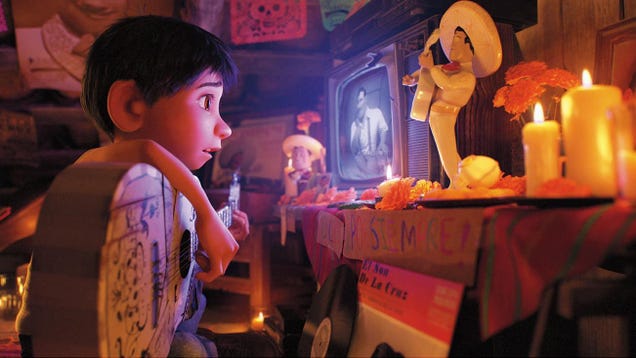
Grab your tissues, mi amor. If you haven’t seen the animated triumph Coco, here’s your chance—the Oscar-winning film is coming to Netflix next month. (But really, why haven’t you seen it? This is a very serious question.) It’s a major gem on the lineup of family shows arriving to the streaming platform in May. Other…
One YouTuber and game mod maker by the name of Kaze Emanuar, a notable Nintendo ROM hacker, has created something truly special: a mashup of two of Nintendo’s most beloved classics, Super Mario 64 and The Legend of Zelda: Ocarina of Time. The game, which was released last month, was featured today in a lengthy profile of Emanuar on Engadget. The article highlights the time and effort the mod maker put into his custom Mario-Zelda fusion. Essentially, Emanuar rebuilt all of Ocarina of Time within the Super Mario 64 engine, letting players traverse the land of Hyrule as Mario using all the same pristine jumping and platforming skills of Nintendo’s signature plumber.
It’s not an exact re-creation. Emanuar, a German citizen who worked on the...
"As with literally anything regarding the royal family, this birth will be accompanied by approximately a metric ton of pomp and circumstance."
I don't know why, but I'm totally fascinated by the UK's constitutional monarchy
Louis Arthur Charles, Kate Middleton and Prince William’s third child, is the first boy in British history who won’t cut his older sister in line for the throne.
Kensington Palace announced early Monday morning that Duchess of Cambridge Kate Middleton had gone into labor with her and Prince William’s third child. On Friday, they announced that his name is Louis Arthur Charles. Being a royal baby and all, he will officially be known as “His Royal Highness Prince Louis of Cambridge,” which is only marginally more awkward than the original.
Were it not for the “Prince Harry and Meghan Markle prepare for their wedding” show, this birth would have been the undisputed biggest royal news of the spring. Still, this newest royal baby is significant if only because he has automatically skipped ahead of Prince Harry in the line of succession for the British throne. Louis is now fifth: Currently, the queue starts with Prince Charles, then William, followed by the new baby’s older siblings George and Charlotte.
In fact, before 2013, a new baby boy would have superseded Charlotte. But the new Succession to the Crown Act made it official that the line of succession would continue according to age, not gender — making Louis the first royal boy in history to not cut his older sister in line.
The Queen, The Duke of Edinburgh, The Prince of Wales, The Duchess of Cornwall, Prince Harry and members of both families have been informed and are delighted with the news.
As with literally anything regarding the royal family, this birth will be accompanied by approximately a metric ton of pomp and circumstance. One of my favorite touches that has somehow stood the test of time is that the birth still gets announced by a “town crier,” complete with an outfit fit for a particularly luxe production of ThePirates of Penzance.
Mitchel Wu is a professional toy photographer. He combines toys, photography skills, practical effects, and imagination to create “alternative universes” in which toy characters come to life.
Instead of using digital trickery in Photoshop, Wu carefully sets up his shots to capture things like flying objects and splashes on camera.
Many of Wu’s photographs combine characters from different universes, creating bizarre crossover storylines.
Thanks for the popularity of his work, Wu has been hired by clients ranging from Warner Bros to Mattel.
It was supposed to be the laptop that saved the world.
In late 2005, tech visionary and MIT Media Lab founder Nicholas Negroponte pulled the cloth cover off a small green computer with a bright yellow crank. The device was the first working prototype for Negroponte’s new nonprofit One Laptop Per Child, dubbed “the green machine” or simply “the $100 laptop.” And it was like nothing that Negroponte’s audience — at either his panel at a UN-sponsored tech summit in Tunis, or around the globe — had ever seen.
After UN Secretary-General Kofi Annan offered a glowing introduction, Negroponte explained exactly why. The $100 laptop would have all the features of an ordinary computer but require so little electricity that a child could power it...
Definitely a pessimistic take, but an interesting one.
It turns out cryptocurrencies and blockchains have a few problems.
Cryptocurrencies like Bitcoin are constantly in the news, as is the blockchain technology behind them.
If, like me, you don’t really understand these things, it’s hard to know what to make of all this. Is Bitcoin, and other cryptocurrencies, the future or will this experiment gradually fade away like a historical footnote? Are cryptocurrencies actually decentralized or are they controlled by small groups of people? Are they fraud-proof or can they be manipulated by insiders?
To get some answers, I reached out to Nicholas Weaver, a researcher at the International Computer Science Institute at UC Berkeley. Weaver teaches a course on blockchainsand seems to think the technology is, at best, misguided and, at worst, a fraud. So I asked him to lay out his case in the simplest possible terms.
A lightly edited transcript of our conversation follows.
Sean Illing
I don’t really understand Bitcoin or blockchains, and my sense is that I’m not alone. So let’s start with a basic question: What is a blockchain?
Nicholas Weaver
It depends on what you mean. There are private blockchains, which is a 20-year-old technology that somehow causes idiots to throw money at it, and then you have public blockchains, which is supposed to be a decentralized record-keeping structure but, in reality, is both centralized and horribly inefficient. The use of private blockchains is pretty varied because there’s nothing new and it’s an old idea. The use of public blockchains is basically limited to cryptocurrencies.
Sean Illing
You say that cryptocurrencies like Bitcoin aren’t decentralized, and yet people are enamored with these currencies precisely because they believe they’re decentralized. What are they missing?
Nicholas Weaver
None of the cryptocurrencies are truly decentralized. They’re actually centrally controlled by the miners, who can basically rewrite history at will.
Sean Illing
I’m not sure we can understand who the miners are unless we understand how Bitcoin works. Can you walk me through this?
Nicholas Weaver
Imagine we have a public square that has written down everyone’s bank balance, and if I want to send you some money, I basically write a check to you and post it in the town square. The miners gather up all these unconfirmed checks and carve them into stone tablets that then go into the public square.
So if I sent you a check and you want to see that it’s good, you just look on the stone tablets and confirm that it’s good. Think of the miners as the record-keepers who manage all of this. They validate the checks, create them into a bundle (called a block), and then they get paid for their role in the process. These miners are the de facto central authority in cryptocurrency exchanges.
Sean Illing
There are plenty of people who see cryptocurrencies, however flawed, as a step in the right direction because they at least take power away from governing authorities and give individuals more freedom. But you seem to think this is bullshit. Why?
Nicholas Weaver
Well, there are multiple arguments. These systems require an obscene amount of energy to function. And the blockchains are not decentralized and they’re not efficient, so that undercuts the two main points in their favor. But the cryptocurrencies don’t work either, because they don’t actually work as currencies.
Sean Illing
What do you mean they don’t work as currencies?
Nicholas Weaver
The rationale for these things is that there’s no central authority, which means no one can block or undo a transaction. And so far at least, it’s true that transactions aren’t blocked. But why do you need such a system? Because you’re doing a transaction that a central authority would otherwise block, like paying off a hitman or buying drugs.
If that’s what you need money for,the cryptocurrencies are the only game in town. But if you don’t need to buy drugs or hitmen, the cryptocurrencies are vastly less efficient. I mean, look at the volatility of Bitcoin and other digital currencies — they’re all over the place. So if you go to one of the few legitimate merchants that take Bitcoins, they aren’t actually taking Bitcoins. They’re using a service that allows them to price in dollars, and that service immediately sells the Bitcoins and deposits the dollars with the merchants. So there’s a mandatory conversion step.
If I want to buy something with Bitcoin, I don’t like that the price is bouncing up and down either. So I have to turn my dollars into Bitcoins and then do the transaction, and that is a remarkably costly process. That, in my opinion, is not a system that works.
Sean Illing
It appears that Bitcoin’s main accomplishment is that it allows people to buy things clandestinely, only in an absurdly inefficient way.
Nicholas Weaver
Correct. But if you want to buy something you don’t want people to know about, you can just use a pre-paid credit card. There’s still no need for Bitcoin.
Sean Illing
You also say that all cryptocurrencies are plagued by frauds that were banned in the 1930s. Can you explain?
Nicholas Weaver
Cryptocurrency exchanges are not like regular stock exchanges. In a stock market exchange, stocks are all tied to together so the prices are very close. These Bitcoin exchanges are unregulated entities that allow all sorts of things that are outright frauds. For example, in a regular stock exchange, you’re not allowed to trade with yourself because that’s price manipulation. But that’s a regular occurrence on these cryptocurrency exchanges.
Some of these cryptocurrency exchanges are accused of front-running as well, which means the people who run them are using their access to see what customers want to trade and then trading ahead of them to get an advantage. There are also plausible claims about insider trading in various cryptocurrency exchanges. I could go on, but you get the point.
Sean Illing
Do you see a cryptocurrency emerging in the future that is more viable than what we’ve seen so far?
Nicholas Weaver
Well, in order to make a cryptocurrency work, you need stability. The value has to hold. So what you need is an entity that will take, say, dollars, and give you cryptodollars one-for-one and vice versa. But we know what these institutions are; they’re called banks and they use banknotes. And if you build a cryptocurrency that way, you’ve got one of three choices.
One, you act like a regulated financial entity like PayPal or Venmo and don’t allow the criminality. So where’s the novelty there? Two, you become like a wildcat bank from the 1800s and issue banknotes that aren’t backed, but then you run the risk of a bank run and your value going to zero. So what’s the point? Or you have a cryptocurrency that actually is banked by money, and doesn’t allow criminal activity, but that’s been tried before; it was called Liberty Reserve, and it was shut down for money laundering in 2013 by the US government.
Sean Illing
Is yours a minority opinion in the world of cryptocurrency?
Nicholas Weaver
Yes, because there’s a self-selecting bias. Most people who think this is bogus simply walk away. Those who are believers are believers. Very few people have followed it like I have for five years and still find it ridiculous, but that’s because I’m an academic and I have the space to do it and I find parts of it, especially the criminality, interesting. But the arguments in defense of this stuff are getting loonier and loonier.


/cdn.vox-cdn.com/uploads/chorus_asset/file/10659007/bnef_electric_buses_2018_lionbatteries.jpg)
/cdn.vox-cdn.com/uploads/chorus_asset/file/10730663/est_hittinger_2017_storage.jpg)
/cdn.vox-cdn.com/uploads/chorus_asset/file/5993459/home-solar-storage.jpg)
/cdn.vox-cdn.com/uploads/chorus_asset/file/10730411/ipi_2018_storage_value_stack.jpg)
/cdn.vox-cdn.com/uploads/chorus_asset/file/10041077/australia_powerpack_blog.jpg)








/cdn.vox-cdn.com/uploads/chorus_asset/file/11559895/1.png)
/cdn.vox-cdn.com/uploads/chorus_asset/file/11563521/1.png)
/cdn.vox-cdn.com/uploads/chorus_asset/file/11563817/alt.png)
/cdn.vox-cdn.com/uploads/chorus_asset/file/11563819/2.png)
/cdn.vox-cdn.com/uploads/chorus_asset/file/11563821/long.png)
/cdn.vox-cdn.com/uploads/chorus_asset/file/11562943/final.png)



/cdn.vox-cdn.com/uploads/chorus_asset/file/11504353/chain_reaction.jpg) Javier Zarracina/Vox
Javier Zarracina/Vox
/cdn.vox-cdn.com/uploads/chorus_asset/file/11496809/Marbles.gif)
/cdn.vox-cdn.com/uploads/chorus_asset/file/11505041/Screen_Shot_2018_06_08_at_7.23.26_PM.png)
/cdn.vox-cdn.com/uploads/chorus_asset/file/11484465/air_1.jpg)
/cdn.vox-cdn.com/uploads/chorus_asset/file/10796311/IRAN_DEAL_CARD_2_centrifuge_diagram.jpg) Javier Zarracina/Vox
Javier Zarracina/Vox
/cdn.vox-cdn.com/uploads/chorus_asset/file/11457691/Screen_Shot_2018_05_31_at_5.35.02_PM.png)
/cdn.vox-cdn.com/uploads/chorus_asset/file/11450925/GettyImages_50585249.jpg) US Department of Energy/The LIFE Picture Collection/Getty Images
US Department of Energy/The LIFE Picture Collection/Getty Images
/cdn.vox-cdn.com/uploads/chorus_asset/file/11505067/Iran_IAEA_Inspection.jpg) Kazen Ghane/AFP/Getty Images
Kazen Ghane/AFP/Getty Images
/cdn.vox-cdn.com/uploads/chorus_asset/file/11505057/NorthKoreaEnrichment.jpg) DigitalGlobe/Getty Images
DigitalGlobe/Getty Images