
Shared posts


15 Dec 12:56
O reino, as carroças e os dispositivos de segurança
by Best Cars
Pressionado ou com receio da inflação descontrolada, o poder real voltou atrás no que estava decidido — mas os súditos deram sua resposta
15 Dec 12:20

Actually, I can probably hold on until we find one of those...
Albener PessoaEarly version of the SNL Love Toilet http://www.pinterest.com/pin/141933825729588500/
Actually, I can probably hold on until we find one of those old-fashioned single-occupancy fellows.
Albener Pessoa likes this
15 Dec 11:12


Fabulous Batman graffiti found in an abandoned building
by Lauren Davis
Albener PessoaCool! (via Firehose)

Redditor sneakylawyer and his girlfriend were doing a bit of urban exploration in Ronse, Belgium, when they came across an unexpected sight: a bevy of Batman graffiti, featuring a variety of Jokers.
    
|
15 Dec 11:07


What I’ve Written In
by John Scalzi
Albener PessoaCuriosidade tecnologica para fas do Scalzi (via Firehose)
I was talking with a friend recently about word processors, which prompted me to think about which word processors I’ve used to write books. For the record, and for the curious, here’s what each of my novels have been written in, in order of their writing (not publication).
Agent to the Stars: Microsoft Works (the “basic” version of their office suite, which it no longer makes)
Old Man’s War: Microsoft Word
The Android’s Dream: Word
The Ghost Brigades: TextEdit
The Last Colony: Word
Zoe’s Tale: Word
Fuzzy Nation: Word
Redshirts: Begun on Google Docs, finished on Word
The Human Division: Started on WordPress, Finished on Google Docs, with one chapter written in Pages
Lock In: Word
For my non-fiction books, five (my three “Rough Guide” books, my two “Book of the Dumb” books) were written in Word, three (Coffee Shop, Hate Mail and Mallet) in WordPress because they were blog posts first and then pasted into Word for the final document, and one (24 Frames) in Google Docs, and then again pasted into Word for final compiling.
Metatropolis (which I edited) and The God Engines (novella) were also written in Word.
It’s not a terrible surprise to me that I end up using Word quite a lot. One, it’s been around in one form or another for 30 years, and its formats and feature set are the industry standard; everyone in publishing uses it. Two, as a consequence of one, I am used to it and therefore when I use a word processor that doesn’t look or act like it, I get discomfited — it messes with my chi, as it were. There are writers who are still using dead word processors on equally dying computers because they’re used to the formatting and don’t want to mess with their workflow — George RR Martin and Robert J. Sawyer are famously dedicated to the antediluvian processor WordStar, for example — and while my devotion to Word is nowhere near that strong, I understand the urge. When you find something that works, you don’t mess with it.
That said, I stray from the path when I have a reason. I wrote Ghost Brigades on TextEdit because at that particular moment I just wanted a very simple word processor, and the aesthetic of TextEdit appealed to me (I wrote Ghost Brigades using the Optima typeface, which looks great on a Mac and pretty much like hell on PC — don’t ask me why). Also I had a Mac at the time and didn’t want to spring for another copy of Word. For Redshirts, I was curious whether Google Docs are robust enough for novel-writing. At the time the answer was no, which is why I switched back to Word. With Human Division I originally started writing in WordPress because I wanted to be able to let my editor have immediate access to what I was doing — I was writing “episodes” and I wanted him to be able to get at them as they were individually completed. But it turned out WP wasn’t as good for that as Google Docs was, in part because it lacked editing tools useful for the publishing industry.
These days I’m reasonably impressed by Google Docs with the caveat that as I understand it there is a practical limit on the size of an individual document, and that size is smaller than that of most of my novels. For The Human Division that wasn’t a problem because I made each episode its own document, but for Lock In it was something I needed to consider, which is ultimately why I went back to Word. Another reason: Word now saves to SkyDrive, which I can access either with my desktop or laptop, so one advantage of Google Docs — accessing text from anywhere — is now replicated (well, sort of. My desktop and Win8 laptop both have Word on them, but my Chromebook needs to access the Web version of Word, which kinda sucks at the moment).
The next novel I write will be the sequel to Human Division, and I haven’t decided which processor I am going to use yet. I am inclined to write on Google Docs, as I did for its predecessor, but if I’m using my desktop, I can configure Word to display two pages side-by-side, and while might not seem like a big deal, in fact being able to see what I’ve just written without having to do a lot of scrolling turns out to be useful to my writing flow (it’s because, among other things, it helps me keep the flow of my dialogue consistent). I’ll decide the closer I get to the actual writing.
(Before anyone asks about Scrivener or [insert your other favorite processor here], rest assured I try almost all of them just to see if I will like them better than my defaults. So far, it continues to be Word in the lead, with Google Docs as the understudy. If find something else I like better, trust me, I will let you all know.)
firehose and -1 others like this



14 Dec 18:56


Ford Fusion Hybrid ganha sistema de condução autônoma (vídeo)
by Ricardo de Oliveira

A Ford também está desenvolvendo um sistema de condução autônoma, mas para uso efeito após 2025. Nesta fase inicial, o projeto tem a participação da Universidade de Michigan e da companhia de seguros State Farm.

A tecnologia está sendo testada no Ford Fusion Hybrid e consiste em quatro sensores infravermelhos LiDAR, que fazem uma varredura eletrônica de 60 metros em torno do veículo. O dispositivo consegue diferenciar uma sacola de plástico voando de um animal pequeno atravessando a pista. Eles fazem 2,5 milhões de escaneamentos por segundo, atingindo alto grau de exatidão nas informações colhidas.

A noticia Ford Fusion Hybrid ganha sistema de condução autônoma (vídeo) foi publicada no site Notícias Automotivas - Carros.
13 Dec 21:52
Apple's 'iWatch' Said to Arrive in October 2014 with Wireless Charging
by Richard Padilla
According to Chinese site C Technology [Google Translate, via GForGames], Apple is planning to release its long-rumored iWatch alongside the next iPhone in October 2014, with the company having tested two iWatch prototypes. However, the report also states that Apple has not decided on the final screen size of the device, with the prototype units being powered by a 100 mAh battery. The iWatch is also said to include wireless charging capabilities which will allow the device to charge from up to a meter away.
The report questions the reported inclusion of a 100 mAh battery, noting that it seems far too small to allow for significant battery life. Samsung's Galaxy Gear watch contains a 315 mAh battery and has received criticism over poor battery life.
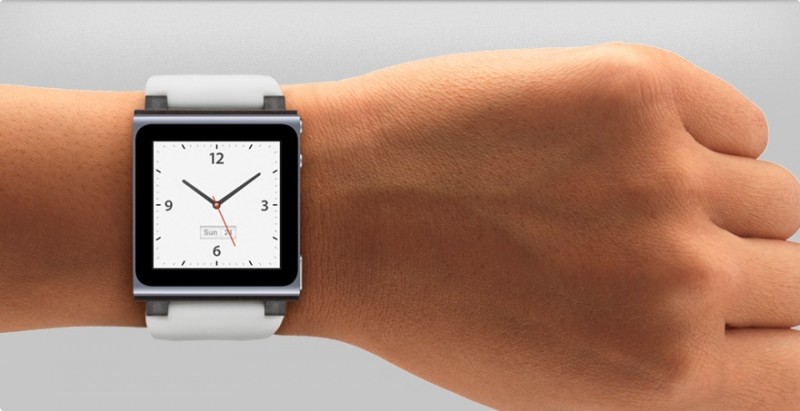 Sixth-generation iPod nano with watch face
Battery life has previously been reported as being an issue for Apple, with iWatch prototypes lasting only 1-2 days on a charge and the company hoping to find ways to extend that to 4-5 days. C Technology notes that wireless charging would be one way to reduce the burden of frequent charges, but it is unclear exactly how it would be implemented by Apple. A 100 mAh battery in the iWatch would roughly match the 105 mAh battery seen in the sixth-generation iPod nano that was designed in part to be able to be used as a watch.
In contrast, a report last month from Digitimes stated that the iWatch would be released in Q2 2014, with component makers having started pilot production for the device. The report also stated that low part yields have pushed back mass production of the device from an internal target date of Q1 2014 to Q2 2014, with Apple suppliers Quanta, Inventec, and Foxconn said to be competing for iWatch production orders.
iWatch reports have surfaced throughout the past few months, with Apple rumored to be releasing both 1.7 and 1.3-inch display sizes of the watch for men and women. NPD DisplaySearch analyst Paul Gagnon also noted that Apple appears to have put its major television product plans on hold for the time being in order to focus on wearables such as the iWatch.
C Technology's rumor track record is mixed, with the site being a frequent source of accurate iPhone 5s and 5c photo leaks leading up to the launch of those devices but also sharing several inaccurate pictures claimed to be of iPads in gold and/or with Touch ID prior to the introduction of the new tablets.


The report questions the reported inclusion of a 100 mAh battery, noting that it seems far too small to allow for significant battery life. Samsung's Galaxy Gear watch contains a 315 mAh battery and has received criticism over poor battery life.
Sixth-generation iPod nano with watch face Battery life has previously been reported as being an issue for Apple, with iWatch prototypes lasting only 1-2 days on a charge and the company hoping to find ways to extend that to 4-5 days. C Technology notes that wireless charging would be one way to reduce the burden of frequent charges, but it is unclear exactly how it would be implemented by Apple. A 100 mAh battery in the iWatch would roughly match the 105 mAh battery seen in the sixth-generation iPod nano that was designed in part to be able to be used as a watch.
In contrast, a report last month from Digitimes stated that the iWatch would be released in Q2 2014, with component makers having started pilot production for the device. The report also stated that low part yields have pushed back mass production of the device from an internal target date of Q1 2014 to Q2 2014, with Apple suppliers Quanta, Inventec, and Foxconn said to be competing for iWatch production orders.
iWatch reports have surfaced throughout the past few months, with Apple rumored to be releasing both 1.7 and 1.3-inch display sizes of the watch for men and women. NPD DisplaySearch analyst Paul Gagnon also noted that Apple appears to have put its major television product plans on hold for the time being in order to focus on wearables such as the iWatch.
C Technology's rumor track record is mixed, with the site being a frequent source of accurate iPhone 5s and 5c photo leaks leading up to the launch of those devices but also sharing several inaccurate pictures claimed to be of iPads in gold and/or with Touch ID prior to the introduction of the new tablets.
|
|
13 Dec 21:36
Putting A 27 year old Mac Plus On The Internet
by Kelly
Hackaday shows us how Jeff connected his 27-year-old Mac Plus to the internet (with help from his Raspberry Pi and a Python script from his friend Tyler):
A Plus has a few options to get on the Internet. The best, but most expensive, is a SCSI to Ethernet computer. For a somewhat slower connections, a PowerPC mac can be used as an Ethernet to Localtalk (the Macintosh serial port networking protocol) bridge. Lacking either of those pieces of hardware, [Jeff] decided to use a Raspberry Pi. The Pi does the heavy lifting, and a handful of serial adapters and voltage converters turns the Pi into something that can talk to the Plus’ serial port…
13 Dec 21:29
3D Systems Acquires Village Plastics #makerbusiness
by Matt

BREAKING NEWS: 3D Systems Acquires Village Plastics Co..
While this might not sound like a big deal if you aren’t a 3D printer of filament vendor or supplier, this news is likely to have tremendous ramifications for desktop 3D printing, in particular for the companies looking to push into the FFF market this coming year.
A large number of the desktop 3D printer manufacturers and filament vendors manufacturer their 3D printing filaments at Village Plastics and then sell the material under their own label — if you have participated in desktop 3D printing in the past four years within the United States, there is a strong possibility that you have printed with material manufactured at Village Plastics.
One of the interesting positive developments is that the new ownership by a company with an emphasis on desktop 3D printing might rapidly stimulate the development new types of printing filament options as the emphasis on that aspect of their business increases — which could well benefit other existing customers as well as the Cube/CubeX 3D Systems line of products.
From the press release:
3D Systems (DDD) announced today the acquisition of Village Plastics Co., a leading manufacturer of filament-based ABS, PLA and HIPS 3D printing materials. Through its state-of-the-art manufacturing facility in Norton, Ohio, Village Plastics delivers the highest quality, precision 3D printing filaments. 3DS plans to immediately integrate Village Plastics materials and manufacturing technologies to accelerate its development of advanced filament-based materials for its growing Cube(R) and CubeX(TM) 3D printers. Additionally, the company plans to support all of Village Plastics’ existing customers by providing full access to its complete portfolio of design-to-manufacturing products and services.
“Village Plastics brings significant filament-based material development know-how and large scale manufacturing expertise that are vitally important to our Cube 3D printer consumer and prosumer growth initiatives,” said Avi Reichental, President and CEO, 3D Systems. “With the Village team on board, we expect to be able to enhance the profitability of this growing category and fast track the delivery of new high-performance filament-based products for the benefit of our users worldwide.”

13 Dec 21:21
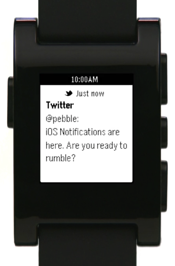 Pebble today released an update for its smart watch that enables various features, including a "Do Not Disturb" function that blocks notifications for a specified period of time, and the ability to create multiple alarms.
Also included is improved control over notifications which allow the user to specify which types of messages are displayed, and enhanced iOS connectivity performance along with various bug fixes.
Originally, the Pebble raised more than $10 million on Kickstarter, potentially proving the viability of the smart watch as a product. Apple is also said to be working on its own iWatch and recently invested hundreds of millions of dollars in a new Arizona factory to make sapphire glass, perhaps for such a product.
The Pebble smart watch is available for $150 from getpebble.com and at Best Buy and AT&T retail stores.


Pebble Smart Watch Adds 'Do Not Disturb' Option, Enhanced Notification Control [iOS Blog]
by Richard Padilla
Pebble today released an update for its smart watch that enables various features, including a "Do Not Disturb" function that blocks notifications for a specified period of time, and the ability to create multiple alarms. Also included is improved control over notifications which allow the user to specify which types of messages are displayed, and enhanced iOS connectivity performance along with various bug fixes.
What’s NewThe device was also updated earlier this month with full support for iOS 7 notifications along with the addition of a developer SDK and APIs for Javascript, the accelerometer, data logging and persistent storage.
Do Not Disturb. Block notifications for a set period of time (from Pebble: Settings » Notifications » Do Not Disturb).
Alarms app update. Create multiple Alarms, toggle Alarms on/off, and edit existing Alarms.
New “Snooze Alarm.” Customizable via the Pebble Alarms app.
Improved Notification Control. Specify what notifications are displayed (Notifications On, Phone Calls Only, or Notifications Off). Notification settings are now accessible more quickly through a dedicated menu (Settings » Notifications).
Improved iOS performance. Notifications are now sent more quickly from your iOS device to Pebble. After exiting Airplane Mode, Pebble will now search for connectable iOS devices immediately, instead of waiting one minute.
Originally, the Pebble raised more than $10 million on Kickstarter, potentially proving the viability of the smart watch as a product. Apple is also said to be working on its own iWatch and recently invested hundreds of millions of dollars in a new Arizona factory to make sapphire glass, perhaps for such a product.
The Pebble smart watch is available for $150 from getpebble.com and at Best Buy and AT&T retail stores.
|
|
13 Dec 21:19
BearExtender Turbo Adds 802.11ac Wi-Fi to Older Macs [Mac Blog]
by Eric Slivka
BearExtender today announced the launch of BearExtender Turbo, a new USB-based solution for adding faster 802.11ac Wi-Fi connectivity to older Macs. Regularly priced at $80 but available through Amazon for $70, BearExtender Turbo can boost Wi-Fi speeds by up to 2-3x for Macs supporting USB 3.0 but not 802.11ac natively.
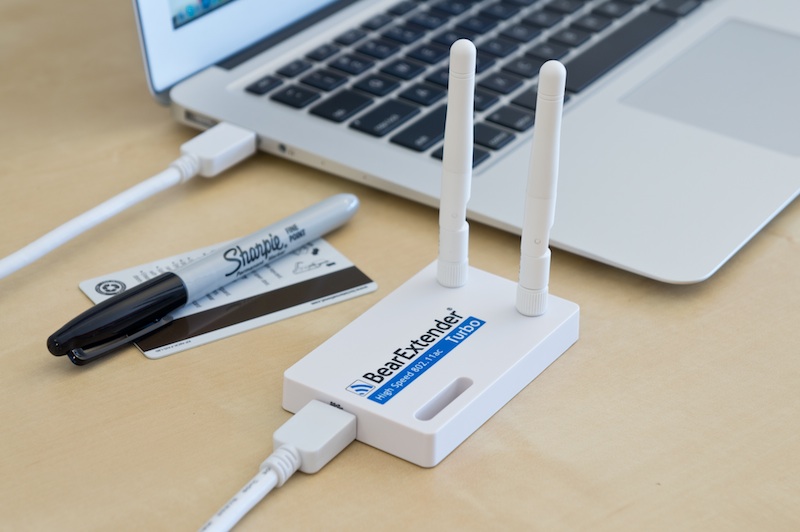
BearExtender Turbo supports maximum throughput of 867 Mbps and includes dual-band connectivity at 2.4 GHz and 5 GHz for maximum speed and compatibility. The device's two antennas can also be removed for portability.


Using AJA System Test on Mac OS X 10.9 Mavericks, a 2GB file was transferred between a Mid-2012 802.11n MacBook Air and a 2013 Apple Time Capsule at a rate of 10.66 Megabytes per second (MB/s not megabits). The same test with BearExtender Turbo connected to the MacBook Air’s USB 3.0 port had a rate of 23.84 MB/s, more than twice the Macbook Air’s internal Wi-Fi card.While speed bottlenecks for most users will continue to be their actual ISP connections when connecting to the Internet, 802.11ac is particularly useful for transferring large amounts of data between machines within a network.
BearExtender Turbo supports maximum throughput of 867 Mbps and includes dual-band connectivity at 2.4 GHz and 5 GHz for maximum speed and compatibility. The device's two antennas can also be removed for portability.
|
|
13 Dec 20:49
Aprenda a ler o pneu do seu carro - em Oficina
Acha que 185/70 R 14 87H é grego? Nós ensinamos como se lê um pneu
Albener Pessoa likes this
13 Dec 20:13
Google Cuts Android Privacy Feature, Says Release Was Unintentional
by Soulskill
An anonymous reader writes "Peter Eckersley at the EFF reports that the 'App Ops' privacy feature added to Android in 4.3 has been removed as of 4.4.2. The feature allowed users to easily manage the permission settings for installed apps. Thus, users could enjoy the features of whatever app they liked, while preventing the app from, for example, reporting location data. Eckersley writes, 'When asked for comment, Google told us that the feature had only ever been released by accident — that it was experimental, and that it could break some of the apps policed by it. We are suspicious of this explanation, and do not think that it in any way justifies removing the feature rather than improving it.1 The disappearance of App Ops is alarming news for Android users. The fact that they cannot turn off app permissions is a Stygian hole in the Android security model, and a billion people's data is being sucked through. Embarrassingly, it is also one that Apple managed to fix in iOS years ago.'" 


Read more of this story at Slashdot.
Ronald.phillips, firehose and -1 others like this
13 Dec 18:50
Jedi Jesus and Santa on a Dinosaur (where else does this belong on Reddit if not here?)
Albener PessoaThe perfect image for a card!
 |
submitted by ReligionProf [link] [3 comments] |
Albener Pessoa likes this
13 Dec 16:57

Run the Amiga 500 in your browser with Portable Native Client
by Peter Bright
Advanced windowing environments.
OK, so this isn't the first in-browser emulator we've seen, but we thought you might get a kick out of it anyway. Using Chrome's Portable Native Client (PNaCl), Google developer Christian Stefansen has the Universal Amiga Emulator (UAE) running within the browser.
Introduced in 2009, Google's Native Client (NaCl) started out as a way of running native x86 code in a safe, sandboxed environment. It uses specially compiled programs, combined with the x86 processor's built-in memory segmentation capabilities, to offer something like 95 percent of the performance of unsandboxed programs. An ARM version made its debut in 2010.
NaCl gets its performance—and the "native" part of its name—by using processor-specific code. x86, x64, and ARM are all currently supported, but programs must be compiled separately for each: ARM processors obviously cannot run x86 code, nor vice versa.
13 Dec 16:57
Ban on in-flight calling proposed because people talking is annoying
by Jon Brodkin
The Federal Communications Commission (FCC) voted today to consider a rule change that would allow cellular phone calls during airplane flights. But the possibility of allowing in-flight phone service might be ruled out even before the FCC can take final action.
US Department of Transportation Secretary Anthony Foxx said his department will consider banning in-flight calls.
"Over the past few weeks, we have heard of concerns raised by airlines, travelers, flight attendants, members of Congress, and others who are all troubled over the idea of passengers talking on cellphones in flight—and I am concerned about this possibility as well," Foxx said, according to Reuters. "As the FCC has said before, their sole role on this issue is to examine the technical feasibility of the use of mobile devices in flight… DOT will now begin a process that will look at the possibility of banning these in-flight calls."
13 Dec 16:55

Report: Google contemplates homemade ARM chips to power its servers
by Andrew Cunningham
One of Google's humongous datacenters.
Google has designed and built its own custom-made servers for years now, but those boxes still use components designed and built by other companies. That could one day change, however: citing the ever-nebulous "person with knowledge of the matter," Bloomberg reports that Google is looking into designing its own ARM-based chips for its custom servers.
We've already seen consumer technology companies like Apple and Samsung become more vertically integrated in the last few years—Apple designs its own phones and tablets, the chips that go in them, and the architecture that goes into the chips, for example. Just as Apple's software benefits from tight integration with Apple's hardware, Google is reportedly eyeing chip design as a way to "better manage the interactions between hardware and software." However, this is in no way a done deal. The same source telling Bloomberg about the chips notes that Google's plans aren't set and are subject to change.
The Bloomberg report goes on to frame Google's reported chipmaking ambitions as a threat to Intel, though this theory doesn't necessarily hold water. Google, Facebook, and other big companies already build their own servers, and yet the wider server market carries on. In any case, the battle between ARM and x86 for the server room won't begin in earnest until at least late 2014; that's when the first chips based on the 64-bit Cortex A53 and A57 architectures are due to begin shipping.
12 Dec 22:24


Kombi Last Edition: proprietários estudam devolver o utilitário de R$ 85 mil
by Ricardo de Oliveira
Albener PessoaTomo ?

O fim dos carros sem airbag e ABS gerou uma pequena revolução no mercado. A Fiat decidiu acabar de vez com o Mille e seus derivados comerciais Uno Furgão e Fiorino, substituindo-os por algo bem mais moderno e seguro.
A Volkswagen não ficou atrás e já acelerou a vinda do novo modelo de entrada, o Up!, que substitui o já envelhecido Gol G4. No caso da Kombi, sem sucessor de baixo custo, a empresa partiu para a despedida do modelo, criando uma versão especial e limitada chamada Last Edition.
O volume foi até ampliado para 1.200 exemplares para dar conta dos pedidos de fãs e colecionadores. Para um veículo que vende sem propaganda, a VW acabou gastando um bom dinheiro na campanha de marketing para encerrar o modelo, inclusive com direito a testamento, encontro na fábrica e por fim, uma derradeira viagem de volta para casa sob as lentes das câmeras.
No entanto, de um megafone afinado saiu algo surpreendente no meio do pátio fábrica da Anchieta e provavelmente pegou todo mundo de surpresa: o fim dos carros sem airbag e ABS estava praticamente adiado. A partir daí, muita água rolou no ABC Paulista e em Brasília, onde o governo confirmou a informação. Agora a Kombi não morre mais. Pelo menos de acordo com a medida provisória, que deverá ser anunciada no dia 17 (terça-feira).
Diante disso, proprietários da Kombi Last Edition estão preocupados, afinal, pagaram R$ 85.000 pela última série da clássica “perua”, que pode não marcar o fim do modelo se a Volkswagen aceitar a medida provisória do governo estendendo o prazo de comercialização para carros sem os itens de segurança exigidos por lei.
Alguns proprietários já se manifestaram, dizendo que devolverão a Last Edition se a Volkswagen manter a produção por mais dois anos. No entanto, outros donos dizem que manterão seus veículos mesmo se a Kombi seguir em frente. Enfim, é uma situação bastante embaraçosa para a VW, que já anunciou que “seguirá toda e qualquer nova regra a ser aplicada para o setor automotivo”. A Fiat apenas aguarda.
[Fonte: G1]
A noticia Kombi Last Edition: proprietários estudam devolver o utilitário de R$ 85 mil foi publicada no site Notícias Automotivas - Carros.