Scott Lord
Scott Lord
Shared posts
23 Oct 02:08
Scott Lord - scottlord.blogspot.com på blogglista.se
Scott Lord, Scott Lord and 3 others like this
23 Oct 02:08
Scott Lord Mystery: Evelyn Ankers in The French Key (1946) - YouTube
Mystery
Tags: Mystery
Scott Lord, Scott Lord and 3 others like this
18 Jul 05:22

 We happenned to notice four hours into her shift. She kept thanking me all morning for getting us here on time.
Donna dressed for work in a hurry.
by Scott Lord on Silent Film, Swedish Silent Film, Danish Silent Film,


Scott Lord, Scott Lord Mystery Film and 2 others like this
04 Jun 04:44
 I honestly had to dust the television after coming home from church, but please look and the previous entry to see how its grown- it found the little "love" pillow Donna's grandmother had given her - after sprawling across the floor, over a plastic storage bin and up the side of the tv stand for over five feet, most likely seven; it has sixty five leaves across for two of its ten "vines", most likely one hundread leaves, more likely over one hundread and ten or one hundread and twenty.
This time our plant found the little “love” pillow.
by Scott Lord on Silent Film, Swedish Silent Film, Danish Silent Film,

Scott Lord, Scott Lord and 2 others like this
28 May 02:31
Scott Lord: Sherlock Holmes- The Woman In Green (Roy William Neal)
by Scott Lord on Silent Film, Swedish Silent Film, Danish Silent Film,
Scott Lord
scott lord
Scott Lord, Scott Lord and 4 others like this
21 May 02:16





Lunch on Nahant Beach
by Scott Lord on Silent Film, Swedish Silent Film, Danish Silent Film,


Scott Lord, Scott Lord Mystery Film and 2 others like this
21 May 02:09
Dracula- Castle Films 8mm
by Unknown
Scott Lord, Scott Lord Mystery Film and 2 others like this
21 May 02:09
Boris Karloff in The Mystery of Mr Wong
by Unknown
Scott Lord, Scott Lord Mystery Film and 2 others like this
21 May 02:09
Universal Sherlock Holmes Trailers
by Scott Lord on Silent Film, Swedish Silent Film, Danish Silent Film,
Scott Lord, Scott Lord Mystery Film and 2 others like this
21 May 02:09
Universal Sherlock Holmes Trailers
by Scott Lord on Silent Film, Swedish Silent Film, Danish Silent Film,
Scott Lord, Scott Lord Mystery Film and 2 others like this
21 May 02:09
Mr Wong in Chinatown
by Scott Lord on Silent Film, Swedish Silent Film, Danish Silent Film,
Scott Lord, Scott Lord Mystery Film and 2 others like this
21 May 02:08
Art History: Rembrandt van Rijn (Korda, 1936)
by Scott Lord on Silent Film, Swedish Silent Film, Danish Silent Film,
Scott Lord, Scott Lord and 2 others like this
21 May 02:08
Scott Lord Mystery: Ellery Queen’s Penthouse Mystery (Hogan, 1942)
by Scott Lord on Silent Film, Swedish Silent Film, Danish Silent Film,
Scott Lord, Scott Lord and 2 others like this
21 May 02:08
Scott Lord Mystery: Mystery of the River Boat, Chapter Four Brink of Doo...
by Scott Lord on Silent Film, Swedish Silent Film, Danish Silent Film,
Scott Lord, Scott Lord and 2 others like this
21 May 02:08
Scott Lord Mystery: The Great Alaskan Mystery, Chapter Three (Taylor’s, ...
by Scott Lord on Silent Film, Swedish Silent Film, Danish Silent Film,
Scott Lord, Scott Lord and 2 others like this
21 May 02:08
Scott Lord Mystery: The Great Alaskan Mystery; Chapter One Shipwrecked (...
by Scott Lord on Silent Film, Swedish Silent Film, Danish Silent Film,
Scott Lord, Scott Lord and 2 others like this
21 May 02:08
Scott Lord Mystery; The Great Alaskan Mystery; Chapter Two Thundering Do...
by Scott Lord on Silent Film, Swedish Silent Film, Danish Silent Film,
Scott Lord, Scott Lord and 2 others like this
30 Mar 01:04
Silent Film Mauritz Stiller site:garbo-seastrom.blogspot.com - Google Search
Scott Lord, Scott Lord and 3 others like this
30 Mar 01:04
Scott Lord Mystery: Midnight Limited (Bretherton, 1940) - Invidious
Mystery
Tags: Mystery
Scott Lord, Scott Lord and 3 others like this
30 Mar 01:04
Scott Lord Mystery: Midnight Limited (Bretherton, 1940) - vTomb
Mystery
Scott Lord, Scott Lord and 3 others like this
30 Mar 01:04
Scott Lord Mystery: Midnight Limited (Bretherton, 1940) - YouTube
Mystery
Tags: Mystery
Scott Lord, Scott Lord and 3 others like this
30 Mar 01:04
Scott Lord Mystery: Lights Out, Strange Legacy (1951) - YouTube
Mystery
Tags: Mystery
Scott Lord, Scott Lord and 3 others like this
14 Jan 04:47
Art House
by Scott Lord on Silent Film, Scott Lord on Mystery Film


Scott Lord, Scott Lord Mystery Film and one other like this
14 Dec 07:09


Photoplay magazine reviewed Love, "Anna Karenina? Not so's you could notice it. But John Gilbert and Greta Garbo melt the Russian snow with their love scenes. Will it be popular? Don't be silly." The present author understably has every need to In part John Bainbridge's quoting of Bengt Idestam Almquist in its near entirety, "Greta Garbo has never been better. In her first American pictures she was something different than this: a sensual body, thin and wriggling like an exotic liana, plus a couple of heavy eyelids that hinted all kins of picturesque lusts. But gradually Miss Garbo has worked her way towards becoming a real actress with depth and sincerity." Kenneth Macpherson of Close-Up magazine reviewed the performance of Greta Garbo in the film, "As this is the rottenest possible film, it is clear that its success is due to the beauty of Greta Garbo, who has a Belle Bennett part of mother love. In twenty years they will be trying vainly to give her those parts for which her youth and beauty now make her suited. As I say, the film is just tripe and Greta's clothes are an abomination...but for the fact of Greta's lovliness and her utter inabilbity to look like anything but an overgrown adolescent dressing up for the school play." That year, for the same magazine, H. D. begged to differ, writing, "Let's put Miss Garbo out of it entirely and say that Greta Garbo, under Pabst, was a Nordic ice-flower. Under preceeding and succeeding directors she was an over-grown hoyden or a buffet Guiness-please-miss. The performance of Greta Garbo in that subtle masterpiece Anna Karenina (Love) was inexplicably vulgar and incredibly dull. It was only by the greatest effort of will that one could visulaize in that lifeless and dough-like visage a trace of the glamour, the chizselled purity, the dazzling, almost unearthly beauty...Greta Garbo in The Joyless Street...remained an aristocrat. Greta Garbo as the wife of a Russian Court official and mistress of a man of the world, diademed and in sweeping robes in the palace of Karenin, waa a house-maide at a carnival."
Greta Garbo in Love
by Scott Lord on Silent Film, Swedish Silent Film, Danish Silent Film,


Photoplay magazine reviewed Love, "Anna Karenina? Not so's you could notice it. But John Gilbert and Greta Garbo melt the Russian snow with their love scenes. Will it be popular? Don't be silly." The present author understably has every need to
 In part John Bainbridge's quoting of Bengt Idestam Almquist in its near entirety, "Greta Garbo has never been better. In her first American pictures she was something different than this: a sensual body, thin and wriggling like an exotic liana, plus a couple of heavy eyelids that hinted all kins of picturesque lusts. But gradually Miss Garbo has worked her way towards becoming a real actress with depth and sincerity." Kenneth Macpherson of Close-Up magazine reviewed the performance of Greta Garbo in the film, "As this is the rottenest possible film, it is clear that its success is due to the beauty of Greta Garbo, who has a Belle Bennett part of mother love. In twenty years they will be trying vainly to give her those parts for which her youth and beauty now make her suited. As I say, the film is just tripe and Greta's clothes are an abomination...but for the fact of Greta's lovliness and her utter inabilbity to look like anything but an overgrown adolescent dressing up for the school play." That year, for the same magazine, H. D. begged to differ, writing, "Let's put Miss Garbo out of it entirely and say that Greta Garbo, under Pabst, was a Nordic ice-flower. Under preceeding and succeeding directors she was an over-grown hoyden or a buffet Guiness-please-miss. The performance of Greta Garbo in that subtle masterpiece Anna Karenina (Love) was inexplicably vulgar and incredibly dull. It was only by the greatest effort of will that one could visulaize in that lifeless and dough-like visage a trace of the glamour, the chizselled purity, the dazzling, almost unearthly beauty...Greta Garbo in The Joyless Street...remained an aristocrat. Greta Garbo as the wife of a Russian Court official and mistress of a man of the world, diademed and in sweeping robes in the palace of Karenin, waa a house-maide at a carnival."
 The magazine The Film Spectator in 1928 highlighted the films editing, "There is one cleaver feature in Love, the close up debauch in which Metro presents Jack Gilbert and Greta Garbo. In the way it places the closing title to one sequence serves as an introductory tile to the sequence that succeeds it. There is a fade out after the title, 'Then I will see you at the grand Duke's ball;' and a fade in on the ball without any further explanatory title."  During June of 1927, Motion Picture magazine reported, "Greta Garbo's week of sulking and refusing to appear at the Metro studios has availed her nothing. The immigration authorities decided that Greta would have to go to work or be deported...She will begin work on Anna Karenina, the story that story that caused her final tempermental guesture and her desertion of the studios is to be directed by Dimitri Buchowetski and Richard Cortez was signed after his recent break with Paramount, to play the male lead." Cortez at the time was married to Alma Rubens. Motion Picture News during 1927 announced that Greta Garbo had signed a five year contract with M.G.M., "Her first story is from the pen of Count Tolstoy. The star is not yet twenty one years of age, but has won considerable popularity both in this country and abraod." It claimed that Garbo was to be given the starring role in Anna Karenina, which was to be directed by Dimitri Buchowetzki, "also under contract at M.G.M." Author and curator Jan-Christopher Horak gives a fairly uncontested account of the replacement of directors on the film, "Buchowetzki went to M.G.M. where he directed Valentia (1927) with Mae Murray, all of them costume films. In February 1927 he was assigned to direct Greta Garbo and Victor Varconi in Love (1927), the film that proved to be his Waterloo. Given the fact that he was Russian and had directed several other films set in Imperial Russia, Buchowetszki was the logical first choice. While Garbo supposedly held out for more money and a different co-star (Richard Cortez eventually replaced Varconi), Buchowetski began production in April, shooting a substantial amount of footage with Cortez. In the first week of May Garbo called in sick and stayed that way at John Gilbert's house untill the studio gave in...the director's original had been scrapped in its entirety." If this is accurate, for all intensive purposes, although only one film starring Greta Garbo, The Divine Woman (Victor Seastrom, 1928), is presently lost, the fragment of Greta Garbo in Love that were earlier filmed rushes, can be added to that. Film Daily, during April of 1927 had printed Buckowets,I Starts Love, which slated Richard Cortez and Greta Garbo in the principal characters, "The cast includes Lionel Barrymore, Helen Chadwick, Zazu Pitts....Dorothy Sebastian. Lorna Moon adapted the screenplay." During May of 1927 it ran the announcement Goulding Directing Love, "Dimitri Buchowetski has been replaced by Edmound Goulding as the director of Anna Karenina, in which Greta Garbo will poetry the title role" John Bainbridge merely writes that Dimitri Buchowetsky was dismissed as director of the film because of an inability to remain compatible, or amicable, with his actors before having had been being replaced by Edmund Goulding, but the biographer then quotes a nameless source that had been present as part of the filming, "'(John Gilbert) wanted to show Garbo how clever he was. Every scene meant his interference with Goulding. He insisted on trying to direct the picture. Garbo insisted that sHe could not act if anyone watched her.'..Whatever the state of their private relations, Miss Garbo habitually deferred to Jack Gilbert on all professional matters. Whenever a question arose, her customary remark was, 'I ask Jack.'" Motion Picture News quietly reported during July of 1927, "Production of Love will be resumed shortly with Greta Garbo and John Gilbert in the leads. The Picture was halted because of Miss Garbo's illness.
That year Photoplay Magazine had included a Photoplay caption beneath a portrait of Greta Garbo That read, "Latest War Bulletin from the Firing Line: Greta starts peacefully to work on Anna Karenina. Some changes to the title Love, Greta goes home pleading illness. She says she's not temperamental." the next photo caption read, Greta Garbo does not think she bill go home. Greta positively enjoys her work in Love now that John Gilbert is definitely cast as her leading man. here is the first photograph of Greta Garbo as Anna Karenina and John as Vronsky."
 During June of 1927, Motion Picture magazine reported, "Greta Garbo's week of sulking and refusing to appear at the Metro studios has availed her nothing. The immigration authorities decided that Greta would have to go to work or be deported...She will begin work on Anna Karenina, the story that story that caused her final tempermental guesture and her desertion of the studios is to be directed by Dimitri Buchowetski and Richard Cortez was signed after his recent break with Paramount, to play the male lead." Cortez at the time was married to Alma Rubens. Motion Picture News during 1927 announced that Greta Garbo had signed a five year contract with M.G.M., "Her first story is from the pen of Count Tolstoy. The star is not yet twenty one years of age, but has won considerable popularity both in this country and abraod." It claimed that Garbo was to be given the starring role in Anna Karenina, which was to be directed by Dimitri Buchowetzki, "also under contract at M.G.M." Author and curator Jan-Christopher Horak gives a fairly uncontested account of the replacement of directors on the film, "Buchowetzki went to M.G.M. where he directed Valentia (1927) with Mae Murray, all of them costume films. In February 1927 he was assigned to direct Greta Garbo and Victor Varconi in Love (1927), the film that proved to be his Waterloo. Given the fact that he was Russian and had directed several other films set in Imperial Russia, Buchowetszki was the logical first choice. While Garbo supposedly held out for more money and a different co-star (Richard Cortez eventually replaced Varconi), Buchowetski began production in April, shooting a substantial amount of footage with Cortez. In the first week of May Garbo called in sick and stayed that way at John Gilbert's house untill the studio gave in...the director's original had been scrapped in its entirety." If this is accurate, for all intensive purposes, although only one film starring Greta Garbo, The Divine Woman (Victor Seastrom, 1928), is presently lost, the fragment of Greta Garbo in Love that were earlier filmed rushes, can be added to that. Film Daily, during April of 1927 had printed Buckowets,I Starts Love, which slated Richard Cortez and Greta Garbo in the principal characters, "The cast includes Lionel Barrymore, Helen Chadwick, Zazu Pitts....Dorothy Sebastian. Lorna Moon adapted the screenplay." During May of 1927 it ran the announcement Goulding Directing Love, "Dimitri Buchowetski has been replaced by Edmound Goulding as the director of Anna Karenina, in which Greta Garbo will poetry the title role" John Bainbridge merely writes that Dimitri Buchowetsky was dismissed as director of the film because of an inability to remain compatible, or amicable, with his actors before having had been being replaced by Edmund Goulding, but the biographer then quotes a nameless source that had been present as part of the filming, "'(John Gilbert) wanted to show Garbo how clever he was. Every scene meant his interference with Goulding. He insisted on trying to direct the picture. Garbo insisted that sHe could not act if anyone watched her.'..Whatever the state of their private relations, Miss Garbo habitually deferred to Jack Gilbert on all professional matters. Whenever a question arose, her customary remark was, 'I ask Jack.'" Motion Picture News quietly reported during July of 1927, "Production of Love will be resumed shortly with Greta Garbo and John Gilbert in the leads. The Picture was halted because of Miss Garbo's illness.
That year Photoplay Magazine had included a Photoplay caption beneath a portrait of Greta Garbo That read, "Latest War Bulletin from the Firing Line: Greta starts peacefully to work on Anna Karenina. Some changes to the title Love, Greta goes home pleading illness. She says she's not temperamental." the next photo caption read, Greta Garbo does not think she bill go home. Greta positively enjoys her work in Love now that John Gilbert is definitely cast as her leading man. here is the first photograph of Greta Garbo as Anna Karenina and John as Vronsky."
Sven-Hugo Borg writes about his having observed John Gilbert and Greta Garbo, "They were cast as lovers in "Love" ("Anna Karenina") and out of that picture came not only another screen triumph for Garbo, but the flowering of what I believe to have been the only real love of her life," He continues, "I believe with all my heart that John Gilbert is the only man who ever touched the deep wells of passionate emotion which lie buried in the breasts of Garbo." Borg alludes to Garbo not having to have wanted to marry Gilbert and of her keeping the details of the romance from Mauritz Stiller. "She was in the arms of Jack Gilbert when I first saw her. The air was surcharged. The atmosphere glowed." Picture Play during 1928 had published its "face to face" account, Once Seen, Never Forgotten, of one of its writers, Malcom H. Oettinger, having met Greta Garbo, "Gilbert, resplendent in his uniform he wore as Vronsky, in Love, was good enough to introduce me to Greta. Even with this auspicious start she was difficult to coax into conversation...For the first minute or two after Gilbert had withdrawn I found my time taken up solely by her beauty." The accompanying photograph of Greta Garbo was taken by Ruth Harriet Louise and was a cut-out outline of the actress, as though silhouette shaped.
Rilla Page Palmborg, who published The Private Life of Greta Garbo in 1931 gave an account of the filming of "Love". "The few persons allowed on the set declared that the Garbo-Gilbert romance was on again in full swing and that the Stars were again living their love scenes and not acting them. Calloused property men, scene shifters and electricians stood spellbound when Jack took Greta in his arms. They declared with pardonable exaggeration, that the air around the set was charged with passion." Before continuing on to an account of the filming of "The Divine Woman" costarring Lars Hanson rather than John Gilbert, Palmborg reported that it was while making "Love" that Greta Garbo had begun to decline interviews. " 'Interviews,' she said. 'how I hate them! When I get to be a big star, I will never give another.' " Rilla Page Palmborg cautiously noted that it was also at this time that Mauritz Stiller had decided to return to Sweden. Palmborg explains that exotic qowns were required to be worn for the Tolstoy adaptation and that Greta Garbo a stand in named Gerladine de Vorak, who had made sure that the gowns were fitted to Garbo. "Occaisionally, in long shots, when her face could not be seen, she was used in the picture."
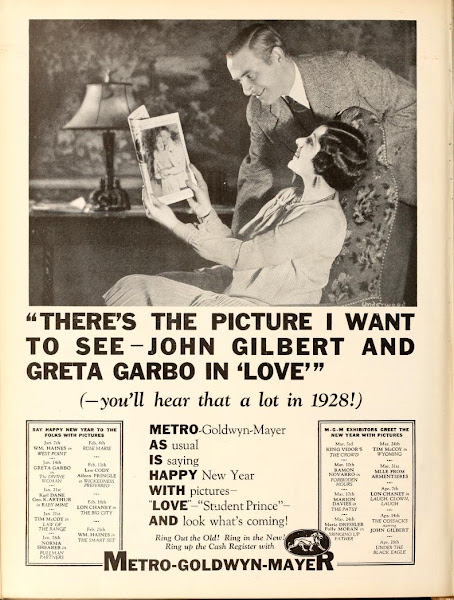

National Board of Review magazine saw "Love" as being an incomplete adaptation of the novel Anna Karenina, that it had abridged the description of Russian society in order to indulge the development of character for a return at the box-office, "The picture deals exclusively with the central love intrigue and resolves itself in aI'm at series of love scenes, scenes and scenes of self sacrifice. It is a fine solo performance for Greta Garbo, seconded by Mr. John Gilbert." American critics had made the same objected that Selma Lagerloff had, that films were not entirely faithful adaptations due to constraints of the art form and demands of the audience.


Motion Picture News Booking Guide during 1929 provided a brief synopsis of the film Love, directed by Edmund Goulding, "Theme: Tragic love drama adapted from Tolstoi's classic novel Anna Karenina. Forfeiting the right to her child, whom she adores, wife of Russian nobleman falls madly in love with a young officer. Finally realizing fate such love brings, girl because of her lover's lost prestige in his regiment and her deprivation from her child, hurls herself beneath the wheels of an oncoming train."
National Board of Review magazine saw "Love" as being an incomplete adaptation of the novel Anna Karenina, that it had abridged the description of Russian society in order to indulge the development of character for a return at the box-office, "The picture deals exclusively with the central love intrigue and resolves itself in aI'm at series of love scenes, scenes and scenes of self sacrifice. It is a fine solo performance for Greta Garbo, seconded by Mr. John Gilbert." American critics had made the same objected that Selma Lagerloff had, that films were not entirely faithful adaptations due to constraints of the art form and demands of the audience.


Scott Lord, Scott Lord Mystery Film and 2 others like this
14 Dec 07:08
The periodical Motion Picture World during June of 1925 published a story from Culver City accompanied by a drawing of Victor Seastrom, one of a dozen announcements carrying portraits of the respective star of each film. The title read "Flesh and the Devil, Seastrom's Next". Beneath it was placed, "John Gilbert, one of the biggest drawing cards on the screen will be starred in 'Flesh and the Devil' Hermann Sudermann's powerful novel....Victor Seastrom will direct. The story is heavy drama, the kind Seastrom handles better than any other director of the day. "
After listing "Tower of Lies as a reunion of Victor Sjostrom, Norma Shearer and Lon Chaney from the film "He Who Gets Slapped", and that Lon Chaney would "appear in another stunning vehicle..Title and details to be announced soon", a magazine advertisement paid for by M.G.M announcing its 52 quality films of 1925-1926 listed the film "Flesh and the Devil" as "The Victor Seastrom-John Gilbert special. Sjostrom as director, Gilbert as star make a marvelous money-winning combination. It is the sucessor to 'He Who Gets Slapped'.
It is difficult to find notice that Victor Sjostrom had been originally slated to direct Greta Garbo and yet it is unlikely that Marcus Loew would have been in error. It is only by flash forwarding to Greta Garbo's fourth film and by claiming that her first three were already in the planning stage without her that we can see the phenomenon of Greta Garbo as having arisen from a combined phenomenon of Greta Garbo/John Gilbert, which it inevitably did. Moving Picture World of 1925 published the predictions of the then President of Metro-Goldwyn. " 'The Flesh and the Devil' is a Victor Seastrom-John Gilbert Special. It is by Herman Suderman. It will be directed by Seastrom, the man who made 'He Who Gets Slapped' and I don't know what better recommendation there is than that. There will be one other John Gilbert production, title and details of which we will announce later." The question is did Loew publish this before director Monte Bell had seen the screen test of Greta Garbo spliced into the rushes of "The Temptress", which would entail his holding The Flesh and The Devil for her during the completion of two film in production- it is quite possibly in that Loew at the same time had announced " 'The Torrent' by Ibanez will have Aileen Pringle in the leading role and this also will be a Cosmopolitan Picture made at our studio. It will be big in every way."
During 1927, the paid magazine advertisements M.G.M. published for "Flesh and the Devil" had resorted to "Hot damn! What a great picture."
For those interested in how the Greta Garbo John Gilbert pairing did come about from 1925 onward, Loew happenned to add, "There will be one Fred Niblo production on our schedule. Details on this picture have not been completed as yet and will be announced later." There literally seemed to be more excitement about the film "The Mysterious Island" containing Technicolor sequences than anyone named Greta Garbo speaking on the screen with John Barrymore.
Greta Garbo in Flesh and the Devil (Clarence Brown, 1926)
by Scott Lord on Silent Film, Swedish Silent Film, Danish Silent Film,

The periodical Motion Picture World during June of 1925 published a story from Culver City accompanied by a drawing of Victor Seastrom, one of a dozen announcements carrying portraits of the respective star of each film. The title read "Flesh and the Devil, Seastrom's Next". Beneath it was placed, "John Gilbert, one of the biggest drawing cards on the screen will be starred in 'Flesh and the Devil' Hermann Sudermann's powerful novel....Victor Seastrom will direct. The story is heavy drama, the kind Seastrom handles better than any other director of the day. "
After listing "Tower of Lies as a reunion of Victor Sjostrom, Norma Shearer and Lon Chaney from the film "He Who Gets Slapped", and that Lon Chaney would "appear in another stunning vehicle..Title and details to be announced soon", a magazine advertisement paid for by M.G.M announcing its 52 quality films of 1925-1926 listed the film "Flesh and the Devil" as "The Victor Seastrom-John Gilbert special. Sjostrom as director, Gilbert as star make a marvelous money-winning combination. It is the sucessor to 'He Who Gets Slapped'.
It is difficult to find notice that Victor Sjostrom had been originally slated to direct Greta Garbo and yet it is unlikely that Marcus Loew would have been in error. It is only by flash forwarding to Greta Garbo's fourth film and by claiming that her first three were already in the planning stage without her that we can see the phenomenon of Greta Garbo as having arisen from a combined phenomenon of Greta Garbo/John Gilbert, which it inevitably did. Moving Picture World of 1925 published the predictions of the then President of Metro-Goldwyn. " 'The Flesh and the Devil' is a Victor Seastrom-John Gilbert Special. It is by Herman Suderman. It will be directed by Seastrom, the man who made 'He Who Gets Slapped' and I don't know what better recommendation there is than that. There will be one other John Gilbert production, title and details of which we will announce later." The question is did Loew publish this before director Monte Bell had seen the screen test of Greta Garbo spliced into the rushes of "The Temptress", which would entail his holding The Flesh and The Devil for her during the completion of two film in production- it is quite possibly in that Loew at the same time had announced " 'The Torrent' by Ibanez will have Aileen Pringle in the leading role and this also will be a Cosmopolitan Picture made at our studio. It will be big in every way."
During 1927, the paid magazine advertisements M.G.M. published for "Flesh and the Devil" had resorted to "Hot damn! What a great picture."
For those interested in how the Greta Garbo John Gilbert pairing did come about from 1925 onward, Loew happenned to add, "There will be one Fred Niblo production on our schedule. Details on this picture have not been completed as yet and will be announced later." There literally seemed to be more excitement about the film "The Mysterious Island" containing Technicolor sequences than anyone named Greta Garbo speaking on the screen with John Barrymore.
Garbo photographer William Daniels in 1926, in addition to lighting Garbo and Gilbert was also cinematographer to the films Altars of Desire (seven reels)) under Christy Cabanne and Bardley the Magnificient under the direction of King Vidor; that is not to say that that is the limit of his contribution to film history; Daniel's had trained on several of Von Strohiem's important films, beginning with Blind Husbands in 1919 and continued in Hollywood after the making of the 1939 film Ninotchka, until 1970. Daniels has been deemed an "inventor of detail" for his ingenuity by American Cinematographer magazine and it was noted that during the silent era he would light the scene with a stand-in and use a bicycle horn when finished and ready to replace the figure with the film's star. Although Daniels seems uncredited for his photography on Von Strohiem's "The Merry Widow", starring John Gilbert and Mae Murray, he is noted for work on the 1925 film "Woman and Gold" (James P. Hogan) for Gotham Productions, film which starred actress Sylvia Breamer. Film historian Leo Braudy has written, "The lighting that William Daniels created for Garbo's early silent film rendered her more erotic than any spoken dialogue."
Hollywood magazine during 1935 printed the article,"Garbo's cameraman Talks At Last", in which William Daniels primarily, for whatever reason, dispelled some of the more than prevalent publicity about Greta Garbo having been " gloomy, aloof, frightened or imperious" It claimed that he had originally become Garbo's cameraman when the studio ace that had been assigned to the film "The Torrent" had on the third day encountered an accident and needed a crushed finger amputated and with the studio busy, only young William Daniels was available to film Garbo. In light of what Daniels said during the filming of Anna Karenina, it would stand to reason that where Greta Garbo was foreign, the studio might reassign the same film crew in her pictures that were to follow. Daniels is quoted as having said, "She's changed. Developed. Matured. Ten years ago, she was a young girl undergoing the bewildering experience of finding herself suddenly famous in a land whose language she couldn't understand. She kept her head then, as she has ever since. Don't imagine she has had an easy time. For instance, look at the way she has perfected her English. I don't think she has learned so much by study as actually making herself use the language...And Miss Garbo is fond of America. She loves the Californian sunlight, basking in it, walking in it, incessantly."
There is an account of Rowland V. Lee having met Greta Garbo when she had first been introduced to the United States in 1925, "Jack Gilbert was all she wanted to talk about."
Greta Garbo and John Gilbert were to attend the premiere of Bardley the Magnificient" (Vidor/Daniels,1926) together. Motion Picture magazine printed, "Hollywood is still talking. The newspaper wires still buzz everytime ther telephones the other. Yet in spite of this, Greta Garbo and John Gilbert dare appear at openings and other Hollywood functions." During this screen writer Dorothy Farnum ran magazine advertisements announcing her having written the screenplay to the film "Bardley the Magnificient" and the portrait from the film of John Gilbert printed in Motion Picture magazine had been taken by Ruth Harriet Louise. 1926 was also the year that Greta Garbo, John Gilbert and Lars Hanson would film an adaptation of the novel The Undying Past, bringing its plotline to the screen untill its emotional concluding scene at the Isle of Friendship during "Flesh and the Devil"
Picture Play magazine during 1927 published what seems to be a seldom seem photograph of Greta Garbo and Jack Gilbert, their staring at each other across a table. In When Hollywood Discovered Bridge, the caption below the four playing cards read, "The Flesh and the Devil quartet- Greta Garbo, Lars Hanson, Jack Gilbert and Director Clarence Brown- more than once took time off during the production to play a hurried rubber. as may be seen, though, Greta and Jack, who are usually partners didn't give their full attention to the game." As posed, they are looking at each other with a sense of either impending doom, or a mutual consent that would soon decide to spring into action, as though the photograph were staged.
Clarence Sinclair Bull published a portrait of Lars Hanson in Picture Play magazine during 1927. it's caption read, "That slow intent gaze which was so powerful a factor in making Hanson's Reverend Dimmesdale in 'The Scarlet Letter' a convincing portrayal is here pictured with equally telling effect. Hanson will next be seen in 'The Flesh and the Devil'.
Biographer John Bainbridge quotes Clarence Brown as though Brown had contributed to the mythical quality of any romance between Greta Garbo and John Gilbert, adding celluloid, or perhaps, tinsel rather, to the publicity it had already acquired, " 'I am working with raw material,' Brown said rather breathlessly. 'They are working in that blissful state of love that is so like a rosy cloud that they imagine themselves hidden behind it, as well as lost in it.'"
For Photoplay Agnes Smith in 1927 wrote the intrigue between John Gilbert and Greta Garbo, "He worked with her in a picture called Flesh and the Devil. He proclaimed his intention of marrying her. As for Greta she seemed to enjoy the rush. And then, when everyone was all set for another Hollywood wedding, Greta walked out...John Gilbert sticks to his story...She is a wonderful woman. A delightful woman And the most fascinating woman in pictures. 'She is,' says Mr. Gilbert, 'a mountian of a girl. She is a statue. There is something eternal about her. Not only did she baffle me, but she baffled everyone at the studio.'"
Rilla Page Palmberg, in her biography The Private Life of Greta Garbo quoted Clarence Brown on the passionate loves scenes in "Flesh and the Devil" that "plunged" Greta Garbo and John Gilbert into each others arms and intimate embrace, implying that they fell in love on the set as a result of the script of the film. " 'I am working with raw material. They are in that blissful state of love that is like a rosy cloud that they imagine themselves hidden behind it, as well as lost in it.'....Instead of hurrying home from her work at the studio, seeing only Mr. Stiller, she now began to go out with Jack."
Of her off-screen Clarence Brown romance with John Gilbert, Clarence Brown has been quoted as having said, "After i finsihed a scene with them, I felt like an intruder. I'd walk away to let them finish what they were doing." Brown has also been quoted as having said, "Those two were in a world of their own." Bainbridge quotes the director with, "Clarence Brown introduced them on the set of 'Flesh and the Devil', 'It was love at first sight,'and it lasted through many years.'" As a biographer, Bainbridge estimates the facets involved in the relationship, "her response to Gilbert's gaily insistent attention was quick, though it was not her nature that it should have been precipitous...Because of their work, Garbo and Gilbert spent all of their days together, and Gilbert took advantage of every oppurtunity to press his cause...Off the set, Gilbert and Garbo were also getting better acquainted. They often dined together, and the young actress became a rather frequent visitor a Gilbert's Tower Road mansion." This estimation reveals Gilbert's advance, "When 'Flesh and the Devil' was finished, Gilbert asked Garbo to marry him- a proposal that he was to make more than once again." The account in Photoplay written by Agnes Smith is very much like John Bainbridge's, "A great many stories have been broadcast concerning the romance of Greta Garbo and John Gilbert. The scenario, according to Hollywood's most reliable gossips runs something like this. John met the beautiful Scandinavian and immediately started an impetuous courtship. He made no secret of his devotion to the lovely Greta. He accompanied her to all the parties. He lunched with her and dined with her." When "Flesh and the Devil" was reviewed by Photoplay Magazine, it was seen as "a picture filmed when the romance of Jack Gilbert and Greta Garbo (see Jack's story in this issue) was at its height." It saw the performance of Greta Garbo as "flashing" whereas that of John Gilbert was delivered by one who "does overshadow his scenes".
Picture Play Magazine in the beginning of 1927 playfully alluded to the meteoric notoriety of Greta Garbo by reintroducing her to magazine audiences as the mystery new to stardom, but elusive by virtue of her celebrity with a portrait taken by Ruth Harriet Louise; its caption read, "That sad, sad look on Greta Garbo's face is deceiving. She's really very happy over here in America and they say that she loved working with John Gilbert in 'Flesh and the Devil'."
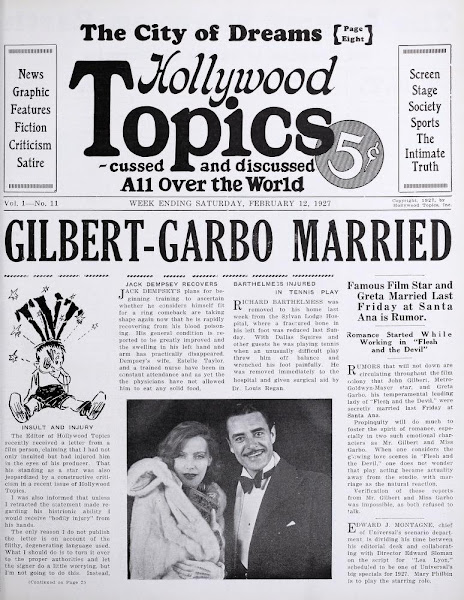
Journalist I.W Irving, during 1926, expalined the film and the act of audience reception in the periodical Hollywood Topics, "As for John Gilbert, well...its one of the best things her ever did. The flapper will simply rave ober him. His love scenes with Greta Garbo will go in motion picture history as a momentous inspiration. And Greta Garbo...she's simply bewitching. The male element will undoubtedly rave over her. So will the female element, for they themselves will learn a few things in the art of love making...But it is Gilbert and Garbo in their great scenes that put the picture over as a directorial triumph."
During the middle of 1927 Photoplay featured the two pictured together in the News and Gossip of the Studios section, "All bets are off on the Garbo-Gilbert wedding. For at least five days Hollywood was in a flurry of excitement. Jack and Greta, fairest of Fjordland, were rumored to have trekked to a neighboring hamlet and murmurred, "I do." A search of marriage license permits revealed nothing. There is bleak silence from the two." Bainbridge adds, "'Gilbert pleaded and begged that they should marry, but Garbo just did not want to,' the director Clarence Brown said recently." Picture Picture magazine during 1927 queries Is the Gilbert-Garbo Match Really Off? Prompted by journalist Dorothy Herzog. The accompanying portrait of Jack Gilbert was photographed by Ruth Harriet Louise with the caption, "There can be no doubt that Jack Gilbert is saddened by the unhappy turn taken by what promised to be his great romance". She began, "She is a thousand years old. She came into the world with all it's knowledge. She knows everything, and instinctively remembers everything.' 'and you love Greta Garbo?', we interrupted. Jack Gilbert's shadowed eyes swept our face swiftly, then looked away. 'She is. Wonderful girl. We were merely good pals,' he evaded, alertly on the defensive. 'is it true you were engaged to her?' 'We were never engaged.' ------ Back to Greta Garbo John Gilbert M.G.M.advertised Greta Garbo in 1927, it often taking full page magazine pages that mentioned several actors and actresses that were currently at the studio at any given time. Garbo had become, "The most sensational find in years, she clicked immediately in The Torrent, then in The Temptress and now Flesh and the Devil" Later it advertised, "Greta Garbo's amazing hold on the public cannot be duplicated anywhere in this industry. Flesh and the Devil is just a foretaste of the money she means for the theaters. " --------- Collen Moore must have read about or in fact contacted the Greta Garbo apparition; during 1928 she compared herself to Greta Garbo by coming to her aid in Motion Picture Classic Magazine, "most of the greatly beloved women of history- they have been possessed of the childish appeal, every one of them. Perhaps not so much childish as wistful, whimsical. Seems a funny thing to say, but Greta Garbo has it too. Really, she romps and plays it less than that worn-out term, vamp, than anyone I know. In its way, it gets across." In an interview during which she outlines her having met John Gilbert, Greta Garbo as quoted by Ruth Biery in The Story of Greta Garbo, said, "When I finisihed The Temptress, they gave me the script for "The Flesh and the Devil" to read. I did not like the story. I did not want to be a silly temptress. I cannot see any sense in getting dressed up and doing nothing but tempting men in pictures." This is oddly echoed by National Board of Review Magazine, in which the conclusion was drawn that, "the leading contributor to the success of Flesh and the Devil is Greta Garbo" It provided a synopsis of the film that also lent a background to its addressing the desire of Greta Garbo to leave her earlier " ladies of vampire repute" characters and to be seen as a more serious dramatic, or perhaps romantic dramatic, actress. it primarily sees her as having been a then more believable character, " Miss Garbo in her later day personal ion shows a frail physique and a fragile ethereal air. She is infinitely more civilized and all the more suitable for not being so deliberate."
Scott Reisfeld, the great nephew of Greta Garbo, reiterates the sentiment that Greta Garbo was dissatified with her assignments and needed to play more demanding characters in her reluctance to star in the film "Women Love Diamonds" but he also questions the part played by Louis B. Mayer in generating the conception of Garbo being a recluse, to which she may have merely acquiesced, "But Mayer was persistent in his attempts to compel Garbo into submission. He intiated a smear campaign in the media to depict Garbo as a megalomaniac. A negative media campaign supported threats to deport her."
The portrait of Greta Garbo that year had been photographed by Ruth Harriet Louise, the caption reading, "We are feverishingly waiting her performance opposite John Gilbert in Flesh and the Devil." By then, it was increasingly unnecessary to introduce her as a rising star. The photograph of Greta Garbo Ruth Harriet Louise published in Photoplay carried a caption referring to her as "the object of John Gilbert's fervant wooing". In regard to the direction of Clarence Brown, Motion Picture new reviwed the film during 1927 with, "And Clarence Brown, who has advanced so rapidly the past year, has brought out every point to build a story which fascinates in its paly of caprice and feeling. It is touched with sex- but sex never becomes rampant. It always remains a film of visual excellence...Early scenes project the development of the affair. What follows are the dramatic complications which culminate in a happy ending- the only flaw in the picture." Under the magazine's section on Explotation Angles, it advised: "Play up Gilbert and Garbo. Use stills. Cash in on title. Play up director. Go the limit." When the film was reviewed by Motion Picture Magazine the film was praised with, "Here is one of the best pictures reflected upon the screen in many a moon, the perfection of which is only marred by the ending, which appears tacked on, as an afterthought...Greta is a beautiful nymphomaniac...You never feel the chaos she causes exaggerated. she's attractive enough to wreak has ok in a man's world." Paul Rotha reviewed a what he deemed to be "a film of more than passing cleverness" directed by Clarence Brown, "Flesh and the Devil had some pretensions to be called a good film. The theme was sheer, undiluted sex,and Brown used a series of close ups to get this across with considerable effect. Notable also was his use of Ngles, different indeed from customary German and American method and the happiness with which he settled his characters in their environment."Back to Greta Garbo John Gilbert Greta Garbo and Jack Gilbert in Love< Film Daily during 1926 sported two interesting entries. During September it wrote, "Marcel de Sarno, director, and Raymond Doyle, scenarist, returned to M.G.M. studios after a trip for research data for Ordeal, which de Sarno will direct with Greta Garbo and Lon Chaney. In November, Film Daily reported, "Clarence Brown, who has just completed the direction of John Gilbert and Greta Garbo in Flesh and the Devil is preparing to direct Lillian Gish's next production, "The Wind", screen adaptation by Frances Marion of Dorothy Scarborough's story. It seems either misprint or misquote that Exhibitor's Trade Review had earlier, during 1925, published, "Miss Alice Scully, a young scenario writer wrote the script for Stella Maris...since the first of the year has also written scripts for "Parisian Love"and "The Undying Past"Greta GarboGreta Garbo
Greta Garbo
Hollywood magazine during 1935 printed the article,"Garbo's cameraman Talks At Last", in which William Daniels primarily, for whatever reason, dispelled some of the more than prevalent publicity about Greta Garbo having been " gloomy, aloof, frightened or imperious" It claimed that he had originally become Garbo's cameraman when the studio ace that had been assigned to the film "The Torrent" had on the third day encountered an accident and needed a crushed finger amputated and with the studio busy, only young William Daniels was available to film Garbo. In light of what Daniels said during the filming of Anna Karenina, it would stand to reason that where Greta Garbo was foreign, the studio might reassign the same film crew in her pictures that were to follow. Daniels is quoted as having said, "She's changed. Developed. Matured. Ten years ago, she was a young girl undergoing the bewildering experience of finding herself suddenly famous in a land whose language she couldn't understand. She kept her head then, as she has ever since. Don't imagine she has had an easy time. For instance, look at the way she has perfected her English. I don't think she has learned so much by study as actually making herself use the language...And Miss Garbo is fond of America. She loves the Californian sunlight, basking in it, walking in it, incessantly."
There is an account of Rowland V. Lee having met Greta Garbo when she had first been introduced to the United States in 1925, "Jack Gilbert was all she wanted to talk about."
Greta Garbo and John Gilbert were to attend the premiere of Bardley the Magnificient" (Vidor/Daniels,1926) together. Motion Picture magazine printed, "Hollywood is still talking. The newspaper wires still buzz everytime ther telephones the other. Yet in spite of this, Greta Garbo and John Gilbert dare appear at openings and other Hollywood functions." During this screen writer Dorothy Farnum ran magazine advertisements announcing her having written the screenplay to the film "Bardley the Magnificient" and the portrait from the film of John Gilbert printed in Motion Picture magazine had been taken by Ruth Harriet Louise. 1926 was also the year that Greta Garbo, John Gilbert and Lars Hanson would film an adaptation of the novel The Undying Past, bringing its plotline to the screen untill its emotional concluding scene at the Isle of Friendship during "Flesh and the Devil"
Picture Play magazine during 1927 published what seems to be a seldom seem photograph of Greta Garbo and Jack Gilbert, their staring at each other across a table. In When Hollywood Discovered Bridge, the caption below the four playing cards read, "The Flesh and the Devil quartet- Greta Garbo, Lars Hanson, Jack Gilbert and Director Clarence Brown- more than once took time off during the production to play a hurried rubber. as may be seen, though, Greta and Jack, who are usually partners didn't give their full attention to the game." As posed, they are looking at each other with a sense of either impending doom, or a mutual consent that would soon decide to spring into action, as though the photograph were staged.
Clarence Sinclair Bull published a portrait of Lars Hanson in Picture Play magazine during 1927. it's caption read, "That slow intent gaze which was so powerful a factor in making Hanson's Reverend Dimmesdale in 'The Scarlet Letter' a convincing portrayal is here pictured with equally telling effect. Hanson will next be seen in 'The Flesh and the Devil'.
Biographer John Bainbridge quotes Clarence Brown as though Brown had contributed to the mythical quality of any romance between Greta Garbo and John Gilbert, adding celluloid, or perhaps, tinsel rather, to the publicity it had already acquired, " 'I am working with raw material,' Brown said rather breathlessly. 'They are working in that blissful state of love that is so like a rosy cloud that they imagine themselves hidden behind it, as well as lost in it.'"
For Photoplay Agnes Smith in 1927 wrote the intrigue between John Gilbert and Greta Garbo, "He worked with her in a picture called Flesh and the Devil. He proclaimed his intention of marrying her. As for Greta she seemed to enjoy the rush. And then, when everyone was all set for another Hollywood wedding, Greta walked out...John Gilbert sticks to his story...She is a wonderful woman. A delightful woman And the most fascinating woman in pictures. 'She is,' says Mr. Gilbert, 'a mountian of a girl. She is a statue. There is something eternal about her. Not only did she baffle me, but she baffled everyone at the studio.'"
Rilla Page Palmberg, in her biography The Private Life of Greta Garbo quoted Clarence Brown on the passionate loves scenes in "Flesh and the Devil" that "plunged" Greta Garbo and John Gilbert into each others arms and intimate embrace, implying that they fell in love on the set as a result of the script of the film. " 'I am working with raw material. They are in that blissful state of love that is like a rosy cloud that they imagine themselves hidden behind it, as well as lost in it.'....Instead of hurrying home from her work at the studio, seeing only Mr. Stiller, she now began to go out with Jack."
Of her off-screen Clarence Brown romance with John Gilbert, Clarence Brown has been quoted as having said, "After i finsihed a scene with them, I felt like an intruder. I'd walk away to let them finish what they were doing." Brown has also been quoted as having said, "Those two were in a world of their own." Bainbridge quotes the director with, "Clarence Brown introduced them on the set of 'Flesh and the Devil', 'It was love at first sight,'and it lasted through many years.'" As a biographer, Bainbridge estimates the facets involved in the relationship, "her response to Gilbert's gaily insistent attention was quick, though it was not her nature that it should have been precipitous...Because of their work, Garbo and Gilbert spent all of their days together, and Gilbert took advantage of every oppurtunity to press his cause...Off the set, Gilbert and Garbo were also getting better acquainted. They often dined together, and the young actress became a rather frequent visitor a Gilbert's Tower Road mansion." This estimation reveals Gilbert's advance, "When 'Flesh and the Devil' was finished, Gilbert asked Garbo to marry him- a proposal that he was to make more than once again." The account in Photoplay written by Agnes Smith is very much like John Bainbridge's, "A great many stories have been broadcast concerning the romance of Greta Garbo and John Gilbert. The scenario, according to Hollywood's most reliable gossips runs something like this. John met the beautiful Scandinavian and immediately started an impetuous courtship. He made no secret of his devotion to the lovely Greta. He accompanied her to all the parties. He lunched with her and dined with her." When "Flesh and the Devil" was reviewed by Photoplay Magazine, it was seen as "a picture filmed when the romance of Jack Gilbert and Greta Garbo (see Jack's story in this issue) was at its height." It saw the performance of Greta Garbo as "flashing" whereas that of John Gilbert was delivered by one who "does overshadow his scenes".
Picture Play Magazine in the beginning of 1927 playfully alluded to the meteoric notoriety of Greta Garbo by reintroducing her to magazine audiences as the mystery new to stardom, but elusive by virtue of her celebrity with a portrait taken by Ruth Harriet Louise; its caption read, "That sad, sad look on Greta Garbo's face is deceiving. She's really very happy over here in America and they say that she loved working with John Gilbert in 'Flesh and the Devil'."
Journalist I.W Irving, during 1926, expalined the film and the act of audience reception in the periodical Hollywood Topics, "As for John Gilbert, well...its one of the best things her ever did. The flapper will simply rave ober him. His love scenes with Greta Garbo will go in motion picture history as a momentous inspiration. And Greta Garbo...she's simply bewitching. The male element will undoubtedly rave over her. So will the female element, for they themselves will learn a few things in the art of love making...But it is Gilbert and Garbo in their great scenes that put the picture over as a directorial triumph."
During the middle of 1927 Photoplay featured the two pictured together in the News and Gossip of the Studios section, "All bets are off on the Garbo-Gilbert wedding. For at least five days Hollywood was in a flurry of excitement. Jack and Greta, fairest of Fjordland, were rumored to have trekked to a neighboring hamlet and murmurred, "I do." A search of marriage license permits revealed nothing. There is bleak silence from the two." Bainbridge adds, "'Gilbert pleaded and begged that they should marry, but Garbo just did not want to,' the director Clarence Brown said recently." Picture Picture magazine during 1927 queries Is the Gilbert-Garbo Match Really Off? Prompted by journalist Dorothy Herzog. The accompanying portrait of Jack Gilbert was photographed by Ruth Harriet Louise with the caption, "There can be no doubt that Jack Gilbert is saddened by the unhappy turn taken by what promised to be his great romance". She began, "She is a thousand years old. She came into the world with all it's knowledge. She knows everything, and instinctively remembers everything.' 'and you love Greta Garbo?', we interrupted. Jack Gilbert's shadowed eyes swept our face swiftly, then looked away. 'She is. Wonderful girl. We were merely good pals,' he evaded, alertly on the defensive. 'is it true you were engaged to her?' 'We were never engaged.' ------ Back to Greta Garbo John Gilbert M.G.M.advertised Greta Garbo in 1927, it often taking full page magazine pages that mentioned several actors and actresses that were currently at the studio at any given time. Garbo had become, "The most sensational find in years, she clicked immediately in The Torrent, then in The Temptress and now Flesh and the Devil" Later it advertised, "Greta Garbo's amazing hold on the public cannot be duplicated anywhere in this industry. Flesh and the Devil is just a foretaste of the money she means for the theaters. " --------- Collen Moore must have read about or in fact contacted the Greta Garbo apparition; during 1928 she compared herself to Greta Garbo by coming to her aid in Motion Picture Classic Magazine, "most of the greatly beloved women of history- they have been possessed of the childish appeal, every one of them. Perhaps not so much childish as wistful, whimsical. Seems a funny thing to say, but Greta Garbo has it too. Really, she romps and plays it less than that worn-out term, vamp, than anyone I know. In its way, it gets across." In an interview during which she outlines her having met John Gilbert, Greta Garbo as quoted by Ruth Biery in The Story of Greta Garbo, said, "When I finisihed The Temptress, they gave me the script for "The Flesh and the Devil" to read. I did not like the story. I did not want to be a silly temptress. I cannot see any sense in getting dressed up and doing nothing but tempting men in pictures." This is oddly echoed by National Board of Review Magazine, in which the conclusion was drawn that, "the leading contributor to the success of Flesh and the Devil is Greta Garbo" It provided a synopsis of the film that also lent a background to its addressing the desire of Greta Garbo to leave her earlier " ladies of vampire repute" characters and to be seen as a more serious dramatic, or perhaps romantic dramatic, actress. it primarily sees her as having been a then more believable character, " Miss Garbo in her later day personal ion shows a frail physique and a fragile ethereal air. She is infinitely more civilized and all the more suitable for not being so deliberate."
Scott Reisfeld, the great nephew of Greta Garbo, reiterates the sentiment that Greta Garbo was dissatified with her assignments and needed to play more demanding characters in her reluctance to star in the film "Women Love Diamonds" but he also questions the part played by Louis B. Mayer in generating the conception of Garbo being a recluse, to which she may have merely acquiesced, "But Mayer was persistent in his attempts to compel Garbo into submission. He intiated a smear campaign in the media to depict Garbo as a megalomaniac. A negative media campaign supported threats to deport her."
The portrait of Greta Garbo that year had been photographed by Ruth Harriet Louise, the caption reading, "We are feverishingly waiting her performance opposite John Gilbert in Flesh and the Devil." By then, it was increasingly unnecessary to introduce her as a rising star. The photograph of Greta Garbo Ruth Harriet Louise published in Photoplay carried a caption referring to her as "the object of John Gilbert's fervant wooing". In regard to the direction of Clarence Brown, Motion Picture new reviwed the film during 1927 with, "And Clarence Brown, who has advanced so rapidly the past year, has brought out every point to build a story which fascinates in its paly of caprice and feeling. It is touched with sex- but sex never becomes rampant. It always remains a film of visual excellence...Early scenes project the development of the affair. What follows are the dramatic complications which culminate in a happy ending- the only flaw in the picture." Under the magazine's section on Explotation Angles, it advised: "Play up Gilbert and Garbo. Use stills. Cash in on title. Play up director. Go the limit." When the film was reviewed by Motion Picture Magazine the film was praised with, "Here is one of the best pictures reflected upon the screen in many a moon, the perfection of which is only marred by the ending, which appears tacked on, as an afterthought...Greta is a beautiful nymphomaniac...You never feel the chaos she causes exaggerated. she's attractive enough to wreak has ok in a man's world." Paul Rotha reviewed a what he deemed to be "a film of more than passing cleverness" directed by Clarence Brown, "Flesh and the Devil had some pretensions to be called a good film. The theme was sheer, undiluted sex,and Brown used a series of close ups to get this across with considerable effect. Notable also was his use of Ngles, different indeed from customary German and American method and the happiness with which he settled his characters in their environment."Back to Greta Garbo John Gilbert Greta Garbo and Jack Gilbert in Love< Film Daily during 1926 sported two interesting entries. During September it wrote, "Marcel de Sarno, director, and Raymond Doyle, scenarist, returned to M.G.M. studios after a trip for research data for Ordeal, which de Sarno will direct with Greta Garbo and Lon Chaney. In November, Film Daily reported, "Clarence Brown, who has just completed the direction of John Gilbert and Greta Garbo in Flesh and the Devil is preparing to direct Lillian Gish's next production, "The Wind", screen adaptation by Frances Marion of Dorothy Scarborough's story. It seems either misprint or misquote that Exhibitor's Trade Review had earlier, during 1925, published, "Miss Alice Scully, a young scenario writer wrote the script for Stella Maris...since the first of the year has also written scripts for "Parisian Love"and "The Undying Past"Greta GarboGreta Garbo
Greta Garbo
Scott Lord, Scott Lord Mystery Film and 2 others like this
16 Oct 02:44


Donna's church was the tallest existing structure during the War of 1812, replacing Boston's Old North Church,which was the tallest existing structure during the American Revolutionary War. Can you find it in he mural. Where in Boston is the mural? Donna opened the library this morning, my having to turn on the lights. She had one or two patrons before the head librarian came down from attending the church service. In effect her ,Donna's seniority was come about. The short story I'm working on mentions her being alone in an empty library, as though it was where God would be, if you wanted to visit, the story itself confronting an earlier story written by John Updike, "The Music School".
Let There Be Love.
Poscript
Actually, being in the library, I was just observing one of the minister/professors conducting part of atour of the church, which you are welcome to try and might enjoy, but he had to explain that a service was inprogress to some young adults and that although we have many M.I.T./Harvard studemts attend and that, and I quote his disclaimer, "We are working for God", two which I add that there is an element or dimension of spirituality when entering the building if not a recoginition of the specific spirituality of others. (The Updikes I would not hesitate to invite as their father was Kierkegaardian and I passed a course on Soren Kierkegaard from the University of Copenhagen with an -A, as long as they note my 'joking' about Paul Revere and/or Anne Bradsreet).
We did have a discussion on "The nature of God" this week at the restaraunt and I'm very quick to begin: God is Omnipotent, Omniscient, Omnipresent and Benevolent and after that the conversation is limitless. Those four givens before we begin. Ministers seem more Christ orientated and Scriptural. This week I quickly added that there are four important things.
In the Old Tetsament: God is Israel and Man Enters a Covenant with God, one in which there is the promise of a Tommorow in exchange for Belief. Added to that, Moses is the greatest Prophet. In the New Testament: God is Love, a love created by his word being all, and Love Thy Neighbor. Those four or five things to explain the "Scriptural" nature of God. They are "tenets" and I am more than amenable to your adding more. If you are in Boston and have already visited our church, here's a link to the Old North church, our Episcopal predecessor. The other really old church in Downtown Boston. If you have time to visit the webpage, you can probably make it to both in person.
Can you spot Donna’s church in the mural and where is the church?
by Scott Lord on Silent Film, Swedish Silent Film, Danish Silent Film,


Donna's church was the tallest existing structure during the War of 1812, replacing Boston's Old North Church,which was the tallest existing structure during the American Revolutionary War. Can you find it in he mural. Where in Boston is the mural? Donna opened the library this morning, my having to turn on the lights. She had one or two patrons before the head librarian came down from attending the church service. In effect her ,Donna's seniority was come about. The short story I'm working on mentions her being alone in an empty library, as though it was where God would be, if you wanted to visit, the story itself confronting an earlier story written by John Updike, "The Music School".
Let There Be Love.
Poscript
Actually, being in the library, I was just observing one of the minister/professors conducting part of atour of the church, which you are welcome to try and might enjoy, but he had to explain that a service was inprogress to some young adults and that although we have many M.I.T./Harvard studemts attend and that, and I quote his disclaimer, "We are working for God", two which I add that there is an element or dimension of spirituality when entering the building if not a recoginition of the specific spirituality of others. (The Updikes I would not hesitate to invite as their father was Kierkegaardian and I passed a course on Soren Kierkegaard from the University of Copenhagen with an -A, as long as they note my 'joking' about Paul Revere and/or Anne Bradsreet).
We did have a discussion on "The nature of God" this week at the restaraunt and I'm very quick to begin: God is Omnipotent, Omniscient, Omnipresent and Benevolent and after that the conversation is limitless. Those four givens before we begin. Ministers seem more Christ orientated and Scriptural. This week I quickly added that there are four important things.
In the Old Tetsament: God is Israel and Man Enters a Covenant with God, one in which there is the promise of a Tommorow in exchange for Belief. Added to that, Moses is the greatest Prophet. In the New Testament: God is Love, a love created by his word being all, and Love Thy Neighbor. Those four or five things to explain the "Scriptural" nature of God. They are "tenets" and I am more than amenable to your adding more. If you are in Boston and have already visited our church, here's a link to the Old North church, our Episcopal predecessor. The other really old church in Downtown Boston. If you have time to visit the webpage, you can probably make it to both in person.
Scott Lord, Scott Lord Mystery Film and 2 others like this