Scott Lord
Shared posts
19 Oct 04:55
Scott Lord Mystery: Evelyn Ankers in The Villier’s Diamond (Mainwaring, ...
Scott Lord, Scott Lord and 3 others like this
19 Oct 04:55
Scott Lord Mystery: Inner Sanctum (Dead Levels, 1953)
Scott Lord, Scott Lord and 2 others like this
19 Oct 04:55

 Directed during 1922 by Frank Borzage, "The Pride of Palomar" (eight reels) features actress Marjorie Draw with Warner Oland in the supporting cast.
Silent Film
Silent Film
Silent Film
Directed during 1922 by Frank Borzage, "The Pride of Palomar" (eight reels) features actress Marjorie Draw with Warner Oland in the supporting cast.
Silent Film
Silent Film
Silent Film
Scott Lord Silent Film: The Pride of Palomar (Frank Borzage, 1922)
by Scott Lord on Silent Film


Scott Lord, Scott Lord and 3 others like this

26 Jul 01:58
Scott Lord Mystery: Midnight Limited (Bretherton, 1940)
by Scott Lord on Silent Film, Scott Lord on Mystery Film
Scott Lord, Scott Lord Mystery Film and one other like this
26 Jul 01:58
Scott Lord Swedish Silent Film: Hans nåds testamente (Victor Sjostrom, ...
Scott Lord, Scott Lord Mystery Film and one other like this
25 Jul 03:40
Scott Lord Silent Film: Sage Brush Tom (Tom Mix, 1915)
Tom Mix was credited as having written, directed and starred onscreen in the 1915 film "Sage Brush Tom", produced by Selig Polyscope. Apearing in the one reel film were actresses Goldie Colwell and Victoria Forde.
Silent Westerns
Scott Lord, Scott Lord and 3 others like this
25 Jul 03:40
Mac Ahlberg (Bert Torn) with Marie Forsa
Justine and Juliette (Mac Ahlberg as Bert Torn, 1975) with Marie Forsa and Anne Bie Wargurg is more explicit than the films of exploitation and sexploitation. My copy is in Swedish and, whereas my first copy of Exposed (Exponerad, 1971) was entirely in Swedish, the earlier film contains only nudity without depicting the sexual act. The swith from Something Weird video to dvd has made some films unavailable to me.
The films screenplay was written by its director. There is the use of an expository retrospective voice over during exterior shots of Marie Forsa during exterior shots; the character being an omnicient she already knows the plotline's denoument. The technique could have been used more fully , near beautifully,had the film been more of a serious drama. The plot turns when Juliette brings Justine to a party, which becomes a quiet orgy. She is then introduced an older man, who brings her home with him and she is brought from liscentiousness to romance. The motif is underdeveloped by the film's levity- that Justine is decieved into a love affair is left as a plot gimmick rather than as a moral theme, but in that way the decadence is supported by its its own hedonist theme rather than a plot theme like The Rise and Fall of Susan Lennox where love is the morality.
The bedroom is darkened as he unfastens her bra and the director uses closeshots and superimposures to depict their making love. The voice over connects adjacent scenes, but the motif of sex in the darkness and erotic moviegoing in the darkness is subtle when connected with later scenes. Only through the tenderness of his lovemaking can the bedroom and movie theater (screening room) be connected thematiclly He photographs her nude of the beach and then, as spectator, screens the film in a projection room. During a dinner party, she undresses while, dancing, being shown nude in profile and over the shoulder. She uses voice over to explain that the two are in love and yet he is more intellectually concerned with dabating free love and morality-the open marriage. He then brings her to the projection room to screen one of his films, the camera cutting back and forth between a close shot of her as vouyer and explicit sex scenes on the screen- the direction is reversed one hundred and eighty degress, from screen to spectator. He underesses her from behind in the darkened room and makes love to her slowly from that position. The use of the vouyer is supradiegetic rather than infradiegetic and positions the subject as spectator.
There is an amazing slightly low angled close shot of her lifting her dress in a subsequent scene. her lover returns her to the orgy from the beginning of the film, where she appears with Juliette- she is now a woman.
Mac Ahlberg had photographed the Swedish film Cats (Kattorna, Henning Carlsen) in 1965.
Marie Forsa appeared in the Joseph Sarno films Veil of Blood, Girl Meets Girl (1974) and Butterflies.
Inga silent film
The films screenplay was written by its director. There is the use of an expository retrospective voice over during exterior shots of Marie Forsa during exterior shots; the character being an omnicient she already knows the plotline's denoument. The technique could have been used more fully , near beautifully,had the film been more of a serious drama. The plot turns when Juliette brings Justine to a party, which becomes a quiet orgy. She is then introduced an older man, who brings her home with him and she is brought from liscentiousness to romance. The motif is underdeveloped by the film's levity- that Justine is decieved into a love affair is left as a plot gimmick rather than as a moral theme, but in that way the decadence is supported by its its own hedonist theme rather than a plot theme like The Rise and Fall of Susan Lennox where love is the morality.
The bedroom is darkened as he unfastens her bra and the director uses closeshots and superimposures to depict their making love. The voice over connects adjacent scenes, but the motif of sex in the darkness and erotic moviegoing in the darkness is subtle when connected with later scenes. Only through the tenderness of his lovemaking can the bedroom and movie theater (screening room) be connected thematiclly He photographs her nude of the beach and then, as spectator, screens the film in a projection room. During a dinner party, she undresses while, dancing, being shown nude in profile and over the shoulder. She uses voice over to explain that the two are in love and yet he is more intellectually concerned with dabating free love and morality-the open marriage. He then brings her to the projection room to screen one of his films, the camera cutting back and forth between a close shot of her as vouyer and explicit sex scenes on the screen- the direction is reversed one hundred and eighty degress, from screen to spectator. He underesses her from behind in the darkened room and makes love to her slowly from that position. The use of the vouyer is supradiegetic rather than infradiegetic and positions the subject as spectator.
There is an amazing slightly low angled close shot of her lifting her dress in a subsequent scene. her lover returns her to the orgy from the beginning of the film, where she appears with Juliette- she is now a woman.
Mac Ahlberg had photographed the Swedish film Cats (Kattorna, Henning Carlsen) in 1965.
Marie Forsa appeared in the Joseph Sarno films Veil of Blood, Girl Meets Girl (1974) and Butterflies.
Inga silent film
Scott Lord, Scott Lord Mystery Film and one other like this
25 Jul 03:40
Scott Lord Silent Film: Ben Hur, A Tale of Christ (Fred Niblo, 1925)
Scott Lord, Scott Lord and 3 others like this
25 Jul 03:40
Scott Lord on Silent Film Hollywood, Lost Silent Film, Swedish Silent Film, Danish Silent Film: March 2023
Silent Film
Tags: Silent silent film
Scott Lord, Scott Lord and 3 others like this
25 Jul 03:40


 Donna is shelving books.
 For anyone interested in Ben Franklin, his parents are buried at the church. The graveyard was here before the church structure, which was a granary that held gunpowder during the revolution. The expression "fire and brimstone" came from our church, it being where the colonists stored gunpowder during the AMerican Revolution.
Sunday at the Church Library
scottlordpoet
shared this story
from  Scott Lord. Scott Lord.
|


Scott Lord, Scott Lord Mystery Film and one other like this
25 Jul 03:40
Scott Lord Mystery: Dark Hazard (Alfred Green, 1934) theatrical trailer
Scott Lord, Scott Lord and 3 others like this
25 Jul 03:40
 I usually don't update this blog and usually do update my other blog on film, but this morning the guide that welcomes people to either the Freedom Trail or to the Park Street Church began a conversation about our lack of books on William Lloyd Garrison. There was one that we had. The photo above is our library card catalog that has internet- as an assistant church librarian I could pull up the sermons that William Lloyd Garrison delivered in this room twenty years after the church was erected (in the same way that if you were at Harvard College you would have poems that Oliver Wendall Holmes had delivered there.) Our welcomer referred to the stautue from the previous entry, and you can notice that there was not yet any snow, as "The Image" and judging from her age I really think she meant "the blessed image of the late Dr. and Mrs King". She couldn't just say statue even though there is a statue of J.F.K (the blessed, but more than that the still legally elected) at the Boston State House, but that is something polite, and nice. There was a class today- Tammy (Harvard Divinity) gave me permission to "jump in" in the middle of it or be added to it next week. It is titled Lenten Discipleship Initiative.
-----:-----::-----:::-----::-----:
I usually don't update this blog and usually do update my other blog on film, but this morning the guide that welcomes people to either the Freedom Trail or to the Park Street Church began a conversation about our lack of books on William Lloyd Garrison. There was one that we had. The photo above is our library card catalog that has internet- as an assistant church librarian I could pull up the sermons that William Lloyd Garrison delivered in this room twenty years after the church was erected (in the same way that if you were at Harvard College you would have poems that Oliver Wendall Holmes had delivered there.) Our welcomer referred to the stautue from the previous entry, and you can notice that there was not yet any snow, as "The Image" and judging from her age I really think she meant "the blessed image of the late Dr. and Mrs King". She couldn't just say statue even though there is a statue of J.F.K (the blessed, but more than that the still legally elected) at the Boston State House, but that is something polite, and nice. There was a class today- Tammy (Harvard Divinity) gave me permission to "jump in" in the middle of it or be added to it next week. It is titled Lenten Discipleship Initiative.
-----:-----::-----:::-----::-----:
Below is my original blog entry on "The Image" and I myself quake in many ways:
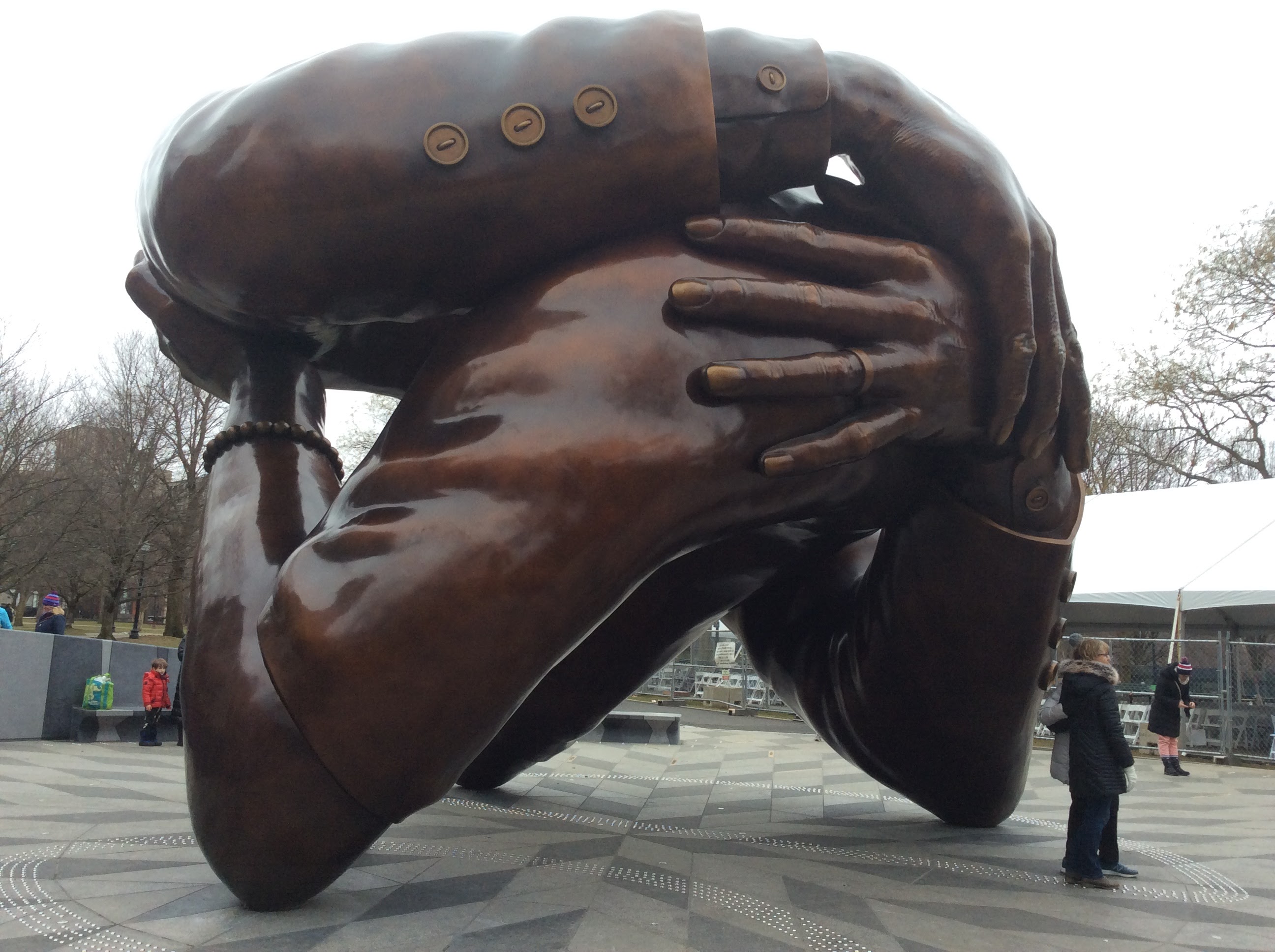
Although the Boston Freedom Trail is meant to be a tour of the Revolutionary War and the grave of Crispus Attucks, a stevadore killed in the Boston Massacre, is directly outside the Church window where I am right now, the new statue of Martin Luther King holding his wife, Coretta Scott King has been unveiled on Boston Common. Another piece of history, ourchurch ran a film on this week marking the one hundreath year of radio broadcasting of the church service, there having been a shop that sold radios across the street on Tremont Street. The service is in progreess upstairs and on WEZE while I am in my wife's library. Donna, please accept these photos as symbolic of our spending our Sundays together.


 photos: Scott Lord
 photo: Scott Lord
Postscript:The Girl on the Flying Trapeze
I spend every Sunday on the Freedom Trail, which our church is on, and I listen to the ministers conduct tours in case I'm needed when in the library or if I think I should point out the Granary Burial Ground. This morning we had a new addition, a sculpture where the usually have a Christmas Star. The other Christmas lights are still in Boston Common. As it is Freedom Trail art, I thought I would add it here, but it takes a couple of photos to conquer the height distance and perspective.
It is an installation- a sculture of a girl on a swing put into an envirornment where art meets reality.
photo: Scott Lord
Postscript:The Girl on the Flying Trapeze
I spend every Sunday on the Freedom Trail, which our church is on, and I listen to the ministers conduct tours in case I'm needed when in the library or if I think I should point out the Granary Burial Ground. This morning we had a new addition, a sculpture where the usually have a Christmas Star. The other Christmas lights are still in Boston Common. As it is Freedom Trail art, I thought I would add it here, but it takes a couple of photos to conquer the height distance and perspective.
It is an installation- a sculture of a girl on a swing put into an envirornment where art meets reality.


 Girl on a Swing photos: Scott Lord
Postscript: Embrace: Dr. Martin Luther and Coretta Scott King Statue added to Boston Freedom Trail

Below is my original blog entry on "The Image" and I myself quake in many ways:
Although the Boston Freedom Trail is meant to be a tour of the Revolutionary War and the grave of Crispus Attucks, a stevadore killed in the Boston Massacre, is directly outside the Church window where I am right now, the new statue of Martin Luther King holding his wife, Coretta Scott King has been unveiled on Boston Common. Another piece of history, ourchurch ran a film on this week marking the one hundreath year of radio broadcasting of the church service, there having been a shop that sold radios across the street on Tremont Street. The service is in progreess upstairs and on WEZE while I am in my wife's library. Donna, please accept these photos as symbolic of our spending our Sundays together.




Scott Lord, Scott Lord Mystery Film and one other like this
25 Jul 03:39
Scott Lord Mystery: Tom Conway as Sherlock Holmes in Murder in the Locked Room (1947)
Scott Lord, Scott Lord Mystery Film and one other like this
25 Jul 03:39
Scott Lord Mystery: Boris Karloff in The Raven (Roger Corman, 1963)
Scott Lord, Scott Lord Mystery Film and one other like this
25 Jul 03:37
Scott Lord Mystery: The New Adventures of Sherlock Holmes, Queue for Murder, 1947
by Scott Lord Mystery Film
Tom Conway as Sherlock Holmes
Scott Lord, Scott Lord and 2 others like this
25 Jul 03:37
Modern Art 1972
by noreply@blogger.com (Scott Lord on Silent Film, Scott Lord on Mystery Film)
Scott Lord, Scott Lord and one other like this
25 Jul 03:37
Silent Sherlock Holmes
by noreply@blogger.com (Scott Lord on Silent Film, Scott Lord on Mystery Film)
Scott Lord, Scott Lord and one other like this
25 Jul 03:37
Sherlock Holmes, The Dying Detective (Elvey, 1921)
by noreply@blogger.com (Scott Lord on Silent Film, Scott Lord on Mystery Film)
Scott Lord, Scott Lord and one other like this
25 Jul 03:37
Scott Lord Silent Film: Midnight Girl (Noy, 1925)
by noreply@blogger.com (Scott Lord on Silent Film, Scott Lord on Mystery Film)
Bela Lugosi appeared with actress Lila Lee during 1924 before having been catapulted into fame in Tod Browning's sound film "Dracula". Director WIlfred Noy had begun directing short comedies in 1911, later directing actress Gladys Jennings in the full legnth mystery "The Face at the Window" during 1920.
The periodical Exhibitor's Trade Review described actress Lila Lee as "wistful" in the titular role. Moving Picture World explained that the Chadwick Pictures Corporation had originally titled the film "The Street Singer" from a scenario written by Garret Fort.
The periodical Exhibitor's Trade Review described actress Lila Lee as "wistful" in the titular role. Moving Picture World explained that the Chadwick Pictures Corporation had originally titled the film "The Street Singer" from a scenario written by Garret Fort.
Scott Lord, Scott Lord and one other like this
25 Jul 03:37

Author Leif Furhammar has written that the merger between Swedish Silent Film companies Svensk Bio and Skandia to form Svensk Filmindustri took place in 1919, after Christmas. Without Swedish Silent Film directors Victor Sjostrom and Mauritz Stiller, who would leave for America with Lars Hanson and Greta Garbo, the remaining pantheon of John Brunnius and Gustaf Molander would teeter and by 1925 delineate the Golden Age of Swedish Silent Film with films that luckily, remarkably, would be contemporary interior dramas more amenable to the advent of sound rather than films that analysed the interior of the character by contrasting it to exterior landscapes and the divine-like prescence of nature as an unreachable narrator, or perhaps the character in specific historic contexts of interest to an audience looking to distance themselves aesthetically from modernity.
Swedish Silent Film scholar Bo Florin makes note of the province held by Nils Bouveng at the newly structured Svenska Filmindustri after the merger had taken place of the smaller companies into one and that Bouveng had published an article entitled Swedish Film Advertising: How the Industry Plans to Conquer the World in the 1919 periodical Filmjournalen. Nils Bouveng of Swedish Biograph was very much responsible for the distribution of Swedish Silent Film in the United States. The publication Exhibitor's Herald during 1921 noted that although Bouveng was deemed to have thought the film market overcrowded, he would still export film "of merit" to the United States. It wrote,"Swedish Biograph has control of all product of Scandinavian studios and will offer only the cream of these pictures to American theaters...While Thy Soul Shall Bear Witness is regarded as its finest offering, company executives believe that Judge Not, Sir Arne's Treasure, Youth Meets Youth, Dawn of Love and Secret of the Monastery will compare favorably with any American made production." Actors that were anticipated to greet audiences in the United States included Mary Johnson, Gosta Ekman Renee Bjorling, Tora Teje, Edith Erastoff Lars Hanson, Karin Molander and Victor Sjostrom.
Scandinavian films were often peered at by American and British film magazines and for thos looking for film rveiews, extatextural discourse on European films can often be located within them. Picture Play Magazine during 1921 looked at the theater screens of Sweden. "Lars Hanson, a star of the Swedish constellation may be added to the European counterparts of American stars. Lesley Mason denominates him 'the Charles Ray of Sweden' and considers him the best male bet of Europe so far as American popularity is concerned. The most popular of the Swedish feminine stars, according to Mr. Mason, are Tora Teje, Karin Molander and Mary Johnson. During the following year, 1922, the periodical Picturegoer magazine in fact recognized actress Mary Johnson as being the leading actress from Sweden in an article about actors known internationally and transnational cinema but opined that as a foreign celebrity she entertained a more subdued fame, as though to denote a lack of commodification of the female in extratextural discourse, ie. exploitation. "Although she rejoices in the title of 'Sweden's Sweetheart", loveable, little Mary Johnson has never recieved a 'fan' letter from Sweden. The reason is extremely simple. There are no 'fans' there. The star, as a star and personality, simply doesn't count. The Swedish picturegoer is very critical as to story, technique and acting and highly appreciative too; but as to writing to the movie stars- perish the thought." Author Walter Bloem, in his volume The Soul of the Moving Picture from 1924, in a discussion on The Scene, singled out two Swedish Silent Film actresses by briefly mentioning Karin Molander and Tora Teje as having "the psychic power which spells variety in the creation of character" as contrasted with a plentiful supply of American actresses that presented "a soporific drama of a single sorrow or grief or pain, of a conventional melancholy, sadness or lament." Author Benjamin B. Hampton to the contrary, in his volume A History of the Movies, published during 1931, seems to transverse the period following the Golden Age of Silent Film as though from 1925-1930 were stagnant, typifying Swedish Silent Film as tendentious. "The Scandinavians, despite fine actors and directors, lean so frequently toward gloomy, sophisticated stories, that they have been negligible factors in production as far as production is concerned." Hampton overlooks that this is exaclty what helps to account for the film made in Sweden after 1925 having been attempts at commercial success through light hearted comedies.
The periodical Motion Picture News during 1925 cited Charles Magnusson as the president of The Swedish Film Industry, Inc. of Stockholm. The occaision was his visit to America and Hollywood. It quoted Magnusson as having said, "American pictures are teaching the people of Sweden to think like Americans, to dress like them and to act like them...They are all emulating the American screen stars and bobbed heads are almost universal throught the North country." He added that Swedish filmmakers were dependent upon artifical lighting, "Our plant in Stockholm is about twelve acres, but we have only two production stages." The Film Daily covered the same visit of Charles Magnusson to Hollywood with the title "Sweden Can't Compete". It claimed that Sweden would look to European markets rather than American and that Swedish audiences demanded American films, one hundread out of one hundread and forty films shown in Sweden being made in Hollywood. Leif Furhammar explains, "Swedish film ended up in a vicious circle, where the production volume declined as American films gained market share, resulting in theaters demanding even more American films to fill the Swedish void." In 1925, only 3% of films screened first run to Swedish audiences were produced in Sweden against 70% of films shown in Sweden being American.
The sentiment that the Golden Age of Swedish Silent Film had been overwhelmed by Hollywood and its towering economic system rather than the expected bolstering of Swedish studios through exportation is expressed by author Joel Fryholm, Lund University, who includes the global prescence of American films as conributing to the decline of the Scandinavian art film in a paper tracing the "Swedish Agitation against American Films" and the splashing of advertisements for them in Swedish newspapers that had neccesitated the need for debate regarding legislation. Providing a historiography of Ipsea, for which Gustaf Molander and Olaf Molander directed, Fryholm sees Ipsea as much of the demise of the Golden Age of Swedish Silent Film by its differing from the transnationalism of a global American cinema by providing a national cinema that differed it choice of subject material from earlier "peasant films", their romanticism, their depiction of provincal culture and that they often "forgrounded the local natural landscape". In effect, Fryholm seems to decribe Sweden as losing world wide ticket holders by offering a new Sweden shown in "Swedish International Films", the reverse effect modernizing storylines had had for the silent film career of Greta Garbo, who at the crescendo of the silent era began to offer a flapper alternative while depating from early costume dramas. In extratextual discourse, film critics had begun to appraise the lack of "peasant films" before the departure of Sjostrom, Stiller, Hanson and Garbo to America had taken hold in the critical reception of first run features. Perhaps not an autuer, Gustaf Molander had reinvented himself and the signature styles of Swedish silent cinema, newspaper critics attempting to compare his films to those made in Hollywood, which at the beginning of the decade absorbed 80% of the Swedish market, as though a new cinematic experience for the remaining 20% of Swedish movie theater tickets. This alternative cosmopolitanism and metropolitanism intended to vie with Hollywood is in part faulted for the decline of the Golden Age of Swedish Silent Film it later having beenn seen unfavorably by film historian Gosta Werner.

During 1921, the periodical Motion Picture Magazine reported there would be an increase of importations from Stockholm and while it featured still photographs from the films Dawn of Love, The Secret of the Monsastery and A Fortuned Hunter, it marked that the storylines we're to be adaptations from the literature of Ibsen, Bjornsen and Selma Lagerlof and that the principal players had come from the Swedish theater, which aptly describes the way in which actress Greta Garbo would be introduced to Swedish film audiences two years later.
Swedish Silent Film director Ivan Hedqvist, who had acted for Svenska Biografteatern in Kristianstad, during 1919 directed the film "The Downy Girl"(Dunungen) from a novel and play by Selma Lagerlof, the film having starred Jenny Tschernichin-Larssen, Mia Grunder in her first appearance on the silent screen and Renee Bjorling in her first screen appearance for Svenska Biografteatern. The cinematographer to the film was Julius Jaenzon. As an adaptation of the work of Selma Lagerlof the film well meets the criteria if being included as an example of the Golden Age of Swedish Silent Film. The following year Ivan Hedqvist directed the film "Carolina Rediviva" scripted by Esther Julin and starring Rene Bjorling, Lia Noree and Hilda Bjorgstrom. Paul Rotha attributes the decline of the Golden Age of Swedish Silent Film simply, uncomplicatedly to their production being discontinued, "In fact, it may be said truthfully that the Swedish Film declined and it died a natural death by reason of its national characteristics of poetic feeling and realism". Paul Rotha typified Golden Age of Swedish Silent Film production with, "They are realized with exceptional visual beauty, being characterized by their lyrical quality of theme and their slowness of development. For their enviornment, full use was made of the natural landscape value of Sweden, whilst their directors were marked by poetic feeling."
Among the films produced by Filmindustri Skandia during 1920 photographed by Raol Reynolds and directed by Rune Carlsten was the film "The Bomb" ("Sunshine and Shadow", "Bomben"), starring Karin Molander and Gosta Ekman. Actress Karin Molander had starred in the lost film "Surrogatet" during 1919, the being no surviving copies of the film. A short film lasting only slightly over a half hour, it was directed by Einar Braun for Filmindustri Scandia, Stockholm. Rune Carlsten in 1920 wrote and directed the Swedish Silent Film film "A Modern Robinson" ("Robinson i skargarden") with actress Mary Johnson. The cinematographer to the film was Raoul Reynolds. Actress Mary Johnson married Norwegian actor Einor Rod after having appeared with him in the film. Director Rune Carlsten that year also directed Mary Johnson with Tora Teje and Hilda Castegren in "Family Traditions" ("Familjens traditioner") which he coscripted as well, his co-author having had been being Sam Ask. The film was produced by Svensk Filmindustri and photographed again by Raoul Reynolds. Einar Froberg was behind the camera duting 1920 to direct the film "Lunda Indians", photographed by Hellwig F. Rimmen. The running time of the film was three quarters of an hour. Swedish Silent Film director Solve Cederstrand directed his first film, "A Fateful Incognito" (Ett odesdigert kognito), starring Tage Alquist and Signe Selid in 1920. The film was written by Axel Essen and photographed by Kurt Jager, who went on to direct the film "Elaman maantiella" (1927) in Finland. Children were allowed to public exhibition of the 1920 film "The Shoemaker Prince",directed by Hjalmer Davidsen and scripted by Jens Locher for Palladium film. The film starred Maja Cassel as Princess Charlotte and Oda Larsen. In her paper The Excavation of New Swedish Childen's Film History, scholar Taichi Niibori, Stockholm University, asks if Pauline Brunius, wife of Swedish Silent Film director John Brunius was the "Founding Mother" of the Swedish Barnfilm with the film "Dragonfly" (1920) in a chapter on the Ambiguity of Generic Identity in exhibition strategies, that its "textural aspect symbolises the contemporaneuous concept of children's films". It is a short film of 21 minutes running time. Brunius often made short films with child actors in the leading parts.
Scripted by Hjalmer Bergman as an adaptation of his 1917 work "Friarna pa Rockesnas", the 1921 film "Fru Mariannes fare" was directed by Gunnar Klintberg, the cinematographer to the film having had been Robert Olsson. The film starred Astri Torsell, Ingrid Sunblad, Aslag Lie-Erde and Gota Klintberg. Gunnar Klintberg continued by directing Astr Torsell in two more Swedish Silent Films, "The Love Circle" [Elisabet) with actresses Julia Hakanson and Gota Klintberg and in "Lord Saviles Brott", adapted from the work of Oscar Wilde. Gunner Klintberg's wife, actress Gota Klintberg had appeared with Signe Kolthoff during 1919 in the film "Jefthas dottar", directed by Robert Dinesen. Swedish Silent Film director Ivan Hedqvist in 1921 directed the film "Pilgrimage to Kevlaar" (Valfarten till Kevlaar). Ragnar Hylten Cavailius, who scripted the photoplay of the film, appears on film as a supporting actor. Ivan Hedqvist followed the film in 1924 with "Life in the Country" (Livets pa Landet), photgraphed by Julius Jaenzon and starring Renee Bjorling, Einar Hanson, and the beautiful Mona Martenson. The film us considered a lost silent film with only fragments from newsreel footage.
Mona Martenson during 1922 was on the Swedish stage at Dramaten , under the direction of Olof Molander, performing Hjalmar Bergman's one act play "Mr. Sleeman is Coming". Greta Garbo that year would give her first on stage performance there, at Dramaten, in the play "The Adventure" (La Belle Adventure".
Bo Florin, Stockholm University, descries a financial crisis in Svensk Filmindustri during 1922, to the extent that its affect was the company only having made three films during 1923. Florin points out that a staggering 90% of all silent films shown in Sweden were in fact American and that this loomed over the perhaps immanent departure of director Victor Sjostrom.
Formerly a journalist, Gustaf Edgren in 1922 had founded his own film company, Varmlandsfilm, making his screenwriting and directorial debut with the film "Miss at Pori" (The Young Lady of Bjorneborg/Froken pa Bjorneborg) starring actresses Rosa Tillman, Elsa Wallin and Edith Ernholm in her first film. The photographer was Adrian Bjurman. Adrian Bjorman was again the photographer for Gustav Edgren during 1923 for the film "People of Narke (Narkingara), which Edgren wrote and directed. Starring in the film were Anna Carlsten, Gerda Bjorne, and Maja Jerlstrom in her first appearance on screen. The film was also produced by Edgren's company Varmlandfilm, which would continue to produce only the flms of Gustaf Edgren.
Aparrently actress Karin Swanstrom was required to give co-directing screen credit to her screenwriter Oscar Rydqvist to the first film she was to direct, "Boman at the Fair" (Boman at the Exbhition, Boman pa Uttstallingen", 1923). Photographed by Gustav A Gustafson, the film starred Ingeborg Strandin and was the only film in which Karin Gardtman was to appear.
Although it joins the narrative of film history in a chapter concerned with the decline of Swedish Silent Film and its Golden Age, author Forsyth Hardy describes the work of Inga Tiblad and Einar Hanson in the 1923 Gustaf Molander film "Malapirater" as "pleasant acting". The film is a comedy. Ragnar Widestedt in 1923 directed Agda Helin and Jenny Tschernichin-Larsson in the film "Housemaids" (Hemslavirmor) written by Ragnar Hylten-Cavallius.
Frederick Andersson in 1923 directed the film "En rackarunge" with actresses Elsa Wallin and Mia Grunder. Gustaf V, King of Sweden, is listed as being in the film. It was photographed by Swedish cinematographer Sven Bardach. Sven Bardach had earlier that year photographed his first film, "Andersson, Petterson och Lundstrom", under the direction of Carl Barklind. The film stars Vera Schmiterlow and Mimi Pollock, both aquaintances of Greta Garbo, Inga Tiblad, and Gucken Cederborg.
Swedish Silent Film director Per Lindberg directed his first film during 1923, "Norrtullsligan", written by Hjalmer Bergman and starring Tora Teje, Stina Berg, Linnea Hillberg and Nils Asther. Peter Cowie, in his volume Scandinavian Cinema, commended the film by writing it "belongs among the most courageous and enjoyable films of the European decade. Films prior to 1923 had presented individual female characters of flesh amd blood, but the Nortell Gang established a precedent....The screenplay by Hjalmer Bergman transcends the familiar image of women as decorative objects." Hjalmer Bergman was in fact the brother-in-law of director Per Lindberg. Per Lindberg directed a second film scripted by Hjalmer Bergman during 1923, "Anna Klara and her Brothers" (Anna Klara och hennes broder), it having starred Anna-Britt Ohlsson, Hilda Bjorgstrom, Karin Swanstrom, Linnea Hillberg and Margit Manstad in what would be her first appearance on screen. The film was photographed by Ragnar Westfelt.
The first two films directed by Sigurd Wallen are presumed lost, with no surviving copies existing. Wallen directed "Anderssonkans Kalle" during 1922 with Anna Diedrich and Stina Berg, the photographer to the film Adrian Bjurman. The following year Wallen directed "Anderssonkans Kalle pa Nya Upptage" photographed by Henrik Jaenzon and starring Edvin Adolphson, the debut film of actress Mona Martenson. Swedish Silent Film director Sigurd Wallen during 1923 directed the lost silent film "Friaren fran Landsvagen", which , co-scripted with Sam Ask and photographed by Henrik Jaenzon, had starred Edvin Adolphson, Jenny Hasselquist, and Mia Grunden. Edvin Adolphson in fact had directed a short film during 1923 starring Hilda Castegren, "Gronkopings veckorevy" his first appearance in Swedish movie theaters as a film director. Castegren had previously worked for Rune Carlsten and Gustaf Molander.
Swedish Silent Film director Bror Abelli in 1923 directed his first two films, including the film "Janne Modig", starring Ture Ottoson in the titular role.
The periodical Motion Picture World during 1927 reminded its readers that actress Sigrid Holmquist had already been introduced to audiences in the United States. "Sigrid Holmquist , once called the 'Swedish Mary Pickford' is another foreign star, very popular with american public, who might named. She is at present making some color art pictures at Tiffany." The periodical Motion Picture Classic countered with a full page portrait of the actress photocaptioned with ,"Sigrid Holmquist is one of the dozen or more 'Swedish Mary Pickfords' - every country has one to fifty." After her first silent film made in the United States, "Just Around the Corner" (Frances Marion, 1921, seven reels) in ehich she started with actress Margaret Seddon for Cosmopolitan Pictures, most of the filmscmade in Hollywood by Swedish actress Sigrid Holmquist are presumed lost, with no surviving existing copies, including two of her earliest, the lost silent film "The Prophet's Pradise" (Alan Croslnd, 1922), and the lost silent film "My Old Kentucky Home" (Ray C. Smallwood, as well as including the films "A Gentleman of Leisure" (Joseph Heneby) (1923) and in all probality the film "The Light That Failed" (George Melford, 1923) in which she starred with actress Jacqueline Logan; all filmed in the United States before Greta Gabo, Mona Martenson, and Vera Schmiterlow had entered the Royal Dramatic Training Academy. Before having left Sweden, actress Sigrid Holmquist had debuted in three comedies directed by Lau Lauritzen during 1920 for Palladium, among which were "Karleck och bjornjakt" and "Flickorna i Ave". Swedish Silent Film director Lau Lauritzen continued during 1921 to film the presumed to be lost film 'Silkesstrumpen" starring actresses Oda Rostrup and Winifred Westover an American from California that had appeared in the "Bodakungen" directed by Gustaf Molander. The cinematographer to the film was Hugo J. Fischer. There are no existing copies of the film that survive. Lau Lauritzen also that year continued with the presumed to be lost film "Karleck och Hypnotism", also for Palladium, starring actress Kiss Andersson.
Swedish Silent Film director John Lindlof in 1924 directed the film "Man of Adventure" (Odets Man) with Inga Tiblad and Uno Henning, photographed by Gustav a Gustafson and written by J. Evicius. Knut Lambert who appears as an actor in the film and subsequently several later films, directed the lost film "Equal Among Equal" (Lika mot lika) in 1906, it having been the first film in which actress Tollie Zellman was to appear. Lambert appears with Tollie Zellman in the film as an actor with his wife Helfrid Lambert. There are no surviving copies of the film.
Sigurd Wallen during 1924 directed Inga Tiblad with Einar Froberg in " Grevarna pa Svanta" photographed by Henrik Jaenzon. Mostly known for being a theater director it was the first of only a handful of films Froberg had appeared in and the only film script that he had written. Froberg had directed an earlier film, "Lunda-indianer" starring Ture Sjogre and Malte Akerman, during 1920, his only time behind the camera, and had directed his own play, "Individerna Forbund' in Stockholm during 1919. Gustaf Molander appeared on stage in Stockholm in Froberg's play "Erna" under the direction of Gustaf Linden at The Drama (Dramaten) during 1922.
Ivar Kage in 1924 directed Gosta Hillberg and Edvin Adolphson in the film "When the Lighthouse Flashes" (Dar fyren blinken) for Svensk Ornfilm. The script was written by Esther Julin who had earlier adapted the novels of Selma Lagerlof to the screen for Victor Sjostrom. A fairly obscure or nonprolific photographer, Hellwig Rimmen during 1924 photographed the only film that he was to direct, "Hogsta Vinsten", it having starred actress Hilma Bolvig. The running time to the film was a half hour. Rimmen had began filming in Sweden under the direction of Einar Fronerg during the only film he was to direct, the 1920 film "Lunda-Indianer".
Actor Bror Berger directed one Swedish Silent Film the 1924 "Den Forgylida lergoken", based on thebplay by Emil Norlander. The film stars actresses Anna-Lisa Lindzen, Gunnilla Ehrenmark, Anna Herzman, and Stina Gutterman.
In the world Swedish Literature, during 1924 the author Birger Sjoberg published the novel Kvartetten som sprangdes (The Quartet That Split Up) which was later adapted for the screen three times, the directors including Arne Bornebusch,Gustaf Molander and Hans Alfredson.
Gustaf Edgren in 1924 directed the film "The King of Trollebro" (Trollebokungen) an adaptation of the Maja pa Stadt's 1917 novel scripted by Solve Cederstrand and photographed by C.A. Soderstrom, the film having starred actresesses Signe Ekloff, Gunvor Winberg, and Anna Carlsten, wife of Rune Carlsten.
Rune Carlsten directed a handful of Swedish Silent Films before distinguishing himself as a director of Swedish Sound Film, in 1924 their having included the film "The Young Nobleman" (Ung greven tar flickan och priset) starring Karin Swanstrom. In 1925 Rune Carlsten married beautiful Dora Soderberg, daughter of novelist Hjalmer Soderberg, author of the 1905 novel "Dr. Glas" and the 1912 novel "The Serious Game".
Included in the number of Swedish Silent Films that are lost, with no surviving copies known to exist is the film "40 Skipper Street" (Skeppargatan 40), directed by Gustaf Edgren during 1925. The film brought Mona Martenson and Einar Hanson together on screen , it also having featutred actresses Magda Holm and Karin Swanstrom. The photoplay was cowritten by director Gustaf Edgren with HUgo CLareus and Solve Cederstrand.
During 1925, Pauline Brunius was appearing on stage with Gosta Ekman in the play "Dalin och Drottningen", written by her brother in law, August Brunius. August Brunius has recently been described by one biographer as having been "the first professional Swedish critic", his having had begun writing essay on the theater in 1917.
Swedish Silent Film director William Larsson during 1925 directed the film "Broderna Ostermans huskors" with Jenny Tscherichin-Larsson and Frida Sporrong; the film is presumed to be lost with no surviving copies existing as is its 1932 remake directed by Thure Alfe, in which actress Fida Sporrong also appeared. During 1925 William Larsson also directed "For hemmet och flickan" with Jenny Tchernichin Larsson and Elsa Widborg in what was to be the first film in which she was to appear. The former was photographed by Arthur Thorell, the former by Henrik Jaenzon. "For hemmet och flickan" is presumed to be lost, with no surviving copies existing and carried the first screenplay written by Weyler Hildebrand, who went on to direct Swedish sound films.
Swedish Silent Film director Sigurd Wallen during 1925 directed the film "Hennes lilla Majestat" starring actresses Margita Alfven, Stina Berg, Gucken Cederborg, and Olga Andersson in the first feature film in which she was to appear. With a photoplay scripted by Henning Ohlson, the film was photographed by Axel Lindblom.
Olaf Molander, to bring the Golden Age of Swedish Silent Film to an anticlimax rather than a crescendo, directed only three silent films, the first in 1925, the next the following year and one the year following that. About the 1925 film, "Lady of the Camelias"(Damen med kameliorna) Forsyth Hardy writes,"The film derived some distinction from the delicately composed interiors and the touching performance of Tora Teje gave in response to Molander's skilled direction." Peter Cowie writes, "Although the film betrays the theatrical loyalties of its director, the camera observing most scenes from a single, rigid, set up, Molander knows how to rein in the histrionics of his players (Nils Arehn, for example creates an excellant Georges Duvall) and he copes well with the outdoor scenes." Photographed by Gustaf A. Gustafson, the films stars Ivan Hedqvist, Hilda Bjorgstrom and Lisskulla Jobs in the first film in which she was to appear. Not incidentally, during 1925 Olaf Molander directed "Kameliadamen" on stage at the Royal Dramtic Theater, Stockholm.
During 1926 Olaf Molander directed August Strindberg's play "Advent" at the Royal Dramatic Theater, Stovkholm. Olaf Molander chose August Strindberg's short story "Ett Dockhem" for his second of three Swedish Silent Films, adapted for the screen in 1926 from a screenplay by Per Axel Branner as the film "Married Life/Getting Married" (Giftas), photographed by Gustaf A. Gustafson. Scholar Jesper Larsson, in his paper "Tora Teje, Reception and Swedishness" writes that actress Tora Teje "was deemed to be stiff and unsuited for the screen". Jesper Larsson intuitively or sagaciously recognizes the reception of the star image of Tora Teje as "an extension of how American films reproduced ideas about consumption and luxury" veering from the concept and aesthetic of the golden age of Swedish Silent Film and its "distillation of a distinctive national style...often set in historical times or rural Sweden." Also appearing in the film "Married Life" are actresses Hilda Borgstrom and Margaret Manstad.
Actress Tora Teje returned to the stage and Dramaten during 1926 to bring August Brunius' play "Messeniernas fall" to Swedish Theater under the direction of of Olaf Molander. Mimi Pollack gives an account that she and Greta Garbo looked up to Tora Teje while at drama school and attempted to imitate her, which may account for Garbo's languishing fatigue of disinterest while portraying characters- Tora Teje at the time was austere while being devoted to religion and lofty. Pauline Brunius, on the other hand was to become Tora Teje's bitter rival.
During a year that he directed "Peer Gynt" by Henrik Ibsen at the Royal Dramtic Theatre in Stockholm, Olaf Molander continued during 1927 with "Only a Dancing Girl" (Bara en danserska), starring Lili Dagover, Karin Swanstrom, and Anna-Lisa Ryding, which he wrote and directed. The cinematographer to the film was Hugo Edlund.
Sigurd Wallen during 1926 directed the film "Ebberods Bank", the assistant director to the film Rolf Husberg. The film starred acresses Stina Berg, Jenny Tschernichin-Larsson and Carina May in her first of three screen appearances. The film is presumed to be lost, with no survivivng copies.
There are no surviving copies of the lost silent film "My Wife Has a Fiancee" (Min Fru har en Fastman, 1926) directed by Theodor Berthels who coscripted the photoplay with wife Greta Berthels. SWedish silent film actress Jenny Hasselquist stars in the film with Thora Ostberg and Tyra Leijman-Uppstrom. It was one of two films produced by Thebe Film. THe following year Theodor Berthels directed the film "Arnljot" (1927) from a manuscript written by his wife Greta Berthels. Both appear onscreen in the film with actress Thora Ostberg. The photographer of the film was Adrian Bjurman. The film is also presumed to be lost, with no surviving copies.
Petschler-Film during 1926 produced the film "Brollopet i Brana" directed by Eric A. Petschler and written by Esther Julin and Lars Tessing. The film, photographed by Gustav A. Gustafson, teamed Edvin Adolphson, Mona Martensen and Emmy Albin. The film "Hin och smalanningen" directed by Erik A Petschler for Petschler Film during 1927 is presumed to be lost, with no known surviving cooies of the film. Co-written by Petschler with Sam Ask as an adaptation of the 1888 play by Frans Hedberg, the film starred actresses Jenny Tchernichin-Larsson, Anita Dow, Birgit Tengroth and Greta Anjov. Screenwriter Sam Ask appears on screen as an actor. The film was photographed by Gustav A. Gustafson.
"Mordbrannerskan" (1926), directed by John Lindlof, photographed by Gustaf A. Gustafson and starring Vera Schmiterlow and Brita Appelgren was the first film in which Birgit Tengroth was to appear.
Actress Vera Schmiterlow, fondly remembered for being a friend of Greta Garbo, during 1927 under the direction of Sigurd Wallen with actress Stina Berg in the film "The Queen of Pellagonia" (Drottninggen av Pellagonia". Scripted by playwright Henningen Ohlsson, the film was photographed byAxel Lindblom.
Swedish Silent Film director Gustaf Edgren in 1927 directed "The Ghost Baron" (Spokbaronen) starring Karin Swanstrom and photographed by Adrian Bjuman, which was followed by "Black Rudolph" (Svarte Rudolph) in 1928, starring Inga Tiblad amd Fridolf Rhudin, both films having been written by Solve Cederstrand. The assistant director to the film "Black Rudolph" had been Gunnar Skogland. It was the first film in which actress Katie Rolfson was to appear.
Vilhelm Bryde directed his only film during 1927, "A Husband By Proxy" (En Perfekt Gentleman) a comedy scripted by Hjalmar Bergman starring Gosta Ekman, La Jana and Karin Swanstrom. The film was produced by Minerva Film. Bryde had acted in a more than a dozen Swedish Silent Films beggining with "Erotikon", directed by Mauritz Stiller.
Screenwriter Ragnar Hylten Cavailius directed a half dozen films over two decades included in his more than fourty years of contributing scripts to Swedish Silent and Swedish sound films. Included among them during 1928 was the film "Hans kungl. Hoget shinglar" starring actresses Karin Swanstrom, Brita Appelgren and Maria Paudler. The film was scripted by Paul Merzbach.
Like Ragnar Hylten Cavailius, a screenwriter from the Golden Age of Swedish Silent Film that later had had a limited foray into directing films, Sam Ask wrote and directed the 1928 Swedish Silent "Erik XIV", it having starred Sophus von Rosen, Eva Monk af Rosenchold, Lisa Ryden and Gosta Werner. Nothwithstanding, despite the film "Erik XIV", author Peter Cowie sees 1928 as the beginning of a "barren period" ensuing after Charles Magnusson was "eased out of" Svenska Filmindustri by Ivar Kruger with Olaf Andersson as head of the firm. Charles Magnusson had folded, and left his position at Svenska Filmindustri during 1928, but the present author feels that perhaps author Peter Cowie is either mistaken or exaggerating when he claims that it had precipitated a "veritable exodus of talent"- the directors Victor Sjostrom and Mauritz Stiller admittedly were in the United States, but contrary to Cowie's volume Scandinavian Cinema, actor and actress Greta Garbo and Lars Hanson had undoubtedly left Sweden prior to the departure of Charles Magnusson, as had Einar Hanson, leaving only the screenwriters Hjalmer Bergman and concievably Tancred Ibsen. And yet the spirit of Cowie's passage views him as essential as a founder and catalyst, which he was.
Peter Cowie, in his volume Scandinavian Cinema chronicles the end of the silent era in Sweden as being a time of less output, "Swedish film production declined through the 1920's, reaching a nadir in 1929, when a mere six features were released."
Danish Silent Film
Victor Sjostrom
Victor Sjostrom
Gustaf Molander
As The Golden Age of Swedish Silent Film Begins to Wane
by noreply@blogger.com (Scott Lord on Silent Film, Scott Lord on Mystery Film)
Swedish Silent Film Companies Merge, Svensk Filmindustri Emerges
Author Leif Furhammar has written that the merger between Swedish Silent Film companies Svensk Bio and Skandia to form Svensk Filmindustri took place in 1919, after Christmas. Without Swedish Silent Film directors Victor Sjostrom and Mauritz Stiller, who would leave for America with Lars Hanson and Greta Garbo, the remaining pantheon of John Brunnius and Gustaf Molander would teeter and by 1925 delineate the Golden Age of Swedish Silent Film with films that luckily, remarkably, would be contemporary interior dramas more amenable to the advent of sound rather than films that analysed the interior of the character by contrasting it to exterior landscapes and the divine-like prescence of nature as an unreachable narrator, or perhaps the character in specific historic contexts of interest to an audience looking to distance themselves aesthetically from modernity.
Swedish Silent Film scholar Bo Florin makes note of the province held by Nils Bouveng at the newly structured Svenska Filmindustri after the merger had taken place of the smaller companies into one and that Bouveng had published an article entitled Swedish Film Advertising: How the Industry Plans to Conquer the World in the 1919 periodical Filmjournalen. Nils Bouveng of Swedish Biograph was very much responsible for the distribution of Swedish Silent Film in the United States. The publication Exhibitor's Herald during 1921 noted that although Bouveng was deemed to have thought the film market overcrowded, he would still export film "of merit" to the United States. It wrote,"Swedish Biograph has control of all product of Scandinavian studios and will offer only the cream of these pictures to American theaters...While Thy Soul Shall Bear Witness is regarded as its finest offering, company executives believe that Judge Not, Sir Arne's Treasure, Youth Meets Youth, Dawn of Love and Secret of the Monastery will compare favorably with any American made production." Actors that were anticipated to greet audiences in the United States included Mary Johnson, Gosta Ekman Renee Bjorling, Tora Teje, Edith Erastoff Lars Hanson, Karin Molander and Victor Sjostrom.
Scandinavian films were often peered at by American and British film magazines and for thos looking for film rveiews, extatextural discourse on European films can often be located within them. Picture Play Magazine during 1921 looked at the theater screens of Sweden. "Lars Hanson, a star of the Swedish constellation may be added to the European counterparts of American stars. Lesley Mason denominates him 'the Charles Ray of Sweden' and considers him the best male bet of Europe so far as American popularity is concerned. The most popular of the Swedish feminine stars, according to Mr. Mason, are Tora Teje, Karin Molander and Mary Johnson. During the following year, 1922, the periodical Picturegoer magazine in fact recognized actress Mary Johnson as being the leading actress from Sweden in an article about actors known internationally and transnational cinema but opined that as a foreign celebrity she entertained a more subdued fame, as though to denote a lack of commodification of the female in extratextural discourse, ie. exploitation. "Although she rejoices in the title of 'Sweden's Sweetheart", loveable, little Mary Johnson has never recieved a 'fan' letter from Sweden. The reason is extremely simple. There are no 'fans' there. The star, as a star and personality, simply doesn't count. The Swedish picturegoer is very critical as to story, technique and acting and highly appreciative too; but as to writing to the movie stars- perish the thought." Author Walter Bloem, in his volume The Soul of the Moving Picture from 1924, in a discussion on The Scene, singled out two Swedish Silent Film actresses by briefly mentioning Karin Molander and Tora Teje as having "the psychic power which spells variety in the creation of character" as contrasted with a plentiful supply of American actresses that presented "a soporific drama of a single sorrow or grief or pain, of a conventional melancholy, sadness or lament." Author Benjamin B. Hampton to the contrary, in his volume A History of the Movies, published during 1931, seems to transverse the period following the Golden Age of Silent Film as though from 1925-1930 were stagnant, typifying Swedish Silent Film as tendentious. "The Scandinavians, despite fine actors and directors, lean so frequently toward gloomy, sophisticated stories, that they have been negligible factors in production as far as production is concerned." Hampton overlooks that this is exaclty what helps to account for the film made in Sweden after 1925 having been attempts at commercial success through light hearted comedies.
The periodical Motion Picture News during 1925 cited Charles Magnusson as the president of The Swedish Film Industry, Inc. of Stockholm. The occaision was his visit to America and Hollywood. It quoted Magnusson as having said, "American pictures are teaching the people of Sweden to think like Americans, to dress like them and to act like them...They are all emulating the American screen stars and bobbed heads are almost universal throught the North country." He added that Swedish filmmakers were dependent upon artifical lighting, "Our plant in Stockholm is about twelve acres, but we have only two production stages." The Film Daily covered the same visit of Charles Magnusson to Hollywood with the title "Sweden Can't Compete". It claimed that Sweden would look to European markets rather than American and that Swedish audiences demanded American films, one hundread out of one hundread and forty films shown in Sweden being made in Hollywood. Leif Furhammar explains, "Swedish film ended up in a vicious circle, where the production volume declined as American films gained market share, resulting in theaters demanding even more American films to fill the Swedish void." In 1925, only 3% of films screened first run to Swedish audiences were produced in Sweden against 70% of films shown in Sweden being American.
The sentiment that the Golden Age of Swedish Silent Film had been overwhelmed by Hollywood and its towering economic system rather than the expected bolstering of Swedish studios through exportation is expressed by author Joel Fryholm, Lund University, who includes the global prescence of American films as conributing to the decline of the Scandinavian art film in a paper tracing the "Swedish Agitation against American Films" and the splashing of advertisements for them in Swedish newspapers that had neccesitated the need for debate regarding legislation. Providing a historiography of Ipsea, for which Gustaf Molander and Olaf Molander directed, Fryholm sees Ipsea as much of the demise of the Golden Age of Swedish Silent Film by its differing from the transnationalism of a global American cinema by providing a national cinema that differed it choice of subject material from earlier "peasant films", their romanticism, their depiction of provincal culture and that they often "forgrounded the local natural landscape". In effect, Fryholm seems to decribe Sweden as losing world wide ticket holders by offering a new Sweden shown in "Swedish International Films", the reverse effect modernizing storylines had had for the silent film career of Greta Garbo, who at the crescendo of the silent era began to offer a flapper alternative while depating from early costume dramas. In extratextual discourse, film critics had begun to appraise the lack of "peasant films" before the departure of Sjostrom, Stiller, Hanson and Garbo to America had taken hold in the critical reception of first run features. Perhaps not an autuer, Gustaf Molander had reinvented himself and the signature styles of Swedish silent cinema, newspaper critics attempting to compare his films to those made in Hollywood, which at the beginning of the decade absorbed 80% of the Swedish market, as though a new cinematic experience for the remaining 20% of Swedish movie theater tickets. This alternative cosmopolitanism and metropolitanism intended to vie with Hollywood is in part faulted for the decline of the Golden Age of Swedish Silent Film it later having beenn seen unfavorably by film historian Gosta Werner.
Swedish Silent Film director Ivan Hedqvist, who had acted for Svenska Biografteatern in Kristianstad, during 1919 directed the film "The Downy Girl"(Dunungen) from a novel and play by Selma Lagerlof, the film having starred Jenny Tschernichin-Larssen, Mia Grunder in her first appearance on the silent screen and Renee Bjorling in her first screen appearance for Svenska Biografteatern. The cinematographer to the film was Julius Jaenzon. As an adaptation of the work of Selma Lagerlof the film well meets the criteria if being included as an example of the Golden Age of Swedish Silent Film. The following year Ivan Hedqvist directed the film "Carolina Rediviva" scripted by Esther Julin and starring Rene Bjorling, Lia Noree and Hilda Bjorgstrom. Paul Rotha attributes the decline of the Golden Age of Swedish Silent Film simply, uncomplicatedly to their production being discontinued, "In fact, it may be said truthfully that the Swedish Film declined and it died a natural death by reason of its national characteristics of poetic feeling and realism". Paul Rotha typified Golden Age of Swedish Silent Film production with, "They are realized with exceptional visual beauty, being characterized by their lyrical quality of theme and their slowness of development. For their enviornment, full use was made of the natural landscape value of Sweden, whilst their directors were marked by poetic feeling."
Among the films produced by Filmindustri Skandia during 1920 photographed by Raol Reynolds and directed by Rune Carlsten was the film "The Bomb" ("Sunshine and Shadow", "Bomben"), starring Karin Molander and Gosta Ekman. Actress Karin Molander had starred in the lost film "Surrogatet" during 1919, the being no surviving copies of the film. A short film lasting only slightly over a half hour, it was directed by Einar Braun for Filmindustri Scandia, Stockholm. Rune Carlsten in 1920 wrote and directed the Swedish Silent Film film "A Modern Robinson" ("Robinson i skargarden") with actress Mary Johnson. The cinematographer to the film was Raoul Reynolds. Actress Mary Johnson married Norwegian actor Einor Rod after having appeared with him in the film. Director Rune Carlsten that year also directed Mary Johnson with Tora Teje and Hilda Castegren in "Family Traditions" ("Familjens traditioner") which he coscripted as well, his co-author having had been being Sam Ask. The film was produced by Svensk Filmindustri and photographed again by Raoul Reynolds. Einar Froberg was behind the camera duting 1920 to direct the film "Lunda Indians", photographed by Hellwig F. Rimmen. The running time of the film was three quarters of an hour.

Scripted by Hjalmer Bergman as an adaptation of his 1917 work "Friarna pa Rockesnas", the 1921 film "Fru Mariannes fare" was directed by Gunnar Klintberg, the cinematographer to the film having had been Robert Olsson. The film starred Astri Torsell, Ingrid Sunblad, Aslag Lie-Erde and Gota Klintberg. Gunnar Klintberg continued by directing Astr Torsell in two more Swedish Silent Films, "The Love Circle" [Elisabet) with actresses Julia Hakanson and Gota Klintberg and in "Lord Saviles Brott", adapted from the work of Oscar Wilde. Gunner Klintberg's wife, actress Gota Klintberg had appeared with Signe Kolthoff during 1919 in the film "Jefthas dottar", directed by Robert Dinesen. Swedish Silent Film director Ivan Hedqvist in 1921 directed the film "Pilgrimage to Kevlaar" (Valfarten till Kevlaar). Ragnar Hylten Cavailius, who scripted the photoplay of the film, appears on film as a supporting actor. Ivan Hedqvist followed the film in 1924 with "Life in the Country" (Livets pa Landet), photgraphed by Julius Jaenzon and starring Renee Bjorling, Einar Hanson, and the beautiful Mona Martenson. The film us considered a lost silent film with only fragments from newsreel footage.
Mona Martenson during 1922 was on the Swedish stage at Dramaten , under the direction of Olof Molander, performing Hjalmar Bergman's one act play "Mr. Sleeman is Coming". Greta Garbo that year would give her first on stage performance there, at Dramaten, in the play "The Adventure" (La Belle Adventure".
Bo Florin, Stockholm University, descries a financial crisis in Svensk Filmindustri during 1922, to the extent that its affect was the company only having made three films during 1923. Florin points out that a staggering 90% of all silent films shown in Sweden were in fact American and that this loomed over the perhaps immanent departure of director Victor Sjostrom.
Formerly a journalist, Gustaf Edgren in 1922 had founded his own film company, Varmlandsfilm, making his screenwriting and directorial debut with the film "Miss at Pori" (The Young Lady of Bjorneborg/Froken pa Bjorneborg) starring actresses Rosa Tillman, Elsa Wallin and Edith Ernholm in her first film. The photographer was Adrian Bjurman. Adrian Bjorman was again the photographer for Gustav Edgren during 1923 for the film "People of Narke (Narkingara), which Edgren wrote and directed. Starring in the film were Anna Carlsten, Gerda Bjorne, and Maja Jerlstrom in her first appearance on screen. The film was also produced by Edgren's company Varmlandfilm, which would continue to produce only the flms of Gustaf Edgren.
Aparrently actress Karin Swanstrom was required to give co-directing screen credit to her screenwriter Oscar Rydqvist to the first film she was to direct, "Boman at the Fair" (Boman at the Exbhition, Boman pa Uttstallingen", 1923). Photographed by Gustav A Gustafson, the film starred Ingeborg Strandin and was the only film in which Karin Gardtman was to appear.
Although it joins the narrative of film history in a chapter concerned with the decline of Swedish Silent Film and its Golden Age, author Forsyth Hardy describes the work of Inga Tiblad and Einar Hanson in the 1923 Gustaf Molander film "Malapirater" as "pleasant acting". The film is a comedy. Ragnar Widestedt in 1923 directed Agda Helin and Jenny Tschernichin-Larsson in the film "Housemaids" (Hemslavirmor) written by Ragnar Hylten-Cavallius.
Frederick Andersson in 1923 directed the film "En rackarunge" with actresses Elsa Wallin and Mia Grunder. Gustaf V, King of Sweden, is listed as being in the film. It was photographed by Swedish cinematographer Sven Bardach. Sven Bardach had earlier that year photographed his first film, "Andersson, Petterson och Lundstrom", under the direction of Carl Barklind. The film stars Vera Schmiterlow and Mimi Pollock, both aquaintances of Greta Garbo, Inga Tiblad, and Gucken Cederborg.
Swedish Silent Film director Per Lindberg directed his first film during 1923, "Norrtullsligan", written by Hjalmer Bergman and starring Tora Teje, Stina Berg, Linnea Hillberg and Nils Asther. Peter Cowie, in his volume Scandinavian Cinema, commended the film by writing it "belongs among the most courageous and enjoyable films of the European decade. Films prior to 1923 had presented individual female characters of flesh amd blood, but the Nortell Gang established a precedent....The screenplay by Hjalmer Bergman transcends the familiar image of women as decorative objects." Hjalmer Bergman was in fact the brother-in-law of director Per Lindberg. Per Lindberg directed a second film scripted by Hjalmer Bergman during 1923, "Anna Klara and her Brothers" (Anna Klara och hennes broder), it having starred Anna-Britt Ohlsson, Hilda Bjorgstrom, Karin Swanstrom, Linnea Hillberg and Margit Manstad in what would be her first appearance on screen. The film was photographed by Ragnar Westfelt.
The first two films directed by Sigurd Wallen are presumed lost, with no surviving copies existing. Wallen directed "Anderssonkans Kalle" during 1922 with Anna Diedrich and Stina Berg, the photographer to the film Adrian Bjurman. The following year Wallen directed "Anderssonkans Kalle pa Nya Upptage" photographed by Henrik Jaenzon and starring Edvin Adolphson, the debut film of actress Mona Martenson. Swedish Silent Film director Sigurd Wallen during 1923 directed the lost silent film "Friaren fran Landsvagen", which , co-scripted with Sam Ask and photographed by Henrik Jaenzon, had starred Edvin Adolphson, Jenny Hasselquist, and Mia Grunden. Edvin Adolphson in fact had directed a short film during 1923 starring Hilda Castegren, "Gronkopings veckorevy" his first appearance in Swedish movie theaters as a film director. Castegren had previously worked for Rune Carlsten and Gustaf Molander.
Swedish Silent Film director Bror Abelli in 1923 directed his first two films, including the film "Janne Modig", starring Ture Ottoson in the titular role.

The periodical Motion Picture World during 1927 reminded its readers that actress Sigrid Holmquist had already been introduced to audiences in the United States. "Sigrid Holmquist , once called the 'Swedish Mary Pickford' is another foreign star, very popular with american public, who might named. She is at present making some color art pictures at Tiffany." The periodical Motion Picture Classic countered with a full page portrait of the actress photocaptioned with ,"Sigrid Holmquist is one of the dozen or more 'Swedish Mary Pickfords' - every country has one to fifty." After her first silent film made in the United States, "Just Around the Corner" (Frances Marion, 1921, seven reels) in ehich she started with actress Margaret Seddon for Cosmopolitan Pictures, most of the filmscmade in Hollywood by Swedish actress Sigrid Holmquist are presumed lost, with no surviving existing copies, including two of her earliest, the lost silent film "The Prophet's Pradise" (Alan Croslnd, 1922), and the lost silent film "My Old Kentucky Home" (Ray C. Smallwood, as well as including the films "A Gentleman of Leisure" (Joseph Heneby) (1923) and in all probality the film "The Light That Failed" (George Melford, 1923) in which she starred with actress Jacqueline Logan; all filmed in the United States before Greta Gabo, Mona Martenson, and Vera Schmiterlow had entered the Royal Dramatic Training Academy. Before having left Sweden, actress Sigrid Holmquist had debuted in three comedies directed by Lau Lauritzen during 1920 for Palladium, among which were "Karleck och bjornjakt" and "Flickorna i Ave". Swedish Silent Film director Lau Lauritzen continued during 1921 to film the presumed to be lost film 'Silkesstrumpen" starring actresses Oda Rostrup and Winifred Westover an American from California that had appeared in the "Bodakungen" directed by Gustaf Molander. The cinematographer to the film was Hugo J. Fischer. There are no existing copies of the film that survive. Lau Lauritzen also that year continued with the presumed to be lost film "Karleck och Hypnotism", also for Palladium, starring actress Kiss Andersson.
Swedish Silent Film director John Lindlof in 1924 directed the film "Man of Adventure" (Odets Man) with Inga Tiblad and Uno Henning, photographed by Gustav a Gustafson and written by J. Evicius. Knut Lambert who appears as an actor in the film and subsequently several later films, directed the lost film "Equal Among Equal" (Lika mot lika) in 1906, it having been the first film in which actress Tollie Zellman was to appear. Lambert appears with Tollie Zellman in the film as an actor with his wife Helfrid Lambert. There are no surviving copies of the film.
Sigurd Wallen during 1924 directed Inga Tiblad with Einar Froberg in " Grevarna pa Svanta" photographed by Henrik Jaenzon. Mostly known for being a theater director it was the first of only a handful of films Froberg had appeared in and the only film script that he had written. Froberg had directed an earlier film, "Lunda-indianer" starring Ture Sjogre and Malte Akerman, during 1920, his only time behind the camera, and had directed his own play, "Individerna Forbund' in Stockholm during 1919. Gustaf Molander appeared on stage in Stockholm in Froberg's play "Erna" under the direction of Gustaf Linden at The Drama (Dramaten) during 1922.
Ivar Kage in 1924 directed Gosta Hillberg and Edvin Adolphson in the film "When the Lighthouse Flashes" (Dar fyren blinken) for Svensk Ornfilm. The script was written by Esther Julin who had earlier adapted the novels of Selma Lagerlof to the screen for Victor Sjostrom. A fairly obscure or nonprolific photographer, Hellwig Rimmen during 1924 photographed the only film that he was to direct, "Hogsta Vinsten", it having starred actress Hilma Bolvig. The running time to the film was a half hour. Rimmen had began filming in Sweden under the direction of Einar Fronerg during the only film he was to direct, the 1920 film "Lunda-Indianer".
Actor Bror Berger directed one Swedish Silent Film the 1924 "Den Forgylida lergoken", based on thebplay by Emil Norlander. The film stars actresses Anna-Lisa Lindzen, Gunnilla Ehrenmark, Anna Herzman, and Stina Gutterman.
In the world Swedish Literature, during 1924 the author Birger Sjoberg published the novel Kvartetten som sprangdes (The Quartet That Split Up) which was later adapted for the screen three times, the directors including Arne Bornebusch,Gustaf Molander and Hans Alfredson.
Gustaf Edgren in 1924 directed the film "The King of Trollebro" (Trollebokungen) an adaptation of the Maja pa Stadt's 1917 novel scripted by Solve Cederstrand and photographed by C.A. Soderstrom, the film having starred actresesses Signe Ekloff, Gunvor Winberg, and Anna Carlsten, wife of Rune Carlsten.
Rune Carlsten directed a handful of Swedish Silent Films before distinguishing himself as a director of Swedish Sound Film, in 1924 their having included the film "The Young Nobleman" (Ung greven tar flickan och priset) starring Karin Swanstrom. In 1925 Rune Carlsten married beautiful Dora Soderberg, daughter of novelist Hjalmer Soderberg, author of the 1905 novel "Dr. Glas" and the 1912 novel "The Serious Game".
Included in the number of Swedish Silent Films that are lost, with no surviving copies known to exist is the film "40 Skipper Street" (Skeppargatan 40), directed by Gustaf Edgren during 1925. The film brought Mona Martenson and Einar Hanson together on screen , it also having featutred actresses Magda Holm and Karin Swanstrom. The photoplay was cowritten by director Gustaf Edgren with HUgo CLareus and Solve Cederstrand.
During 1925, Pauline Brunius was appearing on stage with Gosta Ekman in the play "Dalin och Drottningen", written by her brother in law, August Brunius. August Brunius has recently been described by one biographer as having been "the first professional Swedish critic", his having had begun writing essay on the theater in 1917.
Swedish Silent Film director William Larsson during 1925 directed the film "Broderna Ostermans huskors" with Jenny Tscherichin-Larsson and Frida Sporrong; the film is presumed to be lost with no surviving copies existing as is its 1932 remake directed by Thure Alfe, in which actress Fida Sporrong also appeared. During 1925 William Larsson also directed "For hemmet och flickan" with Jenny Tchernichin Larsson and Elsa Widborg in what was to be the first film in which she was to appear. The former was photographed by Arthur Thorell, the former by Henrik Jaenzon. "For hemmet och flickan" is presumed to be lost, with no surviving copies existing and carried the first screenplay written by Weyler Hildebrand, who went on to direct Swedish sound films.
Swedish Silent Film director Sigurd Wallen during 1925 directed the film "Hennes lilla Majestat" starring actresses Margita Alfven, Stina Berg, Gucken Cederborg, and Olga Andersson in the first feature film in which she was to appear. With a photoplay scripted by Henning Ohlson, the film was photographed by Axel Lindblom.
Olaf Molander, to bring the Golden Age of Swedish Silent Film to an anticlimax rather than a crescendo, directed only three silent films, the first in 1925, the next the following year and one the year following that. About the 1925 film, "Lady of the Camelias"(Damen med kameliorna) Forsyth Hardy writes,"The film derived some distinction from the delicately composed interiors and the touching performance of Tora Teje gave in response to Molander's skilled direction." Peter Cowie writes, "Although the film betrays the theatrical loyalties of its director, the camera observing most scenes from a single, rigid, set up, Molander knows how to rein in the histrionics of his players (Nils Arehn, for example creates an excellant Georges Duvall) and he copes well with the outdoor scenes." Photographed by Gustaf A. Gustafson, the films stars Ivan Hedqvist, Hilda Bjorgstrom and Lisskulla Jobs in the first film in which she was to appear. Not incidentally, during 1925 Olaf Molander directed "Kameliadamen" on stage at the Royal Dramtic Theater, Stockholm.
During 1926 Olaf Molander directed August Strindberg's play "Advent" at the Royal Dramatic Theater, Stovkholm. Olaf Molander chose August Strindberg's short story "Ett Dockhem" for his second of three Swedish Silent Films, adapted for the screen in 1926 from a screenplay by Per Axel Branner as the film "Married Life/Getting Married" (Giftas), photographed by Gustaf A. Gustafson. Scholar Jesper Larsson, in his paper "Tora Teje, Reception and Swedishness" writes that actress Tora Teje "was deemed to be stiff and unsuited for the screen". Jesper Larsson intuitively or sagaciously recognizes the reception of the star image of Tora Teje as "an extension of how American films reproduced ideas about consumption and luxury" veering from the concept and aesthetic of the golden age of Swedish Silent Film and its "distillation of a distinctive national style...often set in historical times or rural Sweden." Also appearing in the film "Married Life" are actresses Hilda Borgstrom and Margaret Manstad.
Actress Tora Teje returned to the stage and Dramaten during 1926 to bring August Brunius' play "Messeniernas fall" to Swedish Theater under the direction of of Olaf Molander. Mimi Pollack gives an account that she and Greta Garbo looked up to Tora Teje while at drama school and attempted to imitate her, which may account for Garbo's languishing fatigue of disinterest while portraying characters- Tora Teje at the time was austere while being devoted to religion and lofty. Pauline Brunius, on the other hand was to become Tora Teje's bitter rival.
During a year that he directed "Peer Gynt" by Henrik Ibsen at the Royal Dramtic Theatre in Stockholm, Olaf Molander continued during 1927 with "Only a Dancing Girl" (Bara en danserska), starring Lili Dagover, Karin Swanstrom, and Anna-Lisa Ryding, which he wrote and directed. The cinematographer to the film was Hugo Edlund.
Sigurd Wallen during 1926 directed the film "Ebberods Bank", the assistant director to the film Rolf Husberg. The film starred acresses Stina Berg, Jenny Tschernichin-Larsson and Carina May in her first of three screen appearances. The film is presumed to be lost, with no survivivng copies.
There are no surviving copies of the lost silent film "My Wife Has a Fiancee" (Min Fru har en Fastman, 1926) directed by Theodor Berthels who coscripted the photoplay with wife Greta Berthels. SWedish silent film actress Jenny Hasselquist stars in the film with Thora Ostberg and Tyra Leijman-Uppstrom. It was one of two films produced by Thebe Film. THe following year Theodor Berthels directed the film "Arnljot" (1927) from a manuscript written by his wife Greta Berthels. Both appear onscreen in the film with actress Thora Ostberg. The photographer of the film was Adrian Bjurman. The film is also presumed to be lost, with no surviving copies.
Petschler-Film during 1926 produced the film "Brollopet i Brana" directed by Eric A. Petschler and written by Esther Julin and Lars Tessing. The film, photographed by Gustav A. Gustafson, teamed Edvin Adolphson, Mona Martensen and Emmy Albin. The film "Hin och smalanningen" directed by Erik A Petschler for Petschler Film during 1927 is presumed to be lost, with no known surviving cooies of the film. Co-written by Petschler with Sam Ask as an adaptation of the 1888 play by Frans Hedberg, the film starred actresses Jenny Tchernichin-Larsson, Anita Dow, Birgit Tengroth and Greta Anjov. Screenwriter Sam Ask appears on screen as an actor. The film was photographed by Gustav A. Gustafson.
"Mordbrannerskan" (1926), directed by John Lindlof, photographed by Gustaf A. Gustafson and starring Vera Schmiterlow and Brita Appelgren was the first film in which Birgit Tengroth was to appear.
Actress Vera Schmiterlow, fondly remembered for being a friend of Greta Garbo, during 1927 under the direction of Sigurd Wallen with actress Stina Berg in the film "The Queen of Pellagonia" (Drottninggen av Pellagonia". Scripted by playwright Henningen Ohlsson, the film was photographed byAxel Lindblom.
Swedish Silent Film director Gustaf Edgren in 1927 directed "The Ghost Baron" (Spokbaronen) starring Karin Swanstrom and photographed by Adrian Bjuman, which was followed by "Black Rudolph" (Svarte Rudolph) in 1928, starring Inga Tiblad amd Fridolf Rhudin, both films having been written by Solve Cederstrand. The assistant director to the film "Black Rudolph" had been Gunnar Skogland. It was the first film in which actress Katie Rolfson was to appear.
Vilhelm Bryde directed his only film during 1927, "A Husband By Proxy" (En Perfekt Gentleman) a comedy scripted by Hjalmar Bergman starring Gosta Ekman, La Jana and Karin Swanstrom. The film was produced by Minerva Film. Bryde had acted in a more than a dozen Swedish Silent Films beggining with "Erotikon", directed by Mauritz Stiller.
Screenwriter Ragnar Hylten Cavailius directed a half dozen films over two decades included in his more than fourty years of contributing scripts to Swedish Silent and Swedish sound films. Included among them during 1928 was the film "Hans kungl. Hoget shinglar" starring actresses Karin Swanstrom, Brita Appelgren and Maria Paudler. The film was scripted by Paul Merzbach.
Like Ragnar Hylten Cavailius, a screenwriter from the Golden Age of Swedish Silent Film that later had had a limited foray into directing films, Sam Ask wrote and directed the 1928 Swedish Silent "Erik XIV", it having starred Sophus von Rosen, Eva Monk af Rosenchold, Lisa Ryden and Gosta Werner. Nothwithstanding, despite the film "Erik XIV", author Peter Cowie sees 1928 as the beginning of a "barren period" ensuing after Charles Magnusson was "eased out of" Svenska Filmindustri by Ivar Kruger with Olaf Andersson as head of the firm. Charles Magnusson had folded, and left his position at Svenska Filmindustri during 1928, but the present author feels that perhaps author Peter Cowie is either mistaken or exaggerating when he claims that it had precipitated a "veritable exodus of talent"- the directors Victor Sjostrom and Mauritz Stiller admittedly were in the United States, but contrary to Cowie's volume Scandinavian Cinema, actor and actress Greta Garbo and Lars Hanson had undoubtedly left Sweden prior to the departure of Charles Magnusson, as had Einar Hanson, leaving only the screenwriters Hjalmer Bergman and concievably Tancred Ibsen. And yet the spirit of Cowie's passage views him as essential as a founder and catalyst, which he was.
Peter Cowie, in his volume Scandinavian Cinema chronicles the end of the silent era in Sweden as being a time of less output, "Swedish film production declined through the 1920's, reaching a nadir in 1929, when a mere six features were released."
Danish Silent Film
Victor Sjostrom
Silent Film
Scott Lord, Scott Lord and one other like this
25 Jul 03:20
Scott Lord Silent Film: Lon Chaney in The Gift Supreme (Oliver L Sellers...
Scott Lord, Scott Lord Mystery Film and one other like this
 Blacklight Castle- Mystery Film.
08 Jul 04:16
Greta Garbo
The Film Daily ran an announcement during 1929 titled "Feyder Directing Garbo" It related, "Greta Garbo has begun work on a new picture under the direction of Jacques Feyder, French director recently signed by M.G.M. Anders Randolph will play the husband in the film, an original by Feyder, not yet titled."
New Movie Magazine quoted the director, " 'Dialougue- that is what will make the love sparkle in American films.' Monsieur Feyder has a great vision of Greta Garbo's future. He directed her in her last silent film The Kiss. Says Mr. Feyder, "What possibilities are opened to her with her voice? She will branchout, her characterizations will broaden. She will enter into her cinema inheritance- and what a glorious inheritance it will be." The Film Daily inadvertantly reviewed the film as an "All-Talker", but the studio in its advertisements that ran in the magazine that year included the film in "a deluge of dialogue delights" that it would be offering. The subtitle to the review read, "Sophisticated drama of continental life puts Greta Garbo in a new kind of role but tragic story misses." The review explained, "Greta Garbo as always is very alluring and excersizes her erotic charm throughout the erotic portrayal. But the subject matter is too tragic and the ending not the type that her average fan looks for...Shapes up as a pretty sophisticated farce that lacks the American slant and is problematical whether Garbo fans will feel enthusiastic about seeing their favorite in this type of production...Feyder worked the camera technique in many novel ways and achives some effective shots." Richard Corliss aptly writes, "It's also true that Garbo looks beautiful but distracted. She walks through the role as if her mind were on other things." Picture Play summarily reported, "Commonplace story made glamorous by Greta Garbo, beautifully produced and directed. Film critic Paul Rotha, in his volume The Fill to Now, a survey of world cinema recognized the assingment of Greta Garbo to Jacques Feyder, "Quite recently Jacques Feyder, the Belgian, who in Europe is associated with the brilliant realization of Zola's Therese Raquin and the political satire Les Nouveaux Messiers, made his first picture for Metro Goldwyn Mayer, The Kiss, in which he skillfully combined intelligent direction with the necessary proportion of picture sense. his treatment of Greta Garbo was more subtle that that usually accorded to this actress by American directors...But there was a freshness about The Kiss that raised it above the level of the ordinary movie and a use of camera angle which was reminiscent of Feyder's earlier work." Earlier in the book Rotha had directed his attention to the film of Greta Garbo in an attempt to characterize the then contemporary film of the United States, "There is found then at the close of the pre-dialouge period of the American film, a mixed selection of production made according to formula...The ingredients of a successful film, conceived from a picture-sense point of view may be said to to: a strong, powerful theme (preferably sexual); a high-polished, quick moveing technique employing all the most recent discoveries (usually German); a story interest that will carry the sex at the same time allowing for spectacle and at least two highspots: and a cast of international players. Of such a type were Flesh and the Devil, The Last Command, The Patriot, Wild Orchids and The Kiss."
John Bainbridge reviews the film but more intriguing is his met intoning the social bond between Garbo and Feyder, I that she was less in contact with John Gilbert and both her sister and Mauritz stillerhas passed away. "however threadbare the plot, "The Kiss" has always been of interest to serious filmgoers for two reasons; it was Garbo's last silent film, and it was directed with consummate artistry...she also took pleasure from that Mrs Feyder was on the set nearly every day. After work the three often went to Feyders' house for dinner, and even once in a while to Garbo's." This was reiterated in Silver Screen magazine by Harriet Parson, who in 1930, penned, "24 Hours with Garbo"
It chronicled an evening where the journalist followed Greta Garbo "I caught my breath in excitement. It was Garbo! I sat breathless while she and her escort selected a table. It was the one next to mine, not four feet away. Garbo was dressed as no other girl in Hollywood would have dressed- a grey suit, severely tailored, a man's grey shirt, a navy blue tie with white dots, a navy blue topcoat and a dark blue beret with no hair showing from beneath it... Suddenly I recognized him- Jacques Feyder, the French director who made "The Kiss", Garbo's last silent picture. They began to eat...Afterward she drank black coffee and smoked a denicotinized cigarette. A flower woman came to the table with her little trey of blossoms. Feyder had purchased a gardenia and with a gallant guest urge handed it to Garbo" After dinner, Garbo and her former director went to a puppet show held in a theater next door where Greta Garbo was being portrayed bu a puppet dressed as Anna Christie. Feyder escorted her home that night as the 24 hour reporter followed, "A fortress as impenetrable as she is herself. She disappears-Feyder departs alone-midnight arrives."
The then twenty year old Lew Ayres was described by Screenland Magazine as a rare sensation that had unexpectedly catapulted on to the screen almost as if he had in fact been hurriedly signed as a newcomer in anticipation of the new technology of sound. When interviewed by Myrene Wentworth, Lew Ayers described his meeting Greta Gabo, " 'Gee, she is wonderful,' he said. 'I was scared to death when I walked on to the set but she made me feel right at home and helped me tremendously.'...It was a scene where he had to rush in and embrace her madly. 'And I hadn't even been introduced to her.', he said with an imagine-my-embarrassment gesture... Miss Garbo saw his discomforture and took his arm, turning to Jacques Feyder, the director. 'Would you mind making me acquainted with this young man?'."
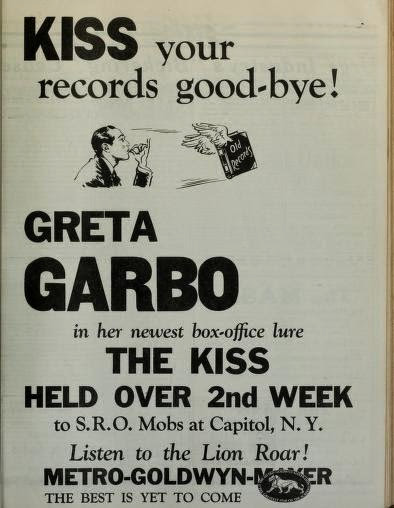
Greta Garbo in The Kiss (Feyder/Daniels, 1929)
scottlordpoet
shared this story
from  scottlordpoet's blurblog. scottlordpoet's blurblog.
|
scottlordpoet
shared this story
from  Scott Lord on Silent Film Hollywood, Lost Silent Film, Swedish Silent Film, Danish Silent Film. Scott Lord on Silent Film Hollywood, Lost Silent Film, Swedish Silent Film, Danish Silent Film.
|
Greta Garbo
The Film Daily ran an announcement during 1929 titled "Feyder Directing Garbo" It related, "Greta Garbo has begun work on a new picture under the direction of Jacques Feyder, French director recently signed by M.G.M. Anders Randolph will play the husband in the film, an original by Feyder, not yet titled."
New Movie Magazine quoted the director, " 'Dialougue- that is what will make the love sparkle in American films.' Monsieur Feyder has a great vision of Greta Garbo's future. He directed her in her last silent film The Kiss. Says Mr. Feyder, "What possibilities are opened to her with her voice? She will branchout, her characterizations will broaden. She will enter into her cinema inheritance- and what a glorious inheritance it will be." The Film Daily inadvertantly reviewed the film as an "All-Talker", but the studio in its advertisements that ran in the magazine that year included the film in "a deluge of dialogue delights" that it would be offering. The subtitle to the review read, "Sophisticated drama of continental life puts Greta Garbo in a new kind of role but tragic story misses." The review explained, "Greta Garbo as always is very alluring and excersizes her erotic charm throughout the erotic portrayal. But the subject matter is too tragic and the ending not the type that her average fan looks for...Shapes up as a pretty sophisticated farce that lacks the American slant and is problematical whether Garbo fans will feel enthusiastic about seeing their favorite in this type of production...Feyder worked the camera technique in many novel ways and achives some effective shots." Richard Corliss aptly writes, "It's also true that Garbo looks beautiful but distracted. She walks through the role as if her mind were on other things." Picture Play summarily reported, "Commonplace story made glamorous by Greta Garbo, beautifully produced and directed. Film critic Paul Rotha, in his volume The Fill to Now, a survey of world cinema recognized the assingment of Greta Garbo to Jacques Feyder, "Quite recently Jacques Feyder, the Belgian, who in Europe is associated with the brilliant realization of Zola's Therese Raquin and the political satire Les Nouveaux Messiers, made his first picture for Metro Goldwyn Mayer, The Kiss, in which he skillfully combined intelligent direction with the necessary proportion of picture sense. his treatment of Greta Garbo was more subtle that that usually accorded to this actress by American directors...But there was a freshness about The Kiss that raised it above the level of the ordinary movie and a use of camera angle which was reminiscent of Feyder's earlier work." Earlier in the book Rotha had directed his attention to the film of Greta Garbo in an attempt to characterize the then contemporary film of the United States, "There is found then at the close of the pre-dialouge period of the American film, a mixed selection of production made according to formula...The ingredients of a successful film, conceived from a picture-sense point of view may be said to to: a strong, powerful theme (preferably sexual); a high-polished, quick moveing technique employing all the most recent discoveries (usually German); a story interest that will carry the sex at the same time allowing for spectacle and at least two highspots: and a cast of international players. Of such a type were Flesh and the Devil, The Last Command, The Patriot, Wild Orchids and The Kiss."
John Bainbridge reviews the film but more intriguing is his met intoning the social bond between Garbo and Feyder, I that she was less in contact with John Gilbert and both her sister and Mauritz stillerhas passed away. "however threadbare the plot, "The Kiss" has always been of interest to serious filmgoers for two reasons; it was Garbo's last silent film, and it was directed with consummate artistry...she also took pleasure from that Mrs Feyder was on the set nearly every day. After work the three often went to Feyders' house for dinner, and even once in a while to Garbo's." This was reiterated in Silver Screen magazine by Harriet Parson, who in 1930, penned, "24 Hours with Garbo"
It chronicled an evening where the journalist followed Greta Garbo "I caught my breath in excitement. It was Garbo! I sat breathless while she and her escort selected a table. It was the one next to mine, not four feet away. Garbo was dressed as no other girl in Hollywood would have dressed- a grey suit, severely tailored, a man's grey shirt, a navy blue tie with white dots, a navy blue topcoat and a dark blue beret with no hair showing from beneath it... Suddenly I recognized him- Jacques Feyder, the French director who made "The Kiss", Garbo's last silent picture. They began to eat...Afterward she drank black coffee and smoked a denicotinized cigarette. A flower woman came to the table with her little trey of blossoms. Feyder had purchased a gardenia and with a gallant guest urge handed it to Garbo" After dinner, Garbo and her former director went to a puppet show held in a theater next door where Greta Garbo was being portrayed bu a puppet dressed as Anna Christie. Feyder escorted her home that night as the 24 hour reporter followed, "A fortress as impenetrable as she is herself. She disappears-Feyder departs alone-midnight arrives."
The then twenty year old Lew Ayres was described by Screenland Magazine as a rare sensation that had unexpectedly catapulted on to the screen almost as if he had in fact been hurriedly signed as a newcomer in anticipation of the new technology of sound. When interviewed by Myrene Wentworth, Lew Ayers described his meeting Greta Gabo, " 'Gee, she is wonderful,' he said. 'I was scared to death when I walked on to the set but she made me feel right at home and helped me tremendously.'...It was a scene where he had to rush in and embrace her madly. 'And I hadn't even been introduced to her.', he said with an imagine-my-embarrassment gesture... Miss Garbo saw his discomforture and took his arm, turning to Jacques Feyder, the director. 'Would you mind making me acquainted with this young man?'."

Photoplay magazine during 1931 used two full pages to exhibit one photo of Jacques on the set to follow the director into the sound era in American film. It was a scene from his film "Daybreak", starring Ramon Novarro. The caption explains that the camera was "mounted on a rubber-tired 'dolly' for the making of traveling shots Jacques Feyder, director of Garbo's 'The Kiss' is the boss. He's at the extreme left, seated from the bottom." Film periodicals had counted on there being interest in the offscreen lives of film stars and in how they might put together a sound film, the extra-textual discourse embroidering distant super luminaries into the conversations that were held after the audiences left the public sphere of the theater and entered the fantasy objectifications of spectatorship that to some of the public may have seemed to be merely an ordinary walk home from the theater; and for theater goer Greta Garbo they may have been.
A publicity still published in Picture Play magazine during 1929 kept the caption, "Miss Garbo, at top of page, unhappy in the midst of luxury, reflects on how little life holds." Interestingly, although Greta Garbo in a low cut dress directing the view of the spectator to where she might not be wearing a bra is in front of a dressing room mirror it is not strictly a mirror shot in that she is also photographed in quarter profile as though nearing over the shoulder to effect a double image. P




Greta Garbo
Greta Garbo
Greta Garbo
Greta Garbo
Greta Garbo
Greta Garbo
Scott Lord, Scott Lord and 2 others like this
24 Jun 04:34
 I honestly had to dust the television after coming home from church, but please look and the previous entry to see how its grown- it found the little "love" pillow Donna's grandmother had given her - after sprawling across the floor, over a plastic storage bin and up the side of the tv stand for over five feet, most likely seven; it has sixty five leaves across for two of its ten "vines", most likely one hundread leaves, more likely over one hundread and ten or one hundread and twenty.
This time our plant found the little “love” pillow.
by noreply@blogger.com (Scott Lord on Silent Film, Swedish Silent Film, Danish Silent Film,)

Scott Lord, Scott Lord and 3 others like this
24 Jun 04:31
Scott Lord The Moonstone
by noreply@blogger.com (Scott Lord on Silent Film, Scott Lord on Mystery Film)
Scott Lord, Scott Lord and 3 others like this
24 Jun 01:31
During Commercials, hint Zuckertort, Chigorin variations.
by Scott Lord on Silent Film, Scott Lord on Mystery Film

Scott Lord, Scott Lord Mystery Film and one other like this