Scott Lord
Scott Lord
Shared posts
18 Oct 01:29
Scott Lord Mystery: Studio One, Marsha Hunt in The Storm (1949)
by Scott Lord Mystery Film
Scott Lord on Mystery: Studio One starring Marsha Hunt
Scott Lord, Scott Lord and 2 others like this
18 Oct 01:29
Scott Lord Mystery: The Late Show, Sir Cedric Hardwicke in Climax, Dr. Jeckyll and Mr. Hyde
by Scott Lord Mystery Film
Scott Lord, Scott Lord and 2 others like this
18 Oct 01:26
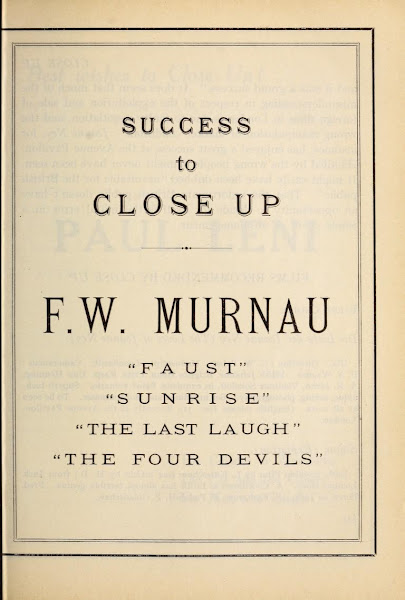
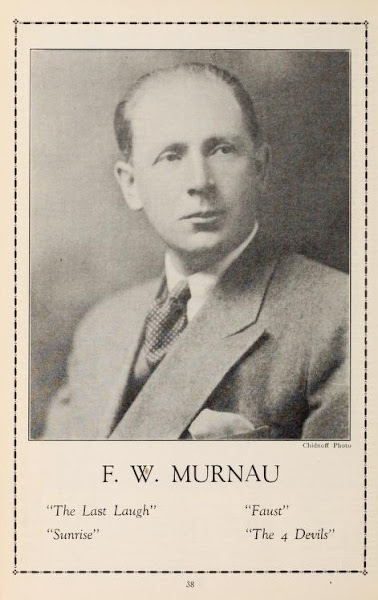
The immanent departure of Silent Horror Film director F.W. Murnau for America had already been announced by the periodical Motion Picture News during late 1925 while Murnau was readying the film "Faust". It was to star Gosta Ekman, "a young Swedish actor who has the title role. He has been a star on the legitimate stage and is now making his first appearance in pictures." Scholar Janet Bergstrom, University of California notes that F.W Murnau had recieced a letter from William Fox during 1925 prompted by the success of "The Last Laugh" (Der Letze Mann) and had already signed a contract to leave for America while filming "Faust" and "Tartuffe".
Janet Bergstrom, University of California , writes that with the film "Faust", among others, Murnau had "unchained the camera" with moving shots that seemed unique...sweeping the audience's emotions with them". Of these moving shots, Bergstrom brings to our attention tracking shots that were photographed above their subject by having rails mounted on the ceiling of the studio.
The use of a mobile camera by Murnau is clearly referred to by Robert Herlth, a designer of sets on the film "Faust", who wrote on the lighting of the film in a chapter entitled "With Murnau on the Set" included in the volume Murnau, published by Lotte H. Eisner. The set designer quotes Murnau as having said, " 'Now how are we going to get the effect of the design? This is too light. Everything must be made much more shadowy.' And so all four of us set about to trying to cut the light...We used them (screens) to define space and create shadows on the wall and in the air. For Murnau, the lighting became part of the actual directing of the film.'"
The periodical Photoplay Magazine during 1927 explained that F.W. Murnau had again resorted to literary adaptation for subject matter, "Goethe's panaoramic poem has been used as its basis and the adaptation was folowed, in the main, as closely as the screen permits...Murnau has caught the medieval atmosphere with suprising success." F.W. Murnau had actually jotted Goethe's name on one of his shootingscripts. Lotte H. Eisner, in his volume Murnau, writes that the script for "Faust", written by poet Hans Kyser, had originally contained a Walpurgisnacht, which may have only reluctantly have been elimanted from a script annotated by the director Murnau in order to "translate the text into visual terms and give directions to actors in terms ofimages."
In regard to whether F.W. Murnau was only on the peripheral of German Expression by definition due to its origins, one idea that supports that if anything F.W. Murnau held that peripheral is the adverse reaction of author Paul Rotha to the subsquent films Murnau made after haveing come to the United States to film. Rotha, in his volume The Film till Now: survey of world cinema, writes, "I find it impossible to accept that the Murnau who made 'Faust' and 'The Last Laugh' are the same man who made 'Sunrise' and 'Four Devils'. Some link between the two pairs of films is sought in vain. They seem the work of seperate persons: the first of an artist working with sincerity among harmonious surroundings; the second of a psuedo artist muddling under extreme difficulties of superabundance." There is a similar discorse concerning the films Swedish silent film director Victor Sjostrom made in Hollywood after having left Svenska Bio, yet it is one that recognizes the film technique od Sjostrom, including the use of ciematic devices such as cutting across the line to a reverse angle and flashbacks.
silent film
Silent Horror Film
Silent Horror
Scott Lord Silent Film: Gosta Ekman in Faust (F.W. Murnau, 1926)
by Scott Lord on Silent Film, Scott Lord on Mystery Film

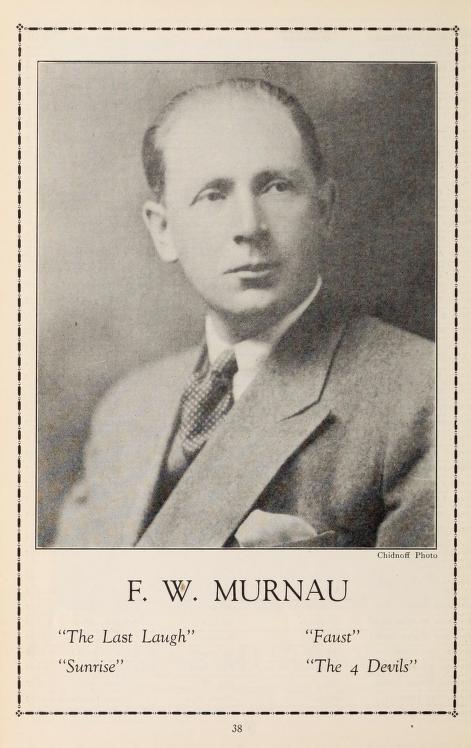
The immanent departure of Silent Horror Film director F.W. Murnau for America had already been announced by the periodical Motion Picture News during late 1925 while Murnau was readying the film "Faust". It was to star Gosta Ekman, "a young Swedish actor who has the title role. He has been a star on the legitimate stage and is now making his first appearance in pictures." Scholar Janet Bergstrom, University of California notes that F.W Murnau had recieced a letter from William Fox during 1925 prompted by the success of "The Last Laugh" (Der Letze Mann) and had already signed a contract to leave for America while filming "Faust" and "Tartuffe".
Janet Bergstrom, University of California , writes that with the film "Faust", among others, Murnau had "unchained the camera" with moving shots that seemed unique...sweeping the audience's emotions with them". Of these moving shots, Bergstrom brings to our attention tracking shots that were photographed above their subject by having rails mounted on the ceiling of the studio.
The use of a mobile camera by Murnau is clearly referred to by Robert Herlth, a designer of sets on the film "Faust", who wrote on the lighting of the film in a chapter entitled "With Murnau on the Set" included in the volume Murnau, published by Lotte H. Eisner. The set designer quotes Murnau as having said, " 'Now how are we going to get the effect of the design? This is too light. Everything must be made much more shadowy.' And so all four of us set about to trying to cut the light...We used them (screens) to define space and create shadows on the wall and in the air. For Murnau, the lighting became part of the actual directing of the film.'"
The periodical Photoplay Magazine during 1927 explained that F.W. Murnau had again resorted to literary adaptation for subject matter, "Goethe's panaoramic poem has been used as its basis and the adaptation was folowed, in the main, as closely as the screen permits...Murnau has caught the medieval atmosphere with suprising success." F.W. Murnau had actually jotted Goethe's name on one of his shootingscripts. Lotte H. Eisner, in his volume Murnau, writes that the script for "Faust", written by poet Hans Kyser, had originally contained a Walpurgisnacht, which may have only reluctantly have been elimanted from a script annotated by the director Murnau in order to "translate the text into visual terms and give directions to actors in terms ofimages."
In regard to whether F.W. Murnau was only on the peripheral of German Expression by definition due to its origins, one idea that supports that if anything F.W. Murnau held that peripheral is the adverse reaction of author Paul Rotha to the subsquent films Murnau made after haveing come to the United States to film. Rotha, in his volume The Film till Now: survey of world cinema, writes, "I find it impossible to accept that the Murnau who made 'Faust' and 'The Last Laugh' are the same man who made 'Sunrise' and 'Four Devils'. Some link between the two pairs of films is sought in vain. They seem the work of seperate persons: the first of an artist working with sincerity among harmonious surroundings; the second of a psuedo artist muddling under extreme difficulties of superabundance." There is a similar discorse concerning the films Swedish silent film director Victor Sjostrom made in Hollywood after having left Svenska Bio, yet it is one that recognizes the film technique od Sjostrom, including the use of ciematic devices such as cutting across the line to a reverse angle and flashbacks.
silent film
Silent Horror Film
Silent Horror
Scott Lord, Scott Lord and 2 others like this
18 Oct 01:25
Scott Lord on Silent Film Hollywood, Lost Silent Film, Swedish Silent Film, Danish Silent Film: Gustaf Molander
Scott Lord, Scott Lord Mystery Film and 3 others like this
15 Oct 01:13


![]()


Donna's favorite downtown Boston orange juice and the adjacent former offices of Houghton Mifflin Company


Scott Lord Mystery Film, Scott Lord likes this


15 Oct 01:13
Scott Lord on Silent Film Hollywood, Lost Silent Film, Swedish Silent Film, Danish Silent Film: Greta Garbo in The Mysterious Lady
Scott Lord Mystery Film, Scott Lord likes this
15 Oct 01:12
Blacklight Castle- Mystery Film
Myster
Tags: Mystery
Scott Lord Mystery Film, Scott Lord likes this
15 Oct 01:12
scotlordnovel's blurblog silent mystery film
Silent mystery film
Tags: silent film
Scott Lord Mystery Film, Scott Lord likes this
15 Oct 01:12
Scott Lord Silent Film: The Phantom of the Opera (Jullian, 1925)
Scott Lord Mystery Film, Scott Lord likes this
15 Oct 01:12
Sherlock Holmes Trailers , Dressed to Kill
Scott Lord Mystery Film, Scott Lord likes this
15 Oct 01:12
Scott Lord Mystery: The Mummy’s Hand theatrical trailer
Scott Lord Mystery Film, Scott Lord likes this
15 Oct 01:12
Scott Lord Mystery: Werewolf of London theatrical trailer
Scott Lord Mystery Film, Scott Lord likes this
15 Oct 01:12
Scott Lord Mystery: She Wolf of London theatrical trailer
Scott Lord Mystery Film, Scott Lord likes this
15 Oct 01:12
Scott Lord Mystery: The Great Alaskan Mystery, Chapter Six (Taylor, Coll...
Scott Lord Mystery Film, Scott Lord likes this
15 Oct 01:11
Scott Lord: Donna's favorite downtown Boston orange juice and the adjacent former offices of Houghton Mifflin Company
Scott Lord Mystery Film, Scott Lord likes this
15 Oct 01:11
The periodical Exhibitors Herld during 1924 announced that the film "The Thief of Bagdad", produced by Douglas Fairbanks came with a story written by Elton Thomas, the scenario editor Lotta Woods, "'The Thief of Bagdad' is a conglomeration of every impossible situation that could be dug out of every 'Arabian Nights' tale ever written, interspersed with a few that do not cause a stretch of the imagination to be what might have happenned."
Included with the autobiography of Douglas Fairbanks, Laugh and Live, is a biographical sketch that refers to Fairbanks occaisionally being called "Doug"; the pseudonym of Douglas Fairbanks was Elton Thomas.
SILENT FILM
Douglas Fairbanks SILENT FILM
Scott Lord: The Thief of Bagdad (Walsh, 1924)
scottlordpoet
shared this story
from  Scott Lord on Silent Film Hollywood, Lost Silent Film, Swedish Silent Film, Danish Silent Film. Scott Lord on Silent Film Hollywood, Lost Silent Film, Swedish Silent Film, Danish Silent Film.
|
The periodical Exhibitors Herld during 1924 announced that the film "The Thief of Bagdad", produced by Douglas Fairbanks came with a story written by Elton Thomas, the scenario editor Lotta Woods, "'The Thief of Bagdad' is a conglomeration of every impossible situation that could be dug out of every 'Arabian Nights' tale ever written, interspersed with a few that do not cause a stretch of the imagination to be what might have happenned."
Included with the autobiography of Douglas Fairbanks, Laugh and Live, is a biographical sketch that refers to Fairbanks occaisionally being called "Doug"; the pseudonym of Douglas Fairbanks was Elton Thomas.
SILENT FILM
Douglas Fairbanks SILENT FILM
Scott Lord Mystery Film, Scott Lord likes this
15 Oct 01:11
The Black Cat Magazine- Boston 1899;contemporary to The Strand Magazine
 Mystery.


Scott Lord Mystery Film, Scott Lord likes this
15 Oct 01:11
Silent Film
Scott Lord silent holmes
Scott Lord Silent Film: Sherlock Holmes, The Devil’s Foot (Elvey, 1921)
scottlordpoet
shared this story
from  Scott Lord shared items on The Old Reader (RSS). Scott Lord shared items on The Old Reader (RSS).
|
Silent Film
Scott Lord silent holmes
Scott Lord Mystery Film, Scott Lord likes this
15 Oct 01:11
silent film silent film
Scott Lord: Vampyr (Carl Th. Dreyer, 1932)
|
scottlordpoet
shared this story
from Scott Lord shared items on The Old Reader (RSS).
|
silent film silent film
Scott Lord Mystery Film, Scott Lord likes this
15 Oct 01:11
Sherlock Holmes Trailers-SpiderWoman
Scott Lord
silent film
Scott Lord Mystery Film, Scott Lord likes this
15 Oct 01:11
Silent Film: Dream Street (D. W. Griffith, 1921)
Scott Lord Mystery Film, Scott Lord likes this
15 Oct 01:10
Scott Lord Silent Film: (Hårda viljor (Brunius, 1923)
Swedish Silent Film director John W. Brunius during 1922 directed actress Lilla Bye and Linnea Hillberg in the film "Harda Viljer", cowritten by Brunius and Sam Ask, the film was photographed by cinematographer Hugo Edlund.
Silent Film
John Brunius
Scott Lord Mystery Film, Scott Lord likes this
15 Oct 01:10
Scott Lord on Christianity: The Door to Heaven (Wheaton)
Scott Lord Mystery Film, Scott Lord likes this