25 Dec 00:58
by Fengjiu Yang, Hong En Lim, Feijiu Wang, Masashi Ozaki, Ai Shimazaki, Jiewei Liu, Nur Baizura Mohamed, Keisuke Shinokita, Yuhei Miyauchi, Atsushi Wakamiya, Yasujiro Murata, Kazunari Matsuda
Abstract
Perovskite solar cells (PSCs) have attracted intensive attention as the most promising next-generation photovoltaic technology because they both enable accelerated development of photovoltaic performance and are compatible with low-cost fabrication methods. The strategy of interface engineering of the perovskite layer in PSCs is expected to result in further enhancement of the power conversion efficiency (PCE) of PSCs via minimizing the charge recombination loss. Here, a high current–voltage (stabilized power output) PCE of 20.4% (19.9%) in CH3NH3PbI3 PSCs under reverse scanning conditions is demonstrated by incorporating a solution-processed polymer layer of poly(methyl methacrylate) (PMMA) between the perovskite photoactive layer and the hole transport layer. Moreover, steady-state and time-resolved photoluminescence spectroscopy and impedance spectroscopy are used to reveal the mechanism of the enhancement of the photovoltaic performance and its stability by the PMMA layer in a CH3NH3PbI3 PSC device. The morphology modification, surface passivation, and protection of the perovskite layer by the insulating PMMA layer substantially contribute to the enhancement of photovoltaic performance and its stability, despite a slight reduction of the charge extraction efficiency. The demonstrated high PCEs and insights obtained into the working mechanism of the PMMA layer pave the way for the industrial application of CH3NH3PbI3 PSCs.

Enhanced surface quality of perovskite photoactive layer is demonstrated by incorporation of the poly(methyl methacrylate) (PMMA) engineered passivating layer, which results in highly enhanced power conversion efficiency from 16.8 to 20.4% of standard and PMMA-incorporated perovskite solar cells, respectively, and reveals the working mechanism of PMMA layer in the perovskite solar cell device.
22 Dec 01:20
J. Mater. Chem. A, 2017, Accepted Manuscript
DOI: 10.1039/C7TA10010H, Paper
Muge Acik, In Kee Park, Rachel E Koritala, Geunsik Lee, Richard Rosenberg
Graphene Oxide or its reduced derivative (GO/RGO) replace metal oxides in perovskite photovoltaics to achieve energy band alignment for minimization of the energy barriers at the film interfaces allowing efficient...
The content of this RSS Feed (c) The Royal Society of Chemistry
22 Dec 01:18
by Jisu Hong, Yeon Hee Ha, Hyojung Cha, Ran Kim, Yu Jin Kim, Chan Eon Park, James R. Durrant, Soon-Ki Kwon, Tae Kyu An and Yun-Hi Kim

ACS Applied Materials & Interfaces
DOI: 10.1021/acsami.7b16004

22 Dec 01:17
by Wenhao Zheng, Yuanbao Lin, Yangdong Zhang, Junyu Yang, Zuosheng Peng, Alei Liu, Fengling Zhang and Lintao Hou

ACS Applied Materials & Interfaces
DOI: 10.1021/acsami.7b14395

22 Dec 01:16
by Ambroise Quesne-Turin, Germain Vallverdu, Delphine Flahaut, Joachim Allouche, Laurence Croguennec, Michel Ménétrier and Isabelle Baraille

ACS Applied Materials & Interfaces
DOI: 10.1021/acsami.7b15249

22 Dec 01:15
by Neha Arora, Christoph Wetzel, M. Ibrahim Dar, Amaresh Mishra, Pankaj Yadav, Christopher Steck, Shaik Mohammed Zakeeruddin, Peter Bäuerle and Michael Grätzel

ACS Applied Materials & Interfaces
DOI: 10.1021/acsami.7b10039

22 Dec 01:14
Energy Environ. Sci., 2017, Accepted Manuscript
DOI: 10.1039/C7EE01981E, Paper
Francesco Ambrosio, Julia Wiktor, Filippo De Angelis, Alfredo Pasquarello
To address the slow recombination of photogenerated charges in tetragonal CH3NH3PbI3, the evolution of extra electrons and holes is simulated through advanced ab initio molecular dynamics. We show...
The content of this RSS Feed (c) The Royal Society of Chemistry

21 Dec 01:55
J. Mater. Chem. A, 2017, Accepted Manuscript
DOI: 10.1039/C7TA09657G, Paper
Teck Ming Koh, Vignesh Shanmugam, Xintong Guo, Swee Sien Lim, Oliver Filonik, Eva M. Herzig, Peter Muller-Buschbaum, Varghese Swamy, Tze Chien Sum, Subodh Gautam Mhaisalkar, Nripan Mathews
Surface imperfections in perovskite films upon crystallization may trigger trap-assisted non-radiative recombination which is a dominant recombination mechanism that potentially restricts the performance of solar devices. In this work, 2D...
The content of this RSS Feed (c) The Royal Society of Chemistry
21 Dec 01:55
J. Mater. Chem. A, 2017, Accepted Manuscript
DOI: 10.1039/C7TA09976B, Paper
Yan Li, Leilei Zhao, zhonglin Du, Jun Du, Wei Wang, Yuan Wang, Lianjing Zhao, Xiaoming Cao, Xinhua Zhong
An efficient electrocatalyst for the reduction of polysulfide electrolyte is vital to the construction of quantum dot sensitized solar cells (QDSCs). Herein, Co,N-bidoped carbon nanomaterials, prepared simply via the pyrolysis...
The content of this RSS Feed (c) The Royal Society of Chemistry
21 Dec 01:55
J. Mater. Chem. A, 2018, 6,41-44
DOI: 10.1039/C7TA07358E, Communication
Peng Huang, Wei Ling, Hang Sheng, Yan Zhou, Xiaopeng Wu, Xian-Xiang Zeng, Xiongwei Wu, Yu-Guo Guo
The heteroatom-doped graphite felt electrode with prominent hydrophilicity presents excellent electroactivity towards V2+/V3+ and VO2+/VO2+, and dramatically extends the energy efficiency of vanadium redox flow batteries towards 1000 cycles with 0.003% reduction per cycle.
The content of this RSS Feed (c) The Royal Society of Chemistry
21 Dec 01:54
J. Mater. Chem. A, 2018, 6,4305-4312
DOI: 10.1039/C7TA09504J, Paper
Saqib Javaid, Chang Woo Myung, Jeonghun Yun, Geunsik Lee, Kwang S. Kim
The proton proximity arising from methylamine (MA) at TiO2/MAPbI3 interface plays a vital role in facilitating interfacial electron transfer process
The content of this RSS Feed (c) The Royal Society of Chemistry
21 Dec 01:52
J. Mater. Chem. A, 2018, 6,1037-1047
DOI: 10.1039/C7TA09193A, Paper
Rahul Ranjan, Asit Prakash, Arjun Singh, Anand Singh, Ashish Garg, Raju Kumar Gupta
This work investigates the effect of tantalum doping in compact TiO2 layer on the performance of planar spiro-OMeTAD free perovskite solar cells. 40% improvement in the overall efficiency was obtained as compared to the device with undoped TiO2.
The content of this RSS Feed (c) The Royal Society of Chemistry
21 Dec 01:52
J. Mater. Chem. A, 2017, Accepted Manuscript
DOI: 10.1039/C7TA10217H, Paper
Natalia N. Shlenskaya, Nikolai A. Belich, Michael Gratzel, Eugene A Goodilin, Alexey Tarasov
We suggest a new degradation mechanism of commonly used gold electrodes in hybrid perovskite solar cells (PSCs) originating from chemical interaction between gold and highly reactive iodine-containing byproducts formed in...
The content of this RSS Feed (c) The Royal Society of Chemistry
21 Dec 01:51
by Boyu Jia, Shuixing Dai, Zhifan Ke, Cenqi Yan, Wei Ma and Xiaowei Zhan

Chemistry of Materials
DOI: 10.1021/acs.chemmater.7b04251

21 Dec 01:51
by Javad Shamsi, Zhiya Dang, Palvasha Ijaz, Ahmed L. Abdelhady, Giovanni Bertoni, Iwan Moreels and Liberato Manna

Chemistry of Materials
DOI: 10.1021/acs.chemmater.7b04827

21 Dec 01:49
by Ji Su Han, Quyet Van Le, Jaeho Choi, Kootak Hong, Cheon Woo Moon, Taemin Ludvic Kim, Hyojung Kim, Soo Young Kim, Ho Won Jang
Abstract
CsPbX3 (X = halide, Cl, Br, or I) all-inorganic halide perovskites (IHPs) are regarded as promising functional materials because of their tunable optoelectronic characteristics and superior stability to organic–inorganic hybrid halide perovskites. Herein, nonvolatile resistive switching (RS) memory devices based on all-inorganic CsPbI3 perovskite are reported. An air-stable CsPbI3 perovskite film with a thickness of only 200 nm is successfully synthesized on a platinum-coated silicon substrate using low temperature all-solution process. The RS memory devices of Ag/polymethylmethacrylate (PMMA)/CsPbI3/Pt/Ti/SiO2/Si structure exhibit reproducible and reliable bipolar switching characteristics with an ultralow operating voltage (<+0.2 V), high on/off ratio (>106), reversible RS by pulse voltage operation (pulse duration < 1 ms), and multilevel data storage. The mechanical flexibility of the CsPbI3 perovskite RS memory device on a flexible substrate is also successfully confirmed. With analyzing the influence of phase transition in CsPbI3 on RS characteristics, a mechanism involving conducting filaments formed by metal cation migration is proposed to explain the RS behavior of the memory device. This study will contribute to the understanding of the intrinsic characteristics of IHPs for low-voltage resistive switching and demonstrate the huge potential of them for use in low-power consumption nonvolatile memory devices on next-generation computing systems.

Cesium lead iodide (CsPbI3) perovskite, which is all-inorganic halide perovskite, is synthesized on platinum-coated silicon substrate for ultralow operating voltage resistive switching memory device. With analyzing the influence of phase transition in CsPbI3 on resistive switching characteristics, an electrochemical metallization mechanism involving metal conducting filaments is proposed to explain the resistive switching behavior for data storage.
21 Dec 00:55
by Ji-Youn Seo, Ryusuke Uchida, Hui-Seon Kim, Yasemin Saygili, Jingshan Luo, Chris Moore, Julie Kerrod, Anthony Wagstaff, Mike Eklund, Robert McIntyre, Norman Pellet, Shaik M. Zakeeruddin, Anders Hagfeldt, Michael Grätzel
Abstract
Rapid extraction of photogenerated charge carriers is essential to achieve high efficiencies with perovskite solar cells (PSCs). Here, a new mesoscopic architecture as electron-selective contact for PSCs featuring 40 nm sized TiO2 beads endowed with mesopores of a few nanometer diameters is introduced. The bimodal pore distribution inherent to these films produces a very large contact area of 200 m2 g−1 whose access by the perovskite light absorber is facilitated by the interstitial voids between the particles. Modification of the TiO2 surface by CsBr further strengthens its interaction with the perovskite. As a result, photogenerated electrons are extracted rapidly producing a very high fill factor of close to 80% a VOC of 1.14 V and a PCE up to 21% with negligible hysteresis.

Cesium modification of bimodal mesoporous TiO2 surface for perovskite solar cells enhances electron transfer and reduces recombination at the interface between perovskite and elective-selective layers. As a result, photogenerated electrons are extracted rapidly producing a very high fill factor of close to 80% a VOC of 1.14 V and a power conversion efficiency of 21% with negligible hysteresis.
21 Dec 00:51
by Zhaodong Chu
Impact of grain boundaries on efficiency and stability of organic-inorganic trihalide perovskites
Impact of grain boundaries on efficiency and stability of organic-inorganic trihalide perovskites, Published online: 20 December 2017; doi:10.1038/s41467-017-02331-4
Probing the nanoscale photoconductivity of methylammonium lead triiodide is important for understanding the microstructures of the solar cell devices, but scanning probe methods suffer from sample degradation. Here Chu et al. solve the problem with noncontact microwave impedance microscopy.

20 Dec 08:15
by Eunsong Lee, Jihoon Ahn, Hyeok-Chan Kwon, Sunihl Ma, Kyungmi Kim, Seongcheol Yun, Jooho Moon
Abstract
Silver nanowire (AgNW)-based transparent electrodes prepared via an all-solution-process are proposed as bottom electrodes in flexible perovskite solar cells (PVSCs). To enhance the chemical stability of AgNWs, a pinhole-free amorphous aluminum doped zinc oxide (a-AZO) protection layer is deposited on the AgNW network. Compared to its crystalline counterpart (c-AZO), a-AZO substantially improves the chemical stability of the AgNW network. For the first time, it is observed that inadequately protected AgNWs can evanesce via diffusion, whereas a-AZO secures the integrity of AgNWs. When an optimally thick a-AZO layer is used, the a-AZO/AgNW/AZO composite electrode exhibits a transmittance of 88.6% at 550 nm and a sheet resistance of 11.86 Ω sq−1, which is comparable to that of commercial fluorine doped tin oxide. The PVSCs fabricated with a configuration of Au/spiro-OMeTAD/CH3NH3PbI3/ZnO/AZO/AgNW/AZO on rigid and flexible substrates can achieve power conversion efficiencies (PCEs) of 13.93% and 11.23%, respectively. The PVSC with the a-AZO/AgNW/AZO composite electrode retains 94% of its initial PCE after 400 bending iterations with a bending radius of 12.5 mm. The results clearly demonstrate the potential of AgNWs as bottom electrodes in flexible PVSCs, which can facilitate the commercialization and large-scale deployment of PVSCs.

A pinhole-free amorphous Al-doped zinc oxide (AZO) protection layer dramatically enhances the chemical stability of silver nanowires (AgNWs). Using all-solution-processed amorphous AZO/AgNW/AZO transparent electrodes in flexible perovskite solar cells, it is possible to achieve a power conversion efficiency of 11.23%.
19 Dec 00:57
Energy Environ. Sci., 2017, Accepted Manuscript
DOI: 10.1039/C7EE03013D, Paper
Mejd Alsari, Oier Bikondoa, James Edward Bishop, Mojtaba Abdi-Jalebi, Lutfiye Y[i without dot]ld[i without dot]z Ozer, Mark Hampton, Paul Thompson, Maximilian Hoerantner, Suhas Mahesh, Claire Greenland, Emyr J. Macdonald, Giovanni Palmisano, Henry Snaith, David George Lidzey, Samuel D Stranks, Richard Friend, SAMUELE LILLIU
Metal-halide perovskites show remarkably clean semiconductor behaviour, as evidenced by their excellent solar cell performance, in spite of the presence of many structural and chemical defects. Here, we show how...
The content of this RSS Feed (c) The Royal Society of Chemistry

19 Dec 00:56
by Pankaj Yadav, Mohammad Hayal Alotaibi, Neha Arora, M. Ibrahim Dar, Shaik Mohammed Zakeeruddin, Michael Grätzel
Abstract
The electronic processes occurring within the perovskite solar cells (PSCs) are strongly influenced by the nature of the organic A cations present within the inorganic framework. In this study, the impact of FA (CH(NH2)2+) and Cs+ cations on the intrinsic and interfacial properties in the FAPbBr3 and CsPbBr3 PSCs is investigated. The analysis of current density (JSC) and photovoltage (VOC) as a function of illumination intensity establishes that the interfacial charge transport is more rapid in FAPbBr3 devices. Small perturbation measurements including intensity modulated photocurrent and photovoltage spectroscopy are applied to explore the resistive and capacitive elements. Furthermore, electrochemical impedance spectroscopy measurements are found to correlate well with the photovoltaic characteristics of FAPbBr3 and CsPbBr3 PSCs. Overall, the in-depth analysis of various phenomena occurring within the bromide PSCs allows to underline the working principle, which provides a key to optimize the device performance. The present protocol is not only valid for PSCs but can also be extended to devices based on alternative light harvesters.

The effect of cations on the intrinsic and interfacial dynamic processes occurring in the perovskite solar cells is explored, which allow to underline their working principle.
19 Dec 00:56
by Lu-Lu Jiang, Zhao-Kui Wang, Meng Li, Cong-Cong Zhang, Qing-Qing Ye, Ke-Hao Hu, Ding-Ze Lu, Peng-Fei Fang, Liang-Sheng Liao
Abstract
Organometallic halide perovskite films with good surface morphology and large grain size are desirable for obtaining high-performance photovoltaic devices. However, defects and related trap sites are generated inevitably at grain boundaries and on surfaces of solution-processed polycrystalline perovskite films. Seeking facial and efficient methods to passivate the perovskite film for minimizing defect density is necessary for further improving the photovoltaic performance. Here, a convenient strategy is developed to improve perovskite crystallization by incorporating a 2D polymeric material of graphitic carbon nitride (g-C3N4) into the perovskite layer. The addition of g-C3N4 results in improved crystalline quality of perovskite film with large grain size by retarding the crystallization rate, and reduced intrinsic defect density by passivating charge recombination centers around the grain boundaries. In addition, g-C3N4 doping increases the film conductivity of perovskite layer, which is beneficial for charge transport in perovskite light-absorption layer. Consequently, a champion device with a maximum power conversion efficiency of 19.49% is approached owing to a remarkable improvement in fill factor from 0.65 to 0.74. This finding demonstrates a simple method to passivate the perovskite film by controlling the crystallization and reducing the defect density.

Graphitic carbon nitride (g-C3N4) is incorporated into the perovskite precursor solution to modify the perovskite film by controlling the perovskite crystallization, reducing the intrinsic defect density, and improving the film conductivity. As a result, a champion device with a maximum power conversion efficiency of 19.49% is approached.
19 Dec 00:55
by Abd. Rashid bin Mohd. Yusoff, Mohammad Khaja Nazeeruddin
Abstract
Perovskite solar cells have been heralded as one of the most promising emerging technologies in 2016 because of the very high power conversion efficiency of 22% and the low cost of generating electricity compared to even fossil fuels. These are formed with various dimensionalities and can be fully manipulated once their bulk structure is reduced to a low-dimensional structure. Despite being one of the most attractive materials to date, their instability significantly influences device performance and subsequently prevents the timely commercialization of perovskite solar cell technology. In this review, the recent advances in the synthesis of stable low-dimensional metal-halide perovskites are highlighted.

The recent advances in the synthesis of low-dimensional metal-halide perovskite and the sources of instability including water intercalation, ion migration, and thermal decomposition are shown.
19 Dec 00:54
by Young Il Lee, Nam Joong Jeon, Bong Jun Kim, Hyunjeong Shim, Tae-Youl Yang, Sang Il Seok, Jangwon Seo, Sung Gap Im
Abstract
The stability of a perovskite solar cell (PSC) is enhanced significantly by applying a customized thin-film encapsulation (TFE). The TFE is composed of a multilayer stack of organic/inorganic layers deposited by initiated chemical vapor deposition and atomic layer deposition, respectively, whose water vapor transmission rate is on the order of 10−4 g m−2 d−1 at an accelerated condition of 38 °C and 90% relative humidity (RH). The TFE is optimized, taking into consideration various aspects of thermosensitive PSCs. Lowering the process temperature is one of the most effective methods for minimizing the thermal damage to the PSC during the monolithic integration of the TFE onto PSC. The direct deposition of TFE onto a PSC causes less than 0.3% degradation (from 18.5% to 18.2%) in the power conversion efficiency, while the long-term stability is substantially improved; the PSC retains 97% of its original efficiency after a 300 h exposure to an accelerated condition of 50 °C and 50% RH, confirming the enhanced stability of the PSC against moisture. This is the first demonstration of a TFE applied directly onto PSCs in a damage-free manner, which will be a powerful tool for the development of highly stable PSCs with high efficiency.

The thin-film encapsulation (TFE) via initiated chemical deposition and low-temperature atomic layer deposition effectively enhances the stability of a high-efficient perovskite solar cell (PSC). The TFE is directly deposited onto the PSC without degradation, and the encapsulated PSC retains 97% of its original efficiency after a 300 h exposure to an accelerated condition of 50 °C and 50% relative humidity.
18 Dec 10:14
J. Mater. Chem. A, 2018, 6,948-956
DOI: 10.1039/C7TA09736K, Paper
Tingting Zhu, Deyu Liu, Kaili Zhang, Yonghai Li, Zhe Liu, Xudong Gao, Xichang Bao, Mingliang Sun, Renqiang Yang
Asymmetric-modified benzodithiophene moiety is designed for D-A conjugated photovoltaic materials, and PCE exceeding 10% is achieved with ITIC as an acceptor.
The content of this RSS Feed (c) The Royal Society of Chemistry
18 Dec 10:14
J. Mater. Chem. A, 2018, 6,957-962
DOI: 10.1039/C7TA07501D, Paper
Biao Xiao, Jingnan Song, Bing Guo, Minli Zhang, Wanbin Li, Ruixue Zhou, Jiyan Liu, Hong-Bo Wang, Maojie Zhang, Guoping Luo, Feng Liu, Thomas P. Russell
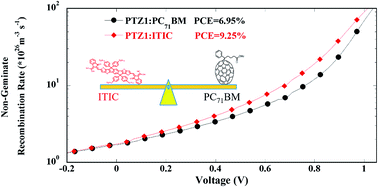
Charge recombination in high-efficiency non-fullerene cells (PCE = 9.25%) is much more serious than that of fullerene based cells (PCE = 6.95%).
The content of this RSS Feed (c) The Royal Society of Chemistry
18 Dec 10:14
by Kui Jiang, Guangye Zhang, Guofang Yang, Jianquan Zhang, Zhengke Li, Tingxuan Ma, Huawei Hu, Wei Ma, Harald Ade, He Yan
Abstract
Ternary organic solar cells (OSCs) have attracted much research attention, as they can maintain the simplicity of the single-junction device architecture while broadening the absorption range of OSCs. However, one main challenge that limits the development of ternary OSCs is the difficulty in controlling the morphology of ternary OSCs. In this paper, an effective approach to control the morphology is presented that leads to multiple cases of efficient nonfullerene ternary OSCs with efficiencies of up to 11.2%. This approach is based on a donor polymer with strong temperature dependent aggregation properties processed from hot solutions without any solvent additives and a pair of small molecular acceptors (SMAs) that have similar surface tensions and thus low propensity to form discrete phases. Such a ternary blend exhibits a simplified bulk-heterojunction morphology that is similar to the morphology of previously reported binary blends. As a result, an almost linear relationship between VOC and film composition is observed for all nonfullerene ternary devices. Meanwhile, by carefully designing a control system with a large interfacial tension, a different phase separation and VOC dependence is demonstrated. This morphology control approach can be applicable to more material systems and accelerates the development of the ternary OSC field.

Multiple cases of efficient nonfullerene ternary organic solar cells with efficiencies of up to 11.2% based on an effective morphology-control approach are presented. This approach is based on a donor polymer with strong temperature dependent aggregation and a pair of small molecular acceptors with similar surface tensions. Increased crystallinity of the acceptor phase is observed and discussed.
18 Dec 10:13
by Zonglong Zhu, Chu-Chen Chueh, Nan Li, Chengyi Mao, Alex K.-Y. Jen
Abstract
Recently, the evolved intermediate phase based on iodoplumbate anions that mediates perovskite crystallization has been embodied as the Lewis acid–base adduct formed by metal halides (serve as Lewis acid) and polar aprotic solvents (serve as Lewis base). Based on this principle, it is proposed to constitute efficient Lewis acid–base adduct in the SnI2 deposition step to modulate its volume expansion and fast reaction with methylammonium iodide (MAI)/formamidinium iodide (FAI) (FAI is studied hereafter). Herein, trimethylamine (TMA) is employed as the additional Lewis base in the tin halide solution to form SnY2–TMA complexes (Y = I−, F−) in the first-step deposition, followed by intercalating with FAI to convert into FASnI. It is shown that TMA can facilitate homogeneous film formation of a SnI2 (+SnF2) layer by effectively forming intermediate SnY2–TMA complexes. Meanwhile, its relatively larger size and weaker affinity with SnI2 than FA+ ions will facilitate the intramolecular exchange with FA+ ions, thereby enabling the formation of dense and compact FASnI3 film with large crystalline domain (>1 µm). As a result, high power conversion efficiencies of 4.34% and 7.09% with decent stability are successfully accomplished in both conventional and inverted perovskite solar cells, respectively.

High-performance FASnI3 perovskite solar cells (PVSCs) are realized for the first time by a two-step deposition technique. Trimethylamine (TMA) is used as an additive to improve the morphology, enabling a dense and compact FASnI3 film with large crystalline domains (>1 μm). Consequently, high PCEs of 4.34% and 7.09% can be successfully realized in both conventional and inverted PVSCs with improved stability.
18 Dec 00:43
by Jingxiu Yang, Peng Zhang and Su-Huai Wei

The Journal of Physical Chemistry Letters
DOI: 10.1021/acs.jpclett.7b02992

18 Dec 00:37
by Yin, J., Maity, P., De Bastiani, M., Dursun, I., Bakr, O. M., Bredas, J.-L., Mohammed, O. F.
Low-dimensional perovskites offer a rare opportunity to investigate lattice dynamics and charge carrier behavior in bulk quantum-confined solids, in addition to them being the leading materials in optoelectronic applications. In particular, zero-dimensional (0D) inorganic perovskites of the Cs4PbX6 (X = Cl, Br, or I) kind have crystal structures with isolated lead halide octahedra [PbX6]4– surrounded by Cs+ cations, allowing the 0D crystals to exhibit the intrinsic properties of an individual octahedron. Using both experimental and theoretical approaches, we studied the electronic and optical properties of the prototypical 0D perovskite Cs4PbBr6. Our results underline that this 0D perovskite behaves akin to a molecule, demonstrating low electrical conductivity and mobility as well as large polaron binding energy. Density functional theory calculations and transient absorption measurements of Cs4PbBr6 perovskite films reveal the polaron band absorption and strong polaron localization features of the material. A short polaron lifetime of ~2 ps is observed in femtosecond transient absorption experiments, which can be attributed to the fast lattice relaxation of the octahedra and the weak interactions among them.