Jean-Philippe Encausse
Shared posts
Viseo développe un chatbot pour Direct Energie
Google Cloud’s Natural Language API gets content classification and more granular sentiment analysis
 Google Cloud announced two updates this morning to its Natural Language API. Specifically users will now have access to content classification and entity sentiment analysis. These features are particularly valuable for brands and media companies For starters, GCP users will now be able to tag content as corresponding with common topics like health, entertainment and law (cc: Henry).… Read More
Remarkable E-ink Writing Slate Reviews – Great Tablet, But Not Ready for Prime Time
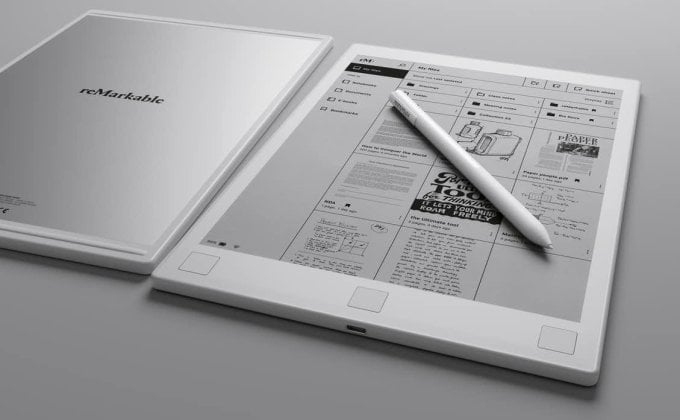
If that early buzz for the $600 Remarkable tablet had you wishing that you had gotten in on the early pre-orders, I have good news for you:
It's not ready yet.
A handful of reviews were posted on Friday, and they show reveal that the Remarkable still has a way to go in the software department (this could explain why it missed the official mid-August shipdate).
This writing slate measures 10.1" by 6.9" by 0.36" thin, and according to official specs it weighs about 12 ounces. runs a proprietary Linux OS on a 1GHz CPU with 512MB RAM and 8GB of internal storage (there is no card slot).
It has a 10.3" Carta E-ink display (1872 x 1404 resolution - 226 PPI). The Remarkable doesn't have a frontlight, but it does have a capacitive touchscreen and a Wacom stylus that supports 2,048 levels of pressure sensitivity and 512 degrees of tilt detection.
Aside from the screen and the stylus, those specs sound like what you can find on a $100 to $200 ereader, and you can also find cheaper ereaders that are almost s good as the Remarkable (like the Onyx Boox M96, which costs $430, runs Android with a 9,7" E-ink screen, and has both dual-touchscreens).
Is the remarkable worth the extra $170 for an ereader cum writing slate?
Based on the following reviews, I would say yes - once the software is done.
Stuff.co.nz
At £529 just for the tablet, with the pen sold separately, this is a seriously expensive device. It’s fantastic at what it does, and the crowdfunding campaign that got it off the ground has been a resounding success, but prioritising the writing experience above all else has forced some compromises.
With no backlight or frontlight, a Kindle is still probably your best bet if you're mainly after an eBook reader. Digital artists that aren’t interested in working purely in greyscale will be better served by an iPad Pro or Microsoft Surface, even if their respective styli can’t match ReMarkable for convincing feel.
Business Insider
I was excited about the potential of the reMarkable tablet, but unfortunately, it didn't quite meet my expectations.
That said, I still think it's an incredible product. The instantaneous nature of the ink is truly impressive, and every person I showed it to was blown away. The prospect of being able to take handwritten notes but save them digitally — not to mention sync them to your computer — is thrilling for those who prefer notepads over notepad apps.
But in making the quickest writing and drawing experience it could, I felt like reMarkable sacrified quickness on the other end. The device's tendency to burn-in was a real problem, as was the slowness to turn the page or navigate back to the home screen. The tablet's user interface still needs work to make it more intuitive, and the overall design could look slightly more modern. In its current form, paying $600 for an E Ink tablet like this in 2017 still seems too steep to me.
Wired
Even the best paper notebook needs a good pen—or in this case, a good stylus, to be worth using. The reMarkable comes with a Wacom stylus that works impressively well on the e-ink display, with hardly any latency. It’s tilt and pressure sensitive for better accuracy, but the results can be shaky, so don’t count on it replacing your sketchbook just yet. Those kinks aside, palm rejection works great, and the stylus doesn’t have a battery, so no need to awkwardly plug it into the bottom of your tablet.
When you’re done jotting down ideas for your screenplay or doodling away, you can bounce over to your eBooks tab and dive into The Jungle or Crash Override. Unfortunately, you won’t get as good a reading experience as you’d find on a Kindle due to a few shortcomings.
I found that text doesn’t look as crisp (limited font options don’t help things, either) and then there’s no bookstore so getting your digital library onto the reMarkable is a hassle. If those issues don’t bother you, there are some nice perks like a larger screen and the ability to write notes into a book’s margins, which you can’t do with a Kindle.
Laptop Magazine
The reMarkable's amazing writing experience is a one-of-a-kind feature that when combined with its cloud-sync capabilities and Photoshop-esque editing, makes it a great tool for note takers and artists alike. Writing on the slate is one of the most realistic, comfortable experiences I've had on a tablet, rivaled only by using an actual pen and paper.
Of course, $599 may be a tough price to swallow for some, especially when the device is made just for writing, drawing and reading. For a more feature-rich tablet, consider the $649 10.5-inch iPad Pro, which supports Apple's $99 Pencil stylus. It's $149 more expensive, though, and writing on its glass doesn't feel as natural. However, the iPad has Apple's huge library of apps and games, while reMarkable has a much more limited offering. Still, the reMarkable has to be used to be truly believed, as writers and artists looking for the best marriage of digital and analogue won't find a better option.
Popular Mechanics
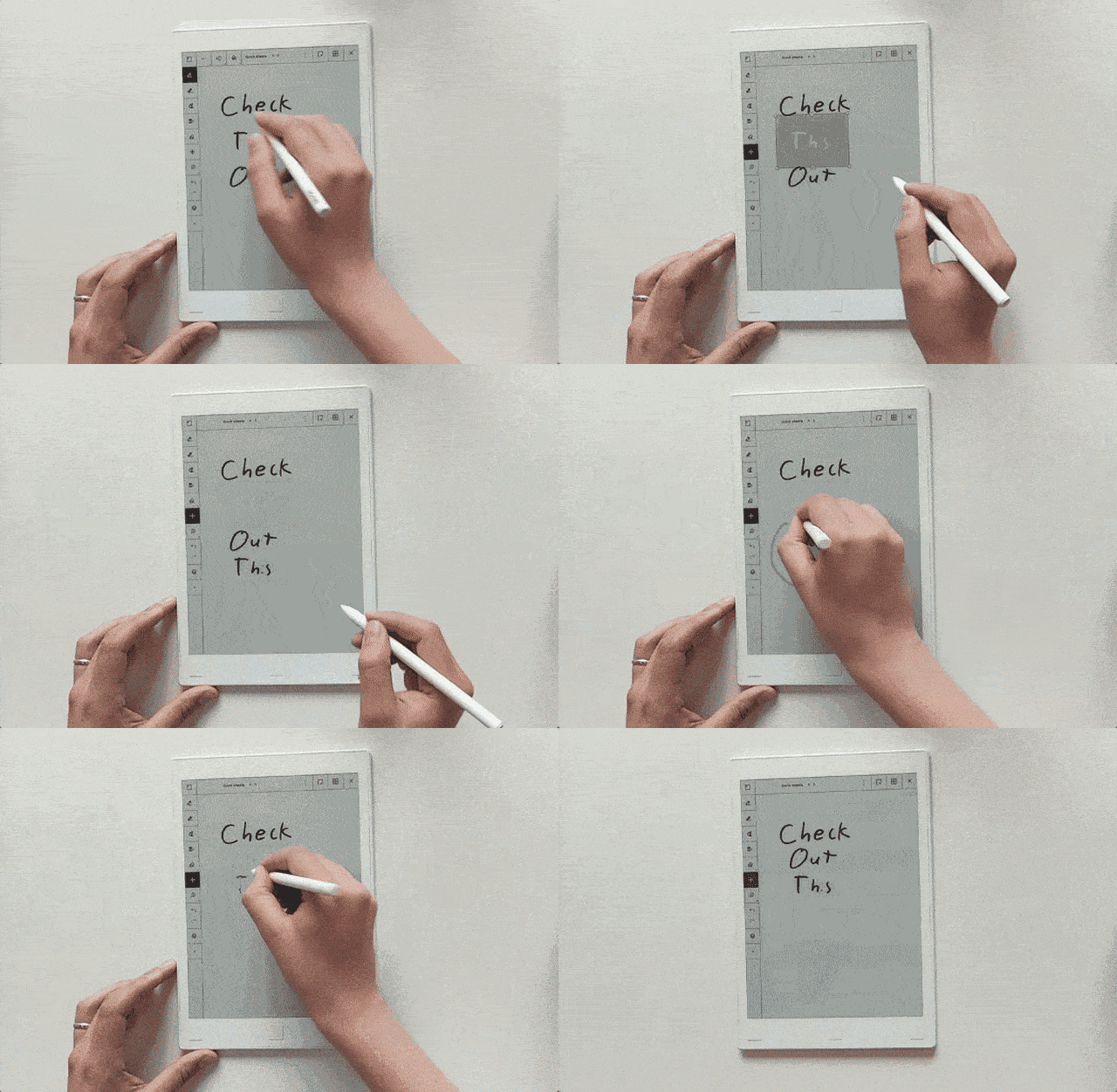
The drawing is great, but navigating the tablet's interface is less so. You'll basically have to memorize the meanings of it icon-labeled on-screen buttons. I still routinely do things like delete an entire page of notes when I meant to select the eraser (undo to the rescue), or create a new page when I mean to navigate to anther digital notebook. I also found myself wanting to touch the on-screen buttons with my finger, as not to move the stylus away from what I was writing, and, frustratingly, this does work but only about 50 percent of the time.
The eBook Reader
In terms of ereading features, the reMarkable is very basic. It supports PDF and DRM-free ePub files, but the software is still a work-in-progress so that makes it hard to review at this point. They plan on adding more features over time; I’ll update this review to reflect any changes as they get added.
At present there’s no table of contents, no dictionary, no bookmarks, no search, no active hyperlinks, no back button, no annotations list, no pinch-zooming, no finger-swipe page turning.
What it does offer is a jump to page option and you can view a list of thumbnails to move around parts of a book.
There are a couple of different ways to zoom in. It has a cropping option that works quite well, and there’s a zoom dial to zoom in and out in increments. Zooming resets with each page turn but cropping remains.
You can add notes and highlights with the stylus, of course, but there is no list to view them or way to add bookmarks so it makes it kind of a hassle to find them unless you remember the page number they were on or manually scan through thumbnail view.
Digital Trends
The pen’s stellar performance stands in contrast to the rest of the experience, unfortunately.
The ReMarkable tablet suffers from the telltale limitations of E Ink technology: Tapping on a menu key or scroll wheel basically guarantees a delay and screen flashes while the tablet refreshes. It doesn’t come close to the responsiveness of the stylus, and it’s incredibly frustrating.
The ReMarkable tablet’s battery life is a little better than its performance, but it didn’t last as long as I’d like. After a typical 9-to-5 day of jotting down reminders, organizing my to-do list, and absent-mindedly doodling, I could count on the 3,000mAh battery dipping well below 40 percent by midweek.
ReMarkable’s engineers say they’re targeting two weeks of standby time, which seems a little optimistic. But we’ll have to take their word for it.
You just finished reading Remarkable E-ink Writing Slate Reviews – Great Tablet, But Not Ready for Prime Time which was published on The Digital Reader.
Google’s new payment app for India uses sound to transfer money

Google has introduced a new payment app in India called Tez (the Hindi word for “fast”). Tez features a technology called audio QR that allows users to transfer money using sounds to pair two devices. Called the “cash mode option,” phones negotiate a connection using audio to identify the payer and payee. (The sounds should be inaudible to human ears though because they’re sent using ultrasonic frequencies, according to the Financial Times.) The feature is therefore similar to cash transactions which don’t require the exchange of personal details like bank accounts and phone numbers. Cash Mode works with any phone with a mic and speaker and Tez app installed, and doesn’t require an NFC chip. Google’s Audio QR technology is similar to...
Microsoft’s AI camera app Pix is now a business productivity tool
 Microsoft Pix, the iOS camera app that leverages A.I. to help you take better photos, is venturing beyond being a tool for consumers with an update that now sees it able to assist with photos of business documents, whiteboards, post-it notes, and business cards. According to Microsoft, the additional support focused on office productivity made sense because people were already doing a lot… Read More

Inside Zero Latency’s Las Vegas VR Arena At The MGM Grand

Melbourne, Australia-based VR company Zero Latency has partnered with the MGM Grand Hotel & Casino to launch its latest eight-player virtual reality gaming location in the U.S.
The 2,000-square-foot arena, which opened last week, is the latest video game attraction for MGM’s Level Up gaming lounge. And it’s one of 20 Zero Latency arenas in operation around the globe, including locations in Orlando, Boston, Philadelphia, Wisconsin and the Poconos.
Zero Latency co-founders Tim Ruse (CEO) and Scott Vandonkelaar (CTO) told UploadVR that the plan is to add another 30 to 40 arenas by the end of next year with the goal of hitting 100 arenas by the end of 2019.
Zero Latency is building its brand in the location-based VR arcade business through this new partnership with the established MGM brand. Ruse said MGM is putting its full marketing muscle behind this new “Virtual Reality Powered by Zero Latency” arena.
“It’s great to add an arena to another tier one U.S. market, and to partner with a global household name like MGM,” Ruse explained. “Outside of the MGM brand boost and marketing platform, the global destination of Vegas allows us to market Zero Latency to tourists who can play and then pass the word to their friends when they return home.”
In other words, Zero Latency is betting that what happens in VR in Vegas doesn’t stay in Vegas. This arena is the first for the company near the West Coast of the U.S., where rivals like IMAX VR and The Void have opened up location-based arenas in New York and Utah with a Disneyland location featuring The Void’s Star Wars: Secrets of the Empire opening this fall.
Featuring an open space with no obstacles, the arena enables teams to freely explore the virtual environment together. The games have been designed to give the illusion of exploring huge spaceships or alien worlds, while players are steered through the same arena in different ways. While battling through a growing library of games (with three titles available and a fourth launching this month), teammates will see each other as full-motion avatars and stay in constant communication, allowing them to call for backup or ultimately compete for the highest score. There’s also a Zero Latency employee inside the arena with players to set them up for combat and oversee the game.
Players stay in contact with each other through Razer headphones and are outfitted with Razer OSVR HDK2 virtual reality headsets while wearing a military-grade backpack containing a high-performance Alienware laptop computer. There’s also a custom-made, two-handed rifle that offers multiple firing options in-game.
The MGM arena charges $60 per person for a 30-minute gameplay experience. And the VR arena is accessible to younger players through a side entrance that circumvents the casino floor.
All Zero Latency locations currently offer three different multiplayer games, including the tower defense shooter Zombie Survival, the zero gravity shooter Singularity and the puzzle adventure Engineerium. Each game lasts for 30 minutes and allows up to eight players to team up and play together. Vandonkelaar said a new zombie game will launch this fall, which combines elements from the first three games for a more in-depth 30-minute experience.
“Over 100,000 players have gone through our system now, and we’re applying lessons learned from those players and their experiences in our first three games,” Vandonkelaar explained.
“The new zombie game has been designed from the ground up to be an eight-player and we’re adding more intensity and more exploration to this game than our first zombie game has.”
Vandonkelaar said all of these initial games have been created using Unity, but the company is currently working on Unreal Engine 4 games. And this fall they’ll release an API and developer kit for third-party companies to create new games for this platform of VR arenas. Some of these games will enter private trials this fall with 2018 launches planned.
Internally, Vandonkelaar said development is under way for a competitive multiplayer game specifically designed for esports.
“We’re working on new content to allow our players to compete,” Vandonkelaar said. “There are a lot of challenges to make a compelling experience, and we’re limited by the amount of space we have to have in these arenas. But we’re making sure the competition is as fun as possible and is skill-based, so that it has everything else esports needs. We’re coming to the point as we have more sites where teams of people can compete against people who aren’t at the same location.”
“There’s an incredible opportunity for VR esports in our arenas,” Ruse said. “It’s not just about a team’s knowledge of gameplay and skills, but you have to move around the arena and work together to best the opposing team. We see VR esports as part of our near future. We’ve been investigating and working on it and we’re keen to get into that business.”
Zero Latency is also fine-tuning a spectating system for its arenas. This will allow players to stream their play sessions across existing platforms like Twitch and Facebook Live to share with friends. But it will also set up a spectating mode for esports competition.
“Players will be able to stream their VR gameplay to the world quite soon,” Vandonkelaar said. “Everyone will get the chance to see the streams, and players can watch them back afterwards.”
Ruse added that in testing, there’s a real connection that develops through watching players compete in VR because you can hear them communicate and see them move within the game worlds.
“It feels like you’re connecting with an actual person,” Ruse said. “Friends can watch friends play and see and compare high individual and team scores, which should help drive the engagement of people going in to play and stir up the competitive nature of gaming.”
As Zero Latency builds out its esports strategy, Ruse said the company has been talking to brands interested in VR esports.
“There are a lot of companies interested in esports,” Ruse said. “It’s something we can have sorted for next year.”
The esports audience could introduce brand new consumers to the Zero Latency brand. Ruse said the company’s core demographic is comprised of males 25 to 40 years of age globally. And 30% of Zero Latency customers are female.
“The majority of people up to 45 years old are gamers to various degrees,” Ruse said. “Because people are more receptive to playing games, they’re more comfortable with our VR tech and we’re seeing a broader range of people coming through. We’re also seeing a lot of people who are VR curious and want to experience it first-hand.”
MGM is betting big on gaming, adding this Zero Latency VR arcade experience to a growing assortment of skill-based games designed to lure younger crowds. Now visitors to the Las Vegas Strip will be able to escape the real world, and any gambling losses, by entering these VR worlds.
Tagged with: Zero Latency
Dodles brings your doodles to life
 I’ve always wanted to create my own animations. One idea is simple. My characters would be born, live, fall in love, and die in real time in a 80 year long masterpiece of constant animation. It would be a commentary on the death of the soul and the deep longing of men and women to be truly understood. My more complex idea would involve a princess who has to fight a dragon. With Dodles… Read More
Quand tu es météorologue pendant un ouragan
Magnet Implants, Your Cyborg Primer
What would you do to gain a sixth sense? Some of us would submit to a minor surgical procedure where a magnet is implanted under the skin. While this isn’t the first time magnet implants have been mentioned here on Hackaday, [The Thought Emporium] did a phenomenal job of gathering the scattered data from blogs, forum posts, and personal experimentation into a short video which can be seen after the break.
As [The Thought Emporium] explains in more eloquent detail, a magnet under the skin allows the implantee to gain a permanent sense of strong magnetic fields. Implantation in a fingertip is most common because nerve density is high and probing is possible. Ear implants are the next most useful because oscillating magnetic fields can be translated to sound.
For some, this is merely a parlor trick. Lifting paper clips and messing with a compass are great fun. Can magnet implants be more than whimsical baubles?
I would like to tell about my magnet which has been implanted for three years. As an automation engineer, I am tasked with trouble-shooting electrical panels. This is often a laborious task which involves probing with a multi-meter and staring back-and-forth at schematics.
When asked to diagnose a troublesome panel for a band-saw by some coworkers, I decided to use my magnet as a diagnostic tool first since it was a five minute walk to my meter. Lo and behold, after a wave of my hand, I noticed that the transformer wasn’t emitting a large field, like I would expect. I traced that back to a tripped circuit breaker, which three other engineers had missed, and flipped it. The machine restarted normal operation after thirty seconds instead of thirty minutes.
My magnet is literally part of me and a valuable tool of my trade.
[The Thought Emporium] has been mentioned here for their guide to making graphene. You can find more biohacking at Cyberpunk Yourself or see a wildly different application of body-mounted magnets.
Filed under: Medical hacks


This Discord bot turns Pokémon into a text-based adventure

If you’re looking to sneak in a little Pokémon time without busting out a handheld device or phone, there’s a Discord bot for that. PokéWorld offers a stripped-down version of the classic catch ‘em all RPG, a text-only version that can be enjoyed at your own leisure.
To play, Discord users can either log onto the main PokéWorld server, or invite the bot onto a server of their own. It plays like a simplified, word-based version of the games. Users input text commands, which the bot dutifully communicates often, to explore the game’s world, battle, and of course capture pokémon.
A California-based programmer who goes by “Bioblaze Payne” created the bot; they started the project in late July and had a prototype completed...
KFC in China tests letting people pay by smiling

Alipay has launched a new way to pay for your KFC in China — by smiling. So far, the facial payment system is only available at a single KFC in Hangzhou, China. The company behind the technology, Ant Financial, an Alibaba subsidiary, says its Smile to Pay technology needs about one to two seconds of facial scanning with a 3D camera and a “live-ness detection algorithm” to check the identity of the person paying, who must also enter their mobile phone number to help guard against fraud. A beta version of Smile to Pay was introduced in 2015 by Jack Ma the founder of Alibaba.
“Taking the facial-recognition payment technology offline was no easy task,” said Jidong Chen, head of biometric identification technology at Ant Financial. “On how we...
Bread Bag Alignment Chart

I am either lawful neutral or chaotic neutral. I’ve also been known to be neutral evil on occasion.
[Source: Aurelian Rabbit on Twitter | Via Neatorama]
The post Bread Bag Alignment Chart appeared first on Geeks are Sexy Technology News.
Settlers of Catan is coming to virtual reality this year

Iconic board game Settlers of Catan is coming to virtual reality. A new version is being developed by game studio Experiment7 — which previously created a pair of VR takes on chess — with feedback from the original minds behind Catan. The VR game, which is coming to both Oculus Rift and Gear VR and called simply Catan VR, is described as “true to the classic, but optimized for virtual reality” with “a fresh, fully-immersive format.” Unfortunately, right now the creators aren’t showing off what the new VR title looks like, though it appears that it will feature both a single-player and online multiplayer component.
Catan was first released as a physical board game back in 1995, and slowly built up a huge following as people became drawn...
Amazon Alexa is coming to the Bragi Dash

The Bragi Dash wireless earbuds are getting a new feature later this year: the ability to talk to Amazon’s voice assistant, Alexa. The headphone maker announced at the IFA trade show today that a software update coming in October will allow access to Alexa, and will be available in English (US and UK) and German.
It’s not the first pair of headphones to receive Alexa support, but this is definitely the first pair of truly wireless earbuds to offer access to the digital assistant. Alexa won’t be triggered by a wake word, though — users will have to either tap or use the Dash’s “4D menu,” in which the earbud uses motion sensing to allow users to turn their head left or right and select from a virtual menu.
Dash (and Dash Pro) users can...
XYZ Printing Unveils Inkjet-Based Filament Printer
XYZ Printing, makers of the popular da Vinci line of 3D printers, have just released one of the holy grails of desktop 3D printing. The da Vinci Color is a full-color, filament based printer. How does this work? A special filament (Color PLA, although this filament is white in color) is extruded through a nozzle like any other 3D printer. Color is then added layer by layer by a system of inkjets in the head of the printer. Yes, it’s a full-color 3D printer, and yes, people have been suggesting this type of setup for years. This is the first time it’s been made real.
The specs for this printer are about what you would expect from any other filament-based printer in 2017. The build volume is 200 x 200 x 150mmm, the print bed has auto-leveling (although strangely doesn’t have a heated bed), and the user interface is a 5-inch color LCD. The da Vinci Color is available for preorder right now for $2,999.
You can check out a few pics of samples printed on the da Vinci Color below:


In terms of brand recognition and XYZ Printing, their DaVinci is a somewhat surprising footnote in the history of desktop 3D printing. XYZ Printing’s da Vinci was one of the first cheap 3D printers with closed firmware, chipped filament, and a slightly terrible user interface. Nevertheless, the da Vinci was cheap and it could be hacked, turning it into a somewhat respectable printer.
As with any advancement in the state of desktop 3D printing, it must be mentioned that this is not. Color printing has been done before by members of the Open Source community. The exact same thing was done years ago with Sharpies, and I know RichRap experimented with markers and dye earlier than this, but I can’t find a reference. Full-color inkjets have been used in the past to create 3D prints, although these are powder-based printers, not filament printers. That doesn’t mean color printers can’t use filament; [Prusa]’s multicolor extruder is shipping soon, the Mosaic Palette splices filament to create multicolor prints (another RichRap invention circa 2011), and [Daren Schwenke]’s Arcus 3D has a mixing hot end that can create any color from CMYKW filament. There are many other solutions to full-color 3D printing that have been invented over the years, let us know your favorites in the comments below.
Filed under: 3d Printer hacks, news


Samsung is already releasing a smaller Frame TV

Samsung announced its design-oriented Frame TV less than a year ago, and already, the company is releasing a new, smaller model. A 43-inch version will join the 55-inch and 65-inch models that are already on sale. Samsung made the announcement at the IFA tech conference in Berlin this week, but didn't specify a timeline or pricing.
Existing models of the 4K HDR TV come with four HDMI ports, three USB ports, and supports all of the standard Samsung smart TV features. But what makes the Frame TV unique is the idea that it doubles as an art display. When it's not playing actual TV content, it cycles through photos and paintings, which come from partnerships with LUMAS, Saatchi Art, Sedition, and the Prado. Users can purchase additional...
LEGO Releases $800 7,541-Piece Millennium Falcon Set

That’s right, geeks, a Lego model of the Millennium Falcon that costs $800. Truly a thing of beauty. The set (Ultimate Collector Series #75192) will be available for purchase on 10/1/17 and will probably sell like hotcakes, even though you might need to remortgage your home to purchase it. Behold:


The post LEGO Releases $800 7,541-Piece Millennium Falcon Set appeared first on Geeks are Sexy Technology News.
Star Wars: Jedi Challenges AR Platform Launching This Holiday For $199

At the D23 Expo in Anaheim, CA earlier this year Lenovo and Disney revealed a partnership, with Lucasfilm, to work on a Star Wars-themed AR experience platform. Titled Star Wars: Jedi Challenges, users would don a specially created Lenovo headset, hold a replica lightsaber handle, and embark on a series of adventures and challenges to become one with The Force.
Today, Lenovo is announcing that the entire platform (Lenovo Mirage headset, lightsaber handle, tracking beacon, and AR apps) will launch this holiday season in November, 2017 for $199.99 and will feature “hours of gameplay.” You can pre-order it now at Best Buy and Lenovo.
The Jedi Challenges platform will feature three core experiences: lightsaber battles, strategic combat, and holochess. You’ll be able to fight in a lightsaber duel against the likes of Kylo Ren and even Darth Vader whereas the “strategic combat” is reportedly like a mini-RTS shrunk down onto the floor.
By looking down with the headset on you’ll see rebel and empire forces duking it out as you take control and command the armies. Finally, there’s holochess, because of course there is. In the videos above and below you can get a first-look at what there is on display from a video featuring the Carlin Brothers.
Once the headset is released all you need to do is download the Jedi Challenges app and slide the phone into Lenovo Mirage headset. You place the tracking beacon (shown below a couple of paragraphs) on the floor so it can see the lightsaber controller, and then you’re good to go. The headset looks like it works very similarly to the Mira Prism AR headset with the visor display.
There are two sensors on the front of the headset to provide inside-out positional tracking so you can easily move around the environment. Since the visor just rests in front of your eyes you can also easily see through the images and still get a feel for your physical surroundings, which is how it creates the illusion of augmented reality in a 3D space.
Once you pair the lightsaber you’ll use it for everything from fighting off Sith lords to selecting options in the menu. Lenovo describes it as a “collectible quality” replica Skywalker lightsaber handle.
“Through visible light-tracking technology, the headset’s sensors work together to lock onto the position of the Lightsaber controller, allowing players to see a beam form above the “hilt”, which they can use to block and interact with the universe in-game,” Lenovo states in its press release. “Haptic feedback is activated as players strike or block their opponents, while an inertial measurement unit sends rotational information from the controller to the smartphone to assist the beam in remaining stable mid-swing.
How all of this adds up to “hours of gameplay” remains to be seen, but it’s certainly an exciting thing to think about unwrapping beneath a Christmas tree this holiday season.
What do you think of the Star Wars: Jedi Challenges AR platform? Let us know down in the comments below!
Tagged with: Star Wars
How to Fit an Entire Outfit Into a Single Pair of Socks
How to Fit a Full Outfit Into Your Socks..(Read...)
Google’s ARCore Gets Unity And Unreal Support

World-building engines Unreal and Unity are both on board with support of Google’s new ARCore augmented reality toolkit.
For those unfamiliar, ARCore is the evolution of Google’s Tango platform that runs first on Google Pixel and Samsung Galaxy S8 with Android 7.0 or better running on it. It’s an answer to Apple’s ARKit, but available on fewer phones initially. We’ve had months of interesting projects rolling out on the Internet showing the capabilities of ARKit, but with Unity and Unreal support now in place for Google’s ARCore we’re likely to start seeing an increase in cool Android-based AR examples.
If you want to get started with Unity you need Unity version 2017.2 beta 9 or later and Android API SDK v.24 or later. Then download and import the ARCore SDK for Unity. the configure Unity “following the steps in the Unity Forum.”
If you want to get started with Unreal, check out the ARCore developer preview and the early access version available on GitHub. The software is planned for a larger roll-out with version 4.18 of the engine arriving in mid-October.
Tagged with: ARCore
Google retires the Tango brand as its smartphone AR ambitions move wider
 I was recently looking at a slide in the pitch deck of an AR startup and there was a graph mapping the addressable markets of individual smartphone AR platforms by devices. When rounding to the hundredth of a percent, Google’s addressable market with Tango makes up 0.00% of the smartphone market.
That’s a bit of a problem when Apple is about to bring smartphone AR to hundreds of… Read More
I was recently looking at a slide in the pitch deck of an AR startup and there was a graph mapping the addressable markets of individual smartphone AR platforms by devices. When rounding to the hundredth of a percent, Google’s addressable market with Tango makes up 0.00% of the smartphone market.
That’s a bit of a problem when Apple is about to bring smartphone AR to hundreds of… Read More
ReSpeaker 4-Mic Array is $25 Quad Microphone Add-on Board for Raspberry Pi
IT EXISTS: A Flying Spaghetti Monster Colander

I don’t know about you guys, but I think this might very well be one of the most amazing colander of all time!
Don’t let his pretty eyes fool you, this spaghetti monster is a straining master. And if you’re planning a spaghetti dish, this noodly master will grant your wish! Whether you want to build an altar to Pastafarianism at the center of the kitchen, require a more interesting colander to wear as a hat, or just want to enjoy some spaghetti-and-meatballs for dinner, this thing should serve as a viable tool for each of those tasks, all while looking so attractive!

[Flying Spaghetti Monster Colander – $19.95 $16.90]
The post IT EXISTS: A Flying Spaghetti Monster Colander appeared first on Geeks are Sexy Technology News.
4 Things You Need to Know About 3D Printing Resolution
Resolution is one of the most important factors to take into account when considering different 3D printers and extends beyond the minimum layer height value that many people are familiar with. In fact, minimum layer height tends to be a poor representation of a 3D printer’s quality.
In this guide, you’ll learn about each of the different components associated with a 3D printer’s resolution. We’ll go over Z resolution, minimum feature size, X/Y resolution, and layer ovality, to get a complete picture of resolution in 3D printing.
Z Resolution
The best known value associated with a 3D printer’s resolution is the minimum Z layer height. 3D printers construct objects layer-by-layer, and this value describes the thickness of one of these layers. For most FDM machines, the smallest practical layer height is 0.1mm or 100 microns and for SLA machines, 0.025mm or 25 microns.
Many FDM manufacturers will list minimum Z layer heights as low as 10 microns. While this is technically possible, printing layers as thin as 10 microns on FDM machines is impractical. Most stepper motors are capable of moving that platform by as little as 10 microns, but FDM extruders cannot control the flow of filament precisely enough to produce clean results. For this reason, 10 micron prints on FDM machines often end up looking worse than 100 micron prints even though the individual layers may be finer.
When to use thinner layers
In many cases, using thinner layers has few to no advantages and only serves to increase print time. Thinner layers are most useful for improving the surface finish on parts that have diagonal or curved surfaces. Formlabs has a great illustration of this concept below.
 Image Source: Formlabs
Minimum Feature Size
For FDM machines, minimum feature size is a function of the diameter of the print nozzle. The most common nozzle diameter is 0.4mm and ergo, the smallest feature that can be printed is 0.4mm. Many printers allow their nozzles to be swapped out and 3rd party upgrades can be purchased with diameters as narrow as 0.15mm. This concept applies to features that stand on their own such as towers and spikes and isn’t applicable to components like text embossed onto the side of an object. We’ll go into greater depth on embossed features in the ‘X/Y Resolution’ section.
It’s important to keep in mind that smaller features are more easily deformed by heat in FDM printing. Tall and thin towers often fail because the heat of the molten plastic and nozzle cause the structures to soften.
 Formlabs Form 2 printed and hand painted figure from Modern Life: Image Source
In SLA printers, minimum feature resolution is a function of the spot size of the laser. Because SLA printing doesn’t involve the same thermal stresses as FDM, tall thin towers are more viable and small features are easily resolved.
X/Y Resolution
X/Y resolution breaks your printer down to its bare hardware and is determined by the minimum rotation of your stepper motor and mechanics of the machine. Lithophanes are useful objects for explaining X/Y resolution.
A lithophane is an image that has been extruded in three dimensions such that the dark components of the image are thicker than light components. When a light is shone through, thicker portions of the model will appear darker and the original image appears. Learn the 3 Steps for Creating Your Own Lithophanes here!
Lithophanes are printed vertically rather than flat on the platform because the resolution in the X and Y axis is often better than the resolution in the Z axis. Below is an example of the cross section of a lithophane. X/Y resolution describes the minimum possible deviation of your nozzle or laser spot and often falls on the scale of 16 microns though this can vary by machine.
 Cross section of a lithophane in Formlabs’ PreForm Software
In FDM printers, there are other factors to take into account when considering X and Y resolution. FDM printers that use a direct drive extrusion setup carry weight above the nozzle that can translate to excessive inertia at high speeds. This leads to an effect called banding where vertical deviations become visible in a model and X/Y resolution is decreased. CoreXY setups reduce this effect through clever kinematics that make the X and Y axis independent of any one motor.
Layer Ovality
Layer ovality is one of the more subtle parameters to take into account when considering 3D printer resolution. When layers are deposited in FDM printing, the outer bounds take on an oval shape which contributes to a rougher surface finish and poor transparency.
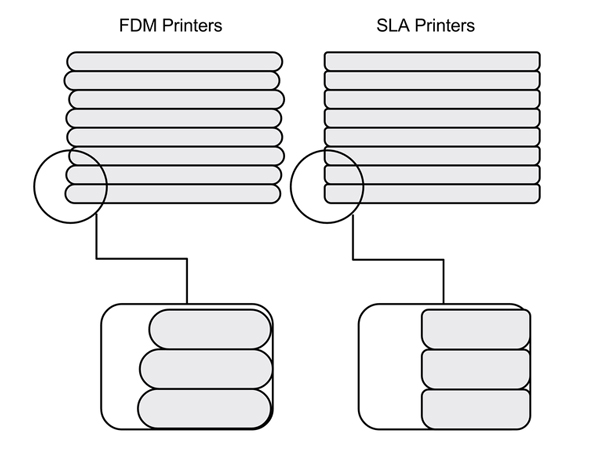 Image Source: Formlabs
Layers created by SLA printers have inherently less ovality than those created via FDM. Laser-based stereolithography creates layers that are more rectangular and this allows for a smoother surface finish and superior transparency.
Sanding parts is a great way to decrease the ovality of the exterior layers and improve surface finish. Coatings like XTC-3D work by filling the gaps between layers to produce a smooth and transparent part. Taulman3D created an excellent illustration of this effect that you can learn more about on their T-glase optics page.
 Image Source: Taulman3D
Each of the 4 components of resolution in 3D printing will impact your final print quality. To gain a greater understanding of resolution in 3D printing especially in regards to SLA, check out Formlabs’ post What Does Resolution Mean in 3D Printing?

The post 4 Things You Need to Know About 3D Printing Resolution appeared first on Pinshape 3D Printing Blog | Tutorials, Contests & Downloads.
The 10 Most Powerful Weapons In Comics!
In this video from VariantComics, host Arris Quinones counts down the 10 most powerful weapons in comics! Check it out!
The post The 10 Most Powerful Weapons In Comics! appeared first on Geeks are Sexy Technology News.
Matterport grabs $5M more to accelerate deep learning development for their 3D capture tech
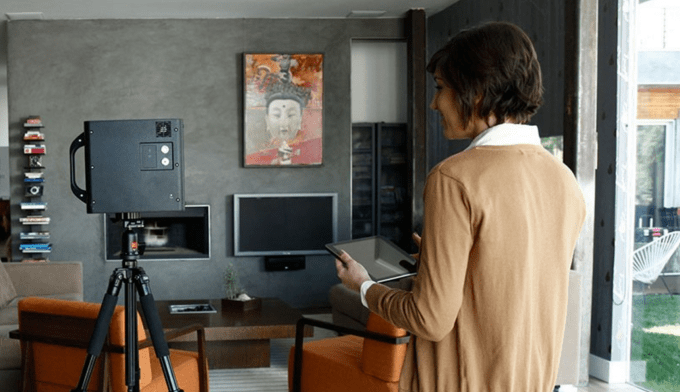 Matterport is picking up new funding as it looks to speed the development of deep learning tech in its capture technology which brings immersive views of spaces into 360-degree 3D The company, which largely specializes in scanning spaces for commercial and real estate purposes, announced today that they’ve picked up $5 million in funding from Ericsson Ventures. This strategic raise… Read More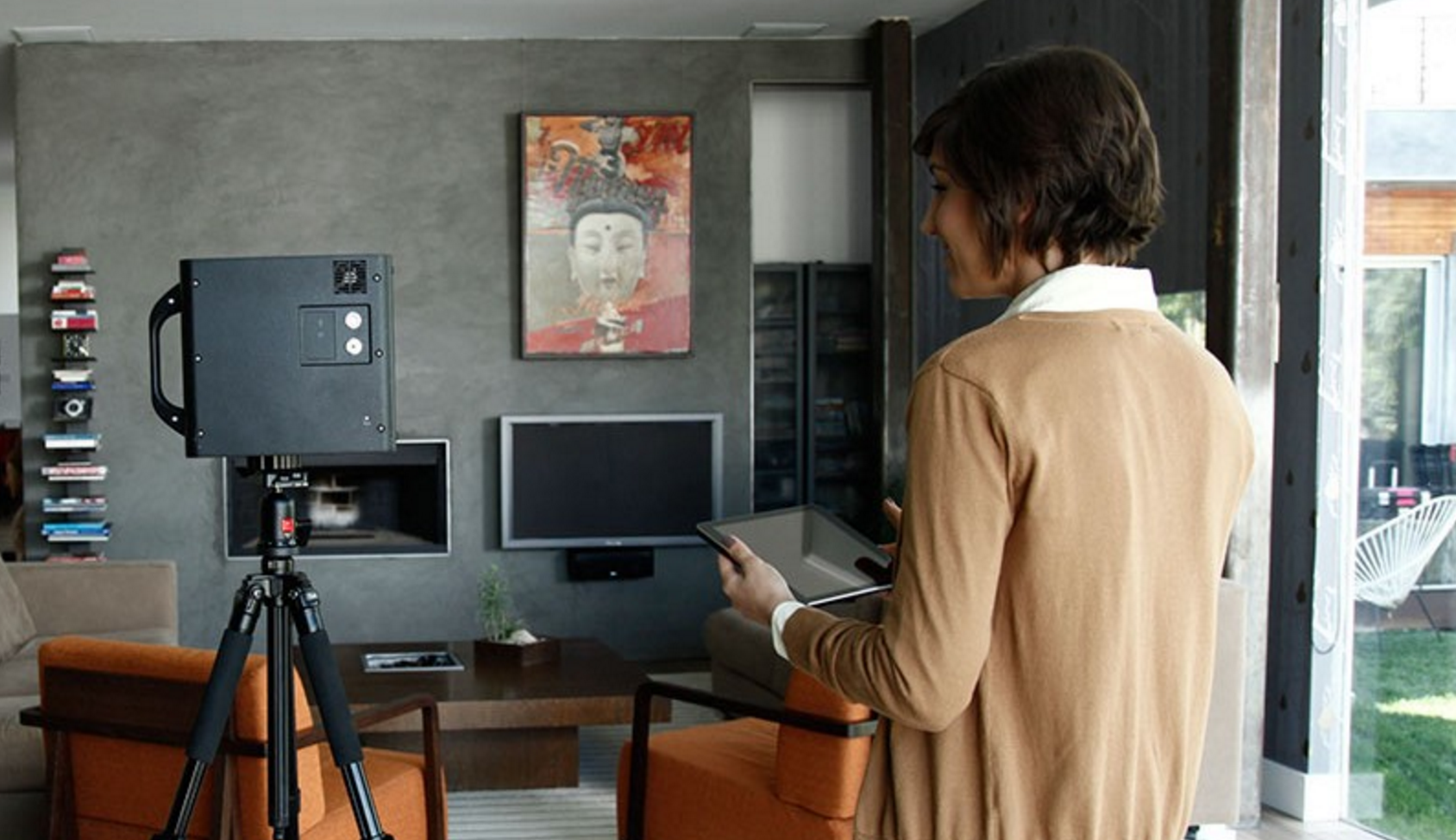
Open Source Modular Rocket Avionics Package
Cambridge postgraduate student [Adam Greig] helped design a rocket avionics system consisting of a series of disc-shaped PCBs arranged in a stack. There’s a lot that went into the system and you can get a good look at it all through the flickr album.
Built with the help of Cambridge University Spaceflight, the Martlet is a 3-staging sounding rocket that lifts to 15km/50K feet on Cesaroni Pro98 engines. [Adam]’s control system uses several Arm Cortex M4s on various boards rather than having just one brain controlling everything.


Each disc is a module that plays a specific role in the system. There are a couple of power supply boards sporting twin LTC2975 able to supply custom power to a dozen different circuits. The power system has a master control board also sporting an M4. There’s an IMU board with the guidance system — accelerometer, magnetometer, gyroscope, and barometer, all monitored by an algorithm that computes the rocket’s position and attitude in-flight. There’s a radio board with a GPS receiver and an ISM band radio transceiver for telemetry, as well as a datalogger with 10 thermocouple measurement channels. Engines are controlled by the pyro board which controls firing currents on four different channels. The vertical spacers also serve to transmit power and data to neighboring boards.
If you’re interested in learning more, check out the project’s code and schematics on [Adam]’s GitHub repository.
[Adam] is no stranger to these pages, with his Nerf Vulcan turret published a few years back, as well as his balloon tracking rig published more recently. Photos are CC-SA and can be found in [Adam]’s Flickr feed.
Filed under: transportation hacks


The HTC Vive just got a $200 price cut

HTC has cut the price of its Vive virtual reality headset by $200, bringing the system’s cost down to $599. The discount is meant to stimulate consumer interest in the system, and make it easier to afford accessories, including the Vive Tracker that went on sale earlier this year. It also comes with a one-month free trial of HTC’s Viveport subscription service, which offers access to a selection of VR games. “We want to really significantly boost VR adoption now across the globe,” says Vive US general manager Dan O’Brien, as the Vive’s second holiday season approaches. “We think now is the right time to reset the price.”
This price drop mirrors the Oculus Rift’s $200 price cut in March, and it means that both systems now have the same...
Microsoft’s speech recognition system hits a new accuracy milestone
 Microsoft announced today that its conversational speech recognition system has reached a 5.1% error rate, its lowest so far. This surpasses the 5.9% error rate reached last year by a group of researchers from Microsoft Artificial Intelligence and Research and puts its accuracy on par with professional human transcribers who have advantages like the ability to listen to text several times. Read More