Shared posts

29 May 23:17

A Simple Tip for Gluing Those LED Filaments

by Donald Papp

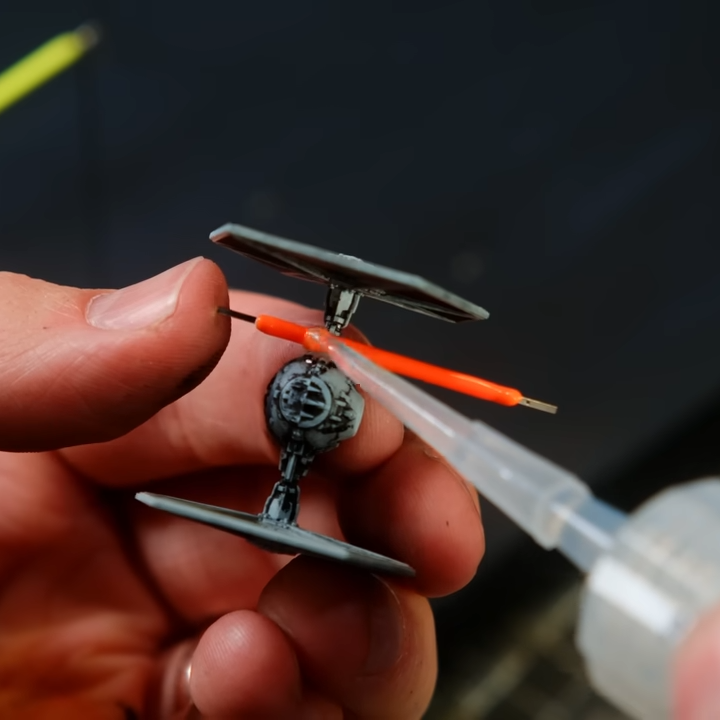
[Boylei] shows that those little LED filament strips make great freeze-frame blaster shots in a space battle diorama. That’s neat and all, but what we really want to highlight is a simple tip [Boylei] shares about working with these filament strips: how to glue them.

Glue doesn’t stick to LED filament strips, so put on a small piece of heat-shrink and glue to that instead.

The silicone (or silicone-like) coating on these LED filament strips means glue simply doesn’t stick. To work around this, [Boylei] puts a piece of clear heat shrink around the filament, and glues to that instead. If you want a visual, you can see him demonstrate at 6:11. It’s a simple and effective tip that’s certainly worth keeping in mind, especially since filament strips invite so many project ideas.

When LED filament strips first hit the hobbyist market they were attractive, but required high operating voltages. Nowadays they are not only cheaper, but work at battery-level voltages and come in a variety of colors.

These filaments have only gotten easier to work with over the years. Just remember to be gentle about bending them, and as [Boylei] demonstrates, a little piece of clear shrink tubing is all it takes to provide a versatile glue anchor. So if you had a project idea involving them that didn’t quite work out in the past, maybe it’s time to give it another go?

29 May 14:12

Ils cherchent l'origine de la vie, et synthétisent... un nouveau biocarburant ⚗️

by Adrien BERNARD
La question de l'origine de la vie sur Terre continue de surprendre. Une nouvelle étude remet en cause une vieille idée: celle selon laquelle une réaction chimique appelée réaction formose...
29 May 14:07

La République tchèque accuse ouvertement la Chine d’une vaste campagne de cyberespionnage

by Amine Baba Aissa

Prague a officiellement attribué à la Chine une cyberattaque visant son ministère des Affaires étrangères. L’Union européenne et l’OTAN affichent leur solidarité, tandis que Pékin reste silencieux.

29 May 14:03

Amazon and Stellantis abandon project to create a digital “SmartCockpit”

by Jonathan M. Gitlin

Automaker Stellantis and retail and web services behemoth Amazon have decided to put an end to a collaboration on new in-car software. The partnership dates back to 2022, part of a wide-ranging agreement that also saw Stellantis pick Amazon Web Services as its cloud platform for new vehicles and Amazon sign on as the first customer for Ram's fully electric ProMaster EV van.

A key aspect of the Amazon-Stellantis partnership was to be a software platform for new Stellantis vehicles called STLA SmartCockpit. Meant to debut last year, SmartCockpit was supposed to "seamlessly integrate with customers’ digital lives to create personalized, intuitive in-vehicle experiences," using Alexa and other AI agents to provide better in-car entertainment but also navigation, vehicle maintenance, and in-car payments as well.

But 2024 came and went without the launch of SmartCockpit, and now the joint work has wound down, according to Reuters, although not for any particular reason the news organization could discern. Rather, the companies said in a statement that they "will allow each team to focus on solutions that provide value to our shared customers and better align with our evolving strategies."

Read full article

Comments

29 May 14:02

Invisible PC Doubles As Heated Seat

by Tyler August

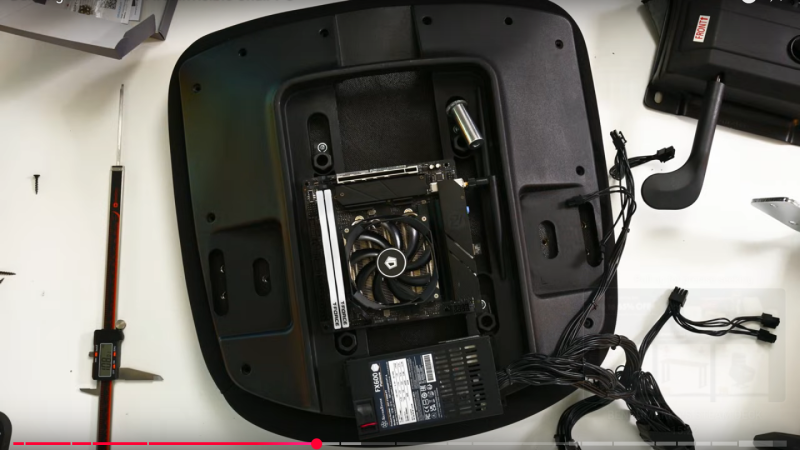
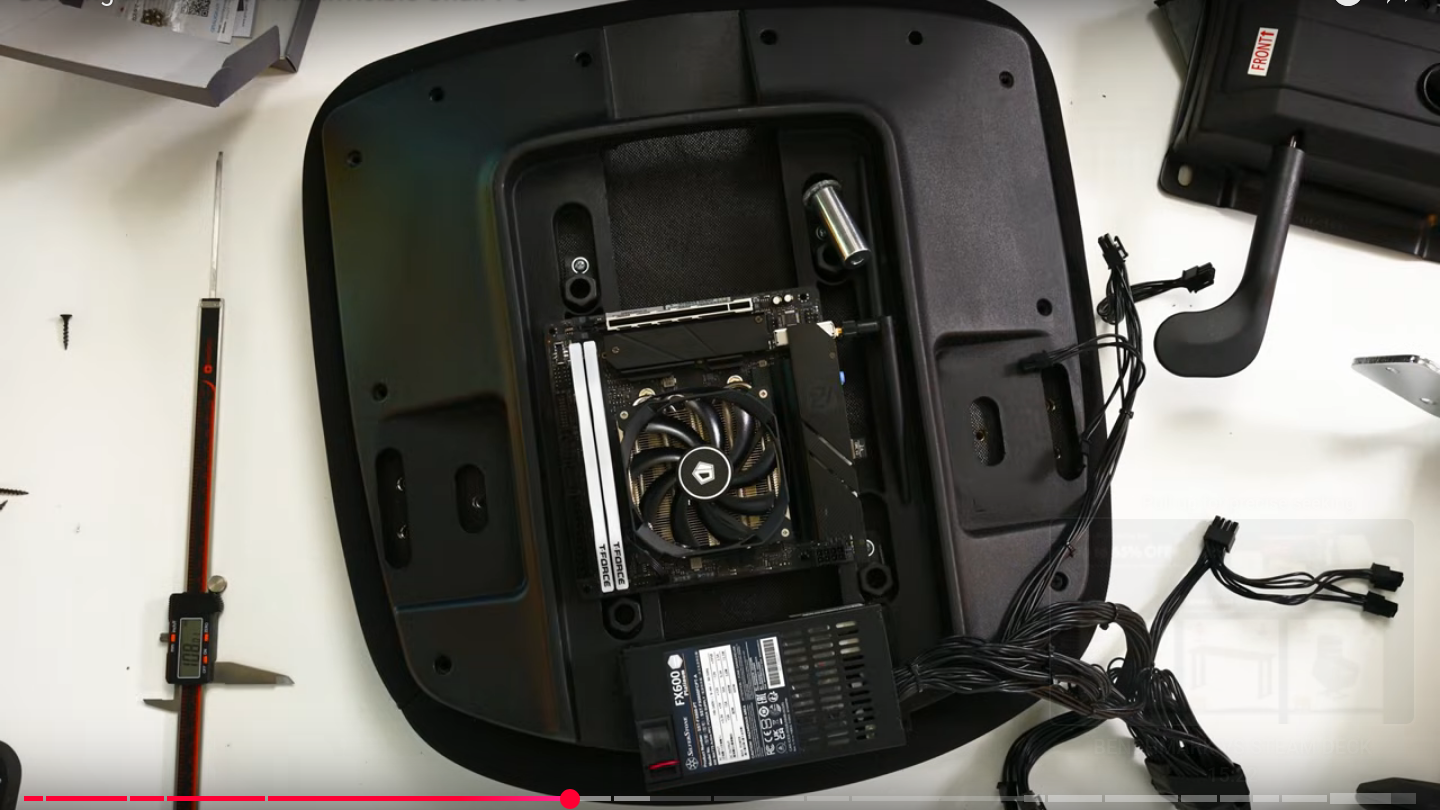
Some people really want a minimalist setup for their computing. In spite of his potentially worrisome housing situation, this was a priority for the man behind [Basically Homeless]: clean lines on the desk. Where does the PC go? You could get an all-in-one, sure, but those use laptop hardware and he wanted the good stuff. So he decided to hide the PC in the one place no one would ever think to look: inside his chair.  (Youtube video, embedded below.)

This chair has very respectable specs: a Ryzen 7 9800XD, 64GB of ram and a RTX 4060 GPU, but you’d never know it. The secret is using 50 mm aluminum standoffs between the wooden base of the seat and the chair hardware to create room for low-profile everything. (The GPU is obviously lying sideways and connected with a PCIe riser cable, but even still, it needed a low-profile GPU.) This assemblage is further hidden 3D printed case that makes the fancy chair donated from [Basically Homeless]’s sponsor look basically stock, except for the cables coming out of it. It’s a very niche project, but if you happen to have the right chair, he does provide STLs on the free tier of his Patreon.

This is the first time we’ve seen a chair PC, but desk PCs are something we’ve covered more than once, so there’s obviously a demand to hide the electronics. It remains to be seen if hiding a PC in a chair will catch on, but if nothing else [Basically Homeless] will have a nice heated seat for winter. To bring this project to the next level of minimalism, we might suggest chording keyboards in the armrests, and perhaps a VR headset instead of a monitor.

29 May 13:59

XIAO Vision AI Camera combines ESP32-C3 and WiseEye2 HX6538 AI MCU with 5MP camera, supports SenseCraft no-code platform

by Debashis Das
Seeed Studio XIAO Vision AI Camera

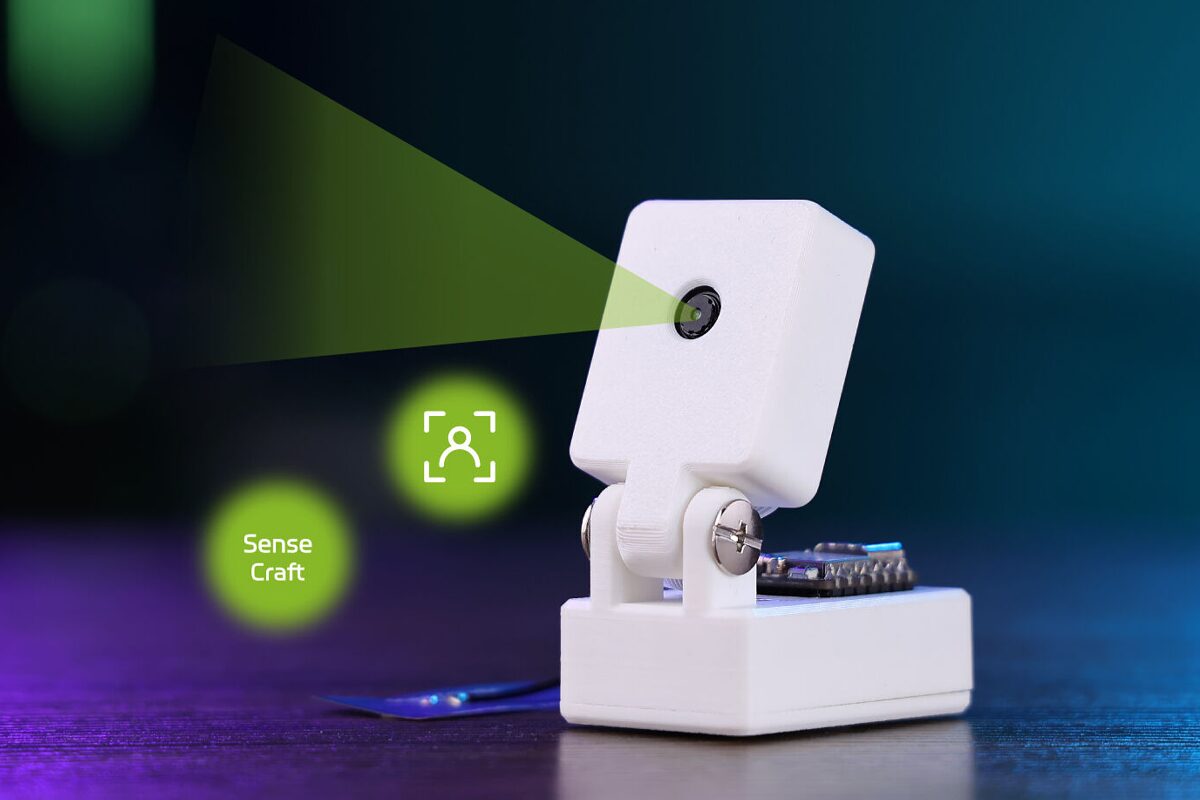
Seeed Studio has recently released the XIAO Vision AI Camera, a compact, open-source smart ESP32-C3 AI Camera that integrates the Grove Vision AI Module V2, a XIAO ESP32C3 module, and an OV5647 5MP camera in a custom 3D-printed PLA case.

One of the key components of the camera module is the WiseEye2 HX6538 chip, which features dual-core Arm Cortex-M55 processors and an Ethos-U55 NPU for edge AI computing. It also comes with Wi-Fi connectivity, turning it into an intelligent IP camera that easily integrates with Home Assistant for closed-loop automation (e.g., object detection triggering lights or alerts). Its 5MP OV5647 camera can record 1080p@30fps video and has adjustable focus. These features make this camera useful for industrial automation, smart cities, transportation monitoring, intelligent agriculture, and mobile IoT devices.

Seeed Studio XIAO Vision AI Camera

XIAO Vision AI Camera Specifications

  • Main MCU module  – XIAO ESP32C3
    • SoC – Expressif Systems ESP32-C3
      • CPU – Single-core RISC-V microcontroller @ 160 MHz
      • Memory – 400KB SRAM
      • Storage – 384KB ROM
      • Wireless Wi-Fi 4 & Bluetooth LE 5.0 connectivity
    • Storage – 4MB flash
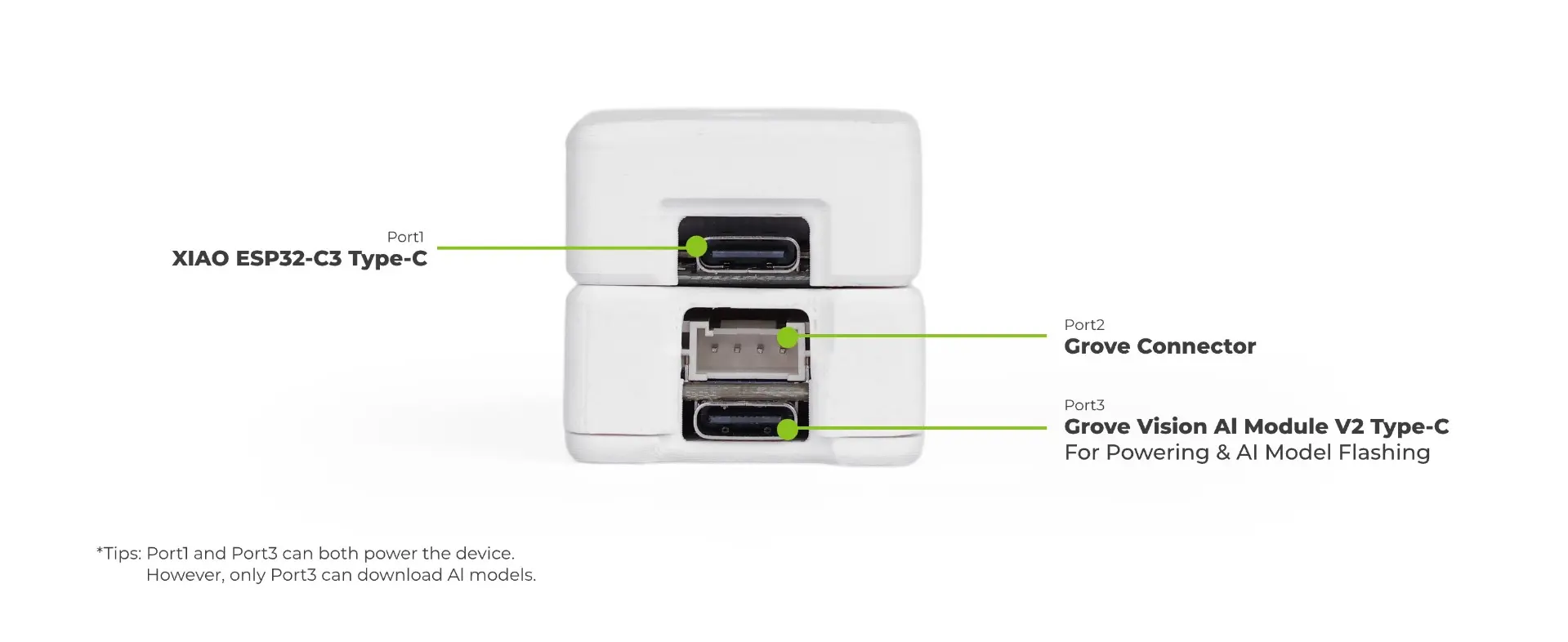
    • USB – 1x USB Type-C port for power and firmware flashing (via CH343)
    • Antenna – External u.FL antenna
  • Vision AI Processor – Grove Vision AI Module V2
    • Himax WiseEye2 HX6538 SoC
      • Arm Cortex-M55  @ 400 MHz
      • Arm Cortex-M55 @ 150 MHz
    • AI accelerator – Arm Ethos-U55 microNPU @ 400 MHz
    • Memory – Up to 2432KB SRAM
    • Storage – 64KB boot ROM
    • CSI camera connector
    • Grove interfaces: I²C, UART, SPI
    • PDM microphone
  • Storage
    • 16MB flash for firmware
    • MicroSD card slot supporting DS mode up to 25 MHz(on the Grove Vision AI Module V2)
  • Camera Module – OV5647
    • 5MP CMOS image sensor
    • Resolution – 2592 × 1944
    • Video output
      • 1080p @ 30 fps
      • 720p @ 60 fps
    • Field of View – 62°
    • Pixel size – 1.4 µm × 1.4 µm
    • Focal length – 3.4 mm (adjustable)
    • Aperture – f/2.8
    • CMOS size – 1/4″
  • Expansion – Grove I2C connector
  • Power Supply – 5V via USB Type-C ports on XIAO ESP32C3
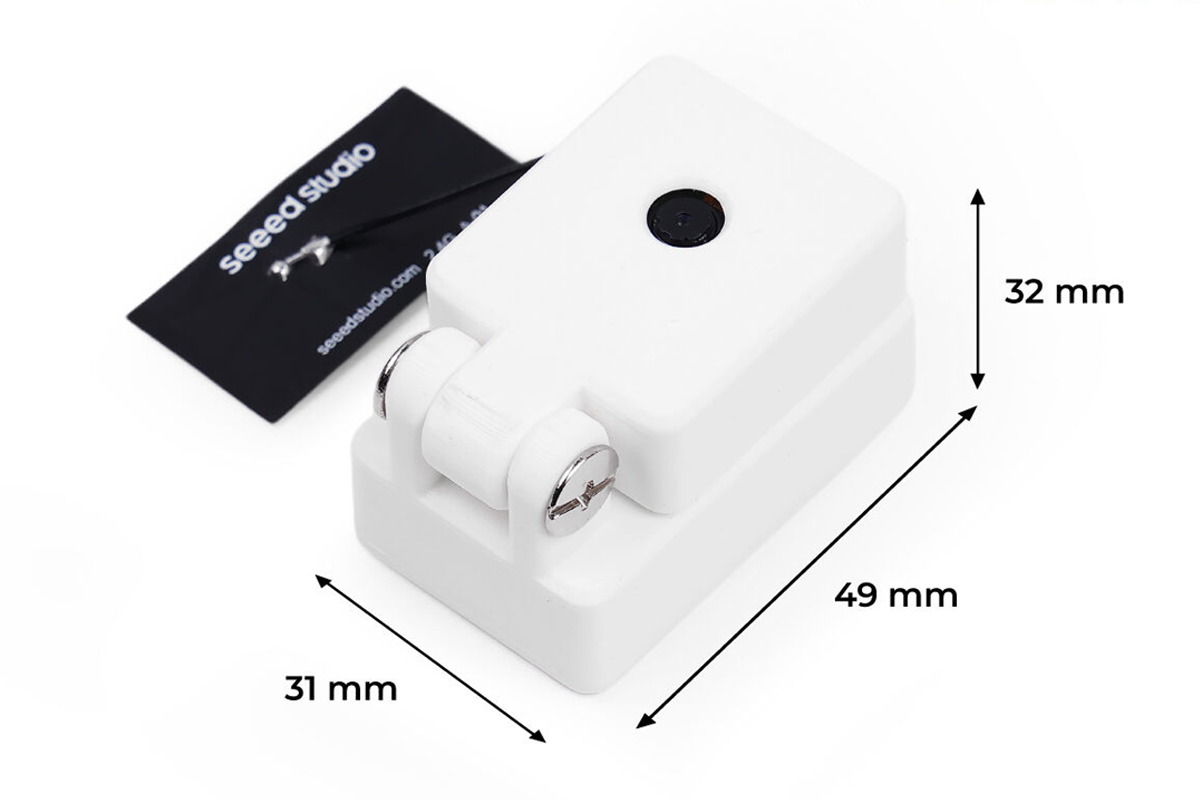
  • Dimensions – 49 x 32 x 31 mm (3D printed housing)
  • Operating temperature – -20°C to +70°C

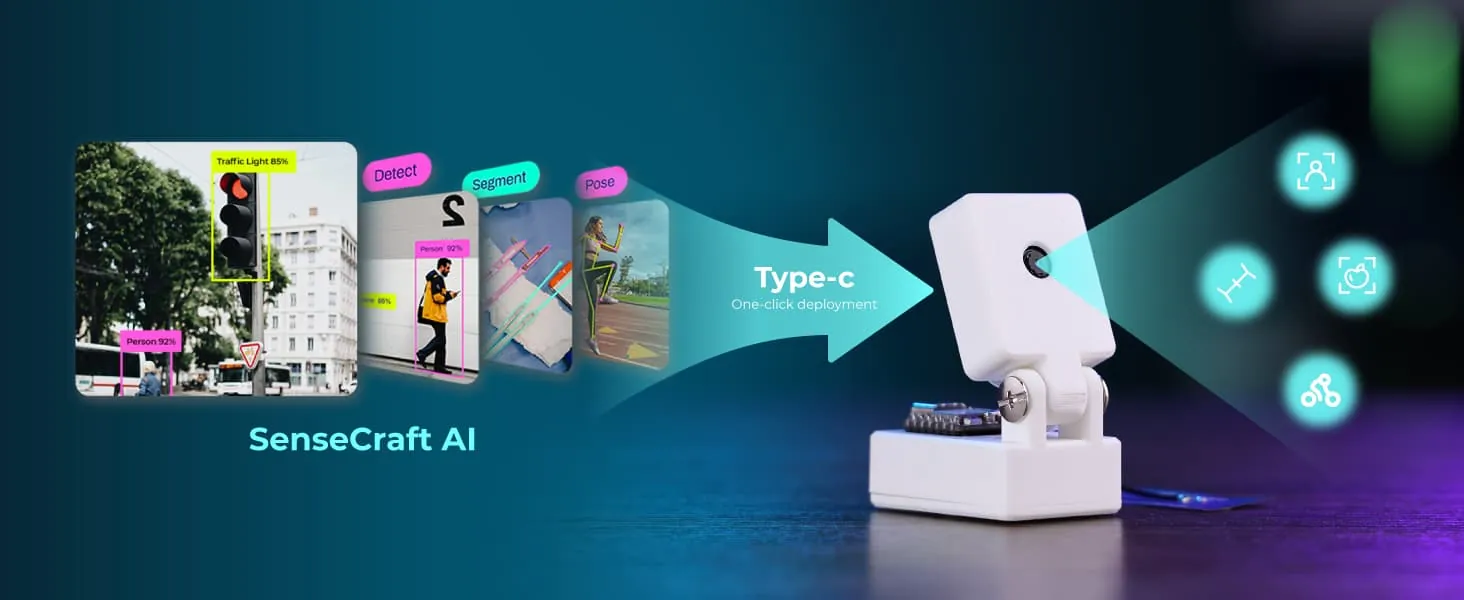
To simplify AI model development, this camera module supports no-code/low-code AI model deployment through the SenseCraft AI platform, so that users can quickly and easily train and deploy models without writing a single line of code. Users can select from a wide range of built-in models, including MobileNet V1/V2, EfficientNet-Lite, and YOLO v5/v8, or upload their datasets for training using either “Quick Training” or “Image Collection Training” methods. Once trained, the models can be deployed to the device with a single click, and inference results are visualized in real time through a web interface.

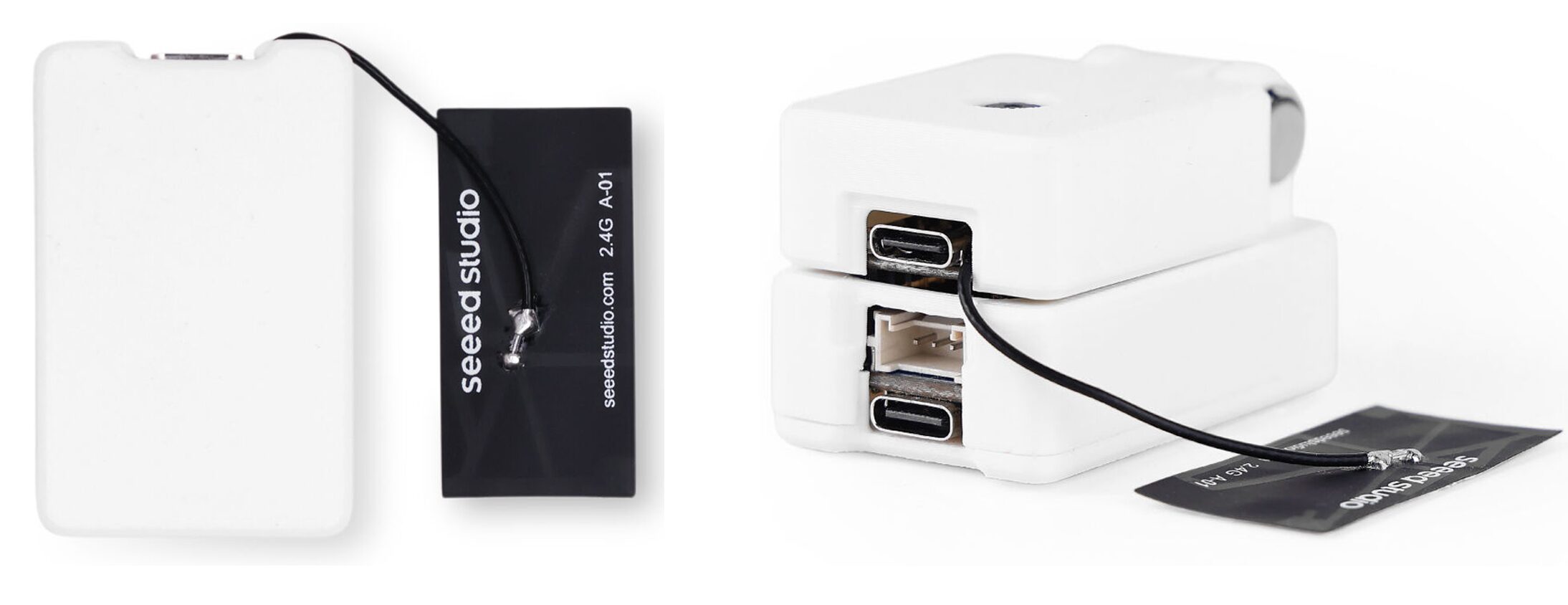
Seeed Studio XIAO Vision AI Camera Interfaces

You also have the option to integrate this camera with Home Assistant for building Smart Home automation solutions. After flashing ESPHome firmware onto the XIAO ESP32C3 and deploying a model via SenseCraft AI, you can link the camera to Home Assistant. Within its automation editor, various actions, such as triggering smart devices or sending alerts, can be programmed based on detection events like object recognition or fall detection, enabling a fully local, closed-loop smart system.

SenseCraft AI No code platform

While reviewing the documentation, I also noticed support for TensorFlow Lite and PyTorch, ensuring compatibility with a broader range of machine learning frameworks, and the Arduino IDE is also supported for more flexibility.

The software is completely open source, with all code, schematics, and design files available on the company’s GitHub repository. Additional documentation, like the 3D-printed foldable holder and datasheet for HX6538, is also available on the products page.

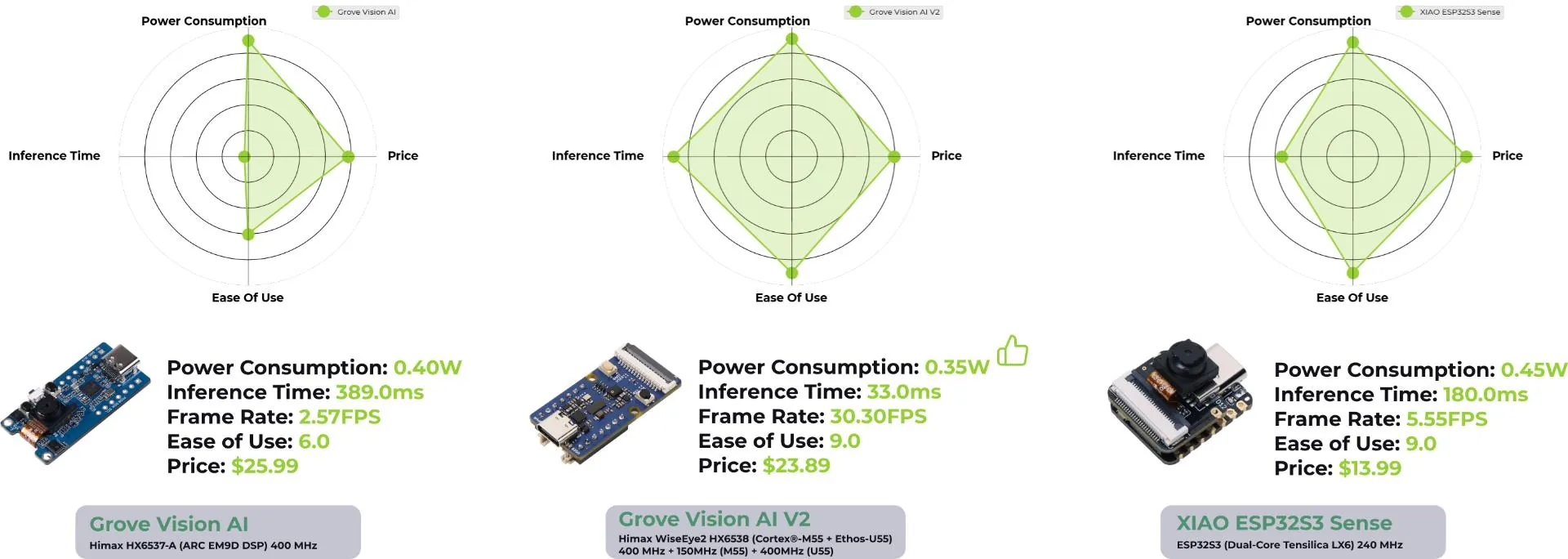
Grove Vision AI V2 performance power consumption
Grove Vision AI V2 module compared to the previous generation Grove Vision AI module and XIAO ESP32S3 Sense

Previously, we have written about various MCU-class edge AI camera boards, including the ultra-low-power OpenMV N6 and AE3 AI camera boards, which can run on battery for years, Seeed Studio’s Modbus Vision RS485 and SenseCAP A1102 (with LoRaWAN) ESP32-based outdoor Edge AI cameras built around the Himax WiseEye2 HX6538 microcontroller, and Sipeed’s MaixCAM-Pro AI camera devkit equipped with the SOPHGO SG2002 RISC-V SoC with a 1 TOPS NPU.

Seeed Studio XIAO Vision AI Camera top and side view

At the time of writing, the XIAO Vision AI Camera is available for pre-order from the Seeed Studio’s store for $24.90, with a discount of $23.50 for 10 units or more. Shipping from the Chinese Warehouse is expected to start from June 3, 2025. It should also soon be listed on the company’s AliExpress store.

Seeed Studio XIAO Vision AI Camera dimensions

The post XIAO Vision AI Camera combines ESP32-C3 and WiseEye2 HX6538 AI MCU with 5MP camera, supports SenseCraft no-code platform appeared first on CNX Software - Embedded Systems News.

29 May 13:59

Tool Turns SVGs into Multicolor 3D Prints

by Donald Papp

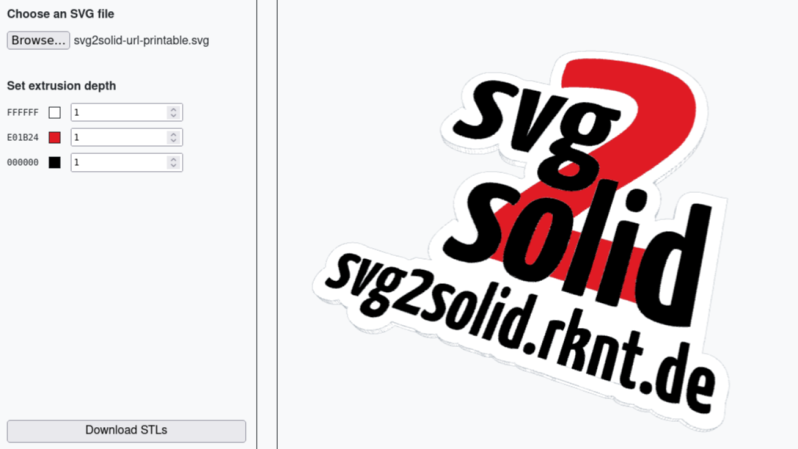
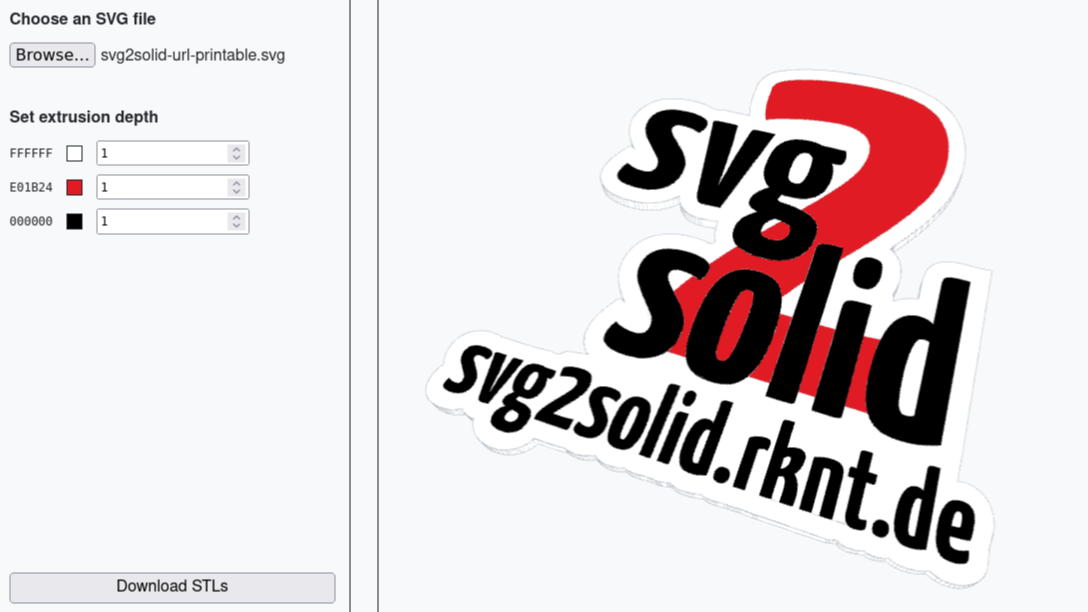
Want to turn a scaled vector graphic into a multicolor 3D print, like a sign? You’ll want to check out [erkannt]’s svg2solid, a web-based tool that reads an SVG and breaks the shapes up by color into individual STL files. Drag those into your slicer (treating them as a single object with multiple parts) and you’re off to the races.

This sign was printed face-down on a textured build plate. The colors only need to be a few layers deep.

This is especially handy for making 3D printed versions of things like signs, and shown here is an example of exactly that.

It’s true that most 3D printer software supports the .svg format natively nowadays, but that doesn’t mean a tool like this is obsolete. SVG is a 2D format with no depth information, so upon import the slicer assigns a arbitrary height to all imported elements and the user must make any desired adjustments manually. For example, a handy tip for making signs is to make the “background” as thick as desired but limit colored elements to just a few layers deep. Doing so minimizes filament switching while having no impact on final visual appearance.

Being able to drag SVGs directly into the slicer is very handy, but working with 3D models has a certain “what you see is what you get” element to it that can make experimentation or alternate applications a little easier. Since svg2solid turns an SVG into discrete 3D models (separated by color) and each with user-defined heights, if you find yourself needing that then this straightforward tool is worth having in your bookmarks. Or just go straight to the GitHub repository and grab your own copy.

On the other hand, if you prefer your 3D-printed signs to be lit up in a faux-neon style then here’s how to do that in no time at all. Maybe there’s a way to mix the two approaches? If you do, be sure to use our tips line to let us know!

29 May 13:49

Virtual models enable real-time decision making for next-generation nuclear reactors

Digital twins are a virtual copy of a real-world system. They are a transformative tool that can assist scientists across numerous disciplines. Researchers at the U.S. Department of Energy's (DOE) Argonne National Laboratory have created a digital twin technology that could make nuclear reactors more efficient, reliable and safe. This technology uses advanced computer models and artificial intelligence (AI) to predict how reactors will behave, helping operators make decisions in real time.
28 May 15:06

Hidden AI instructions reveal how Anthropic controls Claude 4

by Benj Edwards

On Sunday, independent AI researcher Simon Willison published a detailed analysis of Anthropic's newly released system prompts for Claude 4's Opus 4 and Sonnet 4 models, offering insights into how Anthropic controls the models' "behavior" through their outputs. Willison examined both the published prompts and leaked internal tool instructions to reveal what he calls "a sort of unofficial manual for how best to use these tools."

To understand what Willison is talking about, we'll need to explain what system prompts are. Large language models (LLMs) like the AI models that run Claude and ChatGPT process an input called a "prompt" and return an output that is the most likely continuation of that prompt. System prompts are instructions that AI companies feed to the models before each conversation to establish how they should respond.

Unlike the messages users see from the chatbot, system prompts typically remain hidden from the user and tell the model its identity, behavioral guidelines, and specific rules to follow. Each time a user sends a message, the AI model receives the full conversation history along with the system prompt, allowing it to maintain context while following its instructions.

Read full article

Comments

28 May 15:00

Ultra-thin display technology shows dozens of images hidden in a single screen

From smartphones and TVs to credit cards, technologies that manipulate light are deeply embedded in our daily lives, many of which are based on holography. However, conventional holographic technologies have faced limitations, particularly in displaying multiple images on a single screen and in maintaining high-resolution image quality.
28 May 15:00

Scientists Puzzled by Mysterious Motion in Atmosphere of Saturn's Moon

by Victor Tangermann
Researchers have found that the thick and hazy atmosphere enveloping Saturn's largest moon, Titan, behaves in a very peculiar way.

Researchers have found that the thick and hazy atmosphere enveloping Saturn's largest moon, Titan, behaves in a very peculiar way.

As detailed in a new paper published in The Planetary Science Journal, a team of scientists analyzed 13 years' worth of thermal infrared observations recorded by NASA and the European Space Agency's Cassini-Huygens mission.

Their finding: that Titan's atmosphere wobbles like a gyroscope as it shifts with the seasons of its nearly 30 Earth-year cycle, instead of spinning in line with its surface.

"The behavior of Titan's atmospheric tilt is very strange," said lead author and University of Bristol postdoctoral researcher Lucy Wright in a statement about the work. "Titan's atmosphere appears to be acting like a gyroscope, stabilizing itself in space."

The discovery makes the moon, which has already captured the attention of astronomers for its suspected bodies of liquid and planet-like dimensions — it's larger in diameter than Mercury — an even more intriguing candidate for a closer look, since it appears to have its own, independent climate system.

Given the latest discovery, though, scientists are now facing even more riddles about the unusual celestial body.

"We think some event in the past may have knocked the atmosphere off its spin axis, causing it to wobble," Wright posited. "Even more intriguingly, we've found that the size of this tilt changes with Titan's seasons."

"What's puzzling is how the tilt direction remains fixed in space, rather than being influenced by the Sun or Saturn," coauthor and University of Bristol planetary scientist Nick Teanby added. "That would've given us clues to the cause. Instead, we've got a new mystery on our hands."

The findings could influence NASA's upcoming Dragonfly mission, which is tentatively scheduled to launch no sooner than 2028, and will see a massive rotorcraft attempt to descend through Titan's extremely dense atmosphere to explore its surface.

It won't be a walk in the park, as it will have to endure temperatures around -300 Fahrenheit while keeping itself airborne with a surface pressure one and a half times that on Earth and winds of up to 20 times faster than the moon's rotation.

How the atmosphere "wobbles" on its own could allow scientists to get a better idea of how to keep Dragonfly operational, and where to touch down.

The new findings could also have far-reaching implications, forcing us to reevaluate our understanding of the Earth's atmosphere.

"The fact that Titan's atmosphere behaves like a spinning top disconnected from its surface raises fascinating questions — not just for Titan, but for understanding atmospheric physics more broadly, including on Earth," said coauthor and NASA Goddard planetary scientist Conor Nixon in the statement.

As for the chances that we'll encounter extraterrestrial life on the surface of Titan, astronomers aren't exactly hopeful. In a recent study, scientists concluded that Titan's rivers and lakes of liquid methane make it quite inhospitable to life as we know it. However, they found that a tiny amount of glycine-consuming microbes could, in theory, survive in its oceans.

More on Titan: Titan Covered With Fragments of Obliterated Moons, Scientists Say

The post Scientists Puzzled by Mysterious Motion in Atmosphere of Saturn's Moon appeared first on Futurism.

28 May 14:59

F1 in Monaco: No one has ever gone faster than that

by Jonathan M. Gitlin

The principality of Monaco is perhaps the least suitable place on the Formula 1 calendar to hold a Grand Prix. A pirate cove turned tax haven nestled between France and Italy at the foot of the Alps-Maritimes, it has also been home to Grand Prix racing since 1929, predating the actual Formula 1 world championship by two decades. The track is short, tight, and perhaps best described as riding a bicycle around your living room. It doesn’t even race well, for the barrier-lined streets are too narrow for the too-big, too-heavy cars of the 21st century. And yet, it’s F1’s crown jewel.

Despite the location's many drawbacks, there’s something magical about racing in Monaco that almost defies explanation. The real magic happens on Saturday, when the drivers compete against each other to set the fastest lap. With overtaking as difficult as it is here, qualifying is everything, determining the order everyone lines up in, and more than likely, finishes.

Coverage of the Monaco Grand Prix is now filmed in vivid 4K, and it has never looked better. I’m a big fan of the static top-down camera that’s like a real-time Apple TV screensaver.

Read full article

Comments

28 May 14:57

2025 Pet Hacks Contest: Fytó – Turn Your Plant Into a Pet

by Matt Varian
Fytó pet plant

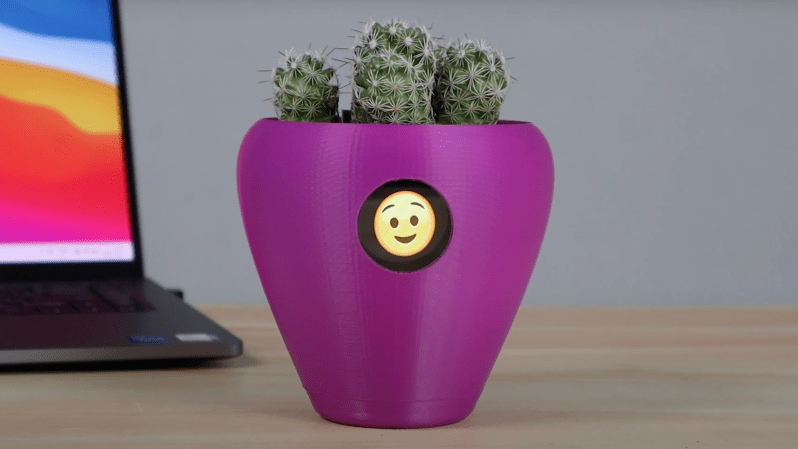
This entry into the 2025 Pet Hacks Contest is about bringing some fun feedback to normally silent plants. Fytó integrates sensors and displays into a 3D printed planter. The sensors read the various environmental and soil conditions that the plant is experiencing, and give you feedback about them via a series of playful expressive faces that are displayed on the screen embedded in the planter.

At the core of the Fytó is a Raspberry Pi Zero 2 W, which has plenty of power to display the animations while also being small enough to easily fit inside the planter without it growing in size much more than a normal planter would be. The sensors include a capacitive soil moisture sensor, a temperature sensor, and a light-dependent resistor. These sensors all provide analog outputs to relay their measurements and so there was an ADS1115 analog-to-digital converter board also included as the Raspberry Pi doesn’t have the required analog pins to communicate with them.

The fun animated faces are displayed with a 2-inch LCD display embedded in the planter. A small acrylic cover is placed in front of the LCD to help ease the transition from the printed planter to the internally mounted screen. The temperature and light sensors were also placed in openings around the planter to ensure they could get good environmental readings. There are six expressions the Fytó can express based on its sensor readings, ranging from happy when all the readings are in a good zone, to thirsty if it needs water or freezing when it’s too cold. Be sure to check out the other entries in the 2025 Pet Hacks Contest.

2025 Hackaday Pet Hacks Contest
28 May 14:46

New Supermaterial: As Strong as Steel and as Light as Styrofoam

by John Elliot V
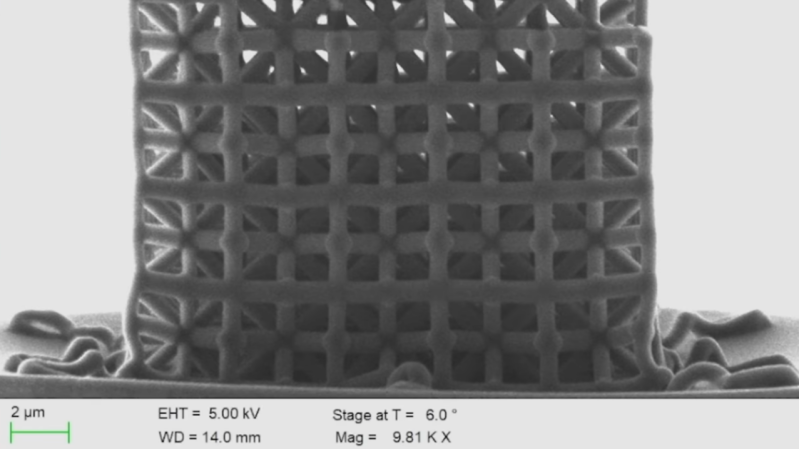
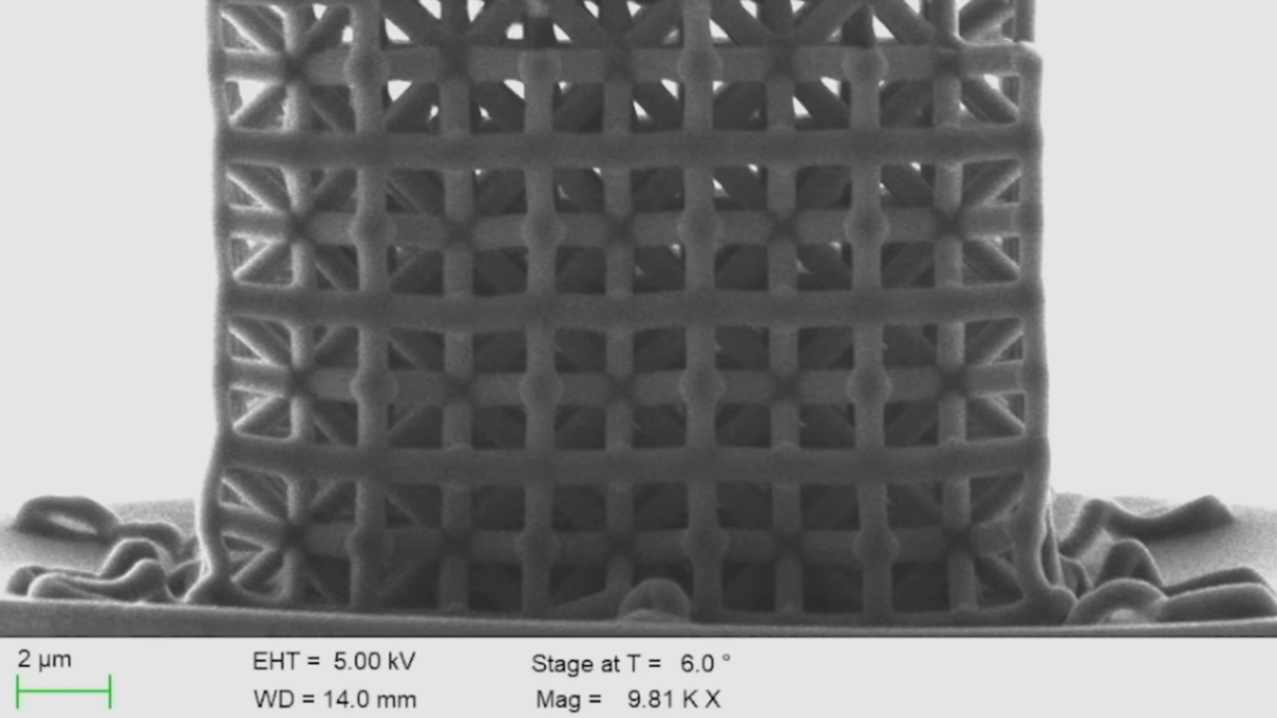
The supermaterial lattice.

Today in material science news we have a report from [German Science Guy] about a new supermaterial which is as strong as steel and as light as Styrofoam!

A supermaterial is a type of material that possesses remarkable physical properties, often surpassing traditional materials in strength, conductivity, or other characteristics. Graphene, for example, is considered a supermaterial because it is extremely strong, lightweight, and has excellent electrical conductivity.

This new supermaterial is a carbon nanolattice which has been developed by researchers from Canada and South Korea, and it has remarkably high strength and remarkably low weight. Indeed this new material achieved the compressive strength of carbon steels (180-360 MPa) with the density of Styrofoam (125-215 kg m-3).

One very important implication of the existence of such material is that it might lead to a reduction in transport costs if the material can be used to build vehicles such as airplanes and automobiles. For airplanes we could save up to 10 gallons per pound (80 liters per kilogram) per year, where an airplane like the Airbus A380-800 weighs in at more than one million pounds.

To engineer the new material the researchers employed two methods: the Finite Element Method (FEM) and Bayesian optimization. Technically these optimized lattices are manufactured using two-photon polymerization (2PP) nanoscale additive manufacturing with pyrolysis to produce carbon nanolattices with an average strut diameter of 300 and 600 nm.

If you have an interest in material science, you might also like to read about categorizing steel or the science of coating steel.

Thanks to [Stephen Walters] for letting us know about this one on the tips line.

27 May 07:16

Beauty and fashion technology specialist Perfect Corp. takes wraps off new AI Clothes Try-On solution

by Staff Writer

Perfect Corp. has announced the launch of AI Clothes Try-on, a generative AI powered experience for virtual fashion shopping.

This lets shoppers see exactly how any look complements their unique body shape, complexion and style. They can mix and match separate pieces, preview full outfit swaps, and experiment with fabrics, prints and colourways, all rendered in photorealistic detail.

AI Clothes Try-on is available through both the YouCam Makeup mobile app and the YouCam Online Editor, Perfect Corp.’s web-based editing platform. For brands and developers, the solution is also accessible through the YouCam Online Editor AI Clothes Try-on API.

“With the AI Clothes Try-on feature, we’re not just visualising clothes, we’re rethinking how people connect with style,” says Alice Chang, CEO and Founder at Perfect Corp. “It gives users the freedom and power to explore, customise, and express their fashion choices instantly. For brands and retailers, it’s a smarter way to deliver personalisation at scale, where inspiration becomes interaction in just one click.”

RTIH AI in Retail Awards

RTIH, organiser of the industry leading RTIH Innovation Awards, proudly brings you the first edition of the RTIH AI in Retail Awards, which is now open for entries. 

As we witness a digital transformation revolution across all channels, AI tools are reshaping the omnichannel game, from personalising customer experiences to optimising inventory, uncovering insights into consumer behaviour, and enhancing the human element of retailers' businesses.

With 2025 set to be the year when AI and especially gen AI shake off the ‘heavily hyped’ tag and become embedded in retail business processes, our newly launched awards celebrate global technology innovation in a fast moving omnichannel world and the resulting benefits for retailers, shoppers and employees.

Our 2025 winners will be those companies who not only recognise the potential of AI, but also make it usable in everyday work - resulting in more efficiency and innovation in all areas.

Winners will be announced at an evening event at The Barbican in Central London on Wednesday, 3rd September.

This will kick off with a drinks reception in the stunning Conservatory, followed by a three course meal, and awards ceremony in the Garden Room.

Please email our Editor, Scott Thompson, if you have any questions or need further information: scott.thompson@retailtechinnovationhub.com

Key 2025 dates

Friday, 18th July: Award entry deadline 

Tuesday, 22nd July: 2025 finalists revealed

Wednesday, 23rd July - Friday, 8th August: Judging days

Wednesday, 3rd September: Winners announced at the 2025 RTIH AI in Retail Awards Ceremony, to be held at The Barbican in Central London.

26 May 19:26

IA générative : une bulle, un krach ou un virage ?

by Bertrand DUPERRIN

En mars dernier je me posais la question de savoir si l’IA générative relevait d’une révolution durable ou d’une bulle spéculative (L’IA vers une impasse économique ?). J’y faisais part d’un optimisme prudent mais toutefois confiant. Je voyais bien les zones d’ombre et les premières dérives mais m’interrogeais surtout sur la capacité des acteurs du marcher à démontrer assez de valeur pour passer leurs coûts à leurs clients pour devenir rentables. Mais j’étais assez confiant qu’au fil du temps on allait trouver des usages solides et bâtir des modèles économiques qui tenaient la route.

Mais quelques mois plus tard, le paysage a changé. Pas beaucoup mais assez, en tendance, pour que je jette un nouveau regard sur le sujet.

Non, l’IA générative n’a pas échoué. Elle progresse même, les modèles s’améliorent, le champ des usages s’élargit mais quelque chose s’est cassé dans le réci et le doute s’installe. Sur les promesses, sur l’impact réel, sur la capacité du secteur à tenir ses engagements notamment techniques et économiques. Et il ne s’agit plus seulement de prudence naturelle face à une technologie encore jeune mais de constater qu’un certain seuil d’insoutenabilité est peut-être déjà franchi.

Ce que l’on nous présentait comme une trajectoire de croissance linéaire semble désormais plus proche d’une surchauffe nourrie moins par les résultats que par l’anticipation de résultats futurs. Un emballement dû non pas à la valeur delivrée mis à l’espérance de valeur future. On mise massivement sur une technologie sans s’assurer qu’elle dispose des conditions minimales de soutenabilité et, faute de modèle clair, la croyance en devient le principal carburant (AGI, emploi, productivité : le grand bluff des prédictions IA).

Aujourd’hui, l’écart entre ce que coûte l’IA générative, ce qu’elle promet, et ce qu’elle produit réellement s’accroit et tout l’écosystème semble avancer, comme ça a toujours été le cas dans ces circonstances similaires, en espérant que quelqu’un d’autre trouvera la réponse avant d’être confronté au principe de réalité.

Ce n’est pas une prédiction catastrophiste car au fond de moi je me refuse à penser que cela ne va pas marcher mais une lecture rationnelle des signaux faibles qui, mis bout à bout, devraient nous apprendre à tempérer nos attentes et que même si, espérons le, le secteur ne s’effondre pas il ne pourra pas faire l’économie d’une reconfiguration.

En bref :

  • L’IA générative progresse techniquement mais rencontre des limites économiques structurelles : coûts élevés d’entraînement et d’usage, difficulté à monétiser, faible fidélisation des utilisateurs et dépendance aux géants de la tech pour la distribution.
  • Le modèle économique repose davantage sur des anticipations et des effets d’annonce que sur une valeur réellement captée, créant une dynamique spéculative semblable à la bulle internet des années 2000.
  • Les acteurs historiques (Microsoft, Google, Amazon) intègrent l’IA dans leurs écosystèmes existants sans modèle de rentabilité clair, tandis que les pure players comme OpenAI ou Anthropic peinent à équilibrer leurs finances.
  • Un réalignement progressif est en cours : rationalisation des projets, réduction des budgets, concentration sur des usages ciblés et industriels, au détriment des ambitions de transformation globale.
  • L’IA générative entre dans une phase de banalisation et d’intégration, devenant un outil d’optimisation métier plutôt qu’un moteur de rupture économique ou technologique.

Et avant toute chose je tiens à préciser une fois encore qu’ici on parle bien d’IA générative. Il y a une tonne de types d’IA qui fonctionnent très bien (L’IA pour les nuls qui veulent y voir un peu plus clair), avec un ROI avéré, qui sont rentables pour toute la chaine de valeur et que l’on utilise, pour certaines d’entre elles, depuis des années sans même le savoir et qui ne soulèvent aucune question sauf, éventuellement, de savoir si un jour on ne risque pas de jeter le bébé avec l’eau du bain.

Des fondations plus fragiles qu’on ne voulait le croire

En dépit des projections enthousiastes mais qui ne reposent sur aucune méthodologie solide (voir ci-dessus) et des démonstrations à couper le souffle dont les éditeurs ont le secret il devient devient de plus en plus évident que le modèle économique de l’IA générative est bancal. Pas seulement parce qu’il est jeune et et immature mais parce qu’il repose sur des hypothèses ou coûts, valeur et revenus ne s’alignent pas. Un déséquilibre pointé par de plus en plus d’observateurs qui est, malheureusement, structurel.

Commençons par les coûts. L’entraînement d’un modèle comme GPT-4 aurait coûté plus de 100 millions de dollars (The Extreme Cost Of Training AI Models) mais c’est surtout l’inférence, c’est à dire chaque requête d’un utilisateur qui reste couteuse, de $0,01 à $0,1 (How much does GPT-4 cost?) en fonction de lasacomplexité. Contrairement au modèle Saas ou aux services financés par la publicité en ligne, ici, plus on utilise le service plus il coûte cher au fournisseur sans qu’il n’y ait d’effet d’échelle automatique.

En face de cela, la capacité à faire payer les utilisateurs et donc de leur passer les couts est plus que limitée. Le grand public se limite à des offres à $20 par mois comme ChatGPT plus et les entreprises, de leur côté, ont du mal de justifier des des coûts élevés pour des gains souvent difficiles à mesurer. D’après une étude IBM seuls de 25% des projets IA atteignent aujourd’hui les objectifs de rentabilité (Will genAI businesses crash and burn?). L’essentiel des gains, quand il y en a, relève de la réduction des coûts et d’automatisations très ciblées ce qui explique également que les secteurs à faible marge ne peuvent se payer le luxe d’investir massivement dans l’IA (The disconnect between AI spend and potential).

A cela s’ajoute une pression déflationniste venue du monde open source avec des modèles comme Mistral, LLaMA ou Phi peuvent être déployés localement, à moindres coûts, avec des performances très compétitives. Un mouvement qui est, peut être, encore minoritaire mais est en train de tirer les prix vers le bas. L’entreprise qui peut internaliser un modèle open source n’a aucune raison de payer cher une API à coût variable. Le résultat est prévisible :le prix unitaire d’un token baisse, sans que les coûts d’infrastructure des acteurs privés ne suivent la même tendance.

Le rapport de force est donc en train de se renverser. Alors qu’on pensait l’IA générative capable de désintermédier les géants de la tech elle est en train d’être elle-même absorbée dans des plateformes qui détiennent alors sa distribution. Google intègre Gemini à Search, Gmail et Android, Microsoft impose Copilot dans Windows et Office 365, Amazon inclut ses briques IA dans AWS. En face de cela les nouveaux acteurs ne possèdent ni l’interface, ni la plateforme, ni la base installée et dépendent de ceux qui contrôlent les points d’entrée.

On le voit très bien avec OpenAI qui bien qu’ayant popularisé le concept d’agent conversationnel avec ChatGPT dépend presque totalement de Microsoft pour son cloud (Azure), pour sa distribution (Copilot), et même pour son support technique dans les entreprises. C’est Microsoft qui facture, Microsoft qui embarque, Microsoft qui encadre et dans ce schéma OpenAI n’est qu’un moteur.

Un moteur qui n’est même pas captif. Les utilisateurs peuvent facilement aller voir ailleurs. D’un modèle à l’autre, la friction est faible, l’usage interchangeable et contrairement aux grandes plateformes historiques, l’IA générative n’a pas de verrouillage structurel. Pas de réseau social, pas d’écosystème fermé, pas de dépendance croisée.

De plus la « fidélité cognitive » est très faible : les statistiques d’usage montrent que la plupart des utilisateurs exploitent ces IA pour des tâches comme la rédaction de messages, la gestion de calendriers, ou la génération de contenus (mémos, emails), qui relèvent d’une assistance ponctuelle ou d’une optimisation de tâches individuelles plutôt que d’une transformation structurelle des workflows (AI Assistant Statistics 2025: How AI is Transforming Workflows and Productivity). De plus les particuliers passent d’une IA à l’autre pour essayer, souscrivent et annulent leurs abonnements à chaque expérimentation ce qui signifie que les prévisions de revenu ne veulent plus dire grand chose (L’ARR ne dit plus grand-chose sur la santé d’une startup).

Résultat : les modèles supportent les coûts, mais ne captent ni d’usage durable, ni de revenu récurrent. De la même manière que durant la ruée vers l’or les seuls à avoir gagné de l’argent sont les marchands de pioches, la seule à gagner quoi que ce soit dans cette histoire est Nvidia, dont les marges records (supérieures à 75 % sur les GPU dédiés à l’IA) sont aujourd’hui financées par une économie encore incapable de prouver sa viabilité (Big Tech’s AI spending boom increases risk of a bust).

Un modèle structurellement non rentable

On présente les pertes financières des acteurs de l’IA comme une question de cycle en laissant entendre qu’il faut laisser le temps au marché de maturer, aux usages de s’ancrer et aux investissements de se transformer en chiffre d’affaire. Et c’est vrai que c’est ainsi que les choses ont toujours fonctionné dans le monde de la tech mais dans le cas de l’IA on peut avoir des doutes car le problème n’est pas conjoncturel mais structurel.

Encore une fois on nous cite souvent l’exemple de Google ou d’Amazon mais ces entreprises ne voyaient pas leur couts augmenter proportionnellement aux usages et c’était même plutôt l’inverse.

Ca n’est pas parce que cela a fonctionné pour un type d’entreprise et de technologie que cela fonctionnera donc pour tous.

Les modèles de langage de grande taille (LLM) ne sont pas des plateformes. Ce sont des infrastructures computationnelles intensives, qui consomment énormément à l’entraînement comme à l’usage. GPT-4, Claude 3 ou Gemini 1.5 ne sont pas comparables à un moteur de recherche ou un logiciel cloud : leur coût marginal ne diminue pas avec le volume, pire, il augmente. Chaque utilisateur supplémentaire, chaque requête, chaque millier de tokens a un coût énergétique et matériel significatif (There Is No AI Revolution).

Le problème c’est que les revenus ne suivent pas. OpenAI aurait généré environ 4 milliards de dollars en 2025, mais dans le même temps, la société aurait vu ses dépenses croitre à environ 9 milliards de dollars sans parvenir à équilibrer son modèle (Will genAI businesses crash and burn?). Et pour ce qui est du futur les analystes s’inquiètent qu’en dépit d’une croissance du revenu l’entreprise continue à voir ses dépenses croitre proportionnellement, sachant de plus que la grande majorité des utilisateurs ne paient rien (OpenAI’s profit trajectory is an open question).

Anthropic, soutenue par Amazon et Google, connaît une situation similaire. Valorisation autour de 15 milliards de dollars pour, selon les sources, moins de 150 millions de chiffre d’affaires annuel. Là encore, les multiples sont typiques d’un pari spéculatif et pas d’une entreprise structurellement viable.

Qu’on soit clairs : chaque utilisateur nouveau, chaque requête, ne rapproche pas ces entreprises de la rentabilité mais contribue à creuser leurs pertes.

En parallèle, les revenus sont largement captés par les wrappers dont je vous ai parlé dernièrement (Wrappers, deeptechs et IA générative : un château de cartes rentable mais fragile). La majorité des revenus d’OpenAI provient des abonnements directs à ChatGPT (Plus, Teams, Business…), représentant plus de 70 % du chiffre d’affaires, tandis que la vente d’accès API (utilisée par les intégrateurs comme Notion, Canva, Copilot, Salesforce, etc.) ne représente qu’environ 15 à 20 % du total alors que c’est la grande majorité des usages. Cela signifie que la valeur générée par les usages intégrés dans d’autres outils remonte principalement à ces plateformes finales, et non à OpenAI elle-même (OpenAI Is A Bad Business) et ce d’autant plus que l’accès aux APIs est souvent vendu à perte (The Subprime AI Crisis) pour en stimuler l’usage qui malgré tout peine à décoller.

Même lorsque les acteurs IA sont présents dans les produits finaux, ils ne maîtrisent ni le pricing, ni la distribution, ni la relation client. OpenAI dans Copilot, Claude dans Notion, Gemini dans Gmail : à chaque fois, l’IA est intégrée mais invisible. C’est Microsoft, Google, Amazon qui commercialisent, qui facturent, qui fidélisent, captent la valeur ajoutée et peuvent de plus changer de fournisseurs d’IA comme bon leur semble.

Et ce que ces mêmes wrappers découvrent aujourd’hui, c’est que la rentabilité n’est pas plus évidente de leur côté. Copilot, qui devait être la démonstration de force de Microsoft dans la productivité augmentée, peine à s’imposer : 60% des entreprises ont testé Copilot, 16% seulement sont passées en phase de déploiement (How to get Microsoft 365 Copilot beyond the pilot stage). Beaucoup d’organisations commencent par acheter un nombre limité de licences, souvent pour tester Copilot sur quelques équipes pilotes, puis hésitent à généraliser, faute de retour d’expérience convaincant.

Que ce soit du côté de Microsoft comme de Salesforce, les revenus générés par l’IA sont faibles et les projections peu engageantes (Reality Check). Mais Microsoft et ses semblables ont un avantage considérable par rapport à OpenAi et consorts : en plus d’être en frontal face au client et de contrôler la distribution d’une partie des pure players ils ne sont pas monoproduits : ils ont des vaches à lait qui peut leur permettre de financer leurs efforts dans l’IA pendant des années le temps que marché devienne mature, un temps que les autre n’auront pas.

Aujourd’hui 66% des pilotes ne passent pas en production pour des raisons d’immaturité et de ROI (88% of AI pilots fail to reach production — but that’s not all on IT) et seulement 25 % des initiatives en matière d’IA ont généré le retour sur investissement escompté au cours des dernières années, avec seulement 16 % qui ont été déployées à l’échelle de l’entreprise (IBM Study: CEOs Double Down on AI While Navigating Enterprise Hurdles).

Dans ce contexte, les coûts continuent d’augmenter, et les entreprises clientes, elles, commencent à se lasser de tester des outils dont elles peinent à démontrer l’impact économique car la productivité promise n’est pas au rendez-vous (Workday CEO: ‘For all the dollars that’s been invested so far, we have yet to realize the full promise of AI’) avec des investissements qui croissent, mais sans que la production nette par travailleur n’augmente proportionnellement (AI’s productivity paradox: how it might unfold more slowly than we think).

Résultat : les modèles sont coûteux, la valeur perçue reste nébuleuse, la fidélité utilisateur est faible, la rentabilité industrielle est incertaine… et les seuls à dégager des marges nettes dans ce système sont les vendeurs d’infrastructure à savoir Nvidia, évidemment, mais aussi Microsoft, Amazon, Google, non pas grâce à l’IA, mais grâce au cloud, à la bande passante, aux GPU. C’est une logique de rente sur la dépendance matérielle, pas sur la valeur logicielle.

Soyons clairs : je ne dis pas que l’IA n’a pas de valeur, n’apporte rien, je suis même intimement convaincu du contraire. Je me borne simplement à constater que vu les bénéfice perçus les entreprises et les utilisateurs individuels ne sont pas prêts à payer le prix qui permettrait aux fournisseurs d’IA de devenir rentables un jour, quand une partie de ce prix n’est d’ailleurs pas capté par des intermédiaires.

Il y a une indéniable asymétrie entre les bénéfices de l’IA et les investissements nécessaires à leur obtention et le caractère structurel de cette dernière pourrait bien mener à une impasse.

Une bulle entretenue par des croyances mais pas par des faits

Ce n’est pas la première fois que la tech fonctionne davantage sur la croyance que sur les résultats. Ce n’est pas non plus la première fois qu’un secteur entier parie sur une promesse, sans vérifier si les conditions économiques sont réunies pour la tenir mais dans le cas de l’IA générative, l’écart entre les attentes et la réalité (AGI, emploi, productivité : le grand bluff des prédictions IA) commence à devenir difficile à ignorer.

Les chiffres parlent : multiples de valorisation sans lien avec les revenus, tours de table massifs sur des projections invérifiables, pression continue pour alimenter une croissance encore théorique.
Anthropic en est un excellent exemple : une valorisation estimée à 15 milliards de dollars pour à peine 100 à 150 millions de chiffre d’affaires annuel. Une structure ultra-financée, mais dont le modèle repose encore essentiellement sur des financements conditionnés et des accords d’intégration avec des géants comme Amazon, Google, Salesforce ou Zoom.


OpenAI, de son côté, fait figure de vitrine mondiale… mais continue de perdre plusieurs milliards de dollars par an, malgré une adoption spectaculaire de ChatGPT. Quant à ses agents dont elle espère tirer $3 milliards de revenus en 2025 il semble qu’ils proviendront d’un seul client, à savoir Softbank, qui se trouve être actionnaire d’OpenAI (Reality Check). Un peu comme si votre banque vous achetait vos produits pour faire croire au monde que vous allez bien et en plus cette activité sera probablement déficitaire elle aussi.

Le parallèle avec la bulle Internet du début des années 2000 n’est pas abusif. L’IA générative est financée sur des promesses d’avenir, pas sur des actifs solides (The Dot-Com Bubble vs. The AI Boom: Lessons for Today’s Market), l’effet de réseau y est faible, la fidélisation client incertaine, et la dépendance au capital externe extrême même si je vois des différences notables comme « des cas d’usage clairs et souvent très B2B, les modèles économiques sont connus et éprouvés avec une manière claire de faire du revenu (même si insuffisants) et, surtout, les gouvernements supportent le secteur. » (L’IA vers une impasse économique ?).

Ce qui alimente cette dynamique, c’est un mécanisme bien connu du capital-risque : le FOMO (fear of missing out). Personne ne veut rater le prochain Google. Le résultat, c’est une course à la valorisation où les modèles de revenus importent peu, pourvu que la trajectoire apparente soit exponentielle.

Ce qui soutient aujourd’hui la bulle IA, ce n’est pas la valeur livrée par les produits mais le narratif d’une rupture inévitable (Is the AI Revolution Already Losing Steam?), d’un basculement technologique auquel il faudrait croire avant même qu’il ne se concrétise.

Cette dynamique est renforcée par le fait que les grands acteurs ont tout intérêt à entretenir cette illusion du passage obligé. Microsoft, Amazon, Google, tous intègrent massivement des fonctions IA dans leurs produits sans hausse de prix toujours visible. Non pas parce qu’elles sont immédiatement rentables, mais parce qu’elles renforcent leur emprise sur les écosystèmes et laissent penser que tout se jouera chez eux.

On vend l’idée d’une transformation en cours, alors qu’il s’agit, le plus souvent, d’un packaging cosmétique ou d’un rebranding intelligent.

Et même chez les acteurs qui s’étaient engagés dans des usages IA concrets avec des cas d’usage bien pensées, les limites apparaissent. Le cas de Klarna est sur ce point intéressant : après avoir annoncé en fanfare l’automatisation d’une partie de son support client grâce à des agents IA, la société a dû reconnaître que les résultats n’étaient ni aussi réplicables, ni aussi transformateurs qu’escomptés et que si ils avaient calculé les gains ils avaient sous estimé ce qu’ils avaient à perdre (Klarna nous montre les limites des agents IA).

On voit peu à peu le vent tourner. Des projets sont gelés, des roadmaps sont revues et les plans de déploiement se ralentissent. Selon The Times, plusieurs projets de data centers géants prévus pour absorber la vague IA auraient été suspendus ou redimensionnés dès le premier trimestre 2025 (Big Tech’s $340bn AI spending boom increases risk of a bust) comme par exemple chez Amazon (Amazon has halted some data center leasing talks, Wells Fargo analysts say) et il semble que ce soit une tendance générale dans le secteur.

Enfin, même côté des utilisateurs finaux, le phénomène de fatigue cognitive commence à se faire sentir. L’effet « wow » des débuts s’estompe. ChatGPT, Claude ou Copilot sont certes encore utilisés, mais moins pour transformer que pour assister. Ce sont devenus des outils ponctuels, pas des agents de transformation.

L’IA semble donc avoir atteint le pic de ses promesses, sans que la réalité ne suive (AI’s productivity paradox: how it might unfold more slowly than we think)

Autrement dit : tout le monde continue à jouer mais plus personne ne regarde vraiment le tableau de score.

Et après ? Explosion ou atterrissage ?

Les bulles technologiques ne finissent pas toujours par une explosion. Parfois elles se dégonflent lentement, sans bruit, l’emballement se tasse, les promesses diminuent, les projets se redimensionnent et à la fin, il reste c’est une infrastructure plus modeste mais parfois plus saine.

Puisqu le scénario d’un krach n’est pas difficile à comprendre ni à expliquer, regardons celui, plus crédible, d’un

2025-2026: un retournement très discret

Rien d’alarmant mais devant les doutes, les critiques, et l’effet « magique » qui s’estompe le marché commence à tout doucement se rétracter. Les budgets IA sont peu à peu réduits, les DSI cessent de multiplier des pilotes qui ne mènent à rien (88% of AI pilots fail to reach production — but that’s not all on IT )mais en tirent des leçons et les directions financières commencent à être strictes sur les ROI.

Côté utilisateurs, la magie s’émousse. L’usage grand public de ChatGPT et consorts plafonne. On commence à parler de fatigue, de banalisation voire saturation cognitive. l’IA lasse et déçoit un peu et au final son marketing envahissant joue contre elle.

Le ralentissement des projets de construction de datacenters est la nouvelle qui fait changer l’IA d’époque : si le marketing des acteurs dit que tout est et sera formidable, leurs propres décisions d’investissement disent qu’ils ne voient pas la demande suivre.

2026-2027 : une purge silencieuse

C’est l’année du réalignement. Des startups disparaissent ou son rachetées mais rien à voir avec le krach des dot-com. C’est discret et d’ailleurs on dit même que les « exits » sont plutôt bonnes. A des années lumières des attentes de 2024 mais finalement très convenables. Preuve que ça n’est pas l’IA qui ne fonctionne pas mais qu’on attendait trop et trop vite.

Les survivantes se réorganisent et rationalisent leur investissements.

Parallèlement les grandes plateformes reprennent le contrôle. OpenAi est de plus en plus intégrée à Microsoft et oublie son rêve de devenir le nouveau Google (OpenAI veut-elle, doit-elle et peut-elle devenir le nouveau Google ?) et Anthropic se fond dans les offres cloud Amazon.

Les grandes plateformes reprennent le contrôl. Les modèles deviennent invisibles : ils tournent en arrière-plan, intégrés à des produits déjà existants, sans plus porter leur nom et. Invisibles, interchangeables, ils sont des commodités.

Encore une fois, avoir plusieurs lignes de produit permet de vivre dans le temps long. OpenAI et les autres étaient, elles, condamnées à vivre dans le temps court et les premières hésitations des investisseurs ont eu raison de leur indépendance mais leur survie était à ce prix.

Dans les entreprises on ne parle plus de transformation IA. On parle d’amélioration incrémentale, d’aide à la productivité, d’assistance documentaire. L’IA devient une brique parmi d’autres.

Côté financement, le ton change aussi : les investisseurs ferment les vannes et c’est un peu ce qui a d’ailleurs accéléré ce phénomène

2027–2028 : reconstruction dans la sobriété

Progressivement, les lignes se stabilisent.

Ceux qui survivent repartent sur des bases différentes.

Des modèles plus petits, plus sobres, open source et spécialisés, comme ceux développés par Mistral ou la série Phi de Microsoft, des intégrations verticales, avec une IA enfouie dans les process métiers, et des business models nouveaux, non plus à l’usage tokenisé, mais à la valeur métier créée : par exemple, génération d’une réponse client qualifiée, d’un contrat structuré, d’un rapport de synthèse validé.

On paie à l’action, voire au résultat et le modèle tenté par Salesforce par quelques années plus tôt devient la norme (Agentforce Pricing Update: Salesforce Announces Major Changes).

L’IA n’est plus une rupture mais un outil et c’est là que commence sa seconde vie.

Ceux qui n’ont jamais venu du rêves mais des composants continuent, eux, à prospérer : Nvidia, bien sûr, mais aussi les fournisseurs de cloud, les éditeurs de middleware, les intégrateurs spécialisés

L’IA générative n’aura peut-être été qu’une transition technologique vers autre chose.

Conclusion

Le problème de l’IA générative ça n’est ni son potentiel ni les bénéfices qu’elle apporte mais le fait que personne n’est prêt à payer pour, d’autant que les fournisseurs de technologie ne sont pas ceux qui captent l’essentiel du revenu du marché.

Le problème n’est donc pas la technologie mais le récit qui l’entoure. Un récit qui la présente comme inévitable, repose sur l’idée que l’IA allait tout changer et la croyance que tout cela créerait un marché et des rentes nouvelles.

Le prix à payer sera trop fort pour beaucoup de clients et la rente ne viendra probablement pas, en tout cas pour les pure players.

Le discours sur l’IA est juste sur la tendance mais ne repose, comme on l’a vu, sur rien en termes de chiffrage (AGI, emploi, productivité : le grand bluff des prédictions IA) et c’est ce qui a provoqué des attentes exagérées qui finissent par saper peu à peu la confiance envers le secteur.

Les bénéfices tardent à arriver et n’arriveront peut être jamais, les couts augmentent et au final le récit lasse. Ca n’est pas propre à l’IA, c’est l’histoire du monde de la tech sauf qu’avec l’IA tout est plus rapide et plus amplifié.

Et comme toujours on rebondira vers quelque chose de moins clinquant mais de plus sain et de plus impactant à très long terme. On est pas à la fin de l’IA mais on atteint la fin de la période d’expérimentation et d’apprentissage.

Il en restera des modèles plus sobres, des usages plus ciblés, des intégrations métier plus profondes mais le tout de manière quasi invisible. L’IA ne se donnera plus en spectacle mais va délivrer dans la plus grande discrétion.

Crédit visuel : Image générée par intelligence artificielle via ChatGPT (OpenAI)

L’article IA générative : une bulle, un krach ou un virage ? est apparu en premier sur Bloc-Notes de Bertrand Duperrin.

26 May 16:37

Découverte: les êtres vivants émettent une lumière qui s'éteint à leur mort 💡

by Cédric DEPOND
Une lueur imperceptible émane des êtres vivants, disparaissant à leur mort. Cette découverte, publiée dans The Journal of Physical Chemistry Letters, ouvre de nouvelles perspectives sur les...
26 May 16:32

Delta Air Lines Is Ditching Basic Economy. Here’s Why

by Bernadette Giacomazzo

Delta Air Lines is one of the most popular airlines in the United States and, indeed, the world. Recently, however, the global airline announced that it is getting rid of one of its most popular offerings. Let’s take a look at what they’re getting rid of and why.

Delta Air Lines Is Getting Rid of Basic Economy

According to Time Out, starting Oct. 1, Delta Air Lines will discontinue its Basic Economy class — at least in name. The no-frills fare is not going away, but it will be given a new name as part of a rebranding of Delta’s fare classes.

According to the airline, the rebrand provides greater flexibility and customization, allowing passengers to select the desired experience.

“As we listen and learn about what our customers want when it comes to their travel, we know that clarity and choice are paramount,” SVP and Chief Digital Officer Eric Phillips said in a press release. “Our reimagined shopping experience gives customers more options and flexibility to pick the travel experience that works best for them, and a full picture of all the benefits of flying with Delta.”

So, what will take Basic Economy’s place?

The airline is combining Basic Economy with a new Delta Main category (previously Main Cabin), which now has three tiers: Basic, Classic, and Extra. Delta Main Basic is effectively the same stripped-down experience: no seat selection until check-in, and the final boarding location is in Zone 8. However. Delta hopes the new moniker will indicate a more expansive and adaptable ticketing system.

Other categories are also being renamed. Comfort+ will become Delta Comfort, and First Class will become Delta First, but the in-flight experience remains unchanged. Premium Select and Delta One maintain their current names.

New Routes, Including One to Aspen

Whatever you want to call these new fare rates, you can take Delta Air Lines to any of its three new routes, including one from the greater New York City area to Vail, Colorado, beginning in December 2025 and extending indefinitely thereafter.

As previously reported in Cirium schedules and confirmed by an airline spokesman, the Atlanta-based carrier will begin service between the following airports on Dec. 20:

  • New York City’s John F. Kennedy International Airport (JFK) — Eagle County Regional Airport (EGE) near Vail, Colorado
  • New York City’s LaGuardia Airport (LGA) — Bozeman Yellowstone International Airport (BZN) in Montana
  • Salt Lake City International Airport (SLC) — Southwest Florida International Airport (RSW) in Fort Myers, Florida

During the heaviest winter months, all new flights will operate once per week on Saturdays. Seats on these new flights are currently available for purchase through Delta Air Lines’ booking systems. As expected, these new flights do not provide saver awards; consequently, if you want to spend miles, you must pay Delta’s dynamic SkyMiles redemption rates.

An Airbus A319 will operate the next two flights, while Delta will use a Boeing 757-200 on the JFK to EGE route.

Flyers looking for a premium winter ski trip without a stopover can consider the 1,746-mile route from New York to Vail. On this route, Delta Air Lines will compete with American Airlines’ daily service. The flight from Salt Lake City to Fort Myers should appeal to individuals in Utah’s capital and other nearby areas looking to dodge the cold.

Finally, with service from New York to Bozeman, tourists will have a new route to visit Big Sky and other nearby ski resorts without flying through JFK or Newark Liberty International Airport (EWR). United Airlines flies there from EWR, while JetBlue flies from JFK.

26 May 16:28

Novo Nordisk Offering Large Discount on Wegovy in Bid to Recapture Market

by Frank Landymore
Facing steep competition, Novo Nordisk has slashed the price for its weight loss drug Wegovy — temporarily, at least.

It's been a tough year for Novo Nordisk, the Danish pharmaceutical company behind the GLP-1 drugs Ozempic and Wegovy. Competitors are nipping at its heels, cheaper knockoffs have been eating into its sales, and it just gave the boot to its former CEO.

Now, hoping its worst days are behind it, Novo says it's offering customers a massive discount on Wegovy, the weight-loss variant of its flagship drug semaglutide.

For your first month of treatment, Reuters reports, you can nab a batch of Wegovy injections for $199 until June 30, Novo said. After that, it'll set you back $499 per month — which is still a lot of money, but the drug used to cost an outrageous $1,000 per month without insurance, so at least it's a step toward broader access.

Don't mistake this for benevolence, though, or even necessarily a sign of growing desperation, though there may be a component of that as well. Instead, Novo is looking to capitalize on a massive victory it was handed last month, when the Food and Drug Administration instituted a crackdown on pharmacies offering compounded forms of semaglutide. The ban took effect this week, following a lengthy grace period. 

Compounded drugs are created by a pharmacy, sometimes by using alternative ingredients, to tailor a drug to a patient's specific needs, typically at a much lower cost than buying it straight from a manufacturer. 

On the one hand, this gives patients access to medications they normally wouldn't be able to afford. But the lack of regulation has raised concerns over the drugs' safety, which have only grown in volume as compounding pharmacies have shot up — and shut down — across the country.

Following the FDA decision, hundreds of thousands of Americans will lose access to their knockoff semaglutide, the New York Times reported, providing a huge windfall for Novo. With the discounts, it's eagerly poised to sweep up a huge amount of new customers, who are desperate not to derail their weight loss journey.

"We are doubling down on our commitment to accessibility, availability, and affordability of authentic, FDA-approved Wegovy," Dave Moore, executive vice president of Novo's US operations, said in a statement.

The once most valuable company in Europe still faces increasingly stiff competition, however.

Eli Lilly overtook US prescriptions for Wegovy with its Zepbound weight loss shot last year. Inflaming the rivalry, a just-published head-to-head trial showed that Zepbound users lost 50 percent more weight than those who took Novo's drug. Eli Lilly also has a pill version waiting in the wings that promises to be just as effective as semaglutide, precipitating a drop in the Danish company's stock, which has never rebounded to its $615 billion peak in market capitalization nearly two years ago.

More on drugs: Eli Lilly's New Weight Loss Drug May Have the Worst Name in Pharmaceutical History

The post Novo Nordisk Offering Large Discount on Wegovy in Bid to Recapture Market appeared first on Futurism.

25 May 11:53

Nerf Blaster Becomes Remote Control Turret

by Lewin Day

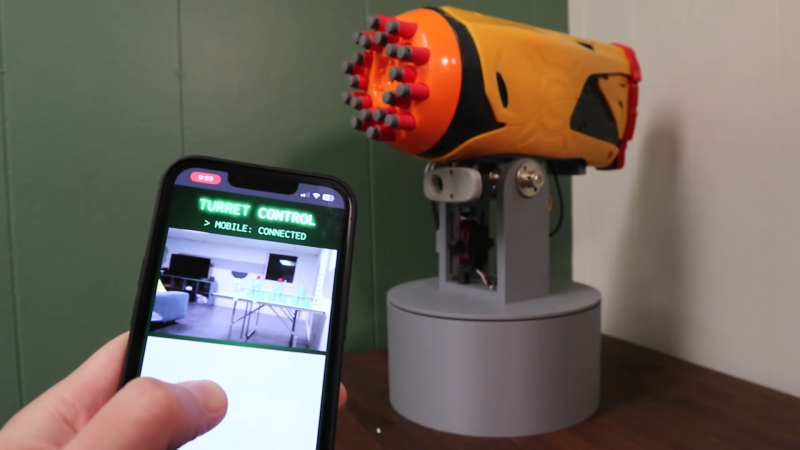
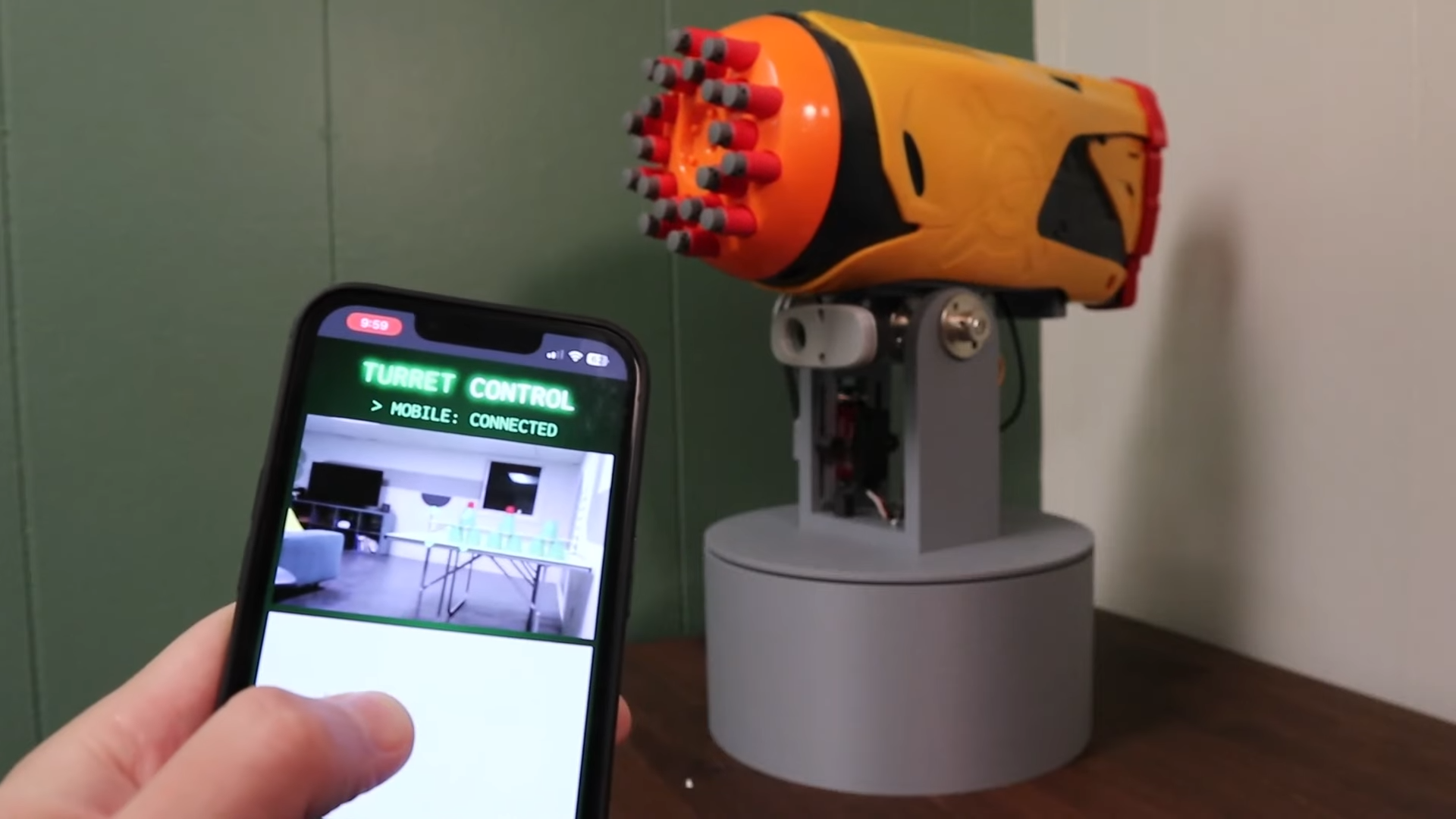
For most of us, turrets that aim and shoot at things are the sole domain of video games. However, they’re remarkably easy to build with modern technology, as [meub] demonstrates. Meet the SwarmTurret.

The build is based around an existing foam blaster, namely the Nerf Swarmfire. This blaster was chosen for being easy to integrate into the build, thanks to its motorized direct-plunger firing mechanism and electronic trigger. It also has the benefit of being far less noisy and quicker to fire than most flywheel blasters.

For this build, the Nerf blaster was slimmed down and fitted to a turret base built with hobby servos and 3D printed components. The blaster is also fitted with a webcam for remote viewing. A Raspberry Pi is running the show, serving up a video feed and allowing aiming commands to be sent via a Websockets-based interface. Thus, you can login via a web browser on your phone or laptop, and fire away at targets to your heart’s content.

We’ve featured some great turrets before, like this Portal-themed unit.

25 May 11:51

OpenAI’s mysterious device: What are Sam Altman and Jony Ive building?

by Grigor Baklajyan
OpenAI’s mysterious device: What are Sam Altman and Jony Ive building?

“People who are really serious about software should make their own hardware,” Alan Kay says. OpenAI CEO Sam Altman and ex-Apple designer Jony Ive totally agree. Altman even backed Humane AI Pin, but that didn’t work out. The product tanked, and the company shut down. That experience might give Altman some perspective as he joins forces with Ive to build an OpenAI device as important as a laptop or a phone.

This new project marks OpenAI’s biggest acquisition yet. Ive is coming in with his crew of about 55 engineers and researchers. His studio, LoveFrom, will take the lead on creative and design work across OpenAI and focus on building hardware that makes tech feel more natural to use.

Altman and Ive aren’t thinking small—they want to move past the smartphone era, which has ruled since the first iPhone in 2007. If their idea takes off, it could kickstart a new wave of tech called “ambient computing.”

OpenAI device development in a nutshell

Jony Ive and Sam Altman

In an interview, Ive and Altman keep quiet about what their new AI gadget might look like or how it’ll work. They say more info is coming next year. But according to The Wall Street Journal, Altman showed his team a sneak peek of the thing on Wednesday. And just like that, the leaks are already starting.

This device is meant to know everything going on around you and in your day-to-day. It won’t get in the way, either—it’s something you can carry in your pocket or set on your desk. Think of it as the third piece next to your MacBook Pro and iPhone.

Reports claim it won’t be a phone, and the goal seems to be pulling people away from screens. Altman says it’s not glasses, and Ive doesn’t seem too into the idea of wearing something on your body. Still, analyst Ming-Chi Kuo thinks one possible use is wearing it around your neck.

My prediction

Humane AI Pin
Humane AI Pin

I’m starting to think it might be an AI-powered pendant. Something that stays on throughout the day, picks up on your habits, and connects with your phone or laptop with no hassle. 

I picture a voice assistant with a mic, speaker, camera, and motion sensors. Maybe it even includes a tiny projector that beams text or visuals onto your hand. If you’re chatting with someone in a different language, it can handle back-and-forth translation right on the spot. Plenty of those features made it into the Humane AI Pin, which ended up being a major letdown. So why do I believe OpenAI and Ivy might explore that direction?

In a conversation with Bloomberg, Ive described the Humane AI Pin and Rabbit r1 as “very poor products.” He pointed out the lack of fresh thinking in today’s product designs. I can understand his point. The laser display on the AI Pin drained a huge amount of power, which led to overheating. But with companies like Apple working on AI-powered battery management, I won’t be surprised if OpenAI finds a way to fit a powerful battery into a clean, compact design.

Release date

Looks like OpenAI timed its Jony Ive news to steal some of the spotlight from Google I/O. That event just wrapped and leaned into Google’s strengths—tight ecosystem, strong AI features, all that. OpenAI can’t compete there right now, so changing the conversation makes sense.

As for the upcoming device, Ming-Chi Kuo thinks it’s heading into mass production by 2027. If you’ve kept up with novel product launches, you know they don’t exactly move fast. The Vision Pro, for instance, spent 17 years in development before coming out. So yeah, I wouldn’t be surprised if OpenAI goes slow with this one too.

OpenAI device: Final thoughts

The mix of Ive’s design chops and Altman’s vision feels like a wild card with real potential. Sure, it might take a while, but I’d rather wait for something that works than rush into another flop. Fingers crossed this thing doesn’t end up as another expensive desk toy.

24 May 14:05

Unknown Unknowns

In a 2002 Pentagon briefing, then U.S. Secretary of Defense Donald Rumsfeld famously said:

"Reports that say something hasn't happened are interesting to me, because as we know, there are known knowns; there are things we know we know.

We also know there are known unknowns; that is to say, we know there are some things we do not know.

But there are also unknown unknownsthe ones we don't know we don't know.

And if one looks throughout the history of our country and other free countries, it is the latter category that tends to be the difficult ones."

It wasn't typical media material. It even won Rumsfeld the "Foot in Mouth" award from the Plain English Campaign in 2003. But the idea of unknown unknowns has endured.

Awareness—Understanding examples

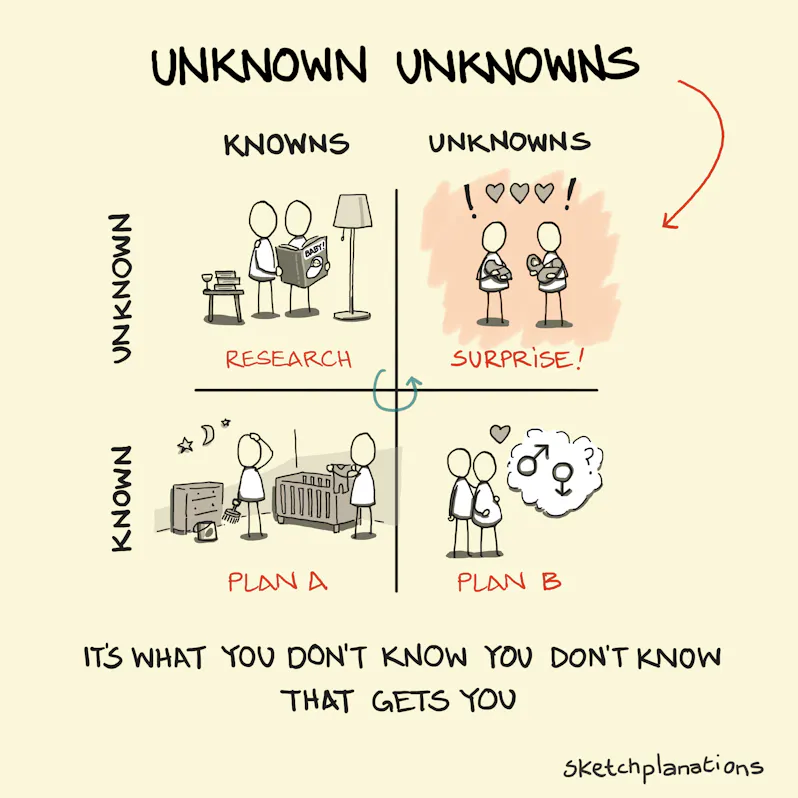
When placed in a 2x2, somewhat like I have done, some people have referred to it as the Rumsfeld Matrix (although he didn't invent it), or the Awareness—Understanding Matrix. I prefer diving straight into Unknown Unknowns as they're the crux of it.

For example:

Say you find out you're going to have a baby. There's a lot you know and a lot you know you don't:

Unknown Knowns — things you know that people know about being a parent and having a baby, but you just don't know them yet. Doing your research and homework transforms these into Known Knowns.

Known Knowns are the things you already know (or just learned) you'll need to do when you're a parent. Your baby will need feeding and changing, clothes, a place to sleep etc. You plan for these, you buy clothes, a crib, and learn about breastfeeding or the bottle.

Known Unknowns — Things like the baby's gender, or whether they'll arrive early or late. You know you don't know these yet, but you can make a plan either way.

Finally, there are Unknown Unknowns — which, in this case, could be that, despite all your plans, you find yourself with twins.

Or, say you plan to start a café:

Unknown Knowns

What you know is knowable, but you don't know it, yet

You can find data on the market, the costs, and potential customers. These things can be known through research—others know them—but you didn't know them.

Known Knowns

What you know you know

Your costs, your product, your route to market, everything you learned in your research. You make your plan around these.

Known Unknowns

What you know you don't know

How people will respond to your product, how fast sales will be, and whether your rent will change.

Unknown Unknowns

What you didn't know you didn't know

Just as you launch your café, Starbucks moves in next door, or we hit a global pandemic.

It's what you don't know, that you don't know, that gets you. After all, if you knew it, you'd have prepared for it.

He Who Knows

There's a well-known saying called "He who knows" which relates to Unknown Unknowns:

He who knows not, and knows not he knows not, is a fool; shun him.
He who knows not, and knows he knows not, is simple; teach him.
He who knows, and knows not he knows, is asleep; awaken him.
He who knows, and knows he knows, is wise; follow him.

Note that, like most interpretations of the Awareness/Knowledge-understanding framework, Unknown Knowns is interpreted as things you know but don't know you know. These might be implicit knowledge that you are yet to make a connection with.

Quotes and Ideas Relating to Unknown Unknowns

We have a host of sayings and thoughts that relate to this.

  • Nassim Nicholas Taleb's Black Swan events: if every swan you've ever seen is white, it's easy to assume that all swans are white, but the next one you see could be black.
  • The Lucretius problem, also from Taleb: We tend to believe the biggest event we've seen is the biggest that could happen. For example, we test our financial models against the most significant market crashes, but each was bigger than any that had hit before.
  • In theory, practice is the same as theory, but not in practice.
  • No plan survives contact with the enemy — from Prussian Field Marshal Helmuth von Moltke the Elder
  • It has often and confidently been asserted, that man's origin can never be known : but ignorance more frequently begets confidence than does knowledge : it is those who know little, and not those who know much, who so positively assert that this or that problem will never be solved by science. — Charles Darwin, The Descent of Man (1871) introduction

Whatever our plans, or what we think we know, or even what we think we know we don't know, we must adapt to succeed.

Related Ideas to Unknown Unknowns

Unknown unknowns evidently weigh heavily on me, as I seem to have drawn many more related ideas:

24 May 14:04

Ceci n’est pas un missile, mais un obus propulsé par un statoréacteur !

by Sylvain Biget, Journaliste
Au coup de feu, un boum, puis un énorme sifflement semblable à celui d’un réacteur. Voici l’obus de 155 mm du futur : une munition qui est propulsée par un statoréacteur, pour une portée quatre fois plus importante qu’un obus classique.
24 May 14:02

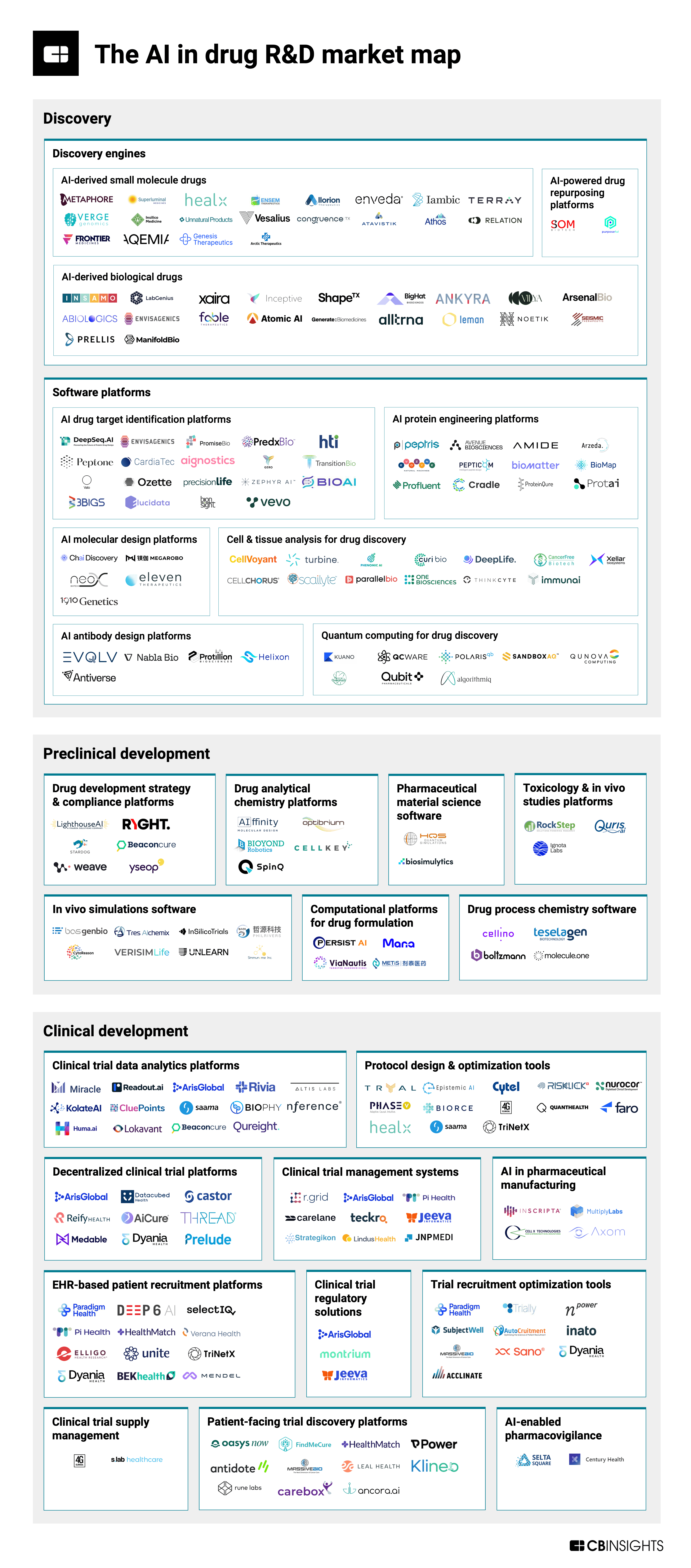
The AI in drug R&D market map

by Ellen Knapp

Billion-dollar drug development costs are redefining pharmaceutical priorities. R&D expenses have increased tenfold since the 1980s (after adjusting for inflation), and pharmaceutical companies now allocate approximately 25% of their revenue to R&D – nearly double the share seen in the early 2000s. 

In response to these cost pressures, pharma companies are using AI to make R&D more efficient. These capabilities enable organizations to quickly identify and evaluate promising drug candidates, influencing the selection of therapeutic approaches that advance to development.

AI could potentially cut years off the discovery process and compress clinical trial times by up to 30%. This would accelerate the delivery of new treatments to patients, unlock novel treatment approaches, and enable more personalized medicine. Companies that effectively leverage these AI capabilities will gain crucial advantages in speed, precision, and breakthrough discoveries.

Get the world’s best tech research in your inbox

Billionaires, CEOs, & leading investors all love the CB Insights newsletter

Our analysis maps 225 AI-driven drug R&D companies across 27 markets. Below the map, we break down several trends shaping the future of pharmaceutical innovation, as well as share the methodology we used to select and categorize companies.

Please click to enlarge.

Note: This market map is not intended to be exhaustive, and categories are not mutually exclusive. For more, see the detailed methodology at the bottom of this report.

Key takeaways

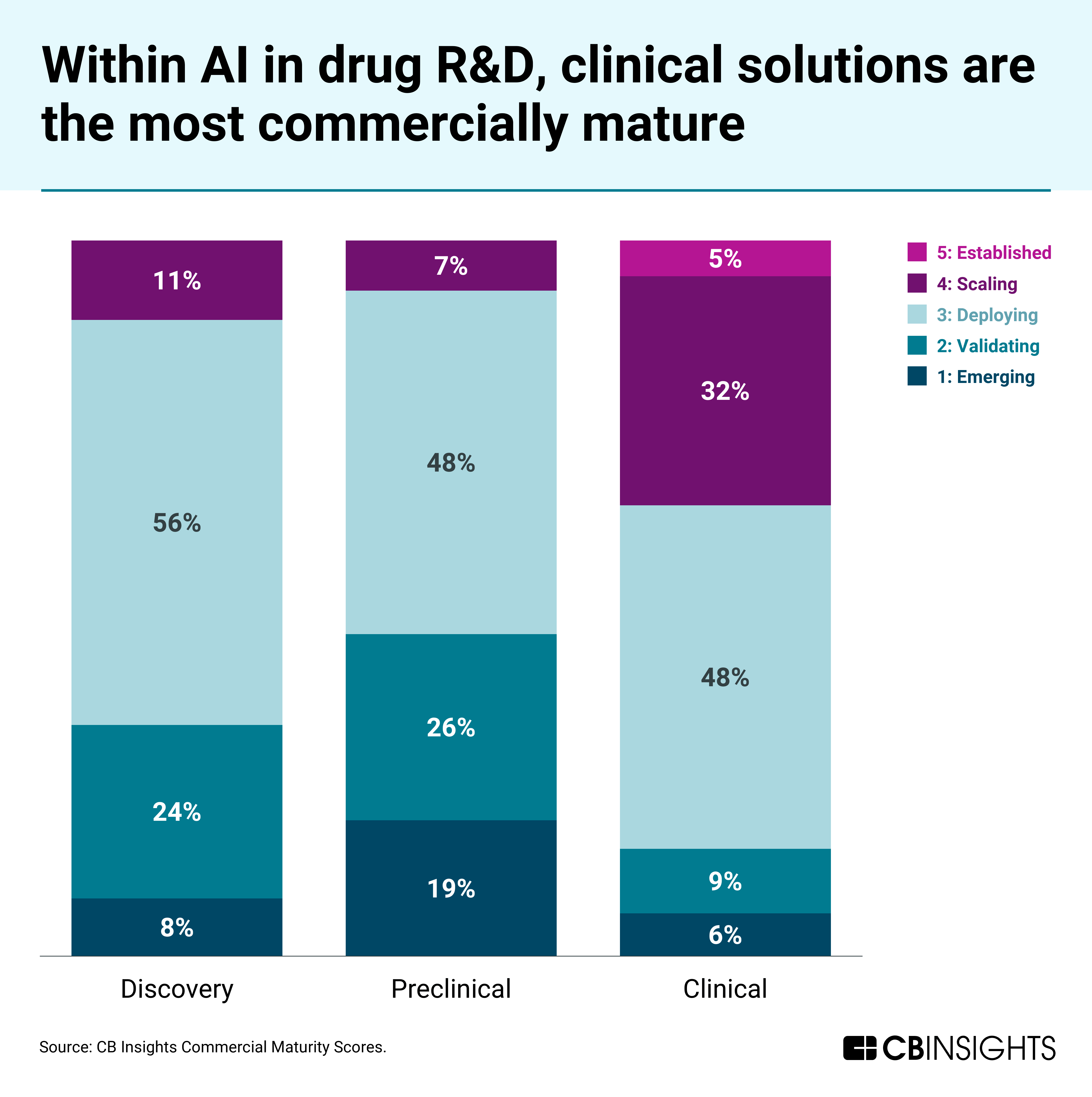
    • AI tools for clinical development are more commercially mature than the emerging field of preclinical applications. According to CB Insights’ Commercial Maturity scores, 37% of clinical development companies have reached the most mature commercial stages (4: Scaling or 5: Established) compared to just 7% of preclinical companies. Late-stage funding follows a similar pattern — 9% of clinical development funding since 2023 has gone to late-stage companies, compared to just 3% for preclinical tools.
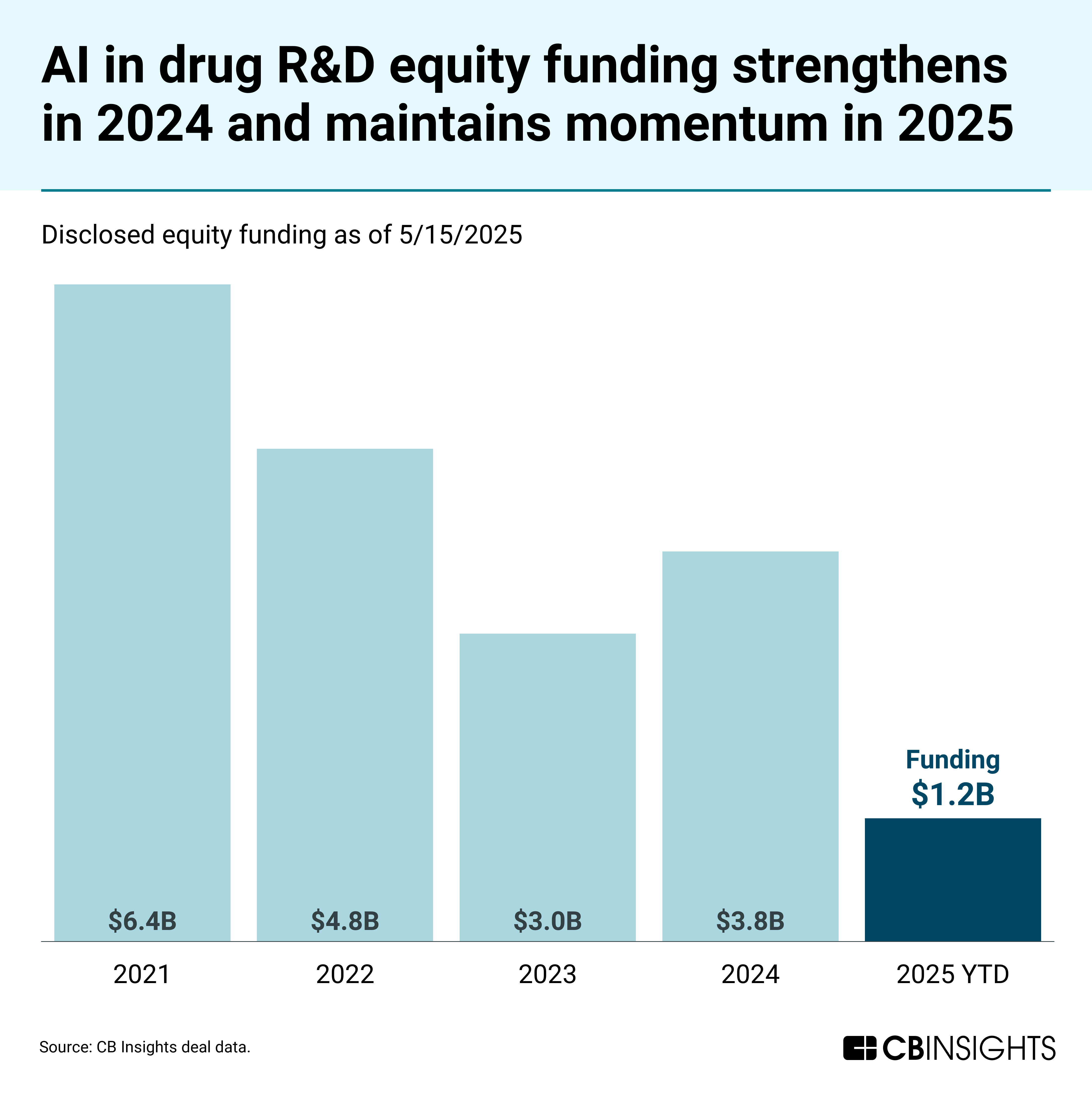
    • AI funding in drug R&D rebounded in 2024, with discovery engines capturing the majority of investments amid consolidation in the clinical trial sector. In 2024, equity funding grew to $3.8B (up from $3B in 2023), with AI-derived biologics and small molecules attracting $1.1B and $1B, respectively. Early 2025 momentum suggests the sector is on track to match last year’s strong performance.
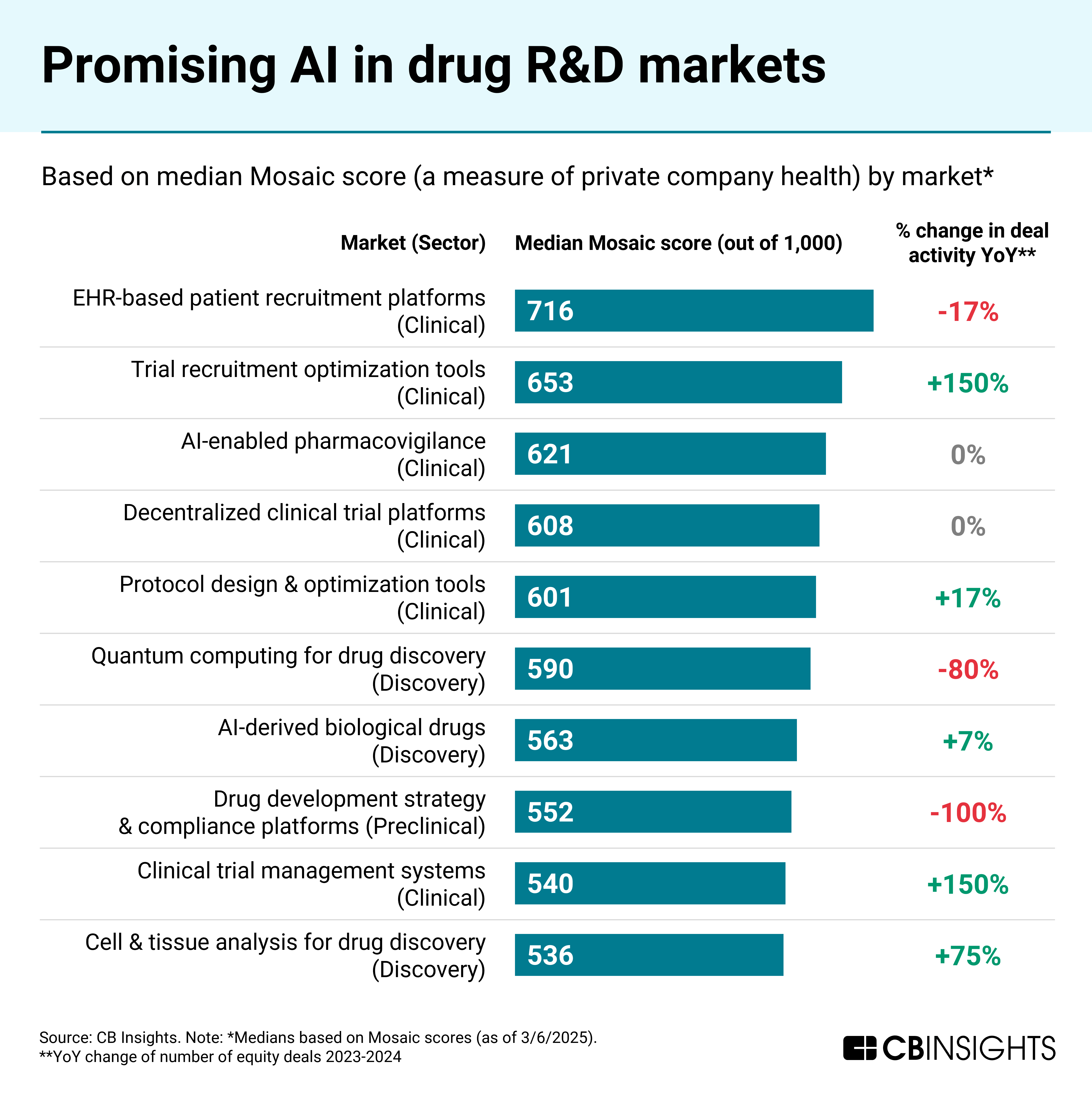
    • Patient recruitment platforms and clinical trial management systems demonstrate the strongest momentum. Examining market performance through average CB Insights Mosaic scores (a proprietary measure of private-company health and growth), EHR-based recruitment platforms lead (716 out of 1,000), while trial management systems show highest deal growth (+150% YoY). Look to these markets as high-growth areas to track within the AI drug R&D space.

Clinical development AI tools have achieved commercial maturity, while preclinical applications offer emerging investor opportunities

The adoption of AI in drug R&D is still emerging, and its pace varies across different sectors.

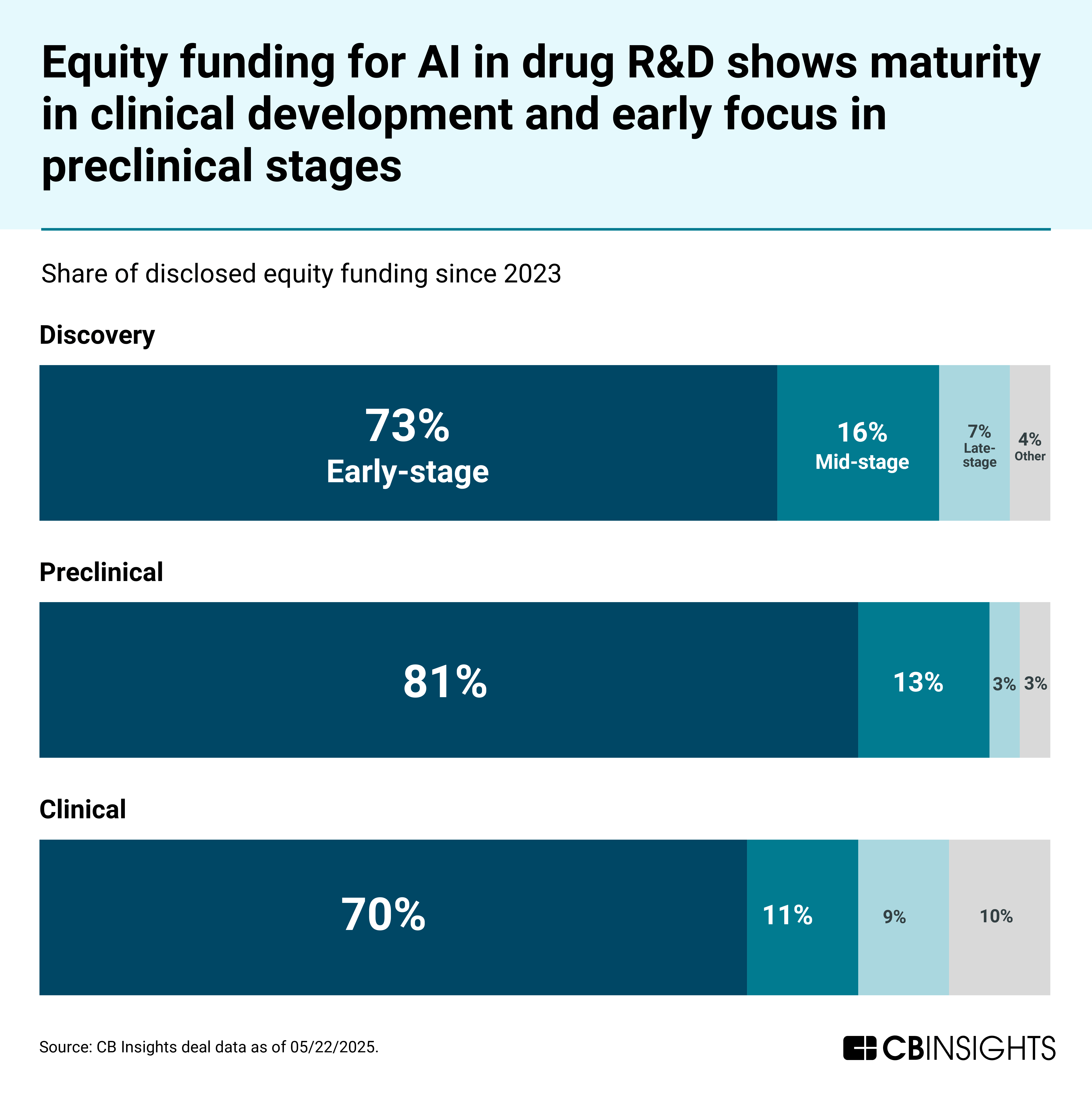
While early-stage funding dominates all sectors, preclinical development remains the most nascent, with 81% of funding since 2023 directed to early-stage deals and only 3% to late-stage deals. 

Clinical development shows greater maturity — still led by early-stage deals, but with a more established cohort of companies in later stages (70% early-stage, 9% late-stage funding).

CB Insights’ Commercial Maturity metrics further highlight this disparity. 

In preclinical development, 45% of companies are in the earliest commercial stages (1: Emerging and 2: Validating) compared to 32% in discovery and just 15% in clinical development. 

Conversely, only 7% of preclinical companies have reached the most mature stages (4: Scaling or 5: Established) vs. 11% in discovery and a substantial 37% in clinical development.

The disparities in maturity stem from each sector’s unique characteristics:

  • Clinical development AI solutions often build upon existing healthcare technology infrastructure, facilitating faster adoption. 
  • The use of AI in discovery carries higher investment risks as companies develop unproven molecules from scratch. 
  • Preclinical development, positioned mid-pipeline, offers more specialized solutions and faces stricter regulatory scrutiny, explaining its slower advancement despite growing momentum.

For investors, this creates a clear distinction: Clinical development companies provide stronger near-term return potential, while the emerging preclinical space offers better opportunities to establish early market advantages.

CBI iconExplore all 700+ AI in drug R&D companies
Drug R&D AI funding recovers as discovery engines lead investments amid clinical trial sector consolidation

After declining YoY between 2021 and 2023, equity funding across AI in drug R&D rebounded in 2024, growing from $3B to $3.8B and significantly surpassing pre-pandemic levels ($2.7B in 2019). The momentum continues in 2025, which, after Q1, is on pace to match 2024’s performance, bolstered by Isomorphic Labs‘ $600M Series A round in March 2025.

Among markets, discovery engines led funding in 2024, with AI-derived biologics securing $1.6B in equity funding and AI-derived small molecules attracting $1B. This aligns with these companies’ higher funding requirements for developing therapeutics and conducting clinical trials. It also demonstrates investors’ strategic bets on AI’s potential to slash drug discovery timelines — with discovery engines serving as the primary vehicles to prove this capability.

Enveda stands out here, having raised a $130M Series C in November 2024, followed by an additional $20M investment from Sanofi in February 2025 — a strong endorsement of its platform, which combines machine learning, metabolomics, and robotics to identify novel compounds from medicinal plants. The company’s recent collaboration with Microsoft Azure (May 2024) further positions it to scale its generative AI capabilities.

Beyond discovery engines, quantum computing platforms had an exceptional 2024, raising $376M, while decentralized clinical trial platforms followed, securing $129M. Huma led the latter group with an $80M Series D round in July 2024, while the market simultaneously underwent a wave of consolidation, with 5 acquisitions in 2024 alone, doubling all exits since 2020. 

However, among these acquisitions, only Aparito (purchased by Eli Lilly in July 2024) leverages AI in its offerings through its Atom5 platform, which enables comprehensive remote data collection and AI-powered data analysis.

CBI iconAnalyze AI in drug R&D deals

Patient recruitment and quantum computing lead commercial momentum in AI-driven R&D

According to CB Insights’ Mosaic scores, the highest-momentum AI markets across phases of drug R&D are: 

Among these high-potential sectors, several companies are making significant advances. 

SandboxAQ (Mosaic score: 843) leads in the quantum computing space; its 2023 release of the AQBioSim technology stack combines AI and quantum algorithms to predict molecular behavior and accelerate drug discovery. This expansion into biotech applications attracted Sanofi, resulting in a partnership in October 2024. 

In the regulatory domain, Weave (Mosaic score: 575) has positioned itself as an early mover in AI-driven regulatory automation for life sciences. Its AutoIND platform, launched in 2024, claims to reduce IND application timelines by up to 70%. 

Among these top 10 markets, trial recruitment optimization tools and clinical trial management systems showed the most growth in deals from 2023 to 2024. This illustrates increasing investor confidence in technologies that address critical bottlenecks in clinical trial efficiency and challenges related to patient enrollment.

In these markets, the companies with the highest Mosaic scores demonstrate rapid advancement and growing investment appeal:

  • In the clinical trial management space, Lindus Health (Mosaic score: 874) secured a $55M Series B round in January 2025 and established a partnership with the Clinical Data Interchange Standards Consortium (CDISC) in February 2025. This collaboration with CDISC — a nonprofit that sets standards mandatory for FDA submissions — focuses on automating data standardization using Lindus Health’s AI platform for trial protocol generation and analysis.
  • Paradigm Health (Mosaic score: 822) leads in trial recruitment optimization with its AI-driven platform for patient recruitment and trial management. Its deployment across 400 research sites and 1,000 healthcare provider locations in 3 countries helped it secure a $203M Series A in January 2023. In November 2024, Japan’s National Cancer Center selected Paradigm for its nationwide clinical trial network to advance precision medicine initiatives, expanding the company’s footprint in the Asian oncology research market.

These market signals suggest AI’s most immediate and transformative impact on drug development will come not from scientific breakthroughs alone, but from technologies that systematically eliminate the operational inefficiencies that have historically extended development timelines and inflated costs.

CBI iconDive into all drug R&D tech markets

Methodology

To identify players for this market map, we reviewed AI companies in drug R&D markets and included startups with a Mosaic score of 400+ that have raised funds within the last 5 years. For markets where these criteria identified more than 20 companies (AI-derived small molecule drugs, AI-derived biological drugs, and molecular design platforms), we selected those that had raised at least $20M in funding. If further reduction was needed, only companies in the top 20 Mosaic scores are shown. 

Categories on the market map align with our recent 3-part series on AI in drug R&D:

  • Discovery encompasses workflows from project inception through lead selection, where discovery platforms are companies whose products are AI software systems, while discovery engines are companies whose products are therapeutics discovered using proprietary AI systems. 
  • Pre-clinical development covers lead development to the first regulatory filing (an Investigational New Drug (IND) application in the United States)
  • Clinical development spans from the start of clinical trials through commercialization

For information on reprint rights or other inquiries, please contact reprints@cbinsights.com.


. . . . . . . . . . . . . . . . . . . . . . . . . . . . . . . . . . . . . . . . . . . . . . . . . . . . . . . . . . . . . . . . . . . . . . . . . . . . . . . . . . . . . . . . . . . . . . . . . . . . . . . . . . . . . . . . . . . . . . . . . . . . . . . . . . . . . . . . . . . . . . . . . . . . . . . . . . . . . . . . . . . . . . . . . . . . . . . . . . . . . . . . . . . . . . . . . . . . . . . . . . . . . . . . .

The post The AI in drug R&D market map appeared first on CB Insights Research.

24 May 14:00

Une IA bouleverse 50 ans de certitudes sur ces étranges structures martiennes 🔴

by Cédric DEPOND
Les stries sombres qui zèbrent les pentes martiennes interrogent les scientifiques depuis des décennies. Une étude récente, s'appuyant sur l'intelligence artificielle, élimine l'hypothèse de...
24 May 13:59

Liens vagabonds : Génération connectée, génération en quête de déconnexion

by oansah

Ils sont nés avec Internet dans la poche, et pourtant… 47 % des jeunes de 16 à 21 ans déclarent qu’ils préféreraient “être jeune dans un monde sans Internet”. Une aspiration choc, qui soulève une question essentielle : que signifie “être jeune sans Internet” pour une génération qui n’a jamais vécu déconnectée ?  S’agit-il de vivre […]

The post Liens vagabonds : Génération connectée, génération en quête de déconnexion first appeared on Méta-media | La révolution de l'information.

24 May 13:51

Exclusive: Rivet Industries Using Lumus Waveguides for Military & Industrial AR

by Karl Guttag

Introduction

On Tuesday, May 13th, the first day of the Display Week Expo, a couple of people asked me if I had heard of this new company, “Rivet,” which I hadn’t heard of up to that point. I asked around at Display Week, and a few other people knew something about them but couldn’t talk. I was able to confirm that several of the key people worked at Microsoft on HoloLens (several people at Rivet, including the CEO and CTO, worked on HoloLens at Microsoft).

It wasn’t until I got back home that I had time to do some more research about Rivet and, more importantly for this article, figure out what technology they were using. As it turns out, Rivet’s display and optics technology were hiding in plain sight on their website, Rivet.us. Consider it a hobby of mine to try to figure out what is inside AR glasses when the companies won’t say what they are using, as I discussed in my last article: Meta Hypernova and Google AR/AI Glasses – Lumus & Avegant Inside, Both Using LCOS MicroDisplays.

AWE on June 10-12, 2025 (Attending and Speaking)

For anyone wanting to meet me, I will be at AWE on June 10-12. I’m happy to meet with both companies and individuals. Please email me at meet@kgontech.com if you want to meet. I’m also going to be speaking on Thursday, June 12th, from 10:30 AM -10:55 AM in the Promenade Room 104 B.

Rivet Industries

Rivet Industries (hereafter Rivet) emerged from stealth mode just before Display Week 2025 and has created a bit of a buzz in the AR industry. According to PitchBook, Rivet raised $12.6M in its last round (there were probably prior rounds), but perhaps more importantly, Rivet appears to have some powerful connections (more on these connections later).

Rivet is aimed at Defense, Security, and Industrial applications. Still, most of the images on the website make it look like a direct competitor for the US Army’s $22B IVAS program that was first “won” by Microsoft’s HoloLens 2. It was widely known that the Army was dissatisfied with the HoloLens 2, which opened the door to other options before much of the IVAS money was paid out. In February 2025, it was announced that Andruil would take over Microsoft’s HoloLens contract, and the US Army approved this in April 2025.

I contacted Rivet with some of the pictures used in this article that proved that Lumus waveguides were in its AR glasses, and they responded nicely, but without answering the question about Lumus:

Rivet develops modular systems configured for the unique needs of defense and industrial tasks. We design, select, and integrate components to suit user and operational performance requirements. We will continue to release details and FAQs on our public website, www.rivet.us.

I have been told that the pictures on their website are of working devices.

Proof of Lumus Z-lens and Maximus Waveguides Used by Rivet

After returning from Display Week, I started looking through every picture on Rivets’ website. In most of the pictures, the glasses were so small that any detail was lost, and in others, the contrast or lighting made it impossible to see any details. I downloaded a few pictures that looked like they best showed glasses and looked blown up on my computer.

Rivet Glasses with Lumus Z-Lens

My first eureka moment happened with a picture (right) on Rivet’s contact page (still there as of this writing). On the lower right corner of the right lens (as you look at the pictures, the user’s left eye), I could see some faint lines indicative of the Lumus Z-Lens’s vertical pupil expansion reflective facets. I have been covering Lumus’s Z-Lens since CES and AR/VR/MR 2023, so I was very familiar with how it looks.

To help you see it better, I cropped the pictures above to just the glasses and then enlarged and enhanced (simple sharpened, lightened, and improved the contrast – no AI) in the picture below. I have also added a picture I took of the Z-lens at AWE 2024 out of the glasses for reference. That Z-Lens has push-pull prescription lenses (by AddOptics) glued directly (with no air gap) to the Z-Lens waveguide. You can see the Z-Lens vertical pupil expansion facets pointed at by the arrow. Most of the facets are covered by a black layer, but a few are visible at the bottom.

Knowing that I had found a Lumus Z-Lens in one picture, I started looking for evidence of it in other pictures and found the one on the right, shot from behind the waveguide. You can see the expansion facets (right at the arrow).

Lumus has shown Z-Lens waveguides that support up to a 50-degree FOV and typically use LCOS microdisplays. As I wrote last time in Meta Hypernova and Google AR/AI Glasses – Lumus & Avegant Inside, Both Using LCOS MicroDisplays, Lumus’ 30-degree FOV Z-lens with an LCOS microdisplay is suspected to be inside the rumored Meta Hypernova AR/AI Glasses. I would expect that the larger 50-degree Z-lens would be the Rivet. I should also note that Lumus has presented 70-degree Z-Lens waveguides in development that will also use relatively low-index glass, rather than higher-index glass used by diffractive waveguides or the more exotic Silicon Carbide, such as Meta’s Orion (see: Meta Orion AR Glasses (Pt. 1 Waveguides)).

Rivet Glasses with Lumus Maximus

Having found the Z-Lens in a couple of photos, I later went back to see if I could find more evidence. To my surprise, I was able to see the horizontal expansion facets indicative of a Lumus Maximus waveguide in the picture (right) on Rivet’s “Hard Spec” page (as of this writing).

Rivet’s website picture contains many distracting orange circles (perhaps by design to conceal the glasses). To make the Lumus Maximus waveguide more visible, I processed it in Photoshop to reduce the orange color and adjusted the brightness, contrast, and sharpening (no AI). I have additionally added a picture that I took when writing the 2021 article, Exclusive: Lumus Maximus 2K x 2K Per Eye, >3000 Nits, 50° FOV with Through-the-Optics Pictures for comparison. You may also notice that the engine on the side of the Rivet glasses looks to be similar to that of the Lumus Maximus.

Comparison of Rivet’s Z-Lens Based on Maximus-Based Glasses

The exterior frames of the Z-Lens and Maximus-based Rivet designs look very similar (see below). The picture with the orange circles is the only one I found on Rivet’s website that clearly uses the Lumus Maximus waveguide. However, this could be due to Rivet’s prototype development process and what was ready for pictures, and it is not indicative of what they will use in their product. I have no idea whether Rivet plans to use Maximus or Z-lens or both in their series of products.

Lumus Geometric Waveguides

Lumus, unlike most others, uses a geometric (also known as reflective) waveguide. In my experience, they offer much better color uniformity than the more common diffractive waveguides. They are also the most transparent, with about 90% transmissivity. Typically, Lumus engines are much brighter than their diffractive counterparts, with light output (to the eye) on the order of 1,000 to 3,000 nits. Lumus waveguides are inherently more optically efficient than diffractive waveguides, which contributes to the greater brightness.

Lumus’s Maximus, like the Z-Lens, uses glass with a lower index of refraction than typical diffractive waveguides. Unlike the Z-Lens, the Maximus waveguides require an air gap when used with push-pull and prescription lenses. My understanding is that the Maximus has better light throughput efficiency than the Z-Lens, but may be more expensive to make and requires an air gap when bonding other optics to it.

Originally, Lumus only had 1-D pupil expanding waveguides, which resulted in rather large optical engines. Lumus found its way into many military and a few industrial products. Lumus’s first geometric 2-D expanding waveguide was the Maximus, introduced in 2023, which enabled a much smaller LCOS optical engine. The Z-lens took this a step further with even smaller LCOS optical engines and the ability to bond other optics directly to the waveguide.

There are also several “clones” of Lumus’s geometric technology, mostly coming out of China. I have never seen any that look nearly as good in terms of uniformity as the Lumus models. Lumus also touts a very strong patent portfolio on its technology.

Teaser On Lumus Maximus with a Fantasically Tiny MicroLED Projector

At last week’s Display Week, Lumus demonstrated a very small projector using a Playnitride full-color MicroLED (using Quantum Dot color conversion) connected to their Maxmus waveguides. They also showed me that they have a working (but not publicly shown), what I can best describe as a fantastically tiny MicroLED projectormore on this, complete with pictures, in my next article.

Small World – Peter Thiel, Palantir Technologies, Anduril, Microsoft HoloLens, and IVAS Connections to Rivet

In searching the internet to learn more about Rivet, I stumbled across some interesting “connections.” In “Six Degrees of Kevin Bacon” terms, they are either one or, at most, two degrees of separation.

While Rivet was founded in 2024, it has some royal roots. Several of the founders and early employees came from Microsoft’s HoloLens IVAS program. Rivet’s founder and CEO, Dave Marra, was at Microsoft from 2013 to January 2023, and for five of those years, he was the Program Director for the HoloLens IVAS program. Mohit N. is the CTO of Rivet and was the Vice President Of Engineering, Augmented and Virtual Reality Core Technologies at Microsoft HoloLens.

Rivet CTO Marra left Microsoft in January 2023 and became the head of Mixed Reality at Palantir Technologies, a large data software company for military, government, and corporate use. Marra Founded Rivet in or about January 2024 while staying on at Palantir as a Strategic Advisor until January 2025 (according to his LinkedIn profile).

Significantly to the Rivet story, famous entrepreneur Peter Thiel is one of the founders and the current Chairman of Palantir. In 2014, Thiel convinced Trae Stephens to join Thiel’s VC firm, Founders Fund. Then, in 2017, with backing from Thiel’s Founders Fund, Stephens co-founded Aduril with former Oculus founder Palmer Luckey.

In addition to Rivet CEO Marra, two Palantir executives are listed by Bizapedia as directors of Rivet. One of those directors, Akash Jain, CTO and President, USG, Palantir, is quoted on Rivet’s website, “Working with Rivet, we are extending human skills with intelligent systems for precise, data-determined action anywhere.” Rivet also lists Palantir as one of their “Partners” and states, “Palantir is redefining workforce capabilities at the edge with AI-powered spatial intelligence.” The other “partner” listed on Rivet’s site is the defense contractor Northrop Grumman.

I don’t know if Rivet has any direct connection to Anduril, whether they are frenemies or perhaps may become partners. Still, several of the big-name players from Anduril and Rivet, at least, know each other. It is not clear whether Rivet is directly competing for future IVAS contracts. Anduril seems more focused on military and other government-related products, whereas Rivet says they are also going after industrial markets. Rivet claims to have a modular design that can be adapted for different markets.

There Is a Big Hole in the Enterprise/Industrial Market Left by HoloLens’s Exit

One thing I keep hearing is that multiple former HoloLens customers are looking for a next-generation product to fill the gap left by Microsoft’s abandonment of HoloLens in the Enterprise/industrial market. While the HoloLens 2 had horrible image quality, as this blog has documented, many companies found HoloLens 1 & 2 useful.

While widespread consumer adoption of augmented reality is still speculative, the value of AR in enterprise/industrial applications seems obvious. The “elevator speech” for the value proposition AR in enterprise applications is simple:

If AR can help a worker be just a few percent more productive, then even expensive AR glasses/headsets will pay for themselves within a few months. Combining AR headsets with cameras and AI, they can also detect any quality issues and give instantaneous feedback to improve quality.

Enterprise headsets are not limited by the consumer market’s severe “look like ordinary glasses” and cost constraints of the consumer market. This enables the integration of more processing, wider FOVs, SLAM, and Multiple cameras.

In addition to Rivet, the Digilens Argo is another product I would put in this space. I have written about Argo several times, including here, and discussed it in a video with Brad Lynch here.

Conclusion

I believe there is a solid market for the type of products that Rivet is trying to address. While not the potential unit volume of smart glasses with displays, there is a much more solid business case that can be made for Rivet’s type of products. I was disappointed by what I thought were poor design choices taken by Microsoft HoloLens and Magic Leap in the past.

Lumus has been demonstrating Maximus (in 2021) and Z-Lens (in 2023) prototype glasses to me for many years. Their combination of image quality, transparency, efficiency, and support of wider FOV in glass has seemed to be a big advantage over diffractive waveguides. I have been waiting to see these Lumus 2-D expanding waveguides in products. With Rivet use and the rumors of Lumus being in Meta’s Hypernova, it looks like Lumus waveguides are may be finally making it to market in a big way.

Rivet, with some of its founders and early employees’ roots in Microsoft’s HoloLens, seems to be applying lessons learned from HoloLens. They are going with Lumus waveguides, which, as I demonstrated in Exclusive: Lumus Maximus 2K x 2K Per Eye, >3000 Nits, 50° FOV with Through-the-Optics Pictures, blows away the HoloLens 2 in image quality and resolution and with a similar FOV (see pictures below taken with the same camera and lens). Lumus’s 2021 Maximus was using a Compound Photonics 2K by 2K LCOS display. As was the first to report in January 2022 in Exclusive: Snap Buying Compound Photonics (LCOS and MicroLED), Snap bought compound photonics. Since then, Lumus has coupled its waveguides to Raontech’s LCOS devices (and perhaps others).

HoloLens 2 used a complex “butterfly” diffractive waveguide combined with a laser beam scanning projector (see HoloLens 2 Display Evaluation (Part 4: LBS Optics)). Microsoft likely spent hundreds of millions, if not billions, of dollars on R&D and manufacturing development on both the waveguide and LBS projector for a terrible (in terms of image quality) result, which left me shaking my head. The Rivet team seems to have learned from that mistake and is leveraging Lumus’s waveguides and LCOS displays.

As I wrote in my last article about Hypernova and Google XR, I don’t understand why the large companies in the AR space have spent so much on certain technologies in areas with a lot of competitive IP, such as diffractive waveguides, while overlooking the likes of Lumus and Avegant.

24 May 13:41

Valve Founder’s Neural Interface Company to Release First Brain Chip This Year

by Scott Hayden

Valve founder Gabe Newell’s neural chip company Starfish Neuroscience announced it’s developing a custom chip designed for next-generation, minimally invasive brain-computer interfaces—and it may be coming sooner than you think.

The company announced in a blog update that it’s creating a custom, ultra-low power neural chip in collaboration with R&D leader imec.

Starfish says the chip is intended for future wireless, battery-free brain implants capable of reading and stimulating neural activity in multiple areas simultaneously—a key requirement for treating complex neurological disorders involving circuit-level dysfunction. That’s the ‘read and write’ functions we’ve heard Newell speak about in previous talks on the subject.

Mike Armbinder (left) and Gabe Newel (right) | Image courtesy Valve

The project aims to overcome current limitations of minimally-invasive neural interface implants, which are often bulky, power-hungry, and difficult to scale across multiple brain regions.

Current clinical technologies, like Elon Musk’s Neuralink (approved by the FDA in 2023), typically focus on single-region intervention in the brain’s motor cortex. In contrast, Starfish hopes to reduce surgical burden through miniaturization, making implants easier to place across multiple sites.

And at just 2 × 4mm, Starfish’s chip is tiny. If you never imaged reading a brain chip spec sheet from a company founded by Valve’s Gabe Newell, well, welcome to the future. Starfish’s first brain chip boasts:

  • Low power: 1.1 mW total power consumption during normal recording 
  • Physically small: 2 x 4mm (0.3mm pitch BGA) 
  • Capable of both recording (spikes and LFP) & stimulation (biphasic pulses) 
  • 32 electrode sites, 16 simultaneous recording channels at 18.75kHz 
  • 1 current source for stimulating on arbitrary pairs of electrodes 
  • Onboard impedance monitoring and stim voltage transient measurement 
  • Digital onboard data processing and spike detection allows the device to operate via low-bandwidth wireless interfaces. 
  • Fabricated in TSMC 55nm process

It’s still early days though. The company is now calling for early-stage collaborators—particularly those working in wireless power delivery, communication, and implantable neural devices—to explore novel applications of this technology ahead of its expected availability in late 2025.

As Newell has long suggested, the real potential lies beyond medicine, noting back in 2023 that “we’re way closer to ‘the Matrix’ than people realize.”

“I think connecting to people’s motor cortex and visual cortex is going to be way easier than people expected and doing things like […] reading and writing to somebody’s motor cortex is way more of a tractable problem than making people feel ‘cold’. And you never would have guessed that,” Newell said in a 2023 interview with IGN. “And I never would have guessed that before going into it. It turns out your brain has really good interfaces for some things and really badly designed, kludgy interfaces for doing other things. And the fact that your immune system gets involved in your perception of temperature means there’s all sorts of weird parts of your brain that participate in the sensation of being cold, whereas your motor cortex [or] your visual cortex are much more tractable problems.”

In 2019, prior to his departure from Valve, the company’s Principal Experimental Psychologist Mike Ambinder also gave some insight into how brain-computer interface might inform immersive games.

“We can measure responses to in-game stimuli. And we’re not always getting [data] reliably, but we’re starting to figure out how. Think about what you’d want to know about your players. There’s a long list of things we can get right now with current technology, current generation analysis, and current generation experimentation,” Armbinder said in his GDC 2019 talk, which was entitled Brain-Computer Interfaces: One Possible Future for How We Play.


Thanks to Brad ‘SadlyItsBradley’ Lynch for pointing us to the news.

The post Valve Founder’s Neural Interface Company to Release First Brain Chip This Year appeared first on Road to VR.

24 May 13:40

Infrared contact lenses let you see in the dark

by Jennifer Ouellette

Tired of using bulky night vision goggles for your clandestine nocturnal activities? An interdisciplinary team of Chinese neuroscientists and materials scientists has developed near-infrared contact lenses that enabled both mice and humans to see in the dark, even with their eyes closed, according to a new paper published in the journal Cell.

Humans and other mammals can only perceive a limited range of the electromagnetic spectrum (light), usually in the 400–700 nm range. There are creatures that can see in infrared (snakes, mosquitoes, bullfrogs) or ultraviolet (bees, birds), and goldfish can perceive both. But humans must augment themselves with technology in order to expand our range of vision.

Night vision goggles and similar devices have been around since the 1930s, including infrared-visible converters, but these require external energy sources, and the converters have a multilayer structure that makes them opaque and hence challenging to integrate with a human eye. The authors previously were able to confer near-infrared vision to mice by injecting nanoparticles that bind to photoreceptors into their eyes—basically creating a near-infrared nanoantenna—but realized that most people would be averse to the prospect of sticking needles in their eyes. So they looked for a better alternative. Contact lenses seemed the obvious choice.

Read full article

Comments

23 May 12:55

Foil Leyden Jar Helps Bring Crookes Tube to Life

by Seth Mabbott
Crookes Tube

It might be too soon to consider the innards of the old CRT monitor at the back of your closet to be something worth putting on display in your home or workshop. For that curio cabinet-worthy appeal, you need to look a bit further back. Say, about 150 years. Yes, that’ll do. A Crookes tube, the original electron beam-forming vacuum tube of glass, invented by Sir William Crookes et al. in the late 19th century, is what you need.

And a Crookes tube is what [Markus Bindhammer] found on AliExpress one day. He felt that piece of historic lab equipment was asking to be put on display in proper fashion. So he set to work crafting a wooden stand for it out of a repurposed candlestick, a nice piece of scrap oak, and some brass feet giving it that antique mad-scientist feel.

After connecting a high voltage generator and switch, the Crookes tube should have been all set, but nothing happened when it was powered up. It turned out that a capacitance issue was preventing the tube from springing to life. Wrapping the cathode end of the tube in aluminum foil, [Markus] formed what is effectively a Leyden jar, and that was the trick that kicked things into action.

As of this writing, there are no longer any Crookes tubes that we could find on AliExpress, so you’ll have to look elsewhere if you’re interested in showing off your own 19th century electron-streaming experiment. Check out the Crookes Radiometer for some more of Sir Williams Crookes’s science inside blown glass.