 A new report claims that two unlikely partners may team up to acquire the world's second-largest mobile carrier. According to the Financial Times, Verizon (VZ) and AT&T (T) are working on a breakup bid for European carrier Vodafone (VOD) that would value the company at $245 billion, a 40% premium over its current valuation of $115. The deal would see Verizon take control of the 45% stake Vodafone currently owns in Verizon Wireless, while Vodafone's business outside of the U.S. would go to AT&T. Earlier reports suggested that Verizon and Vodafone were actively discussing ways to resolve their relationship in the form of a merger or possibly a full or partial buyout.
Bcstevieb
Shared posts
02 Apr 19:22
A new report claims that two unlikely partners may team up to acquire the world's second-largest mobile carrier. According to the Financial Times, Verizon (VZ) and AT&T (T) are working on a breakup bid for European carrier Vodafone (VOD) that would value the company at $245 billion, a 40% premium over its current valuation of $115. The deal would see Verizon take control of the 45% stake Vodafone currently owns in Verizon Wireless, while Vodafone's business outside of the U.S. would go to AT&T. Earlier reports suggested that Verizon and Vodafone were actively discussing ways to resolve their relationship in the form of a merger or possibly a full or partial buyout.
Verizon and AT&T could partner to acquire Vodafone
by Dan Graziano
A new report claims that two unlikely partners may team up to acquire the world's second-largest mobile carrier. According to the Financial Times, Verizon (VZ) and AT&T (T) are working on a breakup bid for European carrier Vodafone (VOD) that would value the company at $245 billion, a 40% premium over its current valuation of $115. The deal would see Verizon take control of the 45% stake Vodafone currently owns in Verizon Wireless, while Vodafone's business outside of the U.S. would go to AT&T. Earlier reports suggested that Verizon and Vodafone were actively discussing ways to resolve their relationship in the form of a merger or possibly a full or partial buyout.
02 Apr 19:20

Google engineers find a way to filter robocalls the way Gmail filters spam
by Adrianne Jeffries
The anti-robocall solution proposed by two Google engineers.
The Federal Trade Commission just announced the three winners of its Robocall Challenge, a contest meant to crowdsource the solution to the robocall scourge that prompts more than 200,000 consumer complaints every month. The first-place award was split between two individuals, programmers Aaron Foss and Serdar Danis. The "technology achievement award," reserved for a submission affiliated with a large company, went to two Googlers, Daniel Klein and Dean Jackson.
02 Apr 19:19

Outlook.com calendar finally gets a refreshed look and new features this week
by Tom Warren
Microsoft has long promised a calendar upgrade for its Outlook.com email service would be "coming soon," but the company is finally detailing its plans today. Microsoft will begin rolling out an updated version of its calendar for Outlook.com this week, with some improved features. One click access to event creation will be available, along with improved sharing options.
The new look and feel aligns the calendar with Microsoft's mail and contact options in Outlook.com, and looks familiar to the Windows Phone and Windows 8 versions. There are month, week, day, and agenda views, alongside access to tasks. Skype, LinkedIn, and Facebook can be integrated into the calendar along with birthday information, weather forecasts, and holidays....
02 Apr 19:18

Yahoo! Mail Partners With Dropbox To Add File Attachments, Brings Brand New Audience To File Hosting Service
by Drew Olanoff
It’s no secret that Yahoo! is overhauling all of its flagship products, including mail. The service has gotten a refresh on both the web and mobile, and today, the company has announced a partnership with file-backup and sharing service Dropbox.
The partnership will make it easier to send, receive and manage attachments in Yahoo! Mail. In case you’ve forgotten, Yahoo! Mail is still the No. 3 most-used mail service in the world behind Hotmail and Gmail. But the last time we checked, it was No. 1 in the United States. By acting nimbly, the company can add small tweaks and enhancements thanks to partnerships like this that will give it a potential edge against the competition.
This is good news for both companies, specifically Dropbox. This brings a new audience to the service, which has become a mainstay in the workplace and small teams of collaborators. The company has yet to crack the pure consumer, in-home, area, and Yahoo! has those users lined up and waiting to try new things. If users don’t have a Dropbox account, they can simply sign up for one via Yahoo! Mail. That also means more potential revenue for Dropbox once these users fill up their free 2GB.
Here’s what David McDowell, Senior Director of Product Management on Yahoo! Mail had to say about the partnership:
Starting today, Dropbox is available within Yahoo! Mail. This integration allows you to share and store files more easily, whether they are vacation photos or important documents like tax returns and research papers. And, because files can be stored in your Dropbox account online, it’s easy to find the files you want even when you are away from your desktop.
Dropbox is available within Yahoo! Mail for the Web in English, French, Spanish, German and Italian. For those of you new to Dropbox, you can quickly create an account from within Yahoo! Mail.
On the Dropbox blog, the company discusses the advantages of managing all of your attachments using their service, including not having to worry about file sizes. Additionally, you’ll be able to share whole albums of photos to emails, no doubt in a push from the recently acquired Snapjoy team, which is really handy. This will all be rolling out to everyone today.
This is the second major move that Dropbox has made in the email space, the first being the acquisition of popular, and hard to get into, mobile app Mailbox. Interestingly enough, sources tell us that Yahoo! was making a serious push to acquire Mailbox, so it’s fun to see them working together in one form another.
If you can’t acquire them, partner with them.
We’ve asked Yahoo! about whether this replaces the partnership that they have with YouSendIt, which basically allowed users to perform the same tasks that Dropbox does. We will update this post if/when we hear back.
UPDATE: A Yahoo! representative tells us that YouSendIt is still available as a file attachment option under “Applications” and “Attach Large Files.”
[Photo credit: Flickr]
02 Apr 19:15
 Done With This Post? You Might Also Like These:


Google Signs New Deals With Janrain And Gigya To Potentially Bring The Google+ Sign In To Basically The Entire Internet
by Eric Ravenscraft
 It was a little over a month ago that Google introduced Google+ Sign-In. The basic idea being the same as it is with Facebook and Twitter: use one account to access all your sites. So, what makes this different from those other networks? Well, allegedly this will result in less social spam and a better integrated experience. Oh, and also, now that Mountain View has signed deals with Janrain and Gigya, the big red button should be just about everywhere on the internet.
Between the two companies, the client list is gargantuan. Everything from major television networks, ISPs, online publications, and consumer brands are represented.
Done With This Post? You Might Also Like These: - Hootsuite Acquires Seesmic, Has Big Plans For Business Customers
- Google Intros Google+ Sign-In: 'Simple And Secure, Minus The Social Spam'
- Google+: Where Real Life Meets Social Networking
- [Review] My Taptu: Social Media + News + Eye Candy = Success
Google Signs New Deals With Janrain And Gigya To Potentially Bring The Google+ Sign In To Basically The Entire Internet was written by the awesome team at Android Police.
 |
 |
02 Apr 19:09

Firefox Updates with Per-Window Private Browsing, a New Download Manager, and More
by Melanie Pinola
Firefox's latest update offers better privacy controls and an easier downloading experience. Now you can browse privately in a new window without interrupting your current browsing session, better access and find your downloaded files, and also close hanging plugins without shutting down the entire browser.
On its company blog, Mozilla points out a few ways the new private browsing feature can help you out: Instead of being asked to save your session and closing your browser before opening a new private browsing window, now you can keep that session open while you privately shop for a birthday gift or check multiple email addresses simultaneously.
In addition, Firefox for Android now also supports private browsing on a per tab basis.
The video above showcases the new download manager in the Firefox toolbar—no more switching to another window to manage your downloaded files.
Read more about what's new in Firefox 20 or download it at Mozilla.org. Current users can just fire up their browser to check for the update.
Firefox Notes | Mozilla.org via The Mozilla Blog
02 Apr 19:07


Avengers 2 Will Be Assembled In The UK


They faced Loki and an alien armada in Avengers Assemble. Now, for the sequel, Earth’s Mightiest Heroes’ great nemesis will be fire. Because according to Screen Daily, the Avengers will be made out of pinewood. Wait... Studios. Pinewood-Shepperton studios. That makes more sense.
Yes, in move that makes our chests swell with more patriotic pride than endlessly singing 'God Save The Queen' could manage, it appears Marvel Studios has found a happy home – not to mention tax breaks – in the UK, as it has already shot Thor: The Dark World in Blighty and Guardians Of The Galaxy will be kicking off soon.
So it looks like noted Anglophile Joss Whedon will be able to sip a proper cuppa as he commands Robert Downey Jr., Chris Evans, Chris Hemsworth, Mark Ruffalo and the rest to do his benevolent, dictatorial bidding from behind the monitor in early 2014. Pre-production is scheduled to kick off later this year. The film itself is expected in spring 2015.
As for what will happen in the Avengers sequel, or whether it’ll be called Avengers Re-Assemble over here? That remains to be seen. Right now, only Whedon and his Marvel collaborators know the details, but we’d expect titbits to start leaking out within the next few months. You know how this works. Given the new digs, we firmly expect a climactic showdown in the town centre of Nag End On Sea, seaside jewel of Little Shitley.
In related Location News, it appears that Michael Bay and his Transformers 4 team won’t simply be shooting in Chicago and Detroit, oh no. They’re also off to China as part of a cooperation agreement signed by Paramount, China Movie Channel and Jiaflix Enterprises.
“I’m proud and honoured by how Transformers has been embraced by Chinese audiences,” said Michael Bay. “I look forward to working with China Movie Channel and Jiaflix Enterprises to help reach more people here and deepen their passion for this ongoing story and its characters.” Presumably adding, “and I get to blow more stuff up in awesome ways” in his head.
China and the rest of the global box office have become increasingly important to big movies, so we can expect to see more of this. After all, if it’s good enough for Tony Stark and Iron Man 3, Michael Bay needs a slice of that action. David Fincher, meanwhile, is apparently floating 20,000 Leagues Under The Sea to Australia. You can read more about that here.
|
|

02 Apr 11:59
Clark Gregg talks about Coulson's return in S.H.I.E.L.D..
http://collider.com/shield-tv-series-details-clark-gregg/
In a one on one interview with Matt Goldberg. Link includes video and transcripts.
02 Apr 11:59


FACT Turn Up at Torrent Site Owner’s House Demanding Domain Names
by Andy
There are many file-sharing sites operated by individuals in the United States and over the years they have become acutely aware that their activities could land them in trouble. As a result most take precautions to hide who they are. UK site admins may soon feel the need to more closely follow the example set by their US counterparts.
Through local anti-piracy group FACT, the major Hollywood studios have been sending out letters to many file-sharing and streaming sites in the UK in an effort to scare them into closure. In at least one recent case, however, they went much further than a basic emailed threat.
The TorrentZone private tracker has operated without incident for some time, but all that changed last week when FACT representatives called in person at the owner’s home.
“FACT knocked my door on Thursday 28/03/2013 at 0730hrs where upon I was handed a cease & desist letter in person,” the owner told TorrentFreak.
FACT has been sending out these letters to many different sites for some time now. They are all signed by Peter O’Rourke, FACT’s Director of Investigations and Intelligence.
Titled “UNAUTHORISED DISTRIBUTION OF MOTION PICTURE SUBJECT TO COPYRIGHT”, the letters state that FACT have examined the site in question and have found that “predominantly infringing film and TV content” is being made available.
“You will no doubt be aware of the conviction this year of Anton Vickerman, the administrator of surfthechannel.com, at Newcastle Crown Court. Vickerman was sentenced to a four year term of imprisonment,” the letter continues.
“This case has clearly demonstrated that online copyright infringement is a crime and that the courts take a very serious view of those who persistently offend. FACT requests that you desist from this activity immediately. Failure to do so will result in further investigation which may result in criminal prosecution,” FACT concludes.
That FACT took the time to turn up in person at the home of the TorrentZone admin is quite unusual (an email to the site or its host is more common), but considering it took TorrentFreak just a couple of minutes to obtain the owner’s personal details, the same would have been achieved by Hollywood extremely easily.
In any event, the personal touch is clearly a powerful one. TorrentZone has already been closed down and it’s clear to us that the admin has no intention of bringing it back. But just in case, FACT wants to ensure that doesn’t happen easily. In exchange to putting an end to the matter they they want to take possession of the site’s domains.
“I agreed verbally and signed further letters to formally sign over the domains related to the site. I was told by [the two FACT men who called] that if I did this immediately there may not be any further action taken against me,” TorrentZone’s admin concludes.
Another site that has received FACT threats recently is AfterDarkTorrents, a lesser-known private tracker. Presumably FACT didn’t turn up at the owner’s home though, as the site is refusing to shut down.
The same cannot be said about TVstreamScript which shut down recently taking hundreds of other sites with it.
Source: FACT Turn Up at Torrent Site Owner’s House Demanding Domain Names
02 Apr 11:53



Game of Thrones Pirates Break BitTorrent Swarm Record
by Ernesto
 As expected, the new season premiere of Game of Thrones has generated quite a bit of activity on various BitTorrent sites.
Hundreds and thousands of downloaders went out to grab a copy of the show, breaking the record for the largest BitTorrent swarm ever in the process.
A few hours after the first torrent of the show was uploaded the OpenBitTorrent tracker reported that 163,088 people where sharing one single torrent. 110,303 were sharing a complete copy of that particular torrent while 52,786 were still downloading.
These are mind boggling numbers that we’ve never seen before.
Previously the record for the largest BitTorrent swarm belonged to the season premiere of the TV-show “Heroes” with 144,663 peers.
Counting all the different releases it’s estimated that the latest Game of Thrones episode has been downloaded over a million times already. Considering the above there is little doubt that Game of Thrones will once again be crowned the most downloaded TV-show of the year.
So who are these people, and why are they pirating Game of Thrones?
One of the reasons cited for the popularity among pirates is the international delay in airing. Outside the U.S. fans of the show sometimes have to wait a while before they can see the latest episode. HBO is trying to close these release gaps as best it can, but for some fans a few hours is already too much.
Delays are just part of the problem though. The fact that the show is only available to those who pay for an HBO subscription doesn’t help either. This explains why many people from the U.S. prefer to use BitTorrent.
To get an indication of where these Game of Thrones fans can be found we took a closer look at their download locations.
The U.S. comes out on top, followed by the UK and Australia. The number three spot for Australia is impressive and with a population of just over 22 million people it has the highest piracy rate. Looking at other cities we see that most downloads come from London, before Paris and Sydney.
But according to HBO, piracy isn’t killing the show, quite the contrary.
While HBO would prefer it if everyone paid for Game of Thrones, their programming president Michael Lombardo doesn’t fear piracy. He sees it as a compliment and doesn’t believe it negatively impacts DVD-sales.
It’s a win-win apparently.
| # | Country | % | City | % |
|---|---|---|---|---|
| torrentfreak.com | ||||
| 1 | United States | 12.9% | London | 4.3% |
| 2 | United Kingdom | 11.5% | Paris | 3.2% |
| 3 | Australia | 9.9% | Sydney | 3.0% | 4 | Canada | 7.4% | Melbourne | 3.0% |
| 5 | France | 4.4% | Amsterdam | 2.2% |
| 6 | The Netherlands | 4.2% | Athens | 1.8% | 7 | Spain | 3.2% | Stockholm | 1.6% |
| 8 | Sweden | 3.0% | Madrid | 1.6% |
| 9 | Philippines | 2.6% | Perth | 1.5% |
| 10 | Norway | 2.5% | Singapore | 1.3% |
Source: Game of Thrones Pirates Break BitTorrent Swarm Record
02 Apr 11:51

New Trailer For This Is The End

Your memory doesn’t need to stretch back very far to recall that we’ve just talked to Seth Rogen and Evan Goldberg about their joint directorial debut, This Is The End. There’s a new, red band trailer for the movie, which you can watch below, laden with violence, swearing and drug referneces.
The film, which finds the apocalypse kicking off just as Jay Baruchel visits Los Angeles to attend a party at James Franco’s house, boasts a sprawling cast featuring most of Rogen and Goldberg’s actor pals (and a few other faces) including Jonah Hill, Jason Segel, Danny McBride, Craig Robinson, Michael Cera, Emma Watson, Paul Rudd, Mindy Kaling, Kevin Hart and Martin Starr.
As the official synopsis has it: “As the world unravels outside, dwindling supplies and cabin fever threaten to tear apart the friendships inside. Eventually, they are forced to leave the house, facing their fate and the true meaning of friendship and redemption.” It promises to be an absolutely insane comedy armageddon with pretty much everyone you've ever seen orbiting around Rogen and co popping up, even if it is to die horribly (hellooo Michael Cera!)
In a nice change from the usual teaser-for-trailer technique that has become so fashionable for films, the directors took the advantage of having the three leads of Pineapple Express – Rogen, Franco and McBride – to shoot a fake trailer for a sequel to the pot comedy that serves as an introduction to the new real promo. Take a look. This Is The End, meanwhile, will be out on June 28.
|
|

01 Apr 23:27

MP3s can't be resold online, says appeals court
by Carl Franzen
Reselling copies of MP3s you legally purchased violates copyright, according to a ruling made over the weekend by a New York district court judge. The ruling is a victory for Capitol Records, a subsidiary of Vivendi, and marks a devastating loss to ReDigi, a website that lets users resell copies of their legally purchased MP3s.
01 Apr 21:50

Mailbird, A Sparrow-Like Client For Windows, Is Making Email A Platform, Not Just An Application
by Sarah Perez
Mailbird, a very Sparrow-like email client for Windows users, is launching into beta this week with plans to take its email desktop app beyond where Sparrow left off before being acquired by Google last July. The similarity between the two clients is striking, but co-founder and CEO Andrea Loubier insists that Mailbird isn’t copying Sparrow – it’s using that mail client’s look and feel for inspirational purposes only. And those similarities are only skin deep.
“By no means are we copying Sparrow,” says Loubier of the two apps’ differences, besides the fact that one is for Mac and iOS users, while the other is for Windows. “What we’re using right now – it’s not like it’s something that only Sparrow did,” she adds. “It’s what we’re seeing as a trend in app design right now.
“We looked at different apps that have this modern, flat design and went with those. They’re not exactly identical,” Loubier notes.
To the layperson who’s not a regular Sparrow user, the differences might be harder to spot, of course. And now that Sparrow is Google-owned, it’s unclear to what extent Sparrow’s new owners will have an issue with the user interface inspiration. However, given that the app is starting off with support for Gmail and Google Apps on Windows computers, Mailbird will probably get the chance to fly.
Though it was important to address the look-alike issue out of the gate here, the differences between Sparrow today and Mailbird don’t extend much further than that. Under the hood, Mailbird is working to bring some unique features to desktop mail clients, the most notable of which is an email app store. The company will open source that part of its code on GitHub, allowing third-party developers the ability to build their own integrated experiences into Mailbird itself.
The Mailbird team has already written some integrations of its own – not full email apps, but extensions – for Google Calendar and Dropbox to start. “The idea is that you can access everything from your email application, rather than have to navigate outside of it,” Loubier explains. “It’s like a one-stop shop in that sense.”
Mailbird also supports more advanced features, such as shortcuts, for those who want them. In fact, it supports the same shortcuts found in Gmail today, and will also allow users to customize their own shortcuts for things like compose or inline replies, for example.
“That’s the thing about the app – it’s super lightweight and simple, but there’s a lot of deep functionality about it,” Loubier says.
Another idea on the roadmap is a plan to include an email dashboard called “Wingman,” which would show users how productive they’re being within their email (or, perhaps, the opposite) with stats for how long you spend composing messages, turnaround time for replies, who you email the most, and more. (That sounds inspired by Google’s own Account Activity Report or Gmail Meter, actually).
And Mailbird will move to support multiple accounts in the future, too. For now, though, it supports a “send as” multi-identity feature for Gmail, Google Apps, Yahoo and Hotmail/Outlook.com.
Mailbird is currently based out of Bali, where’s it’s hosted under the incubator Contenga International, following Mailbird co-founder Michael Bodekaer’s Bali-based startup event, Project Getaway. Bodekaer has invested in the startup, but other than that, Mailbird is entirely boostrapped.
TechCrunch readers can gain early access ahead of this week’s official debut, as well as access to the Pro version for free for six months, which will include more features in the future. (Pro pricing is $12/year/user, will remove ads, and include “Wingman,” multi-identity and more; Business accounts with five-plus users will be $9/year/user). The sign-up is here: http://www.getmailbird.com/signup/?ref=techcrunch.
Mailbird works on Windows XP, Vista, 7 and Windows 8 (desktop not tablet). Plans to extend to other platforms – yes, including Mac – are in the works.
01 Apr 21:49

Now With 3 Million New Users, Google Reader's Heir Apparent Feedly Relaunches On iOS & Android, Reveals How It Plans To Make Money
by Sarah Perez
Feedly, the RSS feed-reading client that is rapidly becoming the one to beat following the planned Google Reader shutdown, is today launching new versions of its Feedly Mobile client for iPhone, iPad, iPod touch, and Android phones and tablets. This update, built-in response to user feedback, is focused on improving search, productivity, discovery and sharing. But the feature, which is likely to appeal to ex-Google Reader users the most is the new “title only” mode, designed to make headline scanning more efficient.
The startup says it has now seen 3 million new users sign up for its service in the wake of Google’s announcement that it’s shuttering Google Reader on July 1, 2013. Prior to this, Feedly had grown its own user base organically to 4 million users since its founding in 2008, to give you some perspective on how rapid this growth has been.
“We are thankful that so many Reader refugees have selected Feedly as their new home, and we will strive to make it the best home we can for them,” says co-founder Cyril Moutran. “Our main priorities over the next 90 days are to keep the service up, listen to new users for suggestions, and keep adding smaller features weekly.”
Feedly has been moving quickly to capitalize on the attention Google’s announcement brought the company, which has benefitted Feedly in terms of app store domination in particular, where its native clients have been topping the charts. The company has also been reassuring users that not only did it expect the Google Reader shutdown, it already had a transition plan in place: all you have to do is sign up for Feedly before Reader is gone, and you’ll be set.
Clearly, many people have followed that advice. But today’s changes are more about keeping those users around for the long haul.
What’s New
For starters, Feedly has revamped its search and discovery engines, a mostly under-the-hood improvement which improves the speed of searching, and brings over 50 million RSS feeds to the search engine’s index. A “smart topic completion” feature helps you find new feeds faster on mobile’s small-screened interface, as it means less typing is involved. Meanwhile, Feedly is now tapping into its community’s behavior to improve its search algorithms – recommending feeds based on popularity. This feature is designed to improve over time, the company says, noting that the more you use Feedly to search, categorize, follow and favorite feeds, the better the feature becomes.
Another new section called “Must Reads” allows you to track your most-watched feeds without the need for special folders. This now appears in the sidebar navigation next to the “Today” and “Saved for Later” sections. Moutran clarifies that, for now, this section is meant for personal organization purposes only – it’s a way to have quick access to the feeds you “absolutely want to see all updates from,” he says. However, he adds that Feedly might use this data in the future for search engine relevance improvements, but only in aggregate; it won’t show others which posts you’ve indicated are “Must Reads,” that is.
Sharing improvements have also been introduced, with support for Google+, and settings that let you pick which sharing options (including Pocket and Buffer, too) will appear as a shortcut on the main toolbar.
The company says it tested the beta of this new mobile release with more than 500 users over the past 10 weeks, giving a special shout-out to Squarespace founder and CEO Anthony Casalena, who has offered his own feedback, as well.
As noted above, the biggest benefit to Google Reader users, who are just looking to duplicate their same Reader experience elsewhere, is the more compact title-only view. Feedly has already been working to make it easier on those transitioning to its web client, and this is the continuation of those efforts.
Feedly’s Biz Model: Freemium
Most importantly, perhaps, Feedly is finally talking publicly about its business model. And yes, it will ask some users to pay.
“We’ve been asked the question of Feedly’s viability a lot recently,” Moutran says. “We have heard from a significant proportion of our users that they would be willing to pay for Feedly. They love and depend on our service, and want to make sure Feedly will be there in the future,” he tells us. “We have also heard from our power users that they would like deeper integration with other services they use and pay for, like Evernote and Dropbox. We intend to launch a premium version of Feedly this year on a subscription basis that would include new features for power users.”
Moutran also notes that Feedly has been working with publishers on efforts that would allow its users to discover, purchase and access premium content, such as those behind “paywalls,” or only available on a subscription basis, for example.
The updated Feedly mobile apps are appearing in their respective app stores as of 9 AM PT, or you can download them from here.
01 Apr 10:09
Google and Microsoft trade insults for April Fools
by Matt Brian
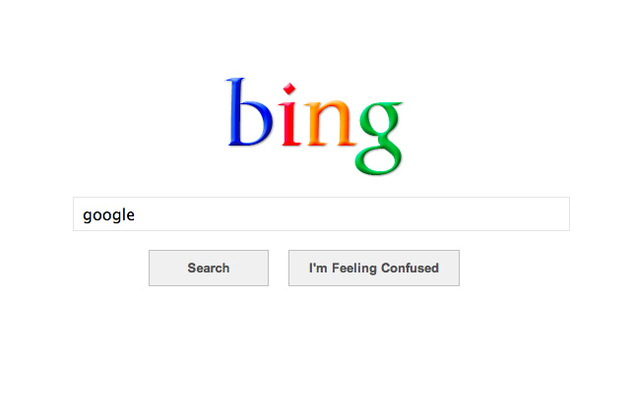
April Fools' Day provides the springboard for companies to make some unbelievable announcements, but for Google and Microsoft, it serves as the perfect time to poke fun at eachothers' shortcomings. With Gmail Blue, Google is teasing Redmond over a product that doesn't officially exist yet, while Microsoft goes back to basics to poke fun at its rival's "vanilla" search engine.
01 Apr 10:06


More April Fools' with Google+ photos and +Emotion
by Jerry Hildenbrand

Google pranks with a feature many users would love to have -- automatically adding emoticons to Google+ photos
Google just won't stop with the April Fools' stunts, and this one got more than a few people to fall for it -- an algorithm that automatically adds the right emoticon to a Google+ photo based on the facial expressions of the people in it. Dubbed +Emotion, it's said to "plumb the emotional depths of everyone in the photo, then summarize their feelings with a beautifully crafted, emotion icon" with the click of a button.
Of course, there is no such button, but folks commenting on the Google+ posting sure seem to want it, and were sufficiently fooled. We cant blame them, it certainly sounds like something Google could -- and would -- implement.
We're used to Google pulling a bit of April Fools' silliness, but this year they seem to have kicked things into high gear. With 24 more hours to go, we expect to see more before it's all over.
See also:
Source: +Erik Murphy-Chutorian
|
|
01 Apr 09:59

Annotary Marks Up Web Pages and Saves Them for Later Research
by Shep McAllister
 Chrome/Firefox/Safari: Whether you're researching a new car purchase or a term paper, you're probably going to be dealing with a lot of different web pages. Annotary lets you highlight and mark up sites, save them for later, and even share your research with collaborators.
Annotary exists as a browser extension for Chrome, Safari, and Firefox. Just invoke the app on a page you're using for research, and it will present you with a toolbox to save the page to your Annotary bookmarks and mark it up. You can highlight relevant blocks of text, and then type your own annotations into an on-screen sticky note. Once you're done, the page and all of your notes will be saved to your Annotary account, and you can even share the marked up page on social media or through email.
In theory, this is pretty similar to the Evernote Web Clipper. However, I enjoy being able to make notes directly on the page itself, rather than just copying relevant passages to a separate app. Annotary is free, so give it a shot for your next research project.
31 Mar 17:04


UK Government ‘Wastes’ £200k on New Anti-Piracy Tech
by Ben Jones
 Let’s face facts here. Piracy-wise, the horse has already bolted. A majority of the population knows how to get what they want, and how to circumvent measures.
The old guard, however, are pushing for ever more draconian measures in an attempt to turn back the tide. Now the UK Intellectual Property Office (IPO) has reached out to some groups it hopes might provide the metaphorical Silver Bullet (or at least white one) to deal with it.
On Thursday, the IPO and the Department of Business Industry and Skills (BIS – better known for being the department that rammed the Digital Economy act through after some back-room deals) proudly announced two anti-piracy grants. Contracts totaling £196,000 were signed with two companies as a result of a competition by the Technology Strategy Board called “How to promote Legitimate Online Intellectual Property Markets”. The simple business-oriented answers of “adapt to new technologies” and “give consumers what they want” clearly were not submitted.
£83,000 went to the University of Surrey for what the BIS calls “a novel scheme for protecting digital media content”, or as we generally call it, DRM. Few details are actually available at present, but the IPO describes it thusly:
Digital content which has been obtained illegally is automatically blocked by the system. A key feature of the proposed technology is not to inconvenience legitimate users like existing Digital Rights Management systems do: Users don’t need to worry about how to configure and use the system; they just use their devices as usual without even knowing about its existence. The technology is patent-pending and further details will be available once it is published.
And if this sounds like the claims made of every other DRM product, you’d be right. Once removed for one person, it’s removed for anyone else, making DRM’d goods MORE popular for piracy.
 Meanwhile those using the DRM’d product are restricted to what the DRM allows, which does inconvenience others. Just ask Apple about Fairplay and why they removed it, or users who’ve fallen foul of CSS, AACS, or indeed any other DRM scheme. In reality, ditching DRM reduces piracy
The lion’s share of the money – £113,000 – went to a company called ‘WhiteBullet’. If you’ve not heard of them, you’re not alone. Started less than 3 months ago, its big idea is that websites really need a colour-coding system so people can tell how ‘legitimate’ it is. Called the “IP Infringement Index”, or IPI, it’s a red/amber/green rating for sites based on how ‘infringing’ they think a site is.
Of course, like all automated systems there are going to be significant errors. When Viacom can’t tell if it uploaded stuff to YouTube itself in court filings, or music blogs get seized because record labels forgot they told them to distribute songs, any automated system assessing 3rd party infringement will be next to useless.
Also missing is exactly how this IPI rating will be used. A consumer-based system would require either a browser plugin, or the likes of Google to integrate it. A private ‘look at our score for your site’ model, by contrast, will have all the wide-ranging appeal and accuracy of a Special 301 report. Also, its claim to be “developed in conjunction with industry and law enforcement” and “in accordance with legal best practices and have been openly reviewed with key Internet stakeholders” might be more believable if they had some actual specifics.
Of course, that’s not so surprising when you find out the two people behind White Bullet are Peter Szyszko and Jane Sunderland. Peter was Senior Legal Counsel at NBC Universal from January 2006, until he left to form White Bullet.
Sunderland is no slouch in the establishment anti-piracy world either. Between 1997 and 2011 she was Vice President of Content Protection at Fox, with another three years before that as VP Intellectual Property. Some of her most memorable actions there include the statement back in 2007 that episodes of 24 uploaded to YouTube before their airdate could cause irreparable harm to Fox (and yet they’re still here)
So never fear our British readers. Public funds are being spent wisely on yet another DRM scheme and a ‘scoring’ system that has no obvious method of use, all to protect massively profitable media companies. Isn’t austerity great?
And if we find out more about how these new white elephant bullets, or DRM-that-isn’t are supposed to work, we’ll let you know.
Source: UK Government ‘Wastes’ £200k on New Anti-Piracy Tech
31 Mar 17:03


The Life and Times of a TV Show Piracy Release Group
by Andy
 In recent decades TV shows have become woven into the lives of hundreds of millions of people but it’s only been during the last few years that they’ve done so from the online space.
In common with many Internet-based media consumption mechanisms, accessing of TV shows online was pioneered and developed by pirates, who in turn were driven by studios’ apparent inability to predict and then adapt to their customers’ evolving needs.
Today, the vast majority of Internet TV show downloaders simply fire up a general site such as The Pirate Bay or specialist outlets such as EZTV, hunt down a torrent, and then count down the minutes until it’s ready to watch. But how did that torrent begin its life and who put it there?
To find out, TorrentFreak has been speaking with ANoN, the founder of a TV show release group responsible for putting hundreds of episodes online. The group are passionate about what they do and they’re passionate about BitTorrent, its technology, and the communities they serve.
Upon chatting with ANoN it’s immediately apparent that he’s not only polite but modest too, and admits that his route to ‘The Scene’ was borne from a random email.
The beginning and entering The Scene
“It all started a few years ago when I began uploading some Spanish TV rips on public torrent sites, just for people and for fun. I tried to keep the best quality possible so I decided to use the x264 Scene ruleset for the encoding process,” he explains.
As reported here on TorrentFreak at the time, the Scene had just ordered all releasers to ditch the old XviD format and begin uploading in x264. That ANoN chose to follow suit for his P2P uploads caught the eye of a pirate higher up the food chain.
“Someone from the Scene saw some of my rips and they contacted me with an offer to join a Scene group, the name of which i’ll have to keep a secret. I instantly said ‘yes’.”
Things didn’t go to plan. Although he appreciated the effort that goes into Scene organization, ANoN came to feel too restricted by their strict rules and regulations. He missed the freedoms offered by the P2P world.
Back to BitTorrent
 “This may sound weird but to me P2P is better than the Scene. The Scene is like an ordered library where there is only one copy of a book. P2P allows you freedoms that the Scene does not,” he explains.
As ANoN explained his recent history it became apparent that he really missed the variety of the P2P world, where anyone can contribute and add to the material already being produced by the Scene, rather than be restricted by it. It was time to move on.
“An Internet friend suggested that I found a P2P TV release group. At the beginning I thought it was a bad idea, since Spanish TV content is not downloaded as much as English TV content, but we decided to start anyway.”
Shortly after PERCEPTiON was born, free to do whatever they wanted on the most open file-sharing networks in the world. The Scene’s aim is to keep TV shows to themselves, but ANoN and friends have a different idea of how things should be done.
“To me the best part of BitTorrent networks is sharing. On P2P everyone shares, even if only downloading. It’s public to everyone and everyone is welcome to download and share without the knowledge that’s required to have access to the Scene. The main thing is that P2P provides us with a way to share quality TV releases with people around the world.”
Security
Of course each system has its drawbacks and BitTorrent is no different. ANoN misses some of the speeds available in the Scene and seems to miss some of its automated organizational aspects too. He’s also mindful that the level of security available in the Scene is a luxury that many casual BitTorrent users don’t enjoy.
“The Scene is much safer than P2P. The Scene is a perfect system that has programming and bots behind it. P2P is much more simple than that and is public so everyone may be tracked and therefore it’s more insecure,” he notes.
ANoN and his fellow members say they take precautions to reduce some of the extra risks of releasing via BitTorrent, but perhaps understandably don’t want to be drawn on too many of the details.
“To do our best with security we have some protocols. I can’t explain all of them but as an example we never seed from our personal computers. To any uploader in a similar position (I’m talking about TV releases only) we suggest to never try to make money releasing, that’s illegal. The spirit is sharing, not earning.”
The day to day – capping, encoding and releasing
Currently PERCEPTiON have 41 pages of TV show releases on ThePirateBay alone which indicates they’ve been pretty busy. So how do they operate on a day to day basis?
 “A typical day in our lives is centered around chatting about what is being aired tonight and who should record it. I personally prefer to start recording ten minutes before a show is announced. This recording is done with a HDTV tuner/recorder from a terrestrial broadcast,” ANoN explains.
“After recording it’s time to remove commercials. Using some software we remove the commercials from the recording so we have a clean episode/show. This one is called ‘original’ or ‘master’ and if it’s bugged (drops or any fail) any rip from this original will be flawed too.
“After checking comes the compression. We are a P2P group but we keep x264 Scene rules for encoding (PDTV, HDTV and 720p HDTV). Compressing on x264 takes a long time even if it’s done on a good workstation. Speed to releasing is not our priority though, quality comes first.
“After compressing it’s time to create the directory for the release, name it, and add an .nfo file with information about the release. A lot of groups use automated scripts to do this packing process, we prefer to do it manually to avoid any fail. At this point the next thing is to move the release to a secure location from where to seed it. After all this we upload the torrent on various public torrent sites.”
Public torrents and the spirit of sharing
Perhaps unsurprisingly the sites favored by ANoN are TPB and KAT.
“The Pirate Bay is like the mom of torrenting, it’s the biggest free P2P site and it represents a movement for defense of the Internet. KAT is my second favorite site. In my opinion it’s very well done site, with categories for every show/movie and the different qualities of rips for that show/movie. It’s very easy to use and I especially like how KAT users are commenting and rating, which is nice for the uploader.”
Although PERCEPTiON releases turn up on some private trackers and file-hosting sites, the group’s preference is to keep things widely available and at zero cost.
“Some private trackers try to get an advantage and earn money from something that should be public and free, and I think that isn’t good. Everyone deserves to get the best quality possible, not only the invited ones, especially when sites only offer invites in exchange for money. That’s disappointing.”
Since they are located in Spain, ANoN and his friends have enjoyed the country’s historic approach to file-sharing, but of course with the new legislation being touted at the moment that could be all set to change. How do they feel about that?
“Users are always downloading and no one can stop it. This is how the Internet works. So one way or another every time that anything related with downloading on Internet is shut down the effect is that there will be another five different systems to download. People will not stop downloading and making it forbidden is not the way.”
The last word from ANoN
“If you have arrived here at the end of this interview I want to tell you thanks personally, thanks for reading. Keep downloading, don’t ever forget to share, but remember that there is a lot of work carried out by people involved in the production/distribution of TV-shows. Please support companies if you appreciate their product.”
Source: The Life and Times of a TV Show Piracy Release Group
30 Mar 22:43


The Pirate Bay Becomes #1 File-Sharing Site as Cyberlockers Collapse
by Ernesto
 Less than two years ago we published an overview of the most used file-sharing sites, covering both BitTorrent and traditional cyberlockers.
At the time one-click download sites were beating BitTorrent sites by a landslide. However, the cyberlocker business changed dramatically following the Megaupload shutdown last year and now the tables have turned.
The Pirate Bay, ranked sixth last time, has become the most-used file-sharing site. While the infamous BitTorrent site certainly gained some new visitors in recent months, it mostly owes its number one spot to the traffic decline of several major cyberlockers.
The most likely explanation for the traffic drop at these sites is the Megaupload shutdown. As covered extensively in the past, many cyberlockers removed their affiliate plans, disabled public sharing or implemented other measures to keep pirates at bay.
The result is a major shift in traffic patterns, with both winners and losers. Quite a few familiar names have fallen from the list, including RapidShare, FileServe and Hotfile. Others such as Uploaded and Putlocker picked up new visitors.
The overall pattern seems to be that BitTorrent sites have regained some of the “market share” they lost earlier. Half of all sites in the file-sharing top 10 are BitTorrent related, compared to only two in 2011.
With six newcomers in the list, it’s clear that the file-sharing ecosystem has been shaken up quite a bit.
Below is the full top 10 of the most-visited general purpose file-sharing sites that are available in English. We used several traffic comparison and analytic tools to compile this list, including Compete, Quantcast and Alexa. The alexa rank is shown in the table below, as well as the # in the 2011 list.
| # | Website | Category | Alexa rank | # 2011 |
|---|---|---|---|---|
| torrentfreak.com | ||||
| 1 | The Pirate Bay | Torrent index | 75 | (6) |
| 2 | Mediafire | Cyberlocker | 115 | (4) |
| 3 | KickassTorrents | Torrent index | 122 | (…) |
| 4 | 4shared | Cyberlocker | 126 | (1) |
| 5 | Uploaded | Cyberlocker | 170 | (…) |
| 6 | Torrentz.eu | Torrent Meta-search | 223 | (9) |
| 7 | isoHunt | Torrent index | 267 | (…) |
| 8 | Putlocker | Cyberlocker | 284 | (…) |
| 9 | ExtraTorrent | Torrent index | 305 | (…) |
| 10 | Rapidgator | Cyberlocker | 317 | (…) |
Source: The Pirate Bay Becomes #1 File-Sharing Site as Cyberlockers Collapse
30 Mar 22:23

South Korea lives in the future (of brutal copyright enforcement)
by Cory Doctorow
The US-Korean Free Trade Agreement came with a raft of draconian enforcement rules that Korea -- then known as a world leader in network use and literacy -- would have to adopt. Korea has since become a living lab of the impact of letting US entertainment giants design your Internet policy -- and the example that industry lobbyists point to when they discuss their goals.
One of the laws that Korea adopted early was the infamous "three strikes" rule, where repeated, unsubstantiated accusations of copyright infringement leads to whole families being punished through restriction of, or disconnection from their Internet connections. Now the Korean National Human Rights Commission has examined the fallout from the country's three strikes rules, and called for its repeal due to high costs to wider Korean society.
Here's the Electronic Frontier Foundation's Danny O'Brien with more:
The entertainment industry has repeatedly pointed to South Korea as a model for a controlled Internet that should be adopted everywhere else. In the wake of South Korea's implementation, graduated response laws have been passed in France and the United Kingdom, and ISPs in the United States have voluntarily accepted a similar scheme.
But back in Korea, the entertainment industry's experiment in Internet enforcement has been a failure. Instead of tackling a few "heavy uploaders" involved in large scale infringement, the law has spiraled out of control. It has now distributed nearly half a million takedown notices, and led to the closing down of 408 Korean Internet users' web accounts, most of which were online storage services. An investigation led by the Korean politician Choi Jae-Cheon showed that half of those suspended were involved in infringement of material that would cost less than 90 U.S. cents. And while the bill's backers claimed it would reduce piracy, detected infringement has only increased as more and more users are subject to suspensions, deletion, and blocked content.
This Wednesday, Korea's National Human Rights Commission recommended that the three strikes law be re-examined, given its unclear benefits, and its potential violation of the human rights to receive and impart information and to participate in the cultural life of the community.
Korea's three strikes rules are similar to the "Six Strikes" rules that America's leading ISPs have voluntarily adopted and just put into effect. If you want to see the future of American Internet policy, and its fallout, look at Korea.
Korean Lawmakers and Human Rights Experts Challenge Three Strikes Law 
|
|
29 Mar 21:39

Mapping the arctic with Google Street View
by Jacob Kastrenakes
Google has been showcasing its Trekker Street View backpack's abilities with imagery from exotic off-road locales, and one of its next unlikely displays will be from another trip into the Arctic. The company recently sent a small mapping team to Iqaluit, an Arctic city of 7,000 people located in a Canadian territory to the west of Greenland. The Guardian reports on the team's work in the town, from hiking along snow-covered trails with the 30-pound Trekker strapped to their backs, to patching holes in the existing satellite imagery, to enlisting the help of locals to plot businesses and homes without listed addresses. The team spent four days in Iqaluit, and the Street View photographs that it gathered should be online this July.
29 Mar 18:43


KickassTorrents Circumvents Censors With New Ka.tt Domain
by Ernesto
 With millions of visitors a day KickassTorrents (KAT) is one of the largest torrent sites on the Internet, trailing only behind The Pirate Bay.
This status has put the site on the radar of the U.S. Government and a wide variety of anti-piracy groups.
Last year this unwanted attention resulted in a nationwide ISP blockade in Italy and a week ago several UK ISPs were ordered by the High Court to follow suit.
Today, however, estranged KAT users on some ISPs in Britain can access the site again just fine. A few hours ago KickassTorrents moved from the Kat.ph domain to Ka.tt, rendering the blockades useless, at least for the time being.
On several ISPs users are unable to access the new site, which suggests these block KAT’s IP-addresses as well so the domain change does very little.
“Yes, it’s official and it was kind of unexpected. We changed our domain name from kat.ph to ka.tt [...]. Kat.ph will still be redirecting visitors to ka.tt, so your bookmarks will be fine,” KAT announces.
The statement made by the site doesn’t specify whether recent UK blockades have anything to do with the move to Trinidad and Tobago’s TLD. There are of course other reasons why the torrent site might want to switch domains (see update below).
Earlier this month KAT had its homepage removed from Google. In addition, more than a million KAT pages have been delisted from the search engine following DMCA takedown requests from copyright holders. These pages are no longer blocked on the new domain.
Or perhaps it’s a more pressing matter. It’s not unthinkable that the previous .ph registrar kindly asked KAT to find a new home, perhaps following behind the scenes lobbying efforts from copyright holders.
This is not the first time that KAT has dumped a domain to avoid being censored. Two years ago when domain seizures where in fashion KAT moved its site to the non-U.S. controlled .PH domain as a precaution.
Whatever the reason for the current change, the hundreds of thousands of KAT users who were unable to access the site directly due to the ISP blockades are happy for now.
Update: KAT informs TorrentFreak that the change was indeed made in response to the ISP blockades. Aside from Italy and the UK KAT is also blocked in the United Arab Emirates, and they want to find out how long it takes before the new domain is blocked. For now most UK readers still can’t access the new domain because the IP-addresses used by the site haven’t changed.
Update: KAT moved back to Kat.ph due to technical issues.
Source: KickassTorrents Circumvents Censors With New Ka.tt Domain
29 Mar 15:09
Done With This Post? You Might Also Like These: 


SoundHound Updated With A New Tablet Interface, All Hail Big Screens
by Cody Toombs

Nothing brings a smile to my face like the words "Tablet Optimized," and thanks to SoundHound, I'll be walking around with a little grin all day long. The music recognition service has updated its Android app to include a fully realized tablet UI and a few other performance enhancements. Here are a few screenshots for comparison (taken on my Nexus 7):
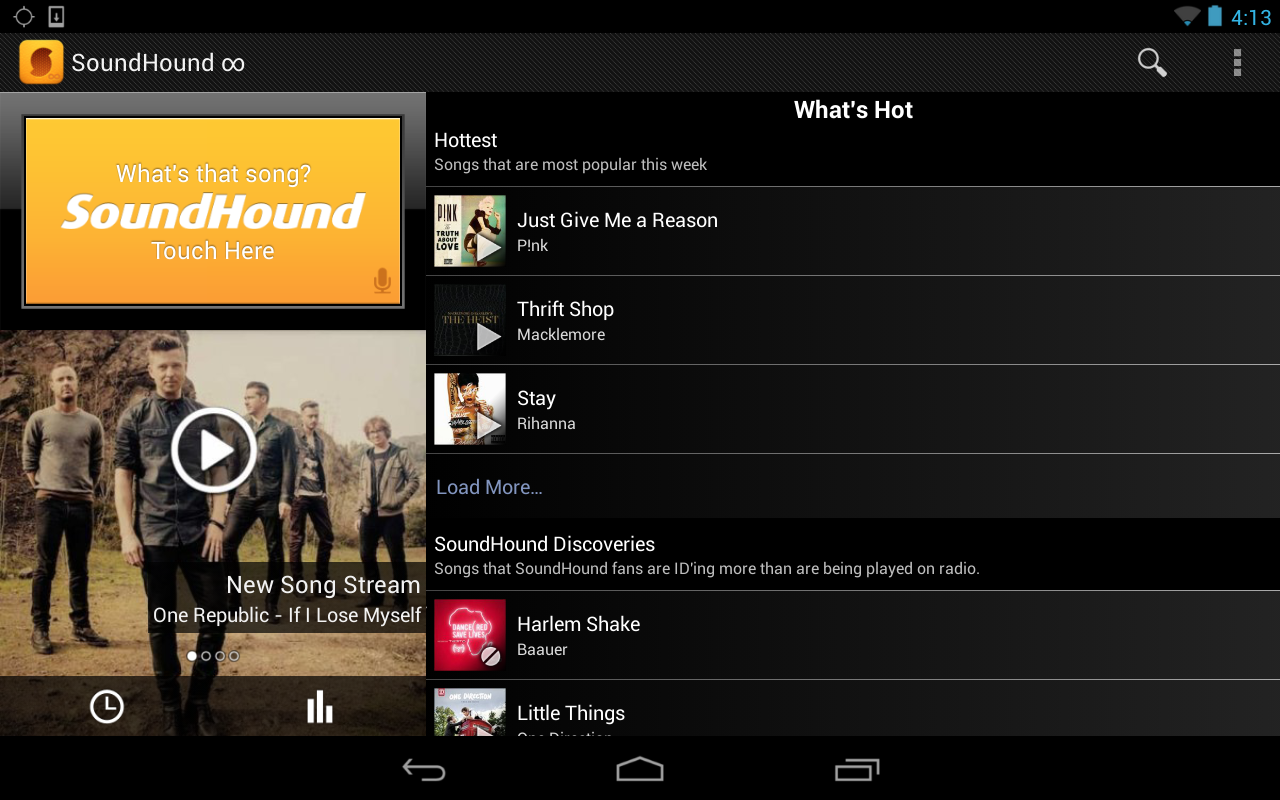

Original
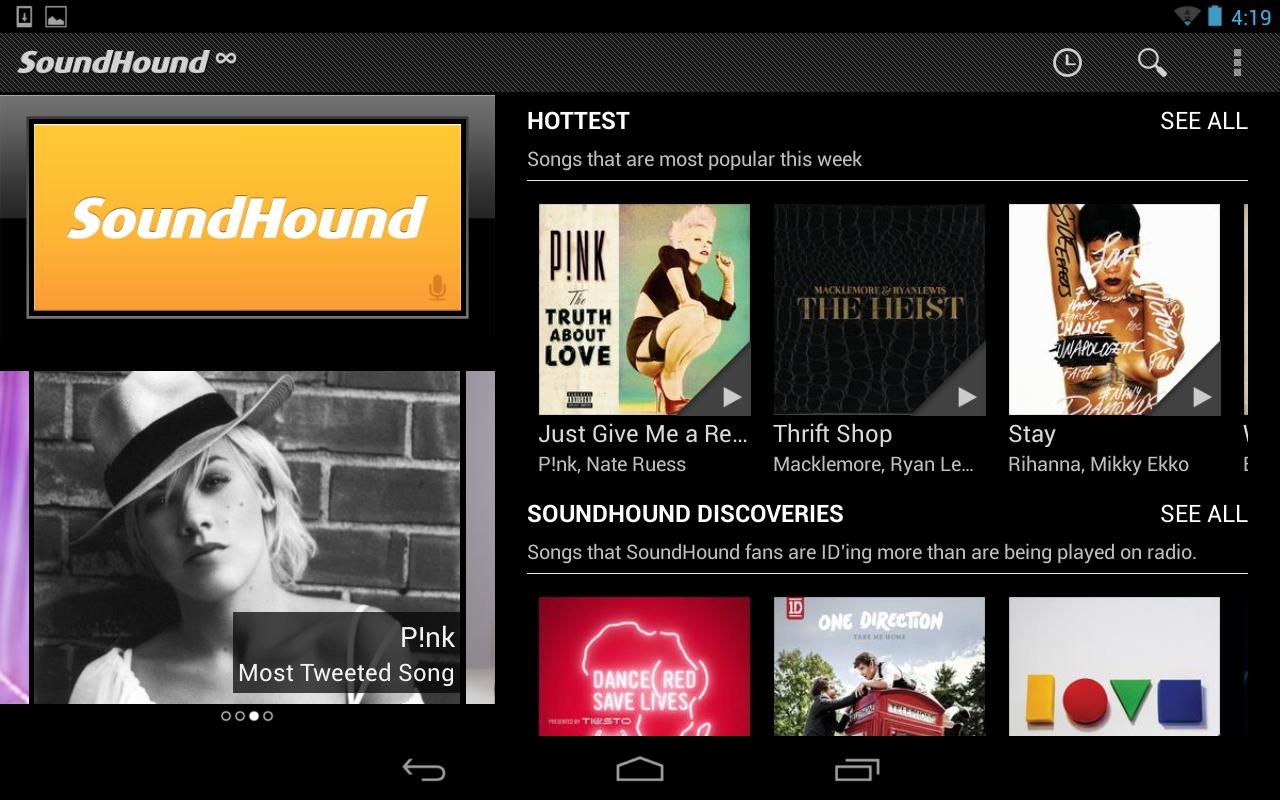
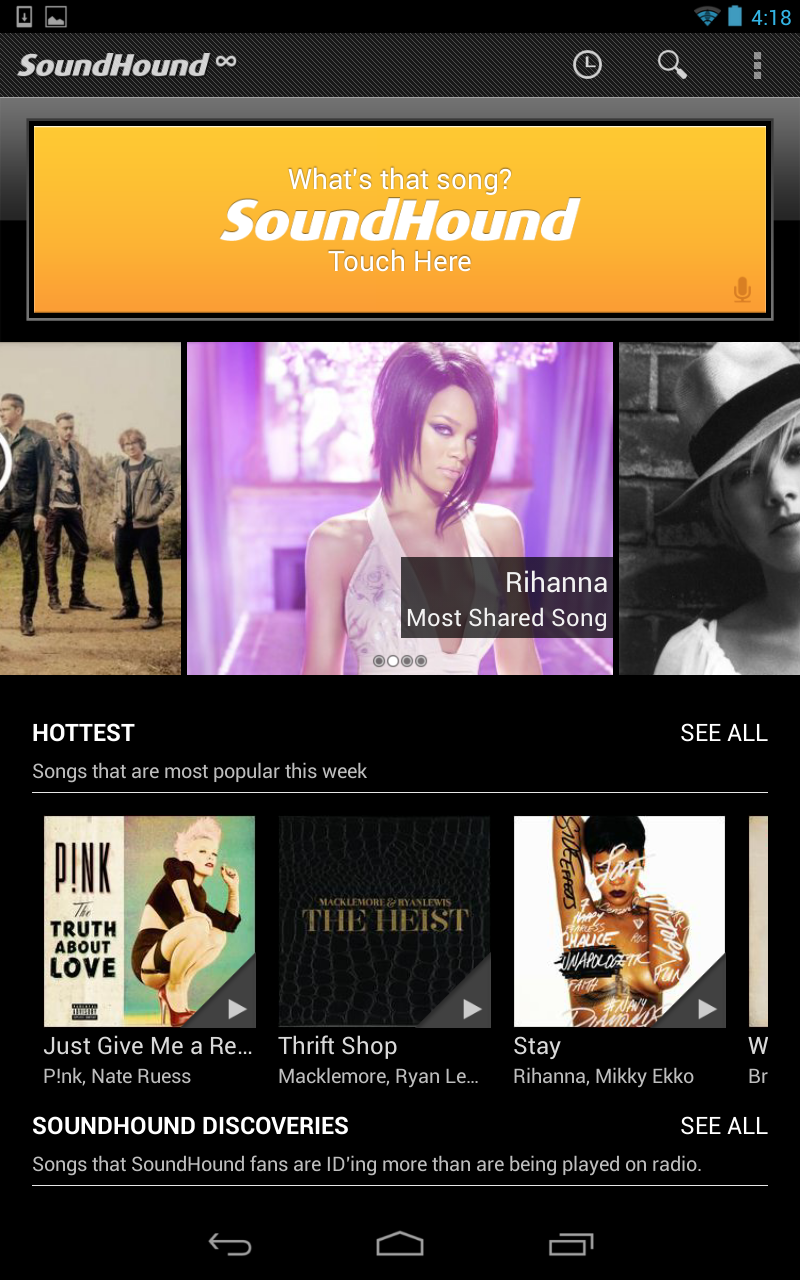
New
The new tablet UI replaces the boring stretched out rows with drag-able lines of large cover art, making much better use of space on the main screen, discovery, and song pages. In landscape mode, history and bookmarks now stack songs into two columns instead of one, but appear otherwise unchanged.
Done With This Post? You Might Also Like These: - SoundHound Version 5.0 Hits The Play Store, Brings All New Interface, Quicker Music Recognition, And "Song Stream"
- Your Move, Shazam - SoundHound's Free Android App Now Features Unlimited Music IDs
- Ad-Free SoundHound Infinity With A Homescreen Widget Is Today's Amazon Appstore Free App Of The Day
- [New App] SoundTracking Lets You Share Your Music Taste With The Social World, With One Twist
SoundHound Updated With A New Tablet Interface, All Hail Big Screens was written by the awesome team at Android Police.
|
|
29 Mar 14:44


‘Pirate’ Site Ad Transparency Report Loses Credibility
by Andy
For years the entertainment industries have complained about American companies’ advertising appearing on and therefore financially supporting so-called “pirate” sites. Hollywood and the record labels believe that responsible companies should place their promotions elsewhere, for the sake of both their businesses and the U.S. economy.
To this end it’s common to publicly highlight the fact that U.S. companies are targeting potential customers on sites deemed offensive by the entertainment industries in the hope that their respective branding departments will feel nervous that continued exposure will cause damage to their image.
In advancement of this name-and-shame philosophy, since the start of the year the Annenberg Innovation Lab at the University of Southern California has produced a monthly report aiming to identify the online ad networks and companies offering the most support to “major illicit file sharing sites around the world.”
The third installment for March 2013 delivers more of the same. The University researchers say they have monitored the top 500 URLs receiving the most DMCA takedown notices as listed in Google’s Transparency Report and from that worked out which ad networks give the most support to “pirate” sites.
The technique is problematic, mainly due to the fact that just because a site receives a DMCA notice it doesn’t necessarily follow that they have refused to comply and therefore in non-compliance. Plus, these are notices sent to Google, not the sites themselves.
Of all companies online, Google receives the most DMCA notices to the tune of several million per week, but they aren’t considered a “pirate site” and rightly so. From the report there is no indication that the USC researchers have considered whether the sites in the top 500 are compliant or not.
Ad Networks criticized
The ad networks topping the charts this month are:
1. Propellerads
2. Exoclick
3. Infolinks
4. Adcash
5. Admxr
6. Adsrevenue (New entry)
7. Yahoo/Right Media
8. Adserver (New entry)
9. Trix.net (New entry)
10. Sumotorrent
Google (Doubleclick) were present in the January report but have not appeared since. The same applies to Quantcast but for different reasons. USC appear to have retrospectively modified both of their previously issued reports when discussions with Quancast revealed the ad network had been included in error (they weren’t serving ads in many cases).
“In late February we have had productive talks with Quantcast about our January and February Ad Reports,” USC write. “We now believe that Quantcast was incorrectly identified as being among the top ten Ad Networks placing ads on infringing piracy sites.”
It’s also worth noting that SumoTorrent, which has appeared in previous USC reports but this month at its lowest position yet, is listed as a large advertising network in its own right. It isn’t. SumoTorrent uses ads from other providers and serves them only on its own sites, SumoTorrent and Seedpeer.
Furthermore, some very basic clickstream analysis reveals several ad networks successfully funding some of the biggest file-sharing sites warrants not a single mention anywhere in USC’s report, which raises serious questions about the validity of the techniques being used.
Brands said to be reporting “pirate sites”.
While noting that they may not have deliberately placed their ads on the sites in question, Annenberg Innovation Lab still lists many large brands who they claim are providing advertising revenue to sites that have received a lot of DMCA takedown notices.
There are some huge names, not least government related departments including the U.S. Army and National Guard.
From the world of fashion we see Adidas and Gucci. In the online and computing realm we see Amazon, Ancestry.com. AT&T, Bing, Google Play, HP, Verizon, World of Warcraft, Windows 8 and Xfinity. Motoring related brands include Firestone, Ford, Honda, Lexus, Lincoln, Mazda, Mini Cooper, Toyota. Sundry others include American Express, IKEA, Pizza Hut and Target.
Finally, and quite unusually, the report takes a shot at this week’s Times Square advertising campaign by the band Ghost Beach.
Speaking with TorrentFreak, band frontman Josh Ocean explained that they hoped the campaign would “..open a discussion up with our peers about how they felt about music distribution on the internet and the future of the industry,” but the USC researchers frame things differently.
They are suggesting a contrast between what the band are really trying to do versus the actions of a company that took efforts to end associations with piracy earlier this year.
“Whether this is just a publicity stunt or a real counter trend, we can’t help but contrast this to the moves of Levi Strauss to make sure its ads did not appear on pirate sites,” the researchers write.
While Levi Strauss did indeed withdraw advertising from certain sites in January, as far as we know Ghost Beach have never advertised on a ‘pirate site’ but in fact have spent significant amounts of money through their licensing deal with American Eagle to place advertising for their own product with a completely legitimate agency. Why this latest campaign is even mentioned in the report seems to defy reason.
Moving forward, if this research by USC is to maintain credibility next month and beyond it will need to consider its methodology and accusations more carefully.
While there is undoubtedly plenty of sites in the top 500 domains in Google’s Transparency report that are not DMCA compliant, there will be many that are. Simply looking at DMCA notices sent to Google and from that concluding that the sites they concern aren’t compliant is seriously flawed.
For example, RapidShare – a company that has made huge efforts to disassociate itself with piracy in recent years – is in the top 50 sites as listed by Google’s Transparency Report. Is this company not allowed to make a living through advertising anymore, even though it is DMCA compliant?
If it is to remain neutral, USC needs to look at DMCA notices sent to the sites themselves (or obtain data on the same) and then measure how many of those are being ignored before it can start judging what is and what isn’t a “pirate site”.
Source: ‘Pirate’ Site Ad Transparency Report Loses Credibility
29 Mar 14:41


Before Midnight Trailer Arrives

Richard Linklater, Ethan Hawke and Julie Delpy’s Before... films have been a sort of rom-com Up (the long-running Michael Apted documentary project, not the Pixar film), chronicling a couple through several stages of their love, from meeting to long-term living. Now comes the third entry, Before Midnight, which has just released a trailer.
Shot stealthily last year in Greece, Midnight finds Jesse (Hawke) and Celine (Delpy) after another nine-year break. In that time, it appears things have gone well for the now fortysomething pair – they live as a couple in Paris, have twin girls and are holidaying on a Greek island.
Yet it appears there are cracks in their outwardly comfortable picture of two people in love: the stresses and strains of maintaining a long relationship are beginning to show...
After some solid reviews at Sundance, it’s a treat for fans of Before Sunrise and Before Sunset to check back in with the characters, even if we’re starting to worry that our Up joke above might end up coming true if Linklater and his actors decide to follow this story to its natural conclusion. Before Midnight is set to arrive on June 21.
|
|


29 Mar 14:35

Under Amazon's Wing, Goodreads Plans Closer Integration While Retaining Its Indie Status
by Anthony Ha
Following this afternoon’s announcement that Amazon has agreed to acquire Goodreads, I had a few minutes to talk to the Goodreads CEO Otis Chandler and Amazon VP of Kindle Content Russ Grandinetti. They stayed pretty vague about the two things I was most curious about — how the deal came together, and the specifics of the planned Kindle/Goodreads integrations — but they did drop a few hints about future plans.
Chandler (pictured here with his co-founder and wife Elizabeth) said that Kindle integration has been a popular request among Goodreads users, and Grandinetti said he wants to make it “super easy” to have a social experience on the Kindle device and apps. As for what that will look like, he said, “We prefer to talk about features when we ship.”
One of the points highlighted by TechCrunch’s Drew Olanoff when he covered the news was the fact that this gives Amazon a social advantage over its e-bookselling competitors, particularly Apple. When I asked if the Amazon acquisition precludes building Goodreads integrations with non-Kindle devices, Grandinetti said the Amazon team “worked hard at Kindle to make the app work on iOS and Android,” so you’ll be able to access Goodreads features on, for example, your iPad through the Kindle app. (That doesn’t take away from Drew’s point, which was more about the iBookstore. It’s also worth noting that Amazon has acquired a social reading startup before, Shelfari, and that hasn’t led to big breakthroughs on the social front.)
I asked if Goodreads will continue to be closely integrated with Facebook, or if it’s going to be building more of a standalone social experience on Amazon. Chandler replied that Facebook “will continue to be an important part of Goodreads — our mission is to help people express themselves through what’s on their bookshelves,” and leveraging Facebook’s enormous user base makes it easier to do that.
Chandler also wrote in his blog post about the acquisition that Goodreads will “continue offering you everything that you love about the site.” For one thing, he told me that the entire Goodreads team will be staying on, and that it will remain in San Francisco. He said it will operate as an independent subsidiary similar to “how Zappos and IMDb are run.”
“We’re going to keep hiring and and growing the team,” he added.
Amazon and Goodreads have had some bumps in their relationship in the past — most notably, back in January of last year, Goodreads switched from Amazon to Ingram as its primary source of book data, because Amazon’s data “came with many restrictions.” When I brought that up today, Grandinetti said, “I don’t think any side took any pleasure at the point that [Goodreads] stopped using the API.” Now is the chance to bring Amazon data back to Goodreads and to “explore whole new areas of discovery and reading,” he said.
Chandler added that one of the downsides of moving away from Amazon was the loss of international data. With the acquisition, Goodreads will have access to that data again.
Speaking of APIs, Chandler said in another interview that Goodreads will continue to offer its own public API and to continue offering a review feed to Kobo.
29 Mar 14:35

Delicious Becomes A Bit More Social Again, Adds Twitter And Facebook Logins
by Frederic Lardinois
It’s recently been very quiet around Delicious, the social bookmarking service Yahoo bought in 2005 and then sold to AVOS in 2011. Back then, the AVOS team said it was relaunching Delicious “back to beta,” but Delicious hasn’t made all that many waves since then, nor has it added all that many features to the relaunched service.
But after four months of slumber, the Delicious blog sprung into action today and launched a few new features that could make the site a bit more interesting for those of us who long ago abandoned social bookmarking for social networks like Twitter and Facebook.
Indeed, today’s update is all about Twitter and Facebook: Delicious added the ability to log in with your credentials for those two social networks and connect. It’s now easier to use Delicious to automatically save all those links you share on Facebook and shared and favorited on Twitter directly on Delicious, too. Delicious acquired the link-saving startup Trunk.ly to power this feature in November 2011 and turned it on for Twitter last March and for Facebook in July.
Using Twitter and Facebook logins isn’t exactly innovative, but it does point toward a more social future for Delicious, especially in combination with the new “Friend Finder” tool that lets you friend and follow people you know on Twitter and Facebook.
The team also made other small improvements – the bookmarklet and site now load faster, for example, but the main feature Delicious power users will surely appreciate is that every link now includes a “first saver” attribution.
I’m not sure that any of this will really rescue Delicious from its current obscurity. Saving the links you share on social networks doesn’t exactly feel like the hot new thing, after all. It’s good to see a sign of life out of Delicious, however, and if Digg is still around and kicking, why shouldn’t del.icio.us be, too?
29 Mar 14:29


Ouya in action at GDC 2013
by Simon Sage
What's a backer launch without a party?

Ouya had their big backer launch bash at GDC 2013, giving everybody a shot to try out the $99 Android-powered gaming console. There has been a lot of excitement leading up to this launch, not only because it stands to be yet another Kickstarter success story, but also because it's paving the way for a whole new product category of Android devices.
|
|
29 Mar 14:27
Facebook to unveil Android phone by HTC next week?
by Taylor Wimberly
Facebook just sent out invites for an Android related event next week, and TechCrunch is reporting that their sources say it will be the often rumored “Facebook Phone.” All the Android blogs were invited to attend with message that read, “Come see our new home on Android.”...
Visit our site to read the full article.


Visit our site to read the full article.