Shared posts

12 Jul 12:16

Saying goodbye to PCWorld in print

by Nathan Olivarez-Giles
Pcworld_640_large

Harry McCracken is calling it: the era of the PC magazine is over. PCWorld announced Wednesday that after 30 years in print the issue on stands now will be its last. McCracken, who worked at PCWorld from 1994 to 2008 as both an editor and a writer, has written what is essentially an obituary for the general-interest PC magazine for his new workplace, Time magazine. If you're not familiar with PCWorld, it could be considered the Sports Illustrated of PC magazines in the 1980s. But while it's leaving print, the publication will live on as a website and digital magazine.

Continue reading…

12 Jul 12:11

Audible receives major interface overhaul in latest update

by Andrew Martonik

Audible

Not a single piece of the app left untouched, bringing the it up to modern design standards

Users of the Audible for Android app are in for a treat tonight with a complete interface design overhaul update pushing out through the Play Store. Previously a very functional but also clearly dated app, Audible has completely moved into the modern design era with a new interface that relies on tabs, proper use of the action bar and smooth interface movement all around. The app keeps a familiar grey, black and orange color scheme, but improves every bit of functionality, adds in a few new features and improves stability.

It seems as though not a single piece of the app was left untouched, and we have to hand it to Audible for making the necessary improvements to bring the app up to par with modern standards. You can grab a download or update of the latest version from the Play Store link at the top of this post.


11 Jul 23:17

Dog works out

by Rob Beschizza

But does he lift? [TMZ via Heather]


11 Jul 23:16

Convicted Music Pirate Refuses to Work For The RIAA

by Ernesto

hndbagDuring the last decade the RIAA targeted about 35,000 people in their file-sharing lawsuits and Jammie Thomas is one of their most famous defendants.

The case is best known for being the first major file-sharing case in the US concerning the P2P activity of a regular user and the vast swings in damages awarded over multiple court hearings.

Even the Obama administration got involved earlier this year, arguing that the Supreme Court should not reduce the $222,000 fine as that would be an encouragement to other music pirates.

The Supreme Court listened and eventually refused to review the case.

The end result is that Thomas now owes the RIAA more money than she can pay, and she’s even considering filing for bankruptcy to avoid paying anything. However, the RIAA sees another opportunity.

Wired reports that the anti-piracy group has offered to reduce Thomas’s fine if she agrees to “work” for them campaigning against piracy. While the RIAA probably has the best intentions, for someone who fought legal battles against the music group for nearly a decade, the gesture probably feels like a slap in the face.

And indeed, Thomas has resolutely refused the offer. “I’m not doing it,” she said.

According to Thomas’s lawyer the RIAA hasn’t yet put a number on the discount, but it was made clear that she wouldn’t have to pay the full amount. This wasn’t the first offer either, previously Thomas was given the opportunity to settle the case in exchange for a donation to a music charity.

Commenting on the issue, the RIAA maintains that its intention is to resolve the manner in a “reasonable way,” minimizing harm for all involved.

“We have communicated to Ms. Thomas that we would consider a variety of non-monetary settlement options, which is up to her to offer. We think this is a gesture of a good will and we’re doing what we can to resolve this case in a manner that works for everyone,” an RIAA spokesman says.

Willingly or not, if Thomas ends up paying even a small amount she will indirectly contribute to the RIAA’s anti-piracy efforts. The RIAA previously stated that piracy damages do not flow to the artists, but are reinvested in anti-piracy efforts.

The only way for Thomas to escape paying is by her going bankrupt, although that would mean that everyone involved in the case ends up losing. Except the lawyers.

Source: Convicted Music Pirate Refuses to Work For The RIAA

11 Jul 23:10

Developer Hacks His Microwave Into The Microwave Of The Future

by Greg Kumparak
cooking_pie_filling

Hello, and welcome back to today’s episode of “Why? LOL BECAUSE WE CAN.”

Tired of your dumb old microwave that just shoots friggin’ radio waves at food to cook it? Stupid thing probably can’t even play animated GIFs or send Snapchats or download the Fergie. What’s the point?

In the coolest mod I’ve seen in ages, developer Nathan Broadbent has hacked away at his microwave to add stuff that any self-respecting microwave manufacturer of the year 2013 should have probably added themselves. Voice commands! Barcodes that pre-set cooking times! A SELF SETTING CLOCK.

Meet the Raspberry Picrowave. As you might’ve gathered from the name, it’s a Microwave mashed up with a Raspberry Pi, the $25 micro-computer adored by modders, hackers, and geeks ’round the world

Here’s what it can do so far:

  • Clock sets/updates itself across the Internet
  • A barcode scanner pulls cooking instructions from an online database. Such a database didn’t actually exist, so he’s building one himself, adding directions as he goes.
  • Voice Commands, like “Microwave, Twenty seconds, Low.” (Alas, Nathan says his kitchen’s acoustics screw this up a bit.)
  • Custom sound effects (because beeps are for chumps).
  • You can control the microwave from your phone. The only uses I can think of for this are: when you know you’ll want microwaved popcorn later and can preload a bag, or when you want to convince your friends that you’re the biggest geek on the planet because you have a microwave that you can control with your phone.
  • It tweets when it’s done cooking, because of course it does.

If nothing else, man oh man do I want that self-setting clock. My (two-year old) microwave uses the most ridiculous and impossibly obfuscated series of button presses for clock setting, so a power outage at my house generally means at least three months of the microwave swearing that it’s blink-thirty.

Stuffing a Pi into your microwave is cool and all, but the scale of the project gets a whole lot more impressive once he starts getting into the deeper details, from wiring the Pi into the microwave’s power supply, to designing a new control panel, to etching and producing a custom PCB that fits in the place of the original.


11 Jul 20:10

O2 latest UK operator to offer London Underground Wifi

by Alex Dobie

London Underground

Tube connectivity provided by Virgin Media now available to O2 subscribers

UK mobile operator O2 has today become the latest provider to launch free London Underground Wifi connectivity to its subscribers. Like rivals Vodafone and EE, O2's offering Wifi through a partnership with Virgin Media, which has hotspots at more than 120 tube stations across central London.

After registering their devices with O2 Wifi, O2 customers can get started by connecting to a Virgin Media hotspot and selecting O2 from the list of available providers. Then to complete the process, they'll need to enter their phone number in the form that appears.

Unlike some other major cities, London's underground network lacks cellular data reception of any kind, making Wifi a necessity for anyone wanting to get connected while they travel. O2's Wifi partnership with Virgin Media means Three now is the only major provider not yet offering this service, putting the UK's smallest network at a potential disadvantage.

Source: TNW, O2 YouTube


11 Jul 20:00

Nokia Lumia 1020: a 41-megapixel Windows Phone available on July 26th for $299.99 at AT&T

by Tom Warren
Lumia1020all_large

After weeks of leaks, Nokia is making its Lumia 1020 handset official on Thursday. The Finnish smartphone maker has just unveiled its latest flagship Windows Phone on stage at an event in New York. The Lumia 1020 is a big upgrade over Nokia's previous Windows Phone efforts for one reason alone: a 41-megapixel camera. Nokia is taking its PureView 808 sensor from its Symbian days and adding a number of enhancements to bring it to Windows Phone.

Continue reading…

11 Jul 19:58

Last.fm Founders Throw The Lights On Lumi, A Site That Uses Your Browsing History To Recommend New Content

by Ingrid Lunden
lumi logo

Earlier this year Felix Miller and Martin Stiksel, the London-based co-founders of music streaming and discovery service Last.fm, launched a prototype of Lumi, a new service that applied a concept similar to Last.fm’s scrobbling to the wider internet, to help people find new things that might interest them online, presenting its results a visual, button-style navigation format. Today, in their first big startup effort since leaving Last.fm after selling it CBS in 2007, the pair are taking Lumi out of prototype and opening it up to the public at large, with extensions available for Chrome, Firefox and Safari, and plans for a mobile app coming soon.

The closure of Google Reader has put a spotlight on RSS and apps that people use to help make their way around the long tail of internet content. Lumi is tapping into a similar concept, but taking a very different approach.

RSS requires users to proactively select sites and information they wanted to track online — and some might argue that this proactive, sometimes technical element is what has prevented RSS readers from really going mainstream. Lumi, meanwhile, has been created with inactivity in mind. People can do nothing and still get relevant, current content delivered regardless, using algorithms that track where you travel online to provide links to what else you might like to see.

As long as you have downloaded the extension, which monitors whatever else do you on your computer, “you don’t have to do anything extra,” Stiksel told me in an interview. “You don’t click buttons or subscribe to new feeds. You can go away for two weeks and it’s even more fresh when you return. Because the system knows more about you.”

This may sound a bit creepy in our day and age of Prism awareness, and it will be interesting to see how and if that impacts Lumi’s growth. In its favor, it has implemented privacy settings almost to a fault: I once forgot my password on my account, and had to dig up my original “welcome” email in order to trigger the ability to recover it: no way of doing that directly through Lumi’s web interface. Miller also notes that there is no direct user tracking in any way at all.

Although today Lumi is transferring from “prototype” to full product, I think the potential of the service is more interesting longer term.

When you log into the service you get a menu in the left that pops out different categories — books, business, design, music and so on. Right now, those are directly related to what pages or content you look at covering each of those subjects. What will be interesting down the line is how content in each of these gets populated semantically. For example, what kind of books might a fan of Grizzly Bear like to read?

“That’s one of the things that we are exploring,” Stiksel tells me. “If you like gardening, you may like this kind of art or this kind of music” is one more step along this idea of scrobbling.

Another is how Lumi may account for the fact that in some households people share computers. My daughter’s interest in Wizard of Oz clips on YouTube may not really say much about me, for example.

And the pair have yet to take the concept mobile — perhaps the most obvious place for services that help users discover content without having to do much typing. Stiksel and Miller say that native mobile apps are on their roadmap “very soon” but because they are for now bootstrapped, most of their energies have been spent on the desktop experience, since this is still where people do most of their web browsing.

On the subject of funding, for now the pair are continuing to bootstrap. “We are focused on getting the product right first,” says Miller.


11 Jul 12:41

Florida bans computers

by Cory Doctorow
Florida tried to ban Internet Cafes that were functioning as unlicensed casinos, but may have banned smartphones and computers instead, due to language that defines slot machines as "any machine or device or system or network of devices" that can be used in connection with games of chance. I question the legitimacy of shutting down all Internet Cafes in the first place, but this is clearly an overbroad definition, as has been pointed out in a suit challenging the law, brought by an Internet Cafe owner in Miami -- ironic, as Florida is the state whose law once took over 100 words to precisely define "buttocks."


11 Jul 12:37

[New Game] Sprinkle Sequel 'Sprinkle Islands' Splashes Into The Play Store With Impressive Water Physics Intact

by Bertel King, Jr.

SprinkleIslands-ThumbSprinkle attracted quite the following when it debuted in 2011, using its realistic water physics to show people what Tegra 2-equipped tablets were capable of. Players controlled a wooden water cannon mounted on a crane and fought fires across a diverse assortment of stages, with water pushing rocks and giant blocks of ice around in order to save houses in hard to reach places. The fire itself was as pretty to watch as it was a pain in the rear, spreading from house to house as gamers discovered that maybe, just maybe, they weren't cut out to be firemen.

Done With This Post? You Might Also Like These:

[New Game] Sprinkle Sequel 'Sprinkle Islands' Splashes Into The Play Store With Impressive Water Physics Intact was written by the awesome team at Android Police.


11 Jul 12:37

Google’s Chromebooks are now the fastest growing PC market segment

by Dan Graziano
Google Chromebook Market ShareIt would appear Google's increased marketing efforts that sought to bolster Chromebooks sales have paid off. According to data from market research firm NPD Group, the low-cost computers have captured between 20% and 25% of the sub-$300 laptop market in U.S. in the past eight months. The firm noted that Chromebooks are now the fastest growing segment of the PC market based on price, Bloomberg reported. NPD analyst Stephen Baker explained that Google will likely continue to benefit from the growth of the sub-$300 PC market, which is expected to increase more than 10% in 2013. By comparison, the PC industry as a whole is forecasted to see negative growth of -7.8% this year. Google's Chrome OS has given PC makers a glimmer of hope, and has helped it lure some of Microsoft's key vendor partners like Lenovo and HP, both of which have now begun to sell Chromebooks.
11 Jul 12:34

IFTTT brings automation to the iPhone

by Ellis Hamburger
Ifttt_large

IFTTT (If This, Then That), a clever website for linking together various other web services, on Thursday launched its first iPhone app. IFTTT for iPhone brings many of the service's trademark features to mobile devices, while adding the ability to create new recipes using apps that are already on your phone. For example, you can have the app upload any screenshots you take to Dropbox, or email a friendly "Nice to meet you" to any newly added contacts using your Gmail account. IFTTT for iPhone can even feed your completed Reminders tasks into your Jawbone UP feed — or to a meticulously organized Google Doc.

Continue reading…

11 Jul 12:32

BlackBerry lets authorities spy on users to end dispute with Indian government

by Chris Welch
Bbm_q101_2040_large

Law enforcement agencies in India will have real time access to email communications, BlackBerry Messenger chats, and the web browsing habits of users inside the country. The expanded surveillance capabilities come as part of a deal between BlackBerry and India's government, marking the end of a lengthy dispute over monitoring practices. While the pact isn't final, a leaked document obtained by The Times of India suggests India is preparing to purchase the BlackBerry-engineered equipment in Mumbai. The memo also reportedly says that nine mobile providers have already begun implementation of the technology.

Local authorities threatened to shut down BlackBerry's infrastructure in 2011 unless it agreed to comply with lawful access...

Continue reading…

10 Jul 22:54

AdwCleaner Removes Toolbars and Other Malware in One Click

by Whitson Gordon

AdwCleaner Removes Toolbars and Other Malware in One Click

Windows: Even the most careful among us can sometimes fall prey to crapware, and when that happens, you could spend quite awhile trying to uninstall every last bit of it. AdwCleaner makes that process dead simple, by finding all the pieces and deleting them for you.

Many antivirus programs and uninstaller programs can handle browser toolbars and other crapware, but sometimes, even they can't uninstall all the pieces. Heck, sometimes you aren't even sure what you're looking for. AdwCleaner is a portable program that finds every last bit of crapware on your system for you, with just one click.

Just start it up and click the Search button to scan your system. It'll show you a text file with everything it thinks is left over from crapware, and you can then click the "Delete" button to remove it all at once. Alternatively (and this is my preferred method), you can go find them and delete them yourself—since every once in awhile, it may come across a false positive. You can also click the question mark in the corner to exclude certain browsers from your scan.

AdwCleaner's been around for awhile, but a few readers have recommended it and we've never featured it, so we thought we'd give it a shout out. Hit the link to download the program.

AdwCleaner

10 Jul 20:08

Google names next victim as killing spree continues

by Zach Epstein
Google Latitude Shut DownGoogle ends up shutting down more than one out of every three services it offers, and the serial killer's next victim has been identified. As of August 9th, Google Latitude will be no more. "Google Latitude will be retired on August 9th, 2013," Google said in a post on its support website. "Products being retired include Google Latitude in Google Maps for Android, Latitude for iPhone, the Latitude API, the public badge, the iGoogle Gadget, and the Latitude website at maps.google.com/latitude." The news comes just a week after Google shuttered its widely used Google Reader RSS feed reading service. What should people who still use the Latitude social network to share their location with friends and family do? Shockingly, Google suggests using Google+ instead. "You can share your location with your friends on Google+ using the Google+ Android app," the company noted on its site. "The ability to share your location on Google+ on iOS will be coming soon."
10 Jul 20:07

Nexus 5 rumored to debut on October 5th with Android 5.0

by Dan Graziano
Nexus 5 Release DateA new report claims that LG and Google will once again partner for a Nexus smartphone to debut later this year. According to Korean news site Daum, the Nexus 5 will be based on the Optimus G2 and be equipped with similar internal components. The G2 will reportedly feature a 5.2-inch HD 1080p display, a 2.3GHz Snapdragon 800 processor and a 13-megapixel rear camera. The device is also said to include either 2GB or 3GB of RAM, LTE connectivity and a 2,700 mAh battery. LG is expected to announce its G2 flagship smartphone at a press event on August 7th, a few months before Google will debut the Nexus 5. Unlike the G2, the Nexus 5 will run a stock version of Android. Google will reportedly announce the Nexus 5 on October 5th with Android 5.0 Key Lime Pie.
10 Jul 20:07

The New Firefox Is Awesome—But That Won't Make It Relevant Again

by Adriana Lee

After years of lackluster performance, the Firefox browser is back. Its latest incarnation—version 22, for those counting at home—is a speedy desktop browser featuring some fancy future-forward tech.

It's just too bad that the Web's future lies in mobile, where Firefox still can't win. 

Liberator And Jailor

Years ago, Firefox liberated Windows users from the stagnation of Internet Explorer, only to wind up imprisoning people with lags and system freezes. 

When it launched back in 2004, Firefox finally offered Web users an alternative to Microsoft's lumbering, resource-hogging native browser. That was a revelation, and Firefox—which, among other things, offered then-novel tabbed browsing and pop-up blocking—inspired wild enthusiasm. In its very first year, the browser jumped out of the gate with 100 million downloads

The infatuation didn't last. Users first seduced by Firefox's rebellious sex appeal wound up in a long-term relationship with a bloated couch squatter. Through the years, it earned a bad reputation thanks to slowdowns, memory leaks and crashes.

But that was then. Now Firefox has a brand new bag with version 22. 

Today's Fox Is Fast

I've been using Firefox 22 for roughly a week now, and it's noticeably faster than before. Much faster. In fact, I've noticed that it runs neck and neck with Chrome on my system.

I'm not alone in noting that improvement. Firefox 22 also outperformed Chrome in recent speed tests by Tom's Hardware. The site pitted it against rivals Chrome 27, IE 10 and two different versions of Opera across four performance-based categories—wait times, JavaScript/DOM, HTML5/CSS3, and hardware acceleration. Firefox stunned testers by edging out long-time champ Chrome and nabbing the top spot. 

These results stem from the changes Mozilla stuffed under the hood. With new Web technologies known as WebRTC and ASM.js, Firefox developers specifically attacked the biggest causes of performance problems—third-party plugins and poor JavaScript handling.

WebRTC (Web Real-Time Communication) eliminates the need for users to download separate bits of often poorly written software known as plug-ins, which have long been necessary to operate communication features such as video chat, audio calls and even peer-to-peer file sharing.

ASM.js, meanwhile, essentially speeds up and optimizes the handling of code written in JavaScript. Huzzah! No more sitting around, waiting for a sluggish browser tab to load JavaScript. 

Even with these welcome changes, Firefox maker Mozilla still has an uphill battle on its hands. After all, it's not easy to get jaded users to forgive and forget. And thanks to the much-hyped browser wars, the competition is fierce. 

No wonder Firefox continues to bleed users.

Not Fast Enough To Plug This Leak

There's no question that Firefox's market share has sprung a slow leak.

NetMarketShare's desktop-browser numbers for June 2013 put Firefox market share at 19%. While that's enough to seal second place behind IE's 56%, it still amounts to a loss of more than a full percentage point since April. Google's Chrome, meanwhile, improved its standing to a 17% share, an increase of a little less than a full point. 

Of course, numbers vary depending on whom you follow. According to StatCounter's statistics, which cover both desktop browsers and tablets, Chrome is in the lead, way above both IE and Firefox. Either way, the Mozilla browser is sputtering along as Chrome usage continues to grow. 

Firefox's bad rep for buggy performance isn't the only reason for its downward turn. It also has no powerhouse platform behind it. In other words, it's not the default browser of any major operating system, so no users are tethered to it. 

You might say something similar of Chrome (at least today, though Chrome OS might be showing signs of life). Still, the Google browser has something else Firefox doesn't—a ubiquitous desktop presence paired with a broad mobile reach. Users like cross-platform browsers for the sheer convenience. With one sign-on, Chrome users can sync bookmarks, login data and browser histories between all of their devices—whether Windows, Mac OS X, Android or iOS.

Meanwhile, Firefox doesn't run on iPhones or iPads,  which means it's missing a huge chunk of the mobile market. Apple considers Firefox "browser non grata" because it doesn't use Webkit, the underlying "rendering engine" that powers both Apple's Safari and Google's Chrome. And that's not changing anytime soon. 

In other words, Firefox's main rivals have home bases in their associated mobile platforms—Safari has iOS, Chrome has Android, and IE has Windows Phone 8. Firefox has nada. 

Well, not exactly nada. Mozilla did just launch Firefox OS, a new mobile operating system that hews to Mozilla's Web-standard approach and that will first roll out on cheaper smartphones.

It's unlikely, though, that Firefox will get much of a boost from Firefox OS in the near term. It's a new platform with a (very) limited reach, as phones based on this operating system are only headed for a few European countries and developing markets such as Latin America.

It's ironic: One of Firefox's strongest early selling points—independence that supersedes dedicated, restrictive platforms—is now a major obstacle for it.

Forget Desktops—Mobile Is Where It's At

While the new Firefox browser is impressive, the whole conversation around desktop browsers may soon be irrelevant. Internet usage via mobile is on the rise. Some even think it's only a matter of time before mobile dominates desktops. None of this is good news for a browser that struggles with mobile. 

It's not Mozilla's fault, says Website expert and SitePoint writer Craig Buckler. "Mozilla launched Firefox on as many [mobile] platforms as they could," he says. In practice, though, that mostly means Android, where Firefox runs well behind Chrome and the stock Android browser. It's a fairly small puddle to be playing in.

But it's not a matter of blame. It's a matter of reach, especially in light of charts like this.

If the browser war was being waged on the desktop alone, Mozilla might have a chance with Firefox 22. It did the best it could on the mobile front by updating its Android app and launching a new mobile OS. But none of that changes the fact that iOS still accounts for 62% of U.S. and Canadian mobile Internet traffic

Unless and until Mozilla can figure out how to get into Apple's hen house, this fox just may not have much fire left.

Lead image via Flickr user mozillaeu, CC 2.0

10 Jul 20:05

Wikipedia Fears That Russian Anti-Piracy Law Could Shut Them Down

by Andy

censorwikiIn just three weeks time Russia will introduce brand new legislation aimed at reducing online copyright infringement of movies and TV shows.

Dubbed ‘Russia’s SOPA‘, the law will see copyright holders filing lawsuits against sites carrying or linking to infringing content. Site owners will then be given 72 hours to remove the suspect material. Failure to do so will result in their entire site being blocked by Internet service providers pending the outcome of a court hearing.

For very large indexes such as Google and Yandex, who have complained heavily about the law, the legislation could prove a nightmare. These sites carry millions of links, any of which could connect to infringing content. Monitoring them all will prove impossible but responding to complaints quickly will be an absolutely necessity.

In addition to search engines, concerns over the new regime are now being voiced by the organization behind Wikipedia.

Speaking with Russian publication Digit.ru, Stanislav Kozlovsky, executive director of Wikimedia Russia, says that due to its nature, Wikipedia is in a very vulnerable position.

Millions of pages on the site carry several links to external sources and Kozlovsky says that it’s impossible to check whether all of those sites are officially licensed. As a result, Wikipedia is probably linking to unauthorized content and could in theory be blocked by the country’s ISPs if things get out of hand.

Ideally, rightsholders will show some common sense and direct their complaints directly to Wikipedia instead of to the authorities, but that’s far from guaranteed. One only has to check out Google’s Transparency Report to see that rightsholders and anti-piracy outfits have no problem trying to have Wikipedia pages de-indexed.

Over the past two years dozens of rightsholders including Sony Music, Microsoft, The Publishers Association, Home Box Office and Warner have sent complaints about Wikipedia.org directly to Google.

In many (but not all) instances, Google refused to remove the pages. For the Internet’s sake, let’s hope Russian authorities are as diligent.

Source: Wikipedia Fears That Russian Anti-Piracy Law Could Shut Them Down

10 Jul 20:03

[Craaaaaazzzzy Money] Sega Finally Releases Crazy Taxi For Android

by David Ruddock

unnamed

An arcade and console classic, Crazy Taxi is a game that needs little introduction. After spending quite some time on iOS, you can finally live out the glory days of Dreamcast chauffeuring shenanigans on Android.

unnamed (2)

$5 appears to net you the full Crazy Taxi experience, conveniently placed ramps and all. I'm almost at a loss for words writing about this game, because I am struggling not to just start playing right now.

Done With This Post? You Might Also Like These:

[Craaaaaazzzzy Money] Sega Finally Releases Crazy Taxi For Android was written by the awesome team at Android Police.


10 Jul 20:02

North Carolina House Republicans sneak abortion rules into motorcycle safety bill without notice

by Cory Doctorow

To reiterate, there is no audio for meeting and the bill was NOT on the committee calendar. #sneakattack #hb695 #ncpol #standwithNCwomen

— Planned Parenthood (@PPHSNC) July 10, 2013

North Carolina House Republicans have, without notice, inserted sweeping changes to the state's abortion rules into a motorcycle safety law. Effectively, they've reintroduced the abortion bill that Governor Pat McCrory had threatened to veto.

“It is a disgrace to North Carolina that legislators have again resorted to sneak attacks to move their anti-women’s health agenda forward,” said Melissa Reed, a lobbyist for Planned Parenthood Health Systems said in a statement. “Once again there was no public notice that this bill would be heard. The public and even many legislators on the committee only learned this was a possibility at 9:57am -- three minutes before the committee was to meet -- when a political reporter was tipped off and posted it on Twitter. This is outrageous and not how the people’s business should be conducted.”

Without notice, NC House rushes forward new abortion bill


10 Jul 20:00

British newspaper barred from revealing details of Prince Charles's political meddling

by Rob Beschizza
Britain's constitutional monarchy, as popularly imagined, requires that its hereditary royals not participate in government. The truth is not only that Prince Charles makes secretive efforts to influence policy, but that the details of it--in the form of "particularly frank" letters to politicans--cannot be published by the press. After a politician vetoed a court ruling that they be made public, the courts have ... agreed with him.

On Tuesday, the lord chief justice, accompanied by Lord Justice Davis and Mr Justice Globe, dismissed the challenge, finding that Grieve had acted in the public interest in a "proper and rational way". However, Judge said that the power of ministers under the FoI Act to issue a veto and override a decision reached by judges raised "troublesome concerns", particularly since even a ruling by the supreme court could be overridden.

Cute Britain: You can't undermine the perceived neutrality of his politics, because that would undermine the perception of his political neutrality.

Not so cute Britain: Judges reduced to mealy-mouthed wheedling about "troublesome" politicans vetoing their courts, in rulings that uphold their right to have done so.


10 Jul 19:54

Skype just released an update to its Android app that makes it much easier to sign out from anywhere

by Eric Ravenscraft

Skype just released an update to its Android app that makes it much easier to sign out from anywhere in the app. Now we just need a similar update for the Windows version. Read more here.

10 Jul 16:11

Galaxy S4 Zoom Will Be Available In The UK From Clove July 11 For £369

by Bertel King, Jr.

Zoom-ThumbThe Galaxy S4 Zoom should become available in the UK tomorrow, July 11. Clove has announced that they will sell the joint smartphone-camera for £369 excluding VAT (£442.80 including). The Zoom will only ship in white and comes with 8GB of internal memory, though just 5GB of that is accessible to the user. Like most digital cameras, you're expected to expand this thing with a MicroSD card, so you might want to add that to your cart when you place that order.

Done With This Post? You Might Also Like These:

Galaxy S4 Zoom Will Be Available In The UK From Clove July 11 For £369 was written by the awesome team at Android Police.


10 Jul 16:11

Swedish Fan-Made Subtitle Site Is Shut Down By Copyright Police

by John Biggs
tumblr_mp9y6t9HmL1qbxmwwo1_400.gif

In a move that should give Twilight slash-fic writers pause, the Swedish copyright enforcement agency, called Intrångsundersökning, raided and seized the servers of Undertexter.se, a fansub site dedicated to collecting fan-made English and Swedish subtitles. The raid happened in Stockholm yesterday morning.

Fansub sites supply specially coded text files that viewers can use to sync the audio with translated subtitles. They are obviously very popular with consumers of pirated content, but even Netflix used some fansubs to add subtitles to their movies in Finland. What’s more, the subtitles aren’t copies of the text available on, say, DVDs or Blu-rays, but are mostly renditions of the on screen action (that are often actually hilariously bad). However they are still unpaid labors of love produced by fans of certain shows and movies, more akin to a remix than wholesale piracy, and they are very valuable in underserved markets.

In short, Hollywood picked exactly the wrong folks to bother. And, incidentally, the data is still online.

Undertexter.se is no longer live. They have placed a message on their Facebook account and domain, translated here by Falkvinge:

This morning the police raided Undertexter.se and seized both servers and desktops. We who work on the site don’t consider a interpretation of dialog to be something illegal, especially not when sharing it for free. Henrik Pontén [the copyright industry's primary henchman in Sweden], who is behind the raid, disagrees. Sorry Hollywood, this was the totally wrong card to play. We will never surrender. [...] We must do everything in our power to stop these anti-pirates. [...] More info soon. / UT Crew

The Swedish Pirate Party also issued a statement saying “Today’s monopoly scuttles and inhibits creativity in a way that is completely unreasonable. The raid against undertexter.se is yet another piece of evidence that the time has come to reform the copyright monopoly from the ground up.”

While there is a lot of highfalutin talk about freedom and means of control flying around about the shutdown, it’s clear that fansubs are the least of Hollywood’s concern. That they would see fit to have the Swedish government pull a set of text files of tangential importance to the film industry is like shutting down an artist who paints portraits of Wesley Crusher kissing Data – it’s obviously unpalatable and destroys far more good will than money it saves.

A similar case appeared in Poland in 2007 when a popular fansub site was shut down. Polish authorities recently closed the case. From DobreProgramy:

Elizabeth Łowicka, deputy head of the Prosecutor’s Office in Zabrze, today announced that the prosecution has decided to discontinue the case. The reason for this decision was justified by the ignorance of unlawfulness of the conduct exhibited by the translators.

In short, the translators didn’t think it was wrong – and, in the end, I hope more copyright enforcers agree it wasn’t.


10 Jul 16:08

Apple Guilty Of Fixing Ebook Prices In DOJ Lawsuit

by Romain Dillet
bargainbooks

While publishers have agreed to a settlement in the ebook price-fixing case involving Apple and all the major book publishers, the federal judge has ruled that Apple is guilty of fixing ebook prices with its iBookstore, according to Reuters. In a separate lawsuit, attorneys will now have to recover damages on behalf of consumers in the coming months.

Back in April 2012, the DOJ wrote an antitrust complaint against Apple and six major book publishers in the U.S. Initially, Apple found the complaint “fundamentally flawed” and “absurd.”

The six book publishers (now five) all caved, leaving Apple as the only remaining contender in the case. In a similar ebook lawsuit with the European Commission, Apple settled the antitrust case without admitting that it was guilty.

When the iBookstore was unveiled in 2010, the so-called agency pricing model took over ebook stores. Amazon was the big guy and Apple the newcomer. Publishers were scared of Amazon’s dominance. For both physical books and ebooks, Amazon used to name their prices. Publishers wanted Apple to grab market share and give them better margins. Instead of paying $9.99 for new releases, books were priced at $12.99 or $14.99. In addition to raising prices, Apple forced publishers to put the same price tag on the Kindle Store, the iBookstore and every other ebook store.

“Apple played a central role in facilitating and executing that conspiracy,” said Judge Denise Cote this morning.

According to the WSJ, both Penguin Group and HarperCollins didn’t want Apple’s caps on pricing but eventually had to agree to Apple’s terms. Publishers then used the iBookstore as a strong convincing point against Amazon. The company had to switch the Kindle Store to the same agency model. Russell Grandinetti, VP of Kindle content, testified in the DOJ lawsuit that the publishers threatened to remove their catalogs on the platform.

As part of the lawsuit, publishers and ebook stores will have to end the agency pricing model for two years. We’ve reached out to Apple and will update if we hear back.

(Photo credit: Casey Hussein Bisson)


10 Jul 12:07

New Google Maps app starting to seed on Google Play

by Alex Dobie

Dot

Update 'rolling out to Android 4.0.3+ users over the next few weeks,' according to Play Store listing

A little under two months ago at Google I/O, Google offered a preview of the next version of Maps for Android. Stand-out features included a completely revamped UI, with a search bar front and center, together with smoother visuals, a re-tooled Zagat experience and Google Offers support.

Today it seems the new version of Maps — ver. 7.0 to be precise — has started to push to some users though Google Play. If you're not seeing it yet, you're not alone. None of our devices are seeing the update, and the "what's new" entry for the app suggests it could be weeks before many get access to the new Maps — "This update will be gradually rolling out to Android 4.0.3+ users over the next few weeks."

Google also highlights a re-worked UI for Android phones and tablets, including a new tablet UI with less chrome and clutter, and a greater focus on the actual map. There's also enhanced navigation including "live traffic updates, incident reports and dynamic rerouting," and a new "explore" section showing shops, restaurants, hotels and other attractions nearby.

Google's transitioning certain features away from Maps, and as such check-ins and Latitude support are absent in the new version (the company's blog post says it'll be retired altogether from Aug. 9). "My Maps" support is also absent for the moment, as is offline map caching, at least as officially — you can still cache areas of the map by typing "OK Maps" in the search box, in a sort of Easter egg.

As always, the version of Google Maps available to you will vary based on your device and which version of Android you're running. If you're on 4.0.3 or above, hit the Google Play Store to see if your update is ready, and let us know if in the comments if you manage to pick it up.

More: Google previews next major Maps update at Google I/O

Source: Google Maps Blog


10 Jul 12:06

Google confirms Latitude being retired from August 9

by Alex Dobie

Latitude

Closure affects Latitude on Android, iOS, the web and Latitude API

Alongside today's Google Maps for Android news, the company has confirmed that Latitude, its location-sharing service, will be closing from Aug. 9. The shutdown affects Latitude in its entirety — on the web, Android, iOs, through badges and the Latitude API. After the Aug. 9 cut-off date, Latitude components such as check-ins and friend lists will be disabled in various Google properties.

Google's location-sharing focus is being shifted across to Google+, which already supports check-ins and social sharing of location data. The move comes as Google has been making efforts to focus on a smaller number of products, closing services deemed less important. In a controversial move, the company recently retired Google Reader, its RSS solution. We doubt the closure of Latitude will prove anywhere near as contentious — nevertheless, if there's anyone out there still using Latitude, be sure to sing out in the comments.

Source: Google


09 Jul 23:02

Making calls from Hangouts — in Gmail and across the web

by The Gmail Team
Posted by Alex Wiesen, Senior Software Engineer

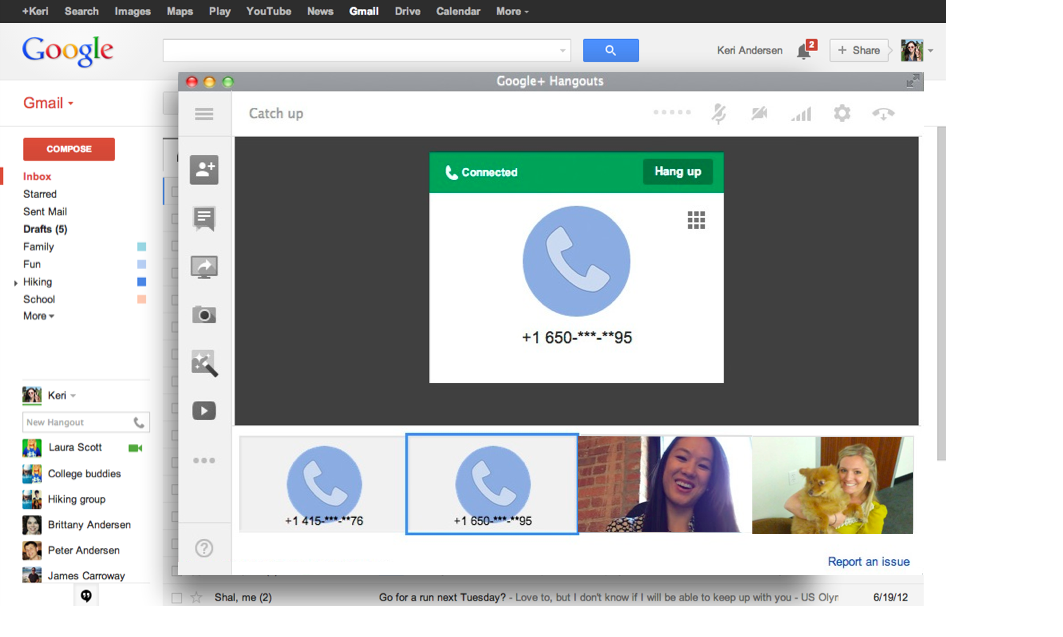
For those of you who have taken the plunge and are using desktop Hangouts in Gmail, Google+, and the Chrome extension, we've heard loud and clear that you miss the ability to make calls from Gmail, so today, we're happy to announce it's back - and better than before! Even better: calls to the US and Canada are now free from all countries where Hangouts calling is available. And international rates remain super, super low.
Today's launch also improves the desktop calling experience in a number of ways. For example: you can add multiple phone numbers and video participants to the same call; and you can play sound effects (like applause or laughter) with the Google Effects app.

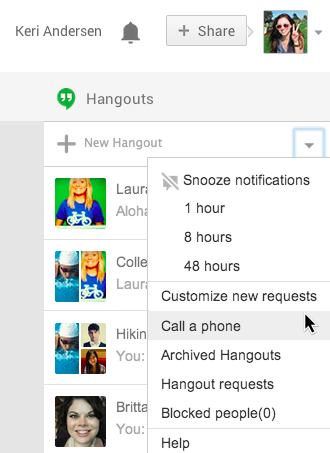
To make a call from Hangouts, just look for the new phone icon in Gmail, or for the new "Call a phone" menu item in Google+ and the Chrome extension. And of course: if you haven't yet tried Hangouts in Gmail, you can always click your profile photo in the chat list and select "Try the new Hangouts."
Making calls from Hangouts is rolling out over the next couple of days. As we’ve said before: Hangouts is designed to be the future of Google Voice, and making and receiving calls is just the beginning. So stay tuned for future updates.
09 Jul 23:00

Most Popular Home Theater Projector: Epson PowerLite Home Cinema 8350

by Alan Henry

Most Popular Home Theater Projector: Epson PowerLite Home Cinema 8350

Putting a movie theater in your home doesn't have to cost an arm and a leg, but you will need a great projector. Last week we asked you which ones you thought were best. Then we took a look at the five best home theater projectors. Now we're back to highlight the winner.

Most Popular Home Theater Projector: Epson PowerLite Home Cinema 8350

The Epson PowerLite Home Cinema 8350 pulled through the crowd to take the top spot with over 37% of the votes cast. Those of you who praised it noted it's a great LCD projector with 3 image processors to reduce the dreaded "rainbow" effect.

In second place with 20% of the vote was the other Epson model in our roundup, the Epson PowerLite Home Cinema 3020/3020e, both pricey models that offer superb image quality, and in the case of the latter, wireless HDMI. In third place was the Optoma HD33 with close to 16% of the overall vote, well loved for its bang-for-the-buck and long, storied history. In fourth place with 15% of the vote was the gaming-oriented, affordable, shorter-throw Optoma GT750E. Bringing up the rear in fifth was the Optoma HD25/HD25-LV, with just over 11% of the votes cast.

For more detail on each of the contenders, and our picks as honorable mentions not listed here, head over to the full Hive Five feature.

The Hive Five is based on reader nominations. As with most Hive Five posts, if your favorite was left out, it's not because we hate it—it's because it didn't get the nominations required in the call for contenders post to make the top five. We understand it's a bit of a popularity contest, but if you have a favorite, we want to hear about it. Have a suggestion for the Hive Five? Send us an email at tips+hivefive@lifehacker.com!

09 Jul 21:19

Apple And Amazon Agree To Stop Stupidly Suing Each Other Over "App Store" Name

by Dan Rowinski

Apple and Amazon have settled their differences over the term "app store," putting an end to a dispute that began when Apple sued Amazon in 2011 over the e-commerce king's use of the term for the store that it uses to sell mobile applications for its Kindle Fire tablets. 

Today, U.S. District Court judge Phyllis Hamilton in Oakland, Calif. agreed to dismiss the case. According to a report from Reuters, Apple agreed to drop the case in order to avoid a counterclaim from Amazon. Apple had originally claimed trademark violation and false advertising over Amazon's use of the App Store name. 

"We no longer see a need to pursue our case," Apple spokeswoman Kristin Huguet told Reuters. "With more than 900,000 apps and 50 billion downloads, customers know where they can purchase their favorite apps."

Amazon's application store is technically called the "Amazon Appstore For Android." It sells and markets apps specifically for its Kindle Fire tablets, which compete with Apple's iPad. Apple's version is just the "App Store" on iPhones and iPads; it also lives as a feature of Apple's desktop iTunes software. 

Amazon had claimed that the "app store" term had become generic and was thus safe to use. 

Apple's App Store turns five years old on Wednesday, July 10. The Amazon Appstore for Android was launched on March 22, 2011.