Shared posts

16 Jun 19:20

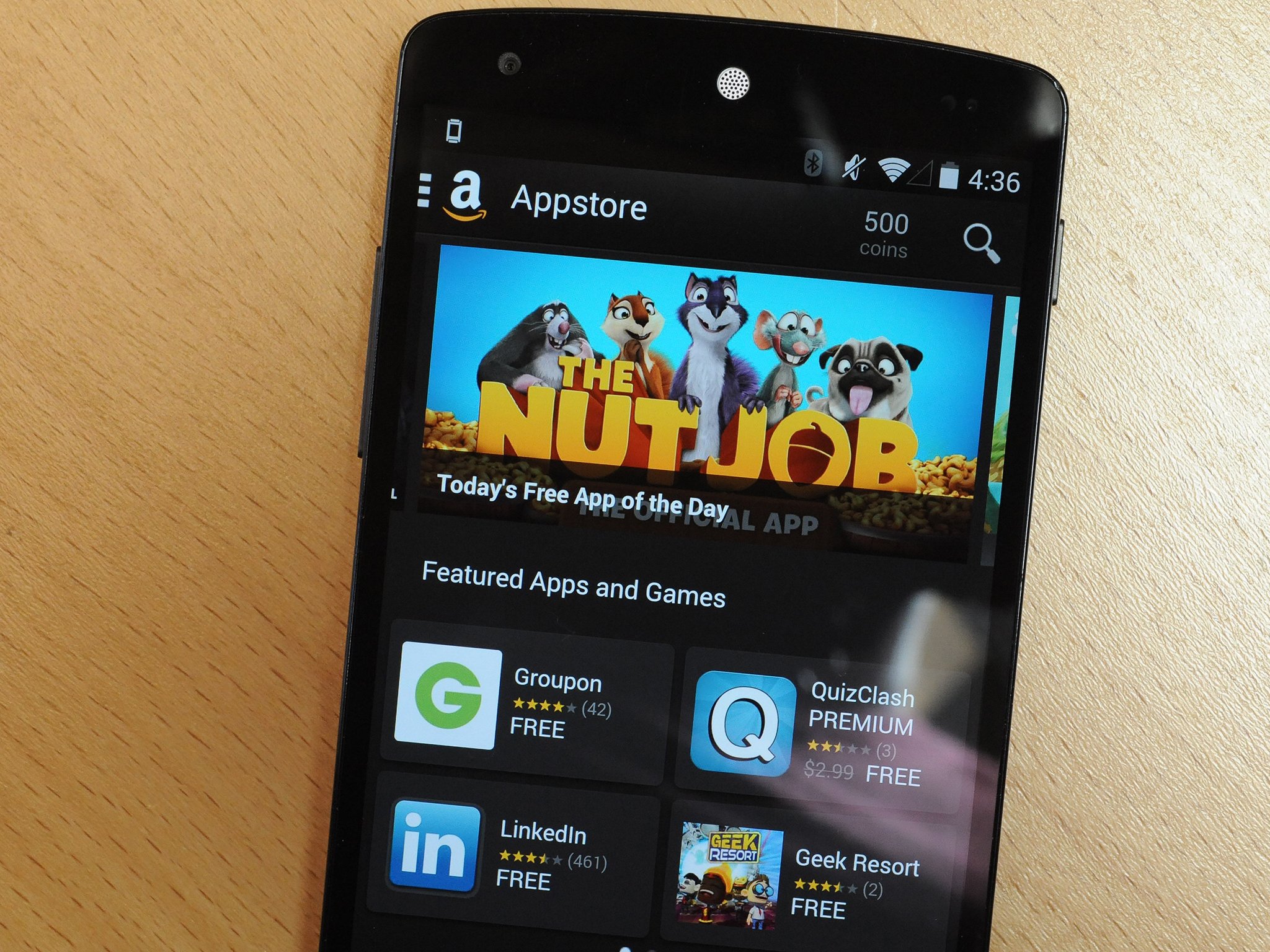
Amazon Appstore triples selection in a year to 240,000 apps

by Derek Kessler

Amazon's Appstore for Android apps has seen tremendous growth over the past year. That growth has seen the selection triple from 80,000 apps to more than 240,000 today. Other companies like Apple or Google might announce such a thing at a press event like WWDC or I/O, but not Amazon. Even though there's an Amazon event set for Wednesday (which we will be attending) where we expect to see their first foray into smartphones, apparently Amazon couldn't wait to get the word out.


16 Jun 19:11

Microsoft’s secret Android patents revealed by Chinese government

by Tom Warren

Microsoft has been licensing access to part of its patent portfolio for several years now, offering device makers protection from litigation related to Android and Chrome OS. While Microsoft boasts that more than 70 percent of Android phones sold in the US are covered by licensing agreements, the company has never listed what patents are infringed by Android. Instead, China’s Ministry of Commerce (MOFCOM) has now revealed a list of more than 300 patents and applications held by Microsoft that formed the Chinese approval of the Nokia deal recently.

The list includes 73 standard-essential patents, but there’s also 127 patents that Microsoft claims are implemented in Android. Some on the list, as Ars Technica notes, include patents that...

Continue reading…

16 Jun 18:26

5iler is a Repurposable, Persistent, Five-column, Minimalist Notepad

by Mihir Patkar

5iler is a Repurposable, Persistent, Five-column, Minimalist Notepad

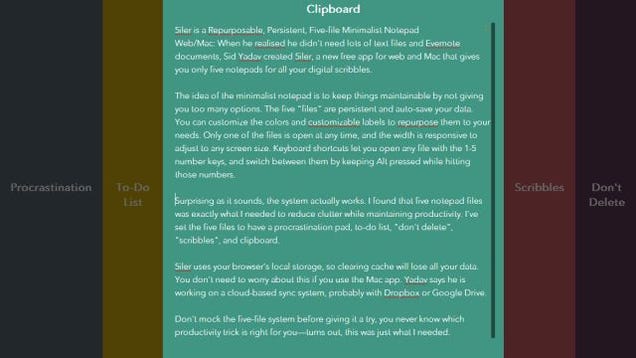
Web/Mac: When Sid Yadav realized he didn't need lots of text files and Evernote documents, he created 5iler, a new free app for web and Mac that gives you only five notepads for all your digital scribbles.

The idea of the minimalist notepad is to keep things maintainable by not giving you too many options. The five "files" are persistent and auto-save your data. You can customize the colors and labels to fit your needs. Only one of the files is open at any time, and the width adjusts itself to any screen size. Keyboard shortcuts let you open any file with the 1-5 number keys, and switch between them by keeping Alt pressed while hitting those numbers.

Surprising as it sounds, the system actually works. I found that five notepad files was exactly what I needed to reduce clutter while maintaining productivity. I've set the five files to have a procrastination pad, to-do list, "don't delete", "scribbles", and clipboard.

5iler uses your browser's local storage, so clearing cache will lose all your data. You don't need to worry about this if you use the Mac app. Yadav says he is working on a cloud-based sync system, probably with Dropbox or Google Drive.

Don't mock the five-file system before giving it a try, you never know which productivity trick is right for you—it turns out, this worked for me better than I thought it would.

5iler | via Product Hunt

16 Jun 18:25

DinnerTime Lets Parents Control Kids' Access to Android Devices

by Mihir Patkar

Android/iOS: The DinnerTime app is the simplest solution you'll find for parents who want to give their kids time-outs from their phones and tablets. The free app currently works only for Android for kids, but parents can use either Android or iPhone.

Here's how it works: You first install the app on the kid's Android device and chosen as "kid" when prompted. From the kid's device, you send an SMS to the parent's device, who is asked to link with the child's. Finally, you will have to give the app administrator access on the kid's device. It's all detailed in this instructional video if you have any trouble. There's one catch, though: the parent device needs the ability to send and receive SMS since that's how the gadgets are connected. The kid's device doesn't need phone capabilities.

Once the two devices are linked, the parent gets three options: "Dinner Time," "Bed Time," and "Take a Break." By default, Dinner time is set to one hour and Bed Time is set to 21:30-07:00, but both of these can be changed. Tap either button and the kid's device is locked down. for that time. Take a Break lets you tap to lock and tap to unlock—simple as that.

You can currently link two parents to each kid's device, and two kids to each parent's device. Basically, a family of four is covered. The DinnerTime Plus app expands this to five kids with an in-app purchase ($1.99), and also enables blocking specific apps—however, DinnerTime Plus is only available on Android right now for both parents and kids.

DinnerTime (Free) | Google Play Store

DinnerTime (Free) | iTunes App Store

DinnerTime
16 Jun 18:13

Movie Piracy Combated by Narrowing Theatrical Release Window

by Andy

cammer1While its popularity has waned in recent years, the issue of camcorder piracy is often spoken about in crisis terms by the major movie studios.

Part of the reason camming occurs, however, is down to the exclusivity enjoyed by the world’s theater chains, meaning that while a mainstream movie is being shown in a cinema, it is not available anywhere else. It will not be available on Netflix nor will it be available for purchase on Blu-ray or DVD. This creates a convenient opening for the black market.

Of course, pretty much the whole time a movie is showing in theaters it will be available both online and on DVD, because someone, somewhere, will have recorded it illegally. True exclusivity only exists in the minds of the theaters and distributors.

Just lately it’s been extremely popular for Australians to be criticized for their piracy habits, an activity sometimes justified by films not being made available quickly enough Down Under. This morning it’s been revealed that the group representing the Australian film and TV home entertainment industry intend to do something about that.

Speaking with Fairfax Media, Australian Home Entertainment Distributors Association chief executive officer Simon Bush said that the current theatrical window will be narrowed in an effort to reduce piracy.

“This 120 days is not the hard and fast rule anymore and there will be some studios this year that will be coming in around the 90 days,” Bush said. “[The studios] don’t like the fact that they are losing out a lot of money to piracy.”

It’s hoped that the shortening of the delay will go someway towards reducing illegal movie downloads in Australia by providing content in alternative formats in a more timely fashion. That being said, AHEDA still wish to preserve the big screen’s exclusivity in the market and its position as the premier location for early viewing.

“It continues to ensure that the theatrical window retains its rightful prominence in the market as the premium movie experience, but also allows the consumer to increasingly access the film earlier digitally and on DVD and Blu-ray and thus reduce what some refer to as the ‘piracy window’,” Bush said of the narrowing window.

While improved availability is key to reducing piracy, theaters will undoubtedly balk at the further erosion of their exclusive window of opportunity. However, according to comments made by DreamWorks Animation chief Jeffrey Katzenberg, release windows could collapse almost entirely in the next ten years.

“I think the model will change and you won’t pay for the window of availability. A movie will come out and you will have 17 days, that’s exactly three weekends, which is 95% of the revenue for 98% of movies,” Katzenberg told the Milken Global Conference in Beverly Hills earlier this year.

“On the 18th day, these movies will be available everywhere ubiquitously and you will pay for the size. A movie screen will be $15. A 75” TV will be $4.00. A smartphone will be $1.99. That enterprise that will exist throughout the world, when that happens, and it will happen, it will reinvent the enterprise of movies,” he said.

In the meantime, the Australian government will try to legislate its way out of the piracy problem, by imposing “three strikes” style schemes on its citizens and pressuring ISPs to take responsibility for the actions of their subscribers.

Source: TorrentFreak, for the latest info on copyright, file-sharing and anonymous VPN services.

15 Jun 16:27

Five Best Android Keyboards

by Alan Henry

Five Best Android Keyboards

Finding the perfect Android keyboard is no easy task—there are so many to choose from, and most of them are great, depending on the type of typist you are. This week, we're looking at five of the best, based on your nominations and votes.

Earlier in the week, we asked you to nominate your favorite Android keyboard for the top five, and vote to decide which ones would make the final round. You responded with way more keyboards than we could possibly highlight here, but some definitely rose above the ranks. Here's what you said, in no particular order.

SwiftKey

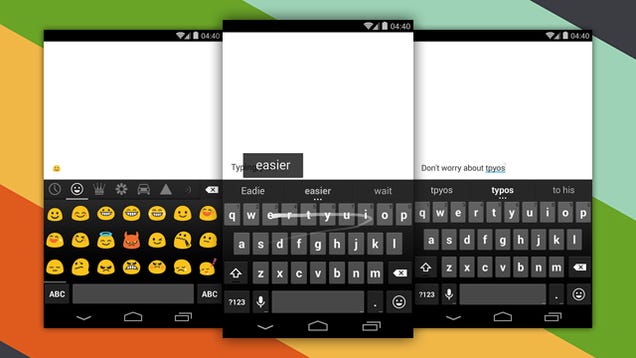
SwiftKey has come a really long way even since the last time we asked for your favorite Android keyboards. Back then, its predictive text engine was its biggest strength—the fact that it was one of the first keyboards to actively learn from the way you typed and offer better word and spelling suggestions as a result. SwiftKey still does that really well, and if you enable it (and it's optional), can learn from your emails, social networks, text messages, and more to auto-fill your friends names, addresses, favorite words, and more. SwiftKey also supports multiple keyboard layouts on screen, multiple keyboard sizes, phone and tablet friendly layouts that you can move around the screen, themes and personalization options, and cloud syncing for your custom dictionary and saved text, so you don't start from scratch on a new device. Of course, it also supports gesture typing and swipe-to-type, including its "Flow through Space" feature, which lets you type entire sentences without lifting up your finger. Also, did we mention that the once premium keyboard is now free over at Google Play?

SwiftKey is no stanger to Lifehacker or Lifehacker readers. You can see our previous coverage here, and those of you who nominated SwiftKey praised it for its features that were most useful to you. In some cases it was its tablet-friendly layouts, with a split keyboard that made two handed typing with your thumbs easy. Others noted its predictive text was the best in the category. Others praised SwiftKey for its themes and personalization tools, all of which create a really personal experience. There's more where that came from, too. Read more in its nomination thread here.


Swype

Swype was the original swipe-to-type/gesture-typing keyboard, and it still comes on a number of Android headsets by default. Over time, Swype has perfected its swipe-to-type engine, improved its predictive text engine and added crowdsourced dictionaries, given users customization options, and emerged from beta onto Google Play, sporting Dragon Dictation text-to-speech, thanks to its new parent company, Nuance. Now, Swype has split-keyboard options and tablet-friendly layouts, great speech recognition, smooth typing, and easy language switching.

Those of you who nominated Swype praised its swipe-to-type feature, and noted that even other keyboards that have it just aren't the same. Many of you noted that Swype makes it easy to add punctuation, and copy and paste text by swiping key-shortcuts. For many of you, Swype just hits the sweet spot, and while it's not perfect (many of you reported sluggishness with it), it's fast, flexible, and offers more shortcuts and hotkeys than most other competitors. If you're interested, now that it's out of beta you'll have to drop $4 to get it at Google Play. Read more in its nomination thread here.

Google Keyboard

Five Best Android Keyboards

Make no mistake, the default keyboard has come a long way in its own right. Google has taken some of the best features from third-party keyboards and rolled them into its own, which is available for free at Google Play. The stock Google Keyboard (at least in Kit Kat) has gesture typing, a learning dictionary that saves words you introduce to it, text expansion built-in, personalized predictive text based on your typing habits, speech-to-text features, and more. It's remarkably powerful, and offers features for free that used to be only available in premium keyboards. It works just as well on tablets as it does on phones, and while it isn't brimming with customization or personalization options, or special features like auto-capitalization of "I" or copy/paste shortcuts, it's solid enough that many people stick with it instead of dealing with another keyboard.

In fact, in the nominations thread, many of you pointed out that there was a time when you couldn't wait to replace the default keyboard, but it's gotten to be good enough now that there's no reason to. The default keyboard is feature-rich enough, and gets the job done, without slowing your phone or tablet down in the process. Many of you pointed to the Google Keyboards' advanced features, which do give you more control over your typing experience. At the same time, it only really excels on devices running 4.0+, so if you're stuck with Gingerbread or a tablet with Honeycomb, the default keyboard may leave something to be desired (although at least one of you noted you prefer the 2.3 keyboard anyway.) You can read more in the nomination thread here.


Fleksy

Fleksy's minimalist look on-screen hides a ton of power under the hood. The keyboard's real focus is on speed and extremely high accuracy. The standard QWERTY layout is fine and all, but where the keyboard shines is that when you start typing, the layout of the keyboard changes to make sure the letters you need next are right there next to your finger. In fact, when it landed as a note-taking app on iOS, we noted it was so good someone with impaired vision could use it. We cheered when it arrived on Android, bringing its exceptional autocorrection engine, invisible keyboards, auto-punctuation, and multiple themes along for the ride. Once you have a feel for where to put your fingers, Fleksy lets you type words and entire sentences without even looking at the keyboard, which is fairly impressive. One thing to note though—Fleksy is designed for tap-typists, not people who love or are used to gesture-typing. If that's you, it's definitely worth a try. You can pick it up for $4 at Google Play, or grab the free version first to get familiar with its features.

Those of you who nominated Fleksy praised its banner feature primarily: It's autocorrection engine. In fact, it's good enough to correct the word to the one you intended even if you've mistyped every single letter, which is pretty impressive. Plus, you noted that you can customize the size and transparency of the keyboard so it's perfect for your needs. Of course, if you're used to predictive text or swipe-to-type, Fleksy's autocorrect may or may not be enough to make you switch, but it's still worth a try. Read more in the nomination thread here .


Minuum Keyboard

Minuum started life as an IndieGoGo project, and its users swept in and funded it, hoping to build a better Android keyboard. Its claim to fame is that it's tiny, but easy to use even if you have large fingers. We've highlighted it before, and again when it left beta. The entire keyboard takes up a small bar at the bottom of the screen, and stays out of the way of your other work. Each QWERTY row is staggered, and Minuum relies heavily on text prediction to make typing fast and easy. While there's certainly a learning curve to using it, it helps if you're a thumb typer who likes to keep the screen clear and you only really need a little space for the keyboard. If you're a big tap-typist, or you love swipe-to-type, this may not be the keyboard for you, but Minuum is still evolving.

Those of you who nominated it praised its minimal interface, and noted that while it takes some time to learn, it's worth it in the long run. Others of you weren't so sure, and noted that you'd tried and gave up, or that you were sticking with it because you believed in the idea. Either way, it generated solid interest, and if you're interested in trying it, you can grab it for $4 at Google Play, or pick up the free version to try out its features first. Read more in its nomination thread here.


Now that you've seen the top five, it's time to vote for the Lifehacker community favorite:

This week's honorable mention goes out to the Hodor Keyboard. Because Hodor.

Okay, beyond that, some other great keyboards just missed the cut. TouchPal X is a keyboard we've highlighted before, and was one of the first to have whole sentence gesture typing. It's extremely customizable, lets you customize the keyboard layout and size, switch between 70+ languages and text inputs, and it supports predictive text. Its predictive text engine learns from your SMS messages, Twitter account, contact names, and other apps, much like SwiftKey does. If you're looking for an alternative to SwiftKey that has many of the same features, TouchPal is worth a look. You can read some solid praise for it in its nomination thread here.

Dextr is a non-QWERTY keyboard that's well loved by its users, and presents a unique and interesting take on speeding up your mobile typing. The keys are spaced in a way to make them easy to hit even with large fingers, and it's rolled in predictive text and autocorrect that actually works well. For those of you used to or who prefer the standard QWERTY layout though, you'll have to climb the learning curve with this one. Once you do—according to its users—you're in for a treat.

Want to make the case for your personal favorite, even if it wasn't included in the list? Remember, the top five are based on your most popular nominations from the call for contenders thread from earlier in the week. Don't just complain about the top five, let us know what your preferred alternative is—and make your case for it—in the discussions below.

The Hive Five is based on reader nominations. As with most Hive Five posts, if your favorite was left out, it didn't get the nominations required in the call for contenders post to make the top five. We understand it's a bit of a popularity contest. Have a suggestion for the Hive Five? Send us an email at tips+hivefive@lifehacker.com!

15 Jun 16:26

WordPress Demands $10,000 For DMCA Takedown Censorship

by Ernesto

wordpressAutomattic, the company behind the popular WordPress blogging platform, has seen a rapid increase in DMCA takedown notices in recent years.

Most requests are legitimate, aimed at disabling access to copyright-infringing material. However, there are also many overbroad and abusive takedown notices which take up a lot of the company’s time and resources.

Last November, WordPress decided to take a stand against these fraudulent practices. The company teamed up with student journalist Oliver Hotham who had one of his articles censored by a false takedown notice.

Hotham wrote an article about “Straight Pride UK” which included a comment he received from the organization’s press officer Nick Steiner. The latter didn’t like the article Hotham wrote, and after publication Steiner sent WordPress a takedown notice claiming it was infringing on his copyrights.

Through a lawsuit filed in a California federal court, WordPress and Hotham now hope to be compensated for the damage this abuse caused them.

“The information in the press release that Hotham published on his blog did not infringe any copyright because Hotham had permission to publish it. It was a press release, which by its very nature conveys the intent to ‘release’ information to the ‘press’,” WordPress’ attorney explains to the court.

The company says that as an online service provider it faces overwhelming and crippling copyright liability if it fails to take down content. People such as Steiner abuse this weakness to censor critics or competitors, and they have to be stopped.

“Steiner’s fraudulent takedown notice forced WordPress to take down Hotham’s post under threat of losing the protection of the DMCA safe harbor,” WordPress argues.

“Steiner did not do this to protect any legitimate intellectual property interest, but in an attempt to censor Hotham’s lawful expression critical of Straight Pride UK. He forced WordPress to delete perfectly lawful content from its website.As a result, WordPress has suffered damage to its reputation,” the company adds.

Since Steiner failed to respond in court WordPress and Hotham have requested a default judgment. In a recent filing they demand a total of $10,000 in damages as well as $14,520 in attorneys’ fees.

If the court agrees with the request it will be mostly a symbolic win, and hopefully a signal to other copyright holders that false DMCA takedown requests are not without consequence.

During a House Judiciary Subcommittee hearing on the DMCA takedown system earlier this year, Automattic General Counsel Paul Sieminski also stressed the importance of this issue to lawmakers,

“The system works so long as copyright owners use this power in good faith. But too often they don’t, and there should be clear legal consequences for those who choose to abuse the system,” Sieminski said.

In a few weeks we’ll know if the court agrees.

Source: TorrentFreak, for the latest info on copyright, file-sharing and anonymous VPN services.

14 Jun 23:09

Court finds full-book scanning is fair use

by Cory Doctorow


The Hathi Trust has won another important victory in its court battles against the Authors Guild over the right of academic libraries to scan books under the banner of fair use. Hathi creates full-text indexes of books from academic institutional libraries that were scanned by Google, so that academic libraries can access full-text indexes of the books, as well as offering the books in assistive formats used by people with visual disabilities, and providing long-term archives of rare texts that are still under copyright.

The Authors Guild members are overwhelming trade-book authors; the books scanned by the Hathi Trust are overwhelmingly scholarly books written as part of an academic tradition that takes free access and sharing as its foundation. The court remanded a question of standing in the case, asking the Guild to demonstrate that it represented authors of the affected works. Read the rest

14 Jun 21:05

Canadian Supreme Court's landmark privacy ruling

by Cory Doctorow

The Supreme Court of Canada's ruling in R. v. Spencer sets an amazing precedent for privacy that not only reforms the worst practices of Canadian ISPs and telcos; it also annihilates the Tories' plans to weaken Canadian privacy law into insignificance. The Supremes unanimously held that the longstanding practice of carriers voluntarily handing over subscriber data to cops and government agencies without a warrant was unconstitutional.

The court's decision, written by Harper appointed Justice Thomas Cromwell, takes a nuanced view of privacy, and upholds the importance of anonymity as part of the protected right to privacy.

The Harper government is currently pushing two surveillance bills, C-13 and S-4, which would radically expand the practice of "voluntary" disclosure of subscriber data without a warrant. As Michael Geist writes in an excellent explainer, these bills are almost certainly unconstitutional under this ruling and are likely to die or be substantially reformed. Read the rest

14 Jun 21:03

Vuze Torrent Client Condemns Piracy, Says It’s Stealing

by Ernesto

piracy-crimeFollowing in the footsteps of the makers of uTorrent, the Vuze team is now taking a stand against piracy.

The California-based company says it will focus more on highlighting legal content through social media and other outlets. Vuze emphasizes that its technology is completely legal, but wants its users to understand that sharing files without permission of copyright holders isn’t.

“Although torrents themselves are a legitimate way to share files, understanding the rights of copyright holders and what content they have or have not authorized for free distribution is the core to understanding the difference between it being legal or illegal to share or distribute content using Vuze,” the company notes.

“Remember, if you use Vuze torrent client software for P2P file sharing then use it responsibly. Be aware of illegal torrents and avoid downloading them. Don’t infringe copyright,” Vuze adds.

This position is sensible for a technology company to take. Also, Vuze does highlight that copyright is a complex issue, and that there are ongoing discussions with varying positions. The bottom-line according to Vuze, however, is that downloading something without the permission of the owners is stealing.

“Now we can get into all sorts of political, social and even religious discussions on this topic, but right now as the laws exist in most places downloading and sharing content without the authorization of the rights-holder is stealing, and even if one copy was purchased, passing digital copies around via P2P is still illegal, sometimes criminally so.”

piracy-is-not-theft“Sharing and downloading infringing MP3s and MPEGs is virtually the same as swiping from a brick-and-mortar,” Vuze adds.

The “stealing” mention is a touchy subject. Many people, including scholars and a U.S. federal court, believe that this term should be avoided when talking about piracy.

Even the MPAA’s Chris Dodd agreed on this. “We’re on the wrong track if we describe this as thievery,” Dodd said two years ago, although the MPAA still uses the term today.

Vuze, however, doesn’t avoid this type of strong language. The company wants to make it clear that piracy is not allowed. In fact, the company encourages its users to follow suit, and “consider reporting illegal content infractions.”

Aside from the promise to highlight legal content on its blog, they also provide some tips for users to spot infringing content. Vuze hopes that with these guidelines, users will be able to steer away from any illegal behavior.

“We want to again stress that we respect the rights of copyright holders, and hope and expect that you do too,” Vuze concludes.

Whether that’s going to happen remains to be seen. Several studies have shown that more than 90% of all public transfers via BitTorrent are copyright infringing, and it will be hard to flip these numbers around.

Source: TorrentFreak, for the latest info on copyright, file-sharing and anonymous VPN services.

14 Jun 21:01

The world's ugliest buildings are being destroyed

by Chris Ziegler

It's doomsday for some of the world's most identifiable Brutalist structures, products of a unique architectural movement defined by thick, exposed concrete and unapologetically harsh angles that flourished in the middle part of the 20th century. Considering how unique they are — and how unlikely it is that Brutalism will make a comeback any time soon — there's an argument to be made that preservation should be a priority. Those efforts have largely failed so far: take Chicago's Prentice Women's Hospital, for instance, which was recently demolished after years of fighting to make way for a more modern replacement. The Awl's Anthony Paletta takes a look at the untimely ends of these monuments to ugliness and the efforts to preserve what's...

Continue reading…

14 Jun 15:06

Lewis Carroll’s 4 Rules for Digesting Information and Mastering the Art of Reading

by Bill Crider
14 Jun 09:23

This Entrepreneur Built An Asthma Monitor To Save Lives—Just Not His Own

by Selena Larson

Like many entrepreneurs, Chris Stiffler had an idea for a world-changing product rooted in his own experience. In his case, the experience was a serious asthma attack. The product was Wheezy, a wearable device designed to help asthmatics monitor their breathing and other factors in order to help prevent attacks.

In January, Stiffler, a friend of mine who I knew through the Phoenix-area tech community, was hospitalized after an asthma attack so severe, it took him more than two hours to drive 30 miles to the hospital. During the drive, he found himself contemplating his own death with something approaching equanimity; when he arrived, he had to scribble "asthma attack" on a receipt with a broken pen because he couldn't pull in enough air to speak.

When he died, entrepreneur Chris Stiffler was hard at work on a device that would help people like himself who suffered from asthma.When he died, entrepreneur Chris Stiffler was hard at work on a device that would help people like himself who suffered from asthma.

"All I could think was, 'Oh shit, this is really bad and I might never see my wife or kids again'," he wrote in a blog post two months later.

While recuperating, Stiffler banged out code for an app that would let him log his breathing data. But it was a pain to enter the numbers manually, so he began sketching ideas for Wheezy, a hardware device that would automate the process and provide warnings of likely future attacks. He built a prototype and began using it himself.

Wheezy is close to a reality; Stiffler's startup, Vicinity Health, had planned to build the first beta models shortly. Those plans, however, are now temporarily on hold following an unexpected tragedy—Stiffler's sudden death last week after another severe asthma attack. Wheezy had predicted the event, although its warning wasn't enough to save its creator.

The entrepreneur, 35, leaves behind his wife, two young children and a startup that's still catching its own breath following the passing of its founder.

Waiting To Exhale

Asthma is a chronic inflammation of the airways that can unexpectedly lead to wheezing, chest pain and shortness of breath. Long-term management is largely a matter of avoiding triggers such as cigarette smoke, using medications that relax the bronchial passages and tracking changes in breathing patterns that might signal whether asthma is worsening.

To track their lung function, asthmatics breathe into a tube attached to a spirometer, a device that measures the volume of air moving in and out of the lungs. (Simpler versions of that device are called peak flow meters.) But tracking lung function regularly is cumbersome. Some mobile apps already let patients track their respiratory information, although they typically require individuals to enter their data manually.

Stiffler conceived of Wheezy as a system that would simplify that process and much more, to the point where it could track enough data to alert a patient's doctors should an asthma attack appear imminent. The gadget itself is a small, colorful rectangle that plugs into a smartphone's headphone jack. Patients breathe into the other end, and an associated app records the spirometric data.

The Wheezy app can also pull in relevant data from other sources—everything from local environmental conditions to sleep and exercise patterns gleaned from other fitness apps a patient might be using. In theory, the app would crunch the numbers, apply machine learning, and gauge the likelihood of an attack.

Hacking His Way To Health

Stiffler was hospitalized for a week after the attack in January, during which time he sketched mockups of the device that would later become Wheezy. He brought them to Gangplank, a local collaborative workspace in Chandler, Ariz., that hosts “hack nights” on Wednesday evenings, and teamed up with programmer and Gangplank regular Jessie Dommert to create the first prototype. I worked at Gangplank for a while, which is how I first got to know Stiffler.

“He needed some help with the hardware of the device, so I started helping him learn Arduino,” Dommert said, referring to the modular do-it-yourself electronics kit. “What was great about Chris was, I could tell him what he needed to do and he'd attempt to do it. Even if he couldn’t do it, he tried.”

After a handful of hack nights, Stiffler had a rough working algorithm, an API (see our API explainer) to monitor weather and other data, and a working prototype of the device built with Arduino. It was enough to start up Vicinity Health, a company founded to help people dealing with a variety of respiratory problems.

Eventually, Stiffler brought on Scott Shrake, an engineering professor at Arizona State University, and Brian Straub, a local pharmacist. The company was accepted into the Iron Yard, an accelerator program in South Carolina that partners with the Mayo Clinic.

According to Shrake, Vicinity was also in the process of closing a funding round that would cover manufacture of the first 100 devices for beta testing. Vicinity planned to price the Wheezy device between $79 and $99, and to sell the accompanying app subscription service for $9 a month. 

“His last message to me was, 'Just think, three months from now we’ll be pitching at Health 2.0',” Shrake told me. 

Those plans are now on hold. Stiffler’s death left a hole in the fledgling company—and while Shrake and Straub are committed to continuing his vision, the circumstances have forced them to rethink the future. 

“He’s irreplaceable, but we’re going to identify what the next critical steps are,” Shrake said. “We want to put together a team around it that can do it justice. We’re going to deliver, but we have to strategize.”

A Heartbreaking Irony

Chris Stiffler is survived by his wife, Sandy Wu Stiffler, and two children.Chris Stiffler is survived by his wife, Sandy Wu Stiffler, and two children.

Asthma affects an estimated 25 million in the U.S.; nine of those die of asthma attacks every day. Stiffler may have initially thought up Wheezy as a way of monitoring his own health, but a device like his could impact millions of people around the world. 

Wearable health technologies are a nascent but growing market. Companies ranging from small fitness startups to tech giants like Apple and Google are trying to figure out how to effectively use resources like apps and smartwatches to manage our health, and ultimately make wearables as ubiquitous as smartphones.

The Chandler tech community is still reeling in the wake of Stiffler's death, but the entrepreneur's team and family agree that he would want the project to be completed. “It’s sad that the tool he was building was working, but not working enough to prevent his death,” Dommert said. 

The team still has to figure out how to patch the hole Stiffler left behind. But once prototypes have been tested, Vicinity Health will launch a crowdfunding campaign to get Wheezy on the market, and eventually, bring the lighter-sized wearables to asthma sufferers everywhere. 

“My husband will be very happy if Wheezy will help anyone, even just one person,” Sandy Wu Stiffler told me in an interview. “Eventually it will be coming out—those asthma patients won’t be afraid anymore.”

Friends of Chris Stiffler are raising funds to support his family. So far, 68 donors have raised $8,642.

Images provided by a friend of Chris Stiffler

13 Jun 20:14

Firefox OS web apps run seamlessly on Android

by Dima Aryeh

Firefox OS is a web-based operating system that runs HTML5 apps built for the web. Using things like WebGL, these HTML5 apps can interact with the hardware to allow true native apps outside of a browser along with graphics-intensive things like games. And thanks to the web-based nature of these apps, Firefox OS apps can run on Android devices without a single change in code.

These apps can be installed with the latest version of Firefox for Android, version 29. They behave just like native Android apps in that they appear in the launcher and can be uninstalled through the Settings menu. Their performance is arguable, as web apps have historically been less than optimized, but we’ll have to see.

This is awesome for developers, as they can make the same app work on Firefox OS and Android without changing anything. Not only is it easier, but it actually gives developers incentive to support Firefox OS (which is really important for developing countries, as the latest phone is only $25). What do you think of web apps coming to Android?

13 Jun 20:09

Bot alerts you every time the Supreme Court silently alters its rulings

by Cory Doctorow


As the New York Times recently reported, the Supreme Court has a habit of silently altering its rulings on its websites. Now, the @SCOTUS_servo feed will alert you when this happens, with links to the diffs and interpretation by David Zvenyach, general counsel to the Council of the District of Columbia. Read the rest

13 Jun 14:20

Moto 360 could cost £199 in the UK

by Alex Dobie

Moto 360

One of the big unanswered questions with surrounding Android Wear devices relates their pricing. But today British outlet MobileFun says it has the first UK price details for Motorola's Moto 360, the circular wearable many have been salivating over since its announcement. And according to the retailer it'll cost £199. That's around the same as the UK price for Samsung's Gear 2 Neo, and a good bit cheaper than the full camera-toting Gear 2.

With recent rumors suggesting the LG G Watch could undercut Samsung's Gear smartwatches, it's looking increasingly likely that both Android Wear watches could arrive at competitive price points. That said, we'll have to wait on final pricing direct from Motorola and LG before it's set in stone.

As for what this means for U.S. pricing, a £199 price tag, less VAT, equates to around $280, so make of that what you will. And as always, take these tentative numbers with a pinch of salt until we hear the official word.

Source: MobileFun via Android Central forums; Thanks Ry!

13 Jun 14:20

Rumored Google Fit to allow wearables to phone home

by Chuong H Nguyen

Google may be planning Google Fit APIs for connected wearables

Google is rumored to be working on a Google Fit project that could become the hub for collecting data tracked through health and fitness wearable technologies. Google Fit could debut as early as by the end of the month at the Google I/O conference.

Though details aren't clear, at its core Google Fit could be introduced as a set of APIs for developers to tap into. Along with Android Wear for smartwatches, Google Fit could create a centralized hub for health and fitness data to be stored and tracked by users, an effort that's not unlike what Samsung had introduced with SAMI and Apple with HealthKit.

The idea of a centralized hub is an attractive one for adopters of wearable and connected devices as it creates one app or hub to track and monitor all data rather than having to visit multiple apps. This would create an ecosystem so that a heart rate monitor, a weight scale, and a pedometer could all link their information together in one portal.

We'll have to wait until Google I/O, which kicks off on June 25th, to find out what Google's exact plans are.

Are you excited about Google Fit? How would you like Google to handle the connected devices market to make it easier for consumers?

Source: Forbes

13 Jun 14:18

Samsung and Marvel team up for global partnership

by Chris Parsons

As part of the unveiling of the new Galaxy Tab S line of tablets at the Samsung Galaxy Premiere event in New York City, Samsung and Marvel have announced a new global brand partnership that will see both the Samsung and Marvel working together across a number of mediums including film, digital and through products with the main goal being to find unique and creative ways to showcase the best both brands.


13 Jun 14:16

How Hayek bred a race of elite monsters

by Cory Doctorow

Though he's been dead for more than 20 years, Friedrich Hayek is the darling of the free market, practically a saint. But as Bill Black explains, Hayek's predictions -- used to justify and glorify unlimited enrichment of the ruling class -- never came true, and the states that followed his prescriptions most closely ended up the barbaric situation that he warned about in re-distributive democracies.

As the gap between the rich and the poor widens, as the proportion of GDP that goes to "guard labor" in our militarized police forces and our bulging private prisons, as the most corrupt captains of industry grow richer while the rest of us are faced with an old age in poverty -- and a working life dominated by caring for our own sick and elderly relations -- it's worth reviewing Hayek's record, and the greedy, selfish, corrupt world it produced. Read the rest

13 Jun 14:15

Save Money and Become Happier by Simply Wanting Less Stuff

by Eric Ravenscraft

Save Money and Become Happier by Simply Wanting Less Stuff

Sometimes the best solutions are the simple ones that are staring you right in the face. You could scrimp and save, you can reduce your expenses, you can create elaborate budgets and those are all good. But if you really want to save money, one killer trick can do tons of good: want less stuff.

We all want so much that we care so little about once we have it. And if we can't actually afford them, we tend to forget about most of the things we want, anyway. We can easily extend this mentality to the things we can afford by simply wanting fewer things. Finance blog The Four Hour Workday explains how this trick—simultaneously the most simple yet the most difficult to accomplish—can do wonders for your wallet.

We're constantly sold to, as well, via marketing campaigns, advertisements, and commercials. We're lead to believe that this product or that service will instantly improve our lives somehow or make us better as human beings. But the things that lead to true happiness, satisfaction, and fulfillment usually can't be bought.

When we want less, when we stop worrying about what a mass-consumer society thinks about our lack of desire to acquire more stuff, we can start increasing wealth.

It may sound trite—or worse, impractical—but we're much more capable of changing our habits than most of us think we are. Wanting something doesn't have to be a permanent condition. Moreover, as you second-guess the things you want and leave the less important ones by the wayside, what you'll be left with is a shorter list of things that are truly important to you. That will give you a pretty good idea of how you should focus your spending to maximize your own happiness.

The Fastest Way to Increase Wealth: Want Less | The Four Hour Work Day via Rockstar Finance

Photo by Mihnea Stanciu.

13 Jun 14:14

Fitbay Helps You Find Clothes that Fit Your Body Type Online

by Eric Ravenscraft

Fitbay Helps You Find Clothes that Fit Your Body Type Online

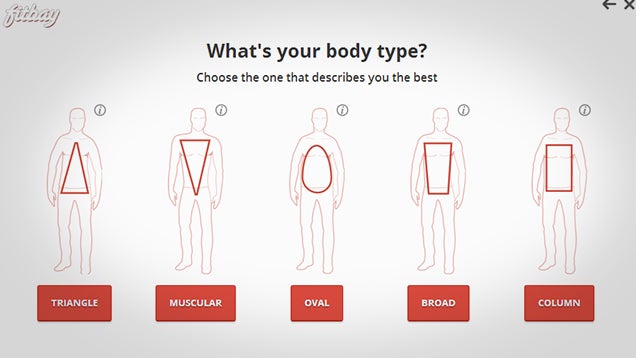
One of the biggest problems with shopping for clothes online is that you can't try them on to see if they fit. Fitbay aims to alleviate this problem by only showing you clothes that are available in your size and fit.

To start with, the site asks some basic questions about your body type. Rather than go by one of the many subjective sizing measurements, it asks about universal physical characteristics like how tall you are and what build type you have. You can optionally enter the sizes of clothes you already own and which brand they are to further refine results.

As you browse the site, all the clothes you'll be shown will be offered in your size. You can also connect with other users who have similar body types so you can see what looks good on them, or add your favorite brands and styles to refine search results by what you like even further.

Fitbay | via MakeUseOf

12 Jun 21:24

Google Steps Up Gmail And Calendar Integration In Google Now With Inferred Events

by Liam Spradlin

nexusae0_g_thumb1

In one of our early Google Now rumors, we described the possibility of "inferred events," or events that Google would grab from your Gmail (or other Google services) and present as a card in Google Now, with the option to add an entry to your calendar.

Today, it looks like the service is being switched on for some users, with Gmail being the first target (as we speculated previously).

Google Steps Up Gmail And Calendar Integration In Google Now With Inferred Events was written by the awesome team at Android Police.


12 Jun 19:21

Tile, The Lost-Item Tracker With Millions In Crowdfunding, Was Worth The Wait

by Sarah Perez
tile4 The first thing you’ll notice about Tile, the crowdfunded lost-item finder that attaches to bags, keys, bikes and more, is that it’s big. I mean, I know the company provided the device’s specs beforehand, but it’s still a surprise to see this large white square — bigger than a Wheat Thin and slightly smaller than a matchbook — sitting there in the black… Read More
12 Jun 19:21

Facebook Is Going To Start Tracking You Even More Closely

by Selena Larson

The next time you log in to Facebook, you might see a notification letting you know the company is “improving” advertising and giving users more control. To translate from Facebookese: The company will now be tracking your browsing and activity on third-party sites and applications to serve you up even more personalized ads. 

Facebook currently displays ads it thinks you’ll be more likely to engage with based on your Page likes and other personal information you share with Facebook. But soon in the U.S., Facebook will use data from websites you visit and applications you use to serve you up ads it thinks are relevant based on what you do off of Facebook.

So if you’ve been shopping online for a crib, Facebook will likely think you’re expecting a baby, and will show you Facebook ads for things like toys, clothes, and other items a new parent might need.

While Facebook provides options to opt-out of being tracked for advertising, it won’t honor do not track requests on browsers. This means, if you have selected “Ask websites not to track me,” on Safari, or “Send a "Do Not Track" request with your browsing traffic,” on Chrome, Facebook will ignore it. 

Instead, Facebook says you can avoid of this type of ad targeting through the Digital Advertising Alliance, which gives Internet users the ability to opt out of tracking from 115 participating companies. Of course, that opt-out process is slow and only works on the browser you're using at the time you visit that page. And if you erase all your cookies for any reason, you'll also inadvertently opt back into ad tracking.

Facebook will honor do-not-track settings on iOS and Android devices. According to a Facebook spokesman, the company doesn’t honor do-not-track requests from browsers because there is no set industry standard. For instance, Twitter honors them, while Google does not. 

“We’ll continue to work actively with privacy advocates, regulators, and others in to build a consensus around what companies should do if they receive a signal like this,” a spokesman said in a statement.

Ad Transparency

Facebook is broadening its net to catch more personalized information, but it’s also giving users a bit more control over what advertisements they’ll see. A new tool called “ad preferences” accessible from each ad on Facebook will tell you why you’re seeing an ad, and allow you to edit your interests. 

For instance, if the crib you bought online was for a cousin, you can remove “babies” from your ad interests. If you’d rather see ads for travel deals, you can add that to your interests instead. 

By tracking your activity off Facebook, the company will now know even more about what your interests are, without you sharing them first. 

Image courtesy of nolifebeforecoffee on Flickr

12 Jun 19:20

'Angry Birds Epic' RPG now available for free on iOS, Android, and Windows Phone

by Jacob Kastrenakes

Rovio's latest Angry Birds entry puts its famous characters into a cartoonish, fantasy RPG, and it's releasing the game to the world today as a free-to-play title. Angry Birds Epic is available on iOSAndroidand Windows Phone, and it looks like a fun and easy way to start getting into RPG gameplay without things becoming too complicated. Though this is Rovio's first RPG, it's done a good job in the past in translating popular genres for mobile. That said, its last big attempt at this — the kart racer Angry Birds Go — also put profits before fun, crippling its gameplay with in-app purchases. Epic offers in-app purchases too, though it looks like it'll only be for buying new items, so they may not get in the way too much.

Continue reading…

12 Jun 19:19

Vessyl is the smart cup that knows exactly what you're drinking

by Ellis Hamburger

As a biomedical computing student at Queen’s University seven years ago, Justin Lee knew he wanted to build his own "internet of things" device — but he didn’t want it to be any old "smart" lamp, toaster, or light switch. "I wanted to put a computer into one of the most ubiquitous objects in the history of the human race," he says. He chose the cup. Then, he enlisted Yves Béhar, the esteemed designer behind Jawbone and the OLPC, to build it.

The result is Vessyl, a 13-ounce cup that recognizes any beverage you pour into it, displays its nutritional content, and syncs all your drinking habits to your smartphone. Let’s cut to the chase: while I only had an hour with a Vessyl prototype, I tried nearly a dozen beverages in it — and it...

Continue reading…

12 Jun 19:17

​FileThis Is an Online Filing Cabinet for Your Digital Paperwork

by Mark Wilson

​FileThis Is an Online Filing Cabinet for Your Digital Paperwork

Dealing with bills, both digital and paper-based, is a chore. FileThis makes life easier by collecting together all of your electronic statements into one place.

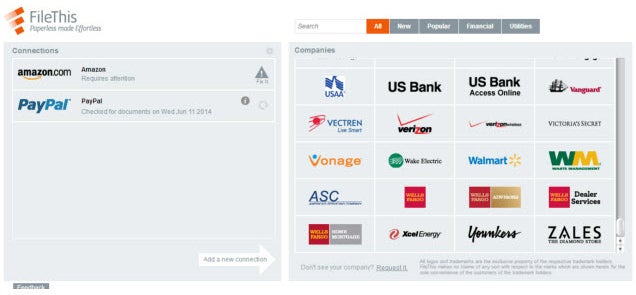
The service is similar to Mint in that it eliminates the need to log into countless websites to keep track of things from different services. FileThis integrates with a number of cloud storage services includes Google Drive, Dropbox, Evernote and Box.

Once authorized, just connect all of the accounts you want to work with. FileThis supports scores of financial institutions, websites, and accounts. After you've chosen your cloud service, FileThis downloads the last three years of statements, automatically names and sorts them into folders, and indexes them for easy searching. From that point on, all of your statements will come to you rather than requiring you to seek them out—and cutting out the need for paperwork.

For easy access to bills and statements on the move, there's also an iOS app—sadly, Android users miss out at the moment. The mobile app adds the ability to photograph and file receipts.

As with any service that deals with sensitive information, security is important. FileThis is backed up by 256-bit encryption, and your other account credentials are not visible on the site. You can read more about FileThis' security here.

There are three FileThis plans to choose from. The free plan allows for up to six account connections, but you can add more by paying a monthly fee—$2 for 12 connections, and $5 for 30. Hit the link to check it out.

FileThis

12 Jun 19:15

Lenovo's K920 brings serious competition to Samsung's Galaxy Note 4

by Chuong H Nguyen

With a display size of just 6 inches, Lenovo's K920 could be considered either a monster of a phone or a very diminutive tablet. Packing in a QHD screen, the same display resolution that is debuting on LG G3's 5.5-inch smartphone, the device is stylishly compact with slim bezels and a metal body with little, if any, compromises.


12 Jun 19:02

Moore's Law may be plateauing

by Maggie Koerth-Baker
An interesting look at how computing and the computing industry changes when processors no longer double in power every 18 months.
12 Jun 19:01

Under subpoena threat, whistleblower site POGO launches leak-anonymizing SecureDrop

by Xeni Jardin

origami-pentagon

Trevor Timm, executive director of the Freedom of the Press Foundation says, "We just helped the Project of Government Oversight (POGO) install SecureDrop. As you may have seen, they were just subpoenaed for over 700 whistleblower records related to the Veteran's Affairs scandal, which they have been critical to uncovering." Read the rest