There are purchases you need to make and the ones that you just want because they'd be nice to have. To identify the latter more clearly, ask yourself if the reason for a purchase goes beyond "Wouldn't it be nice?"
There's no limit to the things that companies can and will sell you to make your life a little easier. A device that cuts vegetables in half the time, a chemical that makes rain roll off your windows easier, a car charger that's also a flux capacitor. Some of these are more useful than others, but they all fall into the category of "Wouldn't it be nice to have?" for most people. As personal finance blog Frugaling explains:
"You know what would be nice" is the reason Ikea, Target, and other big-box retailers exist. They perfected the art of the ensemble. It wasn't enough to get/have a couch; now, you needed the accoutrements. They suggest "what would be nice" and show you the pairing. Their catalogs and stores are expertly laid out to exemplify an orgiastic group of accessories.
A small rug could complement the dining room. That watch would make this outfit POP. This lamp shade would make my room cozier. This shirt would be great for a night out.
"You know what would be nice" is the dream hypothetical that only lives in marketers' models. Realizing this is one of the most painful lessons in consumerism. No matter how many "nice" things I own, the question will continue to putz around my little mind — craving me to cave and spend.
This isn't to say that all purchases that aren't basic needs are frivolous. That windshield treatment for rain would do wonders for someone in Seattle. And maybe you bake enough to warrant an industrial grade mixer. But if the best reason you can come up with for a purchase is "Wouldn't it be nice?" then chances are there are better things to spend your money on.
You Know What Would Be Nice? | Frugaling via Rockstar Finance
Photo by Kirsty Hall.

 The company expanded the "ex parte temporary restraining order" so it could stage one-sided, sealed proceedings to take away rival businesses' domains, sometimes knocking thousands of legit servers offline.


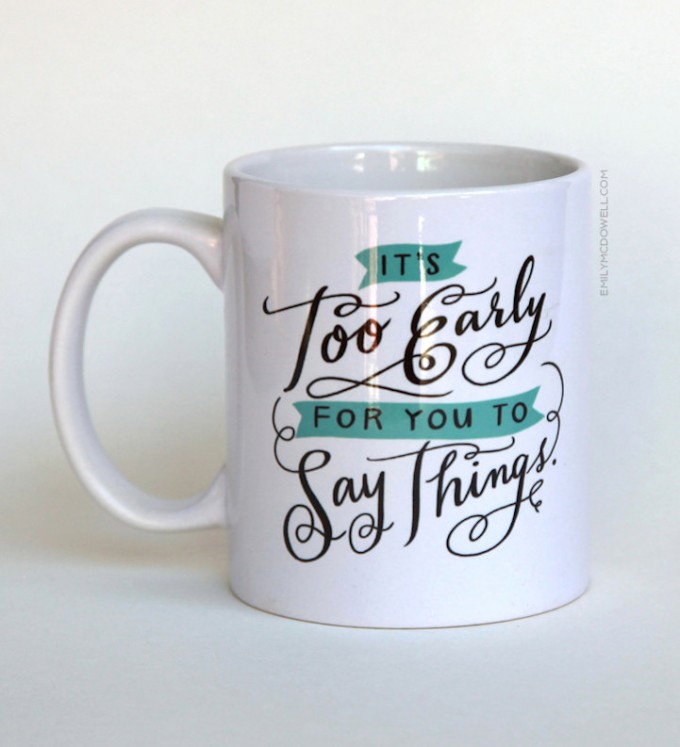 Wonderful mugs for hot beverage and daily inspiration by illustrator and funny lady Emily McDowell.










 iBeacon, the Bluetooth Low Energy technology that is being used by businesses to push offers and other messages to customers’ smartphones when they are in the physical vicinity of a small pinging device, is starting to see some decent traction.
Businesses like Shopkick (recently acquired by SK planet for $200 million) have now rolled out some 7,500 of the devices across its retail…
iBeacon, the Bluetooth Low Energy technology that is being used by businesses to push offers and other messages to customers’ smartphones when they are in the physical vicinity of a small pinging device, is starting to see some decent traction.
Businesses like Shopkick (recently acquired by SK planet for $200 million) have now rolled out some 7,500 of the devices across its retail… 


 Mobile chipmaker Qualcomm has agreed to acquire Cambridge, U.K.-based CSR for £1.56 billion. The latter rejected an earlier offer from Microchip Technology, back in August, but the FT notes that Microchip now has until 5pm today U.K. time to put in an increased offer to challenge Qualcomm’s all-cash bid.

 Transcense is a new app that accurately translates conversations in real time so the deaf and hard of hearing can participate in meetings, presentations and conversations. Founders Thibault Duchemin, Pieter Doevendans and Skinner Cheng, all deaf themselves, say one-on-one conversations are easy. Either they are speaking with someone who can sign or they can just read lips. However,…
  One of the more interesting wearables lining up to challenge the Apple Watch next year is Blocks, a modular smartwatch conceived by a couple of students from Imperial College in the U.K. — in turn inspired by the Phonebloks/Google Project Ara modular smartphone.