Shared posts

16 Dec 15:32

BookBub Now Alerts You When Your Favorite Author Has a Book on Sale

by Alan Henry

BookBub Now Alerts You When Your Favorite Author Has a Book on Sale

BookBub, the site that offers awesome daily deals on ebooks and one of your favorite book recommendation services, now lets you add and follow your favorite authors. If any of their books go up for sale at BookBub, you'll get a notification so you can snag a deal.

If you're not familiar, BookBub sends out an email every day with heavily discounted or free books you can download right away. Most of the deals are limited time, and you have to jump on them before the day is over or the deal sells out. The service allows you to choose categories and genres so you only see deals on books BookBub thinks you might like, but the author follow feature means you'll be able to get notifications for specific authors, even if you don't want emails about that genre or category. The service is also planning to update the feature soon so you can stay up to date on their new books as well as discounted ones. Hit the link below to check it out.

BookBub Author Follow Page via BookBub

16 Dec 15:19

Latest Pushbullet Update Allows You To Activate Android's Rich Notification Buttons On The Desktop

by Michael Crider

unnamedThe developers at Pushbullet seem to have some kind of strange compulsion that forces them to add cool new stuff to their Android-desktop syncing and notification app on a regular basis. Not that we're complaining - PushBullet is a personal favorite of many of us here at Android Police. Today it gets a little better still: the latest update to the Android app and various browser extensions adds the action buttons from Rich Notifications to the mirrored alerts on the desktop.

Latest Pushbullet Update Allows You To Activate Android's Rich Notification Buttons On The Desktop was written by the awesome team at Android Police.


16 Dec 13:23

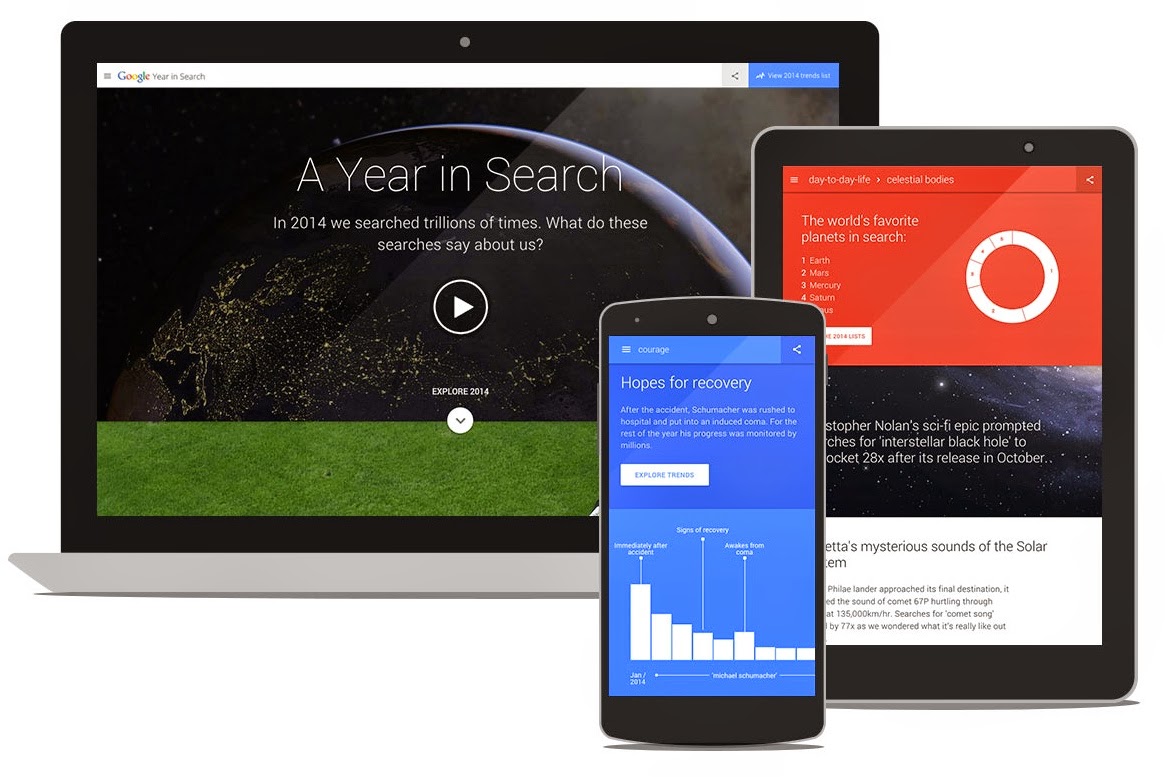
A Year in Search: the moments that defined 2014

by Emily Wood
Every year, we reflect on the moments that made us laugh, smile from ear to ear, or stay gripped to our screens in our annual Year in Search. In 2014, we were struck by the death of a beloved comedian, and watched news unfold about a horrific plane crash and a terrifying disease. We were captivated by the beautiful game, and had fun with birds, a bucket of ice, and a frozen princess.

Watch our video to rediscover the events, people and topics that defined 2014:

Wishing the genie goodbye
“You're only given a little spark of madness. You mustn't lose it.” The passing of beloved comedian and actor Robin Williams shook the world, bringing many people online to search for more information and to remember—and putting Williams in the #1 spot on our global trends charts. There was even an uptick in searches related to depression tests and mental health in the days following his death. We revisited his iconic roles in movies like Aladdin and Dead Poets Society and found solace in gifs and memes that captured Williams’ spirit.

All the world’s a stage
Nothing brings people together like sports, and 2014 had one of the biggest athletic events in recent memory. The World Cup in Brazil had its fair share of unforgettable moments and had everyone glued to their TVs and mobile devices all summer. From Luis Suarez’s bite heard around the world, to Tim Howard's superman performance vs. Belgium, to Germany’s incredible run to their fourth title, the competition certainly lived up to its reputation and topped the charts.

While sports brought people together, so did a good cause. This year, awareness for Amyotrophic Lateral Sclerosis, better known as ALS or Lou Gehrig’s Disease, reached an all-time high around the world due to the viral ALS Ice Bucket Challenge. As celebrities and everyday people alike braved a bucket of ice cold water for a cause, donations to help find a cure for the illness hit almost $100 million.
Into the unknown
How could a plane just vanish into thin air? In the wake of the disappearance of Malaysia Airlines Flight 370, that question propelled the mystery to the global trends charts. As the investigation continued on the ground and online, people stayed hopeful for a happy ending despite the dim odds: searches for “mh370 found” outnumbered searches for “mh370 lost.”

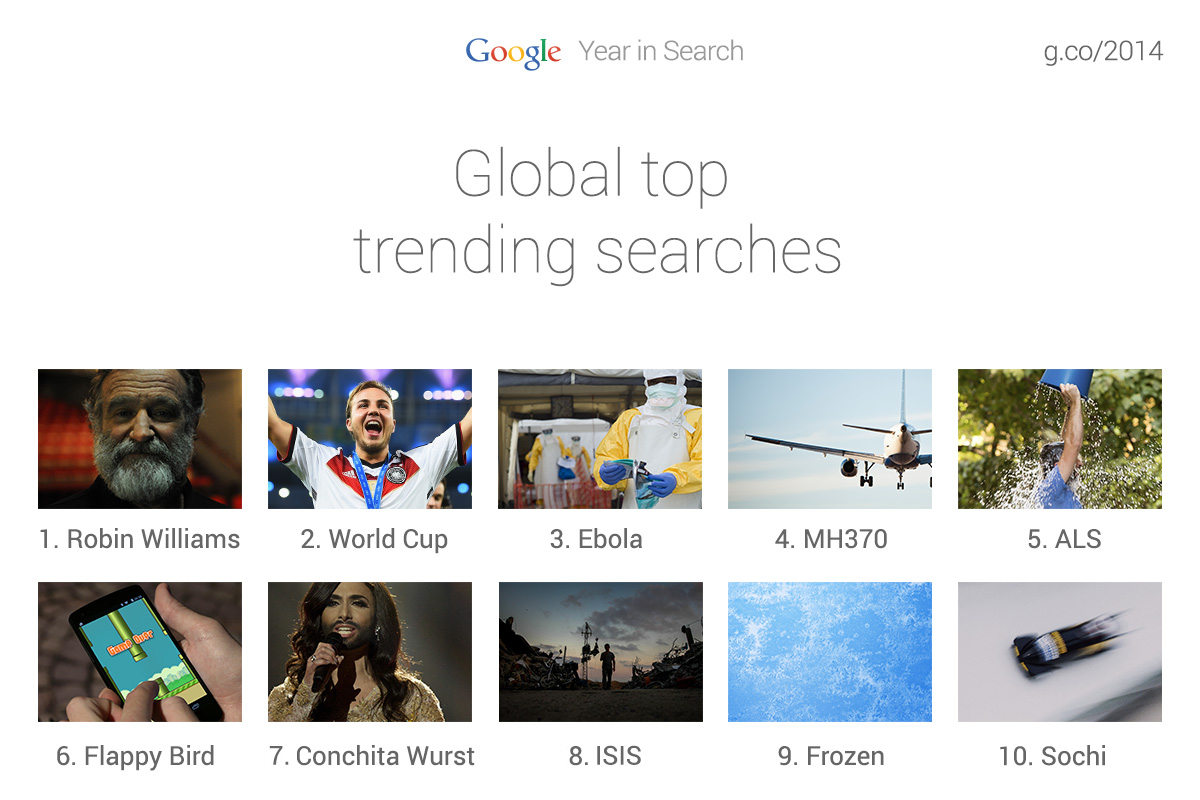
Here’s the full list of our top 10 global trending searches:
You can find more on these top searches and more at google.com/2014

Explore the stories from the year, one chapter at a time
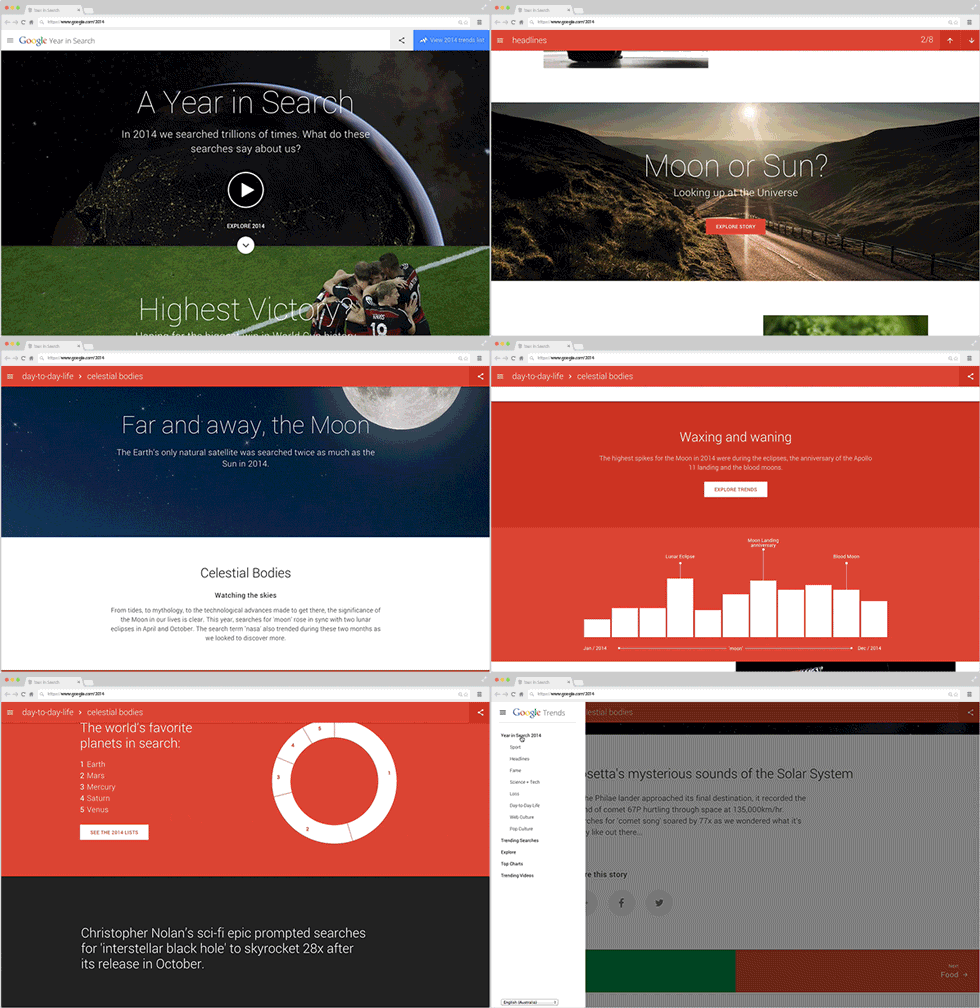
On our Year in Search site, you can take an in-depth look at the stories that made 2014 unforgettable. From the rise of the selfie, to understanding if we search for “how” more than “why,” each chapter shares a glimpse into the people and events that drove this year forward.
We've also made it easier to find the trending topics of the year directly from Google Search. For the first time, a simple search for [google 2014] will give you a peek at what made the top trending lists from around the world. And you can follow more insights from the year with #YearInSearch. So take a moment to appreciate what this year had to offer. It’ll be 2015 before you know it.

Posted by +Amit Singhal, Senior Vice President, Search
16 Dec 13:20

Microsoft’s New Office App, Sway, Is Now Open To Everyone

by Alex Wilhelm
msft-sun1 Microsoft’s Sway, an online tool for creating presentation documents, is now generally available to the public. Previously, a waiting list was in place. That Sway has taken down its rope line isn’t surprising. What is perhaps slightly unexpected are the metrics that Microsoft announced in its blog post concerning the product’s availability. Read More
16 Dec 13:18

49 Best New Android Apps And Live Wallpapers From The Last 2 Weeks (12/2/14- 12/15/14)

by Michael Crider

roundup_icon_largeWelcome to the roundup of the best new Android applications, games, and live wallpapers that went live in the Play Store or were spotted by us in the previous 2 weeks or so.

Please wait for this page to load in full in order to see the widgets, which include ratings and pricing info.

Looking for the previous roundup editions? Find them here.

Featured App

Expense IQ - Expense Manager

This week's roundup is brought to you by Expense IQ - Expense Manager from Handy Apps.

49 Best New Android Apps And Live Wallpapers From The Last 2 Weeks (12/2/14- 12/15/14) was written by the awesome team at Android Police.


16 Dec 13:17

Android Wear's 5.0 update changes the way notifications are handled, and it's a mixed bag

by Andrew Martonik

Things are unchanged if your phone runs KitKat, but Lollipop users will be in for some learning

Android Wear recently added a whole bunch of useful tweaks and features, building on a new base of Android 5.0 Lollipop. Though the focus of the update was on proper APIs for creating third-party watch faces and new "theater" and "sunlight" modes, the latest Android Wear update also changes the way notifications are handled on your watch when you're connected to a phone that's also running Lollipop.

The changes are likely to evoke mixed responses from people depending on how they usually use their Android Wear watch and how they feel about Lollipop's new handling of notification priority. But in either case we can all benefit from a little better of an explanation of the situation — read on.


16 Dec 13:08

Report: Mysterious Russian Malware Is Infecting 100,000+ Wordpress Sites

by Kate Knibbs on Gizmodo, shared by Andy Orin to Lifehacker

Report: Mysterious Russian Malware Is Infecting 100,000+ Wordpress Sites

A Russian malware called SoakSoak has infected over 100,000 Wordpress sites since this Sunday, turning blogs into attack platforms. It's a potential shitshow, and it could've been prevented earlier this fall.

Google has already blocked 11,000 domains to try to curb the damage. According to security firm Sucuri, the malware uses a vulnerability in a slideshow plug-in called Slider Revolution. The Slider Revolution team has known about the vulnerability since September, but it looks like they failed to fix it before the security hole got crammed with steaming hot malware.

Researchers at Sucuri are warning that it'll be hard to completely eradicate the malware as long as so many site owners don't know it's there. In addition to removing the malicious code, they will need to update the premium plug-in. If the plug-in came as part of a theme, it won't update automatically, which means site admins will have to manually update.

Gaming site Dulfy was one of first infected domains to fix the problem by removing code and going behind a firewall, but it may persist on blogs with less diligent administrators indefinitely. And Dulfy's admin isn't sure the fix is permanent. "The firewall will be a temporary measure until we can figure out what is doing it," site owner Kristina Hunter told me.

Over 70 million sites use Wordpress as a content management system, from personal blogs to Time.com. This malware attack only affects self-hosted sites that use Wordpress, so if you have a personal blog on Wordpress.com, you're okay.

Of course, if you run a personal blog on Wordpress.com but you ever visit sites with the malware, you're a lot less okay. This is bad news for anyone who uses the internet. Wordpress sites are incredibly common and Google has only caught a small percentage of the infected sites. It's not clear whether the malware distributors are aiming to steal data or do something else nefarious, but unless this is the first recorded malware attack that's secretly an altruistic mission to infect devices with witty e-cards and free software, it's highly likely that SoakSoak sucks.

There is no reason this kind of attack should go down when the RevSlide team knew about their weak spot in advance. This is yet another stark reminder that ignoring vulnerabilities is an act of hubris that should not be tolerated. Fix your damn vulnerabilities.

I've contacted Wordpress to see if the service is taking any steps to remove the malware, and I'll update if I hear back.[Sucuri via Ars Technica]

16 Dec 13:03

The BFG Finds Its Sophie

The BFG Finds Its Sophie

Newcomer Ruby Barnhill lands dream role

Mark Rylance has been at home in the role of the titular Big Friendly Giant since October, and now Steven Spielberg's much anticipated Roald Dahl adaptation The BFG has finally found its Sophie. A statement from dreamworks reveals that newcomer Ruby Barnhill will be making her big screen debut in perhaps the biggest way imaginable.

Ten-year-old Ruby comes from Cheshire where she's active in youth theatre, and will shortly be seen in the BBC's The Four O'Clock Club. “I feel incredibly lucky and I’m so happy,” she says. “Sophie gets to go on this wonderful adventure and I’m so excited that I get to play her.”

“After a lengthy search, I feel Roald Dahl himself would have found Ruby every bit as marvellous as we do,” says Spielberg. “We have discovered a wonderful Sophie.”

Luke Kelly, managing director of the Roald Dahl Literary Estate and Roald Dahl's grandson, says: “The character of Sophie is one of the most endearing young heroes in Roald Dahl’s stories. She is as brave as she is curious and has an innate sense of wonder. Many congratulations to Ruby on landing the role. We hope that making The BFG proves an utterly magical adventure for her.”

If you’re not familiar with the story, The BFG tells of the world’s only friendly giant and his friendship with young Sophie. He makes it his mission to collect good dreams and gift them to children while destroying nightmares and keeping his nasty fellow gigantic brethren from eating “human beans”.

Spielberg’s take has been penned by E.T. screenwriter Melissa Mathison. It’s had a lengthy and often briar-strewn path to the screen, passing through the hands of directors such as John Madden and Chris Columbus, before Spielberg took up the gauntlet for DreamWorks. It'll finally arrive in British cinemas on July 22, 2016.


15 Dec 21:46

Don't Trust the Pirate Bay Posers

by Mario Aguilar on Gizmodo, shared by Whitson Gordon to Lifehacker

Don't Trust the Pirate Bay Posers

The Pirate Bay went dark last week following a raid by Swedish police. In its wake a number of sites aping the original have popped up, attempting to fill the void. Don't trust them.

It's no surprise that bad actors have swooped in to fill the highly publicized hole left behind by the legendary site. By the end of the week, the folks at another famous torrent tracker, Isohunt launched a buggy clone at the oldpiratebay.org, which supposedly contained a complete copy of The Pirate Bay's original archive. Though, as the most respected observer of piracy-related issues noted at the time, "OldPirateBay.org doesn't have much to do with TPB though. It appears to be little more than a copy of Isohunt.to with a Pirate Bay Theme, which is missing many original Pirate Bay torrents."

Others have followed. Over the weekend, an old (unofficial) Pirate Bay mirror called thepiratebay.cr sent around an email claiming to be a newly rebuilt Pirate Bay with upload capabilities and other original functionality. From the outside, it appears to look just like The Pirate Bay but as VentureBeat, TorrentFreak, and others have noted, the .cr domain has never been officially affiliated by the original tracker. Indeed, by TF's account, TBP still controls its .se domain, so there's simply no reason for the original Pirate Bay to set up shop anywhere else when and if it decides to come back to life.

In short, what we've got are a bunch of opportunists hoping to exploit their old loose affiliation with TBP for their own ends. Which is fine and great if we trust them, but should you? There are already reports that the self-anointed replacement thepiratebay.cr replacement is riddled with malware.

While it's existentially sad that The Pirate Bay might be gone, you should be circumspect of any site that purports to be TPB, no matter how much it looks like the original. It's easy for criminals and law enforcement agencies alike to exploit your trust in that old, familiar brand to harvest your information and get you into trouble.

It's probably best to stay way from clones and to seek out the many established and well-regarded torrent trackers out there. (They're very easy to find.) Torrents aren't dead, but until we get an all clear, it's safer to assume that the Pirate Bay is gone forever.

Top image by Michael Hession

15 Dec 21:11

Play Store shows off 2014's best games, apps, movies, music, and more

by Chuong H Nguyen

Google is highlighting some of the best content of 2014 in the Play Store. A new section called "Best of 2014" showcases the best apps, games, music, movies, books, and magazines from 2014 that Google's editors have chosen. If you're looking for new content for a new phone at the end of the year, Google's Best of 2014 list could help to provide inspiration.


15 Dec 21:10

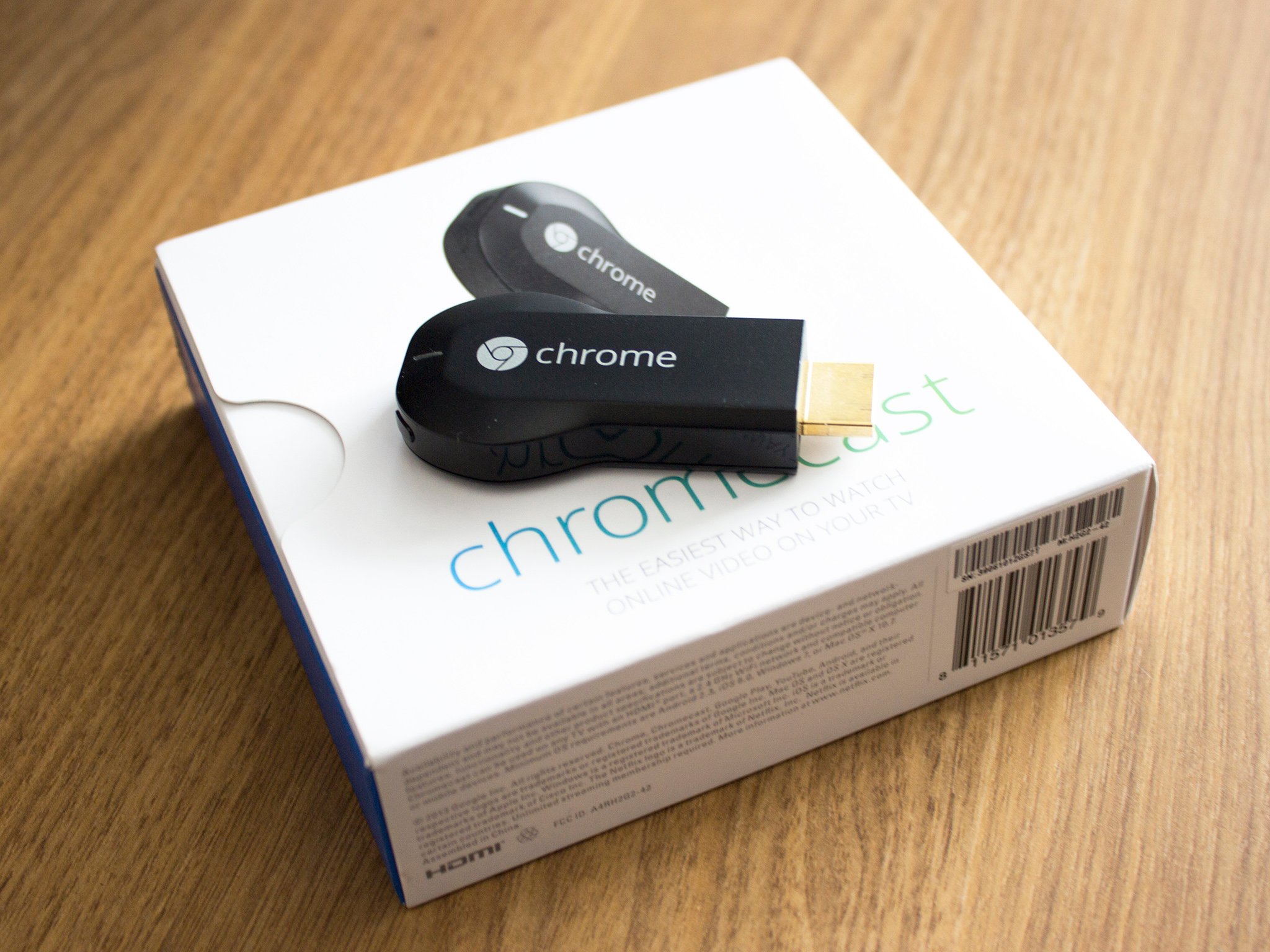
Google offering UK customers £15 movie credit with Chromecast purchase

by Joseph Keller

Google is offering a Google Play Movies credit to UK customers who purchase a Chromecast during the holiday season. Customers are eligible for a £15 credit towards Google Play Movies purchases if they bought a Chromecast between December 7, 2014 and January 31, 2015.


15 Dec 21:10

Whatsapp for the web reportedly in the works

by Joseph Keller

Facebook-owned Whatsapp appears to be working on a web-based version. A number of strings were found in the Android version of the app that point to a web-based Whatsapp. However, since Whatsapp doesn't use accounts, and is instead tied to a phone number, there is the issue of authentication. It appears that Whatsapp on the web may solve this with QR codes.


15 Dec 21:08

Skype Translator Preview Going Live Today

by Darrell Etherington
Screen Shot 2014-12-15 at 9.14.28 AM Skype has been talking about, and demoing, its new real-time translation software for Skype for a while now, but users will begin getting first-hand experience with the tool as of today. The Skype Translator preview program begins welcoming its first participants into the fold, based on sign-ups to the Translator preview page we told you about in early November. The Skype Translator project… Read More
15 Dec 21:07

BT In Talks To Acquire UK’s First 4G/LTE Carrier, EE, For £12.5BN

by Natasha Lomas
BT EE UK telco BT has confirmed it is in talks to acquire mobile carrier EE for £12.5 billion — the largest of the U.K.’s carriers, and the first to roll out a 4G/LTE network, back in fall 2012. Read More
15 Dec 21:06

Kindle For iOS Updated With Goodreads, Kindle Unlimited Integrations And More

by Sarah Perez
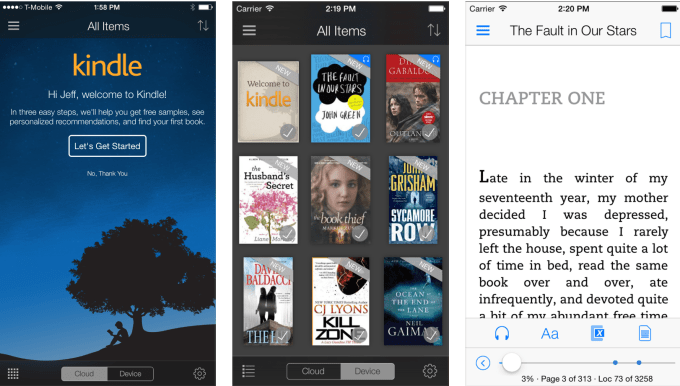
kindle-ios Amazon this morning has rolled out an updated version of its Kindle app for iOS users which now offers readers a number of new features, including integration with Amazon acquisition Goodreads, personalized book suggestions, and, for those who subscribe to Kindle Unlimited, access to over 700,000 titles in the app, among other additions. The update follows the upgrade of the Kindle software… Read More
15 Dec 00:13

T-Band aims to convert your analog watch into a smartwatch

by Chuong H Nguyen

T-Band aims to convert your analog watch into a smartwatch

Kairos is looking to turn your classic, non-smart analog watch into a smartwatch thanks to a clever accessory called the T-band. If you have an heirloom timepiece or an expensive wristwatch that you don't want to replace for what seems to be a disposable smartwatch, T-band essentially replaces the watch band or strap on your existing watch. A display and vibrating motor are built into the strap to give you the connected smartwatch experience from your smartphone. In use, it's similar to having a mechanical watch attached to something like the Microsoft Band.

The band will run the Kairos OS, not Android Wear, and will be able to push out notifications to your watch. An optional vibrating motor can gently alert you to notifications as well. The T-Band also has multiple sensors:

On board Kairos OS will be able to push notifications such as text messages, incoming calls, and also push alerts from available apps via a discreet multi-color LED indicator and/or vibrator motor. On top of having multiple sensors such as 9-axis gyroscope, accelerometer, compass and optical sensor, the ND model also gets GSR (Galvanic Skin Sensor) which detects skin temperature and sweat.

At this time, users will have the option of selecting two different display options for the T-Band strap. A hidden LED display will give you basic information and is said to last 2-3 days on a single charge. A more expensive plastic curved OLED, or P-OLED, panel will add color and a more vibrant experience.

The project right now is currently seeking funding through Indegogo with pledges starting at $129 for a strap with no display and just a vibrating motor, $159 for the strap with the concealed LED display, and $179 for the curved P-OLED display. You can add your favorite, vintage, or classic timepiece to the T-Band, or you can choose from Kairos' analog watch offerings as well, adding to the cost.

Thanks to Danny for the tip.

Source: Indiegogo

14 Dec 23:16

“How To Learn Absolutely Nothing In Fifteen Years,” By The Copyright Industry

by Rick Falkvinge

pirate bayIn 1999, Napster was a one-time opportunity for the copyright industry to come out on top of the Internet. Napster was the center of attention for people sharing music. (Hard drives weren’t big enough to share movies yet.)

Everybody knew that the copyright industry at the time had two options – they could embrace and extend Napster, in which case they would be the center of culture going forward, or they could try to crush Napster, in which case they would lose the Internet forever as there would not be another centralized point like it.

The copyright industry, having a strong and persistent tradition of trying to obliterate every new technology for the past century, moved to crush Napster. It vanished. DirectConnect, LimeWire, and Kazaa — slightly more decentralized sharing mechanisms – popped up almost immediately, and BitTorrent a year or so later.

This was about as predictable as the behavior of a grandfather clock: the cat wasn’t just out of the bag, but had boarded a random train and travelled halfway cross-country already. People had smelled the scent of sharing, and there was no going back. However, people wouldn’t repeat the mistakes of Napster and have a single point of failure. For the next couple of years, sharing decentralized rapidly to become more impervious and resilient to the onslaught of an obsoleted distribution industry.

It is not a coincidence that The Pirate Bay rose about 2003. That time period was the apex of the post-Napster generation of sharing technologies. With the advent of the first generation of torrent sites, sharing slowly started to re-centralize to focus on these sharing sites. For a few years, DirectConnect hubs were popular, before people transitioned completely to the faster and more decentralized BitTorrent technology.

This week, The Pirate Bay was taken offline in a police raid in Sweden. It may only have been the front-end load balancer that got captured, but it was still a critical box for the overall setup, even if all the other servers are running in random, hidden locations.

Sure, The Pirate Bay was old and venerable, and quite far from up to date with today’s expectations on a website. That tells you so much more, when you consider it was consistently in the top 50 websites globally: if such a… badly maintained site can get to such a ranking, how abysmal mustn’t the copyright industry be?

The copyright industry is so abysmal it hasn’t learned anything in the past 15 years.

In the mere week following the downing of The Pirate Bay, there has been a flurry of innovation. People are doing exactly what they did fifteen years ago, after Napster: everybody is saying “never again”, and going to town inventing more resilience, more decentralization, and more sharing efficiency. The community who are manufacturing our own copies of knowledge and culture had gotten complacent with the rather badly-maintained website and more or less stopped innovating – The Pirate Bay had been good enough for several years, even when its age was showing.

I’ve seen signals from every continent in the past week that the past decade of decentralization technologies is getting pooled into new sharing initiatives. A lot of them seem really hot. Some are just hitting the ball out of the park if they get realized: everything from TOR to blockchain technology to distributed computing – components that weren’t there when BitTorrent first surfaced ten years ago. If realized, they should surface over the next few years, like BitTorrent surfaced three to four years after Napster with a bunch of other technologies in between. As a side bonus, these new initiatives will also protect privacy and free speech, which are both incompatible with enforcement of the copyright monopoly.

So in a way, this was welcome. We need that innovation. We need to not grow complacent. We all need to stay ahead of the crumbling monopolies – a dying tiger is dangerous, even when it’s obviously insane. But The Pirate Bay’s legacy will never die, just like Napster’s legacy won’t.

In the meantime, the copyright industry is a case study in how to really insist on not learning a damn thing from your own monumental mistakes in fifteen full years.

About The Author

Rick Falkvinge is a regular columnist on TorrentFreak, sharing his thoughts every other week. He is the founder of the Swedish and first Pirate Party, a whisky aficionado, and a low-altitude motorcycle pilot. His blog at falkvinge.net focuses on information policy.

Book Falkvinge as speaker?

Follow @Falkvinge

Source: TorrentFreak, for the latest info on copyright, file-sharing and anonymous VPN services.

14 Dec 21:47

Spanish Newspapers Want Google News Back

by John Biggs
Screen Shot 2014-12-14 at 1.49.53 PM The Internet is like a delicate rainforest ecosystem. You remove one player and the rest suffer and die. That happened in Spain this week when the government there began cracking down on Google. The Spanish government is requiring the company to pay Spanish news providers every time their content appears on the site. The search giant will shut down Google News there in response and no content… Read More
13 Dec 17:07

Sony wants to assist you in unlocking the bootloader of your Xperia smartphone

by Harish Jonnalagadda

After simplifying the process for unlocking the bootloader of Xperia smartphones, Sony is now providing clear instructions on how users can do so in a new video posted on its SonyXperiaDev channel.


13 Dec 17:07

Congress votes to let banks steal again?

by Marc Perkel

Embedded image permalink

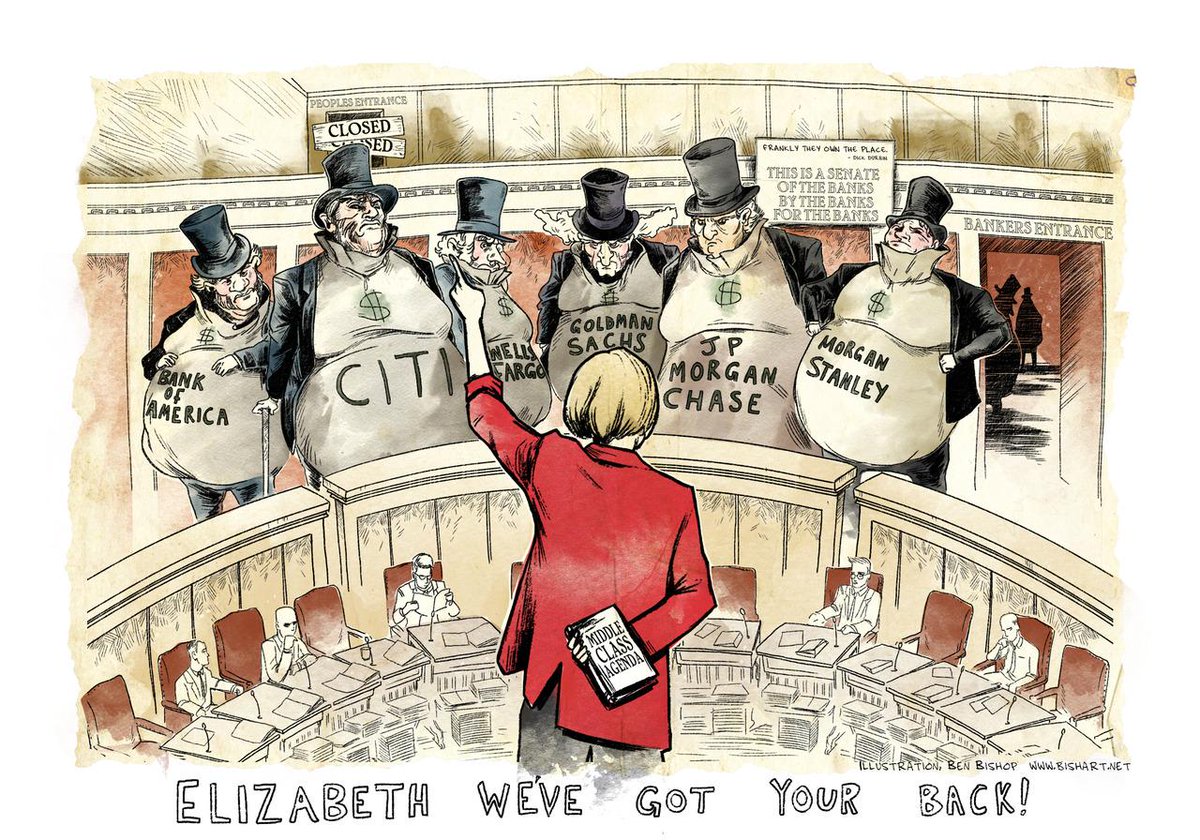
In 2008 the banks almost collapsed the American economy when they took our money and gambled it away at the Wall Street casino trading derivatives. As part of the recovery Congress passed laws to prevent the banks from doing the same thing again. Now Citibank slipped a law into the budget package that allows banks to do it again.

Banks can now gamble with our deposits, our savings, our pensions, and if they lose the taxpayer is stuck with the bill. And this time they just legalized the stealing. America, as a nation, is on the verge of committing suicide. And we have to do this so members of Congress can be home for Christmas. Where is the outrage? Only Elizabeth Warren can save us now.

13 Dec 01:35

IBM's banking security software demands the right to spy on you

by Cory Doctorow


IBM's Trusteer Rapport is a security package that many banks recommend to their customers -- but its latest license agreement includes this gem: Read the rest

13 Dec 01:33

Google to retire Earth API in December 2015

by Chuong H Nguyen

Google announced that it will be retiring the API for Google Earth on December 12, 2015, or a year from today. The decision to retire the Google Earth API comes after both Chrome and Firefox had dropped support for the NPAPI plugin framework, and Google also cites decreasing cross-platform support.


12 Dec 22:00

Yahoo Starts Prompting Chrome Users To “Upgrade” To Firefox

by Frederic Lardinois
firefox-yahoo If you’re visiting any Yahoo property today, chances are you’ll see an “Upgrade to the new Firefox” link in the top-right corner of your browser window. The prompt also appears if you’re using Internet Explorer, Opera and even the new Yandex browser. However, the prompt is missing from Safari, which will surely prompt a new round of speculation about… Read More
12 Dec 17:53

Playground equipment welded to prevent motion

by Mark Frauenfelder

City officials in Brooklyn, NY have welded merry-go-rounds and other playground equipment to make them immobile. They said it was necessary to keep kids from injuring themselves.

Read the rest
12 Dec 15:30

This Can't Be Right

by Bill Crider
12 Dec 15:29

EE to scrap Orange Wednesday 2-for-1 cinema ticket deal after a decade

by Rich Edmonds

EE will be scrapping the Orange Wednesday 2-for-1 cinema ticket deal after being available for a decade. Customers of Orange (and subsequently EE) have enjoyed a weekly deal that allowed them to head down to their local cinema to check out the latest blockbusters at a reduced price. This offer will no longer be available after February 2015, but the carrier stresses they are working on a worthy successor. According to Marketing Magazine:


12 Dec 15:28

Apple Store Online Now Accepts PayPal In U.S. And U.K.

by Darrell Etherington
Screen Shot 2014-12-12 at 8.19.06 AM Customers looking for more payment options for that next Mac or iPhone just got a new choice – PayPal. The online payments giant is now available at checkout on Apple’s online retail channel in both the U.S. and U.K., and Apple is also promoting PayPal’s Credit system which offers buyers using that method up to 18 months to pay off a purchase without interest. In some ways,… Read More
12 Dec 13:09

YouTube is adding an automatic GIF creator to videos

by Rich McCormick

YouTube has quietly added an automatic GIF creator tool to a handful of its videos. The new tool, spotted by Andy Baio, allows the creation of GIFs by selecting a section of YouTube video footage from the video's "Share" menu. GIFs created using the tool can only be a maximum of five seconds in length and have to be cribbed from consecutive video footage, but text can be overlaid on the top and bottom of the image for easy meme creation.

Continue reading…

12 Dec 13:07

Spain’s link tax forces Google News to shut there

by Jeff Jarvis

Google News just announced that Spain’s recently passed link tax has forced the net giant to remove Spanish publishers from Google News and shut off the service in Spain come Tuesday.

Thus a link tax intended to protect Spain’s publishers will only end up harming them — depriving them of untold audience — and could even end up killing the weakest among them. Spain will also bring damage to the web itself and to the country’s reputation, establishing itself as a hostile environment for investment in technology.

Be careful what you wish for, you old, threatened institutions of media and government, huddling together against the cold wind of the new.

Spain’s link tax is inspired by a similar ancillary copyright law in Germany but goes well beyond the Teutonic statute in one key aspect: The Spanish law requires aggregators (read: Google News) to pay publishers (read: newspapers) for linking to and quoting content at any length. Publishers cannot waive the payment. Thus, come January 1, Google said it could not afford to pay for quoting and sending traffic to the publishers in a service where Google places no ads and says it makes no money.

In Germany, the game over its ancillary copyright law — the Leistungsschutzrecht in local parlance — played out as a theatre of the ridiculous. Quoting a piece I wrote about the sequence for Die Zeit:

Their battle reached a crescendo of absurdity as:
(1) a Leistungsschutzrecht was written to forbid Google et al from quoting snippets of publishers’ content;
(2) the legislation was amended to allow snippets;
(3) publishers sued Google anyway for using snippets, demanding 11 percent of Google’s related revenue;
(4) Google said it would stop using snippets from the litigious publishers;
(5) those publishers accused Google of blackmailing them for taking down the snippets the publishers were themselves using to blackmail Google;
(6) government officials laughed the publishers out of the cartel office;
(7) most of the publishers capitulated because they need traffic from Google;
(8) Springer pulled permission to publish snippets from Die Welt and three minor sites but not from its superbrand, Bild; and
(9) Springer itself capitulated after confessing it lost too much traffic from Google and arguing this demonstrated Google’s crushing market power.
The publishers have succeeded in humiliating themselves, their industry, and their nation.

In Germany, publishers led by conservative powerhouse Axel Springer used their considerable political capital to enlist politicians at all levels to play a game intended to box their boogeyman giant, Google, into a corner. They lost to fight another day. In Spain, though, something was gained in the translation and the government, goaded by its publishers, struck a tragic blow against the web itself.

Of course, the internet is suffering many more bruises in Europe. There is the fight against Google Street View in Germany and Google’s right to take pictures of public views from public streets, pushing Google to abandon updating its photographic maps there. There is the so-called right to be forgotten from a European court, which tramples over the right to remember, the right to free speech, and the right to a free press, as publications are quickly learning. As the inventor of the web, Sir Tim Berners-Lee, said in Paris this week: “The right to access history is important.” And there is the political pressure brought to bear from publishers that drove the European Union to abandon its antitrust settlement with Google.

I bring my own perspective to this story. I am an American. I am a fan of technology, of Google, of capitalism. As a matter of disclosure, please know that Google has paid my travel to events in Spain and Germany to speak on this topic (like Google, I don’t much like losing money) but never a fee. So take what I say about Google with a grain of salt the size of a cow’s saltlick, if you’d like.

But consider the damage to the web and the internet brought by these protective measures from disrupted publishers and politicians conspiring together. Consider the damage to Spain’s, Germany’s, and Europe’s hopes to build their own futures in technology, to attract entrepreneurs and investment and the risk that invention requires. Consider the damage to speech, to the ability of any of us to quote and link to anyone else.

Last month, I attended an “unconference” of journalists, publishers, educators and technologists convened in Phoenix by Google and the Knight Foundation (further disclosure: the latter is a funder of my work at the City University of New York). In an unconference, the participants set the agenda. I was one of more than a few participants who requested a session asking what Google could do for news. At that meeting, we discussed many wishes.

Myself, I wish Google would help news organizations new and old break out of old business models and find new means of sustaining themselves on the net. I wish that Google would help us explore new means of distribution, going to the public rather than making them come to us. I wish that Google would increase its investment in media startups — especially in Europe.

But more than anything, I wish that Google would speak up more often and more boldly in defense of the net itself. I wish Google would defend the net more aggressively against spying by the NSA and GCHQ. I wish Google would defend itself and the net against the protectionism and political opportunism of publishers and politicians. That is just what Google has done in refusing to capitulate to Spain’s link tax. Google is defending the freedom of the link and thus of the web itself.

12 Dec 12:58

Furious Google Ended MPAA Anti-Piracy Cooperation

by Andy

Each week Google removes millions of ‘infringing’ links from search engine results at rightsholders’ request, 9.1m during the last documented week alone. In the main Google removes these links within hours of receiving a complaint, a record few other large sites can match.

But no matter what Google does, no matter how it tweaks its search algorithms, it’s never been enough for the MPAA. For years the movie group has been piling on the pressure and whenever Google announces a new change, the MPAA (and often RIAA) tell the press that more can be done.

By most standards, this October Google really pulled out the stops. Responding to years of criticism and endless complaints that it’s one of the world’s largest facilitators of pirate content, Google came up with the goods.

“We’ve now refined the signal in ways we expect to visibly affect the rankings of some of the most notorious sites,” said Katherine Oyama, Google’s Copyright Policy Counsel.

“Sites with high numbers of removal notices may appear lower in search results. This ranking change helps users find legitimate, quality sources of content more easily.”

Google’s claims were spot on. Within days it became clear that torrent sites had been hit hard. Was this the tweak the MPAA had been waiting for?

Google seemed confident, in fact so confident that according to an email made public due to the recent Sony hack attack, the company contacted MPAA chief Senator Chris Dodd the day before to give him the headsup.

But if Google was hoping for a congratulatory public statement, they would need to look elsewhere. Instead of a warm reception the MPAA chose to suggest that Google knew it have been involved in wrongdoing.

“Everyone shares a responsibility to help curb unlawful conduct online, and we are glad to see Google acknowledging its role in facilitating access to stolen content via search,” the MPAA’s press release began.

The leaked emails reveal that Google responded furiously to the perceived slur.

“At the highest levels [Google are] extremely unhappy with our statement,” an email from the MPAA to the studios reads.

“[Google] conveyed that they feel as if they went above and beyond what the law requires; that they bent over backwards to give us a heads up and in return we put out a ‘snarky’ statement that gave them no credit for the positive direction.”

In response to the snub, Google pressed the ‘ignore’ button. A top executive at Google’s policy department told the MPAA that his company would no longer “speak or do business” with the movie group.

In future Google would speak with the studios directly, since “at least three” had already informed the search engine that they “were very happy about the new features.”

While the MPAA and Google will probably patch things up in future, the emails also suggest reasons why the MPAA might have given Google a frosty reception.

First up, the MPAA had no time to assess the changes Google had put in place, so had no idea whether they would work. Welcoming changes that fail to perform in future is clearly something the MPAA would want to avoid.

But intriguingly the emails suggest that the MPAA were trying not to affect another external matter from progressing.

“We were also sensitive to the fact that Mississippi [Attorney General] Hood is expected to issue a [Civil Investigative Demand] to Google sometime this week; we did not want an unduly favorable statement by us to discourage AG Hood from moving forward,” the MPAA email reads.

In conclusion the MPAA felt that Google overreacted to their October press release and that the problems will eventually blow over. It’s certainly possible that relations have improved since the emails were written in October.

Source: TorrentFreak, for the latest info on copyright, file-sharing and anonymous VPN services.