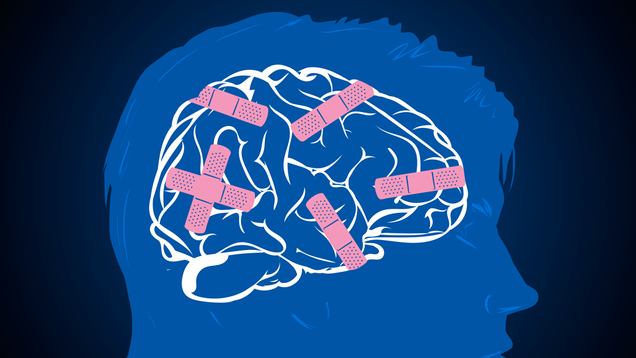
Mental illness isn’t like a sinus infection. You can’t just wait it out or take a pill to make everything go away. Our brains are complex and enigmatic, and mental illness is no different. This leads to a lot of misconceptions that make recovery much harder. Here are a few things you should know, whether you’re a sufferer or not.
Before we talk about misconceptions, it helps to identify just what “mental illness” means. Everyone has stress and difficult emotions from time to time and this is normal. Mental illness, on the other hand, is any condition that makes it difficult to function in daily life. It can affect your relationships, your job, or prevent you from reaching any otherwise attainable goal.
If that sounds like a pretty wide definition, it’s because the human mind is complex. Mental illness can range from anxiety and mood disorders that have a severe and tangible effect on your emotions and motivation, to psychotic disorders like schizophrenia that affect your perceptions or senses with things like delusions or hallucinations. Living with any of these can be debilitating. We rely on our senses, emotions, and perceptions to get us through the day. When any of those fail, it can make life difficult.
I’ve struggled with mental illnesses for decades. Over the years, I’ve had diagnoses ranging from depression to Asperger’s and I’ve encountered a ton of misconceptions. Some are basic things that the general population just hasn’t learned about, while others are deep-seated beliefs that even I have had to un-learn. Here are some of the ones that still seem to stick around.
Misconception: “Mental Health Problems Last Forever”
Doctors, patients, and friends alike that talk about mental illnesses will often tell you it “never really goes away.” They say this both to set expectations (as there is rarely a “cure” in the traditional sense) as well as to help others understand the struggle that those with mental illnesses go through. The problem is, this is often interpreted to mean that the symptoms of mental illness never go away.
If this were true, therapy and treatment would be pointless. In fact, telling someone with a mood disorder like depression that their problems will never go away can sap their already dwindling motivation to try. However, the truth is a bit more encouraging: while we don’t know how to cure mental illness, it’s very possible to treat many types of mental illness to the point that the symptoms can be managed and a person can live a fulfilling, happy life.
For many decades, it was assumed that once a person reached adulthood, their brain would no longer change. As David Hellerstein, MD explains, even as recently as the 80s and 90s, the concept of the brain physically changing over time was given little thought. However, in recent decades, researchers have increasingly discovered that neuroplasticity—which simply means that your brain creates new connections and restructures itself throughout the course of your life—can play a huge part in how your brain develops and changes over time:
In brief, we have realized that ‘neuroplasticity,’ the ongoing remodeling of brain structure and function, occurs throughout life. It can be affected by life experiences, genes, biological agents, and by behavior, as well as by thought patterns. Interestingly, exercise and physical activity in general have a major effect on ‘neurotrophic factors’-chemicals that stimulate the growth and recovery of brain cells.
The concept of neuroplasticity is still a new area of research, but it does give hope to those with mental illness: just because your symptoms are intense and unbearable right now doesn’t mean they always will be. Like many people, I first learned about this idea just a few years ago. It was the first time in decades that it seemed like there was hope for my situation.
It’s still not an easy road, of course, especially for psychotic disorders like schizophrenia that can be much harder to treat. However, over time and with the help of therapy and treatment, your brain can adapt. You might never be “cured”, but it’s still possible that having a mental illness may someday be something that’s only a minor annoyance, rather than a crippling disability that makes it hard to even get out of bed.
Misconception: “Only Violent or Unstable People Have Mental Health Problems”

If you only ever read comic books, you might reasonably be led to the assumption that radiation gives you superpowers. By a similar token, if you only ever watched movies, TV, or the news, you might believe that having a mental illness at best makes you a crippled genius, and at worst a serial killer. Both of these correlations are untrue.
Mental illnesses are, by their very nature, disruptive to a person’s life. However, the way they manifest can vary wildly from person to person. Mental illness is not the only factor that determines how a person behaves and interacts with others. Some depression sufferers internalize their symptoms and can appear perfectly happy on the surface, while others may show their symptoms very obviously. Anxiety can make a person irritable or simply avoid social interactions. Assuming that mental illness makes someone unstable is like assuming a career in engineering causes people to wear polo shirts.
As for the violence stereotype, there’s virtually no evidence to suggest that mental illness and violence have any meaningful correlation. As Dr. Heather Stuart explained in a 2003 paper on the subject of violence and mental health, mental illness is “neither necessary, nor sufficient [to cause] violence.” In other words, having a mental disorder did not inherently make someone violent, nor did being violent indicate that someone had a mental illness.
That’s not to say that there is never any overlap. People with mood and anxiety disorders can still be violent. So can anyone else. If you’re a friend to someone with a mood disorder, you don’t need to worry that they’re going to become violent unless they demonstrate a propensity towards violence. Similarly, you can have an anxiety disorder even if you seem to have your life together. Everyone, regardless of their personality, lifestyle, or background can suffer from a mental illness.
Misconception: “You Can’t Handle Relationships”
Having a mental illness is never ideal, but it also doesn’t mean that you’re unable to take part in normal things like pursuing relationships. Because mental illness can cause stress in any kind of relationship, there’s often pressure to “get yourself together” before you can maintain friendships, work relationships, or romantic endeavors. However, quite the opposite is usually true: isolating from normal relationships can be a hindrance to recovery.
As mental health journalist and schizophrenia sufferer Lisa R. Rhodes explains, having supportive relationships can aid in recovery. Since mental illness affects how you perceive or react to reality, having relationships with people who are able to help you through is a huge asset:
Years of research have shown that having social support is an essential part of recovery in mental illness. Supportive romantic relationships in particular are important for depression, because a good relationship can help bolster someone who’s going through a depressive episode, while a bad relationship can trigger depression or make pre-existing depression worse.
Speaking from personal experience, one of the hardest parts of dealing with depression was that how I perceived the world was frequently wrong. Relying on friends and loved ones to provide outside input helped to counter that perception and keep me grounded. Without that psychological counter-balance, it’s very likely that I would have veered too far towards self-destruction or even suicide. While my illness often took a toll on my relationships (and still does occasionally), they were also crucial to my recovery.
Relationships can certainly be hard for someone with a mental illness. They can also be hard for someone who has a terminal disease, someone with children, people who live long distances apart, or people with red blood who breathe oxygen and live on planet Earth. Relationships aren’t easy. Having a mental illness certainly makes relationships a challenge, but it doesn’t disqualify you from having them.
Misconception: “You Can Just Snap Out of It”

One of the worst and most prevalent misconceptions when it comes to mental illness is the “snap out of it” response. If you’ve ever suffered from a mental illness, you know the drill: you start talking to a friend about your problems. They listen for a while and offer some support, but eventually they start to talk about your attitude towards the problem. “It’s all in your head,” or “Just don’t dwell on it so much,” or “You need to move on.”
The thing is, the inability to “just get over it” is exactly the problem. It’s what separates mental illness from normal, day-to-day stress. Your brain is supposed to be able to filter your emotions and process thoughts rationally, but sometimes it doesn’t. Everyone has problems handling their emotions and could use some encouragement sometimes. What makes mental illness different is that the part of your brain that helps make the jump from discouraged or worried or unmotivated back to normal is malfunctioning. The amazing Hyperbole and a Half blog explains how this concept can be damaging and frustrating for all involved:
But people want to help. So they try harder to make you feel hopeful and positive about the situation. You explain it again, hoping they’ll try a less hope-centric approach, but re-explaining your total inability to experience joy inevitably sounds kind of negative; like maybe you WANT to be depressed. The positivity starts coming out in a spray — a giant, desperate happiness sprinkler pointed directly at your face. And it keeps going like that until you’re having this weird argument where you’re trying to convince the person that you are far too hopeless for hope just so they’ll give up on their optimism crusade and let you go back to feeling bored and lonely by yourself.
And that’s the most frustrating thing about depression. It isn’t always something you can fight back against with hope. It isn’t even something — it’s nothing. And you can’t combat nothing. You can’t fill it up. You can’t cover it. It’s just there, pulling the meaning out of everything. That being the case, all the hopeful, proactive solutions start to sound completely insane in contrast to the scope of the problem.
Having mood or anxiety disorders isn’t just having a particular feeling. It’s losing the ability to feel anything else. Sure, you know that you don’t have to be nervous when meeting new people, but all your brain can think about is how awkward you feel. You can tell yourself not to think about it, but it doesn’t work. Put another way, if you could just “get over it,” you wouldn’t have a mental illness.
This misconception is particularly insidious because people with mental illness succumb to it too. If everyone’s telling you to just feel differently, but you can’t, then you start to stress over why you can’t do it. Your inability to control your anxiety makes you more anxious. You can’t stop yourself from feeling hopeless, so you feel more hopeless. It’s a terrible cycle and the only way to break it is for both sufferers and supporters to recognize that they need to find an alternative solution.
Misconception: “Treatment Is a Waste of Time”
One of the most damaging misconceptions about mental illness is the idea that going to therapy is waste of time. Much like the previous misconception, this one comes from sufferers who feel hopeless and supporters who feel frustrated alike. Also like the last section, it only serves to get in the way of genuine recovery.
Of all the misconceptions in this article, I personally relate to this one the most. Unfortunately, neuroscience is still a developing field, which means that even mental health professionals may be subject to error, developing science, or the constantly-changing models we use to understand human behavior. If you’re cynical (or if the costs of treatment are too high), it can easily feel like getting help is a waste. Why pay someone hundreds of dollars to listen to you talk when you can vent your woes to your bar buddies for free, right?
The reason this misconception is a problem can be explained by the last one: your bar buddies probably don’t know what they’re talking about. Talk therapy might seem like a waste of time, but you’re not paying to talk. You’re paying to get the experience of someone who understands mental illness better than you (and your friends) do. Like most other services where you hire a professional, you’re paying for expertise.
This process can be very long and involve what feels like a lot of wasted effort. Your first few sessions in talk therapy are likely going to involve a lot of explaining your past. Some treatment methods like Dialectical Behavior Therapy can involve classes on coping mechanisms or strategies to help you deal with emotional flare ups. If your doctor prescribes medication, you may end up having to try multiple types of pills before you find one that works for you to produce the intended effects. And that’s to say nothing of newer types of treatment still being developed.
That’s a lot to handle if you feel like your only problem is getting worried too often. If you’re depressed, the thought of even figuring out what type of therapy to pursue can be overwhelming, much less getting the motivation to step out the door every week to keep an appointment. However, as we established earlier, just trying to “feel better” until you’re cured doesn’t work. Getting help, on the other hand, might. Even a small chance is better than none at all.
My personal journey took nearly twenty years. When I was eight years old, I had a few seizures and was diagnosed with epilepsy, which it turns out I didn’t have. Later the diagnosis changed to Tourette’s Syndrome, then they added ADHD and OCD. Depression got tacked on after that. I’ve been on at least a dozen different medications, I’ve been in residential treatment facilities and special education schools. I’ve tried toughening it out, I’ve tried praying it out, and I’ve tried reprogramming my brain with computers.
There were a million moments where that journey felt pointless. In fact, one could argue that some of my experiences actually made my issues worse. I’d like to write here that getting treatment will definitely help, but I know all too well that’s not always true. Sometimes you try something and it doesn’t work, and I don’t want to give anyone false hope. However, doing nothing was the only thing I ever tried that was guaranteed to accomplish nothing.
Illustration by Sam Wooley. Photos by A Zillion Dollars Comic, and Hyperbole and a Half.




 Box has integrated into Microsoft’s Office Online product, burrowing the enterprise file storage and sharing company deeper into the latter firm’s cloud productivity offering. Previously, Box integrated into Microsoft’s Office 365 product. The move is a win for both firms: Box is now an easier sale to potential customers, presuming that those potential users are also…




 Netflix officially announced the launch of its new website today, designed to offer viewers a “richer, more visual experience,” featuring speed improvements, better animations, and an overall more immersive experience that’s more like an app than a series of “linked web pages,” the company says. The website has been in testing for some time – in…

 A long running reform of European data protection legislation which kicked off in 2012 has passed a big milestone today; ministers in the European Council have ostensibly agreed on a general approach — allowing for the debate to move to the next stage and the potential for reform negotiations to be wrapped up by the end of the year.



 Although Paypal's new

 A U.K. review of state surveillance capabilities takes the view that more widespread use of strong encryption within the technology industry ultimately sanctions government agencies conducting mass surveillance — and even hacking activities — as “ingenious or intrusive” workarounds to get at information that’s otherwise locked out of reach.