
Shared posts
06 Mar 00:28
 Installing a web browser is not a challenging task. In fact, you probably installed the one you're using today all by yourself. Nevertheless, Dell is offering to take the burden off the hands of customers in Europe. The cost of avoiding a few lazy...
Dell charging EU customers for Firefox installation, Mozilla's not having it
by Sean Buckley
Installing a web browser is not a challenging task. In fact, you probably installed the one you're using today all by yourself. Nevertheless, Dell is offering to take the burden off the hands of customers in Europe. The cost of avoiding a few lazy...
06 Mar 00:28
How to Build a Computer Test Bench
by Tom McNamara
The basics of building an open-air test bench
While we typically follow a standard formula for our Build It section every month, sometimes it's nice to deviate a bit from the norm and explore different types of systems that are a bit more unconventional. One such system is the type of build we use at Maximum PC HQ for testing hardware, known as the open-air test bench. We have several of them deployed throughout the office alongside our standard-issue desktop PCs, and both types of machines serve an important purpose. The standard desktops are great for YouTube and Reddit, and occasional “work,” while the open-air test benches are used for most of our component testing since they let us swap a video card, CPU, SSD, RAM stick, or even the entire motherboard with minimal effort. When you’re using an open test bench setup on top of a desk, you’ll never again have to dig through the guts of your computer while on your hands and knees, with a flashlight clenched in your teeth. All you need to set up one for yourself is a basic set of spare parts, and it will let you operate like a civilized gentleperson, from the comfort of a chair, without breaking a sweat. With that in mind, we thought we would show you how to build an open air test bench PC!

Thinking Outside the Case
There are a lot of reasons any died-in-the-wool hardware enthusiast would want to have a test bench up and running at all times. The most obvious is that it’s great for quickly testing a stick of RAM, a malfunctioning piece of hardware, or benchmarking hardware outside of a system that needs to be used for productivity. At Maximum PC, our bench of choice is the Top Deck Tech Station Kit made by HighSpeed PC ($140, www.highspeedpc.com). This is a two-tier workbench, where the motherboard sits on the upper tray, and the power supply and storage devices (or other external bay items) sit on the lower tier. The station’s legs, rails, and PCI-card support brace are all made of sturdy and nonconductive materials, and the kit supports a decent amount of hardware, too. The top of the tray looks just like a standard motherboard tray in that it has rubber standoffs for clearance. A nylon guide post helps you align add-on cards with their slots in the motherboard, and a bundled neoprene mat helps prevent items in the lower tray from sliding around. In place of your case’s power and reset switches, there are switches you plug into the board's front-panel connectors that allow you to turn the machine on, reboot, monitor drive activity, and hear the PC speaker. Yes, they are pricey, but very durable and able to accommodate hardware not even conceived of yet, due to their open-air design and flexibility. As always, there are several things to consider before diving in, so let’s take a look at what’s involved in letting your hardware go commando.
1. On the Rails
Storage devices slide into rails pre-installed on the underside of the upper tray, and they only accommodate 3.5-inch drives. The rails also have no holes for drive screws, by design—you just slide the drive in, then slide it out when you're done. If you want to install an SSD, you'll need to order a 2.5-inch rail kit separately at HighSpeedPC.com. Or you can skip the adapter, since SSDs don't need to be near the 120mm fan that cools the devices in that area, and since they have no moving parts they don’t need to be stabilized at all times like a spinning hard drive. The rails are long enough to support two 3.5-inch drives, and we put SSDs on the lower tray dangling from their SATA power cables.

2. More Able Cables
A modular power supply is extremely useful when trying to keep your cables organized in an open test bench. If you’re not using an optical drive, there's plenty of space in the lower tray alongside the power supply to store the bag that contains the unused cables. Orienting the power supply can be a little tricky, since the 8-pin CPU power cable has to go to the top of the board, the 24-pin motherboard cable goes to the side, and the SATA power cables go to the bottom. Therefore, our preferred setup is to have the cables going toward the top of the motherboard, and the AC power plug facing the "bottom" of the motherboard. We also recommend using a stock CPU cooler since it makes accessing the area around the CPU easier, and if you can, just use the CPU's integrated graphics since it gives you one less PCI Express power cable to deal with. If we're testing a CPU without integrated graphics, we just use an old GPU that doesn’t require PCIe power.

Click on page two for the rest of the instructions on how to build an open-air test bench PC.
3. Pushing Buttons
The buttons and lights on the front of an ATX case are very useful, and allow you to turn on your system, reboot it, and watch CPU and hard-drive activity. Open-air benches have similar buttons and lights—on this model it’s called the ATX control kit and features a set of buttons and LEDs that plug into the motherboard's front-panel connectors. It even comes with a PC speaker, so you can hear beep codes in order to help you diagnose hardware issues (unless your motherboard has a debug LED on it, making the speaker redundant). You could always short the power-on circuit yourself with a knife blade, but this is more… dignified.

4. Feeling Pinched
The top tray has an array of standoffs that accommodate ATX, eATX, Mini-ITX, and microATX motherboards. The standoffs sit inside rubberized feet secured with Phillips screws, so you can easily pop them out of one spot and stick them into another. No screws actually touch the motherboard, of course; it just sits on top of the rubber feet. Again, this is by design, to make it easier to swap one board for another. It does complicate plugging in power cables though, as pressing down on one edge of the board can raise the other side. When the connector is large, like with the 24-pin power cable, you have to pinch the top and bottom of the board at the same time, sandwiching the connector, as shown in the photo. When the connector is small, like a USB 2.0 cable, you can just support the board from below with your hand, right underneath where the connector is going in.

5. Getting Some Air
Thanks to the open design of this workbench, there are no limitations to the length of PCI cards (handy when Nvidia and AMD deliver the latest 12-inch monsters). Cards are slid into their expansion slots and secured to the support bracket with the included plastic screws. The support brace is supported by metal posts but is made of plastic to help prevent static discharge. There are a total of seven screw holes in the bracket, which should be more than enough for any mobo configuration.
Once a video card, hard drive, or RAID controller is installed, you may want to add additional cooling that would normally occur by virtue of a case’s airflow, but is lacking in this setup. Your best bet is to just place a 120mm fan on the top tray to move air across the components — jerry-rigged, maybe, but effective. Since the fans are easily accessible, we like being able to control fan speeds with a fan mate, which is an inline fan speed controller. HighSpeed PC also sells extension kits for mounting additional fans on the rim of the upper tray, but we’ve never felt the need to add that much cooling.

6. Dat Masscool
The workbench comes with a pre-installed 120mm Masscool fan with a grill that is mounted in between the bench’s two tiers, so it blows air over the top and bottom of the tray, hitting the motherboard and any storage devices sitting in the rails below. The fan is universally compatible too, sporting both a 3-pin and a 4-pin Molex cable, so it’ll work with any setup you have. That single fan should provide more than sufficient cooling for a basic workbench. It’s surprisingly quiet, but we also use the onboard fan control in our system BIOS to make sure it’s silent.

The ATX control kit is not bad, either. Each of the widgets has an embossed triangle indicating the positive wire, so connecting them is simple. It won't damage anything if you install them incorrectly; they simply won't work. Things got a bit tight on our test board when we tried to plug in the semi-stiff PC speaker widget, so we left it off. The workbench also includes an expansion bracket with both power and reset buttons, but it’s really cheap and its wires are a rat’s nest.
Final Thoughts
It probably takes longer to assemble the workbench than it does to install all of its hardware, but once you remove a conventional case from the equation, building goes 10 times faster. You have superior lighting and there is minimal cable management to work out. We also love not having to worry about feeling crowded or lacking in space when building these rigs. There are some downsides, though. This workbench doesn't really allow liquid cooling, as there’s nowhere to mount the radiator. It would also be nice to have a couple of fasteners to pin down the motherboard, and we’d love to have an SSD rail included instead of it being an expensive add-on. Also, $140 is a lot of money, but HSPC also sells a smaller ATX bench for $80 that will be fine for most users.
Probably the biggest problem with these setups is the exposed fan blades on the CPU, GPU, and chassis. We can already see a small child or a pet getting in trouble around this thing, so be sure to take precautions before deploying one in your home.
06 Mar 00:27
Deformed Landscape Photos Will Twist Your Sense of Reality
by Michael Hession on Reframe, shared by Eric Limer to Gizmodo

Looking at the landscape photography of Laura Plageman, it can take a minute to get your bearings on what's going on. Her technique of manipulating prints then rephotographing them not only plays tricks on your eyes, but might leave you questioning the nature of photography altogether.


06 Mar 00:22

Former Criterion Games founders start Three Fields Entertainment
by Jordan Devore
Criterion Games co-founders Fiona Sperry and Alex Ward have started another venture after moving on from the studio behind Burnout and more recently Need for Speed. The new company, Three Fields Entertainment, has a site up and running but not much else that we know about.
Ward, who was previously the creative director of Criterion, said the team is "looking for talented staff who are skilled in at least three fields of creating electronic entertainment" and that Three Fields "will make games for all platforms where we can self-publish."
Given Criterion's racing DNA, I'd like to see more of that but I think I'd rather have them make something altogether different even more. Keep things fresh.

06 Mar 00:16
A man is sitting at the bar in his local tavern, furiously imbibing shots of ...
A man is sitting at the bar in his local tavern, furiously imbibing shots of whiskey. One of his friends happens to come into the bar and sees him.
"Lou," says the shocked friend, "what are you doing? I've known you for over fifteen years, and I've never seen you take a drink before. What's going on?"
Without even taking his eyes off his newly filled shot glass, the man replies, "My wife just ran off with my best friend."
He then throws back another shot of whisky in one gulp.
"But," says the other man, "I'm your best friend!"
The man turns to his friend, looks at him through bloodshot eyes, smiles, and then slurs,
"Not anymore! ... He is!"
"Lou," says the shocked friend, "what are you doing? I've known you for over fifteen years, and I've never seen you take a drink before. What's going on?"
Without even taking his eyes off his newly filled shot glass, the man replies, "My wife just ran off with my best friend."
He then throws back another shot of whisky in one gulp.
"But," says the other man, "I'm your best friend!"
The man turns to his friend, looks at him through bloodshot eyes, smiles, and then slurs,
"Not anymore! ... He is!"
06 Mar 00:14


Screws Made From Silk Could Be Used In Surgical Implants
by Colin Lecher
Silk Screws
Gabriel Perrone
We've mentioned this before, but one of the coolest candidates for Material of the Future is silk. It's insanely tough, and in the human body, doesn't put the same strain on tissue that metal does. It can also harmlessly degrade in the body over time, which it makes it handy for use in medical devices.
In a study run by Tufts University researchers, a team harvested silk from silkworm cocoons and used it to make plates and screws. They recently tested the materials in six rats and, after four to eight weeks, the silk had dissolved. Next up: the silk screws and plates could be used to mend broken bones in humans, then allow the silk to melt away, rather than requiring another surgery for removal. The researchers want to use the technique to treat face injuries at first, then expand to other broken bones.
They aren't the first to toy with this idea; other researchers have suggested implants like this could come to humans by 2030. So just don't break anything until then, and you're good.
[BBC]
    
|
Spursfan123 and -1 others like this


04 Mar 18:19


A Beginner's Guide to Belgian Beer Styles
by Mike Reis

Some of Belgium's finest. [Photographs: Mike Reis]
How can you not love a country known for its love of waffles, chocolate, French fries, and beer? Belgium is my version of Guns 'n' Roses' Paradise City, where the grass is green and the beers are plenty.
And not only are the beers of Belgium vast in quantity, they're vast in quality, diversity, and cultural importance. Every beer that we credit to the country's name seems to have a history and character that's independent of its neighbors on the shelf. If you're put off by intensely bitter IPAs or bland canned lagers, the Belgian beer section at your local bottle shop may be a good place to start your love affair with beer.
Here's a guide to get you started:
Abbey Ales
When I think of Belgian beer, the image that comes to mind is that of an enrobed monk, tipsy off his own supply, hoisting a clunky chalice full of beer. Actually, it's pretty much just the St. Bernardus logo. The image may not be rooted in reality, but the abbey ales of Belgium are a great place to get started when you're exploring Belgian beer. I'm talking about dubbels, tripels, and quadrupels: the beers made famous by monastic brewers and their secular imitators. Let's dig into 'em a bit:
Dubbel, Quadrupel, and Belgian Strong Dark Ale
 So, the dubbel. The name means (wait for it) "double," in Dutch. But where does that name come from? What's being dubbeled? is there some type of "single" floating around there with a funny Dutch spelling?
Fine questions.
Here's the thing: historians can't seem to agree on where the dubbel/tripel/quadrupel naming comes from. There isn't an exact mathematical relationship between the styles as the names imply, and the "singel" remains an elusive beast that rarely leaves the walls of the few monasteries where it's made. What is clear is that the styles maintain a loose increase in strength between them. Dubbels are, as a whole, stronger than singels. Tripels are, as a whole, weaker than quadrupels.
Back to the singel. It's pretty tough to find unless you're hanging out in a monastery. It's also less clearly defined than its big brothers. The name singel is applied primarily to the generally pale, generally low-alcohol beers that are made by the monks in monastic breweries to keep for themselves. They don't want (at least in theory) to be too tipsy for their monky obligations, so a lower-alcohol beer is a must. Calling it "singel" just seems natural given its relative weakness to the more established dubbels and tripels, but as a style, it is less stringently quantified than either of those. I should note that a few secular breweries make these beers commercially, too, but they aren't common.
The dubbel is more clearly defined. Brown ales of different sizes, flavors, and production methodologies have been made in monasteries for a long time, but in 1926, the style took its modern form when the Westmalle monastery released a beer called Dubbel Bruin. The beer was a success and a wave of imitators solidified dubbel as a recognized style.
These are reddish brown-colored ales of moderate strength (think 6-8% ABV) that, nowadays, are made not just in monasteries, but by secular breweries around the world. Classically, they are made with an ingredient that you might not expect: heavily caramelized beet sugar. The sugar imparts much of the deep color characteristic to this style and lightens the beer in body, fermenting completely and creating a bunch of alcohol along with it. It also leaves behind a pleasant raisin-like flavor. The type of yeast used for fermentation is important as well, yielding a wide range of fruity, peppery, and spicy flavors that give the style a deep complexity and low level of residual sugar.
Quadrupels are basically just amped up versions of the dubbel—stronger in every way with identical ingredients producing more of the same flavors. We're talking big time plum, raisin, caramel, and pepper flavors alongside a noticeable alcoholic bite (these beers can veer upwards of 12% ABV). The quadrupel name isn't accepted by everyone and some prefer to stick with a less-specific catch-all: Belgian strong dark ale.
Tripel
 The origin of the tripel is a matter of much debate, too. One thing is certain: like the dubbel, the modern tripel was popularized by the Westmalle monastery. Also like the dubbel, the tripel is brewed with a good portion of beet sugar included in the recipe, but this time, the sugar isn't caramelized. It still raises the alcohol level and lightens body, but it doesn't impart significant color—the beer's beautiful golden hue comes primarily from the use of lightly kilned malt. Expect a beer filled with apple, pear, citrus, or banana-like fruitiness, clove-like or peppery spice, and a drying but (ideally) subtle hit of alcohol on the finish. Slightly stronger than dubbel, tripel boasts a lofty ABV of around 7-10%, but remains dangerously drinkable.
Farmhouse Ales
Leaving the monastery, let's shift our gaze to the farmland of what is now Northern France and Northern Belgium. This area is the birthplace of the farmhouse ales, saison and bière de garde. As the name implies, these are beers rooted in pastoral living—brewed and consumed with the ebb and flow of the seasons.
Saison and Bière de Garde
 Saison (which means "season" in French, you'll get it in a minute) was born of necessity. The winter months are hard on farmers—you can't grow much and there just isn't a lot of money coming in. So what can you do? Well, if you've got leftover grain from the previous fall's harvest, you can make beer for the seasonal workers that will tend to your fields in the warmer months. Surplus grain gets used, your workers get some safe hydration, and after brewing, you can feed the spent grain to your livestock. It's the ol' win-win-win.
Bière de garde served a similar purpose. The name translates to "beer for keeping." These were beers designed to be stored—kept for the warmer months when brewing good beer was tough and farm life was hectic with obligations outside the brewhouse, but everyone was still thirsty.
Saison and bière de garde have similar histories, but stylistically, they are somewhat different. Saison is pale, highly-carbonated, and super-dry, defined by citrusy aromatics, an assertive peppery yeast character, and a level of floral, earthy hoppiness rarely seen in Belgium. But saisons aren't restricted to the Belgian borders&mash;American brewers and others around the world have embraced the style as well. In the past few years it's a style that's been tweaked, pushed around, and celebrated more than most in the US, with black, imperial (stronger), and heavily spiced variations finding their way to shelves. Even the Belgians have been known to make variations on the style that can be dark, spiced, or brewed with unusual grains.
Despite the stylistic breadth in what brewers call "saison," the beer world generally accepts one beer as the grand-daddy benchmark of the style as we know it today. Brasserie Dupont's Saison Dupont Vieille Provision, known simply as "Saison Dupont" by most, is a true classic in the beer world and serves as the model for many imitators. It's a dry, pale beer with a lively hop presence, some citrus and apple-like fruit flavor and a peppery, yeast-derived finishing bite.
Bière de garde is a bit more refined. It lacks the lithe energy of its pretty sister, trading it for maltiness and strength. Like saison, there's more diversity within the style than you might expect—you'll find bière de garde to be available in pale (labeled "blonde"), amber ("ambrée"), and brown ("brune") varieties, each with a different expression of malt flavor. Blonde versions tend to be doughy, honey-like, and lightly caramelly, ambrée examples emphasize that caramelization, and brune versions supplement the caramel with a toasty, more dense malt complexity. In all versions, the yeast is less prominent in flavor than in saison—bière de garde is fermented at cooler temperatures than most ales, which limits the fruitiness and spiciness that can come from warmer fermentations.
Other Belgian Ales
Belgian Strong Pale Ale and Belgian Blonde
 Belgian strong pale ale (also known as Belgian strong golden ale) is a more recent invention, credited to Belgian brewers Duvel Moortgat. The beer that started it all is known simply as Duvel (that's "devil" in Flemish) and it took its current bright golden form in the 1970s. Crisp, strong, and extremely highly carbonated, Duvel and its imitators are not totally dissimilar to the tripel style, but tend to be drier, lighter in color, and a bit more bitter. As a reference to the demonically-named pace-setter, many beers within this style are named with reference to hell and the underworld, like Russian River's Damnation, The Lost Abbey's Inferno, Het Anker's Lucifer, and others.
Belgian blonde (sometimes spelled blond) beers are slightly less strong than either Belgian strong pale ales or tripels at around 6 to 8% ABV. Often sweeter than Belgian strong pale ales, these tend to taste less bitter with more fruity flavors derived from fermentation. Both Belgian strong pale ales and blondes are usually made with the same sugar used for making tripels, so these are a bit lighter-bodied than you might expect given their strength.
Belgian Pale Ale
 Given the name, it feels strange that Belgian pale ales don't have a lot in common Belgian strong pale ales. These actually more closely resemble English pale ales—amber to copper in color with a toasty malt quality and a moderate strength (around 4.5 to 6% ABV). Expect a fruity and peppery yeast aroma that's more subdued than most Belgian ales, with a mild earthy hoppiness that may poke through on the finish.
Witbier
 Witbier (also known as bière blanche or simply by its translated name, "white beer") has roots that can be traced back to the Middle Ages, but interest in the style waned around the turn of the 20th century amidst the rising popularity of pilsner and pale lagers. By the 1950s, nobody was making witbier commercially and it was considered to be extinct. Then a man named Pierre Celis stepped in, singlehandedly reviving the style at his brewery in Hoegaarden, Belgium.
That name Hoegaarden probably sounds familiar. Celis found wild success with his beer, and later sold the brewery to the company that would become Anheuser-Busch InBev. The beer has been sold worldwide ever since, spawning a resurgence in the style's popularity.
Brewed with unmalted wheat, coriander and orange peel, witbier is ultra-refreshing—tart, light in body, moderate in alcohol (think 4.5-5.5% ABV), and with a pleasant balance of citrusy and spicy flavors from the yeast used to ferment it.
Sour Ales
Lambic and Gueuze
 Though witbier has clawed its way out of obscurity, lambic has remained a product of rarity, hanging out on the fringes of the mainstream as an object of geeky desires. It is still produced by just a handful of companies—the lambic game isn't one you can just step into. The product's scarcity is necessitated by a time-consuming method of production that few fully understand and can require several years between kettle and shelf. Most lambic lovers also prescribe to the notion that it can only be produced in its region of origin: the area around Brussels.
Traditional lambic is funky stuff—fully dry and bracingly sour. To create this signature flavor, the brewer starts the lambic-making process more or less like he or she would any beer: by steeping grain in water and boiling the resulting liquid. From here, things get weird. Lambic is the result of something called 'spontaneous fermentation.' Instead of carefully regulating fermentation using lab-cultured yeasts and sanitized stainless steel vessels, the brewer ferments the beer using the wild yeast and bacteria that constantly float around us in the air.
After boiling, the still-hot liquid is left to cool in a shallow, kiddie pool-looking vessel called a coolship. Here, yeast and bacteria settle into the liquid (now called "wort") and begin to multiply. Then, the wort is transferred to oak barrels. Those floating organisms, along with those that live in the barrels, start to do their thing. Like any beer fermentation, sugars in the wort are consumed to produce alcohol, but the wild buggies in there also produce a bunch of sour and funky flavors not encountered in your everyday pint. That's what makes lambic so unusual.
But the name "lambic" covers a bit more than just a single type of beer. It's more commonly used to refer to all of the beer styles made from a spontaneously fermented lambic base. This includes not just that simple "lambic," also known as unblended lambic, but also gueuze, fruited lambic variants, and some other oddities.
Unblended lambic is rarely found outside of Belgium—it's uncarbonated and served almost exclusively on tap. Blended products are much more common.
Gueuze (this is a tough one to pronounce properly—most just say "gooze") is one of those. It's a blend of young and old lambics—pale, dry, and complex, with funky flavors that range from oaky, cheesy, and barnyard-like to lemony, honey-like, and briny. You might hate it (you'll probably love it).
Fruited lambics are just what they sound like: lambics with fruit added. You might have encountered some of these on the dusty shelves of your local corner store. Chances are, those dusty bottles have an unfermentable sweetener added. The beer inside is ultra-sweet and very low in alcohol (most are around 2.5% ABV). These can be decent beers for dessert pairings, but if you're looking for a beverage of depth and complexity, you'll want a more traditional example (hint: the word "oude" on the label is a tip-off that you're on the right track).
Traditional fruited lambics have the funky flavors of gueuze complemented by a heavy dose of bright, fresh flavor imparted by the fruit of choice. To make these beers, the fruit is usually jammed right into the barrel, kickstarting another fermentation that eats up all of the fruit's sugars leaving a dry finished beer. Much of the fruit's flavor is left behind, and the color of the beer can be dramatically affected by the fruit. Cherry lambics, known by the Dutch word for cherry, kriek, are the most common, but raspberry (framboise), grape, and stone fruit are commonly used as well.
Sadly, there are few producers of traditional lambic left in the world, but a surge in popularity in the American market for lambic has helped the ones that do exist to thrive. New producers are slowly learning the craft and bringing product to market, and not just as brewers. It's common practice for lambic producers (for example, Tilquin, Oud Beersel, and others) to buy wort from other breweries, fermenting, blending, and bottling the beer in their own name.
Flanders Red and Flanders Brown
 Lambic isn't the only sour thing happening in Belgium. Flanders sour ales have a similarly tart thing going for them. These are beers indigenous to the northern half of Belgium and are available in two varieties: red and brown (AKA oud bruin).
Despite their Belgian origin, Flanders red ales likely drew their inspiration from the tart blended porters that once dominated the English beer market. Eugene Rodenbach, who is credited with the style's inception, brought knowledge of porter blending techniques back to Belgium after a stint studying brewing in England. At his family's Rodenbach Brewery, he created the torch-bearing examples of the style. Deep red in color, Rodenbach's sour ales are packed with berry, plum, and balsamic vinegar-like flavor, with acetic sourness coming from a bacterial fermentation in oak vessels.
Flanders brown ales are similar beers, but tend to be a bit maltier. Fruit flavors trend toward plums, figs, and dates more so than red berries and there tends to be a bit less vinegar-like sourness.
About the author: Mike Reis is a Certified Cicerone working as Minister of Education for California-based distributor Lime Ventures. Previously, he co-managed the beer program at San Francisco's Abbot's Cellar and The Monk's Kettle. Follow him on Twitter @beerspeaks or find him behind a pint near you.
Phung.aq, Laszlo Tenki likes this

04 Mar 18:16


Scooby-Doo Mystery Machine Salt and Pepper Shakers
by Craziest Gadgets Jeff

Zoinks! While our friend Shaggy’s favorite spice is clearly *cough* oregano *cough*, sometimes he probably puts a little S&P on his munchies. What better way to get to the bottom of a flavor mystery than with a Scooby-Doo Mystery Machine Salt and Pepper Shakers?

Scooby-Doo Mystery Machine Salt and Pepper Shakers
Check out our Craziest Gadgets Shop for unique gifts!
04 Mar 18:16


Toyota's New Concept Is More High-Tech Horse Than Car
by Alex Davies

Toyota's FV2 concept has made its European debut, and it doesn't look like anything else at the 2014 Geneva Motor Show. It comes with lots of fancy technology, three wheels, and no steering wheel.
It's not hard to imagine a future without steering wheels. Last year, Infiniti's Q50 sedan became the world's first production car to use drive-by-wire technology, so the wheel has no mechanical connection to the wheels. You could pop in a joystick and it would work just as well.
With the auto industry moving quickly toward a future where cars drive themselves, steering wheels could become obsolete.
But Toyota's FV2 isn't an improvement on the Q50. It's an improvement on the horse. The driver stands while in the vehicle (deal breaker), and shifts his weight to steer. Like on a horse. And in its press release, Toyota says it "believes the relationships between drivers and their vehicles will continue to develop aspects of trust and understanding, similar to those a rider will have with a horse."
I can't agree with Toyota that the FV2 is a "glimpse of the future," since the auto industry is headed further from deep connections between drivers and cars, not closer to it. But at least the thing looks cool.


DON'T MISS: Full Coverage Of The 2014 Geneva Motor Show
Join the conversation about this story »
|
|
04 Mar 00:30
AT&T's 'IP Transition' Will Make U.S. Broadband Even Less Competitive
by Karl Bode
AT&T has spent a massive amount of time the last few years harping on the need to speed up the "IP transition." On its surface the idea seems reasonable; the nation needs to begin migrating from older copper DSL and phone technology toward new IP solutions, such as wireless and fiber to the home, the former being easier to deploy to rural areas, and the latter having much lower maintenance costs while being able to deliver faster speeds. AT&T is going state-by-state insisting that if lawmakers gut consumer protections governing these older networks, newer, better networks will spring forth from the ashes to help forge a better tomorrow, as this charming video makes clear:
Aren't those little railroad men saddled with antiquated regulations and ancient technology adorable?
The problem is that AT&T's version of the network of tomorrow for millions of users is going to mean significantly fewer choices and worse, more expensive service than ever before. While it's true many people are moving away from copper phone service, unmentioned by AT&T's video is the fact that millions of customers remain on copper-based DSL because it's the only choice they have and the only one AT&T offered. While AT&T has selectively upgraded some users to their faster but still not fiber to the home U-Verse VDSL platform (about half of their fixed-line network), tens of millions of AT&T and Verizon's DSL customers aren't going to be upgraded anytime soon. Instead, they're going to be hung up on or sold to smaller telcos with even less interest in upgrading them than AT&T did.
Enjoy the magic of tomorrowland, everyone!
While new DSL deployments and upgrades can be expensive (AT&T has always had the funds, they've just long placed investor returns well above offering quality product and support), existing DSL customers are perfectly profitable. They're simply not profitable enough for impatient investors, whose eyes are squarely fixed on wireless with its low usage caps and per gigabyte overages, even if wireless is not (especially at AT&T prices) an adequate replacement for a fixed line. Refusing to upgrade fixed-line networks could almost be excused if it wasn't for the fact that, with their other hand, AT&T has long lobbied for protectionist legislation across multiple states banning towns and cities from upgrading themselves - - even in cases where nobody else will.
Once AT&T has gutted any remaining consumer protections and regulations on copper lines (which were over time quite heavily subsidized by taxpayers, but who cares, right?), they're going to walk away from many areas -- leaving users with either the choice of more expensive wireless (many rural users won't be able to get), or a suddenly emboldened and stronger cable monopoly. AT&T and Verizon are quietly ceding huge swaths of America's fixed-line broadband market to cable, who'll be sure to jack up prices in the face of less competition than ever. This before you even factor in the smaller ISPs that might have been using those telco lines to offer competing services (whoops, sorry!).
The use of "all IP" is also quite a lovely bit of conflation and misdirection, given the company's U-Verse and DSL users are already IP-based. You'll see the "all IP" rhetoric popping up in an endless series of editorials (like this one by Steve Forbes) AT&T has been running nationwide to convince people they really don't need that DSL line they're using. Larry Downes at CNET recently informed readers that AT&T's simply interested in "connecting more Americans to the broadband ecosystem." Nothing quite says connecting more Americans like disconnecting Americans.
The FCC recently started paying closer attention to this "IP transition" when Verizon's version of it involved refusing to repair east coast DSL customers after Hurricane Sandy. Instead, after waiting months for repairs, customers were given something Verizon is calling Voice Link -- a wireless service that locals complained was dramatically less functional and reliable than their previous copper DSL and phone lines, failing to offer basic features or data, leaving Comcast (which had no problem financing coaxial repairs) as the only regional fixed-line broadband competitor in many of these areas. Verizon was using the storm as cover to back out of areas they no longer want to service, though they fell under criticism by the New York AG for violating PSC rules.
To tackle the general technical problems with the "IP transition" (will my home security system still work? Can I even get a reliable LTE signal in my basement? Will 911 work?), the FCC has proposed a series of observed technical trials. AT&T has announced that their version of these trials will involve migrating two tiny towns to presumably LTE wireless and U-Verse over the next few years, after which AT&T and the FCC will likely proclaim the trial to be a smashing success. Ignored by AT&T, the FCC, and the press so far has been the fact that as AT&T and Verizon back away from DSL, they're going to be leaving an even less competitive broadband market than we have now -- at a time when everyone pays endless lip service to improving broadband competition.
The next time you read in the press about the "IP transition," (and you'll be reading about it a lot) notice how quickly everybody applauds the idea that copper is just so lame, old fashioned and unnecessary. Then notice how, buried under the pageantry, nobody seems to recognize that what's actually happening here is simply the lopping off of unwanted DSL customers that companies are refusing to upgrade. That in turn will lead to a stronger cable monopoly across half the country, resulting in cable companies -- like the freshly-merged Time Warner Cable Comcast -- feeling free to impose more draconian usage caps than ever before. Welcome to the "all IP" networks of tomorrow. Watch that first step.
Permalink | Comments | Email This Story


Aren't those little railroad men saddled with antiquated regulations and ancient technology adorable?
The problem is that AT&T's version of the network of tomorrow for millions of users is going to mean significantly fewer choices and worse, more expensive service than ever before. While it's true many people are moving away from copper phone service, unmentioned by AT&T's video is the fact that millions of customers remain on copper-based DSL because it's the only choice they have and the only one AT&T offered. While AT&T has selectively upgraded some users to their faster but still not fiber to the home U-Verse VDSL platform (about half of their fixed-line network), tens of millions of AT&T and Verizon's DSL customers aren't going to be upgraded anytime soon. Instead, they're going to be hung up on or sold to smaller telcos with even less interest in upgrading them than AT&T did.
Enjoy the magic of tomorrowland, everyone!
While new DSL deployments and upgrades can be expensive (AT&T has always had the funds, they've just long placed investor returns well above offering quality product and support), existing DSL customers are perfectly profitable. They're simply not profitable enough for impatient investors, whose eyes are squarely fixed on wireless with its low usage caps and per gigabyte overages, even if wireless is not (especially at AT&T prices) an adequate replacement for a fixed line. Refusing to upgrade fixed-line networks could almost be excused if it wasn't for the fact that, with their other hand, AT&T has long lobbied for protectionist legislation across multiple states banning towns and cities from upgrading themselves - - even in cases where nobody else will.
Once AT&T has gutted any remaining consumer protections and regulations on copper lines (which were over time quite heavily subsidized by taxpayers, but who cares, right?), they're going to walk away from many areas -- leaving users with either the choice of more expensive wireless (many rural users won't be able to get), or a suddenly emboldened and stronger cable monopoly. AT&T and Verizon are quietly ceding huge swaths of America's fixed-line broadband market to cable, who'll be sure to jack up prices in the face of less competition than ever. This before you even factor in the smaller ISPs that might have been using those telco lines to offer competing services (whoops, sorry!).
The use of "all IP" is also quite a lovely bit of conflation and misdirection, given the company's U-Verse and DSL users are already IP-based. You'll see the "all IP" rhetoric popping up in an endless series of editorials (like this one by Steve Forbes) AT&T has been running nationwide to convince people they really don't need that DSL line they're using. Larry Downes at CNET recently informed readers that AT&T's simply interested in "connecting more Americans to the broadband ecosystem." Nothing quite says connecting more Americans like disconnecting Americans.
The FCC recently started paying closer attention to this "IP transition" when Verizon's version of it involved refusing to repair east coast DSL customers after Hurricane Sandy. Instead, after waiting months for repairs, customers were given something Verizon is calling Voice Link -- a wireless service that locals complained was dramatically less functional and reliable than their previous copper DSL and phone lines, failing to offer basic features or data, leaving Comcast (which had no problem financing coaxial repairs) as the only regional fixed-line broadband competitor in many of these areas. Verizon was using the storm as cover to back out of areas they no longer want to service, though they fell under criticism by the New York AG for violating PSC rules.
To tackle the general technical problems with the "IP transition" (will my home security system still work? Can I even get a reliable LTE signal in my basement? Will 911 work?), the FCC has proposed a series of observed technical trials. AT&T has announced that their version of these trials will involve migrating two tiny towns to presumably LTE wireless and U-Verse over the next few years, after which AT&T and the FCC will likely proclaim the trial to be a smashing success. Ignored by AT&T, the FCC, and the press so far has been the fact that as AT&T and Verizon back away from DSL, they're going to be leaving an even less competitive broadband market than we have now -- at a time when everyone pays endless lip service to improving broadband competition.
The next time you read in the press about the "IP transition," (and you'll be reading about it a lot) notice how quickly everybody applauds the idea that copper is just so lame, old fashioned and unnecessary. Then notice how, buried under the pageantry, nobody seems to recognize that what's actually happening here is simply the lopping off of unwanted DSL customers that companies are refusing to upgrade. That in turn will lead to a stronger cable monopoly across half the country, resulting in cable companies -- like the freshly-merged Time Warner Cable Comcast -- feeling free to impose more draconian usage caps than ever before. Welcome to the "all IP" networks of tomorrow. Watch that first step.
Permalink | Comments | Email This Story
|
|

04 Mar 00:28
Filed under: Uncategorized Tagged: Unusual Animals

Come Get Some, Hoppity!
by Not That Mike The Other Mike
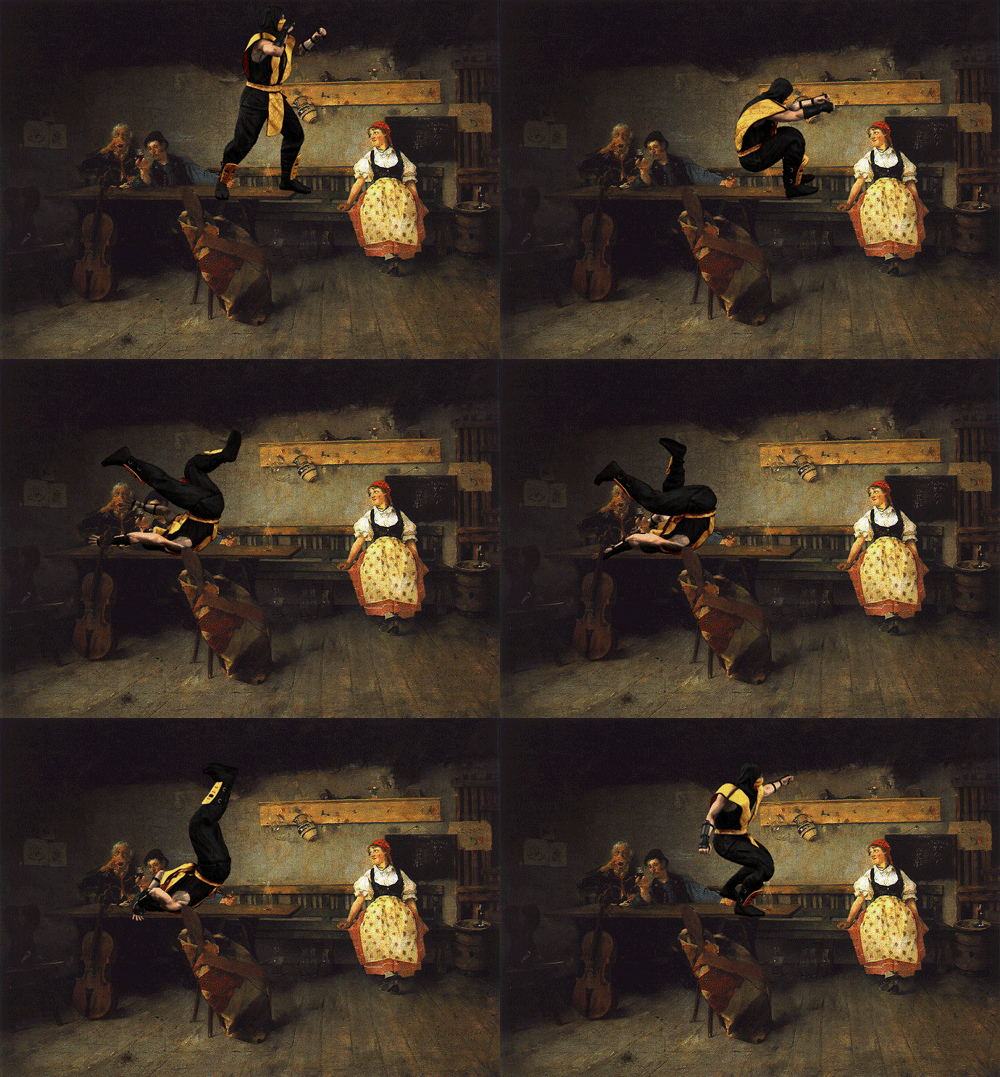
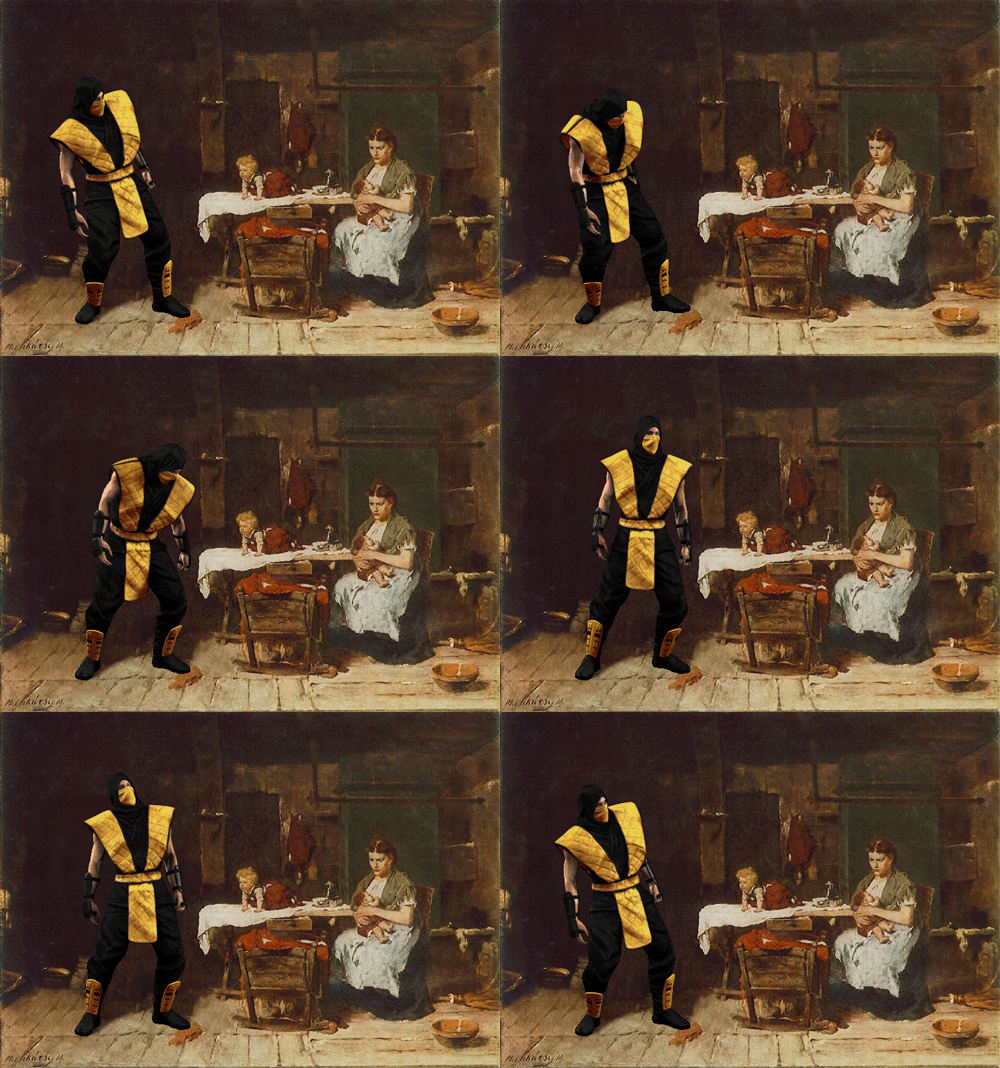
You want a piece of this, diaper baby? C’mon, Matilda, let’s put on the gloves and waltz a few rounds! Yeah, you better run, ya overgrown rat! And keep runnin’!

Filed under: Uncategorized Tagged: Unusual Animals
04 Mar 00:27
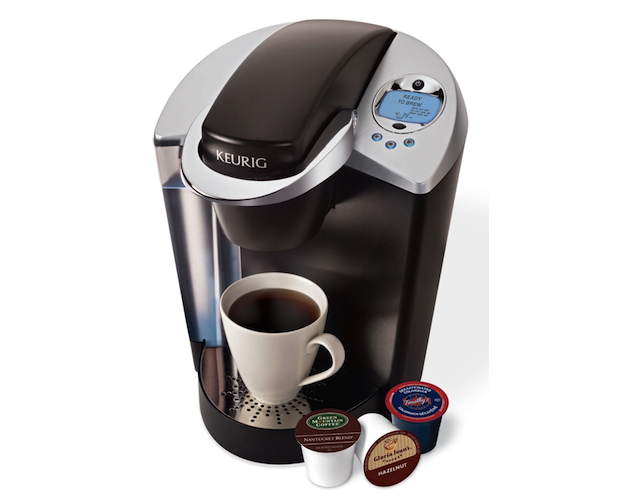


Keurig’s next generation of coffee machines will have DRM lockdown
by Casey Johnston
Your third-party pods will be no good here, soon.
Keurig is setting itself up to attempt a type of coffee "DRM" on the pods used in its coffee-making machines, according to a report from Techdirt. Keurig's next-gen machines would be unable to interact with third-party coffee pods, thus locking customers into buying only the Keurig-branded K-cups or those of approved partners.
The single-cup coffee brewers made by Keurig (owned by Green Mountain Coffee) spurred a rush by coffee brands into the single-cup-pod trade. The K-Cup patent expired in 2012, and prior to that, Green Mountain bought up many of its competitors, including Tully's Coffee Corporation and Timothy's Coffees. Competitors continue to sell K-Cups, often at a 15- to 25 percent markdown from Green Mountain's own pods, according to a lawsuit filed against Green Mountain by TreeHouse Foods.
Green Mountain plans to launch "Keurig 2.0" this fall, a new set of machines that will only interact with Green-Mountain-approved pods. There is no documentation showing how Green Mountain will control this. But if Sony is any precedent, it seems like maintaining control over plastic pods of coffee may be an uphill battle.
Read on Ars Technica | Comments
04 Mar 00:05

The new Strider is apparently full of Capcom references
by Conrad Zimmerman
Capcom-Unity has posted this new video pointing out some of the cameos, references and easter eggs one could discover in Strider. The franchise has a long history, despite how relatively few releases have come in that time, and this video shows how mindful the developers were of that. There's at least a little something included from almost every game in the series just in what's shown here.
I've had enough to play for the moment that I've been able to resist plonking down on Strider, but the reviews and comments from the cohort here have made it more challenging. Now that I know they're using classic "Pow" icons, how can I resist?


04 Mar 00:00


The sledding was delighted.
by engrishwebmaster

The snow was not.
Photo courtesy of Glowrm.
Postcard found in Japan.
03 Mar 23:58


Business Card Plays Tetris. Never Be Unemployed Again.
by Patricia Hernandez

Lots of people have business cards, but most cards are unfortunately kind of forgettable. Not this business card, though—this one is more likely to be a time sink, thanks to the playable Tetris it features.
|
|

![[link]](http://i.imgur.com/WDNcLmx.jpg)
![[link]](http://i.imgur.com/wLKFJmb.jpg)

![[link]](http://i.imgur.com/a5JaJ4j.jpg)
![[link]](http://i.imgur.com/npw9Itt.gif)