Shared posts

12 Nov 17:21

$199 EVGA Tegra Note 7 tablet will be out on November 19, pre-orders start today

by Vlad Bobleanta

Back in September, Nvidia unveiled the Tegra Note 7 tablet and platform, and now we’re starting to slowly see the first devices based on it hitting the streets. Following in the footsteps of the Advent Vega Tegra Note 7 in the UK, EVGA is set to bring its very own Tegra Note 7 to the US of A, and soon.

EVGA, as you may know, is a Greek dairy company. Just kidding, that’s Evga. EVGA makes motherboards and graphics cards based on Nvidia chipsets. So it’s pretty much a natural partner for the ailing mobile chip developer. As far as we know, this is EVGA’s first foray into the tablet space, as it tries to help Nvidia get out of the rough patch it’s been through recently in the mobile world.

The EVGA Tegra Note 7 is identical to any other Tegra Note 7 – after all, Nvidia specced the tablet and is just offering it for co-branding to these companies. So expect EVGA’s contribution to the slate to be one logo and the distribution work (which should come in easy, seeing as how it’s already got agreements in place with major retailers, for its other products).

TN7_front_Nov11-1280x960 EVGA_TN7_back-Nov11-1280x960

The EVGA Tegra Note 7 will be available at Newegg on November 19 for $199. Pre-orders are set to start today (though they’re not live yet). This is the exact price point that Nvidia announced for the tablet, so no surprises here. Sure, you save $30 compared to the new Nexus 7, but you do lose some things (such as higher screen resolution) too.

Once again, here’s a reminder of the Tegra Note 7′s specs: it comes with a 7-inch 1,280×800 touchscreen, a quad-core Nvidia Tegra 4 processor with 72-core GPU and a fifth power-saving core, a 5 MP rear camera, a 2 MP front camera, 1 GB of RAM, 16 GB of storage space, Wi-Fi, Bluetooth, and a stylus. It runs Android 4.2 Jelly Bean.

Via TechnoBuffalo

12 Nov 16:05

A McLaren Magnussent választotta Pérez helyett

Szdani88

szinyort kitették

A csapat hivatalosan még nem erősítette meg, de már biztosnak tűnik, hogy a mexikóinak a szezon végén távoznia kell. A WSR idei bajnoka érkezik a helyére.
12 Nov 15:28

Nem támogatja az Elmű a Chrome-ot

A világ legnépszerűbb böngészőjével nem lehet ügyeket intézni az áramszolgáltatónál. Az IE jó.
12 Nov 15:23

Videón az LG G Flex öngyógyító hátlapja

by Herald
Videón az LG G Flex öngyógyító hátlapja

lg-g-flex-press-image-1

Az LG G Flex nem csak hajlított kijelzője miatt számít rendkívüli különlegességnek. Az egyelőre még csak Koreában kapható készülék egy másik újdonsága a telefon hátlapjának speciális bevonata, melyet nemes egyszerűséggel csak öngyógyítónak titulált a gyártó. Eddig nem tudtuk, hogy ez mit is jelent pontosan, a hátlap bevonata milyen mértékben képes begyógyítani a rajta esett karcolásokat, azonban a koreai gyártó nemrégiben közzé tett egy videót saját YouTube csatornáján, melyen jól láthatóan bemutatja a védőréteg képességeit. A videón is látható, hogy a készülék hátlapját egy gép rövidebb és hosszabb roncsolásnak teszi ki, előbbinél kettő, utóbbinál három perc kellett a felszíni sérülések eltüntetésének.

Bár az LG még mindig nem részletezte a dolog technológiai hátterét, a YouTube videóhoz mellékelt leírás szerint a borítás csak az egyszerűbb, mindennapi használat során létrejövő karcolásoktól védi a telefont, a leesések és mélyebb karistolások következményeit a bevonat nem képes kompenzálni.

12 Nov 09:10

iPad Air drop test result will make you invest in a rugged case

by Adrian Fonseca

iPadAir
Apple has made the iPad Air thinner and lighter than ever before, but has that affected durability in any way? You’re in for a surprise. The iPad Air is Apple’s latest tablet, it is significantly different than its predecessor. In fact, its the only tablet to come with major design changes ever since the iPad [...]

The post iPad Air drop test result will make you invest in a rugged case appeared first on VR-Zone.

12 Nov 07:13

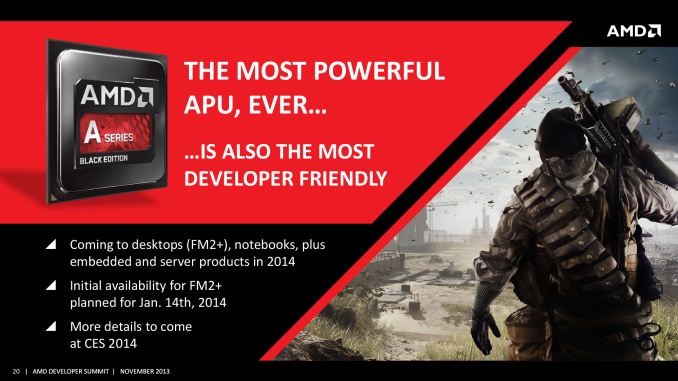
AMD Kaveri APU Launch Details: Desktop, January 14th

by Ryan Smith

Kicking off today is AMD’s annual developer conference, which now goes by the name APU13. There will be several APU/CPU related announcements coming out of the show this week, but we’ll start with what’s likely to be the most interesting for our regular readers: the launch date for AMD’s Kaveri APU.

First and foremost, AMD has confirmed that Kaveri will be shipping in Q4’13, with a launch/availability date of January 14th, 2014. For those of you keeping track of your calendars, this is the week after CES 2014, with AMD promising further details on the Kaveri launch for CES.

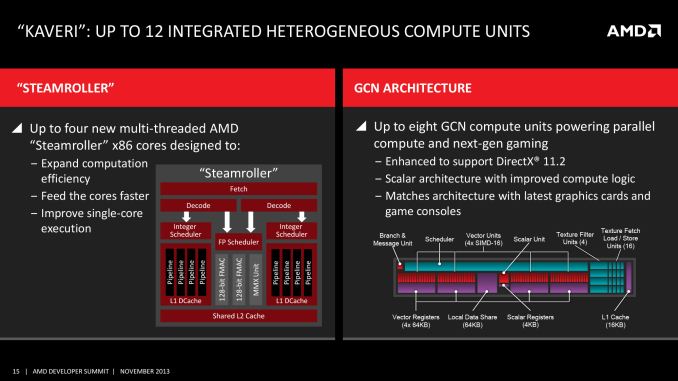
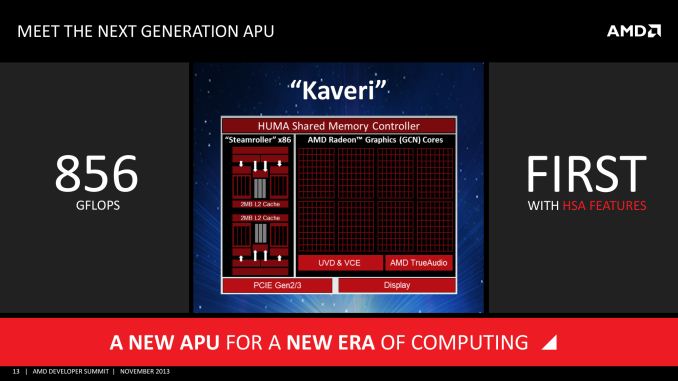
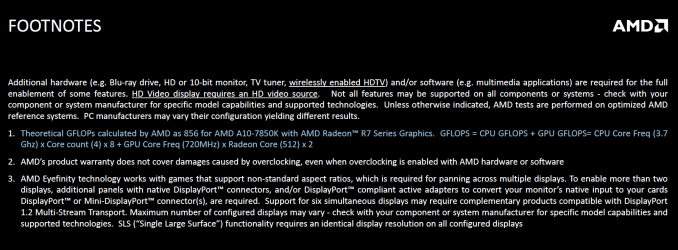
Second of all, we have confirmation on what the highest shipping APU configuration will be. Kaveri will have up to 4 CPU core (2 modules), which will be based on AMD’s latest revision of their desktop CPU architecture, Steamroller. Meanwhile the GPU will be composed of 8 GCN 1.1 CUs, which would put the SP count at 512 SPs (this would be equivalent to today's desktop Radeon HD 7750). Furthermore AMD is throwing around a floating point performance number – 856 GFLOPS – which thanks to some details found in AMD's footnotes by PCWorld gives us specific clockspeeds and even a product name. A10-7850K CPU clockspeed 3.7GHz, GPU clockspeed 720MHz.

Third, in a departure from how AMD launched Trinity and Richland, Kaveri will be coming to the desktop first. The January 14th date is for the availability of desktop socket FM2+ Kaveri APUs, with server and mobile APUs to follow (these are presumably some of the CES details to come). Pricing and specific SKUs will of course be announced at a later time, and there wasn’t any clarification on whether this was just for OEM hardware, or if we’ll be seeing retail CPUs too.

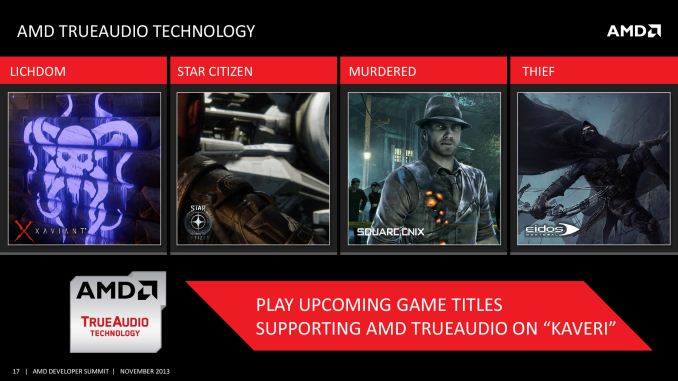
Finally, AMD has confirmed on the GPU side that Kaveri will be shooting for feature parity with AMD’s latest discrete GPUs, by supporting many of the same features. Specifically, TrueAudio will be making an appearance on Kaveri, bringing AMD’s dedicated audio processing block to their APUs as well as their GPUs. On the discrete GPUs this is a move that was mostly about functionality, but on Kaveri it should take on a second role due to the fact that it’s exactly the kind of CPU-constrained environment for which having dedicated hardware will be a boon. Furthermore, AMD has also confirmed that their new low-level API, Mantle, will also be supported on Kaveri – it is after all a GCN based GPU.

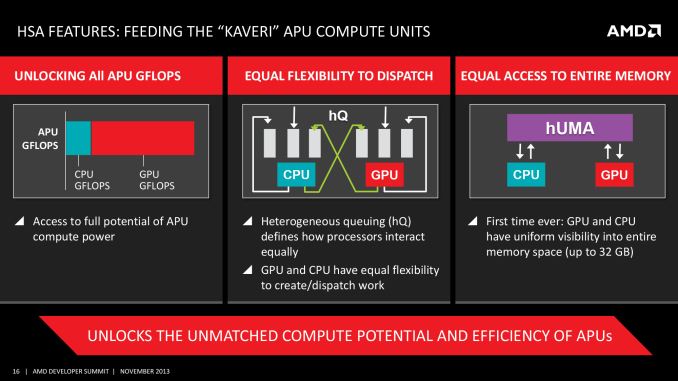
For AMD Kaveri is going to be a big deal; likely the biggest CPU/APU launch for the company in quite some time. Since the acquisition of ATI all the way back in 2006 this is what the company has been building up to: producing a processor with a highly integrated CPU/GPU that allows both of them to be leveraged nearly-transparently by software. Kaveri is the launch vehicle for HSA both as a specific standard and as a general concept for a PC CPU/APU, so it’s something that everyone inside and outside of AMD will be watching closely.


11 Nov 21:56

Xiaomi sells 220,000 smartphones in 3 minutes

It wasn't long ago that we reported that Xiaomi sold its 100,000 HongMi smartphones in about two minutes. The Chinese manufacturer has done it again, and this time the company has managed to sell its flagship smartphone, the Xiaomi MI3 at a similarly brisk pace. Xiaomi has sold 110,000 units of HongMi and MI-2s in a few minutes in a sale done to celebrate "Single's Day", which is basically...

11 Nov 20:39

Anonymousra támad az Anonymous

Berágtak az ausztrál aktivisták az indonézekre, mert a kormány helyett kis cégeket hekkeltek.
11 Nov 20:36

Náthás lett egy teve

Szaúd-Arábiában találták meg az első, közel-keleti légúti megbetegedéssel megfertőződött állatot.
11 Nov 20:31

Meggyűlik a baja az Xbox One-nak a 3D Blu-ray lemezekkel

Szdani88

szerencsétlen One már szánalmas xd

Úgy tűnik a Sony előnyben lesz a Microsofthoz képest a 3D Blu-ray lemezek lejátszásánál.
11 Nov 19:39

Alcatel One Touch Idol X - egyre inkább ideális

Ideje komolyabban számolnunk az Alcatel készülékeivel. Az Idol X remek kijelzővel, ízléses és minőségi külsővel domborít, bár nem minden tökéletes.
11 Nov 19:35

HÁT, ez lenne a Ferrari 2014-es pilótapárosa? (Kép)

by info@motorsportal.hu ()
11 Nov 14:14

Colorfuls GTX 780 Ti mit 12+2-Phasendesign

Szdani88

micsoda katonás rend a harmas képen

Diverse Boardpartner bereiten derzeit eigene Modelle der GeForce GTX 780 Ti vor, wobei wir Karten von Gigabyte und Inno3D bereits testen konnten. Nun sind auch erste Details und Bilder zu einer Eigenkreation einer GTX 780 Ti von Colorful aufgetaucht.
11 Nov 14:13

Orbán szerint emberi jogokat sértettek a lehallgatások

Szdani88

micsoda meglátás

Tömegesen sérültek az emberi jogok az amerikai Nemzetbiztonsági Ügynökség (NSA) törvénytelen lehallgatásai során - szögezte le Orbán Viktor miniszterelnök és Schiffer András, az LMP frakcióvezetője.
11 Nov 07:13

Megvan a szavak szent grálja

Megtalálták a szót, amely minden nyelven ugyanaz. He? Igen, eltalálták.
10 Nov 21:03

Rendőrautó lehet a Tesla S-ből

Szdani88

milyen trükkös xd

Halk hajtásláncával járőrautónak kiváló. Ilyen feladatra drága ugyan, de gazdagokat vigyáznának vele.
10 Nov 15:33

AMD Changes 290 Series Fan Algorithms & About That 290 Conclusion

by Ryan Smith

In a busy week that’s going to end up being just a bit busier, AMD has pushed out another Catalyst driver update specifically targeted at the new Radeon R9 290 series, Catalyst 13.11 Beta9.2. This release is especially notable because it resolves some outstanding issues with the hardware that the hardware press has covered in depth this week opposite the 290 launch, and because it is making low level operational changes that will have a direct impact on the power, noise, and performance characteristics of the 290 series.

First off, let’s talk about what AMD has done with their drivers. Citing an issue with variability in the fan speeds on 290 series cards, AMD has changed the algorithms for how their drivers handle the fan speeds on 290 series cards, essentially overriding the BIOS defaults with new values. This is similar to how AMD deployed their specification changes for the 290 ahead of its launch – adjusting it from 40% to 47% as the default maximum fan speed – but AMD has also used their driver update to change how they’re defining and controlling fan speeds.

Rather than controlling fan speed based on percentages, which are really measuring fan speed as the duty cycle of the fan’s motor on a relative basis, AMD has switched to controlling fan speeds on an absolute basis, using the measured RPM of the fan as their metric of absolute fan speed. This goes back to AMD’s concern over variance, as there is going to be some variance – and apparently too much variance – from fan motor to fan motor in how fast it can go, and consequently just what a specific duty cycle represents on a relative basis. Consequently by switching to measuring fan speed on an absolute basis there will definitely be less variation. as AMD is now controlling fan speeds by the very same metric they use to define that variation (RPM).

For the release of this driver, this is what AMD specifically had to say.

We’ve identified that there’s variability in fan speeds across AMD R9 290 series boards. This variability in fan speed translates into variability of the cooling capacity of the fan-sink.

The flexibility of AMD PowerTune technology enables us to correct this variability in a driver update. This update will normalize the fan RPMs to the correct values.

Given the significant interest there has been this week in articles published over at Tom’s Hardware and their experience with additional retail 290 series cards, it's likely that this is related to the issues Tom’s was seeing. In which case the implication is that fans are running too slow, which could've definitely resulted in lower performing cards. It's obviously also possible that fans could be running too fast in some configurations, which would obviously result in louder/higher performing cards. The third scenario that this update corrects is one that AMD told us about: where the fans are running too slow during light-to-medium workloads, which in turn allows the GPU to heat up more than it should and forces the fan to run at higher speeds down the line. In this third scenario, the overall acoustic profile of the card would actually be quieter post update. Admittedly this isn't something we test for or something we've seen internally, but it's a situation that AMD says also improves with this update.

Along with reducing variation the net result of this driver as far as our samples are concerned will be that fan speeds are going to go up. AMD’s new maximum fan speeds for the 290X (quiet mode) and 290 will be 2200RPM and 2650RPM respectively. A quick meta-analysis doesn’t show any site as having reported their review samples as having RPMs that high or higher, in which case the situation should be similar to ours. Our cards topped out at 2100RPM for the 290X and 2500RPM for the 290, so these new values represent a 100RPM and 150RPM increase in default fan speeds respectively. Or on a percentage basis, we’ve gone from 40% to 42% for the 290X, and 47% to 49% for the 290. 

AMD Radeon R9 290 Series Maximum Fan Speeds
Card Catalyst 13.11 Beta 8 Catalyst 13.11 Beta 9.2
290X (Quiet Mode) ~2100 RPM (40%) ~2200RPM (42%)
290 ~2500 RPM (47%) ~2650 RPM (49%)

Since we don’t have any other 290 cards at this time, and our second 290X already behaved virtually identical to our first, we’re not in a position to talk about the matter of variance in further detail. Presumably variance was a big enough issue that it required AMD’s quick attention, but we don’t have any further cards to get a first-hand impression of just how large that variance was. Whatever the variance was though, this should virtually eliminate it.

What we can briefly look at however is how this changed our performance results. The net effect of this change is that AMD has increased their fan speeds for the 290 series, and as a result noise levels are going to go up slightly, and due to the close relationship between noise, cooling, and heat dissipation, power consumption will also go up slightly too. We’d say performance is going to go up too (again similar to the 290’s spec change), but in reality the amount of variance caused by PowerTune has all but drowned out any possible performance difference on our 290X. Meanwhile our 290 wasn’t cooling limited in the first place, so this change hasn’t affected gaming performance.

With respect to PowerTune on the 290X, we’ve been finding that PowerTune adjusts clockspeeds rather significantly in response to the smallest input changes, which makes it difficult to isolate any resulting performance changes from the fan speed adjustment. The reason why this is happening is unclear, but we suspect that it has to do with the 290 series cards not having much flexibility to adjust their voltages, resulting in them having to instead widely adjust their clockspeeds to achieve the necessary reduction in power consumption and heat generation.

To put this concept to the test, here are some quick scatter plots of the 290 and 290X running FurMark, plotting clockspeed against voltage (VDDC) as measured by GPU-Z. These voltages are going to be subject to external factors such as vDroop, but it’s the best we have right now since we can’t see VIDs.

In brief, there’s only roughly a 100mv difference in voltages between the 290X’s base clockspeed and boost clockspeed, and even less a difference on the 290. If this data is reasonably accurate, then it would explain why the 290 series sees such heavy clockspeed throttling at times, and why our gaming performance hasn’t changed. So with that in mind, let’s look at the numbers.
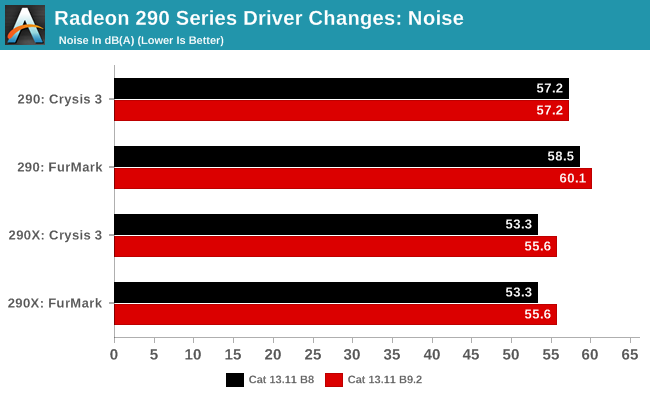
Radeon 290 Series Driver Changes: Noise

First and foremost, noise under load has predictably gone up. For the 290X where FurMark and Crysis 3 top out at the same point, this new noise level is 55.6dB, 2.3dB higher than the old maximum of 53.3dB. For the 290 on the other hand, noise levels don’t change under Crysis 3 since it wasn’t cooling/fan limited in the first place, remaining at 57.2dB. However the worst case scenario, as represented by FurMark, sees noise levels increase a further 1.6dB to 60.1dB.
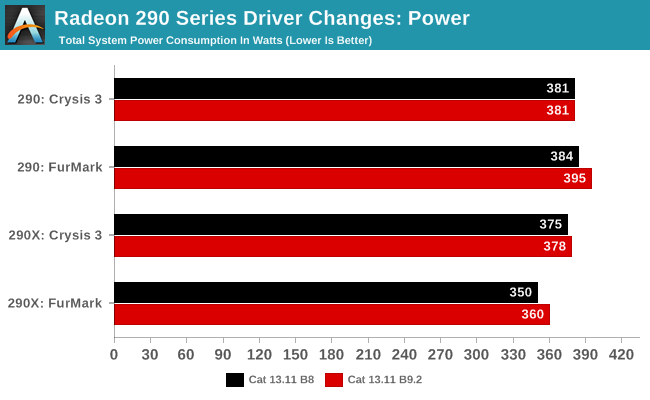
Radeon 290 Series Driver Changes: Power

As for power consumption, since we’re clearly cooling limited in most scenarios on the 290 series, any increase in cooling performance causes an increase in power consumption. For the 290X in FurMark this is another 10W at the wall, while under Crysis 3 (where performance is nearly identical) this is a barely measurable 3W difference. While for the 290 the difference is 11W for FurMark, and absolutely nothing for Crysis 3 since it wasn’t cooling limited in the first place.
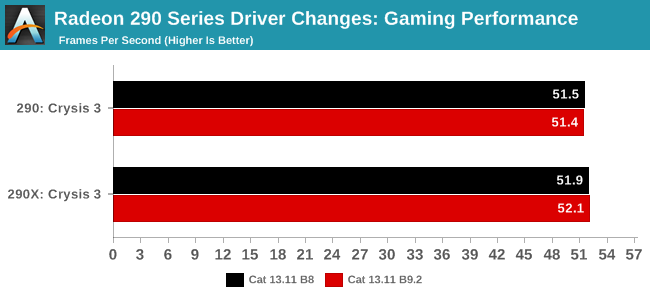
Radeon 290 Series Driver Changes: Gaming Performance

Finally for performance, we can see that the fan speed adjustments had no measurable impact on performance under Crysis. The 290 was never cooling limited in the first place, and for the voltage issues discussed further, PowerTune has all but wiped out any potential performance improvement for the 290X, leaving it changed by a fraction of a frame per second. Unfortunately this means the noise increase is very real, but there’s not a measurable performance increase to go with it.

With all of that said, this won’t be impacting our reviews of the 290 or 290X (or GTX 780 Ti), as there isn’t a performance change to account for, and the noise change, though unfortunate, is under gaming workloads limited to the 290X (though this does mean 290X loses some further ground to 290).

About that 290 Conclusion

Since we’re already on the matter of our recommendations, I wanted to spend a bit of time following up on our 290 review, as that review and its conclusion generated a lot more feedback than we had been expecting. In this week’s article I flat out avoided recommending the 290 because of its acoustic profile. When faced with the tradeoff of noise vs. performance, AMD clearly chose the latter and ended up with a card that delivers a ridiculous amount of performance for $399 but exceeds our ideas of comfortable noise levels in doing so.

I personally value acoustics very highly and stand by my original position that the reference R9 290 is too loud. When I game I use open back headphones so I can listen for phone calls or the door for shipments, and as a result acoustics do matter to me. In the review I assumed everyone else valued acoustics at least similarly to me, but based on your reaction it looks like I was mistaken. While a good number of AnandTech readers agreed the R9 290 was too loud, an equally important section of the audience felt that the performance delivered was more than enough to offset the loud cooling solution. We want our conclusions to not only be reflective of our own data, but also be useful to all segments of our audience. In the case of the 290 review, I believe we accomplished the former but let some of you down with the latter.

Part of my motivation here is to make sure that we send the right message to AMD that we don’t want louder cards. I believe that message has been received loud and clear from what I understand. It’s very important to me that we don’t send the message to AMD or NVIDIA that it’s ok to engage in a loudness war in the pursuit of performance; we have seen a lot of progress in acoustics and cooler quality since the mid-to-late 2000’s, and we’d hate to see that progress regressed on. A good solution delivers both performance and great user experience, and I do believe it’s important that we argue for both (which is why we include performance, power and noise level data in our reviews).

The Radeon R9 290 does offer a tremendous value, and if you’re a gamer that can isolate yourself from the card’s acoustics (or otherwise don’t care) it’s easily the best buy at $399. If acoustics are important to you, then you’re in a tougher position today. There really isn’t an alternative if you want R9 290 performance at the same price. The best recommendation I have there is to either pony up more cash for a quieter card, accept the noise as is or wait and see what some of the customized partner 290 cards look like once those do arrive. I suspect we’ll have an answer to that problem in the not too distant future as well.

Note that this isn't going to be the last time performance vs. acoustics are going to be a tradeoff. AMD pointed out to us that the 290/290X update is the first time its fan speed has been determined by targeting RPMs vs. PWM manipulation. In the past, it didn't really matter since performance didn't scale all that much with fan speed. Given the current realities of semiconductor design and manufacturing, the 290/290X situation where fan speed significantly impacts performance is going to continue to be the case going forward. We've already made the case to AMD for better reference cooling designs and it sounds like everyone is on the same page there. 

Given the amount of interest this has generated I'm curious to get your feedback on the performance vs. acoustic debate. Feel free to share your comments below on how important acoustics are for you (vs. performance) and at what point does a GPU become too loud? For us the reference point was NVIDIA's GeForce GTX 480, but I'm interested to know what GPUs in your past have been too loud.


09 Nov 23:48

Ilyen volt London a 17. században

Rekonstruálták, milyen lehetett 1622-ben a St. Paul's Cathedral és a környező tér.
09 Nov 11:54

Magyar jelentkezőt is várnak az OPPO Ambassador programba

Már lehet jelentkezni az OPPO programjának harmadik körére, melyben Magyarország is helyet kapott.
09 Nov 11:50

Xbox One and PS4 Will Require Updates Out of the Box

by Wade Keye
Xbone_sad

It’s an exciting time to be a gamer, as Sony and Microsoft both have huge next-gen console launches happening this month. The systems will duke it out for console supremacy and our gaming dollars, featuring eye-popping graphics and new play styles. The Xbox One and PS4 are both impressive machines with entertainment capabilities beyond gaming, but before you can make use of your shiny new system you’ll have to download an update.

Microsoft confirmed today that you’ll need to download and install an update before you can play a single game on the Xbox One. While Sony has yet to give details on its PS4‘s functionality without an update, all signs are pointing to a similar situation.

Lame.

One of the most maddening issues of this past generation of gaming has been the need for constant updates and patches (with the PS3 in particular!). The console generation that began in the mid-oughts, the Wii, Playstation 3, and Xbox 360, marked the first time that gaming systems were created with the intention of being online all the time.

Yes, the Playstation 2 had some online capabilities – if you bought an attachable hard drive – and the original Xbox had a very involved online multiplayer community for its time. And let’s not forget the Dreamcast (never forget!), which revolutionized console-based multiplayer with the inclusion of a modem.

But the past generation was the first time that consoles had storage built-in, and were made to be online. This brought about much deeper and more rich online gaming, allowed for downloadable games and content, and made it easy to add new features over the life of the console.

This was curse as much of blessing, however. Consoles, which had been the easy, plug-and-play option since their inception suddenly were riddled with downloads and updates, patches and bug fixes just like PCs. While it was great to be able to download bug fixes, those bugs should have never been on a game disc in the first place!

Okay, rant over. But it’s disappointing that these brand new consoles will need an update out of the box. Talk about a way to put a damper on Christmas Morning!

Sound off in the comments.

[Via: WebProNews]

The post Xbox One and PS4 Will Require Updates Out of the Box appeared first on IntoMobile.

Xbox One and PS4 Will Require Updates Out of the Box originally appeared on IntoMobile.com on 2013-11-08T22:01:16Z. FV1gMYsz9b5j

08 Nov 17:36

A Valve a CES-en mutatja be a Steam masinákat építő partnereit

A vállalat szabad kezet ad a gyártóknak, illetve a kivételezés is kizárt.
08 Nov 17:36

A Sony megmutatta a PlayStation 4 belsejét

Yasuhiro Ootori a vállalat vezető mérnöke darabokra szedte a gépet, melyről kép- és videoanyag egyaránt készült.
08 Nov 17:00

Íme, a legnépszerűbb magyar jelszavak!

by Gálffy Csaba
A világ legnagyobb keresztrejtvénye - jellemezhetjük az Adobe-tól kikerült titkosított jelszó-adatbázist. Az egy-egy jelszóhoz tartozó emlékeztetők alapján a népszerűbbek kitalálhatóak, szórakozásnak sem utolsó a visszafejtés. Az automatizált támadás ellen egyelőre védett a felhasználók nagy része.

08 Nov 13:21

AMD cuts APU prices

by document.write(['staff','fudzilla.com'].join('@')) (Fudzilla staff)
A6 and A8 parts down ~13%
08 Nov 13:20

AMD passt Lüftersteuerung der Referenz R9 290(X) an

AMD hat mit einem neuen Catalyst-Treiber das Verhalten der Lüftersteuerung der neuen „Hawaii“-Grafikkarten Radeon R9 290 und Radeon R9 290X umgestellt. Der Konzern reagiert damit laut eigener Aussage auf eine zu hohe Streuung der tatsächlich anliegenden Lüfterdrehzahlen der Serienkarten. Das hat Auswirkungen auf die Leistung.
08 Nov 10:37

Nem áll meg a GPU-háború: ismét trónon az NVIDIA

by Hlács Ferenc
Az elmúlt hetekben felpörgött GPU-piac még mindig nem állt meg: az NVIDIA bejelentette legújabb csúcsmodelljét, a GeForce GTX 780 Ti-t. A GK110-alapú kártya a gyártó eddigi leggyorsabb darabja, ami a GTX Titant, a GTX 780-at és AMD csúcskártyáját az R9 290X-et is maga mögé utasítja, igaz, utóbbinál 150 dollárral drágább.

08 Nov 10:36

Megfeleződött a Tegrák forgalma

by Bodnár Ádám
Látványosan visszaeső bevételről és profitról adott számot az NVIDIA, a vállalat elsősorban az okostelefonokba és tabletekbe szánt Tegra rendszerchipek forgalmának zuhanását nyögi.

08 Nov 10:35

Nvidia GeForce GTX 780 Ti SLI review

by Sam Reynolds

geforce_gtx_780_ti_1-665x374
Nvidia has created a powerful beast, but its competitiveness is challenged by AMD’s R290X. With AMD playing its concluding hand in this fall’s great game of GPU wars, now comes time for Nvidia’s turn for its final move — and it’s short of the checkmate that many expected. By all means Nvidia’s GeForce GTX 780 [...]

The post Nvidia GeForce GTX 780 Ti SLI review appeared first on VR-Zone.

08 Nov 06:58

Happy Ninth Birthday Firefox!

by Mozilla

Mozilla created Firefox to be an amazingly fun, safe and fast Web browser that embodies the values of our mission to promote openness, innovation and opportunity online. In the nine years since we first launched Firefox, we have moved and shaped the Web into the most valuable public resource of our time

We are excited to join together with the global community of Mozillians to start the celebration of Firefox’s golden ninth birthday on November 9. To celebrate, we’d like to highlight nine of our favorite gifts we’ve given the Web over the past year.

HBDFx.jpg

  • Firefox in Mobile: Firefox has always made a significant impact on the Web and we’ve recently grown Firefox to support not just Windows, Mac and Linux, but also Android phones and tablets. As more and more people access the Web from a mobile device than ever before, our Firefox for Android Web browser consistently offers users an amazing browsing experience, receives 4.5 stars in the Google Play Store and has been downloaded millions of times.
  • Growing the Firefox Family: We also expanded the Firefox family this year with the birth and launch of the first ever Firefox OS smartphones – devices based entirely on open Web technologies. To date, we have launched Firefox OS in nine countries and have thousands of apps in our Firefox Marketplace.
  • Speedy: Firefox is faster than ever before. We beat last year’s Kraken scores by 74%, and we’re 88% faster on Octane. Web Apps and games are 25 percent faster due to our JavaScript improvements and a new technology called asm.js. And, Tom’s Hardware recently named Firefox “the new speed king” and winner of the Web Browser Grand Prix due to startup times, page load times and reliability.
  • Social: We’ve been working on ways to integrate social sites and services directly into Firefox to quickly and easily connect you with your friends and family. Last year, we launched with Facebook as the first Firefox social integration partner. Soon after that we added Cliqz, and Mixi and we are working with more social sites, services and apps to make your browsing experience more social, customizable and personal.
  • Private: We are proud to be named the Most Trusted Internet Company for Privacy in 2012, according to a study performed by the Ponemon Institute. We also just launched the Lightbeam Firefox Add-on, which brings to light the array of first and third party companies people interact with everyday across the Web in a visual way.
  • Secure: We shipped Mixed Content Blocker in Firefox to keep you secure, wherever you surf the Web. Firefox includes Click to Play plugins. By allowing you to decide which sites need to use plugins, Firefox will help protect them and keep their browser running smoothly.
  • The Best Developer Tools: Firefox now boasts a robust set of tools for Web developers for editing and debugging HTML, CSS and JavaScript on the desktop and on mobile. Recent highlights include: the App Manager; Responsive Design View, Network Monitor; Page Inspector; and the JavaScript Debugger.
  • WebRTC: Firefox enables video calls and file-sharing directly in the browser, all without the need for plugins or third-party software with Web Real Time Communications.
  • Innovations in Web Gaming: Over the last year, our developers and engineers have been hard at work to make the Web the platform for high end game development, one of the last challenges to show the Web is a real development platform. We developed a supercharged subset of JavaScript called asm.js that enables developers to create high-intensity applications, like games, directly on the Web. The Web Audio API was added to Firefox and completed the Web as an amazing platform for gaming.

We’ve got some exciting things coming soon including an updated browser interface and Firefox optimized for Windows 8 tablets. We can’t wait to see what other new innovations come to the Web in the next year! Join in on Twitter to celebrate Firefox. Tweet the hashtag #HappyBirthdayFirefox with your favorite Firefox memory or feature all week.

07 Nov 23:52

Megtévesztette a fogyasztókat a Magyar Telekom

Szdani88

buko

A Gazdasági Versenyhivatal megállapította, hogy a Magyar Telekom megtévesztette a fogyasztókat a kedvezményes áron elérhető földgázszolgáltatása népszerűsítése során. A hivatal ezért 20.000.000 Ft bírságot szabott ki a vállalkozásra.