Shared posts
Button a sisakjába üvöltött az Eau Rouge-ban
Vergne: A Red Bull-lal én is képes lennék arra, amire Ricciardo
Szdani88aha oké, edd meg szépen a reggelit, hogy erősek legyenek a csontjait jean

Lotterer kicsit többet várt az F1-es autóktól!

Meizu MX4 blazes past the 50,000 score mark in AnTuTu
Szdani88számháború mai nyertese

The yet to be revealed Meizu MX4 posted the mind-boggling AnTuTu score of 52,811. The handset's achievement is the highest from a Chinese smartphone to date and, quite possibly, the best score from any smartphone globally. The Meizu MX4 version that posted the whopping benchmark score (most of today's high-end smartphones score between 35,000 and 40,000) reportedly features a MediaTek MT6595 SoC with big.LITTLE architecture and LTE connectivity. The device's display has a resolution of 1920 x 1152 pixels and packs a 20.7MP camera. The abovementioned Meizu MX4 hardware setup purportedly belongs to the mid-range model. An even better equipped version with Exynos 5 Octa CPU and 2K is also expected. Meizu MX4 will be unveiled in less than two weeks, on September 2. Source ...
Der E-Book-Reader Kobo Aura H2O ist wasserdicht
Szdani88ha nagyon kell olvasni xdd
Xolo unveils the 4.5-inch Q610s with a sub-100 euro price tag

Xolo has just unveiled the Q610s smartphone - a very affordable midrange offering. The smartphone has a 4.5" 480 x 854 display, MediaTek MT6582M with 1GB of RAM, quad-core 1.3GHz processor and Mali-400MP2 graphics chip, dual-SIM slots, 5MP camera with 1080p video recording and Android 4.4 KitKat. The smartphone will carry a INR 7,499 price tag (around 93 or $123) making it a prime rival to the Nokia Lumia 530 which launched in India for around the same price. There's no official word on the launch date yet. The Xolo Q610s comes just a week after the Q510s was made official with a 5MP snapper, 4" WVGA IPS panel and an even lower INR 6,499 price (around 80 or $107). Source |...
Wooden laptop up for sale
A jövő tankját fejleszti a DARPA
OnePlus One kijelző teszt (4K)

A konkurens modellekkel hasonlítottuk össze kültéren a OnePlus One okostelefon kijelzőjét.
Meghekkelték az USA nukleáris felügyeleti szervét
Szdani88jol hangizk
Jön a fizetős Youtube
Report: AMD, Intel Have Q2 GPU Sales Jump While Nvidia Slips

The losses incurred by many GPU vendors during first quarter of the year have been largely offset by gains in the year’s second quarter, according to a new report by Jon Peddie Research.
According to JPR’s report on the second quarter of the year, shipments were up 3.2% quarter-over-quarter, and down 4.5% compared to the same quarter from last year.
While the crown for the company that has the biggest rise in GPU shipments for the quarter goes back and forth — sometimes quarter-over-quarter — for this quarter AMD takes the lead with an 11% increase, followed by Intel at 4.5%. Nvidia faced a slumping market this quarter, with a decrease of 8.3%.
Breaking down the data, it appears that AMD’s growth comes purely from increased shipments of what the report calls its heterogeneous CPU/GPUs — APUs in AMD’s nomenclature. APU shipments increased 16.7% from the previous quarter, and increased 10.3% in notebooks. However, AMD’s discrete desktop shipments decreased 10.7%. For notebooks discrete shipments increased 30.6%.
While AMD was insulated from falling sales of discrete graphics cards because of its APU efforts, Nvidia had no such luck. Nvidia’s desktop discrete shipments decreased 21% from last quarter. In the notebook space, the company’s discrete shipments increased by 6.9%.
JPR’s report does not include things like semi-custom silicon, and mobile GPUs which AMD and Nvidia have made big efforts to diversify into in order to offset falling discrete GPU sales. While looking at reports like this may have been a way to gauge the health of a company in this sector in the past, the trend of diversification means that many more metrics are needed to get a big picture of where a GPU vendor is going in the future.
The post Report: AMD, Intel Have Q2 GPU Sales Jump While Nvidia Slips appeared first on Bright Side of News*.
Tavaly még gokart, jövőre F1: Verstappen útja a Toro Rosso üléséig

Szemkímélő monitorduó a BenQ műhelyéből
AMD FX-8300 nur für China, 860K im Handel
Vélemény: Windows Phone, ennyi volt.
Szdani88micsoda hasonlatok xd
Browser Face-Off: Chrome 37 Beta Battery Life Revisited
Last week we posted our Browser Face-Off: Battery Life Explored 2014, where the battery run down times of Firefox 31, IE11 Desktop, IE11 Modern, Chrome 36, and Chrome 37 beta were tested on Windows. We used GUI automation to open browsers, tabs, and visit websites to simulate a real user in a light reading pattern. The article answered a lot of questions about popular browser battery life on Windows, but it raised additional questions as well.
Chrome 36 tested with the best battery life, but was the only browser that did not render correctly at 3200x1800 due to lack of HiDPI support. In the Chrome 37 beta, HiDPI support improved rendering but also took a 25% dive in battery life tying it for last place. However, the Chrome 37 beta includes more changes than just HiDPI support (along with some debugging code), so was the battery life penalty from the now-native 3200x1800 rendering or was it something else? After a few more days of testing at 1600x900 with 100% DPI scaling, we can narrow in on an answer.
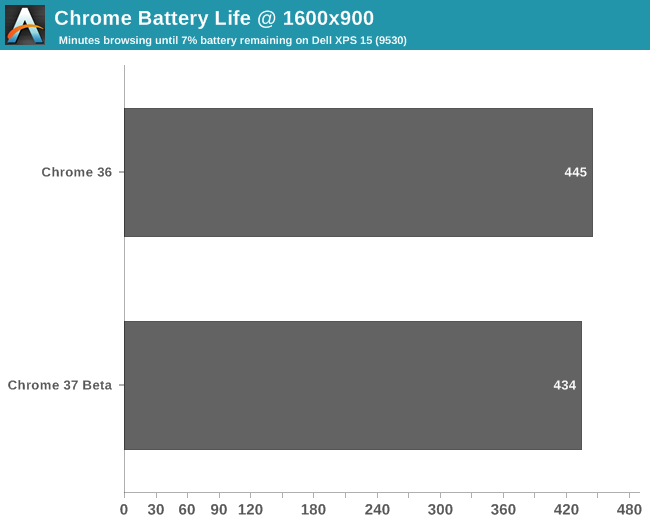
When both Chrome 36 and Chrome 37 beta natively render at 1600x900 there is less than 3% difference in battery life. Two tests of each browser were performed and the results averaged. The variation between runs was only 1%. Looking at our previous numbers of Chome 36 and 37 beta on the HiDPI setting of 3200x1800 and 200% scaling, the situation is entirely different.
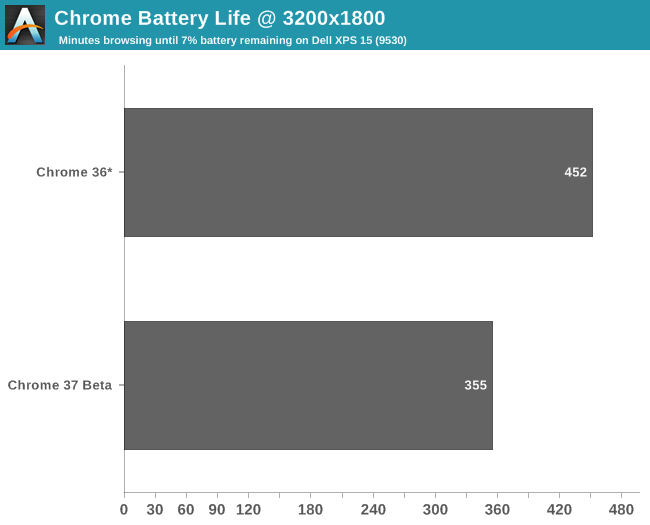
I've added an asterisk here (and clarified the same text on the original article) to indicate Chrome 36 isn't actually rendering at 3200x1800, but rather at 1600x900 and relying on Windows DPI Virtualization to scale up to 3200x1800.
Looking at the numbers, there's some good news and some bad news. The good news is that Chrome 37's new features likely won't hurt the battery life of current users. If you are using Chrome now, you are probably not using a HiDPI display due to the existing blurry rendering. For these users, the pending Chrome 37 upgrade has no significant impact on battery life. The bad news is that if you have been avoiding Chrome due to its HiDPI rending issues, Chrome 37 resolves those issues but also appears to provide worse battery efficiency compared to Internet Explorer. On our XPS 15 that equated to about an hour less of mobility.
Given that this is the first version of Chrome to properly support HiDPI, it's entirely possible – even likely – that there are many opportunities to further optimize the algorithms and hopefully return battery life at least close to Chome 36 levels. A slight dip in battery life is expected as it takes more work to render a 3200x1800 image compared to a 1600x900 image, but a 20% drop seems rather extreme. We'll have to see what future updates bring, but hopefully by noting the discrepancy it will encourage developers to better tune performance.
Problémát okozhat egy múlt héten kiadott Windows-patch
Jiayu G2F - felettébb megéri
Jó vásár a szegény ember GoPrója
Intel Demonstrates Direct3D 12 Performance and Power Improvements
Since the introduction of Direct3D 12 and other low-level graphics APIs, the bulk of our focus has been on the high end. One of the most immediate benefits to these new APIs is their ability to better scale out with multiple threads and alleviate CPU bottlenecking, which has been a growing problem over the years due to GPU performance gains outpacing CPU performance gains.
However at the opposite end of the spectrum and away from the performance benefits are the efficiency benefits, and those are gains that haven’t been covered nearly as well. With that subject in mind, Intel is doing just that this week at SIGGRAPH 2014, where the company is showcasing both the performance and efficiency gains from Direct3D 12 on their hardware.
When it comes to power efficiency Intel stands to be among the biggest beneficiaries of Direct3D 12 due to the fact that they exclusvely ship their GPUs as part of an integrated CPU/GPU product. Because the GPU and CPU portions of their chips share a thermal and power budget, by reducing the software/CPU overhead of Direct3D, Intel can offer both improved performance and power usage with the exact same silicon in the same thermal environment. With Intel's recent focus on power consumption, mobile form factors, and chips like Core M, Direct3D 12 is an obvious boon to Intel.
Intel wisely demonstrated this improvement using a modern low-power mobile device: the Microsoft Surface Pro 3. For this demo Intel is using the Core i5-4300U version, Microsoft’s middle of the road model that clocks up to 2.9GHz on the CPU and features one of Intel’s HD 4400 GPUs, with a maximum GPU clockspeed of 1.1GHz. In our testing, we found the Surface Pro 3 to be thermally constrained – throttling when met with a medium to long duration GPU task. Broadwell should go a long way to improve the situation, and so should Direct3D 12 for current and future Intel devices.
To demonstrate the benefits of Direct3D 12, Intel put together a tech demo that renders 50,000 unique asteroid objects floating in space. The demo can operate in maximum performance mode with the frame rate unrestricted, as well as a fixed frame rate mode to limit CPU and GPU utilization in order to reduce power consumption. The demo can also dynamically switch between making Direct3D 11 and Direct3D 12 API calls. Additionally, an overlay shows power consumption of both the CPU and GPU portions of the Intel processor.
Intel states this demo data was taken after steady-state thermals were reached.

In the performance mode, Direct3D 11 reaches 19 frames per second and the power consumption is roughly evenly split between CPU and GPU. Confirming that while this is a graphical demo, there is significant CPU activity and overhead from handling so many draw calls.

After dynamically switching to Direct3D 12 while in performance mode, the frames per second jumps nearly 75% to 33fps and the power consumption split goes from 50/50 (CPU/GPU) to 25/75. The lower CPU overhead of making Direct3D 12 API calls versus Direct3D 11 API calls allows Intel's processor to maintain its thermal profile but shift more of its power budget to the GPU, improving performance.

Finally, in the power efficiency focused fixed frame rate mode, switching between Direct3D 11 and 12 slightly reduces GPU power consumption but dramatically reduces CPU power consumption, all while maintaining the same 19fps frame rate. Intel's data shows a 50% total power reduction, virtually all of which comes from CPU power savings. As Intel notes, not only do they save power from having to do less work overall, but they also save power because they are able to better distribute the workload over more CPU cores, allowing each core in turn to run at a lower clockspeed and voltage for greater power efficiency.
To put these numbers in perspective, a 50% reduction in power consumption is about what we would see from a new silicon process (i.e. moving from 22nm to 14nm), so to achieve such a reduction in consumption with software alone is a very significant result and a feather in Microsoft’s cap for Direct3D 12. If this carries over to when DirectX 12 games and applications launch in Q4 2015, it could help usher in a new era of mobile gaming and high end graphics. It is not often we see such a substantial power and performance improvement from a software update.
Video shows what happens when you throw your Xiaomi Mi 3 under a bus
Samsung Announces Exynos 5430: First 20nm Samsung SoC
Szdani88"There's no word on when to expect this SoC, but it will first ship in the Galaxy Alpha smartphone."
őőőőőőőő XD no word de jon az alphaval ami szept. 12. értem?
While we mentioned this in our Galaxy Alpha launch article, Samsung is finally announcing the launch of their new Exynos 5430 SoC.
The main critical upgrade that the new chips revolve around is the manufacturing process, as Samsung delivers its first 20nm SoC product and is also at the same time the first manufacturer to do so.
On the CPU side for both the 5430, things don’t change much at all from the 5420 or 5422, with only a slight frequency change to 1.8GHz for the A15 cores and 1.3GHz for the A7 cores. We expect this frequency jump to actually be used in consumer devices, unlike the 5422’s announced frequencies which were not reached in the end, being limited to 1.9GHz/1.3GHz in the G900H version of the Galaxy S5. As with the 5422, the 5430 comes fully HMP enabled.
A bigger change is that the CPU IP has been updated from the r2p4 found in previous 542X incarnations to a r3p3 core revision. This change, as discussed by Nvidia earlier in the year, should provide better clock gating and power characteristics for the CPU side of the SoC.
On the GPU side, the 5430 offers little difference from the 5422 or 5420 beyond a small frequency boost to 600MHz for the Mali T628MP6.
While this is still a planar transistor process, a few critical changes have been made that make 20nm HKMG a significant leap forward from 28nm HKMG. First, instead of a gate-first approach for the high-K metal gate formation, the gate is now the last part of the transistor to be formed. This improves performance because the characteristics of the gate are no longer affected by significant high/low temperatures during manufacturing. In addition, lower-k dielectric in the interconnect layers reduce capacitance between the metal and therefore increase maximum clock speed/performance and reduce power consumption. Finally, improved silicon straining techniques should also improve drive current in the transistors, which can drive higher performance and lower power consumption. The end-effect is that we should expect an average drop in voltage of about 125mV, and quoting Samsung, a 25% reduced power.
In terms of auxiliary IP blocks and accelerators, the Exynos 5430 offer a new HEVC (H.265) hardware decoder block, bringing its decoding capabilities on par with Qualcomm’s Snapdragon 805.
Also added is a new Cortex A5 co-processor dedicated to audio decoding called “Seiren”. Previously Samsung used a custom FPGA block called Samsung Reprogrammable Processor (SRP) for audio tasks, which seems to have been now retired. The new subsystem allows for processing of all audio-related tasks, which ranges from decoding of simple MP3 streams to DTS or Dolby DS1 audio codecs, sample rate conversion and band equalization. It also provides the chip with voice capabilities such as voice recognition and voice triggered device wakeup without external DSPs. Samsung actually published a whitepaper on this feature back in January, but we didn’t yet know which SoC it was addressing until now.
The ISP is similar to the one offered in the 5422, which included a clocking redesign and a new dedicated voltage plane.
The memory subsystem remains the same, maintaining the 2x32-bit LPDDR3 interface, able to sustain frequencies up to 2133MHz or 17GB/s. We don’t expect any changes in the L2 cache sizes, and as such, they remain the same 2MB for the A15 cluster and 512KB for the A7 cluster.
The Galaxy Alpha will be the first device to ship with this new SoC, in early September of this year.
Samsung Galaxy Alpha preview: First look

The Samsung Galaxy Alpha is a surprising change in the Samsung product strategy. It certainly has many of the Galaxy S5 key selling features, while staking on more premium material such as aluminum. But it's not another flagship, no, it's rather an offshoot of the Galaxy family tree - something that the Galaxy S5 mini could have been but is not. An unusual bird, indeed.
Nvidia launches new entry-level GT 720 graphics card
63 Mbit/s rekordsebesség 3G hálózaton
Szdani88az elég érdekes xd elvileg 42 a max
Zotac releases passive GTX 750 graphics card
Tour de Force

Hello! I am sort of back from my vacation, so here is a shocking comic strip! Regular updates should appear from now on. (Well, hopefully! There might be a delay or two in the coming weeks.)