Shared posts

01 Feb 11:52

The other side of unfair

by stabbity

On my last post, about what a dick move it is to tell a partner how to feel about trying kink, Miss Pearl left such an interesting comment that I built a whole post around it.

To quote Miss Pearl:

It is a really bad habit that we tend to treat kinks as an ‘extra’ that gets put up with. It promotes the idea that kinks are something that are secondary to say vanilla. It’s the same attitude that treats gay partnerships as less valid than straight ones (for example that’s used to say it’s not worth changing laws to accommodate them because it’s a fringe thing) and it really doesn’t make allowances for the fact that for a kinked person, performing as vanilla may be just as much as a stretch.

Just as much as it’s unfair to tell your partner they have to love kink, it’s unfair to tell your kinky partner they have to love vanilla when it’s just not satisfying for them. Being kinky is not something a person can just turn off when it’s convenient for their partner. Considering what a pain in the ass it can be to find any kinky partner at all, let alone one whose kinks are compatible with yours, don’t you think most of us would turn off our kinks if we could?

Even if it were possible to turn off our kinks, what kind of person would do that to their partner? If you care about someone, you don’t ask them to cut off pieces of themselves. It’s never fun to find out you can’t give someone what they need, but the answer to that is never ever to tell them to stop having needs.

Expanding on that, Miss Pearl also said:

as much as some of the “please make my wife into my fantasy dominate” types make me want to bash heads, I’ve been on the other side of that- and have many friends who have been on the side of “you spanked me so now you owe me”..

If you’re only grudgingly trying kink so that you can hold it over your partner’s head, for fucks sake just dump them. It would be kinder. Kinky people, you do not have to put up with that kind of douchebaggery. You can do better than someone who uses your kink as a handle to jerk you around by. Again, if you care about someone, you don’t treat them like that. Making someone feel like they owe you for indulging their kinks relies on them feeling ashamed of those kinks. Being alone can definitely suck, but I’d rather be alone than in a relationship that relies on me feeling ashamed of who I am.

Where things get complicated is where, as Miss Pearl says:

Additionally, while you can’t make someone feel a particular way, it’s also largely useless to just go through the mechanical aspects of kinks for many people, myself included. If there’s no connection or chemistry through my kinks, it’s depressing and useless and I might as well just go masturbate.

This is exactly why I don’t do scenes with the ridiculously adorable boyfriend. He’s willing to try things he’s not interested in for their own sake to make me happy, and that’s awfully sweet of him, but sweetness is not enough to make a scene work for me. It doesn’t help that his absolutely unreasonable pain tolerance means I can’t get the reactions that do it for me, which makes any scene we might do kind of a waste of everyone’s time. If someone doesn’t react in a way that I can feed on, no amount of willingness to try will create the energy exchange that makes a scene satisfying for me.

While I believe it’s a dick move to tell a partner how to feel about kink I think it’s fair to say “Thank you for trying, but this just isn’t working for me. Can we find another way to get my needs met?” Some partners will be okay with playing with other people, others may need to end the relationship to find people they’re more compatible with. That’s painful for everyone involved, but I firmly believe it’s better than staying in an unfulfilling relationship while your resentment slowly burns away everything that was ever good about your relationship.

It does get complicated when the non-kinky partner is dependent on the kinky partner, though. Everyone has a right to get their needs met, but at the same time I can’t see it as fair to put a person in a position where they either have to convincingly fake enjoyment of your kinks or end up struggling to find a living space, or health insurance, or physical care, or emotional support. It would be great if everyone made sure they were compatible with their partner before allowing them to become dependent, but I can’t see that actually happening any time soon.

There is no shortage of sad stories on fetlife and other forums where submissive men, in particular, describe how they thought they could do without kink, or didn’t realize they were kinky until long after they were married, or thought they could talk their wives into it, only to find that their wives were unwilling to go through the motions of the odd scene, and unwilling to let them play with anyone else. Unilaterally deciding your partner can’t have any kink in his life is at least as much of a dick move as telling your partner how to feel about kink. I also believe it’s as close to open permission to discreetly play with others as you can get in a relationship with those kinds of communication issues. If you don’t want to play, that’s your right. If you’re not thrilled about your partner doing something so intimate with anyone else, that’s completely understandable. But if you want a relationship where your partner doesn’t do anything kinky with you or with anyone else, well, you need to find a vanilla partner or tacitly agree not to ask too many questions when he “spends a few hours with the guys” now and then.

Kinky people’s needs don’t stop mattering just because those needs are often seen as “weird.” If you really want to tell your partner that what they want is not okay, find someone who has never wanted anything the least bit unusual in any part of their life cast the first stone.

01 Feb 11:52

Book bannings on the rise because apparently Americans can’t deal with discussing race or sexuality

by Syreeta

Screen shot 2013-12-23 at 10.38.06 AMThis fall, there’s been an alarming spike in bannings of books that examine race or sexuality, or are written by minority writers, in school libraries in 29 states, according to the anti-censorship group Kid’s Right to Read. The Guardian reports:

The Kids’ Right to Read Project (KRRP) is part of the National Coalition Against Censorship (NCAC) and says in November alone they dealt with three times the average number of incidents. To date in 2013, KRRP investigated 49 book bannings or removals from shelves in 29 states, a 53% increase in activity from last year. In the last half of the year the project challenged 31 incidents compared to 14 in the same period last year.

Acacia O’Connor of the KRRP said, “Whether or not patterns like this are the result of co-ordination between would-be censors across the country is impossible to say. But there are moments, when a half-dozen or so challenges regarding race or LGBT content hit within a couple weeks, where you just have to ask ‘what is going on out there?’”

Among the books which have been complained about were Ralph Ellison’s Invisible Man, Toni Morrison’s The Bluest Eye, Alice Walker’s The Color Purple, Sherman Alexie’s The Absolutely True Diary of a Part-Time Indian, Isabel Allende’s The House of the Spirits and Rudolfo Anaya’s Bless Me, Ultima.

Coupled with one school’s initiative to use Kathleen Sockett’s The Help as a lens to help  high school students explore the social and political history of Jim Crow America, this trend is alarming. KRRP notes that parents in some of these districts have been a key driver in banning these books, and after quick advocacy on their part, some titles were restored to library shelves and classrooms. Parental advocacy against certain titles reveals a disappointing fact: parents are often ill-equipped to engage their children in unpacking multiple narratives of the American experience. Apparently, the parents in some of these communities are unable and unwilling to engage in ideas and would prefer to sanitize their children’s education and censor class discussions on race, class, and gender, issues that they’ll constantly encounter in their adult lives.

Book banning is something that I pay very close attention to as an artist and educator. I have written on the topic many moons ago on my own blog and here. We know that good books are good for you. They promote empathy. The American story is complex; a more perfect union does not live in the erasure of the complete American narrative because it proves too difficult to discuss. That is exactly why these books are needed.

Image via Flickr.

sm-bio Syreeta McFadden remembers the danger of a single story and so should you.

01 Feb 11:52

Pussy Riot members released from prison: “Everything is just starting, so fasten your seat belt”

by Syreeta

RUSSIA-MUSIC-RIGHTS-POLITICS
Pussy Riot’s Nadezhda Tolokonnikova and Maria Alyokhina are under no illusions about the timing of Russian President Vladmir Putin’s amnesty bill that granted the duo early release todayVia Reuters:

 Two members of Russian punk protest band Pussy Riot freed from prison on Monday derided President Vladimir Putin’s amnesty that led to their early release as a propaganda stunt and promised to fight for human rights.

Nadezhda Tolokonnikova, 24, shouted “Russia without Putin” following her release from a Siberian prison, hours after band mate Maria Alyokhina, 25, was freed from jail in the Volga River city of Nizhny Novgorod.

The women had two months left to serve but walked free days after a pardon from Putin freed former oil tycoon Mikhail Khodorkovsky eight months before the end of his more than 10-year jail term, decisions widely seen as intended to improve Russia’s image before it hosts the Winter Olympics in February.

It’s definitely hard not to view their release with some cynicism. In the face of global criticism of the Putin regime’s record of human rights violations–from anti-Putin protests to the much-publicized laws against LBGT citizens–this move for early release of the high-profile Pussy Riot members is PR at best, propaganda at worst, in advance of the Winter Games in Sochi this February.

“Everything is just starting, so fasten your seat belts,” Tolokonnikova said after her release. Both women plan to continue to work with human rights activists to fight for prisoner’s rights in Russia. ”We will unite our efforts in our human rights activity,” Alyokhina said. “We will try to sing our the song to the end.”

Image via.

Related:
Pussy Riot sentencing sparks international protest
Pussy Riot releases first song since members arrested
sm-bio Syreeta McFadden wears the white hat and reads banned books during the winter break.

01 Feb 11:51

Burn the Fucking System to the Ground

by Clark

"I'm a good judge" … said by government employee and judge Gisele Pollack who, it seems, sentenced people to jail because of their drug use…while she, herself, was high on drugs.

But, in her defense, "she’s had some severe personal tragedy in her life".

And that's why, it seems, she's being allowed to check herself into rehab instead of being thrown in jail.

…because not a single poor person or non government employee who gets caught using drugs ever "had some severe personal tragedy in her life".

I'm reminded of something I read earlier today:

techdirt.com

We've discussed the whole "high court/low court" concept here a few times before — in that those who are powerful play by one set of rules, while the rest of us have to play by a very different set of rules.

The end result seems clear. If you're super high up in the political chain, you get the high court. Reveal classified info to filmmakers? No worries. Not only will you not be prosecuted or even lose your job, the inspectors will scrub your name from the report and, according to the article, the person in charge of the investigation will "slow roll" the eventual release of the report until you switch jobs.

But if you're just a worker bee and you leaked the unclassified draft report that names Panetta and Vickers? Well, you get the low court. A new investigation, including aggressive pursuit by the government, and interrogations of staffers to try to find out who leaked the report.

Twenty years ago I was a libertarian. I thought the system could be reformed. I thought that some parts of it "worked"… whatever that means. I thought that the goals were noble, even if not often achieved.

The older I get, the more I see, the more I read, the more clear it becomes to me that the entire game is rigged. The leftists and the rightists each see half of the fraud. The lefties correctly note that a poor kid caught with cocaine goes to jail, while a Bush can write it off as a youthful mistake (they somehow overlook the fact that their man Barrack hasn't granted clemency to any one of the people doing federal time for the same felonies he committed). The righties note that government subsidized windmills kill protected eagles with impunity while Joe Sixpack would be deep in the crap if he even picked up a dead eagle from the side of the road. The lefties note that no one was prosecuted over the financial meltdown. The righties note that the Obama administration rewrote bankruptcy law on the fly to loot value from GM stockholders and hand it to the unions. The lefties note that Republicans tweak export rules to give big corporations subsidies. Every now and then both sides join together to note that, hey! the government is spying on every one of us…or that, hey! the government stole a bunch of people's houses and gave them to Pfizer, because a privately owned for-profit corporation is apparently what the Constitution means by "public use".

What neither side seems to realize is that the system is not reformable. There are multiple classes of people, but it boils down to the connected, and the not connected. Just as in pre-Revolutionary France, there is a very strict class hierarchy, and the very idea that we are equal before the law is a laughable nonsequitr.

Jamal the $5 weed slinger, Shaneekwa the hair braider, and Loudmouth Bob in the 7-11 parking lot are at the bottom of the hierarchy. They can, literally, be killed with impunity … as long as the dash cam isn't running. And, hell, half the time they can be killed even if the dash cam is running. This isn't hyperbole, mother-fucker. This is literal. Question me and I'll throw 400 cites and 20 youtube clips at you.

Next up from Shaneekwa and Loudmouth Bob are us regular peons. We can have our balls squeezed at the airport, our rectums explored at the roadside, our cars searched because the cops got permission from a dog (I owe some Reason intern a drink for that one), our telephones tapped (because terrorism!), our bank accounts investigated (because FinCEN! and no expectation of privacy!). We don't own the house we live in, not if someone of a higher social class wants it. We don't own our own financial lives, because the education accreditation / student loan industry / legal triumvirate have declared that we can never escape – even through bankruptcy – our $200,000 debt that a bunch of adults convinced a can't-tell-his-ass-from-a-hole-in-the-ground 18 year old that (a) he was smart enough to make his own decisions, and (b) college is a time to explore your interests and broaden yourself). And if there's a "national security emergency" (defined as two idiots with a pressure cooker), then the constitution is suspended, martial law is declared, and people are hauled out of their homes.

Next up from the regular peons are the unionized, disciplined-voting-blocks. Not-much-brighter-than-a-box-of-crayolas teachers who work 180 days a year and get automatic raises. Firefighters who disproportionately retire on disability the very day they sub in for their bosses and get a paper cut.

A step up from the teachers and firefighters are the cops: all the same advantages of nobility of the previous group, but a few more in addition: the de facto power to murder someone as long as not too many cameras are rolling. The de facto power to confiscate cameras in case the murder wasn't well planned. A right to keep and bear arms that far exceeds that of the serf class: 50 state concealed carry for life, not just just for actual cops, but even for retired cops.

At the same level of privilege as cops, but slightly off to one side is different class of nobility: the judiciary and the prosecutors. Judges and prosecutors can't execute citizens in an alley, a parking lot, or their own homes ("he had a knife! …and I don't care what the lying video says."), but they can sentence people to decades in jail for things that any clear-minded reading of the Constitution and the 9th and 10th amendments make clear are not with in the purview of the government. They have effectively infinite resources. They orchestrate perp walks. They selectively leak information to shame defendants. They buy testimony from other defendants by promising them immunity. By exercising their discretion they make sure that the bad people are prosecuted while the good people (i.e. members of their own clan) are not.

Above the cops, the prosecutors, and the judiciary we have the true ruling class: the cabal of (most) politicians and (some) CEOs, conspiring both against their own competitors and the public at large. If the public is burdened with a $100 million debt to pay off a money losing stadium, that's a small price to pay if a politician gets reelected (and gets to hobnob with entertainers and sports heroes via free tickets and backstage passes). If new entrants into a market are hindered and the populace ends up overpaying for coffins, or Tesla cars, or wine that can't be mail ordered, then that's a small price to pay if a connected CEO can keep his firm profitable without doing any work to help the customer. If the Google founders want to agitate for Green laws that make Joe Sixpack's daily commute more expensive at the same time that they buy discount avgas for their private flying fuck palaces, then isn't that their right? They donated to Obama's campaign after all!

I could keep myself up all night and into tomorrow by listing different groups of royalty and the ways they scam the system.

…except "scam the system" is a misnomer. I am not listing defects in a perfectable system. I am describing the system.

It is corrupt, corrupt, corrupt. From Ted Kennedy who killed a woman and yet is toasted as a "lion of liberalism", to George Bush who did his share of party drugs (and my share, and your share, and your share…) while young yet let other youngsters rot in jail for the exact same excesses instead of waving his royal wand of pardoning, to thousand of well-paid NSA employees who put the Stasi to shame in their ruthless destruction of our rights, to the Silicon Valley CEOs who buy vacation houses with the money they make forging and selling chains to Fort Meade, to every single bastard at RSA who had a hand in taking the thirty pieces of silver, to the three star generals who routinely screw subordinates and get away with it (even as sergeants are given dishonorable discharges for the same thing), to the MIT cops and Massachusetts prosecutor who drove Aaron Swartz to suicide, to every drug court judge who sends 22 year olds to jail for pot…while high on Quaalude and vodka because she's got some fucking personal tragedy and no one understands her pain, to every cop who's anally raped a citizen under color of law, to every other cop who's intentionally triggered a "drug" dog because the guy looked guilty, to every politician who goes on moral crusades while barebacking prostitutes and money laundering the payments, to every teacher who retired at age 60 on 80% salary, to every cop who has 50 state concealed carry even while the serfs are disarmed, to every politician, judge, or editorial-writer who has ever used the phrase "first amendment zone" non-ironically: this is how the system is designed to work.

The system is not fixable because it is not broken. It is working, 24 hours a day, 365 days a year, to give the insiders their royal prerogatives, and to shove the regulations, the laws, and the debt up the asses of everyone else.

Burn it to the ground.

Burn it to the ground.

Burn it to the ground.

Merry Christmas.

Burn the Fucking System to the Ground © 2007-2013 by the authors of Popehat. This feed is for personal, non-commercial use only. Using this feed on any other site is a copyright violation. No scraping.

01 Feb 11:51

Christmas Eve 2013

by Maggie McNeill

Commercialization and culture wars can only steal your Christmas if you let them.  -  Maggie McNeill

I’ve written on a number of occasions how important rituals are to human mental health, and how much poorer and sadder modern Westerners are for having largely forsaken them or, more often, allowed them to be replaced with other, synthetic rituals which serve the interests of the ruling classes (festivals such as “Super Bowl Sunday”, “Election Day” and “Black Friday” spring to mind).  The mistake all too many secular and rational people make is in imagining that “ritual” automatically implies “religion”, which it absolutely does not (any more than irrational belief systems require a god).

Pope Xmas blessing 2009As these examples of synthetic ones illustrate, rituals need not be organized around supernatural beliefs, biological families or anything else; the one thing they share is that they involve groups of people voluntarily coming together to do something in some specific way that doesn’t necessarily make logical sense.  The event is not actually about what it is declared to be about; the Super Bowl could be recorded and watched later, shopping could be performed on some other day and no individual vote is worth the trouble it takes to cast it.  What is most important to those who are devoted to such rituals isn’t the actual activity, but the sense of being part of something larger than themselves.  To those who cluster outside stores on “Black Friday” the wait is part of the experience, just as it is for those who wait in lines to see long-awaited new movies or those who throng to an appearance of some admired leader.

The supposed reason for any given ritual is thus much less important than the ritual itself, and Christmas is a perfect demonstration of that.  What began as an attempt  to ensure the return of the sun after a long decline eventually became a celebration of that return, then a festival of various gods associated with rebirth, then a way to brighten the long winter nights, then a time for family and friendship, and now an excuse for spending a lot of money.  But the major aspects of the festivities (such as their extraordinary length in comparison with other holidays, the giving of gifts, the feasting, the singing, symbolism involving plants and lights, etc) continued on through the centuries no matter what the current “official” reason was, and each place and time has made its own contributions to the vast heap of traditions and rituals which we now call “Christmas” (though it has had other names before, and will again).  Some old traditions eventually drop by the wayside, and new ones are added; the pattern varies from place to place and even from household to household; but if we look at the big picture what we see is one large tapestry stretching back some 6000 years in time and across most of the Earth.

The takeaway from all this is summed up in today’s epigram:  Christmas is there for you if you want it, and barring catastrophe or malicious action nobody but you can take it from you.  How people celebrate Christmas next door or across town or in other cities makes no more difference than how they celebrate it on the other side of the world, or how they celebrated it 3000 years ago, or even what they call it or what reason they ascribe to the celebration; anyone who tells you otherwise is selling something.  Take whatever elements you want from the vast Yuletide buffet, and leave the rest; add your own traditions, and cherish them year after year; call the festival whatever you want, and ascribe it to whatever excuse pleases you.  The only important thing is that it’s all meaningful to you and those you care about, and that you refuse to allow the pressures of life and the behavior of selfish busybodies to rob you of something which rightfully belongs to everyone. Grinch feast


01 Feb 11:51

Britain posthumously pardons scientist it chemically castrated

by Katie
AFP

AFP

Alan Turing was a genius, a brilliant mathematician, logician, cryptanalyst, and considered the father of computer science and artificial intelligence. He helped crack the Enigma Code used by Nazis and, many historians argue, is responsible for shortening World War Two by two years, saving countless lives and ensuring victory for the Allies. So, why was this man, who should have been hailed as a hero, disgraced and sentenced to chemical castration? 

Born in London, on June 23, 1912,  Alan Turing studied mathematics at Kings College, Cambridge before getting his PhD in mathematics from Princeton University, NJ. Returning to Cambridge in 1938, Turing started working at the Britain’s Government Code and Cypher School, where his research was crucial in breaking the Nazi code.

But Alan Turing was a “criminal.” Because Alan Turing was gay. And, in England, until 1967, homosexuality was a criminal offense.  In 1951, Turing started seeing a young man named Arnold Murray. Shortly thereafter, in 1952, Turing walked into his apartment and found it had been burglarized. It turns out the robber knew Murray and used homophobia and the reasonable fear of being outed, persecuted and prosecuted, to advance his larceny: Confident that gay men would not risk having their sexuality discovered, the burglar would break into the homes of Murray’s lovers. But Turing went to the police to report the crime. Sadly, when he admitted that he was in a relationship with Murray, the police deemed Turing the criminal. He was convicted of  gross indecency and had his security clearance revoked, which meant an end to his cryptology work. In order to avoid jail, Turing “chose” to under go experimental hormone treatment to “fix” his homosexuality. He suffered side effects including the enhancement of breasts and impotence. In 1954, at the age of 41, he was found dead in his apartment. The autopsy revealed cyanide, most likely from the half-eaten apple found near his body.

This is a stark example of how homophobia can cause people to act against their own self-interest and nations to act against their own perceived national security. In the midst of the Cold War, Turing would have been extremely useful working at Government Code and Cypher School. But keeping the country “safe” from what was deemed unnatural and deviant sexual behavior was, to the powers that be, more important than defending the country, and perhaps the world, from perceived foreign enemies.

In 2009, British computer scientist John Graham-Cumming started an online petition demanding that the British government ”recognize the tragic consequences of prejudice that ended this man’s life and career.” The petition, which gathered over 30,805 signatures, prompted then Prime Minister Gordon Brown to issue an apology, saying,

Turing was a quite brilliant mathematician, most famous for his work on breaking the German Enigma codes. It is no exaggeration to say that, without his outstanding contribution, the history of the Second World War could have been very different. He truly was one of those individuals we can point to whose unique contribution helped to turn the tide of war. The debt of gratitude he is owed makes it all the more horrifying, therefore, that he was treated so inhumanely….

…. It is thanks to men and women who were totally committed to fighting fascism, people like Alan Turing, that the horrors of the Holocaust and of total war are part of Europe’s history and not Europe’s present. So on behalf of the British government, and all those who live freely thanks to Alan’s work, I am very proud to say: we’re sorry. You deserved so much better.

Yet a petition for an official pardon for Turing fell on deaf ears. The government argued that since Turing admitted to committing an act that was, for better or for worse, officially a crime, a pardon could not be issued.

But this changed Tuesday, December 23rd, when Justice Minister Chris Grayling announced that the Queen would, under the Royal Prerogative of Mercy, pardon the man whose ”later life was overshadowed by his conviction for homosexual activity, a sentence we would now consider unjust and discriminatory and which has now been repealed… Dr Turing deserves to be remembered and recognised for his fantastic contribution to the war effort and his legacy to science. A pardon from the Queen is a fitting tribute to an exceptional man.” The pardon reads, ”Now know ye that we, in consideration of circumstances humbly represented to us, are graciously pleased to grant our grace and mercy unto the said Alan Mathison Turing and grant him our free pardon posthumously in respect of the said convictions.”

LGBT and human rights organizer Peter Tatchell said that “another 50,000-plus men who were also convicted of consenting, victimless homosexual relationships during the 20th century” deserve a pardon as well. And Dr Andrew Hodges, an Oxford University mathematician and author of Alan Turing: The Enigma, is more critical:

Alan Turing suffered appalling treatment 60 years ago and there has been a very well intended and deeply felt campaign to remedy it in some way. Unfortunately, I cannot feel that such a ‘pardon’ embodies any good legal principle. If anything, it suggests that a sufficiently valuable individual should be above the law which applies to everyone else. It’s far more important that… LGBT rights movements have succeeded with a complete change in the law – for all. So, for me, this symbolic action adds nothing.

Liberal Democrat Lord Sharkey, who introduced the original failed pardon bill in the House of Lords, agrees, in part, and offers a solution: ”It’s a wonderful thing, but we are not quite finished yet. I will continue to campaign for all those convicted as Turing was, simply for being gay, to have their convictions disregarded. That will be a proper and fitting and final end to the Turing story.”

Screen Shot 2013-10-28 at 11.13.50 PMKatie Halper first heard about Alan Turing from Alan Grayson who spoke about the danger of fear and closed-minded thinking in a speech he gave at a Living Liberally anniversary party. 

01 Feb 11:51

girlinfourcolors: fantastic-nonsense: chicketycheckyourprivileg...


girlinfourcolors:

fantastic-nonsense:

chicketycheckyourprivilege:

militantweasel:

hauntedmarch:

itsthatawesomeperson:

when will america learn….

We won’t learn, because our education system sucks

Instead of treating kids like machines in a factory, being created into obedient workers. It looks like in Finland they’re treated like actual humans.

it’s also because all teachers there have masters’ degrees, and teaching is seen as a prestigious profession like medicine or law.

What’s actually wrong with American schools is not that they’re not like Finnish schools.

What’s wrong with American schools is that they’re an outdated relic of the early 20th century, where the object was to train a child to have the mindset required to work in a factory job long hours of the day, as at the time that mandatory public school was instituted, that was the main expectation of children.

As the industrial age faded and the US entered the era of private sector jobs, the education system failed to reflect that change, and they’re still training us to have the mindset for an industrial job, not a job in today’s job market.

The problem with American schools is not that they’re not like Finnish schools.

The problem with American schools is that they’re preparing us for jobs that no longer exist.

I keep seeing this reblogged as if that system were ever a good and positive thing for children. The American school system wasn’t designed to prepare young adults to enter the work force as free and independent agents. It was designed to indoctrinate children so that they would not complain about the dangerous, monotonous industrial work ahead of them. It was designed by factory owners with the express purpose of quelling working class revolt before it happened. It was designed to repress individual thinking and to increase dependence. Capitalists watched socialism rising up across the world and they designed American schools to ensure it would not happen here.

You want to know what kind of school you get when you apply that thinking to the modern workplace?

This is an example of a Rocketship school, charter schools that target “primarily low-income students in neighborhoods where access to excellent schools is limited.”

How do parents feel about their children being so excellently prepared for the current job market? See for yourself. These schools prey upon low-income communities, especially in areas with high Latin@/Hispanic populations. They’re becoming increasingly popular because they do exactly what the old industrial schools did: they create a workforce. After you’ve spent thirteen formative years of your life in a call center, after all, what more could you possibly want out of life?

Education, arts, independent thinking: those things are for rich children. Stop pretending that “being prepared for jobs” is a GOOD thing to do to CHILDREN.

01 Feb 11:51

Verbal Vulnerability

by kittystryker

It’s been a little while since I’ve last updated this blog. I’m hoping to write more regularly in 2014, but I’ve found it strange how the pressure to create content on a more regular basis has, instead, made me freeze up. I’m not entirely sure what to talk about that will feel honest enough, and yet not overly vulnerable.

It’s a weird balance to strike- I feel too fragile for vulnerability, yet I also know that being in that space means the best content. I veer wildly between being extroverted and introverted these days, wanting to go out and see friends and then feeling so seized by anxiety I struggle to leave the house just to go grocery shopping. I don’t know really where this sudden desire to burrow into myself comes from, or why it changed so quickly, but I do know that to be true to myself I need to make space for both aspects of my personality.

I wonder if part of it comes from the realization that I’m turning 30 this year. It feels like such an adult age, so distant, and yet here I am, still colouring in books and watching My Little Pony. It’s been a tough year, full of heartbreak and financial worries. I’ve had excellent jobs and lost them to budgeting, watching as my work gets squandered by people who don’t know he value of what I’ve brought to them. It’s been demoralizing. It’s been depressing. Honestly, it’s been one of the hardest years of my adult life.

I typically do a review of my last year, but this time I want to let it go quickly. 2013 was a year of hardship. My partner lost his job. I lost my job. I moved to a cheaper flat… an hour away from my social life, and became withdrawn. My car broke down irreparably. The government cut off unemployment benefits over the holidays. This year was filled with death, and injury, and stress, and tears.

But it wasn’t all bad, not really. I did follow through with my resolutions- I traveled, I put my career first, I fully embraced my inner manic pixie,  I asked for and accepted help when needed instead of struggling until I broke. I adopted a cat, Foucault, who is the fuzzy ginger light of my life. I had a beautiful Christmas with my partner. I started a Patreon account so I could be paid for my writing. I survived. I made it through. Sometimes, that’s enough- sometimes, that’s everything.

I think the one thing I want to work harder on for 2014 is letting myself have space for hedonism. I don’t tend to relax enough, and this was the year my libido died. I want to open myself up for more dating, more casual sex, more foodie adventures, more experiences for the sake of experience. Freelance work can often mean little time off, so I want to be better about that. It’s about time I stopped being on the survivor track and allowed myself to just live a little, right?

I’m grateful for the assistance I’ve gotten through IndieGoGo, the presents I received for the holidays (we have many plans for the crock pot and toaster oven!) and I can’t be thankful enough to the friends who made space to talk me down when I felt like I was going over the edge. I think it’s taught me a lot about community- what it means, what it can mean. That’s a post that’s forthcoming, when I have my head around it.

But vulnerability. That’s what 2013 was, just endless confrontations with my own vulnerability. I expect I’ll write more on that, but I’m relieved, at least, that even when it’s terrifying to be so raw and exposed… it’s endlessly better than pretending.  Thank you for being here with me for the journey, and let’s hope 2014 brings better things for everyone.

01 Feb 11:49

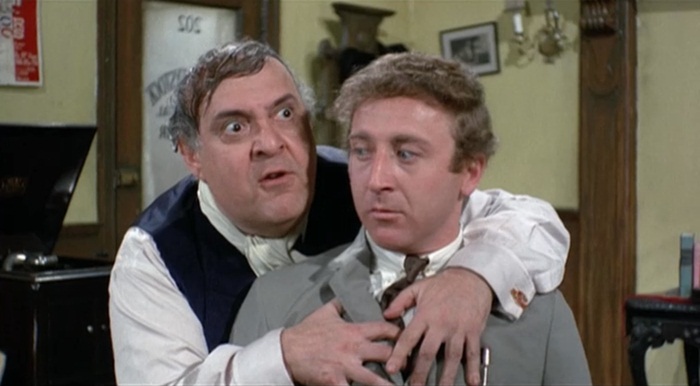
How Do You Solve a Problem Like Gene Wilder?

by bspencer

I was privileged to see a production of “Young Frankenstein” at the Kennedy Center a couple years back. It starred Roger Bart as Dr. Frankenstein, and it was good. It was really, really good. But the casting (of Dr. Frankenstein) was off. Bart’s performance was distractingly understated, and Dr. Frankenstein ain’t exactly an understated guy, ya know?

Cut to yesterday. I re-watched the (extraordinarily uneven) movie musical remake of “The Producers.” Matthew Broderick plays Leo Bloom. And it’s hard for me to put into words how much I hate this particular recast. I just found his performance…off-putting. There’s no other way to say it.

Roger Bart (who is normally great and was–interestingly–perfect as Carmen Ghia in the remake of “The Producers”), Matthew Broderick. What do these two–routinely good–performers have in common? They were trying to replace the inimitable Gene Wilder. And I’m just not certain that can be done. Not well, at least.

I found his performances in “The Producers” and “Young Frankenstein” (and “Blazing Saddles,” for that matter) unforgettable. Let’s face it: Gene Wilder is not just a comic actor, he is a comedy icon. And I think he may be genuinely irreplaceable.

Why is this remarkable? Because it’s rare. Most actors in most performances could be recast, often with wonderful results. A new actor can, if not improve upon a role, give it a reboot. I’ve seen it happen on soaps again and again. A role is recast with a new actress–sometimes a shockingly odd choice–and the new performer, either because of her acting chops or her chemistry with other performers or just sheer affability, makes you forget the role was ever played by anyone different.

And that’s not limited to soaps. Recasting “Cape Fear” must have been daunting task, but Robert DeNiro and Nick Nolte were dazzling in the remake.

So I’m wondering, what makes a role impossible to recast? An iconic role? An iconic actor? A combination of the two? Is it comedy that’s harder to put your own stamp on?

What roles do you think could never be recast?


01 Feb 11:49

This is a dude that messaged me twice today on OkCupid.  I...


This is a dude that messaged me twice today on OkCupid.  I blacked out his stuff because I’m not interested in having people harass him or anything, I’m just using him as an example because he’s not the first guy at all to just freak out at me when they read my profile.

Notice how when he finds out I’m trans, immediately he goes after my looks to say I’m unattractive to him (when I was apparently attractive enough that he messaged me without looking at my profile earlier and sent me boilerplate) because this is really about him freaking out about being attracted to a trans woman, so now I’m “too thin”.  (Also I said I had an eating disorder in the profile, so he’s probably going after that), and then deliberately misgendering me and going “or whatever” (& he couldn’t even spell that right.)

I didn’t approach him, I didn’t say anything to him, and I “disclosed” on my profile, and he still freaked out at me & tried to hurt me for it.  Simply reading my profile is offensive enough to these transphobic cis men.  It has nothing to do with when I disclosed, if I approach them, that I “tricked” them.  None of that matters.  Even WHEN I disclose.  Even when I put in my profile for my own comfort that I’m trans, I still get insulted and lashed out at, as if I’m doing something to them.  My point is, it’s ALL ABOUT THEM, it’s all in their heads, it’s THEIR insecurities, fears, hatred, ignorance, misogyny, etc at play here.  I didn’t do anything except exist near enough their world that they got threatened.

So yeah, I just wanted to use that as an example to show how cis men freaking out & lashing out at trans women has nothing to do with anything we did or didn’t do.  It’s them.  And if you want to prevent violence and other hatred against trans women, how about you talk to cis dudes about how they see us and treat us rather than about whether we “disclosed” or what we did to “provoke” them.  Our EXISTENCE is provocation to these assholes.  They’re the problem, not us.

01 Feb 11:49

immasharpcookie: agelfeygelach: Fatman on Batman 52: ‘Beware the Batman’...

immasharpcookie:

agelfeygelach:

Fatman on Batman 52: ‘Beware the Batman’ talk

obfuscobble:

draqua:

howtoraiseageek:

Want to listen to something that will piss you off?

First off, if you’re not a listener of Fatman on Batman you should be.

Now, download this episode.  (Released this week; it was recorded in early November.)

Take it up to the 21:00 mark to hear Kevin Smith to gush on Beware the Batman for almost twenty minutes.  If you want to skip that, it’s OK.  Start at 39:00 and listen to Paul Dini kill his dreams at 39:30.

Of course, you already know that Beware the Batman was pulled from the schedule, so why should this enrage you all over again?

You must listen to the following ten-ish minutes.

Dini describes the thinking of Cartoon Network execs … and it goes beyond the $imple $elling of toy$.  It almost sounds like misogyny.

Listen to it.

Seriously, check this out. Dini drops some pretty distressing info-bombs

This is… disturbing.  SO much misogyny.

Jeez and crackers, this is disturbing news. He brings up what happened to Tower Prep (the only decent live action show they ever ran), GLTAS, Young Justice. And then he says:

"But then, there’s been this weird—there’s been a, a sudden trend in animation, with super-heroes. Like, ‘it’s too old. It’s too old for our audience, and it has to be younger. It has to be funnier.' And that's when I watch the first couple of episodes of Teen Titans Go!, it's like those are the wacky moments in the Teen Titans cartoon, without any of the more serious moments. 'Let’s just do them all fighting over pizza, or running around crazy and everything, ’cause our audience—the audience we wanna go after, is not the Young Justice audience any more. We wanna go after little kids, who are into—boys who are into goofy humor, goofy random humor, like on Adventure Time or Regular Show. We wanna do that goofy, that sense of humor, that’s where we’re going for.’

Which, to me, shows that CN is missing the reasons why Adventure Time and Regular Show are so successful. Then, a bit later:

DINI: “They’re all for boys ’we do not want the girls’, I mean, I’ve heard executives say this, you know, not Ryan(?) but at other places, saying like, ‘We do not want girls watching this show.”

SMITH: “WHY? That’s 51% of the population.”

DINI: “They. Do. Not. Buy. Toys. The girls buy different toys. The girls may watch the show—”

SMITH: “So you can sell them T-shirts if they don’t—A: I disagree, I think girls buy toys as well, I mean not as many as f***ing boys do, but, B: sell them something else, man! Don’t be lazy and be like, ‘well I can’t sell a girl a toy.’ Sell ‘em a T-shirt, man, sell them f***ing umbrella with the f***ing character on it, something like that. But if it’s not a toy, there’s something else you could sell ‘em! Like, just because you can’t figure out your job, don’t kill chances of, like, something that’s gonna reach an audi—that’s just so self-defeating, when people go, like… these are the same fuckers who go, like, ‘Oh, girls don’t read comics, girls aren’t into comics.’ It’s all self-fulfilling prophecies. They just make it that way, by going like, ‘I can’t sell ‘em a toy, what’s the point?’

DINI: “That’s the thing, you know I hate being Mr. Sour Grapes here, but I’ll just lay it on the line: that’s the thing that got us cancelled on Tower Prep, honest-to-God was, like, ‘we need boys, but we need girls right there, right one step behind the boys’—this is the network talking—’one step behind the boys, not as smart as the boys, not as interesting as the boys, but right there.’ And then we began writing stories that got into the two girls’ back stories, and they were really interesting. And suddenly we had families and girls watching, and girls really became a big part of our audience, in sort of like they picked up that Harry Potter type of serialized way, which is what The Batman and [indistinct]’s really gonna kill. But, the Cartoon Network was saying, ‘F***, no, we want the boys’ action, it’s boys’ action, this goofy boy humor we’ve gotta get that in there. And we can’t—’ and I’d say, but look at the numbers, we’ve got parents watching, with the families, and then when you break it down—’Yeah, but the—so many—we’ve got too many girls. We need more boys.’”

SMITH: “That’s heart-breaking.”

DINI: “And then that’s why they cancelled us, and they put on a show called Level Up, which is, you know, goofy nerds fighting CG monsters. It’s like, ‘We don’t want the girls because the girls won’t buy toys.’ We had a whole… we had a whole, a merchandise line for Tower Prep that they s***canned before it ever got off the launching pad, because it’s like, ‘Boys, boys, boys. Boys buy the little spinny tops, they but the action figures, girls buy princesses, we’re not selling princesses.’

Ugh :(

this is fucking infuriating. If anyone tells me sexism isn’t blatantly in the industry i’ll smack em until they become less blind

What’s interesting is the reason we have Nancy Drew is the creator of Hardy Boys noticed how many girls were buying the books, and realized that girls liked mystery and that he could make a lot of money by creating a girl detective series written by women for them. (He was right.)

What he didn’t do was go “DAMMIT TOO MANY GIRLS ARE READING MY BOOKS!  OBVIOUSLY THAT MEANS SOMETHING IS WRONG WITH MY CREATION.  WE SHOULD CANCEL IT OR CHANGE IT TO BE MORE MANLY TO SCARE OFF THE GIRLS!” which is what these companies/executives/creators would have done.

This is why the “IT’S JUST WHAT SELLS” defense for sexism, racism, etc hurts my head.  No, it’s what YOU want to sell, and who YOU want to sell it to.  There are huge numbers of girls and women interested in genres that not only doesn’t cater to them but are actively hostile to us.  That’s potential money.  You don’t want it for your own sexist stereotypes and assumptions and fear of trying new things.

01 Feb 11:49

4 things feminists can learn from the Zapatistas

by Juliana

DSC_1166

Photos taken by Juliana Britto Schwartz

Tuesday of this week marked the 20th anniversary of the Zapatista uprising in San Cristobal de las Casas, Mexico, a short moment with a long legacy of struggle for indigenous rights. The Zapatistas–also known as the Zapatista Army of National Liberation or the EZLN–are a movement of indigenous people fighting against the effects of neoliberalism, particularly the privatization of land and other natural resources. 

Their movement first became public on January 1, 1994, the day that the North American Free Trade Act (NAFTA) went into effect. The EZLN understood that NAFTA would increase the inequity between rich and poor, and continue to direct the natural resources of Chiapas (their home state) out of the hands of Chiapanecos, and into those of the rich and powerful. So, it was that, twenty years ago, Zapatista activists seized towns within Chiapas, freeing prisoners and burning down police and military buildings. With these actions, the EZLN brought the world’s attention to the plight of indigenous populations around the world, and highlighted the life-and-death effects of globalization on the world’s marginalized.

In their continuing struggle for justice, the EZLN made a concerted effort to raise awareness about the status of indigenous women. In 1994, Comandante Ramona, one of the movement’s most famous women leaders, created the “Revolutionary Law on Women,” which was voted into practice by the EZLN. The law made it clear that women had the right to reproductive autonomy, political participation equal to that of men, equal pay, education, and freedom from domestic violence. Later that year, the movement presented a list of 34 demands to the Mexican government, one of which outlined a series of actions to be taken to ensure the welfare of women.

Unfortunately, since its first public action, the movement has been on the defensive, fighting increasing persecution by the Mexican government.  But the Zapatista struggle continues, ever as relevant, if not as strong. Here are a few things we can learn from this inspiring movement.

DSC_11621. There is another world.

The Zapatistas took a look at the society they lived in, decided it wasn’t working for them, and started a new way of living. They currently maintain various autonomous communities, under their own systems of governance and their own independent schools. According to Gustavo Esteva at Upside Down World,

“They are, in fact, living outside the logic of the market and the state, beyond the logic of capital, and within a new social fabric. This does not imply, of course, that they have escaped the capitalist social fabric that defines Mexico and the world, the unravelling of which, as the Zapatista Sixth Declaration of the Selva Lacandona states, requires weaving another social and political fabric.”

What does this mean for feminism? That if we can imagine a world where patriarchy, homophobia, transphobia, racism, classism and the like are gone, then it can exist. We’ll get there.

2. You don’t have to be powerful, privileged or popular to change the world. In fact, real change often happens from the bottom up. 

The Zapatista movement sprang from some of the world’s most marginalized people: indigenous people living in Mexico’s poorest state. These people had extremely limited access to formal education, health services and land ownership, yet their actions had a lasting impact on our world. Esteva notes their impact within his article,

“All over the world, we can observe gestures, changes, and mobilizations that seem to be inspired by the Zapatistas. To find a political initiative with comparable global repercussions, one has to travel far back in history. As the Zapatistas themselves have already noted, what today looks like Zapatismo, walks like Zapatismo, speaks like Zapatismo, and appears as a form of Zapatismo, is no longer in the hands of the Zapatistas.”

IMG_41123. We must challenge systems of oppression even within our own social justice movements.

As mentioned earlier, the EZLN is a feminist-leaning movement that has demonstrated that it is self-aware when it comes to the welfare of women. The movement has made several steps towards ensuring gender equity among its people. If you walk through Oventik, one of their autonomous communities in Chiapas, you will see many murals of women working alongside men. Of course, the EZLN is very far from perfect and gender equity is always a work in progress. Within any movement, we need to keep pushing each other forward, while acknowledging successes on the road to justice.

4. The road to justice is long

The Zapatistas originally formed in response to the creation of NAFTA. They have now been around for over 20 years, and NAFTA is operating as strong as ever. Indigenous activists have suffered greatly for this cause, and will continue to suffer. But that does not mean that the struggle has not been worth it. The same is true for other movements for justice, in which we have to celebrate small victories on the road to success. But twenty years of indigenous resistance is certainly a big victory, and it must be celebrated.

“In the committee we debated all afternoon. We searched for the word in the tongue to say SURRENDER, and we did not find it. It has no translation in Tzotzil and Tzeltal. Nobody remembers that the word exists in Tojolabal or Chol.” –Surrender does not exist in true language, Subcomandante Marcos [1]

Related:

Latinas Feministas: Lorena Cabnal

96ee0a3b286e0ab66e722794b16d9276_biggerJuliana is amazed.

01 Feb 11:49

“Dear the Doctor, if you can read this tweet…”

by SEK

I may have enjoyed writing this piece too much, for obvious reasons. But it also works as a nice excuse to rejoin the LG&M community. I mean, if you don’t love me for Who-related scientific blather, why would you love me at all?

I could tell you long boring stories about why I haven’t been around as much as I ought to be, but it’s really because I’m The Office Jew and it was Christmas, so I picked up ALL THE SHIFTS.

More from me soon, as soon as I finish recuperating from drunken revelry with Brockington in the Big Easy.


01 Feb 11:48

Photo


01 Feb 11:48

jhenne-bean: hotspicyreginald: thebiblemachine: dendropsyche: ...


jhenne-bean:

hotspicyreginald:

thebiblemachine:

dendropsyche:

fsparverius:

i mean how dare a show for little girls let them identify with it in the sea of male-targeted movies out there that have males in all the roles you just complained about females being in

laughs because girls are not allowed to have anything to themselves ever lmaooooo

An important analysis of bronies and male entitlement. 

i am luaghign so hrad at this entire blog

Is this reAL om Fg

Oh, this is a thing?  They want this to be a thing?  Shall we do this for every single other work of fiction and which gender gets presented as being in charge & the heroes, and stuff?  Cuz, we can do that.

01 Feb 11:48

by kinkinexile

Hello world.

So a lot of things have happened.  I moved cross country for example.  And I lost someone I knew.  And it was the anniversary of Aaron Swartzdeath yesterday.

I wrote a ton about suicide, but I put it all in a notebook I can’t find because I moved cross country.  The piece I remember best is this idea of concentric circles of grief.  I did not get to mourn, in a direct sorta way, for Conor.  I got to hold his daughter and wash dishes for the person who was not washing dishes because she was talking to his widow.  And because I was washing dishes for the person who was talking to his widow my friends finished my packing for me, and so it went in ever expanding circles of impact.  I held the people I love.  The person I was most worried for called me and we sat on the phone silent, him in Philadelphia and me in Maui, unsure if the other knew, not wanting to be the first to say.

Someone wrote a behind the scenes piece about how depression is a disease and most of us aren’t doctors, which I read, and reread, and watched my friends read.  We shared lists of mental health resources with the people who were left who probably weren’t the people who needed them.  I tried, and probably failed, to not ask personal questions – tried to give Conor and his family the privacy and dignity they deserve.  I thanked the person who came over when I was at my lowest, and reflected on how very lucky I was to pull out from depression.  I had a fight with an ex about the nature of suicide and how I relate to it.  I had a fight with an ex who thought I was wishing it away, when I was, sadly, preparing for it to happen again.

I moved my stuff, and carried boxes, and rebuilt furniture, and missed – and still miss – my tribe.

01 Feb 11:48

Sissy Boy Syndrome?

by Robert Farley

Read this and be legitimately appalled, but also note that the writers and contributors almost certainly viewed it as a progressive contribution:

In many cases parents either overtly or subtly encouraged the feminine behavior. But when parents actively discouraged it and took other steps to enhance a male self-concept, homosexual tendencies of the feminine boys were lessened, although not necessarily reversed. Neither did professional counseling divert a tendency toward homosexuality, although it resulted in more conventional masculine behavior and enhanced the boys’ social and pyschological adjustment and comfort with being male.

The study was conducted by Dr. Richard Green, a noted sex researcher who is professor of psychiatry at the University of California, Los Angeles and director of its Program in Psychiatry, Law and Human Sexuality. Details of the findings and implications are described in Dr. Green’s new book, ”The ‘Sissy Boy Syndrome’ and the Development of Homosexuality,” to be published in February by Yale University Press.

Although the study examined extreme cases of boyhood effeminacy, Dr. Green believes the findings may have relevance to lesser degrees of feminine behavior in boys. Such boys, who may, for example, be athletically inept or prefer music to cars and trucks, often have difficulty making friends with other boys and identifying with typically male activities. Dr. Green suggested that to help the boys think of themselves as male, parents might assist them in finding boy friends who are similarly unaggressive and that the fathers might share in activities the boys enjoy, such as going to the zoo or a concert, rather than insist on taking the boys to athletic events. Counseling to guide such parents and enhance the child’s masculine self-image may also be helpful, Dr. Green said.

The study did not examine the development of homosexuality in boys whose childhoods are typically masculine. About one-third of homosexual men recall such masculine boyhoods. Nor does the study suggest that all boys with the sissy-boy syndrome are destined for homosexuality. Indeed, one-fourth of the extremely feminine boys followed to maturity developed as heterosexuals.

The “athletically inept or prefer music to cars and trucks” line inevitably reminded me of this:


01 Feb 11:48

It’s All In The Moment

by astraltravler

1388621477266843_animate

Lap up my Potion.

As it spills before your eyes.

Do not miss a drop

Lick it up quickly before it drys.

*

What you don’t know,

is a Spell was Cast.

It is I that will Seduce you

as you Dream.

*

As you feel me Touch your Flesh

can you feel me Touch your Soul?

You will know I am upon you,

as you feel the Wind of my Spirit blow through your Soul

Breathlessly cumming upon you like a night fog on a marsh.

*

I’ll match my Breathing to Yours,

as I lay there Inside You.

I’ll become One with You,

until you won’t even notice I’m there.

I’m the Stealthy Intruder of your Wildest Fantasies.

Ring Meistress of our cirque du sex.


01 Feb 11:48

The Forest for the Trees

by Maggie McNeill

One of the hallmarks of a panic is that you don’t realize it’s a panic when you’re in the middle of it.  -  Debbie Nathan

Dan and Fran KellerTwenty years after the end of the Satanic Panic, its last few victims are finally being released from prison and in some cases even declared innocent, an extraordinary measure because it requires an organ of the State declaring that its predecessor was not only wrong, but committed a grave injustice.  In just the past few months we’ve seen the release of the San Antonio Four and Fran and Dan Keller; only one more victim of a strictly-Satanic case remains in prison, Frank Fuster in Florida.  There were, however, other hysteria-tinged cases near the end of the panic whose prosecutors avoided “Satanic” language because they saw the writing on the wall, and some of those victims (like Joseph Allen of Ohio) are still slowly dying in cages.  From the safe distance of a generation, reporters – some of whom are young enough to have been peers of the children forced by cops, prosecutors, and other fanatics to make horrible accusations – are now writing stories confidently declaring that the ritual abuse never happened and branding the hysteria a “witch hunt”.  But while I obviously agree with them, I find it both sad and telling that not a one of these reporters so smugly declaring their predecessors gullible have dared to denounce their generation’s revival of the panic, “sex trafficking” hysteria.  Last week, Slate published a column on the Kellers (and the panic in general) entitled “The Real Victims of Satanic Ritual Abuse”, and I’d like to share an excerpt with you.  I don’t think you’ll need much imagination to see how this applies equally well to the current popular hysteria, but to help you I’ve replaced words like “Satanists” with more general terms like “conspirators” [in brackets]:

…Why did psychotherapists and investigators conclude that these fantastic allegations were true?  Because at the time, pretty much everyone else in America did…hundreds of children, usually after lengthy sessions with coercive therapists, came forward to say that they…had been [subjected to bizarre mistreatment such as being transported]…to random cities for sexual abuse, or countless other bizarre stories…Media poured attention on the claims…As televangelists prayed for deliverance from Satan’s scourge, talk show “experts” claimed that every imaginable form of abuse was happening on a massive scale in America and that [conspirators were hiding everywhere…media figures] claimed…that more than a million [villains] were plying their evil trade in America right at the very moment…[books about the panic] appeared in libraries and therapists’ offices…“It sounds laughable,” says Debbie Nathan, an investigative reporter who co-wrote Satan’s Silence: Ritual Abuse and the Making of a Modern American Witch Hunt about the panic and is now a director for the National Center for Reason and Justice… “Children symbolize the good things about culture, the innocence and purity, the future of the culture,” says Nathan.  When a culture feels under threat in some way, fear and anxiety focus on the safety of children…The fear…was perpetuated by both ends of the political spectrum…Most if not all of those involved believed they were acting in the best interests of the children—which meant that any healthy skepticism was interpreted as anti-child.  But extensive investigations revealed little to no truth to the…panic…Michelle RemembersEven so, people still believed…[“experts”]…testified that [organized sexual victimizers] are real, that they are widespread…Common sense and level-headed investigation would have found [these] claims incredible if…panic hadn’t lent a “distorted lens of hysteria” to the picture…

I look forward to reading articles like this about “sex trafficking” hysteria in the late 2030s (there’s a fair chance I’ll still be around; I’d be in my early 70s), but it’s a safe bet that the reporters mocking or marveling at it will be just as oblivious to the absurdity of whatever moral panic is going on then as today’s reporters are to the absurdity of “sex trafficking”.


01 Feb 11:48

Everything Is Like Slavery, Except Slavery

by Scott Lemieux

How’s that Republican outreach to racial minorities going these days?

North Carolina Republican Senate candidate Greg Brannon has an interesting argument for eliminating food stamps: “slavery.” In a videotaped interview with the North Carolina Tea Party in October, Brannon, a Rand Paul-endorsed doctor who is top contender for the GOP nomination to take on Democratic Sen. Kay Hagan, cited James Madison in making the case for abolishing the Department of Agriculture—and with it, the $76 billion-a-year Supplemental Nutrition Assistance Program, also known as food stamps. Brannon has a real chance of winning: A December poll from Public Policy Polling found the GOP primary field split but showed him leading Hagan, 45-43.

“We’re taking our plunder, that’s taken from us as individuals, [giving] it to the government, and the government is now keeping itself in power by giving these goodies away,” Brannon said in the interview. “The answer is the Department of Agriculture should go away at the federal level. And now 80 percent of the Farm Bill was food stamps. That enslaves people. What you want to do, it’s crazy but it’s true, teach people to fish instead of giving them fish. When you’re at the behest of somebody else, you are actually a slavery to them [sic]. That kind of charity does not make people freer.”

Also, Medicaid is like the Gulag, and unemployment benefits are like concentration camps. Subsidies to tobacco farmers are like the Emancipation Proclamation. Surely, we can all come together to agree on these points.

And now, to Serwer with the punchline:

I take it back. Everything is like slavery except for slavery, which wasn't that bad and definitely didn't cause the civil war.

— AdamSerwer (@AdamSerwer) January 14, 2014


01 Feb 11:47

everythingbutharleyquinn: “26% were sexually assaulted at shelters” — 34% of trans women who had...

everythingbutharleyquinn:

“26% were sexually assaulted at shelters”

34% of trans women who had attempted to access shelters were denied entry outright. Of the respondents who did manage to access a shelter, 25% were evicted after it became known that they were trans. 55% were harassed by shelter staff or residents, and 29% of trans women were physically assaulted. 26% were sexually assaulted at shelters. Overall, 47% were treated so poorly that they chose to leave the shelter.

If you wear jeans, you’re not a woman: Transphobia at women’s shelters » Zinnia Jones

(via commanderabutt)

And yet, we’re the ones everybody is afraid will assault people at shelters.  As I keep pointing out when I do trans-inclusive staff training for agencies (in my secret identity), there are no statistics that show allowing trans women into women’s shelters increases the risk to cis women of assault or harassment, however there is evidence that it puts the trans women at risk.  We construct a lot of our fears.  Statistically, driving is way more dangerous than flying, it’s one of the most dangerous things we do every day, and yet most people are much more afraid of planes because they seem scarier.    This is much the same way.  Cis people think trans people are more dangerous, but we’re not, in fact we’re the ones in danger from them.

01 Feb 11:47

Biomass is a Terrible Idea as a Major Energy Source

by Erik Loomis

You might think corn-based ethanol is the worst possible “green energy” alternative. And I’d like to think you are right. After all, turning the entire Midwest into a giant corn monoculture and destroying the remnants of a once fertile ecosystem in order to force an inefficient and dirty way to create ethanol on a nation all because of an already powerful industry with a huge lobbying arm is a pretty bloody awful idea.

But then there’s biomass. And sure, efficient use of plant resources makes sense. After all, the timber industry realized by the 1940s that rather than wasting all that sawdust and stumpage, turning it into wood alcohol or other products was a smart economic strategy that ultimately meant needing to cut less trees for the same amount of product. But biomass as a core alternative energy source? Only if you like massive deforestation.

In 2007, the European Union set an ambitious goal to reduce emissions of greenhouse gases to 20 percent below their 1990 levels by 2020. That, in effect, required power plants across the continent to quickly find new ways to make energy. Some turned to wind and solar. But for coal-fired power plants it was much cheaper to convert their facilities to burn wood. The conundrum for those companies is that much of western Europe doesn’t have sufficiently large forests left to meet the demand, and the remaining woodland is heavily regulated. So corporations turned to the Southeastern U.S., where wood is plentiful, and regulations about what can be done on private land are lax.

Wood pellet manufacturing in the U.S. is now booming.

Drax, Britain’s largest coal plant, is in the process of converting most of its operations to biomass fuel, and other power plants across the continent are following suit.

In 2008 Europe imported about 2.5 million tons of wood pellets. By 2012 it imported 9 million. And by 2020 it’s projected to import upwards of 20 million tons, largely from the United States and Canada, according to John Bingham of Hawkins Wright, a British forest products consultancy.

….

Quaranda said his group has documented several cases of forests clear-cut for biomass fuel. A Wall Street Journal report also found clear-cutting in North Carolina.

Seth Ginther, a lawyer with the U.S. Industrial Pellet Association, insists the pellet industry is not responsible for environmental damage. But he acknowledged that private landowners are free to do what they wish, including cut down whole trees on their land.

And in the South, where nearly 90 percent of land is privately owned, there is no law on the books requiring landowners to grow those trees back.

Dozens of biomass facilities have been built in the South. There are currently two in Louisiana, with eight more planned, according to Quaranda.

With a permit to build roads for logging in a protected area of the Atchafalaya pending approval from the Army Corps of Engineers, Dean Wilson worries he’s just seen the beginning of a decades-long battle to protect the woods he’s been looking after since the 1980s.

Now Wilson is trying to employ the same tactic he used when he found out retailers were selling cypress mulch taken from the Atchafalaya.

Biomass as a major industry basically means the elimination of the United States’ private forests. It would provide a lot of short term profit for companies and land-owners and unbelievably enormous long-term problems, including the destruction of ecosystems, huge losses of carbon-using greenery, erosion, degraded water quality, and widespread deforestation. And if anyone believes the idea that trees are a crop and thus will be replanted for future use, especially on private land, please contact me about the oceanfront property I have to offer you in western Nebraska. The regulatory regime on reforestation, especially in the South is basically zero.

Industrialized biomass is a terrible idea and while we need a multifaceted energy production future and while all energy production has a cost, this cost is completely unacceptable.


01 Feb 11:47

Location, Location, Location

by astraltravler

My Dear Readers,

I’m in the process of moving.

If the stress of moving isn’t enough, I have been battling whatever

viral bug that’s been going around.

Please know All Your Comments, and Blogs Are Important to Me.

It’s going to take me a little time to follow-up with replies, and reading your postings.

You Are All In My Thoughts.

Sincerely,

Anastasia


01 Feb 11:47

Just How Dumb is the “ACA Was A Health Insurance Industry Bailout” Argument?

by Scott Lemieux

It’s so dumb that wingnuts have embraced it.

Now, I’ll grant that the left version of this argument is just as silly and made by people who should know better. The health insurance industry didn’t need a “bailout” under the status quo ante — the fact that individual insurance market was basically a con and the ability to refuse coverage to the least profitable classes of customers worked just fine to ensure ongoing profitability, thanks. The risk corridors in the ACA that might provide subsidies to insurers with unfavorable risk pools are necessary because of the crucial consumer rights — guaranteed issue and the ban on rescission — provided for by the ACA. To call risk corridors a “bailout” comparable to giving cash to corporations so they don’t face the consequences of their own mistakes is still deeply asinine.


01 Feb 11:47

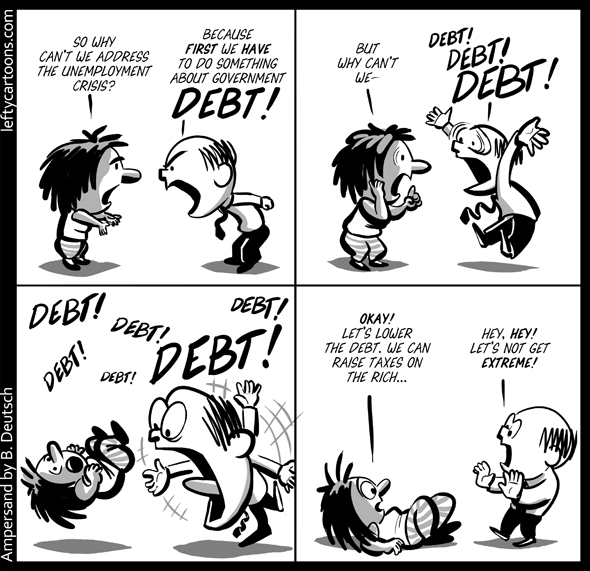
Cartoon: DEBT!

by Ampersand

[expand title="Transcript of cartoon"]This cartoon has four panels. Each of the panels depicts two characters, a woman in casual clothing (striped pants, sleeveless shirt) and a balding man wearing a collared shirt and necktie.

Panel 1
WOMAN: So why can’t we address the unemployment crisis?
MAN: Because FIRST we HAVE to do something about government DEBT!

Panel 2
WOMAN: But why cant we–
MAN (Jumping up and down): DEBT! DEBT! DEBT!

Panel 3
The man’s head has grown to three times ordinary size, as he yells, waving his arms in the air, his tongue sticking out of his mouth. The woman is bowled over by his intensity.
MAN: DEBT! DEBT! DEBT! DEBT! DEBT! DEBT!

Panel 4
WOMAN: OKAY! Let’s lower the debt. We can raise taxes on the rich…
MAN: Hey, HEY! Let’s not get EXTREME![/expand]


01 Feb 11:47

Outsourcing Bobo

by Scott Lemieux

David Brooks presents us with an instant classic of the “let us have the comity and civility to all come together and concede that conservatives are right about everything” genre. The subject is inequality, and it actually induces this sentence:

There is a growing consensus that government should be doing more to help increase social mobility for the less affluent. Even conservative Republicans are signing on to this.

Hahahahahahaha, oh, you’re killing me. Conveniently, Brooks’s column makes abundantly clear that such as a consensus doesn’t remotely exist, and while some Republicans are willing to say that the same anti-mobility policies they’ve always favored will somehow help the poor, what they actually want to do to advance mobility is “nothing.”

Anyway, at least this has produced some inspired commentary. All of these are worth reading in full, but some teasers. Baker:

It’s not clear what social fabric Brooks thinks is fraying. The percentage of children in single-parent families has actually largely stabilized in the last three decades. The percentage of teen mothers is way down as is the crime rate. The high school graduation rate is way up. These changes have not been reflected in improved conditions for those at the bottom as minimum wage workers are more educated and experienced than ever.

As much we might want to take David Brooks’ plea for considering complex cultural, social, and behavioral problems, de-industrialiation looks pretty much like a good old-fashioned economic problem. An over-valued dollar makes our goods uncompetitive internationally. If the currency is over-valued by 20 percent it is roughly equivalent to having a 20 percent tariff on all U.S. exports and a 20 percent subsidy on imports. In addition, if we have trade agreements that expose manufacturing workers to competition with low-paid workers in the developing world, while largely protecting highly paid professionals like doctors and lawyers, then we will have a serious problem of deindustrialization. That’s pretty much economics 101, it’s hard to see why any bigger explanation is needed on this one.

Bruenig:

The David Brooks Problem is that he writes opinion columns for the New York Times, but has no idea what he is talking about. The proximate causes are that 1) he doesn’t know how to do research, 2) he has no motivation to try because he lives an extravagant and distracted life in his $4 million home. In some ways, responding to him is a largely futile affair that misses the point, but sometimes I am called to do so, and so I will.


Scocca:

Since Brooks has taken a passing interest in the question of smarm, let’s note that arguing that reasonable bipartisan legislation should start with one party’s agenda topmost is definitive political smarm.


01 Feb 11:47

newwavefeminism: “What I want to talk about is how emotional outbursts typically more associated...

newwavefeminism:

“What I want to talk about is how emotional outbursts typically more associated with men (shouting, expressing anger openly) are given a pass in public discourse in a way that emotional outbursts typically more associated with women (crying, “getting upset”) are stigmatized. I wish to dispel the notion that women are “more emotional.” I don’t think we are. I think that the emotions women stereotypically express are what men call “emotions,” and the emotions that men typically express are somehow considered by men to be something else. This is incorrect. Anger? EMOTION. Hate? EMOTION. Resorting to violence? EMOTIONAL OUTBURST. An irrational need to be correct when all the evidence is against you? Pretty sure that’s an emotion. Resorting to shouting really loudly when you don’t like the other person’s point of view? That’s called “being too emotional to engage in a rational discussion.” Not only do I think men are at least as emotional as women, I think that these stereotypically male emotions are more damaging to rational dialogue than are stereotypically female emotions. A hurt, crying person can still listen, think, and speak. A shouting, angry person? That person is crapping all over meaningful discourse.”

Bullish Life: When Men Get Too Emotional To Have A Rational Argument (via introvertedactivist) (via vomohiper)

It’s really worth reading the whole article.

(via butwewereokay)

Not only are male outbursts given a pass, they are often placed at the fault of others.

If a white heterosexual male is angry in public, any “other” human will be automatically defaulted as the instigator in the eyes of everyone else. They will be more likely to be coded as undeserving or unworthy.

The safety of being an angry white man.

Also male anger is seen as justified.  If women are angry, we’re hysterical, or over-reacting, or our concerns are dismissed until we can calm down.  If men are angry, then BY GOD there must be something to get angry about!

I remember in the wake of the Penn State sexual assault scandal when I made the case  that Penn State needed their entire football program suspended (the “death penalty” in the NCAA) with the argument that people do not report because they’re worried about hurting the football program, so therefore the consequences of not reporting have to be the total removal of that program.  That way you’re actually saving the program by reporting, and endangering it by not.

I made this argument, and a guy I knew told me that I’m wrong because I’m being emotional and I just want vengeance and I’m not thinking rationally.  And I kept stating that in fact I’m being super cynical by trying to prevent future cover-ups by threatening the only thing these people seem to care about: their football program.  And he kept dismissing me over and over as being emotional and acting purely based on anger and wanting to lash out.

My male friend showed up and repeated the EXACT SAME ARGUMENT I made, with the same passion I had (which for me was construed as irrational anger).  And the dude agreed and said that made much more sense, and thanked him for giving an actual rational reason why this should be done rather than act on emotion like me.

As a good friend of mine often says: male privilege, it’s a hell of a drug.

01 Feb 11:47

"First, I must confess that over the past few years I have been gravely disappointed with the white..."

“First, I must confess that over the past few years I have been gravely disappointed with the white moderate. I have almost reached the regrettable conclusion that the Negro’s great stumbling block in his stride toward freedom is not the White Citizen’s Counciler or the Ku Klux Klanner, but the white moderate, who is more devoted to “order” than to justice; who prefers a negative peace which is the absence of tension to a positive peace which is the presence of justice; who constantly says: “I agree with you in the goal you seek, but I cannot agree with your methods of direct action”; who paternalistically believes he can set the timetable for another man’s freedom; who lives by a mythical concept of time and who constantly advises the Negro to wait for a “more convenient season.” Shallow understanding from people of good will is more frustrating than absolute misunderstanding from people of ill will. Lukewarm acceptance is much more bewildering than outright rejection.”

-

Martin Luther King, Jr. in Letter from a Birmingham Jail (via ethiopienne)

01 Feb 11:47

"When you are an affluent-seeming white man and you ask for things that don’t belong to you,..."

“When you are an affluent-seeming white man and you ask for things that don’t belong to you, sometimes you’re not really asking. It’s sort like Bill Clinton asking Monica Lewinsky to have sex with him. There’s a context behind the asking.

When you ask a serviceperson for something that doesn’t belong to you, there is often a subtext of, “If I complain to your manager, you know your manager is going to listen to me. Just look at me, and look at you.”

And sometimes, of course, this is not the case at all, and you’re just being a garden-variety annoying customer. Or a bully.

If you seem to be “getting everything you want,” you should probably examine whether you’re getting it at someone’s expense, or whether you’re just constantly, in small ways, making the world worse.”

- Jen Dziura, When “Life Hacking” Is Really White Privilege (via shitrichcollegekidssay)
01 Feb 11:47

"Fan fiction is a way of the culture repairing the damage done in a system where contemporary myths..."

“Fan fiction is a way of the culture repairing the damage done in a system where contemporary myths are owned by corporations instead of owned by the folk.”

- Henry Jenkins, in Textual Poachers: Media Fans and Participatory Culture (via quotatiousquotations)