Shared posts

26 Mar 19:59

Jurist Prudence

by Zandar
If there was a moment in yesterday's Supreme Court oral arguments in the Hobby Lobby case where things got weird, convoluted, and political, it was when Justice Elena Kagan quoted Justice Antonin Scalia's own arguments from 1990 on why your boss's religious views should not affect employees:

During oral arguments Tuesday about the validity of Obamacare's birth control mandate, Justice Elena Kagan cleverly echoed Justice Antonin Scalia's past warning that religious-based exceptions to neutral laws could lead to "anarchy."

"Your understanding of this law, your interpretation of it, would essentially subject the entire U.S. Code to the highest test in constitutional law, to a compelling interest standard," she told Paul Clement, the lawyer arguing against the mandate for Hobby Lobby and Conestoga Wood. "So another employer comes in and that employer says, I have a religious objection to sex discrimination laws; and then another employer comes in, I have a religious objection to minimum wage laws; and then another, family leave; and then another, child labor laws. And all of that is subject to the exact same test which you say is this unbelievably high test, the compelling interest standard with the least restrictive alternative."

Kagan's remarks might sound familiar to the legally-trained ear. In a 1990 majority opinion in Employment Division v. Smith, Scalia alluded to the same examples of what might happen if religious entities are permitted to claim exemptions from generally applicable laws. He warned that "[a]ny society adopting such a system would be courting anarchy."

Of course, that was 24 years ago when the President was a Republican, so this time around those religious exceptions to a law a Democratic president signed into law are necessary, in Scalia's eyes.   But in 1990, he wisely wrote of "slippery slope" arguments.

"The rule respondents favor would open the prospect of constitutionally required religious exemptions from civic obligations of almost every conceivable kind," Scalia wrote in the 6-3 opinion, "ranging from compulsory military service, to the payment of taxes, to health and safety regulation such as manslaughter and child neglect laws, compulsory vaccination laws, drug laws, and traffic laws; to social welfare legislation such as minimum wage laws, child labor laws, animal cruelty laws, environmental protection laws, and laws providing for equality of opportunity for the races."

In other words, if Hobby Lobby is allowed to except itself from Obamacare's mandate, what can't it except itself from?  That's the golden ticket..
26 Mar 05:43

Thanks for Noticing

by Maggie McNeill

The cost of noticing is to become responsible.  -  Thylias Moss

cop about to rape sex workerLast Thursday, everybody suddenly noticed that cops think it’s all right for them to rape sex workers before arresting us.  Of course, nobody used that word; all the stories said “have sex”, as though the interaction were consensual…despite being accomplished via deception for the express purpose of harming the victim (which qualifies as rape in my book, and no I don’t want to debate it).  The immediate cause of this sudden revelation was that Hawaiian cops took the unusually-blatant step of asking politicians to explicitly grant them the right in state law, rather than leaving it implicit or officially tolerated as in the other 49 states:

Honolulu police officers have urged lawmakers to keep an exemption in state law that allows undercover officers to have sex with prostitutes during investigations…Authorities say they need the legal protection to catch lawbreakers in the act…they made assurances that internal policies and procedures are in place to prevent officers from taking advantage of it…

I’ll give you a moment to recover from choking after reading that last line.

…A…bill cracking down on prostitution…was originally written to scrap the sex exemption for officers on duty.  It was amended to restore that protection after police testimony…advocates were shocked that Hawaii exempts police from its prostitution laws, suggesting it’s an invitation for misconduct…

The fact that Melissa Farley is described as an “advocate” will give you ample description of the rest of the article.  But as I’m fond of saying, even a stopped clock is right twice a day; the  Farley quote, “Police abuse is part of the life of prostitution,” is missing only two words to make it true: “under criminalization”.  Since that’s as close to the truth as Farley ever gets on this subject, we’ll let it count as “right”; it’s far truer than the ideas of most of those commenting on the story, who seem to be laboring under the delusion that this is somehow unusual.  Let me make it clear for y’all:  This is standard operating procedure everywhere in the United States, and the only thing unusual about Hawaii is that it’s spelled out in law.  Just in case you’re a new reader or have a short memory, here are three examples from just last year:  Indiana, Florida and Pennsylvania are all especially shameless in their defense of government-authorized rape, excusing it by claiming that sex workers are “sophisticated” (while simultaneously being pathetic, infantile victims).  As long as prostitution is criminalized this will keep happening every day all over the country; one of the reasons New South Wales decriminalized was to put a stop to such behavior.

Sex worker activists have labored for forty years to get the public to notice this kind of revolting thuggery, and for the past few years it’s happened with increasing frequency.  But I think it has less to do with our efforts than with “sex trafficking” hysteria; ironically, the crusade to pretend a normal, everyday activity is part of an international criminal conspiracy has resulted in the media paying much more attention to what was once widely viewed as a ho-hum non-story fit only for inclusion on a slow news day.  And when reporters shine light upon police interaction with sex workers hoping to find stories of brave heroescop caught beating woman rescuing crying (and half-dressed) underage “sex slaves”, what they often find instead is cops arresting women for carrying condoms, wearing attractive clothes or walking down the street; sometimes they even find them committing rape without the excuse of a “sting operation”.  So thank you, “trafficking” fetishists, for your unwitting help in exposing cops’ vile behavior.  And thank you, media, for at last beginning to notice; I’m sure you’ll forgive me if I ask what took you so long.


25 Mar 09:34

Enjoying My Hobby in Your Lobby

by Vixen Strangely

It’s some kind of crying shame that I haven’t addressed the Hobby Lobby case when I am supposed to be a pro-reproductive rights feminist over here. I don’t know where my head is at. But when I was buying yarn to crochet a cozy for a diapraghm case, I had a kind of epiphany that really only comes when you’ve been sniffing the Modge-Podge for a while—

Look. I think we can agree that an employment contract is not a one-way street. It never was meant to be. So, if Hobby Lobby believes it is totally in the right to make decisions regarding the reproductive health and maintenance of it’s employees, in other words, making those employees’ private business their store business, then it’s only fair that the employees should be able to bring their private business right into the public business.

That’s right, Hobby Lobby. If you all think you have a right to dictate the methods your employees use for their bedroom or kitchen floor or whatever activities, those employees should feel comfortable enjoying those activities in your store. I don’t mean on the clock. Off-the clock, of course, since your company has decided to also be the boss of all off-the-clock funtimes. But let’s get this clear—you wanna make the rules?

You should get to make the rules about stuff happening on the premises of your store. Sexy funtimes don’t happen in your store. Until you made it about you. Now I think employees should get to use the break room, or even the return desk, to do what they like—because you guys decided their business was your business. So why shouldn’t your business be where they can do their business?

Of course—no one would probably want to actually screw in your store. Not because pony beads and potholder looms aren’t fucking erotic as hell, but because that is not what your store is for. Your store is for serving your customers, who for the most part don’t give a good goddamn what your employees do so long as they don’t screw up an order and give them exact change.  Why don’t you try and be at least as tolerant as your customers? And recognize that your employees are human beings with bodies, and that the female bodies deserve to be treated by the people who have to live in them—and that isn’t you, Hobby Lobby execs.

(X-Posted at Strangely Blogged.)

25 Mar 08:20

thisisnotjapan: sclez: excess-0: queen-of-the-galaxy: He is...


thisisnotjapan:

sclez:

excess-0:

queen-of-the-galaxy:

He is literally the opposite of a weeaboo.

This is what I have been waiting for.

This man is the future.

He is trolling though I mean come on

Yes, but it is amazing trolling.  I can’t give him enough thumbs ups. xD

25 Mar 08:17

The Myth of Porn’s Perfect Bodies

by Marty Klein, Ph.D.

Among the complaints I repeatedly hear about porn is that it features perfect female bodies, which supposedly makes male consumers lose interest in normal, imperfect bodies. Normal imperfect bodies, of course, are what most men are limited to in real life.

People who watch a lot of porn don’t say this. Only those unfamiliar with actual porn say it, because it simply isn’t true.

Sure, many porn consumers seek out and enjoy conventionally perfect bodies—young, blemish- and wrinkle-free, incredibly round where they’re round, as smooth and firm as polished teak where they’re smooth and firm.

But an enormous percentage of internet porn features adult bodies different from that altogether. If you don’t watch porn you wouldn’t know this. But if you watch adult porn, you know what’s out there, including:

~ Amateur porn: Porn posted by non-professionals, usually made in their homes or hotel rooms. These men and women look like you and me—unless, of course, you look like Brad Pitt or Scarlett Johansson.

Amateur porn not only features the non-gorgeous, it sometimes features the downright average-looking. And that’s what consumers of amateur porn want—regular people looking regular, doing really hot things. It’s the genuine enthusiasm that the consumer loves, combined with the idea that the film could have been made by neighbors just down the street. Now if only we could get those neighbors to vacuum the living room before making their next video.

~ Non-silicone, often non-perky: Critics who claim that every porn actress is puffed up with silicone are full of, um, hot air. While the eerily perfect silicone look has lots of fans, so does the natural look.

And so many of the top models feature exactly what they developed on their own, glorious imperfections and all. And some have less than they were born with—whether they’re called hangers, droopers, suckers, or saggers, there’s an audience for breasts that are definitely not youthfully perky. What a great country—whatever breast type you like (even flat-chested), there’s porn made exactly for you.

~ Fetish: While many porn sites feature videos for the mainstream, others cater to niche markets. Fetish sites aren’t for everyone, but one by one they feature everything you can imagine, and plenty you don’t: women on their periods, women who don’t shave their legs, women with giant clitorises, women with bald heads, women amputees, women who are lactating, women wearing diapers, women a little overweight, a lot overweight, and so overweight they have trouble navigating a doorway.

No Emma Watson look-alikes need apply here.

Why do some consumers like to wank to pictures of pregnant women or women finger-painting with their menstrual blood? People who enjoy it answer exactly the same as everyone else describing their favorite visual arousal: “I dunno, it just works for me.” That’s the same answer you give when asked why you prefer the flavor of ice cream that you do, right?

~ Old: There’s mommy porn, granny porn, grandpa porn, in-law porn, mature porn. That’s a lot of gray hair.

Some crusaders say that watching videos of old people being sexual is even more disgusting than watching “normal” (albeit objectionable) porn. But these days we all believe it’s OK for older people to be sexual, right? So how are videos of their sexuality any more perverted than videos of young adults having sex?

The decency critics want to have it both ways—they demonize porn for featuring unrealistically beautiful young actresses, and then they cringe when porn features more normal-looking middle-aged actors and actresses.

* * *
[Reminder: in this piece we’re discussing legal adult porn. Don’t change the subject and talk about illegal child porn, whose viewership is a tiny fraction of the audience for legal adult porn.]
* * *

So what does this all mean?

First, people who don’t know porn should stop talking about what porn shows. For critics who say, “But I don’t want to watch that crap,” fine, don’t watch it—but then you don’t get to be a critic. If you insist on being an ignorant critic, at least preface every third sentence you say with, “Of course, I don’t know what actual porn is like, because I haven’t really seen any.”

Second, people surprised with the real content of porn should ask themselves—if it isn’t just the perfect bodies, what else do people want from porn? Why do they watch stuff that I wouldn’t watch in a million years if I wanted to be aroused?

That’s where things get interesting, because people watch and get excited by an incredibly wide range of sexually explicit material.

Many anti-porn crusaders (and even smart people like the authors of A Billion Wicked Thoughts) make the mistake of assuming that what arouses people on video indicates what they want to do in real life. But that’s wrong: people watch Matrix or The Terminator and don’t go crashing their cars; people watch RoboCop or Natural Born Killers and don’t go out and kill; heck, people watch Olympic curling and they don’t go out and curl.

So why does our human family love watching images of things they don’t want to do themselves? Consider common video choices: straight men like to watch men fellating men. Inhibited people like to watch orgies. Assertive women like to watch submissive women.

We are a perverse species.

Different people watch porn for different reasons. We shouldn’t be surprised that different people like different kinds of porn, including porn that you or I might find boring, disgusting, stupid, or way too much like our first marriage.

If we thought of porn the way we think of everything else—TV, novels, clothes, kitchen appliances—we would have predicted this. In porn, as in everything else, American consumers have a wide range of choices, and vote with their eyeballs. Every eyeball likes perfect images. Intriguingly, every person with eyeballs imagines perfection differently.

If a decency crusader doesn’t watch porn, and thinks that people engage with porn differently than they engage with everything else in their lives, he or she wouldn’t—couldn’t—imagine this.

And if a decency crusader knows nothing about everyday life, he or she could easily overlook the simple fact that all of us are surrounded by gorgeous bodies—at work, at the grocery store, in the airport, at the gym, on the street—and have to figure out how to stay interested in our imperfectly-bodied mate at home. Porn is the least of that problem, which has existed in the West since the Greeks and Romans.


25 Mar 05:26

The Perfect Foreigner

by Remittance Girl

We are all trapped.

Someone, somewhere – it doesn’t matter who, tarnished or bright as the sun – stands like a beacon in our memories for the time we got close.  Close to what? Just close. That’s all I know. Close. Very close.

You might remember it as endless nights of the best sex you ever had. or the only time you wore your own skin comfortably. Or it lingers like immanence, a sense of falling and falling and believing for that one time, that you would be caught.

I remember it like drowning, of being unable to take a breath and not caring.  The weight of him, the vastness of him, and his everywhereness. Like there was no part of the world that did not bear his fingerprint. All I saw, all I felt, all I knew waited for him to give it sense.

He is dead now, says the email from his wife.  She says she found my email address amongst his things and felt she should notify me of his suicide. I don’t reply. I can’t reply.

What is there to say? Sorry for your loss? I gave him back to you and you lost him? Twice? I offered him up, like Abraham, back to his source, and it could not contain him? I did what I thought was the right thing, but I was wrong? No. I left him the way I found him. Floating between worlds.  Angry that they weren’t bigger and bolder and on fire.

He taught me the beauty of a compromised existence. The saintliness of shadow. He taught me that hypocrisy was a Western concept and that walking the walk was how selfish people journeyed. He taught me, early on, how to leave him.

He had square hands, nimble hands, like colts ready to bolt. And skin that always smelled like the sea.  It was, he said, because his father had been a fisherman, will balls full of saltwater. That he would never be free of the stench of tuna blood.  And perhaps that was true. He was the colour of a sun dying on a calm sea.

I met him outside, on the windswept concrete of the Southbank. Smoking in the rain even though, in those days, he could have smoked in the lobby.  He said he was enjoying the cool, wet air. The BFI was running a Japanese film series. I never asked, but I assumed he was there being a good representative for the home team.

He was always a good foreigner. Always ready to be charmed and impressed and grateful for the threadbare hospitality of the English, always particular about his suits being neat and quiet and pressed to perfection. The same with his shoes: shiny and tight, squeaking down drab hallways. His hair, clipped  into a cap, half an inch from his skull.  Its contours trapped light in the evenly distributed steel grey that never changed.

Kaito also taught me to endure a good, hard bite. Halfway between my neck and the slope of my shoulder, where the muscle tightens to stress. He would sit behind me, arms around my waist, press his teeth into my skin and listen to me breathe out the pain. Like a kitten learns to endure its mother’s grip, he said.  Go limp. I have you and I will not let you go.

He taught me all about pain: its edge, its ache, and its pulsing, insistent voice that speaks into flesh. About how skin parted and knitted back together, how bruises painted the skin, how sweat stained the air. He taught me that a body wasn’t an object, it was an act. A ferocious act of being. He taught me to love fear, to lean into its curve, to let it dilate my pupils and make me breathless and wet. He taught me to desire desire. To close my eyes, tilt my head and listen to it sing through the fibres of the flesh. To eat it like a snake tries to swallow its own tail. Never quite the circle you imagine it to be; always a spiral.

He taught me the dignity of indignity, of the exultant power of facing it down, and the hundred and one inappropriate things with which I might be penetrated. A tube of multivitamins, a pocket watch – he laid his head on my pelvic bone and listened to its tick, the bud of a red tulip. There was nothing, he said, that wasn’t worth fucking.

Except for his cock. That, he insisted, was for making children. Once I whined about it, he tied me to the bed and asked me if I wanted a half-breed child. I said I didn’t want any child, so he fucked me with the case of his reading glasses.

“See?” he said, afterwards, perching the lenses smeared with my fluids on the tip of his nose.  “Stop asking for things you don’t really want.”

But I did want him. I thought it mattered. I thought perhaps he saved his cock for his wife, back in Japan. Maybe that was how he managed to make his way through the twilight between my world and his. Keeping to rules he’d never explain to me.

When Kaito got drunk, he would talk about never going back to Japan. About getting divorced and becoming English like Kazuo Ishiguro. As time went by, he did got drunk more often, until I thought that all I needed to say was, “Do it. Be with me.”

That’s when I left and went so far I was sure he’d never find me, sure that I had escaped the trap of saying those words. The allure of altering the course of history. Because he’d taught me about duty. Because he’d taught me how to leave him.

Now he’s dead, and I’m still trapped. By the memory of being in the skin of that woman who knew him, who learned how to be what I was with him. And I can’t get out.

24 Mar 10:13

Patronage

by Maggie McNeill

If a patron buys from an artist who needs money (needs money to buy tools, time, food), the patron then makes himself equal to the artist; he is building art into the world; he creates.  -  Ezra Pound

Lorenzo di Medici by Raphael (c 1518)In days of yore, artists tried to attract patrons; that is, noblemen or other wealthy individuals who would give them money to live on.  The artist was expected to produce poems or paintings or concerti or whatever for the patron, and the rest of the time (barring the occasional cathedral ceiling or requiem mass) was left to putter on his own to produce Great Things; the best patrons required little in return for their generosity, while others were more demanding.  Modern governments and corporations still give out grants, but since these are determined by bureaucratic politics or commercial considerations it isn’t really the same; these entities tend to expect certain results, and on a timetable at that, so there’s little room for the recipient to follow his own path while somebody else pays the bills.  So I’m really very lucky in having a husband who believes in my work and trusts me enough that he’s willing to pay the bills while I do my thing.  Still, he’s not a prince or a cardinal, so it would be nice to have some extra funds coming in to finish building our house and the like; I’ve therefore come up with a few ways that those of you who would like to indulge your inner Medici can do so, on a small scale.

First of all, there’s my book; if you haven’t bought a copy yet here’s your chance!  Its list price on Amazon is $15.95 US, but there’s a slight discount so it actually won’t cost you quite that much.  It’s also available for £9.95 in the UK and €11.95 in FranceGermany and Italy.  Readers in other countries will need to order it from the Amazon branch which gives them the best price and service, or directly from CreateSpace (international shipping applies); it’s also available on Kindle for $8 US.  Starting today, you’ve got another option:  you can buy an autographed copy directly from me for $25 if you live in the US, $30 if you live in Canada and $35 if you live anywhere else; the price includes shipping, which is why it’s more outside the US.  If you want an autographed copy but don’t want to pay that much (and as a thrifty soul myself I totally understand that), you can get one from me for $16 at one of the many book signings I plan to do this summer as I tour across the US.  The launch will be held at the Healthy Rhythm Community Art Gallery in Fairfield, Texas on April 17th, from 6:30-8:30 PM, but the main tour will start six weeks later at the end of May. Here’s a VERY TENTATIVE schedule; I’ll replicate this on a tour calendar page which will be updated as things change or become confirmed:

City Tentative dates
San Francisco, CA May 31st – June 4th
Los Angeles, CA June 5th–9th
Las Vegas, NV June 10th-14th
Phoenix, AZ June 15th-17th
Albuquerque, NM June 18th-20th
Denver, CO June 21st-25th
Oklahoma City, OK June 26th-28th
Dallas, TX June 29th-July 3rd
Kansas City July 5th-7th
St. Louis, MO July 8th-10th
Memphis, TN July 11th-13th
Nashville, TN July 14th-16th
Cincinnati, OH July 17th-19th
Chicago, IL July 20th-24th
Pittsburgh, PA July 25th-29th
Albany, NY July 30th-August 1st
Boston, MA August 2nd-5th
New York, NY August 6th-10th
Philadelphia, PA August 11th-13th
Washington, DC August 14th-17th
Raleigh, NC August 18th-20th
Charleston, SC August 21st-23rd
Atlanta, GA August 24th-26th
Tampa, FL August 27th-31st
New Orleans, LA September 2nd-6th

And that brings us to another way you can help me.  Since my book was self-published, I don’t have the resources of a publishing company to organize events; if you live in any of these cities or even within a couple of hours’ drive of them, I would love your advice and input about events I should attend, places that would like to host a book signing or have me speak, etc.  If you own or manage a business or organization and would like to hold an event for me, please contact me ASAP so we can work out the details; if you aren’t the boss but still think you could arrange it, let me know that too!  I want to meet as many of my readers as possible and attend as many events as possible so this tour will be a success.

money in garterFinally, there’s one more new avenue of patronage:  in the right-hand column under the calendar and subscription button, you’ll see a new box labeled “Become a Blog Patron”.  I’ve created four different subscription levels: 10¢ per day ($36.50 annually), 25¢ per day ($7.75 monthly), 50¢ per day ($15.50 monthly), and $1 per day ($31.00 monthly).  If you want to make a one-time donation, just click on the button of the amount you want to give, wait for it to clear your bank or credit card and then click on “unsubscribe” so it won’t draft again.  If you prefer to give me a gift instead of cash, you can get something from my Amazon wish list.  And pretty soon I’ll be opening up an auxiliary web page with other merchandise like T-shirts and coffee mugs, so keep your eyes out for that.

As I’ve said before with regard to my wish list, I do not ever expect my readers to give me anything or pay for me to write; this blog was not intended as a commercial venture, and it never will be.  I will never carry any advertising, and soon I’ll be upgrading my WordPress package so you won’t see any ads from them, either.  There is nothing I hate more than seeing winking, flashing, jumping bullshit slathered all over a web page, and I will never subject my readers to that.  But many readers have asked how they can help, and many have been generous with gifts; many have urged me to write books and install a donate button.  So if you can afford to show your appreciation in a concrete way and would like to do so, now you can; if you can’t or prefer not to, that’s fine too.  This blog is my art and my calling, not a business, and I think of anything y’all choose to send as gifts, not fees or earnings.  All I ask is that you spread the word if you like my work; anything more is strictly optional, and totally at your discretion.  I appreciate all my faithful readers, because every day y’all reward my work with the gift of your time and attention.


24 Mar 03:36

The Foxes

by Erik Loomis

I should start this post by saying that I couldn’t care one way or the other about the success of FiveThirtyEight. Nate Silver has done good work on both sports and elections, but that doesn’t mean that he is inherently better at reporting or shaping news than a lot of other people. I certainly don’t wish him bad luck because I want quality analysis to read. But it’s notable how strongly negative the response to the rollout of the new site has been. Krugman has perhaps the most important run-down, if for no other reason than that’s the type of writer to whom Silver is supposed to appeal. First, there was the ridiculous manifesto. Then there was the bizarre idea that one could somehow be objective about data and therefore non-ideological, an absurd claim. But whatever. A lot more problematic is the idea that all subjects are equally reported poorly and thus he needs to save the day by hiring people who can bring data to the problem. Silver has brought known climate skeptic Roger Pielke on board to write about climate. Pielke’s first article basically says that natural disasters aren’t increasing and not to worry about climate change caused disasters in any case because the world’s getting richer so we can clean them up. The final paragraph:

When you next hear someone tell you that worthy and useful efforts to mitigate climate change will lead to fewer natural disasters, remember these numbers and instead focus on what we can control. There is some good news to be found in the ever-mounting toll of disaster losses. As countries become richer, they are better able to deal with disasters — meaning more people are protected and fewer lose their lives. Increased property losses, it turns out, are a price worth paying.

A price worth paying for what precisely? And what are the limits of this price? This is the kind of data-centered reporting we were promised by Silver? Uh…. People who actually know climate data, i.e., the kind of data Silver is supposed to provide, are more than unhappy by Pielke’s article and worried about what FiveThirtyEight is going to bring to climate reporting. Given Silver’s prominence, these sorts of stories could do real damage to the battle to build support to fight climate change. Bad stuff.

Silver probably should understand that there are some fields where ridiculous fact-free bloviating dominates and some where it doesn’t. It exists in politics because of the need to fill 24 hours of cable content and generate website hits. It does in sports because sports don’t really matter that much. It does not in climate science–except from the kind of people Silver himself is hiring. If Silver wants to be serious about climate data, it’s there in a gigantic literature that pretty much all agrees on what’s happening. Allowing sketchy climate skeptics to present “data” to question the actual data is basically him becoming what he says he hates.

In the end, creating a website primarily to massage your own enormous ego may come with problems.


24 Mar 03:34

"A boy sprawled next to me on the bus, elbows out, knee pointing sharp into my thigh. He frowned at..."

A boy sprawled next to me on the bus, elbows out, knee pointing sharp into my thigh.
He frowned at me when I uncrossed my legs, unfolded my hands
and splayed out like boys are taught to: all big, loose limbs.
I made sure to jab him in the side with my pretty little sharp purse.
At first he opened his mouth like I expected him to, but instead of speaking up he sat there, quiet, and took it for the whole bus ride.
Like a girl.

Once, a boy said my anger was cute, and he laughed,
and I remember thinking that I should sit there and take it,
because it isn’t ladylike to cause a scene and girls aren’t supposed to raise their voices.
But then he laughed again and all I saw
was my pretty little sharp nails digging into his cheek
before drawing back and making a horribly unladylike fist.
(my teacher informed me later that there is no ladylike way of making a fist.)

When we were both in the principal’s office twenty minutes later
him with a bloody mouth and cheek, me with skinned knuckles,
I tried to explain in words that I didn’t have yet
that I was tired of having my emotions not taken seriously
just because I’m a girl.

Girls are taught: be small, so boys can be big.
Don’t take up any more space than absolutely necessary.
Be small and smooth with soft edges
and hold in the howling when they touch you and it hurts:
the sandpaper scrape of their body hair that we would be shamed for having,
the greedy hands that press too hard and too often take without asking permission.

Girls are taught: be quiet and unimposing and oh so small
when they heckle you with their big voices from the window of a car,
because it’s rude to scream curse words back at them, and they’d just laugh anyway.
We’re taught to pin on smiles for the boys who jeer at us on the street
who see us as convenient bodies instead of people.

Girls are taught: hush, be hairless and small and soft,
so we sit there and take it and hold in the howling,
pretend to be obedient lapdogs instead of the wolves we are.
We pin pretty little sharp smiles on our faces instead of opening our mouths,
because if we do we get accused of silly women emotions
blowing everything out of proportion with our PMS, we get
condescending pet names and not-so-discreet eyerolls.

Once, I got told I punched like a girl.
I told him, Good. I hope my pretty little sharp rings leave scars.


- 'My Perfume Doubles As Mace,' theappleppielifestyle. (via queenofeden)
24 Mar 03:33

The Answer is Class

by Erik Loomis

This Times op-ed on why people born in certain counties dominate Wikipedia entries spends a lot of words to miss the obvious answer. An excerpt:

The first striking fact in the data was the enormous geographic variation in the likelihood of becoming a big success, at least on Wikipedia’s terms. Your chances of achieving notability were highly dependent on where you were born.

Roughly one in 1,209 baby boomers born in California reached Wikipedia. Only one in 4,496 baby boomers born in West Virginia did. Roughly one in 748 baby boomers born in Suffolk County, Mass., which contains Boston, made it to Wikipedia. In some counties, the success rate was 20 times lower.

Why do some parts of the country appear to be so much better at churning out American movers and shakers? I closely examined the top counties. It turns out that nearly all of them fit into one of two categories.

First, and this surprised me, many of these counties consisted largely of a sizable college town. Just about every time I saw a county that I had not heard of near the top of the list, like Washtenaw, Mich., I found out that it was dominated by a classic college town, in this case Ann Arbor, Mich. The counties graced by Madison, Wis.; Athens, Ga.; Columbia, Mo.; Berkeley, Calif.; Chapel Hill, N.C.; Gainesville, Fla.; Lexington, Ky.; and Ithaca, N.Y., are all in the top 3 percent.

Why is this? Some of it is probably the gene pool: Sons and daughters of professors and graduate students tend to be smart. And, indeed, having more college graduates in an area is a strong predictor of the success of the people born there.

But there is most likely something more going on: early exposure to innovation. One of the fields where college towns are most successful in producing top dogs is music. A kid in a college town will be exposed to unique concerts, unusual radio stations and even record stores. College towns also incubate more than their expected share of notable businesspeople.

Or, it’s because you are born rich or you are born poor and that fact goes a very long ways in determining your future in this nation. Even his discussion of African-Americans and immigrants shows this–his examples are people born into the elites of these groups. It’s remarkable how obvious this is and how he totally misses this in a 21st century America where class-based analysis is unfashionable.

The mention of “genes” is basically playing with eugenics, although I’m sure this is unintentional.


24 Mar 03:31

Punishment vs Funishment

by stabbity

First, a small housekeeping note – my post about kink and people with histories of abuse is coming, but I’ve been condescended to as much as I can stand just now and need a little break before I post anything else that’s likely to result in patronizing douchebags setting up shop in my comments.

—–

When people talk about wanting to be punished, they tend to be talking about one of two very different things.

One, there’s what I think of as ‘serious’ punishment – that is, d/s dynamics that include agreements to give and accept punishment for certain infractions, also known as domestic discipline. The sub may enjoy having clear rules and consequences for breaking them, and be delighted to have that type of dynamic with their dom, but the intention is not for them to directly enjoy the punishment, although they may be very happy to feel like they’ve atoned for whatever they’ve done wrong.

Two, there’s ‘fun’ punishment – that is, sort of a punishment-themed scene that involves no actual wrongdoing on the bottom’s part or real unhappiness about the bottom’s actions. In this case, the intention is for everyone to enjoy the “punishment”, which is really just a fun little role-play to set the scene and give the top an excuse to do things to the bottom (I say ‘top’ and ‘bottom’ here rather than ‘dom’ and ‘sub’ because I don’t know that having a d/s dynamic is absolutely necessary to enjoy a punishment-themed scene). Some people enjoy very serious looking scenes which can lead to some confusion about which kind of punishment they actually want, but if they have any self-awareness it should be possible to figure out whether they want a scene or a serious punishment dynamic.

Because the ‘my kink is better than yours‘ thing seems to come up over and over in different ways, I want to be clear that fun punishment is not a somehow ‘lesser’ kink than serious d/s dynamic punishment. It’s annoying when people aren’t clear about which one they mean, but there’s absolutely nothing wrong with enjoying a game of bad student/angry teacher and then going about your day.

If people can explain which one they’re talking about there’s no problem, but frequently when newbie kinksters ask about punishment they have no idea there is more than one type of punishment. Because of that, just about every thread about punishment I’ve seen starts with everyone trying to figure out which definition of punishment the original poster is working from.

Wouldn’t it be great if there were different words for serious ‘this is the way we resolve conflicts’ punishment and sexytimes ‘you’ve been a bad boy, go to my room’ punishment? Then we could get to the meat of a question immediately instead of having yet another boring discussion about the differences between serious punishment and fun punishment. I know, I know, that’s a pipe-dream, but I’ve got to try :)

As it happens, there are different words: punishment and funishment. The thing I love about the word “funishment” is that even if you’ve never seen it before, you can probably tell it’s a combination of the words fun and punishment and guess what it means. Unlike other stupid made-up words that irritate the shit out of me, “funishment” is actually useful because it describes a completely different thing from “punishment.”

Help me out, people. If you mean funishment, use the word funishment. I’d much rather talk about your actual question than have to drag answers out of you to figure out what you’re really asking.

24 Mar 03:29

Summoned!

by Big Bad Bald Bastard
Earlier this month, I received a summons for jury duty. The instructions on the summons were to call the automatic messaging system to find out if my juror number has been chosen. Sure enough, I have to appear at the county courthouse in White Plains by 8:45AM. Since I'm working until 1AM, I'll be dragging my keister tomorrow. Fortunately, I live a scant few blocks from the Wakefield Station on the Metro-North Harlem line, so I'll be able to take public transportation- free parking is only provided to jurors chosen for trial, not prospective jurors. Hell, even if the parking were free, I'd probably take the train anyway, because downtown White Plains is a bit of a pain to navigate.

The last time I was called for jury duty was over fifteen years ago. The case was a civil case in which the plaintiff was a motorist who was suing a utility company for putting a pole too close to a roadway, resulting in an impact. At the time, I was working for an investigation firm which specialized in handling questionable auto accident claims. Needless to say, I was not picked to serve on that particular jury. I wonder what sort of case will be in the offering tomorrow, and if I'll have an angle to work to get dismissed. I am slightly ashamed to admit that I would rather not be picked, regardless of my attitudes toward civic duty.

23 Mar 19:52

filbypott: stand-up-comic-gifs: Like fiery eyeball thing, no...


filbypott:

stand-up-comic-gifs:

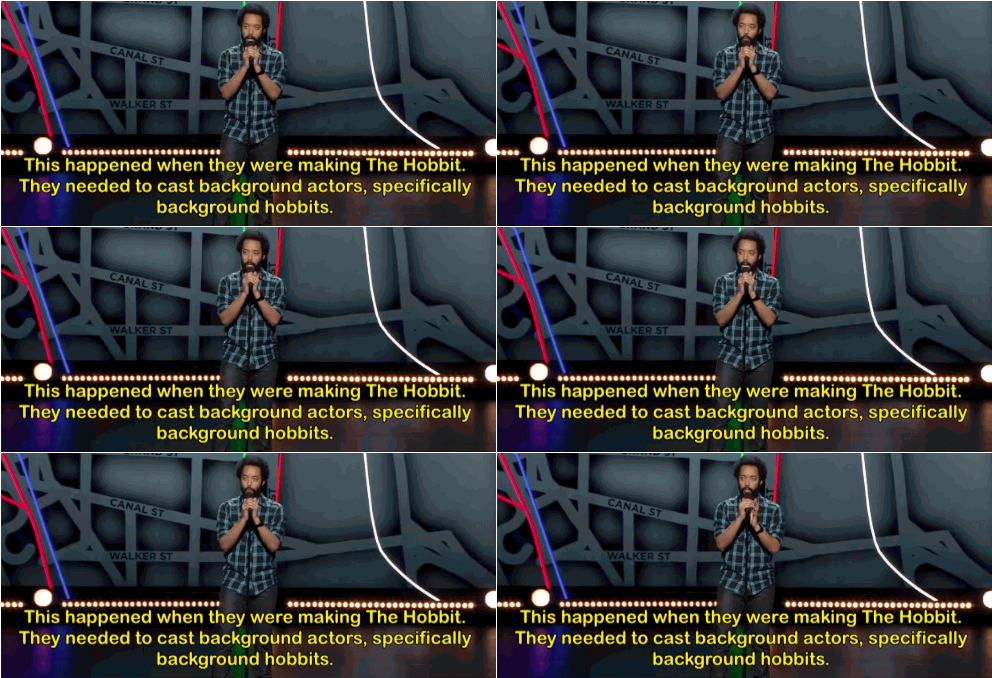
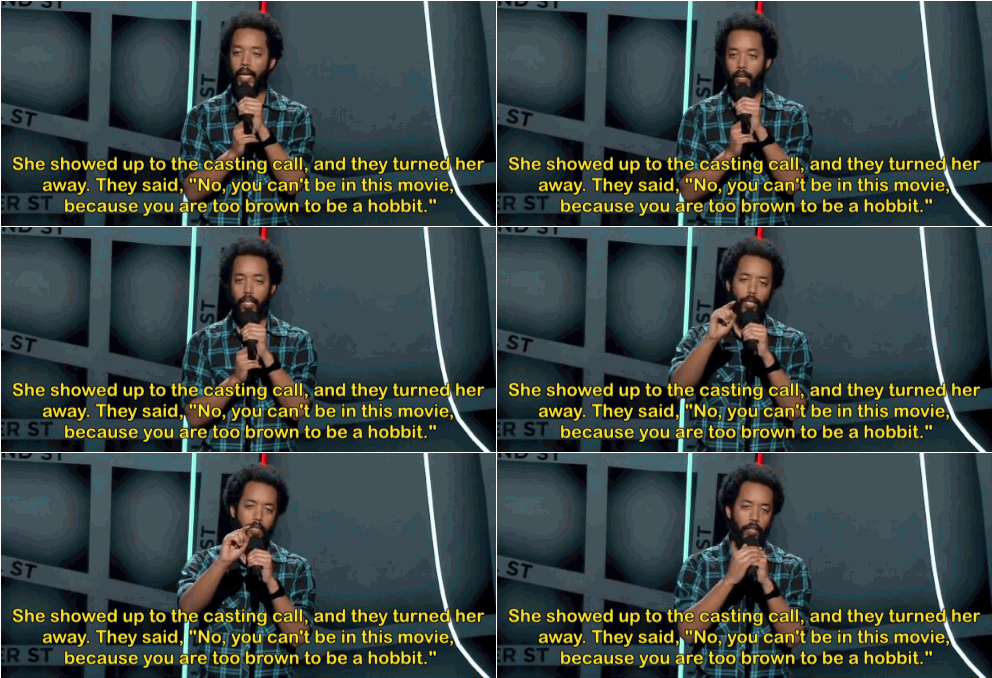
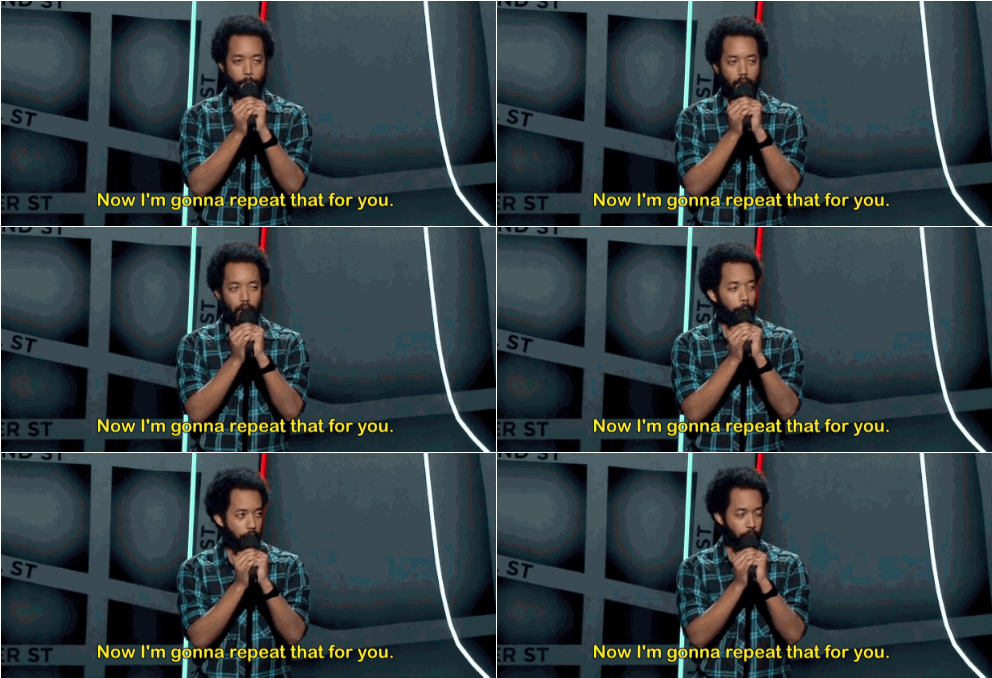
Like fiery eyeball thing, no problem. But don’t even try to imagine a Samoan elf. (x)

Fun fact: In the prologue to The Lord of the Rings, J. R. R. Tolkien explicitly states that the most numerous “ethnic group” of hobbits, the Harfoots, were brown of skin. In fact, the least numerous group, the Fallohides, were apparently unusual in having white skin if their name (meaning “pale hide”) is any indication, so it’s a safe assumption that most hobbits were brown-skinned to some degree. Bilbo, Frodo, and Sam were of predominantly Harfoot descent (Merry and Pippin were more Fallohidish, and Smeagol was from yet another ethnic group, the Stoors), and if Jackson really cared about accuracy to the books (and just look at the movies - he’s not), they would have been played by people of color.

This gifset has been passed around a lot, and I thought I’d reblog my friend’s addition b/c there is stuff in the original text that says there were brown hobbits.  My other friend, summer-of-supervillainy often points this out too, that in the Hobbit, the Hobbits were described as having: “long, clever, brown fingers,”  Even if those descriptions weren’t in the source material though, it still wouldn’t justify rejecting non-white people to play Hobbits, but that it is makes the whole thing even worse and punches a hole through the “but they’re canonically white!” argument too.

23 Mar 19:50

The Sunday Rumpus Essay: Oneiric (another word I’ve never said)

by Cris Mazza

In a 1-minute video, circulated in the usual ways, a swarthy outdoorsy man with lots of dark wavy hair is holding a black wolf puppy, about 3 or 4 weeks old, probably being raised in captivity. The man explains briefly that movements in the pup’s ears have indicated that the ears are now open and functioning, so it’s a good time to begin teaching him his language. The man proceeds to howl. His lips don’t even appear to be open at all.

It was the most lifelike human wolf howl I’d ever heard. Tommy, my Golden retriever, got up from his nap and came to stand beside me, ears cocked toward the computer. Seldom does he ever show any interest in audio from the computer, unless I’m playing a dog-show video that contains my voice giving him his commands. I was watching both Tommy and the wolf pup. The pup’s head motions were jerky at first. Canine young are born with eyes and ears sealed, both unsealing at around 9 to 11 days old. The ears open when they are ready to work and the brain is developed enough to receive the signals, but a pup’s new eyes won’t focus or follow as well as they will a week, even two weeks later. Yet it didn’t take very many of the man’s howls before the pup had turned his head and fixed a stare on the man’s mouth. All his jerky puppy motions stopped. At the video’s 38th second, the little pup threw his head back and joined the conversation. A little squeaky cry that would’ve only been heard inside a den.

Afterwards Tommy went back to his favorite place beneath the window, where he can roll to his back and use the wall to hold him supine, and returned to his nap. He frequently dreams. Interrupting my work with little yips and high-pitched growls. I usually wake him, in case it’s a nightmare. But if he were about to catch a rabbit, I’ve ruined it for him.

It wasn’t until later that night that Tommy woke me with a howl. Two howls. I knew where he was in the room, and I knew he wasn’t standing up. He was in a foam-rubber bed that’s actually two small for him. Who howls lying down? And when had Tommy ever howled?  He hadn’t. He woke after the second howl, got out of the bed and flopped onto another of his customary sleeping places, rattling the vertical blinds. What dream had the wolf video inspired?

There were notes on my nightstand, had been there about a week, about a dream I’d had. Until Tommy had his howl dream, I didn’t know how to write about mine.

*

In 15 to 17 definitions for dream, comprising variations in parts of speech, all but one carry at least tacit ties to “non-reality” — from imagination to delusion. But one definition tries (very hard) to ground itself without the tint (or taint) of illusion: dream as goal or ambition. Some would also call this hope, which brings back the whiff of fantasy. Martin Luther King’s “I have a dream” carries the hope tinge, yet was not meant to imply it was farfetched mirage. He was, however, describing a society that did not yet exist, so his use still sits beside the other definitions of dream that retain at least a fingerprint of “non-reality.”  Walt Disney’s now oft-quoted (on motivational giftware) “If you dream it, you can do it” tried, or wanted, to have a literal understanding. The quip may not have intended to imply that any implausible to impossible notion will instantly (or even someday) be yours just because you dreamed (or wished-upon-a-star) of having it. While King’s line can be simplified to its (4-word) bare bones and retain its nuance, Disney’s simplifies on a slippery-slope more resembling “if I want it I should have it.” Just today I heard that on an insurance radio advertisement: “If you can dream it, you can have it.”  I can have a dream to be a brain surgeon or solo concert violinist for the next ten years, but unless I make any of the necessary steps, like going to medical school or taking violin lessons — not to mention unless I relentlessly focus every iota of energy and discipline — it absolutely won’t happen. But, my current age aside, even if I had executed those grueling requirements, no matter how much I wanted it, geared my life toward it, and, yes, dreamed it in my conscious hours, I simply may not have been able to learn enough or become physically skilled enough to fully achieve either goal. Thousands may dream of being a solo violinist — and do all the requisite work to get there — but never arrive. Yes, they will be able to play the violin. They may play in ensembles from the unpaid community orchestra to world renowned philharmonics. But if their dream was to be a touring solo violinist, they did not get to “have it.”

This use of dream — an ambition, a goal, an objective — why is it the same word that also means images, thoughts, or emotions passing through the mind during certain phases of sleep?

Perhaps the incongruence of the word dream meaning both a real-life attainable ambition and some form of hallucination can be blamed (as many things are) on Freud insisting (and thrusting a generation of psychotherapists into believing) that nocturnal dream content was wish fulfillment. And this thin analysis of personality via dream interpretation is also likely behind the pariah-status dreams acquired among writers of literature.

Possibly as long as there have been creative writing classes, and even a little before that, using dreams in fiction was generally known — if I may overstate to make a point — as amateurish, cheap, the work of a hack, too easy, and juvenile. Putting aside the plethora of examples to the contrary (a list could start with James Joyce and Charles Dickens, and at the other end include me), professors of this art have generally stuck to Henry James’ view: “Tell a dream, lose a reader.” Perhaps he purely meant a loss due to boredom, but “we” all know how dreams are inexpertly used as an updated version of dues ex machina to provide insight to a character or reader, to push resolution, to crudely create symbolism, or explain motive.

Even research scientists have a higher regard for dreams in art than this hard-line.

“The argument can cogently be made that the structure and narrative form of language itself is derived from our attempts to organize and share our dreams. Most dreams are narratives occurring, and often presented without applied organization, grammar, or expectation of critique. In the dream, we can literally observe the ‘thinking of the body,’ and with it, the birth of the literary process. Our dreams can be considered an exercise in pure storytelling whose end is nothing more (or less) than the organization of experience into set patterns that help to maintain order for the thinking system.[i]

Then he goes one better:

“Among successfully creative individuals, dream and nightmare recall, as well as dream incorporation into work and waking behavior is much higher than in the general population, suggesting that one function of dreaming may be in the creative process.”[ii]

*

So the function of dreaming — the why it’s part of our physiological /psychological makeup — is to facilitate a creative process?  Evolution developed the “cognitive mentation that we call dreams”[iii] so we could be “creative”?  Then what’s behind Tommy’s dreams? What will he do with his wordless narrative?

Despite Tommy’s parasomnias — unwanted behaviors occurring during sleep, which usually do indicate but don’t prove dreaming ­— “most sleep medicine physicians consider dreaming to be mentation reported as occurring in sleep by a human participant.”[iv]

I love the word mentation. Loving a word does not set me apart from Tommy. He loves words too. Supper, cookie and toy are favorites. Also squirrel (any small animal) and window (hearing it means he should go look out of one because there might be a squirrel out there). He also has verbs, in the form of commands (which sounds more draconian than he takes it, but I admit, commands are not suggestions). Humans are always trying to find ways we are like our animals. Do dogs do the same? Or is it simply an assumption, to them, that we want what they want, feel what they feel, need what they need, and don’t care about what disinterests them? Without putting it in so many words, of course.

The type of dreaming dogs, decidedly, don’t share with us: that curiously related meaning having to do with desires and hopes, goals and ambitions. Master trainers say dogs can solve problems during training, but do they think about those problems when not engaged in the activity? Can they plan ahead? What kind of cognition, which some say is necessary for dreaming, do they have? Then what about the visual evidence: twitching legs and vocalizations – growls, yips, and the recent singular episode with the howl?  Puppies, from the time they are a day old, sleep with twitching limbs. I’ve heard that’s how they exercise developing muscles. Tommy is 8 years old, fully (and very well) muscled. Add the vocalizing to the leg twitching and these parasomnia-like motions during Tommy’s sleep could be a form of somnambulism: “Sleep terrors and confusional arousals … associated with incoherent vocalizations ….”[v] Or, as I’ve suspected, nightmares. No dreams of glory killing a squirrel. If he’s never caught a squirrel, how would he create the narrative in a dream? But isn’t the same true of nightmares, including the three most prevalent scenarios in human nightmares (all experienced only in my sleep): falling (39.5%), being chased (25.7%), being paralyzed (25.3%)[vi]. Other research into nightmares insinuates they are a human-only occurrence, as those who endure them frequently are more likely to be fantasy prone, psychologically absorbed, have “dysphoric daydreaming and ‘thin’ boundaries.”[vii]  While some dogs do have “thin boundaries,” I don’t know many dogs who are fantasy prone or psychologically absorbed, not to mention the agitated daydreaming. But there’s a person I know …

*

Mark finished high school with me, finished college with me, finished secondary-teacher preparation with me. Just before I abandoned the teaching credential for more graduate school, he confessed what I’d already known for five years: that he’d never wanted to be with anyone else, was distraught over our daily contact coming to an end, and couldn’t I please re-consider the refusal I’d maintained since his ungainly, overly-assertive attempts at love in high school? My response did not change the course of our futures, so he’d embarked on his high-school teaching career 100 miles away, in the desert near the border with Mexico. Two years later, he quit to return to our hometown where I still lived — now with a husband — so he could stay close to where I was. He knew that’s what he’d done, but I did not. He worked a graveyard shift job at a print shop.

But back up to a space between the third and fourth sentences of the previous paragraph. January 1980. I was six months past rejecting the plan (but never a dream) to be a high school English teacher, six months past Mark’s plea for us to remain together; and at least a year away from knowing what the hell I might do instead except the fixated typing that had been going on for almost a decade. Mark was half a year into his foreseen (but not dreamed) career as a high school band director. Despite my refusal to consider him romantically, I begged him to be my friend, to let me write to him. One instinct advised him to say no, to break contact, to try to figure out something else he could want. His other impulse, the one that had been with him since he was 16, told him to embrace any form of intimacy, the only one he was being offered. We wrote letters. Or I did. He was a man with a job and could answer with phone calls. My letters were typed, single spaced, and page after page of misspelled, superfluous, angsty laments, questions, frustration, exasperation, rage, doubts, and fears … about who I was, who should I be, who would I become, what I was doing, where I was going, who would I eventually go there with … and all the gory details about a Jehovah’s Witness I thought I wanted who’d rejected me on the grounds I was too worldly, a sin. I was still a virgin.

Finally one of my letters declared what I needed was to go to a bar and get picked up. Mark seemed the essence of calm when he suggested he could take me to his next gig with the Latino top-40 band he played with — down by the Naval shipyard. The plan was set: he would supply the transportation and the venue, I would take it from there and get picked up. The plan had no exit strategy. It also did not have any hope for achievement because I either sat in self-fulfilling misery in the far back of the nightclub or refused to dance when asked (once). When Mark came to where I was sitting and told me not to sit way back there if I expected to meet anyone, I moved to a closer table. I moved to the band’s table. I was there when they returned for their last break. Without a typewriter, I began narrating another tome of bewilderment and despair. And Mark, hot with worry that I’d come there to meet someone, and planning how he was going to prevent it, was available for me to flop, predictably, into his arms. We held on to each other. We moaned. We kissed. He professed his love. He was careful to not repeat the zealous ardency of his teenaged self, but he couldn’t stop his words. Please .. come be with me … I’ll take care of you … said against my ear in his car. Modified to Please, let me hold you tonight … I promise, I’ll just hold you … please … when we were on my stoop. Just before I closed the door.

For two months I couldn’t even say why. When my letters resumed, I tried to blame the book I was writing, my need to focus on it, on finishing school. I created openings so he could blame the alcohol so as to resume his composure or poise. What I didn’t realize, or allow, was his version: I’d received his raw feelings, I’d accepted them, I’d responded with my own; then I’d said I wasn’t ready that night, but six months later I suddenly was ready, and it was with someone else. I married exactly to-the-day one year after the nightclub night with Mark. Six months later he quit his two-year-old teaching career and came home to live with his parents, work in a print shop, and drop in two or three times a week after his shift to visit. Perchance to dream.

In 1986, Mark was part of the crew helping me and my then-husband move. Mark was teamed with my father. On one trip back for another load, my father, making conversation, casually remarked, “So, Mark, what’re your plans now?” I’m not sure how much my father meant by it, perhaps no more than “What’ve you been up to?”  but Mark took it as, Look, you’ve quit the teaching job you went to college for (so you could be near her) and now you’re helping her move into a house with her husband (who, in case you haven’t noticed, isn’t you) — what’s your next brilliant move?

Mark’s next move was to find the first woman who didn’t notice his preoccupation — one who had enough baggage, chaos, and problems needing (his) help to solve so there wouldn’t be much downtime for reverie — and bring her back out to the desert where he was rehired for another teaching job. His former dream not even a dream anymore. A what-if. An if-only. A reverie put away but not destroyed. Not forgotten. Spoken only by his saxophone.

*

Twenty-five years later, Mark has embarked on a deferred life in partnership with me, and as a member of my extended family. As difficult as it had been to allow himself the yearning, that was easier than it has been to get here. In order to be sitting in a dusk-darkened sunset-illuminated living room across a coffee table from a 93-year-old man he’d thought should be his father-in-law when the man was 60, Mark had to relinquish half the retirement he’d built over a career teaching middle-school music, half the stressed miracle-it-existed-at-all savings account, half his (sometimes crumbling) assets, and had been court-ordered to pay a sum equal to half his monthly salary to the woman with all those problems to solve who’d also never worked, whose deadbeat children he’d partially raised and supported even into adulthood, and whose relentless spending created a runaway-train of the household budget. Not only had she been awarded nearly half of his retirement account, once he started drawing from his remaining portion as income, he still has to pay almost all of each check to her to meet his monthly support requirement. What might have been fair and just to give a former partner who’d maintained the house, meals, and children, was more like ransom paid to free himself. He is only 57, now without a job, has shed almost everything, except his saxophone and his want.

In my parents’ living room, my dad on a sofa with the newspaper, Mark across from him, a sunset lighting up the window behind Mark’s head and reflecting opaque orange from my father’s glasses — while my mother and I struggled to communicate in her newly-formed stoke-induced grammar, making pasta y fagioli which she used to make by rote but now needs a recipe — my father said, “So, what kind of work do you think you’ll be looking for over there.”

“Pretty much anything I can get,” Mark said. “Tutoring, WalMart, HomeDepot, substitute teaching, music lessons … anything.”

“I guess you won’t know until you get there.”

“Yeah, that’s what I figure. Get there first, then start seeing what’s possible.”

As my father lifted the newspaper up to read, he said, “You’re braver than me.”

Mark sat a while, looking at the curtain of newspaper. Then said, “I’m scared.”

My father lowered the paper. He turned his head enough that Mark could tell he was looking past him, out the window to the dimming sunset. The glint on his glasses no longer orange but white, like overcast. “That’s why you’re brave.”

*

I am now three weeks away from the dream whose bedside notes began this essay. The notes preserved enough memory that I still retain the images, as well as the emotions. My body recalls the physical responses. Some of the flashbacks are here for context:

I’m the driver, Mark the passenger. I’m taking him on a tour. Of sights. The first one, I pull off the road or highway or freeway. The spur off-ramp ends, almost immediately, at an outcropping parking space. Fits maybe 2 cars. The parking space is not paved but is made of solid grey shale. The shale protrudes out off a cliff, but it’s obvious enough to not pull that far forward. The parking place is indeed a viewpoint. There’s a similar viewpoint off-ramp on Interstate 5 between Orange County and San Diego, but it’s a complete on-and-off circle. I’m not sure what the particular view is on the I-5 viewpoint, except the Pacific Ocean. Mark has told me that he almost drove off the road (somewhere near that viewpoint?) when I fell asleep in our carpool on the way home from student teaching and my blouse gaped open, exposing (thanks to a bra with equally fatigued elastic) a crescent of nipple-color. He was 23. It was a year before our accidental-on-purpose ill-fated non-date at a nightclub where his band was playing.

This dream viewpoint likewise seems to be ocean, but the beach doesn’t have the classic sand-with-breakers. More like the tide pools of La Jolla, the waves come effervescing up across and into Swiss-cheese pocked flattened rocks. This is what I mean to show Mark. I also (in the dream) recognize it as being the Presque Isle River in the Porcupine Mountains in the Upper Peninsula of Michigan where I now co-own a fishing cabin. The tannin-colored water coming out of the Porkies, descending toward Lake Superior, has carved hot-tub sized circles in the sedimentary rock shoreline. The river swirls into and back out of each tub, a furl of froth always staying behind and circling. Mark and I didn’t get over to the Porcupine Mountains on our brief trip to the U.P. last summer. My foot is firmly on the break, and I shift to park and set the emergency break. A car pulls into the space beside us, then immediately backs out again. I am aware of my foot, my toes slightly bent backwards, maintaining cognizant pressure on the break. I also know I am only wearing my slippers. I can feel the shape of the pedal under the thin sole. I don’t tell Mark out loud, but think to him: don’t worry, my foot won’t slip off the break. And anyway, I’ve shifted to park. But he’s ready to go. We both feel nervous. The way we used to feel nervous driving home from student teaching on I-5. The way we both knew the other was nervous, without saying anything.

My foot increases its pressure on the break. Very careful to not let the foot, in just a slipper, slip off the brake pedal. Release the emergency brake. Shift into drive. Foot will have to jump quickly from brake to gas. The dream doesn’t include a clutch (which would have been present in the car driving us home from student teaching), but all of my old trepidation regarding starting forward motion with a standard transmission when stopped at a light at the top of an incline has returned to me. The fear in that case: stalling (of course), or the car rolling backwards into the car too-close behind before the clutch engages first gear and the car can begin to go forward. And yet I also know there’s no clutch here. I won’t make a mistake.

Is this even a surprise by now? I press the gas, and the car, without a jolt, moves forward and is airborne over the beach with flat pock-marked pools.

My thoughts: I put it in drive by mistake. I can’t change it now.

Mark’s thought: we’re going to die.

My answer thought: Maybe we’ll only be hurt.

We look at each other while also still seeing the overhead view of breakers foaming into the sandstone pools.

Now awake.

The dog on the floor in the bedroom didn’t stir. Even if I’d made any kind of sound, I doubt he would have. But since in the dream I didn’t cry out or scream (or try to scream but met with vocal paralysis), I doubt there was any sound to wake or alarm them. But of course, they don’t even stir if I vomit at night, and what could be a more alarming sound?

Wondering if I’d made any dream-sound was not, however, what was on my mind after waking. My deliberation was over how it was one of those mistakes that simply can’t be undone. Like cutting off a finger while deboning a chicken. Like accidentally hitting a television screen or aquarium with a hammer — something I’ve imagined happening when I’ve walked through a room with a hammer, provided a television or aquarium was present. Like turning on the garbage disposal while I’ve got my hand in there, stuffing the potato peelings down — something I tell myself not to do every time I have to stuff something down there.

No, listing the other kinds of sudden, ghastly mistakes that can’t be undone was also not what I was thinking. Just that I had made one. In the dream. And I was feeling, still, in a sustained extension of the seconds-after, what it felt like to make one. What it felt like seconds before the resounding end.

It was obvious that closing my eyes without replaying the car’s gentle leap off the overlook — without rethinking the thoughts, both Mark’s and mine, without feeling the hot gush of realization — was not going to be possible. So I turned on the light and began reading the first six chapters of a graduate student’s novel manuscript, where every character was in the slow-motion beginning of a metaphoric fiery  crash  with no concept of the impending dire conclusion, which had started when they were born, or at least when their childhood families had fallen apart. Mark and I have no such background. We have other flashbacks, but not that one.

An hour later, light off and replaying the dream scene again — the same flash of soaring fear — I realized I hadn’t ever said I was sorry.


[i] Pagel, James F. “What Physicians Need to Know About Dreams and Dreaming,” Current Opinion in Pulmonary Medicine, 2012;18(6):574-579 … referencing States Bert O. Dreaming and Storytelling. Ithaca NY: Cornell University Press; 1993. p. 53.

[ii] Pagel James F, editor. Dreaming and Nightmares — Sleep Medicine Clinics, vol. 5. Philadelphia, PA: Saunders; 2010. pp. 241—248. And Pagel, The Limits of Dream — a Scientific Exploration of the Mind/Brain Interface, Oxford, UK: Academic Press, 2008.

[iii] Pagel, James F. “What Physicians Need to Know About Dreams and Dreaming,” Current Opinion in Pulmonary Medicine

[iv] Pagel

[v] International Classification of Sleep Disorders – Diagnostic and Coding Manual (ICD-11). Disorders of arousal, Winchester, IL; American Academy of Sleep Medicine; 2005. pp. 139–145.

[vi] Michael J. Breus, PhD, The Sleep Doctor™ www.thesleepdoctor.com

[vii] Hartmann E, Kunzendorf R. The central image (CI) in recent dreams, dreams that stand out, and earliest dreams: relationship to boundaries. Imagination, Cognition & Personality 2006; 25:383–392.


Related Posts:

23 Mar 19:35

Molly Pitcher

by Erik Loomis

Like you ever thought Molly Pitcher wasn’t the Kool-Aid pitcher.


23 Mar 19:34

“NIMBY-ism, but with microphones”

by Scott Lemieux

The LA Weekly‘s piece about the decline of Pacifica is a really terrific read. I’ll pick out a few choice bits at random. First, the ratings:

Pacifica has a long and storied history, and still features such leading liberals as Amy Goodman, the widely known host of Democracy Now! (on which journalists Glenn Greenwald and Jeremy Scahill are frequent guests), but it has fallen on hard times of late. Listenership, according Reese, is “extraordinarily low.” During an average 15-minute period, just 700 people listen to its Los Angeles station, 90.7 FM KPFK, for at least five minutes, according to Nielsen Audio, which monitors radio ratings.

For L.A.’s other public radio stations, KCRW and KPCC, that number is 8,000 and 20,000, respectively. KPFK draws roughly one one-thousandth of all radio listeners in the Metro Los Angeles area.

Pacifica’s New York station, WBAI, is even worse off, with too few listeners to register on the Arbitron rankings, and is all but bankrupt. Last year, most of the staff was laid off, including the entire news department.

Facebook and twitter followers will have heard me complain incessantly about the local NPR station’s pledge drives, which rather than what might think is the mutually beneficially arrangement of interspersing the pledge drive with listenable content like news updates, consist of nothing but people asking for money for days on end. (Does anyone listen to this for more than 3 minutes at time?) But, at least, we’re spared Alex Jones-caliber conspiracy theories:

A National Public Radio fund drive, such as those heard in Los Angeles on much bigger KCRW and KPCC, is a mix of cloying boosterism, promises of tote bags and begging. A Pacifica fund drive, meanwhile, sounds like a never-ending infomercial for products created by a street-corner lunatic.

Take, for example, a five-DVD set titled “The Great Lies of History,” which includes five documentaries by Italian filmmaker Massimo Mazzucco: The Second Dallas; The New American Century; UFOs and the Military Elite; The True History of Marijuana; and Cancer: The Forbidden Cures. Cancer features Dr. Tullio Simoncini, an Italian doctor who claims to treat cancer, which he says originates with a fungus, with sodium bicarbonate, or baking soda.

“There was a woman [diagnosed with] cancer of the uterus,” Mazzucco recently explained to KPFK producer Christine Blosdale on air. “She tried the Simoncini method. She healed by herself by simply doing douches, washing with sodium bicarbonate. The cancer’s gone, and now she can have babies. Of course, that’s one less patient the cancer industry had to milk from.”

I now feel slightly better about academic meetings:

Board elections cost somewhere in the neighborhood of $200,000 — no small price for a network with a $13 million annual budget. The meetings themselves cost about $20,000 each to fly in 20-plus people and put them up for the weekend, and they’re dominated by bickering. Members regularly invoke Robert’s Rules of Order, and can take half an hour simply to approve the minutes of a previous meeting.

And lest you think the only relevant actors in the farce are the ultraleft, former Pajamas Media associate Marc Cooper makes an appearance to compare other factions at Pacifica to both Nazis and the Khmer Rouge and call Amy Goodman an “evil bitch.”

[Via DJA.]


23 Mar 19:31

DRAWING DAILY SUNDAY EDITION: TUESDAY HELL

by Steven Kraan

tuesday hell_rumpus72

Related Posts:

  • No related posts…
22 Mar 21:29

Public Sex, Private Lives

by Stephen Elliott

Join The Rumpus and Why Are People Into That? for a special free screening of Public Sex, Private Lives March 27 at 9:30pm at Videology in New York City.

PSPL_Posters2_HighResPublic Sex, Private Lives is an intimate look at the professional and private lives of porn performers Lorelei Lee, Princess Donna, and Isis Love. Capturing moments of joy and struggle, this film follows the characters as they navigate their lives as artists, daughters, mothers, and women who have made careers in the adult industry. Asked to defend their choices to their families, communities, and even the United States Government, these women share their unique motivations and shifting visions for the future.

RSVP on Facebook.


Related Posts:
  • No related posts…
22 Mar 21:28

Political cartoon: Marriage Fixes Everything!

by Ampersand

poverty-and-marriage-590

Description of cartoon:

The cartoon depicts a young mother and her toddler, in a small and crappy-looking room. The woman is bent double under a load of boxes, trunks and bags, each of which is labeled: Unemployment, Lack of Education, Illness, Bigotry, Exhaustion, Low Wages, Childcare, Looking Poor, and Crime.

Also in the room is a young white guy, wearing a necktie and suspenders, who is grinning happily and telling the woman “I know what’s holding you down! You should be married!”

In a little “epilog” panel at the bottom of the cartoon, the guy continues “…Unless you’re gay.”

22 Mar 21:28

Caturday

by syrbal-labrys

We are working on the big house — when that is done, some changes and updating will occur here in the small Haven.  This is in preparation of the Manchild and I switching residences again in spring/summer of 2015!  So there are boxes and containers of new things — like a kitchen range exhaust fan — sitting around awaiting installation.

photoAnd occasionally, there is a different sort of “installation” — as in Uncas the silver tabby terrorist installing himself in the packing materials!


Tagged: caturday, householding, pets
22 Mar 21:28

COMIQUES:Smuggled In

by Anne Emond

smuggledin

Related Posts:

  • No related posts…
22 Mar 08:19

Let’s Have an In-Depth Conversation about Katy Perry

by bspencer

So, I was reading this entry (which is mostly about Bruno Mars and Katy Perry) at Crooked Timber and I was excitedly composing all these responses (to both the post and comments) in my head. Then I thought to myself “Yeah, but my comments will just be lost in the shuffle. People won’t understand there’s a sage in their midst and my genius will go largely ignored.” Then I thought “Well, shit. I’m just going to write a post about this. Because I’m an incredibly important person with incredibly important things to say about Katy Perry!” So…yeah.

So I’ll start with the contention that Katy Perry is not a good singer. Unless she is severely auto-tuned (and she could be! I don’t know a whole lot about Katy Perry!) she actually has a pretty extraordinary voice. A strong voice with a really great range. So, no, not really.

Katy Perry is not hot: Underbite aside, I think most people would find her pretty darn hot. All done up, her face is super-cute and she has the body of an old-fashioned pin-up.

Katy Perry’s first single was good: “I Kissed a Girl” is not just horrible on its face (because it’s just not a particularly good, danceable, likable or listenable song) it is also deeply offensive because of its male gaze-y approach to bi-curiousity. It’s basically the musical equivalent of the sort of faux-lesbo kisses you might see in a “Girls Gone Wild” video. “OMG, I’m kissing a girl! Dudes, are you watching?!!!! I’m really liking it! Honest!”

Katy Perry’s follow-up hits sucked: “California Gurls,” which–admittedly is awful and pretty much guilty of aural rape–aside, a lot her hits are actually fun, catchy and listenable. “Wide Awake” is addictive and “Hot ‘n’ Cold” is really fun to sing. I even like “Roar” and “Dark Horse.” Are all these songs and glossy-sugary-slick and over-produced? Sure. Absolutely. But they’re also pretty fun to listen to.

So I totally *get* why Katy Perry is popular. Even if she doesn’t deserve to be.

Also, Bruno Mars is terrifically talented and thought his performance at the Superb Owl was amazing.


22 Mar 08:17

Can We Just Cut the Post-Racism Crap Right Now?

by Bette Noir

image


Well, I suppose it was only a matter of time before the editors of The Wall Street Journal came up with a snippy, little “both sides do it” apologia for Paul Ryan’s recent “inarticulate” exploration of “inner city culture.”

Oh my, where do I begin . . . how about the first sentence?

A week later, and liberals are still lining up to assail Paul Ryan’s “racism.” The episode is worth noting not because Mr. Ryan said anything wrong, but because of what it shows about the political habits of today’s elected and media left.

Well! that obsessive “elected and media left” just won’t quit distracting the “elected right” from mounting it’s 52nd attempt to Repeal Obamacare, or its important effort to assign a special prosecutor to teach Lois Lerner a lesson about Liberty.

Seriously, WSJ eds?

Of course, Ryan said something “wrong” because what he said is simplistic and, whether “the elected and media right” like it or not, what he said is highly prejudicial.  Tagging chronic poverty as a cultural failure leaves out at least half of the equation.  Poverty is, after all, first and foremost, an economic condition and not one that many humans wish upon themselves.  Poverty is the result of a complex of interacting social and environmental factors, rather than a predictable outcome of character flaws.  There are plenty of flawed characters pounding the pavements of Wall Street in Gucci loafers, as we speak.  ‘Splain that.

Moreover, a belief that persuading the poor to take on more responsibility will magically make great job opportunities flood back into the inner city poor is simply naive.  Cultural fortitude alone cannot rebuild the broken down social organization, substandard schools, services, housing and health care available to the very poor that took decades for “outside the city culture” to dismantle.  Social amenities follow investment, jobs, success and wealth—exactly those things missing in the inner city . . .  the very things that have been deliberately and systematically stripped away from the inner city—and not by the people who live there.

As a matter of fact, one could conceivably look upon the highly organized and self-policed drug businesses that exist in our inner cities as enterprising and innovative use of the meager, albeit illegal options at hand to survive a very cruel and inescapable life that most of us can’t begin to imagine.  Very few little children dream of becoming drug lords or gang-bangers until it becomes clear to them that there lies survival.

But this is, after all The Wall Street Journal whose thought leadership job is much bigger than simply mopping up after inarticulate bubble boys.  So, bring on the incisive analysis, trying hard not to snark, because it is so totally obvious that the “elected and media left” will be forced to admit their utter defeat when WSJ calls their star witness—President Barrack Hussein Obama, saying the exact same racist stuff about his own race.

Take this, lefties:

We know young black men are twice as likely as young white men to be ‘disconnected’—not in school, not working. We’ve got to reconnect them. We’ve got to give more of these young men access to mentors. We’ve got to continue to encourage responsible fatherhood. We’ve got to
provide more pathways to apply to college or find a job. We can keep them from falling through the cracks.

Well played Wall Street Journal editors, please feel free to indulge in a schadenfreude-tinted moment . . .

No less than Mr. Ryan, Mr. Obama sure sounded like he was talking about “a cultural problem.” He didn’t mention “inner cities,” but his entire White House initiative is geared to helping young minority men, not whites. The President even concluded with an ode to self-reliance that Mr. Ryan might have considered a little too lacking in nuance: “Government cannot play the only—or even the primary—role. . . . It’s ultimately going to be up to these young men and all the young men who are out there to step up and seize responsibility for their own lives.

But then, of course, too much schadenfreude can be addicting:

So even though Mr. Ryan never mentioned race, liberals attacked his off-the-cuff remarks as racist while the President’s moral lecture was hardly noticed. Republicans are accused of racism if they ignore the least fortunate, and now they’re racist for taking poverty and its causes seriously. Unless you unreservedly favor the welfare status quo, or used to be a community organizer, the left gets you coming and going.

The attacks on Mr. Ryan are one more example of the politics of personal vilification that typifies the left these days. Its policies were supposed to reduce inequality, but instead the income gap is widening. They were supposed to lift people out of poverty, but poverty has increased.

So the last thing they can tolerate is a conservative like Mr. Ryan who is looking for better solutions and using a moral language of opportunity and upward mobility that could appeal to Americans of all incomes and backgrounds. Liberals have to smear conservatives personally because they know they’re losing on the merits.

Nice try, fellas.  But you know, and I know and they know that we know comparing what Ryan and Obama said is a big fat false equivalency.  And if you somehow don’t know that? then you have no business running a communications empire.

The “politics of personal vilification that typifies the left these days” oh jeez Louise!  Can you say Benghazi!1!?  Can you say Stalinist Socialist Kenyan Muslim usurper?  Do you guys have to get stoned to get these thoughts on paper?

For the record, Paul Ryan is not saying the same thing that President Obama is saying.  For starters, Obama is not consulting with Charles Murray, a white supremacist, on how best to attack the cycle of poverty. 

And before I’m forced to listen to a lusty defense of Charles Murray’s important sociological contributions, I must warn everyone that no one will ever convince me that a man who writes that blacks and Latinos have lower IQs than Asians and whites or that lower IQ means those groups are prone to crime and not availing themselves of an education, thereby having lots more illegitimate, lower IQ babies and living in poverty, ergo there’s not much that can be done to help those groups rise—is not a racist.

Obama knows that the “cycle of poverty” and nihilism that plague “inner city” areas did not just crop up yesterday while folks were stretching out in their “hammocks” or stumbling into “poverty traps.” 

It had to be planted and carefully nurtured for decades of Social Security exclusions for menial service work, FHA red-lining, city rezoning to prevent residential building or rebuilding, being priced out of rentals by Urban Renewal projects, industrial flight from cities, segregation, limited access to decent education and health care.

It took a long, long time for the despair and hopelessness of being trapped in a ghetto with no good choices and no way out to result in the despair of the inner city that we see today.  And make no mistake, to 98% of Americans the phrase “inner city,” in 2014 means black.  Just like the “urban vote” that Mitt Romney and Paul Ryan talked about so frequently in 2012, meant “minority” voters.

Paul Ryan obviously doesn’t have the ghost of an idea how things really got this way. 

We have got this tailspin of culture, in our inner cities in particular, of men not working and just generations of men not even thinking about working or learning to value the culture of work, so there is a real culture problem here that has to be dealt with.

Ryan specifically says that this is a “culture” problem “in our inner cities in particular.”  Well, Paul, this tailspin has been going on for some 60 years now, including the fourteen-odd years that you have held office.  Suddenly, with an election coming up, you’re going to solve it? 

I doubt that Ryan has done much more than brush the surface of the historical sociological record of poverty and urban decay in the US.  Or the prolonged systemic dysfunction that feeds that “downward spiral” that he noticed but mislabeled as “cultural.” And, frankly, Ryan doesn’t appear to be too interested in learning much about actually solving such problems or he would realize, by now, that 90% of his Big Policy Ideas would only serve to make things immeasurably worse for the people he’s pretending to care so much about.

WSJ dismisses Ryan’s comments as “off the cuff,” implying that, had he had more time to prepare his comments, they might have sounded less “racist.”

But Ryan has been making similar comments for years. In Ryan’s mind, social welfare programs have become a “hammock” too comfortable to get out of to actually work.  He has worried about a social “tipping point” where “takers” outnumber “makers” and who will be politically motivated to vote for whoever offers the best benefits.  He would take an ax to social spending projects because he fears that they “lull able bodied people into lives of dependency.”

On the other hand, WSJ editors, you could be right.  Maybe Paul Ryan isn’t necessarily racist, maybe he’s just not very smart or thorough or objective enough to be writing laws for the rest of us.

Whichever it is, I wouldn’t vote for the guy.


********************UPDATE*****************

Well, now, this should help.  The Ryan Budget is back.


22 Mar 08:12

Last Call For Another One Falls

by Zandar
Another state constitution banning same-sex marriage, another federal judge strikes it down on Fourteenth Amendment grounds.  This time, the state is Michigan:

Federal Judge Bernard Friedman gave his decision Friday, two weeks after the couple's trial against the ban. Friedman's ruling says the state's ban is "unconstitutional because they violate the Equal Protection Clause of the Fourteenth Amendment to the United States Constitution."

Doesn't get much more clear cut than that.

In 2004, the state of Michigan enacted the Defense of Marriage Act after it was passed by 59 percent of voters. The act argues that children benefit from living in homes of heterosexual couples.

April DeBoer and Jayne Rowse sued the state of Michigan's federal court in an effort to overturn the state's ban on joint adoptions by same-sex couples. Friedman invited them to challenge the state's ban on same-sex marriage. They refiled the lawsuit and went to trial against the state's ban on gay marriage.

 The ruling is here.  Judge Friedman's conclusion:

In attempting to define this case as a challenge to “the will of the people,” state defendants lost sight of what this case is truly about: people. No court record of this proceeding could ever fully convey the personal sacrifice of these two plaintiffs who seek to ensure that the state may no longer impair the rights of their children and the thousands of others now being raised by same-sex couples. It is the Court’s fervent hope that these children will grow up “to understand the integrity and closeness of their own family and its concord with other families in their community and in their daily lives.” Windsor, 133 S. Ct. at 2694. Today’s decision is a step in that direction, and affirms the enduring principle that regardless of whoever finds favor in the eyes of the most recent majority, the guarantee of equal protection must prevail.

 Boom.  Won't be long now before SCOTUS is forced to act.
21 Mar 21:26

Lifeboats: The Myth of the Safety of Sameness

by Remittance Girl

il_340x270.449865920_20hwI just finished reading and commenting on The Good Men Project article Who Is In Your Rowboat? by Dale Thomas Vaughn. He’s reportedly vaunted as “a man of quality and one of the leaders of men of quality” by best-selling author and top feminist attorney Gloria Allred” which only reminds me why I have such a problem with most ‘feminists’ too.

Here’s the premise, a common meme: “Imagine you have a life rowboat with room for about 6 other guys – You need 6 guys who you can count on. Who is in your rowboat?

I don’t have a problem with his basic premise, that it is important to identify the strong, brave, ethical, empathetic, wise people in your life and dispense with the flakes, bloodsuckers, users and unengaged. I agree with that, and the older I get, the more brutal I am with the scalpel.

But underlying his article is a strong, exclusionary and, to my mind, misleading message: if you’re a man, a REAL man, the 6 others in your life boat need to be men. Why just guys? What is wrong with a mixed gender rowboat? What about a rowboat with a trans person aboard? Why on earth would any intelligent person place their trust on people based on gender?

The myth of the ‘band of brothers’ is very old and powerful. It transcends culture, too. All Viking guys together! All vestal virgin sistas together! Boo-ya. I’d like to have a go at taking the knife of critique to this.

Historically speaking, it is men who destroy, betray, and undermine men, not women. Generally speaking, it wasn’t women who decided to go to war, drafted you or sent you there. Generally, women didn’t enslave you, or construct economic systems that have ensured your permanent poverty. On a personal basis, yes, your mother might have let you down. Your girlfriend might have cheated on you, but count the number of times you’ve been fucked over by your own gender and I will bet the opposite sex comes out looking pretty good.

It’s the same for women. It’s not, generally speaking, men who make you feel physically inadequate or exclude you from a sport’s team, or took you to some doctor in Cairo and let them slice off your clitoris. It’s other women.

I’m not saying that people don’t find support in the company of their own gender. Nor am I denying the reality of inter-gender nastiness. What I’m saying is that, in the grand scheme of things, the ones who fuck you over… they’re not any specific gender. They were just rotten people. Their gender is irrelevant.

One of the reasons I think these gender ‘gurus’ (male or female) focus so much on celebrating the ‘being with your own kind’ crap is because they haven’t gotten past the myth that sexual attraction makes people unreliable. We’re back to the idea that, if your dick is hard or your pussy’s wet, you no longer exercise good judgement.

The Greeks had no issue with this. In fact, one of the reasons for the celebration of homosexual love in Ancient Greece involved the fact that, if you went into battle with your lover, you were more likely to be heroic. You wouldn’t want your lover to see you in the grips of cowardice.

So, I’d like to unpack this: why on earth would I want to fuck anyone I considered unreliable, flaky, weak, stupid or unprincipled? And if I like this person enough to let them fuck me, why wouldn’t I trust them to have my back in a fight?

My lifeboat is has a mix of gender, sexual orientation, ethnicity and philosophies. There are people in my lifeboat I want to fuck and some I don’t. That doesn’t make it a weak lifeboat. It means I have the resource of a larger range of life-experiences, a wealth of wisdom, I have the counsel of people who see the world with different eyes, whose values have been forged in other furnaces, and some hankie pankie, too. It’s not a sisterhood, or a brotherhood. It’s the very best I can find.


21 Mar 20:34

There's Christian, And Then There's "Christian"

by Zandar
Chase Martinson was a student at Hannibal-LaGrange University in Missouri, a Christian place of learning.  Emphasis on was, because after being readmitted and asked to join the school's honors program in January after taking a break from school, Chase's admission on Facebook that he is gay just got him kicked out of school.

In the words of Gandhi,  “I like your Christ, I do not like your Christians. Your Christians are so unlike your Christ.”

In the letter, the Admissions’ Committee indicated that “[a]dmittance is open to academically and morally qualified students,” and that “[s]tudents at Hannibal-LaGrange should be in agreement with the student life guidelines set forth by the University.” The letter told him to review page 27 of the Hannibal-LaGrange student handbook, which defines “sexual impropriety” as “participation in, or appearance of, engaging in premarital sex, extramarital sex, homosexual activities, or cohabitations on or off campus.”
These guys know how to party.

Moreover, “[t]he promotion, and advocacy of, or ongoing practice of a homosexual lifestyle is contrary to institution expectations and is therefore prohibited.”

When Martinson spoke to head of admissions, he was again told to review the guidelines “because it was brought to his attention (surprise!) that I was outside of them[.]” He does not indicate who informed the admissions administration about his sexual preference.

In a Facebook update that he encouraged people to share, Martinson wrote that he was told that he didn’t represent “Christian values.”

Well good thing Jesus Christ was never associated with sinners, thieves, prostitutes, cheats, the lame, etc.” he continued. “Hannibal-LaGrange University should be ashamed of itself, it’s repugnant.”

 I wonder if any students attend the school while receiving any federal student loans or grants. I would very much like to know the answer to that question.

Second of all, I'm betting the same "get government out of my face" people have little problem with this.  It's okay if the government is a Christian theocracy?

Chase meanwhile is going to attend University of Missouri - St. Louis this fall.  Good for him.
21 Mar 19:37

More Food Stamps For Thought

by Zandar
House Republicans were confident that cuts in food stamps this year (specifically punishing Democrats in northern blue states that took advantage of heating assistance to access additional SNAP money) would help turn voters against Obama in the midterms.  Only one problem:  Democrats in New England and the Mid-Atlantic states aren't playing along.

At issue is a provision in the farm bill, known as “heat and eat,” that allows people who receive benefits through the Low Income Home Energy Assistance Program (LIHEAP) to also receive more nutrition assistance.

The idea behind the link was that low-income families should not have to choose between buying food and heating their home. But Congress has chafed at states that have sought to obtain more food stamp money by sending $1 LIHEAP checks to households that would not otherwise receive help.

To close what some lawmakers called a loophole, Congress increased the LIHEAP subsidy threshold to $20. The Congressional Budget Office estimated the change would save $8.6 billion over a decade, representing a majority of the spending cuts in the nearly $1 trillion farm bill.

Yet in the weeks since President Obama signed the law in February, seven of the 17 states that currently send nominal LIHEAP checks have announced plans to increase that aid to $20, so they can continue to access additional funding from the Supplemental Nutrition Assistance Program. Those states include Connecticut, Pennsylvania, Rhode Island, Oregon, Montana, Massachusetts and New York. All of them, with the exception of Pennsylvania, have Democratic governors.

Orange Julius and the House GOP are furious and are promising yet more food stamp cuts to crack down on "cheating states", but the harder the House Republicans push on this, the meaner they look to voters.

And they know it.
21 Mar 19:29

Chilling Effect, Next Steps, Final Steps, Hope

by Clark

Definition:

https://en.wikipedia.org/wiki/Open_society

open society
government in the open society is purported to be responsive and tolerant, and political mechanisms are said to be transparent and flexible.

Definition:

https://en.wikipedia.org/wiki/Chilling_effect

In a legal context, a chilling effect is the inhibition or discouragement of the legitimate exercise of natural and legal rights by the threat of legal sanction.

Definition:

https://en.wikipedia.org/wiki/Culture_of_fear

Culture of fear is a term used by certain scholars, writers, journalists and politicians who believe that some in society incite fear in the general public to achieve political goals.

Definition:

https://en.wikipedia.org/wiki/Intimidation

Intimidation is intentional behavior that "would cause a person of ordinary sensibilities" fear of injury or harm.

Data:

http://warrantless.org/2014/03/snowden-search/

A new empirical research paper
I have coauthored with Professor Catherine Tucker of MIT-Sloan [ Clark note: originally at http://warrantless.org/wp-content/uploads/2014/03/Surveillance_Search.pdf ] examines the question of how Edward Snowden’s surveillance revelations have shifted the way people search for information on the Internet. We look at Google searches in the US and its top ten trading partners during 2013. We identify a roughly 5% drop in search volume on privacy-sensitive terms. In the US, UK and Canada, the countries in our data who were most involved with the surveillance controversy, search volume fell for search terms likely to get you in trouble with the government (“pipe bomb”, “anthrax” etc.), and for searches that were personally sensitive (“viagra”, “gender reassignment”, etc.). In France and Saudi Arabia, search volume fell only for the government-sensitive search terms. This paper, though at an early stage, provides the first systematic empirical evidence of a chilling effect on people’s search behaviors that is attributable to increased awareness of government surveillance. I will be presenting this paper at the Privacy Law Scholars’ Conference in DC in May, 2014. I would welcome comments at alex@warrantless.org.

Clark's editorial additions:

1) Police states are not boolean: A society can be more or less of a police state. The presence of newspapers and absence of death camps does not mean that there is not something of a police state.

2) It is not necessary for anyone to to desire or plan a police state for a police state to arise. Men of good intentions can honestly attempt to solve problems on the ground and in doing so end up worsen the overall picture.

3) When people feel that they can't look up entirely legal information in the 21st century equivalent of a book because they fear know that their government

and based on this knowledge "voluntarily" curtail their own legal behaviors, we have some noticeable degree of a police state.

Clark's suggestion:

1) Do go read the Marthew's paper. I approach all social science papers with an attitude of skepticism…and in this case I was surprised (pleasantly so) by table 6, where statistical confidence is specified.

2) Add warrantless.org to your RSS reader and follow @rebelcinder on Twitter.

3) Put aside existing models of how and why the US government works and approach it as a forensic anthropology question:

  • Note that the NSA, the DoD, and the State Department are regulated by the government, but regulation does not work they way one might expect.
  • Note that no matter which party seems to win an election, the bureaucracy always stays in place, and has its own agenda.
  • Note that elections do not create moral government or consent.
  • Note that the DNA of the government is not just the Constitution, but the extended phenotype of defense oriented firms, police departments, bureaucrats, dependents, and more.
  • Ask yourself if people of good will tried to reform the government in 1980, and 1990, and 200, and 2010, and it has gotten larger and more intrustive every year, what effect people of good will trying to reform the government in 2014 will have.

4)Withdraw your consent from the system.

  • Note that just because party A is terrible does not mean that party B is any better, and refuse to ever say "this will be better after the next election" or "we just need the right guy in office".
  • Note that just because because a Constitution exists and a Supreme Court says that it will enforce the Constitution does not mean that it actually does so.
  • Note that this is not "your" government but "the" government, which you can choose to give loyalty to or not, as you see fit.
  • Note that the government can do whatever it wants to your body, because it has more men and more guns, but it can not force you to acknowledge its moral legitimacy.

The system is unreformable. It has more guns than the good guys (at least now). But if discontent grows and enough people start to stop talking about "our government" and start talking "your [ illegitimate ] government", at some point even the hard men look out at the swelling crowd, realize that they are on the wrong side of history, and go home.

Or at least we can hope.

Chilling Effect, Next Steps, Final Steps, Hope © 2007-2013 by the authors of Popehat. This feed is for personal, non-commercial use only. Using this feed on any other site is a copyright violation. No scraping.

21 Mar 19:24

The Breadth of Hobby Lobby’s Attack On Its Employees

by Scott Lemieux

The companies advancing the farcically specious religious freedom arguments against the contraception non-mandate want their employees to get even less for the health insurance they pay for with their labor than you think:

Arguments in front of the Supreme Court start next week in the Hobby Lobby case. Hobby Lobby is suing for a religious exemption from the Department of Health and Human Services mandate requiring that employer-provided health insurance cover contraception. Most of the coverage of the case has focused on Hobby Lobby’s objection to the contraception itself and how, if the business prevails, its employees will have to pay out of pocket for things like birth control pills or IUDs. But, as Tara Culp-Ressler at ThinkProgress explained on Wednesday, Hobby Lobby and their co-plaintiff, Conestoga Wood Specialties, are also objecting to insurance plans covering “related education and counseling” for contraception. In other words, these for-profit businesses aren’t just asking their female employees to pay for their own contraception, even though they are already paying for their own contraception by paying for their insurance coverage. These companies want to elbow their way into doctor’s offices and call the shots on what doctors can and cannot say to Hobby Lobby and Conestoga Wood employees.

In summary, Hobby Lobby et al. are citing a “burden” on religious practice so trivial as to be non-existent in order to impose actual burdens on the rights of their employees. This nicely summarizes how American conservatives think about “freedom.”


21 Mar 19:23

Mr. President? Your Reality Check Is Bouncing

by syrbal-labrys

1apathyGee, Mr. Obama thinks the Democrats could get “clobbered” in the midterm elections?

Boo-hoo, Barry.  Open disclosure — I didn’t read past the headline after getting the low-down from a few other folks who did.  Know why? Because you are blaming the “victims”, Sir.  ”We” voters don’t think it is important enough to vote?  No, Sir.  We voters are pretty fucking certain that no matter who we vote for, they won’t vote as WE want them to anyhow in this representative democracy.  I want so badly to believe voting counts, but I am struggling.  It is not apathy, sir, but disillusionment making me wonder why I waste a stamp on a ballot.

Take YOU, for instance.  I voted for you twice.  I voted for you to close GITMO prison.  You didn’t do it.  I voted because I wanted the huge security theater/spying on citizens shit to END.  You didn’t end it. I voted in sincere hope that the criminal abuse of the American Constitution by Bush & Co. might be punished.  You decided it was time to let bygones by bygones and let them all walk away after they reduced my country to war-criminal status.  So, really, if your precious spineless wishy washy (spy on EVERYone but US) Democratic Senators and Congressional Representatives get “clobbered”?  It just might be because YOU and your party have NOT kept faith with your base.

So don’t blame the voters if your party can’t get a grip on Congress, Sir.  Blame YOURSELVES for not delivering what we desperately wanted, needed, hoped and (some of us anyway) prayed for when we voted for the last 12 years or more.  YOUR PARTY HAS BETRAYED US.  How can we hope to see lying advertisements (about your precious Affordable Care Act, for instance) punished when you didn’t even deliver a slap on the wrist to WAR CRIMINALS?  How can we believe there is a point in voting when everyone becomes a venal corporate owned minion once they enter the allegedly hallowed halls of Congress?  When the lies told by the Republicans and especially the Tea Party are not even challenged in public — when the fear-flogging lies of the ‘global war on terror’ go on being danced about as credible?  And while soldiers die to “protect our freedoms” — when their deaths do nothing of the sort?  While veterans suicide, and possibly their loved ones do, too? (Thanks to Skippy) When you KEEP allowing American civil liberties to be mauled by post-911 laws that are a giant power grab and do NOT keep anyone safer either?  Why would anyone believe in the efficacy of voting?

I had such high hopes for the first black President; I thought you would know what the marginalized had suffered.  I thought there would be change, even if it was as uphill a charge as San Juan Hill.  Well, there was change, alright — but not the change I voted for, Sir.  So, will I vote?  Possibly.  Will I vote for any incumbent?  Likely not.  I’ve entirely lost belief in my alleged representatives standing for anything except collecting their pay with self-voted raises, and retirement after as little as two years, while ordinary workers and veterans like my family struggle and can’t find jobs paying enough to clear a few bucks after taxes, health care, and gas fill ups.

So hey, enjoy getting clobbered.  You all earned it — both parties!


Filed under: Politics, Snark Tagged: asshattery, bullshit, constitutional-toilet-paper, gop lies, politics