Shared posts


Female Superhero Pinups by Stephen Langmead
 Wonder Woman in her original costume from 1941
These old-school-sexy pinups of female superheroes by illustrator Stephen Langmead feature them in the very costumes they sported in their first comic book appearances. Drawn with classically shaped physiques and with hair and makeup to match, the pinups are the total package in terms of vintage appeal. Visit Langmead's Art Station site to see more of his work. -Via Design Taxi. Crystal, 1965
  Sue Storm, 1961
 Wasp (Janet van Dyne), 1963
 Bat Woman, 1956
  Scarlet Witch, 1964
There's A New App For People Who Want To Cuddle Complete Strangers
This is either a completely insane or really sweet idea and I don’t really know which.
Right. So. There is this app, and it is called Cuddlr.

And basically, when you need a cuddle, you use it to find nearby strangers who also need a cuddle.
Here are two complete and utter strangers on their way to meet in a park for exactly this reason.
A totally open, no-strings-attached, guilt-free cuddle. He might have body odour. She might be an axe murderer. NO-ONE KNOWS. That's why they encourage you to make your first cuddle take place in public.
Apparently the app's creator says you can report someone who cuddles "inappropriately."

He also went on to tell the Mirror: "Users can give information about their cuddling preferences such as if they favour being the little or big spoon." Amazing.
Anyway, these two have met now.
Not sure that's quite how you cuddle, to be honest. That looks like ear sex. If such a thing existed.
Anyway you have only 15 minutes to reply to a cuddle request. Because this is 2014 damn it, people don't have time to hang around while you make your mind up. Instant. Cuddle. Gratification. That's what this is about.


You can train yourself to pee less often — and 8 other surprising facts about urine

Everybody pees. But that doesn't mean everybody has a perfect grasp of how, exactly, it works.
There are many mystifying aspects of urination — starting with what color your urine should be, how long you can safely hold it for, and if "breaking the seal" is a real thing.
With this in mind, I spoke to NYU urologist Benjamin Brucker to ask some of the most pressing questions about peeing.
1) At least 5 different parts of your brain are involved in peeing
As your blood gets pumped through your kidneys, the organs collect excess water. At the same time, they also filter out a few different types of waste: a molecule called urea (made up nitrogen, a byproduct of your cells' metabolism), chloride, sodium, potassium, and creatinine.
All this flows into a small muscular sack: your bladder. "The bladder is made up of lots of different muscles, cells, nerve endings, and blood vessels," Brucker says. "The desire to urinate comes mainly from stretch receptors in the bladder that send a signal to the brain when the bladder reaches a certain size, telling you it's time to urinate."
Recent research using MRIs has shown that this communication system is fairly complex: the signal is processed by five to seven different areas of the brain, which send a signal instructing your bladder muscles to contract and your urethral sphincter (a pair of ring-shaped muscles that allow urine to flow from your bladder to your urethra) to relax.
"This system is why humans are capable of being continent — why we're not just immediately peeing whenever we need to pee," Brucker says.
2) Your urine doesn't actually need to be clear
There's a widespread belief that, ideally, your urine should be perfectly clear at all times — a sign that you're well-hydrated. In reality, however, having totally clear urine may be a sign that you're actually drinking too much water.
"Generally, if someone is well-hydrated, the urine is going to be on the clear side, and if they're less hydrated it will be darker," Brucker says. "But it's a myth that you should always be super well-hydrated and peeing clear. For most people, I just say, 'Drink when you're thirsty.'"
Doctors generally recommend that your urine is either a "pale straw" or transparent yellow color, although it's not a huge deal if it's a bit darker or lighter (unless you have a condition that requires you to be especially well-hydrated at all times). Other colors — like pink, red, orange, or green — could be a sign of a kidney or liver disorder, or could just be the result of food coloring in something you ate.
3) Your bladder can hold about a soda can's worth of urine
About this much. (Oleg Sklyanchuk)
Despite how long you might pee for after holding it for a while, your bladder might be smaller than you realize.
"Some people have bigger bladders, some people have smaller ones, but usually an adult bladder can hold somewhere between 300 and 600 milliliters," Brucker says. "For a comparison, I often liken it to a can of Coke."
For people with various bladder, kidney, or prostate conditions, this can vary widely in both directions.
4) Holding your urine for a long time isn't unhealthy
While it's generally a good practice to go when you need to, when the occasion calls for you to hold it for a little while, it probably won't do you any harm.
"Urinating at normal intervals — say, every four to five hours — is probably healthiest," Brucker says. "That said, in a normal, healthy patient with no medical issues, would you really do harm to your body by holding it for a while? You probably wouldn't."
It's definitely a myth, meanwhile, that holding it too long can make your bladder burst (unless you recently had a bladder reconstructed from other body tissue due to bladder cancer). There also isn't evidence that holding it for excessive lengths of time increases the risk of UTIs (more on those below).
5) Urine isn't sterile — and you should never, ever drink it
Do not drink. (Shutterstock.com)
Under both normal circumstances and dire straits, it's an absolutely terrible idea to drink your own pee.
The reason is twofold. One is that contrary to popular belief, urine is not sterile. Drinking it puts you at risk of infection from the bacteria living in it.
The second reason is that apart from water, everything else in urine is waste that your body is trying to get rid of. Normally, that just constitutes 5 percent of urine, but if you're dehydrated, it'll make up a greater percentage. Taking in too much urea and other waste further dehydrates you and puts you at risk of kidney failure, as the organs work to filter out double (or more) the usual amount.
Though there are several different miraculous survival stories that involve someone drinking their own urine, most survival experts — along with the US Army's survival manual — do not advise trying it.
Additionally, from time to time, people have advocated drinking one's own urine as a way to treat several different diseases, including cancer. The American Cancer Society, however, confirms there is no evidence that drinking urine is an effective way to cure cancer.
Finally, there's the somewhat related idea that if you get stung by a jellyfish, urinating on the site of the sting is an effective remedy. As it turns out, this is a myth popularized by an episode of Friends — and scientists agree that it probably wouldn't be effective.
6) There's no evidence that peeing after sex prevents UTIs
Both women and men can get urinary tract infections, but women get them much more often for a basic anatomical reason: Their urethras are shorter and are located much closer to the anus, allowing bacteria to more easily jump from one to the other and travel up the bladder. Typically, this occurs with E. coli bacteria, though in about 5 to 10 percent of cases, it's Staphylococcus.
Unfortunately, the activity that actually spreads the bacteria most often is sex — in pre-menopausal women who are sexually active, researchers estimate sex is to blame for about 75 to 90 percent of UTIs. Using a diaphragm or a spermicide makes someone more likely to contract a UTI, but despite conventional wisdom, there's no evidence that peeing or taking a shower after sex, using condoms, or using a birth control pill makes them any more or less likely. There's some evidence that drinking cranberry juice can help prevent them, but the effect seems to be small.
A dose of antibiotics is usually effective in controlling an infection but rarely wipes out the bacteria entirely: 44 percent of women have a second episode within a year of being treated for an initial one.
7) You can train yourself to not need to urinate as often
This sweater-vested man's got to go! (Shutterstock.com)
"I see a lot of patients with complaints of frequent urination, or overactive bladder," Brucker says. "But a lot of the time, it's just a matter of them breaking the habit of peeing every opportunity they have, because then they end up peeing 25 times per day."
Simply holding it for a bit instead of going the second you feel the need to pee will gradually strengthen both the mental communication circuit responsible for keeping your bladder from emptying and the actual muscles that let you do so. (It's probably a myth, however, that holding it stretches your bladder so that it can accommodate more urine in the future.)
If you're stuck in a situation where you do need to hold it for an especially long time, there are some things you can do. WikiHow's exquisitely illustrated guide has some interesting tips: It's good to cross your legs if standing, but not if you're sitting (because raising your thighs at all towards your abdomen will increase pressure on your bladder). Don't move too much, don't drink anything, and try to think about something totally unrelated to your overwhelming urge to pee.
If this all fails, there's a secret move you can whip out in especially dire circumstances, though it requires advance preparation. It's called the knack maneuver, and both men and women can develop the ability to execute it by doing exercises similar to Kegel exercises over time. Essentially, you try to squeeze the muscles that make up your pelvic floor, then intentionally cough or pretend to sneeze (here are some tips on how to locate and contract these muscles).
Over time, doing multiple reps of this exercise will strengthen the muscles. Then if you contract them when you do need to pee, Brucker says, "it essentially sends a signal to your brain that it's not a good time to urinate, which then sends a signal back down to your bladder."
8) "Breaking the seal" is not a real thing
Resist the urinals? (Shutterstock.com)
A common urinary myth holds that if you're drinking heavily and ignore the urge to pee, you can stop your body from producing as much urine. Once you give in and "break the seal," however, your body will produce much more urine, and you'll inevitably have to go over and over again.
It's a nice turn of phrase, but there's no evidence this is the case. Brucker has a more scientific explanation for it. "Let's say you've been out in the sun all day, and you don't have to pee, and then you go to the bar and have four or five beers," he says. "All of a sudden you're more hydrated, and alcohol is a bit of a diuretic, so you'll be making even more urine. As a result, once you start peeing it's probably just going to keep happening."
In other words, you have to urinate over and over simply because you keep drinking — not because you went that first time. And a given volume of alcohol typically leads your body to produce more urine than the same amount of water, exacerbating the problem.
9) Alcohol and caffeine make you pee through different mechanisms
Not because it basically looks like urine. (Photo by Johannes Simon/Getty Images)
Alcohol and caffeine are both diuretics, but they work through entirely different mechanisms.
Alcohol messes with your body's production of a hormone called vasopressin (sometimes called anti-diuretic hormone). Normally your brain's pituitary gland secretes this chemical, which tells your kidneys to filter less water out of your blood, thereby producing less urine. Alcohol, however, interferes with the secretion of this hormone, so a lot more water ends up in your urine — and you need to urinate more often. Drink enough alcohol (and not enough water) over time, and you'll get dehydrated, which may be one of the ways alcohol causes hangovers.
Caffeine acts as a diuretic in a different way. When it enters your bloodstream, it alters activity inside your kidneys — ultimately causing them to filter greater levels of sodium out of your blood. This causes more water to flow out of your blood through osmosis, producing more urine.
However, there's reason to believe that caffeine is a far less potent diuretic than alcohol. Controlled experiments have shown that amount of caffeine found in tea, soda, and coffee — in other words, the amount of caffeine you'd consume in most in realistic scenarios — doesn't substantially increase urine production or dehydrate people, and also that people who regularly drink caffeine develop a tolerance to its diuretic effects. In other words, for caffeine to actually make you have to pee more, you have to drink a whole lot of it.
“All About That Bass” by Meghan Trainor – A pop song review
Bass, how low can you go?
Map: the states where teachers hit their students the most

Paddling students in public school is still legal in 23 states. And while this type of corporal punishment is uncommon in most states, even when it's legal, Mississippi and Arkansas are exceptions.
This chart from the I Got Charts Tumblr, based on data from the Education Department's Office for Civil Rights, shows where students are most likely to be paddled at school as a punishment:

Black students are more likely to be paddled than white students. The Nation reported in detail this spring on Mississippi, corporal punishment in schools, and the racial dynamics at play.
Corporal punishment at school is banned in Europe, Canada, Australia, and New Zealand. And several countries ban spanking as child abuse altogether.
Sumo wrestlers made 100 crying babies fight each other

Over the weekend, parents brought over 100 babies to the Irugi Shrine in Tokyo, so that sumo wrestlers could make them cry by forcing them to fight each other, to ensure their future health.
The parents hope that the babies’ cries will reach God, to hopefully convince him to let their kids grow healthy. Because God remains indifferent unless he hears the pitiful, scared shrieking of tiny defenseless babies. If the babies refuse to cry, the sumo wrestlers will scream in their faces, which sounds like pretty much the best job ever.
Though the 400-year-old ritual seems sort of specious to say the least, the photos are wonderfully absurd. Behold, giant men in diapers holding tiny babies in diapers, making them fight.


h/t Deadspin | Japan Today | Image: Yoshikazu Tsuno/AFP/Getty Images.
Man orgasms 100 times per day, wants to die

Meet Dale Decker, a 37-year-old husband and father of two from Wisconsin who involuntarily orgasms roughly 100 times per day. His life is a living hell.
The trouble started after he injured his back. On the way to the hospital, he reportedly ejaculated five times. He’s been orgasming constantly ever since. He suffers from a condition called Persistent Genital Arousal Syndrome. If this sounds fun, let Decker clear that up for you.
“Imagine being on your knees at your father’s funeral beside his casket, saying goodbye to him — and then you have nine orgasms right there, while your whole family is standing behind you.”
Decker can’t have sex with his wife, and finds it hard to leave the house, for fear of having multiple orgasms in public for no reason, possibly in front of children.
“It happened to me at the grocery store and when it was over, there were around 150 people looking straight at me — why would I leave the house when something like this can happen?”
Obviously, this is taking a harsh toll on his mental health. Here’s a photo of him crying in a field, presumably while orgasming.

Unfortunately, there’s no cure for this affliction. He just has to live with the condition. According to Dr. Dena Harris, a New York gynecologist who has mostly worked with women who have the condition, suicide is a primary concern — many people feel it’s the only escape from the unrelenting, painful sexual arousal.
If you’re curious, here’s an hour-long documentary about three women who also suffer from the condition.
Source: New York Post
Dogs That Look Like Someone (or Something) Else
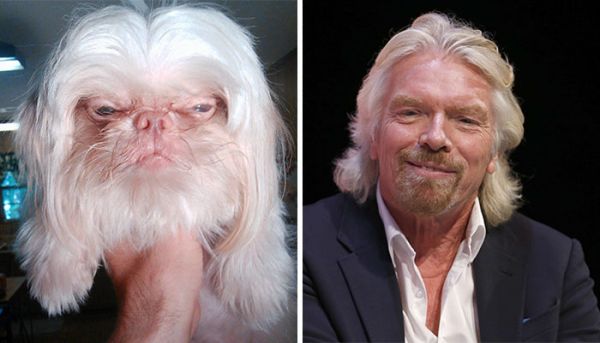 Dog looks like Richard Branson
Bored Panda asked their readers to submit photos of dogs who look like someone (or something) else. Here are some of the submissions they received. There's the old adage that dogs begin to resemble their owners... but who could anticipate them looking like their owners' favorite venture capitalist, cartoon character or most oft-used bath towel? Are these people just seeing things? See the remaining photos to be the best judge.  Greyhound looks like Sid from Ice Age
 Dog looks like Vladimir Putin
 Dog looks like Dumbo the elephant
 Pug looks like Jabba the Hutt
 Shar Pei looks like a fluffy towel
The 'Hacking' Involved in Stealing Celebrity Nude Photos Isn't Even Impressive

Topless selfie via Wikimedia commons (NSFW)
Over the weekend, Emma Watson got in trouble with the uglier parts of the internet when she spoke at the UN about women's rights. Having commited the crime of being an outspoken women's rights advocate, people now claim to have nude selfies of Watson, which they are prepared to leak—out of vengeance, I guess? It could be a hoax, but on the other hand, there was another such leak a couple days ago, which makes the threat plausible.
Although there are still crotchety columnists blaming singers and movie stars for having nude selfies on their phones in the first place, most of the media noise this time around has a very bored air about it. Maybe the voracious appetites of the crotch-pounders on Reddit and 4chan have given the media grainy-boob-shot fatigue. After all, stealing the dark, badly framed snapshots people take in haste to communicate "I'm horny" to their significant others isn't exactly like stealing their polished boudoir pictures. In fact, it's a step above stealing their chest X-rays and jerking off to the nipple outlines.
In other words, this politically-motivated threat against Emma Watson is like the work of the most ineffectual, small-potatoes terrororist group in the world. But if former hacker and leading internet security blogger Nik Cubrilovic is correct, perhaps the only thing less impressive than the photos themselves is the process we're generously referring to as "hacking."
I talked to Cubrilovic about how these photos get stolen. At first I thought we would be discussing who's to blame when these diabolical photo leaks occur, but during our conversation I learned more than I ever thought I would about cloud storage. While it may have been old-school, penetrating-the-firewall-to-access-the-mainframe hacking, it's very possible that these photo thieves accomplish their heists simply by researching celebrities online for hours at a time, and then telling a bunch of lies to get what they're after—more or less the skillset of Hannah Horvath from Girls.

Authorized selfie of Nik Cubrilovic, courtesy of Nik Cubrilovic
VICE: Hi Nik! Who's to blame for all the nude photo leaks?
Nik Cubrilovic: When you try to convey a story to the general public, they often perceive an issue to be very binary: good guy, bad guy. And this is a case where, outside of the actual hackers who broke into the accounts, the blame—and even “blame” is probably a strong word—but the responsibility can be distributed quite broadly.
Is it right to blame Apple?
Does Apple have a responsibility to secure their data? They do. Because the users are putting trust in them.
But what makes Apple less secure?
The best way to explain their culpability (for lack of a better word), is to think about it in this perspective: there are three major mobile crowd providers—everyone belongs to one of these three ecosystems: you’ve got Apple, which is available on the iPhone, you’ve got Google’s cloud services, which are available on Android devices, then you have the Microsoft cloud services which are available on Nokia and other devices. Of those three, Apple is the only company that still has security questions.
So, they’re doing something different, and it just happens that in this case, one of those things that they’re doing different than the other two major providers, was used to break into these accounts.
You’re anti-security question?
Oh yeah[...]. Security questions are a huge flaw. Google got rid of them four years ago or so. Microsoft abandoned them completely about three years ago. So, the core of this issue—if you want to summarize—is the ability to reset a user's password by simply providing their date of birth and then two security questions.
Those security questions have been making me feel safe. What's wrong with them?
When you hit reset, it will show you two of the three questions from when you signed up, and if you get them right, it lets you into the account. [...] The security question scheme is something that used to be used offline in banks and places like that in the 1960s and 1970s to prove your identity. It was adopted online in the 1990s, but companies quickly realized that it was very easy to bypass because on the web today, everybody is just sharing that information. It’s a lot easier to find. It’s a lot easier to go on to Facebook and find out some of these things like date of birth. It’s a lot easier to find what high school they went to, their pet's name, what type of car they drive. And for celebrities it’s even easier to find, because a lot of that information is either on Wikipedia, or on one of the gossip websites.
If I could figure out what Jennifer Lawrence would enter for “favorite city,” and “favorite sports team,” plus I knew her date of birth, then I could get in?
That’s right, yeah. And somebody did do that.
How do you know that's all it took?
It’s not confirmed 100 percent. [However], I knew where these guys hung out. I knew the forums they frequented, and I knew that they were all a part of this sort of subculture of hacking into online backups and stealing pornographic pictures, "revenge porn" or whatever you wanna call it. So [I've been] hanging out in those forums, and speaking to some of those members there. If you read some of their tutorials of how to hack an account—and this is actually the forum where these pictures came from—the number one tutorial is explaining how to answer the security questions.
It's a forum for exchanging tips?
I’ll give you a glimpse of what it looks like on the forum: You’d have somebody post a picture of a car, and it would be like, a maroon Mercedes, mid-1990s model, parked on a beach. Just a car completely in the middle of nowhere, and the question next to it would be, “What type of car is this?” I kept seeing those. There was a picture of a car interior, and some guy was asking what type of car that was. I couldn’t figure out why they were asking that. And it only occurred to me later that one of the security questions on iCloud is “what type of car do you drive?”
So [here's] what these guys were doing: Looking at the public photos of the people they were attempting to hack, and trying to find photos of their cars. Then, when they couldn’t identify them themselves, they were posting those pictures to these forums to get other people to help them out.
They're crowdsourcing their hacking, in a sense?
Yeah. And the penny dropped for me when somebody answered, “Sometimes the girls give their cars a nickname.” The entire forum—90 percent of it—is centered around, first of all, teaching people this method, and then second, helping people—crowdsourcing the answers to the questions. So teaching people techniques like how to stalk somebody online.
To answer some of these questions, you really gotta know your target intimately. You have to spend a lot of time absorbing as much information as you can about them. Then you go back and try and answer their questions. If you go into an Apple account you’ll see there are ten or twelve questions that users can choose from. But all of them, with enough persistence, an attacker can find the answers to.
What about the challenge of finding a person's main email address to begin with?
The way they do it is by paying to access the online people databases such as intelious.com, and there are a couple other providers where you can go in and plug in somebody's name. You pay anywhere from $2 to $60 and you get to get all their public records. So if you know someone’s full, Christian name and where they’re born, you can go and apply for their public database records.
Is there a different method if they're famous?
The second method is social engineering, where you get in touch with an agent or something like that, pretending to be somebody else, and you try and fish out an email address that way. And the third way is that once you’ve hacked one celebrity, you extract their address book, and then you’ve got contacts for a whole lot of other celebrities. That’s what happened in this case. One celebrity getting hacked led to that celebrity having other celebrities in their address book, which then led to the other celebrities.
Should people think of themselves as security vulnerabilities for all of the people they know?
We talk about it being sort of the “weakest link” in the chain. With social networks and address books now, a weak link is often easy to find. An attacker only needs to find one weak link somewhere whereas the [victim] is sort of playing defense. You have to protect and secure everything which involves clues and, everybody that you’ve ever been in contact with, because most modern email clients now will automatically add anybody you’ve emailed into your address book automatically.
I'll have to be more careful then. Thanks Nik!
Follow Mike Pearl on Twitter
Long Live French Wallonia!

Laurent Brogniet (on the right) with Paul-Henry Gendebien, co-founder of the RWF. Image courtesy of the RWF website
Do you remember what happened in Belgium in 2010 and 2011? I doubt you do, and the Belgians prefer it that way, because they didn't have any government for 541 days. It was a serious political crisis, symptomatic of the difficult cohabitation between Flemish people, who speak Dutch, and Walloons people, who speak French. The Flemings have wanted to secede from Wallonia for a long time, and it's quite easy to see where they're coming from: This region has some serious economic problems that have probably given birth to more serial killers than college graduates.
Nevertheless, members of the Rassemblement Wallonie France (RWF) decided to take action first. The RWF is the principal political party pleading for rattachism, which basically consists of transforming Wallonia into a French region.
Obviously, it's quite difficult to unite voters under such a slim banner, and their results in the 2014 legislative elections tend to prove it: Only 0.5 percent of the population who were old enough to vote put RWF ballots in the box. But rattachists are not throwing in the towel just yet, and some polls seem to indicate that there's sympathy for their cause in Wallonia as well as France. From a practical point of view, rattachism seems unavoidable in the long run, given the Fleming's secessionist leanings. I met with Laurent Brogniet, the RWF's president, to find out more.
VICE:What can you tell us about your party?
Laurent Brogniet: The RWF was created in 1999 after several Flemish parties announced their will to transform the Belgian state into a federal state. In response, a handful of militants successors of the Walloon Movement created the party, defending the unification of Wallonia with France.
Do you have any political program aside from rattachism?
Yes. We defend pluralism because we have left-wing and right-wing people. We don't take sides on important social issues, because it would cause a dichotomy inside the RWF. But we have opinions on education, secularism, etc. We want to pursue the legacy of Charles De Gaulle.
What's the deal with Flemish people?
Well, Flanders doesn't want Wallonia to be part of Belgium anymore. Since the 1970s, it ceaselessly demanded more autonomy. The state of Belgium has been ripped off of all its prerogatives. Basically, regions and communities have bigger budgets than the federal state. It's turning into an empty shell, a so-called state ruled by a powerless king. The proof is that, during the 2010-2011 crisis, we didn't have any federal government for 541 days but the country carried on thanks to the regions and communities that had taken the reins. So, what's the point of going independent? We have a linguistic, cultural, and political proximity with the French Republic.

The RWF flag
If I understand correctly, Wallonia is too small to be an independent state?
Not only is it too small but, above all, Wallonia has never been a nation. It was always part of a whole; the Netherlands, France, the Kingdom of Belgium. There is no national feeling in Wallonia, unlike Flanders, where it's been really powerful since the 19th century. It's not possible to create a Walloon state.
The number of votes your party has received has been low, but do you think the Walloon people are sympathetic toward rattachism?
There is sympathy, without a doubt. During the Belgian crisis, some surveys have been conducted in Wallonia. In case of Belgium's disappearance, the most desired option was a union with the French Republic; between 30 and 40 percent of Walloons were in favor of this solution.
That being said, the Belgian state still exists. Our prime minister, Elio Di Rupo, deceived people with a good PR campaign and our performance during the World Cup. But it's being ignorant of the Flemish secessionist dynamic; because of them, I'm convinced the Belgian state will come to an end.
You seem to be even less popular in Brussels, a French-speaking city isolated in Flanders.
Brussels is one of the three federal states of Belgium. This region has its own Parliament and ministers. Brussels inhabitants don't identify at all with Wallonia. They don't think rattachism could be good for them. We want to convince them, but we are not very optimistic. Even when Belgium falls down, I don't think they'll make the right choice.
Why would France accept this solution?
First of all, there's a geopolitical interest. Since Germany's reunification, France's influence in Europe has diminished. Concretely, Germany has more seats in the European Parliament, which wasn't the case in the past. Being able to recover our territory, people, and seats would close the gap between France and Germany.
The other interest is economic. Wallonia would be the eighth French region in terms of GDP. France could benefit from the multilingual and qualified workforce.

A RWF rally. Image courtesy of the RWF website
OK, but it seems that some French people don't want Wallonia to be part of France. It has even been compared to Crimea—
Opinion polls have been conducted in France and between 60 percent to 65 percent of French people are in favor of the union. It's noteworthy that in bordering counties, this rate rises to 70 percent. We're not talking about the [far-right] nationalists, obviously.
Do you have some discussion with French political parties?
We discuss with the Socialist Party and the Union for a Popular Movement, the two main parties. We reject all extremist parties. We have formal and informal connections with French representatives. They are really concerned about what's happening in Wallonia. They confirm that, when the time comes, if a legitimate authority—that is to say a referendum—expressed this demand, they would gladly accept it.
What about the King of Belgium?
He'll do whatever he wants. You know, our past king, Albert II, lived for 300 days a year in Grasse [a city in France]. These people live off the backs of taxpayers. The king will go to one of his many mansions and he'll live happily ever after with his family. Needless to say, we're republicans. We think monarchy can't be democratic because the citizens don't elect their head of state.
Follow Pierre-Alexis Chauvin on Twitter.
18 Mac Tips That Will Make You A MacBook Pro
Did someone say EMOJI KEYBOARD?!

Alejandro Escamilla / BuzzFeed / Via unsplash.com

Depending on the program you type in, the Emoji might only appear as a rectangle, but they will be visible on mobiles.
Daniel Dalton / BuzzFeed

Sums is hard, yo.
Daniel Dalton / BuzzFeed
This Man Has 100 Orgasms A Day
And that’s much less of a good thing than you might think.
This is Dale Decker. He has 100 orgasms a day.

Ruaridh Connellan / Barcroft USA
And he says it's ruining his life.

Ruaridh Connellan / Barcroft USA

Ruaridh Connellan / Barcroft USA Ruaridh Connellan / Barcroft USA
The Most Common Darwinian Misconception About Female Sexuality

For decades, most evolutionary biologists based their understanding of female mating choice on a paper that turned out to be incorrect. The idea that females (including human ones) always choose the single "best" mate, rather than choosing promiscuity? Wrong.

Fricasé de pollo al pimentón
Gracias, señora Child. / EL COMIDISTA
Unos la conoceréis por la película Julie y Julia. Otros, por libros como El arte de la cocina francesa. Otros, tras haber caído en algún programa suyo del año de la polca en YouTube. Y otros no tendréis la suerte de conocerla. Para todos está destinada esta receta, homenaje rendido de un fans a la gran Julia Child.
Esta mujer mayúscula fue la primera gran estrella de la televisión culinaria de la historia. Tras aprenderlo todo sobre la gastronomía francesa en los años que vivió en Francia después de la II Guerra Mundial, Child volvió a Estados Unidos en los sesenta para evangelizar a sus despistados compatriotas en las artes del buen comer. Tras aparecer en un programa educativo hablando sobre su primer libro y enseñando cómo se hace una tortilla, esta fuerza de la naturaleza comenzó su propio show de cocina, The french chef, en 1963, y no paró de hacer excelentes espacios de tele hasta los noventa. Su labor bien se podría comparar con la de Karlos Arguiñano en España: dotada de una socarronería única, logró transmitir sus conocimientos y su pasión por la comida bien hecha a un montón de personas que no tenían ni pajolera idea de guisar.
La receta de hoy es su fricasé de pollo. Los fricasés, según cuenta Child, están a medio camino entre el salteado (cocción sin caldo) y el estofado (con mucho caldo). Ella prepara este clásico francés a la manera clásica; yo me he permitido algunos cambios (espero que tu espíritu me perdone, Julia) para adaptarla a unos tiempos modernos en los que, para bien o para mal, necesitamos platos algo más ligeros y no tan laboriosos.
La adición del pimentón picante es una genialidad que ella misma propone como variante, y que en mi opinión saca al plato de lo convencional y lo hace aún más excitante. ¿Lleva mantequillaza? Sí. ¿Lleva harina? También. ¿Lleva nata? La original sí, aunque yo la sustituyo por leche evaporada, que no empapuza tanto. Para los melindrosos de lo light que se desmayen cual damiselas de época ante la visión de estos ingredientes, recordaré unas palabras de la propia Julia en una entrevista que dio al New York Times en 1990 y qué hoy suenan más actuales que nunca: ''Si el miedo a la comida continúa, será la muerte de la gastronomía. Debemos disfrutar y divertirnos comiendo, porque éste es uno de los placeres más simples y agradables de la vida''.
Por cierto, la segunda parte de El arte de la cocina francesa se publica en España en octubre. ¡Todos listos para un nuevo festín!
Dificultad
Es larguilla, pero fácil.
Ingredientes
Para 6 personas
- 1 pollo troceado, a poder ser de corral, de entre 1,5 y 2 kilos
- 2 zanahorias
- 2 cebollas
- 350 g de champiñones
- Unas 20 cebollitas enanas
- 2 huevos
- 200 ml de leche evaporada (en su defecto, nata líquida con 18% de materia grasa)
- 1 litro de caldo de pollo
- 350 ml de vino blanco seco
- 1 atadillo de hierbas (laurel, tomillo, etcétera)
- 1/2 cucharadita de tomillo
- 2 cucharaditas rasas de pimentón picante (o rebajar con una de dulce, si se prefiere)
- 1 limón
- Pimienta blanca
- Harina
- Sal
- Mantequilla
Preparación
1. Pelar y cortar en rodajas no demasiado finas las zanahorias y las cebollas. Rehogarlas en una cazuela grande a fuego suave con una cucharada de mantequilla unos 5 minutos. Sacarlas y reservarlas.
2. En la misma cazuela, subir un poco el fuego e incorporar el pollo, dorándolo un par de minutos por cada lado.
3. Tapar la cazuela, bajar el fuego y dejar que se haga muy suave unos 10 minutos.
4. Mientras, ir calentando el caldo de pollo.
5. Espolvorear el pollo con dos cucharadas rasas de harina, sal y pimienta blanca. Dar unas vueltas para que la harina se reparta bien. Tapar y cocer 4 minutos más.
6. Incorporar por último el pimentón y rehogar un minuto más.
7. Mojar el pollo con el caldo hirviendo. Mover la cazuela para que ligar la harina con el caldo. Añadir 250 ml del vino y el atadillo de hierbas. Tapar y cocer unos 45 minutos (30 si es pollo no de corral), o hasta que esté tierno.
8. Mientras se hace el pollo, preparar las cebollitas y los champiñones à blanc. Escaldar las primeras en agua hirviendo para poder pelarlas. Ponerlas en una sartén (importante que no se amontonen) con una cucharadita de mantequilla, 100 ml de vino, el tomillo, sal y pimienta blanca. Cubrir casi del todo con agua y poner a cocer tapadas a fuego medio, vigilando que no se queden sin líquido, una media hora, o hasta que estén tiernas. Finalmente destapar y dejar reducir el líquido del todo, con cuidado de que no se doren. Reservar.
9. Cortar los champiñones en cuartos o en mitades, dependiendo del tamaño. Cocer en unos 250 ml de agua hirviendo con una cucharada de zumo de limón y sal unos cinco minutos a fuego vivo. Sacar y reservar. Añadir el agua de cocción al pollo.
10. Sacar el pollo del caldo y reservar. Reducir el caldo hasta que se forme una salsa no demasiado espesa, pero con cuerpo.
11. Batir en un cuenco las yemas de los huevos con la leche evaporada o la nata. Añadir un cazo de la salsa y seguir batiendo. Repetir este proceso tres o cuatro veces.
12. Verter la mezcla anterior en la cazuela en la que hemos hecho el pollo. Subir el fuego y sin dejar de remover, esperar a que hierva. Remover un minuto más, y añadir un chorro de zumo de limón y nuez moscada al gusto. Si se quiere que pique más, se puede añadir un poco más de pimentón. Rectificar de sal.
13. Devolver el pollo a la cazuela con los champiñones y las cebollitas (hasta aquí se puede hacer con antelación). Calentar y servir.
The Secret to Making Really Awesome Hot Sauce
Welcome to Out of the Kitchen, our ongoing exploration of America’s coolest food artisans. Over the next few months, we’re apprenticing with the best knife forgers, cider brewers, and spice blenders, then bringing their knowledge and expertise back to our home kitchens—and to yours.
Hey! Do you want to know a secret? It’s a secret about hot sauces—and you like hot sauces, right? Well, look, I’ve tried a lot of them, from Tabasco and Sriracha to nameless concoctions in unlabeled, reused Lucozade bottles from second-tier Caribbean islands. I’ve nibbled sky-facing chiles in Chongqing housing complexes and filled bags with dried miraciels in Chiapas markets. I’ve eaten raw Reapers and lived to tell the tale. And most recently, I observed Ariel Fliman and Brian Ballan, the guys behind A&B American Style, as they whipped up an enormous batch of their flavorful pepper sauce in Queens.
Now, after taking their advice and making hot sauce in my own home kitchen, I can reveal the secret: Making hot sauce is really pretty easy.
See, hot sauce is pretty forgiving. Use fresh, spicy chiles and enough vinegar, and you’ll create a condiment that will set your mouth aflame in just the way you like. And there’s isn’t much you can do to screw that up, short of pouring whipping cream into the mix. The process is that simple. As Ballan explained it to me, you’ve got four elements: chiles, acid, aromatics (carrots, onions, etc.), and salt. Get roughly the right proportions of each, and you’ll wind up with something downright edible, and maybe even quite tasty.
That’s not to say that making a fantastic hot sauce is easy. Quite the contrary. Mastering those proportions takes trial and error, as does navigating the different varieties of sauces—cooked, raw, fruit-based, ketchupesque.… And of course, there’s sourcing: Which of the million varieties of chiles are you going to use? Fresh, dried, or a combination of the two? What kind of acid—white vinegar, cider vinegar, citrus…? How much will different varieties of salt affect the outcome?
In my own years of making hot sauces at home, I’ve come up with some I loved and others that were perfectly fine if I didn’t think too hard about them. This year, though, I wanted to be more mindful of the process, and so I set out to create one sauce that would hew to A&B’s principles, if not their precise recipe: simple, fresh ingredients you actually want to taste (carrots, onions, and two kinds of chiles, one hot, the other not so), simmered in a bath of white vinegar, puréed into a crimson slurry. Oh, and no added sugar.
When you make a hot sauce this way, the most tedious part is prepping the ingredients. I shredded two fat carrots before getting bored and deciding to simply put everything else—i.e., two sliced red onions, kosher salt, a dozen cloves of garlic, and a pound of red jalapeños (the kind used for Sriracha) and red habaneros—in a pot with a quart of white vinegar and turning the heat to medium-high. Once that had simmered for a little while, I poked in my stick blender and blitzed everything into a liquid. Done!
Well, not quite. The liquid was, you know, liquidy—not so much a sauce as a drizzle. Of course, it was bubbling in a pot on the stove, so I just left it there to slowly reduce, knowing that the cooking process would also temper the heat of the chiles.
While that was going on, I turned my attention to my second sauce. This was to be a fantasy sauce. I’d been dreaming of a really hot sauce with a bright, sweet-tart grapefruit element—something to drizzle over, say, carnitas—but I’d been unsure how to accomplish that. In talks with Ballan at the A&B facility, we’d bandied about some theories. Don’t cook the citrus, he warned, or it would lose its oomph. Should I use grapefruit zest, too, I wondered? What kind of chiles would match well with the fruit? Ballan didn’t have hard-and-fast answers, but neither did he warn me off experimenting. His partner, however, suggested that I do so in a well-ventilated kitchen.
So I experimented! The chiles consisted of maybe half a pound of lemon drops (a small, canary-yellow pepper with a sharp bite), orange habaneros, and green serranos—which presented a problem, sort of. Green chiles may look and taste great, but they often turn brown over time when made into sauce. To sidestep that, I browned them myself—blackened them, really—under my oven’s broiler.

Into the pot they go.
Then I put all the chiles in a quart-sized plastic container along with several good glugs of rice vinegar (which I like both for its sweetness and the way it won’t overwhelm other ingredients), kosher salt, the juice of one lime, the zest of a lemon, and the juice of half a ruby-red grapefruit. Why those specific citruses? The lime was for pure acidity, the lemon zest for a more rounded citrus flavor, and the grapefruit for its intense fruitiness. Into the container went the stick blender again, and 60 seconds later I had a new hot sauce.
Would it be any good? I dipped in a spoon, scooped out a small blob of black-flecked green, and brought the bite to my mouth—it exploded on contact! In an instant, every part of my mouth was aflame, yet suffused with that sweet-tart intensity of grapefruit. And although the heat lingered as I hoped it would, it also leveled off, revealing the smokiness that came from roasting the serranos. This, by some wonderful magic, was an excellent concoction.
Would the A&B-style sauce turn out likewise? After an hour’s simmer, it had reduced enough to take it off the heat. And while I knew I could taste it straight, it didn’t seem right. But this was meant to be enjoyed with food. So I got to work again, poaching a whole chicken in a small pot with ginger, scallions, and garlic, removing the chicken after 20 minutes to an ice bath, and cooking rice in the new chicken stock. This you may recognize as a version of Hainanese chicken rice, the Singaporean classic that is meant to accompanied by a hot sauce made from red chiles, vinegar, and garlic—precisely what I’d made.
And, yeah, as an accompaniment to food, it was good! My sauce was hotter than what A&B makes, and maybe less market-fresh (more carrots next time?), but still a fabulous counterpart to the cool chicken and stock-saturated rice. It hit me (and my wife) with a vinegary punch, but didn’t outstay its welcome. You could eat it with every bite and not blow out your taste buds.
The thing is, now that I’ve made hot sauces more mindfully, thanks to A&B, I’m not sure what I (or you) should do differently next time—besides everything. “Hot sauce” as a concept is fantastic, but it’s hardly one-size-fits-all. You like what you like, and use it wherever seems right. Who am I to tell you how to make it, except to keep in mind Ballan’s quadruplets—chiles, acid, aromatics, salt?
I will, however, tell you that you should definitely make hot sauce at home. The homemade version, no matter how you home-make it, tastes fresher, more alive, more satisfying than anything you’d ever get from a store. (Trust me, I taste-tested dozens of varieties for a competition, and would still probably choose a janky-but-fresh homebrew over all but a few.) And chiles, generally speaking, are highly affordable, so what’s there to lose? Buy a couple of pounds, break out the stick blender, and make enough to give bottles to your friends.
And I’m your friend now, right?
The post The Secret to Making Really Awesome Hot Sauce appeared first on Bon Appétit.
Fred Armisen & Carrie Brownstein Love Breakfast Tacos, Avoid Tapas Ghettos
Fred Armisen and Carrie Brownstein, the Portlandia co-stars (and first-time cookbook authors) have plenty in common. Partying isn’t one of them.
This is our Entertaining Issue. What are your biggest pet peeves as guests and hosts?
Fred: I don’t think I’ve ever hosted anything in my life. As a guest, I’m always flattered just to be invited. But I do enjoy when there’s food out on my arrival. Olives, cheese, crackers…
Carrie: The few times I tried to throw a party, my anxiety level was off the charts. I ended up in my room, alone, waiting for people to leave.
Describe each other’s relationship with food in one word.
Fred: I’d say Carrie’s is ‘private.’ She really likes eating in her car.
Carrie: I always joke that my car is my favorite restaurant.
Fred: Whereas my relationship is more of an ”emergency.” When I’m hungry, I need to eat right away.
Who’s the more adventurous diner?
Carrie: We both love sushi and getting the omakase, but Fred is more daring. He’ll try anything the chef brings to the table. I make him eat the sea urchin.
Fred: And the eel.
In The Portlandia Cookbook, you refer to “the tapas ghetto.” Explain.
Carrie: I like tapas. It’s an adventure in getting to order more off the menu. But I know it stresses Fred out.
Fred: If you’re on the wrong side of the table—the tapas ghetto—you actually miss out on a lot of the items. Everyone picks at the mushroom thing or the toasty thing and you end up with nothing.
Any favorite Portland restaurants?
Carrie: I really like this place called Expatriate, run by Naomi Pomeroy and her husband. They make a great cod sandwich.
Fred: Screen Door, Pok Pok, and Tasty n Sons, which has this ridiculous radicchio salad. I’m not a salad person, and I could eat it forever.
Best and worst Portland food trends?
Fred: Best is anything with eggs on it. I am not, however, a fan of whole fish; I like my food to be cut up for me.
Carrie: The worst is that people will line up around the block for ice cream, but they won’t line up to vote.
Strangest items in each of your fridges.
Fred: A Flaming Lips record with a big white-chocolate skull and brain coming out of it.
Carrie: Syringes full of teeth-whitening gel.
A food you would like to be reincarnated as.
Fred: A wax hamburger, so no one eats me.
Carrie: Breakfast cereal; it rarely disappoints.
What food can you not control yourself around?
Fred: Breakfast tacos. They’re like a drug.
Carrie: It’s hard to find a good one outside of Texas, but HomeState in L.A. is a blessing and a curse. We’ve eaten there the last six days.
Death row last meal.
Fred: Styrofoam peanuts from packaging so that my cause of death is questionable. Like, “What happened?! Was it the peanuts or the lethal injection? We don’t know.”
Carrie: That’s very kind of you to spare the executioner the guilt, but I’m going with a cheeseburger. People can fight over the death penalty after I’m gone.
Who’s on your dream dinner party guest list?
Fred: Among others, Yoko Ono, Cindy Sherman, John Waters, Captain Sensible and Dave Vanian of The Damned, Mick Jones and Paul Simonon of The Clash, all of Sleater-Kinney, Steve Jones of the Sex Pistols, Mark and Bob Mothersbaugh…
Carrie: Jeez, such a big dinner party! I’d be overwhelmed. I’d probably show up for a little bit, say hi to everyone, and then sneak off to eat in my car.
Want even more Portlandia? Check out our food map!
The post Fred Armisen & Carrie Brownstein Love Breakfast Tacos, Avoid Tapas Ghettos appeared first on Bon Appétit.
MFC CHICKEN - Music For Chicken [2012]


No quiero sexo, mejor abrázame
Alguien tenía que decirlo: el cine en 3D no hace que las películas molen más

"La tecnología 3D no mejora la experiencia de visualización".
Gente importante lo confirma: la beca Erasmus sirve para ligar

Europa sí tiene futuro: un millón de bebés han nacido fruto del amor entre dos Erasmus.
Si viajas a cualquier lugar, nunca le preguntes al lugareño
Muchos tenemos una idea romántica de viajar que cosiste en llegar vírgenes y prístinos a un enclave y dejarnos guiar por los lugareños, todos sabios y con alma de cicerone, dispuestos a compartir sus conocimientos secretos del lugar con nosotros. Pero esta idea podría tener demasiados inconvenientes si echamos un vistazo a los estudios sobre cómo la gente interpreta lo que le rodea o transmite su cosmovisión de las cosas.
Asumamos, aunque sea de perogrullo, que los lugareños puede que nos indiquen un restaurante, un rincón recoleto o una actividad poco turística que nos resulte excepcional. Todos nosotros, yo incluido, tenemos buenas experiencias que contar al respecto. Pero también hay que tener en cuenta que la gente suele tener una visión muy parcial de las cosas: sí, es un buen restaurante para el lugareño, pero ¿es bueno en comparación con el resto? (y a esa pregunta solo podemos responder probando todos los restaurantes de la zona) ¿Lo que él considera bueno es también bueno para nosotros? ¿Puede que algún tipo de sesgo cognitivo influya en su respuesta? ¿Puede que sencillamente nos esté mintiendo para reírse de nosotros o que no tenga ni repajolera idea de lo que dice? Entre el 1 y el 4 por ciento de la población mundial tiene inclinaciones psicópatas, ¿cómo saber si el pintoresco local que tenemos delante no lo es?
Todo esto viene a colación de una anécdota que me ha ocurrido hace poco en otro sitio en el que escribo. Tras echar por tierra una serie de tópicos sobre un determinado país, como que su consumo de té no es tan elevado como se creía atendiendo a las estadísticas, diversas personas me han enmendando la plana. Sobre todo un cocinero que trabajaba en dicho país y que aseguraba, según palabras textuales, que el consumo de té sí que era elevado porque todos sus conocidos tomaban mucho té, y en cualquier supermercado hay muchas variedades de té, lo cual evidencia la gran demanda al respecto. Otra persona adujo directamente que las estadísticas no siempre son fiables, así que debíamos respetar la opinión del cocinero; y que poner en duda la fuente de su conocimiento (la experiencia personal) era una muestra de pedantería y temeridad.
Quienes me conocen ya pueden imaginar el terremoto mental que sufrí. Lo que leía no solo violaba el rigor epistemológico más elemental, sino que parecía una broma. Como las estadísticas son poco fiables, ¿nos fiamos mejor de una única persona? Como existen errores y negligencias médicas, ¿la próxima vez nos fiamos de la intuición del cocinero del hospital a la hora de decidir cómo proceder en una operación a corazón abierto? La mayor muestra de pedantería y temeridad, de hecho, es afirmar que se puede saber más personalmente de lo que sugiere una estadística (sobre todo si tus pruebas al respecto se basan en observaciones subjetivas).
Lo que os intentaré demostrar a continuación no es solo el poder de la estadística sobre nuestras intuiciones, generalmente erróneas, sino que los lugareños ofrecen información, a menudo, contradictoria no solo con la de otros lugareños, sino con ellos mismos. Para eso nos adentraremos en el caso de cómo los viajeros a menudo han explicado mal las cosas que han visto, y también cómo los lugareños les han explicado solo su visión parcial e incompleta de la realidad. Un viajero que no lee acerca del lugar al que viaja, pues, difícilmente obtendrá una interpretación certera de lo que está viendo, al igual que un viajero que solo lee y nunca viaja, tampoco tendrá una experiencia completa del viaje.

Imagegallery Tourism NT
La gente es tonta
Sí, la gente es tonta. No es un insulto indiscriminado, sino una generalización que también me incumbe, porque yo también soy gente. Todos somos tontos. No importa lo que hagamos, lo que leamos, lo que aprendamos, los nootrópicos que consumamos. Seguiremos siendo tontos. Esta idea, totalmente contraintuitiva y desmoralizadora, de hecho, apenas tuvo arraigo en el mundo hasta mediados del 1600, por las mismas fechas que se inauguraba el Colegio Invisible y se fundaban los basamentos de la ciencia.
La ciencia no podría existir si, previamente, gente mucho más inteligente de lo habitual no hubiese asumido que era tonta. Que no podía fiarse de ella misma, y ni siquiera podía fiarse de los que parecían más inteligentes todavía. Aceptar este cambio de paradigma fue tan arduo y doloroso como, en su día, asumir que la Tierra no era el centro del Universo o que el ser humano era solo un animal más dentro del alambicado proceso evolutivo. Es lógico, pues todos esos cambios de paradigma implicaban empequeñecer al ser humano, volverlo todavía más minúsculo y escasamente importante para el devenir del mundo.
Tan gravoso ha sido aceptar estos cambios de paradigma que aún hoy, en el siglo XXI, existen algunas personas que todavía sostienen el heliocentrismo o el diseño inteligente (o la versión más burda, el creacionismo). Son los menos, naturalmente, pero no así ocurre con la asunción de que, insisto, somos rematadamente tontos y no podemos confiar en nosotros mismos. Por ello, esta aserción apenas ha calado extramuros del mundo académico, sobre todo científico. Cualquier persona de la calle, incluso con formación universitaria, afirmará sin dudarlo que él no es tonto, que incluso está por encima de la media, que sabe por qué hace las cosas, que puede confiar en sus intuiciones y, sobre todo, en sus percepciones. Los que saben que eso es incierto son los que se dedican a trabajar con el método científico, o con otras herramientas que subsanan los errores de interpretación humanos. Por ejemplo, en un tribunal, los testigos oculares apenas tienen peso si no hay pruebas que respalden sus afirmaciones. Un buen ejemplo de lo quebradizo que es un testigo ocular es la película Doce hombres sin piedad, de Sidney Lumet.
Francis Bacon sabía que éramos tontos, él incluido, por eso señaló que debíamos empezar a desconfiar de todo el conocimiento atesorado por gente que creía saber cómo funcionaban las cosas. Y que, a partir de ahora, solo daríamos por válido un conocimiento que hubiera sido expuesto a los ojos de la mayoría de expertos, sometido a juicio, superado controles y protocolos exigentes. Y, aun así, dicho conocimiento podría modificarse o eliminarse en cuanto alguien, aunque solo fuera una única persona sin nombre importante, demostrara que había un error.
Una de las herramientas que suelen emplearse para evitar la tontunez humana es la estadística. A través de la estadística conseguimos que la intuición personal o el cálculo a ojo cubero no malinterprete la realidad. Si no existiera la estadística, la mayoría de la gente creería que viajar en avión es más peligroso que viajar en coche porque el avión le da más miedo. La estadística corrige esa miopía, o ese anumerismo que denuncia el matemático John Allen Paulos en El hombre anumérico. La estadística también permite saber cuán peligroso es conducir. Si nos ofrecen la cifra de mil muertos al año, en realidad no sabemos nada sobre la peligrosidad de conducir, porque faltan datos del tipo ¿cuánta gente conduce? ¿Cuántas horas se conducen? Si incluimos esos parámetros, entonces descubrimos que muere casi tanta gente conduciendo como sufriendo accidentes en casa, sobre todo en el baño o en las escaleras.
La mayoría de la gente cree que no es tonta. Afortunadamente, miles de psicólogos pueden demostrar tras décadas de experimentos que la gente no solo es tonta, sino que es mucho más tonta de lo que generalmente cree.

Oiga, buen hombre, ¿para ir a Notre Dame?
Llegamos a París, queremos ir a la Torre Eiffel o a Notre Dame, preguntamos a un parisino y nos indica que estamos cerca o lejos o a cinco minutos o a diez, y que queda justo hacia aquella dirección, torciendo tres calles más tarde a la derecha, y luego a la izquierda tres calles más. Es probable que sus indicaciones sean certeras. Que finalmente lleguemos adonde queríamos ir. Pero esas indicaciones jamás tendrán la precisión de un GPS. Ni siquiera puede que se acerque a ella.
Un parisino, aunque lleve toda su vida viviendo en la misma ciudad, no tiene necesariamente un mapa mental proporcionado de la ciudad. Es lo que demostró Stanley Milgram en la década de 1960, tras recopilar cientos de mapas dibujados por parisinos de todas las edades y todas las profesiones, incluidos arquitectos y universitarios, gente aparentemente formada. En los mapas, en ocasiones, se omitían enclaves famosos, como precisamente la Torre Eiffel y Notre Dame. Pero el error más sutil estaba en el Sena, el río que cruza la ciudad. El 92 % de la gente subestimaba la curvatura del Sena, tal y como publicó Milgram en su artículo “Psychological Maps of Paris” para Environmental Psychology. No hablamos de unos pocos, ni de la mayoría, sino de que prácticamente todos los parisinos ignoraban cómo se curvaba el Sena al cruzar la ciudad. Como si fueran turistas ignorantes.
Incluso en un estudio similar, los taxistas, en apariencia perfectos conocedores de los recovecos de la ciudad, enderezaban en su mayoría las calles de la ciudad. Como si su mapa de Manhattan estuviera bajo el influjo del LSD. También las distancias cortas se exageran, y las distancias largas se subestiman. Así, a la hora de preguntar cómo llegar a determinado lugar, la respuesta en general distará de ser precisa, cuando no errónea, tal y como señala Joseph Hallinan en su libro Las trampas de la mente:
Cuando se le pide a la gente que navegue utilizando puntos de referencia, como sus casas o un edificio famoso cercano, sucede algo incluso más extraño: juzgan que la distancia a un punto de referencia es menor que la distancia desde un punto de referencia. Esto es cierto incluso en comparaciones a gran escala. Por ejemplo, la gente juzga que Corea del Norte está más cerca de China que China de Corea del Norte.
De igual modo que nos fiaremos más de un mapa para saber cómo discurre el Sena antes que del criterio de la mayoría de los locales, imaginaos lo que sucede con cuestiones más complejas que atañen a la vida cotidiana de un lugar.

Dígame, ¿y la gente cómo es por aquí?
Metodológicamente, lo más desaconsejado a la hora de conocer a fondo un lugar es preguntar nada a nadie sobre ese lugar. La gente sabe cosas, sobre todo si vive en determinado sitio. Pero lo que sabe es solo su visión de las cosas, parcial e incompleta. Además, los detalles que los lugareños registran en su día a día a menudo tienden a ser eliminados si resultan inoportunos o contradicen algunas de sus ideas preexistentes. Los hechos que sencillamente no encajan, se olvidan o se reinterpretan. Y los que encajan, se usan como ejemplos paradigmáticos. Al igual que un racista frente a un afroamericano, que tenderá a recordar más los ejemplos donde el afroamericano se comporta mal o resulta maleducado antes que al contrario.
Siguiendo con mi anécdota acerca del consumo de té, el tipo que puso en duda la estadística al respecto también cuestionó mi afirmación de que los habitantes de dicho lugar no precisaban más ortodoncia que en otros países. El tipo aducía que eso era falso, que solo hacía falta caminar por las calles para ver que mucha gente tenía los dientes mal. Y que yo, en consecuencia, no tenía ni idea. Porque yo no vivía allí como él, y por tanto no me cruzaba cada día con gente que recordaba a Bugs Bunny.
Una afirmación semejante habría constituido la expulsión inmediata del Colegio Invisible. Recordad, no hay que cansarse de repetirlo: la gente es tonta. Tú eres tonto. Yo soy tonto. Por eso no hay que fiarse de lo que ves, sobre todo si estás realizando una estadística mental de todos los habitantes de un país. ¿Con cuántas personas te has cruzado de los sesenta o setenta millones que viven por allí? ¿Has sido capaz de recordarlas todas? ¿Has comparado todas esas personas con las personas que viven en otros países del mundo para establecer que sí existe mayor necesidad de ortodoncia? Si ni siquiera nos ponemos de acuerdo sobre quién ha fregado más veces los platos en casa, ¿cómo vamos a saber si hay mucha o poca gente así o asá?
Obviamente, este ejemplo es tan delirante que no precisa dedicarle demasiado tiempo para desmontarlo. Sin embargo, estos errores de apreciación se producen en asuntos mucho más sutiles, que incluso pasarán mayormente desapercibidos por nosotros a la hora de informarnos sobre un lugar.
Si hablamos con un local acerca de la comida típica, las costumbres típicas o las manías más arraigadas, no podremos evitar asumir que todo lo que nos dicen es verdad. Pero no hay forma de saber si es así. De hecho, es tan difícil distinguir la verdad de la interpretación de la verdad que los antropólogos lo tienen casi imposible a la hora de estudiar una cultura in situ. La propia presencia del antropólogo incluso puede estar adulterando el comportamiento cultural de los locales, como la luz entrando en una sala de revelado de fotografías.
Uno de los principales investigadores sobre esta tendencia a capturar parcialmente la realidad cultural que nos rodea fue el psicólogo de la Universidad de Cambridge sir F. C. Bartlett en su estudio “Remembering: A Study in Experimental and Social Psychology”. Su experimento más famoso al respecto se llevó a cabo con La guerra de los fantasmas, un cuento popular de los nativos americanos que procedía de finales del siglo XIX y que originalmente se narraba en lengua kathlamet, un dialecto hablado por los chinook que habitaban el curso del río Columbia, entre el actual Washington y Oregón. La historia fue traducida y publicada en inglés en 1901, justo antes de que el dialecto se extinguiera para siempre.
Lo que hizo Bartlett fue dejar leer a veinte ingleses, siete mujeres y trece hombres, La guerra de los fantasmas. El texto apenas tenía una página, así que, tras un pequeño período de tiempo, los lectores debían escribir todo lo que recordaran de la historia. Los detalles de la historia fueron recortados, cambiados e incluso omitidos por los lectores ingleses. Pero lo más interesante fue que la historia se racionalizó bajo el prisma cultural inglés. Los lectores ingleses intentaban encajar la historia en su propio modelo del mundo. Le otorgaban un sentido que sincronizara con la idiosincrasia inglesa, no con la original, que se ignoraba. Como el propio Bartlett admitiría: «Pronto la historia tiende a verse privada de sus formas sorprendentes, chocantes y aparentemente incoherentes y a reducirse a una narración ordenada».
Esta adulteración no se produce al intentar penetrar con nuestras herramientas intelectuales en otra cultura, sino que se produce también al intentar descifrar nuestra propia cultura compartida. Es decir, un lugareño, a fin de cuentas, tiene una visión de las cosas, y esa visión influye en cómo interpreta la cultura compartida de los otros lugareños. Nosotros venimos cargados de nuestra propia idiosincrasia, tratando de darle significado a lo que nos cuenta un señor que, a su vez, filtra a su manera lo que pasa a su alrededor. Conclusión: hemos visto una proyección desenfocada de una adaptación cinematográfica hollywoodiense acerca de una cultura extinta a la que solo podemos acceder a través de las memorias de un marinero que en su día tuvo contacto con ella. Estoy exagerando. Pero nuestra forma de desvirtuar la realidad es tan patológica y queda tan oculta en diversas capas de autoengaño que solo a través de la hipérbole somos capaces de acercarnos un poco a la magnitud del desastre.
Nuestra única salvación al respecto es penetrar en la cultura a través de instrumentos esterilizados, datos contrastados y estadísticas. Todo ello puede estar igualmente contaminado, viciado o hasta manipulado. Pero entonces nuestra labor consiste en mejorar el proceso, o en denunciar las fallas con otros estudios metodológicamente similares. Lo que resulta de todo punto ilógico es llamar por teléfono a un cocinero y preguntarle, oiga, ¿la gente de aquí tiene los dientes que parecen Tiburón o no? (En cualquier caso, deberíamos llamar a cientos o miles de personas de forma aleatoria y abarcando varios segmentos sociales para formular la misma pregunta, realizar una estadística y obtener el siguiente dato: «la mayoría de la gente de este lugar cree que tiene los dientes mal», lo cual dista de parecerse a «la mayoría de la gente de este lugar tiene los dientes mal»).

No todo es evitar mancharse
Después de esta apología al viaje a través de los libros, los datos y la comodidad de la biblioteca, no puedo evitar recordar que viajar no solo consiste en ver las cosas a través de un viril de museo. Para capturar toda la experiencia de un lugar, además, hay que trasladarse físicamente a ese lugar. Y, por supuesto, hablar con los lugareños (aunque tomándose sus aserciones con cierta distancia).
El viaje debe ser físico y palpable porque así ponemos en marcha nuestros cinco sentidos. Al viajar a un lugar desconocido, prestamos más atención de lo habitual, como esponjas, tal y como señala David Brooks en su libro El animal social: «Esta receptividad se produce solo cuando estamos físicamente ahí, no cuando leemos sobre un sitio, sino sólo cuando estamos en el escenario, inmersos en él».
Viajar no solo entraña adquirir datos racionales, sino nuevos estados mentales y emocionales. Acabalar experiencias y anécdotas. Si todo lo miramos a través de la lupa, al fin y al cabo, se nos puede pasar lo más importante, o incluso creer que algo existe cuando no lo hace, como el caso de las montañas Kong, presuntamente descubiertas en 1798 por el cartógrafo inglés James Rennell en África occidental, de oeste a este desde la actual Nigeria hasta Sierra Leona. Se tardó cien años en descubrirse que esa cordillera de mil kilómetros no era real. Hasta que el aventurero francés Louis-Gustave Binger las visitó por sí mismo. O el caso del reputado geógrafo y experto en los pueblos autóctonos americanos, el francés Emmanuel Domenech, que publicó el manuscrito Livre des Sauvag sobre una serie de misteriosos pictogramas originales de la época precolombina… que luego resultaron ser los deberes de un niño alemán, y los misteriosos “pictogramas” en realidad eran los intentos de aquel niño por escribir en letra gótica.
Así pues, no hay que mirar todo por una lupa, pero tampoco olvidar que vuestros ojos (y el de los lugareños que hablarán con vosotros) están desenfocados como si sufrieran presbicia.
The post Si viajas a cualquier lugar, nunca le preguntes al lugareño appeared first on Yorokobu.
Tener 100 orgasmos al día es un infierno

Dale Decker llevaba una vida normal... hasta que empezó a eyacular sin motivo
Los 10 mandamientos de Kurt Vonnegut para comprender a la juventud

La editorial Malpaso acaba de publicar 'Que levante mi mano quien crea en la telequinesis', de Kurt Vonnegut, compuesto por nueve discursos inéditos del autor.
En el siglo XIX las tipografías tenían forma de castillo
Más de un diseñador computarizado de los de hoy, probablemente, se negaría a confesar a qué se dedica si la cuestión se la hiciera el fantasma de Antonio Basoli. Este interiorista boloñés que vivió de 1774 a 1848 no necesitaba ser de la era de las tipografías de mouse para marcarse un trabajo de alto detalle alfabético.
En 1839 publicó un conjunto de litografías para su libro Alfabeto Pictórico, que en versión original se llama Alfabeto Pittorico, ossia raccolta di pensieri pittorici composti di oggetti comincianti dalle singole lettere alfabetiche.
Ilustración a ilustración, en total el italiano donó a la posteridad una serie de 24 letras y un símbolo que recupera hoy Retronaut. La razón por la que aún resultan innovadoras es porque no es tan sencillo dibujar a mano un abecedario representado en edificios con arquitecturas clásicas y orientales de detalles milimétricos.
Tras ser alumno aventajado de la Academia de Bellas Artes, Basoli decoró palacios como el Ercolani o el Palazzo Baciocchi y villas como la de Marescalchi. Incluso se animó a publicar un tratado de decoración doméstica en 1827. Aunque su verdadera devoción era poner de punta en blanco el interior de los teatros, llegó a hacerlo incluso en la Scala (Milán).
Dicen sus biografías que prefería que los decorados entre telones fueran oníricos. Lugares donde cupieran, por ejemplo, letras con forma de castillos.
*Imágenes vistas en Retronaut


The post En el siglo XIX las tipografías tenían forma de castillo appeared first on Yorokobu.
Hawkshaw Hawkins - Car Hoppin' Mama - Gonna Shake This Shack Tonight

Hawkshaw Hawkins - Car Hoppin' Mama - Gonna Shake This Shack Tonight
01-Pan American.mp3
02-I'm A Lone Wolf.mp3
03-Somebody Lied.mp3
04-Some Of These Nights.mp3
05-Dog House Boogie.mp3
06-Stop, Please Stop.mp3
07-There's A Teardrop In Your Eye.mp3
08-Little White Washed Chimney.mp3
09-Shotgun Boogie.mp3
10-I'm Waiting Just For You.mp3
11-I'll Get Along Somehow.mp3
12-Mean Mama Blues.mp3
13-Rattlesnakin' Daddy.mp3
14-Back To The Doghouse.mp3
15-Kaw-Liga.mp3
16-Got You On My Mind.mp3
17-It Would Be A Doggone Lie.mp3
18-I'll Be Gone.mp3
19-Action.mp3
20-Car Hoppin' Mama.mp3
21-Ko Ko Mo (I Love You So).mp3
22-Sensation.mp3
23-If It Ain't On The Menu.mp3
24-I Wanna Be Hugged To Death By You.mp3
25-When You Say Yes.mp3
26-Rebound.mp3
27-Flashing Lights.mp3
28-Ling Ting Tong.mp3
29-I Gotta Have You.mp3
30-Waitin' For My Baby (Rock, Rock).mp3
31-Pedro Gonzales Tennessee Lopez.mp3
32-How Could Anything So Pretty (Be So Doggone Mean).mp3
33-I've Got It Again.mp3
Weird War Tales Vol2

¿Qué son Weird War Tales? Se trataba de una serie de relatos, más o menos cortos, con la Guerra como telón de fondo (principalmente, la 2ª Guerra Mundial), al estilo Hazañas Bélicas pero con un toque especial: lo misterioso, lo inexplicado, el horror, se entremezclan con la trama bélica.
Muchos de los relatos aparecían con una breve introducción por parte de "La Muerte", normalmente representada como un esqueleto con uniforme militar.
El Volumen 1 se componía de 124 comics, que comenzaron a publicarse en Octubre de 1971 y se prolongó hasta Junio de 1983.
El Volumen 2 (el que nos ocupa), a cargo de varios autores destacados como Peter Kuper, Joe R. Lansdale, Duncan Fegredo o Peter Milligan, se publicó entre Junio y Septiembre de 1997, dentro de la línea Vertigo, como una miniserie que homenajeaba y reinterpretaba la cabecera original de los años 70 (al igual que muchos otros títulos de Vertigo).
(Sinopsis DC-Kingpin)
Idioma: Español.
Editorial: Vertigo
Guion: Simon Revelstroke, Brian Azarello, Ian Edginton, Varios.
Dibujo: Richard Corben, James Romberger, Eric Shanower, Varios.
Tradumaquetadores: DC-Kingpin, Wild (CRG)
Archivos: 5
Formato: CBR
Tamaño: 48 Mb


Descarga: