












Segundo de nuestros capítulos dedicados a la escena sixties de garage en países hispanos. Este episodio está dedicado a bandas españolas. Playlist; Mike and the Runaways (Corazón lleno de mal, Um um um um um um), Micky y los Tonys (Estoy cansado, Jabón de azufre), Los Cheyenes (Bla bla bla me cansas, Y olvídame), Los Salvajes (La neurastenia, Es la edad), Los No (Incomprendidos, Gloria), Four Winds and Dito (No me dejas vivir en paz, You’re no good), Los Polares (Que chica tan formal), Los Nivram (Un amor sin igual), Los Pops (Hierba larga, Te esperaba), Los Íberos (Liar liar), Los Buitres (Sensación) y Els Dracs (Casa del Sol naixent).

With a title like Odin’s Afterbirth, you would hope that this short animated film brought plenty of over-the-top gore. And it doesn’t disappoint with its grotesque story of a viking heck-bent on revenge, even in defiance of the Norse All-father himself.


What they do: Holds their anger in, convincing themselves that they can just get over it, but then lets it out subtly, in passive-aggressive bouts.
What they ought to do instead: Communicate their hurt to the opposite party and brainstorm ways to avoid repeating it in the future.
What they do: Attempts to look at things from the other person’s point of view and if it’s not what the ENFP would do, shames the other person for their way of handling the situation.
What they ought to do instead: Ask the other person to explain their side of the situation and try to understand the intent behind their actions.
What they do: Holds in their anger and avoids the person they’re mad at, possibly for the rest of their lives.
What they ought to do instead: Explain to the opposing party why their feelings were hurt and then ask to hear their side of the situation.
What they do: Decides the person they’re mad at is incompetent and ices them out.
What they ought to do instead: Let the other person know that they’ve upset them but that they’d like to hear their side of the situation and to determine a solution to the conflict.
What they do: Retreats to analyze the situation and determine whether or not they are overreacting. May give the silent treatment to the person they are upset with in the meantime.
What they ought to do instead: Before retreating, tell the person they are upset with that their feelings have been hurt and that they require some alone time to process the situation.
What they do: Attacks the other person’s deepest weaknesses and insecurities, either through a series of subtle insults or all at once in a fit of blind rage.
What they ought to do instead: Consider what role they played in the situation and then explain their point of view to the opposing party and ask for theirs.
What they do: If slightly angered, retreats and ices out the opposing party. If deeply angered (this is rare), will use every one of the other person’s weaknesses against them until they have completely psychologically undermined them.
What they ought to do instead: Communicate openly with the person they are angry with in order to find a solution, rather than letting it reach a breaking point.
What they do: If slightly angered, retreats to analyze the situation. If greatly angered, attacks the opposing party with cruel personal truths about him or her.
What they ought to do instead: Recognize the subjective nature of their anger and keep an open mind to the opposite party’s point of view while discussing the issue.
What they do: Oscillates between ignoring the person they’re angry with and directing subtle yet cruel/belittling comments their way.
What they ought to do instead: Ask the person they’re upset with to explain their point of view – and then share their own in a non-confrontational manner.
What they do: Ignores the actual person they’re mad at and engages in a sensory experience that takes their mind off the issue (I.e. Drinking, fighting, exercising).
What they ought to do instead: Find a healthy physical outlet for their anger (I.e. exercise) and then find a solution to the problem that initially angered them.
What they do: Ignores their anger for years at a time until they eventually snap unexpectedly and spew snarky insults about the opposing party’s intelligence.
What they ought to do instead: Take note of when and why they’re feeling angry, rather than pushing it down, in order to avoid outbursts.
What they do: Yells, cries and makes a scene – and then de-escalates quickly and apologizes.
What they ought to do instead: Take a moment to consider how they ought to best communicate their point of view – and then calmly let the opposing party know that their feelings have been hurt.
What they do: Impatiently barks orders at others and shames them for their way of doing things.
What they ought to do: Consider how their reaction to a stressful situation may impact their relationship with those around them and come up with a more effective measure of communicating when under stress.
What they do: Forgives the indiscretion in the moment but then never, ever forgets about it.
What they ought to do: Learn to process feelings of hurt and betrayal as they occur, in order to let them go and move on from past hurts.
What they do: Feels an intense physical reaction and lets it out by confronting others and/or punching/smashing an inanimate object.
What they ought to do: Find a constructive release for their physical energy (I.e. exercising or meditating) so that they can take a step back from their anger and focus on the problem itself.
What they do: Turns cold and calculating, then takes down the opposing party’s argument with a single well-timed phrase or action that gets the ENTJ their way.
What they ought to do: Withdraw to process their feelings on the conflict rather than immediately strategizing a way to ‘win’ it. 

Sarria protagonizou unha nova mobilización comarcal do sector lácteo na que se xuntaron máis de 2.000 persoas e uns 800 tractores. O éxito da protesta, a séptima en cabeceiras comarcais no que vai de mes, ilustra o peso da gandaría na economía de amplas zonas leiteiras do interior de Lugo, Coruña e norte de Pontevedra.
“Se desaparece a gandaría, Sarria queda nunha rúa”, sentencia un gandeiro para dar conta do peso do sector primario na comarca. “Sarria queda nunha rúa, a dos peregrinos”, completa outro entre risas. “Ata pechou o comercio chino, que sempre está aberto; nunca vira tal en ningún sitio”, lembrou na lectura do manifesto final Yolanda Díaz Gallego, unha histórica emigrante que foi directiva do Patronato de Cultura Galega no Uruguai.
“Pechou ata o comercio chino, que sempre está aberto. Nunca vira tal en ningún sitio” (Yolanda Díaz Gallego)
A asistencia de tractores á protesta, arredor de 800, tamén desbordou as previsións da organización. “Viñeron todos os gandeiros, ata os que non estaban a participar de xeito activo en asambleas” -valora Elías Somoza, da Federación Rural Galega (Fruga)- “Toda Sarria é gandeira e todos os gandeiros están aquí”, conclúe Somoza. “Esta asistencia dános unha idea da situación de urxencia das granxas”, engade Miguel Tomé, de Unións Agrarias.
A localidade lucense acollera o fin de semana pasado un festival internacional de maxia, aínda que para números de maxia, os que contan os gandeiros. “Ti pensa, érgueste pola mañá, fas números e imaxina que tes uns gastos ó mes de 500 euros e uns ingresos de 200 e así mes a mes, tódolos meses. Nós estamos dispostos a ir onde faga falta ata que esta situación se solucione”, explica Iván Pérez, un gandeiro que se incorporou á granxa hai 9 anos e que hoxe reflexiona sobre aquela decisión: “Se chego a saber como se ía poñer isto, non me metía aquí, pero agora xa estamos e a que nos imos adicar”, pregúntase.
“A axuda do Goberno non ten pés nin cabeza. O leite ten que ter un prezo e deixarse de rabos de gaita” (Iván Pérez, gandeiro)
Desde o balcón da casa consistorial de Sarria, Yolanda Díaz chamaba ós gandeiros a “non afloxar”. “Hai que loitar –animaba-, pode sonar duro, pero é así. Hai que loitar polo voso, que a emigración é moi dura e sei do que falo”, advertía.
Axudas
Preguntados os gandeiros pola axuda de 300 euros por vaca que vén de anunciar o Ministerio de Agricultura para entre 2.500 e 3.000 explotacións, o sentir do sector é unánime. “Non ten pés nin cabeza. O leite ten que ter o seu prezo e deixarse de rabos de gaita”, demanda Iván Pérez.

De dereita a esquerda, José Luis González, Carlos Valladares e Iván Pérez.
A axuda do Ministerio irá en principio para as explotacións que peor están cobrando o leite, como a de José Luis González, que ronda os 24 céntimos litro e baixando. A expectativa da posible axuda tampouco o convence. “Con estes prezos, estamos perdendo por lactación arredor de 1.000 euros, que é a diferenza entre cobrar o leite a 23-24 céntimos ou a 35, para cubrir custos de produción”, explica. “Que nos dean 300 euros non soluciona nada e o problema segue aí”, critica. “Temos uns gobernantes en Galicia e en Madrid que non se enteran nin da pataca”.
“Estamos perdendo 1.000 euros por lactación. Que nos dean 300 euros non soluciona nada e o problema continúa” (José Luis González, gandeiro)
González cuestiona en especial á deriva na que ve ó sector lácteo, sen estrutura e sen control gubernamental. “Aumentouse moito a produción, en parte porque as industrias animaban e mesmo financiaban o aumento de vacas, e agora atopámonos con que os prezos foron á baixa, cando noutras zonas de España, como Asturias, a cousa non foi así. Estamos sen gobernos –reitera- porque se houbera gobernos… Mira o que fixeron os franceses. En dous días solucionaron o problema”.
A comparación da situación española co acordo de prezos francés repítese nos argumentos dos produtores. “Como aquí temos os prezos máis baixos de Europa e lle facemos competencia a Francia, a esperanza que temos é que o goberno francés lle tire das orellas ó presidente que temos aquí”, ironiza Carlos Valladares. “A solución pasa polo prezo”, demanda. “Despois de todo o que investimos en cota, mira nas que estamos. Esperamos unha solución dos gobernantes, e se non, que se vaian”.
“Despois de todo o que investimos en cota, mira nas que estamos. Esperamos unha solución dos gobernos” (Carlos Valladares, gandeiro)
A mensaxe das organizacións agrarias seguiu a mesma liña. “Toda axuda é benvida, pero o quid da cuestión é solucionar o problema dos prezos”, advertía Miguel Tomé, de Unións Agrarias. “O Goberno puxo en marcha axudas disuasorias para tentar desmobilizar, pero en lugar diso, cada vez imos a máis”, critica Elías Somoza, da Fruga. O xoves, nova mobilización en Curtis e para a semana en Compostela.
La entrada “Toda Sarria é gandeira” aparece primero en Campo Galego.
Na zona centro do país os concellos que perden máis poboación coinciden cos que reduciron máis o número de vacas. Mapa interactivo no interior
Las enciclopedias no son aburridas, y en Sufridores lo sabemos desde hace años. Ya hemos hablado de aquella maravilla que salió a la venta con los Snorkels como reclamo, y los libros de ‘Lo que Yupi sabe’ para descubrir los entresijos del universo de la mano del extraterrestre naranja que con sus mundos sustituyó al Barrio Sésamo donde vivía Espinete.
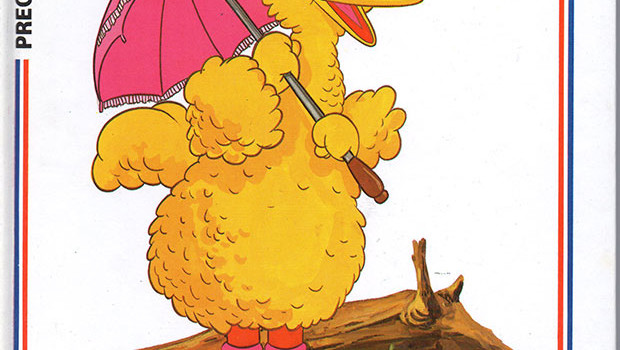
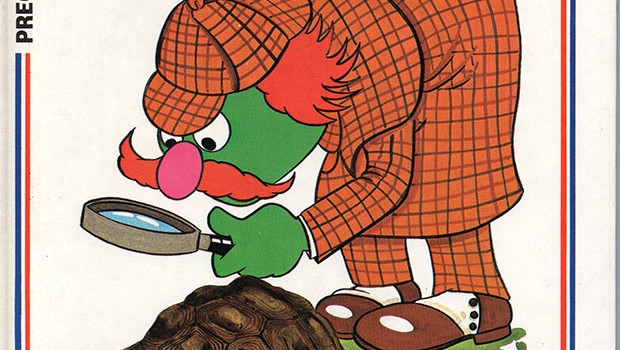
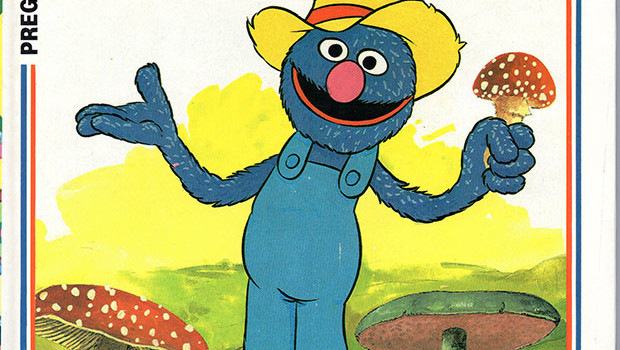
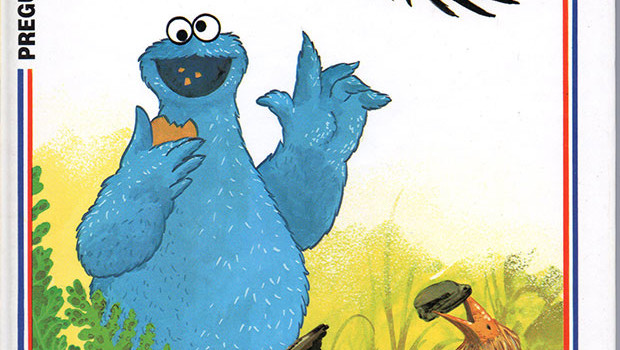
Hablando de Espinete y Barrio Sésamo, hoy vamos a viajar hasta el año 1985 para hablar de ‘Pregúntale a Sésamo’, una enciclopedia destinada a los más pequeños de la casa donde Espinete, Don Pimpón y sus amigos de los Teleñecos explicaban a los niños cómo viven los animales, qué partes formaba un castillo o clásicos como qué es lejos y qué es cerca.
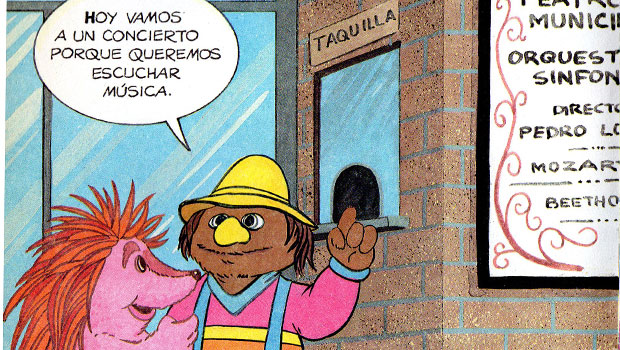
Espinete se va al Sónar
‘Pregúntale a Sésamo’ estaba formado por 25 tomos y fue publicado por Orbis Montera. El autor de esta delicia era Francisco Capdevila como dibujante (¿un primo perdido de Sergio Dalma quizá?) y los textos eran de Saro de la Iglesia y Javier Gómez Rea.

“Paso de tu culo, tío”
Cada libro incluía un índice que guardaba poco orden lógico, tanto dentro del libro como con el resto de la colección, y sus temas eran “¿por qué las flores huelen bien?”, “¿solo los peces tienen escamas?” o “¿por qué tienen número las casas?”, todo ello aderezado con manualidades y experimentos variopintos, como por ejemplo, el fabricarte una careta con una calabaza.

La precuela de El Orfanato
Misteriosamente, los que tienen un mayor protagonismo en el interior de los cuentos son Epi y Blas, quizá porque sean más fáciles de dibujar, o vaya usted a saber por qué. Así, les veíamos compartir rutinas en su casa (en la que había camas separadas, incluso en dormitorios diferentes), en el parque o en la biblioteca.
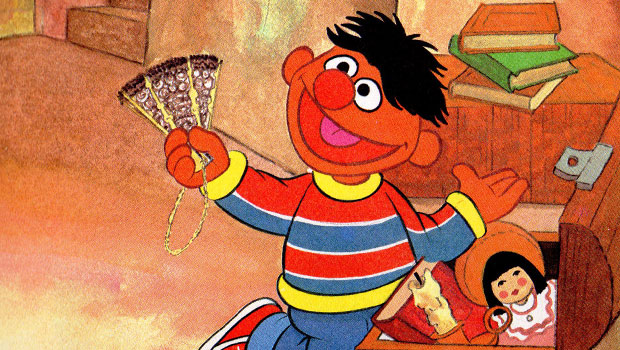
El lado Locomía de Epi
Incluso le veíamos hacer tareas domésticas, a modo de una precuela del anuncio de Asevi Mío.
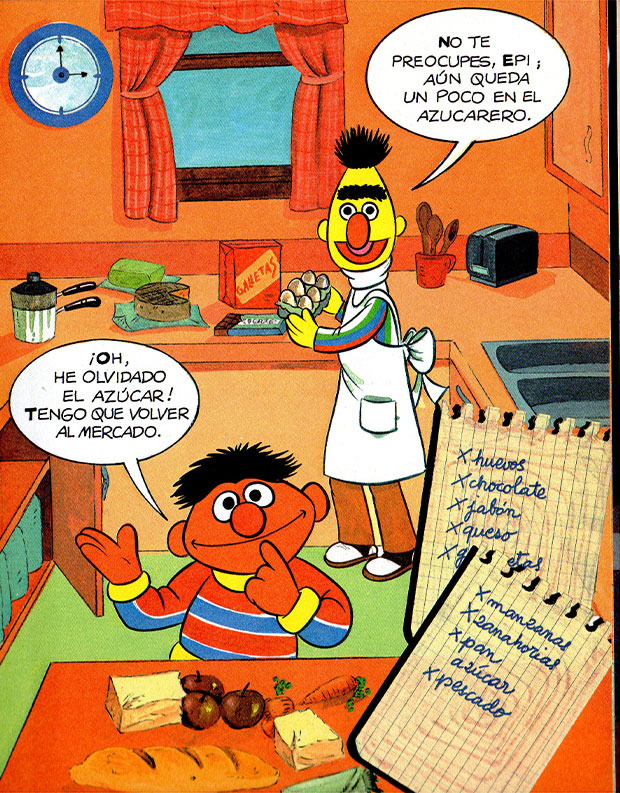
Blas se toca los huevos mientras habla con Epi
Y hasta coqueteaban con el transformismo, si se terciaba.
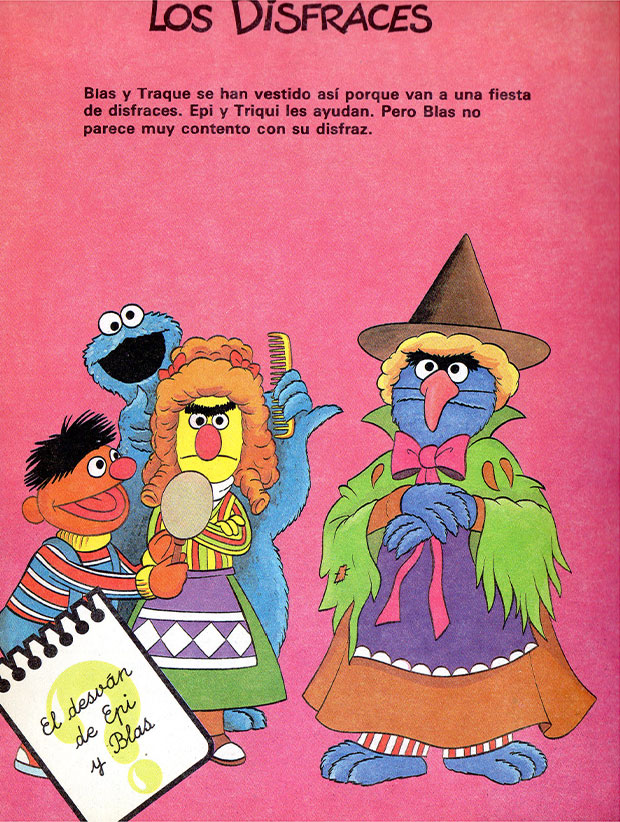
Hay quien sale del armario y hay quien sale del desván
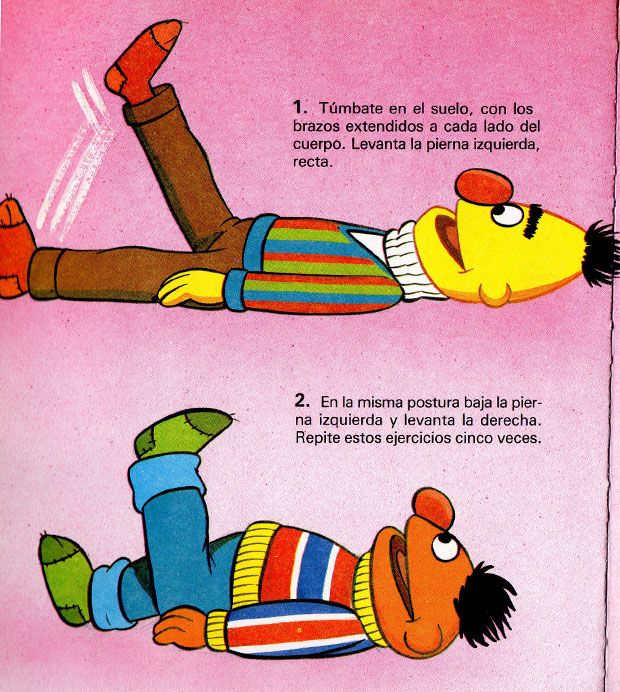
E intentaban hacer de los niños unos pequeños Eva Nasarre con ejercicios sencillos que se podían hacer en casa.
En el lado divulgativo, ‘Pregúntale a Sésamo’ trasladaba a los críos tanto a otros puntos del mundo ya sea en la tierra o en las profundidades del mar, para explicar cómo viven algunos peces.
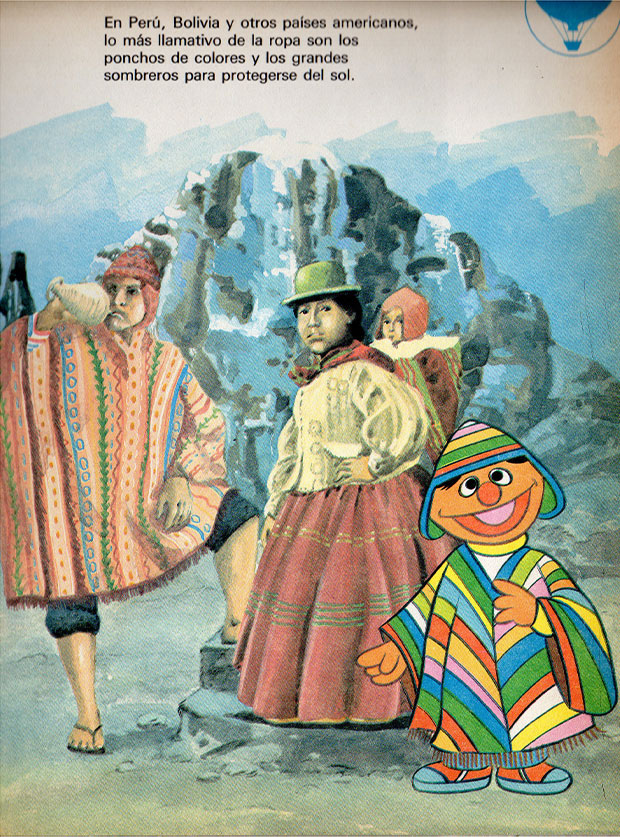
Epi cantando El Humahuaqueño vestido de King África
Incluso había viajes al pasado, como en las películas de Michael J. Fox, para explicar cómo se vivía antaño, una de las épocas histórica favorita de Rachel de ‘Friends‘.
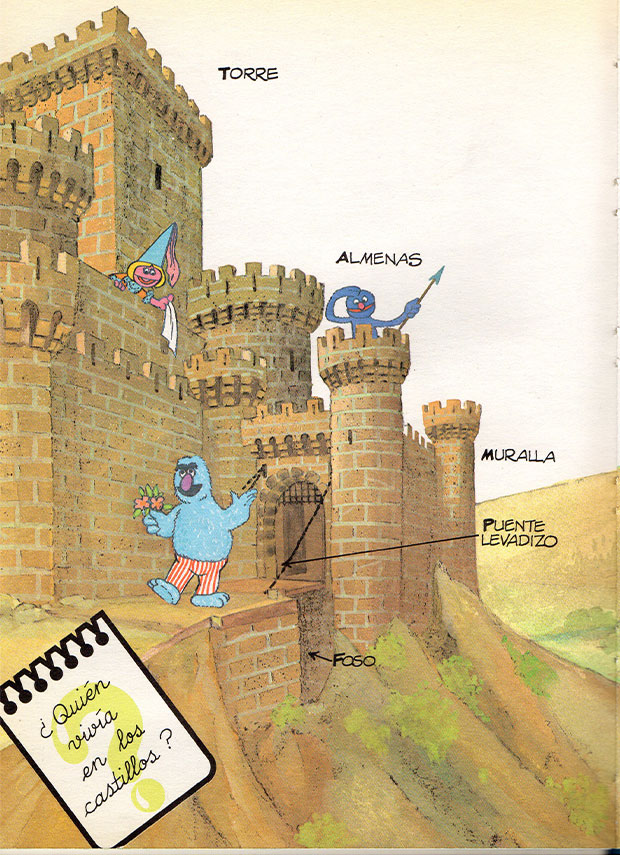
La Noche de los Castillos
Y conocíamos la naturaleza de primera mano, pues explicaban cómo viven los animales en la selva o en el campo, por qué las aves tienen picos diferentes o cuánto tarda en nacer un champiñón.
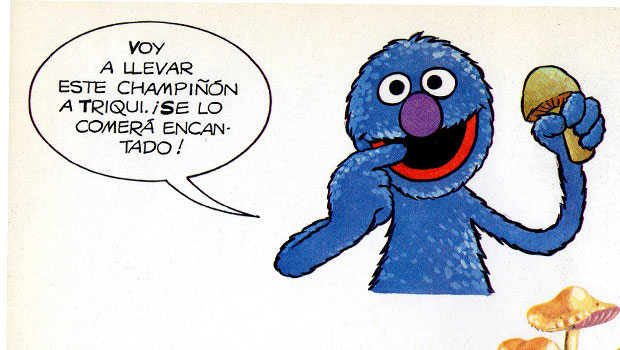
A Triki y Coco le gusta ponerse de monguis
A pesar de que hace 30 años de que salió al mercado, la verdad es que la obra sigue teniendo bastante vigencia en prácticamente todos los temas. Si acaso, lo que ya no tiene mucho sentido es el capítulo dedicado a por qué enviamos telegramas. A día de hoy sería por qué nos escribimos whatsapps o algo así.
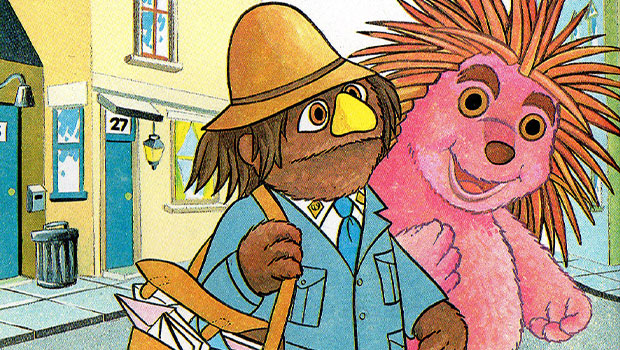
Don Pimpón, con la luna en las pupilas y su traje aguamarina, parece de contrabando
En cada tomo se indican un montón de experimentos y manualidades que se pueden hacer en casa para poner en práctica lo aprendido. Aunque a veces se pedían cosas que un niño no podía hacer solo, como por ejemplo, picar en trocitos muy pequeños una hoja de lombarda y hervirla para tener agua teñida de morado.
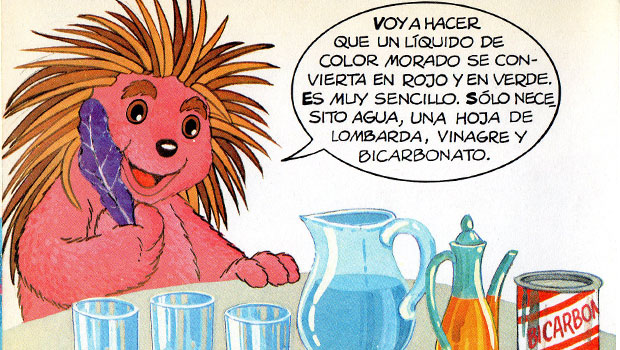
Espinete no tiene pluma, tiene lombarda
A día de hoy puede que también algún experimento pudiese provocar controversia, por ejemplo, cuando explican cómo hacerte una pipa y “fumar” haciendo burbujas de amor, como José Luis Guerra.

“Paco, el niño nos fuma porros en pipas de agua por culpa del Espinete ese”
Otros experimentos dan morriña, como este en el que aparece una moneda de cinco duros de las de antes.

¿Espinete no parece un poco la Alaska gorda de los noventa, con la cara pálida y el pelo colorado?
Y para los niños a los que le gustan hacer experimentos relacionados con la obesidad, incluso explicaban cómo hacer palomitas sin microondas. Admito que no lo he probado, pero dudo mucho que salga bien.
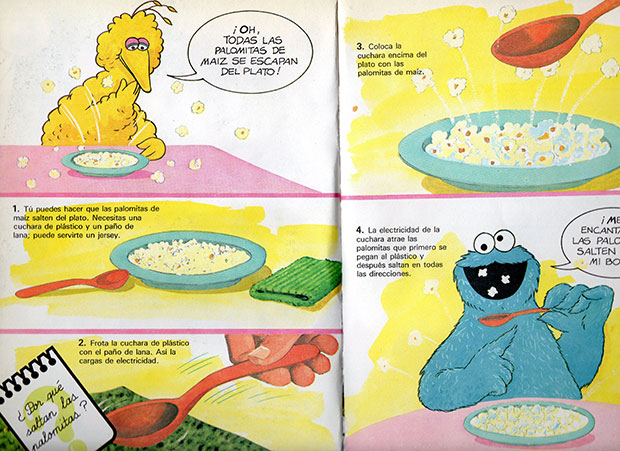
Receta de palomitas al pañito de lana
Hasta te decían cómo hacerte tu propio reloj solar o un termómetro doméstico. Las típicas manualidades que son un poquito follón y que jamás acababas haciendo, a pesar de que en todos estos libros y otros como los de los Jóvenes Castores te incitasen a hacerlas página sí, página también.
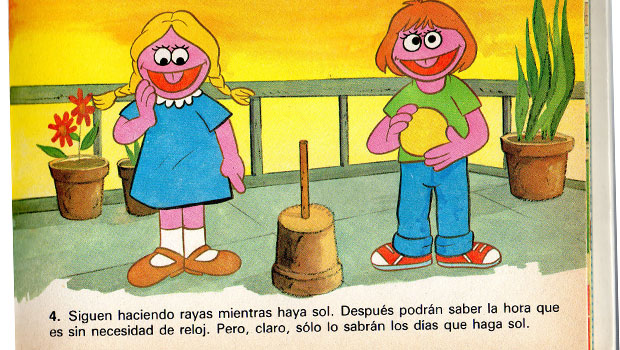
Yo siempre he creído en la pareja, dos polvos, dos rayas, dos amigas, dos cabalgan juntas…
A día de hoy esta enciclopedia es una rara avis, pues otras como la de Ábrete Sésamo sí que es más fácil de localizar. De hecho, en Todocolección piden la friolera de 100 euros por los 25 tomos. Si te criaste con este ‘Pregúntale a Sésamo’ y no tienes esa pasta, pues oye, escríbeme e igul te dejo la mía por menos de la mitad de lo que piden por ahí y de paso hago algo de sitio en casa. Que uno vuelve a estar en paro y lo mismo tengo que acabar montando un mercadillo de Sufridores o algo así.




















 An artful tug job lies not in the hand, but somewhere else entirely... More »


Lots of drama with developer Machine Zone recently, and this last one is an interesting one. Machine Zone is the developer of Game of War: Fire Age [Free], currently the Top Grossing Game on the App Store. So, the company isn't poor. According to a story in The Verge, a Machine Zone employee was intercepted by FBI agents as he was boarding a plane to Beijing for allegedly stealing trade secrets from the company. Apparently, the employee was unhappy with his position in Machine Zone and decided to download data to use as a bargaining chip in an attempt to get more money. What makes the story interesting is the type of data this employee stole, data that was so important that FBI got involved; it wasn't anything to do with the game's code or the company's structure, but, rather, information about player behavior, including how users spend money in the game. The breach didn't include any credit card information or the like, simply information about players' in-game habits and behavior.
It's quite interesting how valuable your habits have become to large F2P companies like Machine Zone and how an employee felt the information was so valuable to the company that he could use it to pretty much blackmail Machine Zone to get what he wanted. We live in interesting times when one of the most important secrets a gaming company can have is what players do in-game. Feeling important, now? This Machine Zone drama comes on the heels of another one earlier this week when the news came out that Machine Zone is suing Kabam (publisher of games such as Marvel Contest of Champions) for leaking corporate information including how Machine Zone paid Kate Upton only 1 million dollars to use her likeness in the Game of War ads. If you want to read up on that whole drama, go here.

Imagen vía.
Mi abuela era miembro de los Testigos de Jehová –o como mi abuelo prefería llamarlos, los Testículos de Caoba– una rama del cristianismo protestante –aunque algunos estudios los pongan por separado, se siguen basando en sus mismos principios– que tiene una visión muy particular de la Biblia que les lleva a creer que el final está cerca, que solo 144.000 personas irán al cielo –los ungidos, que curiosamente estaban y están todos cerca de los círculos dirigentes de la organización– mientras el resto de fieles se contentará con seguir viviendo en la Tierra, no aceptan transfusiones de sangre ni trasplantes, se niegan a celebrar los cumpleaños, la Navidad y cualquier otro tipo de festividades por el estilo y –como no– son totalmente contrarios a la masturbación, el sexo fuera del matrimonio, el aborto, la homosexualidad y toda esa larga lista de prohibiciones que tienen en común todas las iglesias del mundo.
Cuando mi abuela se convirtió y empezó a llenar su casa de La Atalaya y ¡Despertad! –hará unos 30 años– las religiones protestantes eran algo muy pequeño en nuestro país. Al margen de las iglesias evangélicas gitanas, la mayoría de iglesias protestantes eran congregaciones muy pequeñas formadas por extranjeros –en su mayoría europeos– que habían venido a vivir a España, muchos de ellos después de jubilarse –por eso no era extraño que tuviesen sus locales en sitios tan poco cristianos como Lloret de Mar.
Los más jóvenes y los que se convertían, se paseaban vestidos de traje por los bloques de pisos llamando puerta por puerta para intentar atraerte un día al templo –así es como llaman ellos a sus iglesias– como si fuesen comerciales, solo que en vez de venderte un aspirador nuevo te vendían la salvación eterna, ¿como vas a decir no a eso?
A partir de los años 90 las cosas empezaron a cambiar. Según datos estadísticos entre 1990 y el 2004 el número congregantes evangélicos –es decir de la gente que acude a sus misas– ha pasado de 200.000 a 350.000, más de 10.000 nuevos feligreses cada año. Los inmigrantes latinoamericanos – que siguen siendo el colectivo inmigrante más grande de nuestro país– han jugado un papel central en todo este proceso ya que muchos de ellos ya eran protestantes en su país de origen y además suelen hacer de misioneros en sus propias comunidades, atrayendo hacia el protestantismo a personas de su entorno.
Hoy en día se calcula que en España el número de protestantes es de 1.300.000 personas sumando a los 500.000 bautizados –los protestantes no se bautizan hasta que son adultos– y los 800.000 no-bautizados y personas que se sitúan en su órbita de influencia.
A pesar de ello, cuando se habla de las nuevas religiones que se están asentando en nuestro país, normalmente se hace para hablar del crecimiento del islam. El foco que ponen los medios en la población musulmana, el miedo al terrorismo yihadista y las diferencias culturales que percibe una parte importante de la población autóctona hacen que se pase por alto que en los últimos diez años el número de iglesias protestantes en España se haya multiplicado por diez. De hecho a día de hoy los protestantes son la principal minoría religiosa, por delante de los musulmanes.
El evangelismo no llama la atención: sus feligreses no hablan otro idioma ni visten diferente –de hecho suelen ir muy arreglados– y al fin y al cabo su religión se basa en una interpretación libre del catolicismo, que a menudo se intenta vender como una versión progresista del mismo, y se intenta desmarcar de las ramas que han sido catalogadas como sectas y de muchas otras que han sido denunciadas por familiares de algunos de sus miembros por ser un sacacuartos.
Pero solo hace falta rascar un poco para darse cuenta de que en el fondo siguen defendiendo una visión arcaica y retrógrada de la vida y de las personas. Como decía antes, muy a menudo – más de lo que ellos mismos aceptan – siguen criticando la contracepción, el aborto, los modelos de familia alternativos, la sexualidad libre y todo lo que salga de la heteronormatividad basándose en interpretaciones literales e intransigentes de la Biblia que les llevan a planteamientos similares a los que podrían hacer ciertos imanes radicales, pero a pesar de esto ningún partido de extrema derecha se manifiesta cuando se abre otra de sus iglesias.
Es sorprendente cómo se puede estirar el chicle del terrorismo islamista para estigmatizar a una religión que practican 1.250 millones de personas en el mundo y sin embargo nadie hace lo mismo después de que algún protestante radical ponga una bomba en una clínica abortista.
Por poner un ejemplo, ahora mismo cualquier persona que pasee por el centro de Barcelona podrá ver alguno de los muchos puestos que los Testigos de Jehová han puesto por toda la ciudad para regalar sus revistas y extender su visión de la palabra de Dios. Si los musulmanes de cualquiera de las mezquitas de la ciudad hubiesen hecho lo mismo, los medios estarían hablando de una ofensiva islámica y lanzarían presagios apocalípticos mientras que Plataforma Por Cataluña se plantaría como cuarta fuerza política en intención de voto para el 27-S. Quizás tengamos que aceptar que lo que a muchos les molesta no son las gilipolleces que dice o deja de decir uno u otro libro sagrado, sino quién las dice.
Switchel is like cheater's lemonade—but maybe even better. Learn how to make it at home.

I had never heard of switchel when my friend Hannah asked if I would be her bar-back at last September’s Queen Bee Cocktail Classic, a honey-driven cocktail competition put together by NYC Honey Week.
The whole evening was both wacky and wonderful: There were tutus involved (not, I am happy to report, on my own body), there were lots of people buzzing around with drinks in their hands, and Hannah wore handmade paper flowers—complete with bees trembling on the ends of curled wires—in her hair. Bartenders from all over the city hoped their specialty cocktail of the evening would win them the title of Queen Bee. The only rule was that every drink had to include honey in some way.

Hannah’s cocktail was a honey-whiskey switchel, a not-too-sweet highball topped off with seltzer water and a generous pinch of salt. She called it Haymakers Punch—"haymaker's punch" is a farmer nickname for switchel, because the stuff is so revitalizing when it's hot out—and it won her second place at the Classic. It also turned me on to switchel (which has since appeared on the shelves of the Whole Foods around the corner from the Food52 office).
Switchel is a tangy steeped brew of apple cider vinegar, ginger, and something sweet—Hannah makes hers with honey, but I like the rooty warmth of maple syrup. It is excellent as Hannah served it in her punch, with whiskey and seltzer water, but most of the time, I combine everything—vinegar, maple syrup, fresh ginger, and water—all at once in a big jar, screw on the lid, and shake until it’s all combined.
After an overnight steep in the refrigerator, I pour it over ice and drink. It is supremely refreshing, like lemonade but without having to squeeze all of the lemons. And it’s a much less austere way to get apple cider vinegar, which purportedly has about one million health benefits, into your system than a bracing shot of the stuff.

Makes 4 servings
4 teaspoons apple cider vinegar (I like the unfiltered stuff, like Bragg's, best)
4 tablespoons pure maple syrup
Fresh ginger, peeled and thinly sliced (as much as you want—I usually slice up a piece the size of my thumb)
4 cups water


Combine all of the ingredients in a large jar.

Shake to combine thoroughly, then refrigerate for at least 12 hours.

The switchel on the right has steeped for 24 hours—you can see how much darker it is!

To serve, strain into glasses filled with ice—or heat it and drink as a tea.
See the full recipe (and save and print it) here.
Photos by Bobbi Lin
From the Gold Rush to MSG, via the scandalous story of gender-bending Chinese restaurants in 1920s New York City, this episode of Gastropod serves up a tasty buffet of American Chinese food. Grab your chopsticks and dive in!
Inspired by the new documentary “The Search for General Tso,” directed by Ian Cheney and co-produced by Jennifer 8. Lee, author of The Fortune Cookie Chronicles, Gastropod embarked on a quest of our own to untangle the curious history of Chinese food in America. Things got off to an unpromising start: in the nineteenth century, the first wave of Chinese immigrants was greeted with deep suspicion and hostility by Americans of European descent. This mistrust extended to their food: the Chinese ate rice with sticks and, many believed, hid all manner of unpleasant meats in their dishes. A perfectly serious 1883 article in The New York Times began with the question: “Do the Chinese eat rats?”
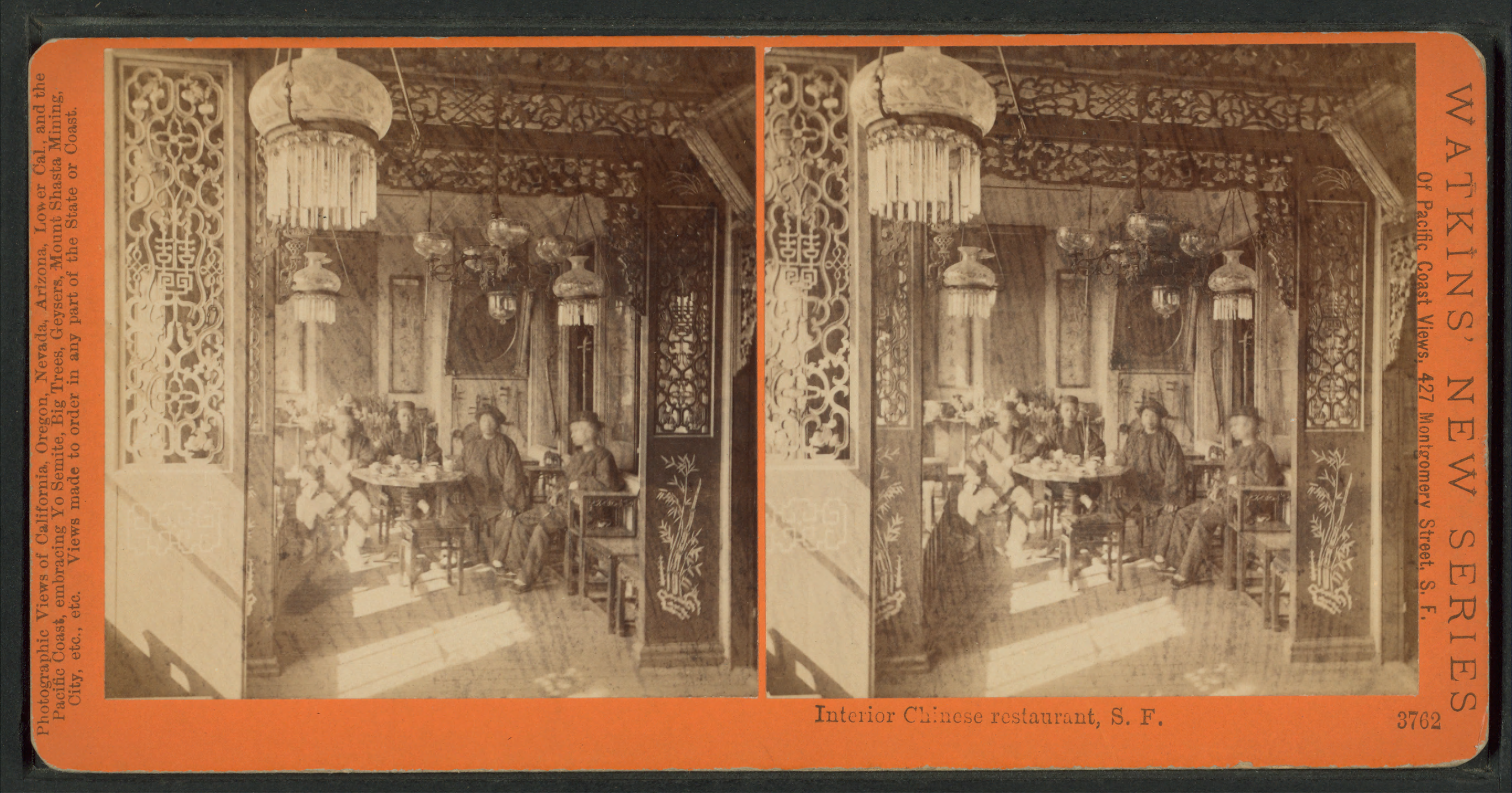
Stereoscopic view of the interior of a Chinese restaurant in San Francisco, in the 1880s, from the collection of the New York Public Library. Below, Chinese restaurant menu from 1904, from the collection of the New York Public Library.

And yet, between 1870 and 1920, the number of Chinese restaurant workers in America grew from 164 to 11,438. Why did Chinese immigrants abandon mining and manual labor to open restaurants—and, more importantly, how on Earth did these new chefs convince white Americans to eat their food? We speak with researcher Heather Lee, who discusses the loophole in American immigration law that unintentionally incentivized the Chinese to become culinary entrepreneurs. Meanwhile, with Jenny 8. Lee we explore the murky origins of chop suey, the dish that took America by storm, but one she considers “the best culinary joke played by one culture on another.”
By the early twentieth century, Chinese food was well on its way to becoming the most popular ethnic food in America. The same adaptive strategies that allowed them to bypass the racist Chinese Exclusion Act and reinvent their cuisine for the American palate continued to serve Chinese restaurateurs well throughout the twentieth century. In this episode, Heather Lee introduces us to the “dine & dances” of the 1920s—exotic, late-night Chinese restaurants in New York City where young people could experiment with new gender roles. Outside the context of their own cultural expectations, women flirted and couples kissed in public, shocking the city’s anti-vice inspectors.
American Chinese food’s biggest headache arrived in the 1960s, with a letter to the New England Medical Journal blaming monosodium glutamate for a range of unpleasant symptoms. But is MSG actually harmful? We dig into the science behind “Chinese restaurant syndrome” to try to put the myth to rest for once and for all.
Listen in to this episode of Gastropod for all this and more, including the economics of the Chinese all-you-can-eat buffet and the curious regional and global variations on Chinese cuisine. Just don’t blame us if you end up ordering take-out tonight…
It will take you five minutes or less and, in return, you will be entered for a $100 Amazon gift certificate and earn our undying gratitude: please take our completely anonymous survey now, so we can let advertisers know a little bit about you.
The movie that inspired this episode of Gastropod! Ian Cheney’s documentary (co-produced by Gastropod guest Jenny 8. Lee) is a funny and fascinating look at the story behind the most famous American Chinese dish of all. It was released earlier this year and is now available on Netflix, iTunes, Amazon, etc. Be sure to check it out!
Guest Jennifer 8. Lee’s 2008 book, The Fortune Cookie Chronicles, explores the many mysteries of American Chinese food—who invented fortune cookies? why is Chinese food so popular with American Jews?—but also tells the stories and struggles of the immigrants who cook, serve, and deliver it.
Heather Lee is a postdoctoral researcher at MIT, working on a book about the Chinese immigrant experience, and Chinese restaurants in particular, in America. A fascinating talk she gave at MIT about her research on New York City’s “dine & dances” provided one of the inspirations for this episode. In 2016, she’ll be an assistant professor at NYU in Shanghai.
With ice-cream episode guest Sarah Lohman, Jonathan Soma co-hosts the other MSG—the Masters of Social Gastronomy event series. He also runs the Brooklyn Brainery, and does lots of interesting things with data and code.
This is your last chance to enter the Great Gastropod Raffle and win fabulous prizes—gorgeous Gastropod T-shirts, fascinating food books, and limited edition “Confused”-flavor Skittles. Donate $10 or more to support the show, and we’ll throw your name in the hat, to be drawn at the end of the month. (No donation necessary to enter, though, of course, we hope you will; email contact@gastropod.com to be entered without making a donation.)
The post The United States of Chinese Food appeared first on Gastropod.
Primero de nuestros capítulos dedicados a la escena sixties de agarge en países hispanos. Este episodio está dedicado a bandas latinoamericanas. Playlist; Los Saicos (Camisa de fuerza, Ana), Los Yorks (Solo estoy, El psicodélico, Cielo), Los Shain (Bule Bule, El tren pasa esta noche), Los Mockers (Make up youir mind, Can’t be a lie), Los Pets (Hello I love you), Los Young Beats (Gloria), Los Streaks (Diablo con vestido azul), Los Tijuana Five (Mi auto puedes manejar), Los aki (Día de noche), Los Locos del Ritmo (Hey Joe), Los Johnny Jets (Deja de llorar), Los 4 Crickets (Yo creí), The Kaleidoscope (Colours) y Los Monjes (Probelams en la mente).

Lord Havelock Vetinari. Imagen: Plaza & Janés / Paul Kidby.
Estimado Lord Rodley, su Gracia, duque de Quirm, cerilla de Occidente, portador de sabiduría y otros (insertar títulos aquí):
En primer lugar, agradecer a Su Gracia (S. G.) el envío del resto de mi equipaje y pertenencias a Ankh-Morpork. Tras casi diez años de estancia en la ciudad volver a dormir con somier se hará raro, pero no por ello menos gratificante. De igual manera, agradecer a S.G. que se haya encargado de que mi esposa e hijos puedan seguir con sus ocupaciones diarias sin percances en su integridad física o moral, lo que dadas las circunstancias resulta bien grato. El trágico accidente por el que Lord Savanaro apareció con su cabeza clavada en una pica y sus extremidades exhibidas en cada puerta de la ciudad nos apenó profundamente a todos. Incidir, en todo caso, en la lealtad de este servidor suyo, desvelado por atender las necesidades de S. G., que también son las de nuestra noble ciudad.
El objeto de la presente carta es hacerle la previa de un volumen mucho más amplio sobre mi aprendizaje político en Ankh-Morpork. Hace ya diez años que S.G. tuvo a bien invitarme a una reubicación en el espacio y el tiempo —es decir, salir de Quirm en menos de diez segundos— y desde entonces he estado sirviendo en la oficina del patricio de la ciudad, Lord Vetinari. Mi ocupación, apenas la de uno de los muchos escribas del Sr. Drumknott, secretario principal del patricio, me ha permitido aprender mucho sobre el liderazgo de esta figura tan particular. Además, la carga de trabajo no es demasiada y me deja algo de tiempo para escribir al caer el sol —vivo al lado del Gremio de Alquimistas lo que hace que cada dos líneas tenga que revisar la caligrafía del manuscrito y limpiarlo de restos de serrín, pólvora o algún meñique travieso.
Mi escrito, que aún no tiene título (¿El Principito? ¿Gobernar es como una caja de bombones?), quiere intentar ser un manual para el gobernante virtuoso. S. G. sabe que siempre hago honores a su gran estilo de gobierno y la contundencia de su puño de latón. Sin embargo, creo que en el modelo de Lord Vetinari hay gran cantidad de cosas que pueden con justicia llamarse fuera de lo común. Cosas que pueden servir de modelo a otros dirigentes. Cosas que le han llevado a gobernar la ciudad más próspera (y compleja) de Mundodisco. Con un sistema político asentado sobre el firme principio democrático de «un hombre, un voto», ese hombre es Havelock Vetinari y no hay duda de que su voto es el único que cuenta.
Espero que S. G. encuentre estos fragmentos que adjunto de su agrado, y sepa dispensar su desorden. Confío en que este texto basado en mi aprendizaje y experiencia, brindado con gusto para la lectura de S. G., permita ganarme un juicio más benévolo a sus ojos. Por último, reiterar mi agradecimiento por la buena salud de la que gozan mis allegados.
Con humildad y respeto, siempre suyo
Nicolasi Manchaveloz
***
De cómo gobernar es hacer malabares sobre un oso borracho
«Si non confectus, non recifiat». El escudo de armas de los Vetinari dice con gran claridad que cuando algo no está roto es mejor no arreglarlo. Esta frase es toda una declaración de intenciones sobre una forma de gobierno basada en dos principios. Primero, si la cosa funciona es mejor dejarla hacer. Segundo, si vas a intentar arreglarla lo más probable es que la rompas. Esta forma de gobernar está inspirada en hondos principios sobre la naturaleza de la política. Aunque es verdad que la frase se la imputan al comandante Vimes —conocido como «el sabueso de Vetinari»— no hay duda de que es pensamiento inspirado por el patricio. En concreto la frase dice que hay dos tipos de dirigentes. De un lado, los que primero imaginan cómo es el mundo e intentan que la gente encaje en él y, de otro, los que aceptan el mundo tal cual es e intentan sobrellevarlo. El problema con el primer tipo de gobernantes es que sus concepciones del mundo terminan siendo tan estrechas que suele hacer falta todo tipo de instrumentos —normalmente de tortura— para que la gente se encaje en ellas.
Por el contrario, el estilo de gobierno del patricio se basa en el reconocimiento de las infinitas diferencias que hay entre hombres, enanos, trols, no-muertos y sí-vivos (en general) y buscar su punto en común: a todos les gusta la previsibilidad. Dicho de otra forma, marginalmente la ciudad de Ankh-Morpork sabe que está mejor si el día de mañana se parece más o menos al de hoy. Es decir, reconoce implícitamente que al menos con el actual patricio no hay sobresaltos. Resulta interesante el contraste con Lord Winder, un antecesor en el cargo que convirtió la ciudad en un estado policial —y que, como suele darse en los procesos de sucesión gubernamental, fue convenientemente depuesto—. El estilo Vetinari huye de la arbitrariedad en el uso de la fuerza. Quitando su tradicional odio por los mimos —a los que toma presos y cuelga de los pies con un cartel de «apréndete la letra»— hasta tolera la libertad de prensa.
En una ciudad tan diversa y compleja como Ankh-Morpork, Lord Vetinari tiene bastante claro que no existe una medida única para todos sus habitantes, sino apenas algún punto gris en el que cada cual puede dedicarse a sus asuntos. El patricio comentó una vez, en uno de estos escasos renuncios que tiene en privado, que gobernar una ciudad es como hacer malabares sobre un oso borracho. Mientras no te bajes en marcha, agarres fuerte las orejas y tengas las pelotas en el aire la cosa puede funcionar.
De cómo hacer que hasta para las malas prácticas haya alguien vendiendo entrada
Ankh-Morpork es con diferencia una de las ciudades más pobres del Disco básicamente porque todo el dinero está en manos de sus habitantes. Esta paradoja solo se entiende por el peculiar sistema gremial con el que funciona la ciudad. La llegada de Vetinari al poder supuso la proliferación de los gremios, en particular de los que hasta entonces eran la periferia de la sociedad. El Gremio de Mendigos, por ejemplo, que estableció un exitoso sistema por el que puedes ahorrarte tener a dos o tres leprosos a la puerta de una boda o bautizo con un pago fraccionable en mensualidades. El de las «Costureras» (o mujeres —y un hombre— de afecto negociable). El de Asesinos, del cual viene el propio Vetinari, que gestionan la institución educativa más elitista de la ciudad para la inhumación de clientes (casi siempre) exprés. Hasta el Gremio de Ladrones, que se encarga de que haya robos dentro de la legalidad. Como dice el patricio, si siempre habrá crimen, que por lo menos sea organizado.
La constitución de los gremios ha sido un elemento fundamental para el gobierno de la ciudad. No solo porque contrapesan el poder de la nobleza y fomentan el auge de las clases emergentes, sino por al menos tres razones. Primero, porque hace transparente lo que antes estaba oculto, luego facilita mejor información sobre lo que pasa en la ciudad. Segundo, porque genera pautas de comportamiento previsibles con órdenes, licencias y regulaciones que atan a oferentes y demandantes. De hecho, si algún empleado autónomo hace la guerra por su cuenta es el propio gremio el que se encarga de reconvenirlo colgando su cadáver en la veleta de la sede central. Ni un solo pedigüeño sin sello de calidad en fístulas y muñones, ni un solo ladrón freelance sin código de visita. Todo siempre bien ordenado. Finalmente, el tercer aspecto clave es que la estructura gremial genera interlocutores. Alguien responsable de una orden con quien te puedes sentar en caso de que haya algún tipo de problema o cuestión a tratar que competa al Gobierno. Mejor aún, alguien que sabes dónde vive, sabes dónde está su familia y al que puedes dejar tarjeta de visita si es menester.
La política de Ankh-Morpork no puede entenderse sin los gremios, basados en la más estricta autorregulación. El patricio no entra en sus prácticas internas siempre que paguen (pocos) impuestos y no generen demasiados problemas. De hecho, quitando los recurrentes procesos de destrucción creativa del Gremio de Alquimistas, dan más miedo los magos, que van por libre jugueteando con el continuo espacio-tiempo. Así y todo, los gremios son instituciones clave en la ciudad por el equilibrio de poder que generan. Un equilibrio en todo caso conveniente porque Vetinari sabe que una rolliza sociedad civil también termina por echar culo y hacer forma en el sillón.

Ankh-Morpork. Imagen: Plaza & Janés / Paul Kidby.
De cómo el buen dirigente sabe imitar a un flamenco carnívoro
Nadie sabe a ciencia cierta cómo llegó Lord Vetinari al poder, pero sin duda marca la diferencia con sus predecesores en el cargo. El patricio siempre viste de negro, odia el lujo, es un devoto total de su trabajo y más allá de alguna partida ocasional de ajedrez y leer partituras de música (tocarlas las estropea, dice) no tiene afición conocida. Hasta aquí uno podría pensar que está ante uno de los dos personajes más peligrosos del Disco; un Quisidor de Om o un abogado. Sin embargo, son otros recursos los que le han dado el apodo del flamenco carnívoro, suponiendo que exista esa especie. El fundamental es la información. Vetinari tiene una increíble red de espías que hacen que el patricio se entere de todo lo que ocurre en Ankh-Morpork y más allá (HOLA, QUE SÉ QUE ESTÁIS LEYENDO ESTO). Y eso que piensa que mirar a través de los ojos de los cuadros es de mala educación. Si solicitas una audiencia con él, te aseguro que ya sabe exactamente lo que le vas a pedir pero prefiere que hagas el viaje. Si tienes ese pequeño negocio entre manos que implica defraudar al fisco probablemente ya no estés leyendo esto.
Pero no es solo la información lo que le hace poderoso sino cómo la administra. Cuando el patricio da una instrucción, esta siempre deja un resquicio abierto a la imaginación de quien le escucha. Sus «interesante», «ajá», «estoy seguro» siempre dejan la duda en su interlocutor y lo hace estar permanentemente intranquilo. Es cuando en la mente se agolpa el: «¿Qué sabe? ¿Lo sabe? Oh, Dios mío ¡LO SABE!». Natural que no necesite ser un tirano al uso. Lord Vetinari sabe conseguir más cosas con la sutil ironía o con un carraspeo que con una visita a las mazmorras. Porque al final, y esta es la tercera clave en la que descansa su saber hacer, no solo lo sabe todo y tú no, es que tú ni siquiera sabes qué pretende. Nunca sabes cuál es su plan más allá de lo que él quiere que sepas. Una esfinge que se pone los brazos a la espalda y mira al vacío desde su ventana en el Despacho Oblongo.
Este manejo le ha permitido mantenerse bien asentado en el poder frente a infinidad de conspiraciones e incluso deposiciones de su cargo —en muchos casos instigadas por él mismo para luego regresar—. Si el Gremio de los Asesinos ha terminado retirando el precio a su cabeza no es porque no haya ganas de quitarlo de en medio, sino porque sabe hacer que todos desconfíen más entre sí que de él mismo. Por eso con razón le llaman el flamenco carnívoro; lo ve todo desde arriba, acecha sin movimiento, y grácil, a la vista de todos, caza con precisión.
De cómo las personas no son bolas de billar pero bienvenido sea ese palo
Hay un viejo dicho en Ankh-Morpork y es que nadie pondría a un maniaco corrupto al frente de ninguna institución salvo, tal vez, el votante medio. Bueno, quizá Lord Vetinari también, porque si algo sabe el patricio es leer a las personas mejor que ellas mismas. Un aspecto fundamental del liderazgo consiste en saber elegir bien a aquellos que se pone en puestos de responsabilidad, desde la Guardia de la Ciudad hasta la oficina de correos. El patricio ha comentado en alguna ocasión que hay dirigentes que ven a los hombres como bolas de billar en la gran mesa del poder. Él, por su parte, duda bastante de que los hombres rueden cuando se les da con un palo, pero sabe que un empujón en la dirección correcta puede desencadenar gran cantidad de reacciones. Ahora, también dice que para que el empujón tenga el efecto deseado hay una cuestión fundamental; que la gente piense que es la que mueve sus propios hilos y dirige su destino. Que lo hagan exactamente en la dirección que pretende el patricio es una feliz coincidencia.
Un buen gobernante sabe tener en su cabeza el plan completo, pero sobre todo sabe utilizar a las personas adecuadas. Y si eso implica tomar la definición de «persona» en un sentido amplio bienvenido sea. Ello explica por qué Ankh-Morpork es de lejos la ciudad más diversa del Disco. Valga como muestra la Guardia, en la que se emplean desde mujeres-lobo o zombis hasta enanos y leprachauns —incluso a Nobby Nobbs—. Al final la mayoría de la gente se mueve por un conjunto de valores sólidos basados en dormir bajo un techo, comer bien, sacar un dinerillo y que no le claven la punta afilada de nada. Dado el amor de los morporkianos por el espectáculo, con un pequeño empujón desde arriba pueden hacer cosas increíbles y, a veces, hasta buenas por su comunidad. Es verdad que a algunos pocos les mueve la ambición, pero a esos el patricio los tiene cerca. A los restantes lo hacen principios morales o religiosos y a esos los tiene más cerca todavía.
Lord Vetinari sabe escuchar, desde a nuestro genio Leonardo de Quirm hasta a los magos de la Universidad Invisible. Se sabe rodear de la gente más adecuada para su propósito. Y es cierto, no tiene un conocimiento vastísimo de las cosas que no tienen que ver con el gobierno pero posee el don de saber leer a la gente y ordenar las prioridades. Probablemente eso sea lo que hace que sepa qué tecla pulsar. O, si somos más precisos, con qué palo dar.
***
Nota expediente: ANK-19092842819
Sr. Drumknott:
Me gustaría una copia manuscrita tanto de la correspondencia como del volumen adjunto arriba. El señor Manchaveloz tiene algunos puntos de vista interesantes, aunque seguro que convendrá que matizables, sobre mi acción de gobierno. En todo caso que sea con la máxima celeridad. Estoy seguro de que, con el descaro de algunas afirmaciones, no solo el orondo Lord Rodley no le hará aprecio, sino que en menos de dos días el libro acabará entre los prohibidos por la mitad de las religiones. Sería una pena condenar su obra al olvido. Quién sabe, quizá con estos mimbres hasta podamos hacer una disciplina más elaborada del arte que es el gobierno.
Firmado
Lord Vetinari

El mundo disco sobre Gran A’Tuin. Imagen: Plaza & Janés / Paul Kidby.
En homenaje a Sir Terry Pratchett
La entrada Cartas de Vetinari aparece primero en Jot Down Cultural Magazine.

Inside Verde, one of Marbella's cannabis clubs
Over the last five years, Spain has come to rival the Netherlands as Europe's cannabis hub. The country's legal framework around weed, which allows its use and sale within private members clubs, has been fully taken advantage of in the north of the country, particularly in the Catalonia region, where clubs reportedly make an estimated $6 million in sales each month.
These private spliff societies—which, unlike Amsterdam's coffee shops, only allow entry to members, rather than any old sweat-suited stoner straight off an EasyJet flight—have risen in number from around 40 in 2010 to over 700 today, according to smokers' groups. And just as America's "cannabis revolution" was initially centered around California and Colorado before spreading boisterously throughout a number of other states, southern Spain is now also enjoying its very own network of private members cannabis clubs.
I recently visited the pearl of south, Marbella, to get to grips with what a burgeoning "green economy" looks like on the ground, and how a number of British nationals are playing their part.
Arriving in Marbella, it didn't take long to notice the amount of "cannabis expats"—foreigners who'd moved to Spain's sunny south to take advantage of freedoms not afforded to them in their home countries. One British guy who calls himself Paz (which, fittingly, means "peace" in Spanish) is in the process of opening a new association in Marbella, and also founded the online community "Medical Cannabis Spain."
His intentions—as you may have guessed from the name—are centered around improving access for medical users of plant, as opposed to catering to recreational users. There are very few clubs focusing solely on medicinal cannabis products, so Paz hopes to open a location that will operate purely as a medical dispensary, and perhaps one day serve as a model for future clubs with a medical slant.
"I was recently informed that only two of 38 associations in Marbella were actually catering for medical, nonsmoking consumers," Paz told me, alluding to the range of cannabis products that can be ingested without inhaling the smoke of burning plant matter. "Medical patients can still struggle to receive the right medication, but it's a changing culture worldwide, so I do expect this to change."
TRENDING ON NOISEY: We Interviewed the Girl Whose Mom Disowned Her for Going to V Festival
While Paz was realistic about the current access available to medical cannabis patients in Spain, he was optimistic about the country becoming the most important player in Europe's cannabis scene. "With the sun, the solar technology, and the cultivation skills, if you were planning things on a resource-based viewpoint, then you would select Spain to supply the whole of Europe," he said.
Considering Marbella's Andalucía region is nearly on the same latitude as the legendary cannabis-filled Emerald Triangle in California, boasting similar conditions and climate for cultivation, he isn't far off.
Away from Paz and his medicinal aspirations, there are plenty of clubs following the established Dutch model of simply providing somewhere for weed smokers to get high. However, locations here vary tremendously compared to those in the Netherlands' capital. While the majority of canal-side coffee shops are characterized by their wooden bars, neon signs, and complete lack of natural light, those in Marbella range from the unpretentious to the upmarket. There's the Honey Bud Club, for example, a pretty standard space with a pool table and a painting of Tupac on the wall; all the way up to Joe's Marbella Smokers Club, which looks a bit like the VIP lounge of a Milton Keynes nightclub.

Cannabis capsules and butane hash oil in Verde
I had a contact at Verde ("green" in Spanish), a club that—like most others—focuses on the recreational and social aspects of cannabis consumption. The building its housed in is perfectly innocuous, with a small buzzer at the door for guests to announce their arrival. Inside, the place is reminiscent of one of Amsterdam's coffee shops—dark, with a neon back-lit bar—only slightly more homely.
I sat down with Verde's British manager, Levi, and asked him what the Verde association stands for. "Our ethos is that we are a relaxed, very social, English- and Spanish-speaking environment for people interested in cannabis," he said. "Everyone is welcome, whether you are a smoker or nonsmoker; whether you are a heavy consumer or partake occasionally—all providing you meet the requirements to become a member."
So what does the average member look like? "Dubai, London, Paris, the US; pretty much name a country and we will probably have a member from there," Levi answered. "These guys are all from a mad variety of backgrounds—some businessmen, some lawyers, some hippie stoners... all sorts. We even have one member, who I obviously can't give any details about, who's a senior CEO with over 1,000 people employed beneath him. [Our members'] ages range from 21 to 60, including people who use cannabis medically."

A "Sublimator" pipe in Verde
Looking around, Verde's patrons certainly didn't look like stereotypical stoners. Mind you, the more time you spend in that world, the more you realize there's really no such thing as a stereotypical cannabis user.
Behind the counter there were a huge number of products that reflected the variety in clientele: organic medicated body creams, infused jellies, caramel slices, cakes, biscuits, and CBD capsules—CBD being the chemical component of cannabis believed to have a range of medical applications. Alongside this new breed of products were your standard selection of sativas, indicas, and hybrid flowers—some of them grown organically, some hydroponically—as well as homemade hash, resin, and dry sift, and the on-trend butane hash oil and "shatter," all made with latest technology shipped in from the States.
WATCH: Our documentary about butane hash oil:
<span id="selection-marker-1" class="redactor-selection-marker"></span>
So is Spain catching up with the US in terms of cannabis production and variety? "Probably not yet, but there is certainly great potential for Spain to be a leading cannabis market in Europe at least," said Levi.
Domestically, why has the rest of Spain lagged behind the north's progress? "The movement had its roots in the north, and with Barcelona being a main city of the north with a relatively big population, it really took off there," Levi told me. "Now, other parts of Spain are catching on to the movement because of the success in Barcelona. Other local authorities have seen the experiment in Barcelona and have decided whether [or not] they want the same happening in their province."
A local government's political leaning plays a large part in how easy it is for clubs to operate unmolested. Malaga's right-wing local authority has been shutting down the clubs with force, for instance, while authorities in Marbella have generally left them to flourish peacefully, hence why it's proving a popular destination for people hoping to open a private members association.

Inside Marbella's Organic Cannabis Club
The Organic Cannabis Club (OCC) is one association that has experienced the problems caused by inconsistent local policy firsthand. The club's founder and only member of staff, Dominique, who's originally from the Netherlands, first opened a club in Malaga, but was forced out of the area by police. I met her recently at her new club in Marbella—a bright, airy space with its own terrace overlooking the beach—which is proving to be much less stressful than her previous location.
"Malaga is one of the only places in Spain where the raids are being done by the local police and not the national police. It makes no sense there," said Dominique. "I'm just glad to be out of Malaga. Here, the atmosphere is much better. Much more relaxed."
She told me how the development of cannabis clubs will come on even stronger if, in November, the country votes out the current conservative government. Mariano Rajoy's People's Party, said Dominique, is the only thing holding the clubs back. "Public opinion leans towards supporting the private club system," she argued. "In Barcelona, the mayor suddenly announced that he would close down 80 percent of the cannabis clubs right before the election. You know what happened? He's not the mayor any more."

The OCC's cannabis safe
Of course, it's highly unlikely that Xavier Trias was replaced by Ada Colua earlier this year purely because of his views on cannabis clubs. But considering the associations in Catalonia, of which Barcelona is the capital, reportedly boast over 165,000 members (about 2 percent of the Catalonian population) it's clear that there's a dedicated network of patrons in the area.
Dominique told me that associations in other areas should use this as inspiration if they want to develop, saying that clubs could become far more influential if they worked together politically. "I think we should get together properly as a united front in order to have lobbying power with local and national governments," she said. "When we become a significant united body, politicians will listen to us in order to get votes in the elections—but if we are all just hiding, they won't do anything for us."
Visiting Marbella, I found a community optimistic about its place in Spain's cannabis scene, but aware of the fact that there are still a number of forces working against it. So much has changed within the past five years, and there's scope for more in the half decade to come. However, as Dominique made me realize, that change might never be realized unless there's a concerted, communal effort from all involved.

Photo by the author
Some of the main, cellphone-related evidence in the trial of convicted murderer Adnan Syed was called into question in a new motion filed in court on Monday. The motion is part of a larger defense strategy to bring the court system of Baltimore in alignment with the views of fans of Serial, arguably the most successful podcast of all time.
Despite not directly arguing for his innocence, the true crime podcast questioned the basis for Syed's conviction in the 1999 murder of his ex-girlfriend Hae Min Lee—a case by the prosecution largely built around cellphone records. By detailing a narrative of his deeds alongside a record of his calls, the prosecution convinced a jury to convict Syed.
Lee's body was found in a local park called Leakin Park, and at a critical moment in the story of the crime, an incoming call seemed to place Syed at the burial site. The fan map below shows locations of the prosecution's narrative in blue, and approximate locations of cellphone towers that interacted with Syed's phone in yellow.
The prosecution's version of events was backed by testimony from Jay Wilds, a friend of Syed's who confessed to being his accomplice. The podcast, however, demonstrated that there were enormous inconsistencies in Wilds' version of events, and ultimately suggested that even if Syed arguably had a motive and an opportunity to commit the crime, the prosecution's specific narrative had been totally implausible.
Now, Syed's attorney, C. Justin Brown, is arguing over a technicality, though not a trivial one: The phone records handed over by AT&T were meant to be taken with a grain of salt, according to the telecom company. There was originally a cover page on the record, stating that "Outgoing calls only are reliable for location status. Any incoming calls will NOT be considered reliable information for location," but it was allegedly disregarded by the prosecution, and completely unknown to defense council Cristina Gutierrez.
After Serial, a second, much grittier podcast called Undisclosed has filled the Serial-shaped hole in some fans' hearts. Although an overt defense of Syed produced by one of Syed's attorneys, Rabia Chaudry, that podcast has revealed persuasive evidence, including the revelation of the AT&T cover sheet.
In May, when Syed was granted a stay of appeal, Maryland attorney Douglas Colbert, who worked with Syed during his bail hearing told VICE that the Maryland court system was likely choosing its moves very carefully. "The court wants to proceed with the utmost care in making this decision, and does not want to rush something which has created a great deal of interest in whether or not Mr. Syed received a fair trial," he said.
The May ruling had nothing to do with these phone records. It stalled the appeals process, and shifted everything to a special kind of trial court focused on two pieces of possible shoddy lawyering, for which Syed might deserve a new trial: there was the question of whether Gutierrez failed when she didn't pursue a plea bargain; then there was whether or not a critical witness named Asia McClain—who will be allowed to testify at the new trial—could offer Syed a clean alibi, as she seemed to do in her appearances on Serial.
This new filing appears to simply be one more possible reason for a post-conviction hearing. It's a process that looks like it's going to stretch out for quite a while, whether Syed's conviction is overturned or not.
Follow Mike Pearl on Twitter.

In New York magazine's new interview with Quentin Tarantino, the film director best known for Pulp Fiction says he's excited that America is finally confronting institutional racism.
When asked how his upcoming movie, The Hateful Eight, deals with race, Tarantino responds:
Finally, the issue of white supremacy is being talked about and dealt with. And it's what the movie's about…
It was already in the script [before the Ferguson and Baltimore protests]. It was already in the footage we shot. It just happens to be timely right now. We're not trying to make it timely. It is timely. I love the fact that people are talking and dealing with the institutional racism that has existed in this country and been ignored. I feel like it's another '60s moment, where the people themselves had to expose how ugly they were before things could change. I'm hopeful that that's happening now.
Tarantino's excitement seems to be directed at the growing movement against racial disparities in the criminal justice system and police use of force. Over the past couple of years, this movement really has tried to bring the issues with institutional racism to the mainstream.
So far, the push appears to be working. A recent Gallup poll found, for example, that fewer Americans of all races are satisfied with how black people are treated in US society — and a growing number of Americans said black people are treated less fairly in police interactions, malls, work, shops, and restaurants, bars, theaters, and other entertainment places. And Democratic presidential candidates can no longer avoid questions about what they're going to do to address these issues.
So Tarantino is right that this issue is certainly getting more attention. Whether that will lead to significant policy changes remains to be seen.
We all know that sex is pleasurable and fun, but first and foremost, it’s an intense challenge that pushes your mental and physical abilities to the limit. Stop wasting everyone’s time by just doing stuff in the sack that “feels good” for you and your partner. Being good at sex means putting in the maximum effort that will yield the minimum payoff. With these tips, you can take things up a notch by making your next sexual experience as hardcore and debilitating as humanly possible so you can feel like a real sex champion. Time to enter the octagon of LOVE!
Be Upside Down More
Doggie style? BORING. Reverse cowgirl? BORING. Missionary? BITCH PLEASE. Sex isn’t supposed to be easy; it’s supposed to be work. The only way you can heat things up is by putting one of your legs behind your head and hanging upside down while you grab his balls and he takes you sideways while both of you are suspended from the rafters on aerial silks. It’s just how you’re gonna have to roll from now on if you consider yourself a serious sex-haver.
Do it in a Panic Room
Any schlub can get off in a nice candlelit boudoir with sensual music playing. How about a florescent-lit panic room, on a broken futon, with voicemails of his mother playing in the background? Now we’re talking! This sex will emotionally exhaust you without even making you climax! If he’s religious, kick things up a notch by whispering, “God is watching us and he thinks this is disgusting!” right as he’s about to come. Finish off the night by competing in a sprint-length triathlon. Sex is pointless if you don’t GO HARD!
Engage in surprise grappling.
You’re both about to climax, great, whatever. What better time to practice your hand-to-hand combat skills? The next time he’s going down on you, mix things up by clenching your thighs shut, Greco-Roman-style. If he’s worth anything, he’ll be able to escape that hold and engage you in an evenly matched grappling competition. Have a friend on hand to keep score and to make sure you stay within the painstakingly marked competition area. Do you want to orgasm easily like some tool who doesn’t work for it? Or do you want to make it a challenge by randomly sparring with your sexual partner? THIS ISN’T A GAME. THIS IS SEX and unexpected physical challenges are NECESSARY.
Pegging—all day, everyday.
If you think pegging isn’t your cup of tea, well, this isn’t a tea party, lady. This is sex—it’s not supposed to feel fun! You peg him and he pegs you. All. Damn. Day. Why would a man with a functioning penis need to wear a strap on, you say? BECAUSE IT MAKES THINGS HARDER! Just strap in, strap on, and get to work, because you’re going to be here a while.
Employ extreme physical restraints.
You may think you’re kinky with your cute little fuzzy handcuffs, but those are for children. You want something that will really prevent your partner from being able to move. Take things to the next level by duct taping everything but his genitals to a wall, then lie on a bed across the room, pleasuring yourself in a way that doesn’t actually feel good. If he wants you bad enough, he’ll figure out a way to get loose. Once he does, don’t have sex. Go to the gym for a few hours while having that unsolvable argument you have every month. Do you want to come, or do you want to WIN?
There, now you have the tools you need to take your erotic exploits to THE NEXT LEVEL. Because if your next sex session doesn’t suck the entire life force out of you, you’re probably a total virgin.

Occultist Aleister Crowley, a recurring character in 'Stranger Than We Can Imagine: Making Sense of The Twentieth Century'
The 20th century—like most centuries, I suppose—was an eventful one. It had a couple of world wars, the advent of pop music, inconceivable technological advancements, tremendous progress in human rights, unprecedented population growth, and the relentless draining of our planet's resources.
All these things together make one of the most peculiar, globe-changing centuries of recent history. But what we're taught about in school, and the historical occasions still written about today, only cover a slim portion of the people and events that shaped the world we live in now. What about the murkier, more confusing stuff—quantum entanglement, cubism, Aleister Crowley, relativity, psychedelics, "Emperor Norton," and chaos theory?
John Higgs, author of The KLF: Chaos, Magic and the Band That Burned a Million Quid, has decided to address some of these less covered 20th-century developments in his new book, Stranger Than We Can Imagine: Making Sense of The Twentieth Century, an alternative history of this weird and wild patch of time that we've just clambered out of.
I met up with Higgs to find out what else we should be concentrating on when it comes to the recent history of humanity.

John Higgs. Photo by the author
VICE: Hi, John. Why did you decide to rewrite the history of the 20th century?
John Higgs: I came to writing quite late in my life; it doesn't come naturally to me. I'm not a historian; I don't have a degree in English. My background is entirely wrong to be writing a history of the 20th century [laughs].
So where did the idea come from?
The idea behind the book is that we're very comfortable with all the innovations and discoveries up until the end of the 19th century; photography, electricity, agriculture, democracy—as a whole, we're fairly happy with these and understand how they work. Then we get to the turn of 20th century and we get relativity, existentialism, modernism, quantum mechanics, and all these things that are fairly terrifying for many of us, so we back away from them. Which results in some of us in the 21st century looking at the world through 19th century eyes and not fully making sense of it all. We need to take on board everything we learned from the 20th century and not shy away from it all.

His Imperial Majesty Emperor Norton I, a.k.a. Joshua A Norton. Photo by Notwist via Wikimedia
Many of the characters in the book—rocket engineer and occultist Jack Parsons, say, or Joshua Norton, the self-proclaimed "Emperor of the United States"—aren't historical figures you often read about. How did you choose whom to focus on?
The story I wanted to tell was of the rise of the individual, so I was looking for characters that best encapsulated this main theme. They're the people that are right on the edge, the people that are so far out there that nobody understands them. These characters are often perfectly in tune with the direction that we're going. [The artist and poet] Baroness Elsa von Freytag-Loringhoven, for example, was one of the people that was truly surfing the change; I just had to write about her.
Yeah, in the book you write that the end of the 19th century marked the end of the hierarchical age of empires, and the 20th century was the age of the individual. Can you expand on that?
Pre–20th century, we lived in an age when large parts of the world were carved up by colonialism—where you were in the hierarchy was more important than who you were as a person. If you were a serf or peasant, then that's who you were, regardless of whether you were a good person. It seems appalling to us now, but it was how people understood themselves. It was extremely harsh on the majority of people, but it was stable, and it was the only model of society that we had. It was something that was so integral to all of history, so when it all disappeared almost in the blink of an eye when WWI ended, it was a really big deal.
The 20th century was about seeing and understanding ourselves as individuals. In the first half of the century we were rushing in that direction, through politics and other areas such as fiction like Buck Rogers and cowboy films. [Occultist] Aleister Crowley is a recurring character in the book because I feel that his idea of "Do What Thou Wilt" crystallized that change towards the individual. It's the individual defined at its most explicit. It is shocking and also a bit problematic.
This was the period where we tried to come to terms with different perspectives and with not having a fixed point of society, or omphalos [an object of world centrality]. This deletion of the arbitrary omphalos happened in many areas, including art, politics, and psychology, during this period. It was difficult, it was violent, but we kind of got there in the end.
What about elsewhere? Surely there are many countries and states that didn't change in quite the same way the West did during the 20th century?
In the East, it's slightly different. The Islamic world still has that fixed point in society. Mecca is the omphalos, and some elements of that pre-20th-century hierarchical age still exist in that part of the world. These places have now been plunged into the modern digital age, where they're connected to people from all over the world that see the world in different ways and have different beliefs. It's sad, but it's no surprise to me that there's so much violence because of it.
I believe there's a war of the Certain going on; people declaring loudly that they're right and that everyone else is wrong. To me, this seems to be missing the lessons we learned in the 20th century. There are 7 billion people on this earth, and no two people will see exactly eye-to-eye on their beliefs, so to say that you're indefinitely right in your beliefs and that your point of view is correct in a way that the others aren't is, if anything else, a poor grasp of mathematics and statistics. We're all just different perspectives looking at things. I think that's one of the things we learned from the 20th century.
TRENDING ON NOISEY: Here's Every Annoying Person You'll Meet at a Festival
In the book you write of how we're just at the beginning of the Network Age.
Yeah, we've gone from the "know your place" pre-20th-century structure to the individualistic "no such thing as society" Thatcherite structure, but it doesn't have to end there. Thinking of ourselves as individuals isn't enough to make sense of who we are.
For example, people born and raised in the 20th century, the age of the individual, see somebody taking a selfie and they immediately think of vanity and narcissism, but that's a dated perspective. The millennial generation would just see it as something to be shared in that person's networks, and the photo can only be understood—and only really exists—in that wider context. To them, it's just somebody smiling at their friends.
It's very easy to look at network society and think it's awful, and to be scared by it because it's arrived so suddenly and it's been traumatic for some people. In the hierarchical world, corruption would build up within institutions because of the way that information used to flow. Therefore, corruption became normalized, like in MP expenses, the Vatican child abuse, Fifa, and so on. However, because information now flows around the world in a network, there are fewer corners in which the corruption can hide. The feedback loops that are now in place have put responsibilities on our freedoms; we can still do what we want and become who we want to become, but we can't act and be entirely free from repercussions.
Because of things like the online mob mentality and public shaming.
Of course there are horrible, nasty people out there and people can get publicly shamed, but it's only because it's all so new. I can't help but think that all these feedback loops—this getting used to what other people think, and becoming responsible for your own actions, thoughts, and words—has got to be positive at the heart of it. The age is in its infancy, and the teething pains can be quite terrifying.
There are still huge unsustainable imbalances in wider society; the global economy, climate change, these things can't go on as they are. We can't hide away and pretend we don't know about these things any more—we're much more aware. We won't be skipping into a utopian future just yet, but the network seems to be our greatest hope for overcoming the problems that we've built up for ourselves.
Related: Watch VICE's new film 'Searching for Spitman'
<span id="selection-marker-1" class="redactor-selection-marker"></span>
What do you think the future of capitalism might be?
I do fear that because neoliberal capitalism funnels wealth and therefore power upward to an increasing minority, the people that have the power to change things have no desire to do so. They are just so heavily invested in the status quo. That's a very difficult problem to understand. The hope is that between where we are now and where we need to be, it doesn't turn violent. I can't see it continuing indefinitely on its current path peacefully. If the inequality continues at the same rate it has been, then I don't think CEOs will make it out alive.
In the book, you cover what you describe as "genuinely new, unexpected and radical" developments, like relativity, cubism, and quantum mechanics. Do you think there's room for innovations and events of that caliber in our immediate future?
I think the book shows that genuinely new, unexpected, and radical things keep coming, and that gives me hope. Things are changing in a different way. It used to be that a great individual would appear and put forward an idea. A figure like John Lennon, Sid Vicious, or Bob Marley would crystallize a movement. We don't seem to have these great individuals any more, but we have these huge movements. It's no longer about leaders.
Stranger Than We Can Imagine: Making Sense of the Twentieth Century will be released on August 27. If you're in London, there's a book launch party on August 28 at the Social on Little Portland Street.
Follow Jak Hutchcraft on Twitter.

The author awaiting a saline infusions
My scrotum is a thin sack of skin that contains part of my reproductive system. Insert a needle, add a liter of saline, and it is apparently transformed into something more rewarding.
I've been interviewing body-modified humans for years and have frequently heard the phrase, "I like the pain." They always explain it the same way: In the brain, your pain and pleasure neural pathways overlap—so the two feelings are never all that far apart. I'm familiar with people pushing and punishing their bodies to extremes, but I was specifically interested in how that pleasure/pain dichotomy plays out in a sexual setting.

Bella van Nes and her partner Paulus of Piercing HQ
Wanting to learn more, I turned to Bella van Nes, owner of Melbourne's Piercing HQ. Bella and her partner Paulus have run Piercing HQ for three years. Although they specialize in genital piercings, they offer every modification imaginable—except tattooing. They also host various workshops on topics such as staple and superglue play, micro branding, medical play, scarification, piercing, spanking, and flogging. One, titled "From Finger to Fist," is a beginner's guide to anal fisting. Between them, their involvement within the fetish community is vast and notable.
Unsure if I wanted to permanently mark myself, Bella suggested a saline session. These can involve little injections of saline just under the skin—not into the actual muscle. Breast and scrotal infusions are the most popular, but labia, buttocks, clit hood, pubic mound, and penile shaft are all common requests too.
Each injection distributes 50 milliliters of saline. With many of the modifications calling for a liter of fluid, a session can involve a lot of needleplay. If that doesn't sound like something you're into, you can opt for an infusion. Here your selected body part is hooked up to a saline drip bag. Depending on the bag's volume, the stream's speed, and your own personal tastes, this can feel like a regular IV, or something much more painful.
Related: They Told Me I Could Be Anything I Wanted When I Grew Up, So I Became a Cyborg
Bella says saline infusions and injections are commonplace throughout the kink community, but getting exact figures on their prevalence is difficult as most participants "balloon" in private residences and behind closed doors. However, the sheer number of boys brandishing their ballooned balls on the internet is testament to its increasing popularity. But this didn't make me any less nervous.
Apparently sensing my remaining apprehension, Bella assured me that the body completely absorbs the saline within 48 hours. Meaning if I did choose to inflate a body part, I'd be back to normal in a couple of days. Speaking to the couple in such a relaxed, matter-of-fact way eased me over the edge. I decided to inflate my nutsack.
According to Paulus the testes actually become less sensitive after the procedure, as they're suspended in saline. "If we were to slap your testicles before the infusion, it would hurt," he explained, "but afterward we'd be able to give them a nice tap around." Other than being able to be more rough than usual, he adds that he personally likes the sensation of the weight during sex, "as they swing back and forth."

The saline that would find its way into my balls
With a mild pinching sensation, the cannula that would deliver half a liter of saline was inserted into my scrotum. Surprisingly, this was less painful than expected, but as the cold liquid started steadily flowing into my sac, I began to feel light-headed.
Casually, Paulus tried to reassure me. "For a momentary discomfort it's a lot of fun," he said soothingly, "although there's only 500 milliliters in a bag, I usually put a liter in. Once all the saline comes out of your body, your balls are back to normal, there's no adverse effect. The most liquid I've held in my sac has been around 1,400 milliliters." He raised his hands as if holding out an invisible basketball.
Watch: The Digital Love Industry
Despite his assurances, I still harbored some concerns for the long-term fate of my gonads. This had nothing to do with the setting, Piercing HQ looks impressively sterile. Bella wore medical-grade gloves and inserted the cannula into my scrotum with practiced ease, thankfully avoiding any potential nerve damage and missing my testes. She swabbed the insertion point before and after the procedure, and unwrapped new equipment prior to use.
I was told to be aware of my own physical limits, listen to my body, avoid bodies of water like baths or lakes that could harbor bacteria, and to play gentle with my freshly inflated sac. If I abided by these simple instructions any risk of scrotal cellulitis (infection of the skin) would be avoided.
While pumping a small milk bottle's worth of liquid into my balls, Paulus explained that pain is the body's way of protecting itself. But if you can push past it, your body realizes the pain is not going to stop, so it starts releasing chemicals to try make itself feel better.

Paulus and Bella show off their own body modifications
"I've done my fair share of drugs over time," Paulus continues, "and I'd say that the [organic] drugs that get released from heavy-impact play are far better than any chemical drug I've taken."
Perhaps noting my unease, Bella told me, "If I'm putting in a couple of liters into the balls, then you'll start getting expansion in the shaft of your cock and also around the pelvic area; you'll start to see that get a bit puffy." But in my case, I've insisted we keep the amount of fluid to a minimal and confined to the scrotum, so "it's like filling up a balloon."
For all the casual chatter of balls swinging during sex, they were very professional about the whole thing.
Soon my attention turned from our conversation back to my balls, which were becoming increasingly uncomfortable. As the saline inflated them, my testes sought asylum inside my abdomen. After 45 minutes of this I'd had enough. Gazing past my navel, it was hard to see objectively whether my sac looked enlarged or whether it was an optical illusion caused by my dick retreating like a frightened tortoise into its shell.

The results were not immediately life-changing
"Gee, Fareed," remarked Bella encouragingly, "you look like you've got a decent-sized package now." I appreciated the support but didn't feel like much of a hero.
Although I had taken on only 250 milliliters, increasing my ball size from prune to fig, I waddled home as though lugging an awkward tumor between my legs. Since my testes were encapsulated like small yolks in inordinately large eggs, the liquid acted like a shock absorber. Experiencing this, I could envisage that filled with a whole liter of saline, the sensation of having them smacked around could be pleasurable. But the discomfort was so overwhelming and foreign that I ensconced myself in bed.
I woke up the next morning to find that the saline had nearly completely dissipated; my scrotum was back to his usual wrinkled self.
It should go without saying, but if you do have a desire to inflate any part of your body remember to seek out a professional. Do not try this at home.
Follow Fareed on Twitter.

All photos by Jake Lewis
This article originally appeared on VICE UK.
Capitalism is on its last legs and is about to be destroyed by a generation so connected by technology that they have more loyalty to their phone than to their social class.
That's what I took from meeting Paul Mason, economics editor of Channel 4 News, VICE's one-time Northern Soul correspondent and the author of a new book that you should probably read: Postcapitalism – A Guide to Our Future.
The book is ambitious, but to boil it down: Mason reckons capitalism as we know it can't really handle the pace of the technological change it has unleashed—specifically when it comes to information technology. It'll have to be replaced, and he calls this replacement "postcapitalism."
I recently met Mason in a small meeting room of the offices of Penguin—of which his publishers Allen Lane are part—in London. As we sat down, his publicist stood a small wall of copies of his book behind his head—with its distinctive cover that Mason describes as "moody"—a bit like the company logos that every soccer manager must perform post-match interviews in front of. Presumably, then, Allen Lane would like you to buy the book after reading this article. They'd probably be annoyed if somebody ripped a PDF and put it on the internet for people to download for free. Which is a bit ironic, since a key theme of the book is how the unstoppable free flow of information facilitated by the internet is going to destroy capitalist trade as we know it.

Take, for instance, copyright law: a fundamental plank of the economy as we know it, hammered out since about the 18th century, and one that basically doesn't make sense in a world of Pirate Bay and album leaks.
"I don't think the Beatles made their first album because they wanted to be charging 99p a track because they still own the copyright to it when they're all dead," said Mason. "They made it so they could shag beautiful women, take drugs, and have a fantastic time while they were young. That's why they did it. And that's why anybody does everything, actually. That's not to be sexist about it—that's why men and women throughout the ages have done amazing creative things; because they want to be valued, have their voice heard, and I think it's mad to imagine that copyright can exist forever. It should be just tapered much more cleverly."
You may recognize Mason from his dispatches on Channel 4 News, reporting from Greece as it gets pushed into a financial abyss, Scotland as it nearly lurched away from the UK, and wherever else the tectonic plates of the world economy and politics are shifting. When we met, his experience as a communicator came into play, talking not just with his hands but, at times, seemingly with each limb and facial feature pointing in a different direction. Beneath the relatively traditional delivery style of a public service newscaster lies a radical political mind with its roots in the traditional left—young Mason was a supporter of Workers' Power, a Trotskyite sect—that is perhaps given a little more room to breathe when he writes op-eds for the Guardian or writes books such as his 2012 hit, Why It's Kicking Off Everywhere: The New Global Revolutions.

The "moody"book cover
McCartney's quibbling over the rights to Sgt. Pepper illustrated just one of the ways that technology undermines capitalism. How can supply and demand make sense when the supply of an mp3 is infinite? It can't, really, and this leads to what Mason calls the "zero-price vortex." Tangible things also get dragged into this zero-price vortex—the value of shoes is "dependent more on socially created ideas (the brand) rather than the physical cost of production." Add to that the destruction of the relationship between how much stuff costs and how much people get paid to make it and capitalism has a pickle on its hands. Can the system survive stuff being free?
Mason argues it can't, and that the harbingers of a change to postcapitalism are what Mason calls networked individuals—the young, digitally connected people who, much like John, Paul, George, and Ringo before them, just want to get laid. But they could use technology for so much more than Tinder and Happn, if only they could recognize it.
"If they began to understand the power of cooperation and networking in their lives, in the same way they understand its personal power—the ability to have three girlfriends at once—you can harness that power, in a much more interesting way, actually."
When he says this, I can't shake the thought of the stereotyped internet generation of cutesters intagramming from the Cereal Killer Café as the leaders of some nauseating, sweet potential revolution.
MASON gives instead the example of Chinese factory workers, who in the West we mainly think of as the suicidal producers of smartphones, rather than avid users of the devices: "They're banned from even touching their mobile phone during the actual work day, they march to work, they carry their tin plate with them, and they eat together, so they look like utterly regimented individuals. But when they're in their own space—say, they go up to the toilet—first thing they do [is get on their phones], 'How much are you getting [paid]? My mate from village X in back-of-beyond shanty town Y [is getting paid this], you're getting this, I'm getting this—this is not right.'"
Related: Watch the VICE documentary, The Disturbing Truth Behind the 'Spitman' Urban Legend
But it's about more than Twitter revolutions led by angry people who have some shiny new tool for airing their grievances—it's about how we define ourselves. "It's like, who do they want to be? When sociologists interview them there is this thing that they say, which is, 'Look, once I'm out of the factory and into the internet café, I'm living. I'm there, I'm in the world, the factory is just a nothingness.'" Being connected has given us a new identity, says Mason—one which is more important than traditional class identity.
"It's the working class sublated, which is a Marxist term and it's a good term, it means destroyed and reborn—a bit like Khaleesi with her dragons, you know what I mean?" he says making a Game of Thrones reference that goes totally over my head and I have to later google.
Not that he relishes this shift. "That's particularly poignant for somebody like me who comes from a factory town, where in my radical culture, my dad's and granddad's radical culture, you were who you were because of who you were at work. These Chinese workers are who they are the moment they can get to the toilet and open their smartphone."
The identity change is true closer to home as well as in the developing world, with traditional workplace identities evaporating.
"Most workers don't think purely as workers any more. They don't have that collectivity and 'work is number one and everything else is outside it'; in fact, their lives tend to be lived in the opposite direction. As a union organizer at the BBC, you'd hit a certain age group below 35 and [employees] go 'Why should I join?' says Mason. "And then, over 35 they go, [knocks on table] 'Hi, I've just joined, how do I join the union?' There's a total break.
"Go to India—you see all the communist flags, and you see all the people coming out of cotton factories, looking like utter, Lenin-era proletariat, and then you go to the union organizers. They're all 50 years old and you go, 'What's your main problem?' and they go, 'People under 35 won't join the union, because they can't afford it, because they don't think this way any more.' Once you've been through that you realize it's not just people in the square mile of Soho and Shoreditch who don't join unions. It's a generational thing."
This is heretical to your average far-leftist infiltrating the Labour Party to vote Jeremy Corbyn for leader, who would say that it is the working class who are going to change everything by overthrowing the Donald Trumps and Philip Greens of this world. Instead, Mason thinks that a new, sharing economy will grow under the surface of capitalism and supersede it. The question of how this change is going to happen takes more cues from how the state created capitalism than from its putative destroyers.
"The state has to be rethought as a transition motor," he says—meaning it needs to be reimagined as a vehicle for change rather than a defender of the status quo. "And transition's a long period—we're not talking about two years, we're talking about 50," says Mason.
"Forget defending random bits of the old system. Think about where society could be going in 50 years. Both what its massive problems are, like climate, aging, and also what the potential of the technology is. If you think that way, what you've then got to do, is do exactly what the British state did in the Waterloo era. They said, 'Look, the whole purpose of this state is to clear a path for these new things'—factories, railways, whatever. I mean literally. The state went, 'We need a railway from there to there, fuck you if you live in between.'"

And now, the same must be done again, with the state promoting a move away from capitalism that he calls "Project Zero," because, he writes, "its aims are a zero-carbon energy system; the production of machines, products, and services with zero marginal costs; and the reduction of labor time as close as possible to zero."
At this point I'm a little confused. Hasn't all this technology so far created a new type of capitalism rather than destroying it? "One, it's less money based," he says. "Two, there's an overt spirit of sharing—that things can't be monetized," says Mason. "And it's like the gift economy. A small scale entrepreneur in the 1930s is a bloke with his thumb in the till in a shop; they'll do everything possible to screw over everybody they can: their supplier, their customer, the butcher, the baker. And now what the network has done is it's made it obvious that if you exude good then good comes back to you.

Greeks protesting against the new Greek bailout. Paul Mason says traditional left-wing parties like Syriza would need to evolve to be successful. Photo by Panagiotis Maidis
"In places like Barcelona and Athens, you get lots of self-organized spaces, lots of people doing things that are not official, and then you ask them what is official, and they say, 'Oh, I wait tables, that's my job but I don't give a shit about waiting tables, it's this—it's the theater group or Bazouki class I go to.'" The key lies in no longer seeing these spaces as refuges from capitalism, but instead as replacements for it.
But for all the Bazouki classes in Athens squats, there's Twitter, which is now trying to enforce copyrighting on stolen jokes—"It's ridiculous really isn't it?" says Mason. "I mean fair enough, it's mad"—and a Facebook trying to sell your data to advertisers. For every Wikipedia, destroying the market for advertising space on online encyclopedias, there's also an Ello—the ad-free social network that was supposed to kill Facebook but didn't.
Over on VICE News: Throwing Stones and Molotov Cocktails—The Greek Debt Crisis
When a corporation makes a networked, user-friendly version of a service, isn't that curtains for the Open Source alternatives? How much less pirating goes on since Spotify and Netflix?
"I think that probably is it, but I think the problem is that they can't go on monetizing the ownership... I wouldn't be surprised if you could talk to Facebook and say, 'Which bit could you do without most?' they'd say, 'All this fucking friend stuff where everybody's exchanging their own stuff.' They'd say, 'What we really want to do is the adverts and the video.'"
At some point, says Mason, the Wikipedias of this world will be as big as the Facebooks. "I think the choke point for the transition to postcapitalism comes when the market sector and non-market sector become round about the same size."

As we wrap up, I'm feeling more aware of what I don't know than what I do know about how postcapitalism might pan out. Whether or not Mason's predictions are accurate, I'm not totally convinced his suggestions are desirable. In its role as a "transition motor" in the early industrial revolution, admits Mason, "the state relentlessly cleared this path for factories, for wage labor, for child labor, unfortunately." How do we know the transition to postcapitalism won't have similar costs? If the state moved heaven and earth to create capitalism, what will stop it doing the same to ensure its survival and creating some kind of techno-fascism—less a transition motor and more a whack-a-mole game, bashing non-capitalist initiatives on the head as they emerge? And what is it about the "sharing economy" of Uber and Airbnb—currently creating a desperate servant underclass—that should give us hope that, as Mason writes, "because its precondition is abundance, postcapitalism will deliver some form of social justice spontaneously"? Abundance is already here—we have enough stuff but don't share it properly. Loads of people are already in bullshit jobs that don't need to happen—and technology hasn't changed that until now.
There are plenty of what-ifs and what-abouts—you try and predict the future without raising thousands of awkward questions. Nevertheless, it's a book worth engaging with and forming some awkward questions of your own, unless you want to spend your life wondering why things are changing. It's a convincing forecast of the macro-sized economic forces that will shape our lives, and way more important than the guff from the government about "fixing the roof while the sun is shining." So go and buy it, and definitely don't wait until some anarchist somewhere rips it and makes it free to download.
Follow Simon Childs on Twitter.


