Visit Uncrate for the full post.
The world of photography is filled with abbreviations that allow longer words or phrases to be more easily communicated. If you’re just starting out as a photographer, however, they could be more confusing than helpful, and this guide was put together just for you.
Here’s a list of common abbreviations, acronyms, and symbols you’ll often hear when talking about photography and/or camera equipment:
A. Aperture priority. Also abbreviated on some mode dials as Av, for aperture value, this is a camera setting in which the photographer chooses a fixed aperture value (or f-number) while allowing the camera to adjust the shutter speed (and possibly ISO) to achieve a proper exposure (as determined by the camera’s internal light meter).
ACR. Adobe Camera Raw. An Adobe Photoshop plug-in that lets you import, process, and enhance raw photographs without going through Adobe Lightroom.
AE. Automatic exposure. Also known as autoexposure, this is a camera mode that automatically determines the optimal exposure settings, usually based on readings from a built-in exposure meter.
AE-L. Automatic exposure lock. A camera feature that allows the photographer to lock the current exposure settings. Often used in conjunction with AF-L, which locks autofocus. Can be used to recompose without re-metering.
AF. Autofocus. A system that allows a camera to focus a lens automatically to achieve optimal sharpness on an automatically-selected or manually-selected point or area.
AF-L. Autofocus lock. A camera feature that allows the photographer to lock the current focus. Often used in conjunction with AE-L, which locks exposure settings. Can be used to recompose without refocusing.
AoV. Angle of view. The angular extent of a scene that can be captured by a camera. This term is often used interchangeably with “field of view.” See FOV.
APEX. Additive System of Photographic Exposure. A system for simple exposure computation first proposed in the 1960 ASA standard regarding monochrome film speed. While APEX failed to become a fundamental standard in the camera industry, its use of Av and Tv to refer to aperture and shutter speed live on in modern cameras.
APS-C. Advanced Photo System type-C. The image sensor format based on the C (“Classic”) film negative size by the Advanced Photo System. These sensors have a range of measurements (usually 22.5x15mm to 24x16mm), have an aspect ratio of 3:2, and have a crop (usually 1.5x to 1.6x) compared to 35mm full frame. Thus, these cameras are often called “crop sensor” or “crop frame.”
ASA. American Standards Association. The standards body that defined the ASA system for rating the speed sensitivity of photographic emulsions. The private non-profit organization has since been renamed to American National Standards Institute (ANSI). In 1974, ASA and DIN were combined into the ISO standards used by photographers today.
AWB. Auto White Balance. A camera or software feature that evaluates a photo and automatically selects the optimal white balance with the goal of removing color casts from the scene.
B. Bulb. A camera shutter setting that keeps the shutters open for as long as the shutter-release button is being held down. The name refers to the rubber bulbs used as pneumatic shutter releases in early cameras — squeezing the bulb would open the shutter and releasing the pressure would close the shutter, so photos were exposed for as long as the bulb was being squeezed.
BBF. Back button focus. A camera feature that allows a separate button on the back of the camera to be used for focusing rather than pressing the shutter button halfway down.
B&W. Black and white. Also called monochrome, this type of photography features photos that only contain shades of neutral gray (or a hue such as sepia) that range from black to white, rather than color.
C1. Capture One. The photography software made by the Danish photography equipment and software company Phase One. The app offers raw file processing, photo cataloging, and tethered shooting.
CA. Chromatic aberration. Also called “color fringing,” this is a color distortion that occurs when a lens fails to focus all colors to the same point. It appears as an outline or fridge of color in areas of an image where there is high contrast between light and dark objects.
CC. Constructive criticism. Used by photographers requesting others to provide beneficial critiques of their work online.
CCD. Charge-coupled device. One of the two major types of semiconductor image sensors, with the other being CMOS. Advantages typically include a global shutter (all pixels are exposed at the same time), high resolution/sensitivity (due to pixels not having to share space with the amplifiers), and high-quality/low-noise. Disadvantages include high power consumption and high cost (a special manufacturing process is needed).
CDAF. Contrast-detection autofocus. An autofocus system that achieves focus by measuring contrast using a sensor through the lens. The camera attempts to focus on an object by adjusting the lens’ focus until maximum contrast at the focus point is detected. Compared to phase-detection autofocus, contrast-detection autofocus has poorer performance when it comes to tracking moving subjects.
CF. CompactFlash. A memory card format that is commonly used by digital cameras. Developed by SanDisk in 1994, it uses flash memory technology to store large amounts of data on relatively small devices. Its primary competitor is the Secure Digital (SD) card.
CIF. Catch in focus. Also known as “trap focus,” this is a method of photographing in which the photographer pre-focuses a camera to a particular spot and then the camera automatically triggers an exposure when it detects that a subject has walked into focus at that spot.
CMOS. Complementary metal–oxide–semiconductor. The dominant type of image sensor found in modern digital cameras (the other being CCD). Advantages include readout speed, low power consumption, and low cost (it uses traditional chipmaking processes). Disadvantages include rolling shutter (pixels are exposed line by line) and lower sensitivity (each pixel site shares space with an amplifier).
CMYK. Cyan, magenta, yellow, and black. A subtractive color model used in color printing that uses cyan, magenta, yellow, and key (black) ink plates on a light (usually white) background. As a subtractive model, the added colors are subtracted from white, and the full combination of colors is black. Color printers are generally CMYK.
CP. Circular polarizing filter. Also abbreviated as CPL, a circular polarizer is a type of filter that attaches to a lens and cuts down on glare and reflections. A photographer can rotate the front part of the filter to control the polarization effect.
CSC. Compact system camera. Another name for mirrorless cameras. See MILC.
CWB. Custom white balance. A camera setting that allows photographers to set their own white balance, usually for situations with tricky or mixed lighting. This involves photographing something pure white or neutral gray in the same lighting to serve as a reference for the camera to adjust color temperature.
DAM. Digital asset management. Software that aids in the organization of large numbers of files. Features generally include importing, viewing, organizing, tagging, editing, and sharing. Popular apps include Adobe Lightroom and Adobe Bridge.
DDSSM. Direct Drive Super Sonic Wave Motor. Sony’s name for its ultrasonic motor lens technology in a linear motor. See USM.
DIN. Deutsches Institut für Normung. A logarithmic system for rating film speed that was introduced in 1934 before becoming widely used in Europe. In 1974, DIN and ASA were combined into the ISO standards used by photographers today.
DoF. Depth of Field. The distance between the nearest and farthest objects in a photo that are in focus by being acceptably sharp. A shallow depth of field can result in considerable blurring in front of and behind the subject that is focused on, while a wide/deep depth of field can render more (or all) of a scene in sharp focus.
DNG. Digital Negative. A lossless raw image format developed and patented by Adobe for use in digital photography. As an open format with freely available specs, DNG is designed to be a universal raw file format as an alternative to the proprietary raw formats developed by camera manufacturers.
DPI. Dots per inch. A way to measure the fine detail capability of a printer or scanner. Refers to the number of separate dots that can be put into the space of one linear (not square) inch.
DSLM. Digital single-lens mirrorless. Another name for mirrorless cameras. See MILC.
DSLR. Digital single-lens reflex. A digital camera that uses a mirror to direct light between the viewfinder prism (for seeing and composing the scene) and the image sensor (when the shutter is activated to expose a photo).
DR. Dynamic range. The range of light intensities, or luminance, between the maximum and minimum in a scene, from the highlights to the shadows. This is often used to refer to the limits of this range that a film or digital sensor can capture.
DSC. Digital Still Camera. Often used by various digital cameras as the prefix on the file names of captured digital photographs.
DX. Nikon’s name for its APS-C crop image sensor format, which measures approximately 24x16mm.
EC. Exposure compensation. A camera feature that allows photographers to over- or under-expose a photograph (often in 1/3rd stop intervals) relative to the proper exposure calculated by the built-in exposure meter.
ED. Extra low dispersion glass. Glass with extra-low dispersion that is used as elements in camera lenses to reduce chromatic aberration.
EF. Electro-Focus. Canon’s standard lens mount introduced in 1987 for its EOS family of film and digital SLR cameras. EF lenses autofocus using an electric motor inside each lens.
EF-S. Electro-Focus Small/Short. Canon’s lens mount introduced in 2003 and designed for EOS family DSLRs with APS-C sized sensors. EF lenses designed for full-frame cameras can be used on EF-S mount cameras, but EF-S lenses cannot be mounted on EF mount cameras. The ‘S’ in the name may stand for Small (referring to the smaller image circle) or Short (referring to the shorter distance between the lens and sensor).
EOS. Electro-Optical System. Canon’s family of autofocus cameras that was introduced in 1987. Originally launched for 35mm film SLRs, EOS has grown to include DSLR cameras as well as mirrorless cameras (with the introduction of the EOS-M line). The EOS line was also named after the Greek goddess of dawn.
EOS M. Electro-Optical System Mobility. Canon’s first family of mirrorless interchangeable-lens cameras.
ETTL. Evaluative though-the-lens. Automatic flash metering that fires a pre-flash, measures the resulting light that comes into the camera, and then uses that information to calculate the proper flash exposure time.
ETTR. Expose to the right. The technique of aiming to have as high an exposure as possible to collect as much light and information as possible without clipping on the histogram and losing detail by overexposing.
EV. Exposure value. A number representing the quantity of light hitting a camera’s film or sensor, as determined by the aperture and shutter speed. Different combinations of aperture and shutter speed that produce the same exposure have the same EV number.
EVF. Electronic viewfinder. A camera viewfinder in which the scene as seen through the lens is projected for the photographer to view with one eye on a miniature digital display.
EVIL. Electronic viewfinder, interchangeable lens. Another name for mirrorless cameras. See MILC.
EXIF. Exchangeable Image File Format. Officially stylized as Exif (without all caps), this is the standardized data that’s saved to every image file a camera records. Information contained may include date/time, camera/lens info, exposure details, GPS, and more.
f. f-number of f-stop. This is the number that specifies a lens’ aperture. It is the ratio of focal length to effective aperture diameter. A low f-number denotes a larger aperture size that allows more light to reach the camera’s film or sensor. One f-stop refers to a change of √2 (~1.41) in f-number and a factor of 2 change in light intensity.
FF. Full frame. The sensor size in digital photography based on the 35mm format that became dominant in film photography. A full frame sensor measures 36×24mm, an aspect ratio of 3:2, and a diagonal measurement of roughly 43mm.
FOV. Field of view. The portion of the world that is visible through and capturable by a camera. When expressed as an angle (of the view cone), this is also referred to as the angle of view (AOV). Field of view depends on the focal length of the lens and the size of the sensor/film.
FPS. Focal-plane shutter. A type of shutter that sits right in front of a camera’s focal plane.
FPS. Frames per second. This is a camera’s maximum continuous shooting (burst) rate for still photos or available frame rates for video.
FX. Nikon’s name for its full frame sensor format, which has dimensions based on that of 35mm film.
GAS. Gear acquisition syndrome. Often used to describe a photographer’s addition to continually purchasing new camera equipment, often without any real practical need.
GB. Gigabyte. A multiple of the byte unit for digital information storage. Since giga denotes 109, a gigabyte is one billion bytes of data.
GIF. Graphics Interchange Format. A bitmap image format introduced in 1987 that supports 8 bits per pixel, meaning each image can display a maximum of 256 different colors. GIFs are ubiquitous on the Web due to the format being widely supported, but the color limitations make the format less suitable for photos than formats such as JPEG. However, photos are widely shared in GIFs in the form of online memes.
GN. Guide number. A number used to indicate the power of an electronic flash and used to calculate the necessary f-stop for any flash-to-subject distance (or the distance for a given f-stop). Guide number = f-number x distance. The larger the guide number, the greater the distance the flash can properly expose a subject.
GND. Graduated neutral density. A kind of neutral density filter in which the amount of light blocked is a gradient from one side to the other. Useful for scenes like landscapes where photographers need to reduce the contrast between a bright sky and a dark landscape.
GP. Gigapixel. One billion pixels. A term used to refer to the resolution of a photos, displays, and camera sensors.
HDR. High dynamic range. A type of photography that aims to reproduce a greater range of luminosity than what is ordinarily captured with standard photographic equipment and techniques. This is often done by capturing multiple photographs at different exposures and then combining them into one photo with a higher maximum and lower minimum tonal value.
HFD. Hyperfocal distance. A focus distance beyond which all objects in a scene are rendered with “acceptable” focus, resulting in the maximum depth of field at a given aperture.
HSM. Hyper Sonic Motor. Sigma’s name for its ultrasonic motor lens technology. See USM.
HSS. High-speed sync. A flash feature that allows you to synchronize your flash output when using shutter speeds faster than the camera’s native flash sync speed. Useful for scenarios such as adding fill-flash to a model outdoors on a bright day.
IBIS. In-body image stabilization. A mechanism found in digital cameras that compensates for camera movement while an exposure is being made by moving the image sensor at the final point of the optical path. These systems compensate for up to 5 axes of movement: X, Y, Roll, Yaw, and Pitch. While optical image stabilization (OIS) is built into individual lenses, IBIS in a camera works with all lenses that can be mounted to it.
ICM. Intentional camera movement. A type of photography in which the camera is moved or lens adjusted during an exposure for creative effect. These acts produce blurring in resulting photos, whether from the movement of the camera or from adjusting the focus or zoom of the lens.
IF. Internal focus. A design for camera lenses in which focus is achieved by only moving internal lens elements without any rotation or shifting of the front lens element. Advantages include the ability to more easily use certain filters (screwed-in polarizing) and hoods (petal), keeping dust out, not hitting macro subjects, avoiding “zoom creep,” and smaller lens designs.
ILC. Interchangeable lens camera. A camera that accepts interchangeable lenses rather than having a fixed non-removable lens.
IPS. In-person sales. A business model in which a photographer meets clients in-person to sell products or services. Rather than decide on final prices and packages prior to a shoot, an IPS photographer generally performs a photo shoot first and then meets with the client afterward to review the photos and sell them as various products and bundles.
IPTC. International Press Telecommunications Council. A London-based consortium of over 50 major news companies and organizations from around the world. As the global standards body of news media, the IPTC defined a standard for photo metadata that is the world’s most widely accepted and used.
IQ. Image quality. The quality of photos, often with regards to the performance and features of cameras (e.g. resolution, noise, dynamic range, color), lenses (e.g. sharpness, aberration, vignetting, distortion), and post-processing software.
IR. Infrared. Light of wavelengths typically between 700nm to 900nm that can be captured using film or image sensors sensitive to that part of the spectrum. Infrared photographs captured with visible light blocked typically have a dreamlike look featuring white foliage, dark skies, bright skin, and dark eyes.
IS. Image stabilization. A feature that compensates for camera motion during image exposure in order to reduce blur, particularly at slower shutter speeds. This can be both mechanical and electronic, and it can be found in both lenses and cameras.
ISO. International Organization for Standardization. A standard for measuring a camera film or sensor’s sensitivity to light. For film, this refers to how quickly the chemicals react to light, and for digital sensors, this refers to the gain (or amplification) applied to the signal before the image is recorded.
JPEG. Joint Photographic Experts Group. Also abbreviated JPG, this is a lossy compression standard named after the group that created it in 1992. It has since become the most widely used compression method in the world for digital photos. The fact that it’s lossy means that editing and resaving the files causes a loss in image quality each time.
K. Kelvin. The international base unit of absolute temperature that’s used to conveniently express color temperature in photography. Higher temperatures (e.g. over 5000 K) are cooler, bluer colors, while lower temperatures (e.g. under 3000 K) are warmer, yellower colors. “Daylight” is traditionally around 5600 K.
KB. Kilobyte. A multiple of the byte unit for digital information storage. Since mega denotes 103, a kilobyte is one thousand bytes of data.
LCD. Liquid crystal display. The display technology that’s ubiquitous in camera screens, viewfinders, computer monitors, and more. It uses liquid crystals, polarizers, and backlighting to produce the displayed images.
LED. Light-emitting diode. A semiconductor light source technology that has applications in photography ranging from lighting to displays. As a light source, they are flexible (with a wide range of colors and intensities), energy-efficient, low heat, and long-lasting. In a display, they are bright, energy-efficient, sharp, flicker-free, and long-lasting.
LR. Lightroom. Adobe’s Creative Cloud software for image editing and organization. Popular among photographers for managing files, culling large sets of photos, and their post-processing workflow.
M. Manual. A camera mode in which the photographer chooses the desired exposure by manually selecting shutter speed and aperture (and optionally ISO).
MB. Megabyte. A multiple of the byte unit for digital information storage. Since mega denotes 106, a megabyte is one million bytes of data.
MF. Manual focus. A process in which a photographer (rather than the camera) adjusts the lens’ focus to achieve the desired sharpness in a photo.
MF. Medium format. A film or digital sensor size that’s larger than 35mm full-frame (24mmx36mm) but smaller than large-format (4inx5in).
MFT (or M4/3). Micro Four Thirds. A mirrorless interchangeable lens digital camera system standard launched by Olympus and Panasonic in 2008 and joined by a large number of camera manufacturers. The specification uses the Four Thirds sensor size while omitting a mirror box and pentaprism to allow for smaller cameras and lenses.
MILC. Mirrorless interchangeable-lens camera. Also called EVIL (electronic viewfinder, interchangeable lens), CSC (compact system camera), and DSLM (digital single-lens mirrorless), this is a digital camera that uses removable lenses on a camera body that doesn’t contain a reflex mirror or optical viewfinder (like a DSLR does).
MLU. Mirror lock-up. A feature in single-lens reflex (SLR) cameras that allows the photographer to flip the mirror up and lock it in that position in advance of the shutter being triggered. This reduces camera vibration during the capture of a photo (thereby reducing blur) and also allows the mounting of lenses that extend further into the camera’s mirror box.
MP. Megapixel. One million pixels. A term used to refer to the resolution of a photos, displays, and camera sensors.
MS. Memory Stick. Sony’s proprietary removable flash memory card format that was originally introduced in 1998. In addition to the original Memory Stick, the family also includes the PRO, Duo, Micro, and PRO-HG. This format has been largely phased out after the rise of SD memory cards.
MTF. Modulation transfer function. A technical way to measure a lens’ optical performance potential. An MTF chart plots the contrast and resolution of a particular lens, with the x-axis representing the distance from the center of the frame (center at left and edge at right) and the y-axis representing light transmission (0% at bottom and 100% at top). MTF charts generally plot sagittal and meridional lines for the contrast measurements of lines that run parallel or perpendicular (respectively) to the line from the center to the edge of the frame.
MUP. Mirror up. Nikon’s name for mirror lock-up in its SLR cameras. See MLU.
ND. Neutral density. A type of filter that reduces the amount of light entering the camera, modifying the intensity of all wavelengths equally so that there are (ideally) no changes in color. Allows photographers to use exposure settings that would otherwise result in overexposed photos (e.g. for a longer exposure or larger aperture on a bright sunny day).
NR. Noise reduction. Digital processing to remove noise from a photograph, whether done in-camera by firmware or by a feature/tool in an image processing/editing application.
OCF. Off-camera flash. The use of flashes or strobes placed away from the top of the camera, where hotshoe-mounted or built-in flashes are located. This allows the photographer to creatively control the direction and intensity of light from each flash.
OEM. Original equipment manufacturer. The company that manufactured any given product, whether that product was marketed under that company’s or another company’s branding.
OIS. Optical image stabilization. Also known as image stabilization (IS) and optical stabilization (OS), this is a mechanism in lenses that compensates for camera movement while an exposure is being made by moving optical elements to vary the optical path to the sensor.
OOF. Out of focus. When some or all of a photograph is blurry due to the subject being found outside the depth of field, range of focal plane distances in which subjects are rendered as acceptably sharp in a photo.
OVF. Optical viewfinder. Allows the photographer to compose (and usually focus) a scene while looking at the scene itself rather than an electronic display (as with an EVF). This can be a through-the-lens viewfinder (like in SLRs) or a look-through viewfinder (like in rangefinders).
P. Program. A camera mode in which the camera calculates the optimal shutter speed and aperture (and optionally ISO). Program mode differs from Auto in that settings other than exposure are manually set by the photographer.
PASM. Program, aperture priority, shutter priority, and manual. The four main modes offered on cameras for determining which parameters of exposure are manually selected by the photographer versus which are automatically chosen by the camera.
PC. Prontor-Compur. A standard 3.5mm (1/8″) electrical connector used in photography to synchronize a shutter to a flash.
PDAF. Phase-detection autofocus. A camera autofocus system that divides incoming light from opposite sides of the lens into two images and compares them to calculate whether the subject is front- or back-focused. This information is then used to adjust the lens until focus is achieved.
PF. Purple fringing. An optical aberration, particularly in digital photography, in which a subject has a purple or magenta fringe.
PNG. Portable Network Graphics. A raster-graphics file format that was created as a replacement for the GIF. PNG images support lossless data compression and millions of colors (by comparison, GIF images are limited to a pallet of just 256 colors). Since the PNG was designed for the Web and not for print, only RGB color spaces are supported (and not CMYK).
PP. Post-processing. Also referred to as “post,” this is the process of editing original camera data with software programs (e.g Photoshop and Lightroom) to create an improved and/or customized final photograph. This can involve both basic edits (e.g. brightness, contrast, white balance, saturation, cropping) as well as more involved editing (e.g. cloning, compositing, masking).
PPI. Pixels per inch. A way to measure the resolution of a digital display. Refers to the number of pixels that are found space of one linear (not square) inch.
P&S. Point-and-shoot. A small compact camera, generally used with full automation to simplify operation for casual photo taking.
PS. Photoshop. The photo and raster graphics editing program made by Adobe. First released in 1988, Photoshop has become the industry standard application for photographers. The software is so ubiquitous that its name has become a generic word for all photo editing (e.g. “that image was photoshopped”).
PSE. Photoshop Elements. The photo and graphics editor made by Adobe geared toward hobbyist photographers. While it contains many of the same core features of Photoshop, it is mainly geared toward fast and simple editing by those who are not experts and professionals.
PZD. Piezo Drive. Tamron’s name for its ultrasonic motor lens technology used in smaller lenses. See USM.
RAW. Not an acronym but widely capitalized as though it were, including by companies like Canon. A raw image file is one that contains minimally processed data straight from a digital camera sensor (or scanner). These files are generally processed in raw editing software before being converted into a format such as JPEG or TIFF for printing or sharing online. Many camera manufacturers use proprietary raw file formats in their camera ecosystems, while others use open formats such as Adobe’s DNG.
RGB. Red, green, and blue. An additive color model in which the primary colors of red, green, and blue are added together in various proportions to create a wide range of possible colors. As an additive model, red, green, and blue are added to black, and the full combination of colors is white. Digital cameras and computer/phone displays typically work in RGB.
S. Shutter priority. Also abbreviated on some mode dials as Tv, for time value, this is a camera setting in which the photographer chooses a fixed shutter speed while allowing the camera to adjust the aperture value (and possibly ISO) to achieve a proper exposure (as determined by the camera’s internal light meter).
SD. Secure Digital. A memory card format that is commonly used by digital cameras. Introduced in August 1999 by SanDisk, Panasonic, and Toshiba, it uses flash memory technology to store large amounts of data on relatively small devices. Its primary competitor is the CompactFlash (CF) card.
SDA. SD Association. The non-profit organization formed in January 2000 by SanDisk, Panasonic, and Toshiba to manage SD Card standards. Around 1,000 companies are now a part of SDA.
SDM. Supersonic Dynamic Motor. Pentax’s name for its ultrasonic motor lens technology. See USM.
SOOC. Straight out of camera. Photos as they were captured by the camera without any additional post-processing afterward prior to it being displayed.
SLR. Single-lens reflex. A camera (most often referring to a film one these days) that uses a mirror to direct light between the viewfinder prism (for seeing and composing the scene) and the image sensor (when the shutter is activated to expose a photo).
SSM. Super Sonic Wave. Sony/Konica/Minolta’s name for its ultrasonic motor lens technology in a ring motor. See USM.
STU. Shoot through umbrella. A white translucent umbrella through which a photographer can fire a flash for diffuse light on a subject.
SWD. Supersonic Wave Drive. Olympus’ name for its ultrasonic motor lens technology. See USM.
SWM. Silent Wave Motor. Nikon’s name for its ultrasonic motor lens technology. See USM.
TB. Terabyte. A multiple of the byte unit for digital information storage. Since tera denotes 1012, a terabyte is one trillion bytes of data.
TC. Teleconverter. An accessory that fits between a camera and lens to extend the focal length of the attached lens, typically by 1.4x or 2x. Tradeoffs generally include less light transmitted, poorer image quality, and slower autofocus.
TIFF. Tag Image File Format. Also abbreviated TIF, this is a file format for storing raster graphics images that is commonly used in photography. TIFF files can store photos in a lossless format, meaning image quality is not lost when images are edited and resaved, making it popular as an archival format.
TLR. Twin-lens reflex. A type of camera that uses two lenses of the same focal length. One of the lenses is used for the viewfinder system while the other is used to capture the photograph.
TTL. Through the lens. A method of metering light in which the intensity of light that’s reflected from the scene is measured through the lens, as opposed to having a separate light detector or an off-camera light meter. Also a flash mode that uses the camera’s built-in light metering to determine optimal flash output for the correct exposure.
TV. Time value. The setting on cameras for shooting in shutter priority mode. This allows the photographer to select the desired shutter speed while the camera selects the aperture required for correct exposure.
USB. Universal Serial Bus. The industry standard for cables released in 1996 that provide communication and power between devices such as computers and cameras. There are a number of common USB connectors, including USB-A, USB-B, Micro-USB, Mini-USB, and USB-C.
USD. Ultrasonic Silent Drive. Tamron’s name for its ultrasonic motor lens technology generally used in larger lenses. See USM.
USM. Ultrasonic motor. A type of piezoelectric motor commonly found in camera lenses that uses ultrasonic vibrations to move lens elements for autofocusing. It has the advantage of being faster and quieter than other types of motors used for focusing. Canon pioneered this technology and offers it under the USM label, but it is found in the industry under a number of names (e.g. Sony SSM, Nikon SWM, Olympus SWD, Panasonic XSM, Pentax SDM, Sigma HSM, and Tamron USD).
UV. Ultraviolet. Electromagnetic radiation with a wavelength between 10-400nm, which is shorter than visible light (which is between 400-700nm. These wavelengths can be captured by special or modified cameras in a niche known as UV photography.
VR. Vibration Reduction. Nikon’s name for its image stabilization technology in lenses that reduces blur caused by camera shake.
WB. White balance. The adjusting of color intensities in a scene that have a color cast caused by different light sources with different color temperatures. The goal is usually to reach natural/correct colors that reflect what the human eye sees.
XQD. XQD (Not an acronym). A memory card format designed as a replacement for CompactFlash cards. Uses PCI Express for its data transfer interface and is primarily targeted at high-resolution still and video cameras. The format was first unveiled by SanDisk, Sony, and Nikon in November 2010.
XSM. Extra Silent Motor. Panasonic’s name for its ultrasonic motor lens technology. See USM.
Did we miss an abbreviation, acronym, or symbol? Feel free to get in touch to let us know and we’ll update the list with your tip.
Image credits: Header illustration photo licensed from Depositphotos
If you're reading this, chances are that you're also holding our "Taste of Gastro Obscura" gift box. Read on to find out more about the tasty treats from around the globe that we selected for your enjoyment. And sign up here for more Gastro Obscura and to be the first to know when new Gastro Obscura gift boxes are available!
The Rwandan condiment is so spicy, it's served with eyedroppers.
Read more >>
Popular in colonial New England, “apple molasses” is now made by only a handful of commercial producers.
Read more >>
With a squeeze of lemon, this plant can turn any drink into a color-changing mood ring.
Read more >>
This spiced jerky is a beloved snack in South Africa.
Read more >>
A New England tradition of steaming bread in coffee tins gave rise to this niche snack.
Read more >>
Chicory blends from New Orleans provided a taste of home.
Read more >>
Fava beans are a delicious snack, but they also have a dark side.
Read more >>
When life gives you lemons, this tropical fruit makes 'em taste like lemonade.
Read more >>
Prickly pear gummies are a taste of the Sonoran Desert.
Read more >>
Isolation, a harsh climate, and decades of candy import bans may have something to do with it.
Read more >>
Sometimes we call it handloading, but most folks call it reloading. After all, what makes it all worthwhile is being…Read More >
The post Reloading: A Guide to Getting Started appeared first on The Shooter's Log.
If this info is correct, Toyota has some seriously cool vehicles coming very soon.
As a kid, I delighted in grossing out my elementary school classmates with details of how my lower-income, Middle Tennessee family ate squirrel meat. My grandfather would go out with a hunting rifle and get a mess of squirrels from the woods on our property. Then we’d fry up the meat like chicken and make gravy to plop on top.
“The brain is the best part though,” I’d tell my friends, and pantomime cracking the skull with a spoon in order to slurp the soft, grayish meat out.
How I wasn’t more popular is beyond me.
Growing up, a lot of the food my family ate was caught, killed or grown, like the tomatoes in my grandfather’s garden, the deer we cleaned and cooked or the fish we fried after catching them in a nearby creek. We shopped at the grocery store, of course, and I even later became a vegetarian, but like many Southern and Appalachian families, we also knew how to survive off the food sources already available to us for free.
Decades later, many of these same survival foods are still eaten in parts of the region. The foods are largely gathered or foraged, not gardened. But some younger Appalachians struggle to understand the relevance of say, poke salad, morel mushrooms or ramps. Historians and chefs alike say it’s more important than ever for us to collect historical recipes from elders and continue the tradition, not only because Appalachia’s resources are being threatened by climate change but because without preservation, these foods and their stories may be lost forever.
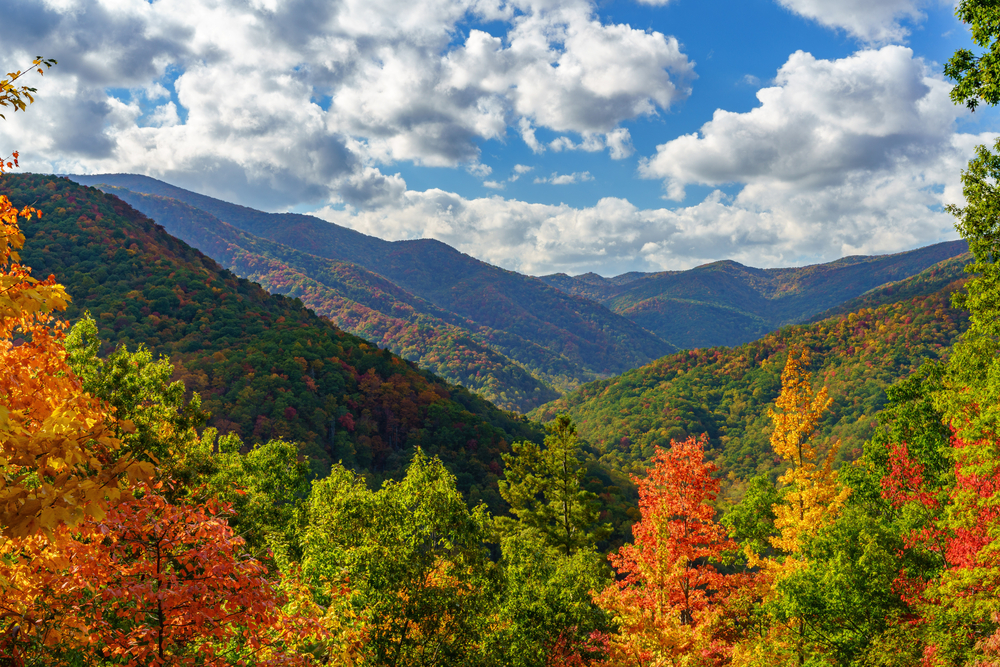
Fall in the Appalachian Mountains. Photo by TheBigMK, Shutterstock.
Appalachia’s food traditions are influenced by both a diverse makeup of people and unique geography. In a 2018 interview, Elizabeth Catte, author of What You Are Getting Wrong About Appalachia, said the face of working-class Appalachians is more likely to be a person of color or a woman instead of the “white miner” stereotype people have about the region. Additionally, West Virginia University geology professor Steve Kite told West Virginia Public Broadcasting that some areas are made of rocks 1.2 billion years old.
According to the Appalachian Regional Commission, Appalachia is made up of 420 counties across 13 states and spans 205,000 square miles from southern New York to northern Mississippi. Its 25 million residents live in parts of 13 different states. According to many food experts and historians, Appalachian food traditions were influenced by various groups, including Native American tribes, enslaved Black people and poor white people who were mostly European immigrants. The mountainous region contains fish, such as trout, not as commonly found in other parts of the country, and a bounty of spring vegetables.
To understand what sorts of foods people ate—and continue to eat—in Appalachia, it’s helpful to organize them into categories: meat, plants and vegetation, and fungi. American culinary historian Adrian Miller, James Beard Award-winning author of Soul Food: The Surprising Story of an American Cuisine, One Plate at a Time, says many families raised and ate pork, but they would also hunt squirrels and opossums for meat sources. He says many hunters would have created a “hunter stew” with meat and vegetables gathered nearby.
“You would have wild game mixed with local vegetables,” Miller says. “Brunswick stew started out with squirrel meat. Today, the same dish is made but with chicken.”
Although I’ve never seen squirrel on a menu in a restaurant, I’ve certainly seen plenty of chicken. It’s not a stretch to say some food traditions may be lost to a mainstream demand for poultry and other common meats such as beef. Even a quick Google search of “Brunswick stew” returns no recipes with wild game, nor does it seem to accentuate its history.
Barbara Swell, founder of the Log Cabin Cooking School in Asheville, North Carolina, says trout was also commonly fished from streams, and Clark Barlowe, chef and founder of Potential Pantry, says he has even developed education material on how to prepare beaver tail, which he smoked and cured.
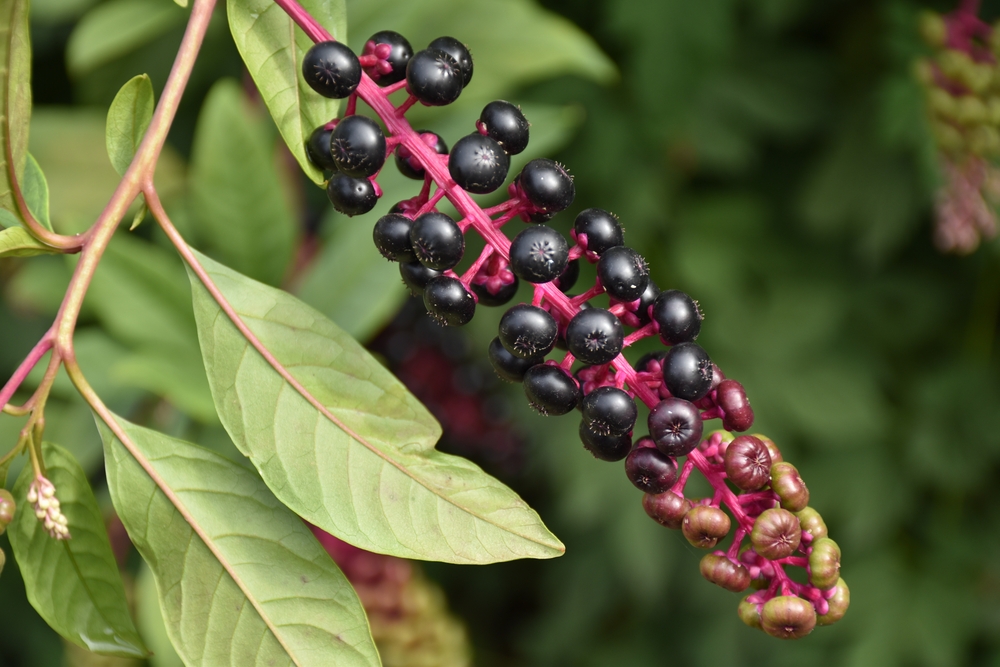
Pokeweed is a poisonous plant when not cooked properly, but a prized ingredient in Appalachian cooking. Photo by Ivanhoe106, Shutterstock.
Barlowe is one of the few chefs who works with traditional Appalachian greens such as ramps and pokeweed, the main ingredient in poke salad, a regional favorite. He used to serve poke salad in his North Carolina restaurant before moving across the country and launching Potential Pantry, through which he provides catering and educational classes focused on wild and foraged foods. According to culinary historian Miller, most Appalachians would have learned how to make poke salad from pokeweed, a toxic plant when not prepared correctly, from Native American tribes or enslaved Black people. Barlowe has cooked not only the greens but also the berries, which he used to make poke berry ice cream.
Log Cabin Cooking School’s Swell highlights branch lettuce as another common green she learned to forage from an elder and friend. According to Appalachian Memory Keepers, the plant isn’t really a lettuce, and like poke salad, is a “stretch” food because it comes up early in the spring and helps families bridge the food gap between winter and spring.
“She would say, ‘oh the branch lettuce is up now, I’d give anything for a mess of that,’” Swell says of her older friend. “Make sure it’s clean, and collect it when it’s young. She waxed poetic about that to no end.”
Other sources of food included foraged fungi, such as morel mushrooms. While morels are prized among chefs and home cooks across the country now, they are also an important spring food that historically would’ve helped Appalachians bridge the food gap between winter and summer. Barlowe says there are a lot of historical accounts of Appalachians eating morels, which are conical. He says they’re often called “dry-land fish” and are easy enough to forage because they are unique and recognizable.

Morel mushrooms sprout up every spring. Photo by Brum, Shutterstock.
Both Miller and Barlowe encourage young people to learn traditional foods and foraging skills, and it seems like the practice is growing more popular. The Tennessee Foragers & Mushroom Hunters Facebook group is a great place to meet like-minded folks in my area, and the group’s more than 9,000 members help each other identify mushrooms and plants such as mullein, often smoked to alleviate respiratory illnesses. One member recently commented that he values foraging because it can offset problems with the supply chain, so he doesn’t have to worry if grocery shelves are thinly stocked. Another member said she expected about 40 people to come to her 500-acre property for a two-day foraging fest, a private event open only to group members. There doesn’t seem to be just one kind of person in the group, and Barlowe says he recognizes a similar diversity at Potential Pantry, too.
“I don’t think there’s a way to say ‘this type of person is interested in foraging,’” Barlowe says. “I see a lot of older people, younger people—it’s all across the board. One thing [about] them is they’ve started caring about where their food comes from and how it affects their overall health.”
Barlowe also says it’s important to forage sustainably, and he says that some commonly gathered items such as ramps are in particular danger. He says there are ways to collect ramps, another wild spring vegetable foraged in Appalachia, that allow them to re-grow relatively quickly. But growing them from seed could take a decade to produce a mature plant.
Beyond foraging, many historical Appalachian foodways are passed down as oral traditions, so preserving them simply starts by writing them down. Although some cooks may want to maintain an air of mystery around a certain recipe, Miller says that, usually, elders will let you watch them make a dish or perhaps even videotape the process.
“I love [recipes] that put in some kind of context,” Miller says. “‘This was a Sunday dinner family treat; when we had a community celebration, this was a featured dish.’”
While it’s unlikely that I’ll be stewing squirrel any time soon now that I’m a vegetarian, I’ve found joy in resurrecting Appalachian foodways and recipes. This year, I learned to make poke berry jelly—which won best in show at the county fair, mind you—as well as how to forage delicious chanterelle mushrooms. Like Miller says, it’s easier to start when you have a guide, but making old traditions new again helps us celebrate where we come from, no matter what part of the world you might live in.
The post Are Appalachian Foodways at Risk of Being Lost Forever? appeared first on Modern Farmer.

There’s running a mile, and then there’s running a mile while your stomach’s full of beer. The fearsome Beer Mile—running four laps around a quarter-mile track and downing four beers in the process—has been attempted by many and mastered by few. But Men’s Health reports that Canadian runner Corey Bellemore has just…
Virtue Cider is the perfect drink for beer and wine lovers alike.

We need to know.

Germany is adding greater risk to its playgrounds. Some of its climbing structures are now three stories high. And who is requesting this?
Insurance companies. They want kids to grow up "risk competent." Ironically, "safety" culture is stunting kids' risk assessing abilities, in their estimation.
"This is fantastic progress in understanding childhood as the right time for children to learn to recognize and mitigate risk," says Gever Tulley.
Tulley should know. He's founder of the San Francisco Brightworks School author of 50 Dangerous Things (You Should Let Your Children Do).
The idea for letting kids develop some basic climbing competency has grown in popularity in Germany. An influential 2004 study had found that "children who had improved their motor skills in playgrounds at an early age were less likely to suffer accidents as they got older," according to The Guardian. Moreover:
With young people spending an increasing amount of time in their own home, the umbrella association of statutory accident insurers in Germany last year called for more playgrounds that teach children to develop "risk competence".
That's music to an actuaries' ears—and also to some parents'. My friend Siobhan is a New York native who moved to Germany. A few years ago, when her daughter was in elementary school, she says, "The school replaced the standard playground equipment with four long, thick trees with their branches removed, all interconnected with wide ropes and wobbly bridges made of rubber. The whole thing was maybe six feet at the tallest point. But the trees had been polished so they were slippery."
Sure enough, says Siobhan, the very first week they were installed, "A girl fell off and broke her arm. As an American, I nervously anticipated the outrage that would surely follow. My heart was in my throat as I eavesdropped on the other parents at pick-up the following day. What did I hear? 'Children need to learn their limitations!'" There were no lawsuits are calls to tear down the equipment.
"Even international safety standards organizations—so often the 'fun police' when it comes to playgrounds—are coming round to a more balanced, pro-risk view," says Tim Gill, author of Urban Playgrounds: How Child-Friendly Planning and Design Can Save Cities.
While the appetite for risk here in the U.S. is perhaps a little slower to develop, New York City built its first adventure playground, The Yard, in 2016, complete with hammers, nails, and plenty of wood and saws. It stands by its credo: "No parents allowed." And as a denizen of play conferences, I can attest that many play scholars are eager for more exciting playgrounds.
Unfortunately, that runs smack into our culture's habit of underestimating kids, overestimating danger, and hiring trial lawyers. In 2019, a family that had sued the Howell Township, New Jersey, school district when their daughter fell off the slide and broke her arm won a settlement of $170,000. Their lawyer had argued that the slide's slope was too steep, as it was at a 35 degree angle, rather than 30.
Perhaps out of fear of just that kind of thing, one school district—Richland, Washington— just plain got rid of its swings, arguing that "swings have been determined to be the most unsafe of all the playground equipment."
That's only because all of the merry-go-rounds, and see-saws, and monkey bars have already been uprooted.
Thus does American childhood remain, for the most part, a mulch-chip, no-slip, primary-colored plastic safe space. Or, as a German insurance exec might put it, a risk-ignorance breeding ground.
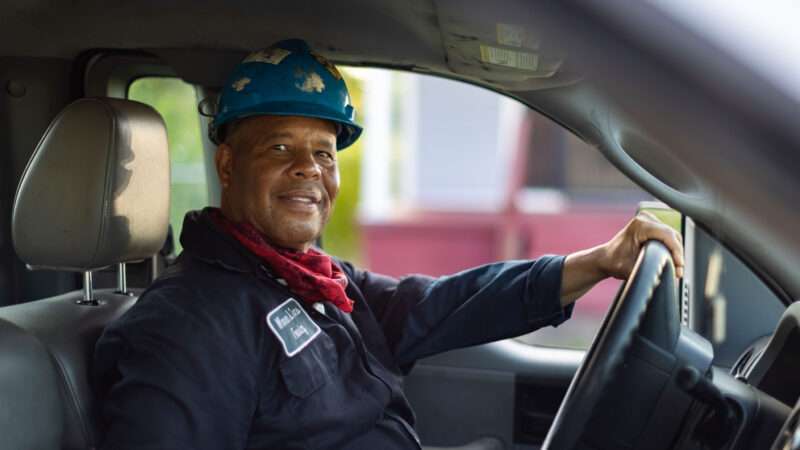
The federal government has agreed to return a New Orleans man's life savings after Drug Enforcement Administration (DEA) agents seized it at an airport through a practice known as civil asset forfeiture.
The Institute for Justice, a libertarian public interest law firm, announced that federal prosecutors have agreed to dismiss the government's case against roughly $28,000 in cash the DEA seized from Kermit Warren, a grandfather who says he was carrying the money to potentially buy a tow truck. Warren was never charged with a crime, but under civil asset forfeiture laws, police can seize property suspected of being connected to criminal activity, even when the owner hasn't been charged or convicted of a crime.
Reason reported on Warren's civil asset forfeiture case in August. Warren, a former longshoreman and shoeshiner, says he and his son had gotten laid off from their jobs last year during the COVID-19 lockdowns, and he was trying to turn a side business as a scrapper into a full-time venture. He and his son traveled to Ohio last November with the cash to purchase a tow truck. However, Warren claims the tow truck was too large for his needs, so he and his son bought a one-way ticket back home.
In the airport, three DEA agents stopped the two men and questioned them about the bag of cash they were carrying. The federal government didn't file a complaint against Warren's money until this April, claiming Warren and his son gave suspicious and incomplete answers about their travel itinerary and plans to buy the truck. Warren, who says he was panicking, also falsely claimed to be a retired police officer. Based on that, the agents concluded that Warren was involved in drug trafficking and seized his money.
Last Thursday, after the Institute for Justice provided pay stubs for Warren dating back to 2016 and text messages from the company that owned the tow truck, federal prosecutors agreed to dismiss the forfeiture complaint against Warren's money and return it.
"I'm relieved that I will finally get my hard-earned savings back after a year of suffering," Warren said in an Institute for Justice press release. "But what happened to me was wrong. The officers and prosecutors treated me like a criminal when all I was trying to do was improve my business and my life. For a year, they've left me struggling to survive a pandemic and a hurricane without my savings. I did nothing wrong, but until the law is changed so that everyone is protected, I am not going to have cash in my house anymore."
There is nothing illegal about flying domestically with large amounts of cash, but local and federal law enforcement frequently stop travelers, search their luggage, and seize their cash on suspicion of drug trafficking, even if they find no drugs.
The DEA and Transportation Security Administration often flag airport travelers who exhibit supposedly suspicious behavior, such as purchasing one-way tickets with short turnaround times and traveling lightly. In 2016, a USA Today investigation found the DEA seized more than $209 million from at least 5,200 travelers in 15 major airports over the previous decade.
Law enforcement groups say civil asset forfeiture is an essential tool to fight organized crime, like drug trafficking, by targeting its illicit proceeds.
However, civil liberties groups say there are too few protections for innocent owners and too many incentives for police to seize property on flimsy suspicions. More than half of all U.S. states have passed some form of asset forfeiture reform because of those concerns.
The Institute for Justice is currently litigating a separate class-action lawsuit on behalf of people whose cash was seized by the DEA at airports. One of the lead plaintiffs in that case, Stacy Jones, had $43,167 in cash seized by the DEA as she was trying to fly home to Tampa, Florida, from Wilmington, North Carolina. Jones says the cash was from the sale of a used car, as well as money she and her husband intended to take to a casino.
One of the other named plaintiffs in the lawsuit, Terrence Rolin, a 79-year-old retired railroad engineer, had his life savings of $82,373 seized by the DEA after his daughter tried to take it on a flight out of Pittsburgh with the intent of depositing it in a bank. After the case went public, the DEA returned the money.
"Kermit's case highlights how the federal government abuses civil forfeiture," says Institute for Justice Senior Attorney Dan Alban. "It seizes cash on the flimsiest of pretexts—traveling with cash at an airport—and effectively forces people to prove their own innocence to get their money back. And even in a best-case scenario, it can take over a year for them to get their property back."
Tired of getting on your hands and knees in the pickup bed to unload your gear? Here’s a two-minute, ten-dollar lifetime solution
The post The One and Only Super Simple Back-Saving Truck Stick appeared first on Garden & Gun.


Every Sunday, we bring together a collection of easy-reading articles from analytical to how-to to photo features in no particular order that did not make our regular daily coverage. Enjoy!
The Nikon Z9’s New Sensor Could be the Start of a Big Shift in Photography – The Verge

From The Verge:
Nikon has made no mention of things like computational photography for HDR-style photos or the cyclical buffering that smartphones do to simultaneously capture up to nine or ten frames and combine them with each press of the shutter button. But the new 45.7-megapixel full-frame backside-illuminated stacked CMOS sensor isn’t far off from what has been in phones for years, at least in terms of the core design. This kind of construction uses a sandwiched architecture of sensor, logic board, and dedicated RAM — yielding incredibly fast readout speeds.
Polaroid’s New Camera Is Great for Pros, Bad for Idiots (Like Me) – Gizmodo

With the new $150 Polaroid Now+, Polaroid has once again tinkered with that time-honored formula to make its famously intuitive camera a little bit more feature-rich, loading it up with new creative tools that boost the camera’s core functionality and allow savvy photographers greater remote creative control over the photos they produce. In other words, the camera that was once idiot-proof is now less so, which is great news for seasoned photogs and bad news for me, an idiot. — Gizmodo
Also, The Polaroid Now+ Takes the Classic Polaroid Camera to a Whole New Level — CNN Underscored
A Photographer Captures American Protests — And Iconic Images From Jan. 6 — BuzzFeed
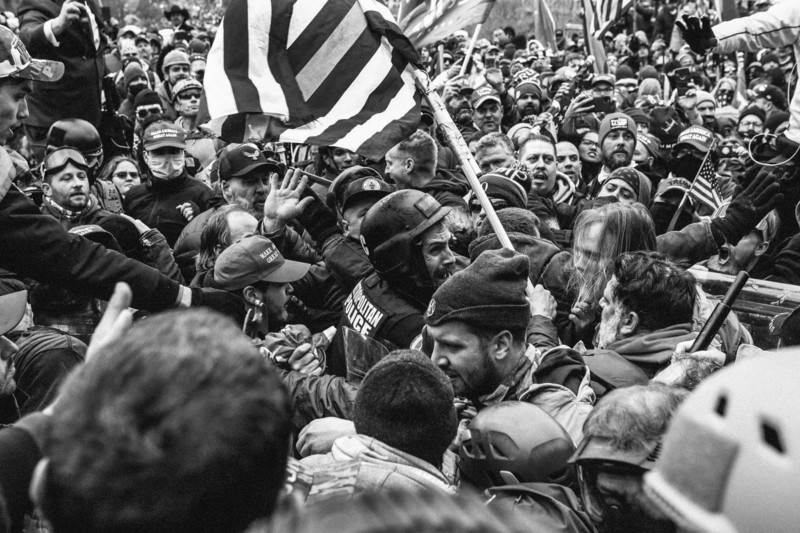
Mel D. Cole has spent the last 20 years documenting music, nightlife and more. In April 2020, during the early days of the COVID-19 pandemic lockdowns, Cole started driving around New York City, documenting the streets. But when George Floyd died after being pinned to the ground by an officer’s knee, Cole dedicated the rest of 2020 and beyond to photographing the Black Lives Matter protests that swept the country and their ramifications.
The body of work he has produced from the electrifying summer of 2020 and beyond is a powerful outpouring of the hurt, outrage and courage of people compelled to act. Inspired by the black-and-white documentary tradition of the 1960s, Cole seeks to create what he calls “a collective memory” that continues the civil rights movement’s legacy.
American Protest: Photographs 2020 – 2021 by Mel D. Cole is published by Damiani.
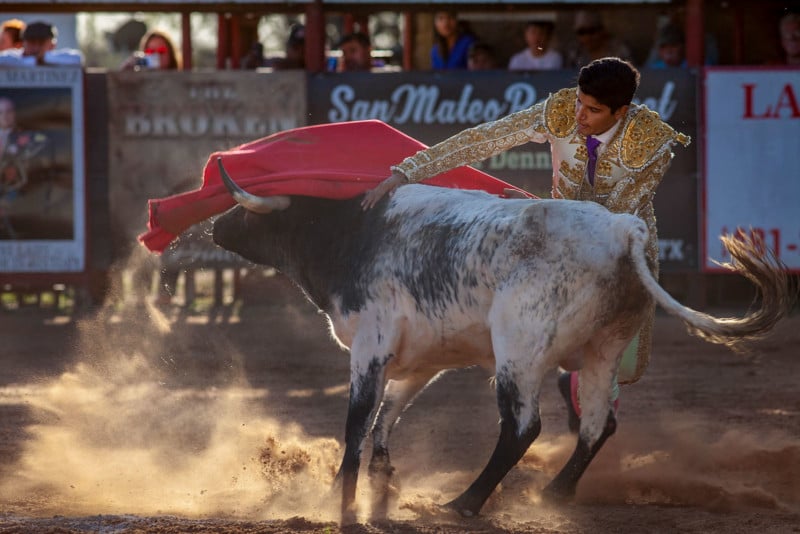
A Photographer Captured the Art of Bloodless Bullfighting in Texas for Over a Decade – NPR
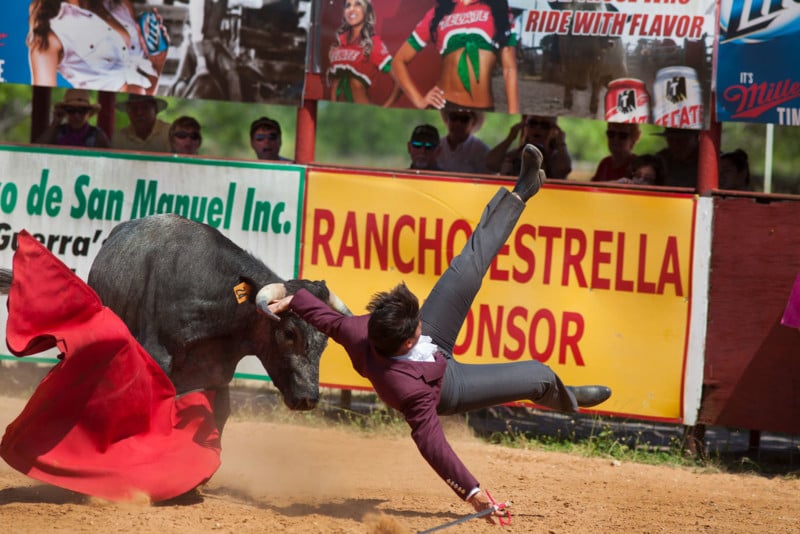
Katie Hayes Luke has been photographing the bloodless bullfights at La Querencia ranch in south Texas for the last 13 years.
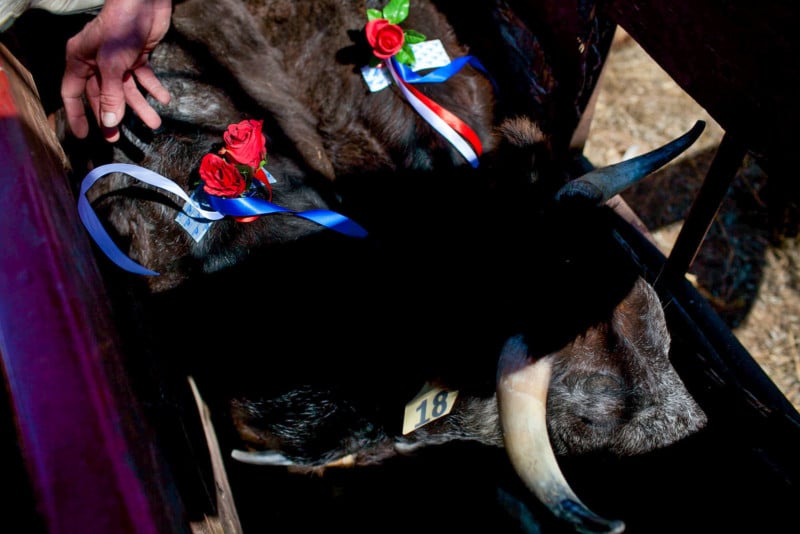
In the United States, it is illegal to kill a bull, and therefore the fights are run differently than in Spain, where it is defined as an art form or cultural event.
Intimate Photos of Cindy Sherman Like You’ve Never Seen Her Before – AnOther

From AnOther:
On 31 October 1985, photographer Jeannette Montgomery Barron arrived at Cindy Sherman’s studio in downtown New York to photograph her as few had seen her before – as she was, unadorned. Gone were the wigs, the theatrical make-up, and the props that Sherman used to transform herself into a vast array of female personas brought to life in her art. In the course of an hour, Baron created 40 black and white portraits of the artist, now brought together in Cindy Sherman: Contact (NJG), a limited edition of 400 books and 20 portfolios.“She seemed very comfortable being photographed by me. I hope she was,” says Jeannette Montgomery Barron, remembering the fateful encounter with the artist on Halloween 1985.
Read also: Cindy Sherman Photograph Sells for $3.8 Million, Setting New Record
A ‘Time Capsule’ of Lost Photographs of the Black Panthers, Found 50 Years Later – Creative Boom
After his mother passed away in 2018, Jeffrey Henson Scales made a surprising discovery while helping to clear out the family home. The photographer and photo editor for the New York Times found 40 rolls of film, which included forgotten images of the Black Panther Party and its founding members.
“I hadn’t seen them since the 1960s and was struck by not only my origin story as a photographer but also the new urgency these images and the civil rights movement takes on in the context of today’s ongoing struggle for racial justice,” Scales tells Creative Boom.
Also, How a Surprise Discovery of Photographs From the 1960s Meets the Moment – The New York Times (Subscription required)
National Geographic: 50 Greatest Wildlife Photographs – ArtfixDaily
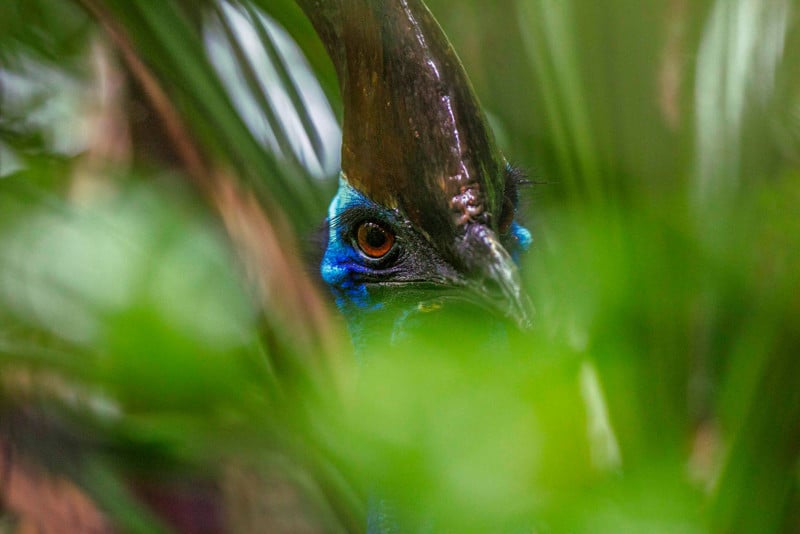
The new National Geographic exhibition, National Geographic: 50 Greatest Wildlife Photographs, displays the very best wildlife pictures from the pages of National Geographic magazine. Curated by renowned nature picture editor Kathy Moran, this exhibition is a celebratory look at wildlife with images taken by National Geographic’s most iconic photographers such as Michael “Nick” Nichols, Steve Winter, Paul Nicklen, Beverly Joubert, David Doubilet and more. These images that showcase photography’s evolution convey how innovations such as camera traps, remote imaging, and underwater technology have granted photographers access to wildlife in their natural habitat.
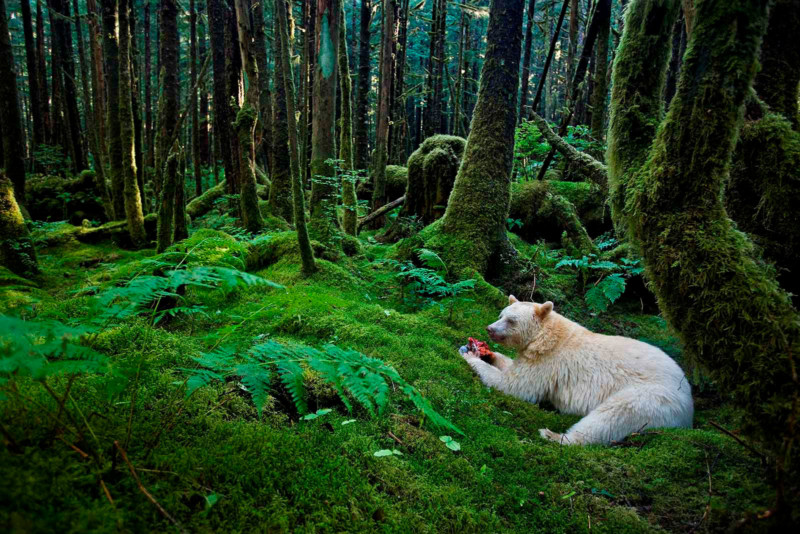
For 130 years, National Geographic has utilized its storytelling expertise to connect its readers to the great outdoors. The organization has pioneered the art of wildlife photography ever since the first image to appear in National Geographic magazine of a reindeer in 1903.
National Geographic: 50 Greatest Wildlife Photographs will remain open at the National Museum of Wildlife Art from Nov 6, 2021 – Apr 24, 2022.
Parents Outraged Over School Picture Day ‘Retouch’ Trend – New York Post
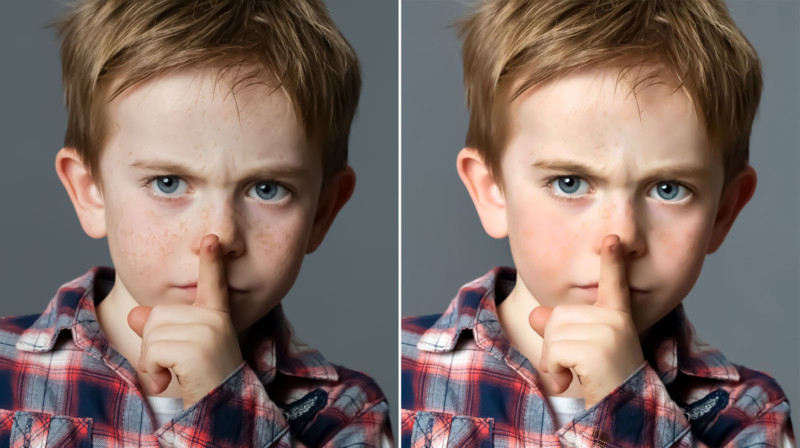
From New York Post
Jennifer Greene doesn’t want her 12-year-old daughter, Madeline, to feel pressured into looking picture-perfect.So, when the Maryland mom opened the seventh-grader’s school picture package from photography company Lifetouch and saw it urged parents to lay out an extra $12 for portrait “retouching” services — including teeth whitening, skin-tone evening and blemish removal — she freaked.
“I was shocked,” Greene, 43, told The Post.
“I completely disagree with [retouching a child’s school picture], because it’s teaching kids that they need to look perfect all the time and that they can change [a perceived flaw] with the click of a mouse.”
Retouching options on school portraits aren’t new — but they’re now being offered to students as young as pre-K and are becoming as ubiquitous as face-altering filters on social media, which have triggered a spike in anxiety and depression in teen girls.
Guide to Contemporary Photography — Shotkit
From ShotKit
Contemporary photography is a category that encompasses fine art photography created after the late 1960s – when modern photography ended.If you want to know more about the history of photography, I recommend the books of John Szarkowski. He was the director of photography at the Museum of Modern Art in New York, and he was one of the most influential historians, curators and critics.
Contemporary art entails any artwork – whether it’s performance, video, sculpture, painting, etc., created in the past few decades up until the present day.
The exact origin is still debated, but most historians consider it at the end of the 1960s or the early 70s. Despite the somewhat precise date range, it refers to the period that follows modernism.
‘Fill the Frame’ Documentary Explores Social Media’s Influence on Street Photography – Amateur Photographer
A new film, Fill the Frame, by director and keen street photographer Tim Huynh, shows some of the challenges of street photography.
Huynh focuses on the work of eight New York-based amateur street photographers Paul Kessel, Jonathan Higbee, Dimitri Mellos, Mathias Wasik, Melissa O’Shaughnessy, Melissa Breyer, Julia Gillard and Lauren Welles.
“I’m seeing the fine art street photography approach (Saul Leiter’s work, for example) gaining more popularity than the Garry Winogrand traditional style of street photography… where the images will predominantly combine deep dark shadows, vibrant colors and architecture, and where the photographer is further back from the subject,” Huynh tells Amateur Photographer.
“Anyone looking to always find the glory shot will be sorely disappointed. If you do street to receive some kind of glorification, I suggest you rethink your purpose. Just enjoy the fact you have this interest and ability to roam the streets and make art happen, capture that moment that only you saw.”
‘I Call It Fire Brain’: What It’s Like to Photograph the West’s Biggest Wildfires — Gizmodo
Embed from Getty ImagesJosh Edelson shot corporate events, headshots and general advertising. Once the pandemic hit, all that work vanished, and news became most of his work.“I enjoy covering a protest, but where I really feel passionate is covering things related to the climate: floods, fires, and things like that,” Edelson tells Gizmodo.
“I don’t know if it’s a healthy thing, but I feel like the camera, in many ways, is sort of an emotional barrier. I don’t often process everything that I experienced until after, like after I leave the fire…
“I’m thinking, where’s the fire moving? Am I safe here? Do I have an exit? Are the power lines above? Are there any trees that are about to fall? Are there propane tanks nearby? Go to 1/500th of a second, f-stop 4, ISO’s too high. Step back; the windows are going to blow out.
“It happens fast. Sometimes a home will catch fire, and in 20 minutes, it’s down… Safety is obviously at the top of my mind. Also…staying out of the way of firefighters.
“If I’m photographing a person coming home to a burned home, I always try and get some sort of at least non-verbal confirmation that they acknowledge my presence. I try not to get too close. When people are crying, the last thing they want is a camera right in their face. There’s a balancing act between getting solid photos and respecting people’s privacy.”
Photoshop 2022: 9 New Features with Pros & Cons! — PiXimperfect
2021 has been a year of AI, and with Photoshop 2022 (version 23.0), Adobe has released many features that use machine learning, powered by Adobe Sensei, and claim to make most things automatic.
This video, by PiXimperfect, hosted by Unmesh Dinda, explores what these new features are and whether they are effective or not.
Also, Adobe Photoshop 2022 Top New Features in 9 Minutes! – Photoshop Training Channel
22 Self-Portrait Ideas to Get You Inspired – Digital Photography School

Are you looking for self-portrait ideas so you can create powerful, eye-catching results?
Below are just 3 of 22 ideas on how to improve your self-portrait game.
1.) Experiment with reflection
2.) Experiment with objects in front of the lens
3.) Try framing
Great Read From the Past – 2017
How Did Peter Hurley Become a Photographer? — Rangefinder
When I was younger, I was training for the Olympics in sailing. Polo wanted real sailors for a campaign they were doing that Bruce Weber was shooting, and I went over and got the job. I didn’t know anything about photography at the time or who Bruce was, but from there, I got into modeling, and one day Bruce was like, ‘Why don’t you pick up a camera?’ He was one of the people that really encouraged me. I value that immensely, but I also just love his work. – Peter Hurley in Rangefinder.
Read also:
How to Light Headshots: Five Tips from Peter Hurley
5 Quick Headshot Tips in 3 Minutes by Photographer Peter Hurley
Photo of the Week
Embed from Getty ImagesThe winner of the scariest costume category with “Maleficent” celebrates during the annual Tompkins Square Halloween Dog Parade at East River Park Amphitheater in New York on October 23, 2021. (Photo by KENA BETANCUR/AFP via Getty Images)Quiz of the Week
1.) Can a high-end digital camera function without a mechanical shutter?
2.) Which manufacturer recently released two zoom lenses and claimed they were the lightest in their class?
3.) Is there a Sigma zoom lens that costs over $25,000? Hint: It weighs 35 lbs. and needs a battery to work.
Answers
1.) Yes, the new Nikon Z9 does.
2.) Nikkor Z 100-400mm f/4.5-5.6 VR S at 1,355 g and Nikkor Z 24-120mm f/4 S at 630 g.
3.) Yes, the Sigma APO 200-500mm f/2.8 with 2x Teleconverter. Sigma first showed this lens at PMA in Jan 2008 in Las Vegas. It is still in production but is a special-order item at Adorama.
Why I Like This Photo – Cameron Dever

I like this photo because not only is it compositionally interesting and beautiful, but also it symbolizes love and connection and what it’s like to be in a relationship. It was a completely experimental shot too, so it became more than what it was originally intended to be when it came out like this. It became more symbolic than just a regular photo of a couple.
I think it’s very important to know how to compose an image and work with light of all kinds, composition, color, and all of the technical aspects of photography. When you do that, your voice and instincts as an artist kick in, and you really make some magical, unique images. That’s what happened with this photo for me. I decided to play with motion blur and turn the camera as I shot. Simple, but it created something amazing.
I shoot on a Canon EOS 5D Mark IV for all of my digital images. For film, I mainly shoot on a Canon EOS Rebel 2000 and various other film cameras I pick up at thrift stores. All my images are currently shot on a 35mm lens. I’m not big into artificial lighting other than the flash I stick on my cameras. So that’s the only artificial light I use for my photography.
This photo was taken in 2020, and it was during an engagement session. Like I said previously, it was a complete experiment, and I just hoped it came out when I took it. It was a pleasant surprise.
One of the biggest pieces of advice I like to share is just to take photographs as much as possible. And experiment with different things when you do. Both of those things help you find your voice, and when you find your voice in your art is when you become a valuable, unique artist. I highly recommend reading Austin Kleon’s Steal Like an Artist, which covers what I just said and so much more.
Cameron Dever, a wedding and commercial photographer, was born in Mesa, Arizona. The desert was home for 19 years until she moved to Utah. She received her first camera for Christmas when she was 15 years old and has been photographing ever since. Dever did a year and a half at ASU with a business entrepreneurship degree but quickly realized that photography always was and will be her passion and ultimately graduated from BYU with a photography degree. She was married last summer to her husband Nathan and now lives in a little vintage apartment with their cat noodle. She enjoys thrifting, traveling, rock climbing, hiking, and trying new Thai food places when she’s not taking photos.
Quote of the Week – Chris Johns
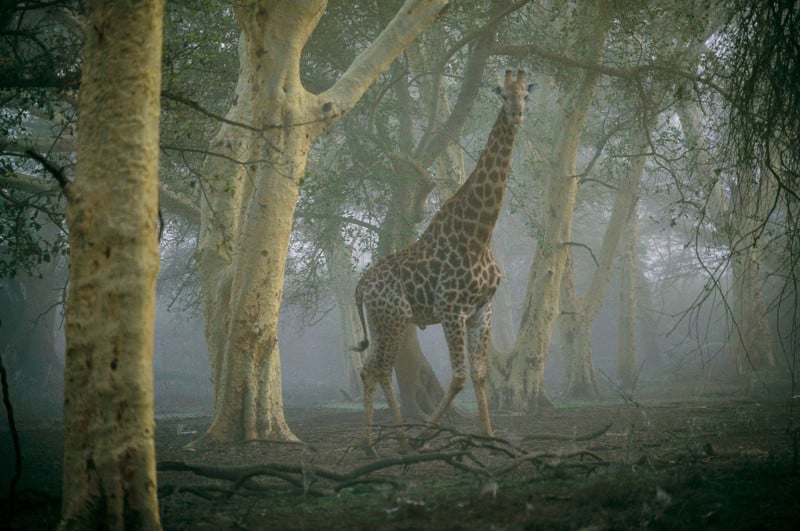
The above photo is from National Geographic: 50 Greatest Wildlife Photographs at the National Museum of Wildlife Art, Jackson, WY, from Nov 6, 2021 – Apr 24, 2022.
Today, taking a photograph is easier than it has ever been, but that does not mean just anyone can create a powerful body of work that informs and emotionally touches people.* – Chris Johns
* Griz Chat with former National Geographic Editor Chris Johns, April 2020
Chris Johns (b. 1951) is a photographer and former editor-in-chief for National Geographic Magazine from 2005-2014. He spent many years in Africa for the magazine and is the first photographer to have been named its editor-in-chief. Johns is the former distinguished professor at the Univ. of Montana and taught a course in conservation journalism, examining the powerful impact visual storytelling has had in the conservation movement.
To see an archive of past issues of Great Reads in Photography, click here.
We welcome comments as well as suggestions. As we cannot possibly cover each and every source, if you see something interesting in your reading or local newspaper anywhere in the world, kindly forward the link to us here. ALL messages will be personally acknowledged.
About the author: Phil Mistry is a photographer and teacher based in Atlanta, GA. He started one of the first digital camera classes in New York City at The International Center of Photography in the 90s. He was the director and teacher for Sony/Popular Photography magazine’s Digital Days Workshops. You can reach him via email here.
Image credits: All photographs as credited and used with permission from the photographers or agencies. Portions of header photo via Depositphotos.

As we first mentioned last year, Google has launched a series of Career Certificate programs that allow students to gain expertise in a field, ideally enough to start working without a 4-year college degree. This initiative now includes a Certificate in Project Management, which consists of six courses.
Above, a Program Manager talks about “her path from dropping out of high school and earning a GED, joining the military, and working as a coder, to learning about program management and switching into that career track.” An introduction to the Project Management certificate appears below.
The Project Management program takes about six months to complete, and should cost about $250 in total. Students get charged $39 per month until they complete the program.
You can explore the Project Management certificate here. And find other Google career certificates in other fields–e.g. UX Design and Data Analytics–over on this page. All Google career courses are hosted on the Coursera platform.
Find more online certificate programs from an array of providers here.

Note: Open Culture has a partnership with Coursera. If readers enroll in certain Coursera courses and programs, it helps support Open Culture.
Related Content
150 Free Online Business Courses
Become a Project Manager Without a College Degree with Google’s Project Management Certificate is a post from: Open Culture. Follow us on Facebook and Twitter, or get our Daily Email. And don't miss our big collections of Free Online Courses, Free Online Movies, Free eBooks, Free Audio Books, Free Foreign Language Lessons, and MOOCs.
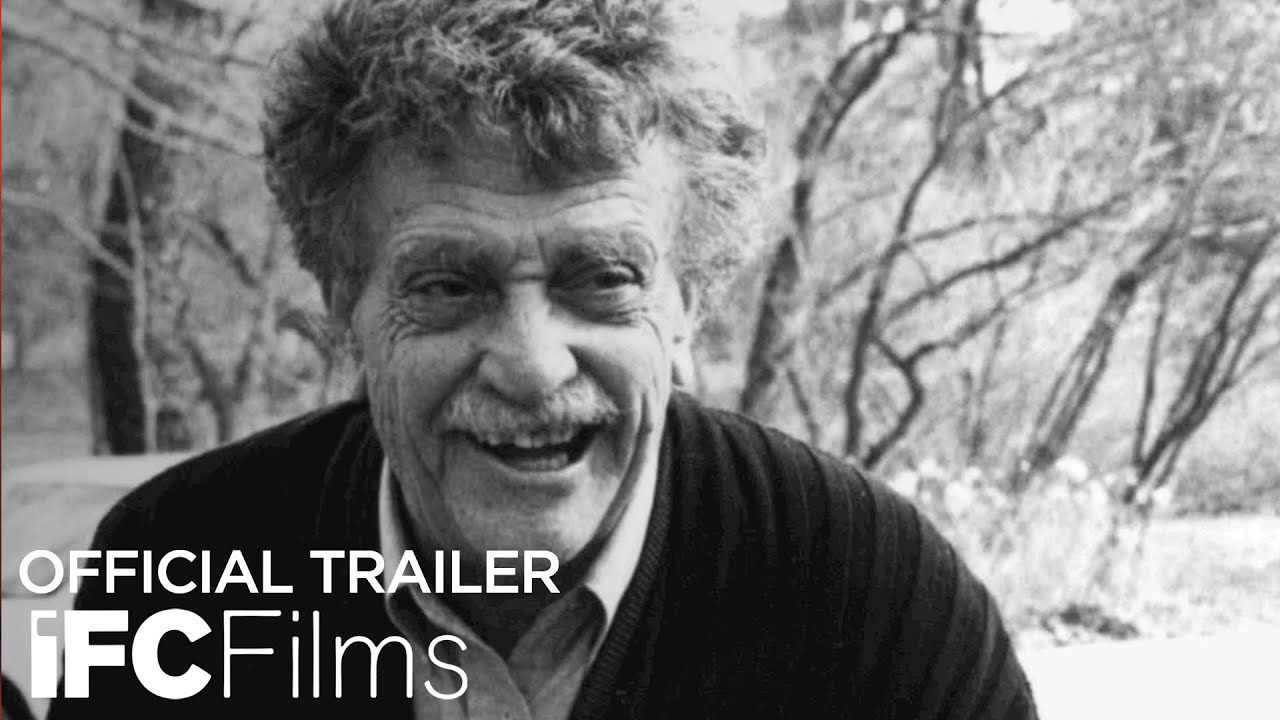
When Kurt Vonnegut first arrived in Dresden, a city as yet untouched by war, crammed into a boxcar with dozens of other POWs, the city looked to him like “Oz,” he wrote in his semi-autobiographical sixth novel Slaughterhouse-Five. After all, he says, “The only other city I’d ever seen was Indianapolis, Indiana.” When Vonnegut and his fellow GIs emerged from the bowels of the pork plant in which they’d waited out the Allied bombing of the city, they witnessed the aftermath of Dresden’s destruction. The city formerly known as “the Florence of the Elbe” was “like the moon,” as Vonnegut’s “unstuck” protagonist Billy Pilgrim says in the novel: cratered, pitted, leveled…. But the smoking ruins were the least of it.
Vonnegut and his fellow prisoners spent the next few days removing and incinerating thousands of bodies, an experience that would forever shape the writer and his stories. Whether mentioned explicitly or not, Dresden became a “death card,” writes Philip Beidler, that Vonnegut planted throughout his work. Death recurs with banal regularity, the phrase “So it goes,” peppered (106 times) throughout Slaughterhouse-Five, which Vonnegut credited to the French novelist Celine, whose cynicism tipped over into hatred. Vonnegut may have gone as far as generalized misanthropy, but his dry, wisecracking humor and his humanism stayed intact, even if it had picked up a passenger: the horror of mass death that haunted his imagination.
Vonnegut, like Billy Pilgrim, became “unstuck in time,” a condition we might see now as analogous to PTSD, his daughter Nanette says. “He was writing to save his own life,” as news from Vietnam came in and Vonnegut, a pacifist, found himself “losing his temper” at the television. “He saw the numbers, how many dead,” she adds, “that these kids were being conned, and sent to their deaths. And I think it probably set a fire under him to have his say.” A new documentary on the writer titled Unstuck in Time shows how much impact his “say” had on the country’s readers. Vonnegut wrote unbridled satire, science fiction, and social commentary, in thin books with irreverent doodles in the margins. As director Robert Weide says in the trailer above, holding a copy of Breakfast of Champions, “what high school kid isn’t gonna gobble this up?”
Weide, like most lovers of Vonnegut, discovered him as a teenager. At 23, the budding filmmaker contacted his literary hero about making a documentary. Over the course of the next twenty-five years, Weide– best known for his work with Larry David on Curb Your Enthusiasm (and as a meme) — filmed and taped conversations with Vonnegut until the author’s death in 2007. The resulting documentary promises a comprehensive portrait of the writer’s life, LitHub writes, from his “childhood in Indianapolis to his experience as a prisoner of war to his rise to literary stardom to the fans left in the wake of his death, all through the lens of Vonnegut and Weide’s close friendship.”
As the relationship between filmmaker and subject became part of the film itself, co-director Don Argott joined the project “to document the meta element of this story,” says Weide, “as I continued to focus on Vonnegut’s biography.” Forty years in the making, Unstuck in Time, evolved from a “fairly conventional author documentary” to what may stand as the most intimate portrait of the author put on film. Perhaps someday we’ll also see the publication of an 84-page scrapbook recently sold at auction, a collection of Vonnegut’s wartime letters, news clippings, and photographs of the ruined German city that he never fully left behind.
Related Content:
Why Should We Read Kurt Vonnegut? An Animated Video Makes the Case
Watch a Sweet Film Adaptation of Kurt Vonnegut’s Story, “Long Walk to Forever”
Josh Jones is a writer and musician based in Durham, NC. Follow him at @jdmagness
Watch the New Trailer for a Kurt Vonnegut Documentary 40 Years In the Making is a post from: Open Culture. Follow us on Facebook and Twitter, or get our Daily Email. And don't miss our big collections of Free Online Courses, Free Online Movies, Free eBooks, Free Audio Books, Free Foreign Language Lessons, and MOOCs.
You're cooler than you think.

Bir Tawil is the last unclaimed, habitable land on Earth. Wedged in between Egypt and Sudan, the oddity has captured the attention of thrill-seekers, curious minds, and people who want a chance to own or rule an unowned plot of land.
At the moment, Dwain Coward, a 41-year-old barrister from south London, proclaims himself the king of Bir Tawil. He even did a coronation ceremony, complete with a crown and oath to develop his ‘new country.’ His interest in the land is due to the belief that Bir Tawil can become an ‘oasis of possibility.’ When travel restrictions due to the pandemic are loosened, the barrister aims to travel to the land in order to redouble his efforts in persuading stakeholders to invest their futures in his vision.
Image credit: Dwain Coward


