Henri Cartier-Bresson, the “father of street photography,” believed that the mission of the photographer was to patiently and deliberately wait with camera in hand for that unique instant that will never again be repeated. He identified this time as the photographer’s Decisive Moment.
Whenever a photographer travels, taking a picture of the Eiffel Tower or Saint Peter’s is obviously a must. However, the true joy is to capture a Parisian or Roman doing something that depicts a little slice of our universal humanity.
The problem is how does one achieve this feat without causing a disturbance while still enjoying your day. It is fun going out with your photo friends for a day of shooting. However, once you arrive at your selected location, split up! Street photography is not a team sport.
It is difficult enough to remain invisible when one is alone. This is impossible to achieve walking down a street with a friend with two giant DSLRs. Whenever I go shooting with a friend, once we arrive at our location, we agree on a time and place to rendezvous, and we then diverge.
While roaming the streets with a camera in hand, one must always be on the lookout for something interesting. When a possible scene is discovered, do not stare! Look away. Pretend to take a picture of something at a different angle. While doing so, adjust your aperture to the required f-stop, and also set your focusing dot to where you will need it for the desired shot. All that is needed now is a quiet turn to the subject and take several images on “quiet mode.”
At times during your travels, you simply have to trust your intuition. You may come across a promising character or group of people, but nothing of true interest is happening at that moment. Do not hesitate to just hang around at a modest distance and see what develops. Many times your instinct will prove worthwhile, and you will be rewarded with something unique.
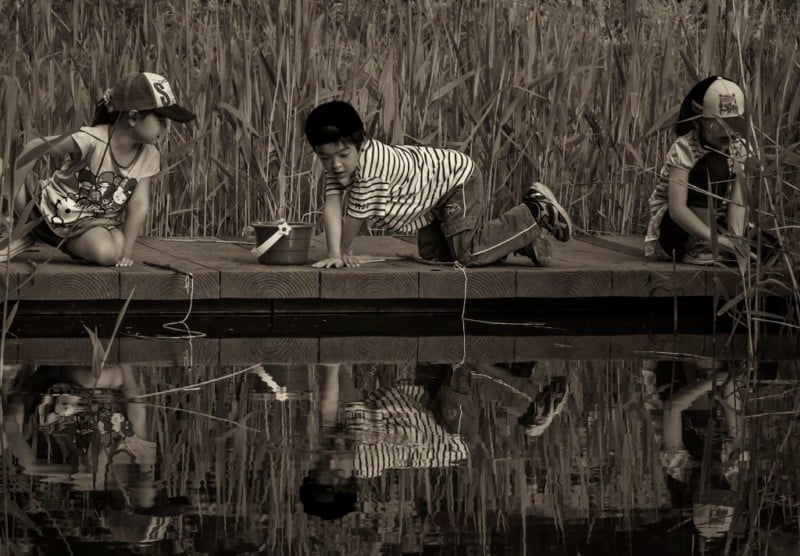
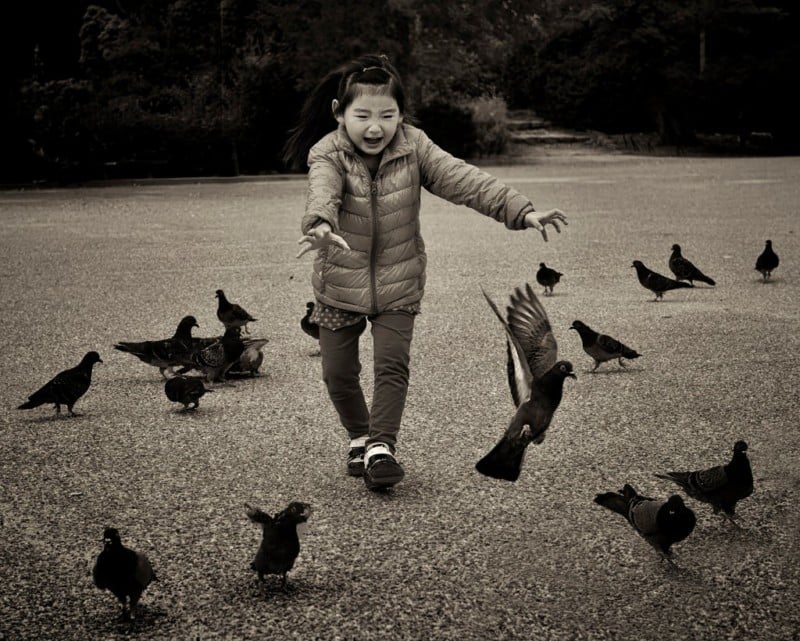
When children are concerned, the photographer must obviously exercise more caution. In a festive atmosphere, such as a fair, parents are usually much more relaxed.
If you can spot the parent of an interesting child, simply approach the parent with a smile and explain that you are a serious photographer trying to document the occasion. Be honest and tell them you would love to photograph the child. I usually also volunteer to send them a photo if it turns out successful. Usually this is all that is needed.
In the average situation on the street, more caution is needed. If the street is crowded, and you are at a moderate distance from the subject, begin to take photos in a circular motion, and when the angle is right, capture the image you want. Afterwards, continue with your circular shooting. If someone says anything, smile and explain you are a serious photographer documenting life in the city.
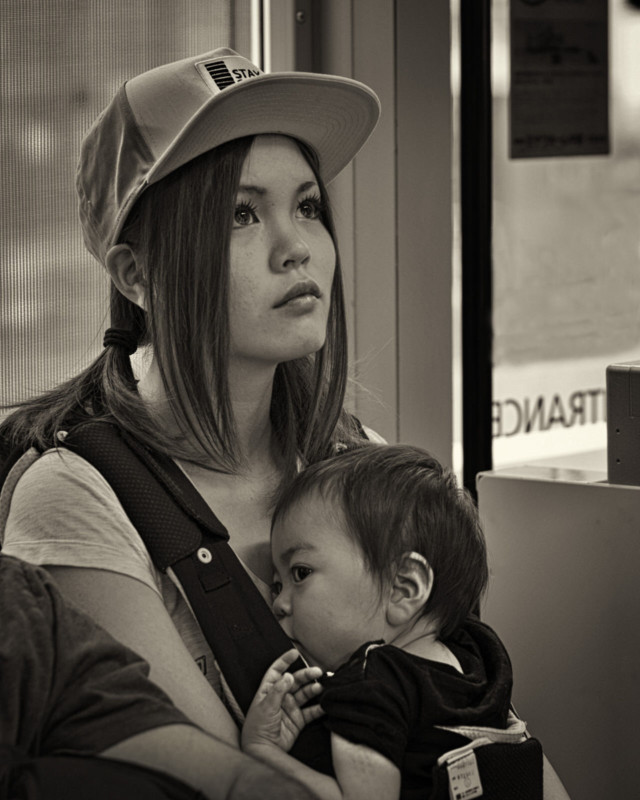
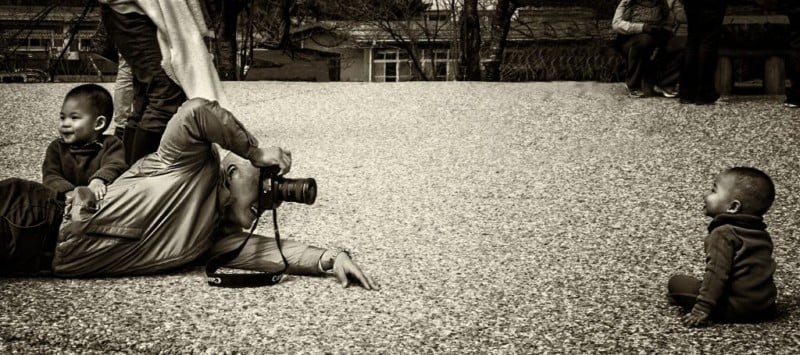
Shooting parents with children is considerably much easier. Just approach with a smile and show them the camera — you will typically get a nod. If questioned, simply have a story prepared. You are a serious photographer from the local camera club, and you are documenting life in the city. Afterwards again approach the parent, thank them, and offer to send them a photo.
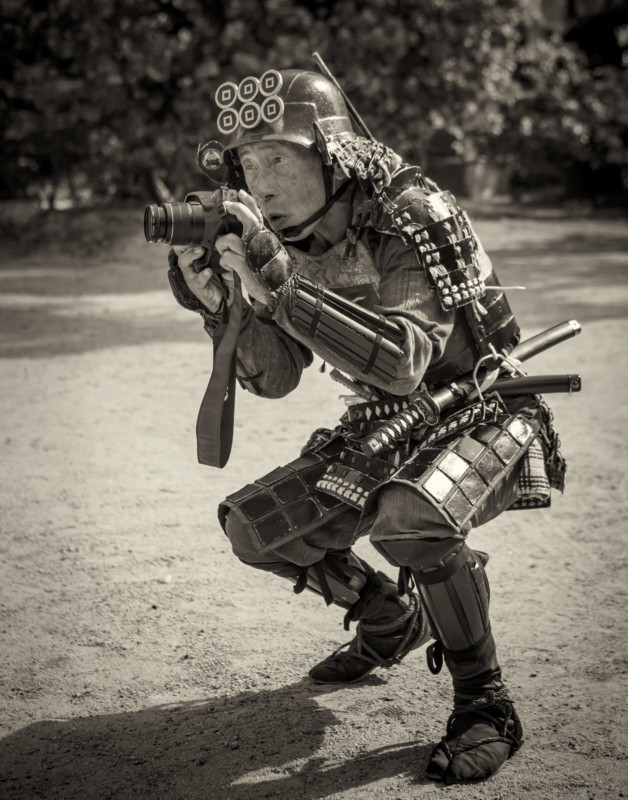
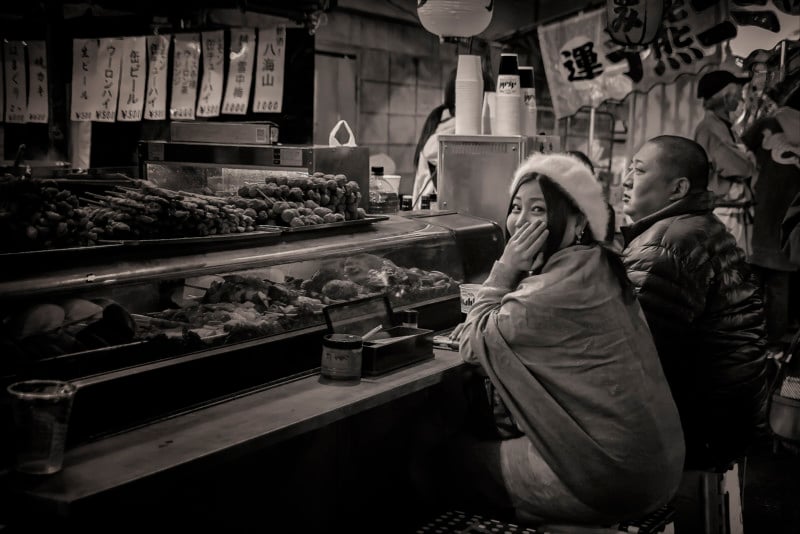
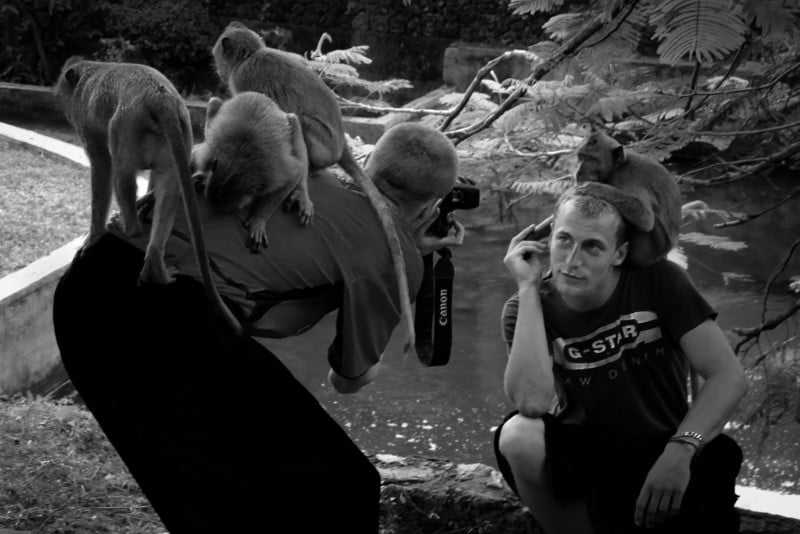
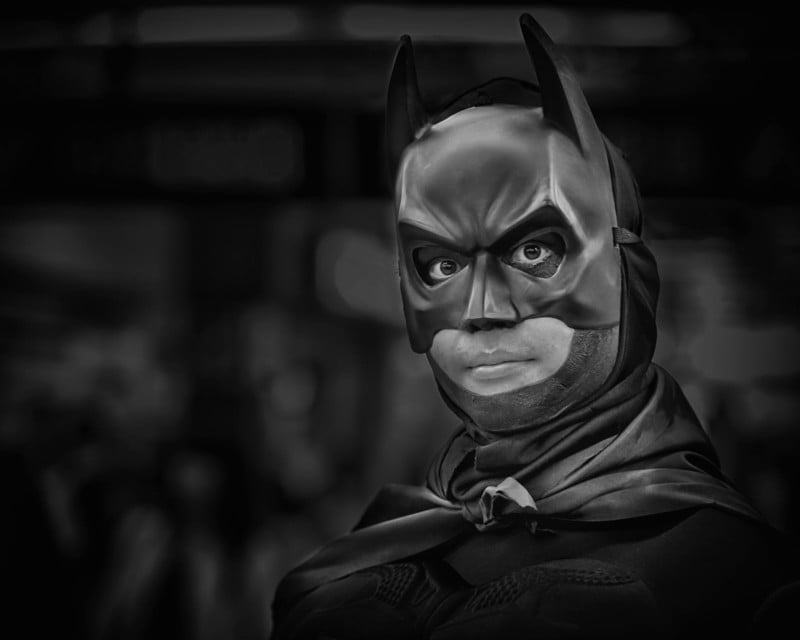
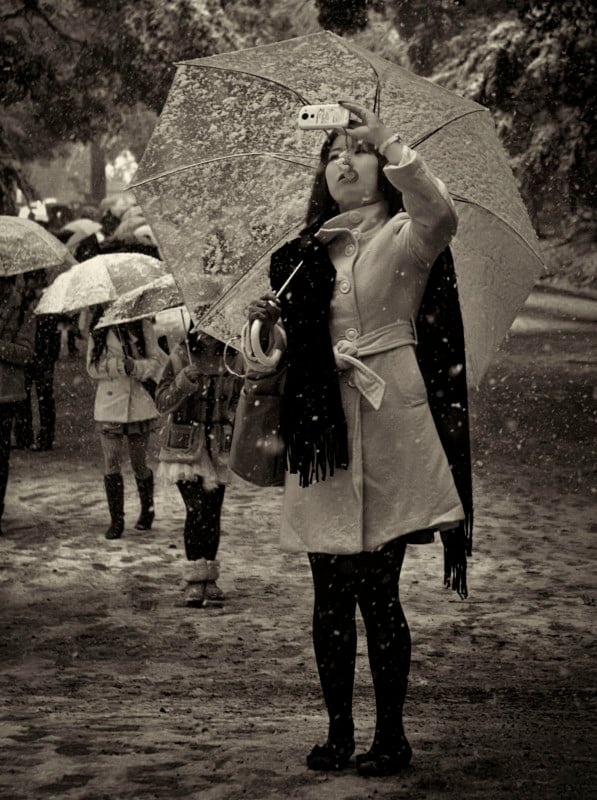
During your walks, look for the unusual, the different, and the strange. Some of the most enjoyable images of the street are slightly funny, peculiar, or ironic.
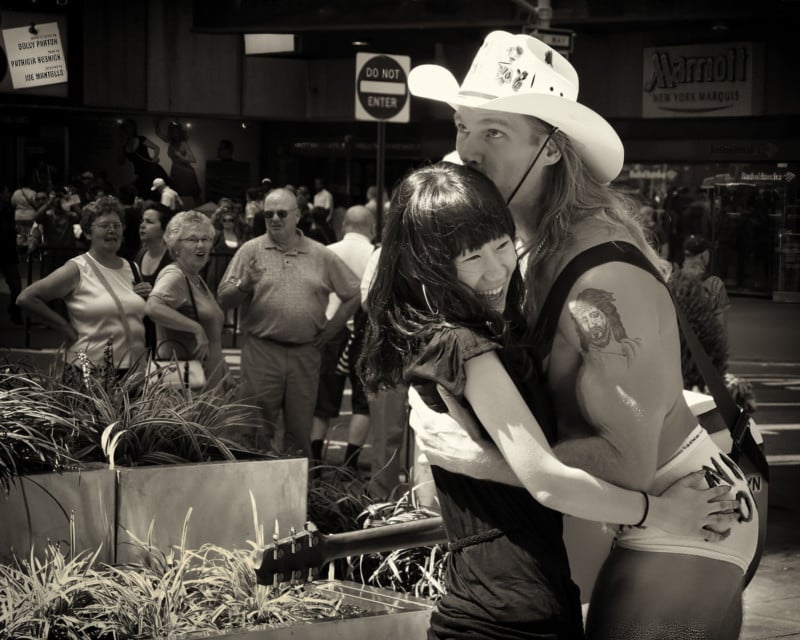
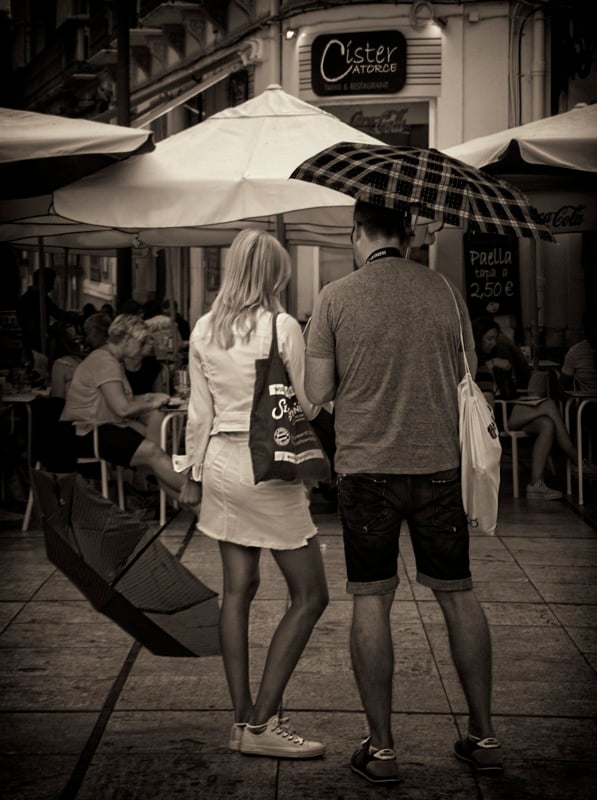
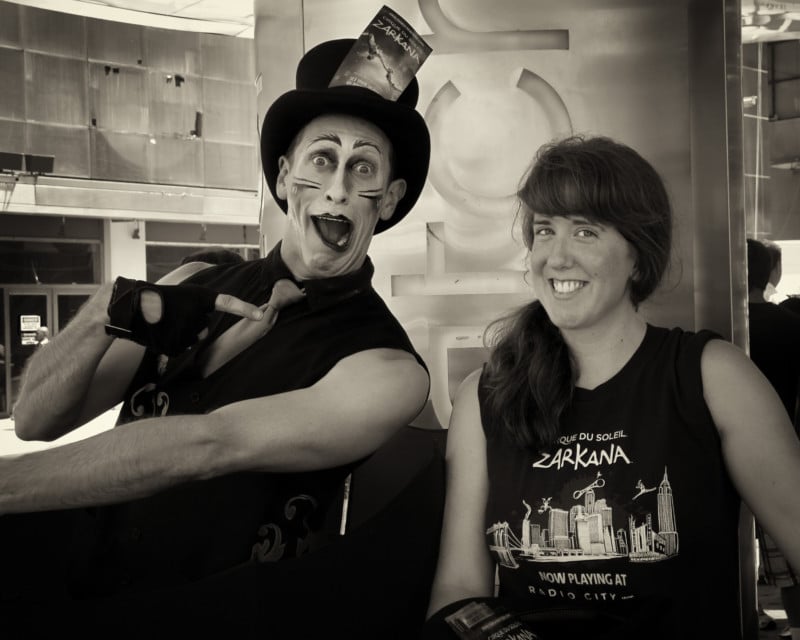
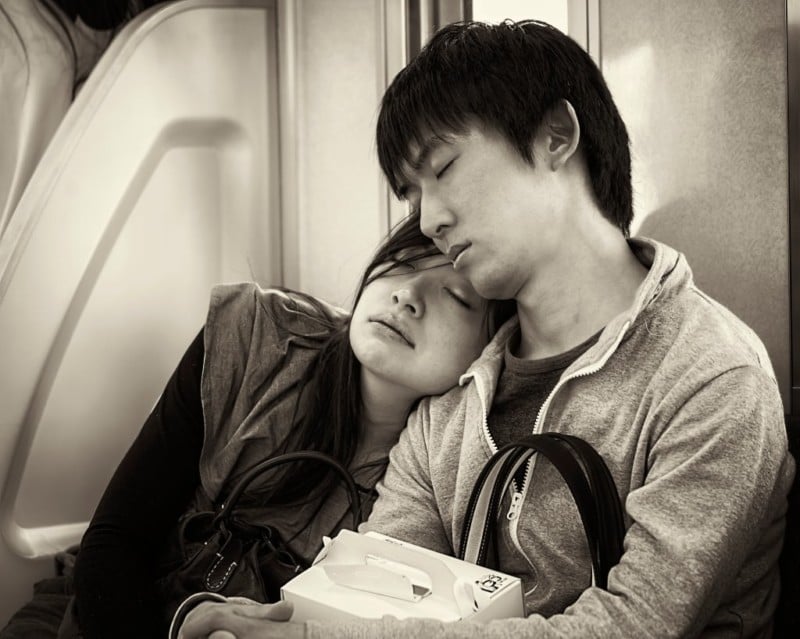
Love is always an interesting subject. From a photographer’s point of view, this makes taking a candid image so much easier. The couples are usually so involved with each other, that they simply do not notice you or your camera.
Sometimes it is just the color or combinations of colors that make a photo. I generally choose to process in monochrome, but occasionally it is all about color.
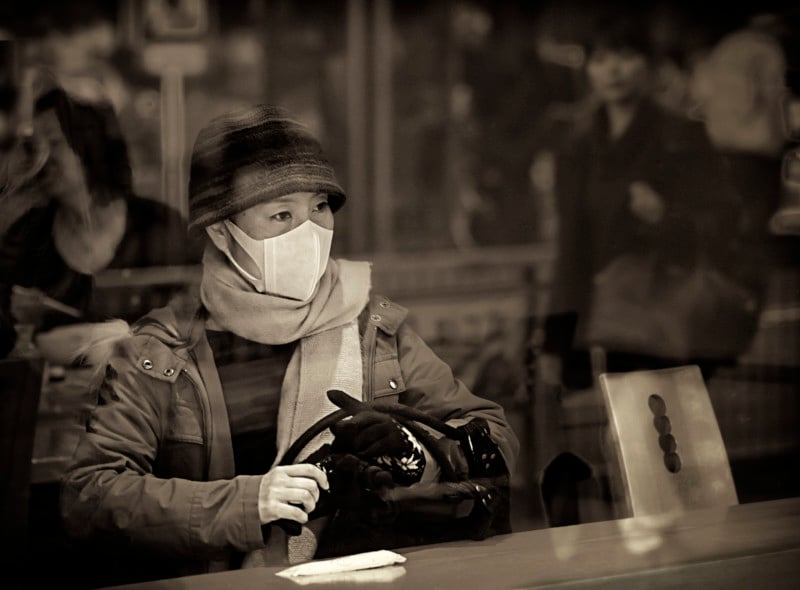
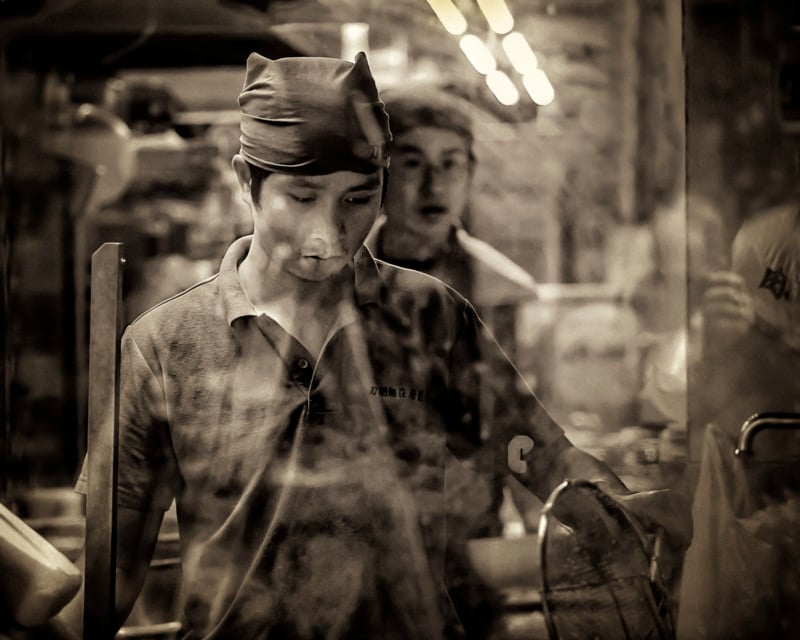
Reflections are a challenge. Focusing is a little tricky, but sometimes it is worth it.
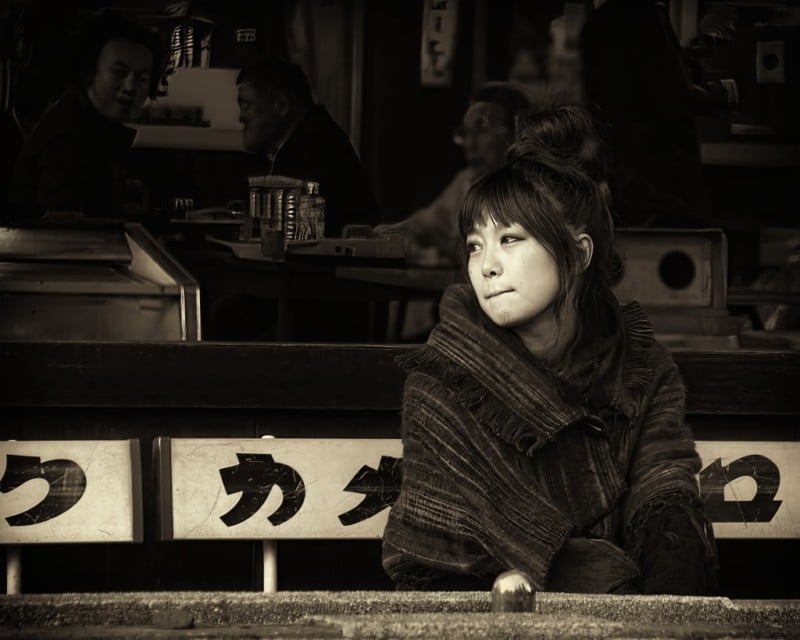
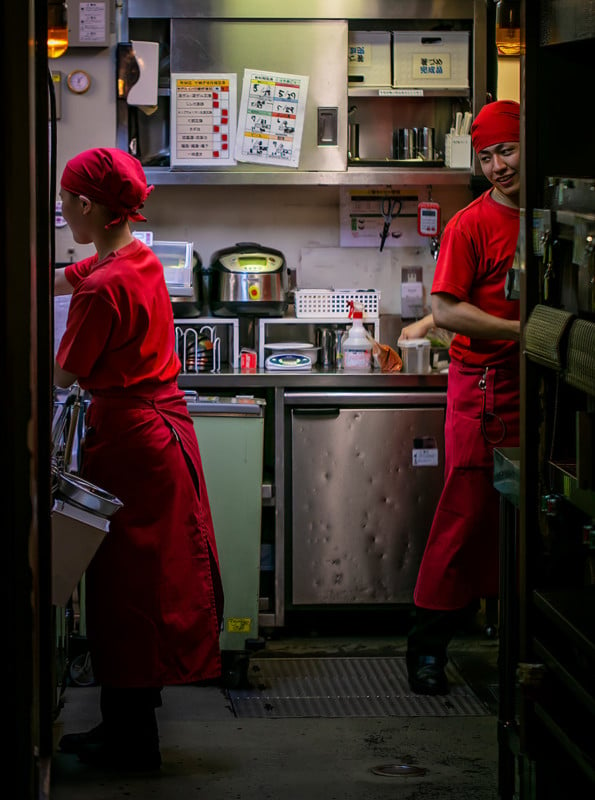
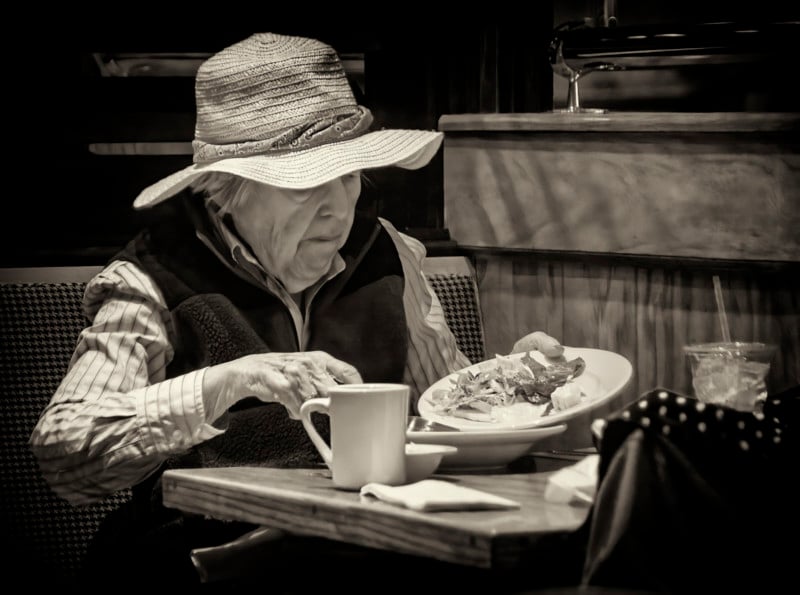
While you are involved in your search, do not only look at the street. Gaze into passing buildings, opened doors, and restaurants. Sometimes the best is not outside!
And sometimes you are rewarded with the truly bizarre.
There are many ways for photographers to enjoy their cameras. Many enjoy the landscape, while others seek wildlife, and still others seek the intimacy of a portrait. For me, the challenge is to modestly try to follow in the footsteps of Henri Cartier-Bresson and strive to somehow capture some aspect of people simply being people. Henri used film, and we today use ones and zeros, but the goal is the same — to create a portfolio for future generations to learn about their past.
Finally, the untold enemy of a street photographer is being hesitant or too cautious. Try not to be tentative. You are not a wildlife photographer in fear of being eaten by a wild lion, nor are you a sports photographer about to be run over by a 230-pound halfback.
In the words of Alfred Eisenstaedt: “When I have a camera in my hand, I know no fear.”
About the author: Charles Levie is a photographer and math educator based in West Friendship, Maryland. The opinions expressed in this article are solely those of the author. You can find more of Levie’s work on his website, Facebook, Flickr, and Instagram. This article was also published here.
I grew up in a world where photographs were produced and consumed in printed format. Digital technology was already brewing in the background back then, but it was still an analog world for the average person.
Newspapers, magazines, and broadcast television were among the primary means of consuming news, entertainment and advertisement. Instead of opening Google or Instagram on your smartphone, you’d walk to your local newsstand.
1. Prints and the Power of Photography
The way we were exposed to pictures was different, but the photograph served underlying social functions which were similar in essence to what we have today – it didn’t just convey the news, but it also helped sway the public opinion through careful editorial curation of which photos to publish or not, as well as deliberate decisions on the photographer’s part on how to compose his images and what to include in the frame. It also served as a vehicle to advertise products and services, to spark our desire and open our wallets.
Photographs have the power to form opinions, express ideologies, and promote lifestyles. That much didn’t change. That’s why we have initiatives like Reading the Pictures, which started in 2001 and according to their own words are “dedicated to visual culture, visual literacy and media literacy through the analysis of news, documentary and social media images”. As pictures become more prevalent and numerous each year, they hope to educate the population on how to carefully “read” the nuance of their narrative and meaning.
Needless to say, back in the analog era, that power to form opinions was far more centralized and concentrated in the hands of the few media corporations that got to pick and choose what to show us. You also needed a lot more money if you wanted to advertise your products or your company in magazines or on television. That wasn’t a market open to small businesses.
It wasn’t very easy to have access to everything photography had to offer either. You were limited by the curation of magazines, galleries, and photo contests — usually the subjective taste of a few critics and editors deciding what the world could see of the photography medium. But all of that was about to change.
The advent of the digital revolution shook photography to its foundation. But it was more specifically the rise of social media that completely changed this centralized dynamic. Even though many of the big media corporations still remained on top, the tail end was extended dramatically. We saw an explosion of digital influencers, content creators, independent news channels, and small digital businesses make an appearance.
Suddenly, photographers who were previously unknown gained huge followings and visibility on social media like Instagram. Tips and techniques were shared faster and more easily as well, which helped to accelerate and facilitate learning for everyone. In a way, you could say access to photography became more democratic as a whole.
But of course, we had and still have the big elephant in the room – the social media algorithms, which dictate what shows up on your feed. Instead of only editors, we now have the almighty algorithm deciding what you see. It’s more decentralized and tailored to our own individual tastes of course, but still follows one main overruling criterion: it will prioritize whatever maximizes your engagement and time spent with the platform. And that comes with the dubious baggage of click baits, hate clicks, fake news, and doctored photos that have become a central topic of discussion in recent years.
On this issue of fake news and doctored pictures, we have the example of Jonas Bendiksen and his brilliant work on The Book of Veles. While doing a photo story on the fake news industry in Macedonia, he fooled the entirety of the photography community with computer-generated fake pictures of fake people as a clever exposé on the topic, before finally revealing the truth about his project.
Bendiksen’s work is fertile terrain for the discussions surrounding digital photo manipulation and how to identify what is real and what isn’t. There are scientific studies showing that fake pictures can lead to very real changes in human memory. People will remember fake photographs as real events, even when warned about the possibility that what they are seeing is fake.
Even though photo montages have existed since the days of the darkroom, the digital environment made photo editing and photo manipulation extremely easy and accessible to all. Even outside of the photojournalism niche, Instagram “bangers” often depict almost surreal landscapes with sky replacements, extreme color manipulations, and portraits of people with impossibly perfect curves and skin.
The discussion here is not whether that is even a problem or just a natural evolution, but rather that this boundary between photography and manipulated photo illustration is getting each time more blurry and tricky to navigate as technology evolves. And this leads us to the current advances in computational photography.
It would be very remiss of me to neglect to talk about the monumental influence that smartphone cameras have had on photography as a medium in society. Rise Above Research estimated that around 1.13 trillion pictures were taken in 2020, and that’s accounting for a 15% decline caused by the pandemic. Between 2010 and 2019, seven times more pictures were taken than in the preceding decade.
That number is not only staggering but also a direct result of the widespread use of smartphones in society. The estimation is that 6.37 billion people have smartphones in the world today, that’s almost 81% of the global population! This number is even higher for older model mobile phones, at 7.10 billion users, which is roughly 90% of the population. And many mobile phones have cameras in them, just like smartphones.
The Kodak Brownie of 1900 is widely mentioned in the history of photography for being the first attempt to bring photo cameras to the daily life of the average person. It had more affordable prices, simple controls, and a portable format. But even though it was considered a commercial success, only 150 thousand Brownies were sold in the first year of production.
It was truly the smartphone that quietly put photography in the hands of nearly 90% of the global population and turned picture-taking into a casual and integral part of their daily lives. And as if that wasn’t enough, smartphone cameras are also starting to take the lead in several areas of research and development, especially computational photography.
At first, smartphone cameras struggled to compete with dedicated camera setups due to the limitations in the size of their sensors and lenses. But over the years these limitations have been overcome, in large part due to computational photography and AI technology. Their shutterless sensors are so blazingly fast that by pressing the release button, several pictures are taken at once, while the computational technology does its part by combining them as needed to create stunning images with high resolution, low noise, and high dynamic range, the likes of which can only be achieved by RAW file post-processing in traditional full-frame cameras.
And that’s just one example of how advanced smartphone cameras are these days. High-end full-frame mirrorless cameras seem to be headed in the direction of computational photography as well, with the most recent Nikon Z9 making waves as the first truly shutterless camera with incredible sensor speed.
Most photographs are now consumed digitally, usually on tiny smartphone screens. This has obviously impacted our workflow as photographers, but even beyond that, it has also affected the aesthetic side of image-making. From the favored vertical crop that fits better on a smartphone screen and makes better use of social media feeds, to the more graphic and contrasty look that tends to pop and get more clicks in these formats.
And now NFTs (or non-fungible tokens) seem to be the next evolution in digital image consumption and art collection. This article won’t go into details on what NFTs are – if you don’t know yet, you can check it out here. But basically, NFTs are allowing photographs to be sold and collected by art dealers in digital format as if they were actual limited edition fine art prints.
The blockchain technology underlying NFTs allows the use of a coded smart contract every time an NFT is sold online. This contract ensures that a particular NFT is a limited edition with ‘X’ number of copies, after which it can’t be sold anymore, only existing copies can be resold. Not only that, but the photographer can also specify a royalty fee percentage, so every time a copy is resold, he will automatically receive a part of the profit.
Many photographers are already starting to make a living out of NFTs. And this is just scratching the surface of what NFTs and smart contracts can do. Several content creators and digital influencers are already using smart contracts in more creative ways to build their communities. Just as an example, you could create a project where each NFT sold will buy the owner of that NFT a VIP membership in your community, access to photo courses or lessons, or even one-on-one video conferences or real-life meetings with you.
The future is here. The way we produce and consume photographs has gradually shifted from analog to digital and now we’re headed towards computational photography and blockchain technologies. But what hasn’t changed in these last few decades is the function of photography.
We still take pictures for sentimental value and to remember important events, to share our lives with friends and the world, to inform and promote values, to market products, services, and lifestyles, to inspire and express our emotions and ideas. And all of that is still best achieved through the careful and deliberate use of composition and lighting, regardless of whether you’re carrying a smartphone, the latest model mirrorless full-frame camera, or a nostalgic 35mm film SLR.
About the author: Raphael Vieira is a conceptual photographer based in Brazil. The opinions expressed in this article are solely those of the author. Raphael started in photography at the New York Institute of Photography in 2008, and has been working professionally ever since. Before that, however, Raphael dedicated himself to the study of Psychology, obtaining a Master of Arts in Behavior Analysis from Columbia University. At the intersection of these different paths, his photographic work often places fictional characters in situations of conflict and tension, portraying the human psyche in photos that are captured directly on camera, without post-processing montages or manipulations. You can find more of Vieira’s work on his website. This article was also published here.
Creator of the e-book O Olhar do Fotógrafo (2020) , Raphael seeks to democratize and demystify the hidden knowledge about how to photograph well; he is a photographer, an educator and a psychologist.
“Don’t you have enough fox pictures yet?” That’s a question I get asked regularly. “Not by a long shot!” Those photos are just a great excuse to stalk these fantastic animals for over ten years. And no, I can’t get enough.
In fact, every day I find them a little sweeter and more beautiful.
The Smiling Fox
I remember ‘my’ first fox (photographed back in 2009) like it was yesterday; A beautiful lady who always seemed to be smiling. Enjoy could have been her middle name. The story goes that she was raised as an orphan fox by foresters. I don’t know if it’s true. I do know that I was amazed at her trust in people.
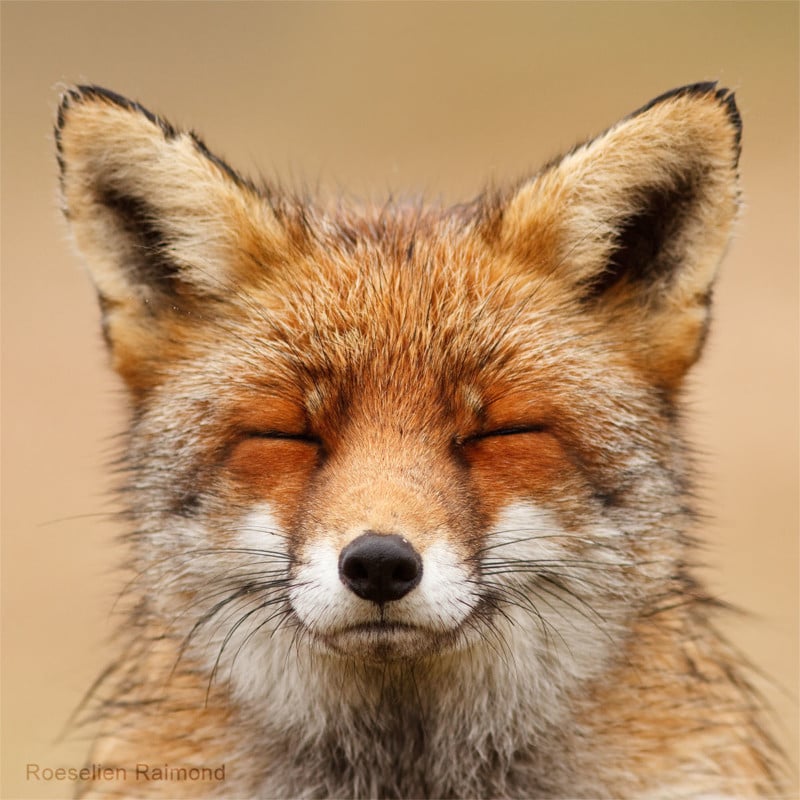
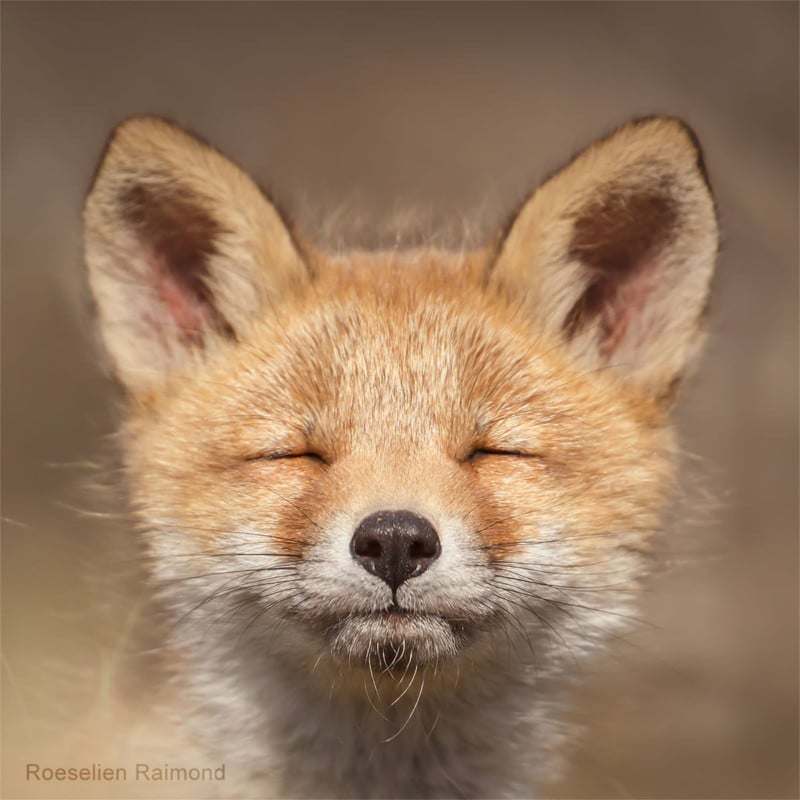
Sometimes I was sitting in a dune pan when she would surprise me with a visit. Quietly she would come and sit next to me, look at me and squeeze her eyes with satisfaction. I looked back, did the same, and for a moment the world was perfect. She taught me the art of “being in the moment.”
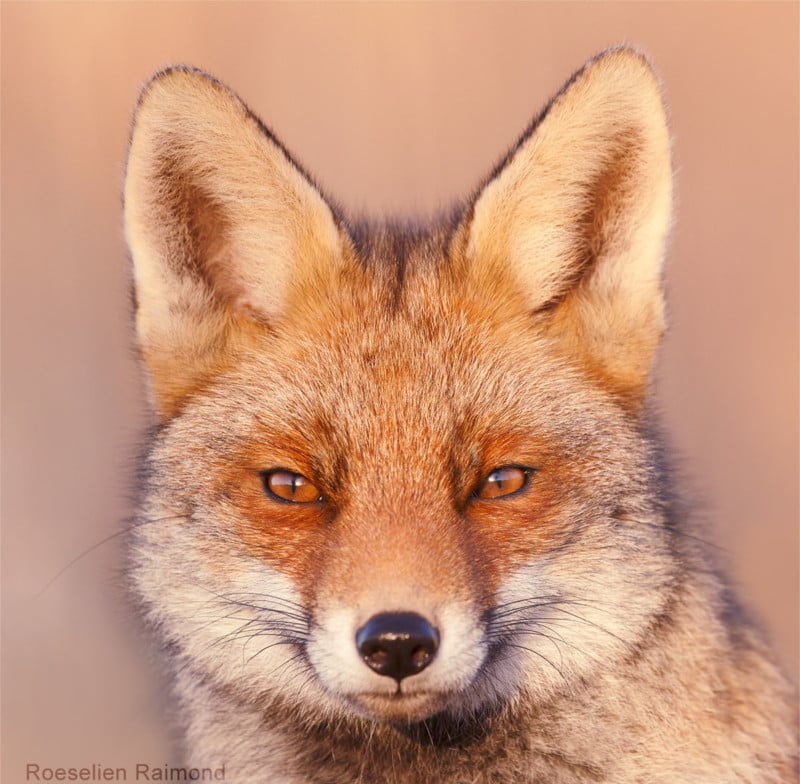
The Vixen. Smiling and squinting.
Flatheads and Longnoses
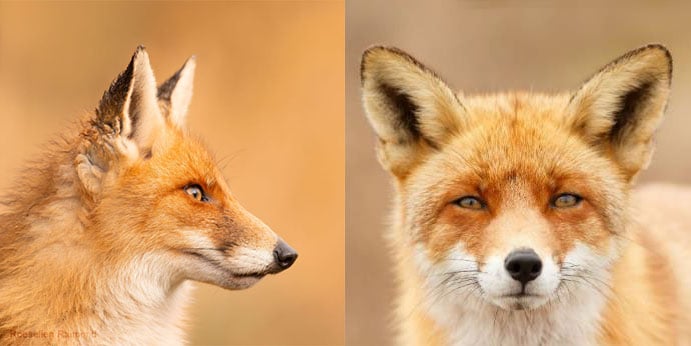
At the time, there were roughly two types of foxes in that area. One group looked like every part of them came rolling out of a round mold: Strikingly round ears, big round eyes, fluffy round bodies, and round faces with a short nose. These foxes I lovingly nicknamed The Flatheads.
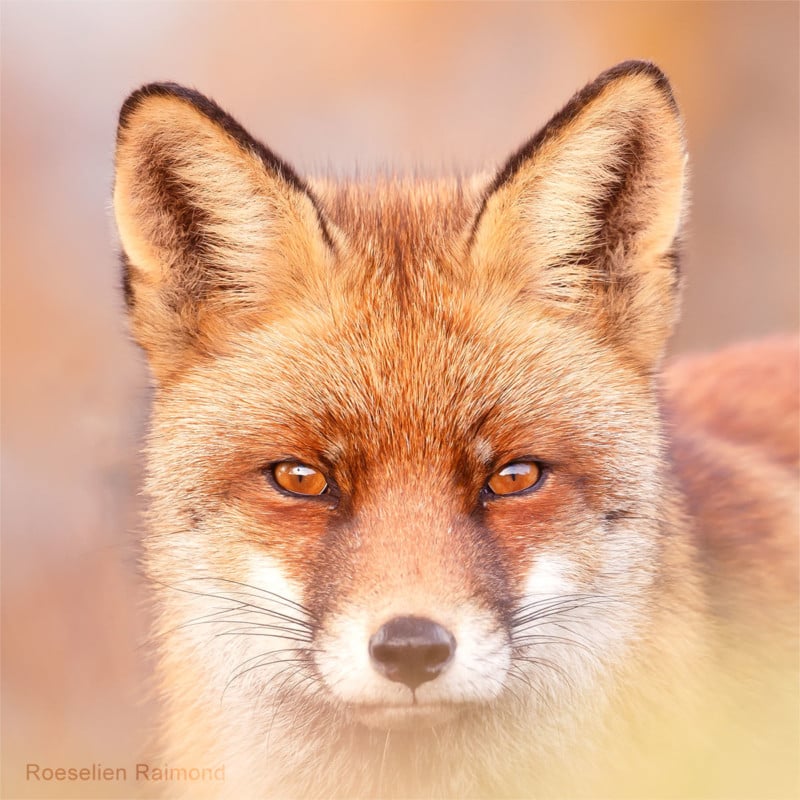
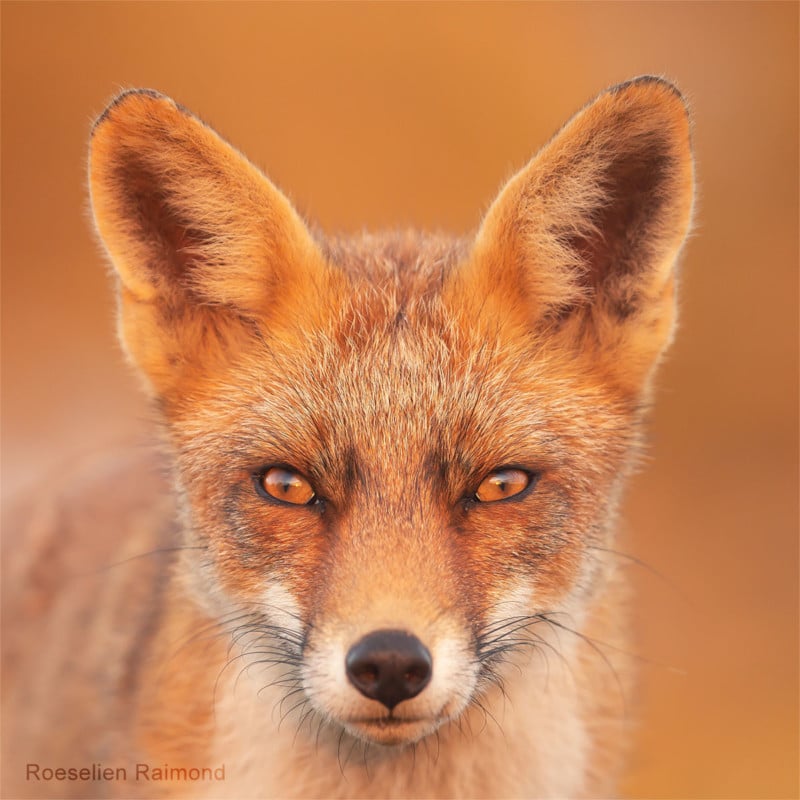
In addition, there was a second family with an almost opposite appearance. Beautiful orange-red slender foxes with a natural elegance, long pointy ears, and large slanted eyes that gave them an almost sultry expression. Inspired by their exceptionally long noses, I called them – how could it be otherwise – The Longnoses.
Longnose (left) and flathead (right) foxes.
The Average Fox
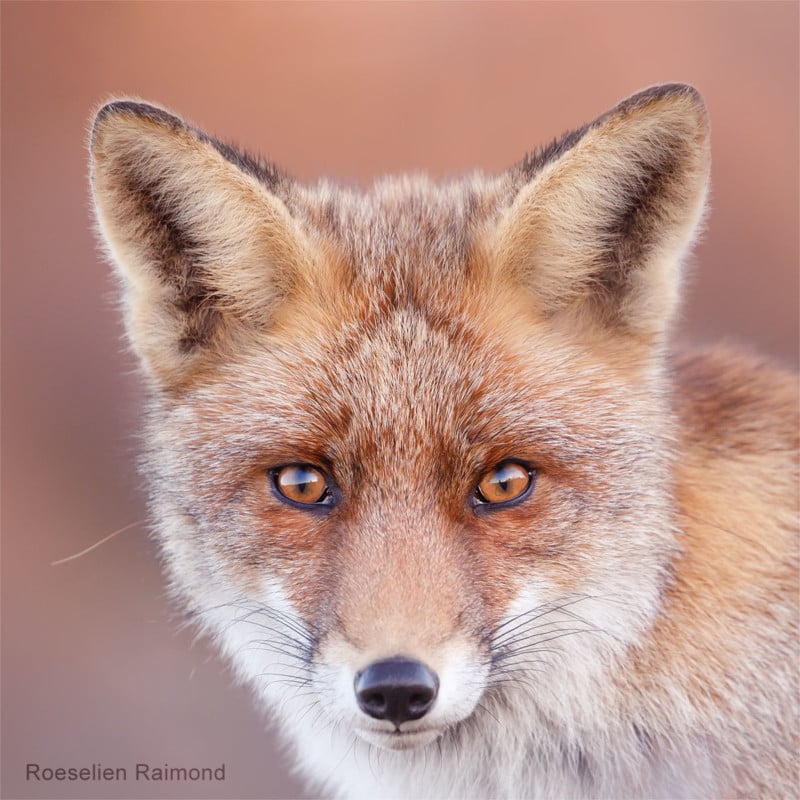
Although the Flatheads and Longnose were rival clans, I suspect there must have been regular love affairs, which mixed the bloodlines against all the rules. Over the years I noticed both sharp and rounded edges slowly disappear. Longnoses and Flatheaded seemed to blend into what could be characterized as an ‘average fox’.
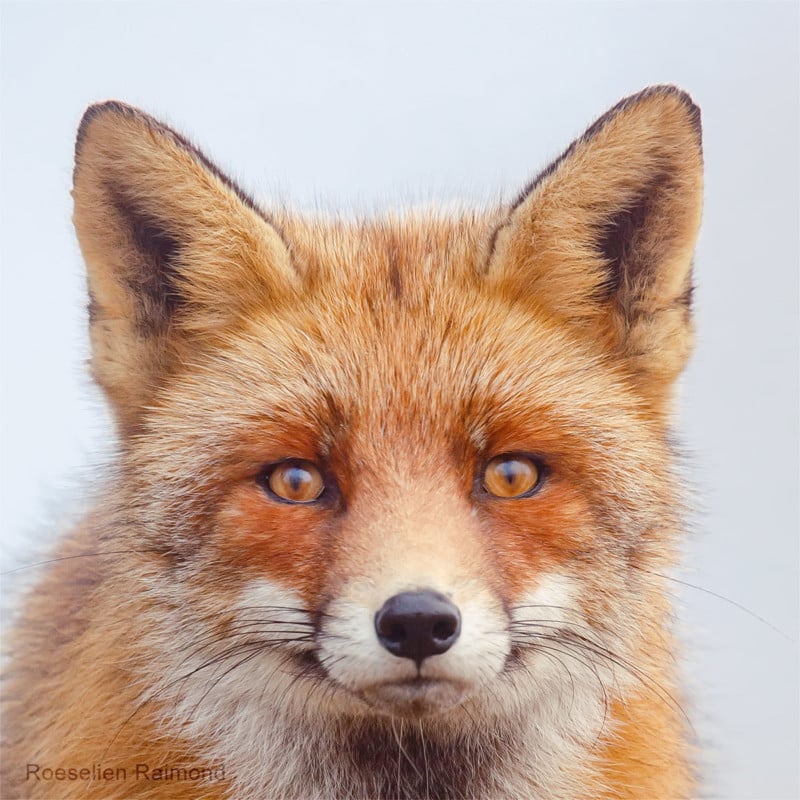
The ‘average fox’, a kind of archetype fox with ‘ordinary’ ears, eyes and face shape.
Facing Foxes
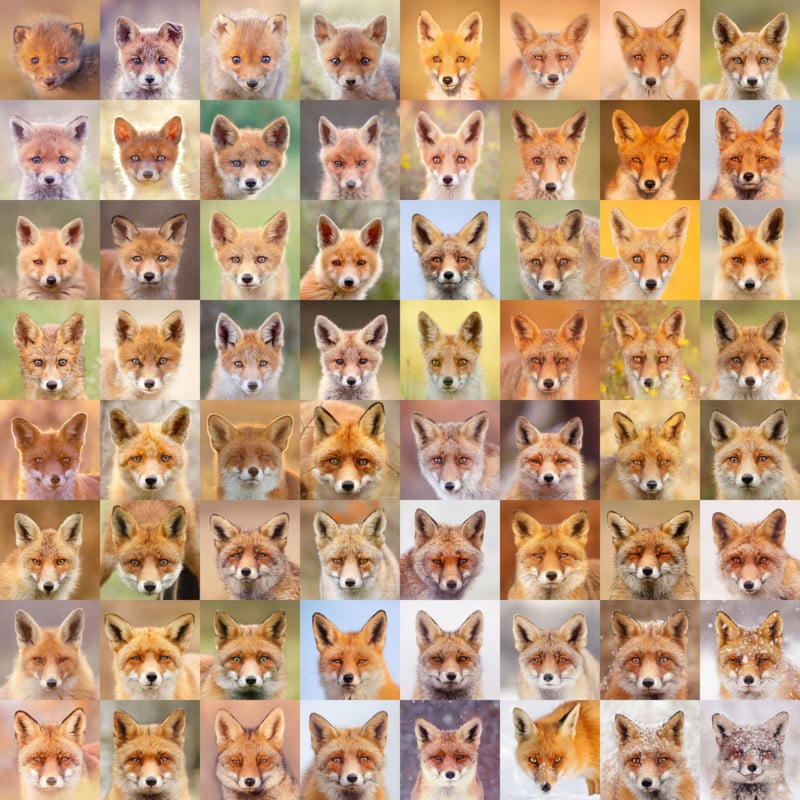
“How can you tell all these foxes apart?” By now I must have roughly met about 50 foxes. And yet the answer is simple: “Just like you keep 50 people apart.”
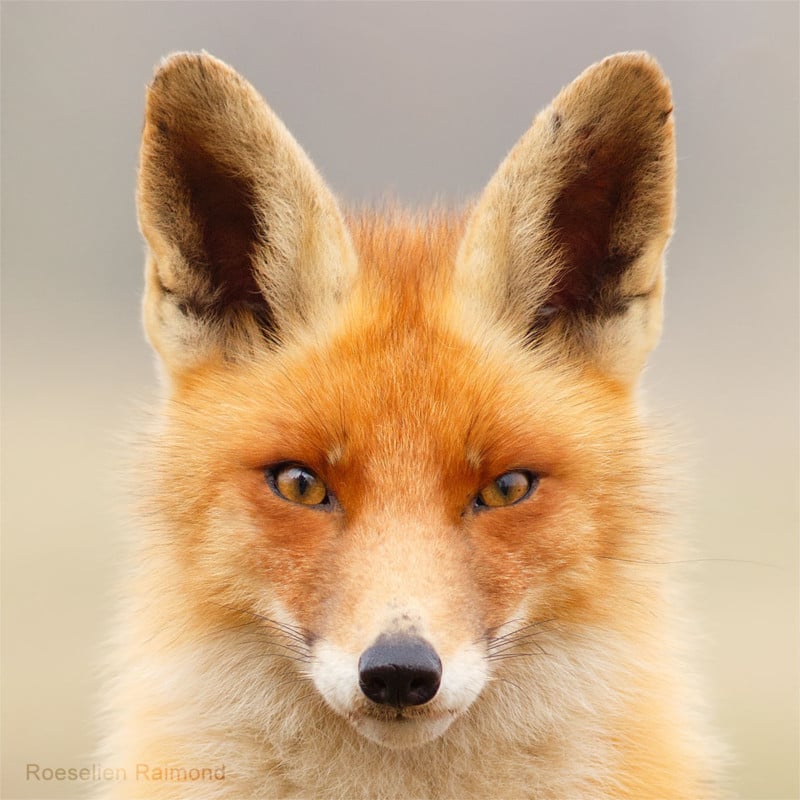
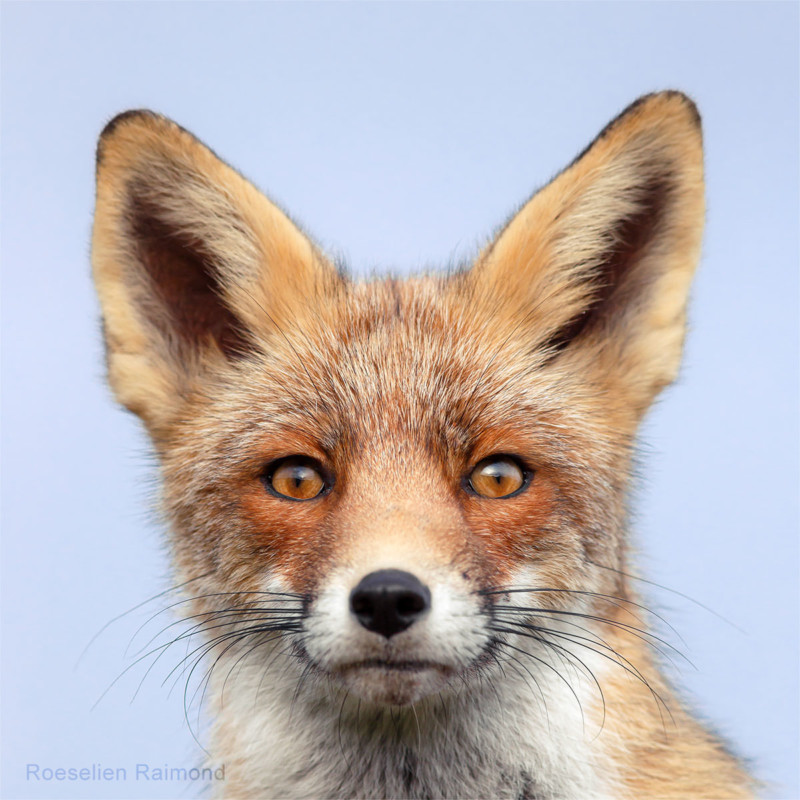
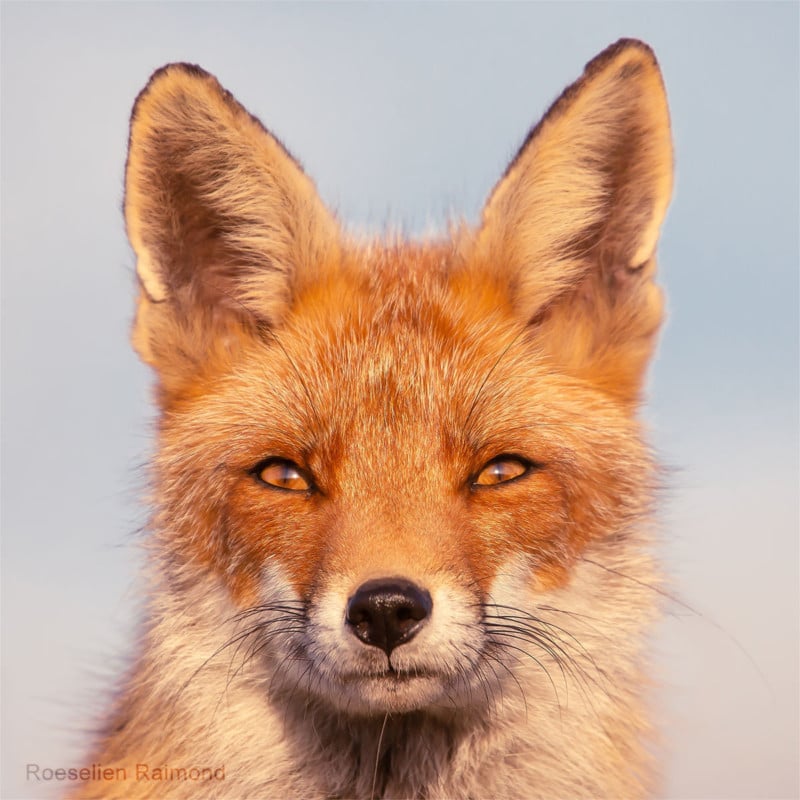
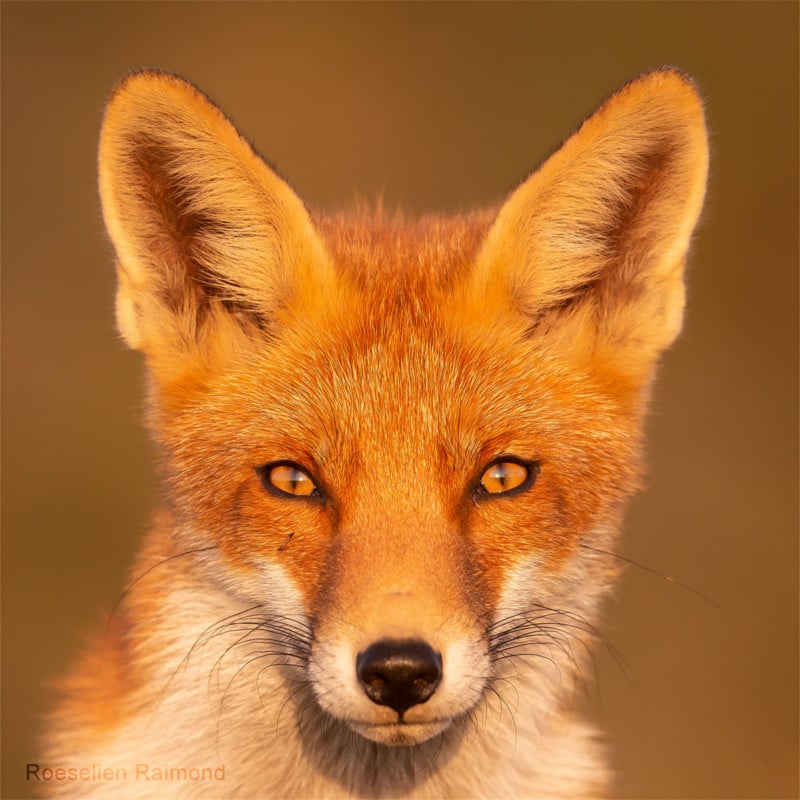
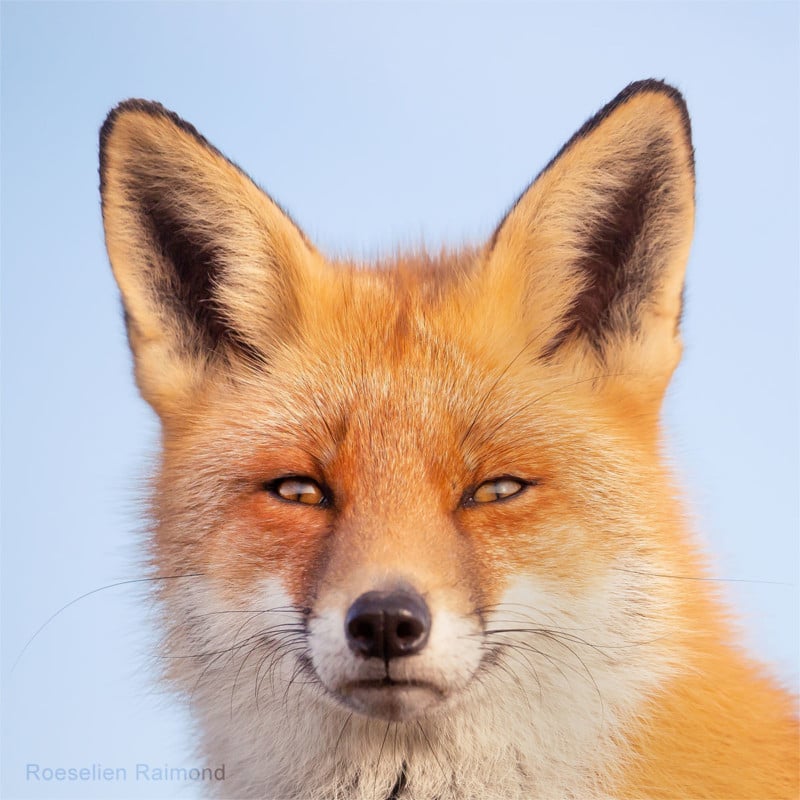
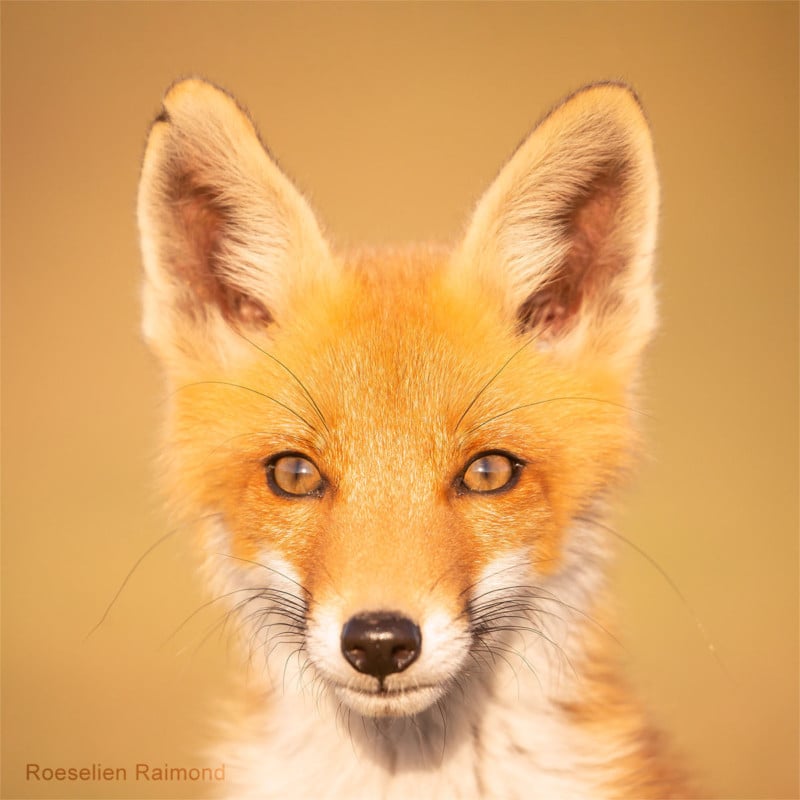
Just as you don’t usually confuse your neighbor with your uncle, the fox in the coastal area looks different from the fox in the forest. Each fox has its own face. One has chocolate eyes, the other golden yellow. Some foxes have the cutest little eyebrows or very long whiskers, beautiful eyeliner, or strikingly white cheeks. But above all, they all have different expressions.
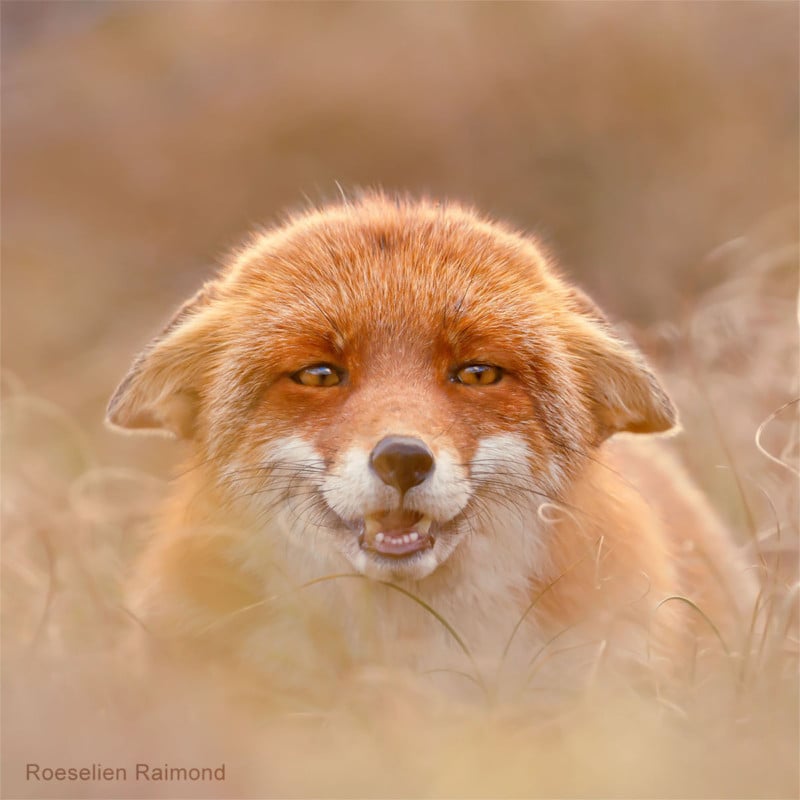
Some foxes are boundlessly friendly. Others are just a bit grumpier. There are exceptionally clever specimens and more clumsy variants. Some foxes seem almost shy. Others have a genuine swagger. And very occasionally I suspect that foxes secretly have a sense of humor. Which could very well be my projection of course.
Do foxes have a sense of humor? They sure know how to make a funny face.
64 Personalities
Anyway…all these totally different personalities, are reflected in their faces. And very, very occasionally a cub is born with a cute flat nose, extremely round ears, and such a fluffy round body. She looks at me, squints her eyes, I do the same and for a moment the world is perfect again.
Round ears, round face, squinting eyes…check!
Do you still think that a fox is simply a fox…? Take a deep look into those 128 beautiful eyes above and… think again!
Some Foxy Facts
Here are some facts about foxes.
Friendly Foxes
Don’t tell my beloved cats, but I think foxes might very well be the sweetest animals I have ever met. Although they can squabble amongst themselves for food or territory, I have never seen them show aggression towards people.
Sissy
As we all know, among our own species, males are dominant. They put themselves out, blow themselves up, and like to boss around. With foxes, the so-called ‘dog foxes’ are most gentle and they wait quietly until the females have calmed down.
Fox Specialties
Each fox has its own hunting specialty. Some are true mouse pounce masters. Others lurk among the reeds for waterfowl. Some foxes even climb trees in search of bird nests!
Night Owls?
It is often thought that foxes are only nocturnal by nature, but we have made them so by hunting them. Foxes that are not hunted are (also) daily active, with the added advantage that we can enjoy their presence.
Amazing Ears
Did you know that foxes can find larvae by ear? While walking they tilt their heads, ear to the left, ear to the right. Suddenly they stop…start digging frantically and… gotcha!
Zen Foxes
Foxes fully master the art of Zen. When there is no hunting, feeding, or defending to do, then only one thing is important: Close your eyes, nose in the air, and… enjoy. Right here, right now.
Solitary but Social
Although foxes are solitary animals and hunt alone and not in packs like wolves, they have strong family ties. Daughters stay with their mothers for one to two years, learning all the tricks of the fox trade. In return, they help mom raise the cubs by playing and hunting with the new siblings.
Good Parenting
Foxes make great parents. Especially the mothers who continue to care for their cubs for about ten months. After that, the -now fertile- sons are, for obvious reasons, meant to learn to stand on their own feet.
Many Flavors
Foxes’ characters may differ as much as human characters. They come in all flavors: Shy and arrogant, from wallflower to cocky, chronically happy or notoriously sad. Helpful or headstrong. Mischievous and cute. Name it and you’ll have a fox version of it.
Cuddle Bugs
Foxes are great cuddlers. Every excuse is used for a good cuddle session. Under the guise of ‘shall I just remove a tick’, faces are mutually swabbed non-stop.
Naughty
Although foxes are much sweeter than I could have ever imagined, they can be a little mischievous at times. Foxes bury prey for later and mark the spot by peeing over it. Also useful for lazy colleagues, who casually steal your freshly caught prey.
Animal of Many Colors
As you can see in the pictures, foxes always have brown eyes. The coat color varies from dull salt-and-pepper to almost golden yellow, to orange-red. The color can vary slightly per year and season. And if you’re very lucky you can even find them in black (melanistic), mixed red and black (cross fox) or white (albino).
Smiling Fox
They say foxes can’t smile. I firmly doubt that.
About the author: Roeselien Raimond is a fox and nature photographer based in the Netherlands. The opinions expressed in this article are solely those of the author. Raimond is also a writer and editor of Natuurfotografie Magazine. You can find more of Raimond’s work on her website, Facebook, and Instagram.
Best Naked Motorcycle of 2021: Ducati Streetfighter V4S
Here goes the broken record again: The Ducati Streetfighter is So. Damn. Good. We rode it a lot this year; first it was the First Ride review, then we rode a $50,000 modified version, then threw the stock one back into the mix for some street and track testing during our seven-bike Heavyweight Naked Bike test. Over and over, we walked away thinking, “Damn. That was good.” It came out on top of the street portion of our naked bike test, and it came one spaghetti strand away from taking top honors in the track portion as well.
What’s in this magic sauce from Ducati that makes it so sweet? The obvious ingredient is that 1103cc V4 engine and its split personality. Traditionally, you’d have to choose whether you wanted a gentle puppy of an engine or a howling screamer of a fire-breather. With the Streetfighter, somehow you get both. It’s shockingly fast when you open’er up, but is also just fine plodding around when you feel like being lazy.
Let’s see, what else? Oh yeah, you’ve got world-class electronics that are easy to navigate, a seating position one could conceivably ride all day on, and stellar good looks, including wings! What else is there to want, really? John Burns would cry foul over the lack of cruise control, which really is an odd oversight by Ducati, but considering the rest of the package, we’re willing to let that one go.
You might have noticed that our MOBOs this year include a Naked and a Standard category. On the surface bikes in both categories are similar in that they’re naked (or shall we say minimally clothed) with handlebars, but to put the Triumph Trident 660 or Honda NC750X – the top two in our Standard MOBO category this year – up against the Streetfighter simply wouldn’t make sense.
The Streetfighter is all-conquering.
Best Naked Motorcycle of 2021 Runner-Up: Aprilia Tuono V4 Factory
You can call it a sympathy vote if you want, but we still have a soft spot for the Aprilia Tuono. With the Tuono V4 Factory, Aprilia has given the bike a slight update to fine-tune a platform it’s been fine-tuning seemingly since Ryan was in diapers.
Now that Aprilia has differentiated the standard RR and Factory models a bit, it’s worth noting that our Runner Up award is going to the Factory model – the more sport-focused of the two. If you find yourself on the touring edge of sport-touring, perhaps the standard V4 is worth a look. You certainly will find yourself with a similar smile on your face. However, in our case, the Factory, complete with Öhlins SMART EC 2.0 electronic suspension, a new swingarm, and various other minor updates was the one pulling our heartstrings.
In the same seven-bike Heavyweight Naked Bike Shootout that saw the Ducati Streetfighter come out our winner on the street, our poor Aprilia could only muster a fourth-place finish. However, once we took the Tuono to Thunderhill and let it manifest its racetrack DNA, its true performance potential shot it up the charts, where it ultimately came out our racetrack winner (by the slimmest of margins).
Like we’ve said a million times before, its distinctive V4 bark is very different from the Ducati’s (arguably better, if you ask me) and really makes you feel alive in full song. Combine that with an excellent (though not quite as good as the Ducati) electronics suite, plus one of our favorite chassis of all time, and the formula for success is still proving to be a winner all these years later. Pro tip: switch the electronic suspension to manual mode for track duty and reap the rewards.
Motorcycle.com Best of 2021 Categories
Become a Motorcycle.com insider. Get the latest motorcycle news first by subscribing to our newsletter here.
A drive-thru Krispy Kreme pop-up is now open on the corner of Ponce de Leon and Argonne avenues in Midtown
The drive-thru Krispy Kreme pop-up shop is now open on the corner of Ponce de Leon and Argonne avenues in Midtown. The original doughnut shop, partially owned by basketball legend Shaquille O’Neal, was demolished in November after two fires caused major structural damage to the historic building earlier this year. The first fire was eventually ruled arson.
As for the temporary pop-up shop, expect a menu of Krispy Kreme’s signature hot glazed doughnuts and other assorted classic flavors paired with bottled beverages. The drive-thru shop is open daily, starting at 7 a.m., with people asked to enter and exit the pop-up via Argonne Avenue.
Two fires caused catastrophic damage to the building, first in February, followed by a second fire in July. Investigators eventually ruled arson as the cause of the February blaze. No one was injured in either fire.
Atlanta Fire and RescueThe aftermath of February 10, 2021 fire at Krispy Kreme on Ponce de Leon Avenue in Atlanta.
Plans are to rebuild the Ponce shop using some original and refurbished design elements from the previous location, including the sign prominently displayed on Ponce. It’s still unclear whether this shop will also feature a 24-hour hot glazed doughnut drive-thru. The new shop should reopen some time in 2022.
Krispy Kreme opened on Ponce in 1965 and included a 24-hour drive-thru window. It was also the only kosher-certifiedKrispy Kreme location within City of Atlanta. O’Neal purchased the landmark doughnut shop on Ponce as part of a 2016 franchise deal with the North Carolina-based doughnut chain.
Sunday - Thursday, 7 a.m. to 9 p.m.; Friday and Saturday, 7 a.m. to 10 p.m.
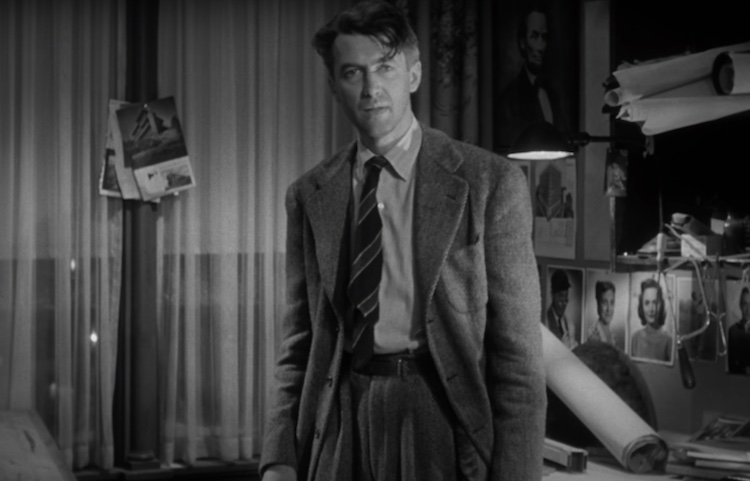
It’s a Wonderful Life is arguably the most classic of classic Christmas movies. What’s not to like? It’s got the talented directing of Frank Capra, the endearing acting of Jimmy Stewart, a compelling plot device that invites viewers to imagine what the world would be like without them, and plenty of feel-good sentiment.
Or, at least, there’s plenty of feel-good sentiment at the end. The other parts of the movie though . . . well I’d long noticed that the bulk of the film actually made me feel rather frustrated and depressed — really, rather sad for George Bailey.
After watching it again recently, I’ve been thinking more about why that is, and have come to the following conclusion: George Bailey is a truly tragic figure — an overly passive man whose sacrifices and sufferings aren’t entirely necessary, even from an ethical and moral standpoint.
When George’s father dies and the board of the Bailey Brothers Building & Loan Association votes to keep it going as long as George will take the reins, his deciding to accept the position — to get things in order, avoid a disruption in services, continue his father’s legacy — is arguably the ethically upstanding thing to do. At least for a time. George makes the very sensible, practically-wise compromise between following his dream of traveling the world and going to college, and not wanting to see the Building & Loan dissolved by Mr. Potter, by striking a deal with his brother, Harry: George will run the association for now, and Harry will go to college; then, after Harry graduates, he’ll come back and take over, and George will go to school.
The decision George makes later on to use his and Mary’s honeymoon savings to cover a bank run is also an ethically generous choice. One can argue that enabling people to own a home, rather than rent — the enabling of what is more of a modern privilege than a basic human need — doesn’t rise to the level of a moral obligation. But, it’s still a thoroughly decent thing to do.
But let’s visit a decision which comes in between these two, and that, had it been done differently, wouldn’t have even put George in the position of having to make that second decision, and to deal with all the other dream-crushing, spirit-suffocating episodes that follow.
When Harry returns from college with a job offer from his new father-in-law to work as a researcher for a glass factory, he says he’s willing to fulfill his and George’s agreement, and take over the Building & Loan as planned, but . . . but . . .
While with the aforementioned dilemmas, there was more moral weight on one side of the equation than the other, that isn’t so in this case. Harry is said to have a genius for research, but George’s own father says he has a talent for architecture. Neither brother has a greater or lesser claim on following their vocational desires. Neither is more or less obligated to give up on the path they wish to pursue.
Perhaps it’s “nice” of George to decide to sacrifice his dream to enable Harry to pursue his, but it seems that he does so less out of moral conviction, than the inability to have a difficult conversation with his brother. George accepts Harry’s implicit dismissal of their deal without even an attempt to talk about it. He’s afraid of confrontation and unable to assert himself.
Better it would have been for George to try to hold Harry to their agreement. If Harry had pushed back, if both brothers steadfastly and understandably did not want to take over the Building & Loan, together they then could have decided on another plan. Maybe George would stay on a year longer, with the agreement that over that time, he and Harry would find a suitable, non-familial replacement willing to run the organization. Maybe he and Harry would decide that while providing affordable loans and housing would add something of value to the world, fulfilling the vocations for which their particular talents were uniquely suited would add value to the world as well, in a different way; maybe they would decide that putting their unique talents to use was itself a moral obligation, and that squandering those talents was in fact the immoral choice to make. They may also have reasoned, quite reasonably, that — even if the film suggests otherwise — the closing of the Bailey Brothers Building & Loan would not have invariably led to the rise of Pottersville.
As Bertrand Russell observed, “One of the symptoms of an approaching nervous breakdown is the belief that one’s work is terribly important.” George makes the mistake of thinking there is such a thing as an indispensable man, a form of pride that inflates one’s centrality in life’s drama, and deprives others of their own agency; in the closing of the Building & Loan, each of the citizens of Bedford Falls — not just George alone — would have had a role and responsibility in shaping the subsequent trajectory of the town.
George could have explored these other lines of thought, but instead forfeits his dreams without a fight. And this decision symbolizes the passive approach he will take with the other decisions in his life as well.
Take his Uncle Billy. George keeps him on at the Building & Loan, despite the fact that Billy, however well-meaning, is incompetent and thoroughly unfit for his job. Again, this can seem like the “nice” thing to do, but is it actually nice to leave someone who’s forgetful, bumbling, and prone to hitting the bottle in charge of the life savings of hundreds of people? Is it nice to give such responsibility to someone whose psyche is so fragile, that if he failed in business, as he does in the alternate reality sequence of the film, he’d end up in an insane asylum? Is it nice to tie one’s personal fate to someone who can end up burdening you with the prospect of prison time and years of separation from your family? Here again, George’s decision to retain Billy seems driven less by a sense of moral obligation, than an inability to have a difficult conversation with his uncle. It’s not as if George would have had to cut off Billy (who, for his own part, seemed rather nonplussed about the prospect of losing his job) with abrupt coldness; he could have told his uncle that he’d keep him on for another year, while asking him to look for another job, and helping him in that search. But the awkwardness of initiating even that sort of plan is something George cannot face.
As with every nice guy, while George puts on a willing smile when it comes to the sacrifices he makes, inwardly, he’s seething. A slow-building anger smolders inside him, and, as it always does, this bile eventually bursts forth in terrible, destructive form. When George comes home to his family on Christmas Eve, Uncle Billy having brought about the seeming ruin of their lives, he viscously berates his wife, his kids, and his kid’s teacher. George’s quite real and yet formerly submerged resentments tumble out of him in a cruel, wounding torrent. He acts angry with his family, but he’s really angry with himself, angry that he alone — with his ever-acquiescing approach to life — is to blame for the predicament he now finds himself in.
His niceness doesn’t turn out to be so nice.
In the end, of course, George realizes the good he’s done for his community, and that community steps in to save him from personal catastrophe. The scene in which his friends and family show up to his house to donate money and toast “the richest man in town” are as touching and life-affirming as anything in cinematic history. And yet, what will happen to George once the credits roll?
Human experience teaches us that the reverberations of such epiphanial experiences don’t last. The glow from a singular moment of affirmation fades as you re-engage in the day-to-day mundanities of life. For George, there will still be weeks, years, decades of “being cooped up in a shabby little office.” There will still be times when he feels an acute, aching desire to get out of “this measly, crummy old town.” There will still be times when building model bridges as a hobby will feel like a paltry insult to his deepest desires. There will still exist a durable strain of anger within him — farther below the surface maybe, but capable of exploding out once more.
One night of affirmation will not ultimately make up for the lingering grief of a life marked by significant compromises. Which might be alright if those compromises had been necessary, had been morally obligated. But George might have taken another, equally moral path, one in which he used his unique talents to better the world, took ownership of his life, and, in allowing himself to fully show up as the man he dreamed of becoming, been in fact an even better — less melancholic and resentful, more stable and centered — husband, father, and member of the community.
Make no mistake, the overarching sentiment of It’s a Wonderful Life holds true regardless: it really is your relationships, your friendshsips, which make you rich. The ending of the film is full of truth, and still chokes me up every time. But this sentiment needn’t be paired with the ultimately tragic corollary that maintaining those relationships requires a willingness to always put others’ needs above your own and the unconditional surrender of all your dreams.
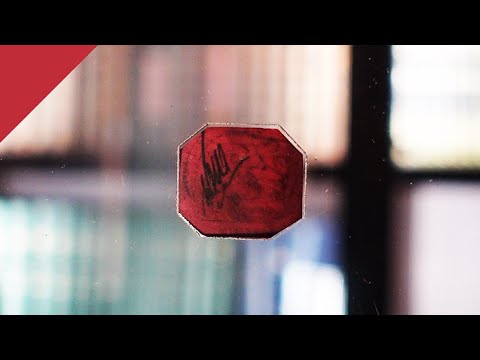
It doesn't take long for Tom Scott to unveil the most expensive object by weight, if that's what you are watching this for. And he tells us its history and the reasoning behind why it's so expensive. However, you might wonder how this thing was selected for that very specific title. It all goes into how you define each term. "Object" must be a non-fungible discrete unit. "Expensive" doesn't exactly mean value. You get the idea. I understand why defining every term one uses is so important, because any time I label something superlative in a simple manner, I hear from commenters about exceptions and stretches until, well, until I'm just wrong. An example is the post just before this one on the last public execution by guillotine. The word "public" is necessary since the French government continued to behead people long afterward. Tom is a lot better at explaining that than I am.
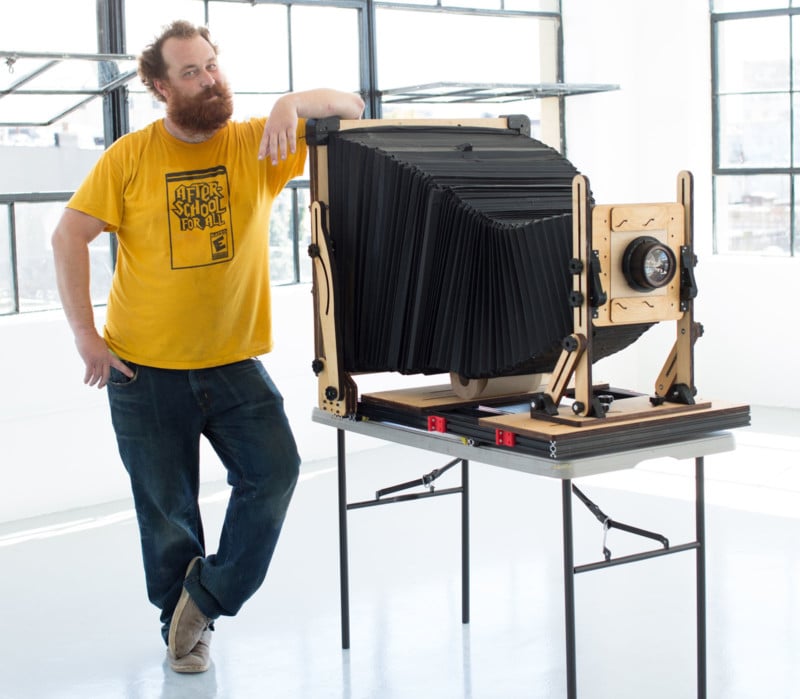
During the long pandemic quarantine, I bought a laser cutter the size of a small Volkswagen to cut ventilator prototype parts, Brooklyn Film Camera Polaroid scan trays, and a number of other photographic equipment parts. I bought the largest cutter that I could fit in my shop, because I had been dreaming of the 20×24 Polaroid and Afghan box cameras since I was about 16 years old.
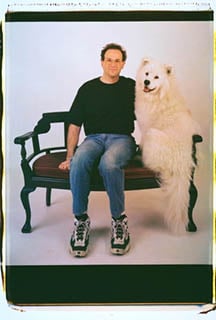
I became fascinated with 20×24″ Polaroids when I first saw a profile photo from the creator of Photo.net, Phillip Greenspun — a thumbnail of himself and a big fluffy white dog on a white backdrop:
Photo.net founder Phillip Greenspun with his dog. Photo by Phillip Greenspun.
That photo was taken by none other than the great, late Elsa Dorfman, and I remember internet sleuthing everything I could about her work — a more difficult job in 1999 than it is today.
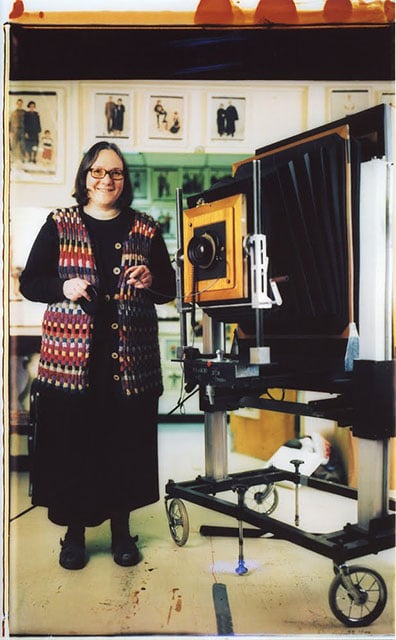
A self-portrait of Dorfman with her giant Polaroid camera, shot with another giant Polaroid camera. Photo by Elsa Dorfman and licensed under CC BY-SA 3.0.
That led me to learn about the 20×24″ Polaroid cameras and their history, which really captured my imagination, and stuck with me for a long time.
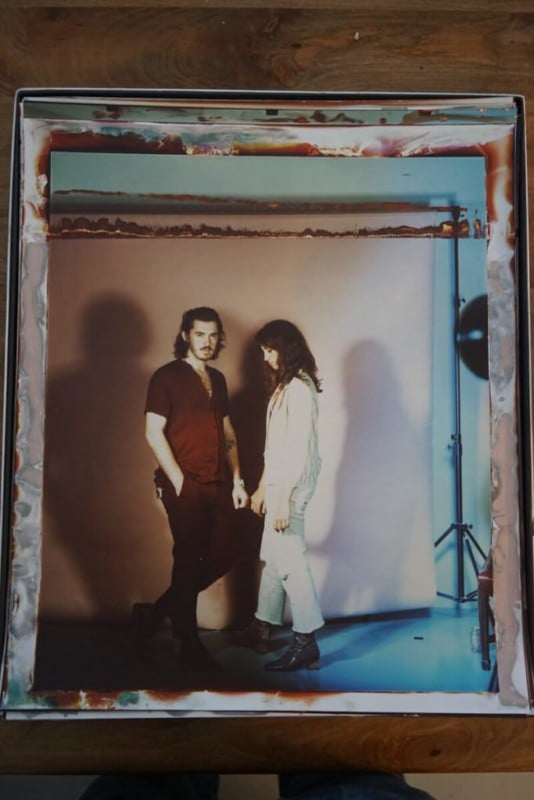
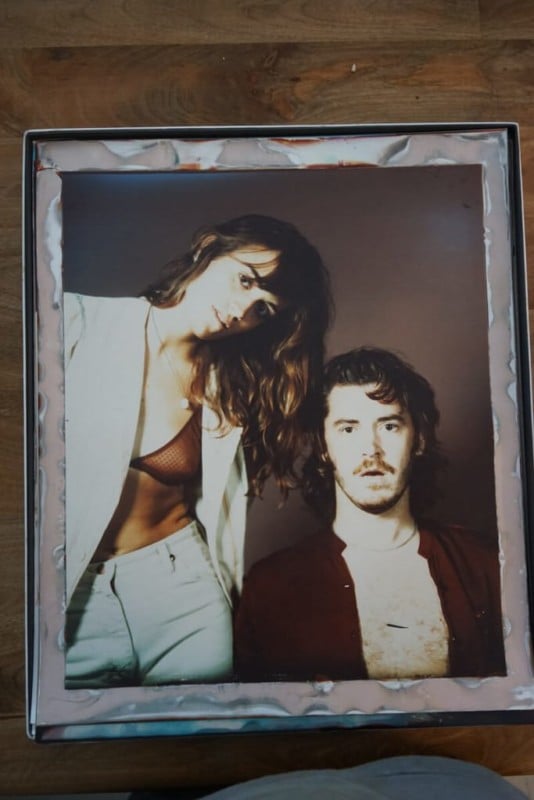
The original seven 20×24″ Polaroid cameras were built in the late ’70s and early 80’s more or less as an advertising campaign for Polaroid’s smaller format consumer films and cameras. The camera was lent or rented to famous photographers and artists, like Andy Warhol, Mary Ellen Mark, Chuck Close, Elsa Dorfman, William Wegman, and many more, who made some of the most iconic images of the last half-century with them.
The Polaroid corporation has long since changed hands and ended production of peel-apart films, including the 20×24″ media, and what very little media is left doesn’t look nearly as good as it did when it was fresh. For now, at least, the 20×24″ Polaroids are an incredibly beautiful, but dead format. It is one of my regrets that I never had my portrait taken by Elsa Dorfman, and now I never will.
I have also been interested in Afghan box cameras (AKA kamra-e-faoree), or Cuban Polaroids, Lambe Lambe, Camera Minutera, or more generally Lab Cameras since I was a teenager and saw a Popular Photography article about the Cuban Polaroid street photographers of Havana.
I was taken by the idea, because it was a relatively fast process that you could do in front of your subjects, and because it was relatively inexpensive and at 15 or 16, I was a part-time professional babysitter and IKEA furniture assembler. I never actually built a proper Cuban Polaroid back then, but I did manage to duct tape a changing bag to a hole in a large Rubbermaid tub that my friend Ryan Muir and I used to process 8×10 paper negatives in blacked-out bathrooms all over New York City when we were kids.
I always loved shooting 8×10 paper negatives but had no professional reason to do so, and so over the last 20 years, Ryan and I have shot two weekend-long projects with the camera and that’s it. Ryan and I had a great time and so did our subjects, and it has been something that we’d both love to find a reason to do again.
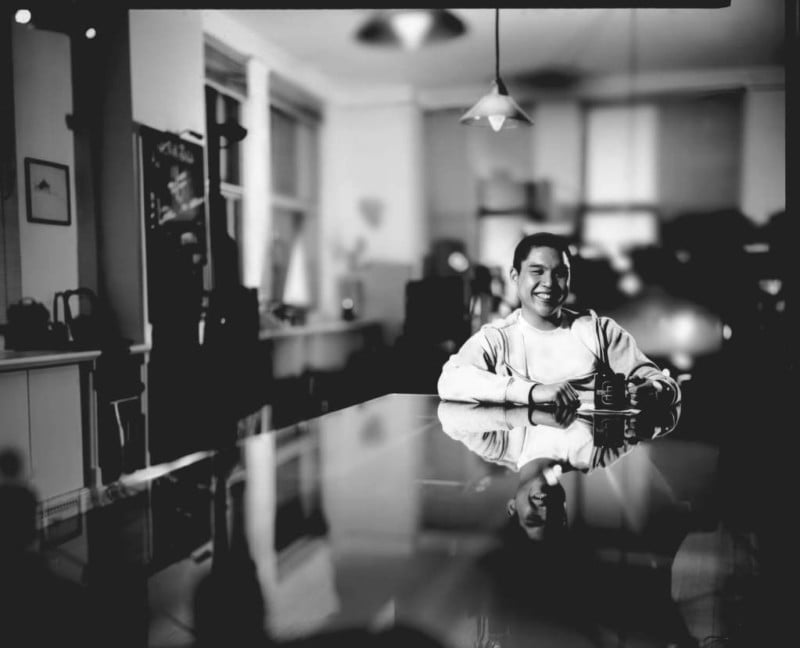
An 8×10 paper negative photo captured with Ryan Muir.An 8×10 paper negative photo captured with Ryan Muir.
Years went by.
I moved to the desert, became a professional camera builder, and more or less stopped taking pictures for fun, save for a few vacations. I met Joe Van Cleave, camera builder and YouTube superstar a few years ago and we became fast friends. We hang out just about every Tuesday and work on building cameras and whatever projects strike us.
I usually use Tuesdays to work on short and simple projects, as a bit of a palette cleanser from whatever I am working on that week. I have to be very careful that Joe doesn’t spark my interest in something that will eat 6 months of my time because I can’t think of anything else. I have had to shelve “Joe projects” more than a handful of times because I just can’t afford to spend months building a pen plotting typewriter, or a laser-cut grandfather clock, 3D printed abacus beads, or mechanical calculators. Sometimes Joe does capture my full attention, and that’s exactly what happened when we started tinkering with direct positive reversal prints.
Joe had built an Afghan box camera years before we met and had done some semi-successful experiments with a reversal process that could produce positive black and white prints on paper, rather than the paper negatives that I was used to working with, and that street photographers all over the world would rephotograph on an easel to make a positive print. Joe and I spent years working on first black and white direct positive prints, and once we had mastered that process, moved on to color direct positives using RA4 color printing paper.
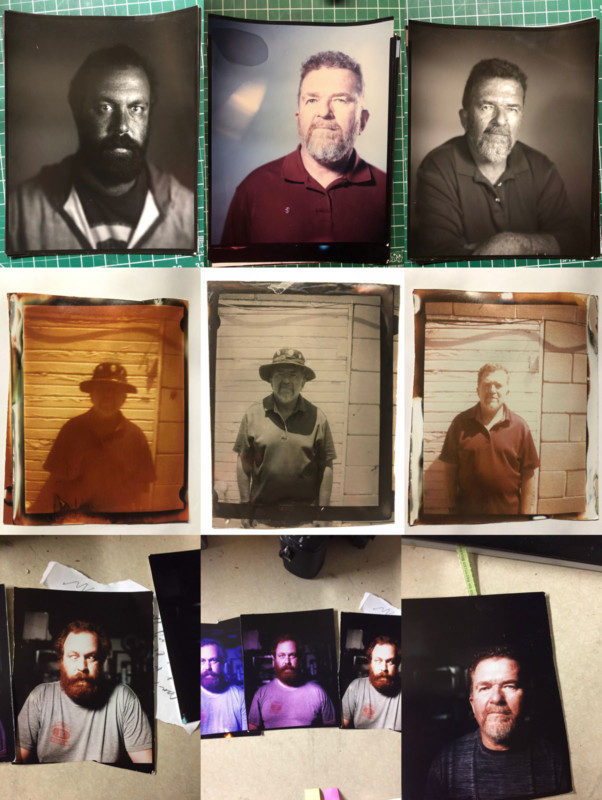
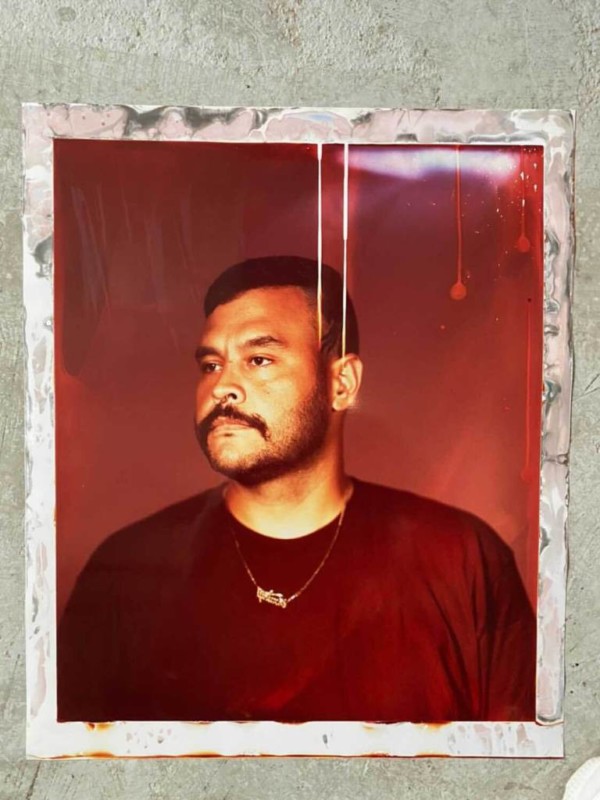
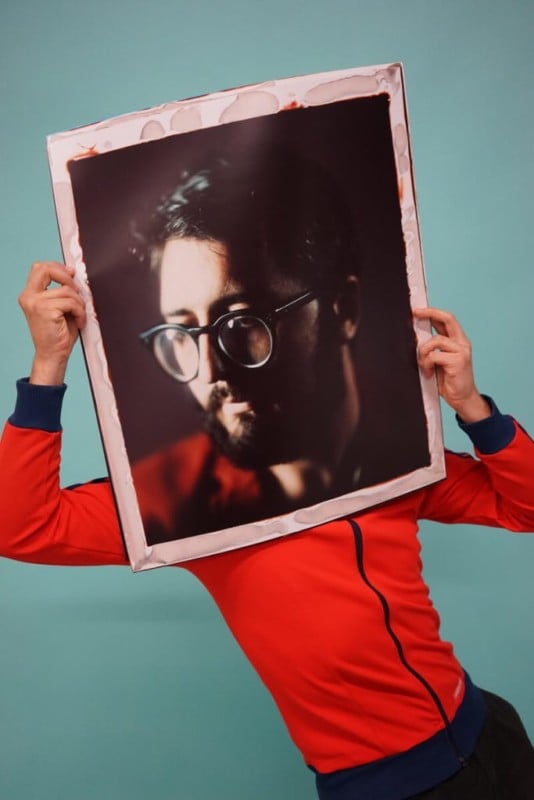
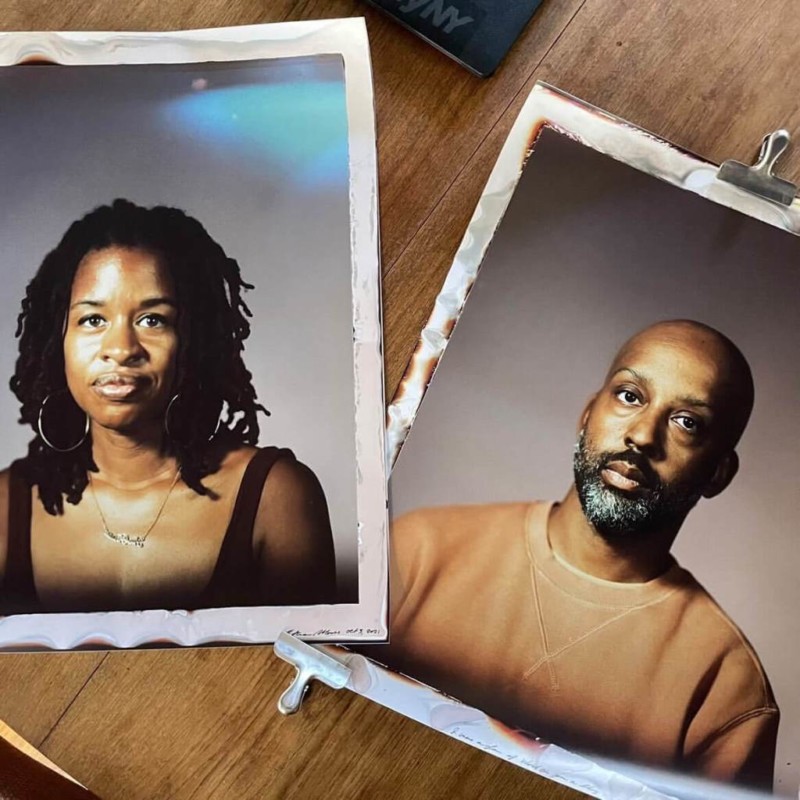
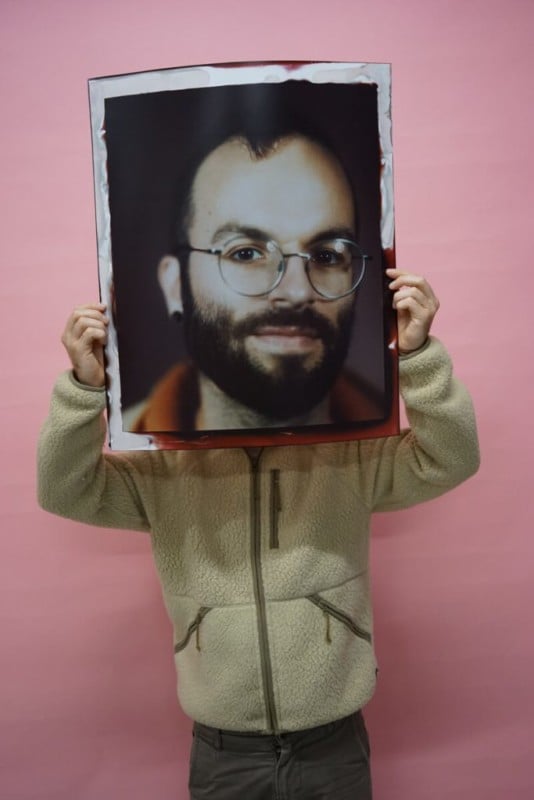
I have hundreds of prints of Joe, with different color balances, exposures, stains, light leaks, and every manner of imperfection made during our years of tests. I like to call this the “Infinite Joes” series. We never really thought of these pictures as art, they were just test photos of joe standing in one or two places, with about the same expression and different clothes around my shop and backyard, but they kind of grew into a series over the years, and I think I’ll probably make something from them one day.
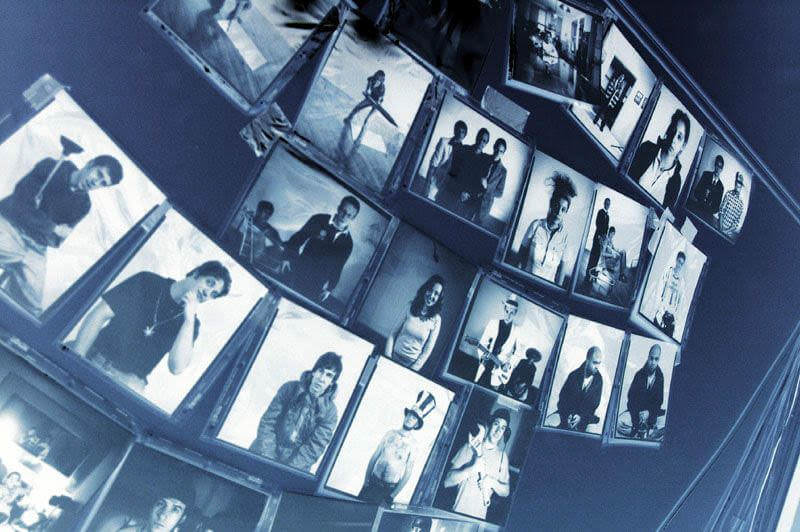
Some portraits of Joe Van Cleave in the Infinite Joes series (along with some portraits of me).
Because Polaroid peel-apart media has long since gone out of production, Joe and I thought that the color reversal process could be a reasonable and accessible replacement for the original 20×24″ Polaroids — perhaps in the form of an Afghan box camera.
Photography on a Much Large Scale
Building a 4×5 or even 5×7 Afghan box camera is a whole different type of project than building one for 8×10 or larger.
The scale of the processing space just increases past the scale of something that a human can easily manipulate. Paper becomes large and unwieldy, tanks require more heavy and spillable chemistry, and the camera itself quickly becomes too large and heavy to move comfortably. Thinking only about 8×10, I might have tried a number of more classical designs and pushed the limits of lightweight materials, but I was already drawing connections between reversal prints, Cuban Polaroids, and the original Polaroid cameras in my mind, and 20×24″ was a natural goal to consider.
A back of the napkin calculation of the weight of JUST THE CHEMISTRY inside an initial 20×24″ Afghan box camera design was between 75 and 120 pounds (34-54kg). That sent me back to the drawing board. How could I process reversal prints instantly, at a large scale, without having the camera be the size of a van? It took a few days of sketching and staring off into space before I struck on the idea of a self-developing film back — a large format film holder, which is a bit deeper than standard but otherwise dimensionally the same, that had a light baffle so that I could pour chemistry in and out of the holder and process the photo immediately without a darkroom.
I built one single 8×10 prototype that Joe and I used successfully for about 50 or 60 pictures. The original design worked very well but was a pain to produce and wasn’t as durable as I would have liked. It had an awkward yellow angled screw-on funnel on the top that looked like the antenna on a Snork. Joe and I put the project on the backburner during the beginning of the 2020 lockdown.
During the pandemic, I did a bunch of work on an open-source simple ventilator that could be built almost anywhere (openventilator.io) and had to cut enough wood and acrylic parts for work that it became worth it to buy a giant laser cutter and dedicate a quarter of my shop to it.
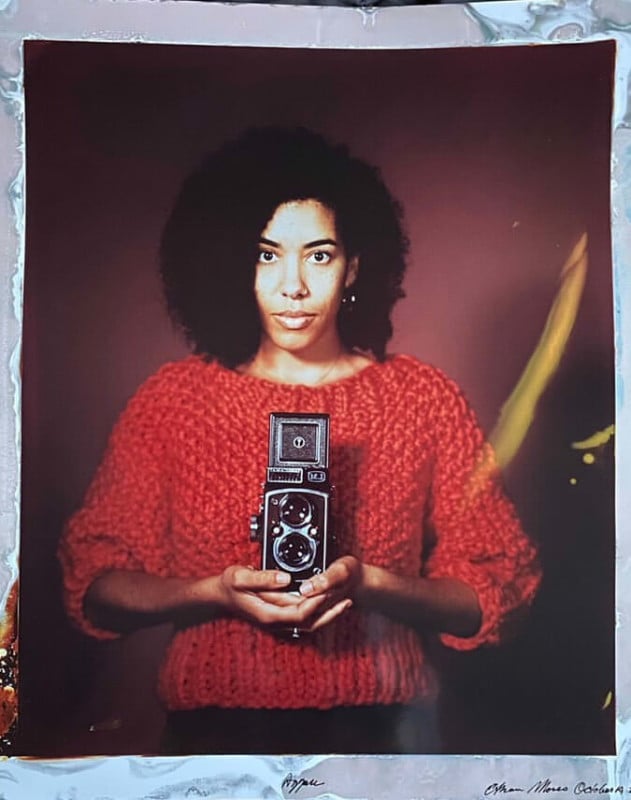
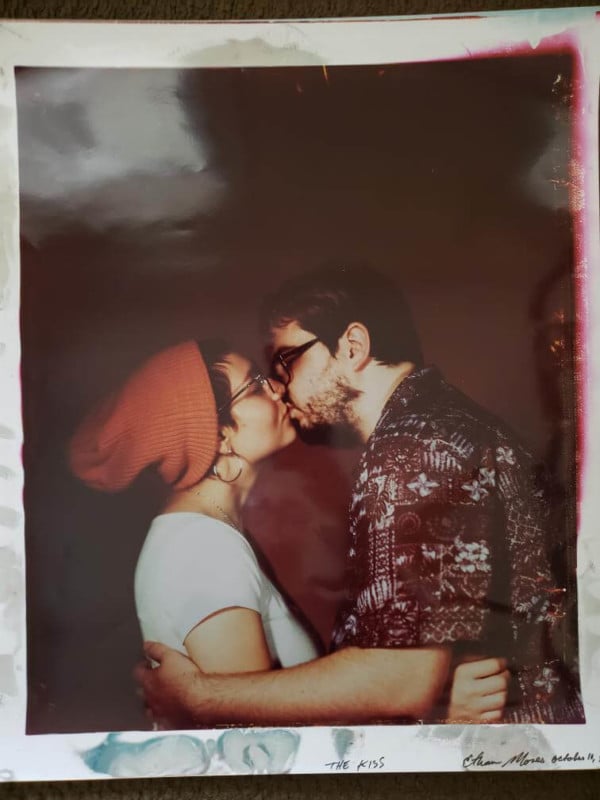
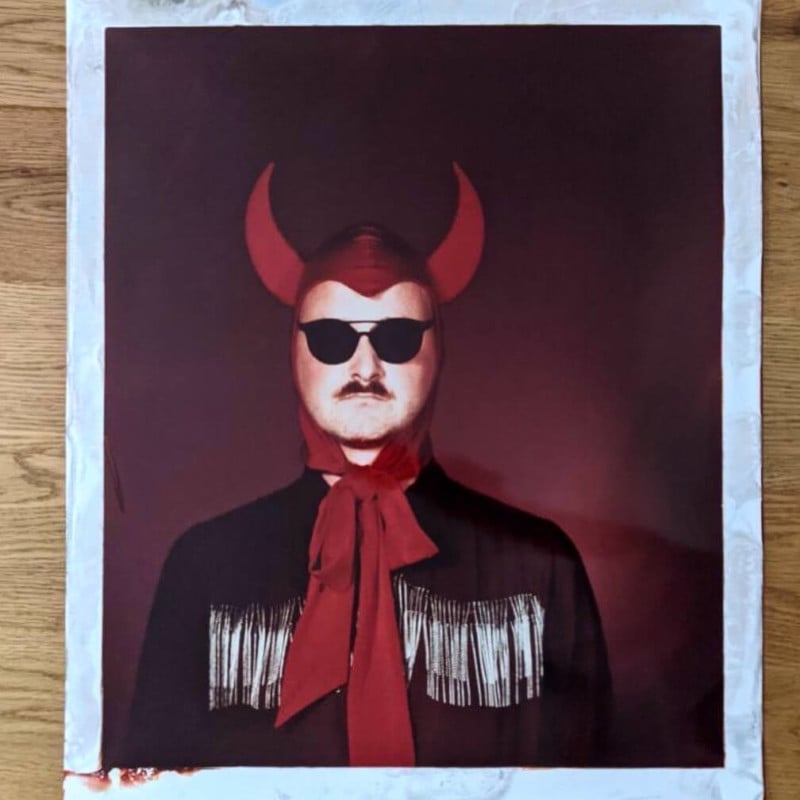
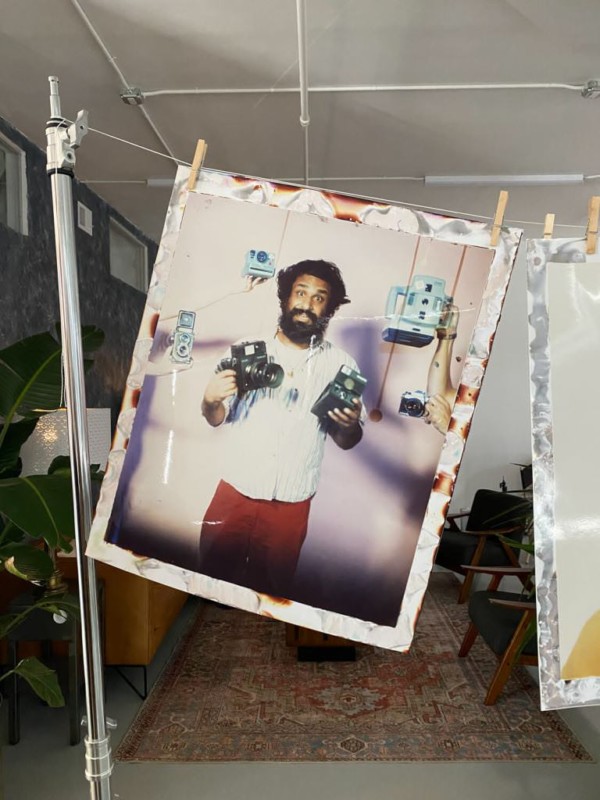
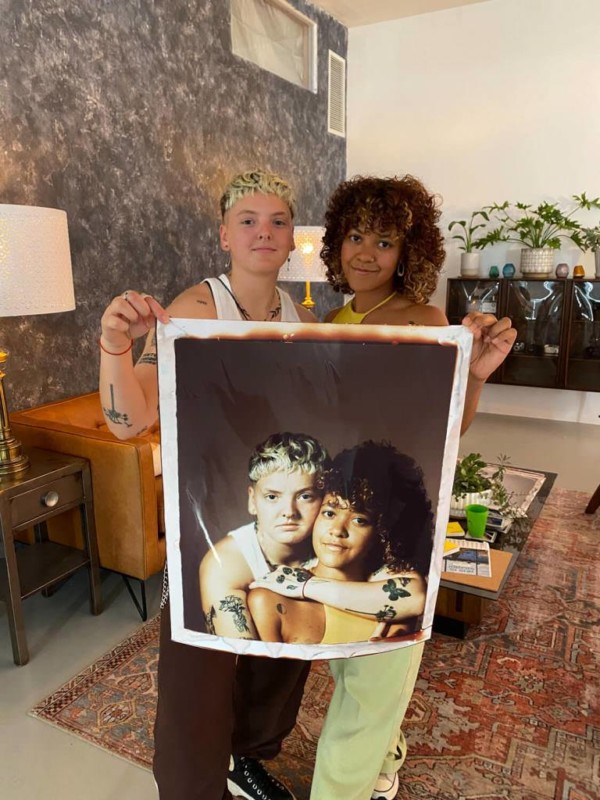
Joe and I had both made YouTube videos about the black and white and color reversal processes early in our investigations, and while we did little to no work on it during the pandemic, lots of people picked it up. There were more YouTube videos and message board threads and Facebook groups created around the reversal processes we were using. Inadvertently, those videos created a much larger market for something like a self-developing film holder, which makes the process much easier and infinitely more portable. When the lockdown ended and my schedule freed up a bit, I spent about 5 or 6 months finalizing the 4×5 and 8×10 self-developing back designs, making a first production run of them, and then designing and building a 20×24 version and a camera to go with it (the thought being to use it as advertising in a similar way to the original 20×24’s built by the Polaroid Corporation).
I was planning on taking the camera up the West Coast, shooting some portraits, and maybe giving some workshops along the way to help pay for the trip and just to get the reversal processes and self-developing backs in front of people who were interested.
I got an invite from Kyle at Brooklyn Film Camera to be the opening act in September 2020 at his new photo studio in Brooklyn, Wyckoff Windows. Kyle is a friend and has always been really fun and easy to work with, so I put the West Coast trip on hold and headed to New York with a cargo van and about one ton of equipment.
We sold out two weekends of portraits and workshops and then did another sold-out weekend as an encore. I was amazed at the outpouring of the community. I got to meet a photographic idol of mine who showed up for a portrait on a Sunday morning, I had two workshop attendees who had worked and currently works for Mary Ellen Mark’s studio.
One of them had a portrait taken on an original 20×24 Polaroid by Mary Ellen Mark from years ago. I got to meet Allen Murabayashi, who founded Photoshelter and changed the landscape of the industry. I met Carla Rodriguez, who flew in from Minnesota to take a workshop, and whom I had been following on Instagram since starting this project, to see how working wet plate photographers run their business. I met so many amazing people who were really into the types of things that I thought that only Joe and I were interested in, in my garage in Albuquerque.
I learned a few things about the camera too, about how long it takes to set up and get dialed in, and how many people it really takes to keep the camera running relatively quickly, about how much chemistry you can go through in a day, and really got a feel for the process that I never had the opportunity to back in Albuquerque.
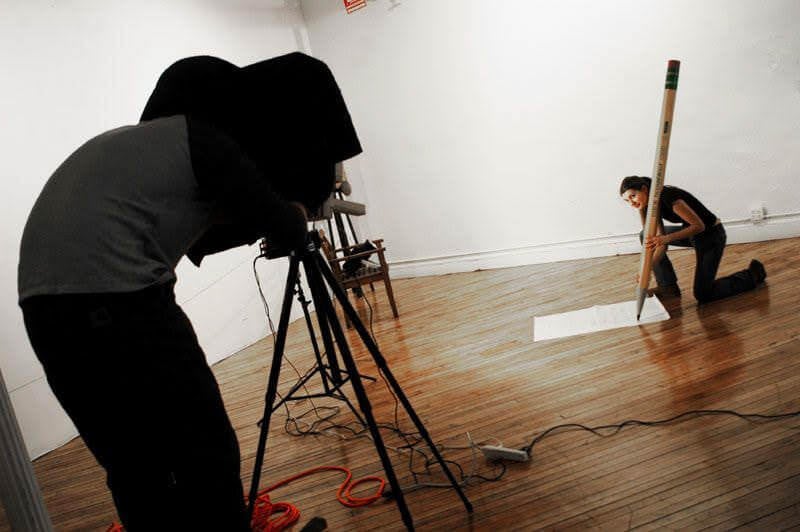
By Ben FraternaleBy Ed Pavez
I am still planning on releasing the self-developing backs as a product, but that will eat a few months of full-time work when I do.
Now that I’ve really got the hang of the camera, I’d really love to shoot some more commercial and advertising work with it. I’d also love to rent the camera out to some of the famous iconic photographers of our time and help them create images with the camera too. For now, I am going to go to Los Angeles to use the camera in a studio with lots of help and interesting subjects, and people interested in the process.
P.S. I’ve launched a a Kickstarter campaign to bring the camera to Los Angeles because of the expense of renting a studio and hiring help, buying bulk chemistry and paper, driving a ton of gear across the country…you get the idea. Kickstarter is helpful because I can ask the community who wants a portrait, a workshop slot, a rental day, or to come to an open studio session, and gauge that interest before committing to renting a space. If there are enough people to make it feasible to bring the camera to LA, Kickstarter will charge everyone and I’ll come, but if there isn’t enough interest, nobody gets charged and I will just happily return to my humble life as a backyard camera maker in the desert.
About the author: Ethan Moses is the photographer and camera maker behind CAMERADACTYL Cameras. The opinions expressed in this article are solely those of the author. You can find more of Moses’s work and connect with him on his Facebook, Twitter, and Instagram.
The ever-continuing quest for the magic bullet has not subsided. In fact, as we journey through this new century, bullet and ammunition manufacturers are continuing to develop better projectiles for all shooting disciplines.
Sometime in the late 18th century, a wealthy salt merchant named Tong Yuejin decided to throw a banquet. The event took place in Tong’s luxurious quarters in Yangzhou, a metropolis 170 miles north of Shanghai. The meal was opulent, even by the standards of the city, whose inhabitants were notorious, as contemporaries quipped, for “throwing money around like dirt and dung.”
Tong’s dinner was a study in conspicuous consumption, with more than 400 dishes. For the occasion, he ordered his cooks to prepare some of the most scrumptious delicacies that money could buy, such as edible bird’s nest, shark fin soup, lake crab, sea cucumber, roast duck, and suckling pig. He also added chop suey. Today, we might think this humble dish was out of place on his table. But chop suey belonged there.
Most people in the English-speaking world know chop suey as a vintage Chinese American dish. For decades, scholars and foodies have heaped scorn on it. Historian Andrew Coe, author of Chop Suey: A Cultural History of Chinese Food in the United States, characterizes the dish as a “brownish, overcooked stew, strangely flavorless, with no redeeming qualities, and redolent of bad school cafeterias and dingy, failing Chinese restaurants.”
Coe is on the mark about many American incarnations of the dish. Nowadays, most chop suey ingredients come straight from a can. To prepare it, heat up a pan, add oil, meat slivers, and sauce-covered vegetables from a tin. Then pour in soy sauce and voilà, you have a quick weeknight meal composed of soggy bean sprouts, soft water chestnuts, and faded pink bell peppers.
But chop suey arrived in the United States in the mid-19th century to much acclaim. In 1886, journalist Allan Forman recalled a splendid meal taken in New York’s Mong Sing Wah, a place he called a “Celestial Delmonico’s”—a label that compared the Chinese restaurant favorably to the era’s leading fine-dining establishment. This writer also extolled “a toothsome stew composed of bean sprouts, chicken’s gizzards and livers, calf’s tripe, dragon fish, dried and imported from China, pork, chicken and various other ingredients which I was unable to make out.” That was chop suey.
At the start of the 20th century, this stew came to exemplify what historian Samuel C. King called the “Chinese epicurean sensibility” to the American ruling class. Chefs prepared it for high-brow club meetings, plays, and formal balls. Chop suey adorned tables at Chicago’s exclusive Victoria Hotel, while American socialites served the dish at parties in their upscale private residences.
Yet chop suey’s star soon began to fade. Chinese immigrants realized they could make a living selling chop suey and other Southern Chinese fare not just to America’s rich and powerful, but also to the working class. When statesman and revolutionary Liang Qichao visited New York City in 1903, he was shocked to find hundreds of eateries catering to what he called the American “addiction” to this one dish. Liang was underwhelmed with the quality of the Americanized rendition, to put it lightly. “As for what they call ‘chop suey,’” he fumed, “the cooking skills involved are so subpar that no one in China would ever eat it.”
Liang never said what exactly irked him about the dish. But cookbooks containing chop suey recipes published a few years later offer clues. The organ meats—previously the stew’s chief attraction—had begun to disappear from chop suey. According to Roger Horowitz, author of Putting Meat on the America Table: Taste, Technology, Transformation, the missing offal was a casualty of a broader change in the way that meat was distributed in the United States. The rise of cooling technology in the 1880s allowed large packing houses to centralize the processing of beef quarters and processed pork, which were shipped across the country in refrigerated train compartments. While this change made meat accessible to more Americans than ever before, it also meant that offal was harder to find at local butchers. After the 1890s, offal was increasingly reserved for sausage filling.
The worst, however, was yet to come. In the 192os, the founders of the Michigan-based La Choy Corporation discovered that they could make a fortune putting chop suey vegetables into a can. While this helped make the dish a household staple, it also tarnished chop suey’s reputation. By the 1960s, gourmands, restaurant critics, and Chinese food lovers all had snubbed the dish. Restaurateurs like the legendary Cecilia Chiang, who owned the Mandarin, one of the first fine-dining Chinese restaurants to gain a national following in the mid-20th century, refused to serve it.
Because of its ubiquity, all sorts of legends have popped up surrounding the true origins of chop suey. One holds that it was invented by Chinese cooks in California, who recycled kitchen scraps to feed hungry American gold miners. The same legend also asserts that chop suey means “odds and ends,” or even “garbage.” Others, by contrast, suggest a Chinese origin for chop suey, but insist that it was originally peasant grub from Toisan, a county in Guangdong, the main source of 19th-century Chinese immigrants in the United States.
Like most myths, the stories about the humble origins of chop suey fail to tell the whole truth. Toisan immigrants did introduce at least one version of the offal stew to America. But chop suey’s name did not originally connote leftovers. Instead, the English word is borrowed from the Toisanese tsaap slui (雜碎). As historian Yu Renqiu notes, the two characters represent a set phrase, referring to entrails and giblets, which were once the main ingredients of the dish.
It is not certain how these urban legends about chop suey being leftovers began. Perhaps it sprung from a jumbled translation, and remained uncorrected because few American food scholars could read old Chinese sources. Regardless of how it started, this view of chop suey as kitchen scraps became dominant in the United States for much of the 20th century. In fact, its staying power reflected the fact that until the 1960s, Americans regarded Chinese immigrants in a distinctly negative light: as poor, unlettered peasants. This view shaped their assessment of Chinese food. Most Americans were—and are—used to thinking about Chinese food just as quick, cheap eats as opposed to anything fancy. Even as Chinese people in the States faced violence and social exclusion, the American public undervalued and belittled their cuisine.
But chop suey was anything but garbage in China. The first attested usage of chop suey as the name of a dish surfaced in the late 16th century, in the famed folk novel Journey to the West, traditionally attributed to Wu Cheng’en, a writer from the Yangzhou area. After that, chop suey appeared frequently in Chinese cookbooks, including from other parts of China. The anonymous author of All Mutton Recipes, a Chinese cookbook written in the 18th or 19th century, instructed readers on the art of preparing chop suey from sheep organs either stewed in blood soup, steamed, or wok-fried. The author recommended topping the innards with green onions, pepper, parsley, and glazed lotus seeds.
Offal also appealed to the ethnic Manchu rulers of China, who founded the Qing dynasty (1644-1911). The Qianlong Emperor, who reigned from 1735 to 1796, made a regular habit of consuming innards: flash-fried, stewed, and pickled in rice beer. This point was not lost on Han Chinese merchants like Tong, whom contemporaries remembered as “a master schemer.” To ingratiate himself with the Manchu officials who controlled his access to the lucrative salt industry, Tong treated his guests to two different versions of chop suey at the lavish, multi-course meal that he threw at his Yangzhou residence. The first version was cooked in the Manchu fashion, showcasing sheep lungs and intestines both boiled and braised. The second, presented in the Han Chinese style, was more similar to a modern stir-fry.
The practice of consuming chopped entrails on fancy occasions was not limited to places like Yangzhou, then a center of haute cuisine in China. Stews and sautés featuring organ meats also spread to the Pearl River Valley in China’s coastal south. Blessed with deep pockets and discriminating palates, Southern Chinese merchants also entertained officials lavishly. They too appreciated their bird and pork organs. One lauded version of chop suey—still on the menu at a venerable Cantonese chain in Taiwan—combines gizzards, pork strips, bean sprouts, and bamboo shoots to make a flavorful stir-fry. This version of chop suey, truer to its roots than the gloopy American variety, found its way into Taiwanese food personality Fu Pei Mei’s celebrated Pei Mei'sChinese Cook Book, published in 1969. The standard chop suey “odds and ends” origins story also appeared with the recipe—but only in the footnotes of the English-language translation.
The true story of how chop suey ended up in the United States is much more straightforward than legend would have it. Chop suey trailed Southern Chinese merchants to California. Like Tong, mid-19th century entrepreneurs saw good food both as a source of personal pleasure and financial success. As early as the 1860s, many began entertaining American politicians several times a year. Those banquets, documented in the English-language press, took place in elegant halls that would have rivaled Tong’s Yangzhou residence. In 1892, an American journalist described Hong Fer Low, an eatery in San Francisco, as “most gorgeously fitted up, the walls being made of carved woods imported from China and inlaid in places with precious stones.” The chandeliers in that establishment cost $1,500 a piece, the equivalent of $50,000 today.
Like Tong, these newcomers to America also spent exorbitant sums of money on food in the hopes of winning over local officials. Their banquets became famous for the lineup of what one journalist called “Oriental dainties.” Some banquets even came close to Tong’s in terms of their scale: at one dinner held in San Francisco in 1865, the host served 325 courses. Surviving menus also disclose the same combination of banquet staples that Tong’s cook had prepared a century before: bird’s nest and shark fin soup, roast duck, and chop suey. The merchants must have been surprised that it was the chop suey, rather than the pricier bird’s nest, that impressed their American guests.
While it long ago lost its luster in the United States, chop suey remains a beloved food in northwestern China. Cooks still fry or braise the finely sliced lungs, hearts, and intestines of sheep together with juicy mutton strips, finishing the dish with parsley, pepper, and scallions. These days, it also incorporates some ingredients from the Americas, such as julienned potatoes and chili oil. In Shaanxi, home to China’s famous terracotta warriors, chop suey even maintains its status as haute cuisine. The local government has declared it “Intangible Cultural Heritage,” and local food writers have noted that formal functions often still feature the dish.
If you are wondering whether gourmet chop suey will appear on menus in America anytime soon, don’t hold your breath. Thanks to the pioneering efforts of restaurateurs like Cecilia Chiang and Ken Hom, Americans have become more appreciative of China’s diverse traditions of fine dining. But they have yet to overcome their aversion to chop suey’s main ingredient, the organ meat. There are, however, signs of change on the horizon. In recent years, environmentally conscious chefs have championed nose-to-tail eating. In this way, they have begun paving the way for liver and brain to return to the standard American plate after a more-than-century hiatus.
Regardless of whether chop suey will get a second act in the United States, the time has come to set the record straight about this storied stew. In both China and the United States, chop suey has always had an illustrious pedigree.
Qing-Dynasty Chop Suey
This is my interpretation of a Qing Dynasty (1644-1911) recipe for chop suey made with sheep organs. People still make it today, but many add chili oil, which lends the stew a glorious pink color.
To find organ meats, you’ll need to call an organic or halal butcher. They are likely to have lamb heart for special orders. It is harder to find intestines, and impossible to purchase lungs in the United States (the latter has been illegal to sell since 1971). For this reason, I have substituted lamb shoulder for the lungs. Lamb shoulder is sometimes used in American versions of haggis, as a replacement for lung.
Ingredients
½ lb lamb shoulder, in one piece One lamb heart, approximately ½ lb ¼ cup ginger, sliced into thin slivers ¼ cup scallion whites 2 pieces star anise 1 bunch parsley, cleaned and trimmed ½ teaspoon salt (plus more to taste) Black pepper (to taste) 2 tablespoons vegetable oil 3 cups beef or chicken stock
Directions
1. Clean and cut the lamb shoulder into thin strips.
2. Wash the lamb heart, removing the fatty tissue on the outside and on the top. Carefully remove the tendons on the inside and slice the heart into thin, flat strips.
3. Heat a medium pot of water, and when the water boils, add the shoulder and heart. Allow the water to return to a low boil, then turn down the heat and let the water simmer for about four minutes. Remove the scum from the top of the liquid, then strain the pot and set the meat aside.
4. Heat up a pan or wok with oil, then add the ginger. Sauté on high heat until fragrant, then add the star anise, scallions, lamb shoulder, and heart, stirring until the meat is browned.
5. Add the stock to the pan along with the salt. Wait for the liquid to reach a low boil, then turn down the heat and sprinkle in the parsley. Simmer for an hour, or until the meat is tender. Season with more salt and pepper to taste.
Mounting electronics on a kayak is usually fairly simple but often, swapping brands creates unique challenges. (Chris Woodward / Sport Fishing/)
I realize that I’m not the first kayak angler to change electronics brands and encounter installation issues. But I figured that the more information and tips available online, the less complicated the task might be for others. Let me start at the beginning.
I like to change the electronics on my kayaks and boats every three to five years. Because I write about electronics for our publications, I usually swap electronics brands each time so that I can become more familiar with the user interfaces.
When I bought my Hobie Compass kayak several years ago, we installed a Lowrance display and transducer, using Hobie’s Lowrance-Ready transducer mounting system — which positions the long slender transom-mount sensor into a pocket beneath the hull. The transducer fastens to the hull using a plastic adapter plate and screws. Easy-peasy.
After three years, I decided to install a Garmin EchoMap UHD 74sv. However, the holes on the Garmin transducer did not match up with the holes on the adapter plate. My own internet search began. I found the BerleyPro Hobie Transducer Mount.
This BerleyPro Hobie Transducer Mount gave me just the part I needed to best install my new Garmin unit. One of the best aspects of outfitting a kayak is that parts makers respond quickly to perceived issues, and the online network of advice and help is broad. (Chris Woodward / Sport Fishing/)
My initial excitement waned as I noticed the company was located in Australia. Shipping would be possible, but costly. Another search located the same product at fishingonline.com. At $73.14 with free shipping, I hit buy.
Once I found this product, the rest of the install went fairly easily, although I managed to fasten on the new adapter plate upside down at first. Attaching the Garmin’s power cord to a Nocqua cable to plug into my Li-ion battery was a simple matter of matching red wires and black wires.
I feel great satisfaction when I plug in something and it works instantly. I used Garmin’s Active Captain app to download and install g3 Vision charts to my MFD. My first fishing trip with the new Garmin showed me all kinds of new functionality as well as pointing out fish and bait schools.
This Czech manufacturer’s take on the modern bolt-action rifle is a game-changer. Dominique led as we moved slowly through the oak forest. Two years of drought had finally come to an end and the acorn crop returned in such abundance that the crunching underfoot sounded as if he and I were walking on bubble wrap.…




























/cdn.vox-cdn.com/uploads/chorus_asset/file/22745394/EvKYMkhXIAYkw_x.jpeg)