KWBaker
Shared posts
Best Radar Detectors - CNET

High Country Comfort Foods: Part 1
HIGH COUNTRY COMFORT FOODS: Part 1 “A body can get the miseries or suffer from mollygrubs most any time,” my Grandpa Joe used to say, “but somehow they seem to come most often in the dead of winter.” He had a bunch of what he considered surefire remedies for these ailments, but virtually every one…
The post High Country Comfort Foods: Part 1 appeared first on Sporting Classics Daily.
Baltasar Gracian
The secret to making perfect chicken wings, according to a golf-club chef - Golf.com
Airmail Arrow in Reno, Nevada

Probably the first commercial application of aviation was carrying mail. Then as now, customers would pay a substantial premium for the swift delivery of an important message. But early aircraft navigation was primitive; With radio in its infancy and radar nonexistent, pilots had to rely on visual landmarks such as railroads and natural geographic features—and even then flight was practical only during daylight hours. Furthermore, a lack of distinctive landmarks—not to mention bad weather—could still lead to navigational errors.
So, to expedite airmail delivery, a network of beacons was built across the country starting in the 1920s. They consisted of concrete arrows pointing the course for planes to follow. In addition, they included a bright light on a steel tower so that nighttime operations became possible, with a plane following a course from light to light.
By the mid-1930s, however, the system was becoming obsolete, with improvements in radio and instrumentation obviating the need for the beacons. Hence the system fell out of use, although the last beacon wasn't officially closed until 1973.
The towers now are mostly gone, having been salvaged for scrap along the way, but a surprising number of the accompanying concrete arrows have survived. This one is on the western edge of Reno, Nevada, in an undeveloped part of a public park just south of Interstate 80.
In Southern France, Unique Boats Revive a Lost Way of Life
In a workshop hazy with sawdust, just a few steps away from the main canals of an idyllic Provençal village, Alain Pretôt crafts a small, wooden boat. It’s one of two or three he’ll make this year, in a style unique to the Sorgues River. The workshop, decorated with posters of Georges Brassnens, The Rolling Stones, and AC/DC, is narrow. There’s just enough space to circle the long table where the boat’s skeleton takes shape. This is a place of labor, but not obligation: The pleasure of crafting in this workshop springs from the love of a river.
“This boat is our own method of freedom on the river. It’s a direct link to the past. It reminds us of our heritage and allows us access to nature in a respectful way,” says Pretôt.
In the late 1970s in the south of France, Pretôt dreamed of gliding over the blue waters of the Sorgues on a traditional lightweight wooden fishing boat called a négo chin—Provençal for "drown the dog," a reference to its inherently unstable low and flat-bottomed shape. Alas, the boat was a rarity at the time, and there was no one to build one for him. So began his quest to learn and revive the forgotten craft. Now, 45 years later, Pretôt has built more than 100 of the boats, and played a significant role in reviving the fishing culture that founded the village of L’Isle-sur-la-Sorgues.

“The first settlers of L’Isle-sur-la-Sorgues were fishermen, before the Gallo-Roman period. The embankments were shallow and wild,” said the late Sauveur Romano—the village’s amateur historian—in a 2020 interview. “They needed boats they could easily manage in the tributaries, that don’t cast a shadow which scares the fish, and that could be maneuvered alone,” said Romano. “These boats were tools for work, adapted to the natural conditions.”
There is no other boat quite like the négo chin because there are few rivers like the Sorgues. Less than an hour east from Avignon, the spring-fed Sorgues is the only outflow of a massive underground basin, and water filters through miles of rock before surfacing. As a result, the river’s temperature hovers around 53-55 degrees Fahrenheit year-round. The river and its narrow feeder streams are surrounded by marshes, which humans have partially rerouted, drained, and cleared over the centuries.
According to Romano, historical records first mention the village’s fishing guild, Confrérie di Pescaïre Lilen, in 1593. More than a professional association, the guild offered local fishermen a variety of assistance, not unlike modern social security or worker’s compensation programs. The fishermen of the Confrérie used négo chins and special fishing techniques, such as l’araignée, the spider (a fisherman places a 40-foot net on the riverbed overnight and collects his catch in the morning) and the l’épervier, the sparrowhawk (the fisherman throws a round net lined with weights in a circular motion, trapping the fish as he pulls it in and the opening closes).

Over time, industries such as papermaking, dyeing, and silk-spinning began utilizing the force of the Sorgues. These activities, as well as villages growing along its banks, increased river pollution and, Romano said, reduced the fish and crustacean populations. The economic value of fishing diminished and membership in the guild waned. By 1870, the Confrerie had disappeared.
“A few old-timers had the boat I was looking for, but not many in good condition,” says Pretôt. In 1976, after digging through archives and scouring the cabanons, small riverbank fishing cabins, for models, Pretôt and his father managed to recreate the ancient fishing boat, using European spruce wood. Following tradition, they let it season in the water to become watertight (today Pretôt uses a thin layer of modern sealant to speed up the process). Once launched, Pretôt had large swaths of the river to himself, gliding along, propelled by a long vertical oar similar to those used by gondoliers.
Around the same time, interest was growing in the fishing culture that had founded L’Isle-sur-la-Sorgues. Jean-Louis Borel, a local fisherman and river enthusiast, led the movement to bring back the Confrérie di Pescaïre Lilen and revive some of the river’s lost traditions.
“Fishing with a net on the river, like our ancestors did, was illegal in the late ’70s. It still is, by the way,” says Borel. A man on a mission, he sought out someone to teach him how the nets were made and how to throw them.
“The people fishing with nets who I learned from were essentially poachers attached to their tradition,” Borel says. But their knowledge was crucial to rebuilding the Confrérie. And in 1977, the reborn guild put on the first festival of Peche d’antan, loosely translated as “fishing of bygone days,” in the center of the village. The festival’s size and popularity has grown each year. The event begins with a parade of négo chins, many of them built by Pretôt. Traditional fishing technique demonstrations follow. It’s the only time of year that net-fishing is allowed on the Sorgues, and even then the fish are thrown back into the water. Outside of the festival, fishing with nets incurs a fat fine.

Other, less-traditional festival activities include négo chin races up and down the canals: When they pass underneath low footbridges in the village, boat navigators flatten themselves to the decks, hoping not to take a tumble into the chilly river.
Borel sees a healthier river today than during his youth, despite development and increased tourism. “Today, we have a river that compares with some of the most pristine and sought-after rivers in Canada when it comes to trout fishing,” he says.
“When you go out on the Sorgues, to fish, to swim, or just to sit, the river has a way of harnessing your attention, so you think of nothing else. The Sorgues has its own universe,” says the current Confrérie president, François Arnaud.
As for Pretôt, who led the négo chin’s revival, he knows that he won’t be building these boats forever. Happily, the craft has been picked up by another so-called “water-carpenter” in the village.
Box Canyon Falls in Ouray, Colorado

Ouray, Colorado bills itself as the "Switzerland of America."
Several waterfalls and slot canyons surround the town, and one of them is right at the southwest edge forming the centerpiece of a city park: Box Canyon Falls (with "Canyon" often spelled "Cañon" in the Spanish fashion on park literature).
A trail starts near the back of the park admission building and quickly heads out onto a steel catwalk built inside the canyon along the left (looking upstream) wall. It ends at a viewing platform from which the falls can be seen.
The Ouray Perimeter Trail can also be accessed from the park, which crosses the slot canyon almost directly above the falls on a steel footbridge that provides stunning views of the canyon and Ouray.
Fisher Towers in Castle Valley, Utah

Moab, Utah has a surfeit of red-rock scenery in the vicinity, with Arches and Canyonlands National Parks, and Dead Horse Point State Park all located in the region.
Those places are indeed gorgeous and worth attention, but they tend to attract massive crowds. Even around Moab, some places get more attention than others, and these red sandstone spires, composed of Permian Cutler Formation with a capping of Triassic Moenkopi Formation, are relatively neglected.
Perhaps it's because they're not a national park, or even a monument, but just a Bureau of Land Management recreation site, and on a dirt road to boot. They're nonetheless spectacular; the tallest tower, appropriately named The Titan, stands at 900 feet and is said to be among the tallest unsupported pinnacles in the world.
A maintained trail goes a little over two miles out to a viewpoint. It is an easy to moderate level hike, where at a certain point, a short steel ladder needs to be navigated. The Fisher Towers also contain several extreme rock-climbing routes.
Grand Tour of the Americas

Visit Uncrate for the full post.
Zoa PL1 Backcountry Rope Tow System

Visit Uncrate for the full post.
Web Hosting: What to Know Before Starting Your Own Site - CNET

Billionaire’s Bidding War: America’s Last, Great Piece Of Real Estate Hits The Market

Best Coffee Grinders for 2025: Oxo, Baratza and Breville

Randomness, in Four Parts
Today in Tedium: A few months ago, I did a piece on repetition that was something of a mechanical exercise, a test to see if I could come up with an edition of Tedium in less time than I usually can, using some of the structures of my newsletter MidRange, which is heavily structured around a prompt. The topic I chose was great, because it offered an opportunity to build variations on a theme. And you know what? Even though it was a bit of a rush to get that piece out, it was actually a lot of fun to do, and creatively fulfilling. And today, on the anniversary of MidRange’s launch, I wanted to write the absolute opposite piece—a four-part treatise on randomness, with each main portion written around a 30-minute time limit. Wish me luck. — Ernie @ Tedium
P.S.: Are you a longtime reader of Tedium? Read to the bottom, I have some questions for you.

Keep Us Moving! Tedium takes a lot of time to work on and snark wise about. If you want to help us out, we have a Patreon page where you can donate. Keep the issues coming!
We accept advertising, too! Check out this page to learn more.

I was looking for a picture of a dictionary page with the word “random” on it, but it turned out I could use the cover. Pretty random, if you ask me.
Where did the word “random” come from, anyway? Was it random?
The thing about stuff being random is that it is supposed to happen without any true rhyme or reason, with the odds of it connecting in any way something we are generally unable to account for, except by chance.
But this concept had to emerge from somewhere, right?
Looking back at a few words in different languages, we get clues in terms of how this random word evolved.
For example, the German word rand often refers to the edge of something, i.e., out of the standard circle of expectation. Another early French-derivative parent word, randon, originally was a way of referencing speed, rather than the propensity of chance.
The propensity-of-chance definition came about in the 19th century, along with a growing interest in mathematics in general, but in many ways, “random” is not a word that has stayed put.
In fact, it keeps evolving, including relatively recently. In a 1980 column, legendary New York Times writer William Safire wrote about the evolving trends in words from college students, ending with this line about the way random was shifting into something of a noun:
A word that kept cropping up in this rewarding response by the Lexicographic Irregulars was “random.” My happiest days at Syracuse U. were spent just strolling about, determined to be aimless, and that wandering wonderment now has a verb: to random. The word, normally an adjective meaning “haphazard,” is also a college noun that Edward Fitzgerald of M.I.T. interprets as “a person who does not belong on our dormitory floor,” or, by extension, a welcome foreigner.
Some have suggested this noun-like definition of the word (which often gets shortened to “rando”) is wrong, but as NPR explained in 2012, it really reflects a prescriptive approach to language, which tends to evolve more organically—yes, randomly.
But it still bugs people. Ken Ringle, in a 2003 column for the Washington Post attempting to make heads and tails of the modern use of “random,” compared it to other faddish words:
Random is the flip side of that favorite slang term of post-World War II adolescent Americans: “neat.” “Neat” was the achievement (or at least appearance) of order and symmetry in one’s personal life equivalent to the butch haircuts, trimmed lawns and squared corners evanescent in 1950s public life. No loose ends left dangling. A well-tuned 1955 Chevrolet was “neat” in part because nothing about it had been left to chance.
Riffing on Ringle’s random obsession with “random,” The Awl contributor Paul Hiebert aimed for a higher cultural calling in attempting to understand it in the context of “neat,” timing neat’s popularity to the post-WWII era, and random’s popularity into the post-9/11 era.
“There is something unthinking and uncurious and unfeeling in its use. It is defensive. It indicates a lack of empathy,” Hiebert wrote. “Random is anathema to synthesis through imagination, a refusal to enter the unknown.”
That one random word can drive so much deep thinking is pretty random.
Time limit given ⏲: 30 minutes
Time left on clock ⏲: 3 minutes, 12 seconds
25
The age at which randomness peaks among humans, according to an academic study published in the journal PLoS Computational Biology. “At age 25, people can outsmart computers at generating this kind of randomness,” said Hector Zenil, a study co-author, in comments to the Scientific American.
This legendary pop song, Buffalo Springfield’s “For What It’s Worth,” almost didn’t happen.
The random encounter that changed the state of rock music forever
Honestly, the thing that got me thinking about randomness was Neil Young, the current hero of the progressive left for standing up against Spotify for hosting podcaster Joe Rogan on its service.
Certainly, a lot of what makes someone like Neil Young famous is a combination of a long track record mixed with a whole lot of great songs, but you can legitimately credit the power of chance for Young’s initial trajectory.
See, had things played out slightly differently in the mid-1960s, he might have ended up a sideman to late funk legend Rick James. Or he might not have had much of a career at all. But ultimately, had he not been in the right place at the right time, he would have been another desperate guy in Los Angeles looking for his big break.
But Young instead found himself running into a friend of his that he had previously hoped to start a band with—Stephen Stills, who he had met on tour in his native Canada—on a busy highway, in the middle of a traffic jam. He was actually looking for Stills in the Unites States, but the place Stills found him (rather than the other way around) was a total crapshoot, only enabled by the fact that Young was driving a fairly distinctive vehicle.
(Side note, given the stat we just published on randomness and age: Young was 20 at the time of this encounter, Stills 21.)
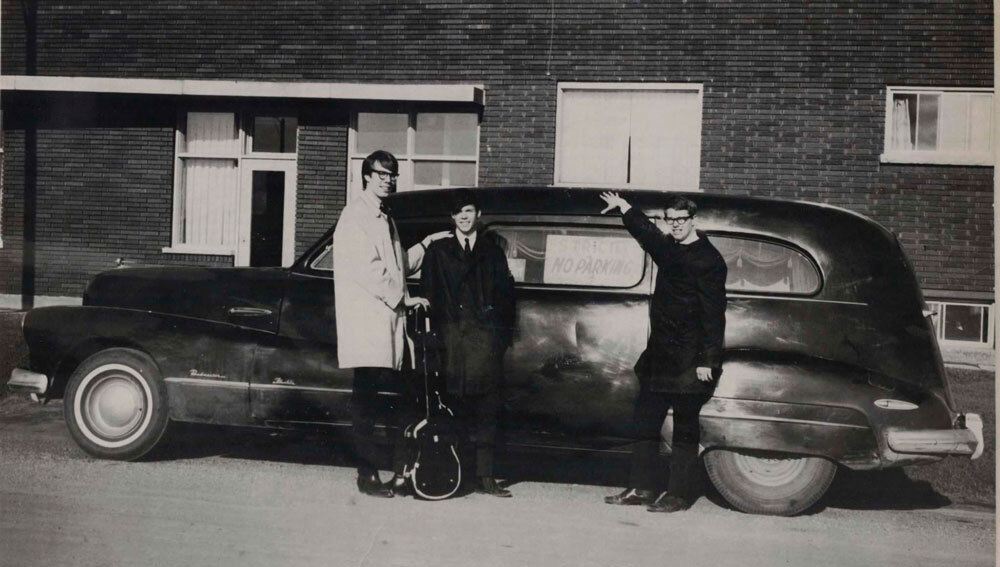
Neil Young and his band, The Squires, next to the hearse they drove at the time. The fact that Stephen Stills knew Young drove this vehicle set the stage for their 1966 L.A. encounter.
Although playing in different bands, Stills and Young became fast friends, and Young immediately became interested in starting a band with Stills. Problem was, Stills was already planning on traveling to the United States to try his odds at becoming a rock star. In a time before cell phones, it was not a sure thing that Stills and Young would ever cross paths again.
Soon after the tour, Young had found work as a backing bandmate in a group called the Mynah Birds, which had an energetic lead singer who would find major success years later: Rick James. Just one problem, and one that emerged when the band was in the studio: James had gone AWOL from the U.S. Navy and was arrested in a Motown studio, serving a one-year prison sentence as a result of the desertion. (Clearly, it didn’t hurt James’ career in the long run.)
Young and his former Mynah Birds bandmate, Bruce Palmer, decided to sell off the band’s equipment, in exchange for a very old-school Pontiac hearse, which they then drove across the border, and then to California, when the chance meeting on Sunset Boulevard occurred. (Stills knew Young favored driving hearses, though not that specific hearse.) Almost immediately, Stills and his musical collaborator, Richie Furay, turned around to get the attention of Young and Palmer. Almost immediately, they started Buffalo Springfield, a band that became hugely popular in the L.A. scene literally overnight.
As the Winnipeg Free Press notes, the creation of Buffalo Springfield and enough bands to start an entire subgenere of music might not have happened had that chance encounter not happened:
If Stills had been looking the other way, Buffalo Springfield and its many offshoots (Crosby, Stills & Nash; Crosby, Stills, Nash & Young; Neil Young & Crazy Horse; Manassas; Poco; Loggins & Messina) might never have happened. Young himself may not have become the iconic musical force he remains 50 years later.
In a way, a lot of life is the result of chance encounters—we are all creatures of circumstance, if you think of it—but generally, those encounters don’t happen thousands of miles from home, without the benefit of cell phones or GPS.
Time limit given ⏲: 30 minutes
Time left on clock ⏲: 6 minutes, 48 seconds
1925
The year Random House, the big-name book publisher, was first rounded. It is effectively named in the way it is to give it license to publish whatever it wants, per NPR.
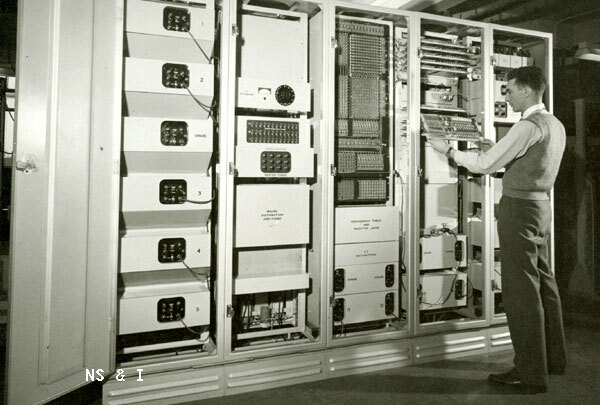
The ERNIE 1 computer. (via Light-Straw)
The random number generator that could change your life is named ERNIE
I don’t know why, but meeting other people named Ernie has always been a bit of a novel thing to me. My first name is so uncommon that I find myself finding affinity with other pop-culture Ernies, like the Ernie from Sesame Street, or Ernest P. Worrell.
But if I were British, I would have a random number generator to consider a cosmic brother of mine. His name is ERNIE, which is an abbreviation for his God-given name, Electronic Random Number Indicator Equipment. And depending on how the numbers play out, he might just make you a little wealthier than you were previously.
ERNIE is at the center of the United Kingdom’s lottery bond system, called Premium Bond. The idea behind a lottery bond, for those not familiar, is that the system, designed to encourage investment, allows a small chance that you might make more than your normal investment in a given month.
For the Americans among our readership, think of it like this: Imagine a version of the lottery where you invest money, but you can redeem the value of the lottery ticket at any time. That money helps to support the federal government, but in the end, most people won’t get particularly rich as a result of this. A decent portion have a chance of seeing some kind of return from it, but a relatively nominal amount, nothing more than a few bucks. But for a very small number of people in the lottery, you could win a huge amount of money—if not quite as big as you could get from a Mega Millions contest.
The process that decides this, at least in the UK, is managed by ERNIE. Over the years, ERNIE has taken a lot of forms. In the late 1950s, when computers were the size of a large room or two, so was ERNIE 1, which was a mishmash of vacuum tubes and transistors. Over time, he got smaller and smaller, generally following broader trends in computing. (ERNIE 4, dating to 2004, fit on a device the size of a standard motherboard, and used thermal noise to randomly generate numbers.)

The ERNIE 5 chip, which generates random numbers with light. (NS&I Corporation)
But the most recent version, ERNIE 5, has moved away from broader computing trends, and is now something of a pace setter; now, he’s one of the earliest prominent examples of quantum computing in action, at a time when quantum computing is a very exotic kind of thing. The primary chip that runs the computing device is roughly the size of a grain of rice, according to the BBC.
Each iteration of ERNIE gets a lot smaller and a lot faster. But lottery bond investment kept growing. By the end of ERNIE 4’s life, it would take hours for the device to run through the millions of potential winning lottery bonds, which grew hugely in popularity during its lifetime, putting lots of strain on the device by the end, per The Guardian.
Perhaps, if you’ve never taken part in a lottery bond before, you find this process a bit high tech. After all, you might be used to something closer to that spinning Bingo drum. But in many ways, the job of the ERNIE is much tougher. Essentially, it is managing a bingo drum including every single lottery bond in the system, and it has to make millions of choices. Even after all that, the odds of winning anything are one in 34,500 or something like that.
To put this all another way: ERNIE could make you rich, but the odds are much more likely that ERNIE will not call your number and keep you poor.
Thanks ERNIE.
Time limit given ⏲: 30 minutes
Time left on clock ⏲: 32 seconds

Why modern computers really struggle with the concept of randomness
But enough about ERNIE, impressive beast as he is.
I’d like to talk about your computer, or the one hosting your website, or the one in your pocket.
How can it do in terms of handling random numbers? To put it simply: Not always the greatest. For example, a traditional pain point of many web hosting tools has been displaying random content. Trying to show random things on WordPress, for example, is likely to cause problems for your server, especially if every user is taxing the random result, so it’s generally encouraged to avoid pure randomization when possible on CMS-driven websites. (I actually added random elements to the recent redesign of Tedium, but I did something clever to work around the headroom limitation: The random elements—the header images on the front and archive pages of the site—change only when I clear the cache or update an article. As a result, it appears randomly, but it’s the same randomness for everyone.)
But web hosting is one thing. Bigger challenges are out there for needs like cryptography, which relies heavy on number randomization. Part of the problem is that the ask being made isn’t quite so simple for a computer. In many ways, it goes against everything a computer is supposed to do.
“They’re deterministic, which means that if you ask the same question you’ll get the same answer every time,” notes Steve Ward, a computer science professor at MIT. “In fact, such machines are specifically and carefully programmed to eliminate randomness in results. They do this by following rules and relying on algorithms when they compute.”
As a result, this leads to situations where the computer’s decision-making isn’t really random, but “pseudo-random.” Think of a “shuffle mode,” for example. If it really was random, in the way we think of randomness, it would lead to situations where the same artist randomly gets played in the same playlist multiple times in a row, possibly even the same song. Which would, ironically feel less random, when in reality, it’s actually random. So companies like Apple and, yes, Spotify, have taken steps to put the song list up against algorithms that would discourage undesirable results from randomness, such as patterns that feel stale. Spotify was actually inspired by a 2007 post that described a concept called “balanced shuffle,” in which an algorithm decides to intentionally discourage the next song to play from being anything like the prior song.
“If you just heard a song from a particular artist, that doesn’t mean that the next song will be more likely from a different artist in a perfectly random order,” Spotify engineer Lukáš Poláček wrote in a 2014 blog post. “However, the old saying says that the user is always right, so we decided to look into ways of changing our shuffling algorithm so that the users are happier. We learned that they don’t like perfect randomness.”
And randomness has many much more important use cases, like cryptography, a huge element of both password creation and the blockchain.
Perhaps for this reason, organizations keep taking stabs to improve it. A refreshed random number generator was recently added to the Linux kernel, for example, and companies like Intel have taken steps to develop hardware solutions for generating random numbers.
Maybe we won’t truly have the problem licked until we embrace quantum computing.
Time limit given ⏲: 30 minutes
Time left on clock ⏲: 9 seconds
I often feel like randomness is a gift of sorts; we can’t anticipate what is going to happen, and often it leads to happy accidents that make life just that much more interesting, as artist of the moment Neil Young knows a thing or 10 about.
But the funny part is, even after all this time, we struggle to harness it. Computers struggle to convince you that they’re actually being random when they are, because randomness implies something that is different than what most people expect.
Seeing 20 of items show up at your door in accidental batches of similar items is random (and, in the Clueless sense, perhaps delivered by a random), but seeing 20 different things separated out by algorithm might actually be secretly orderly. But one feels more random than the other because we’ve been conditioned to think that way.
We may never get a handle on randomness, even with the help of quantum computing, but it’s pretty easy to embrace it for what it is sometimes. Why not just accept that random things happen?
--
Find this one an interesting read? Share it with a pal!
Since I have you and you read all the way to the end, I’d love your feedback on something. I promise, this is not random. I’m thinking about making some big changes to Tedium and MidRange, but I’ve yet to decide on that. I published my thinking on it over there earlier this week. If you have five minutes to tell me how you consume this newsletter, and anything you’d like to see changed, that would be very helpful for me. Just shoot me an email. Thanks.


Sydney Pollack's 1971 Ferrari 365 GTS/4

Visit Uncrate for the full post.
Best Tested Portable Power Stations in 2025

Here’s What To Eat If You Have COVID-19, According To Experts

10 Surprising and Amusing Eponyms
A good way to live on forever is to become a word. Well, it’s a way for your name to live on, anyway. Chances are, the origin and your legacy will be completely forgotten. People will likely forget the word was ever a name at all. Here are ten surprising eponyms and the unique people […]
The post 10 Surprising and Amusing Eponyms appeared first on Listverse.
The Mapping Error That Saved An Entire Forest
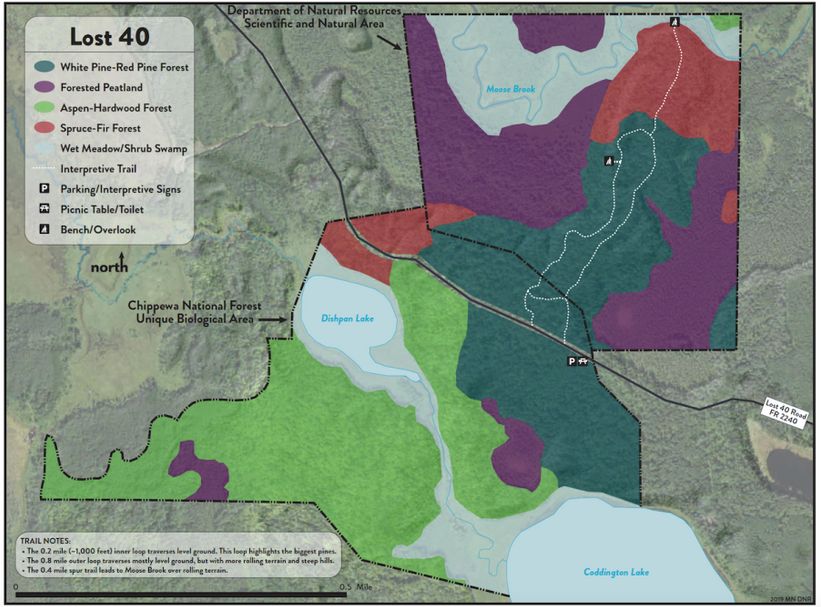
The Lost Forty, located in Minnesota, is the largest surviving patch of old-growth forest in the state. The 144-acre land, officially known as theLost Forty Scientific and Natural Area, contains pine trees that are between 300 to 400 years old, which is close to the trees’ maximum natural life span of 500 years.
The forest managed to avoid deforestation thanks to a surveying error in 1882. It turns out that the three-man survey team sent to chart the area between Moose and Coddington Lakes stretched the Coddington Lake half a mile further northwest than it actually exists. This mistake, which was embedded into maps until the 1960s caused the forest to be overlooked. Learn more about the forest here!
Image credit: Minnesota Department of Natural Resources
Ducati Unica Customization Program

Visit Uncrate for the full post.
British Police Pull Over Man Who Drove Without License, Insurance For 70 Years
California Redwood Forest Returned To Tribal Group And Renamed “Tc’ih-Léh-Dûñ” (Fish Run Place)

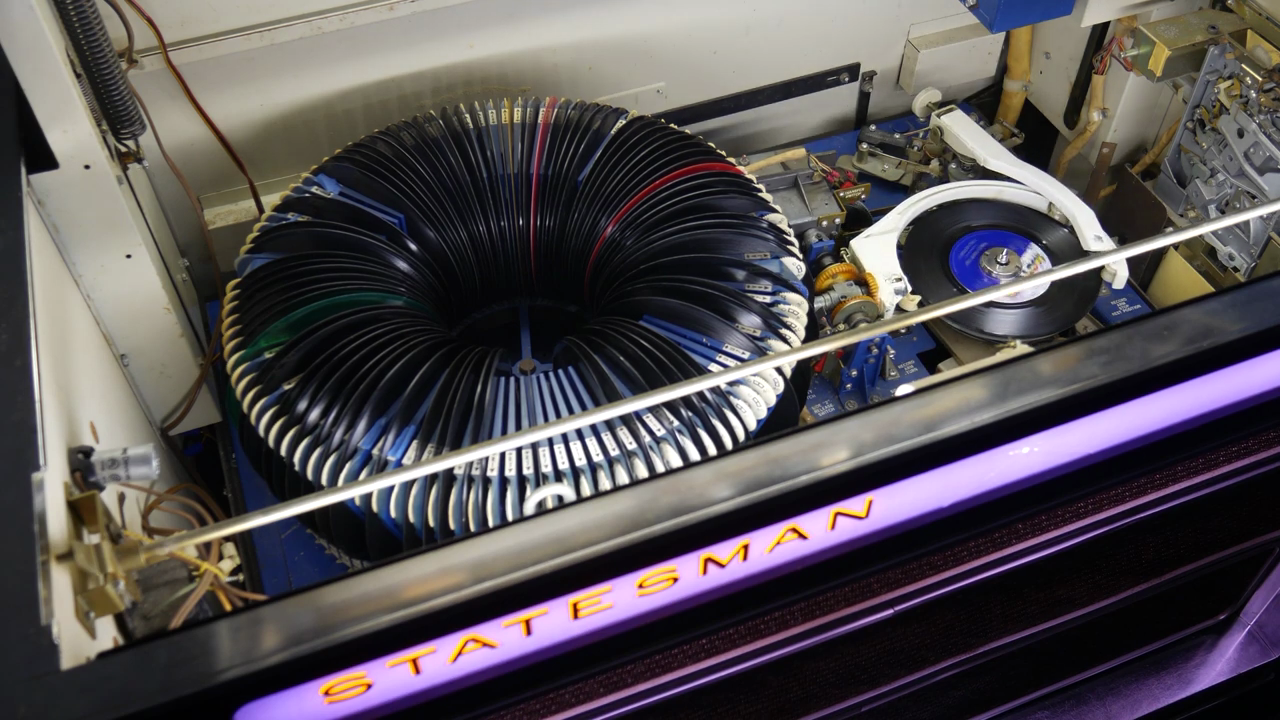
Jukebox Electromechanical Automation Explained
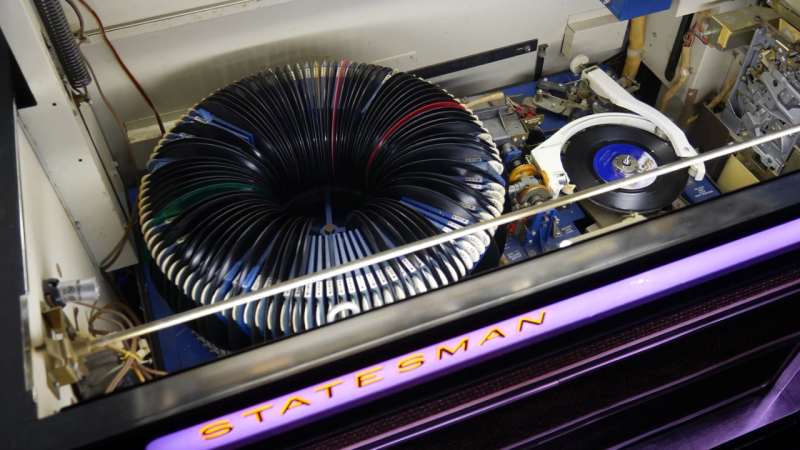
If you ever been curious how old-school jukeboxes work, it’s all electromechanical and no computers. In a pair of videos, [Technology Connections] takes us through a detailed dive into the operation of a 1970 Wurlitzer Statesman model 3400 that he bought with his allowance when he was in middle school. This box can play records at either 33-1/3 or 45 RPM from a carousel of 100 discs, therefore having a selection of 200 songs. This would have been one of the later models, as Wurlitzer’s jukebox business was in decline and they sold the business in 1973.
This may be the ugliest jukebox ever produced.
This jukebox is actually what turned me into the weirdo that I am today.
External appearances aside, it’s the innards of this mechanical wonder that steal the show. The mechanism is known as the Wurlamatic, invented by Frank B. Lumney and Ronald P. Eberhardt in 1967. Check out the patent US3690680A document for some wonderful diagrams and schematics that are artwork unto themselves.


[Technology Connections] explains how the whole thing works, and your brain will be spinning when he’s done. It’s amazing how everything is precisely orchestrated, and even more amazing that people were able to maintain and troubleshoot these contraptions. He says there may be a third installment, so stay tuned. If you like these things, check out this writeup we did about a restoration of a diner table-top Seeburg jukebox back in 2018. Have you ever worked on one of these electromechanical sequencers? If so, tell us about it in the comments below.
These are the best Wes Anderson movies, ranked
Known as a quirky, off-beat, and ever-symmetrical visionary filmmaker, Wes Anderson has brought his own unique perspective to filmmaking. Here are his best.
The post These are the best Wes Anderson movies, ranked appeared first on The Manual.

When And Where To See Elon Musk’s Out Of Control SpaceX Rocket That Will Crash Into The Moon At 5,700 Mph

Best Car Battery for 2022 - CNET

This is What Some of the Top Brewers Drink at Home

Edit.Photo is a Simple and Free Web-Based Photo Editor

Edit.Photo is a new, free, browser-based photo editor that advertises itself as offering fast, effective editing capabilities with no popups, ads, or tracking and doesn't require any account creation to use.
The Tennessee Supreme Court Could Decide the Fate of Nashville's Home Recording Studios

The Tennessee Supreme Court could soon decide whether home recording studios can keep making music in Music City.
On Wednesday, the court heard oral arguments in a lawsuit challenging Nashville's restrictions on client visits to home-based businesses. The plaintiffs argue that the city's regulations arbitrarily and unfairly deprive them of their right to earn a living.
"I've been doing this for 30 years here, so I've already sunk my entire life's career and family into this," says Lij Shaw, one of two plaintiffs suing Nashville over the rules. "For me and most people I know, we can't stop making music. We're artists, and we love to do this."
Shaw, who Reason profiled in 2019, has been fighting to save his business, The Toy Box Studio, since 2015. That's the year Nashville's code enforcers informed him that the law barred him from recording musicians for pay at his home. Presented with the choice of either shutting down his operation or fighting back, Shaw chose the latter.
In 2017, he and Patricia Raynor—whose home hair salon business was similarly targeted—sued Nashville to overturn its prohibition on client visits.
Their lawsuit argues that neither business has caused any injury to its neighbors by receiving customers at their homes, making Nashville's restriction on client visits arbitrary.
The city, Shaw notes, places no limits on how many people you can invite into your home for free, which allows for much more disruptive activities.
"It would technically be legal to hire the entire symphony orchestra to come to my studio, park all over the neighborhood like a football party, and record all weekend," says Shaw. "But if they paid me $1 for a thank you, it would be illegal."
Shaw and Raynor's complaint also says that Nashville's policy is unfair to their particular businesses, given that the city allows home-based businesses such as short-term rentals to have up to 12 paying customers onsite. This unequal treatment, they argue, violates the Tennessee Constitution.
In 2019, a Davidson County Chancery Court judge ruled against Shaw and Raynor. Because Nashville could articulate potential harms from allowing home-based businesses to serve clients onsite, the judge said, the prohibition was rational and, thus, constitutional.
Home-based businesses received something of a reprieve the following year. In July 2020, Nashville's Metro Council voted to amend its client visit prohibition to allow home businesses like Shaw and Raynor's to service up to six customers onsite per day.
That's an improvement over the status quo, says Keith Diggs, an attorney at the Institute for Justice, a public interest law firm representing Shaw and Raynor. (The Tennessee-based Beacon Center is also working on the case.) But it's still unequal treatment, he notes.
"Pat and Lij can only have six clients a day," Diggs notes, while "day care homes [and] historic home events can have up to 12 more clients a day." The city's ordinance also sunsets in January 2023. It is unclear whether client visits will be flatly prohibited or totally unregulated after the law expires.
An attorney for Nashville told the Tennessee Supreme Court yesterday that while the ordinance is ambiguous, it's her interpretation that there will be no restrictions on client visits once the law expires.
Diggs says that Nashville has taken conflicting stances on what happens after the law sunsets. That ambiguity—and the fact that the city could easily reimpose explicit restrictions on client visits in the future—still makes this a live issue, he says.
During yesterday's hearing, the justices spent most of their time exploring whether Shaw and Raynor's case is moot given that Nashville has lifted its blanket prohibition on client visits and given that the new six-client-a-day limit is set to expire next year.
They could choose to dismiss the case, send it back to a lower court, or rule outright on the merits of Nashville's restrictions.
The hope, says Diggs, is that the state Supreme Court will issue a decision saying that "facts actually matter."
At no point, he says, has Nashville been able to show that Shaw or Raynor's home businesses were negatively impacting their neighbors. Without that, he argues, the city shouldn't be able to impose restrictions on what business owners can do on their own property.
Shaw says a ruling protecting home businesses would add much-needed certainty for his studio, which he has sunk some $50,000 into since Nashville passed its temporary rules allowing client visits. He says it would also help preserve the unique music scene that has made his city famous.
"Music City is still a rare gem in the world where the world's musicians get together face-to-face in front of microphones," he says. "Without the ability to have a musician come to my home studio, I'll be forever stuck in a world of Zoom calls and computer living. I don't want to let the old music die."
The post The Tennessee Supreme Court Could Decide the Fate of Nashville's Home Recording Studios appeared first on Reason.com.
