
    
|
|
|
 Late in the course of the Vietnam War, or soon
after its conclusion, my parents and I watched a TV news broadcast
discussing the controversial role military conscription played in
the conflict. "Will I be drafted," grammar-school me asked out
loud, missing the nuances of the discussion, but fully grasping the
idea of being forced to do something you don't want to do. My
parents looked at each other. "If it comes to that," my father
said, "we'll get you out of the country."
Late in the course of the Vietnam War, or soon
after its conclusion, my parents and I watched a TV news broadcast
discussing the controversial role military conscription played in
the conflict. "Will I be drafted," grammar-school me asked out
loud, missing the nuances of the discussion, but fully grasping the
idea of being forced to do something you don't want to do. My
parents looked at each other. "If it comes to that," my father
said, "we'll get you out of the country."
It didn't come to that, of course, since conscription has been dead and buried policy since the Vietnam War, along with the unwilling soldiers killed by its implementation. Walter Oi, an economist who played a key role in ending the draft during the 1970s, passed away on Christmas Eve. David R. Henderson remembers his life and legacy at the Hoover Institution's Defining Ideas blog. Writes Henderson:
If you are an American male younger than 66, you should take a moment and give thanks to economist Walter Oi. Walter died on Christmas Eve 2013. Even though you probably haven't heard of him, he has had a profound effect on your life. He helped end military conscription in the United States.
Between 1948 and 1973, if you were a healthy young male in the United States, here's what you knew: the government could pluck you out of almost any activity you were pursuing, cut your hair, and send you anywhere in the world. If the United States was at war, you might have to kill people, and you might return home in a body bag.
Walter did not think that was right, and it wasn’t because of his own age or health. He was born in 1929. When he started writing about the draft in the mid-1960s, he was well beyond the draft-eligible age range of 18 to 26. (The draft-eligible age for doctors and dentists was even higher.) Moreover, he was blind, having gradually lost all his eyesight in the 1960s. Nor did he choose his position against the draft because he had sons who were at risk. Walter had two daughters, and when he was writing on the issue, almost no one was advocating the conscription of women.
No. Walter thought the draft was wrong because he thought that people should be able to make such an important choice—whether to join the military or not—for themselves.
Oi made his argument in economic form, however, arguing that conscription has hidden costs, in the form of inadequate compensation to military personnel (why hike pay for people you can force to serve?), and mental distress for unwilling draftees. He wrote:
The draft imposes costs on men in the armed services in at least three ways. First, more men from an age class are demanded by the armed forces under a draft because of the high turnover of draftees and reluctant volunteers. Second, some men are involuntarily drafted while others are coerced to enlist by the threat of a draft without being compensated for their aversion to military employment. At sufficiently high levels of military pay, all of these reluctant service participants could, in principle, have been induced to volunteer. Finally, the true volunteers who would have enlisted irrespective of the draft law are denied the higher military pay that would prevail in a voluntary force. First-term military pay can be kept at low levels because the draft assures adequate supplies of initial accessions.
But conscription also distorts the economy, he wrote. Even those who aren't called up suffer fewer opportunities, and make life and career choices they otherwise wouldn't make because of conscription.
In addition to the direct costs borne by those who ultimately serve in the armed forces, the draft allegedly creates other indirect costs which derive from the mechanics of the selection process. Under the current Selective Service System, a youth can remain in a draft-liable status for seven and a half years. There is some evidence which suggests that employers discriminate against youths who are still eligible to be drafted. The youth who elects to wait and see if he can avoid military service is likely to suffer more unemployment. He may be obliged to accept casual employment which does not provide useful job training for later life. Moreover, long periods of draft liability encourage youths to pursue activities which might bestow a deferment. When married nonfathers were placed in a lower order of call in September, 1963, it was followed by small increases in marriage rates of males in the draft-liable ages. It is also alleged that the draft prompts men to prolong their education or to enter occupations which grant deferments.
Being scooped up against your will by the government was no hypothetical problem for Oi. Henderson writes of asking about the older man's experience as an interned Japanese-American during World War II. "He reminisced talked about being taken prisoner by the U.S. government when he was 13 years old and, before being shipped inland, living with his family for the first few days in a horse stall at the Santa Anita race track in Los Angeles."
While you could never wish such an experience on anybody, that insight into the coercive power of the state may well have given Oi the wisdom to know that the use of force has costs beyond government balance sheets and demands for personnel. People aren't mere pawns for politicians to move around—they suffer when deprived of choice and freedom.
You'd think that respect for personal choice in this matter would go hand-in-hand with the nominal respect for liberty boasted by democratic, industrialized nations, but a fairly long list of such countries still engage in the practice. Austria, Brazil, Chile, Denmark, Estonia, Finland, Greece, Israel, Norway, South Korea, Switzerland, Taiwan, and Turkey still practice conscription, and the United States continues to require Selective Service registration to ease reinstatement of a draft. In most, though not all, of those countries, actual combat is highly unlikely and "alternative service" is available—but it's still compulsory work for the state.
Then again, virtually all explicit thugocracies fill the ranks with conscripts, alternatives be damned. So democratic governments are more respectful of their citizens' autonomy, even if not as often and to the degree we might wish.
Oi and his colleagues deserve our thanks for recognizing and fighting for the important principle, as Henderson puts it, "that people should be able to make such an important choice—whether to join the military or not—for themselves."
Young me might not have understood the economic arguments, but I certainly preferred freedom of choice over its absence. And grown me is happy to not have to contemplate the prospect of smuggling my own son out of the country to keep him from serving as some politician's pawn.
 Does your doctor nag you about your drinking?
The federal government wishes he would. Yesterday the U.S. Centers
for Disease Control and Prevention
noted with alarm that "only one in six adults [says] a
health professional has ever discussed alcohol use with them."
Physicians' reluctance to broach the subject is especially
worrisome, the CDC says, because "at least 38 million adults in the
United States drink too much."
Does your doctor nag you about your drinking?
The federal government wishes he would. Yesterday the U.S. Centers
for Disease Control and Prevention
noted with alarm that "only one in six adults [says] a
health professional has ever discussed alcohol use with them."
Physicians' reluctance to broach the subject is especially
worrisome, the CDC says, because "at least 38 million adults in the
United States drink too much."
How does the CDC know at least 38 million Americans drink too much? Because survey data indicate that "approximately one in six (38 million) U.S. adults binge drink." And what counts as binge drinking, as far as the CDC is concerned? Five or more drinks "on an occasion" for men and four or more drinks for women. Why were those cutoffs chosen? According to the National Insitute on Alcohol Abuse and Alcoholism, because those are the amounts that typically raise a person's blood alcohol concentration to 0.08 percent, which corresponds to the per se legal standard for driving while intoxicated.
What if you don't plan to drive? It doesn't matter. The federal government says you should never drink that amount, period. If you do, you are drinking too much by definition (the government's definition, that is). As I have noted several times, the government's notion of a binge encompasses common patterns of social drinking that cause no measurable harm to anyone or anything, except for the CDC's sensibilities—e.g., an after-work cocktail, followed by wine during dinner with friends and an after-dinner drink. I confess I have been known to binge in this manner from time to time. Once a month is all it takes to be counted among the 38 million, the vast majority of whom would not qualify for a diagnosis of alcohol dependence or even alcohol abuse but who nevertheless need to change their ways, according to the CDC.
Why does the CDC say "at least 38 million" Americans drink too much? Because it maintains that "drinking too much" includes not just so-called binge drinking but several other categories as well. If you are a man who consumes 15 or more drinks in a week or a woman who consumes eight or more, you drink too much. Ditto if you are pregnant or younger than 21 and drink any amount at all. If you are a woman, the CDC does not want to hear about how you limit yourself to one drink every day except Saturday, when you have two, thereby exceeding the government's arbitrary limit. Nor does the CDC care that you think 18-to-20-year-olds, who are legally adults in every other respect, should be allowed to drink beer. And don't even try to point out the lack of evidence that light to moderate drinking during pregancy harms fetuses. The CDC has decreed that all these patterns of drinking are excessive, and its only challenge now is convincing the rest of us.
That may be a tough sell. All together, the CDC says, "29% of U.S. adults drink too much." Based on data from the National Health Interview Survey, that means nearly half of all Americans who drink at all, and most (about 60 percent) of those who drink at least once a month, drink too much. Among past-month drinkers, according to the CDC, excessive consumption is the norm.

In Japan there’s a dog that sets the “trusty companion” bar just a bit higher. In fact, few canines are prolific enough to achieve his celebrity status—cast both in bronze and the hearts of an entire nation. But Hachikō, an Akita who lived nearly a century ago and now enjoys legendary status in Japan, is the best of man’s best friends.
In 1924, a professor of agriculture at the University of Tokyo by the name of Hidesaburō Ueno decided to take a pet. He came home with a two month old Akita. He named the puppy Hachikō—“hachi” meaning “eight”, the dog’s order in the litter, and “kō” meaning “prince” or “duke.”

Akitas are a noble Japanese breed known for their boldness, intelligence, and above all, loyalty. So, unsurprisingly, when Ueno would leave for work each day, Hachikō would stand by the door and watch him go.
And, when Ueno came back from work, Hachikō would be waiting promptly at 4 o’clock. Not at home, however, but at Shibuya Station, having traveled the streets to watch for his guardian’s face to materialize out of the commuting masses.

This is itself an astonishing tale of Hachikō’s loyalty and faithfulness. But it gets more incredible:
The two kept up this routine every day, until May 21, 1925. On that day, Hachikō was waiting, as always, in the train station for Ueno to return.
But his master never came. The professor had suffered an abrupt and tragic stroke mid-lecture, and would never ride the train back to Shibuya again.

Hachikō and the professor had lived together for little over a year, and yet the bond between them proved to be something extraordinary.
Hachikō returned to the train station like clockwork to await the professor. When he was sent to another part of Tokyo to live with Ueno’s relatives, Hachikō nonetheless continued his daily commute to Shibuya—now a 10 mile trek through the streets of Tokyo. After a year of this, Ueno’s family conceded, and entrusted Hachikō to the late professor’s gardener, who lived nearer to the station.
He became something of a familiar face among travelers, and the word of his loyalty came with acts of compassion and kindness. The station master set out food and a bed for Hachikō, and many passengers petted him affectionately as they passed.

A newspaper article was written, and Hachikō became a celebrity figure in Japan. His loyalty set an example to be strived for; he was referenced by schoolteachers and parents alike.
In 1934, a bronze statue of Hachikō was installed in Shibuya Station to commemorate the dog that had come to be seen as the station’s mascot, and Hachikō was present at the opening ceremony.

After nearly 10 years of solitary and stoic waiting, Hachikō died in 1935. Numerous books and films, across multiple cultures, have since been made commemorating the life of Hachikō, a story both heartwarming and heart wrenching.
If you ever find yourself in Shibuya, one of the nearly 2.5 million travelers who pass through each weekday, you’ll see him there, cast in bronze, still watching for the return of his companion. A nation symbol of loyalty and faithfulness, Hachikō redefined what it means to be a friend—whatever species you may be.

Images ©: 1, 7: Wikimedia Commons; 2: elprimerpaso; 3: rocketlass; 4: David Offf; 5: Stefan.

One could argue that without photo-sharing devices, the modern world would be infinitely less distracting and possibly more productive. However, our palm-sized digital oracles, with their sleek layouts and eight megapixel cameras (and all the dog and cat and food and baby photos we share with them) aren't going anywhere, so we might as well pay homage to the original photo-sharing device: the magic lantern slide.
Magic lantern slide technology actually predates the invention of modern photography. Originally, glass slides made from drawings or paintings were held up by a device, then backlit by a candle or lantern, then projected on a wall at a rich person's cocktail party.

Eventually, photographers began printing color positive images on glass slides and projecting them through one of these. (Basically, a concave mirror sits behind a light source and focuses the luminance through a small, square plate of glass and out the hole-thing). Some photographers even hand-painted their lantern slides for maximum artistic effect.
Below, you'll see a set of images from the American Alpine Club photo library, a series of more than 4,000 wilderness photos taken from 1890 to 1950. Notice the subtle pastels and bright, arctic blues painted onto the glass plates, then imagine what a pain in the ass it was to create a single photo filter to share with your friends.

The magic lantern slide is Photoshop before Photoshop, Instagram before it was instant. It's slowtography. What used to be a painstaking, time-consuming creative process is now the quick push of a button on our phones.
So let's enjoy the fruits of the pioneers' artistic labors—and be grateful for modern technology.


Images ©American Alpine Club.

You're hiking through the woods in Ontario, Canada. As you approach the edge of Lake Simcoe you see something out of place. Could it be? Sleek, modern architecture? Here? In the middle of the woods?
Regular readers know that such things are more likely than you'd think. And now, the latest entry in the trend of architecturally stunning cabins built for your resident nemophilist? The Sunset Cabin.
It may be only 275 square feet, but that's more than enough when you’re heading out to write, study or relax and gather your thoughts away from the city. The sparse trees and lake view surrounding the cabin are reminiscent of childhood days tromping around the nearby wood.

Unsurprisingly, the cabin is a place built by the owners to get away from it all. The interesting part is that "it all" was just up the hill, where the couple have their main cabin. Enamored with the view over the lake, they decided to set up this small, permanent structure down by the water.
The exterior has a futuristic edge to it without appearing ostentatious. Wooden slats gird the cabin, providing some shade during the day, as well as privacy around the clock. And, because the slats are made of cedar, they will slowly turn to a silvery gray, blending in more with the natural environment.
Which lines up with the cabin’s construction. It was built specifically not to disturb the natural beauty that surrounds it, being prefabricated in Toronto, then moved to the site and constructed in only 10 days.

Inside, classic and understated hardwood floors will have you reaching for your slippers before getting out of bed. Floor-to-ceiling windows dominate three of the four walls. Sunlight cascades through the slats providing you your daily dose of vitamin D without venturing into the harsh Canadian countryside.
A green roof sporting natural, local flora and a wood burning stove increase a sense of separation from the swarming hive of urban life. In all, this little dynamo of a retreat is proof that you don't need a lot of space to get the most out of landscape—and a view.


House by Taylor Smyth Architects.
Images ©A Frame Studio.

If your change needs a change of face, Paolo Curcio is the man to do it. He’s a hobo nickel artist—a meticulous sculptor of coins into miniature bass relief sculptures. The practice has been around for about a century, but Paolo, well, he’s seeing nickels in a whole new light.
Hobo nickel art’s roots run back to two guys: Bert and Bo (real names: Bertram Wiegand and George Washington Hughes). Back in 1913, when the Buffalo Nickel was first minted, artists began looking at the large head on the obverse side of the coin with a creative eye. And thus, H.N.A was born.

But before history starts to roll, let’s remember the question of legality—is carving on American money kosher with the Treasury? As stated in a 1909 law, the ruling stands here: Whoever fraudulently alters, defaces, mutilates, impairs, diminishes, falsifies, scales, or lightens any of the coins coined at the mints of the United States…shall be fined under this title or imprisoned not more than five years, or both.
Legal? Well. It all hinges on the word “fraudulently,” and the spirit of the law was to prevent tampering and deceptive reproductions, not to stop numismatic art. So hobo nickel art gets a pass. And for guys like Bert and Bo, that’s good news.

When they picked up the trade in their early teens, the Buffalo nickel was in its prime, and away they carved. Bo’s series of cameo portraits set a high bar for the art in the 50s, while the form was undergoing a re-imagining (the Buffalo nickel was leaving circulation and the Jefferson was taking over).
And then, in the 80s, a numismatist by the name of Del Romines set the field of hobo nickel art on fire, after his series of articles on the art were published. This marked the “modern” age of H.N.A., the age that Paolo works within.

But Curcio is doing something original with his coins (the term “nickel” is used loosely to cover any coin). Look at the gold in the background of his sculptures—he achieves color variety by using clad coins, a blend of copper and cupro-nickel (copper and nickel), and carefully etching away one layer to expose the layer beneath.
Clad coins came into circulation in the late 60s, and Paolo and his ilk are the first to experiment with H.N.A. on the coins. His artful designs, from macabre skulls to bearded men in bowlers, are keeping the century old art form relevant, and based on this Ebay sales, it’s a hobby that makes even more dollars than cents.


Images ©Paolo Curcio.
White House senior adviser Valerie Jarrett tweeted out a video on Wednesday defending the administration's position on why the current cold snap, otherwise known as the "polar vortex", is still a result of climate change or man-made global-warming.
"You don't want to miss this: President Obama's Science Advisor explains the #PolarVortex," Jarrett said.
In the video, Obama's Science Adviser Dr. John Holdren explains:
"If you've been hearing that extreme cold spells like the one we're having in the United States right now disprove global warming, don't believe it. The fact is no single episode can either prove or disprove global climate change. Climate is the pattern of weather that we observe geographically and over the seasons and its described in terms of averages, variations, and probabilities. But a growing body of evidence suggests that the extreme cold being experienced by the United States as we speak is a pattern we can expect to see with increasing frequency as global warming continues. And the reason is this. In the warming world we're experiencing, the far north, the arctic is warming roughly twice as rapidly as the mid latitudes, such as the United States. That means that the temperature difference between the arctic and the mid latitudes is shrinking. And that temperature difference is what drives what is called the circumpolar vortex, which is the great counter-clockwise swirling mass of cold air that hovers over the arctic.
As the temperature difference declines in the arctic and mid latitudes declines, the polar vortex weakens and it becomes wavier. The waviness means that there can be increased larger excursions of cold air southward, that is into the mid-latitudes and in the other phase of the wave of increased excursions of relatively warmer mid-latitude air into the far north. Computer models tell us there are many different factors influencing these patterns and as in all science, there will be continuing debate about what exactly is happening. But I believe the odds are we can expect as a result of global warming, to see more of this pattern of extreme cold in the mid-latitudes and some extreme warm in the far north."
Interestingly, global warming alarmist, former Vice President Al Gore, has blamed several instances on global warming, including Hurricane Katrina, Hurricane Sandy, and melting ice glaciers. In his 2006 documentary, An Inconvenient Truth, explains why man-made global warming is over-heating the earth. His argument appears vastly different than Holdren's.
Gore explains man-made global warming:
"The sun's radiation comes in the form of light waves and that heats up the earth and then some of the radiation that is absorbed and warms the earth is re-radiated back into space in the form of infrared radiation. And some of the outgoing infrared radiation is trapped by this layer of atmosphere and held inside the atmosphere. And that's a good thing, because it keeps the temperature of the earth within certain boundaries and it's relatively constant and live-able but this thin layer of atmosphere is being thickened by global warming pollution that's being put up there. And what that does is it thickens that layer of atmosphere and more of the outgoing infrared is trapped. And so the atmosphere is heats up worldwide. That's global warming."
In April of 2009, members of congress questioned the former VP about his assertions regarding global warming, which led to a failed carbon cap and trade bill on the hill. Rep. Steve Scalise (R - LA) reminded Gore that in 1997 the now convicted Enron chief Kenneth Lay met with the then Vice President to discuss devising a way to set up a cap and trade policy. Gore and Scalise also argue over whether the issue of global warming is still a debatable matter. Below is the video and transcript of the back and forth between the two.
REP. STEVE SCALISE (R-LA): Thank you, Mr. Chairman.
As we debate what I agree is a very important piece of legislation, a piece of legislation, in my opinion, and many others, that would have very detrimental effects on our economy if it was implemented the way it’s been drafted.
We’ve been trying to get a quantifiable grasp on the cost of this bill — how much it would actually cost American families; how many jobs would be created and lost? And we’ve — number one, on the science side, we’ve had very divergent views. We’ve had dozens of experts come, over the last few days, and testify, giving very different opinions on the science.
On the economics of it, we have not had the same kind of divergence. In fact, most economists and experts that have testified on the cost acknowledge — in fact, I’ll refer to President Obama’s own budget that was just passed two weeks ago. If you go to page 119 often President’s budget, he’s anticipating generating $646 billion in new tax revenue from this bill. So, clearly, the president expects this bill to generate $646 billion in new taxes that even his own budget director has said would be passed on to consumers…
And then, Senator Gore, talk to the numbers that this Congressional Budget Office — and now the president’s budget director, gave to your bill, and how that would relate to this bill in terms of the cost to American families of implementing a cap-and-trade energy tax…
MR. GORE: Congressman, you began by denying that there is a consensus on the science. There is a consensus on the science.
REP. SCALISE: Well, you must not have been listening to our testimony that we’ve had for the last few days, with dozens of experts that have come in, who have given completely different views.
MR. GORE: Well, there –
REP. SCALISE: So, I would — I would encourage you to go back and look at the testimony that this committee’s heard.
MR. GORE: There are people who still believe that the moon landing was staged on a movie lot in Arizona. But –
REP. SCALISE: And neither of us are one of those. And I know you like giving those cute anecdotes. This is not a cutsie issue. We’re talking about –
MR. GORE: No, that’s, that’s –
(Cross talk.)
REP. SCALISE: — that could export millions of jobs out of our economy, out of our country. And testimony’s been given just to those numbers.
And so we’re talking about a serious consequence that there would be on this country, and the carbon leakage that would occur, where the carbon would be emitted but it would be emitted in China and India, and the jobs would go to China and India. And that’s been testified before this committee in the last few days as well.
MR. GORE: Man –
REP. SCALISE: So testify about the actual costs. Do you want to –
MR. GORE: Man –
REP. SCALISE: — talk about the costs?
MR. GORE: — man-made — global warming pollution causes global warming.
That’s not a cutsie issue. It’s not an open issue –
REP. SCALISE: It’s your — and it’s your opinion, obviously. You’ve stated it many times.
MR. GORE: It’s the — it’s the –
REP. SCALISE: But, would you talk to the cost?
MR. GORE: — it’s the opinion of global scientific community. And, more importantly –
REP. SCALISE: They’re not in unanimity. There are others on the other side.
MR. GORE: — more importantly, more importantly, Congressman, that opinion is the opinion of the scientific studies conducted by the largest corporate carbon polluters 14 years ago, who have lied to you and who have lied to the American people for 14 years –
REP. SCALISE: And you talk about carbon — and I’ve got to — I’m running out of time, we talk about carbon polluters. You talk about them. It’s my understanding that back in 1997, when you were vice president, Enron’s CEO, Ken Lay, was involved in discussions with you at the White House, about helping develop this type of policy, this trading scheme. Is that accurate? Is it inaccurate? It’s been reported.
MR. GORE: I don’t know. But I met with Ken Lay, as lots of people did, before anybody knew that he was a crook.
REP. SCALISE: Right. And clearly you can see why so many of us are concerned about this type of cap-and-trade energy tax that would be literally turning over this country’s energy economy.
MR. GORE: I didn’t know him well enough to call him quot;Kenny boy.quot;
REP. SCALISE: Well, you — but you knew him well enough to help devise this trading scheme. And, obviously, we know what Enron and these big guys on Wall Street, like Goldman Sachs — and I know you’ve got interests with Goldman Sachs.
MR. GORE: No.
REP. SCALISE: These people — well, that’s been reported. If — is that not accurate?
MR. GORE: No. I wish I did, but I don’t –
REP. SCALISE: With executives from — you’re partnered in companies with executives from Goldman Sachs. Well, if you’re not, either way, Enron clearly had an interest in doing this when they were around, and we saw what they did.
And when you see the types of people involved in wanting to set up this kind of scheme, you can see why so many of us are concerned about –
MR. GORE: Are you –
REP. SCALISE: — turning our energy economy over to a scheme that was devised by companies like Enron and some of these Wall Street firms that –
MR. GORE: Well, that –
REP. SCALISE: — have wrecked our financial economy.
MR. GORE: — I don’t really know if you want me to respond to that. I guess what you’re trying to say — you’re trying to –
REP. SCALISE: I mean, clearly, there would be –
(Cross talk.)
REP. SCALISE: — big winners and big losers.
MR. GORE: — you’re trying to say — there’s some kind of guilt by association? Is that your –
REP. SCALISE: Not association. I’m saying that there are going to be big winners and big losers in this bill. And that’s been discussed by everybody talking — big winners and big losers.
But, some of the big winners are some of the very financial experts that helped destroy our financial marketplace. And I think that should be noted, that companies like Enron helped come up with this trading scheme that was invoked –
MR. GORE: Enron didn’t –
REP. SCALISE: — in cap-and-trade.
MR. GORE: — Enron didn’t create this proposal in any way, shape or form –
REP. SCALISE: Well, the details are not in this bill –
MR. GORE: — that’s a false accusation.
REP. SCALISE: — the details are not in this bill, and I would suggest that they are.

|
|

Photo via
If you’re a white English speaker, you can get a job teaching private English classes in China. Many schools will hire you without any prior experience, teaching credentials, or a working visa. Sometimes you don’t even need to apply for the job. In Urumqi, in China’s northwest, my writing partner and I were offered our first teaching gig at a roadside noodle stand. We had been in the country less than a week.
“Want to work at my school?” a lady asked us, thrusting two business cards forward with a smile. “You can start tomorrow.”
We weren’t sure whether to laugh or not. Was she serious? Neither of us knew the first thing about teaching children.
“We don’t speak Chinese,” we told her.
“No problem,” she replied quickly. “So what do you say?”
The offer was the first of many we would refuse during the two and a half months we traveled around China—we received unsolicited offers on the street four more times, and nearly every time we visited a school. In the private tutoring industry, which is growing at almost 15 percent a year, private language academies are looking for pale faces like ours to meet the booming demand for foreign English teachers.
But the industry's rapid growth is creating a new leisure class of young foreigners who are often unqualified for their teaching jobs. In addition to the roughly 180,000 “foreign experts” who enter China on working visas each year to work in education, there are many more who come to work on tourist or university visas. Of the dozens of English teachers we talked to for this story, only two had official work visas, and little more than half had any kind of teaching experience or certification.
The black market teaching jobs offer good wages in a cheap country, often with short working hours and little accountability. Many parents who pay the high prices for lessons don’t speak English themselves, making it difficult to track the progress of their child or gauge the talent of his or her teachers. It seems that many locals don’t fully grasp just how easy it is to get a job with some white skin and basic English skills.
Kunming, the capital of the southern province of Yunnan, is just one city where the 4.5 billion dollar a year English teaching industry is supporting a thriving expat scene. The city’s Green Lake neighborhood is dotted with foreign-owned coffee shops like Paul’s Café, where exchange students at the adjacent Yunnan Normal University meet to practice their calligraphy or have a beer after class. Within the confines of the Café’s patio, Kunming’s local dialects suddenly disappear into a swirl of various English accents. Some discuss studies, some their next travel plans around Asia, others the tough questions from Thursday quiz night at the local pub. It is a diverse community, with people hailing from everywhere from Ukraine to Uruguay. But what nearly everyone has in common is a part-time gig teaching English.
Eric, a Norwegian who came to Kunming to study Mandarin, is no exception. When we met him he was sitting alone at one of Paul’s tables practicing Chinese calligraphy. At the next table to us, some Americans in tank tops were popping caps off their second round of beer at two in the afternoon. Eric glanced at his watch and laughed, “As a foreigner in Kunming, it seems you only do four things: smoke, drink, teach English, and occasionally learn some Chinese.”
Eric had decided to take up a job teaching English on the side shortly after arriving in the city. A friend told him he could make 120 yuan an hour for the work (about $22)—a considerable sum in China, where a typical lunch costs 10 yuan. “It’s way easy,” the friend assured him.

Photo via
Eric showed up to a downtown high rise where Lijao Academy rents a room one day a week. The boss hired him immediately and said his first class would begin in two hours. No teaching certifications like TEFL were necessary; payment would be made under the table because he didn’t have a work visa; and it was no problem that Eric wasn’t a native English speaker.
“I don’t think my boss even knows what country I’m from,” Eric said.
Most of the English teachers we spoke to said their employers have similarly scarce requirements, and that ESL certificates are rarely required. Even when they are, forgeries can be purchased for as little as $300. In 2007, The China Post reported that as many as 40 percent of the foreign teachers in Taiwan were operating under fake credentials. In China, the problem is so rampant that the China Foreign Teacher’s Union, an organization that advises foreign educators, maintains a blacklist of agents that falsify credentials. What makes this difficult to track is that many schools tend to be off the books, operating on cash payments that are hidden from regulators.
Perhaps the best argument for the lack of qualifications lies in the numbers. In 2010, the Guardian estimated that 30,000 organizations were offering private English classes, up from around 15,000 in 2005. The supply of new, qualified foreign teachers is limited, and there are simply not enough of them to service the millions of new students who enter the market every year.
The harsh economics are also evident in the premium salaries being awarded to foreign teachers. Eric is being paid three times what the average Chinese teacher makes.
At Robert’s School, the largest private language academy in Kunming, the typical salary for a foreign teacher is 10,000 yuan a month ($1600) for a 25-hour workweek. Chinese natives are paid 3,000 to 6,000 yuan a month, depending on seniority. The salary gap exists because foreign teachers are harder to find, and can generate more revenue for the school. The school’s foreigner-taught classes cost 40 yuan an hour vs. 30 yuan an hour for a Chinese-led class. The academy pays even higher wages to foreign instructors with several years’ experience and teaching degrees or a TOEFL certification.
Robert Norfolk, the UK native who founded the academy in 2001, says foreign instructors are key to making his business competitive. “The fact that I am a foreigner also brings [the business] a lot of credibility,” he said. “It’s a huge attraction for the parents.” Such an attraction, in fact, that even though foreigner-taught classes are more expensive, Robert often struggles to convince parents that working with a Chinese teacher is better during their child’s first years of learning. He says some parents who push for foreign-taught classes as early as kindergarten don’t realize that an expat’s inferior Chinese makes it more difficult to teach kids language basics like the English alphabet.
Among the less legitimate schools, parents’ foreign-fever can lead to some unsavory practices. One Asian-American teacher, who wished to remain anonymous, told us that she had more difficulty finding a job and faced stiffer interviews than her white counterparts. When she was finally accepted on the strength of a co-worker’s recommendation, she continued to face more scrutiny in class sit-ins from both parents and the school manager. The LA Times ran a feature on this phenomenon in 2007.
In all cases, the industry excesses are floating on the pocket books of China’s booming middle class, many of whom have traveled to English speaking countries like the US, Australia, or Singapore.
“Frankly speaking, many of them are rich. They’ve traveled around and want their kids to experience the world,” says Vanessa, a Chinese born English teacher at Hengdong Haina Education, another private English school in Kunming. Their focus has moved beyond the rote memorization kids need to pass the state English exams, which are required from the third year onward in the Chinese curriculum. “Parents want their kids to be conversational.”
Vanessa’s English-teaching colleague, Liang, already has plans to sign her daughter up for the school’s foreign-taught kindergarten class. She says having a foreigner at the front of the classroom will help her daughter learn the pronunciation, accent, and spontaneity of conversational English that will allow her to be successful when she studies abroad. It is an increasingly common outlook in China: the Chinese are the largest foreign student group in the US, with 235,000 students enrolling in American colleges in 2012, according to the annual report of International Education Exchange.
As the industry matures and more westerners move to China, the English education industry may be more heavily pressured to enforce higher standards for their instructors. But until that happens, a foreign instructor does not necessarily guarantee quality lessons. While some are undoubtedly committed and great at what they do, many see these teaching jobs as an opportunity to live an easy life abroad while working only 20 hours a week—and quite possibly screwing up some kid's education while they're at it.

Image by Cei Willis, graphic work by Sam Taylor
On March 12 of last year, Senator Ron Wyden asked Director of National Intelligence James Clapper point blank if the NSA collected bulk data on Americans. In front of a Senate Intelligence committee, Clapper replied, “No, sir… not wittingly.” Roughly three months later, Edward Snowden took a flight to Hong Kong and dumped a shitload of NSA secrets, simultaneously proving Clapper a liar and pushing the word "Orwellian" closer toward redundancy.
Despite the critical mass of outrage since then, nothing has changed—NSA surveillance has gone on unabated, and will continue to do so at least until the end of March. So if you believe that your data is now safe on your laptop or smartphone thanks to Glenn Greenwald's editorial crusade, you are wrong. It is not. As Anton Kapela, a security expert at world-leading data storage company 5NINES, said, the only real privacy is in disconnecting. “There is a way to be private and secure, but at substantial cost and limited practicality,” Kapela says. “Minimize all use of the internet on laptop, desktop, and mobile, because you're 100 percent fucked.”
Kapela should know. In 2008, at the hacking conference DEF CON, he and colleague Alex Pilosov presented a hack that exploited a basic internet protocol called Border Gateway Protocol (BGP). The hack would allow an eavesdropper—any eavesdropper—to monitor the unencrypted traffic flowing to and from your computer. As WIRED reported at the time, “The method conceivably could be used for corporate espionage, nation-state spying or even by intelligence agencies looking to mine internet data without needing the cooperation of ISPs.”
But cyberspace doesn't have to be so bleak. If 2013 was the year of the whistle-blower waking the world up to vast state surveillance, then 2014 should be the year of encryption and privacy. After Edward Snowden's NSA revelations, several tools aiming to help you privatize your online life popped up, from Lockbox’s encrypted cloud to Crypstagram, which allows you to upload images that contain encrypted messages. Elsewhere, Wickr is utilizing the spy film/Snapchat method—providing a service that allows you to send private messages that self-destruct—while just last month, Instagram tried to capture the privacy zeitgeist with its Instagram Direct private messaging tool.
Until the next generation of privacy apps arrive, there are a few things you can do to duck the *Orwellian* gaze of government, tech companies, and advertisers. We asked a few security and internet experts for tips on how you can make your online life more private in 2014. They responded with a range of tactics that anyone could implement with moderate ease. Here they are.
Encrypt Your Web Browsing
The simple act of browsing, whether on a computer or mobile device, opens a whole can of privacy worms. By default, search engines and browsers amass user data—everything from cookies and searches to passwords and download history is fair game. Even if this cache of information is regularly deleted, hackers, NSA agents, Google, Bing, and their fleet of advertisers will have access to everything. The moment you enter a search term, it's out in the world and it’s not coming back. This reality needs to be understood before anything else.
And so free internet advocate Elizabeth Stark, creator of the recently launched Kickstarter-meets-XPRIZE platform called Threshold, believes everyone should be using HTTPS Everywhere. A collaboration between the Tor Project and the Electronic Frontier Foundation, HTTPS Everywhere encrypts your communications over the web, transforming every standard HTTP page into a more secure HTTPS page. This means greater privacy and security when you're browsing the web.
As the Electronic Frontier Foundation notes, many sites have limited support for HTTPS, and those that do often make it difficult to use. Some sites, for example, might support HTTPS but fill the site's page with links that sneakily take you back to the plain-old unencrypted HTTP site. The HTTPS Everywhere extension can be downloaded for Chrome, Firefox, and Opera browsers, allowing you to get one over on those companies and organizations whose websites couldn't give a fuck about your web security.

Photo by Anthony Topper via
Get Yourself Some Anti-Tracking Plugins
Seeing how data is processed is also important in enhancing privacy. Mozilla's Lightbeam is a privacy extension that allows its users to see the first- and third-party sites they interact with on the web. Activate the extension, and you'll be presented with a real-time visualization of all the third parties that are active on that page in three graphic representations: Graph, List, and Clock. While Lightbeam isn’t going to stop user tracking, it’s a good first step in learning how you're tracked on the web.
For those of you looking to stop tracking, enable the "Do Not Track" option on web browsers like Chrome and Firefox. Using an anonymous search engine like DuckDuckGo is a wise choice as well. Its purpose is the exact opposite of Google’s, which is to collect as much information as possible about every Google user on the planet. Regardless of how emotionally stimulating their Doodles can be, avoiding the tech giant as much as possible is vital in securing privacy.
Stop Over-Sharing, Duh
Compared to Facebook, Google is a model citizen. Facebook’s one true goal is to add or tweak features so that users will gleefully offer up treasure troves of private information. They want real, three-dimensional life mirrored online in very precise detail. Facebook owns everything its users post, forever, also reserving the right to hand this data over to the government without notification. The best option for users would be to shutter their accounts, but in an age where social media is just an extension of a social life, this isn't exactly realistic.
If you can't make the break, Stark advises you to check Facebook's privacy settings, which are purposefully labyrinthine. Though you might manage to go publicly incognito, Facebook will still have access to your data, selling it to advertisers and possibly handing it over to the NSA in bulk or via warrants. The same goes for Twitter with its recently announced private photo tool. These “private” photos may be hidden from public view, but Twitter will have access to the photo’s geo-data and content.
“The internet has a long memory,” cautioned Kevin Mahaffey, who is the founder of an app called Lookout that protects your data from cybercrime. “Never put anything on a social network that you don't want your grandchildren to read or a History Channel special on your life to mention.”
Mahaffey believes that the biggest privacy issue facing most people is their willful volunteering of private information on an actively tell-all scale. Facebook, Twitter, Instagram, and various other social media platforms are gold mines of personal data. These services acquire as much data as possible, for which advertisers pay top dollar and governments lobby for secret access. These social media outlets have many different privacy policies, so the best thing to do is to browse them and enable as many privacy protection settings as possible.
Password-Protect Your Shit
On the mobile front, one of the best and easiest moves smartphone users can make is password-protecting your phone’s screen lock function. If anyone gets their hands on a lost or stolen smartphone, they won't be able to check its contents, unless they have a hacking tool that can create a brute force attack. That goes for law enforcement as well, who cannot compel you to hand over your password without a warrant. Users should also encrypt data stored on a smartphone—this will require a longer, more random password, but will be more effective at safeguarding your private information.
Pay Attention to Your Apps—Especially the Healthcare ones
After password-protecting a smartphone, you should become conscious of your device's apps and data, and the interaction between the two. “Beware of health apps and other apps you download,” advised Sell, who noted that health app makers can mine physical data generated by your body and sell it to pharmaceuticals or other for-profit companies in the healthcare industry.
“Also, use Lookout to protect your phone from apps and yourself,” said Sell, noting that people should use anonymous search engines like Blekko—with Super Privacy enabled—for medical and other searches. For added privacy, Sell said people should pay for healthcare (and non-healthcare) products in cash instead of credit or debit, which leave digital paper trails. As any decent cop drama should have told you by now, no one can follow the cash.

Photo via
Stop Telling Tech Companies Where You Are All the Time
Sell encourages more seasoned internet users to feed Google Maps misinformation, so that its algorithms cannot piece together precise patterns. She also advises you to keep smartphones in a Faraday cage, which blocks all wireless signals from entering or exiting the phone. These cages also stop phones from waking up from an off state and transmitting cellular, WiFi, and GPS electrical signals. One of the most notable is Off Pocket, which was successfully crowd-funded into existence earlier this year.
Geotags, or geo-location data, is also a privacy concern. Photo-sharing apps like Instagram embed this information in the image file, permitting the company and advertisers to learn more about your real-world movements through your mobile devices. This allows advertisers to better target ads at you. “Delete geolocation data from media you post online, and don't post kids' photos on Facebook, Google, Twitter, etc,” said Sell, who added that using Skype for private communications is ill-advised, given that Microsoft collects Skype data.
Shred All Your Browsing Data
Smartphones have a "Do Not Track" setting, which, once enabled, blocks first- and third-parties from collecting internet browsing data. The only catch is that access to certain websites might be blocked in turn, disrupting the browsing experience. A few weeks back, app maker MotoTap dropped Dolphin Zero, a stripped down version of its celebrated Dolphin browser, which shreds all data when users close the app. Default mobile browsers don't function like this right out of the gate, so it's worth getting ahold of some software that will.
Protect Your Contacts
Contacts both on computers and smartphones should also be kept private. “Don't upload your contact books to eVite, WhatsApp, Snapchat, and Facebook,” added Sell. “Respect your contacts and expect others to do the same.”
Of course, giving fake names to important contacts in order to confuse digital peeping Toms is one option. Remembering actual numbers instead of saving them is another. But, if your terrible memory won't permit you to pursue either of these options, be sure to research apps that protect contact lists, such as Mobile Vault, to maintain a modicum of contact privacy. Another app that does the trick is My Secret Contacts by Synapsis Research, which saves contacts behind a password-protected wall, among other things.
Step Up Your Password Game
Kevin Mahaffey also emphasizes that whether you're a digital native or not, you should pay special attention to your primary email account. Use a unique password and never spread it across other accounts. Also, never use a word or phrase that can be gleaned from a Twitter or Facebook feed. Randomise passwords and change them often. If need be, write passwords down in case they are forgotten. Store the password on a piece of paper, then place it in a wallet or in a drawer.
If the wallet is lost, change the password, which should be done semi-regularly anyway for security and privacy purposes. And, if possible, use two-step or other multi-factor login authentication. This makes it far more difficult for a hacker to access an email account. Google offers two-step verification for Gmail that is incredibly easy to set up. Mozilla Thunderbird is also a successfully private email service, which can be made more secure with extensions, including PGP or GPG encryption (private keys that make messages secret). Expect new encrypted email services to emerge soon enough and replace the now defunct Lavabit, Tor Mail, and Silence Circle options.
Start Talking to People IRL
Of course, traditional person-to-person communication is still an option. The ease of the internet and mobile communication has tricked people into believing that information has to be exchanged on this digital matrix. If privacy is a major concern, make a point of having proper, real-life conversations. Unless you’re in the actual mob, it’s unlikely you’re being bugged.
---
Ultimately, there is one truism of the digital age: good and bad hackers alike are constantly trying to find system vulnerabilities. We might never be truly secure from malicious hacking and government intrusion. If we simply can’t bear unplugging ourselves from the matrix, then there are tools and apps that grant us a greater degree of privacy. But, it’s important to remember, even these tools are vulnerable.
Beyond that, privacy in this surveillance age is a matter of education. People need to understand why privacy matters and what can be done to better ensure it. Experts stay informed about the latest privacy and encryption apps, tools, and subversions, but average users are rarely, if ever, proactive. The best we can do is to share with our friends and relatives the best tactics against corporate and state surveillance. And, as Kapela suggests, stay the fuck off the internet, or at least severely reduce our usage. Do that, and we'll all be surprised at how private our lives can become.
Follow DJ on Twitter: @djpangburn

No need to plug in this particular hot tub – heat naturally circulates as you burn wood, keeping yourself warm outside by throwing logs on the fire much like you would in front of a living room hearth.


Dutchtub, which started making waves with its distinctive mug-shaped design and off-the-grid mobility, is back with a wooden twist on its original poly-fiber shell (and the same stainless steel lining).

Both the classic and new designs boasts extreme portability, able to be towed behind a bike, tossed on top of a car, or even dragged behind a canoe for the truly ambitious soak-seeker.

Like the outdoor equivalent of a fireplace flue, the spiral contraption sticking out the side allows users to adjust the temperature along with the burn rate. Optional accessories include a chimney to route smoke up and away as well.

While it is not necessarily a safe or sanctioned use, some clever revelers have also discovered you can use the flames to cook a meal while you bask in the warm water and wait, turning the wood-burning element into a de facto stove.





|
|

When you are eyeing the latest DSLR camera on the shop window, a virtual camera application isn’t going to draw your attention. But if that dream camera is still some dollars away, the Outside of Auto from Canon could be the thing to give you a gentler introduction to the basics of photography. The best way to learn photography is by taking thousands of pictures, but learning a bit of theory does bolster the practice. Rather than learning from books, tutorials, or YouTube videos, this web application from Canon Canada is the most fun yet. Canon Outside of Auto is...
Read the full article: 3 Steps To Learning The Basics Of Photography With A Virtual DSLR

Imagine that money was no object. Imagine that you, as a freelancer or just a person who works from home, could have the desk of your dreams. Wouldn’t that be amazing? Yes, that desk from IKEA works great, we all own one, but some desks out there are cool beyond imagination. The first step is to get to know them. The second step is to set your sights on one. And who knows? If you work towards it, one of these awesome desks could be yours one day. I, for one, will keep dreaming. StudioDesk by Bluelounge Working towards a...
Read the full article: 6+ Cool Work Desks Every Freelancer Should Own

Are you a believer in the idea that once something is published on the Internet, it’s published forever? Well, today we’re going to dispel that myth. The truth is that in many cases it’s quite possible to eradicate information from the Internet. Sure, there’s a record of web pages that have been deleted if you search the Wayback Machine, right? Yup, absolutely. On the Wayback Machine there are records of web pages going back many years — pages that you won’t find with a Google search because the web page no longer exists. Someone deleted it, or the website got...
Read the full article: 3 Ways You Can Remove Unwanted Blog Pages From Google

In the parallel universe created by the Sports Gods, Lance Armstrong didn’t win the Tour de France seven times, Joe Paterno isn’t the winningest coach in college football history, and Mike Tyson didn’t beat Andrew Golota. Each of these iconic figures offended the Sports Gods: Armstrong for performance enhancing drugs, Tyson for performance inhibiting drugs (marijuana), and Paterno for his association with a pedophile. So, the Sports Gods removed any record of their accomplishments.
The phenomenon of erasing records and even the existence of controversial athletes and coaches is the subject of an article in today’s New York Times, which looks at last month’s Heisman Trophy ceremony and wonders why two of the award’s top finishers—O.J. Simpson and Reggie Bush—have been erased from memory. The paper cites the omission of the year 2005—Bush’s Heisman-winning season—from the trophy’s official history as an example the sports amnesia address in the piece.
“In avoiding any mention of two controversial winners,” Richard Sandomir writes, “the Heisman ceremony was notable for another recent trend: colleges and sports teams that love to celebrate their history have become masters at editing it. Often this is done quietly, with computer keystrokes altering a record book, and not with an angry mob throwing a rope around a statue’s neck on the stadium steps.”
Bureaucrats punishing dishonest competition generally do so through dishonesty, whiting out wins, seasons, and records as though they never happened. Did Joe Paterno really lose all those games that we saw him win because his defensive coordinator turned out to be a sexual predator?
“Sports, perhaps better than any endeavor except politics, has become adept at a type of cleansing more commonly associated with authoritarian governments,” Sandomir explains. “With surprising regularity and ease, once-popular figures who have run afoul of the rules or the law have been erased like disgraced leaders from an old Soviet photo album, whitewashed from history to preserve an institution’s image or to abide by a governing body’s sanctions.”

|
|
 Licking My Friend
The Public Profile Project is photographer and Feature Shoot Editorial Assistant Jenna Garrett’s ongoing project exploring the subcultures, identities, and lifestyles that sustain themselves on the Internet. For the past year and a half Garrett has been appropriating images and video from Facebook, Tumblr, and YouTube, putting together extensive, curated collections that speak to underlying themes of exploitation, mimicry, and feminism.
The Public Profile of an American Girl is one of Garrett’s works within the larger project, and at its core lies Facebook’s Statement of Rights and Responsibilities, of which says: ‘When you publish content or information using the public setting, it means you are allowing everyone, including people off of Facebook, to access and use that information, and to associate it with you (i.e., your name and profile picture).’ Garrett has collected almost 5,000 Facebook images that girls have labeled “public”—cue in Garrett’s ability to reproduce and use them—and has grouped them into categories of recurrent photographic cliches she began to notice, coining them ‘The Face’, ‘Licking My Friend’, ‘Gang Sign’, and ‘Car Self Portrait.’
The collections are intense—visual mash-ups of Internet persona phenomena—one after the other, after the other, in an almost overwhelming flurry. When extracted from their cozy homes online and placed in the tangible world, the images are at once utterly fascinating and frightening, begging collective reflection and the questions, how did we get here, how did we come to this?
What began for Garrett as an exercise in curiosity, her collections of imagery have morphed into a big picture look at Internet culture and the perceptions that fuel it, becoming an archive of a certain generation, who as Garrett says, “appear to expose themselves at any cost.”
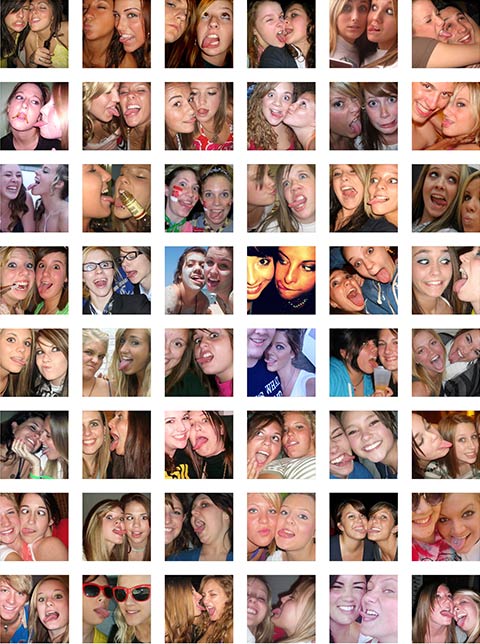 Licking My Friend, 48 Images
 Gang Sign
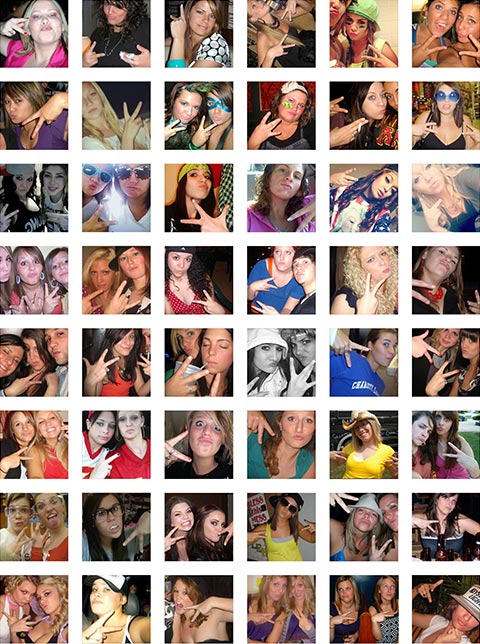 Gang Sign, 48 Images
 The Face
 The Face, 48 Images
 Car Self Portrait
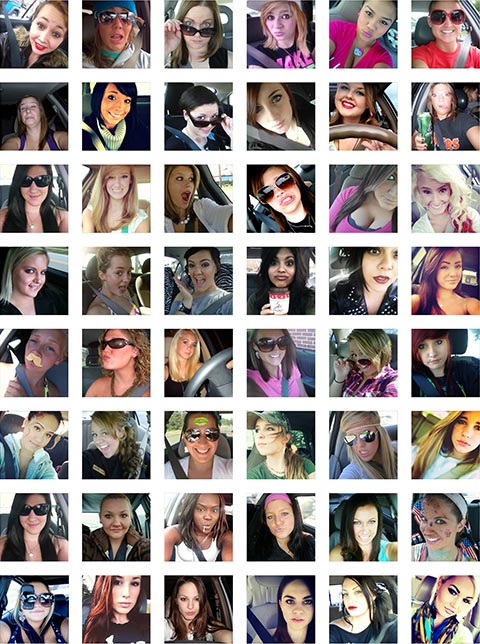 Car Self Portrait, 48 Images

 Writing in USA Today, Glenn
Reynolds, the Instapundit, sounds a call for alternative
education:
Writing in USA Today, Glenn
Reynolds, the Instapundit, sounds a call for alternative
education:
School was practice for working in the factory. Thus, the traditional public school: like a factory, it runs by the bell. Like machines in a factory, desks and students are lined up in orderly rows. When shifts (classes) change, the bell rings again, and students go on to the next class. And within each class, the subjects are the same, the assignments are the same, and the examinations are the same, regardless of the characteristics of individual students.
This had its advantages back during the Industrial Revolution, an assembly-line era where uniformity was more important than anything else, when Henry Ford was happy to sell you a car in any color you wanted, so long as it was black. But this is the 21st century, and now times have changed. You can buy a thousand different kinds of shampoo, so why should your kid have only one kind of education?
And check out his new book The New School: How the Information Age Will Save American Education from Itself. I don't fully agree with his arguments in The New School, but nobody has been more persistent and perceptive in calling attention to the higher-education bubble. Totally worth a read.
Reynolds and I - along with a half-dozen other folks - discussed "Where Higher Education Went Wrong" last February in Reason. Read that here.

It wasn’t long ago that people looked at you funny if you said that the Federal Reserve was working to prop up stocks. Now it’s openly acknowledged. JP Morgan even issued this chart explaining how our financial overlords have manipulated things northward.
Remember when people spoke in hushed tones of a “plunge protection team?”

Basically Chrysler should be JEEP. An that’s about it. Maybe the Ram Trucks brand too. That’s all Fiat wants and it’s all the world wants.

While we are all familiar with motion-detection technology in controlled indoor environments, the technology problem is much more complex when you add stray animals, wind-blown trees, weather-strewn debris and other dynamic variables into the mix.

This high-tech solution designed and developed by Tvilight involves eight sensors and includes recognition software that can distinguish people and cars from other environmental factors that would trigger normal detectors.
Recognition information is relayed between the various independent light posts to account for the trajectory and velocity of pedestrians and automobiles, allowing both reaction and anticipation. Fine-tuned control options allow off-hours intersections to have the lights turned down by 30%, and mostly-empty areas like parking lots to be dimmed up to 70%.


The statistics are staggering – cities, states and countries could save up to 50% on maintenance costs and 80% on energy by illuminating streets on an as-needed basis rather than continuously. In Europe, 40% of government energy spending is on street lighting, so cutting down the cost and pollution of lights can have an incredible impact.

Engineer and entrepreneur Chintan Shah’s company developed this dynamic system such that it can be applied to street lamps of all kinds, both new and old, in various places – sensors can be added to existing lights with traditional or LED bulbs. Already active in Holland and Ireland, Tvilight is looking to expand into the German, Canada and the United States.




|
|

This seems, unwise.
I wonder if the the folks who gave the waiver to the defense contractors to keep the F-35 program close(er) to on schedule have ever perused Unrestricted Warfare, a book written in the late 1990s by a couple of mid-level officers in the Chinese Army. In it the authors argue for the use of a myriad of unconventional warfare forms, one of which, if I remember correctly, was implanting components in enemy technologies which could be “turned on” when needed.*
Putting Chinese components in the American fighter and weapons platform created in large part to counter the Chinese doesn’t make much sense to me.
(From CNBC.com)
“It was a pretty big deal and an unusual situation because there’s a prohibition on doing defense work in China, even if it’s inadvertent,” said Frank Kenlon, who recently retired as a senior Pentagon procurement official and now teaches at American University. “I’d never seen this happen before.”
The Government Accountability Office, the investigative arm of Congress, is examining three such cases involving the F-35, the U.S. military’s next generation fighter, the documents show.
*The components of concern are said to have no programmable features. They are magnets.

This is a Constitutional issue. This is a general privacy issue. But it’s also a crony capitalism issue. How many tech companies have been compelled to partner with, or have partnered willingly with the NSA in its domestic spying efforts? At this moment it looks like a good part of Silicon Valley falls into one or both of these categories.

The horrifying statistics from the Chinese government's latest ecological survey find that a land area the size of Belgium is now too polluted to grow crops in and 28,000 of the country's rivers have disappeared since 1990. With China's population on the rise, pollution and nutritional demand could create a perfect storm for famine.
According to Bloomberg, more than 2% of China's land is no longer usable due to pollution deposits from many government-owned industrial projects. It had been previously revealed that around 15% of the land is polluted in some capacity. The pollution consists mostly of toxic metals, many of which have been found in rice and other crops in land previously believed to be arable. Even when the land is found usable in some form, farmers have unknowingly watered crops with contaminated water or used seeds from other parts of the country more susceptible to pollutants.
Since only 10% of China's total land is available to grow crops on to begin with (much of China is either mountain or desert, and the remaining area too urban for farming), losing 2% of it significantly diminishes the amount of available land for growing. The announcement was made by Vice Minister of Land and Resources Wang Shiyuan, but with little more information, as most of the state-sponsored study conducted between 1996 and 2014 was a "state secret" and unavailable to the public. Shiyuan did promise, however, that "tens of billions of yuan" will be poured into solving the problem.
As for the river situation, Vice notes that the Yangtze and Pearl River deltas are the most polluted because of the amount of industrial work taking place there. It also notes tens of thousands of smaller rivers have since evaporated or otherwise been destroyed.
Reports of toxic food have not been uncovered alone without damage, however. The New York Times notes that many farmers in inland China have reported an uptick in cancer cases and strange illnesses. The cancer threat is so worrisome to some poorer farmers that one woman told the Times she and her husband deliberately refuse to go to the doctor for check-ups, because cancer is "only a burden on the children" and they would rather die while saving the money any attempt at fighting cancer would require.
The pollution problems surface at a time when Beijing has been unable to hide other kinds of pollution-- most notably, smog so thick that it has grounded flights and sickened enough people to require specialized smog clinics to open in some regions. Unlike the air pollution, however, this underground threat hurts China's ability to be independent from food exports to feed its massive population. That population is expected to grow over the next year as the nation eases its one-child policy to allow families to have a second child in the event that one of the parents is also an only child.
This growth coincides with a push by President Xi Jinping to expand the economic influence of the nation, both the power of the market within China and its reach internationally. Health concerns could turn into dependency on imports, which would greatly handicap the nation's economic influence. Aware of this, it appears that China has decided to act on its egregious environmental abuse, though in doing so it hides under "state secret" much of the concerns. Whether this is a mere display of concern for an international audience that cares about the environment or a genuine attempt at change is in the government's hands.

|
|

Over the years I’ve looked at a number of books on hunting, fishing, and foraging, but this turns out to be my favorite. The first sentence: “We live in an edible world.”
There is good info on things like aging game birds, gutting and skinning a deer, even how to get started hunting. Or how to net herring — an annual ritual in NorCal. For the boatless, this can be practiced from shore with a cast net, 5-gallon bucket, and hip boots. Onto harvesting clams, rock crabs, rock fish. How to kill eels with salt (almost impossible otherwise), manzanita cider, madrone bark tea. Making sausage from wild boar, eating squirrels, (there’s a bluegrass song, “Why Would Anyone Eat Beef When They Can Have squirrel?”), and recipes for everything.
-- Lloyd Kahn
Hunt, Gather, Cook
Hank Shaw
2012, 336 pages
$14
Available from Amazon
Sample Excerpts:

*
Catching crabs is pretty easy. You need bait, a cooler, some string, and patience. A trap of some sort helps a lot, but I’ve caught crabs hand-lining a chicken leg off a rowboat in a back bay or off a dock. You lower the chicken to the bottom and wait until you feel little tugs. Slowly bring the line up, and if you see a crab munching on the chicken, you carefully slip a net underneath him-he’ll let go of the chicken as soon as he sees you or the boat.
Trap crabbing is basically a combination line and net. You toss the trap in and wait, then haul it in from time to time. Remove crabs from the trap and toss them in a cooler. Repeat as necessary.
Where to go? Piers are good places, as are jetties or breakwaters. You want to put the trap near places where crabs hide. They will run out and start eating your bait, and you can collect them. If you have a boat, look for underwater grass beds near rocks.
*
Always be ready. Rabbit hunting is an exercise in active relaxation. You never know when a rabbit or hare will show itself, and then you might only have a second to make the shot. Peering intently at everything will wear you out in an hour, so you need to let yourself go and absorb everything as you slowly move through an area. Listen. You can often hear rabbits before you can see them. I’ve heard rabbits chewing before I could spot them.
…Above all, watch. Don’t look for the body of the rabbit or the hare, look for its eye or an ear. I’ve spotted hares staring at me that were standing stock-still. I never saw the hare; his coat melted into the surrounding scrub, but his eyes looked like polished pebbles. Aim for the head, especially with a shotgun. A full blast with a shotgun in the body can destroy the meat on a rabbit or squirrel. A head shot is both more humane and wastes less meat. Remember, the most and best meat in any of these animals is in their back legs.
*
Aging Game Birds
I used to recoil at the idea of hanging shot pheasants or partridges ungutted and in their feathers for days. It did not seem terribly hygienic or sane to me. Old texts wax rhapsodic about the sublime flavor of “high” game, which usually means pheasants that have hung for more than a week. This, I’d decided, was madness. I was wrong.
*

*
Fortunately, science exists on the topic of hanging game birds. My best source is an Australian government publication that did some rigorous experiments. Pheasants hung for 9 days at 50°F have been found by taste panels to be more acceptable than those hung for 4 days at 59°F or for 18 days at 41°F. The taste panels thought that the birds stored at 59°F were tougher than those held for longer periods at lower temperatures. Pheasants hung at 50°F became more gamy in flavor and more tender with length of hanging.
A few things you should know. First, aging works with any game bird. The general rule is the larger the bird, the longer you can hang it. Doves and quail need just a day or so, while grouse, partridges, woodcock, and pigeons can go as long as 5 days. Don’t try to wet-pluck an aged game bird. You must dry-pluck these birds because the skin gets looser, and scalding (more on this ahead) does not seem to help with the feathers. It was a major bummer to scald one bird and rip some of the skin. Dry-plucking, you should be warned, takes forever, but the results are worth it.

After Johnny Manziel likely closed out his college career with a dizzying, dazzling, and daring performance in a 52-48 victory against Duke in the Chick-fil-A Bowl on Monday that showed the world he possesses skills that cannot be taught and signs of maturity and leadership, he was compared to everyone from Houdini to Fran Tarkenton.
Scouts said Manziel reminded them of Tarkenton or Doug Flutie for his elusiveness. Others remarked that Manziel was like Larry Bird for his ruthless "clutch" gene. Brett Favre also came to mind. Some (including many in Tuscaloosa, Alabama) threw up their hands and said he was just Houdini.
I'm going with Allen Iverson. If Eagles coach Chip Kelly's offense is described as "basketball on grass," then Manziel is Iverson on grass.
Practice? Off-the-court-or-field distractions? Children, please.
Manziel doesn't have cornrows. He doesn't have the tattoos that may need to be whitewashed. He comes from a much more privileged background.
But on the field of play, my goodness he is a disrupter like Iverson. A creator. Someone whose motivation to win and heart can never be questioned on the field and who lays it all out on the line for his teammates. He leaves opponents in the dust with his scrambles like Iverson broke ankles with his crossover. Manziel is generously listed at 6' 1" like Iverson was at 6' 0"--and Manziel, like Iverson, plays bigger than his listed height, especially because he has bigger hands than someone typically does at his height. He also, like Iverson, has a Texas-size swagger and gestures that drive opponents crazy.
Coming into the season, Manziel faced so many distractions from his alleged drinking and partying that may have gotten him kicked out of the Manning Passing Academy to autograph scandals. His off-the-field stories made Alabama's quest for a three-peat an afterthought. But when he gets on the field, which must be the closest thing he has to a sanctuary since he became the first freshman to win the Heisman Trophy last year, Manziel just, like Iverson did, blocks out all the distractions and just plays ball, which is what he did in a sophomore season in which he may have arguably been better than he was during his Heisman-winning campaign.
Most importantly, he is "box office." Must-see TV. And someone people will pay their hard-earned money to watch live in an age when NFL teams are thinking of even more creative ways to draw people to the stadium. He is the poster boy for the age of reality TV and social media like Iverson was for the hip-hop generation.
In his signature moment on Monday that still has the college football world abuzz, Johnny Football was being Johnny Football when he may have even outdone himself. With his team trailing by three touchdown, there he was, hurdling into a defender, escaping, and then scrambling to buy himself time to find an open teammate for a touchdown pass.
After the game, Manziel was asked to describe how he pulled the play off.
"I don't know," he said. Neither does anyone else.
And that's why he's good. That's why he's captivating and mesmerizing. And that's why we watch. Because nobody--not even Manziel--knows what will happen next with Manziel in an era when everything feels so scripted.
This year, Manziel, who already could make NFL throws from sideline to sideline, has developed into a better pocket passer. He's matured as a leader. And the fame that came after he won the Heisman may have prepared him to deal with the white-hot spotlight that will follow him around for most likely the rest of his life.
There were three specific instances in Texas A&M's win over Duke that showed why Manziel will succeed at the next level and, was in many ways, reflective of his maturation process combined with a "Jeter-flip"-like instinct that cannot be taught and for which no game plan is available. You don't bet against people like that. And you want them on your side.
First, the Manziel scramble that everyone is talking about even though they do not have the words to do so is remarkably more the norm than the exception.
Trailing by three touchdowns in a game he desperately wanted to win, Manziel leaped over a Duke defender on the line when the pocket collapsed, ran into his own lineman, escaped the pile--and then found Travis Labhart for a touchdown in a play that seemed to leave A&M and Duke players in disbelief on the field. Manziel has done things like that before--the scramble against Alabama that he turned into a touchdown last year when Alabama's Vinnie Sunseri vacated his spot in the zone to try to recover what he thought was going to be a fumble. But this play was crazier and defied logic even more.
Second, in the fourth quarter, in a moment that made Manziel seem like a poor man's Brett Favre, he hit a near 50-yard strike (officially 44 yards) to wide receiver Derrel Walker to bring the Aggies within three
That pass showed how much Manziel, who was already a pretty good pocket passer (see his performance in the second half against Alabama the last two years), had developed as a drop-back passer. He also made numerous throws from the pocket in the Duke game--outs to the sideline and lasers up the middle--that were "NFL throws."
Third, Manziel showed he had the intangibles--being a leader on the field and deftly handling interviews--to succeed in the NFL.
Manziel was the team's emotional and spiritual leader during the game. He implored his defense to "take it from them." And they did, picking off Duke quarterback Anthony Boone twice in the fourth quarter--and returning one of those back for a touchdown--to seal the game. He reined in a frustrated Mike Evans after he took some boneheaded unsportsmanlike conduct penalties that cost Texas A&M. And after the game, Manziel was Tom Brady-like in his interviews. He's grown, as can be seen in the post-game interview where he says all the right things about loving his coach and teammates and deflecting the question on whether he will enter the NFL Draft. He showed that he is ready to handle the "interview game" that is becoming an even more important part of the sports culture in an age of 24-hour media and social media.
Manziel will need to find a the right team, of course, that buys embraces his style of play instead of trying to shackle him into someone who he is not. But he's a top-10 team, and someone teams may be willing to build their franchise and brand around--on and off the field, betting that the huge potential payoffs and and off the field outweigh the risks.

|
|

Got some old tires in the garage? Don’t think of them as eyesores. Those are handy wood-splitting devices that can save you time and trips to the chiropractor. Stack spare tires on top of or around a chopping block, and those worn-out Goodyears will hold wood rounds in place while you work ax magic. The wood stays inside the tire, so you can split smaller and smaller pieces without having to bend over and pick them up each time the ax falls. When the wood splits cleanly, the tire helps keep your ax from biting deeply into the block. Miss the round entirely—hey, it happens—and the tire catches the errant edge and guards your legs against a horrific gash. Here’s how it’s done.

Illustrations by Steve Sanford
Use a utility knife to create tabs on one side of the tire, cutting through the rim bead and a couple of inches into the sidewall. Slide the tire onto the top of the block, tabs facing the ground, leaving plenty of tire above the block surface. Nail the tabs into the side of the block.

Stack four or five spare tires on top of one another with the chopping block fitting snugly in the middle. The top tire needs to extend above the chopping block's surface. Secure the tires together with parachute cord. This arrangement provides stability to smaller splitting blocks.

Slumbering cowboys during the Highwood cattle roundup in the Shonkin Cowcamp bunkhouse, Highwood Mountains, Montana, USA. The cabin is probably about a hundred years old, and has probably sheltered cowboys (and salters) for every yearly roundup since it began in 1913.
Contributed by Brian Liu.

On this the last day of 2013 I was feeling a bit reflective and this video I stumbled across just hit the spot.
I can remember walking with my father in the early 1980s through what were then considered “super computers.” And he said the same things that this fellow does in the video.
How amazing is the human mind? How amazing is technology? What fantastic things wait for us in the coming year? What new solutions? What new opportunities for achievement and mind expansion?
Of course there’s a flip side to all this but for the moment I’ve decided to focus on the positive.


