Shared posts

26 Oct 17:32

Provisions: Campfire Shakshuka

by Zach Piña

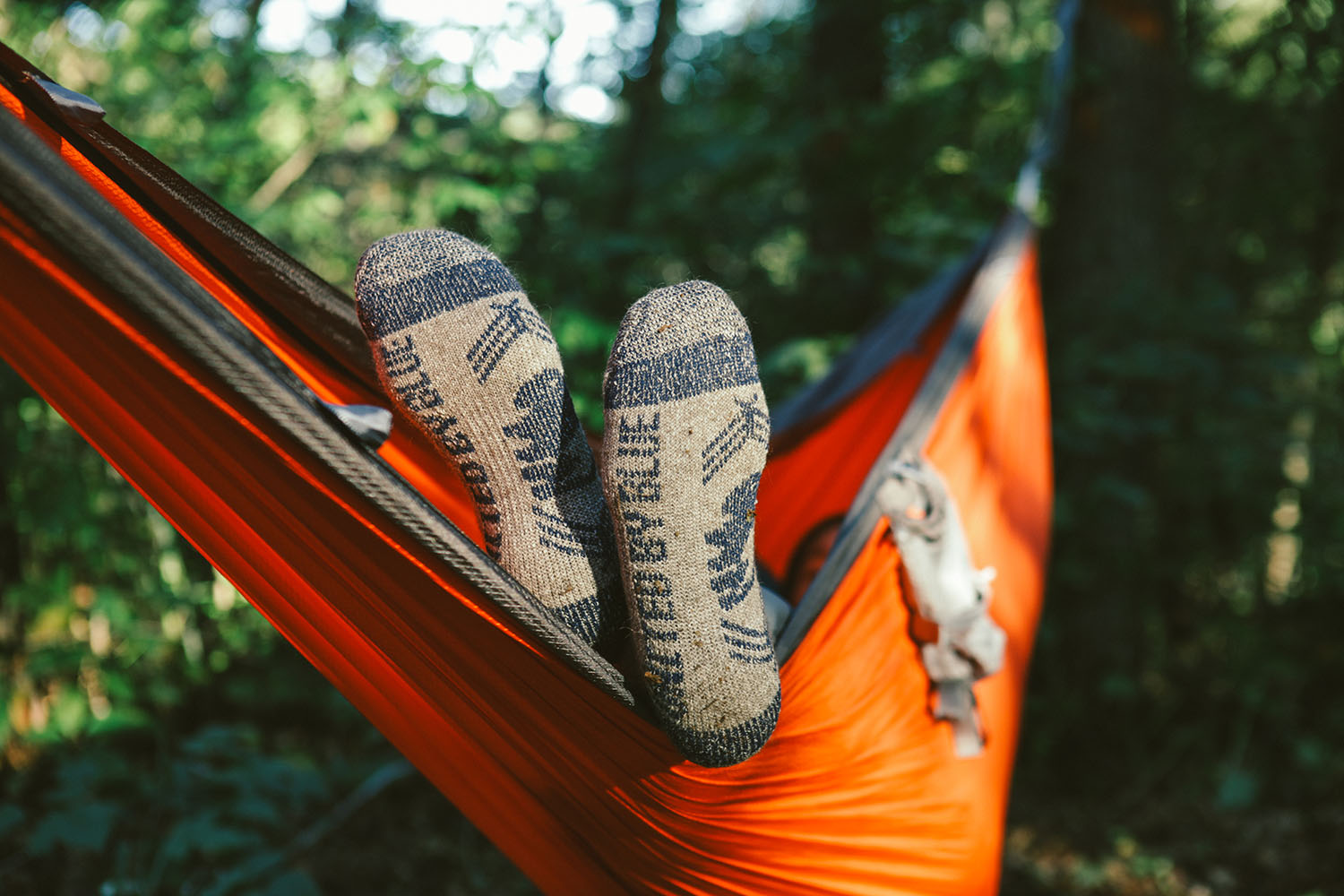
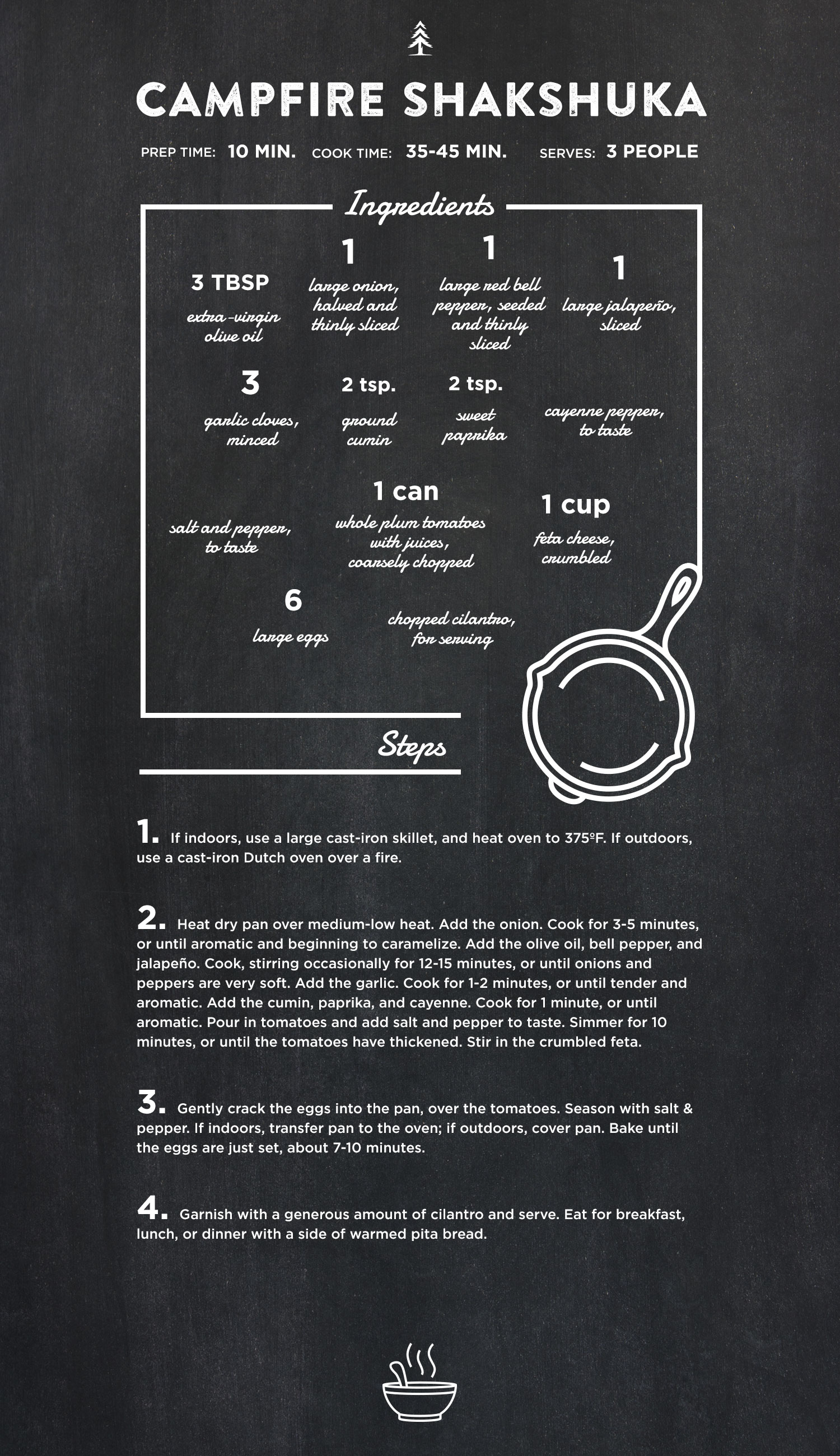
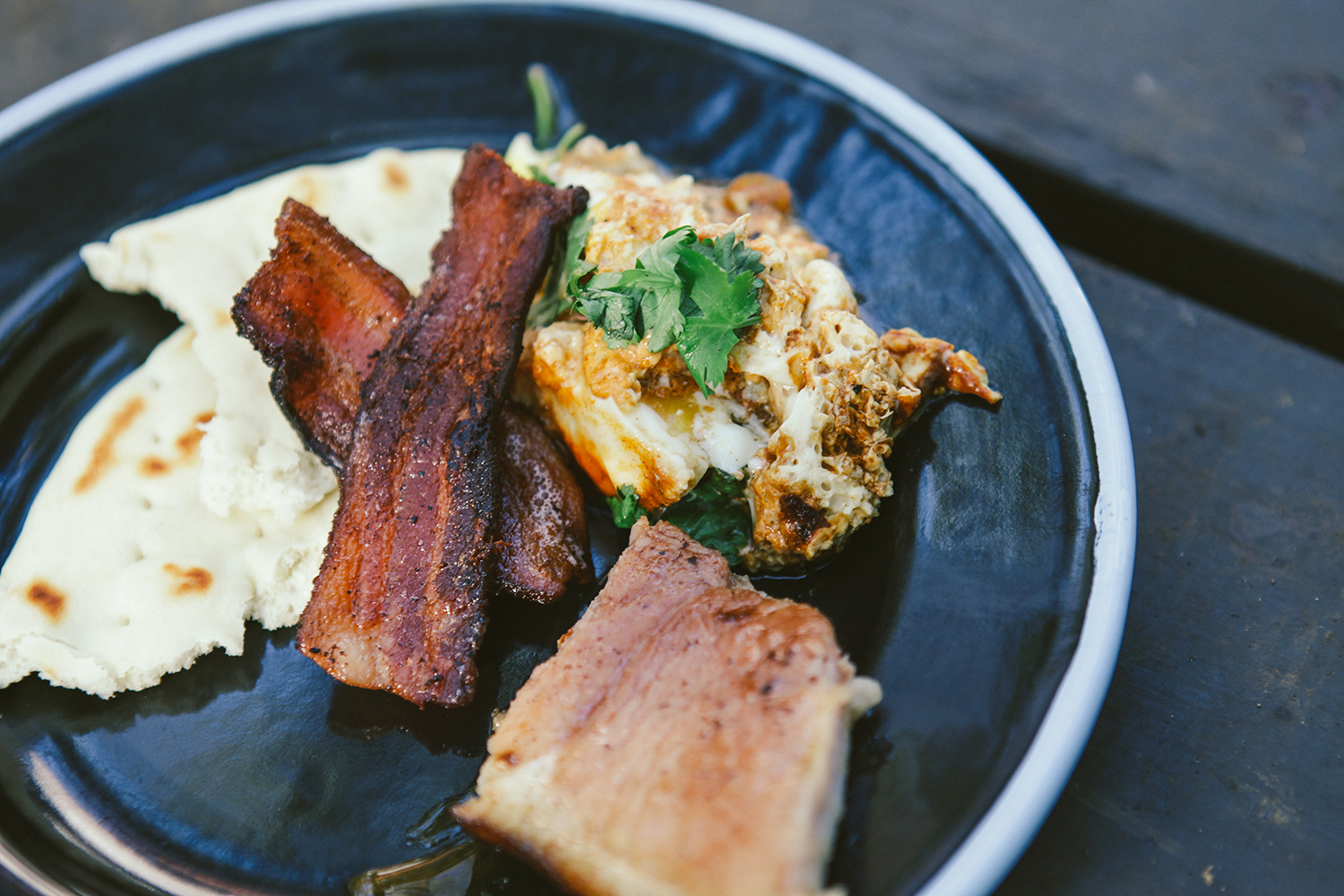
Shakshuka is one of those dishes that’s simply too damn good to enjoy only for breakfast. This vibrant vegetable ragout with poached eggs is enjoyed in various capacities around the world — as breakfast in in North Africa where the dish originated, or as a bright and spicy communal centerpiece for supper in Israel with pitas or challah on the side.

 
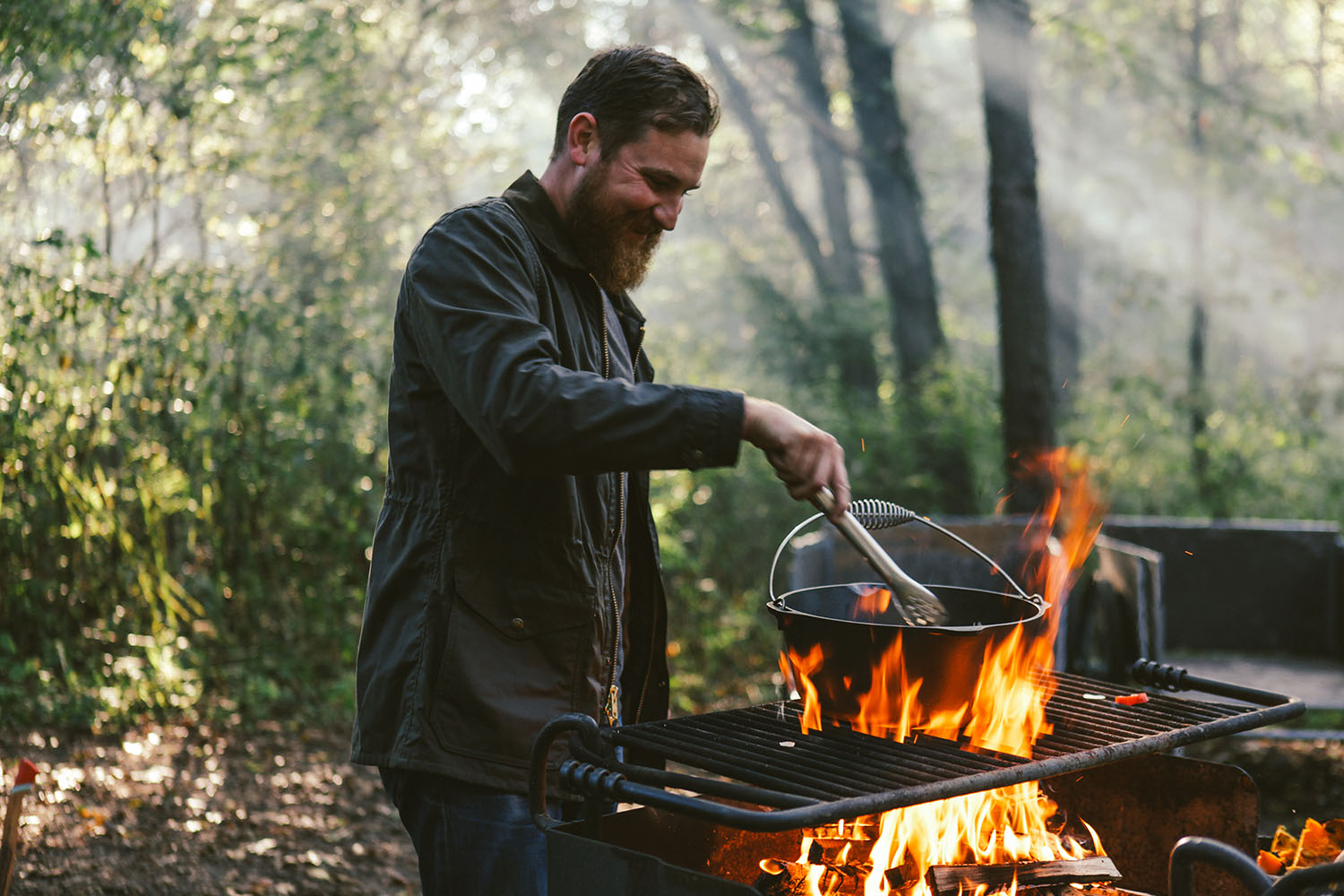
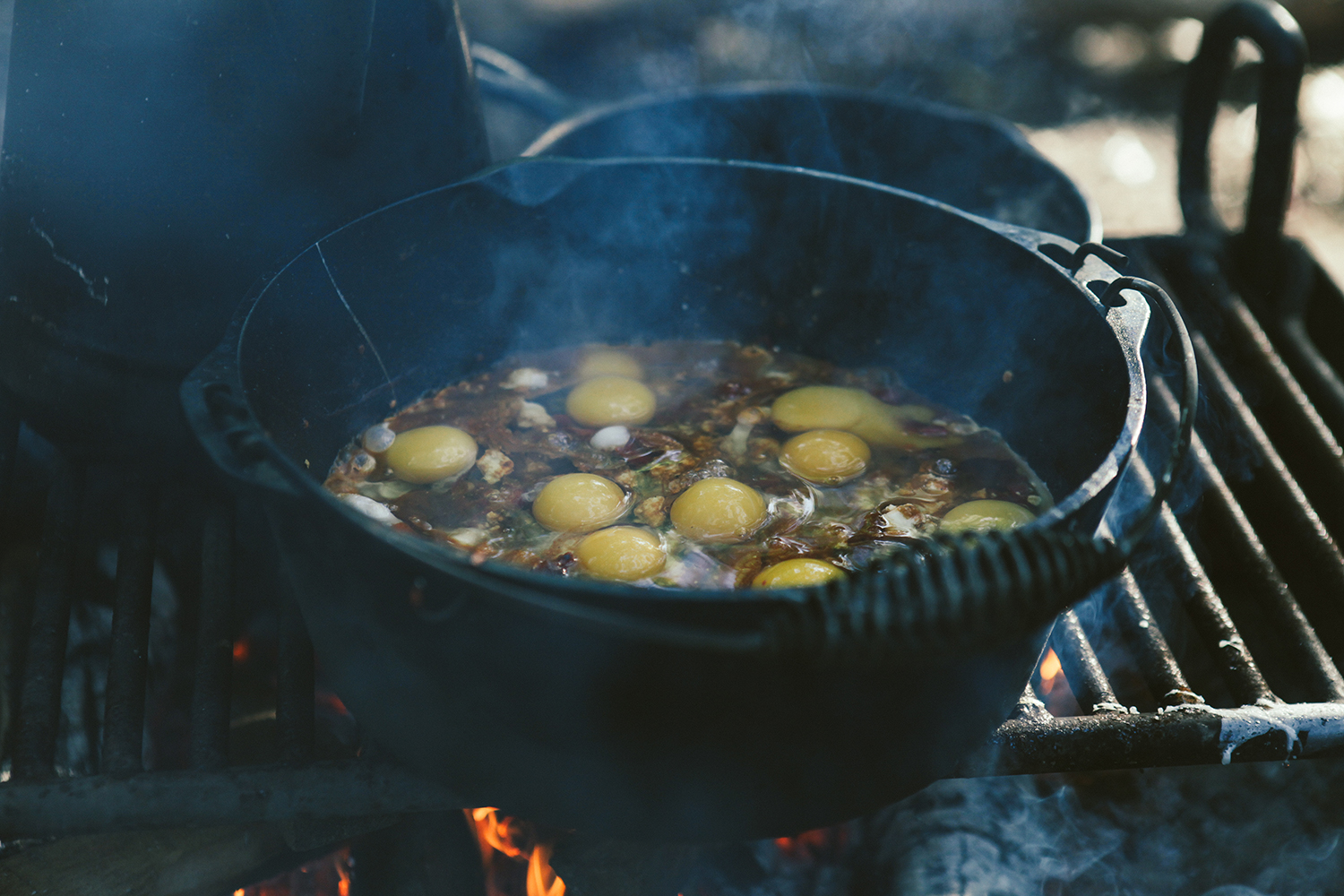
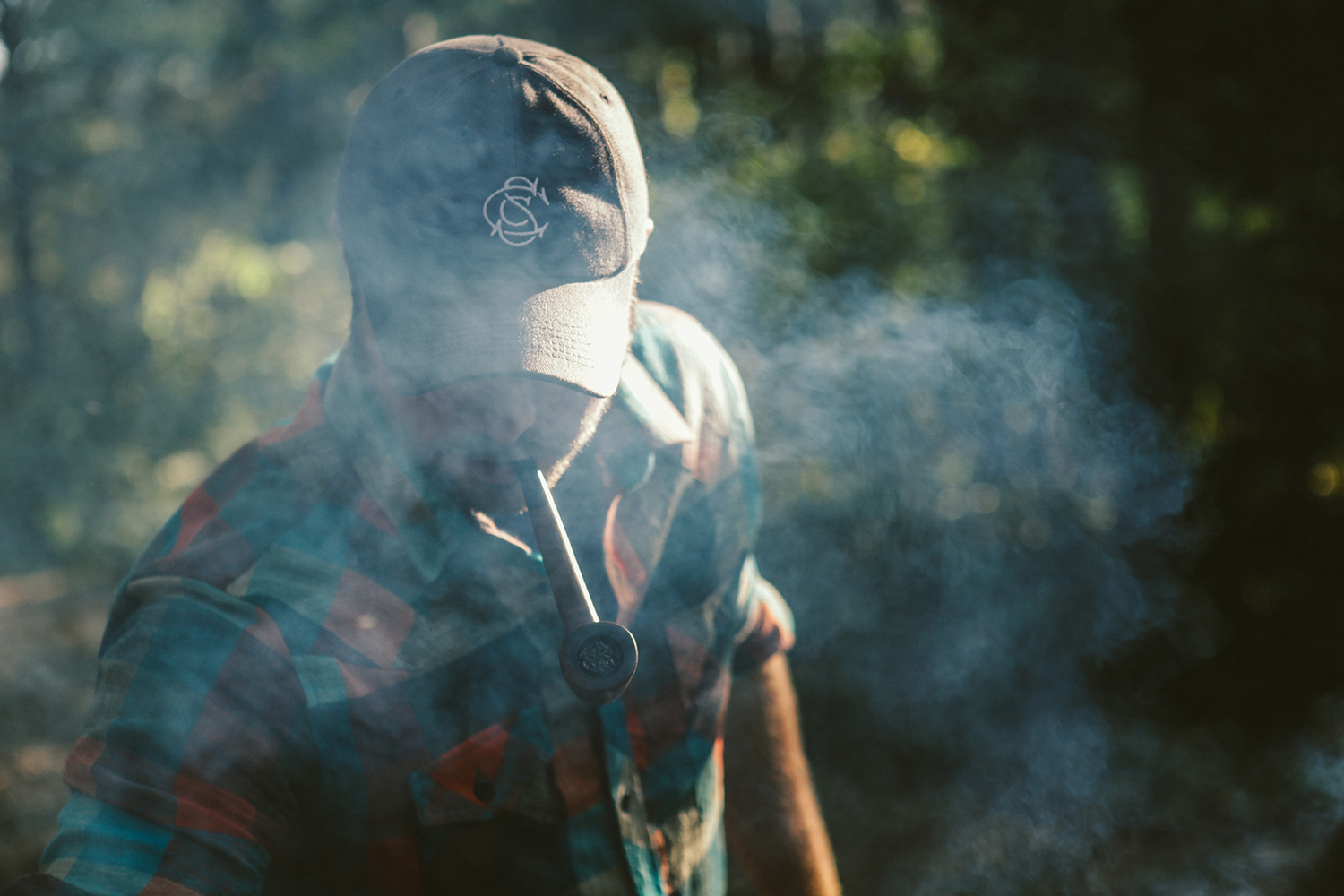
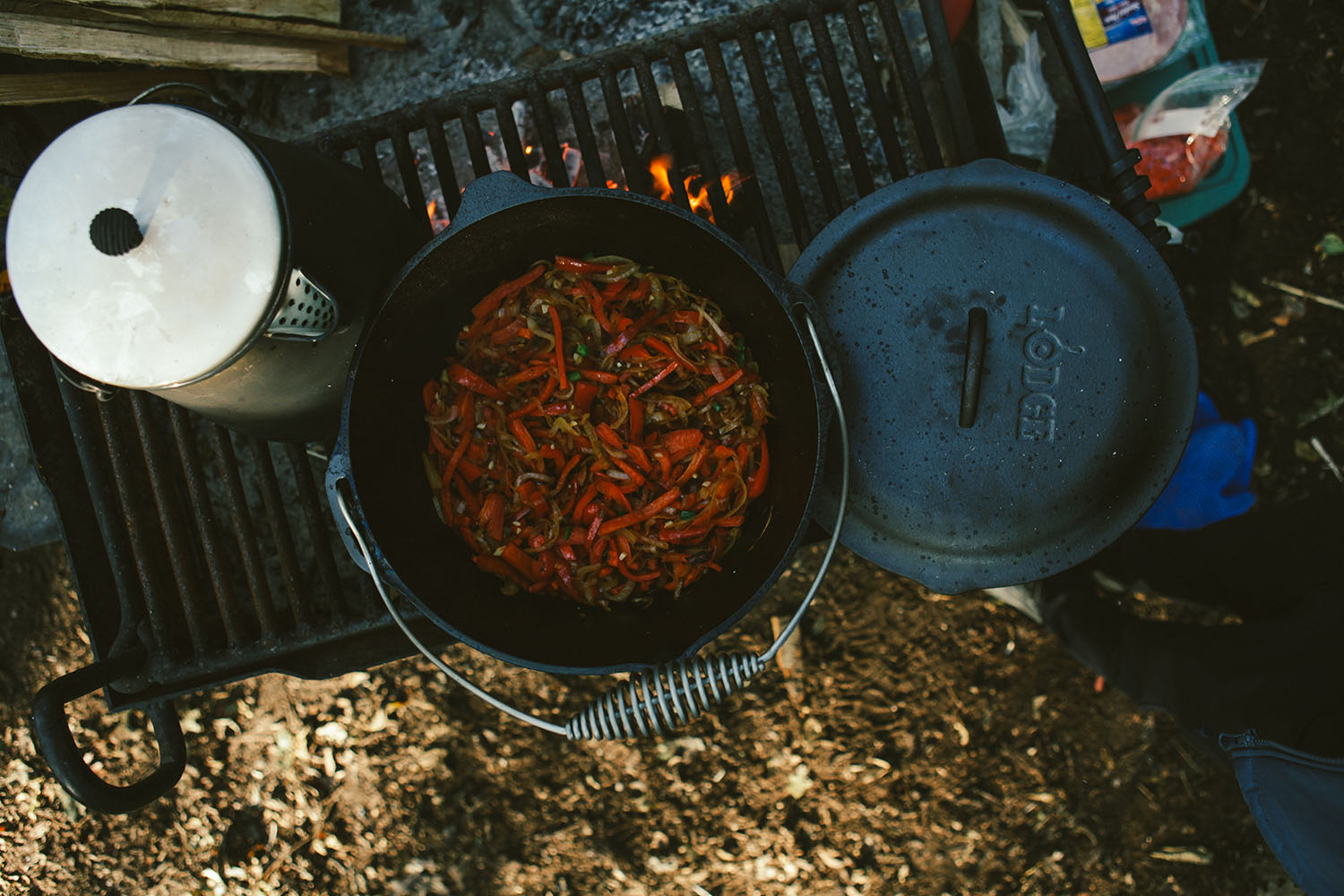
We “re-discovered” Shakshuka deep in Mississippi country while exploring with the boys of Sanborn Canoe Co. The morning after a full day of paddling on the river, which then culminated in a semi-sleepless night of tents hastily pitched in the dark. We awoke to the crackle of a fire amidst our camp, as Jordan Ogren was the first awake, stoking the coals under a cast-iron Dutch oven. In it, were already sizzling the trappings of the most amazing camp breakfast we’d ever had. Stunningly simple and hearty enough for even the mightiest appetites in the field, we couldn’t think of a better way to start — or end a day by the fire, than with a shared shakshuka meal, the same way traders, immigrants, shepherds and families alike have been doing for centuries now. 

As mentioned, the dish is indeed awfully simple. And while there’s plenty of room for improvisation with ingredients and dietary restrictions (this is a ridiculously easy recipe to keep vegan or gluten-free, if you’re into that sort of thing), we can’t recommend enough the importance of staying true to the spices. Not only does it preserve the traditions of the dish, it also provides an extra layer of delicious warmth that’ll permeate even the coldest base camps. Once you have the basics down, improvise with spicy sausage, salty cheeses (our kick-ass version below has feta) or wilted greens like spinach — with only your appetite as the limitation. [H]


Zach Piña is Huckberry's Managing Editor and resident watch nerd.
He's made Shakshuka four times since this story was written.
Follow him on Instagram here

Images ©: Jeff Masamori // Shayd Johnson

26 Oct 15:51

The end of this year’s Nordic Tour

by Greenlandorbust.org

Sunday was the last day of this year’s Rebel Kayaks supported Nordic Tour, and I have to say that it felt strange. The tour started in Asker, Norway on May 23, and for over three months we’ve ran classes in Norway, Sweden and Denmark. We’ve seen the weather go from cold and snowy to hot and sunny, and now the autumn rain seems to be settling in. We’ve coached over 1,000 students, and have had an absolute blast the entire summer. This was year six of the tour, and we’re already looking forward to a year seven.

My last BLOG ended with classes in Helsingborg, Sweden, and from there we took a ferry to Denmark and headed to Rungsted for four rolling classes in some incredibly clear water.

A little yoga is a great way to start a class.

A little yoga is a great way to start a class.

In Rungsted we worked on everything from first rolls to forward finish hand rolls.

We worked on everything from first rolls to forward finishing hand rolls.

Clear skies and calm water created a very tranquil environment.

Clear skies and calm water created a very tranquil environment.

It's nice to stop, reflect and enjoy the sunset.

It was nice to stop, reflect and enjoy the sunset.

After leaving Rungsted, we made our way to Frederiksvaerk, also in Denmark. This was our third year running classes here, and over the years we’ve become good friends with the enthusiastic club members. It was great to be back.

Throughout the two days, I ran four sessions of Simplifying the Roll, while Mark ran technique classes.

Jacob helped me to anchor the kayaks in a fun teaching spot.

Jacob helped to anchor the kayaks while everyone hopped into the water.

We worked on rolls, laughed, played around and had a great couple of days.

We worked on rolls, laughed, played around and had a great couple of days.

Participants in Mark's class are smiling… the sign of a great day.

Participants in Mark’s class are smiling… the sign of a great day.

We had a little competition to determine who had the best inside edge turn. The winners got Rebel Kayaks buffs.

We had a little competition to determine who had the best inside edge turn. The winners got Rebel Kayaks buffs.

Happy paddlers.

Happy paddlers.

Saturday evening we went to a local brewery to taste some different types of beer, all of which were very good.

Saturday evening we went to Halsnaes Bryghus for food and to taste some different types of beer, all of which were very good.

After saying our goodbyes in Frederiksvaerk, we headed to Copenhagen for a few days of exploration. For us, a visit to Copenhagen always includes a trip to the Inuit display at the Natural History Museum of Denmark.

One of many fantastic display cases.

One of many fantastic display cases.

A display of ulus, or

A display of ulus, or “women’s knives.”

It's always fun to look at the paddles, and examine all of the different shapes.

It’s always fun to examine the different paddle shapes.

The cockpit shapes are really interesting too.

The cockpit shapes are really interesting too.

This well decorated norsaq is one of my favorite objects on display at the museum.

This well-decorated norsaq is one of my favorite artifacts on display at the museum.

The upcoming hand line fishing contest at The Traditional Paddlers' Gathering has stirred up quite a bit of interest in Inuit hand lines, so we took some pictures of the ones on display.

The upcoming handline fishing contest at The Traditional Paddlers’ Gathering has stirred up quite a bit of interest in Inuit handlines, so we took some pictures of the ones on display.

After

After “researching” handlines, we headed to Bakken for some brainless fun riding roller coasters and playing games.

We didn't take pictures from the rides, so here's a different type of picture. What is it that makes sticking your head in a hole for a picture so much fun?

What is it that makes sticking your head in a hole for a picture so much fun?

Then we headed to Svendborg, Denmark for the Gronlandsk Symposium, organized by Kajak Inn.

Both days started with yoga.

Both days started with yoga.

Rolling was a great way to cool off during the hot day.

Rolling was a great way to cool off during the hot day.

Many participants at the event were working on very advanced rolls, such as the Spine Roll, the Behind the Back Roll and the Straightjacket Roll.

Many participants at the event were working on very advanced rolls, such as the Behind the Back Roll and the Straightjacket Roll. Here a Spine Roll is born.

Dubside was also teaching at the event, and it was great to catch up with him.

Dubside was also coaching at the event, and it was great to catch up with him.

Greenland Rope Gymnastics were part of the event.

Greenland Rope Gymnastics were part of the event.

I ran a Stupid Paddle Tricks race, complete with prizes.

And I ran a Stupid Paddle Tricks competition, complete with prizes.

Several people tried out the Rebel Husky, a new kayak that we've been using for the Tour.

Several people tried out the Rebel Husky, a new kayak that we’ve been using for the Tour.

A happy camper.

A happy camper.

After the symposium we took a ferry to Bornholm, an island far off the coast of Denmark.

A little down time on a far away island was a really nice vacation.

A little down time on a far away island was a really nice vacation.

We enjoyed the view from a lighthouse.

We enjoyed the view from a lighthouse.

And visited Hammershus, Scandinavia's largest medieval fortification.

And visited Hammershus, Scandinavia’s largest medieval fortification.

We also visited Gaarden, The Bornholm House of Food Culture, which featured a working farm and fresh produce.

We also visited Gaarden, The Bornholm House of Food Culture, which featured a working farm and fresh produce.

This napping hedgehog had us a little concerned, but a gentle poke woke him, and he strolled off into a safer location.

This napping hedgehog had us a little concerned, but a gentle nudge woke him, and slightly irritated with us, he strolled off to a safer location.

We also went to The Bornholms Birds of Prey Show.

We also went to The Bornholms Birds of Prey Show.

The remarkable birds were wonderful to see up close.

The remarkable birds were wonderful to see up close.

Mark and I left the island feeling refreshed, rejuvenated and ready for more classes.

Mark and I left the island feeling refreshed, rejuvenated and ready for more classes.

Our next stop was in Malmo, Sweden.

We started the day with Yoga for Paddlers.

We started the day with Yoga for Paddlers.

I taught two Simplifying the Roll classes, while Mark taught Simplifying the Rescue and Incident Management.

Then I taught two Simplifying the Roll classes, while Mark taught Simplifying the Rescue and Incident Management.

ugliug

A roll is born.

One way to move about the canal.

One way to travel about the canal.

Mark's class worked on maneuvering strokes.

Mark demonstrates an inside edge turn.

Mark takes a break while looking at Oresund Bridge, the bridge that connects Sweden and Denmark.

Mark takes a break while looking at Oresund Bridge, the bridge that connects Sweden and Denmark.

Happy paddlers.

Happy paddlers.

After a day in Malmo, we headed to Karlshamn, Sweden to run two Simplifying the Roll classes for KajakSyd.

The classes took place at a beautiful lake in Karlshamn.

The classes took place at beautiful Lake Langasjon.

A beautiful roll.

A perfect roll in crystal clear water.

Success.

Success.

Much to my horror, Mark expressed an interest in trying Surstromming, fermented Baltic Sea herring potent enough to expand the can it comes in.

Much to my horror, Mark expressed an interest in trying Surstromming, which is fermented Baltic Sea herring potent enough to expand the can it comes in.

The smell coming from the fish was quite possibly the worst thing that I've ever smelt.

The smell coming from the fish was, simply put, awful!

Most people think that the smell is worse than the taste, and when served this way, the flavor blends in. Mark ate his… I had the smallest bite I could take, but enjoyed the other things on the table. Thanks Goran and Veronica for setting up this tasting for us :-)

Most people that have tried this traditional Swedish dish claim that the smell is worse than the taste, and when served this way, the flavor blends in. Mark ate his… I had the smallest bite I could take, but enjoyed the other things on the table. Thanks Goran and Veronica for setting up this tasting for us :-)

Thanks to Annette and Preben (Rungsted), Jacob, Lene, Gitte and Soren (Frederiksvaerk), Pernille and Jacob (Svendborg), Anders (Malmo) and Goran and Veronica (Karlshamn) for taking such good care of us during this leg of the tour. Thanks also to everyone that took care of us on previous legs, to Johan Wirsen of Rebel Kayaks and, of course, to everyone that came out for the classes. You all made us feel very welcome, and we really enjoyed our summer. THANK YOU, and see you next year!

Photos by Mark, Helen and Anders Kristensson.

26 Oct 14:34

The World Was His 'Oyster.' Then Uber Rolled Into Town.

by Jim Epstein

|||New York City cab driver Jaswinder Singh was the subject of a sad and fascinating profile in the Epoch Times this week by reporter Amelia Pang. The story gives a human face to the story of collapsing taxi medallion values.

When Singh purchased his medallion in 2008 for $450,000, the world became his "oyster," he told Pang. The medallion's value soared. So Singh borrowed an additional $390,000 against its value to buy a house in Long Island for his wife and three kids. He also started renting out his cab in the evenings to another driver for $2,000 per month.

Last September, his driver left to go work for Uber. Singh was left to cover his roughly $7,000 in monthly overhead by himself. (The first $4,300 goes to cover the medallion mortgage.) So he started driving seven days a week, which means he never gets to see his young kids. Even so, his bills are stacking up and he hasn't paid his medallion mortgage in three months.

Then Singh's health started deteriorating:

He went to the emergency room twice in September for an overwhelming bursting sensation in his stomach.

It turned out Singh has kidney stones. But his main reaction was frustration that he had to go to the hospital on a weekend, when driving was most profitable.

“I’m scared something will happen to him,” said Ruby Singh, his wife. “He’s sleeping only four to five hours. He’s losing his weight.”

Cabbie and medallion owner Alaa Khalil. |||I feel sorry for Singh. In August, I profiled Alaa Khalil, an Egyptian immigrant and medallion owner, who's having a similar experience. He also borrowed against his medallion to buy a house, which drove up his monthly payments. Now his farebox revenue is plummeting, and he's also facing financial ruin.

The experiences of Singh and Khalil highlight why medallions were such a bad idea from the outset. "Not every city exposes small investors to this business to making big bets on public policy," says New York Times reporter Josh Barro, who was interviewed in my story on Khalil. Those big bet paid off handsomely for years. Then they stopped paying off.

It's also important to remember that for every medallion owner like Singh and Khalil, there are many more cabbies who've seen their quality of life improve immeasurably thanks to Uber. The Epoch Times quotes an Uber driver named Samuel Nunez:

As a yellow cab driver, Nunez earned around $30,000 a year and paid the medallion owner to use his car.

With Uber, he doesn’t need to pay a garage or medallion owner. He drives his own car.

“With Uber, I make about $60,000 a year—and right now, I’m only working three days a week,” he wrote. “We’re no longer stressed about paying the bills and are more focused on spending quality time with one another and doing what we love.”

For more on the fallout from the great taxicab collapse, and for Alaa Khalil's story, click below:

26 Oct 12:01

Pecan pie anyone? Georgia pecan crop 'one of best in years'

by Carla Caldwell
An estimated 110 to 120 million pounds of pecans will be harvested this season in Georgia, making this year’s crop one of the state’s best in the last three years, according the Georgia Cooperative Extension. “In 2013, it was a really wet year,” University of Georgia Cooperative Extension pecan specialist Lenny Wells told FACES, the online news service of the University of Georgia College of Agricultural and Environmental Sciences. “When we have a really wet year, pecan scab disease is…
25 Oct 01:49

Road

by burn magazine

Edit this
Howdy Folks, this is @zambereileen, posting before bedtime from the mountains of Southern Oregon. I know that pictures of roads are overdone and somewhat cliché, and with that in mind I almost decided not to post this picture. But here’s the thing; this particular road is the main artery that runs through our lives. It keeps my family connected to our community in town, allows us access to school, work and all the necessities of life that we can’t provide for ourselves on the mountain. The road is a steady and constant feature, while land and life is ever changing. From the road, we witness the daily transformation as the world turns and seasons melt one into the other. We watch from car windows as the ever-ardent sun trails across the sky, altering the land with light and shadow…. Soaking in all the beauty of the mountain’s visage, as we journey en route to home.

25 Oct 00:33

Historic Paddle Photo - Quebec Laurentide Guide Update

by Murat
Found the source of one of my favourite historic photographs (see original post here).


Canoe Guide, Laurentides, Quebec
Type: Original Photogravure
Expired Ebay Link


The original Ebay seller dated it to 1926, but I came across the same image in the August 1914 edition of  Rod and Gun in Canada (Vol. XVI No. 3 ) thereby dating the image to an earlier time.  You can just make out the loaded pack cloth  filling up the hull.


22 Oct 18:28

Two Methods for Shooting Star Trails Made Easy

by Rick Berk

As a landscape photographer, it can be easy to find stunning subject matter to photograph during the day. At night, things become more difficult as the sun goes down, but there is still plenty to photograph. With some patience, you can create stunning images featuring the stars as your backdrop, or even your subject.

star trails, night, photography, sky, astrophotography

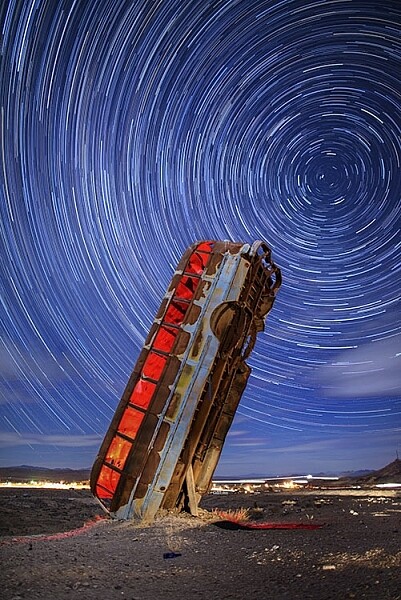
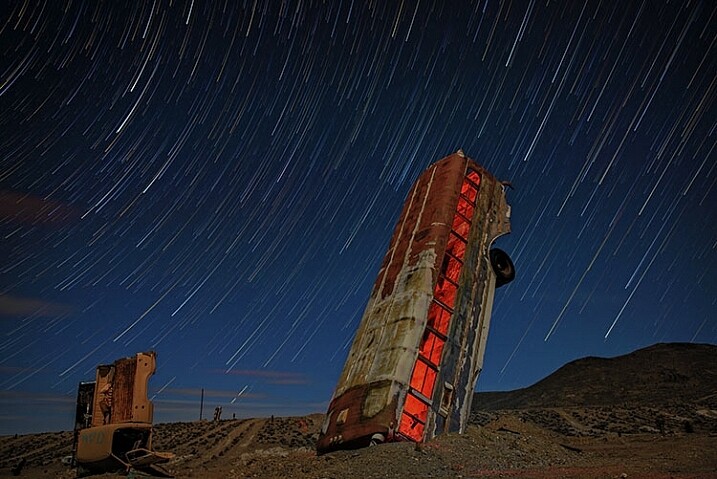
This image is a composite of 156 separate exposures, merged using StarStax software. Each exposure was ISO 400, f/2.8, 30 seconds. The red glow inside the bus was done by shining a red LED flashlight inside the bus from the other side, during one of the exposures.

Equipment list

Before you get started, you’re going to need a few things:

  • A good sturdy tripod is absolutely essential, I’m using an Induro GTT204M2.
  • A wired remote for your camera is also a necessity. Which model you use will depend on the camera you have.
  • A fully charged battery is a must. The vertical grips that are available for some cameras, allowing you to use two batteries at once for longer life, can also be helpful.
  • A flashlight can come in handy, both for finding your way to the location, and for light painting in the foreground.
  • Finally, a large memory card, or two if your camera has dual slots, will be needed.

#1 – The One-Shot Method

There are two ways to photograph star trails. The first is the old-fashioned way, using a single exposure.

For this method, exposures can range anywhere from several minutes, to several hours. This method was the only way to photograph star trails in the days before digital cameras. When using the single exposure method, your camera needs to be in manual mode, with the shutter speed set to Bulb. Some cameras have a separate mode for Bulb. It is like manual mode, but the shutter stays open for as long as the release button is depressed. A time controller such as the Nikon MC-36A, or Canon TC-80N3 can make things easier by allowing you to lock the shutter button down, or program a set amount of time for the exposure.

ISO should be set to 400. You’ll want to set your aperture somewhere around f/4. The wider the aperture is open, the brighter the star trails will be. If you are photographing in a completely dark setting, with no moonlight, the stars will likely be the brightest object in your scene. Once you’ve set your aperture, you need to decide how long a star trail you want. The longer the exposure, the longer the trails.  The image below was a 30 minute exposure.

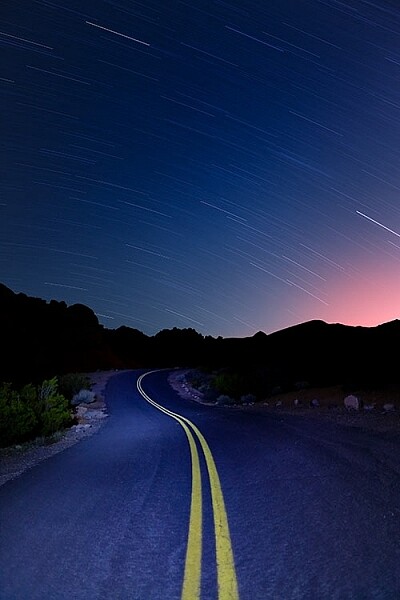
This image was created as a single exposure. Exposure time was 30 minutes, ISO 100, f/5.6. The star trails are dimmer due to the smaller aperture, the fact that the moon was still in the sky, and light pollution from the city in the distance, seen as the glow to the right.

This image was created as a single exposure. Exposure time was 30 minutes, ISO 100, f/5.6. The star trails are dimmer due to the smaller aperture, the fact that the moon was still in the sky, and light pollution from the city in the distance, seen as the glow to the right. The street in the foreground was painted with an LED flashlight for several seconds during the exposure.

One thing you need to be concerned with when using a single long exposure is Long Exposure Noise Reduction. If you choose to photograph star trails using a single exposure, the heat generated on the imaging sensor adds noise to the image. Turning on Long Exposure Noise Reduction reduces that noise by using a method known as dark frame subtraction. I previously discussed dark frame subtraction in the article The Night Sky In Landscape Photography. Long Exposure Noise Reduction doubles the length of time needed to make an image. The camera first takes the exposure. In this case, let’s say the exposure is one minute.Long Exposure Noise Reduction then requires another minute to reduce the noise created by the long exposure. That means if you make a star trail exposure for 15 minutes, your camera will be unavailable to take another picture for 30 minutes. You’ll need to make sure you have enough battery to keep the camera powered while it carries out Long Exposure Noise Reduction.

This is a single exposure of 10 minutes, ISO 400, f/5.6.

This is a single exposure of 10 minutes, ISO 400, f/5.6.

In addition to Long Exposure Noise Reduction, another consideration is the length of the exposure itself. There is nothing worse than standing next to your camera while it makes a 30 or 45 minute exposure, and two-thirds of the way through the exposure, a car goes past, shining its headlights across the scene and ruining the exposure. It’s happened to the best of us.

#2 – Merging Multiple Exposures

This is where the second method for photographing star trails comes in. With the advancement of digital imaging, stacking multiple exposures has become possible, and has made creating star trail images easier than ever. By taking a series of drastically shorter exposures, then stacking them in software such as StarStaX, you can increase your flexibility as a photographer, because there are two benefits to this method. The first is that since the exposure are shorter, you can turn off Long Exposure Noise Reduction. The second benefit is that even if a car drives by to ruin the exposure, it’s only one small piece of the sequence, so you can just delete the one frame that was ruined.

StarStaX works by blending a series of images, allowing you to capture the motion of stars in the sky, similar to a single exposure. The one drawback to using software like StarStaX is if clouds are also moving across the sky, it has a tendency to create a stepped shape with them that doesn’t look natural. Better Star Trails Photographs with StarStax is an excellent tutorial for using StarStaX.

Camera settings

To use the stacking method for shooting star trails, set your camera to Manual mode and your camera’s drive to Continuous. Start with your aperture set to f/4. This setting can be adjusted, but the wider the aperture, the brighter the trails. However, be careful to ensure you have enough depth of field, and aren’t overexposing the stars. Shutter speed will be 30 seconds. ISO should be set to 400. Using the time controller or remote for your camera, release the shutter, and use the locking mechanism to keep the shutter button on the remote depressed. With the camera in continuous drive mode, as each exposure ends, another will begin until you stop it. This also minimizes the pause between each exposure, which can cause small breaks in the star trails when the exposures are merged. Alternatively you can use an intervalometer feature if you camera has that, or similar type of remote.

star trails, night, photography, sky, astrophotography

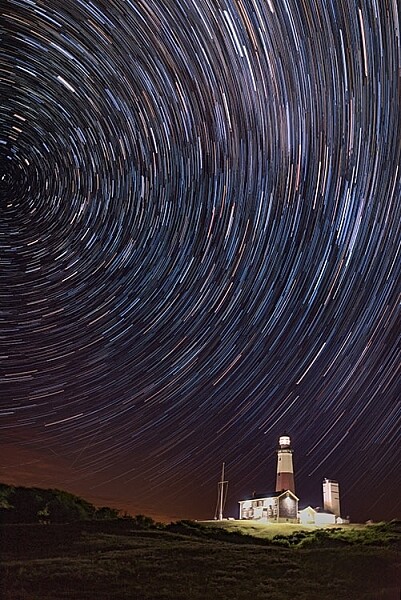
This image is a combination of 121 exposures merged in StarStaX. Each exposure was 15 seconds, ISO 400, f/1.4. To keep the lighthouse from being so bright that it would overpower the star trails, a 3-stop soft-edged graduated neutral density filter was used.

It can be easy to forget the rules of composition when photographing star trails, so don’t get so fixated on the stars that you forget to look at the foreground as well. Chances are your foreground will be shrouded in darkness. A flashlight can come in handy for painting the foreground object with light to make it stand out in the darkness. Colored gels can allow you to get creative with the light painting. When stacking images, you’ll only need to illuminate your foreground for a single frame, as StarStax will use the illuminated exposure for that foreground object.

By the same token, there may be a time where your foreground object is brightly illuminated, as with the lighthouse image above. So I carry a set of graduated neutral density filters, even when shooting at night. For the lighthouse image, I mounted a Vü filters 3-stop soft-edged ND grad on my lens, so that the dark side of the filter was over the bottom half of the frame. This allowed me to keep the lighthouse exposure dim enough to still allow the stars to register in the exposure as well.

This image was created by merging 116 separate exposures in StarStax software in comet mode. Each exposure was 30 seconds, ISO 400 at f/2.8. A red LED flashlight was shone inside the bus for the first exposure.

This image was created by merging 116 separate exposures in StarStax software in comet mode. Each exposure was 30 seconds, ISO 400 at f/2.8. A red LED flashlight was shone inside the bus for the first exposure.

Once you’ve found your foreground, think about the direction you are facing. When facing north, star trails will form concentric circles. When facing away from the north, star trails will simply be slanted lines or arcs in the sky. Both can create interesting and awe-inspiring images.

Now that you know you don’t have to put your camera away when the sun goes down, you need to find some dark sky to get the best results with star trails. The International Dark Sky Association has a great tool on their website to help you find the best places for night sky photography.

Show some of your best star trail images below!

The post Two Methods for Shooting Star Trails Made Easy by Rick Berk appeared first on Digital Photography School.

22 Oct 17:52

Treehouse near Esopus Creek in Marbleton, New York.Built by...

by cpeditor


Treehouse near Esopus Creek in Marbleton, New York.

Built by artists Andrew H. Shirley and Amanda Wong.

Contributed by Christian Gallo. 

21 Oct 18:24

Crofter’s bothe in Poolewe, NW Highlands, Scotland.Contributed...


Crofter’s bothe in Poolewe, NW Highlands, Scotland.

Contributed by Ross Maclean.

21 Oct 18:24

Low cost straw-bale cabin in Andalucia, Costa de la Luz,...


Low cost straw-bale cabin in Andalucia, Costa de la Luz, Spain.

Contributed by Anonymous.
21 Oct 17:44

The Best Factual Podcasts

by cc

Podcasts are on a roll. Diversity and quality keep expanding. New ones pop up every day. But there are precious few comprehensive guides to locating the best podcasts out of the tens of thousands available. It is extremely difficult to find impartial, independently verified measures of audience size for podcasts. They either don’t exist or don’t circulate. Different proxies for audience size have no consensus. And, of course, audience size is not everything.

We made a list of the best factual podcasts by ranking the most popular factual podcasts from the results of an unscientific survey we posted online several months ago. We asked readers of this Cool Tools blog and our social followers to take our survey and rate some suggested podcasts — and to add ones we did not know about. More than 1,600 people filled out the survey, and by the end we had a list of 775 suggested titles. We combined the number of times a podcast was checked together with its average rating to come up with a total score. We then sorted the final list of podcast titles by rank. (The full data dump is here.) We wrote descriptions for the top 50, shown below. (The rankings in this list are biased to our original suggestion list; we’d do the survey differently if we did it again next year.)

There are two broad types of factual podcasts; unscripted and scripted. Unscripted shows are usually interviews or discussions that play out as recorded. The producers don’t know, nor have much control, over where the show goes. Scripted shows, on the other hand, will carefully edit interviews after the fact, mixing them with narration, inter-splicing them with other interviews, maybe adding a soundtrack or ambient sounds. They craft the raw factual materials into a highly produced show in the way a reporter might craft a magazine article, rather than just run a Q&A. Scripted shows, on average, take much more energy, time, staff (and money) to make than unscripted shows (with some exceptions). It is no surprise that the highest ranked podcasts are scripted.

Our list follows this format to give you some clue of what you’ll get if you subscribe via the link provided: Popularity rank and title. Scripted or unscripted. Name of host, typical show length, and average episode frequency. This last one is a little squishy because broadcast frequency is often irregular, or a show runs for an ill-defined “season” or sometimes it appears “whenever.” Last in each item is a description written by us about why it might be worth your while.

Disclosure: The two of us have appeared as a guest on many of the unscripted shows listed here. We also run two of the top 50 podcasts as indicated by our survey. And we are friends with principals of some of the other shows. This fact may have distorted readers’ opinion. Importantly we are regular listeners of about 3/4 of the top 50 and we speak from personal experience when writing their descriptions. However, we don’t have direct experience with about 1/4 of the podcasts mentioned here; those descriptions are compiled from comments made by survey takers, from the shows’ producers, and reviews online. Maybe by next year we’ll have listened to these recommended ones and can say something first-hand about them as well.

If we have overlooked your favorite factual podcast, tell us about it in the comments.

— Kevin Kelly and Mark Frauenfelder

1.

This American Life

Scripted, Ira Glass,
1 hr, Weekly

Mostly true short stories, presented in an audio documentary style. Each segment is superbly crafted with a satisfying emotional arc. A common subtext of a typical story is transformation. Four stories form a rough theme each week, but subjects range widely and unexpectedly. This podcast is consistently top notch and creative, and after decades on the air it is still the gold standard for scripted shows. Their archive is a national treasure that will fill your days.

2.

Radiolab

Scripted, Jad Abumrad and Robert Krulwich,
30 min-1 hr, About 2 per month

Two hosts investigate big scientific questions in an experimental audio style — the “lab” part. Such as: what is time? What is space? Shows are often structured as a debate between the hosts, as they produce sonic evidence (and an original soundtrack for each episode) to keep you changing your mind. Just the way science is suppose to work. There’s a deliberate informality that makes the process of producing the show transparent, all of which keeps it innovative and surprising. Each show also tries to redefine what a podcast can be by mutating the current form. Surprise is certain.

3.

Serial

Scripted, Sarah Koenig,
30 min-1 hr, About 10 a year

The first season of this amazing long-from audio saga (about 10 hours) follows an investigative journalist who dives deep into an old high school murder case. No detail is left unexamined. The thrill is the complete immersion into someone else’s world and the mystery of what happens next. Upcoming seasons promise to apply the same full-court investigations to other subjects.

4.
99% Invisible

Scripted, Roman Mars,
15-30 min, Weekly
Take the boring background things that fill 99% of our lives, all the stuff we never think about — airport carpeting, hold music on telephones, railway tunnels — and really look at them closely. Where did they come from, who made them, and what were they trying to do? Each of these “invisible” objects or systems holds a fabulous story about the people behind them, and their accounts can delivery remarkable insight about how this built world actually works. This is probably the only podcast dedicated to infrastructure, yet it’s the least boring podcast ever.

5.
WTF with Marc Maron

Unscripted, Marc Maron,
60–120 min, Twice-weekly
Standup comedian Marc Maron invites the very famous (President Obama, Mick Jagger) and marginally-famous (cartoonist Drew Friedman, drummer and psychologist Steve Dansiger) into his cat-filled garage where he has a long conversation with them. Maron’s gift of self-deprecation, broad knowledge of popular culture, and appealing nebbishness opens his guests up, allowing them to feel comfortable enough to reveal things they wouldn’t share on late night talk shows.

6.
Invisibilia

Scripted, Lulu Miller and Alix Spiegel,
1 hr, 6-episode Pilot Run

All the things we thought we understood about our inner selves are probably wrong. This show explores new notions about our interior landscape. Each show is a tightly-crafted capsule of audio perfection. While they deal in abstract ideas, the stories are about real people, real lives.

7.
The Memory Palace

Scripted, Nate DiMeo,
5-15 min, Monthly

DiMeo tells true stories about forgotten things that happened in history, with musical accompaniment. Like a modern-day Paul Harvey’s “The Rest of the Story.”

8.

Reply All

Scripted, PJ Vogt and Alex Goldman,
30 min, Weekly

A sort of a This American Life focused on the internet and all its fast moving frontiers. Rather than report on the latest news, it quickly delves into the lives of the people who are out of the news. Not CEOs or digital celebrities, but the people who work at the support desk, or who are the last to sign up for something, or who are hacking the systems, or who are toiling in online obscurity. This podcast airs the humanity of the internet, good and bad.

9.

Mystery Show

Scripted, Starlee Kine,
30 min-1 hr, About 2 per month

A trivial mystery that is important to only one person and that could only be solved by a lot of detective work becomes an excuse for host Starlee Kine to uncover the stories of people unlike you. The only point in answering these unimportant questions (one per episode) is to encounter parts of the universe that your own rational and efficient lives would have no hope of intersecting. On this show the journey to the answer is far more entertaining than the answer, and the answer is always far more interesting than you could have imagined.

10.
Snap Judgment

Scripted, Glynn Washington,
1 hr, Weekly

Like This American Life, Snap Judgment has 3-5 stories exploring a single theme in each highly-produced episode. The Atlantic calls it a “fast-paced, music-heavy, ethnically variegated take on the public-radio story hour.”

11.
StartUp

Scripted, Alex Blumberg and Lisa Chow,
30 min, About 2 per month

Frontiers are swathed in myths and misperceptions. This podcast illuminates the current fashionable frontier of startups, and it hopes to rid this territory of its riddles. The crew follows a few startups as they start up, tracking the novice founders in cringe-worthy closeness as they take each step forward and two steps backward. The company producing this podcast is itself one of the startups they track, making it very meta, but because they provide access to the innermost dynamics of launching a real company, this mirroring makes the reports riveting in their clarity. Overall they capture a lot of drama, which makes for great listening. It’s also indispensable if you have any romantic ideas of doing a start up.

12.
You Are Not So Smart

Scripted, David McRaney,
30-90 min, About 2 per month

David McRaney explores a different type cognitive bias or quirk (e.g., procrastination, learned helplessness, confirmation bias) in each episode through a combination of examples in the news, excerpts from movies and books, and interviews with psychology researchers.

13.

Song Exploder

Unscripted, Hrishikesh Hirway,
15 min, About 3 per month

In each episode, one popular song is dissected. The artist/composer steps through the song bit by bit explaining what they were thinking as they wrote it. Often they will play alternative sounds they tried that didn’t work. The artist will play and annotate the separate tracks, commenting on the logic and methods to create each track. The anatomy of the song is revealed in its pieces. Then the final song is played in full. It’s a mini audio version of a “making of” that works perfectly for one song.

14.
The Tim Ferriss Show

Unscripted, Tim Ferriss,
30-160 min, Twice-weekly

The distinctive superpower of Tim Ferriss is his ability to learn how to learn. He takes the skills you wish you knew — how to invest, how to grow physically strong, how to learn a language — and shows you how to methodically acquire that skill. To help that goal along, in this podcast he interrogates “world class experts” in a wide range of skills, to shake out their tricks and methods. These aren’t lazy shoot-the-bull interviews; rather Tim is zeroing in and asking for the very specifics you would if you were present: how exactly do you do this? Tell me step by step. The resulting “tutorial interviews” are unique in the podcast world.

15.
In Our Times

Unscripted, Melvyn Bragg,
45 min, Weekly

Each week three British professors who are experts in an esoteric field are led by the host to unpack their obscure passion and make it as plain as possible. The more esoteric the subject the better the show. Subjects like: The Siege of Constantinople. Gravity Waves. Occam’s Razor. Icelandic Sagas. Chivalry. The Talmud. Turns out that by narrowing the focus you can get to the bottom of things, and at the bottom almost anything is fascinating. Better than a bland Wikipedia entry, this podcast host defies the stereotype of a English don, at least one of the professors each week is is female.

16.
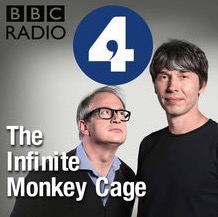
The Infinite Monkey Cage

Unscripted, Brian Cox and Robin Ince,
30-45 min, Weekly

“Has the loose format of a lighthearted round table, with topics like parallel universes, neurology and probability and chance. Each episode features practicing scientists and curious outsiders, often comedians with some science background.” – New York Times

17.
The Joe Rogan Experience

Unscripted, Joe Rogan, 2-3 hr,
10-14 episodes per month

Comedian Joe Rogan runs long conversations with other comedians and mini-celebrities that go on for several hours. In many respects the show resembles core talk radio without FCC oversight. Rogan will talk about anything, say anything, no topic is off limits. You get a lot of Joe. The show works if you like his sense of humor and exploratory instincts.

18.
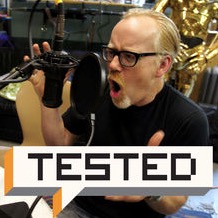
Still Untitled: The Adam Savage Project

Unscripted, Adam Savage, Norman Chan and Will Smith,
30 min, Weekly

Experiential nerdiness. Mythbuster co-host and two buddies discuss making things, blowing things up, hollywood special effects, tools, props, science fiction and other nerdy subjects. Savage is encyclopedic in his experiences, and is continually trying new things. In his podcast he regales tales from his newest exploits (flying in a fighter jet, riding in a submarine, shooting a bazooka, etc.) and also offers practical advice he’s gained, for instance how to drive fast, or use a chainsaw.

19.

Love + Radio

Scripted, Nick van der Kolk,
30 min, About 2 per month

Unconventional true life stories with an edge. The stories are often more ambiguous and open-ended and racier than say the typical This American Life story, and may earn an “Explicit” tag. At the heart of the show is a fascination with complicated relationships and complex characters.

20.
Cool Tools Show

Unscripted. Mark and Kevin,
30 minutes, Weekly

We interview one guest per episode who raves about four tools they love. We let them gush about each tool, while we try to hone in on why listeners might want to use it. Show notes at the end make it easy to track the tools down later.

21.
Here’s the Thing with Alec Baldwin

Unscripted, Alec Baldwin,
30 min-1 hr, Bi-Weekly

Actor Alec Baldwin is an unexpectedly brilliant interviewer. No neutral host he. Baldwin wields his own large personality as a lever to uncover genuine insights from guests who otherwise are polished and guarded. He gets people to say things they have not said before.

22.
Benjamen Walker’s Theory of Everything

Scripted, Benjamen Walker,
30 min, Weekly

Like Paul Krassner’s Realist newsletter, Benjamen Walker reports on stories that are sometimes true, and sometimes fictional as a way to get to the heart of the theme of that week’s episode. Walker’s trembling voice and choice of music have a hypnotic effect.

23.
Dan Carlin’s Hardcore History

Scripted, Dan Carlin,
90 min-4 hr, About 4 per year

“Dan Carlin takes his ‘Martian,’ outside-the-box way of thinking and applies it to the past. Was Alexander the Great as bad a person as Adolf Hitler? What would Apaches with modern weapons be like? Will our modern civilization ever fall like civilizations from past eras? This is a difficult-to-classify show that has a rather sharp edge. It’s not for everyone. But the innovative style and approach has made ‘Dan Carlin’s Hardcore History’ a New Media hit.” – iTunes

24.
Fresh Air

Unscripted, Terry Gross,
45 min, Weekly

Easily the best interviewer in America, Terry Gross has an uncanny ability to ask the right questions and to listen at the right moment in order to get people to be genuine and authentic and tell you something you didn’t know.

25.

Freakonomics Radio

Scripted, Stephen J. Dubner,
30 min-1 hr, Weekly

“Inspired by the books of the same name, Freakonomics Radio is hosted by Stephen Dubner, with co-author Steve Levitt. An award-winning podcast exploring “the hidden side of everything”. From the economy, headline news to pop culture.” – Stitcher

26.
Planet Money

Scripted, Adam Davidson, David Kestenbaum and others,
15 min, Twice-weekly

“Helping you make sense of our rapidly changing global economy. NPR’s Planet Money highlights high rollers, brainy economists and financial experts to keep you up to date on the fiscal world.” – Stitcher

27.
The Truth

Scripted, Jonathan Mitchell,
15-30 min, Every two weeks

“Movies for your ears. Short stories that are sometimes dark, sometimes funny, and always intriguing. Every story is different, but they all take you to unexpected places using only sound. If you’re new, some good starting places are: Silvia’s Blood, That’s Democracy, Moon Graffiti, Tape Delay, or whatever’s most recent. Listening with headphones is encouraged.” – iTunes

28.
Gweek

Unscripted, Mark Frauenfelder,
15-60 min, weekly

Currently on hiatus this year, Gweek is a long-running podcast that featured Mark Frauenfelder, together with a regular guest, interviewing artists and authors who create games, comics, science fiction, toys, apps, tools, and other lighthearted geeky stuff. Mark, the co-founder of Boing Boing, and editor of Cool Tools, sees it as his job to discover new and nifty things.

29.

New Yorker: Out Loud

Unscripted, Amelia Lester,
15-30 min, Weekly

Each week one factual article from the magazine is given an in-depth treatment. The article’s writer will be interviewed by the whip-smart editors at the New Yorker. In the process the discussion will summarize the best parts of the piece and provide an inside look at its origins. This can be as good as or even better than reading the article.

30.
Design Matters With Debbie Millman

Unscripted, Debbie Millman,
30 min, Weekly

“A podcast about design and the broader world of creative culture through wide-ranging conversations with designers, writers, artists, curators, musicians, and other luminaries of contemporary thought.” – Design Matters

31.
The James Altucher Show

Unscripted, James Altucher,
30-90 min, Twice-weekly

A really interesting person interviews other really interesting people.

32.
Bulletproof Radio

Unscripted, Dave Asprey,
1 hr, Twice-weekly

A far-out, self-styled bio-hacker who claims to have cured his obesity and Asperger’s by eating yak meat, buttered coffee, and a high-calorie, high-fat diet invites other far-out people from the world of health, diet, and psychology to share their ideas for optimal living.

33.

a16z

Unscripted, Chris Dixon and others,
15-30 min, 10 per month

Some of the smartest reporting in tech today does not come from magazines but from the offices of investors. They view from a high mega-level with a five-year horizon. This podcast comes from a16z, a VC firm that also produces steady blog posts. Here they interview a range of agents, such as CEOs, analysts, founders, journalists, and other investors. The topics are current trends in the high tech world.

34.
The Ihnatko Almanac

Unscripted, Andy Ihnatko and Dan Benjamin,
60-90 min, Weekly

Tech journalist Andy Ihnatko delivers extemporaneous and knowledgeable soliloquies about comic books, movies, technology, photography, and dozens of other topics. Like a very nerdy Roger Ebert. Co-host Dan Benjamin hardly gets a word in, but he’s there just to wind up Ihnatko and let him go.

35.

Latest in Paleo

Scripted, Angelo Coppola,
60-120 min, Weekly

Angelo Coppola takes a look at the latest news in health and diet, and provides perspective from a paleo point of view. In recent years Coppola has veered from a high-fat, high-protein “classic” paleo diet and is now closer to a being vegan who supplements his diet with a small amount of high-quality protein.

36.
Little Atoms

Unscripted, Neil Denny,
60-90 min, Weekly

A UK-based show dwelling on ideas, science and culture. Neil Denny interviews scientists, thinkers, scholars and writers. Casual, but he often interviews interesting people not usually heard from.

37.

Science… sort of

Unscripted, Patrick Wheatley, Ryan Haupt and others,
60-90 min, About 2 per month

Sitting around beers, a bunch of working scientists chat about science. They often take a breaking science story in the news and will read and discuss the actual scientific paper behind the headlines. That’s a powerful way to learn science and journalism at once.

38.
Open Source with Christopher Lydon

Unscripted, Christopher Lydon,
30-60 min, Weekly

Lydon often roams the world talking to notable people in other cultures who are totally off the radar in America. It’s really one guy with passport and a microphone. He’s incredibly smart, well-read, interested, and eager to disrupt old tired notions. His nimble mind seeks out other nimble minds around the world and he broadcasts what he learns.

39.

Transom Podcast

Scripted, Jay Allison,
5 min-1 hr, 3-5 per year

Each episode is one highly crafted story, often in a slightly experimental format. There is no theme, other than a story well-told.

40.
This is Actually Happening

Scripted, First-hand accounts,
30 min, About 2 per month

People who have undergone distressing experiences describe them. We do not hear the interviewer, only the person telling their story. The background music is a low-toned drone that adds to the sense of dread. In one episode a woman recounts the time that both of her husbands drowned on the same day (she is polyamorous). In another episode, a man describes seeing a ghost in a friend’s living room and the negative effect it has had on his life ever since. if you feel unlucky, this podcast will make you feel lucky, or at least not alone.

41.

Smart Drug Smarts

Scripted, Jesse Lawler,
30 min, Weekly

So-called smart drugs are chemicals believed by some people to improve mental performance. In this podcast, Jesse Lawler interviews doctors, pharmacists, and self-experimenters about the effects (or lack of effects) of different smart drugs, recreational drugs, electrical brain stimulation, research chemicals, psychedelics, and prescription drugs.

42.
The Moth

Scripted, First-hand accounts,
30-60 min, Weekly

Short stories narrated by ordinary people in their own voice in front of a live audience. The stories are true, first-person, and completely unexpected. They are selected from local storytelling events in about 30 cities around the world. Each story is a high quality, small journey.

43.
Revolutions

Scripted, Mike Duncan,
30 min, Weekly

Roman history geek Mike Duncan explores a dozen other historical revolutions which he explores in deep nerdy detail. He’ll devote 50 episodes to one revolution.

44.
Common Sense with Dan Carlin

Unscripted, Dan Carlin,
45-120 min, About 2 per month

The popular maverick historian, Dan Carlin, takes his unorthodox questions and applies them to current events. He’ll take a contemporary issue and pick it apart by questioning everything. It will make you think.

45.
Futility Closet

Scripted, Greg Ross,
30 min, Weekly

This is like “News of the Weird” for things that happened decades or centuries ago. Ross is a former science magazine editor and spends his days poring over old books in university libraries to find forgotten stories about things like a failed atheist commune in the 19th century, a slave who was mailed to a free state in the north, a WWII Japanese soldier who crash landed on an Hawaiian island, and a “rainmaker” who was hired by San Diego to end a four-year drought in 1915 (probably by coincidence, after he used 23 secret chemicals, “the skies opened and torrential rains caused some of the most extreme flooding in the city’s history”).

46.

Life of Caesar

Unscripted, Cameron Reilly and Ray Harris Jr.,
1hr-3hr, Weekly

Yes, a podcast dedicated to telling the biography of Augustus Caesar. The two bro’ hosts chit-chat their way through Caesar’s story.

47.
Stuff You Should Know

Unscripted, Josh Clark and Charles W. “Chuck” Bryant,
20-60 min, Twice-weekly

The folks from How Things Work do an audio version. Two hosts discuss esoteric topics like “How wine fraud works” or “How lobbying works” “How female puberty works,” etc.

48.

The Skeptics’ Guide to the Universe

Unscripted, Dr. Steven Novella,
80 min, Weekly

Four or so skeptics sit around and discuss the week’s news from a skeptic (rational and scientific) perspective.

49.

On the Media

Scripted, Brooke Gladstone and Bob Garfield,
60 min, Weekly

Very polished newscast (recycled from public radio) about media matters. It’s meta-media.

50.
Criminal

Scripted, Phoebe Judge,
20 min, About 2 per month

As their website says “Stories of people who’ve done wrong, been wronged, or gotten caught somewhere in the middle.” Broad, not just true crime, but also about the justice system, the prison system, or legal gray areas.

Image: Tim Wilson from Blaine, MN, USA, licensed under the Creative Commons Attribution 2.0 Generic license.
20 Oct 22:27

Widespread Panic at The Classic Center

Widespread Panic
Appearing at The Classic Center (Athens, GA) on Tuesday, February 09, 2016

20 Oct 22:27

CenturyLinkVoice: 5 Tips For Building An Online Store For Your Small Business

by Lisa Wirthman, CenturyLink
If your retail business relies entirely on customers who walk through your door, it’s time to think differently about your storefront. Online sales in the United States are expected to reach nearly $500 billion by 2019, predicts Forrester Research. That’s a lot of potential sales going right past your door if your [...]
19 Oct 15:26

1962 Aston Martin DB4GT

The DB5 is more widely known, thanks to a certain secret agent, but it's the DB4GT that's most sought after by collectors. This 1962 Aston Martin DB4GT was just the...

Visit Uncrate for the full post.
19 Oct 15:23

Crawlspace Canoe: 1950s

by Dave
From circa 1950s Columbus, Georgia, comes this uncaptioned News Archive negative of a young man and his dugout, evidently crafted in the basement. Ready to open that spigot and float off to points unknown. View full size.
19 Oct 15:21

A-frame near the town of Mäntyharju, Finland.Half of the...


A-frame near the town of Mäntyharju, Finland.

Half of the structure functions as a small living space; the other half is a wood-fired sauna.

Contributed by Richard Jackson.

19 Oct 15:21

Small cabin in the Blue Ridge Mountains of North...


Small cabin in the Blue Ridge Mountains of North Carolina.

Contributed by Hunter Hodges.

19 Oct 15:11

Hillary Knows Something Most Democrats Can’t Admit

by Matt Welch

Smart power at its best. ||| CNNHillary Clinton is nothing if not responsive to the changing winds of Democratic Party opinion. As CNN's Anderson Cooper succinctly put it to her in the very first question of last week's Democratic presidential debate, "You were against same-sex marriage. Now you're for it. You defended President Obama's immigration policies. Now you say they're too harsh. You supported his trade deal dozen of times. You even called it the ‘gold standard.’ Now, suddenly, last week, you're against it." (It's worth noting that she promptly lied about the latter flip-flop.)

On guns, on responding rhetorically to the phrase "black lives matter," and especially on economic policy, Clinton is responding to the contemporary passions of the Democratic grassroots by tacking leftward. So it's illustrative for both the candidate and the party to observe which issues the Democratic frontrunner does not feel evident pressure to "absorb new information" about.

Chief among them is a critique that dominated lefty discourse in 2007-08, and then almost immediately vanished as a hot topic: the imperial presidency. Democrats in the late Bush/Cheney era were apoplectic about the White House's rogue warmaking; now their standard-bearer is characterizing as "smart power at its best" that time when the Obama administration acted in persistent, blatant defiance of Congress by bombing Muammar Gadhafi out of power:

Well, let's remember what was going on. We had a murderous dictator, Gadhafi, who had American blood on his hands, as I'm sure you remember, threatening to massacre large numbers of the Libyan people. We had our closest allies in Europe burning up the phone lines begging us to help them try to prevent what they saw as a mass genocide, in their words. And we had the Arabs standing by our side saying, "We want you to help us deal with Gadhafi."

Our response, which I think was smart power at its best, is that the United States will not lead this; we will provide essential, unique capabilities that we have, but the Europeans and the Arabs had to be first over the line. We did not put one single American soldier on the ground in Libya. [...]

I think President Obama made the right decision at the time. And the Libyan people had a free election the first time since 1951. And you know what, they voted for moderates, they voted with the hope of democracy. Because of the Arab Spring, because of a lot of other things, there was turmoil to be followed.

But unless you believe the United States should not send diplomats to any place that is dangerous, which I do not, then when we send them forth, there is always the potential for danger and risk.

Didn't quite get the eye-twitch right. ||| NBCThis plate of hot rhetorical garbage was quickly disposed of by Jim Webb, whose lack of purchase in the Democratic race—despite his long record of opposing the imperial presidency—is another indication of how this issue just doesn't have juice in 2015. Webb's economical response:

We had no treaties at risk. We had no Americans at risk. There was no threat of attack or imminent attack.

There is plenty of time for a president to come to the Congress and request authority to use military force in that situation. I called for it on the Senate floor again and again. I called for it in Senate hearings.

It is not a wise thing to do. And if people think it was a wise thing to do, try to get to the Tripoli airport today. You can't do it.

Clinton's equally cavalier (and inaccurate) treatment of Edward Snowden ("He could have been a whistleblower, he could have gotten all the protections of being a whistleblower"), and defense of her vote to support the Patriot Act ("I think that it was necessary to make sure that we were able after 9/11 to put in place the security that we needed....We always have to keep the balance of civil liberties, privacy and security") make the case plain: If there remains any anti-war, pro-civil liberties sentiment among Democratic voters, it is not being reflected in their choice for president.

Even more telling, that frontrunner is not feeling any observable political pressure to even feint toward a civil-libertarian direction. Which is an indictment not just of Hillary Clinton, but of the partisan opportunism underlying too much left-of-center activism. If Obama's grotesque flip-flops on executive power and war-making didn't cost him the love of his base, after all, why should Clinton even pretend to care in the first place?

Related:

* Admit it, Dems: Hillary Could Strangle a Puppy on Live TV, and You'd Still Back Her

* Is GOP Foreign Policy Getting More Libertarian, or Is it Just Anti-Democrat Opportunism?

* Executive Branch 'Dictatorship'

09 Oct 14:39

20 Sets Of Words Which Sound Similar But Have Different Meanings

09 Oct 12:27

WASH POST: Obama seriously considering circumventing Congress...


WASH POST: Obama seriously considering circumventing Congress...


(Second column, 2nd story, link)
Related stories:

Struggling With Credit Card Debt?
09 Oct 12:26

Glenn Greenwald says Obama can’t just apologize for a war crime.

by Nick Sorrentino
Image: CNN

Image: CNN

Yeah, that’s about right. Just because one is president does not put one above the rule of law. That’s pretty much a basic tenet of this country. A tenet which seems to have been forgotten since September 11th 2001.

So who authorized the strike? Sounds like we knew it was a hospital.

Read More

09 Oct 12:26

For the first time in human history, “less than 10 percent of the world’s population will be living in extreme poverty by the end of 2015.”

by Editor

micro finance cc cc

This is wonderful news and it is driven by a general tendency to liberalize markets. Resources now flow from one place to the next more easily than they ever have. As such entrepreneurs are more able to create wealth even in some of the most challenged parts of the globe. Freedom works. Liberty works. Economic decentralization works. Where allowed to flourish without undue burden the market makes life generally better. Where the market is largely restricted poverty continues to prevail. This we see from US inner cities to the suburbs of Paris to sub-Saharan Africa.

But let us focus on this good news.

Read More

09 Oct 12:25

In China, every citizen is being assigned a credit score that drops if a person buys and plays video games, or posts political comments online “without prior permission,” or even if social media “friends” do so.

by Editor

A Chinese protestor blocks a line of tanks heading east on Beijing's Changan Blvd. June 5, 1989 in front of the Beijing Hotel. The man, calling for an end to the violence and bloodshed against pro-democracy demonstrators at Tiananmen Square, was pulled away by bystanders, and the tanks continued on their way.

This is full on terrifying. Many of our readers would probably be relegated to “junk credit” status overnight. If you are in China and reading this, please don’t leave a comment. We don’t want you to miss out on a mortgage. (Not really an issue as most of our stuff – most – appears to be outside of the “Great Firewall” of China.)

This score is linked to one’s Citizen ID number and it is all about manipulation, not risk evaluation it appears. This is some seriously sick stuff and don’t think that governments in the West aren’t following how this program goes.

Fight this sort of thing everywhere. Truly, a crony nightmare. Government gets what it wants. Government controlled banks get what they want. “Citizens?” Well, just be happy you aren’t getting a knock on the door in the middle of the night. The government will just crush you into compliance virtually.

Basically it is comply or “die.” Every aspect of your life in the hands of the bureaucrats.

Read More

08 Oct 18:25

Cabin in Folgefonna National Park, Norway.Contributed by Bjørnar...


Cabin in Folgefonna National Park, Norway.

Contributed by Bjørnar Bolstad.

08 Oct 18:25

Partially-buried outdoor kitchen in Corinth, Vermont.Built...


Partially-buried outdoor kitchen in Corinth, Vermont.

Built by Corin Hewitt. Contributed by Andreas Kohl.

08 Oct 13:26

800-pound man kicked out of hospital for ordering pizza...


800-pound man kicked out of hospital for ordering pizza...


(First column, 18th story, link)


Let Us Help You Get Out Of Debt
08 Oct 12:45

'Death ray' gun knocks out drones from mile away...


'Death ray' gun knocks out drones from mile away...


(First column, 16th story, link)


Let Us Help You Get Out Of Debt
08 Oct 12:44

Cabin nestled between boulders in Cabeceiras de Basto, Braga,...


Cabin nestled between boulders in Cabeceiras de Basto, Braga, Portugal.

Contributed by Jaime Moreira.

06 Oct 13:41

How to Improve Your Long-Exposure Photography With Photo Stacking

by Luca Libralato

The post How to Improve Your Long-Exposure Photography With Photo Stacking appeared first on Digital Photography School. It was authored by Luca Libralato.

Improve your long exposures with photo stacking

Long-exposure techniques have become increasingly popular, particularly in the realm of landscape photography. One key reason is the ability to capture scenes with enhanced softness and harmony compared to standard exposures.

With the rapid evolution of digital cameras, we can now take extended exposures without significant digital noise caused by sensor overheating. Additionally, advancements in neutral density (ND) filters mean we can shoot with minimal color cast and no loss of sharpness.

That said, ultra-long exposures are hard to pull off for a variety of reasons. In this article, I explain my stacking technique, which makes it far easier to capture long-exposure effects while avoiding conventional difficulties.

If you’re passionate about long-exposure photography, this is definitely a tool to add to your arsenal!

What is long-exposure stacking?

Long-exposure stacking
I stacked 3 exposures at 260s each for a total of 780s (13 minutes).

By taking multiple photos (usually at least 30 seconds each), you can blend them to create a final image with a total exposure time equal to the sum of the individual exposures.

This technique is especially useful for landscape photography but can also be beneficial in other photography styles that require extended exposure times for maximum quality.

Here are the main advantages of long-exposure stacking:

  • Extended exposure time: Achieve longer exposure without a single long shot.
  • Reduced noise and hot pixels: Shorter exposures result in less digital noise and fewer hot pixels.
  • Decreased vignetting: Using a weaker ND filter per shot reduces vignetting.
  • Minimized risk: Avoid wasting time and shots due to tripod shakes or sudden light changes.
  • Flexible post-processing: You can decide the strength of the long-exposure effect later.
Improve your long exposures with photo stacking
Stacking of 3 x 260s exposures for a total of 780s (13 minutes).

Of course, every technique has its disadvantages, and long-exposure stacking is no exception. Here are the main issues with this approach:

  • Not a single exposure: Some competitions and contests may not accept stacked images.
  • Requires post-processing skills: You need to know how to blend multiple exposures.
  • Purist concerns: This technique might not appeal to photography purists.

When should you use long-exposure stacking?

I recommend this technique in a variety of scenarios:

  • If you want to capture a very long exposure, stacking allows you to push exposure times to higher values without as much risk.
  • If you are frustrated by the amount of noise in your long-exposure shots, stacking will help reduce noise by keeping the sensor from overheating.
  • If you’re not sure how long you want the exposure to be, you can decide on the final exposure duration later by summing shorter exposures.
  • If you’re photographing in rough weather or hostile conditions, stacking reduces the risk of wasting exposure time in challenging environments.
  • If the light is changing quickly, stacking increases the likelihood of capturing the perfect moment.

With all that out of the way, let’s get on with the fun part: actually implementing long-exposure stacking!

Improve your long exposures with photo stacking
Stacking of 2 x 260s exposures for a total of 520s (8:40 min).

Elevating your long exposures with stacking: the step-by-step approach

This technique is relatively easy, but it’s important to pay careful attention to each step if you want to get high-quality results!

Also, before trying this, there are at least a couple of required skills you should have (apart from the basics for taking pictures with your camera):

  • Standard long-exposure photography know-how: Familiarize yourself with long-exposure basics.
  • Basic Photoshop knowledge: Learn to use layers in Adobe Photoshop or similar software.

Step 1: Get the right gear

The equipment for this technique is the same as for standard long-exposure photography. If you’re new to it, here’s a short list:

  • A camera that’s capable of long exposures.
  • A lens that’s compatible with neutral-density filters.
  • A sturdy tripod.
  • A remote trigger (this is optional but recommended).
  • Neutral-density filters. ND filters are essential for most long-exposure scenarios, but if you’re shooting in very low light, you can get away without them.

Step 2: Plan the shot

Never hit the shutter without properly planning your photo. Thorough planning plays a crucial role in capturing a great photo! Do not underestimate the power of planning your long-exposure shooting.

Everyone’s planning process is different, and that’s okay. However, it’s important to think about the lighting, the subject, and the necessary settings before you set up your camera. If possible, scout locations ahead of time and get a sense of what’s available to you!

While luck can help you occasionally, consistent preparation increases the likelihood of being ready when the right conditions present themselves.

Improve your long exposures with photo stacking
Stacking of 5 x 120s exposures for a total of 600s (10 minutes).

Step 3: Take the shots

Once you’ve planned your photo and arrived at your location, focus on two key aspects: composition and exposure. Composition depends on your personal taste, while exposure involves a complex interplay of factors.

Before taking any picture, landscape photographers usually meter the light to determine the exposure time. The final exposure time is influenced by various factors such as wind strength, cloud movement, and water flow. The critical question is, “How long should I expose for?”

In situations with rapidly changing light or strong winds that could shake your camera or tripod, long exposures might not be feasible. That’s one of those times where the stacking technique proves invaluable.

For instance, if you aim for a total exposure of eight minutes, instead of taking a single long exposure, you can divide the total time into four consecutive shots of two minutes each. You can choose the length of each exposure and the number of shots as long as the time gap between shots is minimal for stacking purposes. Ensure you don’t move the tripod or camera between shots. After capturing your series of shots, proceed to the post-processing step.

Before shooting:

  • Ensure your focus is accurate.
  • Stabilize your tripod (avoid sand or uneven surfaces if possible).

After shooting:

  • Check your histogram to confirm proper exposure or exposure to the right.
Dps les 01 Dps les 02
Dps les 03 Dps les 04
Dps les 05 Dps les 06
6 x 130s exposures for a total of 780s (13 minutes)

Step 4: Stack your files

Now that you’re home or at your favorite cafe with your laptop and a coffee or beer, download your shots and select the ones you want to stack.

We’ll demonstrate the stacking process using Adobe Photoshop, although any software supporting layers can be used. Photoshop offers two methods for stacking files to simulate a longer exposure:

  1. Semi-automatic stacking
  2. Manual stacking

Semi-automatic stacking in Photoshop

This semi-automated method involves going to Files>Scripts>Load Files into Stack.

Improve your long exposures with photo stacking

Next, select the individual long-exposure shots, and check the boxes so Photoshop automatically aligns the source images and creates a smart object:

Improve your long exposures with photo stacking

Click OK, then wait for Photoshop to do its thing. Once the process is complete, select the Smart Object, then go to Layer>Smart Objects>Stack Mode>Mean. This process combines all images embedded in the Smart Object, resulting in a new image that simulates a single long exposure with a total time equal to the sum of the individual exposures.

Improve your long exposures with photo stacking

You can see the result of stacking in the image below:

Improve your long exposures with photo stacking
This is what my image looked like after stacking!

Manual stacking in Photoshop (or elsewhere)

The second method involves manual blending, which can be done with any software that supports layers. This process requires adjusting the opacity of each layer sequentially.

The mathematical rule is as follows: each layer’s opacity should be set to 1 divided by its position in the stack. Like this:

  • First photo (bottom layer): 100% (1/1)
  • Second photo: 50% (1/2)
  • Third photo: 33% (1/3)
  • Fourth photo: 25% (1/4)
  • Fifth photo: 20% (1/5)
  • Sixth photo: 17% (1/6)
  • Nth photo: 1/N

This method replicates the automatic Mean Stack Mode and yields identical results.

Step 4: Post-processing workflow

At this point, just follow your typical post-processing steps. Here’s what I like to do:

  1. Clean away dust spots, straighten, and crop: Remove any dust spots, straighten the image, and crop as needed.
  2. Recover detail: Use other exposures (e.g., 3 or 5 bracketed shots) to bring back detail in static parts of the image that were under- or overexposed.
  3. Adjust exposure and contrast: Fine-tune the exposure and contrast settings.
  4. Adjust colors: Modify the colors to achieve the desired look.
  5. Add finishing touches: Apply any final adjustments to suit your taste.
  6. Export: Save your final image.

Here’s my sample image once all of the above has been completed:

Improve your long exposures with photo stacking
Stacking of 6 x 130s exposures for a total of 780s (13 minutes)

Capture breathtaking long-exposure photos!

This technique is highly flexible and can significantly enhance the quality of your final image. Stacking images reduces random digital noise, with a reduction proportional to the square root of the number of photos used.

For instance, stacking four photos results in a 50% reduction in random digital noise in static parts of the image, which is especially beneficial for underexposed areas. This technique is widely used in astrophotography and other fields where increasing the exposure time of a single shot is impractical.

So give it a try and see what you think!

Need further help or explanations? Don’t hesitate to leave questions below!

The post How to Improve Your Long-Exposure Photography With Photo Stacking appeared first on Digital Photography School. It was authored by Luca Libralato.

06 Oct 13:20

Yes, the Second Amendment Protects Individual Rights

by Damon Root

In 2008 the U.S. Supreme Court recognized what numerous historians and legal scholars have been saying for many decades: Namely, that the Second Amendment to the U.S. Constitution secures an individual right—not a collective one—to keep and bear arms. Yet despite this widespread legal and academic consensus, certain gun control advocates still insist on behaving as if the Second Amendment does not mean what it says.

The latest example of such regrettable behavior comes from liberal New Yorker pundit Adam Gopnik, who claims that a vast and intrusive gun control regime can happen here in the United States because the U.S. Constitution protects no such thing as an individual right to possess guns. Nothing in the Constitution, he asserts, "limits our ability to control the number and kinds of guns in private hands." The only reason so many people think otherwise, Gopnik says, is because they've been hoodwinked by the "radical" and "tortured" interpretation of the Second Amendment put forward by "right wing" Justice Antonin Scalia in his "younger-than-springtime decision D.C. v. Heller, in 2008."

For a freshly minted piece of "right wing" radicalism, the individual-rights interpretation of the Second Amendment sure has a lengthy and long-running list of distinguished liberal supporters, including some of the biggest names in legal academia. For example, there is University of Texas law professor Sanford Levinson, a leading liberal scholar, who published an essay in the prestigious Yale Law Journal back in 1989 titled "The Embarrassing Second Amendment." As I explain in my recent book Overruled:

The embarrassment, Levinson argued, came from the legal left's refusal to take the Second Amendment seriously. "I cannot help but suspect that the best explanation for the absence of the Second Amendment from the legal consciousness of the elite bar," he wrote, "is derived from a mixture of sheer opposition to the idea of private ownership of guns and the perhaps subconscious fear that altogether plausible, and perhaps even 'winning' interpretations would present real hurdles to those of us supporting prohibitory regulation."

Eleven years later, Harvard law professor Laurence Tribe, a respected scholar and teacher whose former students include a young Barack Obama, amended the new third addition of his legal treatise American Constitutional Law to officially endorse the individual-right interpretation of the Second Amendment. This was a marked change from the two previous editions, where Tribe had accepted the collective-right view. "My conclusion came as something of a surprise to me, and an unwelcome surprise," Tribe admitted to the New York Times after the third edition came out. "I have always supported as a matter of policy very comprehensive gun control."

Along similar lines, the Constitutional Accountability Center, a respected liberal think tank and law firm "dedicated to fulfilling the progressive promise of our Constitution's text and history," filed an amicus brief at the Supreme Court in the 2010 gun rights case McDonald v. Chicago. As that brief plainly (and accurately) stated, "the original meaning of the Privileges or Immunities Clause [of the 14th Amendment] protected substantive, fundamental rights against state infringement, including the constitutional right of an individual to keep and bear arms."

In short, there is nothing "radical" or even particularly "right wing" about the well-founded idea that the Constitution secures an individual right to keep and bear arms.

Related: No, We Don't Need to 'Fix' the Second Amendment