KWBaker
Shared posts
Basics Of Data Mining That Business People Should Know

50 Best Southern Restaurants in America: OpenTable Releases its Latest List

What Is An Appraisal? (And Why You Need One On Your New Home)

Nebula Capsule is The Ultimate Portable Projector (Review and Giveaway)

This tiny pod produces a fantastic image for its size. Great battery life, excellent remote control, and Android 7.1 all add up to an awesome mini projector!910
Anker’s Nebula Capsule is a tiny, ultra-portable, battery-powered projector. Similar in size to a can of Coke, this projector can go anywhere, and built-in Android 7.1 ensures it can keep up with any of your media needs. Let’s take a deeper look.
Keep reading to see if it’s any good, and don’t forget to enter our giveaway contest at the bottom, for the chance to win a Nebula Capsule mini projector.
Design and Technical Specs

Measuring 4.7 x 2.6 inches, and weighing under 15 oz, the capsule is an ultra-portable, take anywhere projector. Smaller than an Amazon Echo, this little projector feels very sturdy. It has a metal tripod mount on the bottom and a series of control buttons on the top.
A 5W, 360-degree speaker array handles audio, and a small wheel on the left side of the unit is for focusing. The rear of the projector houses the infrared port, and a Micro-USB and full-size HDMI port.

This projector uses an FWVGA DLP sensor, with a native resolution of 854 x 480 pixels. While this isn’t even 1080p, let alone 4K, it’s a common resolution for portable projectors, and Nebula has managed to make the image look clear and sharp. This bulb will last 30,000 hours, which is an outstanding life. You’re unlikely to ever use it enough to kill the sensor.
The capsule has a brightness rating of 100 ANSI Lumens. This may not sound like a lot when compared to the average of 1500 – 2500 for large home projectors, but this is excellent for a mini projector. ANSI Lumens are a standard for measuring light output. If a projector measures brightness in Lumens, and not ANSI Lumens, it’s always going to be much dimmer than you’d expect.
The throw ratio of around 1:1.2 is very good, but like any projector which isn’t classified as “short throw”, it means you’ll need a large amount of room if you want to project a huge image.

The focus wheel on the left can be tough to use, and it’s very loose. This can make it difficult to achieve perfect focus, but you’ll soon get the hang of it after a few uses.
Powered by a 5200 mAh battery, the capsule can run for four hours. When it’s time to charge, you’ll need to connect the included micro-USB cable to your own charger.
This projector houses a quad-core processor, with 1GB of RAM, and 8GB of ROM. Like many projectors, a high-powered fan keeps the electronics cool, and this does produce a loud noise, but you won’t hear it over the speaker. The customized interface lets you change a variety of settings, including Keystone. It supports auto-vertical Keystone correction, but this never appears to work very well.

The basic buttons on the top are for power on/off, volume, and mode switching. USB OTG works, and through the included Micro-USB to USB Type-A converter, you can connect flash storage devices for media playback.
By downloading the Capsule Control (iOS/Android) app, you can control this projector over Bluetooth with your phone.
You don’t have to use this app, as the included remote control and built-in Wi-Fi allow you to run apps such as Netflix or YouTube on the projector itself.

No lens cap comes included, but inside the box, you’ll find a carrying bag, remote control, and quick-start manual. The box is well designed and closes with a magnetic catch. If you don’t want to carry this projector around in the bag, you can always store it in the box.

Operation and Remote Control
While it’s possible to control the Capsule with the buttons and remote control, its real strength comes from the control app. Like many smart TVs, fiddling about with arrow buttons and an on-screen keyboard takes far too long to enter text. The app allows you to enter text using your phone and provides an interface to control the projector.

Mouse mode lets you move your finger over your screen, to control a mouse pointer on the projector. For a more intuitive control, controller mode lets you swipe and tap to navigate through apps. This app works very well and is an innovative way of control.
The app connects over Bluetooth, and it can sometimes take several seconds to connect. Once connected, it generally maintains a stable and reliable connection.

By using the USB OTG port, or full-size HDMI port, you can playback media in a traditional way. The real trick here is Android 7.1. By installing a variety of apps such as Netflix, Hulu, or YouTube, you can consume all your media without ever connecting a cable.
All the apps work very well, but it’s a limited selection from the third-party Apptoide TV store. It’s not as limited as the paltry 11 apps available in the previous Nebula Mars (based on Android 4.4), but still. The Play Store is not available, so it’s not possible to install unsupported apps.
It’s possible to mirror your smartphone, but this doesn’t support playback of protected content (such as Netflix). You’ll need to use the built-in apps for this, or connect through the HDMI port.

Image Quality and Brightness

Image quality is fantastic, which is very surprising for such a low-resolution sensor. A 100-inch screen is possible, but only in a dark room.
At smaller sizes, the output is bright enough to use even with ambient light in the room. This won’t work very well outdoors during the day, but providing you avoid direct light on the screen, it works reasonably well in a bright room.

Colors look bright and vivid, and even projecting onto a plain white wall produces excellent results. Dedicated projector screens provide better results, but setting one up almost defeats the point of a portable, battery-powered projector.

Is It Worth $350?
Nebula Capsule Smart Mini Projector, by Anker, Portable 100 ANSI lm High-Contrast Pocket Cinema with Wi-Fi, DLP, 360° Speaker, 100" picture, Android 7.1, 4-Hour Video Playtime, and App Nebula Capsule Smart Mini Projector, by Anker, Portable 100 ANSI lm High-Contrast Pocket Cinema with Wi-Fi, DLP, 360° Speaker, 100" picture, Android 7.1, 4-Hour Video Playtime, and App Buy Now At Amazon $347.99The Nebula Capsule is a fantastic portable projector. Great image quality, battery life, brightness, and easy remote control are all huge benefits.
Benefitting from Anker’s outstanding after-sales support, the Capsule may be one of the best portable projectors around—but it will cost you. It’s possible to get around the poor focus control, so if you’re after a portable projector, you won’t find much better in a smaller footprint.

If you’re in need of several more advanced features, the Nebula Mars is the big brother to the capsule, and provides better performance, albeit at a much higher price and running an older version of Android.
Interested in building your own home theater? You’ll need something a bit bigger than this projector. Something like the awesome BenQ TK800 4K projector should do the trick!
If you’d like to win a Nebula Capsule for yourself, then thanks to Anker, all you have to do is enter our giveaway contest below!
Enter the Competition!
Anker Nebula Capsule GiveawayRead the full article: Nebula Capsule is The Ultimate Portable Projector (Review and Giveaway)
An Asbestos-Bound, Fireproof Edition of Ray Bradbury’s Fahrenheit 451 (1953)
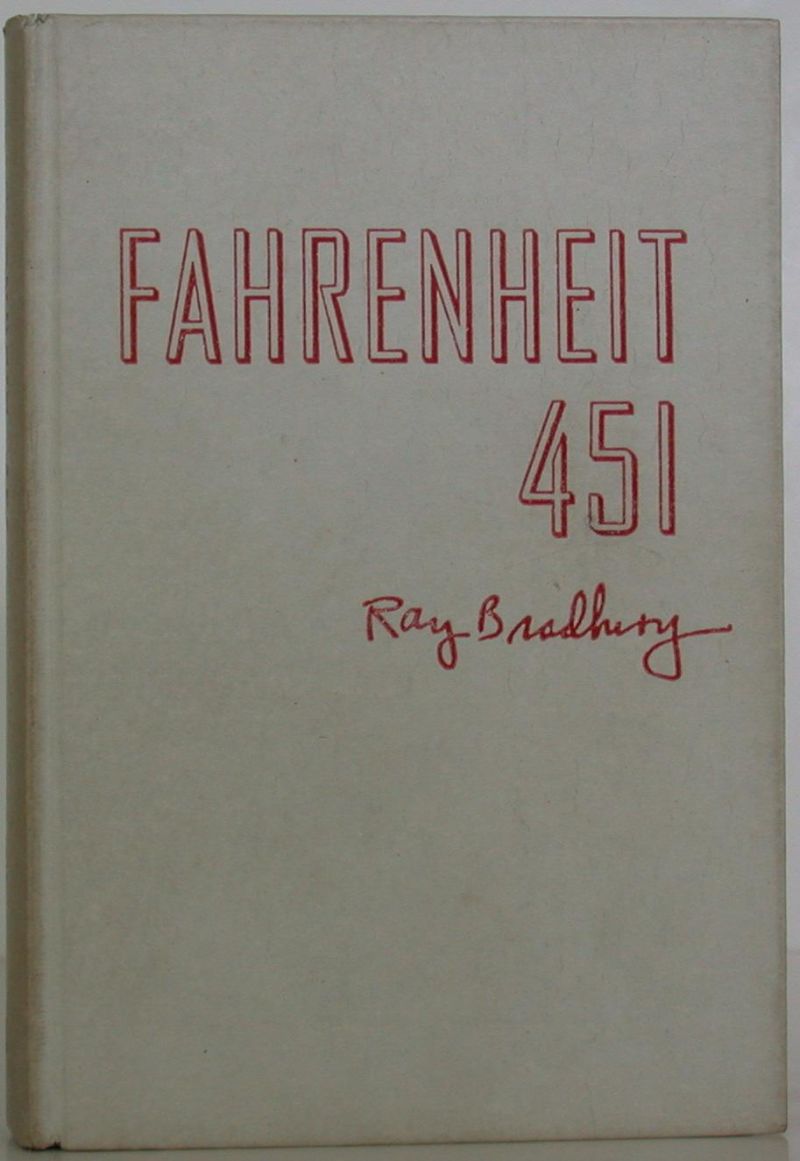
Even by the extreme standards of dystopian fiction, the premise of Ray Bradbury’s Fahrenheit 451 can seem a little absurd. Firemen whose job is to set fires? A society that bans all books? Written less than a decade after the fall of the Third Reich, which announced its evil intentions with book burnings, the novel explicitly evokes the kind of totalitarianism that seeks to destroy culture—and whole peoples—with fire. But not even the Nazis banned all books. Not a few academics and writers survived or thrived in Nazi Germany by hewing to the ideological orthodoxy (or at least not challenging it), which, for all its terrifying irrationalism, kept up some semblance of an intellectual veneer.
The novel also recalls the Soviet variety of state repression. But the Party apparatus also allowed a publishing industry to operate, under its strict constraints. Nonetheless, Soviet censorship is legendary, as is the survival of banned literature through self-publishing and memorization, vividly represented by the famous line in Mikhail Bulgokov’s The Master and Margarita, “Manuscripts don’t burn.”
Bulgakov, writes Nathaniel Rich at Guernica, is saying that “great literature… is fireproof. It survives its critics, its censors, and even the passage of time.” Bulgakov wrote from painful experience. When his diary was discovered by the NKVD in 1929, then returned to him, he “promptly burned it.” Sometime afterward, during the long composition of his posthumously published novel, he burned the manuscript, then later reconstructed it from memory.
These examples bring to mind the exiled intellectuals in Bradbury’s novel, who have memorized whole books in order to one day reconstruct literary culture. Europe’s totalitarian regimes provide essential background for the novel’s plot and imagery, but its key context, Bradbury himself noted in a 1956 radio interview, was the anti-Communist paranoia of the U.S. in the early 1950s. “Too many people were afraid of their shadows,” he said, “there was a threat of book burning. Many of the books were being taken off the shelves at that time.” Reading the novel as a chilling vision of a future when all books are banned and burned makes the artifact pictured above particularly poignant—an edition of Fahrenheit 451 bound in fireproof asbestos.
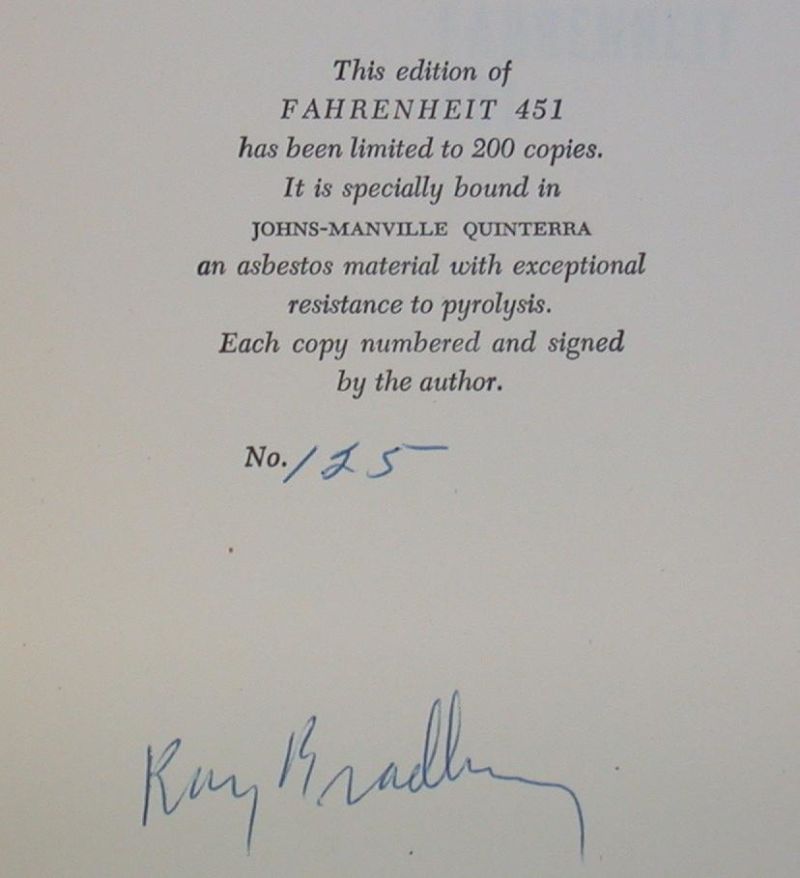
Released in 1953 by Ballantine in a limited run of two-hundred signed copies, the books were “bound in Johns-Manville Qinterra,” notes Lauren Davis at io9, “a chrysolite asbestos material.” Now the fireproof covers, with their “exceptional resistance to pyrolysis,” are “much sought after by collectors” and go for upwards of $20,000. A fireproof Fahrenheit 451, on the one hand, can seem a little gimmicky (its pages still burn, after all). But it’s also the perfect manifestation of a literal interpretation of the novel as a story about banning and book burning. All of us who have read the novel have likely read it this way, as a vision of a repressive totalitarian nightmare. As such, it feels like a product of mid-twentieth century fears.
Rather than fearing mass book burnings, we seem, in the 21st century, on the verge of being washed away in a sea of information (and dis- and mis-information). We are inundated with writing—in print and online—such that some of us despair of ever finding time to read the accumulating piles of books and articles that daily surround us, physically and virtually. But although books are still published in the millions, with sales rising, falling, then rising again, the number of people who actually read seems in danger of rapidly diminishing. And this, Bradbury also said, was his real fear. “You don’t have to burn books to destroy a culture,” he claimed, “just get people to stop reading them.”
We’ve misread Fahrenheit 451, Bradbury told us in his later years. It is an allegory, a symbolic representation of a grossly dumbed-down society, hugely oppressive and destructive in its own way. The firemen are not literal government agents but symbolic of the forces of mass distraction, which disseminate "factoids," lies, and half-truths as substitutes for knowledge. The novel, he said, is actually about people “being turned into morons by TV.” Add to this the proliferating amusements of the online world, video games, etc. and we can see Bradbury's Fahrenheit 451 not as a dated representation of 40s fascism or 50s repression, but as a too-relevant warning to a distractible society that devalues and destroys education and factual knowledge even as we have more access than ever to literature of every kind.
Related Content:
Josh Jones is a writer and musician based in Durham, NC. Follow him at @jdmagness
An Asbestos-Bound, Fireproof Edition of Ray Bradbury’s <i>Fahrenheit 451</i> (1953) is a post from: Open Culture. Follow us on Facebook, Twitter, and Google Plus, or get our Daily Email. And don't miss our big collections of Free Online Courses, Free Online Movies, Free eBooks, Free Audio Books, Free Foreign Language Lessons, and MOOCs.
Executive Summary Template: What To Include

What Is Steemit and How Does It Work?

The Steemit social network has been gaining considerable traction in the last few months. It now boasts more than one million users and is one of the most-visited sites in the world.
But it’s not like any other social network. It’s closely integrated with the Steem cryptocurrency and thus has some unique features which have been enticing users.
So, what’s all the fuss about? Let’s take a closer look!
What Is Steemit?
Steemit is part blogging platform, part social network. At its most basic level, it functions a lot like Reddit; you can upvote and downvote, follow topics that interest you, submit content, and discuss posts with other users.
However, it’s also a revenue-sharing website. And that’s where the cryptocurrency part comes into play. Instead of receiving payment in regular flat currencies like the U.S. dollar or the British pound, Steemit pays you in the Steem cryptocurrency.
You don’t only get paid for posting content. You can also earn Steem for commenting and even just upvoting other posts.
How Does Steemit Work?

Unlike regular social networks, which store all their content on their own servers, almost all the text on Steemit is saved on the Steem blockchain. For images, you’ll still need to use a third-party hosting site like Imgur.
The use of the blockchain has some practical benefits. For example, you retain ownership of your content forever, and no one can delete it.
But more importantly, the blockchain also underpins the entire rewards scheme. Every day, the blockchain mints new Steem tokens. From the new tokens, five percent goes to people who hold Steem Power, 75 percent goes to the community pool, and 10 percent goes to the Steem miners.
Steemit then divides the community pool between users depending on the popularity of their content.
Note: Make sure you understand how a blockchain works before reading any further.
How Does Steemit Divide the Community Pool?
Whenever you create new content, you can choose how to receive your payment. You can either receive 50 percent in Steem tokens and 50 percent in Steem dollars, or you can receive the entire payment in Steem Power.
There are some critical differences between the three:
- Steem: Steem is like any other cryptocurrency. It’s liquid, tradable, and transferable. You can buy and sell it on any of the major cryptocurrency exchanges and keep it in secure wallets. Its price determines the value of the other Steem-based tokens.
- Steem dollars: Steem dollars are pegged to the US dollar. They are a debt instrument that will pay $1 worth of Steem to the holder in the future. You can also convert your Steem dollars into Steem. Some cryptocurrency exchanges allow you to trade Steem dollars.
- Steem Power: Steem Power is like an influence score. The more Steem Power you have, the more your upvote is worth on the network. It’s a tool designed to keep people engaged with the Steem project over the long-term. It is the most illiquid of the three assets. If you want to sell your Steem Power—referred to as “powering down”—you will receive the value of the Power in Steem in 13 equal payments over 13 weeks. Steem Power is not tradeable.
How Much Money Can You Earn on Steemit?
Steemit is not a get-rich-quick scheme. Like with any social network, some social posts can go viral and earn their creators a surprising amount of Steem in a short amount of time.
But if you want to earn a solid amount of Steem consistently, you’ll need to invest time and effort to grow your following, become known in your own part of the community, and develop high-quality content. Again, it’s just like any other social network.
One particularly famous user made $100,000 in a week, but your expectations shouldn’t be so high. If you earn more than $500/month, you’re doing really well. As a new user, you shouldn’t expect to earn more than a few dollars.
Is the Steem Cryptocurrency Valuable?
Steem has a market capitalization of around $440 million putting it comfortably in the world’s top 40 coins. Its all-time high was $7.31 at the start of 2018, but it has spent most of the last 12 months bouncing between about $1.50 and $4.

Are There Any Downsides to Steemit?
So far, we’ve painted a rosy picture of Steemit, but the social network does have some drawbacks that you need to be aware of…
Fleeting Post Exposure
Some users have complained about the transient nature of the posts. They put a lot of effort into creating high-quality content, only to see it vanish from view in minutes because it didn’t receive enough early traction.
Unbalanced Voting Power
As some of the early adopters collect more and more Steem Power, their votes (both up and down) become worth significantly more than any other users’ votes.
This has led to accusations of vote bullying, whereby a couple of long-term users can band together and immediately scupper any hopes you might have of earning money from your content.
Hacking Threat
One of the biggest criticisms aimed at the crypto world is the frequency with which hacks occur. There have been numerous high-profile cryptocurrency hacks that have cost users millions of dollars.
Back in July 2016, hackers attacked Steemit. A total of 260 accounts were compromised, and more than $80,000 was stolen. Steemit responded by shutting down its network and reimbursing any users who lost money.
However, the fact it happened is concerning. Who knows how it would play out if another hack were to occur in the future and a more significant amount of money was taken.
Crash Potential
Some Steemit users have expressed concerns about the high-profile users who hold disproportionate amounts of the Steem token.
If they decided to cash out in one go, it could crash the price of Steem in a flash. The crash would have a disastrous effect on the amount of money you could earn on the network.
Password Resets
Because of the nature of the underlying blockchain, you cannot reset your Steemit password. If you lose or forget your credentials, you will be locked out forever with no way to recover the funds within your account.
You need to guard your login credentials closely; at the very least, use a password manager.
Steemit: One of Many Alternative Social Networks
If you’re growing tired of the incessant bickering on Twitter, selfies on Instagram, and baby photos on Facebook, Steemit is worth checking out.
It’s just one of many alternative social networks that deserve your attention, and we’re happy it exists. Have you ever wondered about the positive impact of social networks on society?
Read the full article: What Is Steemit and How Does It Work?
Photographers Beware: Homeland Security Says Photography Could Be Sign of Terrorism
 Image Credit: Gwengoat
Let me start by saying that this is not an article bashing the Department of Homeland Security. They have a very, very difficult job.
But their "If You See Something, Say Something" campaign has some problems, particularly as they pertain to you and me as photographers.
Know the signs! Did you know photography and surveillance could be a sign of terrorism-related suspicious activity? If you notice this, be sure to report it to local authorities. #seesay #protectyoureveryday pic.twitter.com/Xu9L6p5FcR
— Homeland Security (@DHSgov) July 9, 2018
As you can see in DHS' tweet from earlier this month, they essentially equate photography with terrorism, encouraging citizens to keep their eyes out for suspicious photographers taking too many photos and reporting them to the authorities.
And while I fully understand that terrorists utilize photography and photography-related tools to surveil potential targets, the broad scope of the warning from DHS is a problem for me.
For example, when I've got my Sony a6300 and I'm exploring the city, taking photos of passersby, buildings, passing cars, and so forth, I could easily be reported for "photography" to DHS.
What's more, as I'm taking photos on the street, someone could easily say that I'm behaving "suspiciously," meandering around town, taking photos.
Aside from the fact that the language that "photography and surveillance could be a sign of terrorism-related suspicious activity" is vague and doesn't clearly differentiate between "normal photography" and "suspicious photography," DHS lists photographic activities as the second sign of potential terrorism on their campaign infographic, seen below.
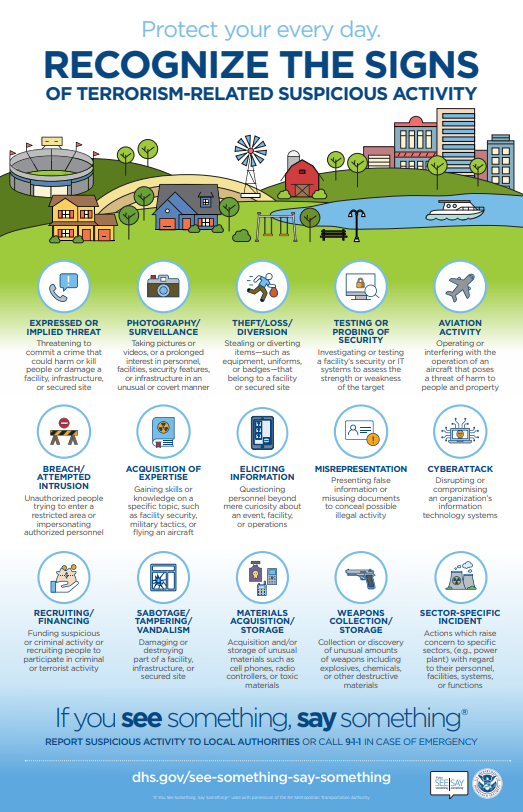
Naturally, advocates for photography rights are not pleased with the manner in which these warnings are worded and the connotation they have that photographers in general could be terrorists.
In an interview with Columbia Journal Review, Frank LoMonte, who serves as the executive director of the Brechner Center for Freedom of Information at the University of Florida summed up the problem as such:
“When you look at what DHS identifies as the signs [and objects] of suspicious photography—‘personnel, facilities, security features, or infrastructure’—it basically leaves squirrels as the only thing that’s safe to photograph. That’s a pretty breathtakingly broad inventory.”
Granted, LoMonte's counterpoint to the DHS campaign is somewhat tongue-in-cheek, but he has a good point - photographers have long faced scrutiny by law enforcement, overzealous security guards, and citizens in general who question their right to utilize their camera in public spaces.
The fear, of course, is that this new DHS campaign will only fuel those fires and put photographers even more in the sights of people that don't seem to fully understand the First Amendment.
 Image Credit: Joel Carillet
In a response to LoMonte's comments, DHS issued a statement to the Columbia Journal Review, stating that the campaign "is not focused on the right of photography or media filming itself, but more about what/how/when someone might be photographing or filming something." They continued, "we are not asking people to file a report if they see someone taking pictures through the normal course of daily life, but rather if someone is filming secure areas or security protocols in a prolonged manner.”
Again, there are problems with this statement.
First, saying that the campaign is not focused on the right to photograph things but instead is focused on what/how/when someone is photographing something makes no sense. The process of photographing something is all about the what/how/when.
Secondly, as the American Civil Liberties Union points out, taking photos and videos of things that are in plain sight from a public space is a constitutional right. That includes photographing government officials, government buildings, police on duty, transportation hubs, and so forth.
How about Tweeting the part that "No investigative activity should be conducted based solely on a person exercising his or her First Amendment rights." See below for the complete directive pic.twitter.com/jrGUWJiGZp
— Mickey Osterreicher (@nppalawyer) July 9, 2018
But there's more...
As the tweet above from Mickey Osterreicher, the general counsel for the National Press Photographers Association, points out, DHS forgot to tweet out the other part of their campaign which explicitly states that investigative activities into terrorism should not take place based solely on a person's First Amendment right to use their camera.
Had DHS included this statement as part of their social media blitz, then perhaps I wouldn't be writing this article. But they didn't, so here we are!
This isn't the first time that DHS seems to be targeting photographers, either.
In 2010, DHS released a poster with a "terrorist" that looks like a photographer taking photos of airplanes with a warning that states, "Don't let our planes get into the wrong hands."
Then, in 2012, DHS produced the video above in which it is suggested that photographers who are taking photos in a covert manner could be a terrorist.
Again, I understand what DHS is trying to do - keep Americans safe.
The problem is that they seem to repeat the same pattern of calling normal, honest, everyday people into question for completely innocuous activities.
When you're out with your camera, be smart, be safe, and know your rights. Otherwise, DHS might come knocking.
Get more details on what you can and cannot do under the First Amendment in the video above by the ACLU.
Via Petapixel, Columbia Journalism Review, and the American Civil Liberties Union








We Recommend
Breakthrough Photography’s Magnetic Filters Attach in a Snap
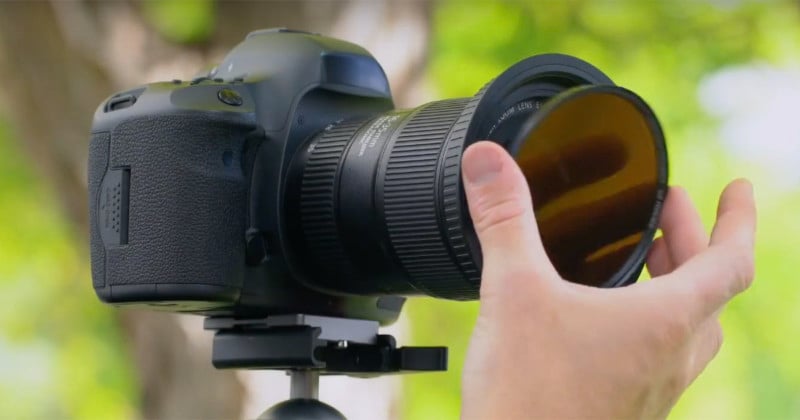
Breakthrough Photography has launched a magnetic circular lens filter system that allows filters to be attached and removed instantly with zero screwing and zero light leaks.
It’s “a revolutionary new way to use filters,” Breakthrough says. “[W]e reimagined the way you use camera filters by allowing you to attach a filter instantly.”
The system comprises two parts: a magnetic adapter and a magnetic lens filter.

The adapter stays screwed into the front of your lens, allowing Breakthrough’s new magnetic filters to be snapped securely into place just by pressing them into the adapter.
Breakthrough’s new system has notable advantages over traditional circular and square filters.
Compared to circular filters, there’s no screwing required, which not only saves time but also ensures that you won’t ever be frustrated with stuck filters again (for that problem, though, there’s the special tapping trick).
Compared to square filters, the magnetic filters attach much faster (any angle is the correct alignment), can rotate independently, and avoid the light leaks that often plague square filters.
“For decades filter manufacturers have designed around the problem of square filter light leak by making different holder designs attempting to completely eliminate light leak 100% of the time,” Breakthrough says. “And when using 10 or 15-stop ND filters, any light leak significantly reduces contrast and saturation.
“We have eliminated light leak with magnetic filters.”


Breakthrough’s magnetic filters work on 82mm thread sizes and smaller, so instead of having to buy a new filter for each lens, all you need is a new adapter/step-up ring.
Another magnetic filter system on the market is the Manfrotto XUME quick release filter adapter system, which use two adapters (one for the camera and one for filters) to allow you to use your existing lens filters.
Breakthrough has magnetic filters for all the major filter types, including UV, CPL, ND, Dark CPL, Night Sky, and Infrared. The 49mm to 82mm magnetic adapter rings cost $12 each, and the filters themselves cost around $100 to $200 each. There’s also a magnetic X100 universal holder for 100mm square filters.
(via Breakthrough Photography via Fstoppers)
For Centuries, People Took Chunks of Stonehenge Home as Souvenirs
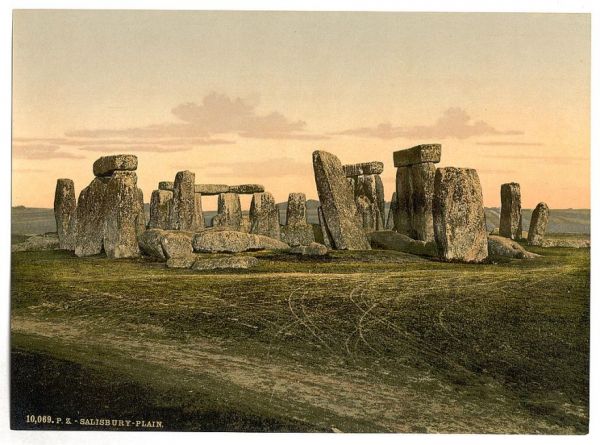
Stonehenge was not always a protected treasure. Ever since it was noticed as something strange and different, people desired a piece of it, and literally took those pieces home with them. A visit to Stonehenge meant taking a hammer and chisel to get a piece of rock for one's collection or mantelpiece. During the Victorian era when travel and tourism was on the rise, the vandalism reached a fever pitch- people not only took chunks of rock home, they left their names carved in the stones.
In 1871, The Times published another series of letters regarding the state of Stonehenge, initiated by a writer who signed off as “A Vacation Rambler.” “There were many visitors,” the Rambler wrote of a recent visit to the site, “and a constant chipping of stone broke the solitude of the place.” The monument’s owner, Edmund Antrobus, 3rd Baronet, retorted in a published response a week later that “considering the thousands who annually visit it, I think the public deserve much credit for the very little damage done.” Antrobus did report several disturbing tales of vandalism, however, including an exchange with a “respectable paterfamilias,” who, upon being asked by Antrobus not to use his hammer and chisel, shot back, “And who the deuce are you, sir?” Told that Antrobus was the owner, the man responded that he believed the stones to be “public property.”
A hundred years ago, the last private owner of Salisbury's Stonehenge donated it to the British government. Only then was any real effort put into preserving the ancient monoliths, even though academics had been complaining about vandalism for centuries. Read about the desecration of Stonehenge at Atlas Obscura.
(Image source: Library of Congress)
A Summer-of-Snitches Subversion: City Helps Teen Rather Than Shut Down Unlicensed Hot Dog Stand
 A teen in Minneapolis has been running a hot dog stand, partly to raise money and partly because he likes having his own business. Jaequan Faulkner, 13, started his own little pop-up venture two summers ago, according to the Minneapolis Star Tribune.
This summer he hit a snag. Someone called the Minneapolis Health Department and complained about the kid with the unlicensed hot dog stand.
It's been that sort of summer, with snitches finding the dumbest reasons to call the cops and other authorities on other people, often kids and teens.
Faulkner's story has a happy ending, though: Rather than shutting him down, the city decided to help him go legit. They gave him the equipment that the health department demanded to operate in compliance with city code (everything from meat thermometers to cleaning equipment), and they covered the $87 required for a "special event permit" to operate legally.
It's nice that the city helped him, but there's something a little unsettlingly self-promotional about its approach. The only reason this story has a happy ending is because of the kindness of some cogs in the city's bureaucracy. This is a story about a teen's entrepreneurial spirit, but it's also a story of the noblesse oblige of those with the power to decide whether or not Faulkner can sell hot dogs.
Faulkner is an adorable, photogenic kid with a dream. He wants his own food truck someday. He's a great story. He's also an "innocent," somebody easy to root for. That's why stories like this go viral. That's why stories about officials cracking down on lemonade stands go viral. That's why lemonade manufacturer Country Time was widely praised for a summer program to pay the costs of permits so that kids can legally run stands.
Does Minneapolis treat everybody who needs a bunch of permits and equipment to do their jobs with such a charitable response? Look at all the business licenses Minneapolis demands. If your kid is selling candy bars to raise money for a band, the band director is supposed to register for a youth fundraising permit. And each kid selling candy is supposed to carry around an identification card with the name of the organization, the permit's registration number and expiration date, and the telephone number for the appropriate office in the city government, in case any of those snitching grown-ups want to make sure you're legitimate.
If you've got an arcade (or I guess a bar/arcade, these days), each machine requires its own license. Heck, you have to get permission to put out a bench on a public sidewalk. It's not all terrible, though. As of 2016, Minneapolis no longer requires special business permits to operate skating rinks, to run bowling alleys, to deliver milk, or to have a jukebox.
It's genuinely great that Minneapolis was kind to Faulkner and didn't succumb to bureaucracy's worst tendencies. But ultimately, these officials want us to praise them for not being as bad as their own ordinances allow them to be. What happens to kids caught up in harsh government regs also happens to adults across the country every single day—and for them, it's not about earning some extra spending money. If Faulkner gets that food truck when he grows up, he's going to discover that many cities have deliberately hostile business environments because other businesses in town (restaurants) don't want the competition.
And if he values his freedom, he won't do something really crazy, like wrap his hot dogs in bacon.
Artist Bothy

Visit Uncrate for the full post.
Insectivorous Birds Annually Consume As Much Energy As Does New York City

The 15 coolest things you can do with your Amazon Echo - CNET
This Photographer Didn’t Let Stage IV Cancer Stop Him from Shooting
Scott Wilson is an award-winning landscape and wildlife photographer based in Denver, Colorado, who has had to overcome a challenge most photographers will never need to face: stage IV cancer.
The 3.5-minute video above by Denver-based NBC affiliate 9NEWS is a look at Wilson’s journey in life and photography.
Shortly after moving to Denver from the UK for a new job after 17-years in the beer industry, Wilson was diagnosed with stage IV colon cancer in August 2016. The cancer had metastasized to his liver.
Treatment for his disease involved removing 13cm (~5.1in) of his colon and 40 weeks of chemotherapy, which involved a drug that caused severe photosensitivity — Wilson was instructed by his doctor to stay out of the sun while getting treated for cancer.
“It was like being punched twice – ‘You’ve got cancer, oh and by the way, you can’t shoot,’” Wilson tells 9NEWS. “I thought – that’s not how I want to live my life. So, I just looked for different ways to shoot.”
Wilson decided to continue doing outdoor photography by covering himself from head to toe and also photographing wildlife from inside his car while driving through parks and wildlife areas.
After a year of in-car wildlife photography, Wilson decided to turn the photos he had captured of Colorado’s wildlife into a photo book titled Through the Window: A Photographic Tale of Cancer Recovery. 122 backers pledged $11,341 through Kickstarter to bring the book to life. Wilson is partnering with the Colorectal Cancer Alliance for the project, and all proceeds from the book ($36,000 already) are donated to the organization for cancer research.
Here are some photos from Wilson’s portfolio:






You can find more of Wilson’s work on his website, Facebook, Flickr, and Instagram.
Image credits: Photographs by Scott Wilson and used with permission. Featured image from video by 9NEWS
Is This the Best Tequila Brand in the World? These Experts Seem to Think So.
Today is National Tequila Day, apparently, and this tequila brand just mopped at an important spirits competition.

Porsche is Recreating a Classic on Its Best Modern Platform
If you look close enough and do the math, it's actually quite obvious what Porsche is cooking up.

How To Create A Business Plan

NEGATIVE ADVERTISING
The Best Notes Found in Used Books
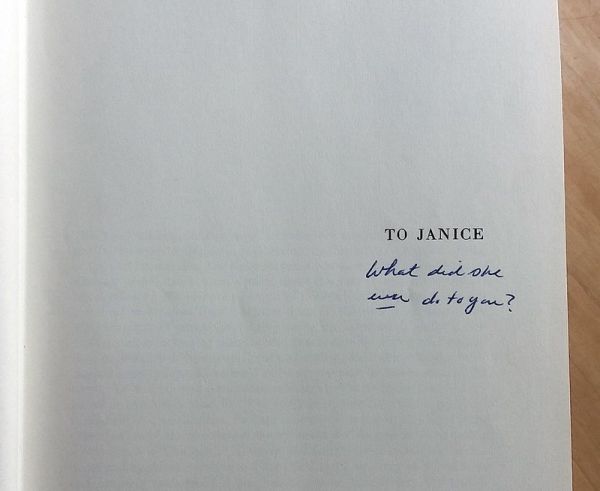
No one wants to throw away books, so people pass them along to others. A used book is as good as a new copy, as long as all the pages are there and it's not disgustingly moldy. So we read books that have been read before, and sometimes we find notes jotted in them. Some are informative, others inexplicable, and some are just plain funny. Atlas Obscura asked its readers to submit the strangest notes they've found in books, and they responded with both stories and pictures. These include criticisms, recommendations, dedications, communications out of context, marginalia, snark, spoilers, secret code, and jokes. Some tell stories, while others only hint at the story behind it. Read them all at Atlas Obscura.
(Image credit: Annie Watts)
How to Stage Photos for a Real Estate Listing

Every once in a while, we have a real estate listing here at Neatorama. They are all either outrageous, unbelievable, or have a great story behind them. But if you are selling an average house, a nice place at a decent price, how do you get people to take a second look? A realtor trying to sell a two-bedroom house in Granbury, Texas, enlisted the help of a T-rex!
Among the lovely shots of hardwood floors, lake views, and a screened-in patio, we see ol' Tyrannosaurus raiding the fridge, taking a nap, fishing in the lake, and even mowing the grass. That's pretty impressive for a guy with such tiny arms, no?
The dino was even seen in the shower. They got 45 showings for the small house and sold it quickly. See more pictures at Realtor.com. -via Boing Boing
Every Circle In This Image Is The Same Color

This image posted at reddit is an illusion. The twelve circles appear to be four different colors, but they are actually all the same color. You can enlarge the image here, which will help you see the real color of the circle. It's kind of peach. They appear different due to the different colored stripes allowed to cross them. What we have is an example of a Munker Illusion.

Yes, there are some people that the illusion will not work on. You can see a video that explains the illusion further at Digg.
Danielle Baskin, Product designer
Our guest this week is Danielle Baskin. Danielle is an entrepreneur, painter, and performance artist based in San Francisco. She’s created internet jokes, like Custom Avocados and Drone Sweaters. She’s also the founder of Inkwell Helmets, a custom bike helmet company, the co-founder of Your Boss, a voice-chat based productivity app, and has started many other companies.
Subscribe to the Cool Tools Show on iTunes | RSS | Transcript | Download MP3 | See all the Cool Tools Show posts on a single page
Show notes:
OffBot
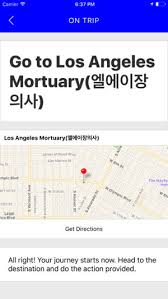
This is an app that sends you to random destinations (cafes, bars, restaurants, parks, and more). It takes locations from Google Maps and selects a place for you within your own determined radius. I use this to make decisions for me to save mental bandwidth. I also use it to discover interesting places spontaneously, and to have unexpected experiences either locally or in new city.
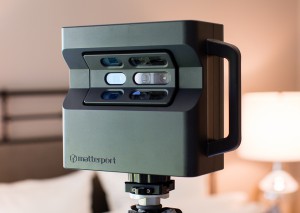
Matterport Camera
This is a 360-degree camera with an infrared depth sensor that can capture interior spaces and turn them into high-fidelity 3D models. It’s meant for real estate tours, but I’ve been borrowing one to document abandoned spaces or soon-to-be-bulldozed buildings for virtual preservation.
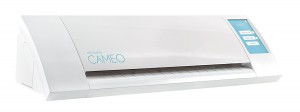
Silhouette Cameo Electronic Cutting Machine
This is an extremely useful vinyl die-cutter I’ve had for 6 years. I use it for so many projects: putting logos on fruit, making decals for my helmet company, making masks, custom stickers, labels, and signs. It also cuts paper and fabric — and if you swap the blade with a pen, it’s an automatic drawing tool.

Cardd
This is a beautifully-designed single-page site builder, and host to many of my domains. I’m somewhat of a domain hoarder, but I try to put content on most of my sites. Carrd is great for quickly getting content online and making it look sleek, without spending the time custom-coding something — which is often unnecessary for certain projects and experimental ideas. Carrd also lets you export your code, if you wanted to turn the site into a larger project later on.
Also mentioned:
HP Latex 110 printer
I was actually a beta tester for it, so that’s why I have one. I can print my own custom Pantone colors on vinyl. It’s a vinyl and fabric printer.
Your Boss
I’m working on a peer-to-peer voice chat network for people with creative side projects. It’s an accountability network — a way to get a boss for a project when you otherwise wouldn’t have one.
We have hired professional editors to help create our weekly podcasts and video reviews. So far, Cool Tools listeners have pledged $337 a month. Please consider supporting us on Patreon. We have great rewards for people who contribute! – MF
‘Rain Bomb’ Captured by Airport Cam
Microbursts are intense small-scale downdrafts that can dump a huge amount of rain on a small area in a short period of time. From a distance, the phenomenon looks like a pillar of water crashing down on the Earth. In Arizona, an airport security camera just captured one of these “rain bombs.”
Royal Norman, the meteorologist at Channel 3 in Phoenix, shared this 26-second video that was captured by a camera at Sedona Airport in the middle of Arizona.
Playing back at 8x actual speed, the timelapse shows a wet microburst reaching down to the ground starting at about 7 seconds in.
Is Bitcoin the Future of Money? Peter Schiff vs. Erik Voorhees
On July 2, 2018, Reason and The Soho Forum hosted a debate between Erik Voorhees, the CEO of ShapeShift, and Peter Schiff, CEO and chief global strategist of Euro Pacific Capital.
The proposition: "Bitcoin, or a similar form of cryptocurrency, will eventually replace governments' fiat money as the preferred medium of exchange."
It was an Oxford-style debate in which the audience votes on the resolution at the beginning and end of the event, and the side that gains the most ground is victorious. Voorhees won by changing the minds of 15 percent of attendees.
The Soho Forum is held every month at the SubCulture Theater in Manhattan's East Village. At the next debate, which will be held on August 27, William Easterly, professor of economics at NYU, and Joseph Stiglitz, a Nobel Prize Winner in economics and professor at Columbia, will discuss whether free markets or government action is the best way to eliminate global poverty. You can buy tickets here.
Produced by Todd Krainin.
This May Be the Best Cheap Camping Chair, and Now It’s Cheaper
You may have never heard of Moon Lence, but its camp chair holds up against some of the best available, for a lot less money, too.

Rigging Live Baits
Methods for rigging live baits.
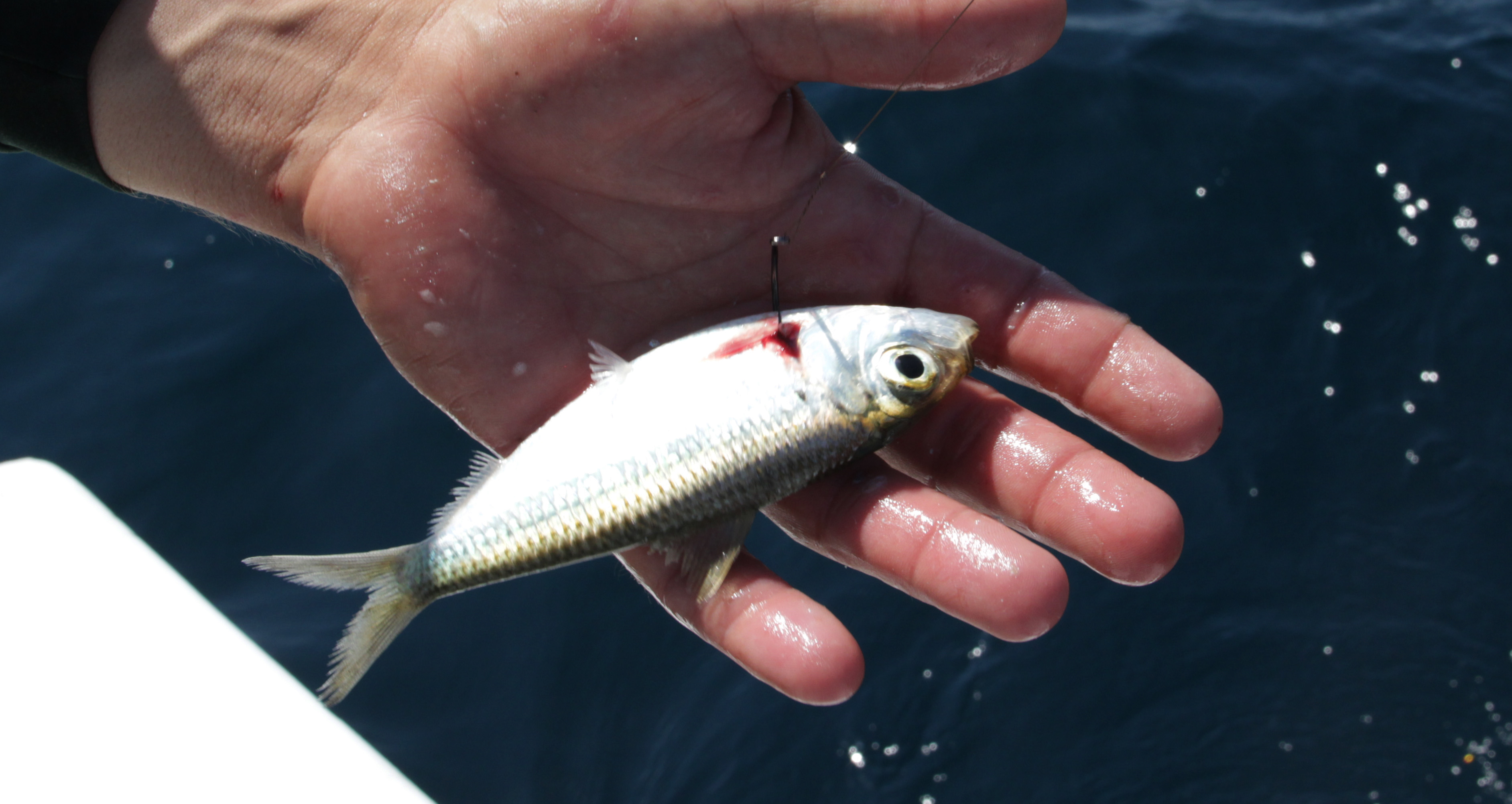 Throat-hooked pilchard, good for light current and steering bait toward deeper water.
“Where do I hook this bait?”
It’s a good question, and from an expert livebait captain you might get 10 different answers on 10 different days. The biggest factor to consider is the conditions.
If you’re bottom fishing, for example, hook placement should be different on anchor than if you’re drifting in heavy current. It will also vary depending on what you are trying to catch. A Miami mutton snapper that sees a hundred chicken rigs a day probably won’t be fooled by a chicken rig with a live sardine or cigar minnow hooked through the lips on a 3-foot leader.
For catching the wariest bottom fish, a “knocker rig” where the sinker slides all the way to the hook is often your best bet. The knocker rig only performs well if the hook is placed near the tail of the baitfish. Think about it. The bait is going to naturally pull away from the pressure of being hooked. If you can drop any species of baitfish with your sinker sliding all the way to the hook, you may indeed be using the most natural presentation of all. It will, however, only be successful if your live bait is frisky enough to pull the leader through the water while the sinker lies motionless on the bottom. Hook that same bait through the lips and he’ll stay jammed up against the sinker in a very unnatural way.
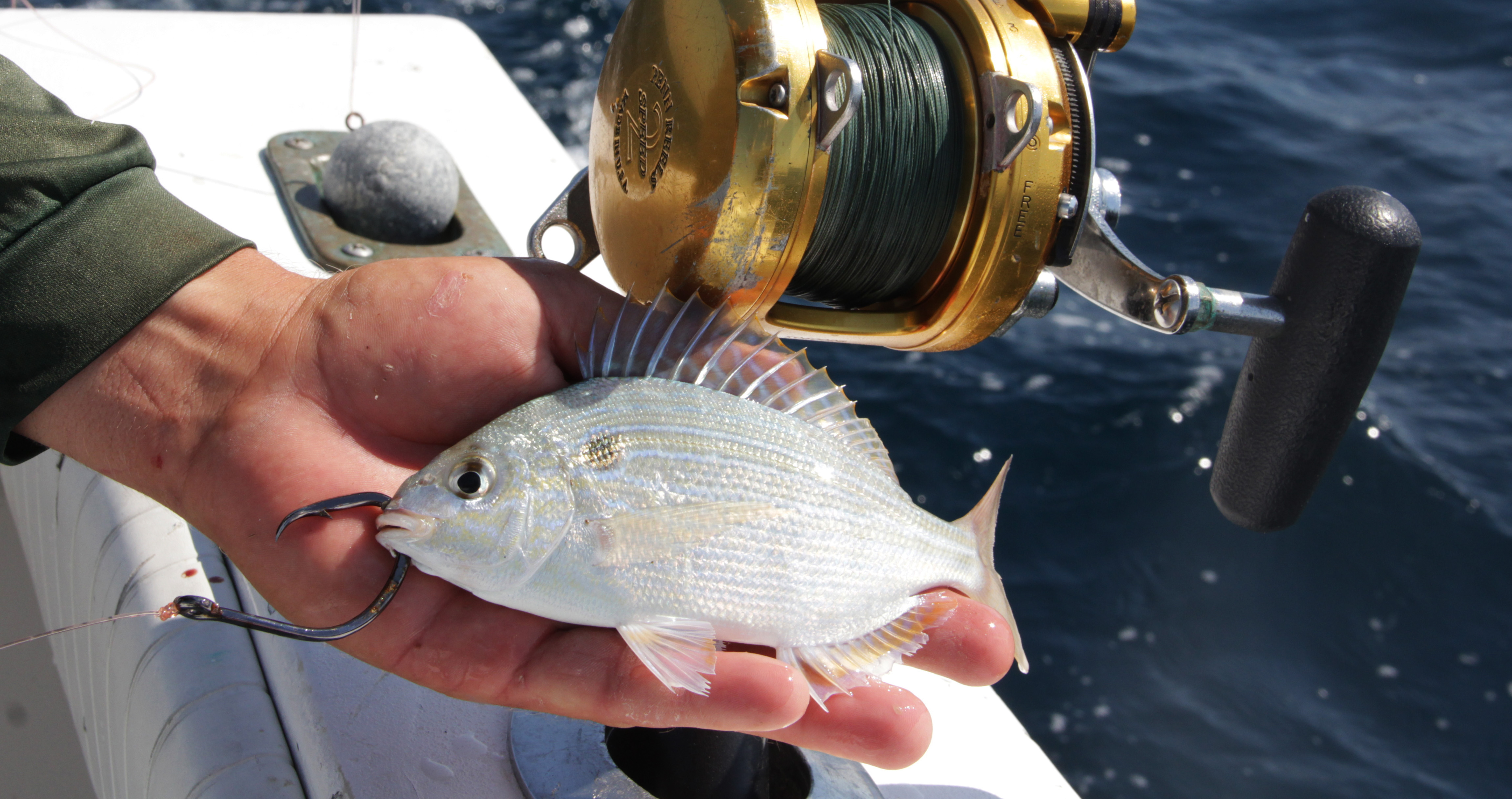 Lip-hooked pinfish for heavy current.
The knocker rig is ineffective while drifting or anchored in a heavy current. When dealing with a drift, or a heavy current, you’re far better to work with your sinker a few feet away from your bait, and having your bait hooked through the lips or eyes makes him lay the most natural in the current.
Bring your game up in the water column and there are other considerations. Is your bait the kind that generally belongs on the bottom, like a grunt or pinfish, or is it a surface dweller like a mullet or sardine? Are you hovering over a piece of structure you want the bait to draw predators off of, or are you slow-trolling a general area? Anytime you’re either moving the bait through the water, or the current is stronger than the bait, you’ll have to decide between hooking your bait through the lips, the nostrils, or through the shoulder just behind the head.
Hooking a bait through the shoulder while on the slow troll gets it deeper, but it puts a lot of stress on the bait if you go any faster than a bump troll (idle speed, in and out of gear). Blue runners and threadfins do better with a shoulder hook than menhaden or sardines. Live mullet are fantastic baits, but their heads may be so fat that a 3/0 to 5/0 livebait style hook will not go through the nostrils or eye sockets. A larger hook (5/0 or 6/0) pinned through the upper or lower lip will keep a mullet alive for a few miles.
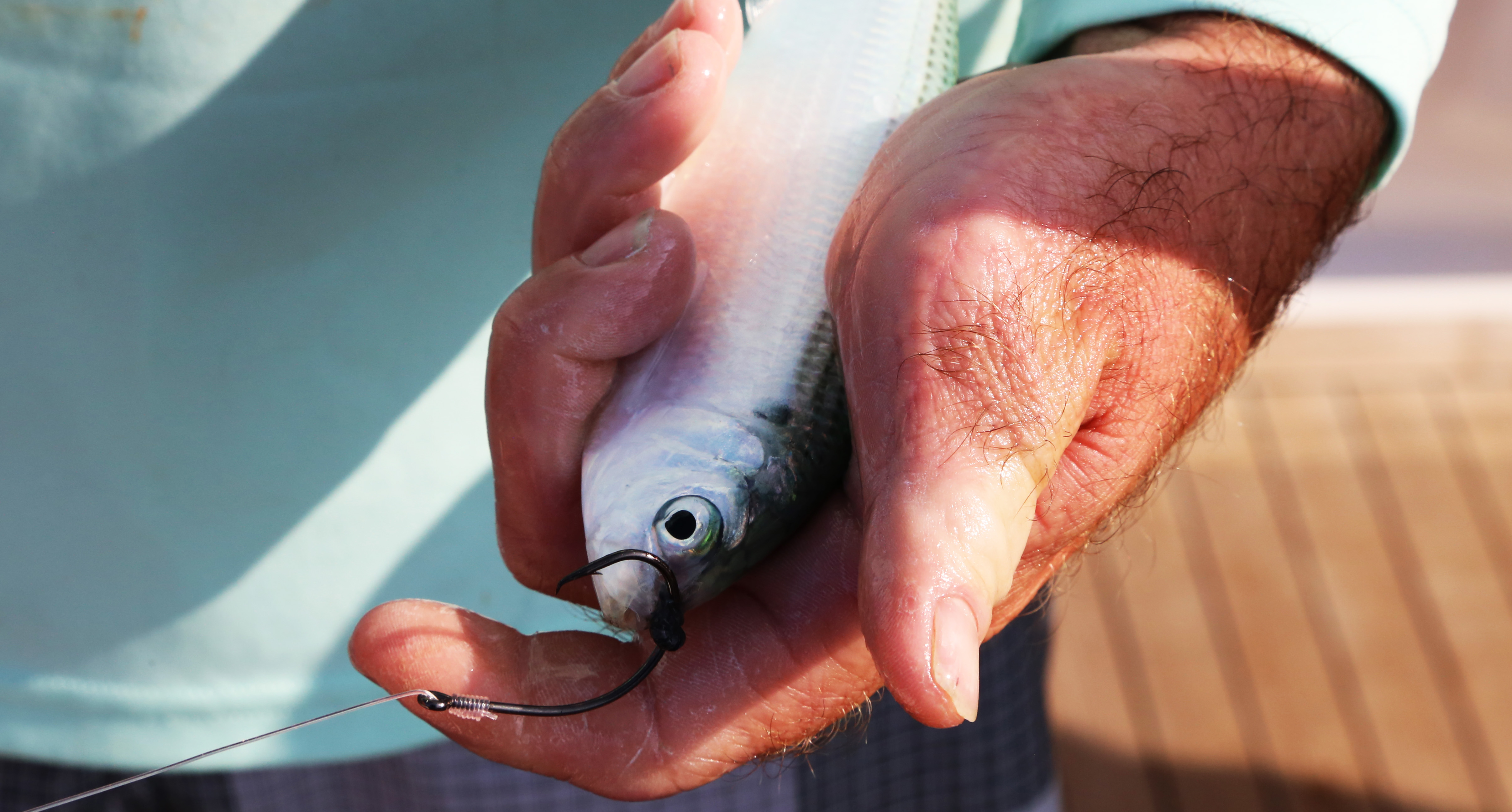 Nostril bridle rig, for aggressive kite fishing.
Bridling the baitfish is another option. This is especially popular among sailfish tournament crews. One easy bridle method is to pull a small rubber band through the bait with a rigging needle and then twist the hook into the two loops protruding from the bait. This is very effective for rigging baits through the middle of the bait’s back, just below the dorsal, for kite fishing. Some of the stress of being held at the surface and occasionally flying through the air is absorbed by the rigging band.
If you’re anchored over a wreck or natural bottom structure you’ve got a few choices depending on your quarry. For kings or mahi, chances are you’ll want your bait to lay naturally in the current. That can be accomplished best by rigging a cigar minnow or sardine through the lips or nostrils, just as you were trolling him. If you’re bottom fishing on the drift, it can be deadly effective to hook your bait just behind the anal fin. As long as he’s drifting at the same rate you are he can really scoot sideto-side hooked that way.
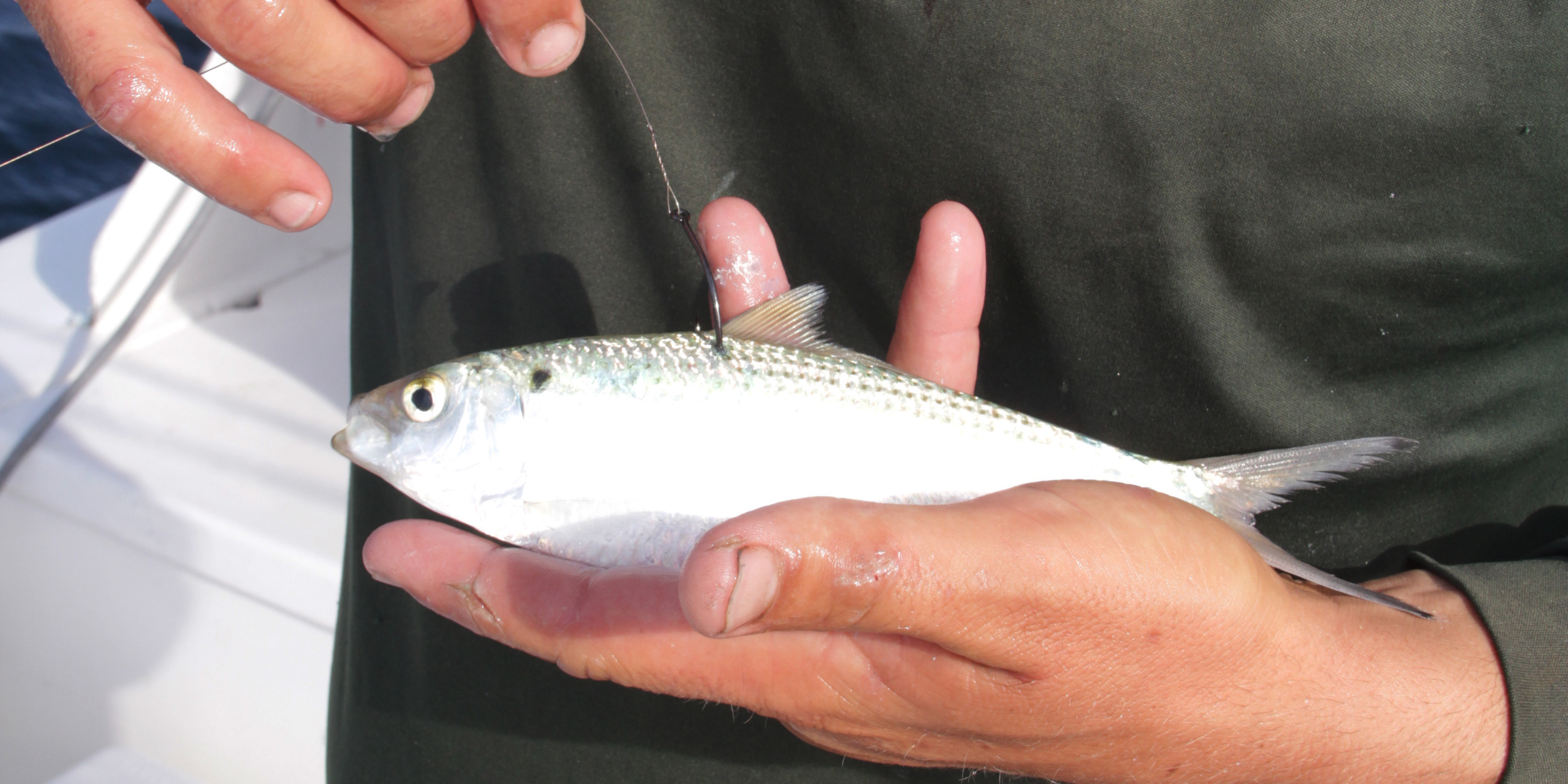 Dorsal hooked herring for kite-fishing.
If you’re anchored and trying to get a bait to swim down to bring up the cobia or amberjack, a grunt or pinfish hooked ahead of the dorsal should get the job done. If you feel him swim halfway down and screech to a halt, get ready! FS
First Published Florida Sportsman Magazine August 2017
The post Rigging Live Baits appeared first on Florida Sportsman.
Succumbing To The Forces Of Unconcern: How We Think About People In Need


1969 McLaren M6GT Coupe

Visit Uncrate for the full post.