Jean-Philippe Encausse
Shared posts
🚀 Ces composantes clés de l'ADN et de l'ARN découverts dans l'espace, sur Ryugu 👽

Etude - Comment les marques peuvent-elles tirer parti des fêtes de fin d'année ?
Dynamic bonuses: using machine learning to predict player preferences in casinos
In recent years and with the many advances in technology, online casinos have been increasingly focusing on providing a more personalised gaming experience to players.
As the competition between online casinos gets tougher, casinos are seeking new and innovative ways to create personalised offers, rewards and bonuses that fit the individual’s preferences, creating a fully customised environment for each player.
This has led to the rise of dynamic bonuses, where machine learning algorithms are designed to predict player preferences and provide them with relevant offers that hit their target. From a deep dive into the various casino bonus structures and player experiences, machine learning is proving itself to be a powerful tool in shaping the future of player retention and satisfaction.

The main role of machine learning in dynamic bonuses
Machine learning allows casinos to quickly and promptly analyse huge amounts of data on player behaviour, from game choices and spending habits to the lengths of gaming sessions and win-or-loss ratios.
By using these very important data points, machine learning models can quickly identify patterns and also predict what types of casino bonuses or rewards will appeal the most to specific players. For example, a player who enjoys playing online slot games is more likely to appreciate a free spins bonus, while a player who prefers RNG card and table games or live dealer games might prefer a match deposit bonus offer.
‘Machine learning allows casinos to delve into a player’s journey and create tailormade bonuses in real-time, which can make a huge difference when it comes to engagement and satisfaction,’ says Jonas Kyllönen, Mr. Gamble’s co-founder and casino expert.
By better aligning with these predictive insights, casinos can not only optimise their marketing efforts but also ensure they provide a value-driven experience for their players.
Casino bonuses: traditional vs dynamic approach
Traditional casino bonuses are often created with a ‘one-size-fits-all’ mentality, where the same offers are available to all players. This can lead to the casinos missing engagement opportunities since these offers do not take into consideration individual preferences.
Dynamic bonuses, on the other hand, take into account data-driven insights, offering more personalised rewards that are more likely to appeal to each player. This results in a better engagement strategy that not only attracts players but is likely to see them return for more.
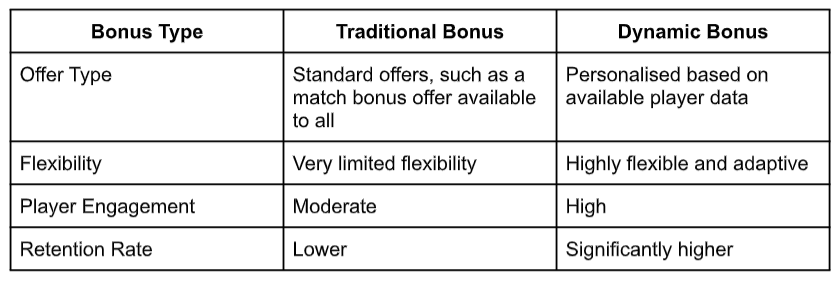
By using ML_driven dynamic bonuses, online casino sites can attract players in unique and very customised ways. Highlighting popular £10 deposit bonuses in the UK, for example, can attract new players looking for low-commitment entry points, while experienced players might benefit from loyalty rewards of exclusive promotions.
How machine learning models in dynamic bonuses work
Machine learning models designed to predict player preferences are typically built on three core components: data collection, pattern recognition and personalised engagement. You can find out more about each one below:
- Data collection: Casinos collect data across all player interactions, including games played, frequency, the device used and the time of day for such gaming sessions.
- Pattern recognition: By analysing this data, ML algorithms detect various behavioural patterns, recognising tendencies that might predict potential future preferences.
- Personalised engagement: With patterns identified, the model can also recommend specific bonuses or promotions to individual players, increasing the likelihood of them accepting the offer and engaging.
These data-driven insights are designed to address player preferences, from offering tailor-made welcome bonuses to designing loyalty programs that align perfectly with the player’s gaming history.
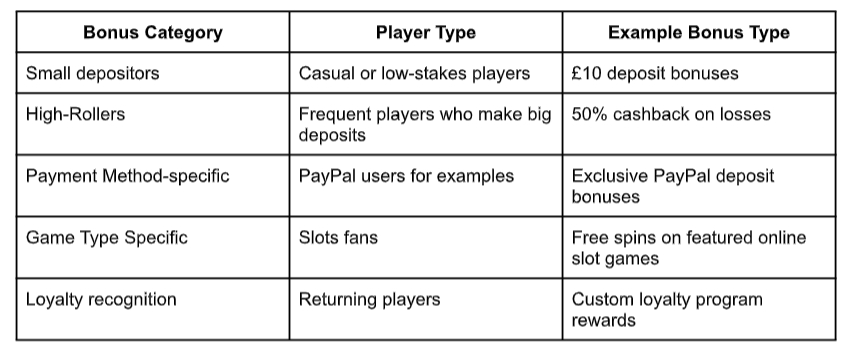
A player that makes small deposits on a frequent basis might be more attracted to the best PayPal casinos in the UK, where they can benefit from safe and smooth transactions, along with snapping up casino bonuses perfectly designed for small deposits.
How online casinos use dynamic bonuses
The power of dynamic bonuses lies in their ability to match casino bonus offers with individual player profiles.
Some online casinos are now using machine learning to send real-time bonus offers based on the player’s current activity. If the player is on a winning streak, they might receive an extra casino bonus for example in a bid to encourage them to try a different game category.
On the other hand, a player who is on a losing streak might be offered cashback or a low-risk casino bonus to maintain engagement levels.
Another example entails highlighting the most attractive casino bonuses based on deposit methods. For example, casinos can create specific casino bonuses towards players opting for PayPal. Offering unique bonuses for PayPal players is not only about luring them to the site but also reassuring them with fast and secure transactions.
Here are some of the most popular UK dynamic bonuses created by machine learning:
The future of dynamic bonuses in the casino industry
As machine learning continues to develop and also advance, the future of dynamic bonuses promises to become even more sophisticated and intricate. Thanks to the integration of artificial intelligence and machine learning algorithms thrown into the mix, online casinos will be able to anticipate player needs with greater precision.
In such a competitive and rife casino environment, a new casino must do its utmost to stand out in a competitive market. One way of doing this is via personalised features such as dynamic bonuses.
Picture yourself logging into your favourite online casino and receiving a casino bonus offer tailored to your favourite game type, time of day or even previous win/loss partners: These sorts of personalised experiences are becoming a standard for many players who crave that unique and value-driven interaction with online casino sites.
Not only do such experiences foster engagement, but they also encourage a sense of loyalty.
Revopoint MetroX 3D Scanner: Blue Laser Scanning Breakthrough at an Appealing Price! (Sponsored)
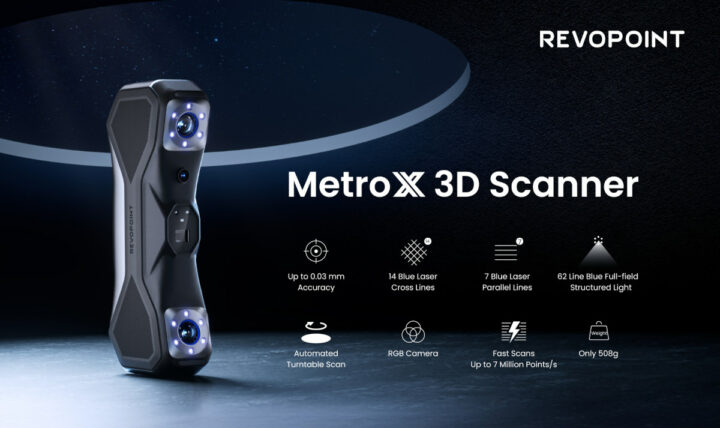
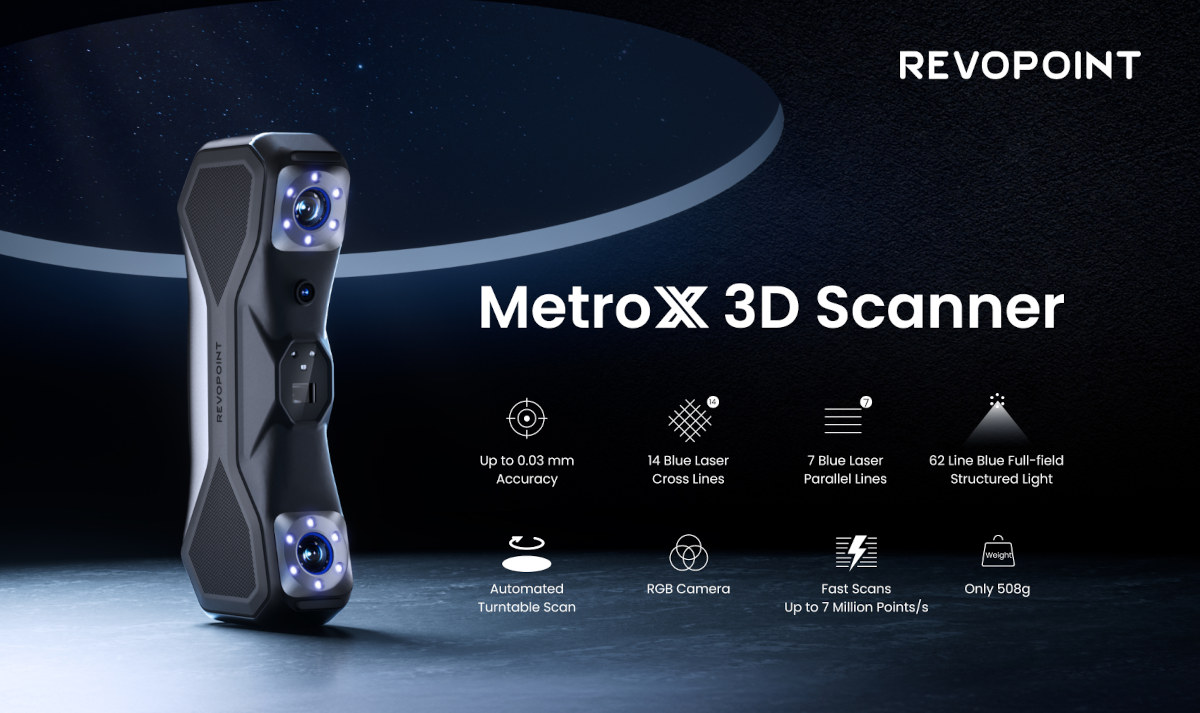
As an innovator in 3D scanning technology, Revopoint has unveiled its latest product, the Revopoint MetroX 3D scanner. The Kickstarter campaign started on October 15th and will run until November 14th, offering MetroX at only $689 (MSRP $999) now.
Four Scanning Modes
MetroX is a versatile 3D scanner that combines blue laser and blue structured light technology. Its four scanning modes give users the right tools to optimally capture every aspect of small to medium objects, from flat areas to complex details.
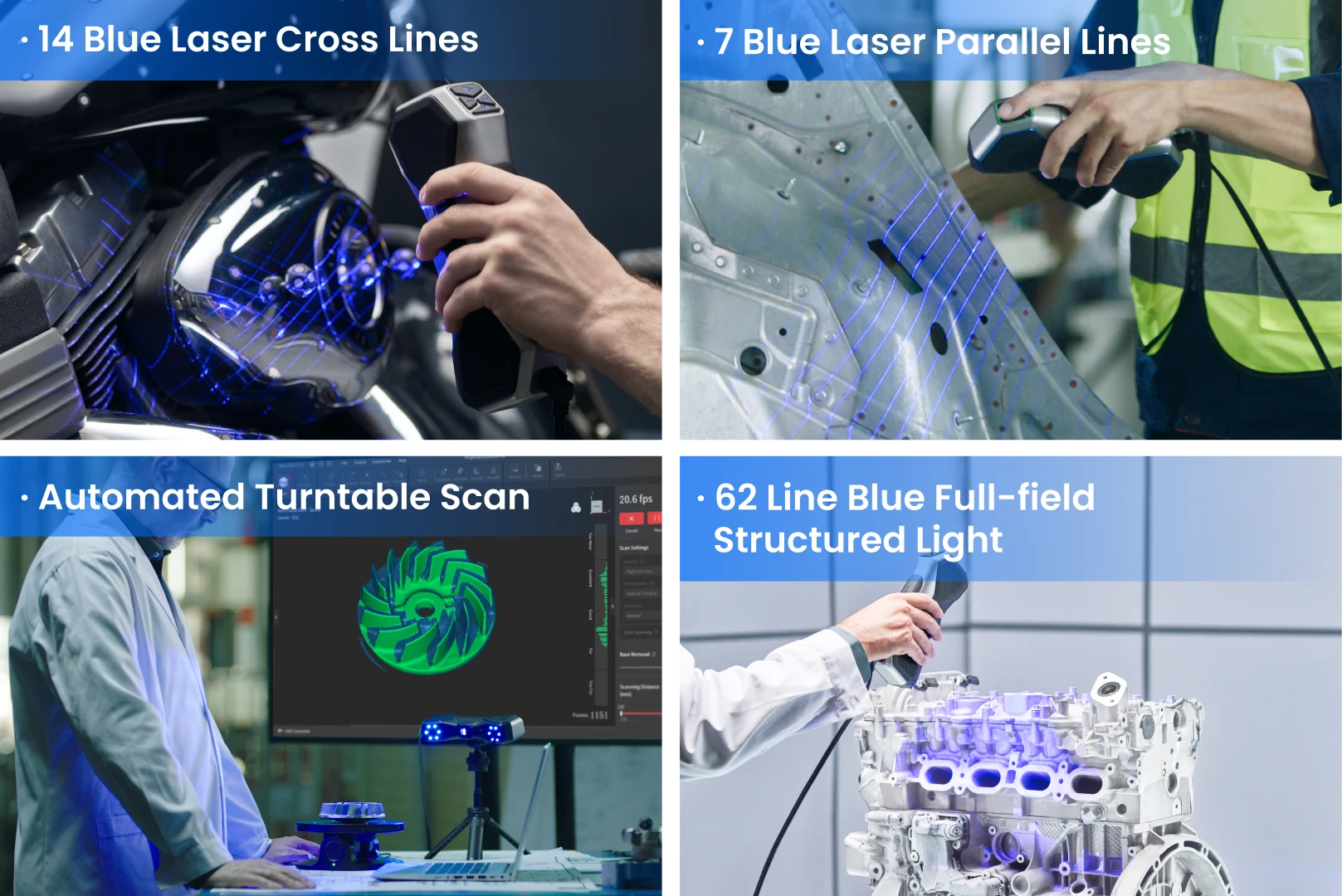
- Cross Lines laser: Fourteen crossed lines rapidly scan larger surfaces at speeds of up to 800,000 points/second. No scanning spray is needed for glossy or black areas.
- Parallel Lines laser: Seven high-powered parallel blue laser lines are projected to accurately capture fine details, edges, and complex surfaces.
- Full-field structured light: Using blue structured light, it offers high-speed scanning at up to 7 million points/second for efficient point cloud capture. This mode also enables marker-free scanning of feature-rich objects, simplifying the process and reducing setup time.
- Auto Turntable: The hands-free setup lets users place MetroX on a desk and automatically scan objects using the Dual-axis Turntable and full-field structured light. This mode ensures reliable point cloud and color capture every time.
High Precision and Accuracy
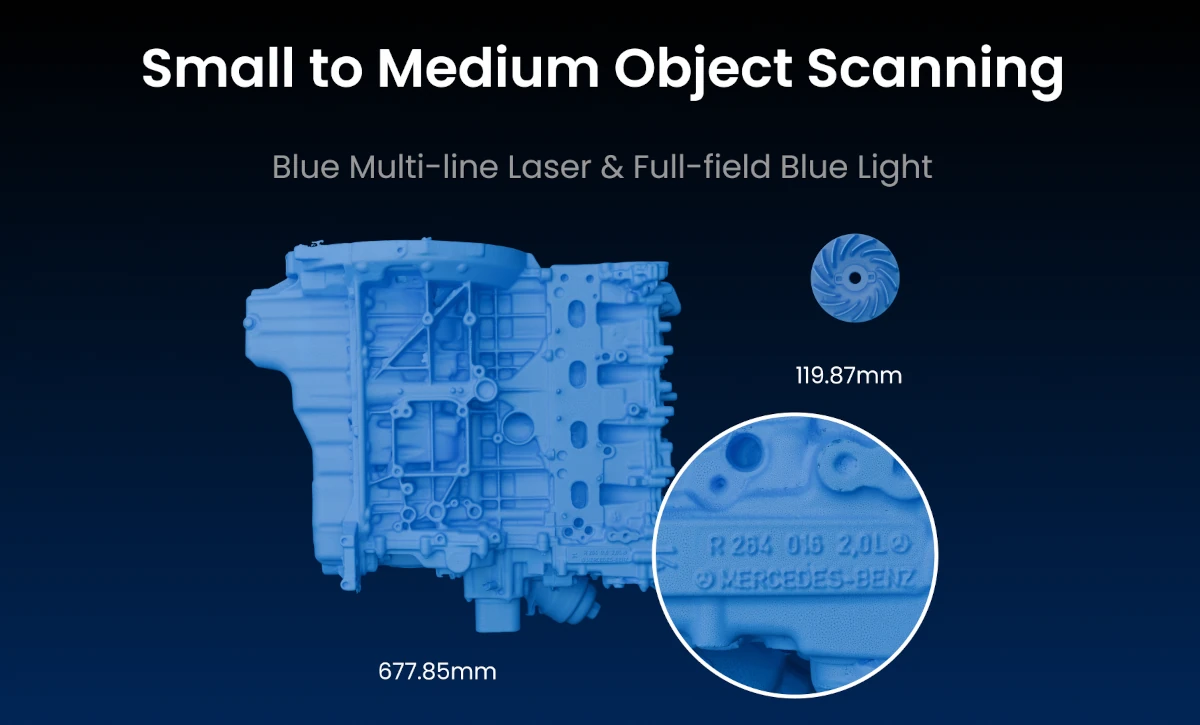
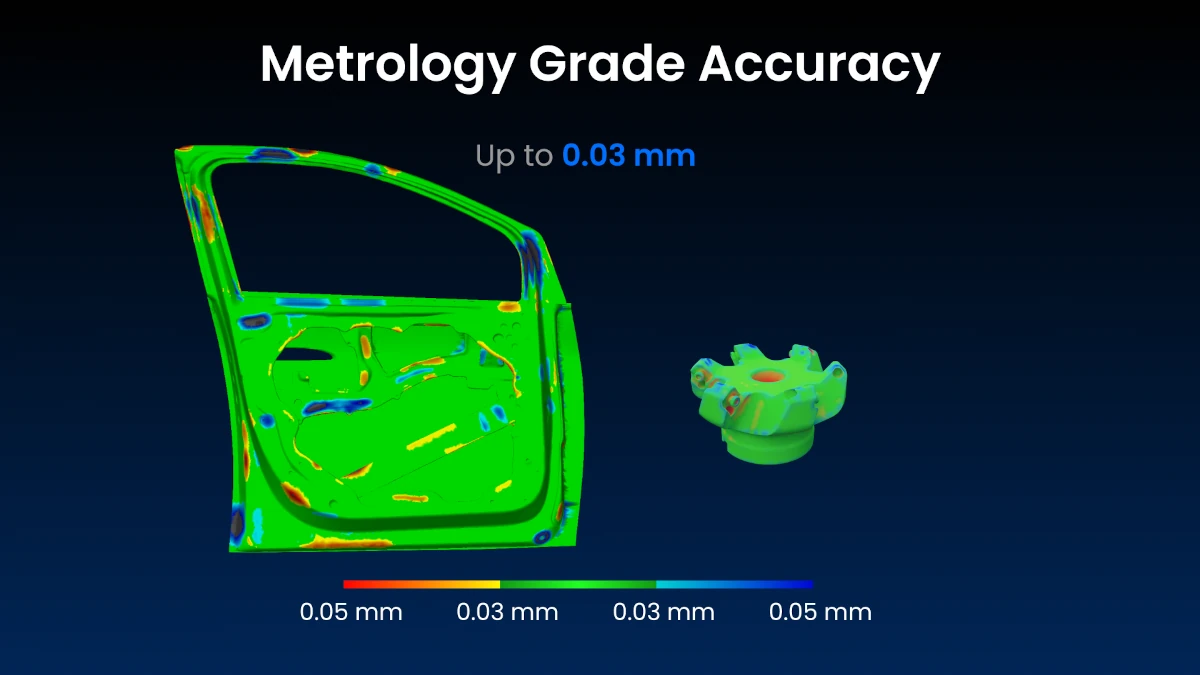
MetroX captures feature-rich and featureless objects with remarkable fidelity—up to 0.01 mm precision, 0.03 mm accuracy, and a fused point distance of up to 0.05 mm.
Additionally, the included high-end lithography calibration plate features pattern accuracy of up to 10 μm, making it easy to calibrate the MetroX 3D scanner and maintain reliable accuracy.
Seamless Workflow
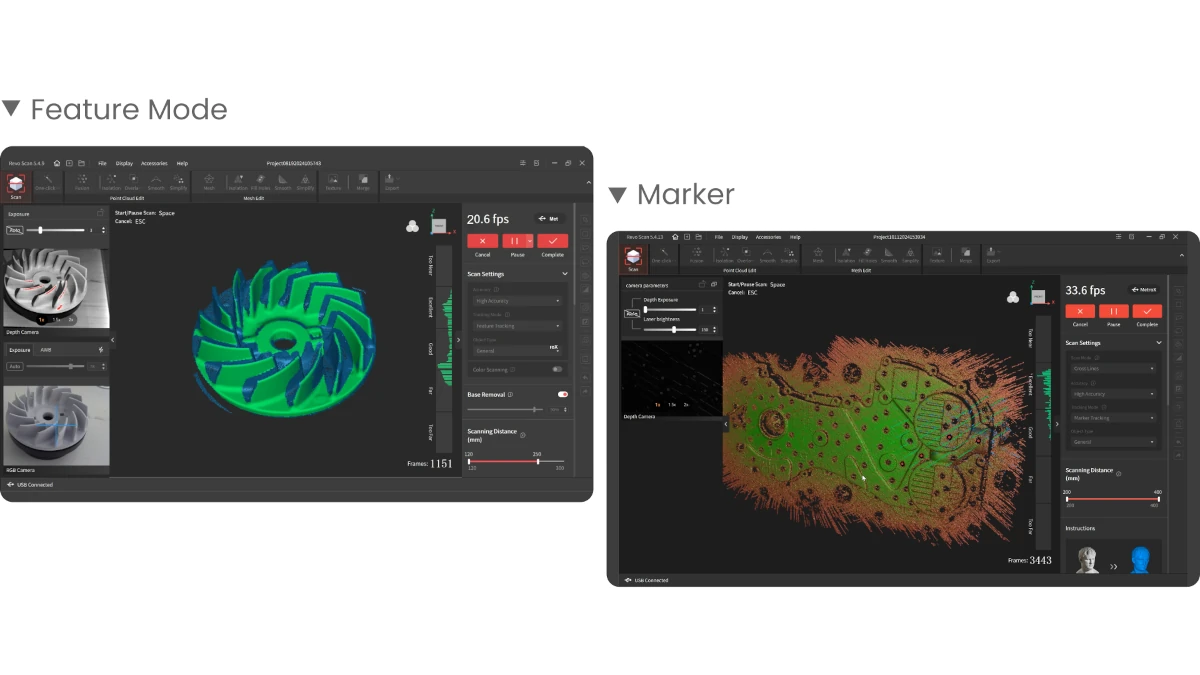
The free companion software, Revo Scan, streamlines the scanning and post-processing workflow, covering point cloud fusion, meshing, editing, and import/export options. It can also offer a wide variety of file formats for full compatibility with third-party software like Quicksurface, Geomagic Wrap, and Geomagic Control.
Professional Solutions
MetroX offers professionals an enhanced reverse engineering, quality control, additive manufacturing, and rapid prototyping 3D modeling experience with metrology-grade accuracy at an appealing price.
What’s in the Box?
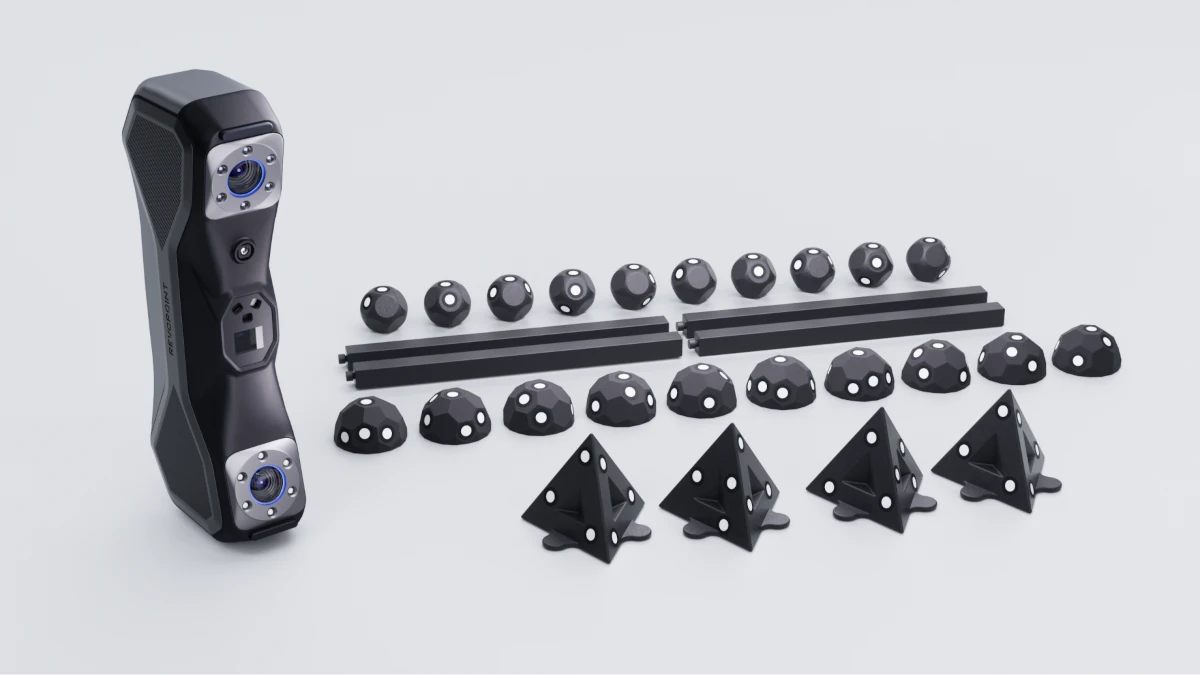
The Revopoint MetroX 3D scanner comes in a smart-looking aluminum carry case that houses the scanner and all its accessories, including a Dual-axis Turntable, a tripod, markers, a calibration board, a power adapter, a USB Type-A to Type-C cable, a scanner cradle and other essential tools. Additionally, a quick start guide is included to ensure that users have everything necessary to begin using the scanner promptly.
The Advanced Edition of the MetroX 3D scanner comes with the Marker Block Kit, which includes 10 magnetic dome markers, 4 magnetic pyramid markers, 10 magnetic ball markers, 4 magnetic bar markers, and additional 500 markers, all specifically designed to enhance and simplify your scanning process.
Revopoint MetroX 3D Scanner: Tech Specs
The technical specifications of the Revopoint MetroX 3D scanner are as follows:
| Scanning Type | Handheld and Desktop |
| Technology | Multi-line laser scan and Full-field structured light scan |
| Single-frame Precision, up to | 0.01 mm |
| Single-frame Accuracy, up to | 0.03 mm |
| Fused Point Distance, up to | 0.05 mm |
| Volumetric Accuracy | 0.03 mm + 0.1 mm × L (m). L is the length of the object. |
| Working Distance | 200 – 400 mm |
| Single Capture Area at Nearest Distance | 160 x 70 mm at 200 mm |
| Single Capture Area at Furthest Distance | 320 x 215 mm at 400 mm |
| Angular Field of View (H × V) | 43 x 33° |
| Minimum Scan Volume | 10 x 10 x 10 mm |
| Maximum Scan Volume | 1 x 1 x 1 m |
| Scanning Speed, up to | Multi-line Laser Scan: 800,000 Points/s Full-field Structured Light Scan: 7,000,000 Points/s |
| Depth Camera Resolution, up to | 2 Megapixels |
| RGB Camera Resolution | 2 Megapixels |
| Color Scanning | Only in Auto Turntable Mode |
| Tracking Methods | Feature, Marker, Global Marker |
| Outdoor Scanning | No |
| 3D Light Source | 14 Blue Cross Laser Lines 7 Blue Parallel Laser Lines 62 Line Blue Full-field Structured Light |
| Fill Lights | 12 Blue LEDs |
| CPU | 4 core ARM, 2.0 GHz |
| Built in Chip Computing | Depth Map Computing |
| Buttons | 4 |
| Output File Formats | PLY, OBJ, STL, ASC, 3MF, GLTF, FBX |
| Ready to Print 3D Models | Yes |
| Connector Type | USB Type-C |
| Power Requirements | DC 12V, 3A |
| Scanner Weight | 508 g |
| Dimensions (L x W x H) | 209 x 88 x 44 mm |
| Supported Accessories | Dual-axis Turntable, Marker Block Kit |
| Compatible Operating Systems | Windows 10/11 (64-bit), macOS 11.0 or better |
The post Revopoint MetroX 3D Scanner: Blue Laser Scanning Breakthrough at an Appealing Price! (Sponsored) appeared first on CNX Software - Embedded Systems News.
Humane rappelle les boitiers de charge de son AI Pin
L’Ai Pin est un gadget proposé par Humane et qui a tenté de surfer sur la vague de l’Intelligence Artificielle en début d’année. Et quand il est finalement sorti, le public a découvert un appareil malhabile, malcommode et affreusement cher. Un appareil qui n’a aucun intérêt puisqu’il peut être très facilement et plus efficacement remplacé par une application.
Le truc marrant avec l’AI Pin, c’est son tarif. 699$ HT et l’obligation de prendre un abonnement cellulaire dédié à 24$ HT. Ce qui nous fait une première année à 990$ HT soit quelque chose comme 1100€. Pour ce prix, on peut s’attendre à un appareil de qualité… mais en fait c’est pas grand chose d’autre qu’un outil qui sert de pont vers un serveur pour lancer des questions et vous communiquer ensuite les réponses obtenues. Le fait qu’il soit incapable de faire cette tâche de manière efficace en étant mauvais dans la capture de son environnement et fort lent dans ses réponses est déjà en soi un problème. Le fait que l’appareil ne soit pas bien pensé, chauffe et pendouille sur vos vêtements est un autre problème. Mais on apprend que Humane vient de proposer un rappel de son chargeur pour un défaut de conception.

Tous les clients de la marque qui ont acheté cette option (oui c’est une option à 129$HT en plus du prix de base) ne doivent pas l’utiliser car la batterie intégrée pourrait surchauffer et détruire l’appareil que l’objet est censé recharger. Plus de 10 000 chargeurs sont donc rappelés par la marque. Une fois le rappel validé l’utilisateur , je ne sais pas si ce mot est valable, sera remboursé ou pourra espérer un chargeur de remplacement dans les 3 à 6 mois…
C’est en réalité une bonne nouvelle car j’imagine que plus personne n’ose trop porter ce bidule à son torse de peur de passer pour le dernier des crétins. Du coup il y a une petite chance de pouvoir récupérer quelques dollars dans ce cauchemar technologique.

Regardez autour de vous, on trouve des dizaines et des dizaines de matériels qui emploient des chargeurs de ce type. Des casques audio, des micro cravates, des appareils en tous genres qui ont adopté des chargeurs mobiles. Je ne parlerais pas des batteries externes USB car là ce sont des centaines de marques et de modèles qui existent sur le marché. Apple propose son chargeur d’AirPod Pro à 109€ TTC, son chargeur classique est à 89€ TTC. Un étui de charge DJI Mic 2 est commercialisé à 69€ TTC.

On est loin des 129$ HT (140€ TTC) du chargeur d’Humane. Et encore, c’est le prix quand on achète l’appareil et le chargeur ensemble, sinon c’est vendu 149$ HT (164€ TTC). Comme peut-on construire un chargeur que l’on va vendre à 160€ et ne pas s’assurer qu’il ne présentera aucun risque pour son produit vendu 699$ HT et que l’on présente comme le fleuron de l’intelligence humaine ? Cela me dépasse. Des marques absolument « Noname » arrivent à fournir des chargeurs de ce type sans soucis. Des marques internationales proposent des produits de qualité pour moins cher et Humane arrive à se rater sur cet accessoire.
La leçon à tirer de tout cela est toujours la même. Il ne faut jamais se précipiter sur des produits qui surfent sur la dernière mode, c’est très rarement signe d’un produit parfaitement fiable. Ni d’un point de vue logiciel, ni d’un point de vue matériel.
Minimachines.net en partenariat avec Geekbuying.com
Humane rappelle les boitiers de charge de son AI Pin © MiniMachines.net. 2024.

Murata unveils stretchable PCB technology for medical and bio-sensing applications

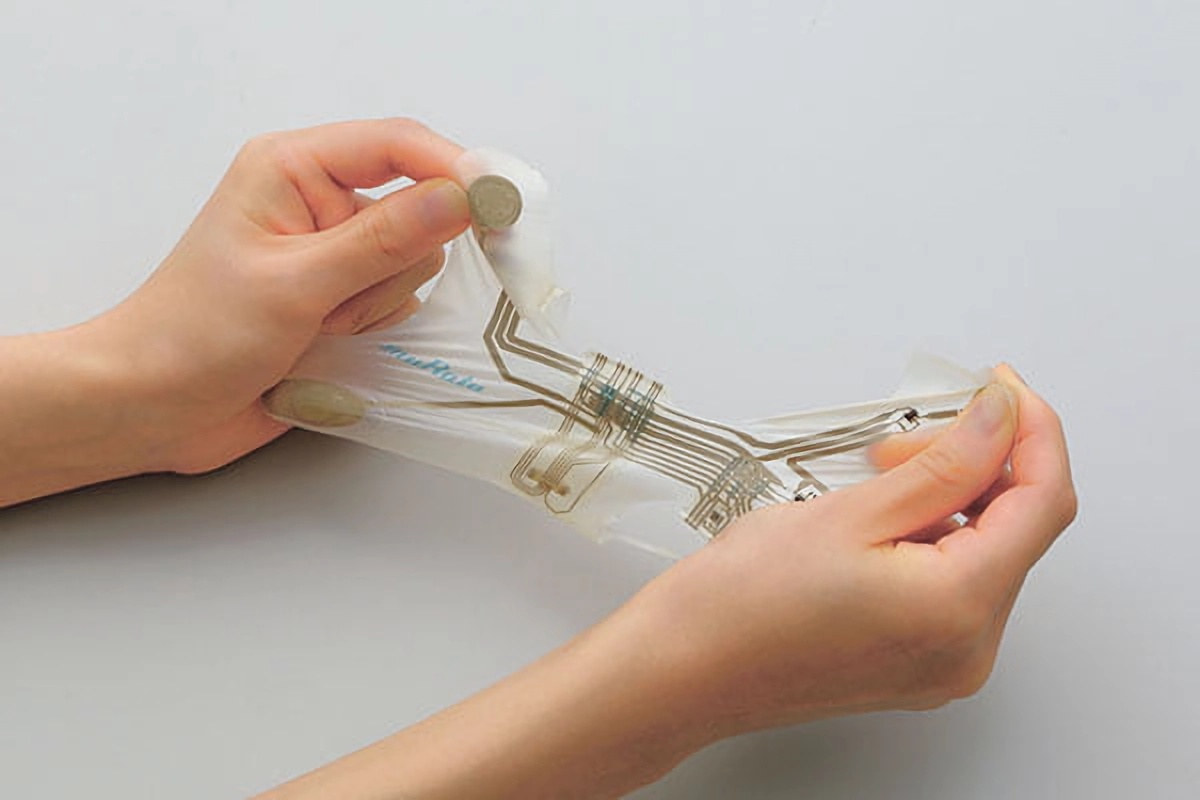
Many PCB vendors now provide flexible PCB manufacturing services, but Murata goes further with stretchable PCB technology that’s not only bendable but can be twisted and stretched to better fit on the body for bio-sensing and medical applications even on parts such as an elbow.
Traditional bio-monitoring sensors have some limitations. For example, they can become unstuck when the body moves, damage the delicate skin of infants and the elderly, data may be distorted due to body movement, and Murata explains “there is a risk of a decline in insulation and the occurrence of ion migration when using a thermoplastic polyurethane elastomer (TPU), known as a stretchable base material, in a high humidity environment”. The company’s stretchable printed circuits ((SPC) are supposed to solve or at least mitigate all those issues.
The technology is under development, but Murata still shared some highlights of the technology:
- Stretchable electrode printing in compliance with ANSI/AAMI EC12 (in-house test). EC12 is a standard established by the American National Standards Institute (ANSI) and the U.S. Association for the Advancement of Medical Instrumentation (AAMI) that stipulates the specifications required in disposable electrodes used when conducting electrocardiograms and other tests.
- About 100 µm per layer
- PCB tested with stretchable silver and silver chloride electrodes
- Suppresses the occurrence of ion migration, a phenomenon that causes short circuits in metal wiring, pattern wiring, and other elements formed on resin materials due to the application of a constant voltage in a high-humidity environment.
- Coating with a safe base material verified with a cytotoxicity test (in-house test based on ISO 10993)
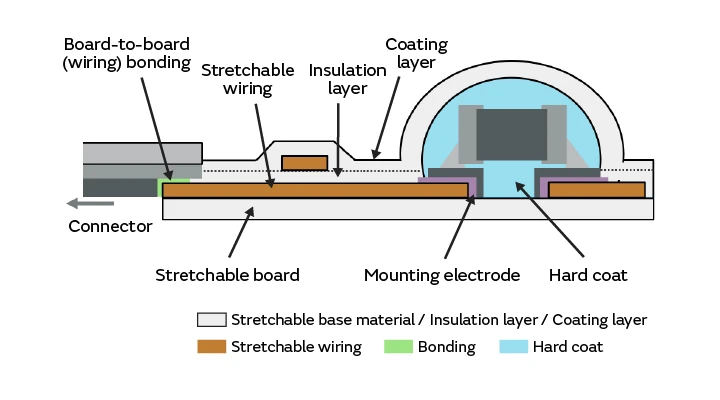 Some applications include stretchable bioelectrode array sheets for bio-potential and bioimpedance measurements such as electrocardiograms (ECGs), electroencephalograms (EEGs), and electromyographs (EMGs), active electrode sheets equipped with an amplifier near the bioelectrode, wireless stretchable wearable patches equipped with BLEs, MCUs, and coin batteries, multi-parameter measurement sheets equipped with various sensors such as thermistors and accelerometers, and shielded soft signal distribution cables.

Murata did not provide a timeline for the stretchable printed circuit services, but the company shares that they will be able to design and manufacture interface modules between the human body and medical devices, jointly develop custom products, and provide local support. But they can NOT help customers design medical devices, implement final productization and conduct inspections, conduct clinical trials, and obtain approval as medical devices. More details can be found on Murata’s website and the video below is worth a watch as stretchable PCBs can be twisted and stretched by more than I initially thought.
The post Murata unveils stretchable PCB technology for medical and bio-sensing applications appeared first on CNX Software - Embedded Systems News.
Transforming Pawn Changes the Game

3D printing has allowed the hobbyist to turn out all sorts of interesting chess sets with either intricate details or things that are too specialized to warrant a full scale injection molded production run. Now, the magic of 3D printing has allowed [Works By Design] to change the game by making pawns that can automatically transform themselves into queens.
Inspired by a CGI transforming chess piece designed by [Polyfjord], [Works By Design] wanted to make a pawn that could transform itself exist in the real world. What started as a chonky setup with multiple springs and a manually-actuated mechanism eventually was whittled down to a single spring, some pins, and four magnets as vitamins for the 3D printed piece.
We always love getting a peek into the trial-and-error process of a project, especially for something with such a slick-looking final product. Paired with a special chess board with steel in the ends, the magnets in the base activate the transformation sequence when they reach the opposite end.
After you print your own, how about playing chess against the printer? We’d love to see a version machined from metal too.
Thanks to [DjBiohazard] on Discord for the tip!

🧬 Il existe un lien entre votre santé cardiaque et cognitive

The Plaud NotePin is the AI assistant everyone needs

ChatGPT Messes Up Badly During Demo With CEO of Chanel

Glass Ceiling
Is ChatGPT a little close-minded, a little old-fashioned in its thinking?
Ask Chanel CEO Leena Nair, who was left disappointed — if not insulted — after she got to experiment with the OpenAI chatbot during her visit to Microsoft's headquarters in Seattle.
Nair, who is the second female global CEO in the iconic fashion house's nearly 115-year history, recalls how she gave ChatGPT a fairly softball image prompt — only for it to screw up badly.
"We're like, 'Show us a picture of a senior leadership team from Chanel visiting Microsoft,'" she said in an interview at the Stanford Graduate School of Business, as quoted by Fortune.
The result? It was "all men in suits," she recalled.
That'd be a mistake at any big corporation, but it's a particularly egregious one to make for Chanel, a brand that mostly caters to women and was founded by one: Coco Chanel, one of the most famous fashion designers in history. You'd think ChatGPT would've scraped a Wikipedia article on that.
"This is Chanel," Nair asserted in the interview. "76 percent of my organization is women. 96 percent of my clients are women. Female CEO," she added, pointing to herself.
"It was a 100 percent male team, not even in fashionable clothes," she roasted. "Like, come on. This is what you've got to offer?"
AI Gaze
Despite what Elon Musk and his ilk of culture warriors might say — that ChatGPT is "woke," or whatever — a wide body of research and embarrassing debacles have demonstrated that generative AI models frequently produce racist and sexist outputs.
Some of the half-baked attempts to put guardrails against this have only heightened the obviousness of their shortcomings.
The problem is that AI models are mostly a product of what they're trained on — the internet, replete with repulsive content — and therefore reinforce the same biases that humans hold. When the tech bears the image of being some impartial, superintelligent arbiter of reality, being presented with its overtly sexualized depictions of women, for example, can be whiplash-inducing.
That being said, Nair is a believer in AI, and says that Chanel has been working on getting "AI-ready." But she's ardent that the tech needs to be designed with "ethics and integrity" in mind.
"I constantly talk to my friends in tech, all the CEOs, saying, 'Come on, guys, you gotta make sure that you're integrating a humanistic way of thinking in AI,'" Nair said, per Fortune.
For now, though, we'd suggest that "AI industry" and "ethics" is a bit of an oxymoron.
More on AI: Mark Zuckerberg Pledges to Fill Facebook With Even More AI Slop
The post ChatGPT Messes Up Badly During Demo With CEO of Chanel appeared first on Futurism.
Animal Tests Show Promise for Restoring Heart to More Youthful Condition, Even After Heart Attack

Scientists are working on turning back the clock on human hearts, allowing patients to grow new heart muscle even after cardiac injury.
As the Wall Street Journal reports, these treatments could represent new hope for patients with heart disease, even after suffering a heart attack.
However, scientists still have a lot to prove, and clinical trials of such treatments in humans are still many years out. Whether any of them turn out into viable ways to treat heart disease, the leading cause of death in the US, remains to be seen.
However, early animal trials are proving to be promising, offering a glimpse of a future in which we could undo heart damage that's currently seen as irreversible.
One approach involves using microRNA to force cardiac cells to start to multiply again. Early experiments by researchers at King's College London involving pigs showed that such a therapy could improve the heart's pumping function, but researchers are still investigating a more effective delivery method.
Other scientists at Scripps Research are using drugs that target proteins that are responsible for cell growth, with the goal of inducing patients' hearts to physically grow larger, as the WSJ notes. Early trials involving mice and pics saw the animals' heart-pumping capacity almost go back to normal after suffering a heart attack.
Some researchers are also working on stem cell therapies that can grow new heart cells, which can then be grafted onto a damaged heart, encouraging it to "remuscularize." University of Southern California stem cell researcher Chuck Murry and his colleagues recently found that their stem cell treatment allowed macaques' hearts to regain full pumping function.
But as the WSJ reports, Murry and his team found that the new cells caused arrhythmias because they were beating to their own rhythms.
Nonetheless, he's hoping to kick off human clinical trials as soon as 2026.
"Society has become OK with the notion of dying from heart disease," he told the WSJ. "It does not have to be this way, because we can do something about this now."
A more experimental approach involves growing entire "personalized" hearts in a lab using cultured human stem cells. Doris Taylor, the CEO of a biotech company called Organamet Bio, told the newspaper that she's hoping to kick off human clinical trials in about five years.
It's possible that none of these treatments will pan out. But it's a promising new avenue of research — and one that just might make a dent in the leading cause of hospitalizations in the US in the not-so-distant future.
More on hearts: Scientists Puzzled to Find Plastic Fragments Inside Human Hearts
The post Animal Tests Show Promise for Restoring Heart to More Youthful Condition, Even After Heart Attack appeared first on Futurism.
How generative AI could supercharge retailers’ ad networks
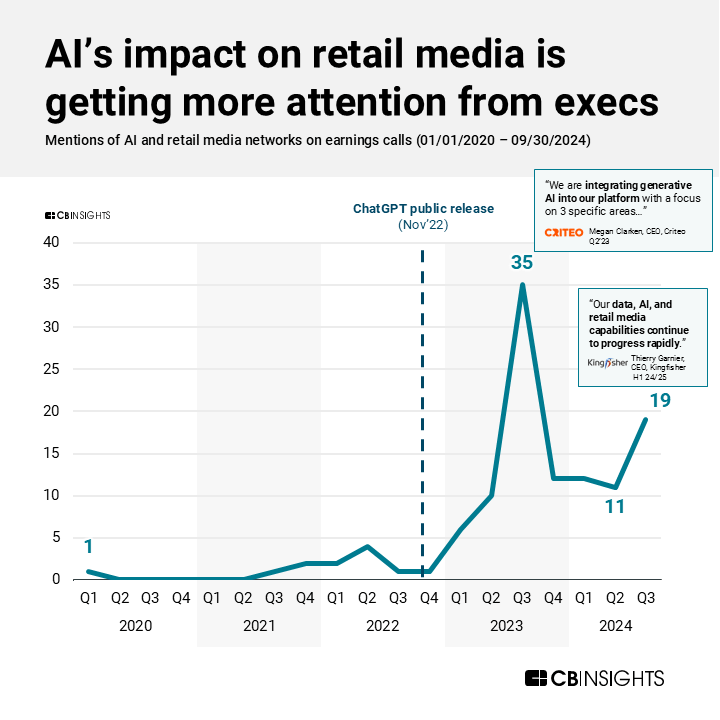
The $140B global retail media market is eyeing AI for growth.
Discussions of retail media networks (RMNs) and AI are picking up momentum among execs from retailers, agencies, and digital media companies:
Want to see more research? Join a demo of the CB Insights platform.
If you’re already a customer, log in here.
The post How generative AI could supercharge retailers’ ad networks appeared first on CB Insights Research.
Small Volumetric Lamp Spins at 6000 RPM
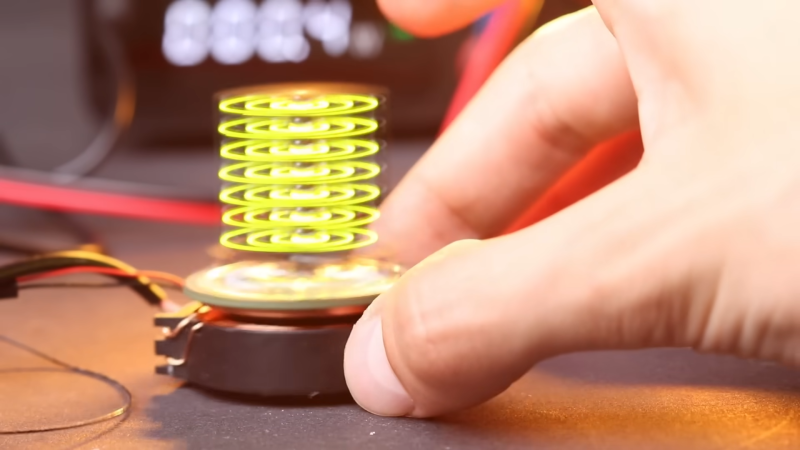
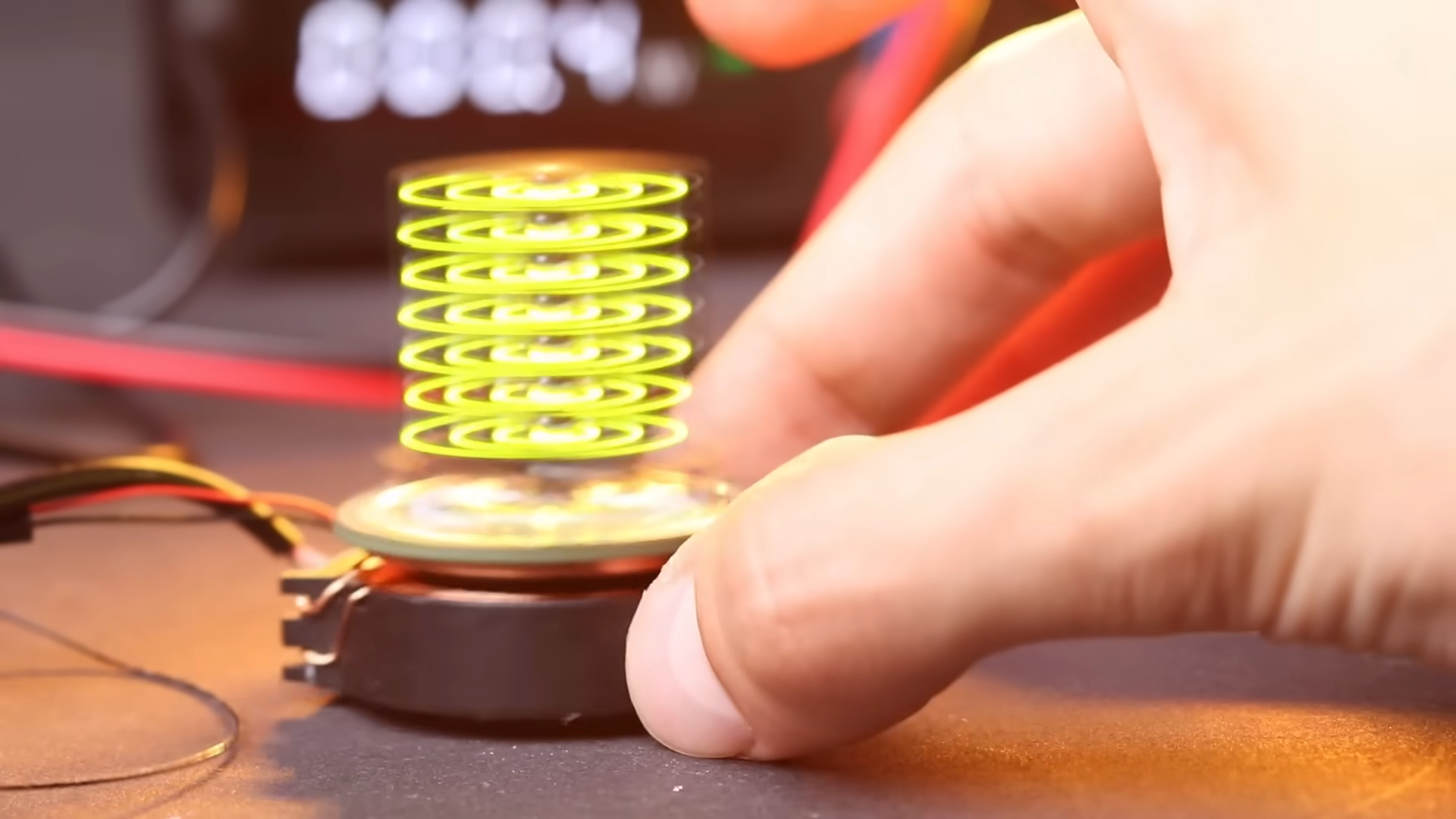
Volumetric displays are simply cool. Throw some LEDs together, take advantage of persistence of vision, and you’ve really got something. [Nick Electronics] shows us how its done with his neat little volumetric lamp build.
The concept is simple. [Nick] built a little device to spin a little rectangular array of LEDs. A small motor in the base provides the requisite rotational motion at a speed of roughly 6000 rpm. To get power to the LEDs while they’re spinning, the build relies on wire coils for power transmission, instead of the more traditional technique of using slip rings.
The build doesn’t do anything particularly fancy—it just turns on the whole LED array and spins it. That’s why it’s a lamp, rather than any sort of special volumetric display. Still, the visual effect is nice. We’ve seen some other highly capable volumetric displays before, though. Video after the break.
OpenAI Patent Could Improve Voice AI Models’ Focus
OpenAI wants to hear you better.
The company is seeking to patent a system for “multi-task automatic speech recognition.” OpenAI’s patent details a voice-activated AI model that’s able to handle tasks in several different languages.
OpenAI’s tech uses a transformer model, which learns context and relationships between data, outfitted with an encoder and decoder to process streams of audio and turn them into text. The decoder is configured to pick up a “language token,” which specifies the target language for translation, as well as a “task token,” which determines the task that the audio stream is asking for.
Additionally, the transformer model is configured to understand “special-purpose tokens,” which guide it to complete specific tasks, and “timestamp tokens,” which time-align audio to text.
“There are many different tasks that can be performed on the same input audio signal: transcription, such as translation, voice activity detection, time alignment, and language identification,” OpenAI said in the filing.
This system helps the model understand relationships between audio snippets and their corresponding text to make it more efficient at translation and task performance, and uses these specific tokens to hone the model’s skills in specific contexts.
Voice-operated AI has become a priority for OpenAI. The company unveiled its advanced voice mode back in May with the announcement of GPT-4o, and released the feature to an invite-only group in July before opening it up to a wider audience at the end of September.
The model surpasses its standard voice mode, capable of handling interruptions and interpreting emotion in a user’s voice. Additionally, the company unveiled several new tools earlier this month that are capable of fast-tracking voice assistants’ development using only a single set of instructions.
However, the company has run into problems with some of its speech recognition tech. OpenAI’s transcription model Whisper has reportedly faced major issues with hallucinations, researchers told the Associated Press, something that’s particularly problematic given the model’s use in healthcare settings.
“It’s an absolute nightmare to have a medical translation tool hallucinate,” said Bob Rogers, Ph.D., the co-founder of BeeKeeperAI and CEO of Oii.ai. “The last thing you want to do is try and push out mission-critical applications and technology that’s not ready for primetime.”
But the tech in this patent (one of the very few filed by OpenAI) could be a “first step” toward making speech recognition models more robust, said Rogers. Having a one-size-fits-all approach to AI may work for some models, but for those used in critical applications, context is often key, he said. “This idea of focusing and creating tokens that control context could be a good start,” Rogers said.
Plus, a major issue with “far-ranging” models is the domino effect that can occur as it learns and grows. “You change things in one place and you get impacts in others — it’s really hard to control,” Rogers said. “Maybe focusing helps with that as well.”OpenAI wants to hear you better.
The post OpenAI Patent Could Improve Voice AI Models’ Focus appeared first on The Daily Upside.
Google Patent Could Overcome Quantum Cooling Barriers
Quantum computers run hot. Google wants to cool them down.
The company is seeking to patent a “cryogenic cooling system” for “multi-unit scaling of quantum computing.” Google’s tech uses multiple stages of cooling to properly get a quantum computer to the extremely low temperature it needs to operate.
The reason quantum computers need to be kept so cool is that they rely on “superconductivity,” or conducting an electrical current without energy loss, to operate, Google said. “A challenge associated with quantum computing includes cooling quantum hardware … to a temperature at which the superconducting qubits achieve superconductivity.”
Google’s tech uses seven stages to cool these devices close to cryogenic “absolute zero” temperatures, referring to the lowest point on the Kelvin scale — nearly -460 degrees Fahrenheit.
The first stage starts above 60 kelvins, or roughly -350 degrees Fahrenheit, and the drops between temperatures get smaller at each stage, reaching around 20 millikelvins (-459 degrees Fahrenheit) by stage seven. This tiered method ensures that there isn’t a dramatic drop in temperature that could damage the quantum components.
Quantum computing faces a number of barriers to scaling. The stability of these devices is deeply impacted by their environment. The most advanced ones have only reached just over 1,000 qubits, and, as Google’s patent addresses, they need to be kept near absolute zero.
“This patent really shows that they’re trying to improve their mastery of [quantum], at least on the cooling side in terms of temperature efficiency, because you don’t want to spend too much energy cooling,” said Ashley Manraj, chief technology officer at Pvotal Technologies.
Quantum computers need to be kept in extremely isolated environments, making their usefulness and collaboration with classical computers limited. “Getting the normal computer itself next to a quantum computer ends up being a problem,” said Manraj.
“This patent is interesting because the objective seems to be to maintain efficient stages of cooling and progressively have regular computers be introduced next to the quantum workload,” he added.
While these obstacles remain significant, the advantages of this market may be underestimated, said Manraj. A quantum computer’s main strength is optimization, he said, which in theory can be applied to practically any field: economics, agriculture, logistics, government, and more. “Basically, we don’t even know what we don’t know,” he said.
Researchers are constantly making progress on this tech, said Karthee Madasamy, founder and managing partner at deep tech venture fund MFV Partners, and many have gone from focusing on physics problems to engineering ones.
“We came to the edge of Moore’s law a few years ago,” said Madasamy. “This is really the next generation of computing.”
And while very few working quantum computers exist, they’re something that Google, IBM, Amazon, and practically every hyperscaler company have their eyes on, he said. There likely won’t be one clear “winner” of quantum computing, he said, but a combined effort of “multiple architectures” that pushes the boundaries.
“Even supercomputers cannot solve many of these problems — it’ll take them thousands of years to solve a problem that can be done in a few minutes [with quantum],” said Madasamy. “I have not seen any other technologies that can leap from current trends of computing to newer things that we can achieve.”
The post Google Patent Could Overcome Quantum Cooling Barriers appeared first on The Daily Upside.
XPANCEO smart contact lenses hands-on: AR prototypes from the future
At AWE, XPANCEO, a Dubai-based company working on smart contact lenses, showcased a few interesting prototypes of its futuristic technology. I was able to even put my eyes close to one of them and I want to tell you everything about this experience!
XPANCEO
If you’re not new to this space, you will surely remember Mojo Vision, an incredible company based in the US that was working on smart contact lenses. Unluckily, after having reached incredible milestones, like having their CEO putting a smart lens inside his eyes, the company pivoted to manufacturing microdisplays.

The dream of having smart contact lenses seemed to vanish, but a new startup called XPANCEO came to the rescue. Based in Dubai, it was founded by two Eastern European guys: Roman Axelrod, a serial entrepreneur, and Valentyn S Volkov, a renowned scientist. Together they joined forces with the mission of creating smart and AR contact lenses.
I interviewed the founders of XPANCEO a few months ago, and they gave me a virtual tour of their laboratory in Dubai. From my remote tour, I had the impression that these guys seriously have the skills to be able to deliver what they have in mind. Differently than Mojo, though, they don’t have a clear roadmap in mind, yet. They are experimenting with different approaches to this hard problem, creating many different prototypes until they understand which is the best way to fulfill their vision. XPANCEO claims to be on track to unveil a fully functional smart contact lens prototype by the end of 2026.
At AWE, XPANCEO was showcasing a few prototypes, and for the first time, also a smart lens in which you could put your eye in.
XPANCEO smart contact lens hands-on
The most exciting moment for me at the booth of XPANCEO, apart from meeting in person Roman and Valentyn, was putting my eyes inside a contact lens made by the company. Exactly like with Mojo Vision, people couldn’t put the lenses inside their eyes, for evident safety reasons. But it was possible to grab the demo unit and put it close to the eye so that to see some visuals inside. And this was already fantastic.

Every time I try some smart contact lens, the magic is always the same: I see it from the outside and it just seems like a normal small contact lens. Then I put it very close to the eye, I start seeing some visuals in it, and I am like WOWOWOW, THIS IS THE FUTURE. It is always very magical and very cyberpunk.
The demo unit was a hard plastic lens having a holographic display. There was an external light source in the handle of the demo device which was emitting the light in a certain way, and the lens, thanks to its holographic display, was letting me see the imagery that I was intended to see. When I put my eyes inside it, after I managed to focus on it, I was able to see some monochrome green writings, something like a simple video emulating the menu of an application that was in use. The imagery was very simple, we are not talking about the menu of the iPhone, more like the menu of a home video game in the 80s: green straight lines and texts.
The visuals I could see were defined enough to see the menus and read the texts. I have the sensation that Mojo Vision had better clarity, though, because I remember crisper texts.
The FOV of the XPANCEO lens was also very limited, so I could barely see a little portion of the menu interface. According to the press release I received after I visited the booth, the lens has a 30° FOV, but I can tell you that the perceived one was less. One of the reasons is that these lenses are made to show full FOV when they are worn on the eye, but of course, I could not do this test, so my perceived FOV with the lens close to the eye was probably just in the range 10-20°.

It’s crazy that this is possible with a power consumption of just 1-3 microwatts. I mean, actually, it’s crazy that something like this is just even possible.
Other XPANCEO prototypes
The demo lens I tried is a new prototype that the company has brought to AWE and that is called “Smart Contact Lens for AR Vision”. As I’ve said, the company is working on many possible prototypes, and some of them were showcased inside some display cases in the booth.

One of the other prototypes showcased was the “Smart Contact Lens with Transparent Electronics”, which was another hard lens that featured of course some transparent electronic components, plus in the middle a one-pixel display. All of this was made possible by XPANCEO’s patent-pending ultra-thin transparent and flexible gold conductors. Valentyn Volkov explained to us that this prototype is closer to what Mojo Vision was doing, that is it has a microdisplay in the middle. He told us that this is a clear example of the experimentation stage the company is in: for the display of the lens they are trying different approaches, both the holographic display of the lens I put my eyes in and the “standard” microdisplay of this prototype.

The “Smart Contact Lens for Data Reading” was instead a demonstration of “wireless data transmission capabilities integrated directly into the lens, enabling real-time interaction with data and the ability to receive information, such as biometric data, from embedded sensors” (Yes, I copied this sentence from the press release). The lens integrated some NFC technology and it was possible to put your phone close to it so that the lens made it go to DuckDuckGo and search for “XPANCEO”. I jokingly asked Valentyn if this was the future of the promotion of my blog: in the future, when I meet people at exhibitions, I randomly ask them to smash a phone into my eye to make them go to my website (I would become blind, but at least I would avoid the pain of spelling “skarredghost” all the times…). He explained to me that the NFC thing is of course a toy interaction for exhibitions to make visitors of the booth amused and the data transmission interactions imagined for the future are actually different.

The last prototype highlighted in the booth was its “Contact Lens with Intraocular Pressure (IOP) Sensor”. This lens featured a small square which was a sensor for intraocular pressure, which is an important parameter for the early detection of glaucoma. This sensor installed directly on the eye can constantly monitor IOP with great accuracy, and if this data is collected e.g. by a smartphone, it could be used to detect some possible health issues before it is too late. What was amazing about this lens is that it was not a hard lens, but a soft hydrogel one. This is relevant because many people who wear contact lenses every day don’t wear hard plastic lenses, but this kind of soft ones. So if XPANCEO manages to install its technology into soft lenses, it could really pave the way to the future of technology. This is an edge the company has over Mojo Vision, which only operated on hard scleral lenses.

Final considerations


I’m a big fan of smart contact lenses and at the booth of XPANCEO, I looked like a little kid inside Santa Claus’s village. It was very interesting to see the different prototypes the company is working on, and especially it was magical to put my eyes inside one of them. There is still a lot of work to do to have commercially available smart contact lenses, but it is great to see that there are already tangible experiments in this sense. XPANCEO is proving with these showcases that they have the capability of actually delivering something interesting.
The dream of having smart contact lenses in this decade is one we can have with our eyes opened…
The post XPANCEO smart contact lenses hands-on: AR prototypes from the future appeared first on The Ghost Howls.
GPU Screen Recorder - Enregistrez votre écran sans perte de FPS
Voici un petit outil bien pratique pour enregistrer votre écran sous Linux sans faire cramer votre CPU ! Ça s’appelle GPU Screen Recorder et ça utilise quasi exclusivement la puissance de votre carte graphique (GPU) pour enregistrer votre écran, en réduisant au maximum l’impact sur les performances de votre système.
Plus de processeur qui gargouille à mort dès que vous lancez une capture vidéo et cela que vous ayez une carte NVIDIA, AMD ou Intel, ce sera votre fidèle GPU qui se tapera tout le boulot, un peu comme ce fameux ShadowPlay sous Windows pour ceux qui connaissent.
Données de FREE vendues pour 175 000 $ ?
Android Trojan that intercepts voice calls to banks just got more stealthy
Researchers have found new versions of a sophisticated Android financial-fraud Trojan that’s notable for its ability to intercept calls a victim tries to place to customer-support personnel of their banks.
FakeCall first came to public attention in 2022, when researchers from security firm Kaspersky reported that the malicious app wasn’t your average banking Trojan. Besides containing the usual capabilities for stealing account credentials, FakeCall could reroute voice calls to numbers controlled by the attackers.
A strategic evolution
The malware, available on websites masquerading as Google Play, could also simulate incoming calls from bank employees. The intention of the novel feature was to provide reassurances to victims that nothing was amiss and to more effectively trick them into divulging account credentials by having the social-engineering come from a live human.

Cyberattaque Free : contester un prélèvement frauduleux sur son compte en banque

Free a été victime d'une attaque informatique qui a provoqué une fuite de données personnelles et de coordonnées bancaires (IBAN). Il est possible de mettre en place des actions pour détecter et parer d'éventuels prélèvements frauduleux.
Voyager 1 Fault Forces Switch to S-Band

We hate to admit it, but whenever we see an article about either Voyager spacecraft, our thoughts immediately turn to worst-case scenarios. One of these days, we’ll be forced to write obituaries for the plucky interstellar travelers, but today is not that day, even with news of yet another issue aboard Voyager 1 that threatens its ability to communicate with Earth.
According to NASA, the current problem began on October 16 when controllers sent a command to turn on one of the spacecraft’s heaters. Voyager 1, nearly a light-day distant from Earth, failed to respond as expected 46 hours later. After some searching, controllers picked up the spacecraft’s X-band downlink signal but at a much lower power than expected. This indicated that the spacecraft had gone into fault protection mode, likely in response to the command to turn on the heater. A day later, Voyager 1 stopped communicating altogether, suggesting that further fault protection trips disabled the powerful X-band transmitter and switched to the lower-powered S-band downlink.
This was potentially mission-ending; the S-band downlink had last been used in 1981 when the probe was still well within the confines of the solar system, and the fear was that the Deep Space Network would not be able to find the weak signal. But find it they did, and on October 22 they sent a command to confirm S-band communications. At this point, controllers can still receive engineering data and command the craft, but it remains to be seen what can be done to restore full communications. They haven’t tried to turn the X-band transmitter back on yet, wisely preferring to further evaluate what caused the fault protection error that kicked this whole thing off before committing to a step like that.
Following Voyager news these days feels a little morbid, like a death watch on an aging celebrity. Here’s hoping that this story turns out to have a happy ending and that we can push the inevitable off for another few years. While we wait, if you want to know a little more about the Voyager comms system, we’ve got a deep dive that should get you going.
Thanks to [Mark Stevens] for the tip.
Wonder Dynamics now lets you go straight from multi-camera video to fully animated 3D scene
Wonder Dynamics made a strong opening play in AI-enhanced visual effects, providing tools animators and filmmakers actually find useful — and earning the startup a prompt acquisition by Autodesk. Their latest tool further automates the animation process, letting you put in practically any video and get a fully editable 3D scene, characters and all. The […]
© 2024 TechCrunch. All rights reserved. For personal use only.
Supercon 2023: Cuddly Companion Bots

Even in the advanced world of 2024, robots are still better in science fiction than in reality. Star Trek gave us the erudite and refined Data, Rogue One gave us the fierce yet funny K-2SO, and Big Hero 6 gave us the caring charmer named Baymax. All these robots had smarts, capability, and agency. More than that, though—they were faithful(ish) companions to humans, fulfilling what that role entails.
The thing is, we’re not gonna get robots like that unless somebody builds them. [Angela Sheehan] is a artist and an educator, and a maker—and she’s trying to create exactly that. She came down to the 2023 Hackaday Supercon to tell us all about her efforts to create cuddly companion bots for real.
Beep Boop
You might remember Angela from her 2019 Supercon costume—she showed up dressed as a color-changing fairy. In fact, she has dabbled in all kinds of fields, which has given her a broad skillset applicable to creating companion bots. She’s done lots of costuming and cosplay over the years, she’s worked in product design, and she brands herself a bit of a fashion hacker. These skills might not be particularly relevant to building a high-speed industrial robot arm to perform 2000 welds an hour. However, they come in absolute clutch when you’re trying to build a robot that acts as a soft, cuddly companion. She notes that she was inspired to create her own companion bots by the work of others formerly showcased by Hackaday—you might remember work in this field from Alex Glow and Jorvon Moss.

Angela’s talk soon tackles the elephant in the room—from the drop, you’ve probably been wondering about the cute critter perched on her shoulder. The long-tailed creature is named Nova, and she’s remarkably friendly and soothing once you get to know her.
Development took some time, with Angela doing lots of research and development to create the Nova we see today. “I actually did a lot of the prototyping and field testing for this bot in the library makerspace that I work at,” she explains. “It was great to see people who don’t know the inside and out of technology interact with [Nova] and I could pinpoint the moment that she became alive to people.” The bot got quite a response, transcending the level of basic machine to something a little more. “People wanted to come in and visit her and pet her,” says Angela. “That was such a powerful moment… that happened as soon as I started putting a face on her.” Angela doesn’t just tell the tale—during the talk, she passes Nova to the audience so they can interact with her up close. She explains that this is something that she does regularly—and we get to see photos of the lovely interactions Nova has had with dozens of smiling, happy people.

The face, though, was perhaps most crucial—as is the case for any anthropomorphic character. She took inspiration from Toothless from How To Train Your Dragon, using a stuffed toy as reference. Initial attempts weren’t particularly satisfying though, so she learned 3D sculpting for a further attempt in clay. Feedback from Twitter helped her develop the face further into the Nova we see today. The eyes were sourced from an Etsy supplier specializing in doll eyes. Angela notes there’s some magic there—when backlit with LEDs, switching them on and off can create a really believable blink pattern that feels super realistic. “What are those elements that make it feel alive?” Angela muses. “There are just little pieces of the psychology of it that you can dial into and you can make something that feels very alive.”
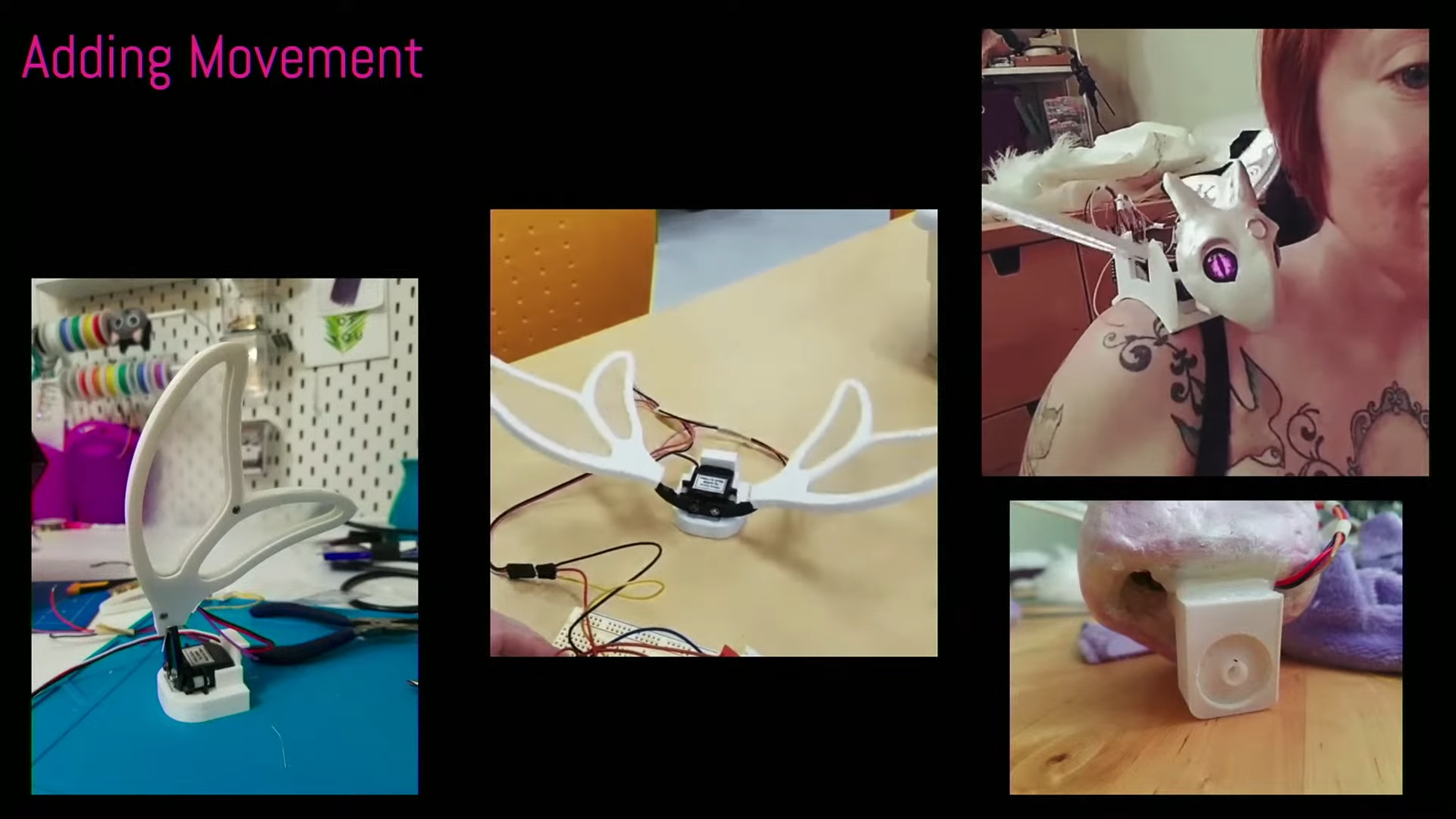
The talk then covers the rest of the design that helps create the “illusion of life.” Angela explains using servos and a robot gripper mechanism to flap the wings, and dialing in the motion so it felt as authentic as possible. She also covers robustness, designing “cuddle-worthy” bodies, and the value of designing for modularity. There’s also a useful discussion about how to make these builds more accessible, including useful starting points like which microcontroller and code platforms are good to use.
Even better, we get a look into the companion bot community, and we learn about the emotional impact these robots can have. Sometimes that’s intentional, other times, it’s down to a happy accident. “There is an unintended effect with [Nova’s] servos, that it feels like a purr,” says Angela. “It’s very comforting right on your shoulder, and I was thinking maybe I should try and insulate it a little bit, but actually people love it.”
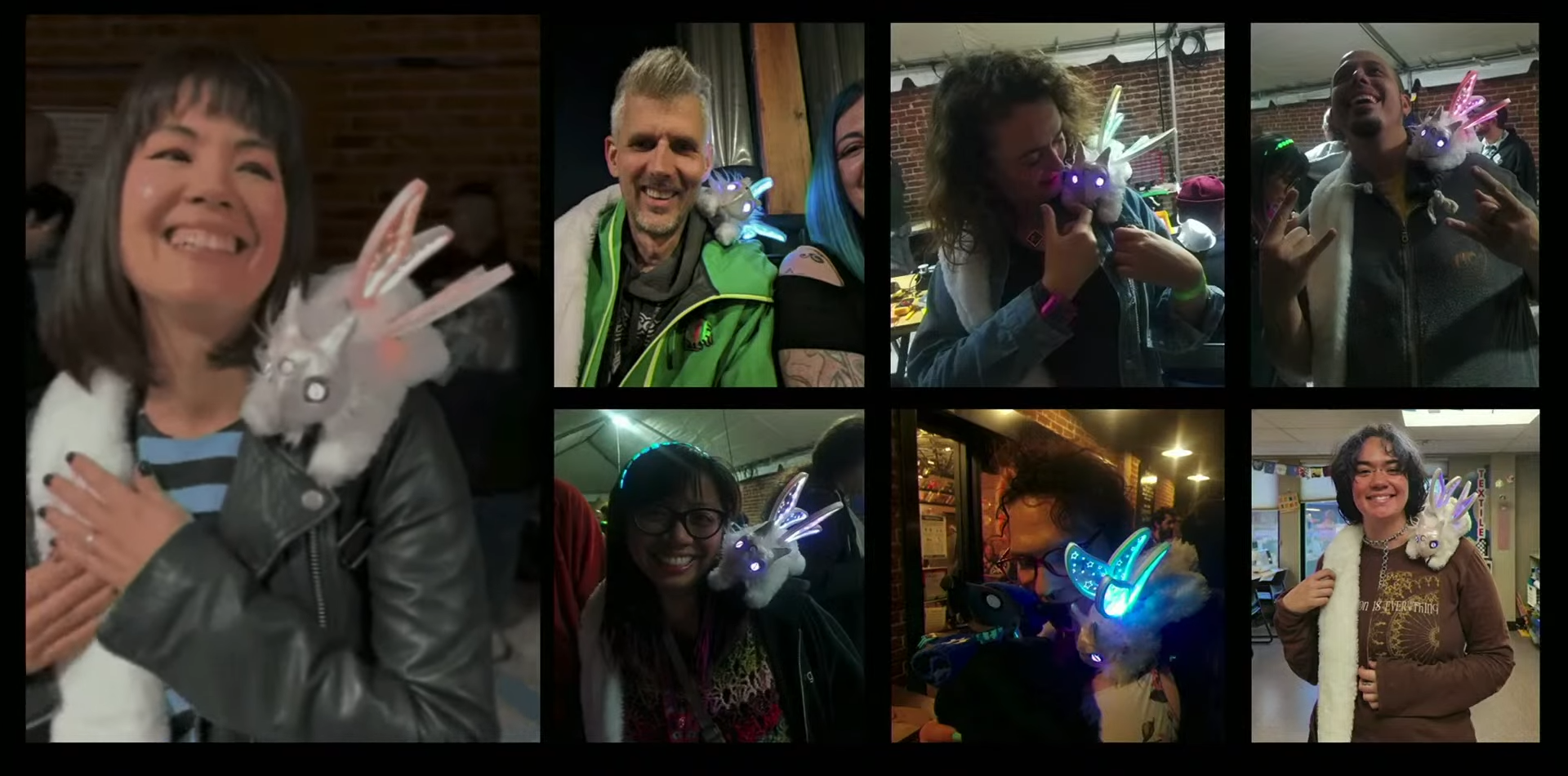
Fundamentally, companion bots are a bit like virtual reality. We’ve seen a ton of products make big promises over the years, but we’ve never seen a killer app. However, as [Angela] demonstrates, it’s very possible to create something very real and very lovable if you pay attention to the right things. Perhaps it’s the personal touch that makes DIY companion bots so seemingly lifelike in a way that Furby never was.
In any case, if you’ve ever wanted a robot companion of your very own, there’s no reason you can’t start building your own. With maker skills, enthusiasm, and the will to succeed, you can create a fun and cuddly robot critter that has that magical spark of life.

AI, cloud boost Alphabet profits by 34 percent
Alphabet’s profit jumped 34 percent in the third quarter as the parent company of search giant Google reported strong growth in its cloud business amid robust demand for computing and data services used to train and run generative artificial intelligence models.
The solid results released on Tuesday helped alleviate investors’ fears about the financial returns on the vast sums being spent on AI by Alphabet and other Big Tech peers as they seek to dominate the nascent sector. The standout unit was Google Cloud, where revenue increased 35 percent to $11.4 billion and operating profit increased sevenfold to $1.9 billion from $266 million in the same period last year.
Net income was $26.3 billion compared with $19.7 billion in the same period a year earlier, exceeding analysts’ expectations for $22.8 billion. Revenue rose 15 percent to $88.3 billion in the three months through to the end of September, beating the average estimate for $86.3 billion.

Boston Dynamics’ new video shows that its humanoid robot doesn’t need a human

Boston Dynamics has shared another look at the latest version of its humanoid robot, Atlas. Earlier videos of the all-electric robot demonstrated its unique range of motions, but this time Atlas is shown using machine learning and its upgraded sensors to perform sorting tasks in a simulated factory environment.
The task of moving engine covers “between supplier containers and a mobile sequencing dolly” isn’t especially exciting, but it demonstrates several of the new robot’s capabilities working together. After being provided with only a “list of bin locations to move parts between,” Atlas uses various sensors and machine learning models to determine the location of bins and how it needs to manipulate its body, arms, and three-fingered...
Designing For Gen Z: Expectations And UX Guidelines
Designing For Gen Z: Expectations And UX Guidelines
Vitaly FriedmanEvery generation is different in very unique ways, with different habits, views, standards, and expectations. So when designing for Gen Z, what do we need to keep in mind? Let’s take a closer look at Gen Z, how they use tech, and why it might be a good idea to ignore common design advice and do the opposite of what is usually recommended instead.
This article is part of our ongoing series on UX. You can find more details on design patterns and UX strategy in Smart Interface Design Patterns 🍣 — with live UX training coming up soon. Free preview.

Gen Z: Most Diverse And Most Inclusive
When we talk about Generation Z, we usually refer to people born between 1995 and 2010. Of course making universal statements about a cohort where some are adults in their late 20s and others are school students is at best ineffective and at worst wrong — yet there are some attributes that stand out compared to earlier generations.
Gen Z is the most diverse generation in terms of race, ethnicity, and identity. Research shows that young people today are caring and proactive, and far from being “slow, passive and mindless” as they are often described. In fact, they are willing to take a stand and break their habits if they deeply believe in a specific purpose and goal. Surely there are many distractions along that way, but the belief in fairness and sense of purpose has enormous value.

Their values reflect that: accessibility, inclusivity, sustainability, and work/life balance are top priorities for Gen Zs, and they value experiences, principles, and social stand over possessions.
What Gen Z Deeply Cares About
Gen Z grew up with technology, so unsurprisingly digital experiences are very familiar and understood by them. On the other hand, digital experiences are often suboptimal at best — slow, inaccessible, confusing, and frustrating. Plus, the web is filled with exaggerations and generic but fluffy statements. So it’s not a big revelation that Gen Zs are highly skeptical of brands and advertising by default (rightfully so!), and rely almost exclusively on social circles, influencers, and peers as main research channels.

They might sometimes struggle to spot what’s real and what’s not, but they are highly selective about their sources. They are always connected and used to following events live as they unfold, so unsurprisingly, Gen Z tends to have little patience.
And sure enough, Gen Z loves short-form content, but that doesn’t necessarily equate to a short attention span. Attention span is context-dependent, as documentaries and literature are among Gen Z’s favorites.
Designing For Gen Z
Most design advice on Gen Z focuses on producing “short form, snackable, bite-sized” content. That content is optimized for very short attention spans, TikTok-alike content consumption, and simplified to the core messaging. I would strongly encourage us to do the opposite.
We shouldn’t discount Gen Z as a generation with poor attention spans and urgent needs for instant gratification. Gen Zs have very strong beliefs and values, but they are also inherently curious and want to reshape the world. We can tell a damn good story. Captivate and engage. Make people think. Many Gen Zs are highly ambitious and motivated, and they want to be challenged and to succeed. So let’s support that. And to do that, we need to remain genuine and authentic.
Remain Genuine And Authentic
As Michelle Winchester noted, Gen Zs have very diverse perspectives and opinions, and they possess a discerning ability to detect disingenuous content. That’s also where mistrust towards AI comes into play, along with AI fatigue. As Nilay Patel mentioned on Ezra Klein Show, today when somebody says that something is “AI-generated”, usually it’s not a praise, but rather a testament how poor and untrustworthy it actually is.
Gen Z expects better. Hence brands that value sincerity, honesty, and authenticity are perceived as more trustworthy compared to brands that don’t have an opinion, don’t take a stand, don’t act for their beliefs and principles. For example, the “Keep Beauty Real” campaign by Dove (shown below) showcases the value of genuine human beauty, which is so often missed and so often exaggerated to extremes by AI.
So whenever you can, aim for the opposite of perfect. Say what you think and do what you promise. Reflect the real world with real people using real products, however imperfect they are. That’s how you build a strong relationship and trust with Gen Z.
Accessibility First
Because Gen Z are so incredibly diverse, their needs are extremely diverse and demanding as well. This doesn’t necessarily mean customization of features or adapting the layout entirely based on custom settings or preferences. But it does mean providing an accessible experience out of the box.
Simple things matter. High enough color contrast. Links that look like links. Buttons that look like buttons. Forms that are broken down into simple steps to follow. Diverse gender and identity options. Proper tab order. Keyboard accessibility. Reduced motion for people who opt in for reduced motion sickness. Dark mode and light mode.
It’s nothing groundbreaking really. Just basic things that help focus and get things done. In fact, accessibility is better for everyone — not just for Gen Z (who expect and demand it) but also for absolutely everybody around the world.
Mobile-Only, Not Mobile First
Many design mock-ups that we are creating today are typically designed and presented on large screens first. However, depending on your user base, a vast majority of users (and that’s especially true for Gen Zs), will use almost exclusively mobile devices to access your products and services. This surely will be different for enterprise software, but consumer products are much less likely to be used on desktop devices by younger Gen Zs.
Get into the habit of presenting your design mock-ups in mobile views only first. Help people read better. Content design has never been more important — especially when designing for mobile screens. Here are a few guidelines to keep in mind:
- Avoid long walls of text → max. 50 words per paragraph.
- Avoid long sentences → max. 20 words per sentence.
- Write for mobile first: brief, clear, and concise.
- Include a plain language summary, even for legal docs.
- Use Inverted Pyramid: key insights first, details below.
- Nothing is more effective than removing waste and fluff.
Subtitles On By Default
Many people, and especially Gen Z, turn on closed captioning by default these days. Perhaps the spoken language isn’t their native language, or perhaps they aren’t quite familiar with the accent of some speakers, or maybe they don’t have headphones nearby, don’t want to use them, or can’t use them. In short, closed captions are better for everybody and they increase ROI and audience.

Gareth Ford Williams has put together a visual language of closed captions and has kindly provided a PDF cheatsheet that is commonly used by professional captioners. There are some generally established rules about captioning, and here are some that I found quite useful when working on captioning for my own video course:
- Divide your sentences into two relatively equal parts like a pyramid (40ch per line for the top line, a bit less for the bottom line);
- Always keep an average of 20 to 30 characters per second;
- A sequence should only last between 1 and 8 seconds;
- Always keep a person’s name or title together;
- Do not break a line after conjunction;
- Consider aligning multi-lined captions to the left.
On YouTube, users can select a font used for subtitles and choose between monospaced and proportional serif and sans-serif, casual, cursive, and small-caps. But perhaps, in addition to stylistic details, we could provide a careful selection of fonts to help audiences with different needs. This could include a dyslexic font or a hyper-legible font, for example.
Additionally, we could display presets for various high contrast options for subtitles. This gives users a faster selection, requiring less effort to configure just the right combination of colors and transparency. Still, it would be useful to provide more sophisticated options just in case users need them.
Support Intrinsic Motivation
On the other hand, in times of instant gratification with likes, reposts, and leaderboards, people often learn that a feeling of achievement comes from extrinsic signals, like reach or attention from other people. The more important it is to support intrinsic motivation.
As Paula Gomes noted, intrinsic motivation is characterized by engaging in behaviors just for their own sake. People do something because they enjoy it. It is when they care deeply for an activity and enjoy it without needing any external rewards or pressure to do it.

Typically this requires 3 components:
- Competence involves the need to feel capable of achieving a desired outcome.
- Autonomy is about the need to feel in control of your own actions, behaviors, and goals.
- Relatedness reflects the need to feel a sense of belonging and attachment to other people.
In practical terms, that means setting people up for success. Preparing the knowledge and documents and skills they need ahead of time. Building knowledge up without necessarily rewarding them with points. It also means allowing people to have a strong sense of ownership of the decisions and the work they are doing. And adding collaborative goals that would require cooperation with team members and colleagues.
Encourage Critical Thinking
The younger people are, the more difficult it is to distinguish between what’s real and what isn’t. Whenever possible, show sources or at least explain where to find specific details that back up claims that you are making. Encourage people to make up their mind, and design content to support that — with scientific papers, trustworthy reviews, vetted feedback, and diverse opinions.
And: you don’t have to shy away from technical details. Don’t make them mandatory to read and understand, but make them accessible and available in case readers or viewers are interested.
In times where there is so much fake, exaggerated, dishonest, and AI-generated content, it might be just enough to be perceived as authentic, trustworthy, and attention-worthy by the highly selective and very demanding Gen Z.
Good Design Is For Everyone
I keep repeating myself like a broken record, but better accessibility is better for everyone. As you hopefully have noticed, many attributes and expectations that we see in Gen Z are beneficial for all other generations, too. It’s just good, honest, authentic design. And that’s the very heart of good UX.
What I haven’t mentioned is that Gen Z genuinely appreciates feedback and values platforms that listen to their opinions and make changes based on their feedback. So the best thing we can do, as designers, is to actively involve Gen Z in the design process. Designing with them, rather than designing for them.
And, most importantly: with Gen Z, perhaps for the first time ever, inclusion and accessibility is becoming a default expectation for all digital products. With it comes the sense of fairness, diversity, and respect. And, personally, I strongly believe that it’s a great thing — and a testament how remarkable Gen Zs actually are.
Wrapping Up
- Large parts of Gen Z aren’t mobile-first, but mobile-only.
- To some, the main search engine is YouTube, not Google.
- Some don’t know and have never heard of Internet Explorer.
- Trust only verified customer reviews, influencers, friends.
- Used to follow events live as they unfold → little patience.
- Sustainability, reuse, work/life balance are top priorities.
- Prefer social login as the fastest authentication method.
- Typically ignore or close cookie banners, without consent.
- Rely on social proof, honest reviews/photos, authenticity.
- Most likely generation to provide a referral to a product.
- Typically turn on subtitles for videos by default.
Useful Resources
- Designing for Gen Z, by Designlab
- Designing For Gen Z (Case Study), by Michelle Winchester
- Intrinsic vs. Extrinsic Motivation, by Paula Gomes
- Shopping Habits For Gen Z, by Sara Karlovitch
- 10 Gen Z Insights To Improve Your CX, by Telus
- Millennials vs. Gen Z Expectations, by Zendesk
New: How To Measure UX And Design Impact
I’ve just launched “How To Measure UX and Design Impact” 🚀 (8h), a new practical guide for UX leads to measure UX impact on business. Use the code 🎟 IMPACT to save 20% off today. And thank you for your kind and ongoing support, everyone! Jump to details.

 (cm, il)
OpenUC2 10x : un microscope portable sous ESP-32
Seeed Studio propose un nouveau produit très intéressant, le microscope portable OpenUC2 10x. Il s’agit d’une solution hautement adaptable qui combine une puce ESP-32-S3 pour l’analyse et un capteur OV2640 pour les images. Les deux reliés à une carte de développement XIAO et enfermés dans un robuste châssis métallique.

L’idée derrière ce OpenUC2 10x est non seulement d’avoir un microscope de terrain abordable, il est vendu 109$ HT, mais également une solution facile à manipuler et que l’on peut adapter à ses besoins. D’abord logiciellement puisque la partie code est confiée à une solution compatible Arduino et CircuitPython mais aussi matériellement avec la possibilité de modifier le projet et notamment choisir ses optiques.

Le OpenUC2 10x propose un examen d’échantillon sur lame, la lumière nécessaire pour la lecture est fournie par un éclairage externe comme une lampe de poche ou une LED, un petit bouton permet de régler la focale au micromètre et la vision de ce que vous cherchez à observer est ensuite transmis sans fil en Wi-Fi et en Bluetooth pour être lu sur un PC, une tablette ou un smartphone et sauvegardé.

La capture peut également être contrôlée de l’extérieur avec une application et un flux peut être créé, partagé avec plusieurs utilisateurs, en configurant le microscope en hotspot. Les données capturées peuvent également être sauvegardées sur une carte MicroSDXC et un timelapse de l’évolution de l’observation est configurable.

Le boitier mesure 15 cm de haut pour 10 cm de profondeur et 5 cm de large, il propose quelques GPIO pour d’éventuelles évolutions et peut accepter d’autres capteurs que le module X10 livré de base. Il est même possible d’intégrer des optiques proposant un autofocus. Cette compacité est liée à l’exploitation d’une optique en miroir qui permet de réduire largement la hauteur de l’ensemble. Le design modulaire ouvre de nombreuses possibilités d’amélioration et le firmware permet également de prendre en charge ces éventuelles modifications.

Réellement portable, le OpenUC2 10x peut être alimenté par une batterie externe en USB Type-C. Au delà du gadget amusant qui permet de jouer à observer avec un microscope – il existe des solutions plus accessibles pour cela en USB – ce projet est suffisamment puissant pour aller au delà. Il peut permettre des analyses poussées d’observations de la nature, d’échantillons et autres mais peut également rendre d’immenses services pour certaines populations. Pour analyser la contamination d’eau. Constater la présence ou l’absence de certains éléments dans le sol ou autres. C’est également un formidable outil d’examen et de partage avec sa fonction hotspot qui permettra à plusieurs utilisateurs de voir les éléments et d’en tirer des conclusions.
Le microscope est distribué par SeeedStudio
Minimachines.net en partenariat avec Geekbuying.com
OpenUC2 10x : un microscope portable sous ESP-32 © MiniMachines.net. 2024.

OpenAI will start using AMD chips and could make its own AI hardware in 2026

OpenAI is reportedly working with Broadcom to develop new custom silicon designed to handle its large AI workloads for inference and secured manufacturing capacity with TSMC, according to sources speaking to Reuters. OpenAI has reportedly built a chip development team of about 20 people, including lead engineers who previously worked on Google’s Tensor processors for AI.
Still, on its current timeline, the custom-designed hardware may not start production until 2026.
In the meantime, the sources also said OpenAI is incorporating AMD chips into its Microsoft Azure setup. AMD introduced its MI300 chips last year, which was a big part of the news this summer that its data center business has doubled in a single year as it chases market...
Your ChatGPT conversation history is now searchable

GitHub Copilot moves beyond OpenAI models to support Claude 3.5, Gemini
The large language model-based coding assistant GitHub Copilot will switch from exclusively using OpenAI's GPT models to a multi-model approach over the coming weeks, GitHub CEO Thomas Dohmke announced in a post on GitHub's blog.
First, Anthropic's Claude 3.5 Sonnet will roll out to Copilot Chat's web and VS Code interfaces over the next few weeks. Google's Gemini 1.5 Pro will come a bit later.
Additionally, GitHub will soon add support for a wider range of OpenAI models, including GPT o1-preview and o1-mini, which are intended to be stronger at advanced reasoning than GPT-4, which Copilot has used until now. Developers will be able to switch between the models (even mid-conversation) to tailor the model to fit their needs—and organizations will be able to choose which models will be usable by team members.