Jean-Philippe Encausse
Shared posts
ChatGPT's Studio Ghibli-style images raise new copyright problems
Bio-based technology successfully recovers up to 95% of high-purity lithium from spent batteries
visionOS 2.4 Out Now, Bringing Apple Intelligence, Spatial Gallery & iPhone Integration
visionOS 2.4 is out now, bringing Apple Intelligence to Vision Pro, a Spatial Gallery app, an iPhone app for remote installs, and a new iPhone/iPad-driven guest flow.
The last significant visionOS update was 2.2 in December, which brought the Wide and Ultrawide Mac Virtual Display modes. visionOS 2.3 instead focused on bug fixes and security updates.
The first visionOS 2.4 developer beta released in February, when Apple announced visionOS 2.4, and now the stable release is available for all Apple Vision Pro owners.
Apple Intelligence
Apple Intelligence is the company's name for its generative AI features. Some features run on-device, while others are offloaded to the company's Private Cloud Compute (PCC) servers, and certain requests reach out to OpenAI's ChatGPT, if you give permission for that.
Apple Intelligence arrived on iPhones (15 Pro and later), iPads (M-series or A17 Pro chips only), and Macs (M-series chips only) late last year, and Apple didn't say at the time whether Vision Pro would get it too.
With visionOS 2.4 Apple has brought the following Apple Intelligence features to Vision Pro: Priority Notifications, Notification Summaries, Smart Reply, Memory Movie creation and Natural Language Search in Photos, Priority Messages & Mail Summaries In Mail, Writing Tools, Image Wand in Notes, Genmoji, and Image Playground.
At launch, Apple Intelligence on Vision Pro only supports US English, with "additional languages" coming later this year.
Priority Notifications & Notification Summaries
Apple Intelligence automatically decides which notifications are most important, such as messages from loved ones about imminent events, and surfaces them at the top of the notification stack.
Further, longer notifications and groups of notifications from the same apps show an AI-generated summary in place of their content. We should note that this feature has been widely criticized for sometimes misconstruing the content of notifications, however.
Tapping the notification summary brings up the original notification.
Smart Reply In Messages & Mail
Smart Reply "identifies questions and suggests relevant replies" to messages and emails, which Apple says lets you "easily respond to texts and emails with just a few taps" on Vision Pro.

This feature should be particularly useful when you don't have a Bluetooth keyboard connected at least, since floating virtual keyboards are slower to type on than touchscreen keyboards.
Memory Movies & Natural Language Search In Photos
In the Photos visionOS app, Apple Intelligence brings the ability to generate a Memory Movie, as well as more advanced search.
"Simply type a description, and Apple Intelligence will pick out the best photos and videos, craft a storyline with chapters based on themes identified from the photos, and arrange them into a movie with its own narrative arc and a soundtrack," Apple explains.
Meanwhile, the Natural Language Search feature lets you find photos and videos in your library by just describing them.
Priority Messages & Mail Summaries In Mail
Just like with notifications, in the visionOS Mail app Apple Intelligence surfaces the most salient messages at the top of the stack.
Each email in the list has an AI-generated short summary of its content, instead of just the first line as in traditional email clients.
Further, upon opening an email you can choose to AI-generate a medium-length summary of its content.
Writing Tools
The Writing Tools feature offers four kinds of tools for "rewriting, proofreading, and summarizing" long-form text that you type or dictate "nearly everywhere" in visionOS, including Mail, Notes, and many third-party apps.

These tools are:
- Proofread: "checks grammar, word choice, and sentence structure with suggested edits".
- Rewrite: "adjust the tone of text to make it more friendly, professional, or concise", or use Describe Your Change to specify the exact kind of change you want.
- Summarize: recap the text, break it out into Key Points, or turn it into a bullet point list or table.
- Compose: leverages OpenAI's ChatGPT to generate any kind of textual content.
Image Wand In Notes
Image Wand in the visionOS Notes app lets you "create images based on rough sketches you create", or AI-generate an entirely new image "based on words and images from the surrounding area".
Genmoji In iMessage
Genmoji is Apple's feature to generate your own custom emoji in iMessage by typing or speaking a description of it.
Within iMessage, these Genmoji can "be added inline to messages, shared as a sticker, or sent as a Tapback".
Image Playground
Image Playground lets you AI-generate "fun and unique images from themes, costumes, accessories, and places".
According to Apple, "users can add their own text descriptions, and can even create images in the likeness of a family member or friend using photos from their photo library."
Image Playground is integrated into apps like Messages and Freeform, and is also available as a new standalone visionOS app.
Spatial Gallery
Spatial Gallery is a new visionOS app from Apple that "features a curated collection of spatial photos, spatial videos, and panoramas from artists, filmmakers, photographers, and more."
At launch, Apple says it offers "remarkable perspectives from photographers like Jonpaul Douglass and Samba Diop; new stories and experiences from iconic brands including Cirque du Soleil, Red Bull, and Porsche; behind-the-scenes moments from Apple Originals like Disclaimer, Severance, and Shrinking; and special moments from top artists."
Rather than being an open platform like YouTube or Vimeo, which added spatial video support in October, Apple's Spatial Gallery sounds like a highly curated closed platform, offering quality over quantity.
Spatial Gallery is available in all Apple Vision Pro countries except for mainland China.
Apple Vision Pro iPhone App
The new Apple Vision Pro app for iPhone lets you remotely queue apps to download & install to your headset, see device information, and browse curated recommendations of the best visionOS content.
The My Vision Pro interface shows device tips, the current visionOS version, and the serial number. It also lets you set up Personalized Spatial Audio by scanning your face shape with your iPhone's TrueDepth sensor.

Meanwhile, the Discovery interface shows "popular apps and games on the App Store; nearly 300 3D movies, Apple Immersive titles, and more video content on the Apple TV app; and the latest spatial photos, spatial videos, and panoramas featured in the Spatial Gallery".
The Apple Vision Pro app is part of iOS 18.4, and is also downloadable from the iOS App Store.
iPhone/iPad-Driven Guest User Mode
Previously, initializing Guest User mode on Vision Pro required putting on the headset and unlocking it first, and if there were any issues you needed to adjust for after the guest put the headset on, you needed to do that all over again. From experience, this led to frustration.
With visionOS 2.4, Apple has added the ability to approve Guest User mode from a nearby iPhone or iPad signed in to the same Apple Account.
As with the in-headset Guest User interface, this iPhone/iPad interface lets you choose which apps the guest has access to, as well as initiate View Mirroring with AirPlay.

Live Intelligence spécial "Futur du retail" : RDV le 10 avril
LVMH réunit La Samaritaine et Le Bon Marché sous une gouvernance unique
The Gemini API and the Internet of Things
Brain implant turns thoughts into speech in near real-time
Europe’s quest to finally land on Mars takes another turn
Oh, ExoMars, what a long, strange trip it has been. Are you ever going to go to space?
The ExoMars mission represents Europe's third attempt to land successfully on Mars, and at a cost of more than $1.3 billion. there is a lot riding on its success. But success is far from assured for a mission that has been whipsawed by geopolitical tensions, budget cuts, and an ever-changing architecture over the last 20 years.
The latest news, announced Sunday, is that Airbus will design and build the lander that will carry the ExoMars down to the surface of Mars. The mission is scheduled to launch no earlier than 2028 on a US rocket. But there have been so many twists and turns in the ExoMars story that it's very difficult to know what will ultimately happen.

mocopi Pro Kit Impressions: Hands-On With Sony’s Full Body Motion Capture System
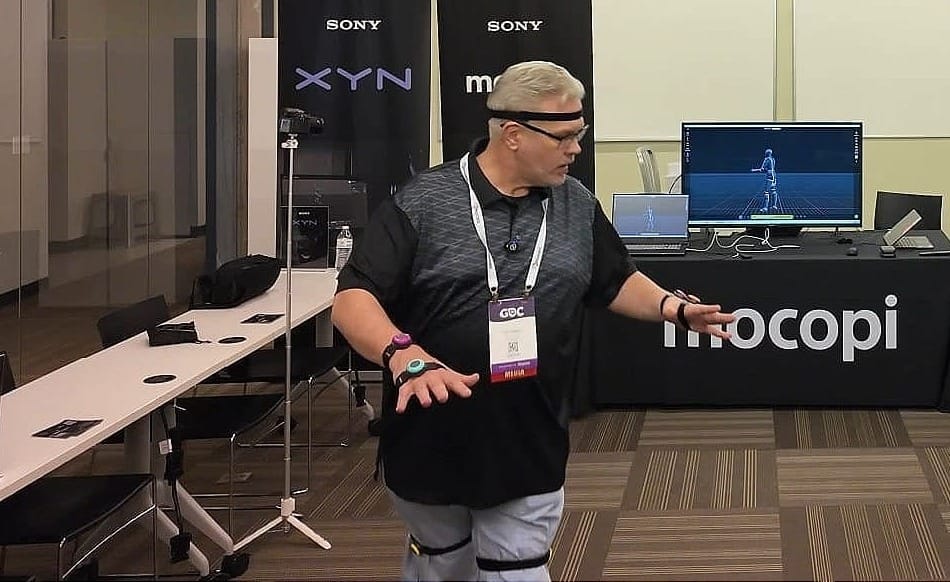
I went body-in with Sony's new mocopi Pro motion capture system with 12 points of body tracking at GDC 2025.
The mocopi Pro system from Sony aims to elevate its body tracking system beyond the six points of the base system by adding six more. It integrates with Sony's XYN Motion Studio, a motion capture pipeline intended for both professional production and VTubers.
 UploadVRDavid Heaney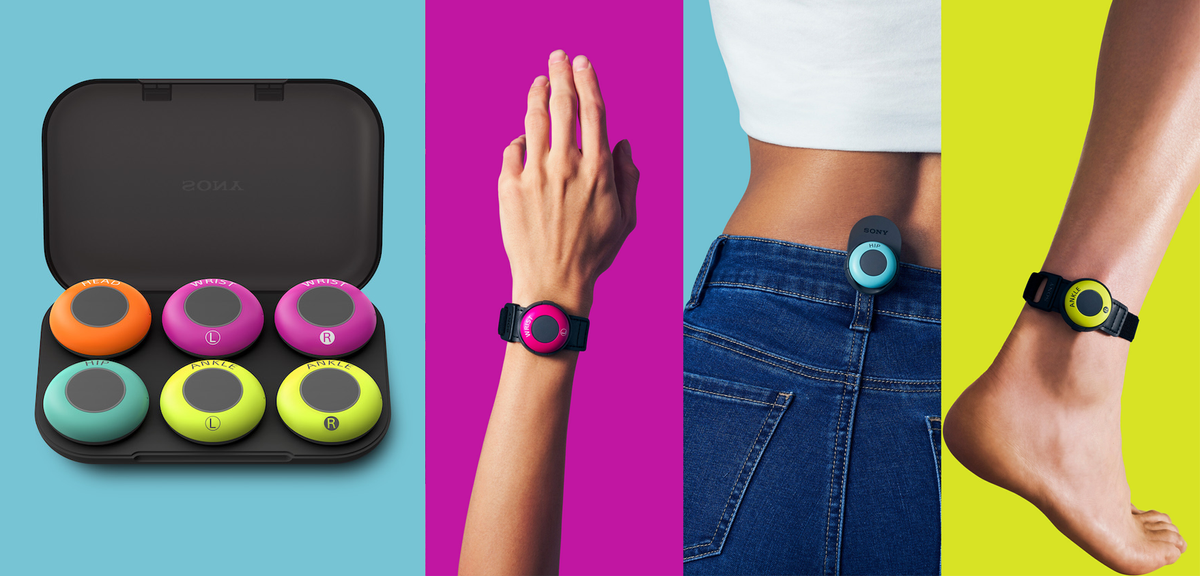
That said, the other interesting use case for mocopi Pro is full body tracking for VR. VRChat and Resonite users who want to spend extraordinary amounts of time in VR want to bring their full bodies in with the highest possible fidelity, and so I suited up and put the system to the test at GDC.
For readers who might be unaware of what Sony's mocopi system is or does, these sensors attach to straps on the body to track movements in supported applications or games using the mocopi VR app on Steam, or for use with the XYN Motion Studio software and headset solution Sony recently revealed at CES 2025.
Announced in 2022 and released in 2023, Sony's mocopi sensors initially required a smartphone to operate with SteamVR. In a recent major update, the necessity for the smartphone was eliminated, allowing you to connect the trackers directly to a PC for full body tracking in compatible games and applications.
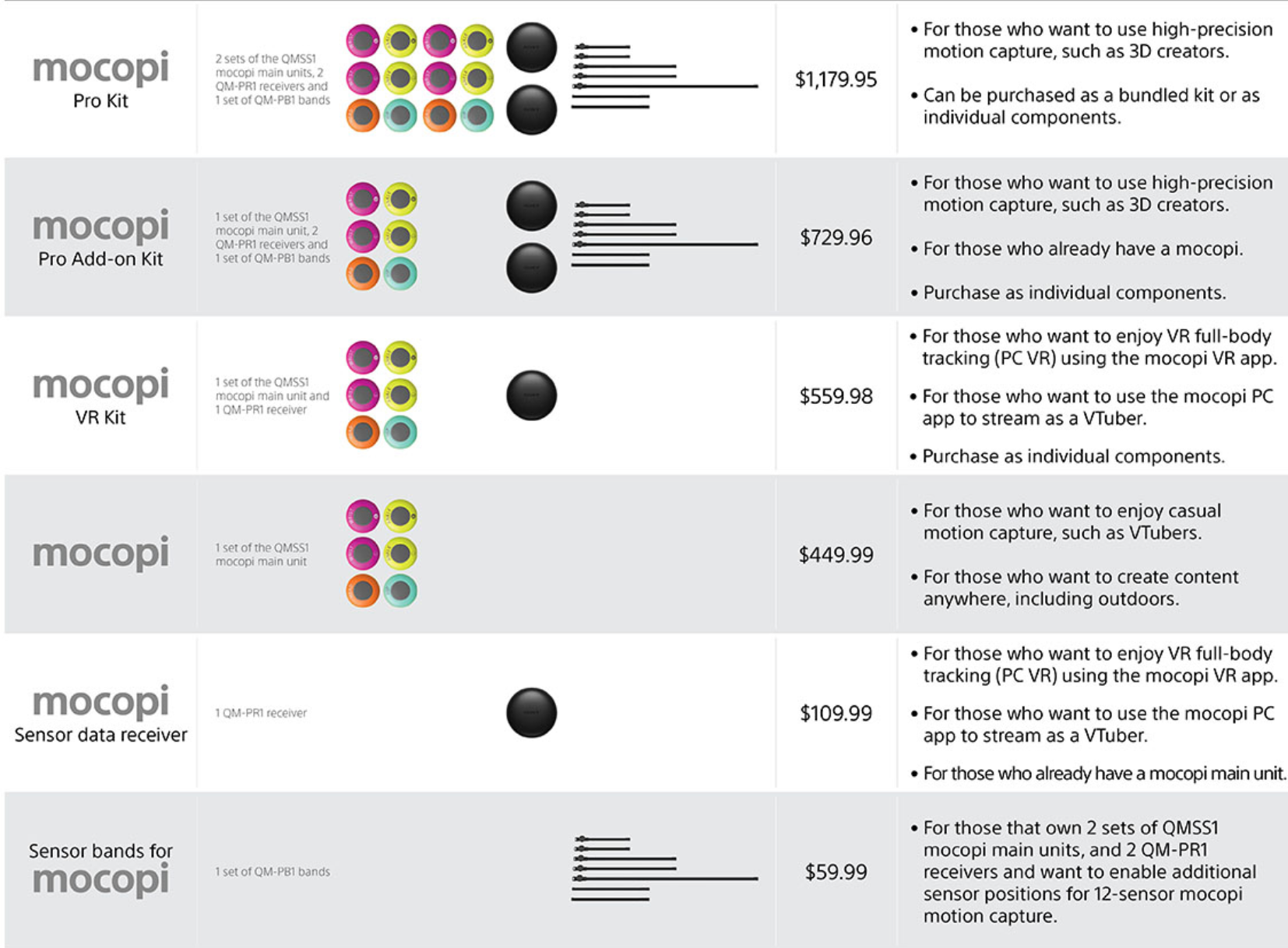
Mocopi is both modular and expandable. For newcomers wanting to experience full body tracking in applications like VRChat, the "VR Kit" priced at around $560 is their starting point for a direct PC connection.
This system offers six sensors, providing full-body tracking, which Sony says should be "good-enough" for most users, at least according to the representative at the demo session I attended. There's an add-on kit available for folks who bought the original mocopi system meant to connect through mobile devices priced around $730. Going from six to 12 potential tracking points should allow for better accuracy and more precise translation of body positions.
Testing The mocopi Sensors
During the hands-on demonstration, other participants opted for making simple motions such as waving their arms around or walking a few steps across the room. But I wanted to test the system more thoroughly.
Calibration and first test
I attempted army crawling, jump kicks, and even pretended to be a quarterback scrambling in the pocket trying to land the perfect touchdown pass.
Recalibration due to tracker movement
I saw the tracking system occasionally slip out of position during this aggressive testing. If the strap slips out of place in any way on my body, it seemed enough to confuse the system and trigger the need for a recalibration. That's a quick process, but one that could be annoying if you had to do it multiple times during a play session. I suspect that for high-intensity movements, mocopi Pro might need a more robust harnessing system to ensure reliable tracking.
Overall, though, I was impressed testing mocopi Pro, and it seemed to have solid performance to my eyes. Of course, incorporating Sony's software ecosystem into the workflow of a professional would be an entirely different question.
High-intensity testing.
After the demonstration, Sony provided us with a mocopi Pro review kit that I have sent off to our Editor-in-Chief, Ian Hamilton for further evaluation. Keep an eye on UploadVR.com for Ian's upcoming insights on how the mocopi Pro performs in his home.
We also talked about my experience with this system on our weekly VR Gamescast so if you missed it, you can see the replay here:
Experiments show adding CoT windows to chatbots teaches them to lie less obviously
Babylon.js 8.0 : Le moteur de rendu 3D web fait peau neuve
Une nouvelle version majeure de Babylon.js vient d’être publiée, confirmant l’ambition de devenir l’un des moteurs de rendu web les plus puissants et accessibles. Cette bibliothèque JavaScript open source, prisée des développeur·se·s pour la création d’expériences 3D dans le navigateur, promet des améliorations significatives en termes de performances et de rendu graphique.
Commentaires
L'article Babylon.js 8.0 : Le moteur de rendu 3D web fait peau neuve a été posté dans la catégorie JavaScript de Human Coders News
I let Gemini turn complex research into podcasts. I’ll never go back

La Chine accélère sur la fusion nucléaire : un centre colossal dévoilé par satellite
Rogue Scientist Who Gene-Hacked Human Babies Gear Up for More Human Experiments

That rogue scientist who created HIV-resistant designer babies is apparently gearing up for more human gene-editing research.
In an interview with the Wall Street Journal, He Jiankui said he wants to conduct human trials on his next big project: encoding genetics to prevent Alzheimer's disease, a heritable illness, in future generations.
He identified South Africa, where the government declared in 2024 that it's open to the "significant potential" of genetic editing, as a good place for those trials to take place. Before that, He wants to send two Chinese colleagues to the US to conduct trials on mice and monkeys. As the controversial researcher told the WSJ, he can't go himself because his home country, which imprisoned him in 2019 for scientific misconduct and fraud over his gene-hacking experiments on human fetuses that were subsequently born, won't renew his passport.
Aside from the broad strokes of a comeback, which seem to be more logistical in nature than anything else, we don't know almost anything else about how He plans to start up again.
The self-styled "Chinese Darwin" has declined to identify his financial backers and doesn't, as the WSJ notes, have any affiliations with any academic institution. When the newspaper tried to figure out who he may be working with in the US, it was unable to do so, and South Africa's health department didn't respond to requests for comment from WSJ reporters.
Lofty promises and opaque funding are, of course, nothing new to science. But He is no normal scientist, and as the newspaper notes, his reputation as "China's Frankenstein" has followed the 41-year-old gene-hacking pioneer even after his release from prison last year. It's no wonder he doesn't want to reveal who's funding him: they could, conceivably, be ostracized for doing so.
It also probably doesn't help that He regularly posts photos of himself in his mysterious lab — which the Chinese government would not, the scientist insisted to the WSJ, allow foreign visitors to enter without permission — alongside cryptic declarations, including his claim that ethics are "holding back" science.
For all that creepiness, however, He clearly has heart. Peppered between self-aggrandizing posts are a number of shockingly egalitarian claims, including an insistence that "health is the universal human right" and that "'Survival of the fittest' is unfair for the people born with genetic disadvantages."
"No one," He wrote in the latter post, "should be left behind."
That ethos in particular seems to be related to the seemingly personal inspiration behind the scientist's latest avenue of research: his mother, who is in her late 60s, has Alzheimer's that has progressed far enough that she no longer recognizes her infamous son.
If he can get human trials up and running, He wants to see if he can mimic a genetic mutation found in Icelanders who appear to have a protein that protects them against the debilitating cognitive disease. That's a far cry from the admittedly reckless experiments he conducted on embryos — and it seems far less ethically dubious, too.
And what of the children born of those experiments? Their real identities aren't know, but according to He, they're healthy now.
"I will apologize only if the children have any health issues," the scientist said. "So far, I don’t need to apologize to anyone."
More on genetics: 23andMe Is Crumbling, and That Means Your Genetic Data Is Blowing in the Breeze
The post Rogue Scientist Who Gene-Hacked Human Babies Gear Up for More Human Experiments appeared first on Futurism.
An Artificial Sun In A Manageable Size

The sun is our planet’s source of natural illumination, and though we’ve mastered making artificial light sources, it remains extremely difficult to copy our nearby star. As if matching the intensity wasn’t enough, its spectral quality, collimation, and atmospheric scattering make it an special challenge. [Victor Poughon] has given it a go though, using a bank of LEDs and an interesting lens system.
We’re used to lenses being something that can be bought off-the-shelf, but this design eschews that convenience by having the lenses manufactured and polished as an array, by JLC. The scattering is taken care of by a sheet of inkjet printer film, and the LEDs are mounted on a set of custom PCBs.
The result is certainly a very bright light, and one whose collimation delivers a sun-like effect of coming from a great distance. It may not be as bright as the real thing, but it’s certainly something close. If you’d like something to compare it to, it’s not the first such light we’ve featured.
Actualité : L'humanité doit-elle semer la vie dans l'Univers ?

📰 Création d’images : l’IA passe à la vitesse supérieure
Grok, Gemini, GPT-4o… Les nouvelles versions des outils d'IA repoussent les limites de la génération et de la retouche d’images. Un tournant technologique aux implications majeures.
Grok, l’IA développée par X (ex-Twitter), permet désormais de modifier des photos existantes avec une simplicité déconcertante : changer un arrière-plan, effacer des éléments, se transformer en cow-boy ou appliquer un style Van Gogh… tout devient possible. Une innovation qui inquiète autant qu’elle fascine.
En réponse, Google et OpenAI accélèrent. Gemini 2.0 propose des fonctionnalités similaires, mais c’est surtout GPT-4o qui impressionne : réalisme accru, respect des consignes, écriture dans les images… L’outil marque une nette rupture avec les limites de DALL·E.
Les réseaux s’emballent, notamment autour du style manga “Ghibli” appliqué à des photos d’actualité, tandis que les enjeux éthiques se font de plus en plus pressants : suppression de filigranes, pillage de contenus visuels, droit d’auteur mis à mal.
Jusqu’où l’IA peut-elle et doit-elle aller dans la création ?
-----------
🎧 L'Hebdo Premium : https://m.audiomeans.fr/s/S-xylotlSe
🌍 Web : https://mondenumerique.info
🗞️ Newsletter : https://mondenumerique.substack.com
📹 YouTube : https://www.youtube.com/@mondenumerique
♥️ Soutien : https://donorbox.org/monde-numerique
Distribué par Audiomeans. Visitez audiomeans.fr/politique-de-confidentialite pour plus d'informations.
Games publisher Ubisoft announces restructuring, billion-euro investment
Enhanced 6D pose estimation method promises better robotic object handling
Smart textiles and surfaces: How lightweight elastomer films are bringing tech to life
The incredible Samsung Odyssey Ark monitor is $900 off today

Brain-like computer steers rolling robot with 0.25% of the power needed by conventional controllers
AI robot pets can be adorable and emotionally responsive. They also raise questions about attachment and mental health
While You're Churning Out Studio Ghibli Selfies With OpenAI, Remember That Hayao Miyazaki Called AI Art "Disgusting" and an "Insult to Life Itself"

The internet has been flooded with pictures modified by OpenAI's new image tool to evoke the style of animation legend Hayao Miyazaki's work at Studio Ghibli.
Despite going mega-viral — to the point where OpenAI took down the free version of its in-app image generator — the trend flies directly in the face of the animator's personal views on the tech. In a 2016 documentary, the filmmaker was shown a demo of an AI-animated 3D model.
"I am utterly disgusted," he said at the time, arguing that the demo reminded him of a friend with a disability. "If you really want to make creepy stuff, you can go ahead and do it. I would never wish to incorporate this technology into my work at all."
"I strongly feel that this is an insult to life itself," he fulminated.
The latest trend spawned countless images that went viral, from Ghibli renditions of the JFK assassination to the photo that showed Donald Trump hanging out with Jeffrey Epstein — and, of course, 9/11.
While it's far from the first time a generative AI-inspired trend has gone viral on the social media platform, the extent to which the Ghibli meme has taken off is notable.
Even OpenAI CEO Sam Altman wasn't spared, complaining in a Wednesday tweet that "no one" cared about his career until you "wake up one day to hundreds of messages: 'look i made you into a twink ghibli style haha.'"
"My timeline is AGI," Stability AI founder Emad Mostaque quipped with a joke about artificial general intelligence. "All. Ghibli. Images."
Even famous retired boxer Mike Tyson uploaded a Ghibli-fied rendition of his own likeness while holding a white pigeon.
Besides directly opposing the views and wishes of its creator, the trend also highlights the continued debate surrounding copyright and the overall rights of human artists and publishers.
As 404 Media found, it's also trivially easy to generate pictures of far more graphic images in the style of Studio Ghibli movies, demonstrating OpenAI's woefully inadequate implementation of guardrails.
It's an unfortunate new reality, greatly denigrating the iconic, hard work of human animators.
"Imagine being Miyazaki, pouring decades of heart and soul into making this transcendent beautiful tender style of anime, and then seeing it get sloppified by linear algebra," one user tweeted.
Other users also pointed out generative AI's infamous strain on the environment — ironic, given many of Studio Ghibli's films are about humanity's disregard for the planet and ecosystem.
"Irony is dead and all but it’s pretty depressing to see Ghibli AI slop on the timeline not only because Miyazaki famously thinks AI art is disgusting but because he’s spent the last 50 years making art about environmental waste for petty human uses," another user tweeted.
More on the trend: Sam Altman Whines That When You Become a Billionaire, "Everyone Hates You For Everything"
The post While You're Churning Out Studio Ghibli Selfies With OpenAI, Remember That Hayao Miyazaki Called AI Art "Disgusting" and an "Insult to Life Itself" appeared first on Futurism.
La Russie poursuit sa surveillance des internautes en bloquant 47 VPN dans le pays

Le Kremlin continue sa politique de contrôle d'Internet en interdisant l'utilisation de plusieurs dizaines de services de VPN. Des pannes sur des sites populaires ont également été constatées à la suite des restrictions.
La guerre se prépare en orbite : l’US Space Force dévoile le premier « porte-avions » spatial !
Avec la réalité mixte, Bvlgari livre une nouvelle facette de sa Haute Joaillerie
OpenAI halts free GPT-4o image generation after Studio Ghibli viral trend

Alibaba Head Warns AI Industry Is Showing Signs of Bubble

For years now, experts have warned of an AI bubble set to burst.
So far, companies have continued to pour tens of billions of dollars into building out massive data centers to meet the demands of increasingly power-hungry AI models.
Whether the sector will continue to grow or find itself in for a rude awakening is anyone's guess. But something striking is that we're starting to see even tech executives worried that the massive spending could collapse under its own weight. Sluggish demand could struggle to keep up with a rapidly rising supply side, a lopsided equation that has executives freaked out.
Despite having committed to spend more than $52 billion on AI development over the next three years, Chinese tech giant Alibaba's chairman Joe Tsai is now warning of a potential bubble starting to form in AI data center construction, Bloomberg reports. During an event in Hong Kong on Tuesday, Tsai said that many of these projects are being constructed without clear customers in mind.
"I start to see the beginning of some kind of bubble," Tsai said, as quoted by Bloomberg.
Alibaba shares slid by almost four percent today in response to the news.
Perhaps one of the biggest warning signs so far was the explosive emergence of Chinese startup DeepSeek, which left Silicon Valley in shambles after creating a top-tier AI at a tiny fraction of the cost of its Western counterparts.
The company's announcement of its reasoning model, which could keep up with OpenAI's most advanced offerings, triggered a more than $1 trillion selloff, with spooked investors wondering whether they had grossly overpaid the likes of OpenAI and Meta for years.
Despite the massive shakeup, companies continue to pour astronomical sums into the construction of data centers. Just weeks into his second term, president Donald Trump announced a behemoth $500 billion AI infrastructure project, dubbed Stargate, with significant buy-in from OpenAI, investment company SoftBank, tech giant Oracle, and Abu Dhabi state-run AI fund MGX.
Last week, news emerged that the project's first data center complex in the small Texas city of Abilene would have enough space for as many as 400,000 Nvidia AI chips, which would make it one of the biggest known clusters of AI computing power when completed by mid-2026.
But to Tsai, it remains to be seen whether that kind of spending is actually warranted.
"I start to get worried when people are building data centers on spec," he said this week. "There are a number of people coming up, funds coming out, to raise billions or millions of capital."
Outside of Trump's Stargate, Amazon committed $100 billion to build out AI infrastructure. Meta CEO Mark Zuckerberg has pledged $65 billion for this year, while Google parent company Alphabet will invest $75 billion.
To Tsai, that could be a terrible idea in the long run.
"I’m still astounded by the type of numbers that’s being thrown around in the United States about investing into AI," he said at this week's event.
"People are talking, literally talking about $500 billion, several 100 billion dollars. I don’t think that’s entirely necessary," he added. "I think in a way, people are investing ahead of the demand that they’re seeing today, but they are projecting much bigger demand."
More on AI overspending: Microsoft Backing Out of Expensive New Data Centers After Its CEO Expressed Doubt About AI Value
The post Alibaba Head Warns AI Industry Is Showing Signs of Bubble appeared first on Futurism.
The High Cost of American Health Care
The United States spends substantially more on health care than any other high-income nation, yet achieves poorer health outcomes by many measures. In 2024, health care spending in the US reached nearly $4.9 trillion, representing about 17.6% of the country's GDP—a percentage far exceeding that of peer nations. Despite this enormous financial investment, the US ranks poorly on measures like life expectancy, chronic disease burden, and preventable mortality.
This analysis examines the structural and systemic factors that contribute to America's exceptionally high health care costs. From market consolidation to payment models, from profit motives to administrative complexity, multiple interconnected forces drive excessive spending without delivering commensurate value. Independent from the attributes of health care services is a population of Americans that develop a seemingly unstoppable rate of chronic diseases like heart disease, obesity, diabetes, cancers. This coupled with high gun-related deaths, high levels of income inequality, and high rates of negative social determinants of health produces the the underlying demand for health services at high prices. The high prices themselves were the topic of a previous article.
In fact, we received a lot of outreach from the previous article which was intended to review a single Health Affairs article discussing high prices in the US system as the primary driver of US health care spending. There certainly are other factors at play as many pointed out, so I am writing a more comprehensive article on factors that may cause higher prices and total spending on health care in the United States. This is not an exhaustive analysis, but it covers the primary points.
Market Consolidation: The Growth of Health Care Giants
Health care consolidation has accelerated dramatically over the past two decades, with profound implications for costs. Both horizontal integration (mergers between similar entities) and vertical integration (combining different parts of the health care supply chain) have reshaped the American health care landscape.
Horizontal Integration: Less Competition, Higher Prices
Horizontal consolidation occurs when hospitals merge with other hospitals, insurers combine with other insurers, or physician practices join together. These mergers have created regional powerhouses with significant market leverage.
When hospitals consolidate within a region, the impact on prices is substantial. Studies consistently show that hospital prices increase when mergers occur in concentrated markets. With fewer competitors, dominant hospital systems can demand higher reimbursement rates from insurers, costs that are inevitably passed on to employers and patients.
The hospital sector has experienced particularly dramatic consolidation. Between 2010 and 2019, there were over 750 hospital mergers and acquisitions in the United States. By 2021, 76.5% of metropolitan areas, hospital markets were considered highly concentrated according to federal antitrust guidelines. This consolidation extends to rural areas as well, where smaller hospitals have increasingly been absorbed into larger systems.
Physician practices have followed a similar trajectory. Once primarily independent, physicians increasingly work for hospitals or large group practices. The percentage of physicians employed by hospitals or health systems increased from 2012 to 2022. This consolidation gives providers greater bargaining power with insurers and often leads to higher service prices.
Vertical Integration: Control Across the Health Care Value Chain
Vertical integration involves combining different stages of the health care supply chain under single corporate entities. Examples include hospitals purchasing physician practices, insurers acquiring pharmacy benefit managers, or retail pharmacies buying health insurers.
When hospitals acquire physician practices, referral patterns often change. Studies show that hospital-employed physicians refer patients to their employing hospital at higher rates, even when lower-cost options exist. Moreover, services previously provided in lower-cost office settings may shift to hospital outpatient departments, where the same procedure often costs significantly more.
Recent vertical mergers have created powerful conglomerates spanning multiple health care sectors:
CVS Health's acquisition of Aetna combined a major pharmacy chain, a pharmacy benefit manager, and a health insurer
UnitedHealth Group's Optum division owns physician practices, outpatient facilities, and a pharmacy benefit manager
Cigna's acquisition of Express Scripts united an insurer with a major pharmacy benefit manager
These integrated entities enjoy multiple revenue streams and can steer patients within their own systems. While proponents claim vertical integration improves care coordination, evidence of cost savings for patients remains limited. Instead, the market power gained through such integration often translates into higher prices.
Restricting Market Entry: Certificate of Need Laws
Further restricting competition are Certificate of Need (CON) laws, which remain in effect in approximately 35 states. These regulations require health care providers to obtain government permission before building new facilities, expanding services, or purchasing certain equipment. Originally intended to prevent duplication of services and control costs, evidence suggests CON laws have instead protected incumbent providers from competition. Studies show that states with CON laws have higher health care prices and fewer facilities per capita than states without such restrictions. By creating regulatory barriers to entry, these laws effectively shield established health care systems from new competitors who might otherwise drive prices down, further contributing to the market concentration that enables higher prices.
These things really are pretty silly.
Profit Motive: The Business of Health Care
Unlike many other developed nations, the US health care system is predominantly private and profit-driven. This orientation affects prices, utilization, and system priorities.
For-profit hospitals, which constitute approximately ~36% of all hospitals in the US, must generate returns for shareholders while delivering care. These facilities typically charge higher prices than non-profit counterparts and may prioritize lucrative service lines over less profitable ones.
Publicly traded health care companies face quarterly earnings pressure and shareholder expectations. This creates incentives to maximize revenue and minimize costs in ways that may not align with optimal patient care or system efficiency. Health insurance companies regularly report profit margins of 3-8%, pharmaceutical companies often exceed 15-20% margins, and medical device manufacturers typically achieve 20-30% margins. This is not inherently a bad thing when markets are operating competitively, but in a scenario without competition it can lead to less-than-desirable societal outcomes and benefit.
In the pharmaceutical sector, profit motives are particularly evident. US prescription drug prices average 2.78 times higher than in other high-income nations. Unlike countries that negotiate drug prices centrally or regulate them, the US allows manufacturers to set prices largely at will, with limited counterbalancing market forces.
The investor-owned health care model has expanded into previously non-profit sectors. Private equity firms have acquired physician practices, nursing homes, and other care facilities at accelerating rates. These acquisitions often lead to reduced staffing, higher prices, and an emphasis on profitable services at the expense of comprehensive care. This is an area of great attention right now in the aftermath of the Steward Health situation in Massachusetts.
New Technologies: Innovation Without Cost Control
The US leads in developing and adopting new medical technologies, from advanced imaging systems to surgical robots to novel medications. While these innovations often improve care quality, their implementation in the American system typically occurs without robust cost-effectiveness evaluation. In fact, Medicare is barred from considering cost-effectiveness analysis in coverage decisions.
Unlike countries with health technology assessment programs—such as the United Kingdom's National Institute for Health and Care Excellence (NICE) or Germany's Institute for Quality and Efficiency in Health Care (IQWiG)—the US lacks systematic processes for evaluating whether new technologies justify their costs relative to existing alternatives. Thus, in many cases, costly new technologies enter the market at high prices without necessarily improving quality of care or performance compared to the prior standards of care.
Once approved by the FDA for safety and efficacy, new technologies typically diffuse through the health care system, regardless of their comparative value. Hospitals compete to offer the latest technologies as marketing advantages, insurers face pressure to cover them, and patients and physicians often demand access to the newest options. Americans have a special love of new medical technologies, politically. Therefore, it is politically undesirable for government health care programs, that often set the coverage and payment rate standards for other payors, to be seen as stifling medical innovation.
The result is widespread adoption of expensive technologies that may offer only marginal benefits over existing alternatives. Examples include:
Proton beam therapy facilities costing hundreds of millions of dollars to build, despite limited evidence of superiority for certain cancer types, though the evidence is growing for others.
Robotic surgical systems that increase procedure costs by thousands of dollars without consistently demonstrating better outcomes. This is a hotly debated topic. There is evidence of benefits in certain conditions, yet the return on investment is not well-understood.
New pharmaceuticals priced at premium levels without proportionate improvements in effectiveness compared to current medications.
Medicare Limitations: Statutory Constraints on Cost Control
Medicare, America's public health insurance program for seniors and certain disabled individuals, faces significant constraints in controlling costs due to legislative restrictions.
Most notably, Medicare is explicitly prohibited from considering cost-effectiveness in coverage determinations. The program must cover treatments deemed "reasonable and necessary" regardless of their price relative to benefits. This contrasts sharply with health systems in countries like the UK, Canada, and Australia, which routinely assess both clinical and economic value before covering new treatments.
Additionally, Medicare is forbidden from directly negotiating prescription drug prices with manufacturers. Until recently, the program had to cover virtually all drugs in certain protected classes at whatever price pharmaceutical companies set. The 2022 Inflation Reduction Act provided Medicare limited authority to negotiate prices for a small number of drugs, but this represents only a modest change to a system that still largely accepts manufacturer-set prices. This is an ongoing debate.
Medicare's rate-setting ability is also constrained by political pressures and provider lobbying. Payment formulas established by Congress often reflect political considerations rather than economic efficiency, and attempts to reduce payments frequently face fierce resistance from affected stakeholders.
These limitations affect not just Medicare but the entire health care system, as private insurers often follow Medicare's coverage policies and use its payment rates as benchmarks for their own reimbursement structures.
Fee-for-Service Payment: Incentivizing Volume Over Value
The predominant payment model in American health care remains fee-for-service (FFS), where providers receive payment for each service, procedure, test, or treatment delivered. This model inherently rewards volume rather than outcomes or efficiency.
Under fee-for-service, providers have financial incentives to:
Deliver more services, regardless of marginal benefit
Perform more complex procedures that carry higher reimbursement
Order additional tests and follow-up visits
Focus on treatment rather than prevention
The financial consequences are substantial. Studies estimate that 25-30% of all health care services in the US may be unnecessary or provide minimal benefit, directly attributable to the incentives created by fee-for-service payment.
Attempts to shift toward value-based payment models—such as bundled payments, accountable care organizations, and global budgets—have made only incremental progress. As of 2023, approximately 60-70% of healthcare payments still followed traditional fee-for-service arrangements.
Even in "value-based" programs, the underlying fee-for-service architecture often remains, with modifications like shared savings or quality bonuses layered on top. True transformation of payment incentives has proven difficult to implement at scale. CMS has set a goal to have most Medicare beneficiaries covered under some form of shared savings or accountable care-like model by 2030.
Administrative Complexity: The Hidden Cost Driver
Administrative costs represent one of the most significant differences between US health care spending and that of other developed nations. Studies estimate that administrative activities consume between 15% and 30% of total US health care expenditures—roughly $800 billion to $1.3 trillion annually.
This administrative burden stems from the system's complexity and fragmentation:
Billing and Payment Complexity
With thousands of health insurance plans, each with unique coverage rules, prior authorization requirements, and payment rates, providers must maintain extensive billing departments. A typical US hospital employs more billing specialists than beds, and physician practices spend an average of $70,000 per doctor annually on billing-related activities.
The average US hospital submits claims to 51 different payers. Each claim must be coded precisely according to complex classification systems, with errors resulting in payment delays or denials. This administrative burden doesn't exist in single-payer systems or those with standardized and streamlined payment procedures.
Insurance Overhead
Private health insurers in the US spend 12-18% of premium dollars on administrative costs and profits, compared to 1-3% for public programs in other countries. These costs include marketing, underwriting, claims processing, and shareholder returns.
The Medical Loss Ratio provision of the Affordable Care Act requires insurers to spend at least 80-85% of premium dollars on medical care, but this still allows for significant administrative expenses compared to international counterparts.
Provider Administrative Burden
US physicians spend an estimated 15-20 hours per week on administrative tasks not directly related to patient care. This includes documentation for billing purposes, quality reporting, prior authorization requests, and compliance with various regulations.
Nursing staff similarly spend greater than 25% of their time on documentation and administrative tasks rather than direct patient care. This represents both a direct cost (staff time) and an opportunity cost (reduced patient care capacity). This is due to insurance billing administrative burden and the need for documentation for both clinical purposes and defense purposes in the event of litigation.
Duplication and Fragmentation
With multiple payers, providers, and regulatory bodies, the US system suffers from duplicative administrative functions. Each insurer maintains its own claims processing system, provider networks, and utilization management protocols. Each provider organization must interface with dozens or hundreds of different insurers and comply with varying requirements.
This fragmentation contrasts sharply with more unified health systems like those in Canada, Sweden, or Taiwan, where administrative simplicity results from standardized processes across the entire system.
Other Potential Contributing Factors
While the major structural drivers discussed above explain much of America's exceptional health care spending, several additional factors contribute to the high-cost ecosystem:
Physician Compensation
American physicians, particularly specialists, earn substantially more than their counterparts in other high-income countries. US specialist physicians often earn 2-3 times what similar specialists make in countries like Germany, France, or Canada. This compensation differential reflects both the higher costs of medical education in the US and the greater market power of physician groups, especially in consolidated markets with limited competition.
Defensive Medicine
The US malpractice environment encourages "defensive medicine"—the practice of ordering tests, procedures, and consultations primarily to avoid potential lawsuits rather than for clinical necessity. Studies estimate that defensive medicine adds $50-100 billion annually to healthcare costs. While the direct costs of malpractice premiums and settlements are substantial, the indirect costs of defensive practices likely have a larger impact on overall spending.
Price Opacity
Unlike most consumer markets, healthcare prices in the US remain largely hidden until after services are delivered. Despite recent price transparency regulations, meaningful comparison shopping remains difficult for most patients. This opacity prevents normal market dynamics from exerting downward pressure on prices and allows for significant price variation for identical services, even within the same geographic area.
I have a good article on the mechanics of this here.
Employer-Based Insurance System
The predominance of employer-sponsored health insurance, covering approximately 164 million Americans, creates inefficiencies through job lock, administrative duplication, and insulation from true costs. The tax exemption for employer-provided health benefits costs the federal government over $250 billion annually in foregone revenue while incentivizing more comprehensive coverage than many individuals might otherwise choose.
Supply Chain Intermediaries
Numerous intermediaries operate between providers, payers, and patients, each extracting a portion of health care spending. Pharmacy benefit managers, group purchasing organizations, health care consultants, and various brokers add layers of complexity and cost to the system while often obscuring rather than enhancing value.
Social Determinants of Health
The US spends less on social services relative to health care than most developed nations, creating downstream medical costs. Underinvestment in housing, nutrition, education, and community resources leads to more severe health conditions requiring expensive medical interventions. Countries that invest more heavily in social infrastructure typically achieve better health outcomes at lower medical costs.
End-of-Life Care Intensity
Americans receive more intensive, hospital-based care in their final months of life than citizens of other developed nations. Approximately 25% of lifetime Medicare expenditures occur in patients' last year of life, with intensive care utilization particularly high. This pattern reflects both cultural attitudes toward death and the financial incentives inherent in the US healthcare system.
Conclusion: A System Optimized for Revenue, Not Value
America's high health care spending results not from a single cause but from interconnected structural factors that collectively drive costs upward. Market consolidation reduces competition that might otherwise constrain prices. Profit motives incentivize revenue generation over efficiency or population health and in the absence of competition we do not benefit from downward pressure on prices. New technologies enter the market without rigorous cost-effectiveness assessment. Medicare faces statutory limitations on cost control mechanisms. Fee-for-service payment rewards volume rather than value. Administrative complexity consumes resources that could otherwise go toward patient care.
These factors create a health care system optimized for revenue generation rather than health outcomes or economic efficiency. Unlike systems in other developed nations—which prioritize universal access, cost containment, and population health—the US system has evolved to maximize financial returns across multiple sectors of the health care economy. While this is not a comprehensive analysis, it covers some of the key underlying drivers of the US experience with health care.
Meaningful reform would require addressing these structural issues simultaneously rather than implementing piecemeal changes that leave fundamental incentives intact. Until then, Americans will likely continue paying substantially more for health care than citizens of other wealthy nations, without receiving commensurate value for this extraordinary investment. It will require significant political will to unwrap the system.
I discuss potential solutions in the following two articles: