Shared posts

19 Dec 08:06

AR Conferences 2026 and Laser Display

by Karl Guttag

Introduction – Display Skeptics Videos

It can take me weeks to prepare an in-depth study of a particular AR product, and I have been looking for an outlet to provide more information more quickly. Former Apple engineer Radu Reit and I have started a video series called Display Skeptics, where we discuss both news and technical content. To date, we have three episodes up, with both a short 30-minute preview and roughly 60- to 90-minute full shows, available via a Patreon paywall. Both Radu and I pay out of pocket for the AR hardware we analyze and the equipment we use, so please consider supporting us on Patreon with a $20/month membership or $15 per episode if you want to see more content.

This article will touch on some concepts covered in episode 3. The 30-minute free YouTube version can be found at Display Skeptics Episode 3: December 2025 News & 2026 Conferences, and the full 1 hour and 18 minute version can be accessed here: https://www.patreon.com/posts/display-skeptics-145837820.

Meeting at CES and AR/VR/MR

I’m later than usual in my planning for CES this year, so I have more open meeting slots than in prior years. CES 2026 is just a few weeks away (January 6-9, 2026), and I will be there for the entire conference. If you or your company would like to schedule a meeting with me at CES 2025, please email meet@kgontech.com.

I’m also going to be at SPIE’s AR/VR/MR conference in January, which has expanded from three to four days, from January 17th to 22nd, 2026. You can use meet@kgontech.com contact me to set up a meeting time.

In the News

In the news portion of the video, we covered the topics outlined below (see the videos for more details)

Meta cutting Metaverse Team by 30%, reported by Bloomberg on December 4th

Meta has been spending nearly $20B per year, so while 30% is significant, Meta will still have by far the largest AR/VR/XR effort of any company. Several sources have pointed to the biggest scaling back will be in VR. Generally, the belief is that the VR market, while real, is limited to a small subset of dedicated gamers. Efforts such as introducing low-cost VR headsets at a loss only result in a small, temporary bump in the market without sufficient follow-on sales to justify the losses.

In the video, I commented that the same thing appears to have happened with the Apple Vision Pro (AVP), where it was rumored that they would introduce a low-cost version. The problem with AVP was not the price but the functionality. Adjusted for inflation, the AVP is less expensive than other early adopter products. If people liked what the AVP could do, the price was not a barrier. I have an AVP that I already paid for sitting in a cabinet, and I don’t know why I would take it out (see my many articles on the AVP).

Meta Ray Ban Display reported to have shipped 50K units, with another 50K on backorder

I don’t know the accuracy of the numbers, but I have seen reports that Meta Ray Ban Displays (MRBD) have shipped 50K units, with another 50K on backorder. This “feels” about right, given that I was able to buy four of them, each order taking longer. The biggest issue I have with the MRBD is once again the functionality of the applications. Right now, there are only Meta applications. Radu pointed out that Meta has recently released development tools for the MRBD.

I have also heard a rumor that Meta is developing glasses with MicroLEDs displays. I don’t know what problem this solves for them that staying with LCOS doesn’t, at least in the short term. There are also rumors that they are considering diffractive waveguides over the current Lumus Geometric (, but this would come at a loss of efficiency and color uniformity, plus a major increase in eye glow.

Google announces both AI+display glasses with diffractive waveguides & display glasses likely using microOLED birdbath in partnership with Xreal for 2026: https://www.android.com/xr/show/

Google is taking a different tack than Meta, relying more on hardware partners, including Samsung and Xreal, to develop headset hardware, while at the same time trying to cover the audio (only) AI glasses, AR/AI glasses with displays, and VR/XR with camera passthrough. Google has the advantage of leveraging its Android application base.

I consider Xreal’s current designs more VR than AR, with only 20-25% transparency. Their optical designs (see XReal One Pro Optics and Its Connections to Ant-Reality and Google) provide much better image quality than waveguide-based designs, but are bulkier and have very low transparency. They are more for portable VR (ex. Steam Deck) and video watching than for augmenting the real world. As I often advise, one has to decide whether the real world or the virtual image is most important, and in the case of Xreal, they have prioritized the virtual image.

As I discussed in Google XR Glasses Using Google’s Raxium MicroLEDs While Waveguide Lab Sold to Vuzix, Google appears to be taking a strange approach of buying MicroLED component maker Raxium in 2022 and exiting Waveguide R&D while leaving headset development to its partners. I’m more than a little skeptical that, even with Google’s backing, they will have monolithic, full-color, native LEDs (Raxium’s technology) with high enough yield to be system-wise cost-effective for many years.

CREAL announces FLCOS Time Sequential Pixel Replication

CREAL has been developing head-worn light field headsets since about 2017. While they have developed interesting technology and demo systems, they still seem fairly far away from something that could be a volume product.

They want to find a near-term market for the technology they have developed. They developed an FLCOS (ferroelectric LCOS) with switching speeds on the order of 10x faster than those of the more common twisted nematic (Tn) LCOS. They are also using laser illumination and MEMS technology developed by CREAL to replicate the display resolution and FOV of a small device, up to 9 times. They believe they will be able to support a 3K x 3K display and a 75-degree FOV from a 1cc light engine. For more information on this technology, see CREAL’s white paper on C-Blast.

Karl’s Regular Conferences

Last year, I attended five conferences: CES, SPIE AR/VR/MR, SID Display Week, AWE (US), and
MicroLED/ARVR Connect (Eindhoven, Netherlands). Below are some of my quick comments on each conference.

CES – Las Vegas in early January

CES is always a logistical nightmare, with multiple conference venues and meetings in hotel suites spread across the Las Vegas area. During busy times of day, it can take 30 minutes to over an hour to go between venues. While there is a dedicated XR area in Central Hall, larger and more established companies often exhibit in their own booths there or at other venues in suites and meeting rooms. Often, startups and smaller companies are located at the Venetian in country-specific booths or in booths that sponsor multiple startups. This year’s exhibitor directory lists 292 Companies in the category of XR and Spatial Computing. It is physically impossible to see everything.

SPIE AR/VR/MR – San Francisco in late January

SPIE’s AR/VR/MR continues to grow, expanding to four days this year. While the conference name included “VR,” the content and exhibits are primarily focused on optical see-through head-worn displays. This has proven to be my favorite conference to attend because of the quality of the presentations and the exhibits. It’s also very simple: almost everything happens on one floor of the large Moscone West conference center, with just the occasional hotel suite nearby, making it easy to take in almost everything. As many of the attendees are regulars, there is also a collegial atmosphere.

SID Display Week – L.A. (2026) in early May

Display Week, as it name implies, concentrates on displays both large and small. I can’t justify attending Display Week every year, as only a small percentage of exhibitors offer microdisplay devices, which I cover. I’m likely to skip it this year, as the venue is in Los Angeles rather than the more common San Jose. Fewer companies’ AR hardware, many of which are based in the Valley, will travel to Southern California.

AWE – Long Beach in mid June

The AWE (US) exhibition was once the best place to see a wide range of AR headsets in one place. But with the move to Long Beach in Southern California, I’m finding much less AR/XR hardware. While the venue and the area around it are certainly nicer, it is drawing a different, and less interesting for me (I cover AR/XR displays and optics), set of companies. As with SID Display Week mentioned above, many tech companies in the Valley are less likely to attend, and even if they do, they will send far fewer people.

MicroLED/ARVR Connect – Eindhoven, Netherlands, in mid-September

MicroLED and ARVR Connect in Eindhoven was a conference I attended last year, and I am going again in 2026. It started as MicroLED only but has expanded into AR/VR. In some ways, it reminds me of the early days of the SPIE AR/VR/MR conference. The plan is for me to teach a “master class” and then hold a panel discussion on display devices for AR.

SPIE AR/VR/MR 2026 Display Papers On Laser Displays

Alexander Mityashin on LinkedIn regularly posts interesting articles on AR. He is presenting at SPIE AR/VR/MR 2026 and noted in a post two weeks ago that almost all the technical sessions focused on laser displays (laser beam scanning or laser illuminated LCOS). There is only one paper talking about quantum dot color conversion, and none directly on MicroLEDs. In past years, there were many MicroLED papers and few, if any, on laser displays.

In a later post, Alexander noted that “On many minds right now: after the latest landscape changes, is laser AR still ‘tier-1-backed’ – or just tier-1-adjacent? And how much $ firepower actually stands behind turning it into products?” Looking over the summary of the presentations, it seems more researchers are doing what researchers do rather than a shift to laser displays becoming mainstream anytime soon. I’m particularly skeptical about LBS and even more skeptical about fiber scanning display (see: Magic Leap Fiber Scanning Display (FSD) – “The Big Con” at the “Core”). I am interested in the concepts for laser illumination of LCOS, such as those presented by Meta and Vitrealabs. For more on my thoughts on this subject, see the Display Skeptic’s Patreon video. I have included below a PDF page with links to the various summaries on the SPIE website.

Next Up

I plan to return to my series on the Meta Ray Band displays soon (within the next few days). I have been doing some detailed display analysis.

19 Dec 08:04

Mistral OCR 3 - L'OCR français qui lit même l'écriture de votre médecin

by Korben

Vous avez des tonnes de vieux documents papier qui traînent dans des cartons, des factures scannées à l'arrache, des formulaires remplis à la main, des tableaux Excel imprimés puis re-scannés par quelqu'un qui n'a visiblement jamais entendu parler du concept de "bien faire son boulot" ?

Considérez que ce problème est réglé puisque Mistral AI vient de sortir OCR 3, un modèle de reconnaissance de documents qui promet de transformer tout ça en données exploitables, et pour pas cher en plus.

Le modèle est capable de déchiffrer du cursif dégueulasse, des annotations griffonnées dans les marges, voire du texte manuscrit par-dessus des formulaires imprimés. Mistral montre même une démo avec une lettre au Père Noël écrite par un gamin et l'OCR arrive à en extraire le contenu structuré. Bon, c'est cool pour les lettres au Père Noël, mais surtout ça veut dire qu'il peut gérer vos ordonnances médicales ou les notes de réunion de votre collègue qui écrit comme un cochon.

Niveau performances, Mistral annonce un taux de victoire de 74% sur leur précédent modèle OCR 2 et sur les solutions concurrentes. Et comme c'est testé sur des cas réels d'entreprises avec des mesures de précision en fuzzy-match, on n'est pas dans du benchmarks théoriques bidon. Le modèle gère les scans pourris avec compression JPEG, les documents de travers, les faibles résolutions, le bruit de fond... Bref, tout ce qui fait que l'OCR traditionnel vous sort de la bouillie.

Et ce qui est vraiment intéressant, c'est surtout la reconstruction structurelle car contrairement aux OCR classiques qui vous crachent un bloc de texte en vrac, Mistral OCR 3 reconstruit la structure du document. Les tableaux complexes avec cellules fusionnées et hiérarchies de colonnes ressortent en HTML propre avec les colspan et rowspan préservés. Vous obtenez du markdown enrichi en sortie, directement exploitable par vos systèmes sans avoir à nettoyer le bordel derrière.

Côté tarifs, c'est 2 dollars pour 1000 pages et si vous passez par l'API Batch, c'est moitié moins cher à 1 dollar les 1000 pages. Pour un modèle qui se dit plus petit que la plupart des solutions concurrentes tout en étant plus précis, c'est plutôt compétitif. Le modèle peut traiter jusqu'à 2000 pages par minute sur un seul nœud, donc même si vous avez des millions de documents à numériser, ça devrait pas prendre des plombes.

Pour l'utiliser, vous avez deux options. Soit vous passez par l'API (mistral-ocr-2512), soit vous allez sur le Document AI Playground dans Mistral AI Studio où vous pouvez glisser-déposer vos PDF et images pour tester. C'est pratique pour voir ce que ça donne avant de l'intégrer dans vos workflows.

Bref, on est en train tout doucement de passer d'OCR qui "lisent du texte" à des modèles qui comprennent la structure des documents. Et ça, ça veut dire que vos archives papier vous pouvoir enfin devenir des données JSON exploitables par vos agents IA, vos systèmes de recherche ou vos bases de connaissances.

Voilà, si vous avez des projets de numérisation d'archives ou d'automatisation de traitement de documents, ça vaut le coup d'aller tester leur playground.

Source

18 Dec 21:45

Interactive Hopscotch Tiles Make The Game More Exciting

by Lewin Day

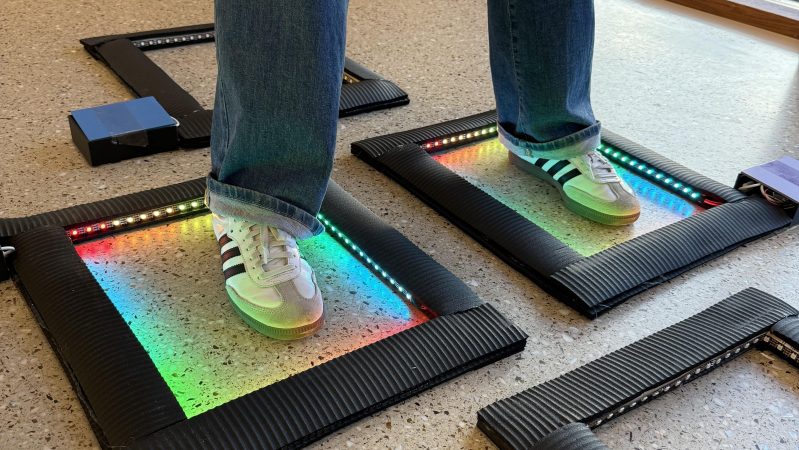
Hopscotch is a game usually played with painted lines or with the aid of a bit of chalk. However, if you desire fancier equipment, you might like the interactive hopscotch setup from [epatell].

The build uses yoga mats as the raw material to create each individual square of the hopscotch board. The squares all feature simple break-beam light sensors that detect when a foot lands in the given space. These sensors are monitored by a Raspberry Pi Pico in each square. In turn, the Pico lights up addressable NeoPixel LED strips in response to the current position of the player.

It’s a simple little project which makes a classic game just a little more fun. It’s also a great learning project if you’re trying to get to grips with things like microcontrollers and addressable LEDs in an educational context. We’d love to see the project taken a step further, perhaps with wirelessly-networked squares that can communicate and track the overall game state, or enable more advanced forms of play.

Meanwhile, if you’re working on updating traditional playground games with new technology, don’t hesitate to let us know!

18 Dec 21:39

REETLE SmartInk I – An AI-powered E-Ink phone case with voice recording (Crowdfunding)

by Debashis Das
REETLE SmartInk I in hand case

The REETLE SmartInk I is a phone case with a touch-enabled E-Ink display and built-in AI features. It features a secondary screen on the back for reading text, viewing notes, recording voice, and displaying to-do items, allowing basic tasks to be completed without using the phone’s main display.

In the back, you have a 3.97-inch E-Ink touchscreen with one-press voice recording, AI-based transcription, summarization, and smart to-do display, all synced to a companion mobile app via Bluetooth 5.0. It supports iPhone 13–17 series and a wide range of Android phones, features a 300 mAh battery with 10W MagSafe wireless charging, and delivers up to 10 hours of reading, 8 hours of recording, and over 2 weeks of standby time. Weighing around 55 grams with a total thickness under 4 mm, it includes military-grade drop protection, tempered glass, widget switching (QR codes, notes, schedules), a thin design, and a 10°C to 55°C operation temperature range, making it suitable for meetings, interviews, reading, journaling, and on-the-go productivity use.

REETLE SmartInk I in hand case

REETLE SmartInk I (ETS 1301 model) specifications:

  • Compatability
    • iPhone 13 to iPhone 17 series
    • Android smartphones (model support via companion app)
  • Display – 3.97-inch, 480 × 800, 235 PPI E-Ink touchscreen
  • Touch interface
    • Capacitive touch panel
    • Operated via onboard touch input and mobile app
  • Wireless Connectivity – Bluetooth 5.0
  • Audio – Built-in microphone for audio recording (up to 8 hours)
  • Misc
    • On/Off button (supports gestures)
    • Record button for recording audio.
    • Up to 10 hours of active use
    • Over 2 weeks of standby time
    • AI Features – Transcription, summarization, smart to-do sync
  • Power
    • 300 mAh rechargeable lithium battery
    • 10W wireless charging for the 300mA battery
  • Dimensions − 152 × 74.5 × 12.5 mm (L × W × H)
  • Weight − 55 grams
  • Operating Temperature − 10°C to +55°C
  • Build − Tempered glass, military-grade drop protection

Software support is provided through a companion mobile application for iOS and Android, which handles device pairing, content synchronization, voice recording, and AI-based transcription and summaries. The app is used to configure widgets, manage notes and to-do lists, and push selected information to the E-Ink display over Bluetooth, while the SmartInk I itself operates as a low-power secondary screen without running standalone applications.

REETLE SmartInk I AI E-Ink Smartphone BackCover

The REETLE SmartInk I can record audio non-stop for up to 8 hours in a single session. This assumes sufficient battery charge and no manual stop of the recording. After ~8 hours, recording will stop due to battery limits or internal file limits, and the device will need to be recharged or restarted before recording again. Captured audio is sent immediately to the companion mobile app on your phone via Bluetooth. Once the audio reaches the phone app, the AI processing (transcription, summarization, key-point extraction) happens there or in the cloud, and the results are stored or managed within the app’s data.

Previously, we wrote about the YotaPhone 3 back in 2017, which featured a 5.2-inch E-Ink display integrated into the phone itself, so the concept is not entirely new; REETLE SmartInk I applies a similar idea by implementing it as a phone case rather than a dedicated handset. We have also written about other Android smartphones and tablets with color E-ink displays like the Bigme HiBreak Pro, the Onyx BOOX Tab, and others.

REETLE SmartInk I Basic Kit
REETLE Android Smartphones
Some of the Android smartphones supported by the REETLE SmartInk I case

The REETLE SmartInk I is currently available on Kickstarter with worldwide shipping. Pricing for a single unit is $119 US for Super Early Bird backers, $149 US (Early Bird), and $169 US (Kickstarter Special), which will increase to $199 US retail. The product is available in iPhone-specific and Universal variants (for most of the Android phones). According to the project timeline, mass production is scheduled for January 2026, with shipping expected to begin between February and March 2026.

The post REETLE SmartInk I – An AI-powered E-Ink phone case with voice recording (Crowdfunding) appeared first on CNX Software - Embedded Systems News.

18 Dec 09:19

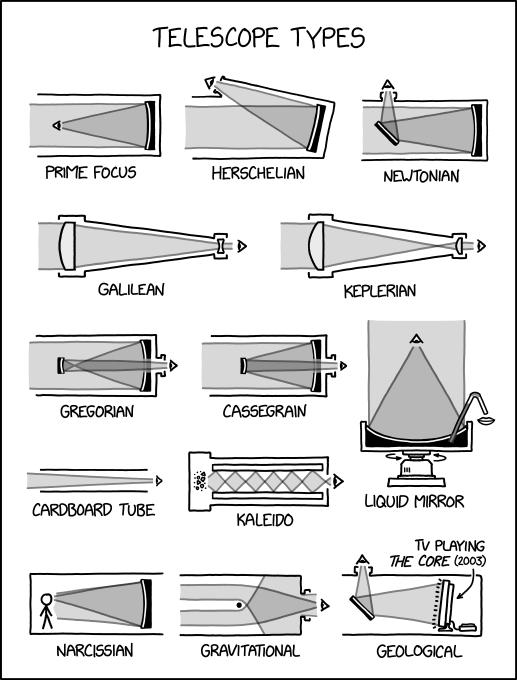
Telescope Types

I'm trying to buy a gravitational lens for my camera, but I can't tell if the manufacturers are listing comoving focal length or proper focal length.
18 Dec 09:15

Virtual Pet Responds To WiFi

by Lewin Day

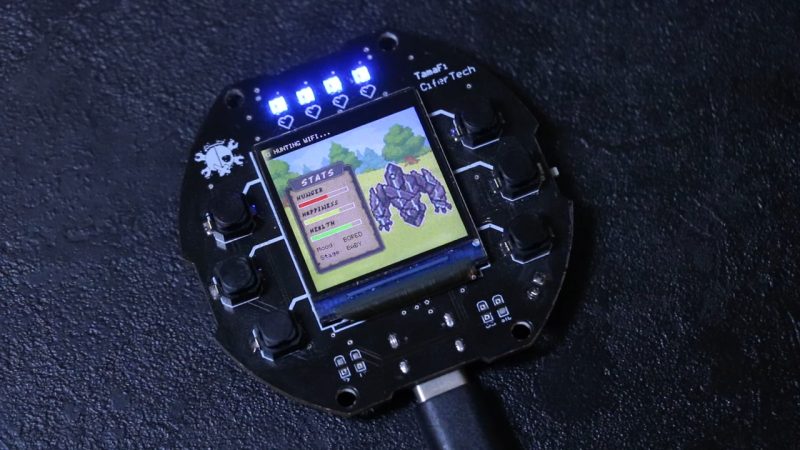
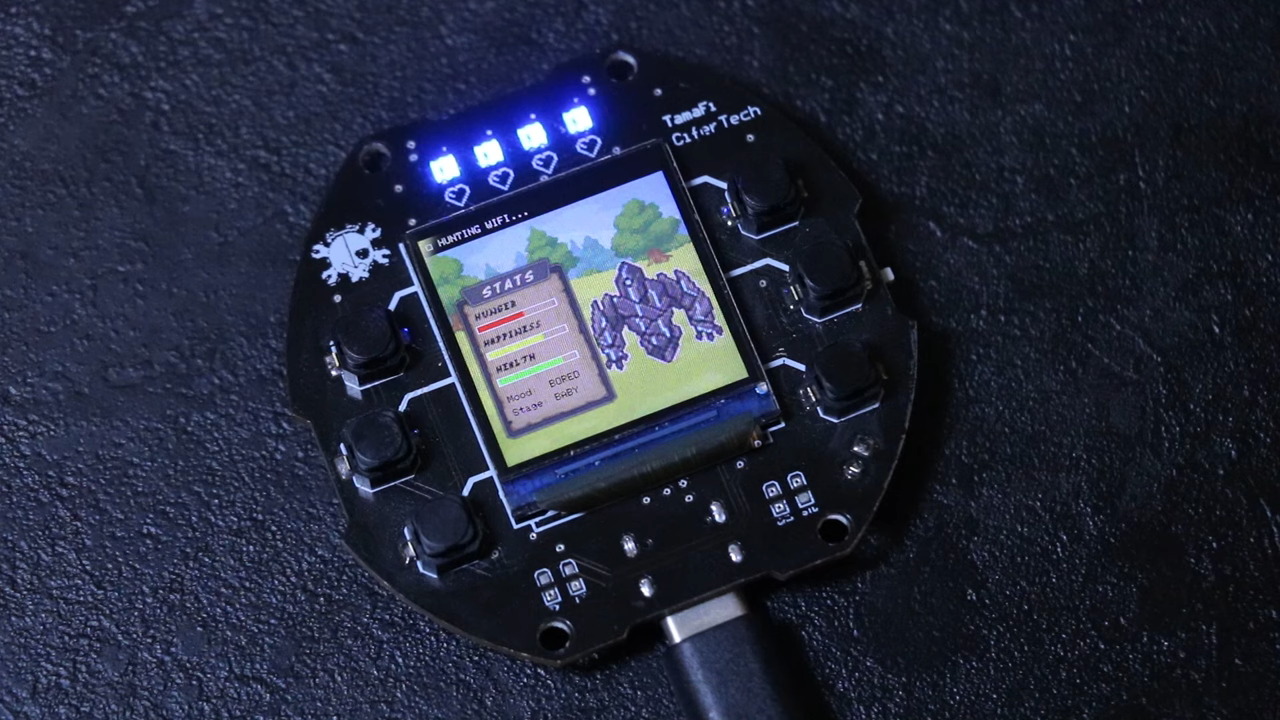
When the Tamagotchi first launched all those decades ago, it took the world by storm. It was just a bunch of simple animations on a monochrome LCD, but it had heart, and people responded to that. Modern technology is capable of so much more, so [CiferTech] set out to build a virtual pet that can sniff out WiFi networks.

The build employs an ESP32-S3, perhaps the world’s favorite microcontroller that has WiFi baked right in from the factory. It’s paired with a 240×240 TFT LCD that delivers bright, vivid colors to show the digital pet living inside. Addressable WS2812B LEDs and a simple sound engine provide further feedback on the pet’s status.

The pet has various behaviors coded in, like hunting, exploring, and resting, and moods such as “happy,” “curious,” and “bored.” For a bit of environmental reactivity, [CiferTech] also made the local WiFi environment play a role. Nearby networks can influence the “hunger, happiness, and health” of the pet.

Incidentally, if you’ve ever wondered what made the Tamagotchi tick, we’ve explored that before, too.

18 Dec 09:12

The Fragrance Shop embraces AI powered retail technology across its stores

by Staff Writer

The Fragrance Shop has announced that it is now using AI powered retail technology.

Berni Hawkins Rusby, who is the Growth Officer and Chief of Strategy, says that the technology is being used across every store. The retailer carried out a pilot and has seen how YOOBIC is not only able to simplify its operation, but also strengthen it, which is proving to be very exciting for the future of the chain’s stores.

Photo credit: Pexels.

More Retailers are Using YOOBIC Retail Technology

As time goes on, more and more stores are using YOOBIC’s UK retail technology. The company's software is now used by 350 companies, with two million users across 80 countries. The technology is essentially an AI powered digital platform that allows employees to engage in better task management, communication, and mobile learning. 

Businesses can empower their operation by ensuring that tasks get done, and customer experiences can also be improved. Any tasks can be digitised, and real-time analytics can also be accessed, which makes sure that brand standards are met while also reducing the total workload for managers. By using YOOBIC, The Fragrance Shop hopes that it can take its store to the next level, while also patching any inefficiency along the way.

Photo credit: Pexels.

The YOOBIC App Supports Live Video

The YOOBIC app also supports live video. Employees can go live to frontline teams with the click of a button, which is a useful feature. Product demonstrations can also be carried out before the product reaches the team, allowing for greater efficiency across the whole chain.

As time goes on, we are seeing more and more retail stores embrace live streaming as well.  Walmart and Sephora are the latest companies to adopt livestream shopping, showing that the desire for live content and features that support it is very much there. 

Interestingly, live content is on the rise across other verticals as well. Live cook-alongs from chefs like Gordon Ramsay are a huge hit on platforms like YouTube, especially during the festive season. Not only is live content a good way to increase engagement, but it also allows complex workflows, or steps to be followed both instantly and visually.

Even in gaming, we are seeing more and more live content. Live casino betting UK games, like roulette, connect you with a real dealer in a casino setting. Not only does this allow for more immersion, but it also allows for instant interactivity, without delay or the need for complex technology. 

Examples like this, and the other examples listed above, show how it's not only possible to bridge the gap between people who may live across the world, but also to provide more experiences that facilitate user interaction.

In the world of retail, this is proving to be especially useful, as now frontline teams can have direct live contact with managers who may live across the country, as well as superiors who may have otherwise been unreachable.

Not only does this speed up the chain of efficiency, but it also improves the customer experience, something that The Fragrance Shop has always put a key focus on.

16 Dec 15:38

AI Industry Insiders Living in Fear of What They’re Creating

by Frank Landymore

They may be responsible for creating the AI tech that many fear will wipe out jobs — if not the entire human race — but at least they feel just as paranoid and miserable about where this is all going as the rest of us.

At NeurIPS, one of the big AI research conferences, held this year at the San Diego Convention, visions of AI doom were clearly on the mind of many scientists in attendance. But are they seriously reckoning with AI’s risks, or are they too busy doing what amounts to fantasizing about scenarios they’ve read in sci-fi novels? It’s the question raised in a new piece by Alex Reisner for The Atlantic, who attended NeurIPS and found that many spoke in grand terms about AI’s risks, especially those brought about the creation of a hypothetical artificial general intelligence, but overlooked the tech’s mundane drawbacks.

“Many AI developers are thinking about the technology’s most tangible problems while public conversations about AI — including those among the most prominent developers themselves — are dominated by imagined ones,” Reisner wrote.

One researcher guilty of this? University of Montreal researcher Yoshua Bengio, one the three so-called “godfathers” of AI whose work was foundational to creating the large language models propelling the industry’s indefatigable boom. Bengio has spent the past few years sounding the alarm about AI safety, and recently launched a non-profit called LawZero to encourage the tech’s safe development.

“Bengio was concerned that, in a possible dystopian future, AIs might deceive their creators and that ‘those who will have very powerful AIs could misuse it for political advantage, in terms of influencing public opinion,'” recalled Reisner.

But the luminary “did not mention how fake videos are already affecting public discourse,” Reisner observed. “Neither did he meaningfully address the burgeoning chatbot mental-health crisis, or the pillaging of the arts and humanities. The catastrophic harms, in his view, are ‘three to 10 or 20 years’ away.”

Reisner wasn’t the only one to observe this disconnect. In a keynote speech titled “Are We Having the Wrong Nightmares About AI?,” the sociologist Zeynep Tufekci warned that researchers were missing the forest for the trees by focusing so much on the risks posed by AGI, a technology that we don’t even know will ever be possible to create, and for which there is no agreed upon definition. After someone in the audience complained that the immediate risks Tufekci raised, like chatbot addiction, were already known, Tufekci responded, “I don’t really see these discussions. I keep seeing people discuss mass unemployment versus human extinction.”

It’s a far point to make. The discourse around AI safety is often dominated by apocalyptic rhetoric, which is peddled even by the very billionaires building the stuff. OpenAI CEO Sam Altman predicts that AI will wipe out entire categories of jobs, cause a crisis of widespread identity fraud, and admitted to doomsday prepping for when an AI system potentially retaliates against humankind by unleashing a deadly virus. 

And Bengio isn’t the only AI “godfather” wracked with contrition. British computer scientist Geoffrey Hinton — who received the Turing Award in 2018 alongside Bengio and former Meta chief AI scientist Yann LeCun — has cast himself as an Oppenheimer-like figure in the field. In 2023, he famously said he regretted his life’s work after quitting his role at Google, and recently held a discussion with senator Bernie Sanders where he went long on the tech’s myriad risks, which included jobs destruction and militarized AI systems furthering empire.

Reisner made an ironic observation: that the name of NeurIPS, short for “Neural Information Processing Systems,” harks back to a time when scientists vastly underestimated the complexity of our brain’s neurons and compared them to the processing done by computers.

“Regardless, a central feature of AI’s culture is an obsession with the idea that a computer is a mind,” he wrote. “Anthropic and OpenAI have published reports with language about chatbots being, respectively, ‘unfaithful’ and ‘dishonest.’ In the AI discourse, science fiction often defeats science.”

More on AI: Anthropic’s Chief Scientist Says We’re Rapidly Approaching the Moment That Could Doom Us All

The post AI Industry Insiders Living in Fear of What They’re Creating appeared first on Futurism.

16 Dec 15:38

Comment deux cyberattaques survenues coup sur coup ont fait vaciller le géant SoundCloud

by Amine Baba Aissa

Le géant du streaming américain fait face depuis plus d'une semaine à de nombreux signalements et mécontentements de ses fidèles utilisateurs. La raison ? Pas une mais deux cyberattaques qui ont affecté la disponibilité du site à plusieurs reprises.

16 Dec 15:29

C’est officiel : PayPal veut créer sa propre banque

by Lisa Imperatrice

PayPal a annoncé, le 15 décembre 2025, avoir déposé une demande pour créer sa propre « PayPal Bank » aux États-Unis. Une étape stratégique pour réduire sa dépendance aux banques partenaires, développer le crédit et proposer des produits d’épargne.
15 Dec 15:12

Waze s’attaque enfin aux feux tricolores : voilà ce que ça va changer

by Nicolas Lellouche

C’était l'une des dernières grandes différences entre Waze et ses concurrents Apple Plans ou Google Maps : l'affichage des feux tricolores. Le GPS communautaire proposera bientôt ces informations sur sa carte.


15 Dec 15:12

Comment bloquer les crawlers IA qui pillent votre site sans vous demander la permission ?

by Korben

Vous en avez marre de voir GPTBot, ClaudeBot et toute la bande de crawlers IA se servir sur votre site comme dans un buffet à volonté ? Perso, j'utilise Cloudflare qui propose des options pour ça directement mais tout le monde n'utilise pas ce service. Du coup ce projet ai.robots.txt est super pratique pour ceux qui gèrent leur propre serveur et qui veulent reprendre le contrôle sur ce qui se fait aspirer.

L'idée c'est de maintenir sur Github une liste exhaustive de tous les crawlers liés à l'IA, que ce soit pour entraîner des modèles ou alimenter des moteurs de recherche IA. On y retrouve les suspects habituels comme GPTBot (OpenAI), Claude-Web (Anthropic), Google-Extended, meta-externalagent, mais aussi des trucs plus obscurs comme img2dataset ou laion-huggingface-processor qui servent à aspirer des images.

Le truc cool, c'est que le projet ne se contente pas juste de fournir un robots.txt à copier-coller. Y'a aussi des fichiers de config prêts à l'emploi pour Apache (.htaccess), Nginx, Caddy et même HAProxy. Du coup vous pouvez carrément renvoyer une erreur HTTP aux crawlers au lieu de juste leur dire "non" poliment via robots.txt (qu'ils ignorent parfois de toute façon, les malotrus).

Pour Nginx par exemple, vous récupérez le fichier nginx-block-ai-bots.conf et vous l'incluez dans votre config de virtual host. Le fichier contient une regex qui matche tous les User-Agent connus des crawlers IA. Même principe pour Apache avec le .htaccess, ou pour HAProxy où vous ajoutez quelques lignes dans la section frontend pour détecter et bloquer ces bots.

Le projet est maintenu activement par une communauté de contributeurs qui surveille les nouveaux crawlers qui débarquent et dès qu'un nouveau bot IA se pointe, la liste est mise à jour et les fichiers de config sont regénérés automatiquement via GitHub Actions.

Après, le robots.txt ça reste un "gentlemen's agreement" et y'a que les crawlers sympas le respectent... Les autres font semblant de pas le voir. A voir maintenant si c'est une bonne idée ou pas de bloquer ces crawlers...

C'est à vous de voir mais si vous n'aimez pas l'IA je pense que vous adorerez cette liste de blocage . Après si vous vous inquiétez sur votre audience votre référencement et compagnie, peut-être que vous voulez quand même récupérer un peu de trafic en provenance de ces chatbots IA.

Donc à vous de voir...

15 Dec 10:13

C’était une question de temps : le loup « mal-aimé » d’Intermarché est devenu une arnaque en ligne

by Amine Baba Aissa

La rançon de la gloire. Sur Internet, les contrefaçons du « mal‑aimé », le loup de la pub d’Intermarché qui fait le tour du monde, squattent désormais les premiers résultats Google, obligeant la chaîne de supermarchés à réagir.

15 Dec 10:13

ChatGPT’s adult mode is coming, but you’ll have to wait until next year to try it

by Pranob Mehrotra

ChatGPT's highly anticipated adult mode is expected to roll out in Q1 2026 as OpenAI tests its age-verification system.

The post ChatGPT’s adult mode is coming, but you’ll have to wait until next year to try it appeared first on Digital Trends.

14 Dec 20:15

Suprise ! Un micro caché dans un petit KVM chinois à 30 balles

by Korben

Je ne connaissais pas le NanoKVM mais c’est un petit boîtier KVM chinois vendu entre 30 et 70€ qui permet de contrôler un PC à distance. Sauf qu’un chercheur en sécurité slovène a découvert qu’il embarquait un micro planqué capable d’enregistrer tout ce qui se dit autour. Ça craint !

En effet, Matej Kovačič a ouvert son NanoKVM et y a trouvé un minuscule composant de 2x1 mm dissimulé sous le connecteur. Un truc tellement petit qu’il faut une loupe ou un microscope pour le dessouder proprement. Et pourtant, ce micro MEMS est capable d’enregistrer de l’audio de “qualité surprenamment élevée” comme il le dit et le pire c’est que l’appareil est fourni avec tous les outils nécessaires (amixer, arecord) pour l’activer via SSH et même streamer le son en temps réel sur le réseau.

Alors comment c’est arrivé là ?

En fait le NanoKVM est basé sur un module LicheeRV Nano qui est prévu pour plein d’usages embarqués différents, dont certains nécessitent de l’audio. Quand Sipeed l’a transformé en KVM grand public, ils ont juste… gardé le micro. Sans le documenter. Sans le désactiver. Sympa hein ?

Et le chercheur a aussi trouvé que les premières versions arrivaient avec un mot de passe par défaut et SSH grand ouvert. L’interface web n’avait aucune protection CSRF, et la clé de chiffrement des mots de passe était codée en dur et identique sur TOUS les appareils vendus. En bonus, le bidule communiquait avec des serveurs chinois pour les mises à jour, sans aucune vérification d’intégrité du firmware téléchargé. Et cerise sur le gâteau, y’avait des outils de hacking préinstallés comme tcpdump et aircrack. Aïe aïe aïe…

Depuis la publication du rapport, Sipeed a quand même bougé et ils ont corrigé pas mal de failles, mis à jour la documentation pour mentionner (enfin) la présence du micro, et annoncé que les futures versions n’auraient plus ces composants audio. Les firmwares récents désactivent aussi les drivers correspondants.

Et comme le projet est à la base open source, des membres de la communauté ont commencé à porter dessus des distributions Linux alternatives (Debian, Ubuntu). Faut ouvrir le boîtier et reflasher la carte microSD, mais au moins vous savez exactement ce qui tourne dessus…

Bref, comme quoi ça vaut toujours le coup de démonter ses appareils et de jeter un œil à ce qu’il y a dedans. Merci à Letsar pour l’info !

Source

14 Dec 20:11

Kindle balance une IA dans vos livres et les auteurs n'ont pas leur mot à dire

by Korben

Amazon vient de lancer une nouvelle fonctionnalité dans son app Kindle iOS qui risque de faire grincer pas mal de dents du côté des auteurs et éditeurs. Ça s'appelle "Ask this Book" et c'est un chatbot IA intégré directement dans vos bouquins.

Le principe c'est de pouvoir poser des questions sur le livre que vous êtes en train de lire. Genre "c'est qui déjà ce personnage ?", "il s'est passé quoi dans le chapitre 3 ?" ou "c'est quoi le thème principal ?". Et l'IA vous répondra instantanément avec des réponses "sans spoilers" basées sur le contenu du livre.

Notez que les réponses de l'IA ne peuvent être ni copiées ni partagées, et seuls les acheteurs ou abonnés Kindle Unlimited y ont accès.

Bon, sur le papier, c'est plutôt pratique pour ceux qui comme moi, reprennent un bouquin après plusieurs semaines et qui ont oublié la moitié des personnages, sauf que voilà, y'a un gros problème.

Amazon a confirmé que cette fonctionnalité est activée par défaut et qu'il n'y a aucun moyen pour les auteurs ou les éditeurs de retirer leurs livres du truc. Et même si certains auteurs râlent, Amazon refuse de leur dire quoi que ce soit, aussi bien sur les conditions légales qui leur permettent de proposer ça ni au sujet des détails techniques sur comment ils empêchent les hallucinations de l'IA ou si les textes sont utilisés pour entraîner leurs modèles. Encore une fois, du grand art niveau transparence.

Du côté de l'industrie du livre, ça passe donc plutôt mal. Beaucoup de détenteurs de droits vont probablement considérer ça comme une œuvre dérivée non autorisée, voire une violation directe du copyright et ça tombe plutôt mal niveau timing, vu que récemment, plusieurs auteurs ont déjà attaqué des boîtes d'IA en justice pour avoir aspiré leurs textes sans permission.

Alors pour l'instant, la fonctionnalité n'existe que sur l'app Kindle iOS aux États-Unis mais Amazon a déjà annoncé vouloir l'étendre aux liseuses Kindle et à Android l'année prochaine et pour le monde entier.

Bref, Amazon continue de faire du Amazon... déployer d'abord, poser des questions jamais.

Source

14 Dec 20:07

La loi du HiPPO : quand l’opinion remplace la décision

by Bertrand DUPERRIN


On croyait avoir remplacé le pouvoir du chef par des approches très rationnelles notamment avec les données. Un siècle de sciences de gestion, de Taylor à Drucker, semblait avoir mis fin au règne de l’intuition et des velléités autoritaires voire autoritaristes de certains. Pourtant, dans la plupart des organisations modernes, la décision suit encore trop souvent la volonté du plus haut placé qui est souvent également le mieux payé. Le phénomène du HiPPO pour Highest Paid Person’s Opinion montre à quel point le réflexe hiérarchique résiste à toutes les révolutions managériales et technologiques.

En bref :

  • Le phénomène HiPPO illustre la persistance du réflexe hiérarchique dans la prise de décision, même dans des organisations se disant rationnelles ou guidées par les données.
  • L’autorité du chef s’impose souvent par défaut lorsque les règles de décision sont floues, comblant le besoin collectif de certitude dans des contextes incertains.
  • Le management moderne, depuis Taylor jusqu’à Drucker, a tenté de réduire le rôle de l’instinct individuel au profit de processus collectifs et structurés, sans toutefois parvenir à éliminer totalement l’influence de la figure d’autorité.
  • L’usage des données tend à légitimer a posteriori des décisions déjà orientées par la hiérarchie, ce qui affaiblit leur fonction critique et alimente le biais HiPPO dans un contexte d’excès d’information mal exploité.
  • Pour limiter ce biais, il est essentiel de structurer la décision autour du débat, de retarder l’intervention du chef et de promouvoir une culture où la confrontation d’idées précède l’autorité, afin de préserver la diversité cognitive.

Le réflexe hiérarchique au cœur de la décision

Il y a toujours ce moment dans une réunion où les arguments s’enchaînent, où on produit toutes sortes de chiffres sans que cela n’éclaire la situation et où chacun attend que « le chef » prenne la parole pour savoir dans quelle direction aller. Dès qu’il s’exprime la tension retombe : la décision est prise, presque naturellement et le simple fait qu’il ait parlé suffisait à clore le débat. C’est précisément cela, la loi du HiPPO : dans toute organisation où le processus de décision est flou c’est l’opinion de la personne la mieux payée qui finit par l’emporter.

Ce n’est pas un défaut moral, ni même une forme d’abus de pouvoir. C’est un réflexe collectif ancré depuis la nuit des temps: quand le système ne sait plus comment décider il se replie sur la hiérarchie. Dans un monde d’incertitude l’autorité agit comme un calmant en offrant une cohérence immédiate même si fragile voire illusoire. C’est précisément cette illusion de cohérence qui rend le HiPPO si résistant au changement : il ne s’impose pas par la force mais par le besoin de certitude.

Quand le management voulait neutraliser le chef

C’est pourtant contre ce réflexe que s’est bâti le management moderne. Taylor, au début du XXᵉ siècle, voulait soustraire l’organisation à l’arbitraire des chefs d’atelier en la basant sur des règles et des mesures. Le but n’était pas de déshumaniser le travail, mais de libérer la production de l’instinct individuel. Un demi-siècle plus tard, Chester Barnard et Herbert Simon montraient déjà que cette ambition se heurtait à une limite : la rationalité des organisations est toujours partielle, et dans le doute, on finit par se tourner vers celui qui incarne le pouvoir symbolique.

Peter Drucker, dans « The Practice of Management », dénonçait lui aussi la tentation du chef charismatique, cette figure rassurante qui dispense de penser. Pour lui une décision n’est pas un acte d’autorité mais une discipline collective, fondée sur l’observation et la confrontation. Deming allait plus loin : si le management échoue, c’est parce qu’il confond la faute des personnes et la défaillance du système. Et Goldratt, dans un autre registre, rappellera plus tard qu’un système où tout passe par un point unique finit par se bloquer.

On pourrait résumer tout cela d’une phrase : chaque fois que l’organisation ne sait pas décider elle se raccroche à la hiérarchie comme à un réflexe de survie. Le HiPPO est un peu la revanche du chef sur Taylor, le retour de l’instinct dans un monde qui voulait le rationaliser.

La donnée devient un instrument d’autorité

Le terme HiPPO lui-même n’apparaît que bien plus tard par l’entremise d’Avinash Kaushik, évangéliste analytics chez Google, au tournant des années 2000. Dans un environnement saturé de données, il avait observé que la hiérarchie n’avait pas disparu mais s’était réinventée. Plus les entreprises se proclamaient data-driven, plus elles finissaient par légitimer des décisions déjà prises à l’avance.

Les chiffres n’aidaient plus à décider mais à valider. Les tableaux de bord devenaient des armes au service de la position du plus haut placé et cette inversion du rapport entre la preuve et le pouvoir est peut-être le signe le plus contemporain du HiPPO : on ne se sert plus de la donnée pour comprendre, mais pour conforter ce qu’on croyait déjà vrai.

Le HiPPO prospère donc dans la zone grise où les organisations disposent de beaucoup d’informations mais de peu de méthode et de structure pour en faire quelque chose. Ce n’est pas le manque de données qui nourrit le réflexe hiérarchique, c’est leur excès mal maîtrisé. L’autorité reprend alors sa place, comme principe de paresse cognitive : quand tout devient mesurable mais que plus rien n’est clair on se réfugie dans le respect de l’autorité

Le HiPPO, symptôme d’un désalignement systémique

Contrairement à ce qu’on pourrait croire ce biais n’a rien à voir avec le caractère des dirigeants mais naît d’un désalignement structurel. Il est la résultante de trois choses : l’ambiguïté des responsabilités, l’absence de règles de décision, et une culture du risque trop faible. Quand personne ne sait vraiment qui décide, selon quelle logique, ni comment assumer une erreur, l’organisation cherche instinctivement une figure d’autorité pour trancher.

Les structures dites « plates » ou « agiles » n’y échappent pas : le HiPPO s’y déplace mais ne disparaît pas. Il prend les traits du fondateur charismatique, du client majeur ou de l’investisseur influent. Les discours sur la dé-hiérarchisation masquent souvent une simple translation du pouvoir. On n’a pas aboli la hiérarchie mais on l’a déplacée ailleurs, parfois dans des lieux où elle est encore plus opaque.

Les effets pervers du HiPPO

Les effets ne se voient pas tout de suite, mais ils s’enracinent profondément. D’abord, la donnée perd sa fonction critique en devenant un alibi pour confirmer l’intuition du chef. Puis vient l’autocensure, car chacun comprend qu’il est inutile de contredire (Pourquoi le silence des salariés est le plus grand échec du management). Peu à peu la confrontation d’idées disparait et est remplacée par un acquiescement poli et une sorte de conformité. L’innovation disparaît au profit de l’imitation et la prudence devient la plus grande vertu.

Le HiPPO agit comme un goulot cognitif car tout passe par un point unique, et plus rien ne circule en termes d’idées. Dans des entreprises ainsi verrouillées, le pouvoir ne se mesure pas à la capacité de décider mais à celle d’empêcher les autres de le faire.

Rompre le cercle : le chef parle en dernier

Pour sortir de ce piège, il faut redonner sens à la discipline décisionnelle. Drucker disait qu’une bonne décision ne se reconnaît pas à sa rapidité, mais à la qualité du débat qui la précède. Décider, c’est d’abord organiser la divergence et cela suppose de clarifier les rôles, d’assumer la responsabilité des choix, et surtout de réhabiliter le désaccord raisonné comme compétence essentielle du manager.

C’est là qu’entre en jeu une pratique bien connue des environnements à haut risque : le chef parle en dernier. Dans l’aviation, cette règle n’est pas une politesse mais un enjeu de sécurité. Après plusieurs accidents dans les années 1970, les enquêtes ont révélé que les copilotes avaient souvent identifié le problème sans oser le dire. Le Crew Resource Management a été créé pour corriger cela : le commandant écoute avant de s’exprimer, afin de ne pas biaiser le jugement collectif (Le CRM peut sauver votre entreprise mais pas le CRM auquel vous pensez).

Cette logique s’est étendue à la médecine, au nucléaire et même à certains cadres militaires. Le principe est simple : tant que le chef n’a pas parlé, les autres peuvent penser. Dans l’entreprise, il fonctionne de la même manière. Laisser les équipes formuler leurs hypothèses avant que la hiérarchie ne s’exprime c’est préserver la diversité cognitive qui permet de prendre de meilleures décisions. Le leadership ne consiste pas à parler fort mais à créer le silence qui permet aux autres de parler.

De la parole du chef à la maturité collective

Le HiPPO n’est pas un archaïsme mais un indicateur de maturité organisationnelle. Tant que la parole du chef restera le principal instrument de régulation, les entreprises ne seront pas vraiment modernes, peu importe la sophistication de leurs outils. Les organisations qui progressent sont celles qui savent décider sans se réfugier derrière une autorité symbolique.

L’intelligence artificielle promet d’objectiver les décisions mais elle risque aussi de créer un nouveau HiPPO à savoir l’algorithme, cette autorité à laquelle on délègue la responsabilité sans pouvoir lui demander des comptes. Après tout si on investit autant dans une technologie ça n’est pas pour remettre en cause ce qu’elle nous dit… Le futur du management et, plus largement, de la gouvernance d’entreprise, ne se jouera donc pas entre l’homme et la machine mais au niveau de la méthode et l’IA apportera si elle est utilisée comme un outil, pas si on la vénère comme un Oracle (Gouvernance augmentée : l’IA comme levier de lucidité collective et L’IA signe-t-elle la fin de l’intelligence collective ?).

Conclusion

Le management a souvent cru que le progrès viendrait de la technique, de la donnée, des outils capables d’éliminer l’arbitraire et de rendre la décision infaillible mais aucune technologie n’a jamais guéri la peur de se tromper, ni le besoin d’être rassuré par la voix du chef. Le HiPPO est le rappel que, dans l’entreprise comme dans la société, l’autorité remplit toujours les vides laissés par l’absence de méthode.

Ce qu’avaient compris les pionniers du management c’est que l’autorité ne disparaît jamais mais se transforme. Quand elle n’est plus incarnée par un homme, elle se cache dans une procédure, un indicateur, un algorithme et le rôle du manager n’est pas de la nier, mais de l’apprivoiser pour qu’elle ne bloque pas l’intelligence collective.

Dans un monde saturé d’outils et de données, la modernité managériale ne consiste pas à décider plus vite mais mieux. Elle commence quand on accepte que le débat précède la décision, que la parole du chef n’a de valeur que si elle vient après celles des autres, et que le silence peut être un acte de leadership.

Pour répondre à vos questions…

Qu’est-ce que le phénomène du HiPPO ?

Le HiPPO (Highest Paid Person’s Opinion) désigne la tendance à suivre l’avis de la personne la mieux payée plutôt que les faits. Ce réflexe hiérarchique ressurgit quand l’organisation manque de méthode pour décider. Face à l’incertitude, l’autorité rassure et donne une cohérence immédiate, même illusoire. Le HiPPO n’est donc pas un abus de pouvoir, mais un réflexe collectif profondément ancré.

Pourquoi les entreprises « data-driven » n’ont-elles pas éliminé le HiPPO ?

Parce que les données ne suffisent pas sans méthode. Dans beaucoup d’organisations, elles servent à justifier des décisions déjà prises. L’excès d’informations non structurées crée la confusion et renforce la hiérarchie. Le problème n’est pas le manque de chiffres, mais leur usage pour confirmer l’opinion du chef au lieu d’éclairer le choix.

Quels sont les effets du HiPPO sur la culture d’entreprise ?

Le HiPPO freine la confrontation d’idées. Les salariés finissent par s’autocensurer, la donnée devient un alibi et la prudence l’emporte sur l’innovation. Peu à peu, l’entreprise perd sa capacité à apprendre et à décider collectivement. Le pouvoir se concentre en haut, transformant la hiérarchie en goulot d’étranglement cognitif.

Comment réduire l’influence du HiPPO ?

Il faut rétablir une discipline de décision claire. Une règle simple : le chef parle en dernier. Cela permet à chacun d’exprimer ses analyses avant d’être influencé. En valorisant l’écoute, le désaccord raisonné et la responsabilité partagée, le leadership devient un levier de débat, non d’autorité.

L’intelligence artificielle peut-elle remplacer le HiPPO ?

Non, car elle risque de devenir un nouveau HiPPO : une autorité qu’on ne discute pas. L’enjeu n’est pas de confier la décision à l’algorithme, mais de renforcer la méthode et la transparence. L’IA doit aider à décider, pas décider à notre place.


Crédit visuel : Image générée par intelligence artificielle via ChatGPT (OpenAI)

L’article La loi du HiPPO : quand l’opinion remplace la décision est apparu en premier sur Bloc-Notes de Bertrand Duperrin.

14 Dec 10:10

Le prochain spin-off de The Big Bang Theory s’annonce complètement dingue

by Salammbô Marie

On savait qu'une nouvelle série dérivée de The Big Bang Theory était dans les cartons depuis 2023, Mais son contenu restait bien mystérieux. Heureusement, HBO Max dévoile enfin les contours de Stuart Fails to Save the Universe. Date de sortie, casting, histoire... Voici tout ce que l'on sait sur ce spin-off très attendu.

14 Dec 10:10

Anthropic’s Chief Scientist Says We’re Rapidly Approaching the Moment That Could Doom Us All

by Frank Landymore

Anthropic’s chief scientist Jared Kaplan is making some grave predictions about humanity’s future with AI.

The choice is ours, in his framing. For now, our fates are mostly in our hands, according to Kaplan — unless we decide to pass the proverbial baton to the machines, that is.

Such a point is fast approaching, he says in a new interview with The Guardian. By 2030, Kaplan predicts, or as soon as 2027, humanity will have to decide whether to take the “ultimate risk” of letting AI models train themselves. The ensuing “intelligence explosion” could elevate the tech to new heights, birthing a so-called artificial general intelligence (AGI) which equals or surpasses human intellect and benefits humankind with all sorts of scientific and medical advancements. Or it could allow AI’s power to snowball beyond our control, leaving us at the mercy of its whims.

“It sounds like a kind of scary process,” he told the newspaper. “You don’t know where you end up.”

Kaplan is one of many prominent figures in AI warning about the field’s potentially disastrous consequences. Geoffrey Hinton, one of the three so-called godfathers of AI, famously declared he regretted his life’s work, and has frequently warned about how AI could upend or even destroy society. OpenAI Sam Altman predicts that AI will will wipe out entire categories of labor. Kaplan’s boss, CEO Dario Amodei, recently warned AI could take over half of all entry-level white-collar jobs, and accused his competitors of “sugarcoating” just how badly AI will disrupt society.

It sounds like Kaplan agrees with his boss’s jobs assessment. AI will be able to do “most white-collar work” in two to three years, he said in the interview. And while’s he’s optimistic we’ll be able to keep AIs aligned to human interests, he’s also worried about the prospect of allowing powerful AI to train other AIs, a “an extremely high-stakes decision” we’ll have to make in the near future.

“That’s the thing that we view as maybe the biggest decision or scariest thing to do… once no one’s involved in the process, you don’t really know,” he told The Guardian. “One is do you lose control over it? Do you even know what the AIs are doing?”

To an extent, larger AI models are already used to train smaller AI models in a process called distillation, which allows the smaller AI to essentially catch up with its larger teacher. Kaplan, however, is worried about what’s termed recursive self-improvement, in which the AIs learn without human intervention and make substantial leaps in their capabilities.

Whether we allow that to happen comes down to some heavy philosophical questions about the tech.

“The main question there is: are the AIs good for humanity?” Kaplan said. “Are they helpful? Are they going to be harmless? Do they understand people? Are they going to allow people to continue to have agency over their lives and over the world?”

While AI’s dangers are real, Kaplan’s warnings warrant some careful unpacking. For one, they uphold the premise is that AI is already some of the most consequential and important tech ever made, regardless of whether existing AI systems represent the powerful autonomous machines warned of in so many a cautionary sci-fi tale — or are at least a meaningful stepping stone to getting there. The adage goes that there’s no such thing as bad publicity, and you can add that doomsaying, especially in the AI industry, is its own form of hype. Visions of apocalypse distract from AI’s more mundane consequences, like its staggering environmental toll, its flaunting of copyright laws, and its addictive, delusion-inducing cognitive effects.

Moreover, many AI experts, including some of the field’s foundational figures like Yann LeCun, don’t believe that the LLM architecture that underpins AI chatbots are capable of blossoming into the all-powerful, intelligent systems that figures like Kaplan are so worried about. It’s not even clear if AI is actually increasing productivity in the workplace, with some research suggesting the opposite — joining several notable attempts of bosses replacing their workers with AI agents but then rehiring them once the tools fail.

Kaplan conceded it’s possible that AI’s capabilities could stagnate. “Maybe the best AI ever is the AI that we have right now,” he mused. “But we really don’t think that’s the case. We think it’s going to keep getting better.”

More on AI: Google CEO Says We’re All Going to Have to Suffer Through It as AI Puts Society Through the Woodchipper

The post Anthropic’s Chief Scientist Says We’re Rapidly Approaching the Moment That Could Doom Us All appeared first on Futurism.

12 Dec 22:17

State of AI : Une étude empirique sur 100 000 milliards de tokens d'interactions LLM réelles

by Camille Roux

OpenRouter présente une analyse approfondie des interactions avec les modèles de langage à grande échelle (LLM) basée sur plus de 100 000 milliards de tokens collectés dans des conditions réelles. Cette étude empirique examine les patterns d’utilisation à travers différentes tâches, zones géographiques et périodes temporelles, offrant des insights précieux sur l’adoption et l’usage des IA génératives par les développeur·se·s et utilisateur·rice·s.


Commentaires
L'article State of AI : Une étude empirique sur 100 000 milliards de tokens d'interactions LLM réelles a été posté dans la catégorie IA de Human Coders News
12 Dec 22:11

Gemini Nano Banana now turns your selfie into a full-body avatar for online try-ons

by Shikhar Mehrotra

Google is rolling out a new virtual try-on feature powered by Nano Banana and Gemini 2.5 Flash image models that can turn a simple selfie into a full-body avatar for trying on clothing.

The post Gemini Nano Banana now turns your selfie into a full-body avatar for online try-ons appeared first on Digital Trends.

12 Dec 22:04

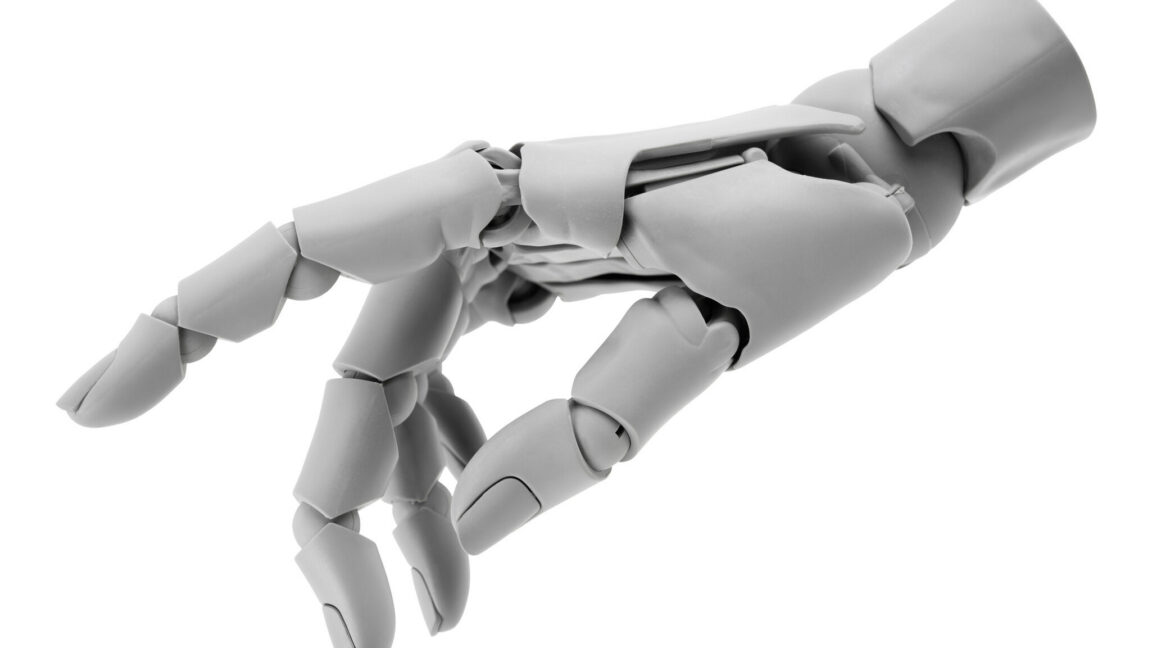
Scientists built an AI co-pilot for prosthetic bionic hands

by Jacek Krywko

Modern bionic hand prostheses nearly match their natural counterparts when it comes to dexterity, degrees of freedom, and capability. And many amputees who tried advanced bionic hands apparently didn’t like them. “Up to 50 percent of people with upper limb amputation abandon these prostheses, never to use them again,” says Jake George, an electrical and computer engineer at the University of Utah.

The main issue with bionic hands that drives users away from them, George explains, is that they’re difficult to control. “Our goal was making such bionic arms more intuitive, so that users could go about their tasks without having to think about it,” George says. To make this happen, his team came up with an AI bionic hand co-pilot.

Micro-management issues

Bionic hands’ control problems stem largely from their lack of autonomy. Grasping a paper cup without crushing it or catching a ball mid-flight appear so effortless because our natural movements rely on an elaborate system of reflexes and feedback loops. When an object you hold begins to slip, tiny mechanoreceptors in your fingertips send signals to the nervous system that make the hand tighten its grip. This all happens within 60 to 80 milliseconds—before you even consciously notice. This reflex is just one of many ways your brain automatically assists you in dexterity-based tasks.

Read full article

Comments

12 Dec 21:56

Hidden Camera Build Proves You Can’t Trust Walnuts

by Lewin Day

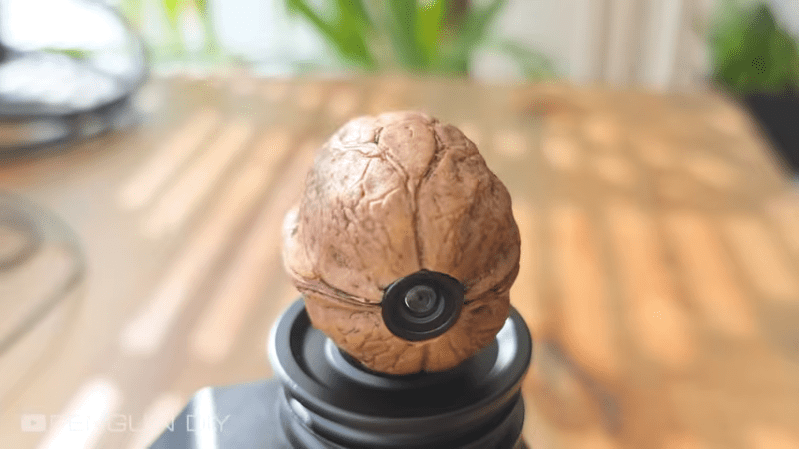
Typically, if you happened across a walnut lying about, you might consider eating it or throwing it to a friendly squirrel. However, as [Penguin DIY] demonstrates, it’s perfectly possible to turn the humble nut into a clandestine surveillance device. It turns out the walnut worriers were right all along.

The build starts by splitting and hollowing out the walnut. From there, small holes are machined into the mating faces of the walnut, into which [Penguin DIY] glues small neodymium magnets. These allow the walnut to be opened and snapped shut as desired, while remaining indistinguishable from a regular walnut at a distance.

The walnut shell is loaded with nine tiny lithium-polymer cells, for a total of 270 mAh of battery capacity at 3.7 volts. Charging the cells is achieved via a deadbugged TP4056 charge module to save space, with power supplied via a USB C port. Holes are machined in the walnut shell for the USB C port as well as the camera lens, though one imagines the former could have been hidden purely inside for a stealthier look. The camera itself appears to be an all-in-one module with a transmitter built in, with the antenna installed in the top half of the walnut shell and connected via pogo pins. The video signal can be picked up at a distance via a receiver hooked up to a smart phone. No word on longevity, but the included batteries would probably provide an hour or two of transmission over short ranges if you’re lucky.

If you have a walnut tree in your backyard, please do not email us about your conspiracy theories that they are watching you. We get those more than you might think, and they are always upsetting to read. If, however, you’re interested in surveillance devices, we’ve featured projects built for detecting them before with varying levels of success. Video after the break.

12 Dec 21:50

OpenAI Researcher Quits, Saying Company Is Hiding the Truth

by Frank Landymore

OpenAI has long published research on the potential safety and economic impact of its own technology.

Now, Wired reports that the Sam Altman-led company is becoming more “guarded” about publishing research that paints an inconvenient truth: that AI could be bad for the economy.

The perceived censorship has become such a point of frustration that at least two OpenAI employees working on its economic research team have quit the company, according to four Wired sources.

One of these employees was economics researcher Tom Cunningham. In his final parting message shared internally, he wrote that the economic research team was veering away from doing real research and instead acting like its employer’s propaganda arm.

Shortly after Cunningham’s departure, OpenAI’s chief strategy officer Jason Kwon sent a memo saying the company should “build solutions,” not just publish research on “hard subjects.”

“My POV on hard subjects is not that we shouldn’t talk about them,” Kwon wrote on Slack. “Rather, because we are not just a research institution, but also an actor in the world (the leading actor in fact) that puts the subject of inquiry (AI) into the world, we are expected to take agency for the outcomes.”

The reported censorship, or at least hostility towards pursuing work that paints AI in an unflattering light, is emblematic of OpenAI’s shift away from its non-profit and ostensibly altruist roots as it transforms instead into a global economic juggernaut. 

When OpenAI was founded in 2016, it championed open-source AI and research. Today its models are close-sourced, and the company has restructured itself into a for-profit, public benefit corporation. Exactly when is unclear, but reports also suggest that the private entity is planning to go public at a $1 trillion valuation, anticipated to be one of the largest initial public offerings of all time.

Though its non-profit arm remains nominally in control, OpenAI has garnered billions of dollars in investment, has signed deals that could bring in hundreds of billions of more, while also entering contracts to spend just as dizzying amounts of money. OpenAI gets AI chipmaker to agree to invest up to $100 billion in it on one end, and says it will pay Microsoft up to $250 billion for its Azure cloud services on the other.

With that sort of money hanging in the balance, it has billions of reasons why it wouldn’t want to release findings that shake the public’s already wavering belief in its tech — as many fear its potential to destroy or replace jobs, not to mention talk of an AI bubble or existential risks to humankind from the tech.

OpenAI’s economic research is currently overseen by Aaron Chatterji, According to Wired, Chatterji led a report released in September which showed how people around the world used ChatGPT, framing it as proof of how it created economic value by increasing productivity. If that seems suspiciously glowing, an economist who previously worked with OpenAI and chose to remain anonymous alleged to Wired that it was increasingly publishing work that glorifies its own tech.

Cunningham isn’t the only employee to leave the company over ethical concerns of its direction. William Saunders, a former member of OpenAI’s now-defunct “Superalignment” team, said he quit after realizing it was “prioritizing getting out newer, shinier products” over user safety. After departing last year, former safety researcher Steven Adler has repeatedly criticized OpenAI for its risky approach to AI development, highlighting how ChatGPT appeared to be driving its users into mental crises and delusional spirals. Wired noted that OpenAI’s former head of policy research Miles Brundage complained after leaving last year that it became “hard” to publish research “on all the topics that are important to me.”

More on OpenAI: Sam Altman Says Caring for a Baby Is Now Impossible Without ChatGPT

The post OpenAI Researcher Quits, Saying Company Is Hiding the Truth appeared first on Futurism.

12 Dec 08:05

Blockchain infrastructure transforms virtual gaming worlds via high performance networks

by Staff Writer

The gaming industry witnesses revolutionary transformation as blockchain infrastructure enables sophisticated virtual economies supporting millions of concurrent transactions.

High speed networks capable of processing thousands of operations per second provide the technological foundation for sustainable in-game marketplaces, seamless player-to-player trading, and complex economic systems rivaling real-world markets.

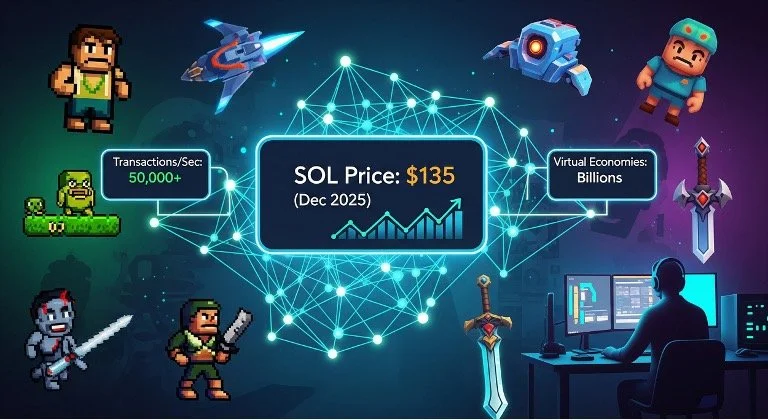
Understanding performance indicators including sol price, currently trading between $130-140 in December 2025, becomes essential for developers evaluating network capabilities when building virtual worlds requiring instant transaction finality and minimal operational costs.​

Network Performance Requirements for Gaming Applications

Game developers require blockchain infrastructure delivering transaction speeds comparable to traditional centralized gaming servers while maintaining decentralization benefits. Solana emerged as the leading blockchain for gaming applications by processing over 65,000 transactions per second with confirmation times under one second. This performance capability proves critical when thousands of players simultaneously execute in-game purchases, trade digital assets, or participate in marketplace activities requiring instant confirmation.​

Traditional blockchains struggle with gaming demands, as Bitcoin requires approximately 10 minutes for transaction confirmation while Ethereum averages 12-15 seconds. These delays create unacceptable user experiences in fast paced gaming environments where players expect instant feedback comparable to Web2 applications.

Solana's Proof-of-History mechanism combined with parallel transaction processing through Sealevel enables the network to handle gaming workloads without compromising decentralization or security.​

Player Ownership and NFT Integration

Blockchain technology fundamentally transforms player relationships with digital assets by establishing verifiable ownership through non-fungible tokens. Unlike traditional games where developers retain ultimate control over in-game items, NFT-based assets provide players true ownership recorded on immutable public ledgers.

Players can freely trade weapons, character skins, virtual land, and other game elements on open marketplaces, monetising their gameplay achievements outside publisher-controlled ecosystems.​

Star Atlas exemplifies sophisticated NFT integration within gaming, allowing players to own spaceships, weapons, and territory as tradable blockchain assets. The game combines strategy, role-playing, and simulation mechanics with play to earn models where players earn cryptocurrency by completing missions and conquering new areas.

Mini Royale: Nations demonstrates NFT interoperability by integrating Ready Player Me avatars, enabling players to use characters across different platforms while maintaining ownership verification through blockchain records.​

Decentralised In-Game Economics

Blockchain enables developers to construct player driven economies operating independently from centralized publisher control. Smart contracts facilitate secure peer-to-peer transactions where players directly trade assets without intermediary involvement, reducing friction and enabling instant settlements.

These decentralised marketplaces operate 24/7 with transparent pricing mechanisms visible to all participants, establishing fair market values through organic supply and demand dynamics.​

Gaming tokens serve as native currencies within virtual worlds while maintaining convertibility to other cryptocurrencies and fiat money through external exchanges. This dual functionality allows players to monetize gaming time by earning tokens through gameplay achievements, then exchanging accumulated wealth for real-world value.

The blockchain and NFTs in gaming market projects expansion to $2,721 billion by 2035, demonstrating institutional recognition of sustainable economic models emerging within virtual environments.​

Transaction Cost Considerations

Network fees significantly impact gaming economic viability, particularly for high-frequency microtransactions characteristic of modern multiplayer games. When evaluating sol price movements and network economics, developers recognise that Solana's average transaction cost remains below $0.001, enabling profitable business models even with numerous small value transactions.

This cost efficiency contrasts sharply with networks charging several dollars per transaction, which prove prohibitive for gaming applications requiring thousands of daily player interactions.​

Affordable transaction fees make Solana ideal for play to earn models, NFT minting, and in-game marketplace operations without imposing excessive overhead on players or developers. Games like STEPN, Aurory, and Honeyland leverage Solana's low cost infrastructure to create engaging experiences where players earn rewards without transaction fees consuming their earnings.

The economic sustainability of these models depends directly on network efficiency, positioning high-performance blockchains as essential infrastructure for next-generation gaming.​

Cross-Game Asset Interoperability

Blockchain technology facilitates asset portability across different gaming platforms, creating interconnected virtual ecosystems. NFT standards enable developers to recognise and integrate assets from other games, allowing players to utilise characters, items, or currencies across multiple titles.

This interoperability enhances asset value by expanding utility beyond single game contexts while building cohesive metaverse environments where digital identities and possessions persist across virtual worlds.​

Echoes of Eldoria implements sophisticated NFT systems where each hero possesses unique attributes and battle histories permanently recorded on-chain. Players can trade these characters in dedicated marketplaces while maintaining complete ownership history and achievement records.

The platform's NFT staking, character fusion mechanics, and limited edition releases demonstrate how blockchain infrastructure supports complex game mechanics impossible within traditional centralised architectures.

12 Dec 07:57

🧠 Cet implant cérébral ultra-mince permet de connecter efficacement son cerveau à une IA

by Adrien BERNARD
Comment pouvons-nous interagir avec les ordinateurs en utilisant uniquement notre esprit ? Les interfaces cerveau-ordinateur existantes sont souvent limitées par leur taille et leur invasivité,...
11 Dec 21:46

10 Contradictory Traits of Creative People

Creative people display contradictory personality traits. This finding has stuck with me since I read it over 20 years ago in psychologist Mihaly Csikszentmihalyi’s book Creativity: Flow and the Psychology of Discovery and Invention.

Csikszentmihalyi drew this finding from over 100 interviews with exceptional people—engineers, writers, historians, chemists, musicians, business people and more—and his lifetime of research into psychology, happiness, and flow. Alongside dismantling several myths surrounding creativity, such as the tortured genius, Mihalyi explores the central idea that creative people do not lean only toward one side or the other on a range of personality traits. Instead, creative people will display quite opposite characteristics at different times, or even at the same time.

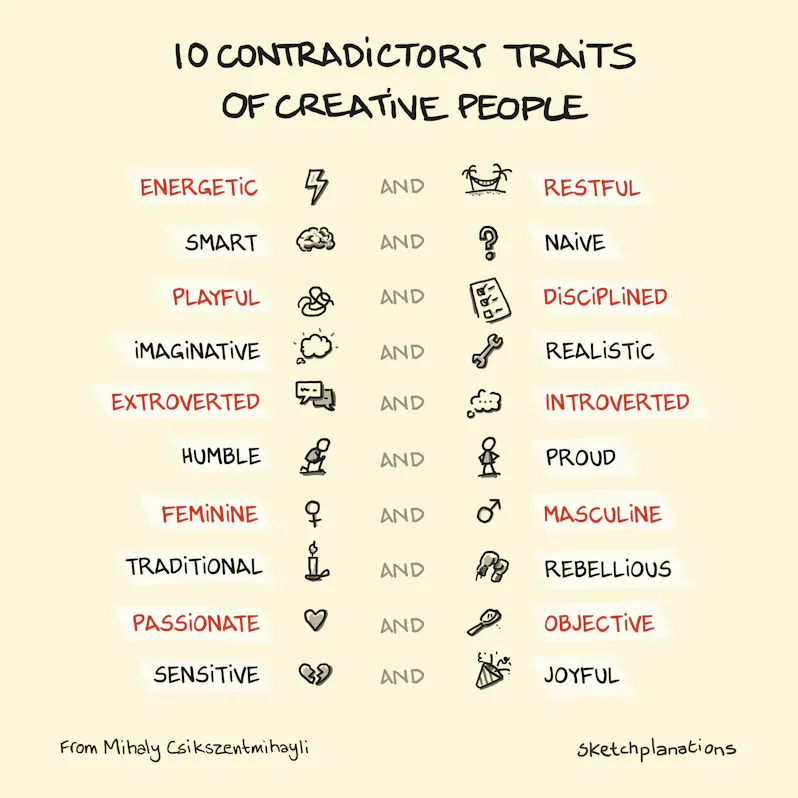
The 10 Contradictory Traits of Creative People

Creative people often display both sides of these traits:

  • Energetic and Restful
  • Smart and Naive
  • Playful and Disciplined
  • Imaginative and Realistic
  • Extroverted and Introverted
  • Humble and Proud
  • Feminine and Masculine
  • Traditional and Rebellious
  • Passionate and Objective
  • Sensitive and Joyful

The Importance of Contradiction

This idea of contradictory personality traits was exciting to me when I read about it. I was a young design and engineering graduate learning and applying the Theory of Inventive Problem-Solving (TRIZ) for what seemed like creative solutions. I was fascinated with where ideas come from, what creative people do differently, and how I could become one.

A fundamental idea in TRIZ is that solutions evolve through the resolution of contradictions. For example, you want a tent to be strong and sturdy so it doesn’t blow over or break. The standard approach for this makes it heavier. But you also want it to be lightweight to carry. How can it be both strong and lightweight? Enter creative solutions.

Compromise and trade-off are sometimes necessary, but whenever you find what seems a truly creative solution, you’ll usually find that someone’s resolved a contradiction at its core.

And here was Mihaly Csikszentmihalyi finding that creative people benefit not just from being imaginative, but also, at times, from being realistic. Not just smart, but also, at times, naive. Resolving a contradiction of personality.

Resisting Labelling

Labelling others or yourself usually seems to me a misguided and often harmful act. For example, attribution bias is the tendency to attribute behaviour to fixed personality traits rather than to circumstances or actions. Considering someone a genius, a loser, or a natural artist, without considering the circumstances and actions that got them where they are, gets us off the hook.

As David Macauley pointed out (video), when people say they can’t draw, they’ve usually never really tried.

The idea of displaying contradictory or paradoxical traits was very freeing to me. To be creative, you don’t have to be this or that. You can be this at times and that at times. And perhaps this fluidity helps us towards creative insights.

I generally consider myself fairly introverted—I easily recharge through time by myself—but in the right company and the right time, I can appear quite extroverted.

The smartest people can also ask naive questions.

Being proud and confident can help try things that others won’t. And being humble enables you to accept help and ideas from others, and not drive collaborators away.

At times, you may be energetic and productive; at other times, you may want to rest and recharge.

We don’t have to be one or the other. We can be open to being both.

Excerpt on Creative Individuals and Complex Personalities

Here’s Csikszentmihalyi from the book:

“Are there no traits that distinguish creative people? If I had to express in one word what makes their personalities different from others, it would be complexity. They show tendencies of thought and action that in most people are segregated. They contain contradictory extremes – instead of being an ‘individual’, each of them is a ‘multitude’. These qualities are present in all of us, but usually we are trained to develop only one pole of the dialectic. We might grow up cultivating the aggressive, competitive side of our nature, and disdain or repress the nurturant, cooperative side. A creative individual is more likely to be both aggressive and cooperative, either at the same time or at different times, depending on the situation. Having a complex personality means being able to express the full range of traits that are potentially present in the human repertoire.

  1. Creative individuals have a great deal of physical energy, but they are also often quiet and at rest.
  2. Creative individuals tend to be smart, yet also naive at the same time.
  3. A third paradoxical trait refers to the related combination of playfulness and discipline, or responsibility and irresponsibility.
  4. Creative individuals alternate between imagination and fantasy at one end, and a rooted sense of reality at the other.
  5. Creative people seem to harbor opposite tendencies on the continuum between extroversion and introversion.
  6. Creative individuals are also remarkably humble and proud at the same time.
  7. Creative individuals to a certain extent escape this rigid gender role stereotyping [of ‘masculine’ and ‘feminine’].
  8. Creative people are both traditional and conservative and at the same time rebellious and iconoclastic.
  9. Creative persons are very passionate about their work, yet they can be extremely objective about it as well.
  10. The openness and sensitivity of creative individuals often exposes them to suffering and pain yet also a great deal of enjoyment.”

Related Ideas to 10 Paradoxical Traits of Creative People

Also see:

The same excerpt above is also in the excellent Farnum Street.

11 Dec 21:46

GPT-5.2 est officiel : OpenAI espère repasser devant Google avec son nouveau modèle

by Nicolas Lellouche

Dépassé depuis plusieurs semaines par Google et son modèle Gemini 3 Pro, OpenAI contre-attaque avec GPT-5.2. Déployé progressivement dans ChatGPT et via l'API, ce nouveau modèle se décline en trois versions, Instant, Thinking et Pro. Avec une fenêtre de contexte massive et des promesses de productivité décuplée, OpenAI espère notamment séduire les professionnels.

11 Dec 21:45

Disney invests $1 billion in OpenAI, licenses 200 characters for AI video app Sora

by Benj Edwards

On Thursday, The Walt Disney Company announced a $1 billion investment in OpenAI and a three-year licensing agreement that will allow users of OpenAI’s Sora video generator to create short clips featuring more than 200 Disney, Marvel, Pixar, and Star Wars characters. It’s the first major content licensing partnership between a Hollywood studio related to the most recent version of OpenAI’s AI video platform, which drew criticism from some parts of the entertainment industry when it launched in late September.

“Technological innovation has continually shaped the evolution of entertainment, bringing with it new ways to create and share great stories with the world,” said Disney CEO Robert A. Iger in the announcement. “The rapid advancement of artificial intelligence marks an important moment for our industry, and through this collaboration with OpenAI we will thoughtfully and responsibly extend the reach of our storytelling through generative AI, while respecting and protecting creators and their works.”

The deal creates interesting bedfellows between a company that basically defined modern US copyright policy through congressional lobbying back in the 1990s and one that has argued in a submission to the UK House of Lords that useful AI models cannot be created without copyrighted material.

Read full article

Comments

11 Dec 18:06

Google is Rolling out Photorealistic ‘Likeness’ Avatars on Android XR to Compete with Apple’s ‘Personas’

by Ben Lang

Google is starting to roll out new photorealistic avatars which they call “Likeness”. Similar to Apple’s Personas, Likeness avatars are generated by scanning a user’s face, then animated it with input from the sensors on a headset. The avatars can be used to represent the user in video call apps, but Google doesn’t yet have a way to have spatial meetings with other Likeness avatars.

The News

Google is launching its own photorealistic avatars called Likeness avatars, for use on compatible Android XR headsets. The idea is similar to Apple’s Persona avatars: scan the user’s face to create a realistic representation, then use the headset’s on-board cameras to animate the scan as realistically as possible.


Likenesses take a slightly different (and probably more user-friendly) approach for the initial face scan; rather than scanning by holding a headset out in front of your face, Google instead released a Likeness (beta) Android app to let people scan themselves with their phone instead. Holding your phone in front of your face for a scan is definitely a bit easier than awkwardly holding a whole headset with both hands.

According to Google, the Likeness (beta) app is only compatible with Google Pixel 8 or newer, Samsung Galaxy S23 or newer, or Samsung Z Fold5 or newer. Without a compatible device, you can’t create a Likeness avatar, meaning Android XR users with an iPhone (or unsupported Android phone) won’t be able to scan themselves. One benefit of Apple’s approach to scanning with the headset itself is that anyone can use a Persona avatar on Vision Pro regardless of what kind of phone they have.

Image courtesy Google

Like Apple’s approach, Likeness avatars can be used generically as a ‘virtual webcam’. That makes them widely compatible with most video call apps that expect a front-facing camera, like Google MeetZoom, Messenger, etc.

And just like Apple, the first ‘beta’ iteration of Likeness avatars are 2D only. They are presented as a 2D representation with no way to transmit them in a spatial format, or have a ‘spatial meeting’, like Vision Pro can do with spatial FaceTime calls. However, Google says it’s working on spatial meetings for the future.

My Take

Photorealistic avatars on XR headsets are a great value-add because of the ability to use video call apps naturally. Apple’s Personas are currently the state-of-the-art as far as consumer-available photorealistic avatars, and the company has shown that it’s possible to cross over the uncanny valley with this approach to avatars.

During a recent meeting with Google, I joined a demo video call on Google Meet with one of the participants using a Likeness avatar. From a photorealism standpoint, the results look impressive, and facial movements look convincing too. However, because I didn’t personally know the individual using the Likeness, I was unfamiliar with their actual idiolect, which makes it impossible for me to judge the accuracy of the facial motion. Still, facial motion only needs to be plausibly realistic to be passable in many circumstances, and that’s been achieved from what I can see.

Image courtesy Google

While it’s a bummer that there’s no ‘spatial meeting’ yet for Android XR (allowing users to chat face-to-face with fully spatial Likeness avatars), Google made the right choice in prioritizing virtual webcam usage at the start. It’s less impressive than spatial meetings, but more widely useful and compatible with existing services and apps.

There’s probably no chance we’ll see spatial calls between Likeness avatars and Persona avatars any time soon, but virtual webcam compatibility makes it trivial for both kinds of avatars to chat across headsets.

One thing worth noting is that Likeness avatars probably won’t be compatible with all Android XR devices. Forthcoming ‘Android XR’ smartglasses (which don’t run anything close to the full-blown version of Android XR) don’t have the power or sensors necessary to render or animate a Likeness avatar. Similarly, devices like XREAL Aura (which does run full-blown Android XR), might have the power but don’t have the sensors (eye and mouth tracking cameras) to animate a Likeness avatar.

It’s possible that Google could make Likeness avatars compatible with these devices by doing simulated eye movements and audio-based lip-sync. Although those technologies are already widely in use for more cartoonish avatars, they’re likely to fall deep into the uncanny valley when applied to photorealistic face scans. So I doubt Google will take that approach.

With the introduction of Likeness avatars, Google also has the same challenge I pointed out recently regarding Apple’s Persona avatars: as headsets get smaller, how will they bring this level of avatar fidelity to smaller headsets that have even less room for the cameras that are essential for these kinds of avatars?

The post Google is Rolling out Photorealistic ‘Likeness’ Avatars on Android XR to Compete with Apple’s ‘Personas’ appeared first on Road to VR.