Aux États-Unis, la chaîne de distribution Target a mis en place, pour Halloween, une visite de maison hantée à 360° sur YouTube.
Lire la suite sur Creapills.com
Aux États-Unis, la chaîne de distribution Target a mis en place, pour Halloween, une visite de maison hantée à 360° sur YouTube.
Lire la suite sur Creapills.com

Creating a convincing haunted atmosphere in your home by accenting the room with one of these creepy screaming face pillows. This cotton polyester pillow is soft to the touch and creates the illusion some poor soul is trapped inside its fluffy innards.
$22.67

Create incredible works of art even if you aren't a great artist by coloring in your masterpieces with these Chameleon color changing pens. The revolutionary design of these refillable pens makes it possible to seamlessly blend colors and shade like a professional.
$5.00

Images tend to make any page more engaging, especially when done right. The problem is that automating image creation and sizing can be a very difficult task, especially when the image is uploaded by a user — who knows what format, size, and resolution the image will be. Hell, who knows if they’re actually sending you an image for that matter (though validating that they’ve uploaded an image isn’t too difficult).
I recently found out about smartcrop.js, a brilliant JavaScript utility which analyzes the contents of an image and finds the focal point (a face, for example) of any image. It’s easy to use and does an outstanding job picking up on the important part of an image.
Check out a few images I put through the smartcrop.js testbed:

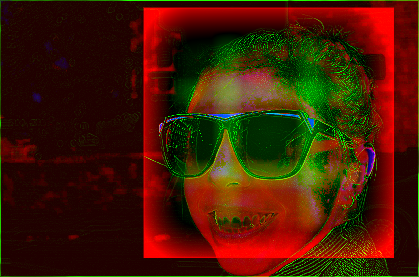

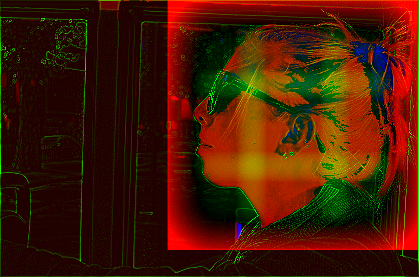
I wont bother showing the super simple code sample — you can view that on the smartcrop.js repo. And be sure to play around on the testbed. I love recognizing developers for their feats and this is some incredible work by Jonas Wagner!
The post Focused Image Cropping with smartcrop.js appeared first on David Walsh Blog.
Jean-Philippe EncausseGoogle Glass
Topsky is the only supplier of headmounted micro-display based devices that I have seen at Hong Kong tradeshows who may be able to provide a Google Glass like experience starting at $230 per unit for a 100-unit minimum order quantity. The only negative things about it is the Ingenic MIPS dual-core processor (instead of using Rockchip or Allwinner ARM solutions), and the software is "not yet" provided by Google, this doesn't run Google Glass UI, it doesn't run Android Wear UI, it runs Topsky's custom UI on top of Android, which looks good, but is not quite the same as having Google's support. What could happen though, is Google people watch this video and contact Topsky below, or maybe some hackers get it and improve it somehow. I look forward to try it out some more to see about the voice-control capabilities, if it hooks into Google Now yet or some other voice command Android app, and how in general it may or may not manage to use any other Android app that may work good for this user interface. My dream is still (since CeBIT 2005) to live-stream from my face and see a live chat from anyone watching about which questions to ask the people that I interview in 4K. Crucial for this "vision" is for affordable Google Glass type devices to become available. These need to be mass produced, the price can be lowered further, then the software platform should be open and fully supported by Google and by everyone! Let's make headmounted computing happen!
You can contact Topsky here (thanks for telling them you watched my video!)
Sofia Huang, Sales Manager
sofia@hktopsky.com
Mobile: +86 15815527996
Skype: sofiatopsky

Despite huge developments, consumers still have a significant wait before driverless cars become a viable option. In the meantime, researchers from Robo Brain and Brain4Cars, have developed a promising system for computer-assisted driving, which uses sensors and deep learning to preempt bad driving and alert the driver before they actually do it.

The majority of road deaths are caused by drivers attempting unsafe maneuvers, which is why Robo Brain monitors the drivers themselves, as well as external factors. The system is comprised of multiple sensors including cameras, wearable devices, and tactile sensors. The devices monitor the driver in real-time, and an algorithm learns the individual’s driving behavior. Over time it is able to anticipate a dangerous driving maneuver up to 3.5 seconds in advance and provide a warning that will discourage the driver from going ahead with it. For example, it might learn that glancing to the right frequently means the driver is going to overtake and alert them if it is likely to result in a crash.

The system was created by the Departments of Computer Science at Cornell and Stanford Universities. Researchers collected thousands of miles of natural driving data from a variety of drivers. It combines this data with the individual’s habits, which it can learn very quickly: in recent tests, after just over 100 miles, the system was able to predict the actions of 10 drivers with 90 percent accuracy.
Computer-assisted driving could help to pave the way for acceptance of driverless cars, winning over skeptics by showing the improvements to safety that computers can provide. Are there other technologies that provide a middle ground for users who are apprehensive of big changes?
Website: www.brain4cars.com
Contact: ashesh@cs.cornell.edu
The post Minority Report system for drivers improves road safety appeared first on Springwise.
On the Coding4Fun blog, we've been doing a theme week focusing on projects related to last week's Hardware announcement. After seeing this project, I thought it cool to continue the theme here too.. :)
Roland Smeenk shared this great project, that just looks awesome...
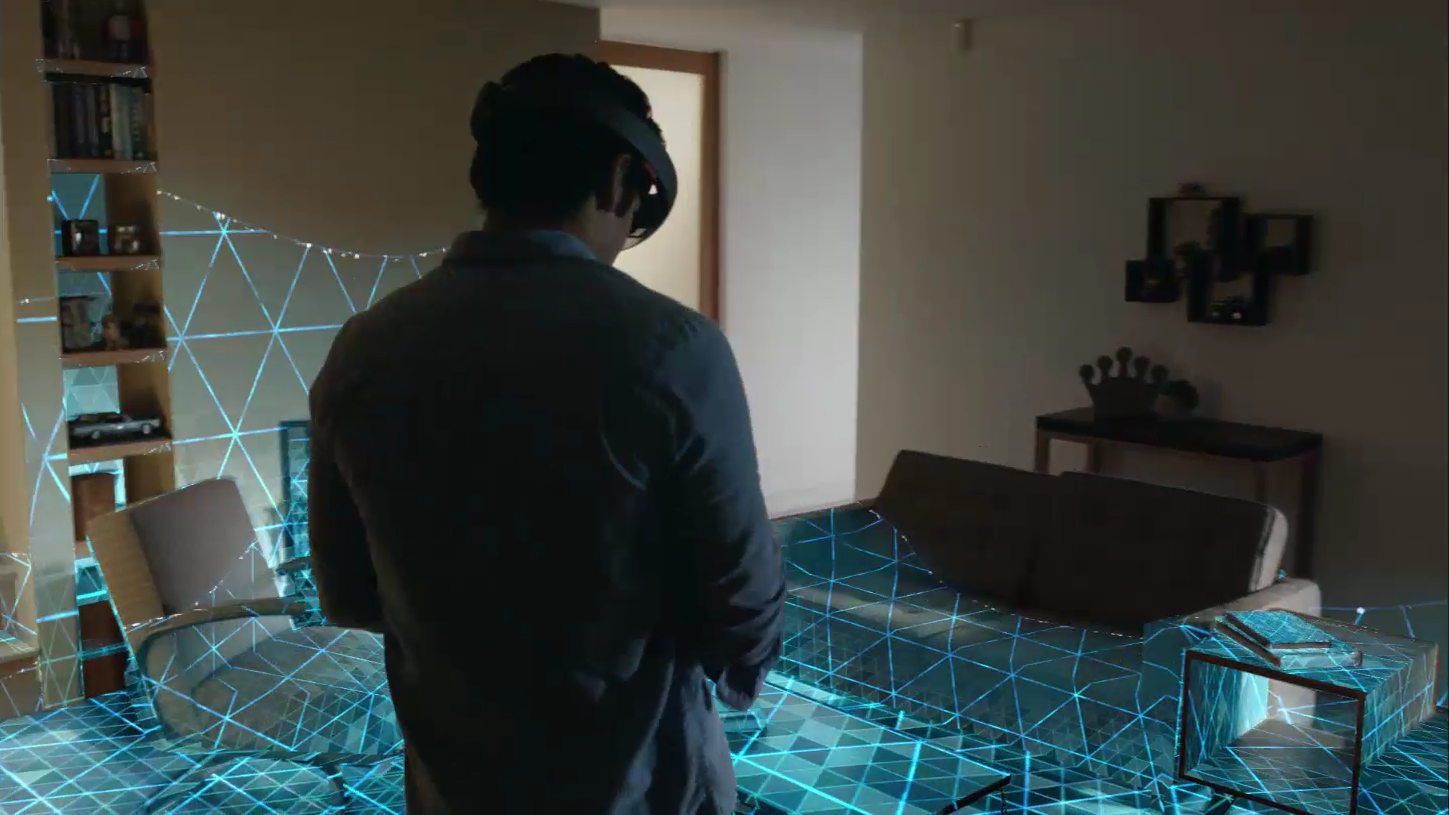
The initial video that explains the HoloLens to the world contains a small clip that visualizes how it can see the environment. It shows a pattern of large and smaller triangles that gradually overlay the real world objects seen in the video. I decided to try to rebuild this effect in real life by using a projection mapping setup that used a projector and a Kinect V2 sensor.
Prototyping in Shadertoy
First I experimented with the idea by prototyping a pixel shader in Shadertoy. Shadertoy is an online tool that allows developers to prototype, experiment, test and share pixel shaders by using WebGL. I started with a raymarching example by Iñigo Quilez and setup a small scene with a floor, wall and a bench. The calculated 3D world coordinates could then be used for overlaying with a triangle effect. The raymarched geometry would later be replaced by geometry scanned with the Kinect V2. The screenshot below shows what the effect looks like. The source code of this shader can be found on the Shadertoy website.
...
Projection mapping with RoomAlive Toolkit
During Build 2015 Microsoft open sourced a library called the RoomAlive Toolkit that contains the mathematical building blocks for building RoomAlive-like experiences. The library contains tools to automatically calibrate multiple Kinects and projectors so they can all use the same coordinate system. This means ...
Bring Your Own Beamer
The installation was shown at the Bring Your Own Beamer event held on September 25th 2015 in Utrecht, The Netherlands. For this event I made some small artistic adjustments.....
...
Project Information URL: http://smeenk.com/hololens-scanning-effect/
Contact Information:
Follow @CH9
Follow @Coding4Fun
Follow @KinectWindows
Follow @gduncan411


Adobe et Fotolia ont mis au point SOOON, un livre connecté qui a pour objectif d'éduquer les créatifs sur les tendances de demain.
Lire la suite sur Creapills.com
Le photographe tchèque Janek Sedlář est à l’origine de sublimes photographies de forêts enveloppées dans le manteau du brouillard automnal. Les couleurs de la saison sont parfaitement mises en valeur, offrant un aspect enchanté aux clichés, dont les paysages semblent sortis de contes fantastiques.




















L'idée a émergé suite à l'expérience réalisée par son fondateur, Jeff Wilson, qui a vécu pendant un an dans une benne à ordures de 10 mètres carrés.


Researchers have created a video-modifying program that transfers the expressions of a subject onto live video of another subject's face in real time. The video warrants cliché: it has to be seen to be believed.
The project is a collaboration between researches from University of Erlangen-Nuremberg, Max-Planck-Institude for Informatics, and Stanford University. Footage of the project was been released in September with a paper titled "Real-time Expression Transfer for Facial Reenactment." Here's how the abstract describes what makes their system unique:
The novelty of our approach lies in the transfer and photorealistic re-rendering of facial deformations and detail into the target video in a way that the newly-synthesized...
Our pals from Sneaky Zebra are back with a new cosplay music video, and this time, they’re covering the New York edition of the con! I’ll also include the one from Aggressive Comix below for you guys to check out!
[Sneaky Zebra | Aggressive Comix]
The post New York Comic Con 2015: A Cosplay Music Video by Sneaky Zebra appeared first on Geeks are Sexy Technology News.
The folks from Jalopnik got on board a Tesla Model S and drove with the autopilot system turned on. Let’s just say that even though I was not behind the wheel, just seeing the thing breaking and changing lane by itself kind of freaked me off.
[Jalopnik]
The post Tesla’s New Autopilot System Is Creepy And Wonderful [Video] appeared first on Geeks are Sexy Technology News.
SOON un guide prospectif sur le design.
The post SOOON by Fotolia, un guide prospectif sur le Design appeared first on FrenchWeb.fr.

23andMe wants to expand its reach — and possibly its consumer health product line. The personal genomics company announced today that it had raised $115 million in venture capital financing. Part of that money will help the company expand its operations abroad, according to a press release. But Bloomberg reports that the money will also be used to accelerate work on a "revamped product with health analysis," which 23andMe hopes to launch by the end of this year.
La banque d’images Fotolia, membre de la famille Adobe, lance son projet SOOON, un guide interactif imprimé et relié par commandes vocales à une plateforme web dédiée. Ce projet a pour objectif d’offrir de nouvelles perspectives d’innovations aux créatifs et de les aider à décrypter les tendances de demain. En abordant des sujets très variés tels que le motion design et la réalité augmentée, il rassemble l’expertise de nombreux professionnels et designers de renoms. À découvrir.










Youtuber Sufficiently Advanced made this cool high tech replica of Mjolnir (Thor’s Hammer) that can only be lifted by himself… or someone that has access to his fingerprints!
[Sufficiently Advanced | Via Dorkly]
The post Geek Pranks People with Real-Life Version of Thor’s Hammer [Video] appeared first on Geeks are Sexy Technology News.

These are a couple pictures and video of Dutch biology teacher Debby Heerkens teaching anatomy to her class by wearing different spandex suits printed with internal organs, muscle groups, and the skeleton. Cool idea! Heerkens came up with the idea when she saw someone walking around with similar leggings. After finding them online, she kade sure that it was ok with the school’s director and then brought them in to class. Since the memorable class, students have been asking about when she’ll be having another similar lesson...(Read...)

Travel around the city without having to lug around a cumbersome lock by riding on the bicycle seat lock. The cleverly designed seat can be pulled off the bicycle and extended to form a one meter long chain that you can use to lock your bike.
$99.00

En Ukraine, Sport Life et l'agence Geometry Global ont mis au point un flyer-origami qui transforme un homme de forte corpulence en bodybuilder.
Lire la suite sur Creapills.com


 Make way for another big player entering the Internet of Things space. Amazon today is announcing its long-awaited IoT platform for AWS at its re:Invent developer conference in Las Vegas. As Amazon describes it, it is a managed cloud platform “that lets connected devices easily and securely interact with cloud applications and other devices.” The platform, which is launching… Read More
This New Hololens Demo Is Freaking Crazy!..(Read...)

It's not often that you see something truly different when it comes to camera design these days. The meaningful differences tend to show up in the more obscure details — more megapixels here, a better viewfinder there. But on the outside, most are variations on the same idea: a rectangle, some buttons, a screen, and a lens. So how do make a camera that's different from all the others, both inside and out? You start by cramming 16 cameras into one body.
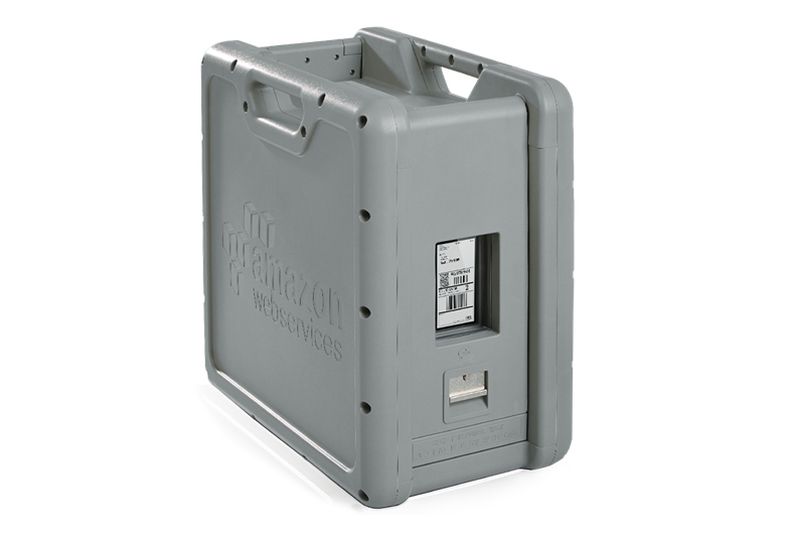
Backing data up to the cloud is pretty fast for most of us since we're syncing small files, but it can be a hugely time-consuming process if you're backing up something bigger, say, an entire data center. So Amazon has come up with a solution: essentially a big ugly box that holds 50TB of storage and can be mailed back and forth with ease so that the transfers can all be done locally, at much higher speeds.

O.zen est un petit capteur dans lequel vous placez votre doigt et que vous connectez à votre iPhone. Celui-ci va transformer votre rythme cardiaque en jeu amusant pour vous aider à gérer le stress au quotidien.
Lire la suite sur Creapills.com

A Disney Research team has developed technology that projects coloring book characters in 3D while you're still working on coloring them. The process was detailed in a new paper called "Live Texturing of Augmented Reality Characters from Colored Drawings," and it was presented at the IEEE International Symposium on Mixed and Augmented Reality on September 29th. That title's a mouthful, but it's descriptive: the live texturing technology allows users to watch as their characters stand and wobble on the page and take on color as they're being colored in. You can see an example in the video above: the elephant's pants are turning blue on the tablet screen just as they're being filled on the page itself.
Augmented reality has been used to...
Jean-Philippe EncausseC'est du rebranding de Ozobot
Cannybots, une startup de l’université de Cambridge au Royaume-Uni, a lancé une campagne de financement participatif sur la plateforme Kickstarter afin de financer le développement de ses voitures de course programmables. La startup s’était fixée un objectif de 40 000 $ (35 800 €), objectif qu’elle a atteint en moins de deux heures. Lancée le 29 septembre, la campagne se terminera dans 40 jours et a quasiment atteint les 110 000 $ (98 000 €).
Les voitures Cannybots sont des jouets robots intelligents contrôlables depuis un smartphone ou une tablette. L’objectif est d’inciter les enfants, à travers ces jouets interactifs, à s’intéresser à la programmation, la robotique ou l’intelligence artificielle. Le fonctionnement est simple, puisqu’il suffit de se procurer le kit, de construire la voiture et la connecter à son téléphone pour pouvoir conduire. Il est en outre possible de modifier le logiciel en utilisant Scratch ou Arduino. Par le biais de CannyTalk, l’application dédiée, n’importe qui peut programmer le Cannybot en utilisant de l’anglais courant. Le moteur d’intelligence artificielle utilisé par l’application est développé en partenariat avec des chercheurs du département des sciences informatiques de l’université de Cambridge.

Chaque kit comprend toutes les pièces et instructions nécessaires pour assembler un robot. Celui-ci est ensuite programmable via un téléphone, une tablette, un ordinateur ou une Raspberry Pi. Pour Anish Mampetta, le PDG de la startup, “passer par le processus de construction fournit aux enfants une expérience de première main de la construction d’un robot fonctionnel qu’ils peuvent aussi programmer.” Pour lui, “la programmation est une compétence essentielle aujourd’hui, mais ce n’est pas facile d’intéresser des enfants à ce domaine. [Cannybots] permet aux enfants de faire cela de façon amusante, interactive et gratifiante.”

Une fois programmés, les robots peuvent être utilisés dans de nombreux scénarios. Nous pouvons, entre autres, citer les courses de vitesse, les courses contre la montre, des combats de sumo, des joutes ou des puzzles. Des applications et des designs imprimables en 3D sont disponibles pour chaque jeu. De plus, en utilisant un logiciel gratuit de conception assistée par ordinateur, fourni par Autodesk, le partenaire de Cannybot, les utilisateurs peuvent créer des nouveaux concepts de carrosseries pour les voitures. Les concepts sont ensuite imprimables en 3D en utilisant n’importe quelle imprimante 3D.
Les voitures sont déjà très populaires et utilisées dans plus de 20 écoles au Royaume-Uni et en Europe. En accédant à la campagne Kickstarter, il est possible d’acquérir les robots pour le prix “Early Bird” à 89 $ (80 €). Les robots seront envoyés à temps pour les vacances de Noël. Vous pouvez accéder à la campagne ici.


Cet article Cannybots présente ses voitures de course programmables pour enfants est apparu en premier sur H+ Magazine.