
Shared posts
22 Jul 16:22


An Abandoned Indonesian Church Shaped Like a Massive Clucking Chicken
by Kate Sierzputowski
via uzone.id
Towering above the trees in a densely forested area of Indonesia lies a giant chicken. The gigantic structure has the body, tail, and head of the bird, even holding open its beak in what appears to be mid-squawk. Although the very old bird is quickly decaying, Gereja Ayam (as the locals call it) attracts hundreds of photographers and travelers to its location in Magelang, Central Java each year who are looking to explore the bird’s bizarre interior.
The building was originally built as a prayer house by 67-year-old Daniel Alamsjah after he received a divine message from God. Although he intended the building to resemble a dove, the locals care more that it looks like a chicken, nicknaming it “Chicken Church.” In addition to a prayer house, Alamsjah also used the building as a rehabilitation center, treating disabled children, drug addicts, and others. Alamsjah was forced to shut the center’s doors fifteen years ago after steep construction costs.
Currently five of the eight pillars holding up the building are crumbling while graffiti covers the inside walls. No longer a place for therapy, the building still serves as a place for worship and travel and according to locals—a private spot for many young couples to hide away from parents or prying eyes. (via Hyperallergic and Daily Mail)
via Punthuk Setumbu
via Alek Kurniawan
via Alek Kurniawan
via Alek Kurniawan
via Alek Kurniawan

via Alek Kurniawan
via Alek Kurniawan
André Bergei, Bunker.jordan and 2 others like this

20 Jul 07:57
Connaissance du 20/07/2015
C'est grâce au soutien financier de Bomis, une société spécialisée dans la vente de publicité et d'images érotiques et pornographiques en ligne, que Wikipédia a vu le jour.
20 Jul 07:57
Connaissance du 20/07/2015
L'ADN n'est pas éternel. Les chercheurs ont pu définir qu'une molécule conservée dans la terre à une température de 13 degrés était détériorée de moitié au bout de 521 ans. Peu de chances de voir un jour un vrai "Jurassic park".
16 Jul 09:24

French artist Thomas Mailaender sunburns photographs onto skin
by Alex Hawkins

French artist Thomas Mailaender is putting a new spin on the old trope of the body as a canvas. For his most recent book, Illustrated People, Thomas applied 23 negatives of archival photographs onto his subjects’ bodies and used a UV lamp to sear the images onto their skin. This process of temporarily transferring negatives onto skin has a similar effect to sunburn, although the fleeting images begin to fade as soon as they are exposed to daylight. Juxtaposing colour photographs of his sunburn shots with black and white archival imagery, Thomas’ jarring, pink-skinned portraits are seen on arms, backs, stomachs and legs in a 128-page hardcover publication with a befitting red sleeve.


15 Jul 08:25
Connaissance du 15/07/2015
En 1903, les Etats Unis obtiennent de Cuba la location perpétuelle de la baie de Guantanamo et envoient tous les ans un chèque de 4085$. Depuis la prise de pouvoir par Fidel Castro en 1959, seulement un chèque a été encaissé, par erreur.
15 Jul 08:20


#MotivationalMonday
by Elizabeth Freeman
Start your week off with a little #MotivationalMonday from The Dieline!


Martim.baffi likes this
15 Jul 08:13
Noma Bar’s Birds Eye View
by Antonia Wilson

Translating his illustrations into architectural forms, graphic designer and illustrator Noma Bar has been commissioned to create a viewhouse in the wooded area of Momofuku Centre in Komoro, Japan.

The structure sits at the highest point of the site with a view across the surrounding landscape, and Mount Asama, an active volcano in central Japan. It is the seventh in a series of treehouses commissioned by the Momofuku Ando Foundation designed by various artists.


After playing with leaves from the forest, Bar discovered the bird structure when folding one over another, which inspired him to create the structure.
In keeping with his illustration style, the 9-metre treehouse invites visitors to discover a visual playfulness, using simple geometric shapes in its construction, with the architecture offering various forms depending on perspective or direction of view.
"I wanted the viewers to discover, so this treehouse is built with a few angles. So if you come from one angle in front you are not going to see a bird, you will see a leaf. It will be in different tones of green, and from a distance will be a leaf," Noma describes in a Momofuku Centre video interview. "And when you turn you will discover it is actually two leaves, and then that the two leaves form a bird. And then you will discover that you have stairs to go up to view. So it's constant discoveries."


agenthamyak.com/artists/noma-bar




13 Jul 09:19

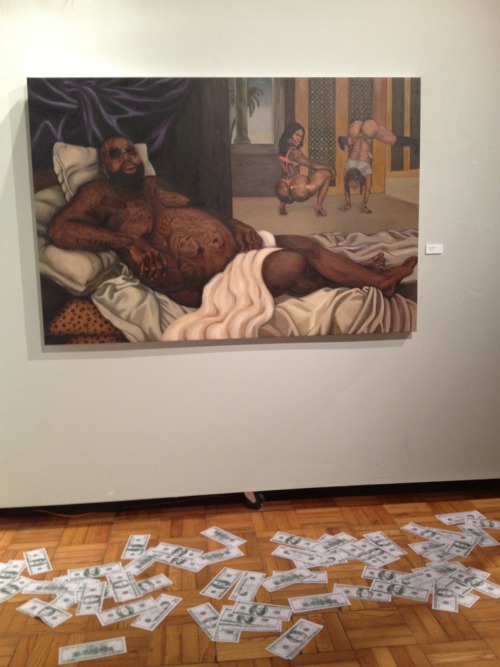
HENRI MATISSE AT THE HÔTEL RÉGINA, NICE. 1952unknown...
HENRI MATISSE AT THE HÔTEL RÉGINA, NICE. 1952
unknown photographer
13 Jul 09:19
It’s Hard To Believe That These Naturally Forming Rainbow Colored Mountains In China Are Not Photoshopped
by Tamara Akcay


A humble kingdom of mountains dominates the geological park of Zhangye Danxia in China. The images are surreal, hard to believe they haven’t been photoshopped. Naturally formed of multi-colored layers, the mesmerizing rocks echo the intoxicating installations of Katharina Grosse. She creates an environment of massive abstract installations on where she sprays vivid horizontal and vertical colored lines.
The mountains are overlooking the world and we are observing their similar version in the work of Katharina Grosse. A bizarre unpredicted three way which leaves us, humans, feeling very small face to face with the immensity of creation.
They are both the result of a performance, nature’s on one hand, the artist’s on the other; leaving on site a charismatic scene. The colors on the mountains are the result of deposits of sandstones and other minerals that occured over 24 million years ago. The regularity of the juxtaposed colors is shocking, as if a human hand had meticulously traced those lines. Unthinkable; yet nature did it on its own.
Katharina Grosse, already featured in Beautiful/Decay for her incredible installations, uses space without any limits. Her art is, at times, perceived as graffiti art or outdoor paintings. Means by which she expresses herself as a vision and avoids to think about a separation between what’s inside and what’s outside. “When I’m painting I show what I’m thinking about the world I live in. I don’t make up a world”.


The post It’s Hard To Believe That These Naturally Forming Rainbow Colored Mountains In China Are Not Photoshopped appeared first on Beautiful/Decay.
13 Jul 09:15
Connaissance du 13/07/2015
Les habitants de Bonny-sur-Loire, commune du département du Loiret, s'appellent des Bonnychons.
13 Jul 09:11
Print Isn't Dead Element 003 (UK)
by Coverjunkie
This issue of Print Isnt Dead revolves around the possibility to create your own personalized cover (250 characters, digitally printed).
This is a project of the People Of Print, an unique creative community driven by an experienced force of art directors, project managers, graphic designers, illustrators, developers and printmakers across the globe.
Richard Owers, Director of PurePrint:
"Its a publication about creativity. Because there are so many printing techniques, printing i...


09 Jul 10:09
Everyday Foods Cut Into Perfect Squares Is Bizarrely Satisfying
by Stephanie Young


What if all our food was served sushi style? Would it be more appetizing? And would we eat less if everything was the same size? The artist/design team of Lernert and Sander asks that question and ponders the aesthetic of making food dimensionally equal. In an ambitious project they took dozens of food items and cut them into uniform cubes then photographed the results. The final result is an array of colors which resembles a very large tray of sushi. The different pieces offer an interesting palette through color but the size seems well a bit static. Overall it has a futuristic vibe but is it appetizing? In other words, would you rather eat cherry pie in a cube or oozing with cherries? It probably works better as a puzzle because its display references word and board games. The puzzle at hand would be guessing at quick glance what food group or item you’re eating from. Still only eye candy maybe there’s a chef or game designer out there that can make something else of the food seen here; and attempt to make something more than just the perfect square. (via 1designperday)


The post Everyday Foods Cut Into Perfect Squares Is Bizarrely Satisfying appeared first on Beautiful/Decay.
09 Jul 10:07
Shake Shack Unveils The ChickenShack

It's been rumoured for months, but now Shake Shack has officially unveiled the ChickenShack - a chicken burger which will be going on sale today at the chain's three Brooklyn locations.
09 Jul 09:06
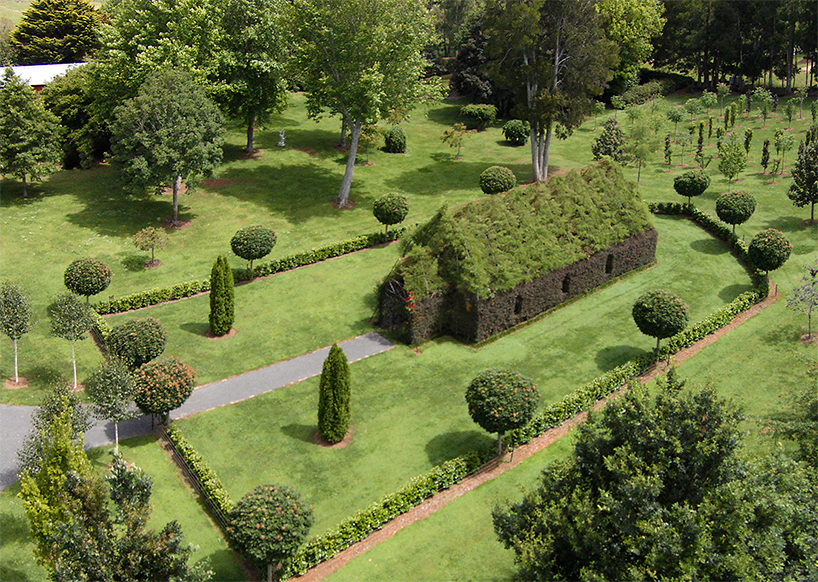
new zealand nature lover grows living tree church and lush labyrinth walk
by nina azzarello I designboom
barry cox has built a living chapel on the grounds of a 3-acre garden in the region of ohaupo.
The post new zealand nature lover grows living tree church and lush labyrinth walk appeared first on designboom | architecture & design magazine.
08 Jul 09:30

Jean-Michel Basquiat, the artist who brought graffiti to the Guggenheim
by Alex Hawkins

From subway graffitist to art world darling, Jean-Michel Basquiat was perhaps the quintessential New York artist. Before he came to embody that particularly urbane trinity of poetry, jazz and painting, the Brooklyn prodigy was spray painting cryptic messages on Lower Manhattan buildings under the moniker SAMO and selling sweatshirts and postcards emblazoned with his work. Basquiat was one of several graffiti artists to transition to the gallery, but the only one with such a meteoric ascent and with such staying power. By his early twenties he counted Andy Warhol as a friend and collaborator, and his impassioned brand of countercultural painting had completely taken New York by storm.
08 Jul 08:48

Artist Spotlight: Jakub Geltner
by Staff

Prague-based artist Jakub Geltner has been installing clusters of surveillance equipment in random places since 2011. See more images from the most recent seaside installation as well as a selection from Geltner’s Nests series below.
View the whole post: Artist Spotlight: Jakub Geltner over on BOOOOOOOM!.