| archive - contact - sexy exciting merchandise - search - about | |||
 |
|||
| ← previous | February 1st, 2016 | next | |
|
February 1st, 2016: YOU GUYS, I started Dinosaur Comics on February 1st 2003, 13 years ago today! AS OF TODAY DINOSAUR COMICS IS OFFICIALLY A TEENAGER! This is madness. This is pure, freebased madness. Thank you all for liking my comics, for supporting it through merchandise and patronage throughout the years, and for letting me have the best job in the world! Holy crap. Y'all are the best. I can't believe I have a teenager now. Dinosaur Comics is all sassing authority figures and sneaking into R-rated movies! Metaphorically!! – Ryan | |||
Andrew Hickey
Shared posts
12 Feb 12:11
the first draft of this comic included the line "the only thing that didn't die with johnny was his horniness"; it was a very different comic that, for some reason, i abandoned
12 Feb 12:09
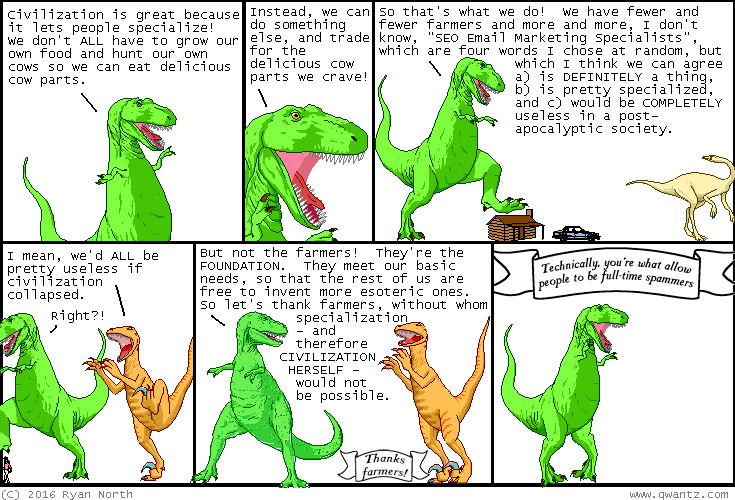
"civilization is great" - ryan north, a man who has specialized in making up imaginary stories about talking dinosaurs, and who is FOR SOME REASON very interested in civilization not collapsing
| archive - contact - sexy exciting merchandise - search - about | |||
 |
|||
| ← previous | February 8th, 2016 | next | |
|
February 8th, 2016: HEY GUESS WHAT?? I've got a new book coming out in June called ROMEO AND/OR JULIET and you can preorder it now and IF YOU DO, you can send a special Valentine's Day ecard to your sweetie THIS MONTH that features new art by either Kate Beaton or Noelle Stevenson! AHHHH
 – Ryan | |||
11 Feb 15:01

Let’s get rid of drive-throughs
by Emily Badger
(frankieleon/Flickr)
So many Americans drive today — 86 percent of us to work each morning — because we've made driving incredibly easy in this country. We've built gobs and gobs of parking. We don't charge much for it. We don't expect users to pay for the true cost of maintaining our roads. And in dozens of subtle ways — how we design streets, construct buildings, fund infrastructure, subsidize commuting — we've prioritized cars over just about every other way of getting around.
And then there is the drive-through, the ultimate symbol of how we've built into the world around us the deeply held belief that you should be able to do everything you want, as conveniently as possible, by automobile. Grab coffee without leaving your car! Do your banking at the driver's wheel! Pick up your lunch from your front seat — and then eat it there too!
The allure of the drive-through makes it a fascinating place to begin thinking about car culture and how we might change it. Minneapolis, according to the Star Tribune's Eric Roper, is weighing this now, with potential new regulations aimed at curbing the proliferation of these things:
Some Minneapolis leaders want to clamp down on drive-throughs in favor of people traveling the city on foot. A change to city rules in its early stages would likely further restrict where drive-throughs could be installed in the city.
“The streets where a lot of people are walking, on our transit corridors, maybe we don’t want to have drive-throughs at all,” said Council Member Lisa Bender, who sponsored the proposal with Council Member Lisa Goodman. “If we do, we may want to strengthen our controls of them and minimize their impact on people walking.”
Drive-throughs essentially turn sidewalks into roadways, making them incompatible with good environments for people on foot. And, as officials in Minneapolis point out, idling cars contribute to pollution, too (which also isn't that great to walk through).
In some cases, drive-throughs may still make sense; as one Walgreens developer argues in Minneapolis, they make access to medicine easier for the elderly and overwhelmed parents at drugstores. And they're less problematic on the kinds of wide commercial streets, far from residential neighborhoods, where few people walk and bike.
Broadly speaking, though, the idea is fundamentally a product of the belief that we should design communities around cars — and at the expense of people who can't or don't want to use them. If a city is rethinking the drive-through, that's a sign it may be ready to reconsider that more deeply entrenched idea, too.
11 Feb 15:00


Donald Trump represents the end of the end of history
by Matt O'Brien
(Reuters/Jonathan Drake)
At least he's a leader.
That's what—time to get used to these words—Republican frontrunner Donald Trump said about Vladimir Putin when he was reminded that the Russian president's critics in the press have a nasty habit of turning up dead. It was the sort of thing you might have heard in the 1930s about fascists who "knew how to get things done." Or in the 1970s about communists who seemed to be whipping us at the same time that we couldn't even figure out how to whip inflation.
In other words, it's not new for our democracy to go through a crisis of confidence—just don't call it a malaise—when our economy does. What is new, though, is the kind of crisis our economy is in today. Now, things aren't as bad as they were during the Great Depression or even the Great Inflation, but they aren't as easy to turn around, either. Back then, fixing the economy meant fixing big-picture policies that had failed. It was, as economist John Maynard Keynes put it, a simple matter of "magneto trouble:" our economic engine would work just fine if we replaced a part here and pulled a lever there.
But that's not true anymore, at least not for blue-collar workers. More and more people feel like they're falling further and further behind even during the "good times." They're mad as hell, and they're not going to take it anymore, which is just another way of saying that they're looking for scapegoats. And that's why even if Trump isn't long for the political stage—although who wants to bet on that after his New Hampshire win?—Trumpism is. The only question is whether it will completely capture the Republican Party or remain a quadrennial curiosity, you know, like the Winter Olympics.
This isn't just an American problem. It's an everywhere problem. All across the rich world, a new type of nationalist is either taking power or getting close to it. They often display signs of chauvinism, a sympathy for authoritarianism, and skepticism of, if not active hostility to, globalization. On that last point, a lot of them are, put more simply, anti-trade and anti-immigrant. Putin's Russia was really the first, but it's been followed by plenty of others: Erdogan's Turkey, Orbán's Hungary, and, just in the last few months, Kaczynski's Poland. There are even hints of it in Abe's Japan. And those are just the countries where the new nationalists have already won. Among the ones that haven't, France's National Front and Britain's UKIP have also made big gains.
It's the end of the end of history. That, of course, was Francis Fukuyama's idea that capitalism and liberal democracy didn't and couldn't have any ideological competitors after they vanquished communism. They had won now and forever—which turned out to be for 15 years. What happened? Well, global capitalism has undermined national democracy. The fact is that the working-class in rich countries have stagnated since the Berlin Wall came down and they faced increasing competition from the billions of new workers entering the global economy. You can see that in the chart below from economist Branko Milanovic, in particular the red area I've highlighted. It shows how much inflation-adjusted incomes have increased—or not—for the whole world between 1988 and 2008.
(A quick note on reading this chart: Imagine everyone, as in everyone in the world, lined up based on how much money they make. The richest people in the richest countries, and everywhere else for that matter, would make up the global top 1 percent. Working-class people in the richest countries would be around the 80th percentile. And middle-class people in middle-class countries would be around the 50th percentile.)
Source: Branko Milanovic
It's not exactly a surprise, then, that the people who have been hurt the most by globalization don't like it. Indeed, the working class in countries like the United States, United Kingdom, and France have actually seen their inflation-adjusted incomes fall the past 30 years at the same time that hundreds of millions of Chinese, Indian, and Indonesian workers have been lifted out of extreme poverty. It's true that these rich-world workers are still, well, richer than people in the rest of the world, but that's not much of a consolation for them. That's because the things they need just to tread water—housing, healthcare, and higher education—keep going up in price while their wages do not. That adds up to a financial future where their kids could very well end up worse off than they are, something 60 percent of Americans and 85 percent of French people are afraid will happen.
If that's not depressing enough, there's more. Think about this: Economics 101 teaches us that free trade works when you redistribute (through government policy) the gains from the winners to the losers, so you'd hope that the countries that do, in fact, redistribute more would have less of a backlash against globalization. The only problem is that sure doesn't seem to be the case. Right-wing populists, after all, are just as popular in tax-and-spend France as they are in tax-and-spend-a-lot-less America. Now, maybe that's because of anti-immigrant hysteria rather than anti-trade anger. And maybe a stronger safety net is enough to get people to support a more open economy. But I doubt it. Why? Well, it goes against Psychology 1o1: people prefer jobs to welfare. Jobs give them pride, give them purpose, give them a future. You can't make up for that with just a check—although that doesn't mean we shouldn't do what we can. It just means that we shouldn't expect this to make people who have had their jobs offshored say that it was worth it since they can now buy things for less at Walmart.
That leaves us in a rather dark place. On the one hand, a lot of working-class people feel like our elites have sold them out, but on the other, our elites feel like those people want things that go against basic human decency. They both have a point. The bigger problem, though, is that it's hard to do anything about this and harder still to convince people that the things we can do are enough. Trump voters don't want to hear that we need a president who will strengthen the safety net or a central banker who will weaken the dollar. They want a strongman who will stick it to their enemies at home and overseas—Putin with a New York accent.
So does that mean we're doomed for some kind of democratic breakdown? No, not if we can stall for time. That's because even though it's true that free trade has cost us a lot of jobs, it's also true that there's only one China. That means the worst of what happened the past 15 years shouldn't happen again. You see, it turns out that adding a billion people to the global labor market makes labor worth a lot less. Economists David Autor, David Dorn, and Gordon Hanson estimate that China alone made us lose 1.5 million manufacturing jobs between 1990 and 2007, and, in the hardest-hit areas, pushed down non-manufacturing wages too. But, after 30 years of its one-child policy, China's labor glut is almost over now—and there's nothing to replace it. As a result, wages should start rising in China, in the U.S., and everywhere else for that matter. That won't stop people from being xenophobic, but it should stop them from thinking xenophobia will solve their problems since they won't have as many.
It's just a matter of making it till then. That will take a real leader.
11 Feb 14:14
Day 5514: A Great Deal of Europe but not Mr Balloon's Dreadful Deal
by Millennium Dome
Friday:
In this week's the Evening Standard, Mr Matthew "Gideon's Voice on Earth" Anaconda wrote that the EU referendum could: "turn Mr Balloon from a good PM to one of the greats".
This is utter bunkum.
For starters, he ain't no bleedin' good to begin with!
And, for seconders, at best this wretched referendum will decide between whether Mr Balloon has wasted all our time (and money!) to keep the Status Quo or if he's going to be the first Prime Monster since Mr Pitt to have to explain to a reigning monarch how they managed to LOSE A CONTINENT!
So, as the Conservatories perform their farcical DANCE OF DEATH between their loathsome Europhobic back benches and their cowardly-but-pragmatic cabinet ministers, it is increasingly clear that the case for Europe must rest on its own merits.
Do we REALLY have to do this PANTOMIME? All of the Papers have thrown up their hands and said how DREADFUL a deal Mr B has got, so he will troop off back to Europe and return with an "even better" deal ("even better" – i.e. more foul) JUST so he can wave it in the face of his backbench and keep Teresa Nuts-in-May and Bojo the Clown onside.
What has he actually achieved? Let's play the Once-in-a-Generation Game and ask: "What's on the Euro-Conveyor Belt tonight, Brucie?"
Europe has brought us PEACE and PROSPERITY – and both in levels UNDREAMED OF in a THOUSAND YEARS.
Europe has given us freedom to travel, and in safety, and to retire to warm climes while still claiming our British pensions. It has enshrined our Human Rights – the Human Rights that Churchill espoused after the Second World War so that the Holocaust would never happen again. It has championed our workers and our free trade. It has brought us continent-wide health protection, and joint action on the things that threaten us: crime, terrorism and climate change.
Europe has brought us FRIENDSHIP.
The OUT campaign cannot even be friends with EACH OTHER!
Or rather OUT campaign S – plural, multiple, or paranoid schizo – since they cannot even agree to BE one campaign. They literally cannot organise a piss-up in THREE brewery. Nigel Farrago cannot even manage to get to Question Time by car – do you REALLY believe he could make the trains run on time?
And what EXACTLY to the OUTERS want to DO with the Country once they've achieved their dream? (A dream to some; a NIGHTMARE to others!) Some of them want to trade – don't we do that in Europe? Some of them want us to "stand tall" (whatever that means) – do we not take a leading place in Europe? Some of them want to go back to an imaginary Nineteen Fifties – I've SEEN Dr Woo; it's MAKE BELIEVE! If you want to experience the Nineteen Fifties, try the former Communist states… in Europe! Some of them, even – whisper it – want to pull up the drawbridge and keep the migrants out – do we not migrate TO Europe? Are we to bar from returning all of those MILLIONS of BRITISH people who've gone work or retire in Europe? Because their England-for-the-English phobias (trading Polish plumbers and Hungarian handymen for grumpy geriatrics) would actually make our migration figures CALAMATOUSELY WORSE?
The way to make this country GREAT again is NOT to run away from our responsibilities, is not to deny that we have a DUTY to the rest of the World, but instead to stop SKULKING at the BACK and TAKE OUR GODDAMED PLACE in the fellowship of nations, and for GOD, HARRY and SAINT BLEEDIN' GEORGE DO our BIT to LEAD IN Europe.
In this week's the Evening Standard, Mr Matthew "Gideon's Voice on Earth" Anaconda wrote that the EU referendum could: "turn Mr Balloon from a good PM to one of the greats".
This is utter bunkum.
For starters, he ain't no bleedin' good to begin with!
And, for seconders, at best this wretched referendum will decide between whether Mr Balloon has wasted all our time (and money!) to keep the Status Quo or if he's going to be the first Prime Monster since Mr Pitt to have to explain to a reigning monarch how they managed to LOSE A CONTINENT!
So, as the Conservatories perform their farcical DANCE OF DEATH between their loathsome Europhobic back benches and their cowardly-but-pragmatic cabinet ministers, it is increasingly clear that the case for Europe must rest on its own merits.
Do we REALLY have to do this PANTOMIME? All of the Papers have thrown up their hands and said how DREADFUL a deal Mr B has got, so he will troop off back to Europe and return with an "even better" deal ("even better" – i.e. more foul) JUST so he can wave it in the face of his backbench and keep Teresa Nuts-in-May and Bojo the Clown onside.
What has he actually achieved? Let's play the Once-in-a-Generation Game and ask: "What's on the Euro-Conveyor Belt tonight, Brucie?"
- An "emergency brake" on benefits – being publicised as stopping people taking out before they've paid in, but sold under the counter as stopping those entirely-imaginary "pull factors" that mean bunches of migrants fleeing a massive war (that's our fault) are "pulled" to come to a cold, wet island full of xenophobes.
- A "red card" to stop European legislation and protect British sovereignty – how EXACTLY would Mr Balloon feel about giving the power to any 15 counties "red carding" HIS legislation? Sovereignty is a funny old thing, though. You actually get MORE by sharing. Europe may seem very distant, but at least at the moment you HAVE a say when you vote for the Parliament. The Europhobes talk BIG about "sovereignty" but actually they want you to have LESS voice, less voting power.
- A guaranteed "opt-out" from "Ever Closer Union" – Here's the thing about "ever closer union": it doesn't JUST mean Britain becoming more like France, Germany or Italy… it means France, Germany and Italy becoming MORE LIKE US too. And it's a BIT bleedin' rich to opt out of it, when "ever closer union" was ACTUALLY the compromise Britain demanded because all of our little-englander politicians got huffy about "towards a federal Europe". A FEDERAL Europe of CO-EQUAL states would actually SOLVE a lot of those problems about Sovereignty. But it would also mean finally accepting that Britain IS equal and not top of the heap (an attitude that can only lead to us ending up top of the RUBBISH heap!).
- And "protection" from the policies of the Eurozone – which means freedom from responsibilities for the BANKERS of the City of London (like THAT never got us into FINANCIAL ARMAGEDDON!) and, essentially, the right to make SWEETHEART Google-tax deals (did you know TART was originally a short form for SWEETHEART – so Master Gideon is Google's… well, you can work it out).
- And thankfully NOT a Cuddly Toy, because I am SO not on board with this pandering.
Europe has brought us PEACE and PROSPERITY – and both in levels UNDREAMED OF in a THOUSAND YEARS.
Europe has given us freedom to travel, and in safety, and to retire to warm climes while still claiming our British pensions. It has enshrined our Human Rights – the Human Rights that Churchill espoused after the Second World War so that the Holocaust would never happen again. It has championed our workers and our free trade. It has brought us continent-wide health protection, and joint action on the things that threaten us: crime, terrorism and climate change.
Europe has brought us FRIENDSHIP.
The OUT campaign cannot even be friends with EACH OTHER!
Or rather OUT campaign S – plural, multiple, or paranoid schizo – since they cannot even agree to BE one campaign. They literally cannot organise a piss-up in THREE brewery. Nigel Farrago cannot even manage to get to Question Time by car – do you REALLY believe he could make the trains run on time?
And what EXACTLY to the OUTERS want to DO with the Country once they've achieved their dream? (A dream to some; a NIGHTMARE to others!) Some of them want to trade – don't we do that in Europe? Some of them want us to "stand tall" (whatever that means) – do we not take a leading place in Europe? Some of them want to go back to an imaginary Nineteen Fifties – I've SEEN Dr Woo; it's MAKE BELIEVE! If you want to experience the Nineteen Fifties, try the former Communist states… in Europe! Some of them, even – whisper it – want to pull up the drawbridge and keep the migrants out – do we not migrate TO Europe? Are we to bar from returning all of those MILLIONS of BRITISH people who've gone work or retire in Europe? Because their England-for-the-English phobias (trading Polish plumbers and Hungarian handymen for grumpy geriatrics) would actually make our migration figures CALAMATOUSELY WORSE?
The way to make this country GREAT again is NOT to run away from our responsibilities, is not to deny that we have a DUTY to the rest of the World, but instead to stop SKULKING at the BACK and TAKE OUR GODDAMED PLACE in the fellowship of nations, and for GOD, HARRY and SAINT BLEEDIN' GEORGE DO our BIT to LEAD IN Europe.
PS:
Also, what Andrew says about Britain Stronger In.
11 Feb 14:04
Here’s some video of me spouting about Deep Questions
by Scott
In January 2014, I attended an FQXi conference on Vieques island in Puerto Rico. While there, Robert Lawrence Kuhn interviewed me for his TV program Closer to Truth, which deals with science and religion and philosophy and you get the idea. Alas, my interview was at the very end of the conference, and we lost track of the time—so unbeknownst to me, a plane full of theorists was literally sitting on the runway waiting for me to finish philosophizing! This was the second time Kuhn interviewed me for his show; the first time was on a cruise ship near Norway in 2011. (Thankless hero that I am, there’s nowhere I won’t travel for the sake of truth.)
Anyway, after a two-year wait, the videos from Puerto Rico are finally available online. While my vignettes cover what, for most readers of this blog, will be very basic stuff, I’m sort of happy with how they turned out: I still stutter and rock back and forth, but not as much as usual. For your viewing convenience, here are the new videos:
- The black hole information paradox, firewalls, and Harlow-Hayden argument (6 minutes)
- Physics and free will (8 minutes 24 seconds)
- Which entities are conscious? (6 minutes 3 seconds)
- Quantum mechanics, the predictability of nature, the Bell inequality, and Einstein-certified randomness (5 minutes 12 seconds)
- What’s the value of philosophy, and can it make progress? (3 minutes 42 seconds)
- Newcomb’s Paradox (4 minutes 13 seconds)
- Gödel’s Theorem and the definiteness of mathematical truth (8 minutes 20 seconds)
I had one other vignette, about why the universe exists, but they seem to have cut that one. Alas, if I knew why the universe existed in January 2014, I can’t remember any more.
One embarrassing goof: I referred to the inventor of Newcomb’s Paradox as “Simon Newcomb.” Actually it was William Newcomb: a distant relative of Simon Newcomb, the 19th-century astronomer who measured the speed of light.
At their website, you can also see my older 2011 videos, and videos from others who might be known to readers of this blog, like Marvin Minsky, Roger Penrose, Rebecca Newberger Goldstein, David Chalmers, Sean Carroll, Max Tegmark, David Deutsch, Raphael Bousso, Freeman Dyson, Nick Bostrom, Ray Kurzweil, Rodney Brooks, Stephen Wolfram, Greg Chaitin, Garrett Lisi, Seth Lloyd, Lenny Susskind, Lee Smolin, Steven Weinberg, Wojciech Zurek, Fotini Markopoulou, Juan Maldacena, Don Page, and David Albert. (No, I haven’t yet watched most of these, but now that I linked to them, maybe I will!)
Thanks very much to Robert Lawrence Kuhn and Closer to Truth (and my previous self, I guess?) for providing Shtetl-Optimized content so I don’t have to.
Update: Andrew Critch of CFAR asked me to post the following announcement.
We’re seeking a full time salesperson for the Center for Applied Rationality in Berkeley, California. We’ve streamlined operations to handle large volume in workshop admissions, and now we need that volume to pour in. Your role would be to fill our workshops, events, and alumni community with people. Last year we had 167 total new alumni. This year we want 120 per month. Click here to find out more.
11 Feb 14:03
“Why does the universe exist?” … finally answered (or dissolved) in this blog post!
by Scott
In my previous post, I linked to seven Closer to Truth videos of me spouting about free will, Gödel’s Theorem, black holes, etc. etc. I also mentioned that there was a segment of me talking about why the universe exists that for some reason they didn’t put up. Commenter mjgeddes wrote, “Would have liked to hear your views on the existence of the universe question,” so I answered in another comment.
But then I thought about it some more, and it seemed inappropriate to me that my considered statement about why the universe exists should only be available as part of a comment thread on my blog. At the very least, I thought, such a thing ought to be a top-level post.
So, without further ado:
My view is that, if we want to make mental peace with the “Why does the universe exist?” question, the key thing we need to do is forget about the universe for a while, and just focus on the meaning of the word “why.” I.e., when we ask a why-question, what kind of answer are we looking for, what kind of answer would make us happy?
Notice, in particular, that there are hundreds of other why-questions, not nearly as prestigious as the universe one, yet that seem just as vertiginously unanswerable. E.g., why is 5 a prime number? Why does “cat” have 3 letters?
Now, the best account of “why”—and of explanation and causality—that I know about is the interventionist account, as developed for example in Judea Pearl’s work. In that account, to ask “Why is X true?” is simply to ask: “What could we have changed in order to make X false?” I.e., in the causal network of reality, what are the levers that turn X on or off?
This question can sometimes make sense even in pure math. For example: “Why is this theorem true?” “It’s true only because we’re working over the complex numbers. The analogous statement about real numbers is false.” A perfectly good interventionist answer.
On the other hand, in the case of “Why is 5 prime?,” all the levers you could pull to make 5 composite involve significantly more advanced machinery than is needed to pose the question in the first place. E.g., “5 is prime because we’re working over the ring of integers. Over other rings, like Z[√5], it admits nontrivial factorizations.” Not really an explanation that would satisfy a four-year-old (or me, for that matter).
And then we come to the question of why anything exists. For an interventionist, this translates into: what causal lever could have been pulled in order to make nothing exist? Well, whatever lever it was, presumably the lever itself was something—and so you see the problem right there.
Admittedly, suppose there were a giant red button, somewhere within the universe, that when pushed would cause the entire universe (including the button itself) to blink out of existence. In that case, we could say: the reason why the universe continues to exist is that no one has pushed the button yet. But even then, that still wouldn’t explain why the universe had existed.
10 Feb 22:11

This generation has far too many ‘Ezras’ already, thanks
by Fred Clark
Charismanews editor and sex-with-demons beat reporter Jennifer LeClaire endorses Ted Cruz for president, saying “The Lord wants to raise up Cruz, 45, as an Ezra in this generation.”
The reference there is actually somewhat apt. The biblical figure of Ezra was also a callous, racist prick. The conclusion of the book of Ezra, and the culmination of Ezra’s own story, is a nationwide mass-divorce and mass-deportation of foreigners: “to send away all these wives and their children.” No alimony, no child support — just cast them out like Hagar and Ishmael.
Ezra’s male followers deported so many women and children — their own children — that the process took days to carry out.
In Ezra’s mind, this was the only way for his people to return to obedience:
We have forsaken your commandments, which you commanded by your servants the prophets, saying, ‘The land that you are entering to possess is a land unclean with the pollutions of the peoples of the lands, with their abominations. They have filled it from end to end with their uncleanness. Therefore do not give your daughters to their sons, neither take their daughters for your sons, and never seek their peace or prosperity.”
You won’t find a footnote cross-referencing that citation of nameless “prophets” back to an actual passage in one of the books of the prophets. And if you actually read those actual prophets, you won’t have a hard time finding lots and lots of passages where those actual prophets contradict what Ezra is attributing to them there. Jeremiah, for instance, told the people of Israel to “seek the welfare of the city where I have sent you into exile, and pray to the Lord on its behalf, for in its welfare you will find your welfare.” And Isaiah has whole strings of chapters anticipating the glorious day when people of all nations — the icky, unclean, pollution-people Ezra can’t stand — will come to worship in Jerusalem.
Click for link.
Ezra’s story doesn’t get discussed as much as it should. When “pro-family” preachers turn to the Bible to collect proof-texts on divorce, they always seem to forget the “clear biblical teaching” of the final chapters of Ezra. For Ezra, divorce is not merely permitted — it’s mandatory. Divorce is commanded by God. And so is the abandonment of racially impure children.
Like I said, Ezra was a prick. He was such an abusive, wrong-headed jerk that whole chunks elsewhere in scripture go out of their way to repudiate his ideology and behavior. That’s why Ruth is in the canon. It’s why Ruth is in every story of David and why Ruth is in the genealogies of Jesus in the Gospels. Oh, and pretty much everything the Gospels and Acts have to say about Samaritans.
I realize that for many of my evangelical friends this — Ruth vs. Ezra — is a terrifying, headsploding matter. They can’t look at it — can’t allow themselves even to peek at it. But you can’t read both the book of Ruth and the book of Ezra and not see that what you’ve got there is a direct, explicit, intentional conflict. It’s Ruth vs. Ezra. Pick one side or the other, you can’t have both.
And, by the way, there’s a right answer and a wrong answer here. I mean, you can sign up for Team Ezra if you really want to insist that David and Jesus are polluted and tainted by the uncleanness of a Moabite garbage-person, but the idea that the anointed king’s great-grandmother should have been deported and his grandfather abandoned as an infant isn’t something you’re going to find much support for in the rest of the canon.
But, yeah, OK, Ted Cruz as Ezra. Scapegoat foreign women, insist that the solution to all our problems is just getting rid of the wrong kinds of people, and never give a second thought to what this means for any of those women and children because you don’t think of them as real people. Kind of fits.
10 Feb 21:11
First Timers
by evanier
I just stole the paragraph below from Josh Marshall's website because I thought it was worth quoting in full…
You'll hear a lot today about how since 1322 or whenever it is, only three men have lost the New Hampshire primary and gone on to be president. But definitely pay attention to who the three are: Clinton, Bush and Obama. In other words, the last three presidents, going back 24 years. So yeah, the New Hampshire primary ain't what it used to be.
And keep in mind that no matter who the nominees are, there's going to be some precedent-breaking. If the Democratic nominee is Hillary Clinton, you'll hear, "This country has never elected a woman president" If it's Bernie Sanders, you'll hear, "This country has never elected an admitted Democratic Socialist."
If the Republican nominee is Donald Trump, you'll hear, "This country has never elected a man with no experience in government or the military." If it's Ted Cruz or Marco Rubio, you'll hear, "This country has never elected a person of Hispanic ancestry."
Just like not long ago, it was "This country has never elected a black man." There's a first time for everything except President Jim Gilmore.
The post First Timers appeared first on News From ME.
09 Feb 19:35
Guest Post: Grant Remmen on Entropic Gravity
by Sean Carroll
 “Understanding quantum gravity” is on every physicist’s short list of Big Issues we would all like to know more about. If there’s been any lesson from last half-century of serious work on this problem, it’s that the answer is likely to be something more subtle than just “take classical general relativity and quantize it.” Quantum gravity doesn’t seem to be an ordinary quantum field theory.
In that context, it makes sense to take many different approaches and see what shakes out. Alongside old stand-bys such as string theory and loop quantum gravity, there are less head-on approaches that try to understand how quantum gravity can really be so weird, without proposing a specific and complete model of what it might be.
Grant Remmen, a graduate student here at Caltech, has been working with me recently on one such approach, dubbed entropic gravity. We just submitted a paper entitled “What Is the Entropy in Entropic Gravity?” Grant was kind enough to write up this guest blog post to explain what we’re talking about.
Meanwhile, if you’re near Pasadena, Grant and his brother Cole have written a musical, Boldly Go!, which will be performed at Caltech in a few weeks. You won’t want to miss it!
One of the most exciting developments in theoretical physics in the past few years is the growing understanding of the connections between gravity, thermodynamics, and quantum entanglement. Famously, a complete quantum mechanical theory of gravitation is difficult to construct. However, one of the aspects that we are now coming to understand about quantum gravity is that in the final theory, gravitation and even spacetime itself will be closely related to, and maybe even emergent from, the mysterious quantum mechanical property known as entanglement.
This all started several decades ago, when Hawking and others realized that black holes behave with many of the same aspects as garden-variety thermodynamic systems, including temperature, entropy, etc. Most importantly, the black hole’s entropy is equal to its area [divided by (4 times Newton’s constant)]. Attempts to understand the origin of black hole entropy, along with key developments in string theory, led to the formulation of the holographic principle – see, for example, the celebrated AdS/CFT correspondence – in which quantum gravitational physics in some spacetime is found to be completely described by some special non-gravitational physics on the boundary of the spacetime. In a nutshell, one gets a gravitational universe as a “hologram” of a non-gravitational universe.
If gravity can emerge from, or be equivalent to, a set of physical laws without gravity, then something special about that non-gravitational physics has to make it happen. Physicists have now found that that special something is quantum entanglement: the special correlations among quantum mechanical particles that defies classical description. As a result, physicists are very interested in how to get the dynamics describing how spacetime is shaped and moves – Einstein’s equation of general relativity – from various properties of entanglement. In particular, it’s been suggested that the equations of gravity can be shown to come from some notion of entropy. As our universe is quantum mechanical, we should think about the entanglement entropy, a measure of the degree of correlation of quantum subsystems, which for thermal states matches the familiar thermodynamic notion of entropy.
The general idea is as follows: Inspired by black hole thermodynamics, suppose that there’s some more general notion, in which you choose some region of spacetime, compute its area, and find that when its area changes this is associated with a change in entropy. (I’ve been vague here as to what is meant by a “change” in the area and what system we’re computing the area of – this will be clarified soon!) Next, you somehow relate the entropy to an energy (e.g., using thermodynamic relations). Finally, you write the change in area in terms of a change in the spacetime curvature, using differential geometry. Putting all the pieces together, you get a relation between an energy and the curvature of spacetime, which if everything goes well, gives you nothing more or less than Einstein’s equation! This program can be broadly described as entropic gravity and the idea has appeared in numerous forms. With the plethora of entropic gravity theories out there, we realized that there was a need to investigate what categories they fall into and whether their assumptions are justified – this is what we’ve done in our recent work.
In particular, there are two types of theories in which gravity is related to (entanglement) entropy, which we’ve called holographic gravity and thermodynamic gravity in our paper. The difference between the two is in what system you’re considering, how you define the area, and what you mean by a change in that area.
In holographic gravity, you consider a region and define the area as that of its boundary, then consider various alternate configurations and histories of the matter in that region to see how the area would be different. Recent work in AdS/CFT, in which Einstein’s equation at linear order is equivalent to something called the “entanglement first law”, falls into the holographic gravity category. This idea has been extended to apply outside of AdS/CFT by Jacobson (2015). Crucially, Jacobson’s idea is to apply holographic mathematical technology to arbitrary quantum field theories in the bulk of spacetime (rather than specializing to conformal field theories – special physical models – on the boundary as in AdS/CFT) and thereby derive Einstein’s equation. However, in this work, Jacobson needed to make various assumptions about the entanglement structure of quantum field theories. In our paper, we showed how to justify many of those assumptions, applying recent results derived in quantum field theory (for experts, the form of the modular Hamiltonian and vacuum-subtracted entanglement entropy on null surfaces for general quantum field theories). Thus, we are able to show that the holographic gravity approach actually seems to work!
On the other hand, thermodynamic gravity is of a different character. Though it appears in various forms in the literature, we focus on the famous work of Jacobson (1995). In thermodynamic gravity, you don’t consider changing the entire spacetime configuration. Instead, you imagine a bundle of light rays – a lightsheet – in a particular dynamical spacetime background. As the light rays travel along – as you move down the lightsheet – the rays can be focused by curvature of the spacetime. Now, if the bundle of light rays started with a particular cross-sectional area, you’ll find a different area later on. In thermodynamic gravity, this is the change in area that goes into the derivation of Einstein’s equation. Next, one assumes that this change in area is equivalent to an entropy – in the usual black hole way with a factor of 1/(4 times Newton’s constant) – and that this entropy can be interpreted thermodynamically in terms of an energy flow through the lightsheet. The entropy vanishes from the derivation and the Einstein equation almost immediately appears as a thermodynamic equation of state. What we realized, however, is that what the entropy is actually the entropy of was ambiguous in thermodynamic gravity. Surprisingly, we found that there doesn’t seem to be a consistent definition of the entropy in thermodynamic gravity – applying quantum field theory results for the energy and entanglement entropy, we found that thermodynamic gravity could not simultaneously reproduce the correct constant in the Einstein equation and in the entropy/area relation for black holes.
So when all is said and done, we’ve found that holographic gravity, but not thermodynamic gravity, is on the right track. To answer our own question in the title of the paper, we found – in admittedly somewhat technical language – that the vacuum-subtracted von Neumann entropy evaluated on the null boundary of small causal diamonds gives a consistent formulation of holographic gravity. The future looks exciting for finding the connections between gravity and entanglement!
09 Feb 19:30
Voice Choices
by evanier
The passing of our friend Joe Alaskey led to a number of news stories that were a little confused or confusing. Joe was a voice of Bugs Bunny, Daffy Duck, Tweety, Sylvester, Marvin the Martian, etc. At times, he was probably the most frequent voice of certain characters but he was not the only voice of any of the characters originally done by Mel Blanc. Since Mel left us, at least twenty different actors have spoken for all those animated superstars.
Why not one guy? Or at least, one guy for each character? There are two reasons, one being that if no one has a lock on any one role, it makes it harder for that one person to demand a whole lot o' money for any particular gig. Mel did that the last decade or two of his career. They weren't paying him residuals for the eleven-millionth rerun of What's Opera, Doc? so when they needed him to speak for Bugs in a new Kool-Aid commercial, he adjusted his fees upwards…and good for him.
They paid him well because he was Mel Blanc and it seemed so wrong — and possibly injurious to the properties — to get somebody else. It doesn't feel equally wrong to cast one guy who wasn't Mel to speak for Bugs instead of a different guy who also isn't Mel. So money is one reason.
Also, there is no one person at Warner's who makes all the decisions on this kind of thing. One person producing a cartoon may think Jeff Bergman does the best Bugs. Another one who's in charge of a Bugs Bunny videogame may think Billy West does a better Bugs while down the hall, someone supervising a commercial with Bugs in it may favor someone else. My late friend Greg Burson, who did Bugs an awful lot before he left us, used to complain incessantly about how he had to constantly audition for the same parts: "I did eighteen jobs for them as Bugs last month but I still have to go in today and read for the job for a different boss."
Joe endured a lot of that. He seems to have done Daffy more than anyone else but for example, in Space Jam, it was Dee Bradley Baker. (As you may have noticed, some of the folks making the casting decisions have very different ideas of what some of these characters should sound like. On one of my panels, Joe once demonstrated a couple of variations in Daffy's voice. Some directors, he explained, wanted the duck to have the voice Mel gave in the 1940's, whereas some wanted the way Mel did him in the sixties.)
I don't think this is a great way to handle this and when I've discussed it with actors or those who do the hiring, none of them seem to, either. But that's how they do it. Disney tends to have one official voice for their characters at a time but at Warner's, it's always a jump ball.
The post Voice Choices appeared first on News From ME.
09 Feb 10:36
Texts From John Donne
by Mallory Ortberg
do you know whats great about God
what
there's three of him so they can all beat you up at once
what?
like if you asked God to beat you
all of
all three persons of him could whale on you pretty efficiently
Read more Texts From John Donne at The Toast.
08 Feb 14:25


Pizza and Particles: An Observation on Writing
by John Scalzi
Note: This entry includes spoilers for my book Redshirts, so if you haven’t read it and want some elements to be a surprise, go ahead and stop reading now.
Super proud of this bullshit answer to a question I didn't actually think about. TO A NASA SCIENTIST EVEN #Brazen pic.twitter.com/R7RmdvGVLk
— John Scalzi (@scalzi) February 7, 2016
As you can see from the above embedded tweet and picture, a reader (who also appears to be a NASA scientist) asked me a question about the atoms in the pizza eaten in Redshirts, consumed by the heroes of the story, who had also traveled back in time.
Why would this matter? Because as a plot point in the book, time travelers had about six days to get back to their own time before they began to disintegrate — the atoms of their bodies from the future also existed in the past they’re visiting, and the atoms (eventually) can’t be two places at the same time and would choose to “exist” in the positions where they were in the current frame of reference.
Which is fine as long as you don’t mix atom eras. But when the characters ate pizza, they were commingling atoms from the book’s 2012 with their own atoms several centuries later — and what happens to those atoms from the pizza when the characters return to their own time? Because the atoms gained from the pizza would simultaneously be present elsewhere, and, as already noted, the atoms default to where they were supposed to be in their then-current frame of reference. Right?
As you can see from the tweet above I avoided the answer by giving a completely bullshit response (and then bragging about it). I’m delighted to say I was immediately called on it by another NASA scientist, and I responded appropriately, i.e., by running away. I’m the Brave Sir Robin of science, I am.
But it is actually an interesting question, both for itself and for what it says about my writing process. So now let me try to answer it more fully, because why not.
First, here are the some of the options for what happened to the pizza atoms:
1. After six days they were pooed out and that was the end of it (so to speak). This is a glib answer, and immediately brings up other questions like: So, people from the future don’t absorb atoms from the past at all? Wouldn’t they get hungry? Or thirsty, because presumably it would work the same for liquids? How would they respire? Wouldn’t it be the case in this scenario that everyone from the future would be dead in five minutes from lack of oxygen? These are all reasonable questions, and if correct would have made for a shorter and rather more tragic book, so let’s assume this scenario is not in fact the correct one.
2. After six days the atoms do what they do and revert to their then current locations. What does this mean for each individual? I suspect in the long term not too much. One, a fair number of the atoms will no longer be in the body anyway; they’ll have left through excretion, both through the alimentary canal and respiration. As for the rest, some of them would still be in the body as waste product (i.e., in the process of being expelled but not yet), while the ones that were in the body would be roughly evenly distributed so their sudden disappearance would… probably… not be substantially noticed or cause great disruption to body systems. But it’s certainly possible (depending on how much you eat and/or the positions of these atoms in one’s body) there might be side effects. In this scenario, time travel carries risk analogous to exposure to high radiation levels: Probably fine in small doses, but the more you do it, the more problems potentially crop up. This scenario is logical, given the rules of the particular universe in the book.
3. But wait! At the very end it was revealed there was yet another layer of reality, maybe, and also, maybe, a prime mover of the story independent of the story itself, an author, if you will, who probably could, at their whim, decide that the pizza atoms would just stay where they were, or at least not cause any damage as they left because the author had promised the readers that everyone in the book lived happily ever, so he wouldn’t, like, have them die stupidly from vaporizing atoms, what kind of bullshit is that. This scenario is not outside the realm of possibility, given the rules of the particular universe in the book, but it is kind of slapdash and lazy. Or is it? (Yes.) (Maybe.)
So what’s the actual answer? The actual answer is as the writer I didn’t give the pizza atom scenario any thought whatsoever — it just didn’t come up at all while I was writing — so when this fellow asked the question, I had no idea what the actual answer was, aside from “I don’t know, I didn’t think about it at the time, or really ever, until just now.”
Why didn’t I think of it? For one thing it wasn’t directly material to story at hand, either immediately or long term, so as a plotting consideration it wouldn’t have been anything I would have spent time on. For another thing I was writing quickly and even if I had thought about it at the time, my answer would have likely been “it doesn’t matter to the story, keep going.”
For a third thing, and this is the most relevant thing, I think, writing fiction isn’t about necessarily about so thoroughly developing your world that you as an author have an immediate answer for every possible consequence of the development of your universe. What you are often going for is sufficiency — that the world is logical enough to play in for the purposes of your story — and direction — moving people along in the story quickly enough that they don’t have time or the interest to question your worldbuilding or story-telling choices, at least until the story is done and you’ve bundled them back out into the real world, waving and smiling.
This doesn’t mean you settle for bad or sloppy worldbuilding, on the idea that you’ll just move readers along quickly enough that they don’t see the seams. No, you still attempt to make the universe you’re creating sound. If you set up rules for the universe, you have to follow them as a writer. What it means, however, is that once you’ve made up the rules for the universe, you don’t necessarily have to have an answer for every single question that might come up later. If you’ve built the universe soundly, when previously unanswered questions come up, you can create plausible answers based on the rules of the world you’ve built. Or, more likely, others can, in fan forums and blog posts and Twitter streams, while you sit back and every once in a while say “This is a very interesting theory you have! It might even be true!”
The point is that authors are often an interesting combination of god and tour guide: We create worlds, but then only let readers see the parts of the worlds that suit our own needs — that tell the story we want to tell. What that means is sometimes there are parts to our world that we haven’t seen either, that we only see when or if a reader gets away from us and asks a question we didn’t think to ask ourselves. Sometimes, that question is about pizza.
08 Feb 14:23
Please ignore those damned writer memes (and don't repost them)
by M Harold Page
^^^^Me again. M Harold Page. I do books with swords and tanks in them. And writer memes piss me off.
You know what I mean. Stuff like this that pops up on social media:
If you fall in love with a writer,
They will forget normal things like anniversaries and cooking times
for salmon (which was quite expensive but will turn to sludge, then ash),
But they'll remember the important things,
Like what you wore and how it felt that night
And they'll make you immortal.
Jesus Christ! Shut up! Shut up! Shut up!
Yes. It's all true! But - and you're already thinking this - not in the fluffy emo-hipster singer-songwriter way as pitched by this meme.
Authors forget normal things, not because we are special, but because we are busy and our heads are full, just like anybody else running their own first (or second) business. Worse, we remember the "important" things in order to rip them off.
What you wore? Goes straight in to a fictional character's wardrobe.
How it felt? Well, they do say "write what you know..."
And as for making you immortal? Um. Yes... some of us can - potentially - make you immortal, but at the price of being remembered as "the inspiration for that psycho-ex/sex addicted assassin/tragically frigid lover/useless best friend/drunk guy who dies comically while trying to have sex with a dolphin". Because story hinges on drama.
So you really don't want us to make you immortal.
Perhaps after reading this, you don't want to be around us either. It's true, writers mine our own life experience ruthlessly, and when that fails, we lift a chunk of yours. (Despite being a loud extrovert, I have also learned to be a good and active listener. I'll let you join the dots.) Don't worry, though, because we usually mash up what we learn, if not for ethical and legal reasons, then for literary ones; To turn it into interesting fiction, your life experience needs added dolphin sex.
Memes like this seem all about projecting and claiming a certain wrong-headed image of what a writer is.
The same goes for most of the inspiring quotes that do the rounds (e.g. here).
Granted, some are clearly useful for aspiring writers, for example Terry Pratchett saying, "The first draft is just you telling the story to yourself" (but as author Robert Bevan points out, wouldn't the wannabes who produce them be better spending their time writing than messing with Photoshop?)
However, most seem to be optimised for maximum angst-wafting. For example, this one from Orhan Panmuk:
A writer is someone who spends years patiently trying to discover the second being inside him, and the world that makes him who he is.
Can you see the latter-day beatniks all nodding into their flat whites and going, "Profound, dude!" none of them actually knowing what the hell this quote means?
Mr Panmuk, of course, is a literary author, but not the poser this quote makes him out to be. He very much walks the walk, writes novels, wins (real) awards. The full quote is:
A writer is someone who spends years patiently trying to discover the second being inside him, and the world that makes him who he is: when I speak of writing, what comes first to my mind is not a novel, a poem, or literary tradition, it is a person who shuts himself up in a room, sits down at a table, and alone, turns inward; amid its shadows, he builds a new world with words.
Yes, it's a flowery way of putting it, but note the bit about shutting yourself up in a room and doing the damn work. The cherry-picked pseudo-Koan quote is out of context. Other quotes don't even have a source - "Writing is my addiction. Books are the song of the spheres." They're all really saying, "Look at me! Look at me and my lit-er-ary prooooocess. I could make you immortal you know. Shall I take off my smoking jacket. (What was your name again?)" They also emphasise the self-indulgent psychological journey over the hard graft for which we deserve to be paid.
Finally, we come to the "Aren't we writers weird (chortle)?" memes.
It's quite reasonable for specialised hobbies and professions to joke about what we do. Yarn folk and HEMA types do it too, "That moment when you take the wrong bag to the tournament and spend the day knitting instead." So, that meme about browser history? Yeah - Jesus! - don't look at mine either. And I too tell lies for money. But to outsiders, most of these "My cat helps me procrastinate while buying too many books" memes and the "Woe-is-me" variants, such as that bloody De Niro quote, just look like showing off. Worse, they feed the idea that authors are all weird in some way.
For a start, most professional authors are demonstrably not weird.
Living in Edinburgh, I know a fair few writers to talk to, and most of them are pretty ordinary middle aged folk who spend a lot of time at a screen. Some of us belong to weird-to-outsiders sub cultures - gamers, sword folk, bikers, tech-heads - but then we're weird because of the subculture, not our writing. Like most vocations, ours requires drive and self-discipline, so there's not really much room for scotch-bottle-wielding craziness in our day-to-day routine. And if our conversation is sometimes... specialised, it's no different than if you listened in to some microbrewers talking shop... and our specialism is where the books come from, the books people read, which leads us to...
By definition, professional authors can't possibly be all that weird because people read us. If books with minimal connection to modern reality were what sold, then Sumerian creation myths would top the charts.
Take me.
OK. Yes. I have above the average number of swords in my flat for my particular demographic. And yes, a friend somewhat harshly pointed out that most of my Facebook posts related to killing: Wow look at this tank! (Comment: Killing) Nice sword! (Comment: Killing) Here's a good interpretation of an ancient martial art! (Comment: Killing again) Battle anniversary! (Comment: Killing)
But, people buy my books and even give them nice reviews. So that stuff in my head must find at least an echo in your head. It's no different from being a rock guitarist and living and breathing guitars and guitar riffs.
So, most writer memes originate in somebody showing off in a wrong-headed way. That makes them annoying in their own right. I also worry that they offer toxic scripts to aspiring authors: If you want to write, cultivate an inability to fit in and spend a lot of time very publically crying over your iBook in boutique coffee shops. Oh and bore your friends by boasting about it. However, that's not quite what pisses me off about them.
The real problem is that as these self-aggrandising special-magic-snowflake-angsty-outsider writer memes pile up, people are going to start to thinking that all authors are self-entitled posers.
This is bloody annoying on a social level when somebody asks what I do. Thanks to the confusion wrought by the self-publishing boom, it already takes a conversational dance to knock the finger-quotes off the word author. Now not only do I have to establish, no really I do this for a living, I also have to somehow do so without making people think I'm going to rant about how the cats hairs sometimes stick to the moleskin notebook I always carry with me in case I am transfixed by an idea. Note that this is not about establishing my status as the local shaman, it's just about being taken seriously as an adult.
I suspect that these memes are going to become even more bloody annoying for the profession as a whole. If people regard authors as privileged assholes who waft around in a cloud of masturbatory angst, if the underlying feeling about authors is one of hostility, then they will feel less and less inclined to actually pay for our work.
And work it is.
Even if authors did the imagination bit for free - it is gloriously exhilarating, I do love writing - there's still the task of making it readable, and the grind of snagging all the typos. And there's the admin around publishing or indy publishing, and the complexities of being self-employed. If we were paid just for editing and admin, most of us would still get a pretty lousy hourly rate. We don't want pity - we choose to pursue our vocations - but, just like microbrewers, craft bakers, chefs, musicians and anybody else trying to professionalise a passion - we do want to be treated fairly by those we serve.
So please ignore and don't repost those damned "being a writer makes me special" memes.
M Harold Page is the sword-wielding author of books like Swords vs Tanks (Charles Stross: "Holy ****!") and is planning some more historical fiction. For his take on writing, read Storyteller Tools: Outline from vision to finished novel without losing the magic (Ken MacLeod: "...very useful in getting from ideas etc to plot and story." Hannu Rajaniemi: "...find myself to coming back to [this] book in the early stages.")
08 Feb 13:53

This is Bob.
Bob was the voice of the promise of the 60s counterculture.
Bob forced folk into bed with rock.
Bob donned makeup in the 70s and disappeared into a haze of substance abuse.
Bob emerged to find Jesus.
Bob was written off as a has been by the end of the 80s.
Bob suddenly shifted gears in the late 1990s, releasing some of the strongest music of his career.
Be like Bob.
http://www.andrewrilstone.com/2016/02/this-is-bob.html
by Andrew Rilstone

This is Bob.
Bob was the voice of the promise of the 60s counterculture.
Bob forced folk into bed with rock.
Bob donned makeup in the 70s and disappeared into a haze of substance abuse.
Bob emerged to find Jesus.
Bob was written off as a has been by the end of the 80s.
Bob suddenly shifted gears in the late 1990s, releasing some of the strongest music of his career.
Be like Bob.
06 Feb 14:34
Pray that you will be among those ‘left behind’
by Fred Clark
I suppose we should blame Larry Norman for this. This particular bit of wretched exegesis originated before the godfather of Jesus Rock was even born, but Larry was the one who set it to music. And he’s the half-baked genius who amended the words of Matthew’s Gospel, adding that fateful phrase “left behind.”
Life was filled with guns and war
And everyone got trampled on the floor
I wish we’d all been ready
Children died the days grew cold
A piece of bread could buy a bag of gold
I wish we’d all been ready
There’s no time to change your mind
The Son has come and you’ve been left behindA man and wife asleep in bed
She hears a noise and turns her head he’s gone
I wish we’d all been ready
Two men walking up a hill
One disappears and one’s left standing still
I wish we’d all been readyThere’s no time to change your mind
The Son has come and you’ve been left behind
That’s poetry. “I Wish We’d All Been Ready” is an affecting, haunting song. The fact that it endures is testament to that. This is a song that survived being covered by DC Talk in their NSYNC phase, a song that survived Jordin Sparks’ rendition and its association with the Nic Cage version of Left Behind.
This is a song that survived the Fishmarket Combo*:
Click here to view the embedded video.
Theologically, though, Larry Norman’s song is an irredeemable mess.
The first two verses above illustrate how Norman had absorbed the cut-and-paste hermeneutics of the Scofield Reference Bible and the premillennial dispensationalist scheme beloved by End Times enthusiasts and “Bible prophecy” scholars. Thus we get the first verse, which is Norman’s version of Revelation 6 and the four horsemen of the Apocalypse, followed immediately by that verse disastrously paraphrasing — and inverting — an apocalyptic passage from Matthew 24.
For Norman, and for generations of white evangelicals steeped in this Scofield/Darbyite End Times tradition, this sequence makes perfect sense. In their view, those paragraphs from the ending of Matthew 24 naturally and properly follow the opening verses of Revelation 6. How else would one read the Bible?
The arbitrary decision to insert a chunk of Matthew into the middle of Revelation is not an auspicious starting point for those seeking a clearer understanding of either passage.
What I want to highlight here, though, is how completely upside-down and bass-ackwards Norman gets this passage from Matthew’s Gospel. This chapter — sometimes referred to as a “mini-apocalypse” — starts with Jesus predicting the destruction of the Temple in Jerusalem:
As Jesus came out of the temple and was going away, his disciples came to point out to him the buildings of the temple. Then he asked them, “You see all these, do you not? Truly I tell you, not one stone will be left here upon another; all will be thrown down.”
That leads some of us to imagine that Jesus is actually talking about what he’s talking about, and that this chapter describes the cataclysmic destruction of Jerusalem in 70 AD. (Whether this is an account of Jesus’ foretelling that event or it’s a ret-conned description of Jesus discussing it written after that event by those struggling to make sense of it is a separate question that needn’t distract us here.) It’s rather strange that those of us who read this chapter by taking Jesus at his word — accepting that he’s really talking about the thing he tells us he’s talking about — are condemned for doing so by those who say they insist on a “literal” reading. That “literal” reading leads them to the conclusion that when Jesus tells us he’s talking about the destruction of the Temple, he actually means something else (most probably the Rapture of white Christians 2,000+ years in the future on a far-off continent that neither Jesus nor any of his disciples even knew existed).
But this anti-literal literalism is not the worst feature of Norman’s garbling of this passage. For that, we need to look at the specific verses his song paraphrases. This is Matthew 24:37-42**:
For as the days of Noah were, so will be the coming of the Son of Man. For as in those days before the flood they were eating and drinking, marrying and giving in marriage, until the day Noah entered the ark, and they knew nothing until the flood came and swept them all away, so too will be the coming of the Son of Man. Then two will be in the field; one will be taken and one will be left. Two women will be grinding meal together; one will be taken and one will be left. Keep awake therefore, for you do not know on what day your Lord is coming.
The analogy here is Noah’s flood. “The flood came and swept them all away,” but Noah was left behind.
Being left behind, in other words, is a Good Thing. “One will be taken and one will be left.” You do not want to be “taken” — to be swept away in the destruction. You want to be left behind.
That’s underscored by the next verse in Matthew 24: “If the owner of the house had known in what part of the night the thief was coming, he would have stayed awake and would not have let his house be broken into.” Having your house broken into is a Bad Thing. “Keep awake,” Jesus says, so that this Bad Thing does not happen to you — so that you do not get swept away in the flood. Keep alert and watchful so that you can avoid being the one taken. Keep alert and watchful so that you wind up being the one who gets left behind.
There’s nothing ambiguous at all about this passage as written. Getting taken, or robbed, or swept away is Bad. Being left — left alone and left behind — is Good.
Absolutely nothing in the text itself suggests reading it the other way around. That reading — Norman’s interpretation, and Hal Lindsey’s and Tim LaHaye’s and John Hagee’s and Rafael Cruz’s — would never occur to anyone approaching this text unless that person were already, prior to reading it, committed to the Rapture mythology of PMD “Bible prophecy” folklore. Only someone like Irene Steele, caught up in the fantasy of “Jesus coming back to get us before we die,” could come away from this text thinking that getting swept away was something desirable and that getting left behind was something grim.
This is one of the two cornerstone biblical passages cited as teaching the “Rapture,” but as you can see, it teaches nothing of the sort. You can’t read the idea of the Rapture out of this text, you can only try to read the Rapture into it. You simply cannot go to Matthew 24 and find there any credible support for the idea that Christians should wait and long and pray for the day when they get swept away in the flood, just like all those favored with destruction and death in the days of Noah.
But what about the other key “Rapture” text? What about that bit in 1 Thessalonians with the trump sounding and the dead rising and all the rest of that?
Well, we’ll get to that next. I’d intended to get to that here, today, but then I spent an indefensible amount of time this afternoon Googling around trying to figure out whatever became of the Fishmarket Combo. (Did they ever record anything else? Where are they now? If you’re out there, please let us know.)
- – - – - – - – - – - -
* I surely can’t be the only person who really wants a Fishmarket Combo 1972 World Tour T-shirt. Why hasn’t the Internet made this happen for us?
I’m not picking on those groovy Iowans here. Their rendition of “I Wish We’d All Been Ready” is vastly superior to my own attempt to perform the song, several years later. My sixth-grade teacher signed me up for the middle school talent show because she’d heard I was taking piano lessons and, thus, mistakenly assumed I had some show-able talent. I did not. I practiced this song for weeks, during which it seemed to get progressively worse, so finally I took the only honorable course of action and faked having the flu, thereby avoiding the talent show and my impending artistic and social death. (I did not really have the flu, but after weeks of dread and anxiety, I quite honestly was physically ill on the day of the talent show. That wasn’t a lie.)
** Norman’s “man and wife asleep in bed” image is probably taken from the parallel passage in Luke’s Gospel — Luke 17:34-35. But that passage doesn’t give us a man and wife, it gives us two men. The King James translation of these verses seems particularly awkward for the sort of anti-LGBT Christians who insist on the KJV these days:
I tell you, in that night there shall be two men in one bed; the one shall be taken, and the other shall be left. Two women shall be grinding together; the one shall be taken, and the other left.
OK, then.
Stay in touch! Like Slacktivist on Facebook:
05 Feb 19:38

If you wasted endless hours playing X-Wing on your first PC, and if you had a Brash Pilot with 8 dice Starship Piloting then you will understand that "Use the toggle on the left to switch between missiles, cannons and pulses; use the sight on the right to aim; the trigger is to fire" is the best line in any movie, ever.
It would be untrue to say "so when Han Solo himself turns up, it is a surprise." But it would be fair to say that most of us weren't expect him to pop up at quite that moment. We are sufficiently engaged with Finn and Rey that he have temporarily forgotten that a class reunion of graduates from the original trilogy was precisely the thing we bought out ticket to see. We knew Han was in it, but we weren't waiting for him.
But once Rey Solo has stolen the Millennium Falcon, the next thing which has to happen in the story is for Han and Chewie to come looking for it. This is the real explanation for the plot holes and coincidence that killjoys complain about. There could have been a caption which said "Rey and Finn traveled around the universe for some weeks, trying to find word of the location of the Resistance base…" and a map of the Star Wars galaxy with a wibbly line being drawn across it to show their route; and a cutaway to Han and Chewie hearing the rumour that the Millennium Falcon has been seen near Jakku and deciding to check it out… but that would have been boring. Han and Chewie showing up is the next thing that needs to happen in the Plot. So it's the next thing which happens, and damn common sense and logic.
So: Han and Chewie suddenly turn up; and are suddenly boarded by two different gangs of jabbas who Han owes money to. The ridiculous Mars Attacks B-movie creatures that Han is smuggling suddenly get loose and start eating people. Everyone continues to treat the whole thing as a brilliant game, even when Finn is about to be suddenly eaten alive by a carnivorous space octopus. No one is worried. We know that heroes don't get eaten by carnivorous space octopuses in the first reel. He knows it too. Whatever may be in store for old Mr Gandalf, I'll wager it isn't a wolf's belly. May the Plot be with you.
I grant that it would have been exhausting and vulgar if the film had tried to maintain this pitch for the whole two and half hours. We would have started to experience action-sequence fatigue, like we felt in the seventeenth or eighteenth hour of the battle of the five sodding armies. The tone changes noticeably when we arrive on…er…checks guide book…Takodana.

Rebel agents discover the First Order's ultimate weapon. You won't believe what happens next!
by Andrew Rilstone
V
"A marvellous healthy innocence… Nothing unpleasant. People go bang-bang and other people fall over, but no horrors. No sleazy sex, in fact no sex at all. A wonderful freshness about it. Like fresh air... People are going to read too much into it."
Alec Guinness on Star Wars.

Star Wars was fun. It never strayed into camp or self-parody; but there was always a sense that Han and Luke were big kids, having a great time. Bad stuff happened: planets got blown up, uncles and aunts got incinerated, princesses got tortured — but no-one really minded. Look at Leia greeting Luke in the detention cell: is this a woman who was subjected to torture a few minutes ago? Look at Luke greeting Han after the battle: is this a man whose best friend has just been blown up? Think of the garbage masher. Were you horrified at the idea that our heroes were almost certainly going to be crushed to death (or consumed by a garbage eating squid) or were you delighted that such a classic movie serial cliffhanger was being acted out on the big screen? And weren't even Han and Luke were enjoying themselves? "One thing's for sure; we're all going to be a lot thinner." I suppose soldiers do engage in gallows humour when they are seconds away from death, but surely not that kind of wise-cracking.
Furry first mates who tear people's arms off over chess games; quick kisses before swinging over chasms — utility belts containing ropes that are only of any use to you if you are planning to swing over a chasm, come to that; nervous little robots that scoot off down corridors when they see wookies. Everyone gives the impression that they are playing at being heroes and villains. This is one of the reasons why the Star Wars role-playing game was such a success.
The Empire Strikes Back is not fun. Goodies lose; death is final, and sad; friends betray you; trusted mentors lie to you; and being tortured really, really stings. Luke has his hand cut off, and Vader kills people to death, instead of just threatening to. Return of the Jedi fudges it: it seems to realize that Empire Strikes Back was altogether too dark, but instead of lightening up, it makes the main plot even heavier but counterbalances it with some comic relief. Ewoks. One of the things to be said in favour of Phantom Menace — I will repeat that: one of the things to be said in favour of Phantom Menace — is that what with Anakin winning the chariot race, and making friends with R2D2 and blundering into the front line of a battle; there is quite a bit of fun to be had even without that charming rascal Jar-Jar Binks. But Episodes II and III take us on a downward spiral of grimness.
"Let's play Star Wars! I'll be your forbidden love, and you can accidentally murder me."
"Ooo, ooo, can I be the little kids who get massacred!"
How could Lucas defend the silliness of Phantom Menace on the grounds that it was a children's movie, and then perpetrate the final half hour of Revenge of the Sith?
One of the very great strengths of the Force Awakens is that it puts that sense the fun back into Star Wars. It's by no means without dark moments — it starts with the massacre of a whole village by stormtroopers; and we distinguish Finn, the stormtrooper with a moral conscience from the others by virtue of the fact that he's got a bloody hand-print on his nice white helmet. Before long, apparent good guy Lor San Tekka has been killed and Poe Dameron is shouting "no, no not the mind probe!" But even these sequences have a great deal of joy about them. What better way for a story to start than with a hero meeting a mysterious contact in a tent and receiving a mysterious map? How right and proper for the mysterious contact to die right after handing over the macguffin!
Once Finn and Poe hook up, the fun really kicks in. They have just the kind of bravado and banter that a pair of player characters ought to have. (Template: Reformed Stormtrooper; Template: Brash Pilot.) And anyway, we're Star Wars fans. We're getting a feel of what it would be like to fly a TIE fighter. In Star Wars, the iconic fighters were little ships, the ones that came in packs and buzzed around like mosquitoes. And we scarcely ever got a look at the pilots. So of course the first set piece action sequence should be about a goody flying one of those little ships — and letting us see the cockpit, and the controls. Giving us all, in fact, a sense that we are inside the ship. Showing us, more than anything in the previous six movies, what it would feel like to be a pilot.
"I always wanted to fly one of these" says Poe. Life and death situation? Trying to save the Resistance? Could be killed at any moment?
Whee...this is fun!
"I always wanted to fly one of these" says Poe. Life and death situation? Trying to save the Resistance? Could be killed at any moment?
Whee...this is fun!
If you wasted endless hours playing X-Wing on your first PC, and if you had a Brash Pilot with 8 dice Starship Piloting then you will understand that "Use the toggle on the left to switch between missiles, cannons and pulses; use the sight on the right to aim; the trigger is to fire" is the best line in any movie, ever.
Meanwhile, down on Jakku…
Rey is having a hard time; eating the Star Wars equivalent of pot-noodles; scavenging for metal; getting short changed by definitely not Jewish scrap dealer Unkar Plutt (Simon Pegg, not that you would know.) But after a brief and obligatory misunderstanding, Rey and Finn are having the time of their lives, running away from explosions, stealing broken down space ships and leading First Order TIE fighter into shipwrecks.
Abrams is obviously very pleased that modern compositing technology allows us to see X-Wings and TIE fighters flying low over deserts and forests and seas and ice-flows where the old movies could really only show them against jet-black starscapes. It does look rather cool: but much of the Star Wars aesthetic involved ships whizzing across stars spangled backdrops. And it's less fun for X-Wings to be all-terrain vehicles. There should be X-Wings for fighting in space, snow-speeders for fighting in the snow, a new kind of half submarine half spaceship boat for fighting near the water — a cool new toy for each environment. (We don't even see any A-Wings and B-Wings and Y-Wings.) The Empire used to use totally impractical AT-ATs when attacking targets on land — the First Order just throws even more TIE fighters at them.
It would be untrue to say "so when Han Solo himself turns up, it is a surprise." But it would be fair to say that most of us weren't expect him to pop up at quite that moment. We are sufficiently engaged with Finn and Rey that he have temporarily forgotten that a class reunion of graduates from the original trilogy was precisely the thing we bought out ticket to see. We knew Han was in it, but we weren't waiting for him.
But once Rey Solo has stolen the Millennium Falcon, the next thing which has to happen in the story is for Han and Chewie to come looking for it. This is the real explanation for the plot holes and coincidence that killjoys complain about. There could have been a caption which said "Rey and Finn traveled around the universe for some weeks, trying to find word of the location of the Resistance base…" and a map of the Star Wars galaxy with a wibbly line being drawn across it to show their route; and a cutaway to Han and Chewie hearing the rumour that the Millennium Falcon has been seen near Jakku and deciding to check it out… but that would have been boring. Han and Chewie showing up is the next thing that needs to happen in the Plot. So it's the next thing which happens, and damn common sense and logic.
So: Han and Chewie suddenly turn up; and are suddenly boarded by two different gangs of jabbas who Han owes money to. The ridiculous Mars Attacks B-movie creatures that Han is smuggling suddenly get loose and start eating people. Everyone continues to treat the whole thing as a brilliant game, even when Finn is about to be suddenly eaten alive by a carnivorous space octopus. No one is worried. We know that heroes don't get eaten by carnivorous space octopuses in the first reel. He knows it too. Whatever may be in store for old Mr Gandalf, I'll wager it isn't a wolf's belly. May the Plot be with you.
I grant that it would have been exhausting and vulgar if the film had tried to maintain this pitch for the whole two and half hours. We would have started to experience action-sequence fatigue, like we felt in the seventeenth or eighteenth hour of the battle of the five sodding armies. The tone changes noticeably when we arrive on…er…checks guide book…Takodana.

The Force Awakens is perhaps not overburdened with originality. I am happy, for the present purposes, to accept the theory that there is Only One Story. But Abrams seems committed to the idea that there is Only One Place, or at any rate, only about six places: the Desert Place, the Woody Place, the Snowy Place and the Wet Place — Tatooine, Endor, Hoth and Naboo (which also happen to be the most memorable locations on the planet Mongo.)
One of the good things about the prequel trilogy — I will say that again: one of the good things about the prequel trilogy — was the sheer range of silly and inventive settings that Lucas threw at us. Abrams seems only interested in revisiting settings we recognize from the old movies. If Rey's story was going to sort-of kind-of recapitulate Luke Skywalker's than maybe she should have been found living with her uncle and her aunt at the bottom of the ocean; or on the top of a mountain; or on a planet made entirely of cheese. But Abrams evidently feels that unless we start out with a long desert sequence we won't know it's Star Wars.
One of the good things about the prequel trilogy — I will say that again: one of the good things about the prequel trilogy — was the sheer range of silly and inventive settings that Lucas threw at us. Abrams seems only interested in revisiting settings we recognize from the old movies. If Rey's story was going to sort-of kind-of recapitulate Luke Skywalker's than maybe she should have been found living with her uncle and her aunt at the bottom of the ocean; or on the top of a mountain; or on a planet made entirely of cheese. But Abrams evidently feels that unless we start out with a long desert sequence we won't know it's Star Wars.
So it is no particular surprise that Abrams should want to recapitulate the iconic saloon scene from Star Wars. And, it is no surprise, given 30 years of technology and thinking time, that the aliens in this cantina are far more imaginative and realistic than anything Lucas offered — doubtless each with a well-thought out back story that we'll have to buy the action figures and read the Visual Dictionary to find out about. It is no particular surprise that, somewhere in Abrams' iteration of the Star Wars universe there should be a wise-old-person who knows the Ways of the Force and can dispense cryptic plot-information in a strange dialect. And definitely no surprise that she is a diminutive CGI alien.
I was, however, quite surprised that Abrams chose to mash-up those two elements: to make this season's Yoda analogue the barkeeper in this season's saloon.
I was, however, quite surprised that Abrams chose to mash-up those two elements: to make this season's Yoda analogue the barkeeper in this season's saloon.
The Star Wars cantina (doo de dooby dooby doo, do, dooby do) is ordinary; just another rough place in a rough part of town. Luke lives in a world where meeting flatworms and walruses in a pub is only like bumping into a Chinese guy and a native American by the docks. Maybe doesn't happen every day, but nothing weird about it. But this tavern; this a place of power. There are holy relics in the basement. If anything, it's standing in for the Swampy Place. Rey's vision when she touches the lightsaber is the equivalent to Luke's vision at the Tree. It's a test.
One wonders, in fact, if Han knew exactly what he was doing when he brought Rey here. He says that Maz Kanata will help them get their droid home, something she shows absolutely no interest in doing.
One wonders, in fact, if Han knew exactly what he was doing when he brought Rey here. He says that Maz Kanata will help them get their droid home, something she shows absolutely no interest in doing.
Abrams now lays his cards on the table. While the fun stuff with the octopus was going on the baddies have been engaged with the Dark Side of the Plot. Kylo Renn has done his big reveal: Han Solo is my father. We've met this movie's Emperor analogue, and discovered that he's constructing this movie's Death Star analogue.
The Starkiller base is the one really weak idea in the movie. Star Wars was about the Death Star. It was the centerpiece of the film. To all intents and purposes, the Death Star was the Empire. It may not have made total logical sense to imprison the Princess inside the Ultimate Weapon that she's stolen the plans for; or for the planet-buster to come complete with a detention block and conference suite; but it makes terrific dramatic sense for all the baddie scenes to happen in one place. It's the thing which holds the film together.
Starkiller, on the other hand, seems tagged on as an afterthought, basically to give Dameron Poe something to do in the second half; and to give us an excuse to cut back and forth between Jedi Stuff and X-Wing Stuff. The scene in which the rebels sit round a conference table with a white board and brainstorm how to destroy the Ultimate Weapon is the one genuinely silly moment in the entire movie. It lampshades the problem that Star Wars baddies always seem to design their weapons with easily accessible self-destruct buttons too blatantly. It makes the audience say "I know this is fantasy, but puh-leaze..."
From Takodana onwards, we know where we are. Han and Leia did not live happily ever after: they had a son; he turned evil; they broke up. There is an Ultimate Weapon coming to kill everyone. It is Rey, not Finn, who Luke's lightsaber calls out to: she's the Jedi, the Force-person, the Hero of this trilogy. From then on, we're into the grim, dark, serious, mythical round of lightsaber confrontations on bridges and in forests, Son against Father, maybe Sister against possibly Brother, no final resolution, and the whole thing ending on a dying fall.
From Takodana onwards, we know where we are. Han and Leia did not live happily ever after: they had a son; he turned evil; they broke up. There is an Ultimate Weapon coming to kill everyone. It is Rey, not Finn, who Luke's lightsaber calls out to: she's the Jedi, the Force-person, the Hero of this trilogy. From then on, we're into the grim, dark, serious, mythical round of lightsaber confrontations on bridges and in forests, Son against Father, maybe Sister against possibly Brother, no final resolution, and the whole thing ending on a dying fall.
I don't know quite what it means for the Starkiller base to suck in a sun in order to power its hyperspace capable planet-buster rays. I don't know if it travels, Galactus-style, from solar system to solar system; eating stars and chucking their energy at planets that have annoyed it; or if somehow a side effect of a fantastically efficient solar energy converter is that it causes an artificial but temporary eclipse. I suspect Abrams doesn't know either. But it does make for a fantastically cool moment when Kylo Ren comes on stage in the final act and everything literally goes dark. (The very first scene in the movie is a stardestroyer eclipsing Jakku's sun.)
It's like we've squashed the happy go lucky victory of Star Wars and the grim sordid defeat of the Empire Strikes Back into one movie.
I like space knights and space dragons and duels and confrontations and no-Luke-I-am-your-father. I said that I thought the dominant genre of Star Wars itself was the Arthurian legend. Of course the new chapter should include desperate confrontations on bridges and terrible duels in dark forests, and awful tragedies. And of course, one of the veterans from the last trilogy needs to die on Starkiller, just like Obi-Wan died on the Death Star.
But oh, I do wish The Force Awakens could have stayed funner for longer.
If you want me to carry on writing, either buy my book...
If you want me to carry on writing, either buy my book...


05 Feb 18:05
The Machine Stops
by Tom
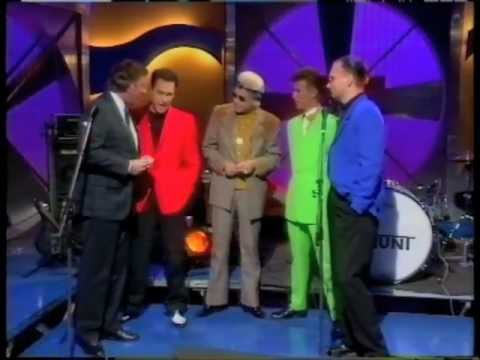 The odd thing about Tin Machine, having finally listened to Tin Machine, is that Bowie’s instincts were dead on. It’s not a mistake at all. He’s listening to the Pixies so he’s in tune with what’s happening in American indie rock; he’s thinking it’s time to strip back the production and make rock music, he wants to make something a bit more confrontational and instinctive… these are all exactly the right ideas for the moment. And yet when he comes to act on those instincts and form his band he ends up with a record of skronky blues rock and some of his worst ever lyrics. Of course you can say he picked the wrong collaborators, but it’s not just that. It really underlines the horrible gulf between knowing what the right move is and actually pulling off that move.
In general when people think about getting older, losing your edge, etc, they would assume that executional competence improves with experience but that the ability to stay in touch, know what to do, falls off. You get better at things but you lose a sense of what’s relevant – which creates a strain of typical middle-aged resentment: how come I, with my vast experience, am ignored in favour of these know-nothings. But I think it’s just as likely to be the other way around. The instincts stay sharp – get cannier, even. It’s turning them into something worthwhile that becomes harder and harder.
If the “Imperial Phase” – the point in your career or life when everything you do seems to come off, where your mistakes really do end up as hidden intentions – is real, then we can imply the existence of its opposite. The Imperial Phase’s shadow, the part where nothing quite works right. The good ideas that turn leaden when you realise them. The prose that grinds instead of flows. The clothes that looked great on someone else. The incisive intervention that’s received as meddling. The shots that don’t come off. That you look a fool for attempting.
Most of the time this decay phase goes unseen, for obvious reasons. Attention is a scarce commodity, so is charity. People turn away. If the phase ends, who is still there to know it? But what we see in Bowie is someone whose Imperial Phase was so inspiring for so many that the amount of goodwill it generated turned out to be inexhaustible. He got as many chances as he needed. He could be written off, but not written out. So you can endure the decline alongside him, instead of just passing by, and then you can see if and how he gets out of it. This is an important thing; the value of tin is higher than it seems.
03 Feb 08:38
This week has been weird and basically the last semi-normal thing I remember from this weekend is being asked the title question on Saturday morning, so I am going to give context. And then I am going to answer said question.
Context the first:
I brought this target to archery, like one does, because I'd just heard from a long time very unwanted internet harasser. Again.

It's the initials of said long time very unwanted internet harasser, with my editorial comments, including the words "creepy sad little stalker".
So. Then the question was asked: "you're a skilled archer. Why do you have a stalker?"
This is my blog! Let me tell you why! (general you. You, the reader. Assuming you don't already know why).
The flip answer is "because I live in Oregon. Stalker lives in Florida. No one is that skilled" but there's also actual a lot of systemic junk that matters in a serious conversation about such things.
This is going to need to start, again, with context, going back to when I was an unjaded, barely cynical little baby K just jumping into the world of advocacy. Back when I didn't think self advocate was patronizing and silencing. Back when I thought if I was smiley and adorable enough, people would suddenly see the humanity in me and in their kids.
Yes, really, this was an era that existed.
So. To understand why I have someone persistently contacting me even though I told him to fuck off, you need to know why he fucked on. Back in the early AOL days, when we were just kids--there's an 14 month age difference or so, and all the safety stuff back in the day was "make sure you aren't actually talking to a creepy adult who preys on kids." It was not "some of the boys you are friends with who are your age will grow up to be scary when you diverge in fundamental views." No one told me that. People to this day actively avoid telling girls that.
Way way back in the day, creepy sad little stalker and I were friends. He is autistic. I am autistic. We were exploring this whole world of autistic community and autism community. But our views started diverging pretty drastically; I grew into a hardline neurodiversity activist. He grew into someone who whines about how autism ruined his life and he wants a cure.
This is mutually incompatible, no? So I started withdrawing contact because I do not need in my life supposed friends who think that people like me are lesser. I don't really need friends who think they are lesser either. I didn't have the terms "spoons" or "emotional labor" then. I did have words for things like "I know you think we're destined to be together even though I don't understand your logic, but no we aren't not even a little" and "leave me alone" and "I'm not having this conversation" and "go away." I started pulling away, saying "leave me alone", at the turn of the century.
In 2005 creepy sad stalker crashed an actual line. While before that it had been a lot of "he makes me uncomfortable", for reasons I will get into later in this post that didn't really matter to anyone. Him showing up at the ASA 2005 conference with the stated goal of getting in my pants did. That is a line that most people will acknowledge is a line. Following me around trying to get me isolated? A line that more people notice.
(not entirely relevant but also not entirely irrelevant is that ASA 2005 was right at the beginning of my span of time spent very critically ill. So he was creeping on a tired, sick, dropping weight very fast K. That's relevant in the nuances, but not the big picture maybe?)
After that it was a big hard nope we cannot at all be even vaguely friendly. I spent an entire conference clinging to safe people because creepy sad stalker was making me feel unsafe. A couple times a year he still sends me an email that's a mix of "I'm sorry but here let me give you excuses and also say things that are meant to sound intimidating".
"You're a skilled archer. Why do you have a stalker?"

I think that about covers the how I picked up a stalker. As for the skilled archer part? I've known how to shoot forever, but in the late 90s and early 2000s that barely registered on "important parts of my identity". So even if my ability to hit things with projectiles was going to be a factor--and it probably wasn't--other things were much more prominent in the list of things that make me, me.
Skilled gymnast? Yes. Fearless advocate? Yep. Funny in the words? Yeah. Made of eyes and Princess Leia buns? Uhhuh. Great with kids? Sure. Weirdly flexible? Actually not so much because I didn't realize what normal was at the time. On the internet, the aspects of you that you find salient are how you are known, and "oh, I did horseback archery and stationary archery for a few summers" weren't ever part of the conversation. I was too busy flying, or telling people that no really your kid is fine, I promise, you better believe I'll babysit, behold, your kid adores me.
...some things never change. A lot of those things, really.
So now the question becomes "why do you still have a stalker?"
There's a lot of answers to that question.
First, because of the distance. Sad creep and I are on different coasts. Police forces have not heard of airplanes apparently. Indeed, their go to suggestion when people are being scary on the internet is "hang up your computer". Not to suggest that the offender should maybe leave people the fuck alone. No one wants to handle it. I have called this guy's parents--he's 30 and a bit--because of how many fucks police don't give. Not like his parents cared either, because he is made of excuses.
Second, let's be real here: there are gender issues (and race issues, though in my case they're largely intertwined--people expect super compliant lady stuff from me because of my race. That is not and has never been me). He sends me whiny pants messages about how his disabilities mean he can't not be a douche and wraps them around "and let me tell you how much I can bench or whatever because I decided to try to do a sport and oh let me say again that I can lift way however much". That's an intimidation tactic. It's also so accepted for men to do that no one cares. They tell me that maybe he's trying to impress me.
Whereas when I post a picture of the destroyed target, I have to be careful to not use one that could be taken as a threat. Men try to impress women, but women who can take care of themselves are threatening and scary, I guess? The natural order of things is that I'm scared of him? Turning it around by actually having skills, and advertising them, is not. If I was a dude, advertising would be fair warning, but since I am not, it's being threatening. Nevermind that he's the one sending me things that sound like intimidation. Not being intimidated is a bigger issue.

And then there's the thing no one wants to talk about:
We're both autistic. Now, people are quick to tell me that he can't be held to any standards at all because he's autistic. That he cannot understand that a very clear "fuck off, never talk to me again, I mean never, let me call your dad to explain it to you what 'never' means" message means exactly that. He has poor social skills, because autism. He's a lonely sad self pitying sack of crap because autism. He has fixated on me because autism. No expectations of decency or fucking right off allowed.
However, I am autistic too. And people expect me to coddle him because I should know what it's like. Because apparently I have magic angel powers or something. Because by not telling him to fuck off when I was 16 somehow I gave him an in to fixate on me until the end of time. Because he can be a creep, but defending myself is kicking a puppy. A puppy with adult skills I do not have, no less. But gender roles dictate that I should nurture him or be gentle or whatever. Then his not understanding gentle (or rude. Or ignoring. Or anything) is still my fault, because autistic women can't win.
So that's why I'm a skilled archer with a stalker. The archery is largely irrelevant except where using it could get me in big, terrible trouble. Society is set up to coddle his wee little feelings, to encourage him to be creepy and scary, particularly at people like me.

"You're a skilled archer. Why do you have a stalker?"
by Neurodivergent K
Content notes: this discusses stalking & other boundary violations. It also discusses systemic issues that allow that. There are pictures, including a picture of a vaguely torso shaped thing with arrows in.
This week has been weird and basically the last semi-normal thing I remember from this weekend is being asked the title question on Saturday morning, so I am going to give context. And then I am going to answer said question.
Context the first:
I brought this target to archery, like one does, because I'd just heard from a long time very unwanted internet harasser. Again.

It's the initials of said long time very unwanted internet harasser, with my editorial comments, including the words "creepy sad little stalker".
So. Then the question was asked: "you're a skilled archer. Why do you have a stalker?"
This is my blog! Let me tell you why! (general you. You, the reader. Assuming you don't already know why).
The flip answer is "because I live in Oregon. Stalker lives in Florida. No one is that skilled" but there's also actual a lot of systemic junk that matters in a serious conversation about such things.
This is going to need to start, again, with context, going back to when I was an unjaded, barely cynical little baby K just jumping into the world of advocacy. Back when I didn't think self advocate was patronizing and silencing. Back when I thought if I was smiley and adorable enough, people would suddenly see the humanity in me and in their kids.
Yes, really, this was an era that existed.
So. To understand why I have someone persistently contacting me even though I told him to fuck off, you need to know why he fucked on. Back in the early AOL days, when we were just kids--there's an 14 month age difference or so, and all the safety stuff back in the day was "make sure you aren't actually talking to a creepy adult who preys on kids." It was not "some of the boys you are friends with who are your age will grow up to be scary when you diverge in fundamental views." No one told me that. People to this day actively avoid telling girls that.
Way way back in the day, creepy sad little stalker and I were friends. He is autistic. I am autistic. We were exploring this whole world of autistic community and autism community. But our views started diverging pretty drastically; I grew into a hardline neurodiversity activist. He grew into someone who whines about how autism ruined his life and he wants a cure.
This is mutually incompatible, no? So I started withdrawing contact because I do not need in my life supposed friends who think that people like me are lesser. I don't really need friends who think they are lesser either. I didn't have the terms "spoons" or "emotional labor" then. I did have words for things like "I know you think we're destined to be together even though I don't understand your logic, but no we aren't not even a little" and "leave me alone" and "I'm not having this conversation" and "go away." I started pulling away, saying "leave me alone", at the turn of the century.
In 2005 creepy sad stalker crashed an actual line. While before that it had been a lot of "he makes me uncomfortable", for reasons I will get into later in this post that didn't really matter to anyone. Him showing up at the ASA 2005 conference with the stated goal of getting in my pants did. That is a line that most people will acknowledge is a line. Following me around trying to get me isolated? A line that more people notice.
(not entirely relevant but also not entirely irrelevant is that ASA 2005 was right at the beginning of my span of time spent very critically ill. So he was creeping on a tired, sick, dropping weight very fast K. That's relevant in the nuances, but not the big picture maybe?)
After that it was a big hard nope we cannot at all be even vaguely friendly. I spent an entire conference clinging to safe people because creepy sad stalker was making me feel unsafe. A couple times a year he still sends me an email that's a mix of "I'm sorry but here let me give you excuses and also say things that are meant to sound intimidating".
"You're a skilled archer. Why do you have a stalker?"

I think that about covers the how I picked up a stalker. As for the skilled archer part? I've known how to shoot forever, but in the late 90s and early 2000s that barely registered on "important parts of my identity". So even if my ability to hit things with projectiles was going to be a factor--and it probably wasn't--other things were much more prominent in the list of things that make me, me.
Skilled gymnast? Yes. Fearless advocate? Yep. Funny in the words? Yeah. Made of eyes and Princess Leia buns? Uhhuh. Great with kids? Sure. Weirdly flexible? Actually not so much because I didn't realize what normal was at the time. On the internet, the aspects of you that you find salient are how you are known, and "oh, I did horseback archery and stationary archery for a few summers" weren't ever part of the conversation. I was too busy flying, or telling people that no really your kid is fine, I promise, you better believe I'll babysit, behold, your kid adores me.
...some things never change. A lot of those things, really.
So now the question becomes "why do you still have a stalker?"
There's a lot of answers to that question.
First, because of the distance. Sad creep and I are on different coasts. Police forces have not heard of airplanes apparently. Indeed, their go to suggestion when people are being scary on the internet is "hang up your computer". Not to suggest that the offender should maybe leave people the fuck alone. No one wants to handle it. I have called this guy's parents--he's 30 and a bit--because of how many fucks police don't give. Not like his parents cared either, because he is made of excuses.
Second, let's be real here: there are gender issues (and race issues, though in my case they're largely intertwined--people expect super compliant lady stuff from me because of my race. That is not and has never been me). He sends me whiny pants messages about how his disabilities mean he can't not be a douche and wraps them around "and let me tell you how much I can bench or whatever because I decided to try to do a sport and oh let me say again that I can lift way however much". That's an intimidation tactic. It's also so accepted for men to do that no one cares. They tell me that maybe he's trying to impress me.
Whereas when I post a picture of the destroyed target, I have to be careful to not use one that could be taken as a threat. Men try to impress women, but women who can take care of themselves are threatening and scary, I guess? The natural order of things is that I'm scared of him? Turning it around by actually having skills, and advertising them, is not. If I was a dude, advertising would be fair warning, but since I am not, it's being threatening. Nevermind that he's the one sending me things that sound like intimidation. Not being intimidated is a bigger issue.

And then there's the thing no one wants to talk about:
We're both autistic. Now, people are quick to tell me that he can't be held to any standards at all because he's autistic. That he cannot understand that a very clear "fuck off, never talk to me again, I mean never, let me call your dad to explain it to you what 'never' means" message means exactly that. He has poor social skills, because autism. He's a lonely sad self pitying sack of crap because autism. He has fixated on me because autism. No expectations of decency or fucking right off allowed.
However, I am autistic too. And people expect me to coddle him because I should know what it's like. Because apparently I have magic angel powers or something. Because by not telling him to fuck off when I was 16 somehow I gave him an in to fixate on me until the end of time. Because he can be a creep, but defending myself is kicking a puppy. A puppy with adult skills I do not have, no less. But gender roles dictate that I should nurture him or be gentle or whatever. Then his not understanding gentle (or rude. Or ignoring. Or anything) is still my fault, because autistic women can't win.
So that's why I'm a skilled archer with a stalker. The archery is largely irrelevant except where using it could get me in big, terrible trouble. Society is set up to coddle his wee little feelings, to encourage him to be creepy and scary, particularly at people like me.

02 Feb 12:25
 Star Wars is a 1977 rite-of-passage movie. It concerns the adventures of Luke Skywalker (Mark Hamill), usually described as a farm boy but actually depicted as a sulky James Dean teenager who likes nothing more than wasting time with his friends and fooling around with vehicles called T16s (or skyhoppers). Luke’s journey from boy to man is represented by a pair of interlocked quests: to identify and rescue the beautiful woman (Carrie Fisher) who’s cry-for-help he has stumbled upon; and to be initiated into a legendary order of warrior monks by retired hero Ben Kenobi (Alec Guinness). Despite talk of princesses and Emperors the action takes place neither in a fairy tale kingdom, nor feudal Japan, but in a vaguely imagined but compelling visualized space-opera future. An oppressive Empire rules the entire galaxy; mile-long space-ships are swallowed up by battle-stations as large as planets; and a hop between stars is treated like a stagecoach ride between two outposts. Luke forms an alliance with the charmingly amoral Han Solo (Harrison Ford) who is described as a pirate but heavily coded as a cowboy.

If Star Wars is the story of how Everyboy became Everyman then Star Wars "episode IV" is a stand-alone movie with an entirely satisfying beginning, middle and end. Luke doesn’t need wilderness training from a Muppet to become a Jedi Knight: he became one the second he trusted to the Force and destroyed the Death Star.
The most incredible article about the Star Wars trilogy you'll ever read
by Andrew Rilstone
I
"The story, when you actually put it into words, is only so-much nonsense to hang a great visual experience onto."
"The story, when you actually put it into words, is only so-much nonsense to hang a great visual experience onto."
Mark Hamill, talking in 1978
The action runs the gamut of screen-genres: Arabian Nights, Wild West, Perils of Pauline, and the Dambusters are all referenced. The uniforms look vaguely manga, and one of the anonymous fascists at a baddies’ council of war actually claims to be searching for a hidden fortress. The heritage the film explicitly lays claim to is the Germanic-English fairy tale tradition (the rather arch opening caption tells us it’s happening "A long time ago in a galaxy far far away…") and Flash Gordon (an anachronistic scrolling text telling us "the story so far".) But by far the most memorable figure in the movie is Darth Vader (David Prowse / James Earl Jones) whose role is at this stage undefined but who seems to act as stand-in for the unseen Emperor. He sports a black helmet, black armour, and a fantastically impractical black cloak. The film’s centerpiece is a ritualized duel (with laser weapons rather than swords) between him and Luke’s mentor: so the overarching genre is probably Arthuriana.
Just as each space-ship is dwarfed by the size of the next, so the moral volume of the action is turned up throughout the movie. Our whining rebel-without-a-cause becomes a rebel against the evil Empire, and ends up putting his T-16 flying skills to good use on a suicide mission to save the revolutionaries from being wiped out by Vader. The moment Luke destroys the Empire’s Ultimate Weapon is also the moment he becomes a Jedi Knight and therefore the moment he becomes a man. It’s also, incidentally, the moment that the cynical Han Solo develops a moral conscience: a masterpiece of economical plotting.
The films ends with all the heroes getting a medal and living happily ever after. People queued round the block to see it in 1977 and some of them experienced it 6 times in a single week.
Star Wars was followed some three years later by a wholly unnecessary sequel, branded, not as Star Wars II (this was the era of Jaws II and Rocky III) but as "Star Wars Episode V: The Empire Strikes Back". This not only turned Star Wars in to "Star Wars Episode IV" but implied the existence of three other films which no-one had ever seen. Until 1999, this seemed like a very good joke.
The second film featured all the main characters from Star Wars — even Ben Kenobi gets a cameo, despite being dead. It gives us our first glimpse of the Evil Emperor, introduces us to giant four legged tanks known imaginatively as "walkers" and a floating city straight out of Flash Gordon and the Hawk Men. But the tone of Empire Strikes Back had nothing whatsoever in common with the tone of Star Wars. The fairy-tale structure — indeed, any structure whatsoever — is abandoned. Instead, we are asked to follow two separate, highly episodic plot threads. In one, Luke Skywalker receives cod-philosophical instruction from a swamp dwelling Muppet who we are supposed to believe mentored Alec Guinness; in the other, Han Solo and the Princess are chased by Darth Vader through fields of asteroids, swallowed by a giant space worm and end up taking refuge with one of Han’s barely trustworthy associates.
Producer George Lucas obviously had more money to throw at this movie, and much of it remains visually breath-taking even thirty five years later. But nothing in it has any of the charm of, say, the dwarfish second-hand robot-dealers or the alien-filled outpost from the original movie.
The film’s impact depends on the revelation that Darth Vader has been Luke’s father all along. Nothing in the Empire Strikes Back foreshadows this; and it actively contradicts everything we were told in Star Wars. The revelation is so stunning and so emotionally charged that the film doesn’t so much end, as merely stop after this point. Since the climactic battle, which the good guys lose, is place at the beginning of the movie, some people have speculated that Lucas wanted to recreate the feelings of a schoolboy sneaking into the cinema and catching the second half of one movie and the first half of a different one. It is inexplicably regarded as the high point of the sextology, although in 1980 it was universally regarded as a baffling disappointment.
Sometime during the filming of Star Wars, George Lucas encountered the mythological snake-oil salesman Joseph Campbell, and became convinced that Star Wars was a version of the "journey of the hero" and Skywalker an avatar of the Hero With a Thousand Faces. Since Campbell’s universal key to all mythologies amounts to the assertion that mythical heroes tend to go on a journey, encounter obstacles, and in the end achieve something it is quite hard to see how it could have failed to do so. By 1983 Lucas had swallowed Campbell’s bullshit hook, line and sinker and spent the third Star Wars movie retrofitting the first two to fit in with some of his ideas.
Return of the Jedi feels like the culmination of a trilogy. Themes, musical and visual, are revisited. Jabba the Hutt and the Emperor, who were only talked about in the first two films, finally come on to the stage. We do the climax of the first film (many little ships against one huge battle station) all over again, twice as big and about half as fun. We re-do the land battle from Empire Strikes back, only smaller, and with teddy bears.
After some preliminary loose-end tying in which the charming Tunisian sequences from Star Wars are re-imagined as a computer game and feminist princess Leia gets to dress like the cover girl of a Gor novel, Luke-the-farm-boy commits fully to the role of Jungian Archetype. He surrenders to Darth Vader; who takes him before the Evil Emperor who tries to turn him to the Dark Side of the Force. Vader, who has spent the last three movies torturing princesses, blowing up planets and strangling underlings draws the line at watching his son being zapped by evil lighting bolts, and decides, literally at the last moment, to turn good and destroy the Emperor.
So the film ends with the teddy bears — furry alien primitives with bones through the noses and a marked tendency to put white people into cooking pots — celebrating a Great Victory. The Emperor is dead, Vader is redeemed, the Empire is defeated, and they all lived happily ever after.
And there, for 16 years, the matter rested.
"Oh, dear."
"Why 'oh dear'?"
"You are in love."
"Is that bad?"
"For a monk, it does present certain practical problems."
Name of the Rose

If Star Wars is the story of how Everyboy became Everyman then Star Wars "episode IV" is a stand-alone movie with an entirely satisfying beginning, middle and end. Luke doesn’t need wilderness training from a Muppet to become a Jedi Knight: he became one the second he trusted to the Force and destroyed the Death Star.
If, on the other hand, Star Wars is the story of how a group of peasants with bows and arrows defeated a huge technocracy by virtue of their innate goodness and spirituality (apocalypse when?) then Return of the Jedi barely counts as an ending at all. Sure, they’ve blown up the Death Star again and sure, they’ve killed Darth Vader’s boss, but isn’t this meant to be an Empire which extends across the whole galaxy? How much difference is the assassination of one politician and the destruction of one weapon likely to make? Several comic-book and paperback "continuations" show our heroes waking up the morning after the party and resuming the battle against the remains of the Empire, which rather spoils the Ewok victory dance.
Return of the Jedi can only be thought of as a conclusion if you turn the trilogy on its head and make the villain the hero — if Star Wars is not "the adventures of Luke Skywalker" but "the redemption of Darth Vader". And between 1999 and 2005 this is what George Lucas set out to do, ploddingly re-working the back story to this affect through a trilogy of monumentally misjudged "prequels".
The Phantom Menace (Episode I) is a kind of protoevangeleum, showing us Darth Vader when he was a starry eyed child named Anakin (Jake Lloyd). Much mumbo-jumbo is spoken over him: he is "the chosen one", "conceived by the midi-chlorians" who will "bring balance to the force". Young Darth himself wanders about the set, blundering into spaceships, winning chariot races, saying "yippee" and generally being as un-messianic as it is possible to imagine. We are left with no hint as to why this likable moppet became cinemas most iconic super-villain. The film works best if you try to ignore the Darth Vader angle and just see it as the adventures of a spunky little slave-kid.
Attack of the Clones and Revenge of the Sith (Episodes II and III) depict Vader (Hayden Christensen) between the ages of 19 and 23 and offer various reasons why he became evil: anger against the savages who killed his mother; hubris because he thinks he’s a better Jedi than his master; fascist theories about authoritarian rule; belief that the Dark Side could resurrect the dead; fury and grief when he causes the death of his lover Amidala. The religion of the Jedi Knights — in Star Wars, merely a non-threatening, non-specific polytheism — becomes explicitly Buddhist: emotion, and attachment in general, are now paths to the Dark Side. The Jedi are revealed to be celibate and Anakin’s love for Amidala is the ultimate cause of his fall. The child Anakin’s "sin" was that he loved his mother; the teenaged Anakin’s offense is that he lusted after Natalie Portman, as which of us can honestly say we haven’t. [*]
In the background, we see the machinations by which someone called Palpatine gets himself elected President of the Galaxy, votes himself an invincible army of clones, and declares himself Emperor. This, it transpires, is part of a longer and much more evil game: Palpatine is in reality Darth Sideous, the last in a long chain of evil Jedi Knights called the Sith. Palpatine becoming Emperor puts the embodiment of ontological evil in charge of the Universe. Vader is, of course, Palpatine’s anointed successor.
The three prequels are not, in fact, anywhere near as bad as people sometimes say. If you treat them as six hours of space opera, replete with gladiatorial arenas, chariot races, capital ship battles, dog-fights and martial arts confrontations, with an undercurrent of galaxy-wide diplomacy, Faustian pacts and machinations at the center of government, they are a lot of fun. They are probably much closer to what George Lucas intended Star Wars to be than Star Wars itself was. But there is an underlying silliness of which comedy Jamaican fall-guy Jar-Jar Binks is only the most egregious example. Jake Lloyd nor Hayden Christensen are poor substitutes for Mark Hamill, and instead of Harrison Ford’s witty, cynical side-kick we have an endless stream of portentous Jedi preachers. The films somehow manage at the same time to be too silly and not nearly enough fun.
But they served their purpose. They redefined what Star Wars is all about. The evil of the Empire flowed from, and only from, Emperor Palpatine. Darth Vader was Palpatine’s apprentice; Luke would have been Vader’s. With Palpatine and Vader dead, the infection has been cured. The funeral pyre in the woods really was the end of the story.
And there, once again, the matter rested.
[*] When Ben told Luke "I was once a Jedi Knight, the same as your father" Luke did not reply "Don’t be silly, the Jedi didn’t marry."
If you want me to carry on writing, either buy my book...
If you want me to carry on writing, either buy my book...
02 Feb 12:17


How Hollywood got Star Wars wrong
by Andrew Rilstone
II
A long time ago in a galaxy, far, far away...
A long time ago in a galaxy, far, far away...
The Journal of the Whills (presumably)

Story is a slippery word. It could mean what happened ("we've pieced together the story") or one person's version of what happened ("that's my story and I'm sticking to it"). Or it could simply mean a lie ("don't tell stories"). Philip Pullman emblazons the words this is a story in large letters on the back of his feeble retelling of the life of Christ. You can take it how you will. "This doesn't purport to tell the historical truth, it's just something I made up to make a point"? "Religious truths always take the forms of stories because stories are magical things"? "Jesus wasn't real, ha-ha Christians are silly"?
A lot of tosh has been talked about stories, mostly by Neil Gaiman.
Life is made up of stuff. We experience one thing after another, in no particular order. When we talk about our lives, that's what we mostly talk about. One thing after another, in no particular order.
"It was cold. I was in that yellow dressing gown. It was the old house. The one next door to the old lady with the parrot. The door was green. It was called Charlie. It couldn't speak. The Christmas decorations were still up. It was the first time I'd seen new kittens. You were cooking fish, weren't you?"
Oscar Wilde was wrong: when people talk about themselves, they are hardly ever interesting.
Sometimes, one particular bit of life seems to have a shape. Perhaps the stuff really did happen in that shape: perhaps you really do always go into town on a Wednesday, but one particular Wednesday you decided, for no real reason, to stay at home, and then, oh goodness me, there was a terrible terrorist attack so if you had gone you would have been killed! Or perhaps we force them into shape by telling them over and over again in the same words. Perhaps we add the little bit about how something in your gut was telling your not to go into town although you really needed to get a spare part to fix the washing machine. Not lying, of course, but leaving out the bits which aren't important and exaggerating the bits which are.
Does anyone doubt that Alec Guinness met James Dean? Does anyone doubt that Dean showed Guinness the brand new Porsch Spyder he was so proud of? Does anyone remotely believe that Guinness had a gut feeling that no good would come of the car, and begged Dean not to drive it? Can anyone really blame Guinness for creatively turning a quite interesting bit of stuff into a really, really good story?
A story is a story because it is shaped like a story. The shape of a story is a pleasing thing and something which is shaped like a story is easy to remember. You could doubtless write 10,000 words about the princess's domestic life while she was hiding out in the cottage; and another 10,000 words about the pranks and day to day quarrels that her seven boyfriends engaged in while they were working in an all-male industrial environment. You might get a good novel out of it. You might get a good novel out of anything. But it wouldn't be the story of Snow White and her Seven Dwarfs. It wouldn't have the right shape.
J.R.R. Tolkien, who knew a thing or two about stories, once contemplated a sequel to Lord of the Rings. Anyone who has read Lord of the Rings understands that that, in Tolkien's world, evil can never be completely defeated. It always returns in a new form, becoming more petty but more insidious in each incarnation. The Dark Tower is knocked down at the end of the War of the Ring, but no one is in any doubt that it is going to get up again; as it did after the fall of Numenor and after the Last Alliance. The story that Tolkien envisages—teenagers in Minas Tirith playing at being orcs, the rise of a half-serious Sauronic cult—is just the kind of thing we would expect to happen next.
But Tolkien felt that this story was not one worth telling. It would "only be a thriller". Oh, he could tell you, in some detail, what stuff happened in the decades after Lord of the Rings. He tried to cover some of the stuff in a monumentally ill-judged epilogue, which his publisher sensibly forced him to delete. But this stuff is no more part of the story of Lord of the Rings than the post-war Labour government is part of the story of Dad's Army.
Not that it wouldn't have been fascinating to see Tolkien writing a thriller set in the world of Lord of the Rings. Lord of the Rings is a novel set in the world of the Silmarillion, after all. (The Hobbit is a fairy tale set in the world of the Silmarillion, one of many points that Peter Jackson entirely missed.) And now I've typed it, I realize that some clever writer could put together a very funny play showing us a very elderly Captain Manwaring in the 1960s. There was a sequel to Steptoe and Son showing and elderly Harold in the present day, wasn't there? Anything can work if you want it to, even a grown up Harry Potter.
"A long time ago in a galaxy far, far away..." was not, in 1977, a piece of branding. It was an artistic statement of intent. Star Wars is a story.
The Empire Strikes Back is just one thing after another.
Now this is not the end. It is not even the beginning of the end. But it is, perhaps, the end of the beginning. Winston Churchill

What happens after Return of the Jedi?
It's an easy question and we don't need a film to tell us the answer.
With the Sith destroyed, the Empire would rapidly heal itself from within. It would quickly be displaced by a New Republic, with Princess Leia as President. (Mon Motha? Okay, you can have Mon Motha if you like.) Han and Leia would marry, and keep the Skywalker bloodline going. Luke, in obedience to Jedi tradition, would remain celibate, but would pass on to the children what Yoda had taught him about the ways of the Force. They in turn would go and look for more younglings. Old Luke would live to see a New Republic with a new Jedi order and peace and justice would be secure for another thousand generations.
But there's no story there.
You want a story? Okay, I'll give you are story. One of the young Jedi is seduced by the Dark Side of the Force, and the whole cycle begins again. Master against apprentice. Father against son. Brother against brother, or sister, or just conceivably cousin. In fact, let's give Han and Leia two kids. Twins if you like. One hairy and one smooth. Er...one good and one evil...
This was the plot of the Legacy of the Force novels, all nine of them. But it does rather undo the conclusion of Return of the Jedi and render the trilogy null and void. Stories in which our heroes face some new threat from outside the galaxy—telepathic robot space crabs, maybe—seem tawdry and pointless. Ones in which it turns out that there was a spare clone of the Emperor in cold storage under the Jedi Temple; or in which someone magics Darth Vader back from the dead are best described as travesties.
We don't want to know what events followed Return of the Jedi. We don't even want to know what story followed Return of the Jedi. We want to know what film follows Return of the Jedi.
Is Star Wars Episode VII be a reboot? Everything's a reboot nowadays: poor Peter Parker has hardly had time to swear to spend his life catching thieves just like flies before a younger geek's uncle is getting shot all over again. A 1978 cut-price Star Wars knock-off called Battlestar Galactica was rebooted in 2005 as a political and religious war story. It was so serious and realistic that critics said it couldn't possibly be science fiction. So why not reboot Star Wars? Maybe recast Luke Skywalker as a jihadi and show that Vader is doing the right thing according to his own lights? Abrams got away with claiming that his Captain Kirk was a different fella to the T.V Captain Kirk, or at any rate the same fella in an alternate universe. No-one had any problem with that, apart from people who like Star Trek, who are not the target audience of a Star Trek movie, obviously. Why not give us a brand new Luke Skywalker?
Mark Hamill once claimed that George Lucas wanted "a long time ago in a galaxy far far away" to be the words printed in a book, a book of fairy tales that a mother wookie would be seen reading to a baby wookie. A sort of furry Princess Bride. Suppose Star Wars VII had put the book back on the shelf and told us the historical version?
Is Episode VII a continuation of the Star Wars saga: an extrapolation of Star Wars history, gungans and midi-chlorians and Ewoks and all? That is very much what the current batch of Star Wars comics are doing: treating the existing six moves as story-making matrix. Granted that Alec Guinness used to be Ewan McGregor; and granted that Anakin Skywalker was the Chosen One; and granted that Ben was on Tatooine primarily to watch over his son while he's growing; and granted that Jabba the Hutt lives on Tatooine... well, what kind of stuff must have happened? People who like this sort of thing have found that this is the sort of thing that they like.
But what if…
What if Episode VII, while nodding its head to the Trilogy and wiggling its eyebrow at the Prequels tried to recreate Star Wars for a new generation? Not Star Wars Episode IV A New Hope but Star Wars, the stand-alone rite-of-passage tale about how whiny kid-Luke finally switched off his targeting computer and became a man.
What if Star Wars VII were a sequel to that film.
What if it were the film we wanted, and never got, in 1980.
What if The Force Awakens turned out to be a story.
Is that even possible?
If you want me to carry on writing, either buy my book...
02 Feb 08:48
Why the 2014 coup against Clegg was botched
by Nick
 And as I complain about a lack of inspiration, the latest edition of Liberator comes out and gives me some. Specifically, Seth Thevoz’s article on the 2014 attempted coup to remove Nick Clegg as leader of the Liberal Democrats.
I’m usually in agreement with much of what Seth writes, and I do agree with most of what he writes in the article. However, I do think he’s wrong in attributing all the blame for it not succeeding to MPs not stepping up to the plate and calling for Clegg to go. That was definitely an important factor, but it misses out that part of the reason they weren’t willing to step forward was because of the way the grassroots call for Clegg to go had become a damp squib.
The key problem was the issue of timing. The 2014 election results had an odd electoral calendar because of the European elections. Voting took place on Thursday, but only local elections could be counted on the Thursday and Friday, with European votes not being counted and declared until Sunday, making political geeks glad that the Monday was a bank holiday. The problem was that for a lot of the country (especially areas with no local elections) this created an odd hiatus period over the weekend where votes had been cast in a national election, but results would have to wait for 72 hours. This, I believe, wasn’t a good time to begin the manoeuvres against Clegg. Yes, the local election results were bad, but people had expected that and were still hopeful that the European results for the ‘Party of In’ might be better.
So, when Lib Dems 4 Change was launched into that hiatus, people were reluctant to sign up to it, share it and discuss it because one crucial piece of information – how we’d do in the European elections – was missing. Now, it may have been meant to be a open letter and not a petition, but it was offering people the chance to add their names to it like a petition and people who might have been willing to sign it after the utter debacle of the European results weren’t going to do it before. (And once people make a political decision to do or not do something, it’s very hard to get them to change their minds in the short term)
What this meant was that not only was the grassroots pressure that would have backed the MPs looking a lot thinner than they might have hoped for, those who wanted to defend Clegg and keep in him position were given the opportunity to organise their fightback for the Sunday night and Monday morning. Yes, if the MPs had still come out and called for CLegg to go then, he might well have done, but they were expecting to be doing that on the back of strong grassroots support, which hadn’t been demonstrated over the weekend.
Things might have been different if the grassroots campaign had started after the European results, when people were genuinely angry with the leadership over a terrible result. Going off with it too early meant it never developed the momentum necessary to get potential rebel MPs onside, which led to the whole thing fizzling out. Yes, there was a failure of nerve, but it was also bad timing and poor planning that led to it failing.
02 Feb 08:18
[gastronomy, Patreon] How to Cook
[Read in black and white]
As those of you who have been following me for a while know, in the last few years I've taken up cooking in a more serious way. Exigencies of health and economics made it necessary that I move beyond heating things out of boxes and cans, and also eating out a lot. So I think of myself as someone who has been learning to cook.
I thought today I would share with my readers some of my hard-won knowledge, for anybody else who is learning to cook, or who might be teaching someone else how to cook.
Now, obviously, this is just my opinions and approach. There are probably many other ways to cook, and I am not the boss of you. Nevertheless, for simplicity's sake I have framed this as a set of directives. Feel free to adapt for your own tastes and needs. I, myself, do not always do everything as I have set it out here.
How to Cook
0. Have something to eat. Cooking involves a lot of executive function, and that's hard to do with low blood sugar. If you're planning on winging it without following a fixed recipe, that's even more taxing, cognitively speaking.
1. Evaluate your physical condition for the cooking you plan on doing. Review the steps in your cooking plan to make sure you are physically up to your plan, or change your plan. It could be bad to, e.g., be most of the way through preparing an elaborate roast only to realize that due to a pulled back muscle, it is impossible for you to bear the weight of the pan with the roast in it while simultaneously bending low enough to get it in the oven.
2. Change into your cooking clothes. Bleach and curry are forever.
3. If you have long hair that needs to be fastened out of the way, do that.
4. If you require vision correction for near-vision tasks, e.g. bifocals, find them and apply them to your face.
5. Since this is not a "how to shop for groceries" post, we will take it for granted that you have already done that, determining what you will need and going to get it. Now go figure out where you put each and every one of your necessary ingredients when you brought them home from the store.
6. Double check to make sure you do in fact have all the ingredients that you will need to make what you intend. If following a recipe, review the actual recipe and not your memory of the recipe. If you're improvising, now is a good time to reacquaint yourself with the state of your staple stores. If you find yourself thinking anything about substitutions like, "I don't have an onion, but that's okay, I can just use frozen onion," stick your nose in the damned freezer and make sure you actually have frozen onion.
7. Review the stores of any disposables you will require, e.g. ziplocs for marinading meat, muffin cups for baking muffins, cooking twine for binding meat, cheese cloth, slow cooker liners, paper towels, tin foil, plastic wrap, cooking parchment, vinyl gloves, trash bags, composting bags. Both locate them, and be sure to look in the containers to make ensure there is actually a sufficiency of what you require.
8. Make sure you have whatever cleaning supplies you will need to clean up during and afterwards: dish soap, brillos, sponges, bleach, iodophor, etc.
9. If any of your ingredients required in-advance preparation process (e.g. defrosting, marinading, fermenting) check to make sure they have completed the process and are ready for use.
10. If you are planning on making a large volume of food that will require either freezing or refrigeration, check that the space is available in the freezer or refrigerator, respectively.
11. If necessary, adjust the temperature of your cooking space. (I.e. if about to run the oven for a few hours, maybe turn down the thermostat or turn up the AC or open the windows or whatever.)
12. Put away all the dishes in the dish drainer or dish washer. This will help with the later equipment steps; also, you can't wash up as you work if you have no place to put the washed or to-be-washed dishes.
13. Clean any dishes soaking in the sink or anywhere else or otherwise in need of cleaning. If you filled the dish drainer or dish washer, you should consider waiting until the dishes have dried or the dish washer has run and going back to step 12, rather than proceeding past step 23. The steps 12 to 23 can be done while dishes dry/are mechanically washed.
14. Check the status of the trash bin. If you don't have any room in there for more trash, take the trash out, and put in a fresh trash bag. Ditto for any recycling bin or composting bin you may have.
15. Review the recipe or plan for the requisite cooking equipment. This is best done by reading through the recipe or thinking through the plan and visualizing each step as you go, and making note of what equipment would be required. Note cooking vessels, mixing vessels, measuring tools (cups, spoons, scales, thermometers), prep surfaces (cutting board, pastry marble, etc.), knives, openers (can opener, cap snaffler, etc.), utensils (spoons, forks, ladles, tongs, whisks, etc.), heat management tools (trivets, mitts), serving vessels and utensils (if necessary), and any others; locate them and ensure their readiness for use. If you are planning on substituting one piece of equipment for another you lack, make that decision now and make a note of it.
16. Review the equipment requirements for resource contention and bottlenecks: a four burner stove can't have five pots going at once, and presumably you have an only finite number of mixing bowls. Remember that all packages of food must be dispensed into some other container for inspection before being added into the container with all the other ingredients; just because that package of sliced button mushrooms says "fresh and clean!" doesn't mean it's telling the truth. Account for these additional containers. Check your plan for practicality, or adjust your plan.
17. Figure out which appliances you will need and review or inspect them for readiness. After you've separated two dozen eggs is a lousy time to remember the oven isn't working. If you are planning on using a slow cooker, make sure it is clean and ready to go. If you are planning on baking something in an oven, take a look into the oven to see if there's anything in there that shouldn't be; also, now is the ideal time, when the oven is cold, to position the racks to where you will need them.
18. If your region or cooking facility is prone to outages, check to make sure the services you will need (e.g. electricity, gas, water) are functioning. If you note scheduled outages on a calendar, check it now and adjust your plan accordingly.
19. If your appliances will need to be deployed from storage, pull them now and figure out where they will go in your cooking space. If they will not all fit at once, figure out what you will be doing for staging.
20. Inspect dish towels for cleanliness, and if inadequate, chuck in hamper and pull fresh ones out.
21. If you are planning on cooking in bulk for subsequent storage or distribution (e.g. leftovers, freezing, gift-giving), make sure you have the requisite storage containers located and ready to use.
22. Make sure your prep and cook surfaces are clean and ready to use. Make sure you haven't used up your cleaning supplies doing so.
23. Make sure your staging areas, if any, are clear and ready to use. If the dish drainer or dish washer are full again, wait until they are ready to empty and then empty them.
24. If you require any medical interventions before cooking – pre-dosing with analgesics, stretches before lifting, e.g. – do that. If you take meds daily, check to make sure you haven't forgotten; if you take scheduled medications, reflect on whether your cooking schedule will intersect with a scheduled dose, and plan accordingly. When you're up to your elbows in raw chicken is a bad moment to need to take your AZT or suddenly realize you forgot to take your Adderall.
25. (Optional) Turn on auditory entertainment.
26. If you haven't already, wash your hands or put on your gloves.
27. Make the food.
28. If you're going to eat or serve the food, do that now.
29. If you are planning on storing the food, and are planning on labeling the packages of food, go find the writing utensil. If you are planning on storing in ziplocs, consider labeling the ziplocs before putting the food in them, while they are still flat, room-temperature, and dry. Then package up the remaining food, and refrigerate, freeze, shelve, give away, etc. as appropriate.
30. If the temperature of your space needs to be de-adjusted, do that now.
31. Clean up all the equipment, including appliances, that you used cooking. Put things that need drying in a place and configuration in which they can dry.
32. Clean the space in which you cooked. Sanitize any surface that contacted or might have contacted raw meat.
33. Review the state of the trash, recycling, and composting bins; take out as needed and replace bags.
34. If you require any post-activity medical interventions, e.g. analgesics, moisturizing your hands, do that now.
35. Review the state of your stores of ingredients, disposables, and cleaning supplies. If in this cooking you exhausted or came near exhausting any of your staples, update your shopping list now to replace them.
36. Once dried, put away equipment and appliances that needed drying. Put back into storage any equipment that belongs in storage.
I wrote this because I have literally never encountered anybody talk about cooking on this... level of abstraction, for want of a better term. We use the term "cooking" both to refer to the characteristic steps of putting food together (the steps that make eggs a quiche and not a soufflé) and to the general, larger enterprise of providing oneself and/or others food made from scratch, but as I think I've illustrated, they're quite different things.
I'm willing to bet that these are the things that make "cooking" hard for the novice. Following a recipe is pretty easy if it's not too techniquey; it's the not getting caught by surprise by resource limitations or resource contentions that screw up timing that's the tricky bit. Itemizing them, as I've done here, is a remedy for that.
It's also what makes cooking so damned demanding for those who don't start with a lot of energy to begin with. The word "just" crops up way too much in discussions of cooking; the activity and its demands are minimized in a way which is deeply unhelpful. Not only does it give a mistaken impression of the work that goes into cooking, it makes people who discover that all this work is entailed by the process think there must be something wrong with them that it's not "just" quick and easy for them. I hope I've done a bit to put paid to that.
These steps get faster and easier with practice – though more complex and time consuming the more involved a cooking project it is and the bigger a scale it reaches and the tighter the logistical constraints. Some steps, with practice and good maintenance habits, can collapse down to less than a minute. ("Can I see the dish soap and a steel-wool pad? Yes? Eight: check!") If you keep putting things away, well you might not have any dishes to empty from your dish drainer or dish washer, or any unwashed dishes that need handling before you start cooking. But it is also risky to skate through them. That's where hard-to-recover from errors come from. Man, is it hard to fake a ball of kitchen twine.
It seems to me this level of abstraction is often missing from the body of instruction for lots of crafts. There must be a million YouTube videos of music instruction, but I've never seen any how-to for how to do a gig from arrival to departure. The theory and craft of acting fills books, but almost entirely the part that happens on the stage. These things I think most everyone learns (of those who learn them) by immersion, which is how I learned them.
And despite seeing an endless array of programming documentation, I've never seen a discussion of the craft of programming at this level of abstraction. That was far and away the most deterring part of learning to program: how to set up (or find) my development environment, how call the language, how to orient myself to the work, how to organize my tools, even what tools I should have. These things were hard-to-impossible to learn by immersion, because programming is (usually) a pretty solitary activity.
I understand that my graduate school was better than most about providing this sort of information about the practice of therapy, but it was informal and oral, and it still was very weak; perhaps someday I will write the same sort of instructions as I did here for cooking, only for treating patients.
I wish we had a name for this level of abstraction around a human activity. I think a lot of fields might be benefited by having such a term to prompt them into considering it a mete topic for instruction.
Link for sharing: http://siderea.livejournal.com/1261434.html?format=light
This post brought to you by the 90 readers who funded my writing it – thank you all so much! You can see who they are at my Patreon page. If you're not one of them, and would be willing to chip in so I can write more things like this, please do so there.
Please leave comments on the Comment Catcher comment, instead of the main body of the post – unless you are commenting to get a copy of the post sent to you in email through the notification system, then go ahead and comment on it directly. Thanks!
As those of you who have been following me for a while know, in the last few years I've taken up cooking in a more serious way. Exigencies of health and economics made it necessary that I move beyond heating things out of boxes and cans, and also eating out a lot. So I think of myself as someone who has been learning to cook.
I thought today I would share with my readers some of my hard-won knowledge, for anybody else who is learning to cook, or who might be teaching someone else how to cook.
Now, obviously, this is just my opinions and approach. There are probably many other ways to cook, and I am not the boss of you. Nevertheless, for simplicity's sake I have framed this as a set of directives. Feel free to adapt for your own tastes and needs. I, myself, do not always do everything as I have set it out here.
How to Cook
0. Have something to eat. Cooking involves a lot of executive function, and that's hard to do with low blood sugar. If you're planning on winging it without following a fixed recipe, that's even more taxing, cognitively speaking.
1. Evaluate your physical condition for the cooking you plan on doing. Review the steps in your cooking plan to make sure you are physically up to your plan, or change your plan. It could be bad to, e.g., be most of the way through preparing an elaborate roast only to realize that due to a pulled back muscle, it is impossible for you to bear the weight of the pan with the roast in it while simultaneously bending low enough to get it in the oven.
2. Change into your cooking clothes. Bleach and curry are forever.
3. If you have long hair that needs to be fastened out of the way, do that.
4. If you require vision correction for near-vision tasks, e.g. bifocals, find them and apply them to your face.
5. Since this is not a "how to shop for groceries" post, we will take it for granted that you have already done that, determining what you will need and going to get it. Now go figure out where you put each and every one of your necessary ingredients when you brought them home from the store.
6. Double check to make sure you do in fact have all the ingredients that you will need to make what you intend. If following a recipe, review the actual recipe and not your memory of the recipe. If you're improvising, now is a good time to reacquaint yourself with the state of your staple stores. If you find yourself thinking anything about substitutions like, "I don't have an onion, but that's okay, I can just use frozen onion," stick your nose in the damned freezer and make sure you actually have frozen onion.
7. Review the stores of any disposables you will require, e.g. ziplocs for marinading meat, muffin cups for baking muffins, cooking twine for binding meat, cheese cloth, slow cooker liners, paper towels, tin foil, plastic wrap, cooking parchment, vinyl gloves, trash bags, composting bags. Both locate them, and be sure to look in the containers to make ensure there is actually a sufficiency of what you require.
8. Make sure you have whatever cleaning supplies you will need to clean up during and afterwards: dish soap, brillos, sponges, bleach, iodophor, etc.
9. If any of your ingredients required in-advance preparation process (e.g. defrosting, marinading, fermenting) check to make sure they have completed the process and are ready for use.
10. If you are planning on making a large volume of food that will require either freezing or refrigeration, check that the space is available in the freezer or refrigerator, respectively.
11. If necessary, adjust the temperature of your cooking space. (I.e. if about to run the oven for a few hours, maybe turn down the thermostat or turn up the AC or open the windows or whatever.)
12. Put away all the dishes in the dish drainer or dish washer. This will help with the later equipment steps; also, you can't wash up as you work if you have no place to put the washed or to-be-washed dishes.
13. Clean any dishes soaking in the sink or anywhere else or otherwise in need of cleaning. If you filled the dish drainer or dish washer, you should consider waiting until the dishes have dried or the dish washer has run and going back to step 12, rather than proceeding past step 23. The steps 12 to 23 can be done while dishes dry/are mechanically washed.
14. Check the status of the trash bin. If you don't have any room in there for more trash, take the trash out, and put in a fresh trash bag. Ditto for any recycling bin or composting bin you may have.
15. Review the recipe or plan for the requisite cooking equipment. This is best done by reading through the recipe or thinking through the plan and visualizing each step as you go, and making note of what equipment would be required. Note cooking vessels, mixing vessels, measuring tools (cups, spoons, scales, thermometers), prep surfaces (cutting board, pastry marble, etc.), knives, openers (can opener, cap snaffler, etc.), utensils (spoons, forks, ladles, tongs, whisks, etc.), heat management tools (trivets, mitts), serving vessels and utensils (if necessary), and any others; locate them and ensure their readiness for use. If you are planning on substituting one piece of equipment for another you lack, make that decision now and make a note of it.
16. Review the equipment requirements for resource contention and bottlenecks: a four burner stove can't have five pots going at once, and presumably you have an only finite number of mixing bowls. Remember that all packages of food must be dispensed into some other container for inspection before being added into the container with all the other ingredients; just because that package of sliced button mushrooms says "fresh and clean!" doesn't mean it's telling the truth. Account for these additional containers. Check your plan for practicality, or adjust your plan.
17. Figure out which appliances you will need and review or inspect them for readiness. After you've separated two dozen eggs is a lousy time to remember the oven isn't working. If you are planning on using a slow cooker, make sure it is clean and ready to go. If you are planning on baking something in an oven, take a look into the oven to see if there's anything in there that shouldn't be; also, now is the ideal time, when the oven is cold, to position the racks to where you will need them.
18. If your region or cooking facility is prone to outages, check to make sure the services you will need (e.g. electricity, gas, water) are functioning. If you note scheduled outages on a calendar, check it now and adjust your plan accordingly.
19. If your appliances will need to be deployed from storage, pull them now and figure out where they will go in your cooking space. If they will not all fit at once, figure out what you will be doing for staging.
20. Inspect dish towels for cleanliness, and if inadequate, chuck in hamper and pull fresh ones out.
21. If you are planning on cooking in bulk for subsequent storage or distribution (e.g. leftovers, freezing, gift-giving), make sure you have the requisite storage containers located and ready to use.
22. Make sure your prep and cook surfaces are clean and ready to use. Make sure you haven't used up your cleaning supplies doing so.
23. Make sure your staging areas, if any, are clear and ready to use. If the dish drainer or dish washer are full again, wait until they are ready to empty and then empty them.
24. If you require any medical interventions before cooking – pre-dosing with analgesics, stretches before lifting, e.g. – do that. If you take meds daily, check to make sure you haven't forgotten; if you take scheduled medications, reflect on whether your cooking schedule will intersect with a scheduled dose, and plan accordingly. When you're up to your elbows in raw chicken is a bad moment to need to take your AZT or suddenly realize you forgot to take your Adderall.
25. (Optional) Turn on auditory entertainment.
26. If you haven't already, wash your hands or put on your gloves.
27. Make the food.
28. If you're going to eat or serve the food, do that now.
29. If you are planning on storing the food, and are planning on labeling the packages of food, go find the writing utensil. If you are planning on storing in ziplocs, consider labeling the ziplocs before putting the food in them, while they are still flat, room-temperature, and dry. Then package up the remaining food, and refrigerate, freeze, shelve, give away, etc. as appropriate.
30. If the temperature of your space needs to be de-adjusted, do that now.
31. Clean up all the equipment, including appliances, that you used cooking. Put things that need drying in a place and configuration in which they can dry.
32. Clean the space in which you cooked. Sanitize any surface that contacted or might have contacted raw meat.
33. Review the state of the trash, recycling, and composting bins; take out as needed and replace bags.
34. If you require any post-activity medical interventions, e.g. analgesics, moisturizing your hands, do that now.
35. Review the state of your stores of ingredients, disposables, and cleaning supplies. If in this cooking you exhausted or came near exhausting any of your staples, update your shopping list now to replace them.
36. Once dried, put away equipment and appliances that needed drying. Put back into storage any equipment that belongs in storage.
I wrote this because I have literally never encountered anybody talk about cooking on this... level of abstraction, for want of a better term. We use the term "cooking" both to refer to the characteristic steps of putting food together (the steps that make eggs a quiche and not a soufflé) and to the general, larger enterprise of providing oneself and/or others food made from scratch, but as I think I've illustrated, they're quite different things.
I'm willing to bet that these are the things that make "cooking" hard for the novice. Following a recipe is pretty easy if it's not too techniquey; it's the not getting caught by surprise by resource limitations or resource contentions that screw up timing that's the tricky bit. Itemizing them, as I've done here, is a remedy for that.
It's also what makes cooking so damned demanding for those who don't start with a lot of energy to begin with. The word "just" crops up way too much in discussions of cooking; the activity and its demands are minimized in a way which is deeply unhelpful. Not only does it give a mistaken impression of the work that goes into cooking, it makes people who discover that all this work is entailed by the process think there must be something wrong with them that it's not "just" quick and easy for them. I hope I've done a bit to put paid to that.
These steps get faster and easier with practice – though more complex and time consuming the more involved a cooking project it is and the bigger a scale it reaches and the tighter the logistical constraints. Some steps, with practice and good maintenance habits, can collapse down to less than a minute. ("Can I see the dish soap and a steel-wool pad? Yes? Eight: check!") If you keep putting things away, well you might not have any dishes to empty from your dish drainer or dish washer, or any unwashed dishes that need handling before you start cooking. But it is also risky to skate through them. That's where hard-to-recover from errors come from. Man, is it hard to fake a ball of kitchen twine.
It seems to me this level of abstraction is often missing from the body of instruction for lots of crafts. There must be a million YouTube videos of music instruction, but I've never seen any how-to for how to do a gig from arrival to departure. The theory and craft of acting fills books, but almost entirely the part that happens on the stage. These things I think most everyone learns (of those who learn them) by immersion, which is how I learned them.
And despite seeing an endless array of programming documentation, I've never seen a discussion of the craft of programming at this level of abstraction. That was far and away the most deterring part of learning to program: how to set up (or find) my development environment, how call the language, how to orient myself to the work, how to organize my tools, even what tools I should have. These things were hard-to-impossible to learn by immersion, because programming is (usually) a pretty solitary activity.
I understand that my graduate school was better than most about providing this sort of information about the practice of therapy, but it was informal and oral, and it still was very weak; perhaps someday I will write the same sort of instructions as I did here for cooking, only for treating patients.
I wish we had a name for this level of abstraction around a human activity. I think a lot of fields might be benefited by having such a term to prompt them into considering it a mete topic for instruction.
Link for sharing: http://siderea.livejournal.com/1261434.html?format=light

This post brought to you by the 90 readers who funded my writing it – thank you all so much! You can see who they are at my Patreon page. If you're not one of them, and would be willing to chip in so I can write more things like this, please do so there.
Please leave comments on the Comment Catcher comment, instead of the main body of the post – unless you are commenting to get a copy of the post sent to you in email through the notification system, then go ahead and comment on it directly. Thanks!
02 Feb 08:16
[edu, soc, Patreon] The Value of College
[Read in black and white]
Now that I've finally posted about social class as culture (and distinct from economic class) there's all sorts of other things I can tell you, o gentle readers, about. One of them is about the value of going to college.
I would like to make the radical proposal that, for any specific "you", whether or not it is worth the expense for you to go to college – and there is now open debate as to whether or not it is – depends entirely on what you intend to go to college for.
I don't mean what you plan on majoring in. Though that too.
People say this thing: "You can get just as good a quality of education at a cheaper school." Okay. Who the hell goes to college for the education?
Can we get real here for a moment? Is there anything in your life that you have wanted to know badly enough that you said, "I so greatly desire to learn this that I'm willing to pay $200,000 dollars to do so. In fact, I so ardently want to learn it that even though I don't actually have $200,000 right at this moment, I'm willing to take out an unforgivable loan for $200,000 to pay to learn it, and then take however many years – or decades – it requires to pay back that money, in order to learn this thing I so badly want to learn."?
Or if not $200,000, how about $100,000? How about $50,000? How about $20,000? How about $10,000? How about $5,000?
How many undergraduates feel that way, you think? Do you think that of the one million high school seniors who took the SAT last year, there are a lot who are so passionate about learning a specific thing – or about learning in general – that they're willing to sign up for potentially decades of crippling debt to do so? How about their parents co-signing the loans?
Can we please stop pretending that for the education is a legitimate or reasonable or even common reason to go to college? It is tremendously disingenuous. Only the very most economically privileged (and those who get free tuition from something like the GI bill) could afford to attend college just for the enrichment of their minds. Everybody else has to get something else out of it – something radically more valuable to them than an education – to justify the staggering expense.
Even "affordable" programs are so much more expensive than the vast majority of Americans could afford as personal improvement – and vastly more expense than most people are willing to pay for pure education, even in topics they want very much to study. We live in a reality in which most people who think they want to study a musical instrument blanch at the prospect of paying $50 a lesson for private instruction, coming to a mere $2,500/yr. But then, all you get out of music lessons is education in music.
And it's not just the expense of tuition, it's also the opportunity cost of attending college instead of doing something more immediately profitable. Whether we're talking about someone taking four years out of their lives to attend a full-time bachelor's program or someone curtailing their work hours or opportunities to study part time, college takes vast numbers of hours of your day you could be spending elsewhere, and getting compensated for. Frankly, we, as a people, simply do not love education enough to make that kind of sacrifice for it, even if we dared.
To say that people go to college to get an education is simply not what is happening, except in the case of those poor bastards who fall for the emic lie, and wind up saying things like, "You can get just as good a quality of education at a cheaper school," as if that mattered, as if whether or not that was true was relevant, because they have no idea what everyone else is going to college for.
Let me be clear: I'm not saying that college doesn't educate. I got a fabulous education at my graduate school. If you are a college student, the college you attend will offer you an education. Considering what you're paying to be there, I strongly recommend that you take it. You bought that orange; I suggest you squeeze every last drop out of it. Hopefully it will be a really great orange, considering what you paid for it.
I got a great education at my graduate school, but I didn't go to graduate school to get that education. I went to graduate school to get a credential. From my perspective, I paid them for the credential, and they threw in a complimentary education with it.
Not only do colleges offer educations to their students, an education is the thing that the college will, to some extent or another, require that you demonstrate having got some of before they complete their deal with you. They can't make you learn, but they can refuse to give you a diploma if you don't. An education may be the thing you have to get through to get what it was you went there for.
If you are thinking about college as primarily a means to an education it is possible that you are about to make – or have made – a terrible, costly mistake.
Here's the thing: going to college can be – and for many people is – the single most important determinant of your standard of living subsequent college.
Going to college is a tool to improve your life after college. It may be the single most powerful tool to do so that you ever have access to. That is why people are willing to go into hock for tens or hundreds of thousands of dollars to go to college. Going to college is an attempt at buying a future.
(Well, a chance of a future. No guarantees. More on that below.)
People who say that awful thing about colleges and education often understand this, but in a dangerously vague way. They get that college is the gateway to your future, but they have no idea how it does that.
And the answer to how it does that is: variously.
There are multiple ways to use attending college to improve your life. Or put another way there are several different things that schools can provide you with to improve your life post-college.
(Yes, there is a list below. Bear with me for the moment.)
It is up to the student to capitalize on what they get. The things that colleges provide (by your attending them) don't (mostly) automagically confer increased income or other benefits. If you turn around from a college experience and go right back to the life you were (or could have been) living before, you will gain nothing from your sacrifices.
Different people have different approaches to life. Consequently different college-goers are prepared to leverage different college-attendance benefits. It is probably a good idea – and probably way too much to ask of a seventeen year old – to have at least some idea of which college-attendance benefits you're going to want or be able to leverage on the far side.
Think of it like playing a computer game: once you fight your way through the program, and slay the level boss, it will give you the option of which special power you get. Which special you pick should have something to do with how you prefer to play the next stage of the game – your strengths, weaknesses, preferred tactics and over-all strategy.
Furthermore, as we all know, the game isn't fair: different people start at different levels and are playing on different hardness settings. One consequence of this is that, if you chose poorly, you can wind up having spent an enormous amount of money and effort and irreplaceable days of your life not actually having one's life bettered. You can chose a special which advances you to... a level below you. You can chose a special which pays out at a rate less than your student loans.
Given all that, it's important to understand yourself – your aspirations and your location in society, or, put another way, where you are and where you want to get to – if you don't want to make an amazingly expensive mistake.
And most importantly, you need to realize that different schools offer different college-attendance benefits.
You should probably attend a school that does a good job providing the college-attendance benefit(s) that work for you, in accord with your goals.
The question of whether attending college – and especially taking out college loans – is economically wise cannot be answered in the general. It can only be answered in the specific.
The question is never really, "Is college worth it?"
The question is "What is your plan for making attending college worth it?"
Here's a list of benefits that one can get from attending college:
Let's examine each of these in turn.
Credentials, general
Simply having a degree, any degree, can make you more employable. How much more employable is an interesting question. If you are already pretty employable, it might not help enough to be cost effective, which is what all those (typically white, straight, male) teenage programmers are doing noping out of higher education. Furthermore, in the present economy and possibly the future economy, a degree-any-degree may not make you all that much more employable, because competition is very fierce and likely will only be getting fiercer for the kinds of positions for which a-degree-any-degree is adequate qualification. Getting stuck with student loans and still having to work for $12/hr is not a win – which is something that happens. (Culinary programs are notorious for this.)
On the other hand, I went to a graduate program with a specific track for "People who cannot by organizational policy be promoted any higher by their employers until they have master's degrees", and they apparently did a brisk business; in my first day in seminar, a professor said to the class, "I know a bunch of you are here because the day after you graduate you get a raise at work," and a whole bunch of people nodded back.
If you have a personal life advancement plan that suggests you just need a-degree-any-degree, please check it for sanity with people in a later life stage and living the life you want. There's this horrible thing that happens, where kids who have internalized the message "you have to go to college to do anything with your life!" assume that, e.g., you need to get a bachelor's degree to be a writer or a welder or a ballet dancer.
The people for whom a-degree-any-degree are most likely to benefit are people for whom low-stature white-collar work is an improvement on where they would be otherwise. A bachelor's in interpretive dance may be adequate to, say, get you a job working in an HR department or as an administrative assistant; if you could not have gotten that job otherwise, and it's an improvement on the kinds of job you otherwise could have gotten, then it might be worth it to pursue.
If after sanity checking it you are still convinced that this is all you need or want out of going to college – just to be able to get the damned diploma and say you have it – then there's approximately no reason not to optimize for price, and go to the cheapest available school. Nor is there much reason not to take the cheapest available path through school; for instance, if your logistics are such that you can save money by commuting instead of residing at the school, you can do that with impunity.
Note, if the school is inadequately credentialed, i.e. if is not appropriately accredited, any degree you get from it will basically be considered fake, and you might as well not bother. So you can't save by scrimping on accreditation.
Also, note I said there's approximately no reason not to optimize for price. There is one thing that you might want to consider paying more of a premium for.
The credential of a degree is a benefit you can only get if you complete the course of study. Not all schools are equally good at getting their students across the finish line.
There's this hack some people attempt in an effort to save money on bachelor's degrees: going to a two-year community college program on the cheap, and then instead of accepting the associate's degree, transfering into a four-year college as a third-year bachelor's student. It's doable (my sister did this, sort of.)
The problem with this is that the odds may be against you: a lot of community college programs have horrendous completion rates: 80% of students enter planning on transferring to four-year programs, and after six years, only 14% have graduated a four year program (n=700,000). Defenders of community colleges say this is an artifact of the populations they serve – students less "ready" for four-year programs – and surely to some extent it is.
But there is also horrible evidence that many community colleges use bogus measures of "readiness" to stall students' educational careers, as a scam to get more tuition out of them. This also applies to non-selective four-year state schools.
If you are going to try to economize on price, you need to be careful that the institutions of higher ed that you pick are not predatory. And you need to either find an institution that despite the low tuition spends sufficient money on student services (including professor advising time) to increase all their students' odds of completing their degree, or you need to have a justified belief in your capability to complete it anyways. Or both.
Here is a thing about schooling and privilege: what unconscious lessons you learned about schools and education from your own childhood experiences of being a student have an awful lot to do with how much privilege you had.
If you attended a school flush with funds, with an active PTA (flush with volunteers who did not need to work to the exclusion of volunteering), with a modest student-teacher ratio; if you had a gender, race, native language, (lack of) disability status, or social class which school staff felt indicated you would benefit by instruction and opportunities; if you had people telling you they expected much of you and noting your performance, good or bad – then you will likely think of school as a institution which has agency, which relates to its students, which gets involved in their outcomes. To whatever extent this is true, you will feel entitled to being served by the school; when in a school you don't immediately see where the services you need are offered, you seek them out, out of the unconscious assumption that surely they're around, somewhere.
Conversely, if you attended a school that didn't have enough money, with little parent involvement (because few parents could afford to spare the time), with more students than the teachers could handle; if your gender, race, native language, disability status, or social class suggested to school staff that instruction and opportunities would be wasted on you; if you were no more than just another anonymous cog in a school-machine – then you will likely think of school as an institution which is impersonal, just a structure you move through independently, like a maze-shaped swimming pool, in which you sink or swim on your own. To whatever extent this is true, it will simply not occur to you that the educational institution might owe you some sort of customer service or support for your tuition dollars.
More privileged kids think schools are like sit-down restaurants. Less privileged kids think schools are like vending machines.
When someone who comes from school experiences that are less privileged, they often don't know what they're missing, especially the subtle, interpersonal stuff. When they attend a school that is really bad at supporting students, it doesn't even occur to them that that is a thing they're missing out on.
(For the record, there are extremely expensive, fabulously prestigious schools that are unbelievably bad at supporting their students through their programs. There are professors and whole departments at many schools that consider a high drop-out rate a badge of honor – their classes are so hard core, "not everyone" can hack them. Giving a college an enormous sack of money is not a guarantee they won't abandon you.)
I am telling you: picking a school on the basis of their ability to support you to completion of your degree is totally a thing you can do. It can be challenging to evaluate schools from the outside on this basis, but it's not impossible. (Also note, individual departments which can vary across a single college.)
Lack of support and out-right predation are not the only two things that can make a collegiate program hard to complete; nor is this problem exclusive to community colleges.
When I was 17 and applying to bachelor's programs (this would be Fall 1988), I learned that there was a problem in the University of California system, particularly acute at the (reasonably prestigious) UC Berkeley: certain required classes for certain popular majors were so over-subscribed, that students were finding themselves wait-listed and locked out of classes required to advance, causing their bachelor's programs to stretch beyond four years. Since tuition was reckoned on a semester basis, not on a by-class-credit basis, this could add thousands of dollars of expense to their total tuition, through no fault of their own. I don't even know how that would work out for students on merit scholarships; poorly, I suspect.
Similarly, only differently, I heard rumor (back in the early 90s) that the Physics Department (Course 8) at MIT had some breathtakingly sexist professors, who tended to thwart the careers of female undergrads, who in turn tended to transfer to the Earth, Atmospheric and Planetary Science Department (Course 12) to escape. Obstacles to completion can be specific to certain demographics. You could do worse than seek out a photo of a recent graduating class and the stats on demographic distributions of a recent entering class and compare them, doing a little back-of-the-envelope calculation.
The graduate program I attended was very inexpensive on a by-credit basis, however, that savings came with a catch: the school did not provide the required clinical internships. That was the one big place where the money you didn't pay them didn't go: if you were in the clinical program, you had to land your own. This is something other graduate schools provide their students (including other schools we competed with, who inked exclusive contracts with internship sites for their students, locking us out). Students sometimes washed out of this graduate school without their degree because of their inability to land an internship; I had a brutal time of it, myself.
So when pursuing a college education for a credential, whether the general, a-degree-any-degree, or the specific, you need to evaluate a program's likelihood to be something you complete. One part of that is knowing your own needs for scaffolding and support. Another part of that is finding out, if possible, if the school (and department) you're considering has any additional obstacles to completion – or fails to remove obstacles that other programs remove for their students.
One more thing, specifically about bachelor's degrees. People, especially people from lower social classes who are not familiar with how the game is played, often make erroneous assumptions confusing prestige and price. If you're convinced that you just need "a bachelors, any bachelors", hold the toppings, and intend to economize on price, you might assume that prestige indicates expense and avoid schools to the extent they are prestigious. Why go to some fancy-pants school, when you don't actually want to pay for the fancy-pants brand name?
There may have been a point that was correct, but it is no longer. The very most prestigious schools have become the cheapest for the poorest students. Like free. The prestigious schools are the wealthiest schools, so they can have the most generous financial aid and tuition policies.
The trick, of course, is getting in. But if you can pull that off, you may find that going to an elite private college with enormous prestige is actually ultimately cheaper than going to a state school.
For instance, if you are a 17yo young woman from an impoverished family who doesn't know what she wants to be when she grows up, but knows she should have a degree and aces school, you might think Wellesley, one of the most prestigious women's colleges in the US, is beyond you and beside the point. But if you got admitted to Wellesley and they determined you need financial aid, they would not set you up with a loan. They would just give you the money. Or rather, just pay the bill to themselves. You would graduate without student debt.
And as a bonus, the box includes this incredible secret-decoder ring of prestige, and, for that matter, class socialization.
Conversely, just because a school charges a lot of money doesn't mean that it's prestigious. That is a particularly terrible mistake to make.
Credentials, specific
If you want a specific academic credential for a specific thing you want to do that requires or recommends that credential, for the love of all that's holy, make sure any program you attend actually provides the credential you are trying to buy.
My professional license requires that one have a master's degree, but not just any master's degree. The regulations for my license actually spell out all sorts of requirements for the academics and clinical preparation of a qualifying master's degree. The application for licensure requires that you demonstrate that in the course of your master's degree studies you took all the courses required by law. All of this is spelled out, conveniently enough, on the mass.gov website, and has been since at least the first day I ever looked at the website of the college that ultimately graduated me and wondered, "Hey, does this academic program meet the requirements for getting a license to practice in this state?" and went to look it up.
Nevertheless, I have met multiple graduate students (usually from other schools, but occasionally from mine) who (1) had no idea these requirements existed, (2) had no idea whether the program they were in fulfilled these requirements, (3) had no idea that there was a possibility that their academic program might graduate them with a degree that didn't qualify them for practice.
For instance, my college had several graduate degree programs in the School of Psychology and Counseling that wouldn't qualify you for licensure. One wasn't clinical at all, and merely fulfilled the "masters, any masters" requirement. Two others were just clinical enough to be able to say they were clinical – if that was what you needed for a promotion at work[*]. These other programs served other purposes than licensure. They are radically less expensive than the licensure qualifying degree, because they were shorter by about half. But if you didn't understand that you couldn't practice with them, and signed yourself up for one thinking thinking to economize on a licensure-qualifying degree, you could find yourself with serious student loans and a degree that is useless to your purpose.
[* Or, as in my case, to prove that I could handle the work and earn a transfer into the fully license-qualifying clinical program, which I did not originally qualify for admission to.]
Horrifyingly, I heard a rumor a couple years ago about a large local clinic that wound up having to purge a bunch of their staff. They had hired quite a number of clinical-enough-to-call-clinical degreed people to work as therapists, who were not license eligible. Something happened – an insurer found out? the state? – and they wound up having to fire all of them.
(I know another clinic that heard that rumor and quietly put all its not-license-eligible therapists on an approximately one year countdown timer to remediate their licensure status with either additional graduate study or the pursuit and attainment of some other license, such as in substance abuse counseling.)
If all you want of your degree is that it fulfills some specific requirement, it behooves you that you make sure that the degree you're pursuing will actually fulfill that requirement.
Do not – DO NOT – leave it up to someone else to ensure compliance. During my internships, I spoke with grad students from other schools who took the attitude, "Well, I'm sure my school must be looking after it and the program is qualifying." It's going to be your umpteen thousand dollars, maybe you should do your own damned due diligence.
But if a program does meet the requirements for what you want to do with it, and factoring in what I said about completion, above, which is just as true for a specific credential as a general one, there's no reason not to get through as cheaply as you can. I paid the lowest per-graduate-credit rate in Massachusetts for my licensure-qualifying degree, and the licensure board didn't give a damn.
Now, I could do that because I intended a career path that wouldn't need a prestigious degree (more on which below). I wasn't planning on impressing anybody with my masters-granting institution. I was already a member of the social class it socializes to, so I didn't need that function. I didn't need much of anything out of the degree than that it conformed to the regulations for the license I wanted, and so I economized with a degree that didn't come with anything else.
Here's the kicker: to evaluate whether such a degree is economically worth it to buy, you have to determine whether the degree qualifies you for the thing you're aiming to get qualified for, and you also have to determine whether the thing you are aiming to get qualified for will have an adequate return on your investment.
The one thing that my degree most definitely did not do was increase my earning power. This is okay with me because I did not become a therapist to increase my economic class. But if I had pursued a licensure-qualifying degree with the erroneous belief that having a license would mean I could get higher paying jobs than I already had – or that I could get sufficiently higher paying jobs as to be worth the expense – that would be tragic.
This happens all the time in my field. People pick the profession without realizing what its earning power is (or, as the case may be, isn't). People actually put themselves through the rigors and expense of graduate school only to find out after the fact that therapist compensation is so low it will take them decades to recoup their expenses, if ever. Tragically, sometimes these people are from lower social classes, and in their ignorance of the distinction of social and economic class, assume that if a career is associated with the professional social class, it must be much more remunerative than what they had been previously doing.
Prestige
Probably of all the things on this list, prestige is the one I'm least clear on the utility of – it may well be bumping up against the limits of my own social class knowledge – but I can tell you what I've figured out.
To my knowledge, prestige – that is, going to a prestigious school for its prestige – has two applications. One is for impressing authority figures who don't know you (yet). The other is that it's a kind of credential, which some jobs require.
Attending a prestigious school is like having a high-value person vouch for you. When you apply for a job or a graduate school or a loan, the person who is sitting in judgment of you and your suit knows nothing of you. You have no reputation with them. But if you went to a prestigious college, they know the reputation of the school you went to. And they think something like, "Oh, well, if Yale thinks you're okay, you must be okay."
Gaining admission to a prestigious school is a lot like getting a snapshot of your reputation as a very promising young person; graduating is then like having it notarized. Then you can send it on ahead to people who have never had the opportunity to assess your promise for themselves, and have them react as if they had (or at least an approximation thereof.)
In this way, if you make it to the end of high school at the top of your game, you can invest to preserve and perpetuate that accomplishment. Nobody cares after high school that you got all As in high school, that you whipped the SATs, that you raised lots of money for charity or won the science fair three years running. All that will fade away from everybody else's memory and interest almost immediately. But those are the things that can get you into a prestigious school, and then the fact you attended (and, better, graduated) a prestigious school will convert those accomplishments into the durable currency of the prestige of the school on your diploma, and that you will be able to trade on permanently.
This matters most if your career path will subject you to a lot of judgment. If you're planning on graduating and getting a decent middle-gentry job and just staying in it as long as possible, you probably don't need a lot of prestige. If you're trying to convince a lot of rich people to invest money with you, if you're going to try to climb a towering promotion ladder, if you're going to have a career with a lot of jobs, if you're going to run for office, you probably want the prestige.
There are, I am told, career paths that involve such such ruthless judgment, that prestige moves from being something very helpful, to something much more like a credential, sine qua non. I knew a man who was a lawyer, who told me that his dream had been to be a law professor – but that he did not know when he chose his law school that it is impossible to become a law professor unless one got one's law degree from a very prestigious school, and his has insufficient prestige to do that. He was very bitter about this fact.
As I mentioned above, prestige is not necessarily expensive. Schools that sell prestige often are very generous in their financial assistance to those of low economic class. Young people of low social class often do not know this. Pass it on.
Networking, aka Social Capital
It is said, "It's not what you know, it's who you know." (Whom, damn it.) College is when you get to meet them.
In your life, your network of social contacts is your primary source of leads on employment opportunities, your primary source of potential lovers and spouses, your primary source of emergency assistance of all sorts.
There was a famous paper written by a guy named Granovetter about how people find jobs. It was called "The Strength of Weak Ties". He found out that it's not your BBFs who help you find work, because you already know all the same job leads they know. It's the people you are friendly acquaintances with who get you job leads. They are well disposed to you (being friendly) and they know things you don't, being as they are enmeshed in different families and friendship groups than you are.
People talk about the strength of friendships made in college, and that may be true. But the big economic value of social contacts made in college is the huge wealth of friendly acquaintances – Granovetter's "weak ties".
Not all social networking opportunities are the same. The resources of your network have direct bearing on how useful it will be to you. If everyone you know is a struggling artist, they're probably not going to be in a position to be as financially helpful to you as a social network full of stock brokers. If everyone you know is a stock broker, they probably don't have a lot of leads on places to book gigs or gallery shows.
Few people – at least in my social class and, I believe, lower classes – deliberately chose colleges on the basis of what networking opportunities it provides, but it is one of the things a college can be useful for. I know one person who has done this.
I have a friend who is a CPA. One night over pizza, I learned from him that he did his undergraduate degree at Hampshire College, one of the most expensive private schools in the country, and not particularly prestigious. Now, I knew he came from a blue-collar family in a rough, urban neighborhood. "Wait, the Hampshire College out in Western Mass? The one rich kids go to for degrees in underwater basket weaving?" "Yep." "What did you study there?" "Accounting." "Huh. I didn't know they had an accounting program." "They don't. I had to cross-register for all my accounting classes." I chewed on this for a moment. "Okay, why did you go to Hampshire to study accounting?"
"Well, the way I saw it, here were all these rich kids who had trust funds and would be inheriting huge amounts of money. They were mostly all artists – terrified of money and can't count. They would all figure out eventually that they'd need to hire an accountant. And I'd be the one guy they'd all know."
So one thing attending a college can be useful for is providing you with a pool of potential social contacts that is very valuable to you. But this only works to the extent that:
(1) You are willing to go out there and meet people. If you're going to be bashful and so socially avoidant nobody ever gets to learn your name or strike up an acquaintance with you, the opportunity is wasted.
(2) Your fellow students and your professors are willing to be met – and interested in networking back. One of the things that was somewhat disappointing about my graduate school is how weak many of my classmates were at cultivating social contacts. (I once ran into a classmate after graduation, one who was specializing in child therapy; I asked her for her card so I could send her referrals and she looked at me quizzically, "My card? But you're down in Cambridge, and I'm up on the North Shore.")
(3) The school experience you get affords opportunities to meet and interact with people. This is one of the downsides to commuter schools. You don't have as much opportunity to meet classmates and chat with them as when you live with them. Commuter schools also don't have student activity groups the way residential schools do, and those activities are often excellent ways to get to know and bond with others (*waves to all my Scadian peeps*).
The other way that colleges provide social networking is by formal means. Some schools have formal programs to provide students with opportunities that, typically, are ostensibly educational, but the primary value of which is networking opportunities.
One locally famous example is Northeastern University's undergraduate "co-op" program where the school itself arranges for industry work experiences for all its undergrad students, thus providing them all with workplace social pools. Another is MIT's UROP program, which connects undergraduates with laboratories and research groups they would never otherwise see the inside of. Some schools have study-abroad exchange year programs; some provide institutional affiliations that lead to internships and jobs.
I think it is hard to overstate the economic value of these sorts of opportunities – if you can make the most of them. If you are, then they can be worth absolutely enormous amounts of money.
Social class advancement
As I wrote previously, college's primary function in our society is to socialize people into higher social classes.
Our society is like a card game where if you don't like the hand you're dealt, you can turn it in for a re-deal – but the ante is enormous. Large enough, most people can only ever manage to do it once in a lifetime.
Now, it is not the case that if you don't go to college right after high school, you can never, will never, go to college. But that's the way to bet. Our society is set up to support that life pattern as it supports no others.
So basically, in our society, you're assigned a social class at birth. If you want to be in a higher one, for reasons I described previously, your best – and maybe only – shot at that is "going to college". If that works out for you, you get to trade up, at the expense of beingindentured indebted for years, if not the rest of your life.
From the point of view of (some? many?) people in the classes into which colleges discharge their charges, higher education thereby has a civilizing function on the savages of the lower classes. The lower classes are exhorted to get college educations to stop being lower class, which the people in these other classes consider desirable to stop being, prima facie.
From the point of view of the people in the classes below that to which colleges discharge their charges, they know at least in an inchoate way, that higher education has something to do with getting into a higher social class, but they have no idea how it works.
This social-class socialization function of college is perhaps its most mysterious function for most people, especially people who don't have first-hand experience with it. It's widely understood that college is a thing you do to "better yourself", but insofar as most people understand it has something to do with class, that something is chalked up to economic class: college improves your earning power, because you get a diploma which makes employers more willing to hire you or willing to pay you more. It is also surmised that college teaches you how to do high-paying jobs you would otherwise not be qualified for, which can be true, though is less true than most people who are unfamiliar with the realities of college often think it is.
The thing that college most fundamentally does is teach its students how to comport themselves in a culture and milieu in which the work is organized around the written word, which is to say, in our society, to the white-collar and higher classes. This is basically what higher education has been doing since it really got going about one thousand years ago in the West: transforming promising young (historically male) people into clerics and clerks, professors and potentates, lawyers and doctors.
While at college, one's activities – now, as for the last millennium – are primarily absorbing, internalizing, and synthesizing semantic information from lecture and from the written word, and expressing oneself in formalized, moderated speech and writing. The college student functions primarily as a clerk in his own service.
But that is not all that is going on. The student must meet the expectations of and function within a society – a culture – that valorizes this work above other works. The student must dress the part, speak the part, follow the rules written and unwritten. The student learns how fellow students spend their time and their money when left to their own devices. The student is introduced to new ideas, new people, new foods, new habits, new fashions, new codes of conduct – and expected to adopt these by her fellows and by her faculty. She is provided with new role models by the score, by the hundred. From them she learns how to ask a superior for an extension of a deadline, what shoes to wear to a job interview, how to discuss administrative matters via email, how to follow arbitrary formatting conventions, how to sound confident, how much she should expect to be paid coming out of school, how her vowels should be shaped, how to give a presentation to two hundred people, and a thousand things besides. Perhaps she learns how to pick a wine, use chop sticks, order sushi, crack a lobster; do her makeup and hair to excel by the standards of her new community; discriminate between fashionable and unfashionable clothes; comport herself at a faculty-student dinner; network at conferences; conduct her sex life. She picks up ideas and attitudes about what work is most prestigious or remunerative, about what age it is becoming to become a parent, about what are good places to live, about what are good things to do with your leisure time.
In short, the student is being socialized into a social class.
I think one of the reasons we don't talk about this function of higher education explicitly is because it's simply not socially acceptable to express an aspiration to become a member of a higher class. To the extent the (potentially) class-elevating function of college is admitted to, it's described as an unfortunate thing: "I don't want to forget where I came from", which is code for "I don't want to be thought a class traitor."
That makes it awfully hard to reason clearly about this part of the college experience and make judicious choices.
Here are some things to think about concerning the social-class promoting function of colleges.
1) Different colleges socialize to different social classes. (And different departments in the same college can socialize to different social classes.)
2) You presumably already have a social class.
Consequently, if you want to move into a higher social class, you'd better pick a college (and/or department/program) that promotes its students into a higher class than the one you started with.
If you're labor class, you probably don't have to be too terribly fussy. (Be careful of aggies, techs, and trade schools.)
If you're gentry class, you should probably pay more attention. If you pick a college where everyone is just like you're used to, it's all terribly familiar and comfortable, and it barely feels like being away from home? You're not actually getting any social class advancement.
Which may, of course, be perfectly fine if you're there for something else (a credential either general or specific, prestige, networking, or a scheme). You're not required to use college-going this way.
But do bear in mind. There are a lot of people out there complaining that college wasn't worth it to them; that they graduated with a degree dearly bought and eternally to be paid for, and it hasn't actually done them a damned bit of good in the workplace; that they are unemployed and saddled with huge debt, which they took on in obedient submission to the doctrine that good middle class kids go to college so that they can get jobs.
Generally when I hear these stories, the people so complaining:
1) Have a degree that is not a specific credential for anything in particular they want to do (e.g. a degree in English, which is totally a necessary specific credential if you want to be a professor of English, but otherwise functions as a general credential) .
2) Went to a college which doesn't have much prestige.
3) Apparently haven't been able to leverage their network into employment, assuming they have something like a network.
4) Have no other scheme that makes college rewarding for them.
5) Are generally pretty privileged upper-middle social class young people who attended schools that promote to... the upper-middle social class.
As best I can tell from the outside, the complainants approached college with the belief that a general credential would be highly valuable, and had no other plan for getting value from going to college. That might have accidentally worked out okay if they hadn't already been upper-middle-class young people. Had they come from lower classes, the socialization would have made them much more employable. But they more-or-less already had that level of employability. So getting the diploma was not much of an improvement.
I recommend you try not to make that mistake. You have to optimize for something. If you don't optimize for something, you will probably get screwed. But the thing you optimize for had better be worth what you pay for it.
To make the most of the social class socialization function of a college, first pick one that goes somewhere you want to be. Then when you're there, you will need to make like an anthropologist and figure out who are the best role models to emulate, then emulate them. Seek out explicit mentorship and advice; it is always easy to find people to tell you what they think you should do, just pick ones whom you have reason to believe know what they're talking about. And then use their advice. Assume that there are better and worse ways to do everything, and ask other people in your target class explicitly what they are in any particulars that come to your attention. Don't try to make people justify why some things are considered better than others; if you demand justifications and argue, people will stop answering your questions.
Schemes
If you happen upon a scheme, you'll know it. A scheme is a reason for going to college that is contingent upon some completely other benefit that has somehow become tied to attending college. Like avoiding the draft.
My favorite story I can't really tell you. It concerns my sister, who kinda-sorta got a bachelor's degree by accident, as a side effect from a zany and successful scheme to live in Europe for a year, and not pay for it all herself. I gather that from her perspective, she only paid for one year of tuition to get a four year bachelor's degree – because from her perspective, all of the other tuition she paid was actually just the cost of doing business for completely other ends. As far as I know, she's never used her degree for anything whatsoever; she's a yoga instructor and a SAHM.
So I'll tell you my second favorite story.
Legend has it that there was an MIT undergraduate who took over 20 years to get a degree; according to the story, he came from a wealthy family, and had had a trust set up for him, the terms of which said that his upkeep and tuition would be paid, so long as he was pursuing his first degree. Being no dope, he kept switching his major at the last minute to reset the clock and protract his education. The story has it that eventually he took so many classes, MIT could no longer construe him as not having completed any of its undergraduate programs, and issued him at least one SB and regretfully kicked him out.
Whether or not a given scheme is worth the money is way beyond the scope of this, or possibly any, post. You'll have to figure it out for yourself.
But the importance of college-going schemes is two-fold. If you have a scheme all other considerations may go out the window, and that's okay. Schemes often wind up with their own rules, and if that means ignoring everything else, that's fine, if the scheme is a good one. You're more on your own with schemes, so it's even more necessary that you do your own due-diligence. (I still can't believe my sister pulled off the scheme she did; I would never have imagined that that was possible, but she researched it and established it was, and did it.)
The other things about schemes is that they confuse other people. The primary reason I'm alerting you to the existence of schemes is so they don't confuse you about what is possible if you don't have one making college worthwhile in the absence of the above listed benefits.
At a college you may, from time to time, encounter somebody who is not optimizing for any of the other college-going benefits because they have some racket going. If you can, learn about it, so you understand what is going on (and you might pick up a great story!) and not accidentally conclude something weird and wrong about college-going. They may be making very different choices, against very different criteria ("I must not graduate or they'll turn off the money!") than you are.
Link for sharing: http://siderea.livejournal.com/1261773.html?format=light
This post brought to you by the 91 readers who funded my writing it – thank you all so much! You can see who they are at my Patreon page. If you're not one of them, and would be willing to chip in so I can write more things like this, please do so there.
Please leave comments on the Comment Catcher comment, instead of the main body of the post – unless you are commenting to get a copy of the post sent to you in email through the notification system, then go ahead and comment on it directly. Thanks!
Now that I've finally posted about social class as culture (and distinct from economic class) there's all sorts of other things I can tell you, o gentle readers, about. One of them is about the value of going to college.
I would like to make the radical proposal that, for any specific "you", whether or not it is worth the expense for you to go to college – and there is now open debate as to whether or not it is – depends entirely on what you intend to go to college for.
I don't mean what you plan on majoring in. Though that too.
People say this thing: "You can get just as good a quality of education at a cheaper school." Okay. Who the hell goes to college for the education?
Can we get real here for a moment? Is there anything in your life that you have wanted to know badly enough that you said, "I so greatly desire to learn this that I'm willing to pay $200,000 dollars to do so. In fact, I so ardently want to learn it that even though I don't actually have $200,000 right at this moment, I'm willing to take out an unforgivable loan for $200,000 to pay to learn it, and then take however many years – or decades – it requires to pay back that money, in order to learn this thing I so badly want to learn."?
Or if not $200,000, how about $100,000? How about $50,000? How about $20,000? How about $10,000? How about $5,000?
How many undergraduates feel that way, you think? Do you think that of the one million high school seniors who took the SAT last year, there are a lot who are so passionate about learning a specific thing – or about learning in general – that they're willing to sign up for potentially decades of crippling debt to do so? How about their parents co-signing the loans?
Can we please stop pretending that for the education is a legitimate or reasonable or even common reason to go to college? It is tremendously disingenuous. Only the very most economically privileged (and those who get free tuition from something like the GI bill) could afford to attend college just for the enrichment of their minds. Everybody else has to get something else out of it – something radically more valuable to them than an education – to justify the staggering expense.
Even "affordable" programs are so much more expensive than the vast majority of Americans could afford as personal improvement – and vastly more expense than most people are willing to pay for pure education, even in topics they want very much to study. We live in a reality in which most people who think they want to study a musical instrument blanch at the prospect of paying $50 a lesson for private instruction, coming to a mere $2,500/yr. But then, all you get out of music lessons is education in music.
And it's not just the expense of tuition, it's also the opportunity cost of attending college instead of doing something more immediately profitable. Whether we're talking about someone taking four years out of their lives to attend a full-time bachelor's program or someone curtailing their work hours or opportunities to study part time, college takes vast numbers of hours of your day you could be spending elsewhere, and getting compensated for. Frankly, we, as a people, simply do not love education enough to make that kind of sacrifice for it, even if we dared.
To say that people go to college to get an education is simply not what is happening, except in the case of those poor bastards who fall for the emic lie, and wind up saying things like, "You can get just as good a quality of education at a cheaper school," as if that mattered, as if whether or not that was true was relevant, because they have no idea what everyone else is going to college for.
Let me be clear: I'm not saying that college doesn't educate. I got a fabulous education at my graduate school. If you are a college student, the college you attend will offer you an education. Considering what you're paying to be there, I strongly recommend that you take it. You bought that orange; I suggest you squeeze every last drop out of it. Hopefully it will be a really great orange, considering what you paid for it.
I got a great education at my graduate school, but I didn't go to graduate school to get that education. I went to graduate school to get a credential. From my perspective, I paid them for the credential, and they threw in a complimentary education with it.
Not only do colleges offer educations to their students, an education is the thing that the college will, to some extent or another, require that you demonstrate having got some of before they complete their deal with you. They can't make you learn, but they can refuse to give you a diploma if you don't. An education may be the thing you have to get through to get what it was you went there for.
If you are thinking about college as primarily a means to an education it is possible that you are about to make – or have made – a terrible, costly mistake.
Here's the thing: going to college can be – and for many people is – the single most important determinant of your standard of living subsequent college.
Going to college is a tool to improve your life after college. It may be the single most powerful tool to do so that you ever have access to. That is why people are willing to go into hock for tens or hundreds of thousands of dollars to go to college. Going to college is an attempt at buying a future.
(Well, a chance of a future. No guarantees. More on that below.)
People who say that awful thing about colleges and education often understand this, but in a dangerously vague way. They get that college is the gateway to your future, but they have no idea how it does that.
And the answer to how it does that is: variously.
There are multiple ways to use attending college to improve your life. Or put another way there are several different things that schools can provide you with to improve your life post-college.
(Yes, there is a list below. Bear with me for the moment.)
It is up to the student to capitalize on what they get. The things that colleges provide (by your attending them) don't (mostly) automagically confer increased income or other benefits. If you turn around from a college experience and go right back to the life you were (or could have been) living before, you will gain nothing from your sacrifices.
Different people have different approaches to life. Consequently different college-goers are prepared to leverage different college-attendance benefits. It is probably a good idea – and probably way too much to ask of a seventeen year old – to have at least some idea of which college-attendance benefits you're going to want or be able to leverage on the far side.
Think of it like playing a computer game: once you fight your way through the program, and slay the level boss, it will give you the option of which special power you get. Which special you pick should have something to do with how you prefer to play the next stage of the game – your strengths, weaknesses, preferred tactics and over-all strategy.
Furthermore, as we all know, the game isn't fair: different people start at different levels and are playing on different hardness settings. One consequence of this is that, if you chose poorly, you can wind up having spent an enormous amount of money and effort and irreplaceable days of your life not actually having one's life bettered. You can chose a special which advances you to... a level below you. You can chose a special which pays out at a rate less than your student loans.
Given all that, it's important to understand yourself – your aspirations and your location in society, or, put another way, where you are and where you want to get to – if you don't want to make an amazingly expensive mistake.
And most importantly, you need to realize that different schools offer different college-attendance benefits.
You should probably attend a school that does a good job providing the college-attendance benefit(s) that work for you, in accord with your goals.
The question of whether attending college – and especially taking out college loans – is economically wise cannot be answered in the general. It can only be answered in the specific.
The question is never really, "Is college worth it?"
The question is "What is your plan for making attending college worth it?"
Here's a list of benefits that one can get from attending college:
- Credentials, general – Simply being able to say "yes, I have a bachelor's degree" can make you more employable, even if it's a Bachelor of Art in Underwater Basketweaving.
- Credentials, specific – There are jobs that you can't have (sometimes legally) without the specific college degree that qualifies you for it. If you want to be a physician, you have to go to med school.
- Prestige – There are schools prestigious enough that simply being able to list them on your resumé makes you substantially more employable. There are hiring managers who will prefer you simply for having attended such a school; there are also highly competitive employment positions that it is effectively impossible to get unless one's credential comes from a sufficiently prestigious school.
- Networking, aka Social Capital – The social contacts you make during a course of collegiate study – both fellow students and faculty – are potentially extremely valuable, if they are good ones, for whatever purpose you have.
- Social class advancement – As previously discussed, residential programs provide one of the few avenues available to most people to trade up their social class, by means of providing a live/work social experience that acculturates the student into the new class.
- Schemes – Sometimes life presents people with weird situations in which they can beat rule systems by going to college. For instance, avoiding military conscription (the draft), or getting a visa.
Let's examine each of these in turn.
Credentials, general
Simply having a degree, any degree, can make you more employable. How much more employable is an interesting question. If you are already pretty employable, it might not help enough to be cost effective, which is what all those (typically white, straight, male) teenage programmers are doing noping out of higher education. Furthermore, in the present economy and possibly the future economy, a degree-any-degree may not make you all that much more employable, because competition is very fierce and likely will only be getting fiercer for the kinds of positions for which a-degree-any-degree is adequate qualification. Getting stuck with student loans and still having to work for $12/hr is not a win – which is something that happens. (Culinary programs are notorious for this.)
On the other hand, I went to a graduate program with a specific track for "People who cannot by organizational policy be promoted any higher by their employers until they have master's degrees", and they apparently did a brisk business; in my first day in seminar, a professor said to the class, "I know a bunch of you are here because the day after you graduate you get a raise at work," and a whole bunch of people nodded back.
If you have a personal life advancement plan that suggests you just need a-degree-any-degree, please check it for sanity with people in a later life stage and living the life you want. There's this horrible thing that happens, where kids who have internalized the message "you have to go to college to do anything with your life!" assume that, e.g., you need to get a bachelor's degree to be a writer or a welder or a ballet dancer.
The people for whom a-degree-any-degree are most likely to benefit are people for whom low-stature white-collar work is an improvement on where they would be otherwise. A bachelor's in interpretive dance may be adequate to, say, get you a job working in an HR department or as an administrative assistant; if you could not have gotten that job otherwise, and it's an improvement on the kinds of job you otherwise could have gotten, then it might be worth it to pursue.
If after sanity checking it you are still convinced that this is all you need or want out of going to college – just to be able to get the damned diploma and say you have it – then there's approximately no reason not to optimize for price, and go to the cheapest available school. Nor is there much reason not to take the cheapest available path through school; for instance, if your logistics are such that you can save money by commuting instead of residing at the school, you can do that with impunity.
Note, if the school is inadequately credentialed, i.e. if is not appropriately accredited, any degree you get from it will basically be considered fake, and you might as well not bother. So you can't save by scrimping on accreditation.
Also, note I said there's approximately no reason not to optimize for price. There is one thing that you might want to consider paying more of a premium for.
The credential of a degree is a benefit you can only get if you complete the course of study. Not all schools are equally good at getting their students across the finish line.
There's this hack some people attempt in an effort to save money on bachelor's degrees: going to a two-year community college program on the cheap, and then instead of accepting the associate's degree, transfering into a four-year college as a third-year bachelor's student. It's doable (my sister did this, sort of.)
The problem with this is that the odds may be against you: a lot of community college programs have horrendous completion rates: 80% of students enter planning on transferring to four-year programs, and after six years, only 14% have graduated a four year program (n=700,000). Defenders of community colleges say this is an artifact of the populations they serve – students less "ready" for four-year programs – and surely to some extent it is.
But there is also horrible evidence that many community colleges use bogus measures of "readiness" to stall students' educational careers, as a scam to get more tuition out of them. This also applies to non-selective four-year state schools.
If you are going to try to economize on price, you need to be careful that the institutions of higher ed that you pick are not predatory. And you need to either find an institution that despite the low tuition spends sufficient money on student services (including professor advising time) to increase all their students' odds of completing their degree, or you need to have a justified belief in your capability to complete it anyways. Or both.
Here is a thing about schooling and privilege: what unconscious lessons you learned about schools and education from your own childhood experiences of being a student have an awful lot to do with how much privilege you had.
If you attended a school flush with funds, with an active PTA (flush with volunteers who did not need to work to the exclusion of volunteering), with a modest student-teacher ratio; if you had a gender, race, native language, (lack of) disability status, or social class which school staff felt indicated you would benefit by instruction and opportunities; if you had people telling you they expected much of you and noting your performance, good or bad – then you will likely think of school as a institution which has agency, which relates to its students, which gets involved in their outcomes. To whatever extent this is true, you will feel entitled to being served by the school; when in a school you don't immediately see where the services you need are offered, you seek them out, out of the unconscious assumption that surely they're around, somewhere.
Conversely, if you attended a school that didn't have enough money, with little parent involvement (because few parents could afford to spare the time), with more students than the teachers could handle; if your gender, race, native language, disability status, or social class suggested to school staff that instruction and opportunities would be wasted on you; if you were no more than just another anonymous cog in a school-machine – then you will likely think of school as an institution which is impersonal, just a structure you move through independently, like a maze-shaped swimming pool, in which you sink or swim on your own. To whatever extent this is true, it will simply not occur to you that the educational institution might owe you some sort of customer service or support for your tuition dollars.
More privileged kids think schools are like sit-down restaurants. Less privileged kids think schools are like vending machines.
When someone who comes from school experiences that are less privileged, they often don't know what they're missing, especially the subtle, interpersonal stuff. When they attend a school that is really bad at supporting students, it doesn't even occur to them that that is a thing they're missing out on.
(For the record, there are extremely expensive, fabulously prestigious schools that are unbelievably bad at supporting their students through their programs. There are professors and whole departments at many schools that consider a high drop-out rate a badge of honor – their classes are so hard core, "not everyone" can hack them. Giving a college an enormous sack of money is not a guarantee they won't abandon you.)
I am telling you: picking a school on the basis of their ability to support you to completion of your degree is totally a thing you can do. It can be challenging to evaluate schools from the outside on this basis, but it's not impossible. (Also note, individual departments which can vary across a single college.)
Lack of support and out-right predation are not the only two things that can make a collegiate program hard to complete; nor is this problem exclusive to community colleges.
When I was 17 and applying to bachelor's programs (this would be Fall 1988), I learned that there was a problem in the University of California system, particularly acute at the (reasonably prestigious) UC Berkeley: certain required classes for certain popular majors were so over-subscribed, that students were finding themselves wait-listed and locked out of classes required to advance, causing their bachelor's programs to stretch beyond four years. Since tuition was reckoned on a semester basis, not on a by-class-credit basis, this could add thousands of dollars of expense to their total tuition, through no fault of their own. I don't even know how that would work out for students on merit scholarships; poorly, I suspect.
Similarly, only differently, I heard rumor (back in the early 90s) that the Physics Department (Course 8) at MIT had some breathtakingly sexist professors, who tended to thwart the careers of female undergrads, who in turn tended to transfer to the Earth, Atmospheric and Planetary Science Department (Course 12) to escape. Obstacles to completion can be specific to certain demographics. You could do worse than seek out a photo of a recent graduating class and the stats on demographic distributions of a recent entering class and compare them, doing a little back-of-the-envelope calculation.
The graduate program I attended was very inexpensive on a by-credit basis, however, that savings came with a catch: the school did not provide the required clinical internships. That was the one big place where the money you didn't pay them didn't go: if you were in the clinical program, you had to land your own. This is something other graduate schools provide their students (including other schools we competed with, who inked exclusive contracts with internship sites for their students, locking us out). Students sometimes washed out of this graduate school without their degree because of their inability to land an internship; I had a brutal time of it, myself.
So when pursuing a college education for a credential, whether the general, a-degree-any-degree, or the specific, you need to evaluate a program's likelihood to be something you complete. One part of that is knowing your own needs for scaffolding and support. Another part of that is finding out, if possible, if the school (and department) you're considering has any additional obstacles to completion – or fails to remove obstacles that other programs remove for their students.
One more thing, specifically about bachelor's degrees. People, especially people from lower social classes who are not familiar with how the game is played, often make erroneous assumptions confusing prestige and price. If you're convinced that you just need "a bachelors, any bachelors", hold the toppings, and intend to economize on price, you might assume that prestige indicates expense and avoid schools to the extent they are prestigious. Why go to some fancy-pants school, when you don't actually want to pay for the fancy-pants brand name?
There may have been a point that was correct, but it is no longer. The very most prestigious schools have become the cheapest for the poorest students. Like free. The prestigious schools are the wealthiest schools, so they can have the most generous financial aid and tuition policies.
The trick, of course, is getting in. But if you can pull that off, you may find that going to an elite private college with enormous prestige is actually ultimately cheaper than going to a state school.
For instance, if you are a 17yo young woman from an impoverished family who doesn't know what she wants to be when she grows up, but knows she should have a degree and aces school, you might think Wellesley, one of the most prestigious women's colleges in the US, is beyond you and beside the point. But if you got admitted to Wellesley and they determined you need financial aid, they would not set you up with a loan. They would just give you the money. Or rather, just pay the bill to themselves. You would graduate without student debt.
And as a bonus, the box includes this incredible secret-decoder ring of prestige, and, for that matter, class socialization.
Conversely, just because a school charges a lot of money doesn't mean that it's prestigious. That is a particularly terrible mistake to make.
Credentials, specific
If you want a specific academic credential for a specific thing you want to do that requires or recommends that credential, for the love of all that's holy, make sure any program you attend actually provides the credential you are trying to buy.
My professional license requires that one have a master's degree, but not just any master's degree. The regulations for my license actually spell out all sorts of requirements for the academics and clinical preparation of a qualifying master's degree. The application for licensure requires that you demonstrate that in the course of your master's degree studies you took all the courses required by law. All of this is spelled out, conveniently enough, on the mass.gov website, and has been since at least the first day I ever looked at the website of the college that ultimately graduated me and wondered, "Hey, does this academic program meet the requirements for getting a license to practice in this state?" and went to look it up.
Nevertheless, I have met multiple graduate students (usually from other schools, but occasionally from mine) who (1) had no idea these requirements existed, (2) had no idea whether the program they were in fulfilled these requirements, (3) had no idea that there was a possibility that their academic program might graduate them with a degree that didn't qualify them for practice.
For instance, my college had several graduate degree programs in the School of Psychology and Counseling that wouldn't qualify you for licensure. One wasn't clinical at all, and merely fulfilled the "masters, any masters" requirement. Two others were just clinical enough to be able to say they were clinical – if that was what you needed for a promotion at work[*]. These other programs served other purposes than licensure. They are radically less expensive than the licensure qualifying degree, because they were shorter by about half. But if you didn't understand that you couldn't practice with them, and signed yourself up for one thinking thinking to economize on a licensure-qualifying degree, you could find yourself with serious student loans and a degree that is useless to your purpose.
[* Or, as in my case, to prove that I could handle the work and earn a transfer into the fully license-qualifying clinical program, which I did not originally qualify for admission to.]
Horrifyingly, I heard a rumor a couple years ago about a large local clinic that wound up having to purge a bunch of their staff. They had hired quite a number of clinical-enough-to-call-clinical degreed people to work as therapists, who were not license eligible. Something happened – an insurer found out? the state? – and they wound up having to fire all of them.
(I know another clinic that heard that rumor and quietly put all its not-license-eligible therapists on an approximately one year countdown timer to remediate their licensure status with either additional graduate study or the pursuit and attainment of some other license, such as in substance abuse counseling.)
If all you want of your degree is that it fulfills some specific requirement, it behooves you that you make sure that the degree you're pursuing will actually fulfill that requirement.
Do not – DO NOT – leave it up to someone else to ensure compliance. During my internships, I spoke with grad students from other schools who took the attitude, "Well, I'm sure my school must be looking after it and the program is qualifying." It's going to be your umpteen thousand dollars, maybe you should do your own damned due diligence.
But if a program does meet the requirements for what you want to do with it, and factoring in what I said about completion, above, which is just as true for a specific credential as a general one, there's no reason not to get through as cheaply as you can. I paid the lowest per-graduate-credit rate in Massachusetts for my licensure-qualifying degree, and the licensure board didn't give a damn.
Now, I could do that because I intended a career path that wouldn't need a prestigious degree (more on which below). I wasn't planning on impressing anybody with my masters-granting institution. I was already a member of the social class it socializes to, so I didn't need that function. I didn't need much of anything out of the degree than that it conformed to the regulations for the license I wanted, and so I economized with a degree that didn't come with anything else.
Here's the kicker: to evaluate whether such a degree is economically worth it to buy, you have to determine whether the degree qualifies you for the thing you're aiming to get qualified for, and you also have to determine whether the thing you are aiming to get qualified for will have an adequate return on your investment.
The one thing that my degree most definitely did not do was increase my earning power. This is okay with me because I did not become a therapist to increase my economic class. But if I had pursued a licensure-qualifying degree with the erroneous belief that having a license would mean I could get higher paying jobs than I already had – or that I could get sufficiently higher paying jobs as to be worth the expense – that would be tragic.
This happens all the time in my field. People pick the profession without realizing what its earning power is (or, as the case may be, isn't). People actually put themselves through the rigors and expense of graduate school only to find out after the fact that therapist compensation is so low it will take them decades to recoup their expenses, if ever. Tragically, sometimes these people are from lower social classes, and in their ignorance of the distinction of social and economic class, assume that if a career is associated with the professional social class, it must be much more remunerative than what they had been previously doing.
Prestige
Probably of all the things on this list, prestige is the one I'm least clear on the utility of – it may well be bumping up against the limits of my own social class knowledge – but I can tell you what I've figured out.
To my knowledge, prestige – that is, going to a prestigious school for its prestige – has two applications. One is for impressing authority figures who don't know you (yet). The other is that it's a kind of credential, which some jobs require.
Attending a prestigious school is like having a high-value person vouch for you. When you apply for a job or a graduate school or a loan, the person who is sitting in judgment of you and your suit knows nothing of you. You have no reputation with them. But if you went to a prestigious college, they know the reputation of the school you went to. And they think something like, "Oh, well, if Yale thinks you're okay, you must be okay."
Gaining admission to a prestigious school is a lot like getting a snapshot of your reputation as a very promising young person; graduating is then like having it notarized. Then you can send it on ahead to people who have never had the opportunity to assess your promise for themselves, and have them react as if they had (or at least an approximation thereof.)
In this way, if you make it to the end of high school at the top of your game, you can invest to preserve and perpetuate that accomplishment. Nobody cares after high school that you got all As in high school, that you whipped the SATs, that you raised lots of money for charity or won the science fair three years running. All that will fade away from everybody else's memory and interest almost immediately. But those are the things that can get you into a prestigious school, and then the fact you attended (and, better, graduated) a prestigious school will convert those accomplishments into the durable currency of the prestige of the school on your diploma, and that you will be able to trade on permanently.
This matters most if your career path will subject you to a lot of judgment. If you're planning on graduating and getting a decent middle-gentry job and just staying in it as long as possible, you probably don't need a lot of prestige. If you're trying to convince a lot of rich people to invest money with you, if you're going to try to climb a towering promotion ladder, if you're going to have a career with a lot of jobs, if you're going to run for office, you probably want the prestige.
There are, I am told, career paths that involve such such ruthless judgment, that prestige moves from being something very helpful, to something much more like a credential, sine qua non. I knew a man who was a lawyer, who told me that his dream had been to be a law professor – but that he did not know when he chose his law school that it is impossible to become a law professor unless one got one's law degree from a very prestigious school, and his has insufficient prestige to do that. He was very bitter about this fact.
As I mentioned above, prestige is not necessarily expensive. Schools that sell prestige often are very generous in their financial assistance to those of low economic class. Young people of low social class often do not know this. Pass it on.
Networking, aka Social Capital
It is said, "It's not what you know, it's who you know." (Whom, damn it.) College is when you get to meet them.
In your life, your network of social contacts is your primary source of leads on employment opportunities, your primary source of potential lovers and spouses, your primary source of emergency assistance of all sorts.
There was a famous paper written by a guy named Granovetter about how people find jobs. It was called "The Strength of Weak Ties". He found out that it's not your BBFs who help you find work, because you already know all the same job leads they know. It's the people you are friendly acquaintances with who get you job leads. They are well disposed to you (being friendly) and they know things you don't, being as they are enmeshed in different families and friendship groups than you are.
People talk about the strength of friendships made in college, and that may be true. But the big economic value of social contacts made in college is the huge wealth of friendly acquaintances – Granovetter's "weak ties".
Not all social networking opportunities are the same. The resources of your network have direct bearing on how useful it will be to you. If everyone you know is a struggling artist, they're probably not going to be in a position to be as financially helpful to you as a social network full of stock brokers. If everyone you know is a stock broker, they probably don't have a lot of leads on places to book gigs or gallery shows.
Few people – at least in my social class and, I believe, lower classes – deliberately chose colleges on the basis of what networking opportunities it provides, but it is one of the things a college can be useful for. I know one person who has done this.
I have a friend who is a CPA. One night over pizza, I learned from him that he did his undergraduate degree at Hampshire College, one of the most expensive private schools in the country, and not particularly prestigious. Now, I knew he came from a blue-collar family in a rough, urban neighborhood. "Wait, the Hampshire College out in Western Mass? The one rich kids go to for degrees in underwater basket weaving?" "Yep." "What did you study there?" "Accounting." "Huh. I didn't know they had an accounting program." "They don't. I had to cross-register for all my accounting classes." I chewed on this for a moment. "Okay, why did you go to Hampshire to study accounting?"
"Well, the way I saw it, here were all these rich kids who had trust funds and would be inheriting huge amounts of money. They were mostly all artists – terrified of money and can't count. They would all figure out eventually that they'd need to hire an accountant. And I'd be the one guy they'd all know."
So one thing attending a college can be useful for is providing you with a pool of potential social contacts that is very valuable to you. But this only works to the extent that:
(1) You are willing to go out there and meet people. If you're going to be bashful and so socially avoidant nobody ever gets to learn your name or strike up an acquaintance with you, the opportunity is wasted.
(2) Your fellow students and your professors are willing to be met – and interested in networking back. One of the things that was somewhat disappointing about my graduate school is how weak many of my classmates were at cultivating social contacts. (I once ran into a classmate after graduation, one who was specializing in child therapy; I asked her for her card so I could send her referrals and she looked at me quizzically, "My card? But you're down in Cambridge, and I'm up on the North Shore.")
(3) The school experience you get affords opportunities to meet and interact with people. This is one of the downsides to commuter schools. You don't have as much opportunity to meet classmates and chat with them as when you live with them. Commuter schools also don't have student activity groups the way residential schools do, and those activities are often excellent ways to get to know and bond with others (*waves to all my Scadian peeps*).
The other way that colleges provide social networking is by formal means. Some schools have formal programs to provide students with opportunities that, typically, are ostensibly educational, but the primary value of which is networking opportunities.
One locally famous example is Northeastern University's undergraduate "co-op" program where the school itself arranges for industry work experiences for all its undergrad students, thus providing them all with workplace social pools. Another is MIT's UROP program, which connects undergraduates with laboratories and research groups they would never otherwise see the inside of. Some schools have study-abroad exchange year programs; some provide institutional affiliations that lead to internships and jobs.
I think it is hard to overstate the economic value of these sorts of opportunities – if you can make the most of them. If you are, then they can be worth absolutely enormous amounts of money.
Social class advancement
As I wrote previously, college's primary function in our society is to socialize people into higher social classes.
Our society is like a card game where if you don't like the hand you're dealt, you can turn it in for a re-deal – but the ante is enormous. Large enough, most people can only ever manage to do it once in a lifetime.
Now, it is not the case that if you don't go to college right after high school, you can never, will never, go to college. But that's the way to bet. Our society is set up to support that life pattern as it supports no others.
So basically, in our society, you're assigned a social class at birth. If you want to be in a higher one, for reasons I described previously, your best – and maybe only – shot at that is "going to college". If that works out for you, you get to trade up, at the expense of being
From the point of view of (some? many?) people in the classes into which colleges discharge their charges, higher education thereby has a civilizing function on the savages of the lower classes. The lower classes are exhorted to get college educations to stop being lower class, which the people in these other classes consider desirable to stop being, prima facie.
From the point of view of the people in the classes below that to which colleges discharge their charges, they know at least in an inchoate way, that higher education has something to do with getting into a higher social class, but they have no idea how it works.
This social-class socialization function of college is perhaps its most mysterious function for most people, especially people who don't have first-hand experience with it. It's widely understood that college is a thing you do to "better yourself", but insofar as most people understand it has something to do with class, that something is chalked up to economic class: college improves your earning power, because you get a diploma which makes employers more willing to hire you or willing to pay you more. It is also surmised that college teaches you how to do high-paying jobs you would otherwise not be qualified for, which can be true, though is less true than most people who are unfamiliar with the realities of college often think it is.
The thing that college most fundamentally does is teach its students how to comport themselves in a culture and milieu in which the work is organized around the written word, which is to say, in our society, to the white-collar and higher classes. This is basically what higher education has been doing since it really got going about one thousand years ago in the West: transforming promising young (historically male) people into clerics and clerks, professors and potentates, lawyers and doctors.
While at college, one's activities – now, as for the last millennium – are primarily absorbing, internalizing, and synthesizing semantic information from lecture and from the written word, and expressing oneself in formalized, moderated speech and writing. The college student functions primarily as a clerk in his own service.
But that is not all that is going on. The student must meet the expectations of and function within a society – a culture – that valorizes this work above other works. The student must dress the part, speak the part, follow the rules written and unwritten. The student learns how fellow students spend their time and their money when left to their own devices. The student is introduced to new ideas, new people, new foods, new habits, new fashions, new codes of conduct – and expected to adopt these by her fellows and by her faculty. She is provided with new role models by the score, by the hundred. From them she learns how to ask a superior for an extension of a deadline, what shoes to wear to a job interview, how to discuss administrative matters via email, how to follow arbitrary formatting conventions, how to sound confident, how much she should expect to be paid coming out of school, how her vowels should be shaped, how to give a presentation to two hundred people, and a thousand things besides. Perhaps she learns how to pick a wine, use chop sticks, order sushi, crack a lobster; do her makeup and hair to excel by the standards of her new community; discriminate between fashionable and unfashionable clothes; comport herself at a faculty-student dinner; network at conferences; conduct her sex life. She picks up ideas and attitudes about what work is most prestigious or remunerative, about what age it is becoming to become a parent, about what are good places to live, about what are good things to do with your leisure time.
In short, the student is being socialized into a social class.
I think one of the reasons we don't talk about this function of higher education explicitly is because it's simply not socially acceptable to express an aspiration to become a member of a higher class. To the extent the (potentially) class-elevating function of college is admitted to, it's described as an unfortunate thing: "I don't want to forget where I came from", which is code for "I don't want to be thought a class traitor."
That makes it awfully hard to reason clearly about this part of the college experience and make judicious choices.
Here are some things to think about concerning the social-class promoting function of colleges.
1) Different colleges socialize to different social classes. (And different departments in the same college can socialize to different social classes.)
2) You presumably already have a social class.
Consequently, if you want to move into a higher social class, you'd better pick a college (and/or department/program) that promotes its students into a higher class than the one you started with.
If you're labor class, you probably don't have to be too terribly fussy. (Be careful of aggies, techs, and trade schools.)
If you're gentry class, you should probably pay more attention. If you pick a college where everyone is just like you're used to, it's all terribly familiar and comfortable, and it barely feels like being away from home? You're not actually getting any social class advancement.
Which may, of course, be perfectly fine if you're there for something else (a credential either general or specific, prestige, networking, or a scheme). You're not required to use college-going this way.
But do bear in mind. There are a lot of people out there complaining that college wasn't worth it to them; that they graduated with a degree dearly bought and eternally to be paid for, and it hasn't actually done them a damned bit of good in the workplace; that they are unemployed and saddled with huge debt, which they took on in obedient submission to the doctrine that good middle class kids go to college so that they can get jobs.
Generally when I hear these stories, the people so complaining:
1) Have a degree that is not a specific credential for anything in particular they want to do (e.g. a degree in English, which is totally a necessary specific credential if you want to be a professor of English, but otherwise functions as a general credential) .
2) Went to a college which doesn't have much prestige.
3) Apparently haven't been able to leverage their network into employment, assuming they have something like a network.
4) Have no other scheme that makes college rewarding for them.
5) Are generally pretty privileged upper-middle social class young people who attended schools that promote to... the upper-middle social class.
As best I can tell from the outside, the complainants approached college with the belief that a general credential would be highly valuable, and had no other plan for getting value from going to college. That might have accidentally worked out okay if they hadn't already been upper-middle-class young people. Had they come from lower classes, the socialization would have made them much more employable. But they more-or-less already had that level of employability. So getting the diploma was not much of an improvement.
I recommend you try not to make that mistake. You have to optimize for something. If you don't optimize for something, you will probably get screwed. But the thing you optimize for had better be worth what you pay for it.
To make the most of the social class socialization function of a college, first pick one that goes somewhere you want to be. Then when you're there, you will need to make like an anthropologist and figure out who are the best role models to emulate, then emulate them. Seek out explicit mentorship and advice; it is always easy to find people to tell you what they think you should do, just pick ones whom you have reason to believe know what they're talking about. And then use their advice. Assume that there are better and worse ways to do everything, and ask other people in your target class explicitly what they are in any particulars that come to your attention. Don't try to make people justify why some things are considered better than others; if you demand justifications and argue, people will stop answering your questions.
Schemes
If you happen upon a scheme, you'll know it. A scheme is a reason for going to college that is contingent upon some completely other benefit that has somehow become tied to attending college. Like avoiding the draft.
My favorite story I can't really tell you. It concerns my sister, who kinda-sorta got a bachelor's degree by accident, as a side effect from a zany and successful scheme to live in Europe for a year, and not pay for it all herself. I gather that from her perspective, she only paid for one year of tuition to get a four year bachelor's degree – because from her perspective, all of the other tuition she paid was actually just the cost of doing business for completely other ends. As far as I know, she's never used her degree for anything whatsoever; she's a yoga instructor and a SAHM.
So I'll tell you my second favorite story.
Legend has it that there was an MIT undergraduate who took over 20 years to get a degree; according to the story, he came from a wealthy family, and had had a trust set up for him, the terms of which said that his upkeep and tuition would be paid, so long as he was pursuing his first degree. Being no dope, he kept switching his major at the last minute to reset the clock and protract his education. The story has it that eventually he took so many classes, MIT could no longer construe him as not having completed any of its undergraduate programs, and issued him at least one SB and regretfully kicked him out.
Whether or not a given scheme is worth the money is way beyond the scope of this, or possibly any, post. You'll have to figure it out for yourself.
But the importance of college-going schemes is two-fold. If you have a scheme all other considerations may go out the window, and that's okay. Schemes often wind up with their own rules, and if that means ignoring everything else, that's fine, if the scheme is a good one. You're more on your own with schemes, so it's even more necessary that you do your own due-diligence. (I still can't believe my sister pulled off the scheme she did; I would never have imagined that that was possible, but she researched it and established it was, and did it.)
The other things about schemes is that they confuse other people. The primary reason I'm alerting you to the existence of schemes is so they don't confuse you about what is possible if you don't have one making college worthwhile in the absence of the above listed benefits.
At a college you may, from time to time, encounter somebody who is not optimizing for any of the other college-going benefits because they have some racket going. If you can, learn about it, so you understand what is going on (and you might pick up a great story!) and not accidentally conclude something weird and wrong about college-going. They may be making very different choices, against very different criteria ("I must not graduate or they'll turn off the money!") than you are.
Link for sharing: http://siderea.livejournal.com/1261773.html?format=light
This post brought to you by the 91 readers who funded my writing it – thank you all so much! You can see who they are at my Patreon page. If you're not one of them, and would be willing to chip in so I can write more things like this, please do so there.
Please leave comments on the Comment Catcher comment, instead of the main body of the post – unless you are commenting to get a copy of the post sent to you in email through the notification system, then go ahead and comment on it directly. Thanks!
02 Feb 07:10
[pols, curr ev, SFF] Welfare Cowboys
"Listen. I am not a person with any kind of ethnic bias or bigotry. I limit my concern to those poeple, of whatever ethnic group, who take advantage of the system. Who are like parasites on the prosperous economic system taht has been built up over the years by the hard work of productive citizens the likes of Sam Wyatt."From Interface by Neal Stephenson and Frederick George (1995).
"Sam Wyatt," Eleanor said. "Sam Wyatt, who grazes his cattel on government-owned land. Land that was occupied by Native Americans until the government paid soldiers to come out here and kill them. Sam Wyatt, who irrigates his ranch with water from a government-built damn. And you think that Anna Ramirez is a welfare queen? I've got news for you, cowboy. Everyone in the state of Colorado is a welfare queen. We all live and feed off the largesse of taxpayers in other parts of the country. It's jsut that some of us, like Sam Wyatt, have been here longer than others, and have had time to pile up more government welfare checks in their bank accounts and funnel more of that money back into big campagn contributions. So don't stand here in Denver, a metropolis built on a creek, the capital of Colorado, a state that would dry up and turn back into a prairie without the continuing help of the government, and bray about the bad moral qualities of welfare queens. [...]"
28 Jan 23:26
 We all know that homosexuality was largely decriminalised in England and Wales by the Sexual Offences Act of 1967. (Scotland and Northern Ireland followed later.) But we know little about how it was criminalised in the first place.
That episode is the subject of Scandal: How homosexuality became a crime, a new book by David Boyle.
I recently spoke to David about the forgotten history he has uncovered.
Your book shows that homosexuality was criminalised suddenly, and rather unexpectedly, in the summer of 1885. How did that come about?
The story goes back to the Phoenix Park murders of 1882, when republican terrorists stabbed the Irish Secretary to death – accidentally, as it turned out: he happened to be walking with the intended victim.
The murders shocked the public on both sides of the Irish Sea, and to claw back the moral high ground, Irish Nationalist MPs launched a campaign to identify homosexuals in the Irish government, or part of the establishment in Dublin in some way – starting with the senior detective in charge of the Phoenix Park case, James Ellis French. The campaign led to huge torchlight processions and mass demonstrations, with bands, in many towns and cities of Ireland.
Most of the defendants were acquitted – the main issue at stake was whether it was physically possible to commit sodomy in a hansom cab (sodomy was the only charge that could be brought at that time, which had been illegal since Henry VIII but was, for obvious reasons, hard to prove).
The so-called ‘Dublin scandals’ barely ruffled feathers in London, except among campaigners linked to the Irish nationalist cause, or political friends of their parliamentary leader, Charles Stewart Parnell. Among these, the maverick Liberal radical MP Henry Labouchère, was particularly frustrated that sodomy had been so difficult to convict.
So when the opportunity arose the following summer in 1885, as the Criminal Law Amendment Act - designed to raise the age of consent for women from 12 - crawled through Parliament, Labouchère seized his chance. His amendment was debated at night in a few minutes and only one MP queried whether it was relevant to the debate. But for the next eight decades, it put men – it only applied to men – in a perilous position if they loved anyone of their own gender.
And you found that you had a family connection with these events...
Well, I always knew my family was basically Irish, and I always knew the old story about how my banker great-great-grandfather escaped from Dublin wearing a false nose in 1884. Why he went, and what he had been afraid of, had been lost in the mists of time – except that his photo remains torn out of the family album.
But now that Victorian Irish newspapers can be read online, I was finally been able to uncover some clues – and following them was what led me to this strange story about the Labouchere amendment and what followed. I was looking for something else entirely when I absent-mindedly put the name ‘Richard Boyle’ into the search engine at the British Library, and read for the first time the phrase ‘Dublin Scandals’, which dominated the Irish press that summer.
It took me some time to track down what happened to him later, feeling reluctant to reveal what he had tried so hard to hide, but I couldn’t leave the trail alone. I tracked him to a new career as a stained glass artist, among the glass industry in Camberwell, and – among other revelations – living with a man who was with him when he died, during the terrible London smog of Christmas week 1900.
But I also found strong evidence that he fled a second time, in the spring of 1895.
Is it right to say the new law did not much have much effect until the trial of Oscar Wilde in 1895?
There were prosecutions, but there was something about Wilde’s arrest that turned public concern on the issue into outright moral panic. The Dublin scandals were the first gay political scandal. Ten years later, something about the moral climate made it ripe for this kind of sexual witch-hunts.
Contemporary letters imply that many others fled the night Wilde was arrested – maybe many hundreds of them: one correspondent reported that there were 600 passengers queuing for the Calais ferry. There were reports about well-known names seen in Paris or Nice or other parts of the continent for the rest of the year, and rumours of a major purge of the establishment. It was linked with the fall of Rosebery’s Liberal government a few months later.
It may be that this was an unprecedented moment of fear in modern UK history – one of the very few times people have fled (if they were wealthy enough) from London to Paris, rather than the other way around. It may even have been a unique moment of intolerance and fear in our history.
Do you see modern parallels with these events – say in the prevalence of accusations of the sexual abuse of children?
I do. There are lessons today about the dangers of political witch-hunts about sexual behaviour, the stock-in-trade of politicians since time immemorial. Whatever the arguments for investigating child sex abuse by the establishment – and we do have to investigate – if it is used to drag down people for political reasons, these campaigns can take on a terrifying life of their own, as the events in Dublin showed.
The campaign by Irish nationalists in Dublin led directly to a bitterly illiberal law which ruined many tens of thousands of lives. We have to be careful.
I gather this is the first book from a new venture of yours – the Real Press.
I’ve been writing books for a couple of decades now and it isn’t easy to make a living that way, partly because nobody seems to have developed new ways of paying the poor authors. Well, it seems to me that it was up to people like me to develop one – and I have! I’m planning, if possible, to publish ebooks and print on demand paperbacks in line with the themes I’ve been writing about in my blog. That’s why I’ve launched (actually relaunched) The Real Press.
Scandal: Why Homosexuality Became a Crime is the first – I hope it will be one of many, fiction, non-fiction and self-help – and they won’t all be by me either!
David Boyle on 'Scandal: How homosexuality became a crime'
by Jonathan Calder
We all know that homosexuality was largely decriminalised in England and Wales by the Sexual Offences Act of 1967. (Scotland and Northern Ireland followed later.) But we know little about how it was criminalised in the first place.That episode is the subject of Scandal: How homosexuality became a crime, a new book by David Boyle.
I recently spoke to David about the forgotten history he has uncovered.
Your book shows that homosexuality was criminalised suddenly, and rather unexpectedly, in the summer of 1885. How did that come about?
The story goes back to the Phoenix Park murders of 1882, when republican terrorists stabbed the Irish Secretary to death – accidentally, as it turned out: he happened to be walking with the intended victim.
The murders shocked the public on both sides of the Irish Sea, and to claw back the moral high ground, Irish Nationalist MPs launched a campaign to identify homosexuals in the Irish government, or part of the establishment in Dublin in some way – starting with the senior detective in charge of the Phoenix Park case, James Ellis French. The campaign led to huge torchlight processions and mass demonstrations, with bands, in many towns and cities of Ireland.
Most of the defendants were acquitted – the main issue at stake was whether it was physically possible to commit sodomy in a hansom cab (sodomy was the only charge that could be brought at that time, which had been illegal since Henry VIII but was, for obvious reasons, hard to prove).
The so-called ‘Dublin scandals’ barely ruffled feathers in London, except among campaigners linked to the Irish nationalist cause, or political friends of their parliamentary leader, Charles Stewart Parnell. Among these, the maverick Liberal radical MP Henry Labouchère, was particularly frustrated that sodomy had been so difficult to convict.
So when the opportunity arose the following summer in 1885, as the Criminal Law Amendment Act - designed to raise the age of consent for women from 12 - crawled through Parliament, Labouchère seized his chance. His amendment was debated at night in a few minutes and only one MP queried whether it was relevant to the debate. But for the next eight decades, it put men – it only applied to men – in a perilous position if they loved anyone of their own gender.
And you found that you had a family connection with these events...
Well, I always knew my family was basically Irish, and I always knew the old story about how my banker great-great-grandfather escaped from Dublin wearing a false nose in 1884. Why he went, and what he had been afraid of, had been lost in the mists of time – except that his photo remains torn out of the family album.
But now that Victorian Irish newspapers can be read online, I was finally been able to uncover some clues – and following them was what led me to this strange story about the Labouchere amendment and what followed. I was looking for something else entirely when I absent-mindedly put the name ‘Richard Boyle’ into the search engine at the British Library, and read for the first time the phrase ‘Dublin Scandals’, which dominated the Irish press that summer.
It took me some time to track down what happened to him later, feeling reluctant to reveal what he had tried so hard to hide, but I couldn’t leave the trail alone. I tracked him to a new career as a stained glass artist, among the glass industry in Camberwell, and – among other revelations – living with a man who was with him when he died, during the terrible London smog of Christmas week 1900.
But I also found strong evidence that he fled a second time, in the spring of 1895.
Is it right to say the new law did not much have much effect until the trial of Oscar Wilde in 1895?
There were prosecutions, but there was something about Wilde’s arrest that turned public concern on the issue into outright moral panic. The Dublin scandals were the first gay political scandal. Ten years later, something about the moral climate made it ripe for this kind of sexual witch-hunts.
Contemporary letters imply that many others fled the night Wilde was arrested – maybe many hundreds of them: one correspondent reported that there were 600 passengers queuing for the Calais ferry. There were reports about well-known names seen in Paris or Nice or other parts of the continent for the rest of the year, and rumours of a major purge of the establishment. It was linked with the fall of Rosebery’s Liberal government a few months later.
It may be that this was an unprecedented moment of fear in modern UK history – one of the very few times people have fled (if they were wealthy enough) from London to Paris, rather than the other way around. It may even have been a unique moment of intolerance and fear in our history.
Do you see modern parallels with these events – say in the prevalence of accusations of the sexual abuse of children?
I do. There are lessons today about the dangers of political witch-hunts about sexual behaviour, the stock-in-trade of politicians since time immemorial. Whatever the arguments for investigating child sex abuse by the establishment – and we do have to investigate – if it is used to drag down people for political reasons, these campaigns can take on a terrifying life of their own, as the events in Dublin showed.
The campaign by Irish nationalists in Dublin led directly to a bitterly illiberal law which ruined many tens of thousands of lives. We have to be careful.
I gather this is the first book from a new venture of yours – the Real Press.
I’ve been writing books for a couple of decades now and it isn’t easy to make a living that way, partly because nobody seems to have developed new ways of paying the poor authors. Well, it seems to me that it was up to people like me to develop one – and I have! I’m planning, if possible, to publish ebooks and print on demand paperbacks in line with the themes I’ve been writing about in my blog. That’s why I’ve launched (actually relaunched) The Real Press.
Scandal: Why Homosexuality Became a Crime is the first – I hope it will be one of many, fiction, non-fiction and self-help – and they won’t all be by me either!
28 Jan 23:22


Facebook and Your Friends
by John Scalzi
Over on Facebook I see a fair number of people linking to the story that although the average Facebook user has 155 “friends” on Facebook, there are also on average only four of those “friends” that a Facebook user would call in a genuine crisis, suggesting that just because you are “friends” with someone on Facebook, it doesn’t mean you are actual friends with them in the real world.
My thoughts on this:
One, hey, having four people you can reach out to in an actual crisis is a pretty good number;
Two, I’m not sure why this is at all surprising to anyone at all. Just because Facebook calls its connection mechanism “friending” doesn’t mean that everyone you connect with there are actual friends; they’re merely people who, for one reason or another, you’ve decided to connect with on a social media network. It’s not in the least relevatory to me that the number of “friends” one has on social media doesn’t make much difference to the number of people you consider actual friends, or the number of people who would help you bury the proverbial body.
Here’s a thing about social media, in my experience of it. The people (or entities) one follows on it tends to be part of three groups which overlap but are not exactly the same: The people one cares about, the people one knows of, and the people who one is entertained by. Only one group of these is properly friends; the other groups may or may not be acquaintances, and their presence in one’s feed comes down to the fact that most of us like to have a varied mix of things to look at when we sign on and scroll down. Someone does not need to be your friend to entertain you, either by telling you tidbits of their own life or by putting up links to material they’ve found online that they find interesting.
Can people you otherwise do not know become your friend through online interaction? Sure, although (also in my experience) eventually it helps to make an offline connection as well, to confirm that the comfort level you have with them isn’t just an artifact of online presentation and the fact that it’s mediated in a way that face-to-face encounters aren’t. I have a number of friends I’ve met online. I’m not going to rely on any of them to bury a body with me until we have that click in the offline world.
But then again, how many people do you need to be willing to help you in a crisis? Four really does seem sufficient in most cases. Likewise, if you have two or three dozen people you would call your true friends, well. That seems a lucky amount to me. That’s a person a day for a month you’d be delighted to hang out and spend time with and involve in your various shenanigans. That’s a full life right there, folks.
My personal Facebook feed has (currently) 641 people in it, most of them people who I’ve known personally (meaning, actual physical face-to-face time) at some point in my life, starting from elementary school and moving through my life now as a writer and author. Are they all my friends? Well, some were friends back in the day, and might be friends again if I got to spend face time with them in the physical world. Some are people I’ve more recently met who I would like think could become friends with me if circumstances allowed.
Not everyone of my Facebook Friends is a current friend, but the way I curate that list, the potential for friendship is there, at least. One of the reasons to connect on Facebook is to keep that potential humming along, through the exhibition of pictures and news about our lives. This qualifies as mutual entertainment as well; I like knowing about them and I hope they like knowing about me.
But I don’t expect the vast majority of my Facebook cohort to feel obliged to help me in a crisis. It seems a little much for me to pick up the phone and expect the guy I knew best when we were in elementary school to drop everything and tend to me. And maybe he would! But it seems a lot to ask. I save that for the few people that I already know are there for me in that capacity (and for whom I’m willing to serve in that capacity as well). It’s more than four, I’m happy to say, but not so much more than four that it invalidates the general concept.
The article I linked to above says “The results suggest that people with hundreds of Facebook friends are kidding themselves if they think they can maintain a network so large.” Well, no. They’re not kidding themselves if, one,and again, they realize that just because Facebook calls their connection “friending” it does not oblige them to actually be friends, and two, if they recognize that some people they’ve “friended” are there to be entertainment (and for whom they are likewise entertainment).
And there’s not a thing wrong with that! Thank you, Facebook friends, for entertaining me with your lives and links. I hope I do likewise. And don’t worry that I’ll send a message asking for money, or a kidney, or for you to show up somewhere in the middle of a rainstorm with a shovel and several gallons of lye. Most of you will never get that call. I think you’re happy about that, or should be, anyway.
Barbara Printz and -1 others like this
28 Jan 16:47
Empathy turned to fear and resentment
by Fred Clark
“For the day of the Lord of hosts shall be upon every one that is proud and lofty,
and upon every one that is lifted up; and he shall be brought low.”
Part of what fascinates me about the deadly mass hysteria of the New York Conspiracy of 1741 is that it arose, in a way, from empathy. It was empathy denied, empathy neglected and rejected and thereby channeled into something twisted and perverse, but empathy is still where it began.
That event is sometimes referred to as the “New York Slave Revolt of 1741,” but there’s very little evidence that any such revolt ever took place or even had been planned. White New Yorkers panicked due to their fear of a potential slave revolt. That fear, I think, refutes all the nonsense we often hear about how the stark immorality of the slave system was perceived differently back in those days, and how we should all be more generous toward the defenders and exploiters of slavery because things were different back then and (white) folks just didn’t know any better.
They knew. That’s why they were scared. In 1741 — more than 60 years before Toussaint Louverture shocked the world and nearly a century before the enslaved preacher Nat Turner took up arms — white New Yorkers were wild with fear of a slave revolt because they knew that slavery was an abominable, intolerable injustice. They looked at this brutal system and — even if only semi-consciously — thought about what they would do if they were the ones being crushed by it. And they realized, with utter clarity, that they would want to resist and revolt and to overthrow their oppressors. And they realized, just as clearly, that they would be justified in doing so.
That is why they were afraid.

That thought — what if that was me? — is the essential core of empathy. It is a rational, logical exercise of imagining oneself in another person’s position.
We sometimes get distracted from that rational basis for empathy by focusing on the emotions that often accompany its logic. The Good Samaritan, Jesus said, “was moved with pity,” and we often confuse that emotional response for the prior thought that prompted it. That emotional response — a pang in the heart, a lump in the throat — can supplement the mental exercise of empathy, but that logical exercise does not require any such feelings or sentiment.
Empathy is simply asking the question: What if that were me? Our feelings and emotions can play a role in exploring that question, but empathy has more to do with doing than with feeling. It’s not about “How would you feel if that were you?” so much as it is about “What would you do if that were you?” Or, more pointedly, What would you be obliged to do if that were you? and What would you be justified to do if that were you?
When someone callously passes by another person in need or in distress and glibly ignores them, saying, “Sucks to be you,” we sometimes describe such a person as lacking empathy. But they’ve already demonstrated they’re perfectly capable of it. “Sucks to be you” is still a stunted version of the exercise of empathy. It is an unfeeling response to that exercise rationalized by an overemphasis on feelings as the basis for empathy. It asks “How would I feel if that was me?” and answers “That would suck.” And then — due to laziness or deliberate evasiveness — it refuses to explore the matter any further.
But such evasions are never wholly satisfactory. “How would I feel?” cannot ever fully distract us from the more pressing question of “What would I do?” That question lurks and lingers and gnaws at us, even if we don’t like the answer. Especially if we don’t like the answer.
This never wholly successful attempt to ignore the logic of empathy reminds me, again, of this bit from Tolstoy:
I sit on a man’s back, choking him and making him carry me, and yet assure myself and others that I am sorry for him and wish to lighten his load by all means possible … except by getting off his back.
That describes the situation of those white New Yorkers back in 1741. The inescapable logical exercise of empathy made them acutely aware of the injustice they were participating in, but they weren’t willing to get off his back or to stop choking him.
Empathy is like water. It has to go somewhere. If it is not channeled into something productive, then it will flow into something destructive. Damming it up will only work for so long, causing it to build up ever more destructive power before it finally breaks loose.
Empathy denied tends to be rechanneled into either fear or resentment. The recognition — the stark, unavoidable knowledge — that enslaved New Yorkers were being subjected to an intolerable injustice wasn’t permitted to flow into a constructive form of empathy, so it was rechanneled into fear. And in 1741, that fear overheated in a fever of madness, the result of which was a string of public hangings and burnings at the stake. This brutal expression only compounded that initial fear by making the injustice even worse and thereby making an even clearer case for the semi-acknowledged justification of revolt.
But let’s not single out those long-dead white New Yorkers. White Americans are still afraid of black people for the same reason that those folks were afraid back in 1741. That fear is a twisted product of the inescapable logic of empathy when that empathy is not allowed to bear fruit. We see injustice, and we know what it means, and we assure ourselves and others that we are sorry for it and wish to lighten the load by all means possible … except by correcting it. And so our empathy curdles into fear and resentment, and our fear and resentment causes us to act in ways that exacerbate all the underlying injustices, thereby making us ever more resentful and afraid.
The fear that swept through white New York in 1741 is the same fear that shot 12-year-old Tamir Rice in Cleveland in 2014. It is born out of the same source — empathy denied, empathy rejected and neglected. And that fear still proves that we know. We have always known. And because we have always refused to act on that knowledge, we have always been afraid.
28 Jan 16:15
Sorcerer to the Crown, by Zen Cho
Andrew HickeySaving as note-to-self to check out.
A book set in a magical nineteenth-century England, with strong shades of Jonathan Strange & Mr Norrell and also Mary Robinette Kowal, and of course pastiche of Jane Austen if she had been interested in scientific magic; but by bringing in the rest of the world, and making her central character an African orphan who unexpectedly becomes Sorcerer Royal, to the dismay of Society, Zen Cho turns a lot of those tropes sideways, and then injects a dose of Faerie and smart young woman with dragons as well. I really liked this and will be considering it seriously for my Hugo nominations and BSFA second round vote (due on Sunday).
28 Jan 10:11
[games] Fwd: "How to Win at Monopoly and Lose All Your Friends "
Via Metafilter: "How to Win at Monopoly and Lose All Your Friends":
However, 110+ years of advancement in the field of game design has produced games that are far superior, packing more strategy, nuance, and fun into a fraction of the play time. Monopoly is, by comparison, a long, boring, unpleasant slog. On the now-rare occasions that people insist I join a game of Monopoly, I play in a way that ensures not only that I'll win, but that they'll be more open to my suggestions for other games in the future.
This strategy involves the use of rules that many people don't know about, and having the rulebook nearby will speed up the process of dealing with the numerous complaints you'll receive during the game.