| archive - contact - sexy exciting merchandise - search - about |

| ← previous | March 13th, 2019 | next |
|
March 13th, 2019: DINOSAUR COMICS BOOK ARE ON SUPERSALE! THIS NEVER HAPPENS – Ryan | ||
| archive - contact - sexy exciting merchandise - search - about |
| ← previous | March 13th, 2019 | next |
|
March 13th, 2019: DINOSAUR COMICS BOOK ARE ON SUPERSALE! THIS NEVER HAPPENS – Ryan | ||
| archive - contact - sexy exciting merchandise - search - about |

| ← previous | April 1st, 2019 | next |
|
April 1st, 2019: DUNFERMLINE WAS GREAT!! Thank you to everyone who came out - and particular thanks to the women who made me Nanaimo bars, giving me a taste of Canada!! - and I hope I can come back really soon! – Ryan | ||
| archive - contact - sexy exciting merchandise - search - about |

| ← previous | April 19th, 2019 | next |
|
April 19th, 2019: Girl are you a cartoonist because you're great and have no flaws and that's all I have to say. I have no further comment on you or your appearance. – Ryan | ||
| archive - contact - sexy exciting merchandise - search - about |

| ← previous | May 22nd, 2019 | next |
|
May 22nd, 2019: VanCAF was great and it was so amazing to meet readers who have been reading Dinosaur Comics for over a decade, in some cases since just about day one! Thank you all for coming out and for being, TO A PERSON, extremely rad. – Ryan | ||
BORING OLD-SCHOOL ANALOGUE-ERA PHYSICAL MEDIA BUSINESS MODEL
Hello! Thank you for purchasing our product. It is now yours to do with as you like*, but please be aware that if it is damaged, you will have to pay to replace it. Some products may be difficult to find. Changes in technology may require occasional upgrades to the product, and an initial investment in a device that will allow you to use it. Please enjoy this product, and if you like it, consider purchasing more.
*: Please don’t pirate it! Wink wink!
EXCITING NEW-WAVE INTERNET-ERA DIGITAL MEDIA BUSINESS MODEL
Hello! Thank you for purchasing a subscription to use our service, which provides temporary access to a product. You do not own the product, and we will go to great lengths to prevent you from converting into any format in which you might be said to do so. In fact, there is no actual “product”, but merely many lines of code which do not exist in any meaningful way, although this will not keep us from brutally enforcing our intellectual property rights to it*, temporary as they may be. We also do not own the product, but merely license it from another service provider, and it may disappear without warning from this service. Perhaps it will resurface again in the same or a different form on this service or a totally different one, or perhaps it will not. Who can say? Theoretically, nothing is hard to find, and you should be able to have access to any content ever made since the dawn of time, but labyrinthine licensing requirements make this a practical impossibility, and for marketing purposes, we will make it almost impossible to find anything more than twenty years old, if we even bother to make it available at all, which we probably won’t. You need no longer purchase a specific device for accessing this content; instead, you will need to purchase an entire array of them, which are governed by an inexplicable set of presentation standards that seem identical but are essentially incompatible. Also, we have freed you from the tyranny of cable, replacing it with dozens of streaming services which, if you get enough of them to equate to cable, will actually cost more than cable, and may disappear at any given time. Because of the aforementioned marketing and licensing requirements, the selection will also be worse than cable, and will manage to simultaneously have so much content you will be paralyzed with choice and also not ever have what you will actually be looking for. You can actually purchase content to keep, but it will not be in physical form, and you have no rights to it in any meaningful way; we may expunge it from the cloud or even delete it from your hard drive without warning, and thanks to the byzantine complexity of our user agreements, you will have no resource when this happens. We additionally reserve the right to delete or destroy any other content that you purchased from other providers. All subscriptions will require the transferral of your credit card and contact information, making it vulnerable to data theft, which we will respond to with a sincere promise to never let it happen again, followed by a shrug. All content will come equipped with exciting new ‘social’ features that you did not ask for and will result in system slowdowns and technical problems that you will be in no way equipped to understand, let alone solve. Our service is contingent upon high-speed internet access that may not be available in your location, and which can only be purchased through the same huge telecoms that you cut your cable to avoid having to deal with. They may, without warning or recourse, throttle your streaming speed, resulting in a situation whose badness is compounded the more streaming devices you have. If, for any reason, you are unable to access high-speed internet streams, you will not be able to use our service at all, but you do have to keep paying for it. Content may be blacked out at any time, for any reason. Programming is determined by a sophisticated and incomprehensible algorithm that will result in frustration, confusion, and, ultimately, surrender. Changes in technology will require near-constant upgrades, and may render you unable to access content on Monday that you spent all day using on Sunday, even though you are using the exact same service, platform, and device you were mere hours before. The method of compensating content creators for their work, previously dishonest and murky, is now practically occult, and may not exist in any measurable sense. Changes in weather, the stock market, or the general mood of anyone from low-level programmers to the CEO may render the service inoperable. Terms of service on your end are written with acid in solid steel; terms of service on our end are as rainbows against the clouds, and you may find that we are offering not only entirely different parameters, but a completely different business model, from one week to the next. The entirety of our operation is driven by the needs of our capital investors, who may decide to junk the entire thing if it is not profitable enough at the moment they decide it needs to be, but are much more likely to change it into something that is similar to, but significantly worse than, what you signed up for in the first place. Their number one priority is their investment, and we aren’t sure what their number one million priority is, but it’s still not you. Any cultural product old enough to rent a car might as well not exist and can only be experienced in dreams or in the near-mythological memories of the Olds. Curation of content, once done by individuals and later outsourced to masses of consumers, will now be done by a line of code. If you like something, please tell us! We’re not sure how because we have no consumer-facing outreach whatsoever and our numbers are cooked like a Thanksgiving turkey, but if you tweet something at us, our algorithm will happily recommend whatever it was going to tell you to get anyway.
*: Please don’t pirate it! Seriously we will destroy you.

2014 Euros polling – Wikipedia
With polls coming thick and fast at the moment the one big trend is that YouGov has been showing markedly better numbers for TBP and the LDs than just about all the others. At times like this it is useful to look at the record and what happened last time.
The table above shows how well YouGov did in 2014 compared with the other firms and overstated Farage’s then party the least.
Clearly that was all five years ago but it is worth highlighting. The key to polling low turnout elections is to ensure that as far as possible your numbers are based on the views of those who have or will actually vote. It is here that YouGov, who first got into online polling nearly 20 years ago, has probably got an edge if only because of the data it has on its polling panel.
But who knows? GE2015 was a shock followed by the Brexit referendum in 2016 and of course GE2017. Might we see something like that when the Euro results start coming out a 1opm on Sunday night?
So a couple of months ago I handed in a new novel (it won't be out until the second half of 2020--these things have a long lead time). And it occurs to me that it's probably worth discussing book titles at some point, because I haven't really done so before.
As I noted in CMAP 6: Why is your book cover so awful? the only thing an author is expected to provide to a publisher is a finished manuscript containing the text of a novel (which they will then colaborate with the publisher on editing and proofread and, these days, marketing). The cover is not within the author's remit, and indeed the author may not see it before the general public. Nor is the cover marketing copy the author's job (writing cover copy that sells books, and writing books, are very different tasks, and many authors are utterly dire at writing their own marketing copy).
But something that also escapes many readers is that book titles are (a) fraught, and (b) not necessarily the author's job either. Which prompts me to write another entry in my ancient and haphazard series of essays about Common Misconceptions about Publishing (CMAP).
When I sold my first novel to Ace in 2001, it was not titled "Singularity Sky": it was called "Festival of Fools". But Ace already had a book on inventory with a very similar title--"Ship of Fools" by Richard Paul Russo--and my editor wanted to avoid any confusion in the minds of bookstore clerks (16-17 years ago Amazon was much less significant to book sales than they are today: the action was all Barnes and Noble/Borders). Also, my novelette "Lobsters" was on the Hugo shortlist and the big buzzing thing in hard SF was the Singularity. "Can you come up with a new title? And it needs to have the singularity word in it--the singularity is hot," she told me, then gave me a number of suggestions that made me want to stick my fingers down my throat. In the end we agreed to disagree on Singularity Sky", which (being followed 2 books later by "Accelerando") resulted in me being labelled the "Singularity Dude" for the first decade of my bookselling career, much as a different unfortunate trope choice can lead to you being called the Talking Cat Guy if you're unwary enough to put talking cats in two or more works of fiction the same decade.
(I am so over the singularity, okay? It's just dead to me. HAND.)
Now, I mentioned Amazon. During the first decade of the noughties, Amazon was gathering momentum as a sales channel to rival (later eclipse) the big bookstore chains. And the internet as a thing was gradually coming to the attention of elderly publishers who still expected to receive manuscripts typed double-spaced in 10 point Courier, the way Mark Twain used to send 'em in, dammit, even though we were all using word processors and submitting electronically by then.
The first rumble of thunder from the approaching stormfront was a diktat from management level at my US publisher: "all series of three or more books must now have a series title--no exceptions". I got this memo by way of my editor at Ace around 2007 or 2008, in the shape of an email telling me I was now the author of the Laundry Files. Why the Laundry Files? Well, in the first two books Bob called his employer, SOE X-Division, "the Laundry", as a joking nickname (I will note that in real life GCHQ, the Government Communications HQ agency, the British version of the NSA, is known as "the donut", due to the shape of its eponymous headquarters building in Cheltenham). And Ginjer's imprint also published Jim Butcher, whose bestselling series was the Dresden Files. So I spent the next decade cringing slightly and feeling like I was being marketed on Jim's coat-tails to readers of urban fantasy, and as some kind of detergent directory to everybody else.
(My other big series at Tor got named "the Merchant Princes" for similar reasons, but that title at least bears some resemblance to the subject matter.)
So, lesson 1: they're gonna want a series title, because it makes google and Amazon searches easier for your reader. Be prepared to cough one up even if you've only written one book, because if you don't, the marketing department are going to play "pin the tail on the donkey" and you're going to be stuck with a thumb-tack in your arse for the next decade if they choose badly.
Lesson 2 was a bit more obvious: if writing a series, it should be clear that you want to pick book titles that are roughly similar in form and tie into a common theme, so as not to confuse your readers.
The Laundry Files' book title structure is fairly simple and consistent: it's a definite article ("the", or maybe "a"), followed by an intriguing noun ("Jennifer", "Atrocity", "Labyrinth") that ties into something in the story, and then a noun describing a type of document or corpus of texts ("archive", "index", "codex", "morgue"--as in, a newspaper morgue). If you look at one of my book titles you can probably spot a Laundry Files book just by its name, right?
But I got hit by lightning in 2013, when I handed in the sixth Laundry Files installment. That one was titled "The Armageddon Score", because it's the Mo novel, and she's playing her violin, and it's going to bring about the end of the world if she's not careful. Obvious, see?
However, my UK editor nixed it on sight. "Charlie, have you googled this?" she asked. (Said British editor is of a different generation: under 40 with blue hair, goes LARPing, understands these new-fangled Babbage engines. See, not all editors are old school!)
And I googled "The Armageddon Score" and fuck me if she wasn't right: anyone typing the title of my novel into Google would come up with the sound track to a Bruce Willis movie instead.
Which leads to Lesson 3: google your proposed titles (and check them on Amazon), or you'll be sorry.
I note that title conflicts are a movable feast. That book I handed in is titled "Lost Boys", because it riffs off Peter and Wendy (the original of Disney's Peter Pan, and can I just say that if you ditch Disney's pernicious twee santised version and to back to basics it's really horrifyingly grim?). Now, if you feed "Lost Boys" to Amazon you will of course get the cult 90s movie. But you'll also get about a dozen novels containing revisionist or fan-fic takes on Peter Pan, because obviously.
Was it rash of me to try to recycle the same resonant title as a bunch of other books?
If I was just starting out, it would be foolhardy. But I'm nearly 30 books into a career and these days my publishers print my name on the book cover in a larger typesize than the book title itself--this is the definition of a "big name" author: it simply means that the author's name sells books on their own merit, rather than the book standing unsupported in the marketplace. So one may hope that readers might search for "Stross Lost Boys" rather than just "Lost Boys."
But this isn't under my control: and it's quite possible the title will be swapped out from under me before the book is officially announced, just to reduce the risk of search engine mis-hits.
As a complicating factor, "Lost Boys" is hopefully the start of a new series spinning off from "The Laundry Files" much as "Deep Space Nine" was a by-blow of "Star Trek"; different focus, different characters, zero relationship with the Laundry itself--but sharing the same setting. Marketing will thus get a say. On the one hand: pitching it as book 10 of the Laundry Files guarantees a certain level of sales. On the other hand: it also guarantees not selling to people who don't want to jump in on book 10 of a series, or who don't want to read about the Laundry. And it would also annoy some readers, who expect Bob and the gang and are instead going to be confronted with SPOILER instead. So I don't even know what series title is going to go on this one, let alone whether the title will survive to publication.
We're now well established in the age of Amazon, Google, Facebook, eBay, Apple, and Microsoft--the big platforms. The title structure of novels has been changing increasingly fast over the past decade, so that now you'll often see the series title and book title concatenated, then followed by a brief descriptive gloss, simply because we locate books by searching. Back in 1988, noted SF satirist (and multiple Hugo winner) Dave Langford published a book titled "Dragonhiker's Guide to Battlefield Covenant at Dune's Edge, Odyssey Two". I'd like to note that this is pitch-perfect for a self-published Kindle Unlimited title, even though Dave was taking the piss at the time. If I followed the self-pub title playbook, this one would be called something like "Laundry Universe book 10: the Lost Boys Files, a humerous horror novel about Peter Pan in the age of the New Management". Which is kind of a pantomime horse of a title (or maybe a dromedary) but contains all the keywords and even approximates the title structure of a Laundry Files novel (that "The Lost Boys Files" in the middle).
Anyway, here are the rules for book titles these days:
Make it memorable and pronouncable for a not-too-lexicographically-aware English speaker. (Avoid creative misspellings, homophones like their/there, anything else that could confuse a reader typing a badly-memorized title into amazon.)
Make it unique. XKCD 936 applies for book titles as well as passwords! Don't violate rule 2 unless you're a big name, i.e. enough people will buy anything you write to keep you from starving. Or you're feeling vindictive. (You may want to look up the other book titled "Saturn's Children" ... but please don't buy it new, I don't want to encourage John Redwood, okay?)
Have a series title waiting in the wings, even if you're not writing a series. ("The Atrocity Archive" was a short stand-alone. Then "The Jennifer Morgue" was the middle volume of a trilogy. Approximately a million words later, I wised up.)
While your snappy, unique title is the lede, feel free to add a colon or semi-colon separated list of potential series titles and cover blurbs, so that folks searching Amazon for Regency-setting dragon shifter hentai romance with talking starships will still be able to find your novel even if they've never heard of you. In an ideal world the searchable title on Amazon should contain the entire text of the book: failing that, we can but include a tantalizing taster.
No title is guaranteed to survive contact with the realities of corporate marketing policy.
Final footnote: "Lost Boys", or whatever it's ultimately titled, is not really the tenth Laundry Files novel, even if it's marketed as such. Current plans call for it to be followed by two final Laundry novels (the Senior Auditor's workplace journal, and then a final Bob story), with a second Lost Boys novel sandwiched between them. If it all goes according to plan (spoiler: it won't, this is me speculating about what I'll be doing five years hence), there'll a third one after that. Set during CASE NIGHTMARE GREEN under the rule of the New Management, but having nothing to do with the Laundry, "Lost Boys" is free to get away from the pervasive, claustrophobic assumption that of course the civil service spooks are trying to do the right thing, which has become an increasingly onerous constraint on the series in recent years. I started writing the Laundry Files prior to 9/11, extraordinary rendition, the war on terror, and the Manning and Snowden revelations: we're now living in a very different (and much darker) world than the one I started out in, and if the Laundry Files has an overarching theme, it would be about the loss of innocence that comes with age and experience.
A rerun from June 5, 2010…

Mock me if you will but I like foods that are kinda plain. To me, a hamburger is meat, bun, ketchup and maybe some onions — no cheese, no lettuce, no tomato, no chili, no mustard, no dressing, no nothing extra. Baked potato? Butter and sometimes not even that. Hot dog? Mustard only. Pizza? Cheese is fine. Maybe some mushrooms and/or meatballs.
You would not believe the condescending sneers you sometimes get from people who think there's something wrong with you as a human being if you don't like all sorts of excess, experimental things on your dinner. Or the number of waiters and waitresses who think you can't possibly mean that you want the chicken without the chutney-mango guacamole smeared all over it.
Actually, my servers have gotten better about this since I learned to make a funny issue out of these things when I order. Nowadays if you eat with me, you're likely to hear something like this…
ME: I would like the pulled pork sandwich but without the cole slaw.
SERVER PERSON: You don't want any cole slaw on the sandwich?
ME: I don't want any cole slaw on the plate. I don't want any cole slaw on the table. I don't want any cole slaw in the restaurant. You see those people at the next table eating cole slaw? Go take it away from them and tell the manager to remove it from the menu. If you can do something about banning it from this state, I'd be so appreciative, I might even tip.
Understand that I don't expect them to actually remove cole slaw from the menu or the state, though either would be nice. I just say stuff like that because I want them to remember that the large guy at table 8 really, really doesn't want cole slaw. About 90% of the time, this works whereas when I used to merely specify "no cole slaw," I'd almost always wind up with cole slaw…and a server who'd swear on some blood relative's life I said no such thing.
It's a problem I have with most restaurant meals, especially in new eateries. Between my food preferences and my food allergies, I'm always cross-examining the waitress and asking that they leave something out. Sometimes, they can't.
I long ago gave up ordering tuna fish sandwiches in restaurants because to me, a tuna fish sandwich is tuna, mayo or Miracle Whip, two slices of some non-exotic bread…and nothing else. Most places will leave off the tomato, lettuce, arugula, alfalfa sprouts, vinegarette dressing, cole slaw, etc. that their sandwich maker likes to heap onto the bread but they can't do much about what's already mixed into their tuna salad: Celery, chopped olives, Dijon mustard, onion, dill, cottage cheese, chopped avocado and so on.

The add-ins were not the problem. If they want to do that to perfectly good tuna fish, that's their right. My problem was the vast number of times I'd ask, "What do you put in your tuna salad?" and the person taking my order would say, "Just mayo." And then when the sandwich came, it would have chopped chili peppers or live caterpillars or something blended in. So I gave up on public tuna salad. I only eat what I make. In an upcoming post, I'll tell you how I do this…and believe it or not, I have something to complain about there, too.
For now, I just want to say: There are new moves across the country to force restaurants to divulge nutritional info on their menus. I'm not completely comfortable with this being mandated by law…though the info itself is welcome. Wouldn't you like to know before you order the Bistro Shrimp Pasta at Cheesecake Factory that a single serving contains 2,285 calories and contains 73 grams of fat and more sodium than they have in Utah?
But what I'd really like to see more restaurants do is tell you what's in what you're ordering and what can be omitted. I'd like to know before I decide that the turkey meatloaf comes in a sauce made out of the contents of old Lava Lamps and that the stuffed salmon is stuffed with teriyaki-flavored Soylent Green. It's pretty awful but it's better than cole slaw…
The far right has been defeated. Andrew Neil’s interview with Ben Shapiro and Andrew Marr’s with Nigel Farage have exposed both men as shifty, vacuous and evasive. Their support will therefore disappear. What took the might of the Red Army in 1941-45 has today been achieved by two ageing Scotchmen.
Or not. For one thing these episodes won’t weaken the far right’s resolve. Farage is playing the victim card. “We are not just fighting the political class, but the BBC too” he says. Sure, his opponents think his interview was a disaster but his sympathizers don’t: Andrew Lilico called it his “best ever.” Such reactions demonstrate the pervasiveness of asymmetric Bayesianism – that we interpret evidence to corroborate our priors.
If we’re being honest with ourselves, many of our political views – by no means just those on the right – were formed sub-rationally. And as Jonathan Swift said, “reasoning will never make a Man correct an ill Opinion, which by Reasoning he never acquired." This is especially the case if the protagonists are debating in bad faith.
Now, many of you will object to this that whilst such interviews and debates might not persuade rightists themselves, they might help turn neutrals away from the movement. I’m not convinced, and not just because Marr and Neil are only watched by a handful of politics nerds.
One issue here is that defeating rightists in debate is like playing whack-a-mole; even if you knock one down, another pops up. It’s generally agreed that Nick Griffin made a fool of himself on Question Time back in 2009, and sure enough he has since fallen into deserved obscurity (although the BNP did increase its vote in the following year’s general election). But other far-right figures have replaced him, such as Stephen Yaxley-Lennon.
There’s an analogy here with snake-oil sellers. Even when reason and evidence did show that a particular product was inadequate, customers did not shun snake-oil generally. They simply switched to other sellers instead. As Werner Troesken showed in a fantastic paper (pdf), demand was unaffected by failure.
A second problem is that we’ve no good reason to believe that people are swayed by fact and reason alone. We know that huge numbers of voters are ignorant of basic facts, which makes them credulous about all sorts of daft ideas. We know too that they are swayed by things other than rational argument, such as looks (though in fairness these are unlikely to win Mr Farage much support). Rationality doesn’t just require intelligence. It needs immense self-discipline, which many of (not least me) just do not have – and in the case of politics, have neither the means nor incentive to acquire it.
Which means neutral observers – even assuming there to be such things – are prone to countless cognitive biases. A particularly dangerous one in this context is the mere exposure effect; the more we see or hear something, the more we like it. It’s possible (pdf) then that Andy Dawson is right: “the blanket coverage [Farage and UKIP] have been afforded has directly led to the shifting of the political landscape in Britain.”
What matters here is not just Farage’s personal appearances on TV. It’s also what gets discussed. The more time the BBC devotes to the concerns of the right – ethno-nationalism, anti-“elitism”, Brexit and so on – the more normal people think such debates should be. And conversely, in crowding out other matters, such as the decade-long stagnation in productivity and real wages, these become fringe issues. The agenda matters. And merely debating with the right shifts the agenda onto their terms.
I fear, then, that the right will not be defeated by debate. We must instead pull out the roots of its support. It is surely no accident that right-wing populism has increased around the world at a time of economic stagnation. Reducing its support therefore requires an end to that stagnation. It won’t be done by talk alone.

To be wrong once is inevitable, to be wrong twice is unfortunate, to be wrong three times is careless, but to be wrong as many times as Change UK have been is to show all the tactical and strategic awareness of a garden leaf trying to outwit a playful cat. It’s not merely that they keep losing the game; it’s not even that they don’t seem to know how the game’s played; it’s as if they don’t even know that there’s a game on at all.
Time and again, right from the beginning, they have made such basic errors in their thinking, their planning and their execution that if they’re to be remembered by history at all, it will be as an object lesson in how not to launch a political party.
We could list dozens of their mistakes but let’s keep it to seven of the bigger ones, as a demonstration of where they went wrong.
1. They failed to organise as a party at or shortly after defecting
You only get one chance to make a first impression, as the saying goes. Change fluffed theirs. From the first days, it was clear that the defecting MPs were far more animated by what they were opposed to (Corbyn, Brexit) than what they advocated. As soon as they left their previous parties and created a new group, it should have been clear that there could be no going back and that therefore the only options were to join another pre-existing party or to form one themselves. Having rejected the former option, they needed to define themselves before others defined them. They didn’t.
2. They failed to appoint or elect a leader
Minor parties get little media coverage and need to force their way into news stories and discussions. Having a clear leader who is constantly available, willing and capable of projecting their message is crucial: Change failed to appoint or elect one (and once they did, they might as well have not bothered). British politics has certain parameters parties are expected to conform to. If you ignore them, chances are you’ll be ignored yourself.
3. They failed to give themselves a clear name
Nothing sums up Change UK’s blundering more than the sorry saga of their name. They first picked one – The Independent Group – that said little about what they were for, before dumping what progress they had made with that and switching to Change UK, which also says nothing about what they stand for or against, yet still tagged on their previous name in a made-by-committee composite.
Their Twitter handle has changed so often that it’s hard even for interested politics watchers to keep track and their website is registered under the unintuitive voteforchange.uk . Remarkably, if you type changeuk.org.uk into your browser, you’ll be redirected to the Lib Dems.
Contrast all this with Nigel Farage’s new vehicle, The Brexit Party – which implies all you need to know about it in about a second. Change could have taken a leaf out of the same book and called themselves the Remain Party and so tried to appropriate to themselves that generic mantle. Alternatively, if they wanted something with a longer shelf-life, the Centre Party would have defined where they stood in the political spectrum.
4. They failed to recruit members and build a movement
By chance, Change had a massive opportunity to build a political movement. Not long after they launched, a petition was registered on the government website demanding that Article 50 be revoked, which gathered an extraordinary six million signatures. These people should have been Change’s target voters and the coincidence of timing, plus the fact that no party was offering Revoke, meant that Change could and should have built a movement around that premise. Had they ridden the wave, they probably could have recruited tens, if not hundreds of thousands of supporters and members, as well as millions in donations and subscriptions. They failed to do anything.
5. They failed to establish a niche political position
New or small political parties need to offer something different: Change UK doesn’t. Following on from the point above, the obvious one was to move outright to Revoke, which is beyond what either the Lib Dems or Greens advocate (although the Lib Dems are getting there now). Sure, it would have been criticised by Brexiteers and others as undemocratic but if you’re worried about criticism, keep your head down and don’t defect. As an aside, going straight for Revoke and the 6m petitioners would have put huge pressure on the Lib Dems to follow suit, and on Labour to move more assertively to Remain, which would of itself have demonstrated their power and relevance, as well as advancing their cause.
6. They failed to contest the local elections
Having messed up on points 1-5, not contesting the local elections was probably a blessing. A lack of candidates, policies or organisation would probably have led to a smattering of poor results and an embarrassing contrast with the Lib Dems. At least this way no-one noticed. But a political party that doesn’t contest elections (they’re not standing in Peterborough either), is about as useful as a radio that doesn’t produce sound. On the other hand, if they’d got the earlier organisation right, they could have not only blunted (or prevented) the Lib Dem recovery but could have made themselves one of the stories of the night and then next few weeks.
7. They’ve failed to play the media game
Change UK seem to have the view that the world owes them a hearing. It doesn’t. Minor parties literally need to make the news if they want to be on it. Partly that’s about proactively badgering broadcasters and publishers that they want to be on but also it’s about putting on media stunts. Again, Farage knows what he’s doing there. Similarly, Caroline Lucas for the Greens has no trouble generating publicity for herself and her party by less orthodox methods, for example deliberately being arrested at demonstrations. Obviously, you need to play to your audience but the point is that far more politics happens beyond Westminster than Change is willing to accept or embrace.
What the MPs of Change UK failed to recognise – and to a large extent, still fail to recognise – is that they crossed a Rubicon when they left their former parties. By forming a new party, they are in direct competition with Labour and the Lib Dems (never mind the ill-will both parties have reason to bear, the former for the defection of the turncoats; the latter for them having rejected a direct defection). They are fishing in the same pools and cannot expect to be treated as fellow travellers in a common cause. That failure of understanding was amply demonstrated by Change blaming Labour (who are defending the seat) for reminding a proto-Remain alliance that Labour would actively campaign against the independent candidate the Remain parties wanted to back. Campaigning against your opponents is what you do in an election and what you can reasonably expect your opponents to do to you.
Trying to discern Change’s intended strategy from their actions is probably about as useful as looking for hints to Gaussian mathematics in a bowl of porridge. If they’d launched their party with flair and dynamism, they might well be in the mid-teens in the polls now. That might sound excessive but they peaked at 18% with YouGov in the week after they launched (three times the Lib Dem score, and against a 36% Con share – much has changed since February). Suppose they’d been able to sweep up much of the 6m Revoke vote: it could have been them rather than the Lib Dems making big gains at the local elections. In the medium term they could realistically hope to either replace the Lib Dems outright (in the same way that the Brexit Party will almost certainly replace UKIP), or to bargain for a merger from a position of strength, marrying Lib Dem experience, data and activists with Change support and members. That cannot now happen: they have nothing to trade.
Instead, their future must either take them out of politics altogether or into an existing party, which has to be the Lib Dems. Their initiative has ground to a halt through its own lack of momentum. Who would now join them, either in parliament or as activists and members? What purpose do they serve?
Change UK’s multiple failures, which of themselves must be hugely off-putting for potential recruits, have left them with no voice and no future. Given the difficulties and divisions within Labour and the Tories, there is still plenty of scope for realignment within Britain’s politics. To the extent that Change has any role in that, it is purely as a cautionary tale as to how not to do it.

Source - Comics RSS - Patreon


The widely reported problems it is having with its selection of some candidates for the European elections together with the difficulty getting a logo registered are just indications of the teething trouble that ChangeUK is having in its attempt to establish itself as a new political force.
This will likely be amplified a week today in the English local elections which cover almost all the English counties with the exception of London and a couple of other places. The Tories are defending more than 4k seats and the chances that are that this will not be a comfortable night for Mrs May.
From what we can judge so far (and this is all anecdotal) is that the main beneficiaries will be the Lib Dems and the Greens both parties which are fiercely hostile to Brexit. CUK will not be getting any seats because it is not putting up any candidates.
This could be problematical in the CUK efforts to present itself as the main vehicle for the anti Brexit vote. If the Lib Dems and the Greens have taken a few hundred seats as might happen, then they surely will argue that they are the parties of Remain.
Unless there is something that causes Tory turnout to get back to normal local election levels then the two parties are going to be able to present themselves as the true groupings for anti-Brexit voters.
ChangeUK going AWOL for the biggest set of local elections in the four year cycle of these elections might in retrospect not look smart.

Source - Comics RSS - Patreon
Paul Simon, a long time ago, visits Sesame Street. He does not seem all that happy that the young lady has decided to rewrite the lyrics to his song. Hers actually make more sense than his…
In January, while I was preparing to teach a craft workshop here in Las Vegas, I was happily reading a lovely essay on the comma in the Oregon Quarterly. The essay, titled “For Love of the Comma,” written by Kate Dyer-Seeley, is beautifully done, and as I read, I was thinking of recommending the piece on my monthly recommended reading list—until I hit this:
…I never flinch when editors suggest changes in a manuscript….When my first manuscript went through copy edits, every introductory comma was removed. I made note and intentionally didn’t use a single introductory comma in the next manuscript. But stop the presses! Don’t make assumptions or get attached to the pesky punctuator, because the next copy editor added every introductory comma back in.
Sigh. I wanted to intervene somehow. Because Dyer-Seeley, who writes mysteries as Ellie Alexander, has a lovely voice. That’s clear from her word choice alone.
However, she lets others dictate the most important part of her voice. Punctuation.
Punctuation is the most sophisticated tool that a writer has. The writers with the strongest voices also have the most eclectic punctuation. If you run a grammar checker on a passage from those writers’ works, the grammar checker will light up with “mistakes.” They’re not mistakes. They’re evidence of a writer who knows her craft and knows how to make the best of it.
Punctuation, like words themselves, is a tool for writers to use. And as is the case for any tool, you have to learn how to use it properly before your usage can become more sophisticated.
A lot of you who felt vindicated when I said the grammar checker would light up may now pack that vindication away. Most new writers misuse punctuation terribly. Those writers have no idea where to place semicolons or what an exclamation point does. They don’t know how to use quotation marks properly and would probably get the hives if I tried to explain nested quotation marks.
Writers feel like they got enough of that “grammar crap” in school, when they probably got very little at all. And what they did get, usually, was a turgid discussion of hard and fast rules which aren’t really hard and which certainly aren’t fast.
So, (she writes, with an introductory comma and a second grammatically unnecessary comma), here’s the short version of my comma rant.
The manuscript you have just finished writing is not your story. Your story lives in your mind. The manuscript is a tool that takes the story from your head and puts it in my head.
The very best writers use that manuscript tool so effectively that readers can actually hear the writer’s voice as they read. That’s why so many readers have a visceral response to writers like Stephen King or Nora Roberts. (Oh, I hate them. They can’t write. Or Oh, I love them. They could tell me stories forever.) That’s why so many English students and unsophisticated writers will complain that certain bestsellers “can’t write their way out of a paper bag.” Those reviewers, students, readers, and writers are all reacting to upper-level voice, without realizing it.
Writing itself comes from the oral tradition. In class, I always tell writers that we’re storytellers first, and writers second. Before the invention of paper and pens, stories only lived orally. A lot of great storytellers only speak their stories to this day. (Listen to stand-up comedians some time.)
Generally speaking, though, writers are introverts. We don’t want to stand up in front of our audiences and regale them with adventures. We don’t care (and might not ever want) to see the audience laugh at our jokes or cry at our tales of woe. We want to tell stories, yes, but we want to do so in the privacy of our own offices. We want others to enjoy the story, but at their own pace, and far away from us.
Hence the manuscript. Which is nothing more than a delivery system.
We all understand delivery systems. When the system breaks down, you’ll need a new and different system. (You don’t try to patch the old system.) That’s why writers in my class learn to redraft a failing manuscript. Tinkering with the words doesn’t work. Adding stuff to a failing system only makes it fail more.
Writing the story again, from scratch, will improve the delivery system, so that the reader can actually understand what the writer wants to do.
The best writers in any language use their manuscripts to hijack the reader’s mind. The reader no longer thinks in their voice. They are absorbing the writer’s voice, at least for the length of the story.
We do that all the time when we consume stories. Listening to a friend at a party, watching a program on television, going to a movie, getting deep into a video game—all of that takes us out of our own heads and puts us somewhere else.
We call that escape.
The best writers control the escape down to the tiniest detail. And those details include voice.
So let’s discuss upper-level punctuation for a moment. Just for a moment, because I can’t effectively teach this concept through a blog post. But I shall try to give you a taste of what I mean.
Punctuation at the upper levels of craft controls voice. Readers generally don’t see punctuation unless you want them to. They hear punctuation.
Punctuation is sound. A period is an actual break. A comma is a breath. A colon is a pause. A dash is breathless. And ellipsis trail off. (We’ve all met that uncertain person who never really takes a breath, who never really ends a sentence, who never really stops talking. You know, that girl…the one who…oh, I don’t know…but you know….)
Most of my examples when I teach are spoken. But if you want to see punctuation in action, read the Emily Dickinson poems as they were first published. Her editor put in “correct” punctuation, making her poems grammatical. Then read the poems as she wrote them, breathless and heartfelt.
One example from the first publication:
Because I could not stop for Death,
He kindly stopped for me.
Um. So polite and bland. (And puts the emphasis on kindly which is not where she intended it.) Then put in an em-dash at the end of each line, and realize that for Dickinson, the sentence isn’t anywhere near done.
I can’t reprint the poems as they’re supposed to be (although I did link to this one) because of copyright issues. Amherst and Harvard own the copyright to the correct versions of the poems. (You can see that at the bottom of the page the link takes you to.) The original publication is in the public domain, bland, and not in the poet’s voice at all (although whispers of it peek through in word choice alone).
The more craft you learn, the more tools you put in your toolbox, the more your manuscripts will sound like you. Then your peers in your peer workshop will beat all over you, telling you that you have screwed up the sentences and the grammar. Flee that workshop. You’ve graduated. Move on. (See my posts on perfection and workshops to understand this.)
As you learn more and more about the craft of writing, and how to take the way you speak and put it accurately on the page, the farther you will go from “good” grammar. Every sentence you write—from your subconscious, mind you—will be in service of the story, not in service of beautiful language and some weird concept that there is a “right” way to tell your story, which everyone knows but you.
It takes confidence in yourself to use your writing tools properly. You have to trust the process. If your subconscious wants you to write a poem about Death, and wants that poem to sound breathless, filled with asides, then write it with em-dashes.
Not only must you be creative and courageous in the act of writing, but you also need to be fierce when it comes time to defend your work. What do I mean by defend? I mean the opposite of what Dyer-Seeley discusses above.
She tried to learn what her editors “wanted” when it came to the comma, rather than telling the original editors that she believed in the introductory comma, at least for the piece she had written for those editors. Dyer-Seeley’s subconscious had believed the introductory comma needed to be there, so she had put it there. And then meekly removed it when asked by someone who “was in charge” or “knew better.”
What Dyer-Seeley should have done—what you all should do—is defend her use of the introductory comma. She should have put those suckers back into her manuscript, rather than trying to second guess the people who don’t know her voice.
When you’re working at the next level of craft, going beyond grammar to actual voice, you defend grammatically incorrect sentences. You have one-word paragraphs. You use sentence fragments. You stick periods in places that make grammarians shudder.
You realize that exclamation points aren’t there for emphasis. They’re screamers. Someone is screaming at you when using them.
Like this.
Run!
I mean it. Run!!
Ruuuuuuuuun!!!
Look at all the ways I mangled the language. I added too many “u”s, and too many exclamation points.
You could write the same three lines like this:
Run!
I mean it. Run!
RUN!
The problem with that last paragraph is that it sounds different. Ruuuuuuuuun!!! is a long drawn-out scream of panic. The all-caps italicized RUN! is a forceful command.
Both use screamers. Or rather, exclamation points. But they have a different emphasis.
You can learn some more on this by reading Stephen King’s short story “L.T.’s Theory of Pets.” After you’ve read it, listen to the audio book. He reads it. See how surprised you are (or not) by the sound of his voice. (Ignore his accent.) After you’ve listened, listen again with the story in front of you. You’ll see what he intended with each piece of punctuation because he is literally giving you the sound of the story as it runs inside his head.
Does my saying that a writer needs to defend herself against the copy editor and editor mean that copy editors and editors have no place in fiction? Not at all. They find inconsistences, dropped words, misspellings, and yes, the occasional punctuation error.
But they can change your voice terribly if you let them. My Kristine Grayson novels are deliberately filled with em-dashes. One copy editor I had at one of my traditional publishers pulled out every single one.
I called my editor and told him that I couldn’t repair that with a thousand “stets” (look it up). I was just going back to the original, and I would put in the copy edits that I believed were viable myself.
Instead, he had the book copy edited a second time (by someone who wasn’t politically opposed to a creative use of the em-dash), and from that point on, he used my books to train new copy editors. If they had more than two corrections per page on my work, they never got another job from him. Because that traditional editor knew they were messing with my voice. He understood voice and the importance of it.
Many editors do not. And almost all of the “editors” you can hire as an indie writer—those editors who call themselves “content editors” or “line editors”—they don’t understand voice at all. They’ll remove all of your voice and make it as bland as those two stanzas I reprinted from the original publications of Emily Dickinson.
Don’t let someone do that to your work. Certainly don’t look on letting people mess with your voice as a virtue.
It’s not.
Learn the upper level of craft—the stuff that takes you beyond good grammar and the dull repetitiveness of college-textbook English—and then defend your craft. Look at what copy editors do as suggestions, not instructions. If the copy editors have a heavy hand and that hand changes your voice, hire a different copy editor, one who understands you. If you’re traditionally published, don’t be afraid to tell your editor that the copy editor has murdered your manuscript.
Believe me, it happens more often than you think.
How do you learn all the tools of your craft? By reading. For enjoyment. You won’t hear an author’s voice if you read critically. Shut off the critical brain and read for pleasure. Stuff your brain full of the fiction that you love.
Eventually, you will see what others have done, and that will come out your fingers.
Sometimes a writer will stop you with a technique. You’ll get done reading a chapter of a thriller and realize that your heart is pounding, your breath is coming in short gasps, and you are shaking. That’s the power of good storytelling. When you finish reading the book, it might be worthwhile to go back to that stunning chapter, and type it into your computer. You won’t get lost in the story that way. You’ll be down in the words and the punctuation. It’ll feel awkward, because you’ll want to change things.
That’s your voice fighting with the other author’s voice. Learn from that. Realize that the fight is a common reaction—because you don’t talk the way they do. You talk like you.
Learn your craft.
Trust the process.
Defend your voice.
You’ll be a better writer for it—and you’ll have a lot more fun.
***
This blog is reader-supported.
If you feel like supporting the blog on an on-going basis, then please head to my Patreon page.
If you liked this post, and want to show your one-time appreciation, the place to do that is PayPal. If you go that route, please include your email address in the notes section, so I can say thank you.
Which I am going to say right now. Thank you!
Click paypal.me/kristinekathrynrusch to go to PayPal.
“Business Musings: Punctuation, Voice, And Control,” copyright © 2019 by Kristine Kathryn Rusch. Image at the top of the blog copyright © Can Stock Photo / gpointstudio.
A friend tells me that when I started my first job in an investment bank I did not speak for the first three weeks. He exaggerates, but not much. What I was doing was working out the unwritten rules of how to behave in an alien environment.
I was reminded of this by reading Tony Connelly’s description* of Geoffrey Cox’s behaviour last week in Brussels: he boasted of not having visited the city for 40 years and angered Sabine Weyand by calling her "my dear." Mr Cox did not do what I did - shut up until you've learned what to do.
Herein, I think, lies a class difference. If you are upwardly mobile from a poor background, you have to learn how to fit in. If you are posh, you don’t. You glide from school to Oxbridge to the city or bar all the time surrounded by like-minded people so you know the rules. The upshot is that in the unusual contingency of ever being outside of that environment – as Cox was in Brussels – you put your foot in it.
We should read Cox’s behaviour alongside Boris Johnson’s claim that the inquiry into historic sex abuse is money “spaffed up a wall”. (Mr J, of course, is no stranger to wasting public money). Both, I suggest, are examples of the arrogant insensitivity that results from not having to work out how to consider the sensitivities of those outside your group. (When those sensitivities are upset, of course, it is political correctness gone mad, rather than what it is – the result of crass behaviour.)
At about the same time I was in purdah my contemporary Mr Johnson was being sacked by the Times for lying. Which highlights another class difference. Those of us from poor backgrounds know we don’t get many chances so we must take those we get: there are no second acts in working class lives. Had I been sacked from my first job for dishonesty, I doubt I’d have got another chance. Posh people do get other chances. And both sides know this.
My point here should be a trivial one. Background determines character, so rich backgrounds tend to generate different characters than poor ones. I’d suggest other differences, all of which should disqualify most posh people from politics:
1. If everything comes naturally to you, you don’t need to think so much about how to get it. So you under-invest in learning how to hustle, negotiate or strategize. (Is it really an accident that the western politician who most mastered these arts, Lyndon Johnson, came from a poor home?) This might be one reason why Brexit has gone badly. Having spent his entire life thinking he could get what he wants simply by asking, Jacob Rees-Mogg has been disturbed to find that the EU doesn’t work like that.
2. Posh people have confidence – too much of it: it was overconfidence that led Cameron to call that referendum. Because people mistake confidence for actual ability, this lends them a credibility denied to others, which is reinforced by the dominance in the media of other posh folk. If Johnson and Rees-Mogg had thick Brummie accents, how would the media treat them?
3. The rich don’t appreciate just how important money is. For a poor family, an extra fiver at the end of the week can make the difference between relief and misery. This warps their political priorities. Whereas I regard economic growth and redistribution as the main political issues, the rich have others – Brexit if you are on the right, Palestine if on the left.
4. If you are surrounded from birth by other rich people, you lack a gut understanding of how others live. You are prone to the middle England error – of over-estimating the incomes of ordinary people. This means that even the most well-meaning are apt to conflate the national interest with that of the wealthy. What’s more, you never get a true grasp of what poverty really means. It’s not just about a lack of money, but about a lack of opportunities and role models: the first people I met with degrees who did not work in the public sector were the guys who interviewed me for that investment bank job. And it’s about insecurity too: if you are “just about managing” you are only one decision away from abject poverty. One of the greatest days of my life was the realization, sometime in my thirties, that I would never be homeless. Some of you reading this won’t understand that. As one of the key texts on class has it:
You will never understand
How it feels to live your life
With no meaning or control
And with nowhere left to go
5. Trust. We naturally trust those like ourselves. Which means that posher politicians are apt to surround themselves with other posh people. This isn’t a purely rightist trait: think of Andrew Murray and Seamus Milne working for Jeremy Corbyn. It also means they are more likely to take advice from other posh folk, leaving then vulnerable to undue influence from the rich.
Now, I should caveat all this. It is possible – with effort - for the rich to understand this. One or two do. But even for these, there’s something missing. Just as religious converts lack the visceral knowledge of their faith that comes from having been raised in it, so posh people lack such understanding of poverty. As Bill Shankly said: “the trouble with you son is that your brains are all in your head.” Perhaps the tragedy of Tony Blair embodies this. His success lay in an awareness of what mattered to working people: money and crime. His failure came when he forgot this and was seduced by foreign policy.
Here, though is the thing. Despite Disraeli's famous quip that rich and poor are two nations formed by a different breeding this hasn’t always been the case. For much of the 20th century there was a massive mitigation of these tendencies. Military service forced posh men into close relationships with poor ones, thus broadening their perspective. As the Times’ obituary of Lord Carrington says:
He found himself sleeping in a hole beneath his tank with his four crew who came from poor backgrounds and had suffered hardship during the pre-war years. The experience shaped his politics, he said later. “You could not have got a finer or better lot than they were. They deserved something better in the aftermath of the war.
This is not atypical: in my first job most equity salesmen had army backgrounds and so were accustomed to working with people from working class backgrounds.
One cost of living in a less militaristic society, however, is that this influence is much diminished and that posh men are therefore more distant in consciousness from the rest of us: the contrast between Lord Carrington and Boris Johnson – both former foreign secretaries – perhaps embodies this.
* an account which shows that Irish coverage of Brexit is an order of magnitude superior to the British.
Terry Barrett writes…
I know almost nothing about comic books and you seem to know everything about comic books. Can you explain why there's a movie with a character named Captain Marvel and another movie called Shazam! about a character named Captain Marvel?
I can. In 1939, a company called Fawcett Publishing introduced a super-hero by that name as a quick response to debut of Superman. That Captain Marvel was created by a writer named Bill Parker and drawn by artist C.C. Beck. He was a young orphan boy named Billy Batson who could turn into the adult hero Captain Marvel by shouting the magic word, "Shazam!" The comic was a huge success with sales that sometimes dwarfed those of Superman…and so the firm that owned Superman — the company we now know as DC Comics — sued over the similarities.
The lawsuit dragged on into the fifties. By that point, sales of Captain Marvel comics had declined and the folks at Fawcett were less interested in keeping their hero alive than in ridding themselves of the lawsuit and the attendant legal fees. They settled outta-court with DC, paying a reported $400,000 and getting out of the comic book business. They later got back in but did not revive the Good Captain because they'd agreed never to publish him again without DC's consent.
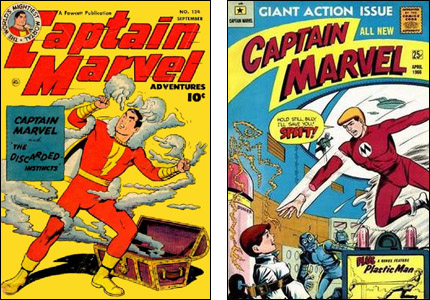
In 1966, a small publisher named Myron Fass realized the name "Captain Marvel" was up for grabs. It still had a certain amount of fame and since the hottest thing on the comic racks was the new Marvel line, he figured it might be a commercial title for a new hero. He commissioned Carl Burgos (who had once upon a time created the Human Torch) to create a brand-new Captain Marvel, totally unlike the Fawcett version.
This one was an android from another world who could fly and order his arms and legs to split from his body by yelling "Split!" If it sounds like a stupid idea for a comic, it was.
Martin Goodman, who then owned Marvel, was pretty unhappy about this infringement on the use of the word "Marvel." He got his lawyers busy and he also gave the order for his company to quickly come up with a new Captain Marvel which they began publishing. There was another of those outta-court settlements and the Myron Fass version went away. In fact, Fass never published color comic books again, publishing just about everything else, including gory black-and-white horror comics in magazine form.
Marvel's Captain Marvel debuted in 1967 shortly before the Fass version went away. This one also was totally unlike the Fawcett hero. His first story was done by Stan Lee and Gene Colan, though others were apparently involved in its development. It quickly became one of those comics that was handed around from writer to writer and artist to artist (never a good sign) with frequent revamps and format changes — some successful for a time, some not. There were many points where it probably would have been canceled had not Marvel's lawyers recommended keeping a book called Captain Marvel in print to preserve the company's claim on the title.

They had all the more reason to protect it in 1973 when, based on a suggestion from Jack Kirby, DC made an arrangement with Fawcett. The old Billy Batson Captain Marvel was revived as a DC comic…but since it couldn't be called Captain Marvel, they named the comic Shazam! and in a sub-title, noted that it featured a hero named Captain Marvel. DC later bought out every interest Fawcett had in the property.
Both Captains Marvel have appeared intermittently, not always to acceptable sales, and both have undergone changes as various creative teams attempted to find something that readers would support for a while. DC has more or less changed the name of their Captain Marvel to Shazam but the old name pops up now and then. Marvel's C.M. has changed more over the years with the name passing to protagonists of different races and genders. That's a long explanation that you don't need and it's one I have no interest in wading through. Perhaps the current movie versions will each establish one particular version for an extended period.
Anyway, that's how come Marvel has a comic book called Captain Marvel featuring a character named Captain Marvel, and DC has a comic book called Shazam! featuring a character that is sometimes referred to as Captain Marvel. Which is all you really wanted to know, right?
Got a question you want me to answer on this blog?
Send it here. No politics, no personal replies...
and tell me if you want me to leave your name out of it.
The post Ask ME appeared first on News From ME.
Note: I have just written a short book titled Writing With Chronic Illness. The book will appear in mid-April, just in time for my annual spring Writing Storybundle. I’ll be excerpting three chapters from the book on this blog. There’s a lot of material in the book that’s not available on the blog, but I feel this post, and the previous two are general enough to appeal to everyone.
When Dean and I first got together, we had a long discussion about careers. We were both new writers at the beginning of our careers. And we knew that our careers would not end up being the same. We had a long series of conversations about what we would do when one career was ascendant over the other.
Good thing, too. I won the John W. Campbell Award for Best New Writer shortly after we got together. For about ten years, I was on all the award ballots. Dean’s books sold more copies, but I got more attention.
Right now, he’s the one who is getting attention. He has done videos that have gone viral. His Cold Poker Gang series sells like crazy.
If we hadn’t been aware of the potential differences in our careers from the very start, we probably would not have been together for more than thirty years.
Comparison is a natural thing. It’s how we learn. Watch toddlers sometimes. They mirror their parents, sometimes literally— trying to sit like Daddy or moving their hands (or trying to) the way that Mommy is. We look to others to see what’s possible.
It’s hard to stop doing that, particularly when we’re only seeing others from the outside. It still surprises me when I hear very successful people talk about their struggles. The skier Lindsey Vonn has been upfront about her injuries and her goals, how she managed her profession day to day while dealing with so much pain that I can’t quite imagine it. Yet to look at her, pretty, blond, smart and athletic, without knowing any of that, you’d think her life is perfect.
Writers are even more mysterious than celebrities. You see their output, but not their daily struggles to get it done. Everyone puts a good face on what they’re doing, particularly on social media. Sure, a handful of people log onto their accounts and outline how depressing their day is, but most only talk about the highlights.
I’m as guilty of that as the next person. I don’t like sharing the bad things. I love sharing the good.
But the struggles? They’re personal. Not to mention the fact that I’m not the most touchy-feely person. I would prefer to discuss books than health problems—mine or anyone else’s.
That makes comparisons even tougher.
I’m considered prolific. So from the outside, I look like a writing machine to many writers. I’ve heard that over and over again: How I’m so dedicated and strong and am all about writing.
It doesn’t feel that way from the inside. I don’t write nearly enough. I never get to everything I want to do. I feel like I’m doing things other than writing most of the time.
It’s even harder considering that I live with an extremely healthy former professional athlete. Dean, even as he ages, gets more done in a single day than some people do in six months. If he sets a goal of 10,000 words per day, he hits that goal. He doesn’t have to stop because he got brain fog or needs extra sleep.
He did suffer from severe migraines when I met him, and that did slow him down, but he had such a healthy base that he could do amazing things on the days he wasn’t down with a headache. I never had that healthy base.
If I compare my daily word count to his, I always fall short. He can be much more consistent than I am and he can write more. He’s a sprint writer, though, so he often stops to do something else. I wish he wouldn’t, because I love his work and want more of it, but I understand.
I suspect the sprint writing is his way of resting. He goes hard and then takes time off, just like the running guides tell you to do when you’re in training for a sporting event. You work hard, then you taper. You do the event, and rest afterwards before starting hard training again.
That’s his history as an athlete and he took it to writing.
I couldn’t do athletic things as a younger person, so I learned how to write around illness, rather than the other way around.
The comparisons end here, though, because they’re not useful. No matter how hard I try, I can’t do things the way he can. And no matter how hard he tries, he has been unable to break the start/stop sprint aspect of his career (careers). That’s his work method.
Most writers aren’t lucky enough to live with another writer. They don’t get into the nitty-gritty of someone else’s routine. Most writers have the Imagined Routine of Favorite Writer or Role Model and then their own routine. And their routine never measures up to the imagined routine.
So rather than let the comparisons overwhelm, try this.
Celebrate your achievements.
Dean actually taught me that early in our relationship. I have since learned it’s another sports thing. Once I started running five days per week, I realized that all runs are not created equal. Some are great; some suck. And getting to the run isn’t easy either. Some days, that’s all I want to do. Mostly, though, the running, like my steps, is a serious inconvenience. I would so much rather sit on my butt and write and read or go to a movie or go out for a meal or spend time with Dean.
But all the running guides point this out: if you go out for 10 minutes (even if your normal is an hour), count that as a victory, especially on the tough days.
Here’s the secret: if you go out for ten minutes, you often do your usual run.
That was a great rule of thumb for me with the running because it got me out, even on rainy days (up north) and on days with the beginnings of a migraine. On the rainy days, I’d often have the most fun, because running in the rain makes me feel like a little kid. I actually run and laugh. (Even here: I did a 5K in February and it rained, and I found such joy in getting wet.)
However, with the headache, I was never certain if I could run until I tried. Sometimes I’d run for ten minutes, and the headache would get significantly worse. A few times, up north, I’d start the run and realize I would have trouble making it home. On those days, I’d run toward the WMG offices, which were a mile from my house. I could always get to WMG and catch a ride home.
That sounds like a defeat, doesn’t it? My run ended because of my headache.
But I never saw it that way. I would get a half mile of running, usually, and some walking, as well as some fresh air. Considering how ill I was, that was a victory.
A major victory.
I learned to apply that attitude to my writing as well. If I was really sick, and I managed to get 500 words on a day when I could barely crawl out of bed, then that was a victory. It wasn’t a qualified victory. It was a real victory.
What do I mean by a qualified victory?
I mean this: Considering how sick I was, that was pretty good.
No. Get rid of the qualifier. How many other people could get 500 words in a day while healthy? How many other people have the determination to write at all?
500 words that day was great. It was amazing. And I pat myself on the back for getting that much done.
Sometimes I pat myself on the back for the planning. Yesterday, for instance. I had a busy day. I had a yoga class in the morning, and Dean and I had some planned time off in the afternoon—going to see a movie. We also planned our steps at the local mall, to do some browsing.
But I want to finish this book, and I had a hunch I’d be too tired when I got home. (Turned out, I had a migraine from some perfume. Which I found ironic, given that I’m working on this book.) Since I knew I’d be busy, I got up early enough to write one of the chapters before I went to yoga.
And sure enough, that was all the writing I managed yesterday. But I was and am happy with that. I planned well, and that’s a victory.
A friend of mine has a saying about certain people. He says that they can find the dark cloud in any silver lining.
In other words, they can make any positive experience negative.
I sure get that. It’s really easy for those of us who suffer from a chronic illness to beat ourselves up for all of our body’s failings. In fact, that’s often the default for us. It’s about what we can’t do rather than what we can do.
I’m as guilty as anyone else of that.
But mostly, I try as hard as I can to savor the silver linings. And the rainbows. And the sunshine.
I like to see accomplishing things—even small things—as victories. The more victories I have, the more victories I want.
And that keeps me going, even on the hard days.
So stop comparing yourself to some imagined ideal. Start celebrating what you accomplish. Make a list of your daily victories.
You’ll be surprised, over the space of a year, just how much you’ll accomplish.
And how much fun you’ll have doing it.
******
As I mentioned above, this is part of the book Writing With Chronic Illness that will appear later this spring. If you support my Patreon at the $10 or above level, you’ll get this book (and others that I write while doing this blog) for free. If you support at the $5, you’ll be able to see some Patreon-only content, including one other short essay that’s part of the book, but too short (in my opinion) to be part of this weekly blog.
The next two posts will be from the book as well, unless something major happens, the way it did last week, with the whole plagiarism scandal. Then I’ll bump the chapters back to accommodate the news items.
And…since I’m mentioning Patreon…here’s the weekly reminder that this blog is reader-supported.
If you feel like supporting the blog on an on-going basis, then please head to my Patreon page.
If you liked this post, and want to show your one-time appreciation, the place to do that is PayPal. If you go that route, please include your email address in the notes section, so I can say thank you.
Thank you!!!
Click paypal.me/kristinekathrynrusch to go to PayPal.
“Business Musings: Comparisons,” copyright © 2019 by Kristine Kathryn Rusch. Image at the top of the blog copyright © Can Stock Photo / andrewgenn.


