Andrew Hickey
Shared posts
20 Dec 17:34
The process of evolution in a time war context produced a number of
decoy or false gallifreys as well as iterations designed to follow one
or other extrapolation of the time-war to a logical conclusion. It was
the hope of the powers behind Rassilon, that this myriad engine of
Gallifreys, would act in essense as a quantum computation on a
macroscopic scale resultimg in entities capable of ending the
time-war. We have seen the horrors of one extreme of that 'range' in
earlier lectures. However there was a secondary consequence at the
other end of the spectrum. Just as there were the Gallifreys that had
become dark, and evil, and distorted, there were those that had become
'weak' and 'victimised', and this was to provide the final route out
of the time-war impass for at least one version of the Homeworld. For
by abandoning the looms, by returning to organic models of childbirth
to replenish the dying, by enacting the rituals of the 'entrenched
last stand' of gallant victimhood, that Gallifrey in essense cried out
to the unknown future "We are the 'deserving-at-war", rescue us!
Won't someone think of the children!" Consequently it was that
Gallifrey and, so far as we know, that Gallifrey alone that passed
through the diffraction slit of the grand experiment, into the
potential future. All it seemed was well. But, what power or powers
could so engineer a world as to appeal to the sentiments of the
future? Were we in fact swapping the Nightmare Child of the War
Homeworld with its smoke-looms and War-King, for a world of something
else?
"Extract from the The Book of The Peace"
(That said, I thought the 50th was astonishingly good!)
Faction Paradox Stands
by Site Owner
The process of evolution in a time war context produced a number of
decoy or false gallifreys as well as iterations designed to follow one
or other extrapolation of the time-war to a logical conclusion. It was
the hope of the powers behind Rassilon, that this myriad engine of
Gallifreys, would act in essense as a quantum computation on a
macroscopic scale resultimg in entities capable of ending the
time-war. We have seen the horrors of one extreme of that 'range' in
earlier lectures. However there was a secondary consequence at the
other end of the spectrum. Just as there were the Gallifreys that had
become dark, and evil, and distorted, there were those that had become
'weak' and 'victimised', and this was to provide the final route out
of the time-war impass for at least one version of the Homeworld. For
by abandoning the looms, by returning to organic models of childbirth
to replenish the dying, by enacting the rituals of the 'entrenched
last stand' of gallant victimhood, that Gallifrey in essense cried out
to the unknown future "We are the 'deserving-at-war", rescue us!
Won't someone think of the children!" Consequently it was that
Gallifrey and, so far as we know, that Gallifrey alone that passed
through the diffraction slit of the grand experiment, into the
potential future. All it seemed was well. But, what power or powers
could so engineer a world as to appeal to the sentiments of the
future? Were we in fact swapping the Nightmare Child of the War
Homeworld with its smoke-looms and War-King, for a world of something
else?
"Extract from the The Book of The Peace"
(That said, I thought the 50th was astonishingly good!)
07 Dec 01:34
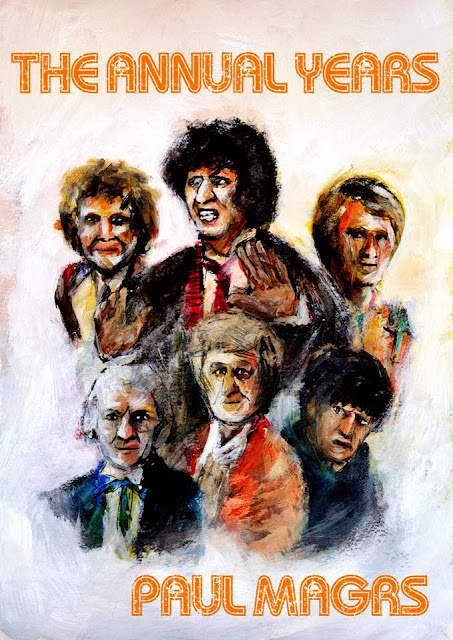
The Annual Years - Cover Reveal and Excerpt
by noreply@blogger.com (Paul Magrs)

What I learned from the Dr Who Annual… (Excerpt from The Annual Years by Paul Magrs, Obverse Books, 2014.)
What I learned from the Dr Who Annual 1976.
When he tells you he’s taking you to a beautiful world inhabited by friendly pacifists: watch out. Even the most innocuous worlds can be terrifying, especially if you materialize on the wrong scale and fall in a pond. Also, it isn’t just the monsters and stuff marauding about that can do you harm. Some planets are alive and telepathic and can bring your worst fears to life before you. Sponges can be sentient but not necessarily evil. Watch out for noisy feminists. Cabbage tea can do wonders for hormonal imbalances. The Neuronic Zone is a very strange and scary place. Watch out for being zapped into a human farm and receiving the excess psychic energy of flame-headed skeleton people.
What I learned from the Dr Who Annual 1977
The deeper you get into outer space, the stranger the alien species become, and still Dr Who is pretty blase about everything he sees.
What’s more dangerous than evil space lizards who hate you? Evil space lizards with a wind machine who hate you.
Beware of return visits from your old friend Dr Who. He doesn’t ever have quiet weekends away. If he turns up on your doorstep again, something hideous is about to happen.
It really isn’t worth getting into a battle of mind-power with Dr Who. He will most definitely kick your mental arse.
What I learned from the Dr Who Annual 1978
When you go looking up old friends? Prepare to be disappointed. People change. They forget you. They move on. They can go to the bad. When you travel with human beings, they soon get tired of very dusty hot planets with three suns. They quite like going back to Earth every now and then, no matter how much they tease about wanting to be somewhere exotic. Just because someone says they’re a peaceful scientist, don’t believe them. They might be psychotic killers, even if they’re not ugly on the outside. In fact, don’t listen to anyone. Do your own thing. We can’t ever be sure whether the world we’re in and the further adventures we’re heading into are actually real, or whether they’re just a heroic dream that Dr Who is having.
Never mind!
What I learned from the Dr Who Annual 1979
Persecution and sacrifice are both are waste of time, and not at all nice. It’s necessary to cultivate your own garden. And, if you do, you might get help at just the right moment from the unlikeliest of sources. Watch out for gigantic space cows in ermine robes. Anyone too smiley and happy and perfect is bound to turn out to be a vampiric fiend. Always buy Princesses anti-grav belts as presents. If all your clothes and flesh are made to disappear by a crazy mystic in a castle, run straight to Dr Who, who understands how M-Rays work. And never, ever get into a mind duel with him – but you already know that, don’t you?
02 Dec 12:01
Surveillance as a Business Model
by schneier
Google recently announced that it would start including individual users' names and photos in some ads. This means that if you rate some product positively, your friends may see ads for that product with your name and photo attached—without your knowledge or consent. Meanwhile, Facebook is eliminating a feature that allowed people to retain some portions of their anonymity on its website.
These changes come on the heels of Google's move to explore replacing tracking cookies with something that users have even less control over. Microsoft is doing something similar by developing its own tracking technology.
More generally, lots of companies are evading the "Do Not Track" rules, meant to give users a say in whether companies track them. Turns out the whole "Do Not Track" legislation has been a sham.
It shouldn't come as a surprise that big technology companies are tracking us on the Internet even more aggressively than before.
If these features don't sound particularly beneficial to you, it's because you're not the customer of any of these companies. You're the product, and you're being improved for their actual customers: their advertisers.
This is nothing new. For years, these sites and others have systematically improved their "product" by reducing user privacy. This excellent infographic, for example, illustrates how Facebook has done so over the years.
The "Do Not Track" law serves as a sterling example of how bad things are. When it was proposed, it was supposed to give users the right to demand that Internet companies not track them. Internet companies fought hard against the law, and when it was passed, they fought to ensure that it didn't have any benefit to users. Right now, complying is entirely voluntary, meaning that no Internet company has to follow the law. If a company does, because it wants the PR benefit of seeming to take user privacy seriously, it can still track its users.
Really: if you tell a "Do Not Track"-enabled company that you don't want to be tracked, it will stop showing you personalized ads. But your activity will be tracked -- and your personal information collected, sold and used -- just like everyone else's. It's best to think of it as a "track me in secret" law.
Of course, people don't think of it that way. Most people aren't fully aware of how much of their data is collected by these sites. And, as the "Do Not Track" story illustrates, Internet companies are doing their best to keep it that way.
The result is a world where our most intimate personal details are collected and stored. I used to say that Google has a more intimate picture of what I'm thinking of than my wife does. But that's not far enough: Google has a more intimate picture than I do. The company knows exactly what I am thinking about, how much I am thinking about it, and when I stop thinking about it: all from my Google searches. And it remembers all of that forever.
As the Edward Snowden revelations continue to expose the full extent of the National Security Agency's eavesdropping on the Internet, it has become increasingly obvious how much of that has been enabled by the corporate world's existing eavesdropping on the Internet.
The public/private surveillance partnership is fraying, but it's largely alive and well. The NSA didn't build its eavesdropping system from scratch; it got itself a copy of what the corporate world was already collecting.
There are a lot of reasons why Internet surveillance is so prevalent and pervasive.
One, users like free things, and don't realize how much value they're giving away to get it. We know that "free" is a special price that confuses peoples' thinking.
Google's 2013 third quarter profits were nearly $15 billion; that profit is the difference between how much our privacy is worth and the cost of the services we receive in exchange for it.
Two, Internet companies deliberately make privacy not salient. When you log onto Facebook, you don't think about how much personal information you're revealing to the company; you're chatting with your friends. When you wake up in the morning, you don't think about how you're going to allow a bunch of companies to track you throughout the day; you just put your cell phone in your pocket.
And three, the Internet's winner-takes-all market means that privacy-preserving alternatives have trouble getting off the ground. How many of you know that there is a Google alternative called DuckDuckGo that doesn't track you? Or that you can use cut-out sites to anonymize your Google queries? I have opted out of Facebook, and I know it affects my social life.
There are two types of changes that need to happen in order to fix this. First, there's the market change. We need to become actual customers of these sites so we can use purchasing power to force them to take our privacy seriously. But that's not enough. Because of the market failures surrounding privacy, a second change is needed. We need government regulations that protect our privacy by limiting what these sites can do with our data.
Surveillance is the business model of the Internet -- Al Gore recently called it a "stalker economy.: All major websites run on advertising, and the more personal and targeted that advertising is, the more revenue the site gets for it. As long as we users remain the product, there is minimal incentive for these companies to provide any real privacy.
This essay previously appeared on CNN.com.
29 Nov 11:52
The slippery slope to political Internet censorship
by Zoe O'Connell
It has been revealed today that Cameron is planning on ordering Internet Service Providers to block “extremist” websites.
It may surprise some people, but I don’t have a problem with this. The reason I’m not worried is that it’s not going to work, because Cameron wants to use the anti-Child-Abuse Cleanfeed system to do it. One of the many criticisms of Cleanfeed is that it’s completely ineffective in the face of either a web site host or an end user with even a hint of technical ability, and there are even US Navy-sponsored initiatives to help users in oppressive regimes get around blocks.
The counter-argument by Cleanfeed is that it is not designed to stop “determined access”, just inadvertent access to unwelcome images. So it would seem the new system will prevent inadvertent access to terrorist and extremist web sites, not something that will likely have any significant access besides a few “Tough on terrorism” headlines in the Daily Mail.
What I do have a problem with is the slippery slope. When Cleanfeed was first introduced, many assurances were given that it would only be used to block images of child abuse. We’ve already seen that go wrong with the accidental block of Wikipedia, and it appears the secret list will now be extended to content someone, somewhere deems “extremist”. First it will be the obvious targets, but what about websites calling for civil disobedience or protest? The police will no doubt have some input into the block list and do you think they will be able to resist the temptation to add sites causing them headaches?
Mysteriously, they will become inaccessible with no way of verifying if you are on the list and no appeal.
This is worrying when it happens to mainstream websites, because Cleanfeed is somewhat dishonest and doesn’t tell you that you have hit a blocked site. Instead, you receive a generic File-not-found message. Not being a terrorist, why would you bother installing any mechanism to work around the blocks? No doubt people will figure out they have been blocked eventually, but in the case of a time-critical demonstration the damage could already have been done.
And once it is in place, might the powers that be try even more desperately to find ways of closing the loopholes in the system? I doubt this would work, given even China has failed in this regard so far, but there is a huge amount of collateral damage that could happen if they tried.
No doubt Cameron will say he doesn’t want to do any of the above, but will there be sufficient safeguards put in place? We saw when David Miranda was stopped at an Airport, where supposed anti-Terrorism powers were abused due to a lack of appropriate rules and oversight, that such things are critical. And what prevents a future, less liberally minded, parliament from quietly chipping away at those safeguards once the system is operational. Being a secret system, how would the public know?
If Cameron wants to do this, he needs to propose a better way than Cleanfeed. A more transparent system, with judicial oversight. And then we can talk.
27 Nov 23:37
Nick Harvey says we must get a better deal if we go into coalition again
by Jonathan Calder
Nick Harvey has given an interview to the Huffington Post that is well worth reading.
In it he - rightly, I think - questions Nick Clegg's enthusiasm for giving free school dinners to all children at infants schools while doing nothing more for older poor children:
But the critique Nick Harvey offers in this interview is an important one and should be listened to by the leadership.
In it he - rightly, I think - questions Nick Clegg's enthusiasm for giving free school dinners to all children at infants schools while doing nothing more for older poor children:
"Someone, somewhere, has found £600m a year we didn’t know about down the back of a filing cabinet and has come up with the brilliant brainwave that the best way to spend it is to give a free school meal to all five, six and seven year olds - regardless of their income level. I am sitting there, gawping in open-mouthed astonishment."Harvey also considers how the party may react if the next general election again produces a hung parliament:
"I don’t think you should take it as read there would be a stampede to join a coalition again," he cautions. "I think there would be serious debate to be had inside the Lib Dems as to whether we would do better to remain outside of government and let them form a minority government."He and the interviewer between them also make a point that those who are debating which other party we should form a coalition with must take on board:
"We won’t get the choice. We don’t need to trouble ourselves. We are talking about a fluke within a fluke." This is because the Lib Dems will stick to the line that the party which wins the most votes and most seats will get the first chance to form a government. And it is also unlikely that the electoral maths will enable the Lib Dems to pick which larger party to drag over the finish line.But for me the most important point Harvey makes is one not picked out by the headline writer. Because he questions the deal that was struck to form the Coalition:
"It was completely unacceptable to ask a national political party like the Lib Dems to come into government on a comprehensive deal and then have some departments in which there is no Lib Dem minister," he says. "Why on earth should we support any executive action or any legislation which came form a department in which we don’t have a minister, it's absolutely preposterous."
"If you don’t agree with something don’t agree to it," Harvey says, slapping his leg for emphasis. "In the nature of the horse trading that has gone on we have agreed to a lot of things that we don’t basically agree with and I don’t think we would make that same mistake again."I am hearing reports of disquiet on the Liberal Democrat backbenches at the moment.They are such a disparate bunch that you suspect there may be as many reasons for this as there are backbenchers.
But the critique Nick Harvey offers in this interview is an important one and should be listened to by the leadership.
27 Nov 23:36
Nick Clegg's self-defeating move on Europe and immigration
by Jonathan Calder
I once heard Jim Wallace say that when your opponents start fighting on your chosen ground you should be pleased. It shows you are winning this debate.
He is right, which is why I do not think Nick Clegg's embrace of the Conservatives' anti-immigrant rhetoric will achieve its aim of curbing the threat from UKIP.
Imagine you are a UKIP voter - go on, try. If you here even the leader of the hated Liberal Democrats admitting that we are too soft on immigrants who come here to live off the state, that will confirm you in your view of the world. It will not make you question it and decide to vote Liberal Democrat instead.
I think there is a better approach and it is that advocated in the Commentary in the current issue of Liberator, which advocates the consistent third of the electorate that is pro-European:
I am not the most instinctive pro-European you have ever met. I recognise that being in coalition involves compromise. It is just that I do not think this latest Clegg initiative will work.
Mainstream politicians, by pandering to the Farages of this world, are feeding the very far-right public opinion they fear. I suspect that, once again, we are seeing an effect of the political class now being formed from such a narrow, privileged base.
He is right, which is why I do not think Nick Clegg's embrace of the Conservatives' anti-immigrant rhetoric will achieve its aim of curbing the threat from UKIP.
Imagine you are a UKIP voter - go on, try. If you here even the leader of the hated Liberal Democrats admitting that we are too soft on immigrants who come here to live off the state, that will confirm you in your view of the world. It will not make you question it and decide to vote Liberal Democrat instead.
I think there is a better approach and it is that advocated in the Commentary in the current issue of Liberator, which advocates the consistent third of the electorate that is pro-European:
That one third is a minority but it is a considerably larger one than that which has ever voted Liberal Democrat. It is the obvious pool in which the party should be fishing.
The pro-European vote has effectively been abandoned in previous elections, perhaps on the assumption that it had nowhere much else to go. Not merely can that vote be awakened but it is essential that it is awakened ahead of any referendum eventually happening.At present Nick Clegg is veering between this approach and one that seeks to appeal to everyone. When pursuing the latter he talks about the centre, but in the case of immigration at least, he locates that centre far to the right.
I am not the most instinctive pro-European you have ever met. I recognise that being in coalition involves compromise. It is just that I do not think this latest Clegg initiative will work.
Mainstream politicians, by pandering to the Farages of this world, are feeding the very far-right public opinion they fear. I suspect that, once again, we are seeing an effect of the political class now being formed from such a narrow, privileged base.
27 Nov 23:19
 “Artists should not be trusted. If an artist is not deceitful
Downstairs, in the garage, Timmy the Rat Terrier rattles his chain. He's on a new short chain, 'cause he's been pooping where he shouldn't - he's a rescue dog, and not very amenable to training. I go downstairs, and I'm horrified - the dog is on the landing of the steps, right on the edge of falling off and choking to death from the short chain. I move him away from the ledge, and back upstairs to try to sleep. Again, the chain rattles, and again I go downstairs and scoot him away. Again the chain rattles, and this time I just remove it. My “ex” swears if the dog poops on the floor one more time, he's a goner. I promise myself I'll clean it up first thing in the morning; besides, the dog's going to kill himself tonight on that chain.
I go upstairs, and try to sleep, but I can't. I start running the loops in my head, over and over again, Charlie going to the Tree and getting hung, and he does this by Choice, to save Claire. Knowing what we know of Charlie, he would do this, he would sacrifice himself out of his love for another. Charlie's going to die so that he can Go Back, 'cause he saw Claire destroyed by the Smoke Monster. And then Ethan will have to take him to the Tree again, to complete the loop, and Charlie will forget it all.
~~~ whooosh ~~~
Pop Between Realities, Home in Time for Coffee (LOST)
by noreply@blogger.com (Philip Sandifer)
 “Artists should not be trusted. If an artist is not deceitful
every so often in the cause of his art, then he is a poor artist.”
-- Chaim Potok, My Name is Asher Lev
LOST was quite possibly one of the biggest shows to hit television in the last decade. More remarkable was the fact that it was ostensibly “cult television” and yet it still hit it big in the mainstream. It was never the highest rated show on television, but it was in the American top-20 for most of its six-year run, it was the most recorded TV show at the time, and it was also an international sensation. It garnered 55 Emmy nominations (the American equivalent of BAFTAs) winning 11; many critics once called one of the greatest shows ever made.
As far as this blog is concerned, we shouldn’t be surprised. Like Doctor Who, LOST provided a means by which disparate genres could be smashed together. Doctor Who has the TARDIS; LOST had The Island. A place for people who were metaphorically lost in their lives, it allowed all kinds of different stories to play out. One week The Fugitive would be running about helping people and all the while trying to evade the law. Next week there might be a medical drama, followed by a comedy, a family drama, a love story, a con game, or a tragedy. This all got mixed in with the adventure of exploring a mysterious Island, populated by ghosts, time travel, an Island god, and a Smoke Monster for good measure. It hit the sweet spot of soap tropes and “genre” mythology.
Today its reputation is far different, and it’s impossible to go back and watch it again without keeping this in mind. The finale (as was the case for most of its final season) was largely panned, and it isn’t unusual to find it on a critic’s “10 worst” list of some sort or another. People expected answers that were never delivered; new but less compelling characters came to the forefront; the show veered into iconography better found in a greeting card penned by Jonathan Livingston Seagull. Which really begs the question: What the hell happened?
~~~ whooosh ~~~
KATE: We have to go back for him.
CHARLIE: Go back? There? Kate, there's a certain
gargantuan quality about this thing.
(1x01: Pilot, Part 1)
~~~ whooosh ~~~
It’s August 15th, 2005. Oasis is poised to hit number one, with McFly, Babyshambles, Iron Maiden, and British Whale all charting. Americans are killing Iraqis, but Indonesia signs a peace treaty with the Free Aceh Movement, so there’s that. India celebrates its 60th Independence Day. Helios Airways Flight 522 crashes near Athens, killing 121.
While on Netflix, it’s Disc One of Season One of LOST. I inhale it quicker than Bill Clinton can suck down a cigar. Yes, I’m late, almost a year late to the LOST party (it premiered on September 22nd, the Fall Equinox of 2004) but it won’t take me long to go back and get caught up. I’m struck by how cinematic the show is – lead directors Jack Bender, Stephen Williams, and Tucker Gates know their stuff, and of course JJ Abrams directed the twin pilot episodes, and of course Hawaii makes for a gorgeous backdrop. It’s immediately apparent that this also a literary project – from the character naming conventions (famous authors, foundational philosophers, and blatant allusions) to how quickly it dives into serious subject matter, be it a debate on euthanasia, the nature of human politics, or how to survive a crash landing in the South Pacific.
For most people, the introduction of the Monster (still hidden under cover of night) at the end of Act One sufficed as a hook; others immediately began translating the varying iterations of the Frenchwoman’s transmission at the end of Pilot Part Two, but for me it was the construction of Walkabout, the 4thepisode of the series that put the nail in my coffin. This is the first episode to feature John Locke, who in Flashback is seen to be a lonely, angry, office drone of a man, a lumpen who rails against being told what he can’t do. Locke, we discover, works at a box company, is nicknamed “box man”, and even wanted to be a boxer when he was a teenager.
It’s deliciously character-centric, and yet it’s the Reveal of his plight in Australia that’s astonishing, coupled with the emotional climax of his rising off the beach of the Island after the plane crash, hooking your faithful writer like a rainbow trout out of Candlewood Lake. I should have known better, of course, given that “fish” are highlighted in this episode as symbolic of “faith,” but also of “suckers” – of marks taken in by con artists.
~~~ whooosh ~~~
SUN: I want to go back to the beginning. Can't we just start all over?
(1x17: …In Translation)
~~~ whooosh ~~~
To properly understand LOST, one must examine the underlying philosophy of JJ Abrams’ storytelling. While Abrams wasn’t generally involved with the show much beyond its launch, he did lay the groundwork with Damon Lindelof, who ran the show with Carlton Cuse all the way to the end.
In 2007, Abrams gave a TED talkconcerning LOST. He brings up his grandfather, Harry Kelvin, who would bring over radios and TVs (boxes) and open them up for Abrams to see how they worked. This got Abrams deeply invested in boxes. One day, because Kelvin got Abrams interested in stage magic, Abrams bought a box from a magic store, a Mystery Box that contained a surprising number of magic tricks. Abrams, however, didn’t open the box. He was having too much fun imagining what could be inside. In fact, as long he never opened the box, it could very well be anything! Which made the Mystery Box all the more enticing. This, then, became a guiding narrative principle: Mystery was such an effective hook that it could be employed throughout a story to generate constant tension and curiosity.
This is, in fact, how LOST was structured. It set up two grand Mystery Boxes (The Island and The Smoke Monster) which were endlessly deferred while several other Mystery Boxes provided periodic Reveals as a show of good faith. Any time a box was opened – for example, meeting the Frenchwoman whose radio transmission generated such excitement in the second pilot episode – a new mystery box would be put on display -- like, what the hell happened to her to make her this way? In other words, answering a question simply leads to another question.
There are a couple problems with this method of storytelling. First, using a Hook – a first-act device – through an entire story can lead to deficits in other areas, from poor plot development in the second act to unsatisfying climaxes (Reveals) in the third. A story that’s made entirely of hooks simply begins to sting; there’s never any fish to cook. Second, and more egregious, this principle is often extended to characters as well. This poses a dramatic problem, because while it’s enticing to anticipate what’s in a Mystery Box, it’s difficult to believe in or fully appreciate the conflicts between characters when we don’t know what’s actually motivating them.
Mind you, the Mystery Box lecture Abrams delivered for his TED talk was directly in response to all the questions he received about LOST, and specifically about the nature of the Island. Much digital ink has been spilled about the show’s failure to deliver on that particular Reveal, but Abrams closes the TED talk specifically with an admonishment that the Mystery Box will remain closed. (And what’s with the bit about showing us two characters mirroring each other, and the appreciation of sleight-of-hand over explosions? No one ever brings this up.)
Anyone who’s seen this lecture should have guessed that the Reveal of the Island would never happen. While it’s fair notice – well, not really, given that most people who watch TV don’t watch TED talks – it’s not particularly satisfying on dramatic grounds. The only justification for such ambiguity is if the narrative itself provides enough clues for the savvy viewer to figure out a plausible theory. Even so, doesn’t tackling such a puzzle box amount to little more than a leap of faith?
~~~ whooosh ~~~
JACK: You didn't want to go back there. Did you know about this?
HURLEY: Jacob kind of, sort of, hinted at it...
(6x05: The Lighthouse)
~~~ whooosh ~~~
It’s April 16th, 2006. Gnarls Barkley’s “Crazy” tops the charts, and has been topping the charts since David Gilmour’s album “On an Island” disappeared. The Danube floods in Eastern Europe, displacing hundreds of people. Dan Brown, writer of The DaVinci Code, fends off a copyright suit from Henry Lincoln, writer of Holy Blood Holy Grail and three Doctor Who stories. Scientists conclude that containment of the avian flu pandemic has failed.
While in my Easter basket, courtesy of the love of my life my ex, it’s The Third Policeman, by Flann O’Brien. As if I don’t have enough to read, given the rigors of the academic life, but this one’s a treat. It’s a masterpiece of postmodernism, but it was virtually unheard of before it appeared in “Orientation,” the third episode of Lost’s second season. The book details the surreal experiences of an unnamed amateur scholar of De Selby, a fictional philosopher-scientist with decidedly eccentric and esoteric ideas on the nature of the Universe. De Selby’s outlandish theories put LOST theorists to shame.
More to the point, it also opens up a new way for me to appreciate the epic mythology that is LOST. Since getting hooked on the show, I’ve taken an intertextual approach. It starts with Watership Down, a childhood favorite that appears early in the first season, and which vaguely foreshadows future events on the show. When A Wrinkle in Time appears later in the season, I happily re-read it, and am handsomely rewarded with a fabulous joke in the 19th episode, “Deus Ex Machina.”
But The Third Policeman is something else entirely. In the end, it’s revealed that the despicable protagonist is dead, in hell, and that hell is an eternally recurring Sisyphean circle that keeps getting forgotten. So, if the books are intertextually relevant and not simply gratuitous – as all the other titles that have appeared in the show bear out – it seems I’ll have to go back and watch it again, with an eye for cracks in the narrative that allude to such circularity. I wonder if Nietzsche has been referenced yet?
~~~ whooosh ~~~
KATE: I've spent the last three years trying to forget
all the horrible things that happened on the day that we left.
How dare you ask me to go back?
(4x13: There’s No Place Like Home, Part 2)
~~~ whooosh ~~~
If one hopes to decode LOST through literary analysis, a library is required. Nearly a hundred different titles appeared in the show, and coupled with the enormous number of other references to philosophers, scientists, and critics (hello, “Brother Campbell”) one could spend far more time studying external sources than watching the show itself, which is saying something, given that LOST is comprised of 121 episodes of television, all in service to a single story.
The bigger problem with a puzzle-box story is that most people aren’t watching stories to decode puzzles, they’re watching to see characters in conflict, and how those conflicts evolve and resolve. In this respect, LOST somewhat acquits itself. While few of its characters are actually likeable, the huge cast provides a myriad of different faces to follow, and even identify with. And indeed, the show has consistently devoted itself to character-based storytelling, even within the framework of epic mythology.
This is as good a place as any to highlight one of LOST’s main narrative conventions, which is the use of FlashBacks to tell its story. The vast majority of the episodes focus on one of the main characters, to go back and explore the resounding climaxes in a life prior to arriving on the Island. This allows the show to have its cake and eat it too, by juxtaposing heavily mythological content with mundane ordinary life, week after week, with a different character. In this respect the show has an almost anthologized feel to it, not unlike Doctor Who – if you don’t like Jack Shephard, for example, don’t worry, because next week will have Kate Austin in focus, or Hugo Reyes.
This technique was much more effective in the early going of the show, when each character was a Mystery Box, and the FlashBacks were actually revealing of character. At their best, the character stories were heavily laden with dramatic irony, often via supporting characters, as in “The Moth” which showed Charlie Pace’s journey from choir-boy to drug addict, a mirror-image of his brother Liam, who starts out as the wannabee rock-star and ends up a straight-laced family man. The two fates are the same, but the characters trade places, replacing each other in their crossing trajectories.
Another example: Jack Shephard was originally supposed to die in the Pilot episode. The network honchos said that wouldn’t work, so Abrams and Lindelof replaced Jack’s death with the death of the airplane pilot. The pilot takes Jack’s place, but in the meantime the two characters are juxtaposed: Jack opens the episode lying on the ground, alive, with a close-up on his opening right eye that reflects the trees and sky above. The pilot, whose right eye is swollen shut, is found through a reflection in a puddle of water on the ground, which reveals up in the trees, dead. Jack says he trained to be a pilot, but it wasn’t for him. Architecturally it’s rather clever.
But at times this “X” structure stretched credulity. John Locke and Ben Linus were similarly juxtaposed, but through some incredibly coincidental trivia – their mothers share the name Emily, they both have operations on their backs, they both spend time in wheelchairs, they both moved a mystical Wheel in the heart of the Island, and they even share similar lines of dialogue. This builds to the crescendo of John replacing Ben as the leader of the Others, and Ben becoming the butt of a cosmic joke – a contrivance with a reprehensible entailment.
In the LOST universe, the roles people can play are fixed, not unlike Campbellian archetypes. The characters can swap places, but there’s no opportunity to fundamentally change the material social dynamics of the different roles in play. This is the very antithesis of progress, not to mention of alchemy. It’s more like a game of musical chairs, but worse, because it never ends.
~~~ whooosh ~~~
BEN: So how is it that you think you know this island better than I do?
LOCKE: Because you're in the wheelchair, and I'm not.
...
BEN: I want to help you, John.
LOCKE: Why?
BEN: Because I'm in a wheelchair and you're not. Are you ready to see?
(3x13: The Man From Tallahassee)
~~~ whooosh ~~~
It’s September 26th, 2006. Blah blah blah.
While in the world of games, it’s the end of LOST’s first Alternative Reality Game, or ARG, otherwise known as “The Lost Experience” or “the TLE,” which is, yes, redundant. Now, anyone who knows me know that I love games, especially when there’s a computer of some sort involved; after all, as a child, I played games on a Commodore machine. But the TLE isn’t really a game so much as a webmaze, a scavenger hunt for clues to LOST’s mythology that takes place all over the Internet. And it completely wastes one of my summers.
This ARG doesn’t just take place on the Net. Parts of it take place in the Real World™ with the distribution of Apollo Candy Bars. It’s first alluded to in a fake commercial (like one of those fake ads in GAMES magazine) that aired back in the Spring of 2006, advertising the website of the fictional Hanso Foundation, which on LOST was the organization that funded the Dharma Initiative that left behind all those Hatches filled with rusting technological boondoggles on the Island. And indeed, the parallel “story” of the TLE includes a fictional character (Rachel Blake, aka “Persephone”) interacting with real people on the internet.
(This isn’t the last time a weird commercial appears during a LOST broadcast. For the Season Four finale, for example, which introduced the Dharma Initiative’s Orchid Station, Old Navy will run a commercial that features an “orchid print” dress, despite the fact that no such dress exists in their catalog. However, the commercial also has a soundtrack culled from Lights’ “Last Thing on Your Mind,” so there’s that.)
The TLE, in other words, is not only an opportunity to keep marketing the show during its summer hiatus, and not only a way for the showrunners to flesh out non-crucial backstory to their epic without intruding on the television show proper, it’s a way for the show to blur the edges between fiction and reality. So, on the show, Hurley and Sawyer discover a manuscript called “Bad Twin” (written by the fictional Gary Troup, which is an anagram) before Jack throws it into the fire. In real life, the manuscript is actually published, a mediocre potboiler that purports to expose salacious details of minor characters on the show, but which contributes very little to actually understanding LOST, other than, perhaps, its use of “mirror-twin” characters – literally twins, but with reversed facial characteristics – as a source of metaphor for the show at large. (It was actually pretty awful, and I’m not tempted to go back to it again, even as reference material.)
I’m more disappointed in the final Reveal of the TLE – a woman is reconciled with her father, playing the same note of “daddy issues” that have been prevalent in the show – but still, the notion of a “breach” between the show and the culture surrounding it is much more interesting. I mean, I watch a lot of TV, and I couldn’t help but notice that LOST was getting referenced in other shows – a fortune cookie with Hurley’s numbers showed up on Veronica Mars, for example, or Chuck from “Chuck” announcing, during a close-up on his eye, that he knows the secret behind Flight 815, the plane that crashed on the Island in the very beginning of the show – on the actual date that the show first aired.
It’s also around this time that I start getting active in online communities devoted to discussing and dissecting LOST. That is to say, it isn’t just impinging on my reading habits, and interfering with my other studies, but that it’s becoming a part of my social life as well. Which, frankly, is one of the best things to come out of LOST. I’m not exactly a people-person, but interacting over the Internet is something I actually find enjoyable. Especially when I can employ an avatar and any number of different names. It’s interesting to see how people’s attitudes and ways of interacting change depending on who they think they’re talking to. On the other hand, there’s something to be said for authenticity – well, as long as your mail isn’t getting stolen or anything like that.
It’s also instructive for understanding LOST. So many characters on the show are not who they say they are, and there are even a few who aren’t who they think they are, well, according to the Season Two trailers. This might explain why so many of them have such striking names, like “Christian Shepherd” or “Mikhail Bakhunin.” The ethic of the confidence man rules, and very much in the postmodern fashion suggested by Melville’s “Confidence Man,” the last novel he wrote.
It’s at the online forum called The Fuselage that I become acquainted with one Robert Goodman, who claims to be a friend of showrunner Damon Lindelof’s (dead) father, and indeed of Damon himself. Goodman proposes a game where every narrative convention in the show has to have a diegetic purpose. This allows him to spin a grand conspiracy narrative explaining the show – Walt wasn’t lucky, he was a con-artist who used loaded dice at backgammon; the characters picked fake names to indicate to other characters which sides they were on; there was a security system on the Island that prevented anyone from speaking of the true nature of their deceptions; and so on. It’s an inventive theory, and though obviously demented, it speaks to the conspiracy-theory paranoia undercurrents of American culture.
Another online personality, “Ada” at the ABC boards, tried instructing hard-core fans on the art of “close reading” the show. Pointing out not just the blatant literary references, but the kinds of literary techniques the show was using – repeated dialogue, mythological symbolism, the importance of episode titles as clues to character analysis, how to make a timeline, and even something as basic as noticing which numbers keep coming up over and over again.
I think I’m finally starting to “get” LOST.
~~~ whooosh ~~~
DESMOND: Why'd you try and to kill me?
CHARLIE: I didn't try and kill you. I was trying to show you something.
(6x11: Happily Ever After)
~~~ whooosh ~~~
One of the things that became apparent through the online ARG, The Lost Experience, was that the showrunners were more actively engaged with their audience (or, to be specific, with their fandom) than either had previously enjoyed.
Indeed, this has become a model for showrunning. Damon and Carlton got into the habit of hosting semi-regular podcasts to dissect recently aired episodes, and to respond to criticism of those episodes. They granted numerous interviews, interviews which were picked over in search of clues that might reveal the nature of their show, not to mention the Island. Many people on the show, from production staff to the talent, would post on online forums like The Fuselage. They became headliners at cult-ish events like San Diego Comic Con. Damon even wrote an essay about Harry Potter for the New York Times, all the while drawing (misleading) comparisons to LOST.
Of course, this is all part of marketing a show now, generating buzz, keeping audiences engaged. But it provided them several opportunities, related to the Mystery Box nature of the show itself, to fuck with their audience.
First, they lied incessantly. Early in Season One, for example, Damon stated unequivocally that there was “no time travel,” which later turned out to be quite the red herring. This lying had some rather felicitous entailments. On the one hand, it helped to mitigate spoilers, through the spread of misinformation, and misdirecting those hardcore fans who were determined to unearth the Island’s secrets in advance of a Reveal, preserving the sanctity of the Mystery Box. On the other hand, and far more important, it made Darlton into unreliable narrators, which in turn made it easier for fans to spin their own theories on the show without relying on external authorities to validate (or invalidate) them. In essence, this kind of showrunning pays homage to the Death of the Author; one must consult the text in order to determine what’s actually being said.
The other implication of this interactive form of showrunning has to do with using the show to reflect back to the audience what they’ve been voicing about the show. In this respect, the use of many Mystery Boxes can function like so many mirrors. When the Hatch was conceived in Season One, the writers didn’t actually know what was going to be found inside; after all, they didn’t even know at the time if the show was going to be renewed or cancelled.
So a Mystery Box can have nothing at all inside of it, except a plan to put something into it culled from audience speculation. The idea of finding TV dinners and rusted-out world-saving technology appealed to the writers, so they built the Dharma Initiative out of those visions.
Using the Mystery Box notion extended through the run of the show, and provided more opportunities for the show to respond to its audience. In 2009, when one very creative online theorist likened LOST to The Muppet Show, including a detailed mapping of LOST’s characters to the iconic Muppets, she was rewarded with a flash of Kermit the Frog on one of the Dharma Initiative’s monitors less than a week later – and such a feat is possible in last-minute post-production when the show is filmed with all monitors covered in blue-screen cut-outs for future editing.
Another theorist likened the show’s use of coincidence to Lawrence Weschler’s “Everything That Rises: a Book of Convergences,” spawning a discussion of Flannery O’Connor’s collection of short stories as related to LOST, in particular regards to its spiritual concerns; in the Season Five finale, the mysterious Jacob is seen reading O’Connor’s “Everything That Rises Must Converge,” just before touching John Locke and bringing him back to life the latter’s fall from the eighth story of a skyscraper. Other online theorists have seemingly had their work acknowledged through inserted references to Stephen King’s “The Shining” and Philip K Dick’s “VALIS.”
~~~ whooosh ~~~
CLAIRE: People don't seem to look me in the eye here. I
think I scare them. The baby... It's like I'm this time bomb
of responsibility just waiting to go off.
(1x05: White Rabbit)
~~~ whooosh ~~~
It’s December 1st, 2007, and I think I’m going insane. I’ve got LOST pouring out my ears. My work has suffered due to my obsession with this show. But I’m so close to figuring it out! It has something to do with mirrors. Reversed images. Continuity errors that are too on-the-nose to be anything but deliberate. And I’m sure that the writers are seeding the online forums with clues. It would be so easy for them to create fake online personas – after all, they’re in the business of making up characters. The writers are “the Others” – everything on the show has a real-world analogue. It’s a Breach between fiction and reality.
The Island is a resurrection hub. When you die, you go back, and you can change things, but only the latest iteration can be shown. The FlashBacks are particularly dangerous. The characters don’t know they’re having them. It’s clearest to see with Claire, whose name means Clarity. In “Raised by Another” (raised by an other?) she starts having flashbacks, and starts getting sick. She’s filled with regret, with guilt, and the Smoke Monster is keenly attuned to it. She’s about to make a decision that might create a paradox – if she doesn’t take the tickets to get on Flight 815, she’d never come to the Island, never have flashbacks, never not take the tickets. But she takes them because Charlie has faith in Malkin, the psychic con-man.
In fact, I’m sure that in a prior iteration, Claire’s flashbacks caused her to get Smoked. Charlie saw it happen, and Ethan showed him how to go back and stop it from happening. Ethan hung Charlie from a Banyan Tree, and Charlie traveled back in time. There’s a reversed image of Charlie running through the trees, right before Claire’s fateful flashbacks. I found it because of Magritte’s painting, “Carte Blanche,” a repeated phrase in Outlaws. And now Charlie’s necklace is reversed – a continuity error. No wonder his head is haloed by vines after Jack retrieves him from the Banyan Tree! Charlie sacrificed himself to save Claire. A leap of faith, all the way around.
In Claire’s next centric episode, which explains her disappearance after Ethan kidnapped her, there’s a FlashBack where Claire asks Ethan what happened to Charlie. Ethan says, “Oh, he’s fine. When we got far enough away from camp, I let him go back.” He let him go back.So it’s true. On LOST, “to die” means “to go back.”
~~~ whooosh ~~~
HURLEY: They all think I'm dead. When we get rescued
and I go back, I'm gonna be free.
(4x01: The Beginning of the End)
~~~ whooosh ~~~
After three years of fleshing out the characters through FlashBacks, that particular narrative convention had thoroughly run its course. The characters were no longer mysteries, and the flashback conceit had become very predictable.
It was at this point that the Cuse and Lindelof decided to switch things up and start playing with the narrative convention itself. For the Season Three finale, “Through the Looking Glass,” they replaced Jack’s FlashBacks with FlashForwards. They did this without making it apparent until the very end of the story, when Jack implored Kate to go back to the Island as they stood at the edge of an airport runway.
This game-changing device, called “the Snake in the Mailbox,” was perhaps the greatest twist in the show’s history, but it also marked the beginning of the end. By showing us the characters’ futures off the Island, the show lost a lot of its dramatic impact. Well before the end of the next season, everyone knew who would make it off the Island and who would get left behind. The main narrative principle of the show, the setting up of a Mystery Box for a subsequent Reveal, had been violated. Effects preceded causes, denuding the events on the Island of any tension – if we know that Sayid, for example, escapes the Island, there’s no real danger to his being captured by the Others.
So the show stopped being a character-driven drama, and took a hard turn towards plot-driven mythology dependent on cliffhangers, incredibly strained twists, and the proliferation of hunting for Easter Eggs.
Ah, Easter Eggs. It’s one of the things the show is famous for. On the one hand, it’s commendable that the show would trust its more devoted fans to study the show closely. On the other hand, it makes it less accessible to the typical casual viewer. To be clear, the show has employed Easter Eggs from the beginning. In the pilot episode, for example, the Frenchwoman’s transmission is supposedly on a loop, but each iteration of the message is slightly different – though one would need to translate French in order to know this. The Whispers were in fact highly processed voices that again would take technological prowess to decode. Other Easter Eggs were more benign – using Backgammon as a metaphor, or a sign in a medical facility misspelled as “Magnetic Resonance Imagining.”
And then there were the queer editing choices – certain reversed images that served no clear purpose, or having a background character speaking backwards. Splicing in images that would take a DVR to find. To expect an audience to wade through the show studying every line of dialogue, and every frame of footage, is frankly insane.
~~~ whooosh ~~~
LOCKE: What if everything that happened here, happened for a reason?
(1x05: White Rabbit)
~~~ whooosh ~~~
It’s December 4th, 2007, and I’ve started hearing voices. Obviously they’re in my head – I’m not so loony as to think they’re externally generated. They’re more like… whispers… and they tell me things about LOST.
Well, let me take that back. Sometimes they’re externally generated, but in a peculiar way. Like, I’ll be asking myself a question, and then a commercial comes on the television that answers that very question, but in the form of riddle or metaphor. Or, I’m wondering about the four-toed statue (it has a “lost toe”) and my best friend (definitely not my ex) starts telling me about an article concerning the latest “theory of everything” in quantum physics, including the fact that a TOE is an acronym for a “theory of everything.”
And then there are the problems with material reality. Both of my VCRs die in the span of a couple of days. How can I do a frame-by-frame analysis of the episodes coming next month without a VCR? Also, the toaster oven is acting up: I put two frozen hash-brown patties into it, side-by-side, and one comes out burnt while the other is still cold. Even my food has become “mirror twinned.”
Most peculiar of all, someone asked if I were pregnant. Ha ha, very funny. Nice way to say I’ve gained some weight lately. (I have gained some weight lately.)
But the Voices are what’s really bugging me. One of them definitely has a British accent, and another is certainly female. Lately they’ve been concerned with decoding Jacob’s Cabin as seen in the third-season episode “The Man Behind The Curtain.” This is one of those episodes were images and sounds were spliced in. In a fraction of a second, as John Locke shines a light on an empty chair in a creepy cabin, someone calls out “Help Me” while the cabin shakes and people and objects are thrown across the room. Locke accuses Ben of being a charlatan, of faking a supernatural event, and I believe Locke – until I see the screenshots.
Ever so briefly, there’s a splice of someone sitting in the Chair, and a close-up of someone’s Eye. And there’s a continuity error that follows this event: Ben replaces a lantern outside the cabin door after all this, even though the lantern broke inside the cabin when all hell broke loose.
The voices tell me that Ben was supposed to sit in the Chair and replace the person who’s sitting there, some poor time-traveler who got caught in a loop; hence the pathetic cry of “help me.” Locke, who’s been juxtaposed with Ben for the better part of the season, could have done it, but Ben ended up shooting Locke by the Dharma pit, where the bodies of the DI were dumped after The Purge. Regardless, whoever’s in the Chair will be stuck there indefinitely. Whoever this Jacob fellow is, I feel sorry for him. He obviously got tricked into his terrible fate.
I’ve also realized that Liam tricked Charlie into taking his place on Flight 815. But, did Liam do it out of self-preservation, because he didn’t want to drown in the Looking Glass? Or was it for the greater good, given that Charlie was a better musician and could properly enter the code for Good Vibrations to cut the jamming signal?
~~~ whooosh ~~~
JACK: It doesn't matter, Kate, who we were - what we did before this,
before the crash. It doesn't really... Three days ago we all died.
We should all be able to start over.
(1x03: Tabula Rasa)
~~~ whooosh ~~~
There were two types of LOST fans, for the most part. There were those who were primarily concerned with understanding the characters on the show and following their journeys, and there were those who were obsessed with understanding the mythology underlying the show, from the nature of the Smoke Monster and the Island to the evolution of The Others, the Dharma Initiative, and indeed the nature of the show they were watching.
This is, of course, a false dichotomy; most “theorists” had characters they gravitated towards, and most “shippers” were as pleased as anyone else about the discovery of the latest Hatch. Which makes sense – after all, the Mysteries of the Island were, in the end, wrapped up in the nature of the characters, and the characters themselves were revealed in juxtaposition to the strangeness they discovered on the Island.
Nonetheless, it’s a useful dichotomy for understanding the reception of LOST’s finale (and final season.) Those who were most satisfied with the show tended to be most concerned with the resolution of the characters’ stories, which they got, by and large; as it turns out, the characters needed only each other, not a damn mystery Island, to move on. Conversely, the people who were invested in a Sixth Sense type of reveal were sorely disappointed, as the Mystery Box was essentially kept closed, and what little was revealed was so steeped in obvious symbolism and ambiguity it might have been better just to chuck the box back into the ocean.
We’ve seen such dichotomies in fandoms before. It’s not exactly the same as the gun/frock debate amongst Whovians back in the 90’s, but its close. More generally, it’s the debate between plot-driven stories versus character-driven stories, but it goes further than that. This is because LOST, being a popular mainstream story, was understood through basic narrative conventions. Its ability to tell character stories through FlashBacks, for example, was possible only because we understand the conventions of prolepsis and analepsis, that stories don’t have to be told in a strictly chronological fashion.
But this same contract also applies to genre conventions. A Mystery Box story is supposed to have a Reveal, and indeed the early going of LOST seemed to promise such a Reveal – from the shocking revelation of John Locke’s chair at the end of Walkabout to the thorough exploration of the Swan Hatch throughout Season Two.
LOST made a deal with its fans, implicitly through its narrative conventions, but ultimately failed to deliver the goods.
~~~ whooosh ~~~
JULIET: I lied.
SAWYER: You lied?
JULIET: It was the only way he'd let us go back.
SAWYER: So why are you going back?
JULIET: Karma.
(3x22: Through the Looking Glass, Part 1)
~~~ whooosh ~~~
It’s December 8th, 2007. I’m watching TV with the love of my lifemy ex, and a bad rendition of A Christmas Carol for some sitcom episode gets quickly skipped over (I'm not the one wielding the buttons) and some other show comes on, probably the History Channel.
And I have a weird feeling. A not so good feeling. I don't know why, but I have the feeling that I’m going to die. Tonight. For some reason, I don't know why, I'm going to die this very night.
And I have a weird feeling. A not so good feeling. I don't know why, but I have the feeling that I’m going to die. Tonight. For some reason, I don't know why, I'm going to die this very night.
Downstairs, in the garage, Timmy the Rat Terrier rattles his chain. He's on a new short chain, 'cause he's been pooping where he shouldn't - he's a rescue dog, and not very amenable to training. I go downstairs, and I'm horrified - the dog is on the landing of the steps, right on the edge of falling off and choking to death from the short chain. I move him away from the ledge, and back upstairs to try to sleep. Again, the chain rattles, and again I go downstairs and scoot him away. Again the chain rattles, and this time I just remove it. My “ex” swears if the dog poops on the floor one more time, he's a goner. I promise myself I'll clean it up first thing in the morning; besides, the dog's going to kill himself tonight on that chain.
I go upstairs, and try to sleep, but I can't. I start running the loops in my head, over and over again, Charlie going to the Tree and getting hung, and he does this by Choice, to save Claire. Knowing what we know of Charlie, he would do this, he would sacrifice himself out of his love for another. Charlie's going to die so that he can Go Back, 'cause he saw Claire destroyed by the Smoke Monster. And then Ethan will have to take him to the Tree again, to complete the loop, and Charlie will forget it all.
Both stories have two versions of events, and for each story I play the loops simultaneously, one on one side of my mind, the other on the other side of my mind. It’s holographic, in 3D, but only one side can ever be shown.
And then there’s that poor man stuck in Jacob’s Chair. I wish I could help him. If I could sit in that Chair and free him from his torment, I would. I see the Chair whirring past me, holographically, and I sit in it. I sit in the Chair, and that’s when I died.
~~~ whooosh ~~~
CHARLIE: It's a mulligan. Mulligan. It's a gentleman's sport,
you've got to get the words right. Mulligan.
(1x09: Solitary)
~~~ whooosh ~~~
In “Flashes Before Your Eyes”, the eighth story of season three, it’s revealed what happened to Desmond David Hume after he turned the key in the underbelly of the Swan Hatch, after the timer reached zero, replaced by mysterious Egyptian hieroglyphics that Darlton have lied about – they say the glyphs mean “Underworld,” but they’re actually lifted directly from the Admonitions of Ipuwur, a phrase properly translated as “to cause to die.” Desmond’s consciousness goes back in time, to another island (Britain) many years before he arrived in the South Pacific.
It’s almost the same as any other FlashBack we’ve seen before on LOST, but this one is different. First, we stay in FlashBack almost until the end of the episode – the FlashBack itself is a feature of the story. Second, the character of Desmond becomes aware that he’s in a FlashBack of some kind, especially when he encounters a woman named Hawking who’s determined to make sure he doesn’t make any changes to the decision process that led him to arrive on the Island in the first place.
This argument between Hawking and Hume manifests over the choice of whether to buy a “ring” for Hume’s lover, Penelope Widmore. The “ring” becomes a metaphor for what ends up being Hume’s time-loop, a causal loop from which he can’t escape. He ends up throwing the ring into a river – another metaphor for time, but of the linear variety. When his consciousness returns to the Island, he is “reborn” amidst the implosion of the Hatch, naked, and desperate to “go back”:
DESMOND: Please, let me go back. Let me go back
one more time. I'll do it right. I'll do it right this time.
I'm sorry, Penny. I'll change it. I'll change it.
This episode functions as a synecdoche for the series as a whole, or a Russian Nesting Doll if you prefer. It reveals that the heart of LOST is a time-travel story, driven by regret, a perfect union of myth and character. It also suggests that the narrative conventions for telling the story, namely the FlashBacks, the FlashForwards, and the FlashSideways, are more than storytelling conventions, but part of the plot itself. The Flashes are always character-centric – is it possible that other characters’ consciousnesses are travelling through time, but that they’re generally unaware of it?
This, in turn, might explain a mystery of the Smoke Monster, and why it seems to be bound by certain “rules.” If someone inadvertently changed their own timeline because they were having or about to have a FlashBack that would somehow prevent them from coming to the Island in the first place if a different choice were made, the Island’s “security system” (which can read people’s memories) would jump in an stop them, thereby protecting the Island.
Let’s be clear here: “go back” is one of the most repeated phrases in the show, starting in the Pilot. The repetition is a form of literary technique – not unlike Vonnegut’s repetition of “so it goes” in Slaughterhouse Five after every description of death. LOST is filled with repetitions, this most basic literary technique, from its dialogue and catchphrases to the kinds of symbols it consistently employs: the Opening Eye, a moment of revelation and rebirth; the confluence of Water and Faith; of Trees, a symbol of connection in myths all over the world; of Chairs, from which brainwashing occurs; and especially in its deployment of Mirrors, at moments of reversal, the revealing of character, and passage to or communication with “the other side.”
But all this means nothing. What was once a show devoted to exploring serious philosophical and social issues – long gone are the days when it deconstructed ignorant stereotypes! – is now a show predicated on cheap thrills, narrative trickery, and warmed over symbolism from 19thCentury esoterica best left to cold-reading “psychics” and the deluded recordings of so-called near-death experiences. LOST lost its concern with the material conditions of living life, and was much the poorer for it.
~~~ whooosh ~~~
BEN: This must be quite the out-of-body experience.
LOCKE: Something like that.
(5x15: Follow the Leader)
~~~ whooosh ~~~
lost
river lethe
after my memory
goes back to quench
the barren desert, unfolding hereafter
in the eternal maelstrom, purple stars
river lethe
after my memory
goes back to quench
the barren desert, unfolding hereafter
in the eternal maelstrom, purple stars
The voices are laughing at me as all gravity slips away, and I’m sailing up to the center of the Galaxy, to the resurrection hub. I think the voices are what other people might call Angels, but I call them Whisperers. The Whispers are Beautiful.
And then I’m alone, crossing an endless expanse of blue sand, under the night sky. I have to find the mountain. Inside the mountain is a cave, and buried in the cave are bones. I have to dig up the bones, and bring the witch back to life.
coming into being
with a divine intention
reveal secrets
of light
reflected off the mirror
with a divine intention
reveal secrets
of light
reflected off the mirror
of the heart
And suddenly I’m lifted up yet again, beholding a bright, all-encompassing Light. I can’t see the face, won’t see the face, for to know the face of God is to know madness. I’m terrified. I’m enraptured. Fear and Love are One.
“What about all the Goddesses I’ve worshipped throughout my life?” I ask, not with words, but thoughts. The Universe unfurls before me, the living Goddess, and She smiles. It’s not like I ever believed in Gods and Goddesses, in all my rituals – I always took them to be metaphors. Symbols of the subconscious mind.
And now my life is spread out before me, half-shadowy images as if flickering from an ancient film projector. I remember everything, and everything in my life was absolutely necessary to come to this moment. I’m asked if there’s anything I want to go back and change. The terror of bullies in school. The sexual abuse at the age of three. The loss of loved ones. No. I won’t change a thing. Not even the choices that were wrong? No. I will go back to the present, with a debt on my soul. I owe the Universe two boons. And that frog that ended up in a lawnmower when I was ten, I will do something about that, too. Judgment is harsh, but I’m grateful, so grateful, that I can go back to my life with a chance to balance the scales.
opens an ephemeral eye, shining out
unwinding heavens, a juicy torrent
comes forth never thirsting
ere we forget
aletheian wine
found
unwinding heavens, a juicy torrent
comes forth never thirsting
ere we forget
aletheian wine
found
~~~ whooosh ~~~
JACK: I've already heard everything you had to say, John.
You wanted me to go back. I'm going back. Rest in peace.
(5x06: 316)
~~~ whooosh ~~~
The lack of concern with material social progress is the biggest problem in most mythologies, especially the epic variety, which try to speak to all times and places, but are necessarily constrained and ultimately rendered useless by historical, material conditions. We’ve dealt with the problem of epic mythology in this blog before, and specifically with the problem of Joseph Campbell. Ever since Star Wars, Hollywood has become enamored with tailoring stories to edicts of the Heroic Journey. In short, the hero hears a call to adventure, receives guidance from a mentor, ventures to a special place, and secures a boon to heal the ordinary world. A resurrection and a love interest usually happen along the way.
This is reductive template. There’s a lot more to heroism than this. Furthermore, there’s a lot more to mythology than this. Campbell’s work can’t be taken seriously within the field of comparative mythology; furthermore, it wasn’t even meant to be a storytelling template in the first place. On top of it, there are several regressive elements to the framework, from its treatment of women to the insistence that everything in a myth be taken metaphorically, as if the literal elements of story had no real value. This is deeply unfortunate for those who are invested in material social progress.
All of these problems afflict LOST. Women are reduced to baby machines and love interests, even the ostensibly tomboyish Kate Austin. Worse, however, is how LOST ends up treating the notion of Utopia. Utopia has gotten a pretty bad rap in today’s culture. Hardly anyone indulges in utopian thinking any more, and when they do it’s usually wrapped up in an eschatological framework that denies the possibility of carving out a materially better future, as if the messiness of real progress is too much to overcome.
Make no mistake, Utopia is on the LOST plate, in many different forms. The first season explores the possibility of creating a new society in nature, away from the constraints of contemporary culture. By the second season, the Losties are perpetually in conflict; power games are rife. The Others are another model of utopianism, a religious cult built around an absent god but clearly authoritarian and shrouded in secrecy. The Dharma Initiative storyline, taking place in the 1970s, especially takes utopian thinking to task, and roundly denigrates the opportunities of technological advancement. Always, there is an external threat to paradise.
Only in the deeply flawed final season does the show come back around to presenting contemporary culture as potentially redeeming, but even here it’s wrapped in eschatology, as apparently the alternate timeline where heaven on earth can be achieved is only possible if everyone (including the mythological Island) is dead.
So LOST purports to deliver a modern day myth, fulfilling Campbell’s call to adventure, but falls into the same potholes as Campbell’s work – too many of the episodes are clearly structured according the Heroic Journey, and the series as a whole is blatantly concerned with “daddy issues” while shunting women’s issues to the side. And while the show is obviously concerned with its own symbol-system, with lingering shots on “world trees” and “opening eyes” and all kinds of “mirrors,” there’s no attempt to delineate a system for interpreting them. What’s the use of a symbolically rich mythology if it can mean anything to anybody?
27 Nov 22:19
Tagged: doctor who, fake geek girls, fandoms, fangirls, feminism, geek sexism, misogyny, one direction, save the day, sexism

Here’s To The Fangirls
by feministaspie
Here’s to the fangirls.
Because fandom isn’t really an exclusive club which is entered only on the permission of other fans. And even if it were, what business does anyone else have to exclude you?
Because being a fan is about liking something. Not knowledge, or ability to afford merch or go to conventions, or whether or not you happened to be born long enough ago to remember the beginning. You just have to like the thing. That’s it.
Because female fans, especially teenage girls, are policed at every turn. But how many comics haven’t you read? How much trivia are you not yet aware of? People will try and trip you up.
They’ll assume you’re straight, and then they’ll assume you only like the thing because you like some attractive man that’s involved. Like everything a woman thinks revolves around men. Like it’s not possible to simultaneously like a fandom and be attracted to a person anyway. It’s usually only ever heterosexual women’s attraction to men that’s used to literally try and kick them out of the fandom. For instance, I didn’t see or hear a single remark from a teenage girl (or anyone) that Peter Capaldi was too old to be the Doctor, but the Internet was full of people attacking teenage girls for this allegedly predominant opinion.
They’ll tell you that you’ve just jumped on a bandwagon, you’re too late, if you weren’t there right at the beginning, you shouldn’t be there at all. Astoundingly, Whovians under 50 exist. They’re everywhere. If you’re reading this on the day it was written, that means you’re online today and THAT means you’ve probably already heard from several. Not many fandoms can claim to have existed for that long, so it’s probably not a fair example. But still, again, why does it matter when you started? You’re here now, and nobody can take that away from you.
You’ve probably heard “Are you really a fan or are you just wearing the T-shirt?” “Are you really a fan or are you just pretending?” And some of you will even be pop-quizzed on the fandom. Again, people will look to catch you out. People will presume you’re fake, something they would never presume of a man or boy.
For what? What do people gain from this, other than shutting women up and keeping them out?
And it’s often coupled with remarks about boybands and other fandoms dominated by teenage girls. These fandoms are constantly mocked and ridiculed. The “Tumblr-speak” often used by teenage girls online is mocked and ridiculed. Teenage girls in general are mocked and ridiculed. For being girls. “Fangirl” has almost become an insult.
Sadly, this fan-policing and general fangirl-hate can often come from other female fans trying to prove their own worthiness, trying to gain entry to this exclusive club by distancing themselves from this hated group; it’s for the same reasons that “you’re not like other girls” is seen as a compliment. “Not like other girls” is synonymous with “an actual human being”, and clearly there’s something massively wrong there. I get it, I’ve been there, but instead of competing for male approval the way we’ve been taught to, how about we challenge the rhetoric that’s led to this competition and elitism in the first place?
So here’s to the fangirls.
Whether you’re spending today being excited about the Doctor Who 50th anniversary special, the One Direction livestream, or anything else in between.
With every “I CAN’T” and “MY FEELS” and “I SHIP IT”, you are finally making your presence known and inescapable.
Better yet, you can challenge the bullshit “feminists v fandoms” rhetoric by fighting for representation and respect from within the fandom.
And don’t you ever, ever, ever let yourself believe that you’re somehow not a worthy fan. Because you are.
Fangirls rock.
Now if you’ll excuse me, I have to dash to an appointment with the Doctor…
Tagged: doctor who, fake geek girls, fandoms, fangirls, feminism, geek sexism, misogyny, one direction, save the day, sexism
27 Nov 21:57
FAQs On Groundrules for Polyamorous Relationships
I regularly get asked variations on a theme of
The problem with giving people a primer is that I can only do it for my relationships; everyone who does poly does it slightly differently. Poly is, at the end of the day, all about maximising freedom while minimising pain for all concerned, so every poly relationship starts with a negotiation of what each person involved is happy to do and not do.
Actually, my personal rules for poly relationships are remarkably similar to the ones I had for monogamous relationships in the dim and distant, and they are all there for a reason. So I am writing this post becauseI am procrastinating several more important things I find myself in my brother's house in Solihull with the afternoon free and no real capability to do anything else. It might get long...
Why Do I need rules anyway?
I'm a Liberal, right? Rules are things for authoritatarians, right? Well, no. I have rules because, especially with my mental health issues, reduction of the potential for drama is an inherently good thing. I have broken most of these rules at one time or another** and a break in the rules always leads to emotional ructions sooner or later. Sometimes - rarely - it's worth it. Most times it isn't. Going all starry-eyed over a new squeeze is a wonderful and heady experience. But letting that make me relax the rules always leads to consequences for me, usually for other people, and generally it would all have been avoidable if I'd been sensible.
Sensible is not something I am good at, but that's another reason for having hard and fast rules. And of course, if I DO break a rule normally the consequences of that will remind me of why the rule was there in the first place...
The Rules
Isn't this all a bit complicated?
Well yes. Yes it is. But human relationships are complicated, and poly ones exponentially more so. If you have rules to make negiotiating the trials of relationships easier it means that everyone involved can spend more time doing the fun stuff than worrying about problems. And the fun stuff in poly is absolutely worth it.
Poly is not for everyone, I freely accept that, but where the potential for hurt and drama is obviously multiplied by involving more people, so is the potential for good stuff too. There are more people to have fun with in good times and more people to help out in bad times. For me, it's absolutely worth it. YMM, as they say, V.
*yes, yes, lots of shagging. But also lots of people to snuggle and have mutual support systems with
**some of them very recently -_-"
***I also have people primed to keep an eye on me if I have beer when he's around because despite his irresponsibility and stunted emotional growth I am still incredibly attracted to him -_-"
****and, you know, USING your diary/google calendar/outlook/whatever is a GOOD PLAN (totally not aiming this at anyone in particular at all) (although, you know, I'm bad for this too)
*****quit it with the hollow laughter at the back there. QUIT IT.
 comments
So, this poly thing, how does it work, then...?by people with prurient-yet-hopeful expressions on their faces. I suppose that because it's not (yet) a mainstream way of arranging things people are naturally curious. People are always curious about unusual things, as most minority groups find out to their frustration. I suspect it's also because most people can see the positives* but haven't really considered the negatives. The assumption from many people appears to be that because I'm both bi and poly, that means I will do anything to anyone with not a thought for the consequences. I'm kind of hoping to put that myth to rest with this post.
The problem with giving people a primer is that I can only do it for my relationships; everyone who does poly does it slightly differently. Poly is, at the end of the day, all about maximising freedom while minimising pain for all concerned, so every poly relationship starts with a negotiation of what each person involved is happy to do and not do.
Actually, my personal rules for poly relationships are remarkably similar to the ones I had for monogamous relationships in the dim and distant, and they are all there for a reason. So I am writing this post because
Why Do I need rules anyway?
I'm a Liberal, right? Rules are things for authoritatarians, right? Well, no. I have rules because, especially with my mental health issues, reduction of the potential for drama is an inherently good thing. I have broken most of these rules at one time or another** and a break in the rules always leads to emotional ructions sooner or later. Sometimes - rarely - it's worth it. Most times it isn't. Going all starry-eyed over a new squeeze is a wonderful and heady experience. But letting that make me relax the rules always leads to consequences for me, usually for other people, and generally it would all have been avoidable if I'd been sensible.
Sensible is not something I am good at, but that's another reason for having hard and fast rules. And of course, if I DO break a rule normally the consequences of that will remind me of why the rule was there in the first place...
The Rules
-
Proactive Honesty. Honesty is rule number one as far as I am concerned, and not just in the narrow sense of
if you get caught doing something bad, fess up
. I call it proactive honesty because you need to tell people things as soon as they come up. This is because in poly it's not just two people's feelings you need to consider, it's however many people are in the relationship, plus however many people are in relationships with them, etc. If you upset partner A, and A has another partner B who has to pick up the pieces, and then B goes moaning to their other partner C about what a shit you are for upsetting A... One little white lie or failure to pass on information in a timely fashion can have knock on effects for a lot of people.
My belief about proactive honesty is that it applies to any relationship with anyone, but it's utterly vital in poly: if you can't be honest with someone about how you feel about them (whether that's good or bad) or if they have hurt you or if you have news they need to know but you don't want to tell them it's impossible to have an effective relationship. Multiply that by however many relationships are involved in a poly set-up and you have the potential for enormous amounts of drama, pain, and heartache for lots and lots of people.
Personally, I apply this rule to things likeletting people down gently
as well. If you tell someone you're not looking for a relationship with anyone else right now when what you mean is you're not interested in a relationship with them, for an example I witnessed recently, you're only going to end up causing more hurt than if you'd just been honest. - Informed enthusiastic consent. I toyed with the idea of not putting this one in because it should be bloody obvious, but to some people it apparently isn't. Everybody involved has to be giving informed enthusiatic consent, not just to sexual stuff, but to every part of the relationship. It's one of the reasons why honesty is so important. You can't give informed enthusiastic consent to X if you haven't been told about Y.
- Safety First. Safe sex is important. We all know this. But again, it's multiplied in it's importance in poly. If you have a drunken hookup and pick up the clap, you're not just hurting yourself, you're potentially infecting your other partners, and their other partners, and THEIR other partners... etc. One needs to bear in mind also that condoms are not a failsafe, too. Get tested regularly, just to be sure. I have one former partner who is only a former partner precisely because of his inability to stick to this rule***
- Consider the consequences. Another one that applies to any relationship IMHO: don't agree to anything with anyone without stopping first for at least a nanosecond to consider if it might cause a problem further down the line. Once you have considered the consequences, I'm not saying don't do it, but you need to be aware that your actions affect more than just you. Again, in poly, this is multiplied by however many people you are connected to in the web of relationships. This can be the simplest thing, such as checking your diary before agreeing to a date with partner X to see you haven't already booked in with partner Y that day****; or it can be more complex (for example: "if I start seeing this person will they cause problems with my existing relationships?"). Wherever a decision lies on the scale of seriousness, whereas in a monogamous relationship you only need to consider the feelings of yourself and your partner, in poly you need to bear in mind the feelings of a lot more people.
- Not without permission 1. I don't start seeing anyone new without consulting my existing partners first. I loathe the primary/secondary/etc terminology for reasons too complex to go into here, but for logistical reasons in this rule I do only mean "primary" partners rather than on/off long distance people like the Duracell Bunny. If anyone else ever approaches the level of seriousness of relationship I have with Mat and James, I'll consult them first too.
-
Not without permission 2. If a potential partner is already in a relationship I won't do anything, not even holding hands, without permission from their existing partner IN PERSON.
Oh yeah, I spoke to my boyfriend and he's fine with it
is not good enough for obvious reasons, but I prefer to do it face to face rather than over the phone/email as well. It's easier to be sure they mean it that way. -
Don't screw the Crew. Never, ever, ever have a sexual relationship with anyone you have to work with - and I apply this is the broadest sense of
work
too. This is the rule I have most trouble sticking to*****, but that's also why I know it's important. NRE is a wonderful thing, but once it wears off and you decide that actually you're not madly in love with your colleague, all the little rankles that come with a relationship dying have the potential to fuck up an entire office/business/political party. It's really not worth it. Usually.
Also, as well as not starting relationships with people you work with, don't get someone you're in a relationship with a job at your workplace. The mechanics might be different, but the potential for drama is exactly the same.
Isn't this all a bit complicated?
Well yes. Yes it is. But human relationships are complicated, and poly ones exponentially more so. If you have rules to make negiotiating the trials of relationships easier it means that everyone involved can spend more time doing the fun stuff than worrying about problems. And the fun stuff in poly is absolutely worth it.
Poly is not for everyone, I freely accept that, but where the potential for hurt and drama is obviously multiplied by involving more people, so is the potential for good stuff too. There are more people to have fun with in good times and more people to help out in bad times. For me, it's absolutely worth it. YMM, as they say, V.
*yes, yes, lots of shagging. But also lots of people to snuggle and have mutual support systems with
**some of them very recently -_-"
***I also have people primed to keep an eye on me if I have beer when he's around because despite his irresponsibility and stunted emotional growth I am still incredibly attracted to him -_-"
****and, you know, USING your diary/google calendar/outlook/whatever is a GOOD PLAN (totally not aiming this at anyone in particular at all) (although, you know, I'm bad for this too)
*****quit it with the hollow laughter at the back there. QUIT IT.
27 Nov 21:28

There are two Silver Surfers. There is the Surfer who appears occasionally in Marvel Comics to this day, the character who successfully headlined his own solo series for ten years in the late 80s and 90s, and continues to appear as a utility player in Fantastic Four, Thor, and most Defenders revivals. This Surfer has a new series set to premiere in March, from the creative team of Dan Slott and Mike Allred.
The other Surfer made only a handful of appearances in his brief career. This is the Surfer that originally premiered in Fantastic Four #48 (March 1966), the mysterious herald of Galactus who came to Earth and learned about humanity from Alicia Masters, who betrayed his master and was imprisoned on our planet for his transgression. This Surfer disappeared in the summer of 1968, when the first issue of The Silver Surfer hit stands.
The first Surfer was added to the art of Fantastic Four #48 almost as an afterthought by Jack Kirby (or so the legend goes). He was an especial favorite of Kirby's, but was soon thereafter unceremoniously taken from Kirby by Lee, who launched the character in a bimonthly, double-sized magazine whose increased scale underscored Lee's serious ambitions. Lee's vision for the Surfer, expertly enabled by John Buscema, was diametrically opposed to Kirby's. Kirby's Surfer was a cosmic naif, a blank slate created by Galactus to be a vessel for his power. Lee's Surfer was a man, Norrin Radd, from the planet Zenn-La, who sacrificed himself by volunteering to serve Galactus in exchange for Galactus sparing his homeworld.
Kirby did not take kindly to Lee's usurpation. The Surfer was immediately recognized as something special, a visually striking figure with great potential for future stories. The problem is that Kirby didn't run the company: he had no recourse when Lee decided to take the Surfer for his own and saddle the character with an origin and mythos Kirby had no interest in accepting or exploring. The split over the Surfer (or so the legend goes) was one of the deciding factors in Kirby's subsequent departure from the company. Kirby had believed the Surfer was his, the spawn of his visual inspiration and nothing else, but Lee had stolen the Surfer from under his creator's nose.
It is worth noting that in this instance the winners were able to almost completely efface all traces of the first Surfer from the historical record. The first Surfer, the blank slate Surfer who encountered every human custom as if encountering civilization for the very first time, who reacted like a petulant infant to conflict, who was for all intents and purposes a kind of holy fool, was soon retconned as a victim of Galactus' tampering. Through mercy or convenience, Galactus had tampered with Norrin Radd's mind, turning his herald from a noble and sensitive man into an unthinking automaton. His first few months on Earth (according to this retroactive rationalization) saw the Surfer slowly overcoming his amnesia, until by the first opening splash page of SIlver Surfer #1 Norrin Radd had regained all his memories, along with his native tendencies towards loquaciousness and self-pity.

All the differences between the first Surfer and the second Surfer were buried under the weight of a thoroughly comprehensive retcon. Kirby's designs for the character were effaced, as it were, without leaving so much as a trace.
Except that this is not strictly true. The trace remains: invisible, imperceptible, but ineradicable nonetheless. We see the modern Surfer, but anyone who knows the character's history cannot help but see the shadow of Kirby's Surfer floating behind, just out of vision, a character defined by nothing so much as the boundless potential of creative choices pruned before their time, a million roads less traveled. What would Jack Kirby's Silver Surfer have been, if Lee had given the King carte blanche for the character's solo debut back in 1968? We will never know, and so the alternate history of Kirby's Surfer remains a pure totem: a victim not merely of Lee's avarice and callousness, but a symbol of all the hypothetical possibilities curtailed by Marvel over the course of the company's long and bitter history.
Or so the legend goes.
I can't dispute these facts, nor would I. The Surfer was taken away from Kirby by Lee, and Lee's ideas - as they were the company's ideas - won the day. For many people, Kirby's Surfer is the only "legitimate" Surfer, in every way that matters, because every other Surfer was the product of original sin, the most basic original sin at the heart of Marvel's history. Substitute the Silver Surfer for almost any other character and you see the same story retold over and over again.
So we have two Surfers - the original Surfer, and the second Surfer, the illegitimate Surfer, the schismatic Surfer of the "Zenn-Lavian Heresy." And we have the moral weight of Lee's great betrayal pushing a thumb down on the right side of the scale, imposing an ethical burden on a character who has subsequently passed through the hands of dozens of worthy creators. Even readers who accept the second Surfer cannot quite dispel the phantom image of the first, like an blotchy imprint of the sun on the inside surface of their eyes. Which is the real Surfer? The Surfer who appeared in a dozen issues before disappearing forever, or the Surfer familiar to forty-five years of subsequent readers?
I knew and loved the Surfer for years before I was able to read his original appearances. I was intimately familiar with the Lee / Buscema stories before I read the original Galactus saga in Fantastic Four - which might seem obscene to some, I realize. I have always maintained that the Silver Surfer is my favorite comic book character, and I will continue to maintain it even as the character has lapsed into a long period of disuse alternating with misuse - perhaps not as badly misused as Dr. Strange, but still. The Surfer's personality has changed conspicuously depending on the needs of his stories: one month he's the character who spent decades on Earth and is a close family friend of the Fantastic Four, the next he's once again a disconnected and disconcertingly alien figure. At the very least, it can be said that there is already an established reason for his personality shifts, an excuse most other characters do not have: dating back to the origins of the "Zenn-Lavian Heresy," it is established that the longer the Surfer spends in close proximity to Galactus, and consequently the more Power Cosmic he is able to harness, the less human he becomes. Every inconsistency falls away.
All of which, to anyone unsympathetic to the character's second incarnation, may seem like so much useless window-dressing to rationalize the fact that the Zenn-La Surfer is a poor bastardization of the character's initial promise. From an ethical standpoint, it's hard to argue with this assertion. But from a practical standpoint, we're left with the fact that the Surfer I like, the Surfer I grew up with, is a completely different character from the Silver Surfer Jack Kirby created.
How do we reconcile these differences? How do we resolve the tensions between the Surfer we have and the Surfer we might wish we had? Can we keep the question from devolving into merely another iteration of the standard Lee vs. Kirby nerd litigation? Is it possible to accept both that the Surfer was stolen from Kirby by Lee and that Lee's produced his best non-Kirby and non-Ditko work with the character? Anyone looking to renew the indictment against Lee will note that even left to his own ostensible devices, he was still reduced to cribbing from Kirby's notes in order to achieve anything of lasting effect. But at the same time, I assert that Lee's Silver Surfer, especially the first six double-size issues, are the best things that Lee ever wrote by himself.
There Are Two Silver Surfers
by Tim O'Neil
There are two Silver Surfers. There is the Surfer who appears occasionally in Marvel Comics to this day, the character who successfully headlined his own solo series for ten years in the late 80s and 90s, and continues to appear as a utility player in Fantastic Four, Thor, and most Defenders revivals. This Surfer has a new series set to premiere in March, from the creative team of Dan Slott and Mike Allred.
The other Surfer made only a handful of appearances in his brief career. This is the Surfer that originally premiered in Fantastic Four #48 (March 1966), the mysterious herald of Galactus who came to Earth and learned about humanity from Alicia Masters, who betrayed his master and was imprisoned on our planet for his transgression. This Surfer disappeared in the summer of 1968, when the first issue of The Silver Surfer hit stands.
The first Surfer was added to the art of Fantastic Four #48 almost as an afterthought by Jack Kirby (or so the legend goes). He was an especial favorite of Kirby's, but was soon thereafter unceremoniously taken from Kirby by Lee, who launched the character in a bimonthly, double-sized magazine whose increased scale underscored Lee's serious ambitions. Lee's vision for the Surfer, expertly enabled by John Buscema, was diametrically opposed to Kirby's. Kirby's Surfer was a cosmic naif, a blank slate created by Galactus to be a vessel for his power. Lee's Surfer was a man, Norrin Radd, from the planet Zenn-La, who sacrificed himself by volunteering to serve Galactus in exchange for Galactus sparing his homeworld.
Kirby did not take kindly to Lee's usurpation. The Surfer was immediately recognized as something special, a visually striking figure with great potential for future stories. The problem is that Kirby didn't run the company: he had no recourse when Lee decided to take the Surfer for his own and saddle the character with an origin and mythos Kirby had no interest in accepting or exploring. The split over the Surfer (or so the legend goes) was one of the deciding factors in Kirby's subsequent departure from the company. Kirby had believed the Surfer was his, the spawn of his visual inspiration and nothing else, but Lee had stolen the Surfer from under his creator's nose.
It is worth noting that in this instance the winners were able to almost completely efface all traces of the first Surfer from the historical record. The first Surfer, the blank slate Surfer who encountered every human custom as if encountering civilization for the very first time, who reacted like a petulant infant to conflict, who was for all intents and purposes a kind of holy fool, was soon retconned as a victim of Galactus' tampering. Through mercy or convenience, Galactus had tampered with Norrin Radd's mind, turning his herald from a noble and sensitive man into an unthinking automaton. His first few months on Earth (according to this retroactive rationalization) saw the Surfer slowly overcoming his amnesia, until by the first opening splash page of SIlver Surfer #1 Norrin Radd had regained all his memories, along with his native tendencies towards loquaciousness and self-pity.
All the differences between the first Surfer and the second Surfer were buried under the weight of a thoroughly comprehensive retcon. Kirby's designs for the character were effaced, as it were, without leaving so much as a trace.
Except that this is not strictly true. The trace remains: invisible, imperceptible, but ineradicable nonetheless. We see the modern Surfer, but anyone who knows the character's history cannot help but see the shadow of Kirby's Surfer floating behind, just out of vision, a character defined by nothing so much as the boundless potential of creative choices pruned before their time, a million roads less traveled. What would Jack Kirby's Silver Surfer have been, if Lee had given the King carte blanche for the character's solo debut back in 1968? We will never know, and so the alternate history of Kirby's Surfer remains a pure totem: a victim not merely of Lee's avarice and callousness, but a symbol of all the hypothetical possibilities curtailed by Marvel over the course of the company's long and bitter history.
Or so the legend goes.
I can't dispute these facts, nor would I. The Surfer was taken away from Kirby by Lee, and Lee's ideas - as they were the company's ideas - won the day. For many people, Kirby's Surfer is the only "legitimate" Surfer, in every way that matters, because every other Surfer was the product of original sin, the most basic original sin at the heart of Marvel's history. Substitute the Silver Surfer for almost any other character and you see the same story retold over and over again.
So we have two Surfers - the original Surfer, and the second Surfer, the illegitimate Surfer, the schismatic Surfer of the "Zenn-Lavian Heresy." And we have the moral weight of Lee's great betrayal pushing a thumb down on the right side of the scale, imposing an ethical burden on a character who has subsequently passed through the hands of dozens of worthy creators. Even readers who accept the second Surfer cannot quite dispel the phantom image of the first, like an blotchy imprint of the sun on the inside surface of their eyes. Which is the real Surfer? The Surfer who appeared in a dozen issues before disappearing forever, or the Surfer familiar to forty-five years of subsequent readers?
I knew and loved the Surfer for years before I was able to read his original appearances. I was intimately familiar with the Lee / Buscema stories before I read the original Galactus saga in Fantastic Four - which might seem obscene to some, I realize. I have always maintained that the Silver Surfer is my favorite comic book character, and I will continue to maintain it even as the character has lapsed into a long period of disuse alternating with misuse - perhaps not as badly misused as Dr. Strange, but still. The Surfer's personality has changed conspicuously depending on the needs of his stories: one month he's the character who spent decades on Earth and is a close family friend of the Fantastic Four, the next he's once again a disconnected and disconcertingly alien figure. At the very least, it can be said that there is already an established reason for his personality shifts, an excuse most other characters do not have: dating back to the origins of the "Zenn-Lavian Heresy," it is established that the longer the Surfer spends in close proximity to Galactus, and consequently the more Power Cosmic he is able to harness, the less human he becomes. Every inconsistency falls away.
All of which, to anyone unsympathetic to the character's second incarnation, may seem like so much useless window-dressing to rationalize the fact that the Zenn-La Surfer is a poor bastardization of the character's initial promise. From an ethical standpoint, it's hard to argue with this assertion. But from a practical standpoint, we're left with the fact that the Surfer I like, the Surfer I grew up with, is a completely different character from the Silver Surfer Jack Kirby created.
How do we reconcile these differences? How do we resolve the tensions between the Surfer we have and the Surfer we might wish we had? Can we keep the question from devolving into merely another iteration of the standard Lee vs. Kirby nerd litigation? Is it possible to accept both that the Surfer was stolen from Kirby by Lee and that Lee's produced his best non-Kirby and non-Ditko work with the character? Anyone looking to renew the indictment against Lee will note that even left to his own ostensible devices, he was still reduced to cribbing from Kirby's notes in order to achieve anything of lasting effect. But at the same time, I assert that Lee's Silver Surfer, especially the first six double-size issues, are the best things that Lee ever wrote by himself.
27 Nov 18:17
What scared H. P. Lovecraft
by Charlie Stross
(No, not unicorns.)
H. P. Lovecraft was born in August 1890 and died in March 1937. (And I have just experienced a queasy moment of realization: that I am now older than he was when he died.) He's remembered to this day mostly as an author of disturbing and fantastic fiction, and as the spark that ignited an entire sub-genre of horror, in which many other authors work (myself included).
But what exactly was it that fuelled his deep sense of paranoia and dread at the scale of the cosmos, and made his work so memorable?
I have a hypothesis.
We know that Lovecraft was fascinated by astronomy as a boy; and the formative years for this interest would have been approximately 1895-1910.
A trip to the McCormick Museum at the University of Virginia's online history of photographic astronomy may shed some light on Lovecraft's view of the cosmos. Prior to the development of photographic processes, astronomy was limited to what the human eye could see, with or without magnification. But from the 1840s onwards astronomers began to experiment with Daguerreotypes and later with improved photographic processes. By use of long exposure times, and telescopes on mobile platforms that kept the instruments aimed at the same point in the heavens despite the Earth's rotation, it was possible to gather far more photons than a merely human eye could sense, over a longer period of time, from fainter objects. During the 1880s the use of silver bromide emulsions revolutionized the field of photographic astronomy, and permitted the first photographic sky surveys.
(Incidentally, there's a lot more on the history of photographic astronomy and astronometry here—it's well worth a browse.)
Prior to the 1890s, our conception of the universe was very different from the cosmology we are familiar with today.
We measure the Apparent magnitude of an object to classify stars by how bright they appear to the naked eye, using a system dating to antiquity but formalized in the 1850s. (The higher the number, the fainter the object: anything with an apparent magnitude higher than roughly 6.5 is not visible to the naked eye.) There are roughly 5000 stars in the skies that are visible with the naked eye, and a scant double-handful of visible galaxies. Individual stars in other galaxies are not visible to the naked eye, and so these objects were commonly known as "spiral nebulae", to distinguish them from other non-stellar objects (which today are known to be gas and dust clouds). When we add telescopic assistance, many more stars are visible: there are about a third of a million above apparent magnitude 10.0.
So the universe into which H. P. Lovecraft was born consisted of the Milky Way, containing perhaps a million stars, and some irritating unidentifiable nebulous things.
But there's more! Remember that in 1890 we didn't know how the sun generated heat and light, or how old it was. Perhaps the best-remembered theory of the time was Lord Kelvin's paper from 1862: "the sun is now an incandescent liquid mass, radiating away heat, either primitively created in his substance, or, what seems far more probable, generated by the falling in of meteors in past times, with no sensible compensation by a continuance of meteoric action." Working backwards from this assumption, Lord Kelvin derived an estimate of the maximum age of the sun:
We may, therefore, accept, as a lowest estimate for the sun's initial heat, 10,000,000 times a year's supply at the present rate, but 50,000,000 or 100,000,000 as possible, in consequence of the sun's greater density in his central parts.Remember, if you will, that the discovery of radioactivity did not take place until 1896. Lord Kelvin's speculation was based on the rigorously understood physics of the Newtonian era; working with the best information available, he placed the age of the sun at most likely less than 100 million years (and definitely less than 500 million).The considerations adduced above, in this paper, regarding the sun's possible specific heat, rate of cooling, and superficial temperature, render it probable that he must have been very sensibly warmer one million years ago than now; and, consequently, if he has existed as a luminary for ten or twenty million years, he must have radiated away considerably more than the corresponding number of times the present yearly amount of loss.
It seems, therefore, on the whole most probable that the sun has not illuminated the earth for 100,000,000 years, and almost certain that he has not done so for 500,000,000 years. As for the future, we may say, with equal certainty, that inhabitants of the earth can not continue to enjoy the light and heat essential to their life for many million years longer unless sources now unknown to us are prepared in the great storehouse of creation.
So: the universe H. P. Lovecraft was born into consisted of a single galaxy containing about a million stars, and our own star was less than 100 million years old.
The universe Lovecraft died in was very different.
The first attempts at using parallax to determine the distance of stars and other astronomical objects from photographs took place in the 1890s. Instruments for comparing photographic plates taken at different times during the Earth's orbit around the sun were developed over the next couple of decades, and studies soon expanded from measurements of distance to proper motion and spectral analysis. At the same time, larger and larger mirrors were becoming available for reflector telescopes, aiding the observation of increasingly distant (and faint) objects. During the second decade of the 20th century, Edwin Hubble pushed back the distance scale of the observable universe to a dizzying extent. By studying Cepheid variables, a type of star characterised by its highly predictable variable luminosity (making them a useful standard candle), and comparing the brightness of Cepheid variables visible in "spiral nebulae" to nearer Cepheids whose distance could be calculated by parallax observation, Hubble was able to prove that the spiral nebulae were located far outside the milky way. Next, during the 1920s, Hubble used spectroscopic observation and distance estimates based on Cepheid variables to establish that more distant galaxies were receding faster, determining the Hubble constant—the rate at which the observable universe is expanding.
Finally, during the early decades of the 20th century it became obvious that the sun's radiation was powered not by gravitational collapse but by some other nuclear-related energy source. The precise mechanism was not determined until the 1940s, but in 1920 Arthur Eddington proposed that the fusion of hydrogen nuclei into helium was a likely candidate; subsequently the detailed theory of stellar nucleosynthesis emerged to support this hypothesis.
Today, in 2013, we live in the Milky Way galaxy; it is believed to contain between 100 billion and 500 billion stars. The Milky Way is part of a local group of over fifty galaxies, but the observable universe is believed to contain 100-200 billion galaxies (and possibly a lot more). Finally, detailed observations have determined that our universe is 13.8 billion years old.
At the time of Lovecraft's death in 1937, the universe was considerably smaller—but it was still vastly larger than it had been at the time of his birth; with over a hundred million stars in our own galaxy, and many tens or hundreds of millions of other galaxies estimated, and the upper limit on the sun's age raised to five billion years, the universe had expanded by two orders of magnitude in age and nine orders of magnitude in size (as measured by the number of stars) during Lovecraft's life. That's eleven orders of magnitude in just over four decades.
Let's look for a modern metaphor:
The cosmos expanded during Lovecraft's life at a rate comparable to the rate of expansion of available data storage during my life. I was born in late 1964. In 1973, the total manufactured fixed disk storage capacity in the United States was on the order of 100Gb. 40 years later, it's really hard to buy hard disks that small; hard disk storage currently costs on the order of 4 cents per gigabyte, giving our 1973 USA's installed hard disk capacity a value of around $5.
I am going to take it as so glaringly obvious that our computers' power has grown exponentially since 1973 that I'm not going to bother with figures, other than to note that my mobile phone in 2013 has over a thousand times the processing power, storage/memory bandwidth, and storage capacity of a Cray-1 supercomputer from 1976 (price: $8.86 million, in 1976 dollars—$36.46M in today's money.
Forty years of Moore's law and its cousins have given us an inflating, exponentiating bubble in computing power that compares eerily to the forty year marathon of cosmological discoveries that informed Lovecraft's later weltanshauung, as expressed through fictions such as "At the Mountains of Madness" (1931), "The Color out of Space" (1927) and "The Whisperer in Darkness" (1931).
I believe that Lovecraft's sense of cosmological dread emerged from the exponential expansion and recomplication of the universe he lived in—it eerily prefigures the appeal of today's singularitarian fiction, which depends for its dizzying affect on a similar exponential growth curve. Lovecraft interpreted the expansion of his universe as a thing of horror, a changing cosmic scale factor that ground humanity down into insignificance. Not all writers from his period took this approach; to many, the expanded universe was a playground of joyous imagination. Today, singularitarian fiction is frequently aspirational, a literature of transcendence (with theological taproots linking it to the early Russian cosmists). But the inversion of a sense of wonder is a sense of dread. Which leaves me asking, where is the singularitarian Lovecraft?
27 Nov 11:26


Me, my selfie and I
by stavvers
The latest thing which we’re meant to discuss if it is or isn’t feminist is selfies: those little pictures we take of ourselves. Most of us fell somewhere between “Yes, I’m a feminist and I take selfies” and “Meh”, but in the spirit of media-friendly debate and clickbait, some awful stuff had to be shat out and published.
Jezebel stepped up for publishing the worst. I can’t say I’m surprised, since they’ve managed to be godawful in the past on other issues, most notably with their massive race problem, which interacted with them defending and enabling an abuse perpetrator. This article isn’t as bad as those things, but it’s still so awful I won’t link to it. It’s called “Selfies Aren’t Empowering. They’re a Cry for Help.” For reals. And its argument falls into two strands: “women aren’t saying anything in pictures of themselves” (?!) and “it’s just a way of getting validation from other people” (????!!!!!)
Here’s a picture of my face while I was reading it:

You might not think it, since I decided to stick a big picture of my horrorshock face in the middle of this post, but I’m terrified of having my photo taken. When it comes up, I am filled with bubbling anxiety and almost end up on the brink of tears. I don’t have any current photo ID because I hate the idea so much, and I have often ended up disappearing when among friends and the camera comes out.
It started some years ago. I won’t go into detail, but suffice to say it involved a man, coercion, a camera and my naked body. Since then, I haven’t exactly had the association of cameras with male control of me broken. I often encounter cameras in my interactions with the police: they photograph and film me and people like me to keep us in line. It’s a threat, the way police hold the cameras: we are watching you, and we will attack you and say you deserved it all along. This method of using cameras has since filtered down to the kind of misogynist who likes to do the cops’ work for them, and will photograph and film those who call them out on their behaviour in an attempt to intimidate.
To me, someone taking my photo is therefore intrinsically linked with patriarchal control. Whether it’s sexual or behavioural control, it is an attempt to mould me into something that men want me to be: the quiet woman, the sexual object. They use the camera to position me into whichever roles they would prefer me to occupy.
It’s different with selfies. With selfies, I have complete control over my own image.
I suppose I started taking selfies when I realised there were some things that words couldn’t articulate well, and what I needed to say was best said with my face and body. When putting a webcam or a front-facing camera in front of me, I can see exactly what I look like, and make sure, before taking the snap that I look how I want to look and I am communicating what I want to communicate.
And that’s why I take selfies. Because it’s me presenting myself to the world in the way I want to be presented.
I am not filtered through a male lens into what these shutterbug Pygmalions want to see. It’s just me and my message.
27 Nov 00:19
Day 4710: DOCTOR WHO: Just a Moment
by Millennium Dome
The Day of the Doctor (flashback):
In “The Curse of Fenric”, the Reverend Wainwright’s faith is broken not by German bombs, but by British ones. British bombs killing German children. Remember that.

The Doctor is a traveller in Time and Space. That’s where all this begins and where it always comes back to. But there are two ways to travel: never looking behind you, and there and back again. Over the (fifty) years, the Doctor has exemplified both modes, reflecting the mores of the production team of the time. They represent quite different world-views, different approaches to making “Doctor Who”, different ideas about what the series is saying, and what – and who – it’s for.
“Never look behind you” is innovative, risk-taking, “out there” in a Universe that is often a dark and strange place where light is a guttering candle; iconoclastic, it breaks continuity, changes things shakes them up, causes chaos, creative and destructive; this is “Doctor Who” typified by the likes of Verity Lambert or Philip Hinchcliffe, Mac Hulke or Andrew Cartmel. Let’s call this group “Explorers”.
“There and Back Again” is honour, tradition, moral strength, defending “hearth and home (counties)” from the weird and other, usually with the idea that “home” is somewhere “safe” to return to and worth defending; it builds upon what has gone before, strengthens and deepens, forges connections, brings order, reactionary and nurturing; it’s the “Doctor Who” of Terrance Dicks and Barry Letts, of Graham Williams era Guardians and space princesses and John Nathan-Turner’s middle years. I thought about naming this group “Nostalgics” but that seems pejorative, so let us say “Conservers”.
Change is said to be one of the keys to the enduring success of Doctor Who, so it’s important that we don’t say that one mode is “better”, even if each of us will certainly have a preference for one over the other.
Russell Davies, for all of the Barry Letts’ Era tropes that he revels in, lavishes his love on even, is clearly an “Explorer”. He pushes the Doctor into new places all the time: Platform One, planet Midnight; Jackie Tyler’s boudoir… His signature companion is Rose Tyler and the first and most important thing about Rose is that she wants to get out there, leaving her past behind. And when she leaves, she’s gone further than anyone else, to a whole new Universe, and she’s still going.
Steven Moffat, in spite of his reputation as Mr Terror, is just as clearly a “Conserver”. So much of his writing is about family and the threat to family and “home”. His signature companion is Amy Pond, who is defined by her absent family, and whose story is all about how she and the Doctor become family, how he “fixes” her (ugh) by un-orphaning her, and when she leaves it’s because the Doctor gives her a nice house and when she leaves again it’s to be with her husband.
The most telling difference between the two groups has to be their attitude to the Time Lords.
It should be pretty obvious that, as the television series “Doctor Who” developed, the Time Lords became a metaphor for Britain, just as the Daleks were a metaphor for the Nazis. It was pretty inevitable that the biggest, most important war ever would end up being between them. And that it would destroy them both. But, unlike the Daleks – there being obviously only one opinion to be held on the Nazis – Britain means different things to different people and therefore so do the Time Lords, whether it’s the stern, patrician, nay Reithian, but basically good intergalactic ticket wardens of Barry Letts or the befuddled, introverted, vain academics of Robert Holmes; the overseers of galactic order (and shipping lanes) under the supervision of the White Guardian under Graham Williams or the dark and enigmatic architects of a history that conceals their worst mistakes as conceived by Lawrence Miles.
And there is a very good case for saying that the Time Lords have always been gits. I know because Alex made it. After all, practically the first thing they do is execute the Doctor. But that’s not always been the perspective of subsequent writers and producers. Or even of co-writer of “The War Games” Terrance Dicks!
Britain, for good or ill – in fact, for good and ill – moulded the modern world, whether by Imperial conquest, or the conduct of the slave trade, or the economic influence of the East India Company, or the expeditious, even perfidious, promises of the territory of Palestine to at least four deeply antagonistic factions, torturing, maiming and murdering our way across five continents and four-hundred years all blindly convinced that technological superiority conveyed moral superiority and utterly deluded about our “basic British decency”, and the only remote claim to absolution being that maybe we were slightly less bad than other people at the time would have been, and maybe that we did it to stop people – Napoleon, Kaiser Wilhelm, Adolf Hitler – who would have been worse.
This completely schizophrenic view of our own past – that the British Empire was an appalling crime against humanity that at the same time was the only thing that saved the world from absolute despotism; whether we are, at heart, good or bad – informs the writing of the Doctor and the Time Lords. Is he fleeing from them, rejecting their decadence or corruption? Or is he upholding their principles even when they themselves fall short? Is he the renegade or the exemplar? Or is the Master?
And, I have to say, the conclusion of “Genesis of the Daleks”, where the Doctor – on behalf of his people – chooses to reject retro-genocide of the Daleks, in spite of all their evil, has long weighed upon me. Out of that evil, will come something good. What, really, does the Doctor mean by that? It can’t just be the future alliances brought about against the Daleks; surely those races could have become friends anyway. No, it’s something more than that, more fundamental really. My settled feelings came to be that the choice was never between Daleks and no-Daleks. Because Genocide of the Daleks would have made the Time Lords into the Daleks. So the choice was between a Universe of Daleks, and a Universe with Daleks and Time Lords. A Universe where there was only obedience and extermination, and a Universe where we even have a choice.
In a way this is the only way that “Remembrance of the Daleks” does not flatly contradict “Genesis” morally and logically. The Doctor gives Davros a choice. He may be tricking him, he may have set everything up to force Davros’ hand, he may know perfectly well that Davros is never going to choose to surrender the Hand of Omega or stop his quest for ultimate power, he may have goaded Davros to the point of frothing lunacy and wound him up past the point where he’s thinking rationally, but he still – just about – gives him the choice to do it or not to do it. At that point in Genesis, the point of exercising ultimate power – the “moment”, you might say – the Doctor paused. And because he paused, he realised that he could make that choice. Davros doesn’t, literally doesn’t stop to think. That’s the difference between Dalek and Time Lord.
And that difference, that there still is a difference between Dalek and Time Lord is one idea that runs deep in the heart of “The Day of the Doctor”. In the prologue piece “Night of the Doctor”, Paul McGann’s Doctor tries to rescue a crashing space pilot, Cass, and she refuses when she recognises him as a Time Lord. “At least I’m not a Dalek!” he protests. “Who can tell any more?” she retorts. But we can tell.
“Are you coward or killer?” demanded the Emperor Dalek, and Chris Eccleston’s Doctor replied “Coward every time.” And he was right. Every time.
Alex’s reaction to “The Day of the Doctor” – and he’s not wrong – was that Moffat has now succeeded in un-writing all of Russell; that, dear lord, it’s the Leekley Bible, with the Doctor on a hero’s journey to find his lost father(land); that Moffat’s taken the very heart of Doctor Who – the Doctor running away from Gallifrey – and turned it on its head, with a Doctor running to find his home. And of course that’s what Moffat has done: he’s a “Conserver”, he needs the story to be “There and Back Again”, the future must build on the past, the hero has to return home. He made his views on Britain – that plucky little island standing up to the Nazis – pretty clear back in “The Empty Child”, and nothing since has changed that. Britain stood against the Nazis; Gallifrey must stand against the Daleks. That’s the way the tide in the affairs of “Doctor Who” is running at the moment.
But then, as Simon pointed out, “The Three Doctors” unwrote the Doctor’s exile to Earth, took him away from the safe, cosy UNIT family and cast him out into the Universe, leading eventually to the great trinity of “Explorers” Baker/Holmes/Hinchcliffe.
Things change.
Perhaps I should actually review the episode a little bit. I think “The Day of the Doctor” succeeds far more as a tribute to fifty years of the Doctor than it does as a story. The Daleks, for all the show-offy Time War CGI were hardly in it except to blow up on demand, and would they really all shoot each other in a big circle? (Alex wanted me to call this review “Gallifrey Ducks”, and I’m mightily tempted.) Though I post-facto justify that by reminding him that Rose as the Bad Wolf – and let’s be honest, it’s pretty clear that the Moment and the Bad Wolf are one and the same here; though it’s rather lovely that the clockwork box evolves itself into a big red button that is clearly a Rose – annihilated every Dalek everywhere in Time and Space. So presumably that included all the Daleks surrounding the suddenly-missing Gallifrey (less any that actually did shoot each other!).
The Zygons – really? the Zygons? Even as a gift to Davy T? – were forgotten in the big resolution (I mean are they still locked in the Black Archive negotiating that treaty? And why was it necessary for Osgood and Osgood-Zygon to work out who was who by means of the inhaler when nothing came of that? It’s not like Osgood-Zygon was anice Zygon before). Nice transformation moment, mind you. And they did a good job of disguising the fact they only had one Zygon costume. And on second watching I spotted the moment Kate got replaced (having worried that she’d been a Zygon all along!).
It does, though, support my belief that the Doctor’s gabble to Ood Sigma at the start of “The End of Time” was him putting a spin on his reasons for not going straight to the Ood-Sphere from “The Waters of Mars” (though I still prefer my own theory that there’s a bit of non-linear storytelling going on and he goes and visits all his companions before he sets off to the Ood-sphere and is just remembering them all again as he staggers to the TARDIS about to explode. Okay, maybe allowing him one last visit to Rose).
The 3D – better mention the 3D since it was a big deal, and we went to the cinema on the Day-After-the-Day-of-the-Doctor so as to see it; a disaster all of its own, but that’s another story – the 3D was patchy at best. The helicopter stunt was pretty good; the “look we’re a movie now” style titles stood out very well, as you’d expect from lettering over a deep field background; the Time War was mostly a lot of coloured lights (and the first and only other time since “Remembrance” that the Daleks have fired bolts rather than beams, I guess to make the 3D work. Ish.) Bits of stone and rubble flying out of the screen as the TARDIS took out a squad of Daleks sort of worked. The best bit, as it happened, was a tree. As Elizabeth was chased by the former-horse Zygon, one branch really did the sticking out of the screen thing. And ironically, the 3D Time Lord paintings (great in concept, though what were they doing on Earth and how did Liz 1 get hold of them to stick into her Undergallery?) looked completely flat. Or at least no better than they looked in 2D, when the zoom and look round gave just as much impression of 3D as the silly glasses.
But none of that was important, because it opened in Totters Lane and Coal Hill School and had photos of past companions and Kate Lethbridge-Stewart name-checking her dad, and a joke about Cromer and another about UNIT dating, and a great big red countdown.
The three Doctors played it beautifully. I’ll join the chorus who say that Chris did us a tremendous favour by bowing out of the anniversary, missed though he was, as it gave us John Hurt as the War Doctor. This will almost certainly – barring surprises – be the only time we get to see John Hurt’s incarnation, and it goes without saying what a shame that is.
Moffat was spurred to write something clever (or fan-baiting) that allowed us to see the kind of Doctor who actually would fight on the front lines, while retaining the character integrity of Eccleston’s recently-regenerated post-Time War Doctor and McGann’s pre-Time War Time Lord (or the one who runs into the start of it; another neat nod there to the books, especially Lawrence Miles’ Faction Paradox works).
There’s a sense of genuine progression from McGann’s weariness at fighting the injustice of the Universe (in the later Big Finish as well as “Night of the Doctor”), to Hurt’s ground to dust Doctor who says “No More” and breaks into the Omega Archive to steel the Moment. (Did the Hand of Omega let him in, do you think?) Hurt is perfect as the Doctor straight away, from the way he hides his shame from the TARDIS, to the way he can be acerbic to his older selves, right to the joy expressed when they think their way out of the trap of the last day. The way he can be wise, but not quite wise enough.
And he speaks on behalf of the Twentieth Century series when, almost baffled, he confronts his Twenty-First Century selves for all that they’ve become. And to be fair, Moffat can wax lyrical when he tries: the man who regrets and the man who forgets being beautifully little vignettes of David and Matt as the Time Lord. Better than “skinny” and “chinny” anyway. The badinage between Doctors ten and eleven (or is that eleven/twelve and thirteen, now?) was clearly fashioned after the “The Three Doctors” and yet came across as more like friendly ribbing between siblings than the sniping between Troughton and Pertwee. But the two new series Doctors were much more than the comic relief. Fair play to David Tennant: he restrained his occasional habit of overplaying the anger and the suffering, to turn in one of his finest turns as the Time Lord, by turns funny, self-satirising, angry and sad. And bonus for befuddled on hearing the words “Bad Wolf Girl”. And Matt, Matt was as always wonderful. Some particular emoting nicely mirroring the extreme close up of half his face against half of Hurt’s. Impressive to see them go toe to toe and the younger man keep up with the old master.
And I had genuine tears of joy when the three Doctors were joined by his other selves to make the twelve Doctors… and then my heart leapt even higher for “all thirteen”. Peter Capaldi stole the show with only his eyebrows. And then I was misting up again when Tom returned to our screens to steal the show right back; enigmatic, wise, cryptic, bonkers, Who Knows? Past self or future, or just eternally the Doctor. Along with the wonderful Paul McGann mini-episode it truly made this a proper anniversary. And it’s impossible not to think that Sylv, Colin and Peter D were there too, under those shrouds as the statue -impersonating Zygons.
(Thoughts on the Five-ish Doctors: brilliant, best of the celebration; Moffat forced to play a scene where he deletes his own Victory Daleks from the anniversary special; Peter D, choosing to delete Russell’s voice message just as the Grand Moff had deleted the Doctors’ messages earlier with an expression on his face that says – a la Space Commander Travis, a joke only Blake’s Seven aficionados will get – “oh yes, I’m a Moffat too”.)
This is something I wrote in about 2001, after “The Ancestor Cell”:
In “The Curse of Fenric”, the Reverend Wainwright’s faith is broken not by German bombs, but by British ones. British bombs killing German children.
In “The End of Time”, the Doctor’s faith is broken by the High Council of the Time Lords’ decision to abandon the Time War against the Daleks, to let Arcadia fall, and to wipe out all of History in order to ascend, escape, run away to a higher plane.
Moffat’s writing, mawkish, sentimental, won’t somebody think of the children though it may be, is a reminder of what the Doctor, in his long despair, has forgotten. In “The End of Time” the Doctor confesses that his stories of the Time Lords are always about how good and wonderful they were, but that that is how he chooses to remember them; that at the end, they became as bad as the enemy they were fighting. But that’s not necessarily true either; that’s how he really remembers them, from his darkest day, from the choices of the few – admittedly a Nuremburg Rally-full of the High Council, but few compared to 2.47 billion children – that drove him to despair. But the Time Lords are not the Daleks. They are not all the same. And they can choose.
Gallifrey Falls. Or Gallifrey Rises. Those are the choices the Doctor takes into the moment. But he’s the Doctor. He’s always about being given two choices and finding the third. Gallifrey Stands.
In “The Curse of Fenric”, Ace says to Wainwright: “Have faith in me”.
In “The Day of the Doctor”, Clara and the Bad Wolf remind the Doctor of who he is, and through faith in them, he restores his faith in himself.
Don’t get me wrong; I still agree with Alex. By rewriting the Last Day of the Time War, Moffat has turned “everybody dies” into “everybody lives”; he’s taken the ultimate message of Russell – “consequences” – and made it meaningless.
And yet, and yet…
I must confess, I felt the loss of Gallifrey deeply, a Universe without Gallifrey – without a Britain – was like a wound, it was to be unhomed.
So good and bad, right and wrong, Explorer and Conserver, like the Time Lords, like Britain, like all of us, “The Day of the Doctor” can be both at once and all at the same time.
After all, it’s “Doctor Who”.
Next Time… It’s Christmas. We’re promised Daleks and Cybermen and Weeping Angels. Oh My. And Silence, finally, will fall. Back to Trenzalore, then, in search of some answers. Why did the TARDIS explode? What was the endless bitter war? When will the Grand Moff stop tweaking fandom by the tail? He’s taking on the Doctor Who curse, by putting “Time” in the title, and settling once and for all the question of what happens after the Doctor’s twelve regenerations in “The Time of the Doctor”


In “The Curse of Fenric”, the Reverend Wainwright’s faith is broken not by German bombs, but by British ones. British bombs killing German children. Remember that.

The Doctor is a traveller in Time and Space. That’s where all this begins and where it always comes back to. But there are two ways to travel: never looking behind you, and there and back again. Over the (fifty) years, the Doctor has exemplified both modes, reflecting the mores of the production team of the time. They represent quite different world-views, different approaches to making “Doctor Who”, different ideas about what the series is saying, and what – and who – it’s for.
“Never look behind you” is innovative, risk-taking, “out there” in a Universe that is often a dark and strange place where light is a guttering candle; iconoclastic, it breaks continuity, changes things shakes them up, causes chaos, creative and destructive; this is “Doctor Who” typified by the likes of Verity Lambert or Philip Hinchcliffe, Mac Hulke or Andrew Cartmel. Let’s call this group “Explorers”.
“There and Back Again” is honour, tradition, moral strength, defending “hearth and home (counties)” from the weird and other, usually with the idea that “home” is somewhere “safe” to return to and worth defending; it builds upon what has gone before, strengthens and deepens, forges connections, brings order, reactionary and nurturing; it’s the “Doctor Who” of Terrance Dicks and Barry Letts, of Graham Williams era Guardians and space princesses and John Nathan-Turner’s middle years. I thought about naming this group “Nostalgics” but that seems pejorative, so let us say “Conservers”.
Change is said to be one of the keys to the enduring success of Doctor Who, so it’s important that we don’t say that one mode is “better”, even if each of us will certainly have a preference for one over the other.
Russell Davies, for all of the Barry Letts’ Era tropes that he revels in, lavishes his love on even, is clearly an “Explorer”. He pushes the Doctor into new places all the time: Platform One, planet Midnight; Jackie Tyler’s boudoir… His signature companion is Rose Tyler and the first and most important thing about Rose is that she wants to get out there, leaving her past behind. And when she leaves, she’s gone further than anyone else, to a whole new Universe, and she’s still going.
Steven Moffat, in spite of his reputation as Mr Terror, is just as clearly a “Conserver”. So much of his writing is about family and the threat to family and “home”. His signature companion is Amy Pond, who is defined by her absent family, and whose story is all about how she and the Doctor become family, how he “fixes” her (ugh) by un-orphaning her, and when she leaves it’s because the Doctor gives her a nice house and when she leaves again it’s to be with her husband.
The most telling difference between the two groups has to be their attitude to the Time Lords.
It should be pretty obvious that, as the television series “Doctor Who” developed, the Time Lords became a metaphor for Britain, just as the Daleks were a metaphor for the Nazis. It was pretty inevitable that the biggest, most important war ever would end up being between them. And that it would destroy them both. But, unlike the Daleks – there being obviously only one opinion to be held on the Nazis – Britain means different things to different people and therefore so do the Time Lords, whether it’s the stern, patrician, nay Reithian, but basically good intergalactic ticket wardens of Barry Letts or the befuddled, introverted, vain academics of Robert Holmes; the overseers of galactic order (and shipping lanes) under the supervision of the White Guardian under Graham Williams or the dark and enigmatic architects of a history that conceals their worst mistakes as conceived by Lawrence Miles.
And there is a very good case for saying that the Time Lords have always been gits. I know because Alex made it. After all, practically the first thing they do is execute the Doctor. But that’s not always been the perspective of subsequent writers and producers. Or even of co-writer of “The War Games” Terrance Dicks!
Britain, for good or ill – in fact, for good and ill – moulded the modern world, whether by Imperial conquest, or the conduct of the slave trade, or the economic influence of the East India Company, or the expeditious, even perfidious, promises of the territory of Palestine to at least four deeply antagonistic factions, torturing, maiming and murdering our way across five continents and four-hundred years all blindly convinced that technological superiority conveyed moral superiority and utterly deluded about our “basic British decency”, and the only remote claim to absolution being that maybe we were slightly less bad than other people at the time would have been, and maybe that we did it to stop people – Napoleon, Kaiser Wilhelm, Adolf Hitler – who would have been worse.
This completely schizophrenic view of our own past – that the British Empire was an appalling crime against humanity that at the same time was the only thing that saved the world from absolute despotism; whether we are, at heart, good or bad – informs the writing of the Doctor and the Time Lords. Is he fleeing from them, rejecting their decadence or corruption? Or is he upholding their principles even when they themselves fall short? Is he the renegade or the exemplar? Or is the Master?
And, I have to say, the conclusion of “Genesis of the Daleks”, where the Doctor – on behalf of his people – chooses to reject retro-genocide of the Daleks, in spite of all their evil, has long weighed upon me. Out of that evil, will come something good. What, really, does the Doctor mean by that? It can’t just be the future alliances brought about against the Daleks; surely those races could have become friends anyway. No, it’s something more than that, more fundamental really. My settled feelings came to be that the choice was never between Daleks and no-Daleks. Because Genocide of the Daleks would have made the Time Lords into the Daleks. So the choice was between a Universe of Daleks, and a Universe with Daleks and Time Lords. A Universe where there was only obedience and extermination, and a Universe where we even have a choice.
In a way this is the only way that “Remembrance of the Daleks” does not flatly contradict “Genesis” morally and logically. The Doctor gives Davros a choice. He may be tricking him, he may have set everything up to force Davros’ hand, he may know perfectly well that Davros is never going to choose to surrender the Hand of Omega or stop his quest for ultimate power, he may have goaded Davros to the point of frothing lunacy and wound him up past the point where he’s thinking rationally, but he still – just about – gives him the choice to do it or not to do it. At that point in Genesis, the point of exercising ultimate power – the “moment”, you might say – the Doctor paused. And because he paused, he realised that he could make that choice. Davros doesn’t, literally doesn’t stop to think. That’s the difference between Dalek and Time Lord.
And that difference, that there still is a difference between Dalek and Time Lord is one idea that runs deep in the heart of “The Day of the Doctor”. In the prologue piece “Night of the Doctor”, Paul McGann’s Doctor tries to rescue a crashing space pilot, Cass, and she refuses when she recognises him as a Time Lord. “At least I’m not a Dalek!” he protests. “Who can tell any more?” she retorts. But we can tell.
“Are you coward or killer?” demanded the Emperor Dalek, and Chris Eccleston’s Doctor replied “Coward every time.” And he was right. Every time.
Alex’s reaction to “The Day of the Doctor” – and he’s not wrong – was that Moffat has now succeeded in un-writing all of Russell; that, dear lord, it’s the Leekley Bible, with the Doctor on a hero’s journey to find his lost father(land); that Moffat’s taken the very heart of Doctor Who – the Doctor running away from Gallifrey – and turned it on its head, with a Doctor running to find his home. And of course that’s what Moffat has done: he’s a “Conserver”, he needs the story to be “There and Back Again”, the future must build on the past, the hero has to return home. He made his views on Britain – that plucky little island standing up to the Nazis – pretty clear back in “The Empty Child”, and nothing since has changed that. Britain stood against the Nazis; Gallifrey must stand against the Daleks. That’s the way the tide in the affairs of “Doctor Who” is running at the moment.
But then, as Simon pointed out, “The Three Doctors” unwrote the Doctor’s exile to Earth, took him away from the safe, cosy UNIT family and cast him out into the Universe, leading eventually to the great trinity of “Explorers” Baker/Holmes/Hinchcliffe.
Things change.
Perhaps I should actually review the episode a little bit. I think “The Day of the Doctor” succeeds far more as a tribute to fifty years of the Doctor than it does as a story. The Daleks, for all the show-offy Time War CGI were hardly in it except to blow up on demand, and would they really all shoot each other in a big circle? (Alex wanted me to call this review “Gallifrey Ducks”, and I’m mightily tempted.) Though I post-facto justify that by reminding him that Rose as the Bad Wolf – and let’s be honest, it’s pretty clear that the Moment and the Bad Wolf are one and the same here; though it’s rather lovely that the clockwork box evolves itself into a big red button that is clearly a Rose – annihilated every Dalek everywhere in Time and Space. So presumably that included all the Daleks surrounding the suddenly-missing Gallifrey (less any that actually did shoot each other!).
The Zygons – really? the Zygons? Even as a gift to Davy T? – were forgotten in the big resolution (I mean are they still locked in the Black Archive negotiating that treaty? And why was it necessary for Osgood and Osgood-Zygon to work out who was who by means of the inhaler when nothing came of that? It’s not like Osgood-Zygon was anice Zygon before). Nice transformation moment, mind you. And they did a good job of disguising the fact they only had one Zygon costume. And on second watching I spotted the moment Kate got replaced (having worried that she’d been a Zygon all along!).
It does, though, support my belief that the Doctor’s gabble to Ood Sigma at the start of “The End of Time” was him putting a spin on his reasons for not going straight to the Ood-Sphere from “The Waters of Mars” (though I still prefer my own theory that there’s a bit of non-linear storytelling going on and he goes and visits all his companions before he sets off to the Ood-sphere and is just remembering them all again as he staggers to the TARDIS about to explode. Okay, maybe allowing him one last visit to Rose).
The 3D – better mention the 3D since it was a big deal, and we went to the cinema on the Day-After-the-Day-of-the-Doctor so as to see it; a disaster all of its own, but that’s another story – the 3D was patchy at best. The helicopter stunt was pretty good; the “look we’re a movie now” style titles stood out very well, as you’d expect from lettering over a deep field background; the Time War was mostly a lot of coloured lights (and the first and only other time since “Remembrance” that the Daleks have fired bolts rather than beams, I guess to make the 3D work. Ish.) Bits of stone and rubble flying out of the screen as the TARDIS took out a squad of Daleks sort of worked. The best bit, as it happened, was a tree. As Elizabeth was chased by the former-horse Zygon, one branch really did the sticking out of the screen thing. And ironically, the 3D Time Lord paintings (great in concept, though what were they doing on Earth and how did Liz 1 get hold of them to stick into her Undergallery?) looked completely flat. Or at least no better than they looked in 2D, when the zoom and look round gave just as much impression of 3D as the silly glasses.
But none of that was important, because it opened in Totters Lane and Coal Hill School and had photos of past companions and Kate Lethbridge-Stewart name-checking her dad, and a joke about Cromer and another about UNIT dating, and a great big red countdown.
The three Doctors played it beautifully. I’ll join the chorus who say that Chris did us a tremendous favour by bowing out of the anniversary, missed though he was, as it gave us John Hurt as the War Doctor. This will almost certainly – barring surprises – be the only time we get to see John Hurt’s incarnation, and it goes without saying what a shame that is.
Moffat was spurred to write something clever (or fan-baiting) that allowed us to see the kind of Doctor who actually would fight on the front lines, while retaining the character integrity of Eccleston’s recently-regenerated post-Time War Doctor and McGann’s pre-Time War Time Lord (or the one who runs into the start of it; another neat nod there to the books, especially Lawrence Miles’ Faction Paradox works).
There’s a sense of genuine progression from McGann’s weariness at fighting the injustice of the Universe (in the later Big Finish as well as “Night of the Doctor”), to Hurt’s ground to dust Doctor who says “No More” and breaks into the Omega Archive to steel the Moment. (Did the Hand of Omega let him in, do you think?) Hurt is perfect as the Doctor straight away, from the way he hides his shame from the TARDIS, to the way he can be acerbic to his older selves, right to the joy expressed when they think their way out of the trap of the last day. The way he can be wise, but not quite wise enough.
And he speaks on behalf of the Twentieth Century series when, almost baffled, he confronts his Twenty-First Century selves for all that they’ve become. And to be fair, Moffat can wax lyrical when he tries: the man who regrets and the man who forgets being beautifully little vignettes of David and Matt as the Time Lord. Better than “skinny” and “chinny” anyway. The badinage between Doctors ten and eleven (or is that eleven/twelve and thirteen, now?) was clearly fashioned after the “The Three Doctors” and yet came across as more like friendly ribbing between siblings than the sniping between Troughton and Pertwee. But the two new series Doctors were much more than the comic relief. Fair play to David Tennant: he restrained his occasional habit of overplaying the anger and the suffering, to turn in one of his finest turns as the Time Lord, by turns funny, self-satirising, angry and sad. And bonus for befuddled on hearing the words “Bad Wolf Girl”. And Matt, Matt was as always wonderful. Some particular emoting nicely mirroring the extreme close up of half his face against half of Hurt’s. Impressive to see them go toe to toe and the younger man keep up with the old master.
And I had genuine tears of joy when the three Doctors were joined by his other selves to make the twelve Doctors… and then my heart leapt even higher for “all thirteen”. Peter Capaldi stole the show with only his eyebrows. And then I was misting up again when Tom returned to our screens to steal the show right back; enigmatic, wise, cryptic, bonkers, Who Knows? Past self or future, or just eternally the Doctor. Along with the wonderful Paul McGann mini-episode it truly made this a proper anniversary. And it’s impossible not to think that Sylv, Colin and Peter D were there too, under those shrouds as the statue -impersonating Zygons.
(Thoughts on the Five-ish Doctors: brilliant, best of the celebration; Moffat forced to play a scene where he deletes his own Victory Daleks from the anniversary special; Peter D, choosing to delete Russell’s voice message just as the Grand Moff had deleted the Doctors’ messages earlier with an expression on his face that says – a la Space Commander Travis, a joke only Blake’s Seven aficionados will get – “oh yes, I’m a Moffat too”.)
This is something I wrote in about 2001, after “The Ancestor Cell”:
The Doctor dreams. Something that he can't quite grasp, gone but not forgotten, in a universe in a bottle, a place of last resort, a redoubt, somewhere forgotten, forgotten that he'd forgotten. A place within a place, worlds within worlds, even if all was lost they wouldn't all be lost, or lost but not all gone, not gone but forgotten. They're not gone but forgotten. He wakes.
In “The Curse of Fenric”, the Reverend Wainwright’s faith is broken not by German bombs, but by British ones. British bombs killing German children.
In “The End of Time”, the Doctor’s faith is broken by the High Council of the Time Lords’ decision to abandon the Time War against the Daleks, to let Arcadia fall, and to wipe out all of History in order to ascend, escape, run away to a higher plane.
Moffat’s writing, mawkish, sentimental, won’t somebody think of the children though it may be, is a reminder of what the Doctor, in his long despair, has forgotten. In “The End of Time” the Doctor confesses that his stories of the Time Lords are always about how good and wonderful they were, but that that is how he chooses to remember them; that at the end, they became as bad as the enemy they were fighting. But that’s not necessarily true either; that’s how he really remembers them, from his darkest day, from the choices of the few – admittedly a Nuremburg Rally-full of the High Council, but few compared to 2.47 billion children – that drove him to despair. But the Time Lords are not the Daleks. They are not all the same. And they can choose.
Gallifrey Falls. Or Gallifrey Rises. Those are the choices the Doctor takes into the moment. But he’s the Doctor. He’s always about being given two choices and finding the third. Gallifrey Stands.
In “The Curse of Fenric”, Ace says to Wainwright: “Have faith in me”.
In “The Day of the Doctor”, Clara and the Bad Wolf remind the Doctor of who he is, and through faith in them, he restores his faith in himself.
Don’t get me wrong; I still agree with Alex. By rewriting the Last Day of the Time War, Moffat has turned “everybody dies” into “everybody lives”; he’s taken the ultimate message of Russell – “consequences” – and made it meaningless.
And yet, and yet…
I must confess, I felt the loss of Gallifrey deeply, a Universe without Gallifrey – without a Britain – was like a wound, it was to be unhomed.
So good and bad, right and wrong, Explorer and Conserver, like the Time Lords, like Britain, like all of us, “The Day of the Doctor” can be both at once and all at the same time.
After all, it’s “Doctor Who”.
Next Time… It’s Christmas. We’re promised Daleks and Cybermen and Weeping Angels. Oh My. And Silence, finally, will fall. Back to Trenzalore, then, in search of some answers. Why did the TARDIS explode? What was the endless bitter war? When will the Grand Moff stop tweaking fandom by the tail? He’s taking on the Doctor Who curse, by putting “Time” in the title, and settling once and for all the question of what happens after the Doctor’s twelve regenerations in “The Time of the Doctor”

26 Nov 19:18
Al Plastino, R.I.P.
by evanier

As some of you may have heard, veteran comic book artist Al Plastino has been locked in a messy squabble lately regarding the ownership of the original art he drew in 1964 for a Superman story about President John F. Kennedy. The battle has come to a sad ending for Mr. Plastino, who died this afternoon. He was 91 and had been battling prostate cancer for some time.
Plastino was, I believe, the only person alive who drew Superman comics professionally before about 1967. He started in 1948. His earliest known comic book work was in 1941 for a little-known company called Dynamic Comics. After serving in World War II, he freelanced in and out of comics until connecting in '48 with DC, where he worked until the early seventies. For most of that time, he was the second-string Superman artist. Wayne Boring was the main guy through the fifties, then it was Curt Swan. The stories they didn't have time to do were done by Plastino. He drew some memorable stories for the Superman line of comics, including the first stories of Supergirl and also of The Legion of Super-Heroes.
In 1966, he worked on the syndicated Batman newspaper strip and drifted into that line of work. He was an excellent mimic of styles and took over the art on the Ferd'nand newspaper strip in 1970, drawing it until his retirement in '89. At one point, someone at the syndicate got the brilliant (!) idea to replace Charles Schulz on Peanuts and they had Plastino draw several weeks to show that he could ape that style…which he could. There are several accounts of what happened next but they all resulted in Schulz being furious (though not at Plastino), Schulz staying on his strip and getting lots of apologies from the syndicate, and Plastino's strips never being published. He also worked on the Nancy strip for a time and possibly others. He was a very versatile artist.
I do not know how Mr. Plastino's passing will impact the battle over the Superman-Kennedy story. (You can read about it here. It sounds to me like someone at DC just fibbed about donating the artwork in the first place and it disappeared into someone's closet. I also suspect that they fibbed when they announced that an earlier version of the same story that was drawn by Curt Swan was donated to the Kennedy Library.)
I never had the pleasure of meeting Mr. Plastino but folks who did said he was a good man and a dedicated professional. It's always sad to lose someone like that.
26 Nov 12:15
The long-gone tax that everyone still thinks they're paying.
The long-gone tax that everyone still thinks they're paying.
26 Nov 12:12
Tiki Talk
 It’s not such a bad life, being a tiki god outside the Tahiti-Fa’aa International Airport in Papeete.
Nobody really worships me anymore, but the hepcat money just rolls in. And I get to watch the planes come in.
I wonder who’s president in America now. It’s probably not still that Kennedy. I don’t get to see the paper much except when one flutters past.
Still, almost all the people who get off the plane are white guys with expensive clothes, so I guess there can’t have been too much of a shakeup.
It gets kind of boring during the off season, but it could be worse.
Hapahala says that this place is a real dump compared to Sydney Airport in Australia, but I think he’s full of crap. I don’t think he’s ever even been to Australia. Unta-Tahiki says he’s never even seen him move from that rock over by the customs house.
One good thing is that I get to work close to my wife. She’s mounted over the baggage claim.
Of course that’s way over the hell on the other side of the building. But you don’t see me complaining! Women.
I wonder if today’s flight will have any Japanese dudes on it. They usually come off the plane totally ripped. That’s fun to watch.
No, it’s not such a bad life, being a tiki god outside the Tahiti-Fa’aa International Airport in Papeete.
Mirrored from LEONARD PIERCE DOT COM.
26 Nov 00:44
Box of Delights' 29th Anniversary
by noreply@blogger.com (Paul Magrs)

It’s the 29th Anniversary of the broadcast of the first episode of the BBC TV adaptation of ‘The Box of Delights’.
All those years ago. Just six episodes. But episodes that I’ve watched many times over. A serial that looks a bit ropey now, to modern eyes, maybe – with its blend of live action, animation, camera trickery and Kirby wires. At the time, of course, the makers were very proud of the mind-boggling effects they’d achieved. Taxis turn into aeroplanes, boys become stags, toy boats run rapids and phoenixes appear at the calling of an old Punch and Judy man.
It’s one of those TV shows that seem to have magic trapped inside it. Somehow sheer glittery magic dust is caught up inside the very frames. Masefield’s is one of the most loopily illogical stories and, faithfully adapted, sometimes it’s hard to follow. I’m still not sure if all of it makes sense, but I think it mostly does. Perhaps its opacity is why it stands up to repeated viewings? Years and years after, it’s still yielding up echoes, connections and obscure plot points.
The other thing that repays the constant viewer – besides the crackle and dazzle of the mechanical effects and the strangeness of the storytelling – are the wonderful characters. Everyone in the cast gets their moment to shine and do a star turn. Each year I feel like applauding them when they arrive – especially Robert Stephens and Patricia Quinn as the horrible villains, both relishing every second of it. And especially Patrick Troughton as the old Punch and Judy Man – kindly and frighteningly ancient all at once.
I look forward to starting it again, one episode a week, each year at the end of November. It never grows dull. And there’s something about that eerie, tinkling theme tune – from Hely-Hutchinson’s ‘Carol Symphony’ - that summons up for me the very essence of the season.
So, really – I should be starting episode one tonight. But not yet, I think. First there’s the Doctor Who Anniversary to consider – and tonight it’s all about William Hartnell. A not-too distant relative of the wizardy wanderer Cole Hawlins with his box of magic tricks…
26 Nov 00:37

Abigail Brady will get the sole power to decide if you ever get to see me play Soldeed. She is also responsible for starting the entire Chelsea Manning feud on Wikipedia by moving the article to its correct title. Beyond that, she's invaluable for checking random facts about London for various projects and is an Iron Man villain. She also happily stepped in for a guest post on short notice. She is, in short, one of the five greatest people never to be Verity Lambert.
Now, I know what you’re thinking: what’s the connection between Phonogram and Moths Ate My Doctor Who Scarf other than on November 17th, 2013 I went straight from seeing a panel discussion containing the writer of the first to a performance of the second? After all, one is a comic taking an adult perspective on the someone from the middle of nowhere in the West Midlands’ teenage obsession, whereas the other... is the exact same thing but in plural.
 It’s telling that he starts with the same gag I did here, using the exact same words to describe Girls Aloud and the Autons. On the Phonogram flyer (and what would be more Phonogram than including the flyers as an integral part of the text?), a chibi Seth Bingo - one half of the DJ pair in The Singles Club - says, after outlining the three rules of Never On A Sunday that “if you say Girls Aloud aren’t a real band, I will destroy every thought you’d ever had.” Poor Toby. Do we imagine Toby Hadoke has ever listened to a Girls Aloud album? I’m guessing not.
Guest Post: Moths Ate My Girls Aloud CD
by noreply@blogger.com (Philip Sandifer)

.jpg)
Abigail Brady will get the sole power to decide if you ever get to see me play Soldeed. She is also responsible for starting the entire Chelsea Manning feud on Wikipedia by moving the article to its correct title. Beyond that, she's invaluable for checking random facts about London for various projects and is an Iron Man villain. She also happily stepped in for a guest post on short notice. She is, in short, one of the five greatest people never to be Verity Lambert.
Now, I know what you’re thinking: what’s the connection between Phonogram and Moths Ate My Doctor Who Scarf other than on November 17th, 2013 I went straight from seeing a panel discussion containing the writer of the first to a performance of the second? After all, one is a comic taking an adult perspective on the someone from the middle of nowhere in the West Midlands’ teenage obsession, whereas the other... is the exact same thing but in plural.
Moths Ate My Doctor Who Scarf is a one-man standup show by Toby Hadoke, C-list Doctor Who celebrity, actor, writer and comic. It debuted at the Edinburgh Fringe in 2006, and did a West End run in 2008. If you never saw it live, you're now officially out of luck, as that performance I saw was supposedly the last (I speak as someone who went to two of Pitchshifter’s last tours) - an audio CD version released in 2007 by the BBC is your best bet. It’s a picture of the role that Doctor Who played in his life from his early childhood up to about 2005. There’s nothing massively unexpected: he is obsessed with it as a youngun, and eventually starts to lose hope about a return, then the new series is announced, which is quite good, and he bonds with his son over it. It’s quite funny: he does angry very well, with a nice sideline in self-mockery. The performance was double-billed with his new show My Stepson Stole My Sonic Screwdriver, not entirely to the latter’s benefit. The biggest laugh that Sonic Screwdriver got was in the opening, just after a 15-minute interval, when he kept to his usual script and said “you may have seen my other show, Moths Ate My Doctor Who Scarf”... Well, yes.
Phonogram is a comic, as well, but the other kind. This one is by Kieron Gillen (writing) and Jamie McKelvie (arting), and was published from 2006 to 2010 by Image Comics. Its topic is neatly summarised by the identity equation that Gillen scrawls when signing copies: “MUSIC = MAGIC”. It has an almost Mooreish take on matters, with the magic of music simultaneously being wholly metaphoric and completely literal. Thus far there are thirteen issues over two volumes. In the first, Rue Britannia, protagonist David Kohl, one of the few practitioners of music-magic (phonomancers) still rooted in the British guitar music scene of the 1990s, is tempted by the goddess Britannia into accepting a revival of Britpop. He rejects it, natch. His key realisation is that Britpop was already a nostalgic recreation of something: the 1960s music scene that was the origin of the British invasion. A subplot concerns his non-ex, Beth, and her inability to integrate her past as a teen Manic Street Preachers fan with an adult life. By the end, Kohl has grown up a bit and is able to hold his tongue about what are still deeply-felt opinions about Peter Doherty’s self-destruction, while Beth smiles to the Manic’s 1992 single “Motorcycle Emptiness”.
The second, The Singles Club is seven intersecting tales set at an indie club night, each told in a single issue, with Kohl appearing as an attendee but not a main character per se. The club night has three simple rules: “No Boy Singers”, “You Must Dance”, and “No Magic.” It’s usually the one they recommend new readers start with (sickeningly, Rue Britannia was their first major work). It’s a very tightly-plotted, structurally complex, and a passionate celebration of spontaneity.
The obvious connection is the one I already hinted at: they are both very personal stories about fannish activities in the tradition of Nick Hornby’s Fever Pitch. David Kohl has been alleged to be a Gillen self-insert - although I personally don't see the resemblance. If we accept that reading, then he reflects Gillen’s almost painful level of self-awareness. The first issue is about Kohl’s own inappropriate intrusion into a predominantly a female space. Indeed, this is what gets him in trouble with the Goddess. But Kohl is aware of the problem, and even makes a point of it.
Hadoke doesn’t really seem to have that awareness. He makes a few jokes about how weird it is that he’s straight given how big of a Doctor Who fan he is, and he does the mandatory racist-bashing, but there’s almost a sense that this is pro forma stuff that he doesn’t really think about too much. In the second show, the arc ends with his not with him dealing with his refusal to watch the show with the subtitles that are necessary for his stepson’s enjoyment, but with his stepson watching Classic Who with him. There’s a bit of material about him not understanding girls, but his fandom is very detached and anti-social, so it’s more the him and the not-him rather than the we and the not-we. He’s self-deprecating, but only inasmuch as he’s willing to get laughs at his encyclopedic knowledge of Doctor Who. A casual or crossover audience (which Moths is aimed at - he says there are only two jokes in it that only Doctor Who fans will get) might assume that’s a comedic exaggeration, but this is a case of hiding in plain sight. Toby Hadoke is really like that. It’s like he has the Internet British Rep Database in his head or something. And the basic joke worked: Hadoke had successful Edinburgh and West End runs with Moths, playing to audiences that had probably never heard of a Myrka, but could understand Hadoke’s embarrassment at a monster played by Dobbin, the pantomime horse out of Rentaghost.
Similarly, Gillen and McKelvie's work on Phonogram was designed to be accessible from outside the scene. It didn’t top the sales lists, but worked well enough to open doors in New York - Gillen is now a high-profile Marvel writer who has written the Uncanny X-Men, and recently took on Iron Man, while McKelvie has drawn X-Men Season One and worked on Defenders and Secret Avengers. McKelvie’s women are particularly praised, and he has become Marvel’s go-to guy for superheroine designs. The pair have subsequently collaborated on Siege: Loki, a couple of issues of Generation Hope and a year-long run on Young Avengers, and are planning on uniting again for the third volume of Phonogram, to be called The Immaterial Girl, in late 2014.
Phonogram displays detailed knowledge of an aspect of pop culture. The particular music involved is at once completely essential and totally irrelevant. What’s important is what the characters think about the music. But it only works because the music is real. I know the scene it’s set in well, even if I’ve never been to that particular night at that particular venue. I love me some Kenickie (a band responsible for my first single, my first album, and my first gig - at least in the version I remember, which is the only one that counts), so those bits have a special significance. But there’s also stuff I didn’t know that was just as powerful. In The Singles Club, one of the viewpoint characters, Laura, speaks almost entirely in quotes from songs, mostly from the Long Blondes catalogue (and particularly their first LP “Someone To Drive You Home.") Here, Laura couldn’t just be quoting lyrics from a fictional band, because what matters isn't what she's saying - it's the bits of lyrics she's not saying, and the band she's choosing to quote.
Hadoke’s love for Doctor Who is equally grounded in the reality of the show, warts and all. He won’t get much argument about that on this blog. He cites the usual reasons. It’s a show that can do anything, go anywhere and be anywhen. The Doctor is a different protagonist from your standard action hero. And there’s his oft-quoted line that the show makes us feel bigger on the inside. But this feels a bit spurious - looked at from the outside obviously Hadoke was quite a bookish kid and if it hadn’t been for Doctor Who he’d have probably found something else instead.
His love for the show isn’t left entirely unchallenged: as I noted before a good portion of the laughs come at his own expense. But it’s all on his terms. No other character is allowed to emerge in the story - his ex and his wife remain exasperated ciphers. A lot of his logic is “at least it isn’t X”, where X is something he’s less interested in and thus deems less worthy. He makes jokes about Star Trek fans learning Klingon (as if that wasn’t a fascinating conlang in its own right that combines all sorts of features not traditionally found in Western languages). Football is associated with the thuggish bully of his childhood (now a BNP councillor), and its fans imagined to be an entirely alien species (and never mind that the current Doctor was very nearly a professional footballer). Reality TV also comes in for a kicking, with Big Brother 2002 winner Kate Lawler denied the prospect of work for the sin of saying that Doctor Who is rubbish without having seen it (Big Brother having had no influence on the series whatsoever).
For Hadoke, the problem is the popularity of what he sees as undesirable low culture - stuff that’s dumbed-down for the masses (he didn’t actually use that term, but the meaning was clear). The fantasy adventures (i.e. Harry Potter) the kids are into these days are rubbish. He complains about soap operas: Hollyoaks is the butt of several jokes, and not only is Coronation Street blamed for Doctor Who’s cancellation, its fans are looked down upon and treated, again, as mysterious outsiders. Vince Tyler’s dilemma (that he wanted to watch both) isn’t really considered, nor is Phil Collinson’s career trajectory. He takes issue with the way other people watch television, complaining about their inattentiveness during the Doctor Who Christmas special, while separately objecting to television made for that style of viewing. Not only do you have to be interested in the same stuff he is, you have to share his obsessive focus on it.
It’s not that Hadoke’s routine is not entirely without a sense of irony. He skewers his own reaction to Billie Piper’s casting - initially skepticism turning to a declaration that he “always loved Billie” after she has proven herself. And he is thoroughly aware that his son’s fascination with Harry Potter is analogous to own with Doctor Who. But he can’t quite let go of what was so awesome about Doctor Who. But… what was that, exactly?
Something about “material social progress” has been mentioned. It’s the cynically optimistic show. The one with a belief in the innate goodness of humanity, although it distrusts authority. The one in which things can be better and frequently are. And yet, Hadoke (or rather Toby Hadoke’s Comedy Persona, ‘cos perhaps attributing all this to him personally isn’t any more fair than treating Kohl as Gillen) hasn’t internalised all that stuff about how wonderful humans are, in all their messy gloriness. He thinks Tom Baker saying “indomitable” was a good line, rather than a truth worthy of celebration.
 It’s telling that he starts with the same gag I did here, using the exact same words to describe Girls Aloud and the Autons. On the Phonogram flyer (and what would be more Phonogram than including the flyers as an integral part of the text?), a chibi Seth Bingo - one half of the DJ pair in The Singles Club - says, after outlining the three rules of Never On A Sunday that “if you say Girls Aloud aren’t a real band, I will destroy every thought you’d ever had.” Poor Toby. Do we imagine Toby Hadoke has ever listened to a Girls Aloud album? I’m guessing not.
So what is Hadoke’s objection to Girls Aloud? It seems like he picked them simply because they’re a highly prominent and well-regarded “manufactured” group. In comparing them to plastic, he is attacking their authenticity. Yes, they were the winners of a reality show, grouped together almost arbitrarily. But vocal groups rarely form organically, so unless he’s saying that a popular genre of music shouldn’t exist at all what is the problem? (And if he is saying that, he’s missing the point of Doctor Who.) We accept the worth of plenty of collaborative arts. Television, for example. To pick a random example, how many people would Doctor Who need on its “created by” credit? I’m counting half a dozen, without even including anyone after 1963.
Hadoke does this whole bit about wobbly sets in one of the shows. Or rather, he does a bit about the sets only wobbled twice, and how unfair it is that everyone keeps going on about them. I believe his counting. He is, after all, Toby Hadoke. And I remember people using that as a canard. Oh ho ho ho, Doctor Who, it was a bit rubbish, wasn’t it. Dodgy acting. Bubblewrap! Wobbly sets. The idea of wobbly sets was an oral tradition (even if it was sometimes written down), and Hadoke complains that people weren’t fact-checking. But his attitude to Girls Aloud is every bit as lazy and facile as that.
In the end, Toby Hadoke doesn’t like other people’s low culture, and isn’t afraid to let them know. To be fair, Kohl is a bit like Hadoke, at least to begin with. But by the end of Rue Britannia, well, he’s still never going to fall in love with the Libertines or the Arctic Monkeys, but he can respect their fans, and this is presented as personal growth. He can see simultaneously that Kenickie are the best band ever in the history of the universe, and also that it’s quite ridiculous for a grown man of his age to hold that opinion. He appreciates the arbitrariness of it all. Similarly, Seth Bingo’s attitude to Girls Aloud is a little defensive, and I wonder if he’s been persuaded that they are a real band, rather than having decided saying otherwise is a rockist fallacy. His attitude to that particular group may have changed, but he is similarly snobby about the Pipettes, and by the end of the evening Silent Girl (the other DJ) has to call him out for it.
The thing is, it’s not about being superior or clever. It’s about the music, about the dancing, and the sheer impassioned love of it all. My first brush with rockism was at a disco in Cape Town in 1997 full of young people from different countries. A Spice Girls song came on, the dance floor filled, and a fellow member of the British delegation went around apologising to people, ashamed to be associated with the group that everyone was enjoying. The what now? And yes, you DJ because you want to share music you love, but you have to avoid being too self-indulgent (unless it’s a night like Nowhere or Phasers on Random where self-indulgence is part of the premise). Being a television commissioner is a lot like being a DJ. It will sometimes involve things you don’t appreciate yourself, not because you are cynically shovelling shit at people too stupid to know better, but because you understand that your personal tastes are not the only thing that matters. That Michael Grade forgot that back in the 1980s was the direct cause of much of Hadoke’s anguish.
Gillen has said that one of the harder parts writing Phonogram stories is the villains, because he doesn’t want to cast fans (even Placebo ones, apparently) as being actively evil. The threat in Rue Britannia is impersonal: an embodiment of a second BritPop revival, rejected by Kohl as a bridge too far that would remove all life from the thing that he had loved. In The Singles Club the closest thing to a bad guy is Lloyd, whose a cynical plan to subvert nostalgia is foiled by nobody else caring about it. Even quite judgemental fans can come out fairly well in Phonogram, because their hatred is borne out of love. But if he were in that particular Avon club on that particular Saturday evening, I reckon Toby Hadoke would be pestering Seth and Silent all night. In fact, I bet he was the one who requested Fall Out Boy. On the other hand, imagine the Doctor there: he’d have been dancing to everything he liked, and, if he was being played by Matt Smith, most of the stuff he didn’t.
Music is magic, and Phonogram shows why. Music is about dancing in tiny little nightclubs with your mates, and passing a spliff around a circle of friends that includes a police officer (off-duty, so it’s fine). It’s about staying at a friend's way too late at night listening to dodgy tapes of albums and getting angry about philosophy. It’s about going to gigs at shitty little venues and finding out that you prefer the support band you’d never heard of to the headliner you were ostensibly there for. It’s about getting into gigs you’d never had gone to for free because you had to drop off a mic stand that got lost earlier in the tour. It's about finding bad cover versions and bizarre mixes, and inflicting them upon your friends. The only thing it’s not about is the music, except for the fact that it’s the most important thing.
Can Doctor Who be like that? Of course it can. Even if you don’t accept that Phil’s blog has shown that, look at something like Love & Monsters and you’ll see Doctor Who being portrayed as exactly that magical. But Moths Ate My Doctor Who Scarf doesn’t come close. It’s a celebration of a mid-2000s revival of an important legacy of British pop culture from the 1960s. Phonogram is, in part, a warning of how terrible that could be. That’s the difference between them: one helped me rediscover an important part of my life; the other made me feel a little embarrassed about another.
25 Nov 11:36
One Day There Will Come a Point When Everyone Realises That I Actually Did Just Want Things to Be Nice
by Lawrence
I don't want to keep arguing. I really, really don't. I was writing a blog that gave up fighting forever. And then, "An Adventure in Space and Time"...
...and being so angry, I tweeted about it, may my bones rot. And then I realised, moments later, that this will be taken as some sort of grudge match. Moments after that, I started getting tweets asking me to justify my angst. "Ahh, it's not a documentary! Yeah, it gets some facts wrong, so what? Isn't this a great way of telling the story of the programme in the early years? Oh, you just don't like Mark Gatiss!"
It does, indeed, get facts wrong. Just like Mel Gibson movies get facts wrong. It gets facts wrong to a degree that would be actionable if those involved were still alive.
"Facts" like people's entire professional lives. Here are the two chief victims.
1. Verity Lambert was hard as nails. In a script full of stereotypes, she becomes an off-the-shelf silhouette from Mad Men, a token woman whose purpose is to oppose The Male Hierarchy without having any life of her own. Ooh, look! The Old Boys at the BBC aren't listening to her, so she has to clear her throat and shout just to find her voice...! Bullcrap. The reason Newman described her as "piss and vinegar" (a term repeated throughout this cock-pie, since Gatiss can't be bothered doing more than surface research) is that she was terrifying before she got the Who gig. We recall that when an actor died live on TV in 1958, it was Lambert who fixed it without breaking a sweat. We recall that by the time "An Adventure..." portrays her as a young woman gulping at the thought of having to face a room full of BBC humbuggers, she'd already been threatening productions into shape on both sides of the Atlantic and was openly complaining about the fact that those bastards wouldn't let her produce or direct. "An Adventure..." has her shuffle into an office like a new girl who's had a tail welded between her legs as part of an initiation ceremony. Because, gee, that's what women did in the early '60s! Right?
In short: Verity Lambert, the greatest left-wing feminist firebrand in the history of British television. Reduced by this script to a simpering girl-who-learns-self-confidence (aged 28...!) and only becomes a Proper Character when she shouts down Sydney Newman in his office after he pushes her that one step too far. I'm not suggesting Mark Gatiss is a misogynist, I'm just saying that maybe he doesn't appreciate the way female characters are... no, f*** it, I am saying that. He can't write a workable female character unless it's based on his own mum. By the time her fiction-self starts whining on about not being taken seriously, the real Verity would already have been flicking fag-ash in Sydney's face.
2. Sydney Newman was not, as "An Adventure..." suggests, a 1930s film producer exactly like Cecil B. DeMille. You probably knew that anyway, but you let it slide because it was funny. What isn't funny is the thought that although Newman could certainly hold his own against TV execs on all sides, here a dead man who can't defend himself is made to look exactly like one of the people he enjoyed fighting. He had a North American accent; ergo, he has to behave like the boss of a major TV network in an '80s movie, or possibly Scarface. But Newman was the most inventive producer of his era, and although it's true that his background in commercial telly made him wise to the needs of Those Who Pay For This, he really liked the oddness that a space-time series could bring. "An Adventure..." begins with Newman suggesting an SF programme because The Kids will go for it, whereas in truth, he honestly wanted to see what would happen. Note the way his creation of The Avengers is mentioned as a side-note, delivered as if he's the boss and his minions did all the hard work. Because obviously, this American-talking cigar-chomper couldn't possibly have done anything really creative.
Even though he did. Repeatedly. Doctor Who was incomplete when it came out of his mouth / subconscious, but he was undeniably its source. For that, he's now treated like a monumental git. He thought up Adam Adamant Lives not by wondering what would sell, but by looking out of his window at roadworks and thinking "hang on, what if...?". And we should bear in mind that Newman chiefly objected to bug-eyed-monsters not because of personal anti-Martian issues, but because the Frick-Braybon report at the BBC said they definitely didn't work on television. He loved science fiction, and openly said so.
Among the people Sydney Newman promoted in their TV careers were Harold Pinter, Dennis Potter, and Ken Loach. Again, he apparently did this despite being a mogul from three decades previously who just couldn't resist sticking that cheroot in his mouth while going "waak, waak, waak" like the Penguin.
The clincher comes in the everyone-knows-this-never-happened scene of "An Adventure..." in which Newman congratulates Lambert on her Daleks getting ten-million viewers, and retracts his previous views re: aliens. "WOO!" yells Lambert, running down the corridor. But the BBC didn't treat the ratings as their guide in the early '60s: when independent television began stealing the viewers in 1955, many at the BBC even breathed a sigh of relief, since it meant they didn't have to be populist any more. Big Dalek ratings would indeed have been welcomed by Our Verity - who doesn't like being liked? - but presenting this as a scene in which she stands before Newman the Network Chief, justifying the series in terms of viewing figures, is simply drivel. Yes, yes, we can accept him as the producer-figure long after he was actually producing. We can swallow it as part of the story. But making a good (dead) man look like a cynical arch-scheduler is just... rude.
In short: The person who first thought of Doctor Who, then summoned up the best people to make it happen, is a corporate monster who lurks behind a desk and dwells on the ratings despite having no real reason to do so. His dialogue is so awful that even non-professor Brian Cox can't make him look good. It's horrible, partly because it's made of lies, but mostly because the real Sydney was always trying to do something interesting. And this version only exists because Cigar-Chomping TV Producer Stereotype is easy to write, whereas actual Sydney Newman isn't. Nonetheless, this version is in the TV pseudo-drama, and will be repeated at every anniversary from now on as if it were true.
Mark Gatiss. You are the Mel Gibson of fandom. Please, please stop trying to write. You were very good in The League of Gentlemen, but being a talented comic actor doesn't qualify you as a writer. Your Doctor Who scripts are mediocre at best, and even then, you're relying on the designers to bail you out. Your Poirot adaptations are also terrible. Just... stop. All right? Comic acting. You're good at that. Keep it up.
There. Tomorrow, my "nice" goodbye. The one I was planning on writing.
25 Nov 11:32
One Last Time
by Lawrence
The proposition: that all Doctor Who is ridiculous, hackneyed, and saa-aad...
...unless you're interested in the time in which it was made. Every story ever told, every work of culture ever cultured, has to be judged in the context of its era: Our Thing goes further. A narrative spread across decades, stealing from the rest of human creation by its very nature, magpie-collecting from all of history and from all the storytelling devices we've used to make sense of that history. Watch virtually any other television made in 1963, and you're looking at something that only makes sense if you're first-generation Homo '60s, something you can mock for its scenery-flat cowboys or its egregious use of the word "transistor". Watch the very earliest Doctor Who, and you're watching something about 1963 as much as something that happened to be made there. The ability of the TARDIS to step outside the here-and-now means that every episode is a commentary on its own place in time.
Now we've arrived at the great jubilee, every blogger and broadsheet is listing its Ten Best Stories, or Best Stories of Each Doctor, or All Stories Ranked According to Personal Prejudice. But the final verdict has to be this: Doctor Who has bound itself into every year in which it's been made. I couldn't care about "An Unearthly Child" without being curious about early '60s radiophonics and early '60s war-baby thinking. I couldn't care about "Carnival of Monsters" without taking an interest in '50s SF literature, and the way it affected the people who wrote for TV twenty years later. I couldn't care about "Weng-Chiang" without wondering how the Hammer-gothic tradition shaped British pop-culture in the years that followed. I cculdn't care about "Caves of Androzani" unless I cared about I, Claudius as well, though admittedly that's a bit of a weird one on my part.
Which is why the need to rank and review Doctor Who stories, usually according to spurious rules of sci-fi telly devised years after those stories were made, is a curse on all of us. Lists have always been our downfall. Consider Doctor Who as a mass of TV-making, ethic-defining principles hurtling forwards in time, smacking against the what-we-now-call-tropes of every age and making fabulous, unpredictable shrapnel. Endless pages of About Time - by myself and Tat Wood, and you can often see the bloodstains on the pages where we're ripped chunks out of each other - were wasted in arguing about whether we liked any given story. But the internet is already made of reviews, and besides, Doctor Who covers so much territory that none of us will ever agree with anybody else re: what it really "is". I can only say what I think it is...
...it's like nothing else on Earth. Nobody else in 1963 was making anything that looked like "The Daleks". Nobody else in 1982 was making anything that told the same kind of story as "Kinda". Nobody else in 2005 was making anything that resembled "Rose" at all.
So there it is. All Doctor Who is ridiculous, hackneyed, and saa-aad - let's say it, unwatchable - unless you're primed to understand its place in history. This is, and will be, just as true of the present series as it was of the past: future generations, should they be able to neuro-experience their complete set of iPsych engrams before complete global meltdown, won't be able to appreciate the Matt Smith era unless they also appreciate superhero movies, the cinema version of Harry Potter, XBox-age video gaming, or the early twenty-first-century version of slash-fic. I don't appreciate any of these things, which is why I find it unwatchable now, and also why I hate the modern world. Natch.
But am I right...? Yes, of course I am! Don't be silly. The ad for "The Day of the Doctor" looks as if it should have "not actual game footage" at the bottom of the screen. I'm also entirely wrong, according to people who were eleven-ish in the early '70s and think Doctor Who is all about alien invasion stories, or people who were born just after "Survival" and have no problem with that f***ing fez.
I have nothing else to say, but I don't want "fez" to be the last word.
22 Nov 17:07
The Flowers "Scandal" Is Just Moralising Nonsense
by noreply@blogger.com (Jae Kay)
Now there is some real debate to be had about Paul Flowers suitability for the chairmanship of the Co-op Bank. And there is some investigating to be done by the police, whether one feels it is right or wrong, into alleged criminal activity (drug dealing etc.) by Mr Flowers. But these two things are actually quite unconnected.
Paul Flowers oversaw the rather serious decline, and near collapse, of the Co-op Bank. The fact he admits he was put in charge due to a "power struggle within the co-operative movement" is something that really beggars belief (even if it is all too common). Questions must be asked.
Alas. Instead of asking these important questions the media is obsessed with a man choosing to do drugs (OH NOES!) and, heaven forbid, pay for sex with some young scally type (all a bit sad really, but then I'm not a big fan of drugs nor scallies so I'm just being judgmental). Yes. Awful stuff indeed. The dodgy political motives of his appointment and his terrible legacy at the bank pale into insignificance compared to what he puts in his body (or puts in others, depending on his preference). Well they do if you are more interested in puerile gossip stories about some silly aspects of a more serious scandal.
Worse than his role in bringing a bank to its knees, he broke the rules by watching legal adult material on a council laptop and had to resign from being a councillor and then, shock horror, became a governor of a school!
He also once sent a smutty joke around as an email. This man needs to be locked up...
*sigh*
In other shocking news:
David Cameron's official Prime Ministerial Twitter feed followed an escort agency! Won't somebody think of the children?? Hopefully his Twitter feed will be blocked by the Great Firewall of Cameron.

Paul Flowers oversaw the rather serious decline, and near collapse, of the Co-op Bank. The fact he admits he was put in charge due to a "power struggle within the co-operative movement" is something that really beggars belief (even if it is all too common). Questions must be asked.
Alas. Instead of asking these important questions the media is obsessed with a man choosing to do drugs (OH NOES!) and, heaven forbid, pay for sex with some young scally type (all a bit sad really, but then I'm not a big fan of drugs nor scallies so I'm just being judgmental). Yes. Awful stuff indeed. The dodgy political motives of his appointment and his terrible legacy at the bank pale into insignificance compared to what he puts in his body (or puts in others, depending on his preference). Well they do if you are more interested in puerile gossip stories about some silly aspects of a more serious scandal.
Worse than his role in bringing a bank to its knees, he broke the rules by watching legal adult material on a council laptop and had to resign from being a councillor and then, shock horror, became a governor of a school!
BBC has learned that Paul Flowers was appointed as a LEA school governor after resigning from council for adult images on a laptop -
— Gary O'Donoghue (@BlindGazza) November 20, 2013
Yes, a man who once looked at porn was allowed to be a school governor. Imagine. Let us ban all people who've looked at porn from having any such connection, no matter how far removed, with children!He also once sent a smutty joke around as an email. This man needs to be locked up...
*sigh*
In other shocking news:
David Cameron's official Prime Ministerial Twitter feed followed an escort agency! Won't somebody think of the children?? Hopefully his Twitter feed will be blocked by the Great Firewall of Cameron.
22 Nov 12:08
UK edition of The Arrows of Time now in stock at Amazon.co.uk
The UK edition of The Arrows of Time (the final volume of the ORTHOGONAL trilogy) is now in stock at Amazon.co.uk
22 Nov 12:08
Who at 50: Night of the Doctor
An Adventure in Space and Time broadcasts later this evening, and I may well want to write up some Thorts on that, so I'd better make sure I note down my reactions to the anniversary prequel, Night of the Doctor, first.
There's plenty to like in it. Obviously it is GREAT to see Paul McCann's Doctor getting some proper screen time beyond the 1996 movie, and he does his stuff really well. So does Clare Higgins as Ohila. In under seven minutes, the dramatic weight of the Doctor's situation is set out very effectively, so that his decision at the end makes emotional sense. And there are some good lines: "I'm a Doctor... but probably not the one you were expecting" for the meta, "Bring me knitting" for the funnies, and especially "Fat or thin? Young or old? Man or woman?" for reinforcing the suggestion (already made in The Doctor's Wife with respect to the Corsair) that Timelords can opt to change gender.
But somehow I don't seem to have had the "OMG SQUEE!" reaction to it that has dominated fandom. Perhaps I'm expecting too much from a seven-minute short which needs to make sense to people who may never have seen the Eighth Doctor or the Sisters of Karn before, but in some ways the script felt to me a bit work-a-day and pedestrian. Cass in particular felt very generic, and the way she died in order to prompt the Doctor into finally engaging with the reality of the Time War makes her a classic Disposable Woman.
But above all I think my sense of slight disappointment reflects how invested I've become over the years in my long-running assumption that it was Eight who took on the burden of ending the Time War, dying in the process and turning into Nine. I've always liked that image precisely because all we have seen of him (on screen - I do know about his audios) is a rather starry-eyed ingénue Doctor in a frock coat. The idea of Eight the romantic idealist gradually watching the Universe turn to chaos around him, changing himself in response as it does so and finding a steely core of determination and responsibility that made him step up to the mark to bring it all to an end - but at the cost of his life - is really powerful. I get that in a way we do see a much-changed Eight doing the beginnings of that in Night of the Doctor, but it isn't the full narrative trajectory I'd always imagined for him. The truth is I am very fond of the Eighth Doctor, and I wanted him to have that story in the shadowy territory which lurks between his movie and the start of the revived TV series
As for the wider character of the Doctor, I'm also just not that keen on the whole set-up which we got at the end of the last series of him having distanced himself from the actions of the Hurt Doctor (aka the Warrior Doctor). If, as looks so likely now, he basically renounced his normal persona in order to end the Time War, and then denied that it was ever anything to do with him afterwards, that just double-trashes my favoured image of Eight fully owning the decision and taking it, and its consequences, directly on the chin. There is a lot of weight in the idea of the Doctor being faced with two really appalling options, and making a wise choice between them in a way that is consistent with his morality both before and afterwards. Contracting all of that out to a temporary personality instead really feels like a cop-out to me.
Maybe I (and many others) have got the wrong end of the stick, and the story of the Hurt Doctor won't be as I am expecting it to be at all. Maybe part of what we'll see in the anniversary special is Ten and Eleven finally re-absorbing his actions into their personal timelines, and coming to terms with them as their responsibility after all. I hope so. Moffat is certainly good at toying with us and misdirecting our expectations. All I know for now is that the signals we've been given in this prequel aren't really pointing in a direction which I feel as enthusiastic about as I would like to for the 50th Anniversary Special of my favourite TV show of all time. Here's hoping the special itself changes that.
Click here if you would like view this entry in light text on a dark background.
There's plenty to like in it. Obviously it is GREAT to see Paul McCann's Doctor getting some proper screen time beyond the 1996 movie, and he does his stuff really well. So does Clare Higgins as Ohila. In under seven minutes, the dramatic weight of the Doctor's situation is set out very effectively, so that his decision at the end makes emotional sense. And there are some good lines: "I'm a Doctor... but probably not the one you were expecting" for the meta, "Bring me knitting" for the funnies, and especially "Fat or thin? Young or old? Man or woman?" for reinforcing the suggestion (already made in The Doctor's Wife with respect to the Corsair) that Timelords can opt to change gender.
But somehow I don't seem to have had the "OMG SQUEE!" reaction to it that has dominated fandom. Perhaps I'm expecting too much from a seven-minute short which needs to make sense to people who may never have seen the Eighth Doctor or the Sisters of Karn before, but in some ways the script felt to me a bit work-a-day and pedestrian. Cass in particular felt very generic, and the way she died in order to prompt the Doctor into finally engaging with the reality of the Time War makes her a classic Disposable Woman.
But above all I think my sense of slight disappointment reflects how invested I've become over the years in my long-running assumption that it was Eight who took on the burden of ending the Time War, dying in the process and turning into Nine. I've always liked that image precisely because all we have seen of him (on screen - I do know about his audios) is a rather starry-eyed ingénue Doctor in a frock coat. The idea of Eight the romantic idealist gradually watching the Universe turn to chaos around him, changing himself in response as it does so and finding a steely core of determination and responsibility that made him step up to the mark to bring it all to an end - but at the cost of his life - is really powerful. I get that in a way we do see a much-changed Eight doing the beginnings of that in Night of the Doctor, but it isn't the full narrative trajectory I'd always imagined for him. The truth is I am very fond of the Eighth Doctor, and I wanted him to have that story in the shadowy territory which lurks between his movie and the start of the revived TV series
As for the wider character of the Doctor, I'm also just not that keen on the whole set-up which we got at the end of the last series of him having distanced himself from the actions of the Hurt Doctor (aka the Warrior Doctor). If, as looks so likely now, he basically renounced his normal persona in order to end the Time War, and then denied that it was ever anything to do with him afterwards, that just double-trashes my favoured image of Eight fully owning the decision and taking it, and its consequences, directly on the chin. There is a lot of weight in the idea of the Doctor being faced with two really appalling options, and making a wise choice between them in a way that is consistent with his morality both before and afterwards. Contracting all of that out to a temporary personality instead really feels like a cop-out to me.
Maybe I (and many others) have got the wrong end of the stick, and the story of the Hurt Doctor won't be as I am expecting it to be at all. Maybe part of what we'll see in the anniversary special is Ten and Eleven finally re-absorbing his actions into their personal timelines, and coming to terms with them as their responsibility after all. I hope so. Moffat is certainly good at toying with us and misdirecting our expectations. All I know for now is that the signals we've been given in this prequel aren't really pointing in a direction which I feel as enthusiastic about as I would like to for the 50th Anniversary Special of my favourite TV show of all time. Here's hoping the special itself changes that.
Click here if you would like view this entry in light text on a dark background.
22 Nov 11:10


Kid Flash The Super Creep: The Problem With ‘Funny Harassment’
by Annalee
Andrew HickeyThis is something I find annoying about Wally West in all media -- see also the Justice League cartoons, the old JLI comics, etc.
Content Warning: this post discusses sexual harassment, stalking, and sexual assault.
Kid Flash
I’ve recently been introduced to Young Justice, a superhero cartoon featuring beloved sidekicks of the Justice League. It started in 2010 and wrapped up earlier this year. I’m a big fan of superhero cartoons, having grown up on the DC Animated Universe. So Young Justice is right up my alley.
But if Kid Flash doesn’t have a drastic character adjustment pretty soon, I’m giving up on the show.
Kid Flash, AKA Wally West, is one of the founding members of the Justice League’s covert junior team. As soon as he meets teammate Miss Martian, he starts hitting on her. She brushes him off.
And so begins a campaign of sexual harassment that, seven episodes in, shows no sign of ending soon. It’s annoying enough to watch as a viewer, because harassment isn’t funny, but what it says about this world and the morals of these alleged ‘heroes’ is pretty gross.
Aside from Robin making fun of Kid Flash with no apparent concern for Miss Martian’s personhood, no one has called him out. Neither Robin nor team leader Aqualad has pulled him aside and said “Bro. She’s not interested. Quit being a creep.” The adult members of the Justice League don’t seem concerned, either–though given how the adult Flash behaves, it’d not hard to work out where young Wally picked up his views on women.
So Miss Martian has to put up with not just killer robots and evil monsters, but also with an incessant campaign of sexual harassment. On top of that, she has to rely on a team that clearly doesn’t have her back. They’d rather laugh about Kid Flash’s behavior than tell him to knock it off.
As far as the show is concerned, this situation is funny. We’re meant to laugh at Wally and his pathetic antics, rather than empathize with how awkward and uncomfortable his harassment makes things for Miss Martian.
If it were just this one obnoxious character on one show, it’d be an ignorant joke in terrible taste. But Kid Flash is part of a larger pattern[1] of pop culture heroes portraying sexual harassment as funny or endearing.
Miss Martian
This stuff matters–not just because it’s an annoying trope that alienates harassment and assault survivors, but because it leads to real people getting harassed and assaulted in the real world. It perpetuates the idea that harassment is normal courting behavior, and that “no” actually means “keep asking me until I change my fickle girly mind and fall madly in love with you.” Some folks who’ve been raised on a steady diet of this trope have it so bad that they take anger and contempt as signs that their victim secretly likes them back.
A guy who assaulted me went on to subject me to this kind of ‘funny’ harassment. He was a friend of my brother’s and a member of a social club I was very heavily involved in, so I had no good way to avoid him.
Among other obnoxious behavior, he was constantly calling me ‘babe.’ Every single time he did it, I told him to knock it off. I tried patiently explaining that I found it demeaning. I tried yelling. I tried getting up and leaving the room. I tried flipping him off and calling him sexist.
He kept right on doing it.
One day he told me he did it because the main character in his favorite book did it.
I bet the romantic interest in that book told the main character to quit calling her ‘babe,’ too. I’ll bet she was a Strong Female Character who Didn’t Put Up With Nonsense.
And I’ll bet by the end of the book, his campaign of harassment had changed her fickle, girly mind and she’d fallen madly in love with him, thus completing his hero narrative of the good guy getting the girl.
They guy who assaulted me? His campaign of harassment didn’t end that way.
It ended with him assaulting me a second time.
Since I grew up watching cartoons, I’m used to superheroes telling me about seat-belts, recycling, stranger danger, staying away from guns, and not trying superheroics at home. Would it have killed Young Justice to have a member of the Justice League take young Wally aside and tell him that heroes treat women with respect?
Or, better yet, they could have just not included ‘funny harassment’ at all, because harassment isn’t funny, and Miss Martian is supposed to be there to fight bad guys, not to teach socially-awkward boy geniuses like Wally how to behave around women.
[1] TV Tropes has several pages full of examples, including:
21 Nov 23:15
#s28pink
by noreply@blogger.com (Jen)
Remember when Labour decided 5 more years of kids growing up under section 28 was worth it for a slightly easier ride from the Daily Mail?
It's not the story Labour-leaning groups are giving us on the tenth anniversary of the abolition of Section 28, but the infamous clause has at its inception and abolition two of the moments that kept me from being a member of the Labour party even at the height of Labour popularity in the mid to late 90s.
Section 28 made homosexuality a thought crime, a terrible but brilliant move that it would be nice to think was only possible off the back of HIV hysteria. A splendidly vague law that could be argued to prevent anything homophobes in positions of power wanted to stop happening, it was used to block information for schoolkids and bar newspapers appearing in libraries. In those pre-interweb days, it helped isolate a generation of queers just as homophobic myth and hate was at a crescendo.
In the late 80s when the Conservatives unveiled Section 28, Labour's instinct was to tack with the popular mood and support its introduction. In those early days of the bill, only the Lib Dems opposed it - at a time when the party was in such a mess it couldn't even agree on its own name. Much credit to those people inside the Labour party who managed to turn that around over time, but the kneejerk response of the reds went the wrong way. Popularity or all people equal before the law? Labour jumped one way, the SocialLiberalDemocraticExpialidocious party the other.

Come 1997, the country was in the mood for change and deep down we all knew this time the Tories were on their way out. The Lib Dem manifesto included repeal of Clause 28 among other equality commitments. Remember, back then you could be fired from your job or turned down for employment for being bi or gay. We had a discriminatory age of consent to keep gay men in their place and tell bi men that their mixed-sex relationships were more legitimate. Adoption, fostering, partnership recognition, so many things that are 'normal' now were a world away.
Labour didn't include repeal of Section 28 in their manifesto. In the great tension of "what is right to do" versus "what will upset the Sun and the Daily Mail", they decided that keeping the tabloids on side was more important than the impact on isolated queers, including lots of LGBT and cishetero children growing up in schools that wouldn't give them the support they needed when they had questions about their sexual orientation or were being bullied because they were perceived as gay.
So when Blair got his landslide, Section 28 wasn't in the Labour manifesto. That meant repeal had to wait until the 2001-2005 parliament because the House of Lords, packed with prejudiced peers angry at their imminent removal from the House under Lords reform, unsurprisingly blocked repeal.
As Labour shadow ministers trumpet the great repeal of the Tories' Section 28 today, remember: their party actively chose to keep it in place for another parliamentary term, chose to keep it damaging schoolkids for another four or five years, for the sake of a couple of cheap headlines.
My crudest Anglo-Saxon lacks adequate words.
It's not the story Labour-leaning groups are giving us on the tenth anniversary of the abolition of Section 28, but the infamous clause has at its inception and abolition two of the moments that kept me from being a member of the Labour party even at the height of Labour popularity in the mid to late 90s.
Section 28 made homosexuality a thought crime, a terrible but brilliant move that it would be nice to think was only possible off the back of HIV hysteria. A splendidly vague law that could be argued to prevent anything homophobes in positions of power wanted to stop happening, it was used to block information for schoolkids and bar newspapers appearing in libraries. In those pre-interweb days, it helped isolate a generation of queers just as homophobic myth and hate was at a crescendo.
In the late 80s when the Conservatives unveiled Section 28, Labour's instinct was to tack with the popular mood and support its introduction. In those early days of the bill, only the Lib Dems opposed it - at a time when the party was in such a mess it couldn't even agree on its own name. Much credit to those people inside the Labour party who managed to turn that around over time, but the kneejerk response of the reds went the wrong way. Popularity or all people equal before the law? Labour jumped one way, the SocialLiberalDemocraticExpialidocious party the other.

Come 1997, the country was in the mood for change and deep down we all knew this time the Tories were on their way out. The Lib Dem manifesto included repeal of Clause 28 among other equality commitments. Remember, back then you could be fired from your job or turned down for employment for being bi or gay. We had a discriminatory age of consent to keep gay men in their place and tell bi men that their mixed-sex relationships were more legitimate. Adoption, fostering, partnership recognition, so many things that are 'normal' now were a world away.
Labour didn't include repeal of Section 28 in their manifesto. In the great tension of "what is right to do" versus "what will upset the Sun and the Daily Mail", they decided that keeping the tabloids on side was more important than the impact on isolated queers, including lots of LGBT and cishetero children growing up in schools that wouldn't give them the support they needed when they had questions about their sexual orientation or were being bullied because they were perceived as gay.
So when Blair got his landslide, Section 28 wasn't in the Labour manifesto. That meant repeal had to wait until the 2001-2005 parliament because the House of Lords, packed with prejudiced peers angry at their imminent removal from the House under Lords reform, unsurprisingly blocked repeal.
As Labour shadow ministers trumpet the great repeal of the Tories' Section 28 today, remember: their party actively chose to keep it in place for another parliamentary term, chose to keep it damaging schoolkids for another four or five years, for the sake of a couple of cheap headlines.
My crudest Anglo-Saxon lacks adequate words.
21 Nov 11:42
but i put up alley signs and everything
| archive - contact - sexy exciting merchandise - cute - search - about | |||
 |
|||
| ← previous | November 20th, 2013 | next | |
|
November 20th, 2013: Whoah, a Machine of Death text adventure game! It's by Hulk Handsome and it came in 8th in the 19th Annual Interactive Fiction Competition, which is really good! YOU CAN PLAY IT IN YOUR BROWSER, GO PLAY IT, THANKS IN ADVANCE One year ago today: one time andrew hussie and i were going to make a book that was all fake book covers you could fold back to make it look like you're reading another, even more awesome book – Ryan 
| |||
Randy Laue likes this
21 Nov 11:40
When After All, It Was…
by LP
Thank you for coming, ladies and gentlemen. As most of you are already aware, my reputation in the Kennedy assassination research community is that of a firebrand, a rabble-rouser, and a source of controversy; to be honest, I wasn’t even expecting to be asked here, let alone as the keynote speaker. But the truth will out, like murder, as John Milton, the Bard of Liverpool, told us, and that’s why I, alone amongst the luminaries in this field, have been chosen to stand here before you in the Lakeside Room of the Boca Raton West Holiday Inn Express.
You could have chosen any number of other researchers, all of whom have done excellent work. I see before me Alec Kowalchuk, who proved once and for all that President Kennedy’s motorcade contained a total of seven extraterrestrial corpses, instead of the four we had been taught to believe by the so-called authorities. In the back there, over by the boiled egg tray, there’s Marjorie Helmand-Böse, who did such outstanding research into bullet trajectories and how they relate to alternate climatology in post-revolutionary Cuba. And if I were to stop talking, I’m sure we could all hear the hooting and catcalls of Rupert Van Jackson, one of the most prominent Afro-American assassination researchers, who, despite his jealous attitude towards my own work, has contributed indispensable data to what we know about the Black Panther clonebot program that is now widely accepted to have been headquartered out of a post office box once owned by David Ferrie. But out of all these, out of all my peers who have worked so tirelessly to discover the facts behind that dark day in November when America’s innocence exited the back of John F. Kennedy’s brain pan at subsonic speeds, you chose me to deliver the summational speech of this, the 49st Annual The Warren Commission Is A Bunch Of Dirty Fibbers Society Convention And Ultimate Truth Indian Buffet.
And ‘truth’ is why you chose me. It’s the truth I’ve discovered, and the truth I’m trying tirelessly to spread across the country and throughout the world. (Indeed, it was just prior to coming to the TWCAABODFScon that I concluded a highly successful tour of Finland, Bolivia, Micronesia, and Botswana; in this last country, particularly, I was very well-received even after we cleared up the initial confusion about my not being Jeff Goldblum.) It’s the truth, the ultimate, cleansing truth about the death of America’s innocentest president, so long kept from us by deceivers in government, shadow government, crrypto-government, quasi-government, and private government, that I have come here to discuss.
I know the criticisms some of you have. I’ve read your rebuttals, I’ve responded to your e-mails, I’ve strained to hear your angry bellows from across the complimentary breakfast mimosa bar, I’ve narrowly avoided being hit in the face with your flicked golf pencils. I know how much so many of you have invested in counter-theories, and frankly, no one was as shocked as I was when I finally discovered the real story about JFK. Some of you believe that I slander the man; rather, by understanding the dark thoughts that led to his final drive, I seek to truly know him. Some of you say that I let the CIA, the mob, and Lyndon Baines Johnson off the hook, when in fact I go to great pains to mention their roles as enablers and co-dependents. Some of you argue that I ignore the role that Castro played in Kennedy’s demise, despite the rigorous cataloguing I have done of his innumerable crank phone calls to the White House, pretending to be a showgirl or a pizza delivery jobber and then telling JFK he was a big sissy Mary or cruelly mocking his Massachusetts accent. And there is at least one of you who maintains I unconscionably minimize the role of Black Panther clonebots in the death of our 35th president; to that I can only respond, Rupert, wait for my next book.
But the fact is, no one can argue away the truth. No one can yell loud enough to dispel forensic evidence, ballistic testing, psychiatric profiles, eyewitness accounts, illegal phone taps, and conversations I am 99% certain were not dreams. No one can shout down the evidence that stands before you. And after I finish, I know that even the doubters among you will join me in mourning the man and celebrating the truth, because only then can we ensure that this horrible tragedy is never repeated.
And now, I present my PowerPoint monograph, My Camelot for a Hotline: John F. Kennedy, America’s Most Shocking Suicide.
21 Nov 10:41

http://www.andrewrilstone.com/2013/11/todays-guardian-essay-about-c.html
by Andrew Rilstone
Today's Guardian essay about C.S Lewis contained all the usual distortions by all the usual suspects. If anyone but me is still interested in the Historical Lewis, the following may possibly be helpful:
Sam Leith (journalist)
Susan appears to be punished for entering adolescence and develping an interest in lipstick by exclusion from what in the Narnia mythos passes for heaven.
C.S Lewis
"Susan is interested in nothing nowadays except nylons and lipstick and invitations."
The Last Battle
*
A.S Byatt
There was a terrifying moment in the Screwtape Letters where the devil is trying to tempt somebody into thinking milk is disgusting because it comes from somewhere in the cow quite close to excrement. I think that was a personal thing of Lewis's I think he didn't like milk because he didn't like females.
C.S Lewis
Then I dreamed that one day there was nothing but milk for them, and the jailer said as he put down the pipkin. "Our relations with the cow are not delicate, as you can easily see if you imagine eating any of her other secretions."
"Thank heaven! Now I know you are talking nonsense."
"What do you mean?" said the jailer, wheeling round upon him.
"You are trying to make us believe that unlike things are like. You are trying to make us think that milk is the same sort of things as sweat or dung."
"And pray, what difference is there except by custom?"
"Are you a liar, or only a fool, that you see no difference between that which nature stores up as food and that which she casts out as refuse...?"
The Pilgrim's Regress
*
Phillips Pullman
He pours scorn on little girls with fat legs....among Lewis's readers will be some little girls with fat legs who find themselves utterly bewildered by this slur on something they cants help and are embarrassed and upset by already.
C.S Lewis
Then (Miss Pizzle) saw the lion, screamed and fled, and with her fled he class, who were mostly prim, dumpy little girls with fat legs.
Prince Caspian
*
A.N Wilson
For 33 years he shared his life with the woman he called Minto, Jane Moore. She was the love of his life.
George Sayer
Some of those who have written about C.S Lewis regard his living with Mrs Moore and Maureen as odd, even sinister. This was not the view of those of us who visited the Kilns in the thirties...Like other pupils I thought it completely normal in those days that a woman, probably a widow, would make a home for a young bachelor. We had no difficulty in excepting her, even when we came to realise that she was not his mother.
C.S Lewis: His Life and Times
*
A.N Wilson
C.S Lewis hated all poets because he was a failed poet. He hated TS Eliot. He hated Louis MacNiece. There's a very bad 'poem' by Lewis about reading The Love Song of J ALfred Prufrock and it just shows how stupid he was about modern poetry.
C.S Lewis
I am so coarse, the things the poets see
Are obstinately invisible to me.
For twenty years I've stared my level best
To see if evening - any evening - would suggest
A patient etherized upon a table;
In vain. I simply wasn't able.
A Confession
This 1929 satire is not Lewis's last word on modernism, as Wilson very well knows:
C.S Lewis
To read the old poetry involved learning a slightly different language; to read the new involves the unmaking of your mind, the abandonment of all the logical and narrative connections which you use in reading prose or in conversation. You must achieve a trance-like condition in which images, associations, and sounds operate without these. Thus the common ground between poetry and any other use of words is reduced almost to zero. In that way poetry is now more quintessentially poetical than ever before; 'purer' in the negative sense. It not only does (like all good poetry) what prose can't do: it deliberately refrains from doing anything that prose can do.
An Experiment in Criticism
Modern poetry is such that the cognoscenti who explicate it can read the same piece in utterly different ways. We can no longer assume all but one of these readings, or else all, to be 'wrong'. The poem, clearly, is like a score and the readings like performances. Different renderings are admissible. The question is not which is the 'right' one but which is the best. The explicators are more like conductors of an orchestra than members of an audience.
Ibid.
In music we have pieces which demand more talent in the performer than in the composer. Why should there not come a period when the art of writing poetry stands lower than the art of reading it? Of course rival readings would then cease to be "right" or "wrong" and become more and less brilliant "performances".
De Descriptione Temporum
I do not see in any of these the slightest parallel to the state of affairs disclosed by a recent symposium on Mr. Eliot's Cooking Egg. Here we find seven adults (two of them Cambridge men) whose lives have been specially devoted to the study of poetry discussing a very short poem which has been before the world for thirty-odd years; and there is not the slightest agreement among them as to what, in any sense of the word, it means. I am not in the least concerned to decide whether this state of affairs is a good thing, or a bad thing. I merely assert that it is a new thing.
Ibid
if this sort of thing interests you then you could always buy my book on C.S Lewis, J.R.R Tolkien and related subjects....
21 Nov 00:02
Whoever you vote for the political class gets in
by Jonathan Calder
Nick Boles's idea of a National Liberal Party is, of course, a nonsense. As the Continuing SDP and the Pro-European Conservatives demonstrated, you cannot establish a successful political party from above. And if Boles is seeking to attract those Liberal Democrat members who think that Nick Clegg is too left wing, I hope he has not booked to large a hall.
What is behind the idea is surely an attempt to allow a few Liberal Democrat MPs - it may be significant that in his speech Boles praised both Jeremy Browne and David Laws by name - to join the Conservatives by stealth.
At the next general election they would hold their seats with the help of Conservative votes, beating the new Liberal Democrat candidate. When the National Liberal party folded a year or two later, they could quietly and regretfully join the Tories.
Stephen Tall (and sometimes this blog feels like a dialogue with him) has an article on Liberal Democrat Voice, where he tentatively reaches a tamer version of the same conclusion.
What interests me is what he goes on to say:
Because this natural seeming confluence between large parts of the three main parties is based less on shared ideology than on a shared social background.
These days mainstream politicians are overwhelmingly likely to come from the same wealthy middle-class families, to have been to the same limited range of schools and universities, to have worked as special advisers (and perhaps in a more lucrative career and then to have been selected to fight winnable seats.
The are all light on ideology and tend to buy in their policies from charities and think tanks. Their shared enthusiasm for "evidence-based policy" disguises a tacit, unexamined agreement about the nature of the problems we face. Where is the evidence-based policy for reducing income inequality, for instance?
I can see the idea of a party of sensible, moderate party that would unite people of good will and stay in power for ever will attract some politicos - especially exhausted Liberal Democrats. But the idea of institutionalising this social exclusivity and political timidity does not attract me.
Is the pejorative term "tribalism" - of which Liberal Democrat were accused in the 1990s when we stubbornly and unaccountably refused to join Labour when Tony Blair was so wonderful - just another way of describing what little distinctive thinking British parties still possess?
What is behind the idea is surely an attempt to allow a few Liberal Democrat MPs - it may be significant that in his speech Boles praised both Jeremy Browne and David Laws by name - to join the Conservatives by stealth.
At the next general election they would hold their seats with the help of Conservative votes, beating the new Liberal Democrat candidate. When the National Liberal party folded a year or two later, they could quietly and regretfully join the Tories.
Stephen Tall (and sometimes this blog feels like a dialogue with him) has an article on Liberal Democrat Voice, where he tentatively reaches a tamer version of the same conclusion.
What interests me is what he goes on to say:
It’s a shame because there is an interesting speech to be made about the prospects for a National Liberal party, one which brings together the Orange Bookers, the Blairites and the Cameroons. There would be disagreements over civil liberties, but on the economy, public services, the environment and Europe they would have more in common with each other than with their current parties. Tribal loyalties, combined with our stultifying electoral system which inhibits new parties, means such an alliance is unlikely to come to pass.To which I say is thank goodness for tribal loyalties.
Because this natural seeming confluence between large parts of the three main parties is based less on shared ideology than on a shared social background.
These days mainstream politicians are overwhelmingly likely to come from the same wealthy middle-class families, to have been to the same limited range of schools and universities, to have worked as special advisers (and perhaps in a more lucrative career and then to have been selected to fight winnable seats.
The are all light on ideology and tend to buy in their policies from charities and think tanks. Their shared enthusiasm for "evidence-based policy" disguises a tacit, unexamined agreement about the nature of the problems we face. Where is the evidence-based policy for reducing income inequality, for instance?
I can see the idea of a party of sensible, moderate party that would unite people of good will and stay in power for ever will attract some politicos - especially exhausted Liberal Democrats. But the idea of institutionalising this social exclusivity and political timidity does not attract me.
Is the pejorative term "tribalism" - of which Liberal Democrat were accused in the 1990s when we stubbornly and unaccountably refused to join Labour when Tony Blair was so wonderful - just another way of describing what little distinctive thinking British parties still possess?
20 Nov 09:18
No One Expects the Monty Python Reunion!
by evanier
The surviving members of Monty Python are reassembling for a stage show. I think those guys are great and I’d like to see the make all the money they can and I’d like more fans to be able to say, "I saw them live." But there’s been something a little sad for me the last eighty times I saw Cleese and Palin do the Parrot Sketch. And it’ll be sad to see them perform with someone missing.