22 Jan 19:00
by Jinhyuk Yun (윤진혁), Sang Hoon Lee (이상훈), and Hawoong Jeong (정하웅)
Author(s): Jinhyuk Yun (윤진혁), Sang Hoon Lee (이상훈), and Hawoong Jeong (정하웅)
A study of the entire editing history of English Wikipedia shows that the articles cluster into four categories based on how frequently and how aggressively they are edited.

[Phys. Rev. E 93, 012307] Published Fri Jan 22, 2016
19 Jan 15:20
by Talitha Weiss, Andreas Kronwald and Florian Marquardt
We study how quantum and thermal noise affects synchronization of two optomechanical limit-cycle
oscillators. Classically, in the absence of noise, optomechanical systems tend to synchronize either
in-phase or anti-phase. Taking into account the fundamental quantum noise, we find a regime where
fluctuations drive transitions between these classical synchronization states. We investigate how
this ‘mixed’ synchronization regime emerges from the noiseless system by studying the
classical-to-quantum crossover and we show how the time scales of the transitions vary with the
effective noise strength. In addition, we compare the effects of thermal noise to the effects of
quantum noise.
18 Jan 07:27
by Hyunsuk Hong, Kevin P. O'Keeffe, Steven H. Strogatz
We consider a mean-field model of coupled phase oscillators with quenched
disorder in the coupling strengths and natural frequencies. When these two
kinds of disorder are uncorrelated (and when the positive and negative
couplings are equal in number and strength), it is known that phase coherence
cannot occur and synchronization is absent. Here we explore the effects of
correlating the disorder. Specifically, we assume that any given oscillator
either attracts or repels all the others, and that the sign of the interaction
is deterministically correlated with the given oscillator's natural frequency.
For symmetrically correlated disorder with zero mean, we find that the system
spontaneously synchronizes, once the width of the frequency distribution falls
below a critical value. For asymmetrically correlated disorder, the model
displays coherent traveling waves: the complex order parameter becomes nonzero
and rotates with constant frequency different from the system's mean natural
frequency. Thus, in both cases, correlated disorder can trigger phase
coherence.
Donate to arXiv
12 Jan 07:21
by Adrian van Kan, Jannes Jegminat, Jonathan Donges, Jürgen Kurths
Transient dynamics are of large interest in many areas of science. Here, a
generalization of basin stability (BS) is presented: constrained basin
stability (CBS) that is sensitive to various different types of transients
arising from finite size perturbations. CBS is applied to the paradigmatic
Lorenz system for uncovering nonlinear precursory phenomena of a boundary
crisis bifurcation. Further, CBS is used in a model of the Earth's carbon cycle
as a return time-dependent stability measure of the system's global attractor.
Both case studies illustrate how CBS's sensitivity to transients complements BS
in its function as an early warning signal and as a stability measure. CBS is
broadly applicable in systems where transients matter, from physics and
engineering to sustainability science. Thus, CBS complements stability analysis
with BS as well as classical linear stability analysis and will be a useful
tool for many applications.
Donate to arXiv
11 Jan 15:41
by Mark J. Panaggio, Daniel M. Abrams, Peter Ashwin, and Carlo R. Laing
Author(s): Mark J. Panaggio, Daniel M. Abrams, Peter Ashwin, and Carlo R. Laing
Chimera states are dynamical patterns in networks of coupled oscillators in which regions of synchronous and asynchronous oscillation coexist. Although these states are typically observed in large ensembles of oscillators and analyzed in the continuum limit, chimeras may also occur in systems with f…
[Phys. Rev. E] Published Thu Jan 07, 2016
07 Jan 19:19
by C. L. N. Oliveira, A. P. Vieira, D. Helbing, J. S. Andrade, Jr., and H. J. Herrmann
Author(s): C. L. N. Oliveira, A. P. Vieira, D. Helbing, J. S. Andrade, Jr., and H. J. Herrmann
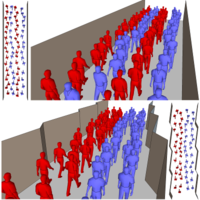
Ensuring efficient pedestrian streams through transit corridors such as subway hallways is a problem of significant relevance to many cities. By modeling self-driven particles, scientists show that modulating the shape of a hallway’s walls might help to separate opposite pedestrian flows.
[Phys. Rev. X 6, 011003] Published Thu Jan 07, 2016
05 Jan 16:58
by Amy Zhao Yu
Pantheon 1.0, a manually verified dataset of globally famous biographies
Scientific Data, Published online: 5 January 2016; doi:10.1038/sdata.2015.75

05 Jan 07:06
by José F. Fontanari
Problem solving (e.g., drug design, traffic engineering, software
development) by task forces represents a substantial portion of the economy of
developed countries. Here we use an agent-based model of cooperative problem
solving systems to study the influence of diversity on the performance of a
task force. We assume that agents cooperate by exchanging information on their
partial success and use that information to imitate the more successful agent
in the system -- the model. The agents differ only in their propensities to
copy the model. We find that, for easy tasks, the optimal organization is a
homogeneous system composed of agents with the highest possible copy
propensities. For difficult tasks, we find that diversity can prevent the
system from being trapped in sub-optimal solutions. However, when the system
size is adjusted to maximize performance the homogeneous systems outperform the
heterogeneous systems, i.e., for optimal performance, sameness should be
preferred to diversity.
Donate to arXiv
30 Dec 23:52
by Sangeeta Rani Ujjwal, Nirmal Punetha, and Ramakrishna Ramaswamy
Author(s): Sangeeta Rani Ujjwal, Nirmal Punetha, and Ramakrishna Ramaswamy
We study the dynamics of nonlocally coupled phase oscillators in a modular network. The interactions include a phase lag, a. Depending upon the various parameters the system exhibits a number of different dynamical states. In addition to global synchrony (GS) there can also be modular synchrony (MS)…
[Phys. Rev. E] Published Wed Dec 23, 2015
30 Dec 23:50
by Jinhyuk Yun, Sang Hoon Lee, and Hawoong Jeong
Author(s): Jinhyuk Yun, Sang Hoon Lee, and Hawoong Jeong
Wikipedia is a free Internet encyclopedia with enormous amount of contents. This encyclopedia is written by volunteers with various backgrounds in a collective fashion; anyone can access and edit most of the articles. This open editing nature may give us prejudice that Wikipedia is unstable and unre…
[Phys. Rev. E] Published Wed Dec 30, 2015
30 Dec 18:42
by Dong Zhou, Avi Gozolchiani, Yosef Ashkenazy, and Shlomo Havlin
Author(s): Dong Zhou, Avi Gozolchiani, Yosef Ashkenazy, and Shlomo Havlin
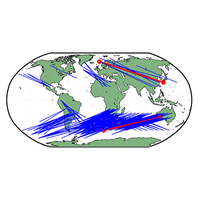
A new method allows researchers to extract climate connections between remote regions from global temperature datasets.
[Phys. Rev. Lett. 115, 268501] Published Wed Dec 30, 2015
30 Dec 07:16
by Simona Olmi
The dynamics of two symmetrically coupled populations of rotators is studied for different values of the inertia. The system is characterized by different types of solutions, which all coexist with the fully synchronized state. At small inertia, the system is no more chaotic and one observes mainly quasi-periodic chimeras, while the usual (stationary) chimera state is not anymore observable. At large inertia, one observes two different kind of chaotic solutions with broken symmetry: the intermittent chaotic chimera, characterized by a synchronized population and a population displaying a turbulent behaviour, and a second state where the two populations are both chaotic but whose dynamics adhere to two different macroscopic attractors. The intermittent chaotic chimeras are characterized by a finite life-time, whose duration increases as a power-law with the system size and the inertia value. Moreover, the chaotic population exhibits clear intermittent behavior, displaying a laminar phase where the two populations tend to synchronize, and a turbulent phase where the macroscopic motion of one population is definitely erratic. In the thermodynamic limit, these states survive for infinite time and the laminar regimes tends to disappear, thus giving rise to stationary chaotic solutions with broken symmetry contrary to what observed for chaotic chimeras on a ring geometry.
Thomas and -1 others like this
28 Dec 18:35
by Wai Lim Ku, Michelle Girvan and Edward Ott
In this paper, we study dynamical systems in which a large number N of identical Landau-Stuart oscillators are globally coupled via a mean-field. Previously, it has been observed that this type of system can exhibit a variety of different dynamical behaviors. These behaviors include time periodic cluster states in which each oscillator is in one of a small number of groups for which all oscillators in each group have the same state which is different from group to group, as well as a behavior in which all oscillators have different states and the macroscopic dynamics of the mean field is chaotic. We argue that this second type of behavior is “extensive” in the sense that the chaotic attractor in the full phase space of the system has a fractal dimension that scales linearly with N and that the number of positive Lyapunov exponents of the attractor also scales linearly with N. An important focus of this paper is the transition between cluster states and extensive chaos as the system is subjected to slow adiabatic parameter change. We observe discontinuous transitions between the cluster states (which correspond to low dimensional dynamics) and the extensively chaotic states. Furthermore, examining the cluster state, as the system approaches the discontinuous transition to extensive chaos, we find that the oscillator population distribution between the clusters continually evolves so that the cluster state is always marginally stable. This behavior is used to reveal the mechanism of the discontinuous transition. We also apply the Kaplan-Yorke formula to study the fractal structure of the extensively chaotic attractors.
28 Dec 18:35
by A. K. Kryukov, V. S. Petrov, G. V. Osipov and J. Kurths
We study collective dynamics in rotator ensembles and focus on the multistability of synchronous regimes in a chain of coupled rotators. We provide a detailed analysis of the number of coexisting regimes and estimate in particular, the synchronization boundary for different types of individual frequency distribution. The number of wave-based regimes coexisting for the same parameters and its dependence on the chain length are estimated. We give an analytical estimation for the synchronization frequency of the in-phase regime for a uniform individual frequency distribution.
28 Dec 18:27
by Jakob Runge
Author(s): Jakob Runge
Measures of information transfer have become a popular approach to analyze interactions in complex systems such as the Earth or the human brain from measured time series. Recent work has focused on causal definitions of information transfer aimed at decompositions of predictive information about a t…
[Phys. Rev. E 92, 062829] Published Mon Dec 28, 2015
28 Dec 18:25
by Sun-Ting Tsai, Chin-De Chang, Ching-Hao Chang, Meng-Xue Tsai, Nan-Jung Hsu, and Tzay-Ming Hong
Author(s): Sun-Ting Tsai, Chin-De Chang, Ching-Hao Chang, Meng-Xue Tsai, Nan-Jung Hsu, and Tzay-Ming Hong
The ubiquity of power-law relations in empirical data displays physicists' love of simple laws and uncovering common causes among seemingly unrelated phenomena. However, many reported power laws lack statistical support and mechanistic backings, not to mention discrepancies with real data are often …
[Phys. Rev. E 92, 062925] Published Mon Dec 28, 2015
28 Dec 18:24
by V. M. Bastidas, I. Omelchenko, A. Zakharova, E. Schöll, and T. Brandes
Author(s): V. M. Bastidas, I. Omelchenko, A. Zakharova, E. Schöll, and T. Brandes
Chimera states are complex spatiotemporal patterns in networks of identical oscillators, characterized by the coexistence of synchronized and desynchronized dynamics. Here we propose to extend the phenomenon of chimera states to the quantum regime, and uncover intriguing quantum signatures of these …
[Phys. Rev. E 92, 062924] Published Mon Dec 28, 2015
25 Dec 11:19
by Vladimir Vlasov, Arkady Pikovsky and Elbert E. N. Macau
We analyze star-type networks of phase oscillators by virtue of two methods. For identical oscillators we adopt the Watanabe-Strogatz approach, which gives full analytical description of states, rotating with constant frequency. For nonidentical oscillators, such states can be obtained by virtue of the self-consistent approach in a parametric form. In this case stability analysis cannot be performed, however with the help of direct numerical simulations we show which solutions are stable and which not. We consider this system as a model for a drum orchestra, where we assume that the drummers follow the signal of the leader without listening to each other and the coupling parameters are determined by a geometrical organization of the orchestra.
22 Dec 22:05
by Juan Ignacio Perotti, Claudio Juan Tessone, and Guido Caldarelli
Author(s): Juan Ignacio Perotti, Claudio Juan Tessone, and Guido Caldarelli
The quest for a quantitative characterization of community and modular structure of complex networks produced a variety of methods and algorithms to classify different networks. However, it is not clear if such methods provide consistent, robust, and meaningful results when considering hierarchies a…
[Phys. Rev. E 92, 062825] Published Tue Dec 22, 2015
Thomas and -1 others like this
22 Dec 22:05
by Arindam Mishra, Chittaranjan Hens, Mridul Bose, Prodyot K. Roy, and Syamal K. Dana
Author(s): Arindam Mishra, Chittaranjan Hens, Mridul Bose, Prodyot K. Roy, and Syamal K. Dana
We report chimeralike states in an ensemble of oscillators using a type of global coupling consisting of two components: attractive and repulsive mean-field feedback. We identify the existence of two types of chimeralike states in a bistable Liénard system; in one type, both the coherent and the inc…
[Phys. Rev. E 92, 062920] Published Tue Dec 22, 2015
22 Dec 08:43
by Lee DeVille, Bard Ermentrout
We consider the existence of non-synchronized fixed points to the Kuramoto
model defined on sparse networks: specifically, networks where each vertex has
degree exactly three. We show that "most" such networks support multiple
attracting phase-locked solutions that are not synchronized, and study the
depth and width of the basins of attraction of these phase-locked solutions. We
also show that it is common in "large enough" graphs to find phase-locked
solutions where one or more of the links has angle difference greater than
$\pi/2$.
Donate to arXiv
21 Dec 15:37
by Vladimir V Klinshov, Vladimir I Nekorkin and Jürgen Kurths
A new measure to characterize the stability of complex dynamical systems against large perturbations
is suggested, the stability threshold (ST). It quantifies the magnitude of the weakest perturbation
capable of disrupting the system and switch it to an undesired dynamical regime. In the phase space,
the ST corresponds to the ‘thinnest site’ of the attraction basin and therefore indicates the most
‘dangerous’ direction of perturbations. We introduce a computational algorithm for quantification of
the ST and demonstrate that the suggested approach is effective and provides important insights. The
generality of the obtained results defines their vast potential for application in such fields as
engineering, neuroscience, power grids, Earth science and many others where the robustness of
complex systems is studied.
18 Dec 09:27
by Roberto Murcio, A. Paolo Masucci, Elsa Arcaute, and Michael Batty
Author(s): Roberto Murcio, A. Paolo Masucci, Elsa Arcaute, and Michael Batty
An analysis of London’s street network shows how the network has evolved over time from a heterogeneous to homogeneous fractal pattern.

[Phys. Rev. E 92, 062130] Published Thu Dec 17, 2015
17 Dec 00:04
by Xiukai Sui, Bin Wu, and Long Wang
Author(s): Xiukai Sui, Bin Wu, and Long Wang
The likelihood that a mutant fixates in the wild population, i.e., fixation probability, has been intensively studied in evolutionary game theory, where individuals' fitness is frequency dependent. However, it is of limited interest when it takes long to take over. Thus the speed of evolution become…
[Phys. Rev. E 92, 062124] Published Mon Dec 14, 2015
17 Dec 00:04
by A. Navas, J. A. Villacorta-Atienza, I. Leyva, J. A. Almendral, I. Sendiña-Nadal, and S. Boccaletti
Author(s): A. Navas, J. A. Villacorta-Atienza, I. Leyva, J. A. Almendral, I. Sendiña-Nadal, and S. Boccaletti
Synchronization of networked oscillators is known to depend fundamentally on the interplay between the dynamics of the graph's units and the microscopic arrangement of the network's structure. We here propose an effective network whose topological properties reflect the interplay between the topolog…
[Phys. Rev. E 92, 062820] Published Tue Dec 15, 2015
17 Dec 00:02
by Rinku Jacob, K. P. Harikrishnan, R. Misra, and G. Ambika
Author(s): Rinku Jacob, K. P. Harikrishnan, R. Misra, and G. Ambika
We propose a general method for the construction and analysis of unweighted e - recurrence networks from chaotic time series. The selection of the critical threshold ec in our scheme is done empirically and we show that its value is closely linked to the embedding dimension M. In fact, we are able t…
[Phys. Rev. E] Published Fri Dec 11, 2015
16 Dec 11:44
by Filippo Radicchi
Article
The percolation transition has been regarded as model-independent, namely determined by the geometry of a system but otherwise identical for bond or site percolation models. Here, the authors show the violation of this assumption both analytically and numerically for networks with null percolation thresholds.
Nature Communications doi: 10.1038/ncomms10196
Authors: Filippo Radicchi, Claudio Castellano

14 Dec 07:38
by Vladimir V. Klinshov, Vladimir I. Nekorkin, Jürgen Kurths
A new measure to characterize stability of complex dynamical systems against
large perturbation is suggested, the stability threshold (ST). It quantifies
the magnitude of the weakest perturbation capable to disrupt the system and
switch it to an undesired dynamical regime. In the phase space, the stability
threshold corresponds to the "thinnest site" of the attraction basin and
therefore indicates the most "dangerous" direction of perturbations. We
introduce a computational algorithm for quantification of the stability
threshold and demonstrate that the suggested approach is effective and provides
important insights. The generality of the obtained results defines their vast
potential for application in such fields as engineering, neuroscience, power
grids, Earth science and many others where robustness of complex systems is
studied.
Donate to arXiv
14 Dec 07:37
by Victor M. Preciado, M. Amin Rahimian
In this paper, we analyze the limiting spectral distribution of the adjacency
matrix of a random graph ensemble, proposed by Chung and Lu, in which a given
expected degree sequence $\overline{w}_n^{^{T}} = (w^{(n)}_1,\ldots,w^{(n)}_n)$
is prescribed on the ensemble. Let $\mathbf{a}_{i,j} =1$ if there is an edge
between the nodes $\{i,j\}$ and zero otherwise, and consider the normalized
random adjacency matrix of the graph ensemble: $\mathbf{A}_n$ $=$ $
[\mathbf{a}_{i,j}/\sqrt{n}]_{i,j=1}^{n}$. The empirical spectral distribution
of $\mathbf{A}_n$ denoted by $\mathbf{F}_n(\mathord{\cdot})$ is the empirical
measure putting a mass $1/n$ at each of the $n$ real eigenvalues of the
symmetric matrix $\mathbf{A}_n$. Under some technical conditions on the
expected degree sequence, we show that with probability one,
$\mathbf{F}_n(\mathord{\cdot})$ converges weakly to a deterministic
distribution $F(\mathord{\cdot})$. Furthermore, we fully characterize this
distribution by providing explicit expressions for the moments of
$F(\mathord{\cdot})$. We apply our results to well-known degree distributions,
such as power-law and exponential. The asymptotic expressions of the spectral
moments in each case provide significant insights about the bulk behavior of
the eigenvalue spectrum.
10 Dec 16:46
by M. Riedl, N. Marwan and J. Kurths
The description and analysis of spatio-temporal dynamics is a crucial task in many scientific disciplines. In this work, we propose a method which uses the mapogram as a similarity measure between spatially distributed data instances at different time points. The resulting similarity values of the pairwise comparison are used to construct a recurrence plot in order to benefit from established tools of recurrence quantification analysis and recurrence network analysis. In contrast to other recurrence tools for this purpose, the mapogram approach allows the specific focus on different spatial scales that can be used in a multi-scale analysis of spatio-temporal dynamics. We illustrate this approach by application on mixed dynamics, such as traveling parallel wave fronts with additive noise, as well as more complicate examples, pseudo-random numbers and coupled map lattices with a semi-logistic mapping rule. Especially the complicate examples show the usefulness of the multi-scale consideration in order to take spatial pattern of different scales and with different rhythms into account. So, this mapogram approach promises new insights in problems of climatology, ecology, or medicine.
