21 Jul 22:13
by Joseph D. Hart, Jan Philipp Pade, Tiago Pereira, Thomas E. Murphy, and Rajarshi Roy
Author(s): Joseph D. Hart, Jan Philipp Pade, Tiago Pereira, Thomas E. Murphy, and Rajarshi Roy
We provide the first experimental evidence that adding links to a network's structure can hinder synchronization. Our experiments and theoretical analysis of networks of time-delayed optoelectronic oscillators uncover the scenario of loss of identical synchronization upon connectivity modifications.…
[Phys. Rev. E] Published Fri Jul 17, 2015
21 Jul 22:13
by Maxim Komarov and Arkady Pikovsky
Author(s): Maxim Komarov and Arkady Pikovsky
We report on finite-sized-induced transitions to synchrony in a population of phase oscillators coupled via a nonlinear mean field, which microscopically is equivalent to a hypernetwork organization of interactions. Using a self-consistent approach and direct numerical simulations, we argue that a t…
[Phys. Rev. E] Published Fri Jul 17, 2015
16 Jul 14:44
by Wenchang Zhou, Lumin Chen, Hongjie Bi, Xin Hu, Zonghua Liu, and Shuguang Guan
Author(s): Wenchang Zhou, Lumin Chen, Hongjie Bi, Xin Hu, Zonghua Liu, and Shuguang Guan
In this work, we study the synchronization in a generalized Kuramoto model with frequency-weighted coupling. In particular, we focus on the situations in which the frequency distributions of oscillators are asymmetric. For typical unimodal frequency distributions, such as Lorentzian, Gaussian, trian…
[Phys. Rev. E 92, 012812] Published Thu Jul 16, 2015
16 Jul 14:16
by Wei Zou
Article
Oscillatory behaviour is essential for proper functioning of several processes, yet quenching phenomena can lead to steady states with suppressed oscillations. Here the authors present a scheme to revoke these states in diffusively coupled networks, and demonstrate their approach on a chemical oscillator.
Nature Communications doi: 10.1038/ncomms8709
Authors: Wei Zou, D. V. Senthilkumar, Raphael Nagao, István Z. Kiss, Yang Tang, Aneta Koseska, Jinqiao Duan, Jürgen Kurths

15 Jul 19:46
by Norbert Marwan, Jürgen Kurths
We present here two promising techniques for the application of the complex
network approach to continuous spatio-temporal systems that have been developed
in the last decade and show large potential for future application and
development of complex systems analysis. First, we discuss the transforming of
a time series from such systems to a complex network. The natural approach is
to calculate the recurrence matrix and interpret such as the adjacency matrix
of an associated complex network, called recurrence network. Using complex
network measures, such as transitivity coefficient, we demonstrate that this
approach is very efficient for identifying qualitative transitions in
observational data, e.g., when analyzing paleoclimate regime transitions.
Second, we demonstrate the use of directed spatial networks constructed from
spatio-temporal measurements of such systems that can be derived from the
synchronized-in-time occurrence of extreme events in different spatial regions.
Although there are many possibilities to investigate such spatial networks, we
present here the new measure of network divergence and how it can be used to
develop a prediction scheme of extreme rainfall events.
14 Jul 20:40
by A. Fiasconaro, M. Tumminello, V. Nicosia, V. Latora, and R. N. Mantegna
Author(s): A. Fiasconaro, M. Tumminello, V. Nicosia, V. Latora, and R. N. Mantegna
We propose two recommendation methods, based on the appropriate normalization of already existing similarity measures, and on the convex combination of the recommendation scores derived from similarity between users and between objects. We validate the proposed measures on three data sets, and we co…
[Phys. Rev. E 92, 012811] Published Tue Jul 14, 2015
14 Jul 05:25
by Hiroki Sayama, Catherine Cramer, Mason A. Porter, Lori Sheetz, Stephen Uzzo
Networks have become increasingly relevant to everyday life as human society
has become increasingly connected. Attaining a basic understanding of networks
has thus become a necessary form of literacy for people (and for youths in
particular). At the NetSci 2014 conference, we initiated a year-long process to
develop an educational resource that concisely summarizes essential concepts
about networks that can be used by anyone of school age or older. The process
involved several brainstorming sessions on one key question: "What should every
person living in the 21st century know about networks by the time he/she
finishes secondary education?" Different sessions reached diverse participants,
which included professional researchers in network science, educators, and
high-school students. The generated ideas were connected by the students to
construct a concept network. We examined community structure in the concept
network to group ideas into a set of important themes, which we refined through
discussion into seven essential concepts. The students played a major role in
this development process by providing insights and perspectives that were often
unrecognized by researchers and educators. The final result, "Network Literacy:
Essential Concepts and Core Ideas", is now available as a booklet in several
different languages from this http URL .
12 Jul 03:04
by Kezan Li, Weigang Sun, Michael Small, and Xinchu Fu
Author(s): Kezan Li, Weigang Sun, Michael Small, and Xinchu Fu
We consider practical synchronization on complex dynamical networks under linear feedback control designed by optimal control theory. The control goal is to minimize global synchronization error and control strength over a given finite time interval, and synchronization error at terminal time. By ut…
[Phys. Rev. E] Published Thu Jul 09, 2015
11 Jul 01:50
by Clara Granell, Richard K. Darst, Alex Arenas, Santo Fortunato, and Sergio Gómez
Author(s): Clara Granell, Richard K. Darst, Alex Arenas, Santo Fortunato, and Sergio Gómez
Detecting the time evolution of the community structure of networks is crucial to identify major changes in the internal organization of many complex systems, which may undergo important endogenous or exogenous events. This analysis can be done in two ways: considering each snapshot as an independen…
[Phys. Rev. E 92, 012805] Published Fri Jul 10, 2015
10 Jul 06:17
by R. Sevilla-Escoboza, J. M. Buldú, S. Boccaletti, D. Papo, D.-U. Hwang, G. Huerta-Cuellar, R. Gutiérrez
Maximally synchronizable networks (MSNs) are acyclic directed networks that
maximize synchronizability. In this paper, we investigate the feasibility of
transforming networks of coupled oscillators into their corresponding MSNs. By
tuning the weights of any given network so as to reach the lowest possible
eigenratio $\lambda_N/\lambda_2$, the synchronized state is guaranteed to be
maintained across the longest possible range of coupling strengths. We check
the robustness of the resulting MSNs with an experimental implementation of a
network of nonlinear electronic oscillators and study the propagation of the
synchronization errors through the network. Importantly, a method to study the
effects of topological uncertainties on the synchronizability is proposed and
explored both theoretically and experimentally.
Donate to arXiv
07 Jul 20:39
by Wenchang Zhou, Lumin Chen, Hongjie Bi, Xin Hu, Zonghua Liu, and Shuguang Guan
Author(s): Wenchang Zhou, Lumin Chen, Hongjie Bi, Xin Hu, Zonghua Liu, and Shuguang Guan
In this work, we study the synchronization in a generalized Kuramoto model with frequency-weighted coupling. In particular, we focus on the situations in which the frequency distributions of oscillators are asymmetric. For typical unimodal frequency distributions, such as Lorentzian, Gaussian, trian…
[Phys. Rev. E] Published Thu Jul 02, 2015
07 Jul 20:39
by Johanne Hizanidis, Evangelia Panagakou, Iryna Omelchenko, Eckehard Schöll, Philipp Hövel, and Astero Provata
Author(s): Johanne Hizanidis, Evangelia Panagakou, Iryna Omelchenko, Eckehard Schöll, Philipp Hövel, and Astero Provata
We study numerically the development of chimera states in networks of nonlocally coupled oscillators whose limit cycles emerge from a Hopf bifurcation. This dynamical system is inspired from population dynamics and consists of three interacting species in cyclic reactions. The complexity of the dyna…
[Phys. Rev. E] Published Tue Jul 07, 2015
07 Jul 20:38
by Weijie Lin, Yafeng Wang, Heping Ying, Ying-Cheng Lai, and Xingang Wang
Author(s): Weijie Lin, Yafeng Wang, Heping Ying, Ying-Cheng Lai, and Xingang Wang
In data based reconstruction of complex networks, dynamical information can be measured and exploited to generate a functional network, but is it a true representation of the actual (structural) network? That is, when do the functional and structural networks match and is a perfect matching possible…
[Phys. Rev. E] Published Tue Jul 07, 2015
07 Jul 16:00
by Anders Nordenfelt
We clarify the degree to which the entropy functional puts constraints on the possibility of convergence of states in the infinite-N Kuramoto model. It is shown that convergence to the uniform incoherent state is impossible in the L
2 norm but it is left as an open question whether the same can be said about convergence in the L
1 norm. We conclude with a discussion on the entropy of the marginal density function where similar constraints do not apply.
Thomas and -1 others like this
07 Jul 14:11
by Vladimir Vlasov, Yong Zou, and Tiago Pereira
Author(s): Vladimir Vlasov, Yong Zou, and Tiago Pereira
Spontaneous explosive is an abrupt transition to collective behavior taking place in heterogeneous networks when the frequencies of the nodes are positively correlated with the node degree. This explosive transition was conjectured to be discontinuous. Indeed, numerical investigations reveal a hyste…
[Phys. Rev. E 92, 012904] Published Mon Jul 06, 2015
07 Jul 14:11
by Jaime Clark, Miguel Kiwi, Felipe Torres, José Rogan, and Juan Alejandro Valdivia
Author(s): Jaime Clark, Miguel Kiwi, Felipe Torres, José Rogan, and Juan Alejandro Valdivia
The Ehrenfest urn model is extended to a complex directed network, over which a conserved quantity is transported in a random fashion. The evolution of the conserved number of packets in each urn, or node of the network, is illustrated by means of a stochastic simulation. Using mean-field theory we …
[Phys. Rev. E 92, 012103] Published Mon Jul 06, 2015
Thomas and -1 others like this
07 Jul 14:11
by J. J. Kranz, N. A. M. Araújo, J. S. Andrade, Jr., and H. J. Herrmann
Author(s): J. J. Kranz, N. A. M. Araújo, J. S. Andrade, Jr., and H. J. Herrmann
Two-dimensional space-filling bearings are dense packings of disks that can rotate without slip. We consider the entire first family of bearings for loops of four disks and propose a hierarchical construction of their contact network. We provide analytic expressions for the clustering coefficient an…
[Phys. Rev. E 92, 012802] Published Mon Jul 06, 2015
06 Jul 17:55
by Cesar H. Comin, Filipi N. Silva and Luciano da F. Costa
A good deal of current research in complex networks involves the characterization and/or
classification of the topological properties of given structures, which has motivated several
respective measurements. This letter proposes a framework for evaluating the quality of
complex-network measurements in terms of their effective resolution , degree of degeneracy and
discriminability . The potential of the suggested approach is illustrated with respect to comparing
the characterization of several model and real-world networks by using concentric and symmetry
measurements. The results indicate a markedly superior performance for the latter type of mapping.
30 Jun 15:36
Nature Methods 12, 615 (2015).
doi:10.1038/nmeth.3440
Authors:

26 Jun 13:12
by Per Sebastian Skardal, Juan G. Restrepo, and Edward Ott
Author(s): Per Sebastian Skardal, Juan G. Restrepo, and Edward Ott
We investigate the effect of preferentially connecting oscillators with similar frequency to each other in networks of coupled phase oscillators (i.e., frequency assortativity). Using the network Kuramoto model as an example, we find that frequency assortativity can induce chaos in the macroscopic d…
[Phys. Rev. E 91, 060902(R)] Published Wed Jun 24, 2015
26 Jun 13:11
by R. Gopal, V. K. Chandrasekar, D. V. Senthilkumar, A. Venkatesan, and M. Lakshmanan
Author(s): R. Gopal, V. K. Chandrasekar, D. V. Senthilkumar, A. Venkatesan, and M. Lakshmanan
We show that coexisting domains of coherent and incoherent oscillations can be induced in an ensemble of any identical nonlinear dynamical systems using nonlocal rotational matrix coupling with an asymmetry parameter. Further, a chimera is shown to emerge in a wide range of the asymmetry parameter i…
[Phys. Rev. E 91, 062916] Published Thu Jun 25, 2015
26 Jun 13:10
by A. Clauset, M. Kogan, and S. Redner
Author(s): A. Clauset, M. Kogan, and S. Redner
The evolution in time of the score in professional sports games can be described by a random walk. Based on this picture, the authors present a model showing that, surprisingly, the time of the last lead change and the time of the largest lead size are both governed by the arcsine law, a distribution that diverges at the start and at the end of the game.
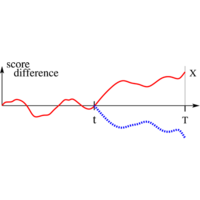
[Phys. Rev. E 91, 062815] Published Thu Jun 25, 2015
24 Jun 20:00
by Francesco Scafuti, Takaaki Aoki, and Mario di Bernardo
Author(s): Francesco Scafuti, Takaaki Aoki, and Mario di Bernardo
We study the evolution of heterogeneous networks of oscillators subject to a state-dependent interconnection rule. We find that heterogeneity in the node dynamics is key in organizing the architecture of the functional emerging networks. We demonstrate that increasing heterogeneity among the nodes i…
[Phys. Rev. E 91, 062913] Published Mon Jun 22, 2015
22 Jun 15:17
by Ernest Montbrió, Diego Pazó, and Alex Roxin
Author(s): Ernest Montbrió, Diego Pazó, and Alex Roxin
Understanding memory and decision making in the human brain requires generating models of how neurons fire. Using ordinary differential equations, researchers formulate an exact firing rate description for an ensemble of spiking neurons.
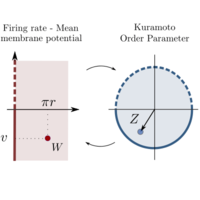
[Phys. Rev. X 5, 021028] Published Fri Jun 19, 2015
19 Jun 05:27
by Travis Martin, Brian Ball, M. E. J. Newman
In the study of networked systems such as biological, technological, and
social networks the available data are often uncertain. Rather than knowing the
structure of a network exactly, we know the connections between nodes only with
a certain probability. In this paper we develop methods for the analysis of
such uncertain data, focusing particularly on the problem of community
detection. We give a principled maximum-likelihood method for inferring
community structure and demonstrate how the results can be used to make
improved estimates of the true structure of the network. Using
computer-generated benchmark networks we demonstrate that our methods are able
to reconstruct known communities more accurately than previous approaches based
on data thresholding. We also give an example application to the detection of
communities in a protein-protein interaction network.
18 Jun 19:01
by Sebastian Werner and Klaus Lehnertz
We study the impact of dynamical and structural heterogeneity on the collective dynamics of large small-world networks of pulse-coupled integrate-and-fire oscillators endowed with refractory periods and time delay. Depending on the choice of homogeneous control parameters (here, refractoriness and coupling strength), these networks exhibit a large spectrum of dynamical behaviors, including asynchronous, partially synchronous, and fully synchronous states. Networks exhibit transitions between these dynamical behaviors upon introducing heterogeneity. We show that the probability for a network to exhibit a certain dynamical behavior (network susceptibility) is affected differently by dynamical and structural heterogeneity and depends on the respective homogeneous dynamics.
18 Jun 06:50
by Zhongzhi Zhang, Yuan Lin, and Xiaoye Guo
Author(s): Zhongzhi Zhang, Yuan Lin, and Xiaoye Guo
The eigenvalues of the transition matrix for random walks on a network play a significant role in the structural and dynamical aspects of the network. Nevertheless, it is still not well understood how the eigenvalues behave in small-world and scale-free networks, which describe a large variety of re…
[Phys. Rev. E 91, 062808] Published Wed Jun 17, 2015
17 Jun 14:58
by Bernard Sonnenschein, Thomas K. DM. Peron, Francisco A. Rodrigues, Jürgen Kurths, and Lutz Schimansky-Geier
Author(s): Bernard Sonnenschein, Thomas K. DM. Peron, Francisco A. Rodrigues, Jürgen Kurths, and Lutz Schimansky-Geier
We study two intertwined globally coupled networks of noisy Kuramoto phase oscillators that have the same natural frequency but differ in their perception of the mean field and their contribution to it. Such a give-and-take mechanism is given by asymmetric in- and out-coupling strengths which can be…
[Phys. Rev. E 91, 062910] Published Tue Jun 16, 2015
15 Jun 21:13
by Filippo Radicchi
Nature Physics.
doi:10.1038/nphys3374
Author: Filippo Radicchi

12 Jun 17:34
by Justin Werfel, Donald E. Ingber, and Yaneer Bar-Yam
Author(s): Justin Werfel, Donald E. Ingber, and Yaneer Bar-Yam
Standard evolutionary theories of aging and mortality, implicitly based on mean-field assumptions, hold that programed mortality is untenable, as it opposes direct individual benefit. We show that in spatial models with local reproduction, programed deaths instead robustly result in long-term benefi...
[Phys. Rev. Lett. 114, 238103] Published Fri Jun 12, 2015
