07 Aug 01:54
J. Mater. Chem. C, 2017, 5,9559-9569
DOI: 10.1039/C7TC02903A, Paper
Jianhua Chen, Xianhe Zhang, Gang Wang, Mohammad Afsar Uddin, Yumin Tang, Yulun Wang, Qiaogan Liao, Antonio Facchetti, Tobin J. Marks, Xugang Guo
A novel imide-functionalized dithienylbenzodiimide was synthesized and incorporated into polymer semiconductors, which exhibit low-lying FMOs and substantial electron mobilities.
The content of this RSS Feed (c) The Royal Society of Chemistry
07 Aug 00:52
J. Mater. Chem. C, 2017, 5,8431-8435
DOI: 10.1039/C7TC02802D, Paper
Fengying Zhang, Bin Yang, Yajuan Li, Weiqiao Deng, Rongxing He
Both trap-state densities and energy levels affect carrier transfer, resulting in a maximum diffusion length of 380 [small mu ]m in CH3NH3PbI3-xClx (x = 0.005).
The content of this RSS Feed (c) The Royal Society of Chemistry
07 Aug 00:52
J. Mater. Chem. C, 2017, 5,8033-8040
DOI: 10.1039/C7TC02566A, Communication
Yaxiong Guo, Hongwei Lei, Liangbin Xiong, Borui Li, Guojia Fang
We report conjugated polymer FBT-TH4 modified Cu2O as an organic-inorganic integrated hole transport material (HTM) for the first time. The optimized OSCs show a high power conversion efficiency of up to 9.56% based on a model PffBT4T-2OD:PC71BM system. Meanwhile, the HTM significantly improved the long-term stability of the OSCs.
The content of this RSS Feed (c) The Royal Society of Chemistry
30 Jul 23:59
J. Mater. Chem. A, 2017, 5,21161-21168
DOI: 10.1039/C7TA03890A, Paper
Yongguang Tu, Jihuai Wu, Xin He, Panfeng Guo, Tongyue Wu, Hui Luo, Quanzhen Liu, Qihui Wu, Jianming Lin, Miaoliang Huang, Zhang Lan, Sizhong Li
Further efficiency enhancement mainly relies on decreasing the interface losses between the active layers in perovskite solar cells.
The content of this RSS Feed (c) The Royal Society of Chemistry
30 Jul 23:58
J. Mater. Chem. A, 2017, 5,16976-16983
DOI: 10.1039/C7TA04717G, Paper
Meirong Zhang, Zhitong Jin, Chuanqi Feng, Min Wang, Zhong-Sheng Wang
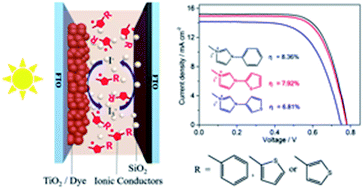
The photovoltaic performance of quasi-solid-state DSSCs depends on the substituent and the substitution site of the imidazolium ring as well.
The content of this RSS Feed (c) The Royal Society of Chemistry
30 Jul 23:57
J. Mater. Chem. A, 2017, 5,16907-16913
DOI: 10.1039/C7TA05282K, Paper
Seth[space]M. McAfee, Abby-Jo Payne, Sergey V. Dayneko, Gururaj P. Kini, Chang Eun Song, Jong-Cheol Lee, Gregory C. Welch
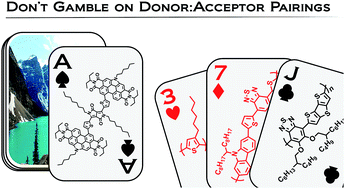
Utilizing the N-annulated PDI acceptor PDI-DPP-PDI, a simple air-processed and air-tested organic photovoltaic device fabrication procedure has been established to streamline the screening of donor materials.
The content of this RSS Feed (c) The Royal Society of Chemistry
30 Jul 23:55
J. Mater. Chem. A, 2017, 5,17499-17505
DOI: 10.1039/C7TA00203C, Paper
Xiaofeng Zeng, Tingwei Zhou, Chongqian Leng, Zhigang Zang, Ming Wang, Wei Hu, Xiaosheng Tang, Shirong Lu, Liang Fang, Miao Zhou
Organic-inorganic hybrid perovskite solar cells with a CdSe quantum dot/PCBM composite as an electron transport layer are reported by materials synthesis, characterization, device fabrication, performance measurements and large-scale first-principles calculations.
The content of this RSS Feed (c) The Royal Society of Chemistry
30 Jul 23:55
J. Mater. Chem. A, 2017, 5,17230-17239
DOI: 10.1039/C7TA05865A, Communication
Xuning Zhang, Xiaobing Zuo, Shenkun Xie, Jianyu Yuan, Huiqiong Zhou, Yuan Zhang
Photovoltaic characteristics, recombination and charge transport properties are investigated. The determined recombination reduction factor can reconcile the supreme device performance in organic solar cells using non-fullerene ITIC acceptor and severe carrier losses in all-polymer devices with P(NDI2OD-T2).
The content of this RSS Feed (c) The Royal Society of Chemistry
30 Jul 23:55
J. Mater. Chem. A, 2017, 5,17632-17639
DOI: 10.1039/C7TA04851C, Paper
Youyu Jiang, Jing Li, Sixing Xiong, Fangyuan Jiang, Tiefeng Liu, Fei Qin, Lin Hu, Yinhua Zhou
2,6-Dimethoxypyridine serves dual functions as a Lewis base for surface passivation and as a dopant for PC61BM in the fabrication of highly reproducible and high-efficiency planar perovskite solar cells.
The content of this RSS Feed (c) The Royal Society of Chemistry
30 Jul 23:54
J. Mater. Chem. A, 2017, 5,17619-17631
DOI: 10.1039/C7TA05583H, Paper
Xuncheng Liu, Li Nian, Ke Gao, Lianjie Zhang, Lechi Qing, Zhen Wang, Lei Ying, Zengqi Xie, Yuguang Ma, Yong Cao, Feng Liu, Junwu Chen
Side-chain random copolymers show high 3-D hole transport and offer excellent active layer thickness tolerance.
The content of this RSS Feed (c) The Royal Society of Chemistry
30 Jul 08:26
by Bing Guo, Wanbin Li, Xia Guo, Xiangyi Meng, Wei Ma, Maojie Zhang, Yongfang Li
In this work, high-efficiency nonfullerene polymer solar cells (PSCs) are developed based on a thiazolothiazole-containing wide bandgap polymer PTZ1 as donor and a planar IDT-based narrow bandgap small molecule with four side chains (IDIC) as acceptor. Through thermal annealing treatment, a power conversion efficiency (PCE) of up to 11.5% with an open circuit voltage (Voc) of 0.92 V, a short-circuit current density (Jsc) of 16.4 mA cm−2, and a fill factor of 76.2% is achieved. Furthermore, the PSCs based on PTZ1:IDIC still exhibit a relatively high PCE of 9.6% with the active layer thickness of 210 nm and a superior PCE of 10.5% with the device area of up to 0.81 cm2. These results indicate that PTZ1 is a promising polymer donor material for highly efficient fullerene-free PSCs and large-scale devices fabrication.

The nonfullerene polymer solar cells based on a wide-bandgap polymer PTZ1 and a narrow-bandgap acceptor IDIC exhibit weak active-layer thickness and area dependence with an optimal power conversion efficiency of 11.5%, indicating that the blend of PTZ1/IDIC has potential for the practical application of polymer solar cells.
30 Jul 08:16
by Wei Gao, Qiaoshi An, Ruijie Ming, Dongjun Xie, Kailong Wu, Zhenghui Luo, Yang Zou, Fujun Zhang, Chuluo Yang
Side group of ITIC-like small molecular acceptor (SMA) plays a critical role in crystallization property. In this article, two new SMAs with n-hexylthienyl and n-hexylselenophenyl as side chain, namely ITCPTC-Th and ITCPTC-Se, are designed and synthesized by employing newly developed thiophene-fused ending group (CPTCN). And thiophene and selenophene side group substituted effects of SMA-based fullerene-free polymer solar cells (PSCs) are investigated. A stronger σ-inductive effect between selenophene side group and electron-donating backbone endows ITCPTC-Se with better optical absorption and higher LUMO level, ITCPTC-Th-based PSCs deliver a higher power conversion efficiency of 10.61%. Charge transport and collection, recombination loss mechanism, and morphology of blend films are intensively studied. These results confirm that side group substituted effects of SMAs are multiple and thiophene is a superior option to selenophene as aromatic side group of ITIC-like SMAs.

Two new small molecular acceptors (SMAs), ITCPTC-Th and ITCPTC-Se, are designed and synthesized to investigate thiophene and selenophene side group substituted effects. A polymer solar cell (PSC) based on ITCPTC-Th achieves high power conversion efficiency (PCE) of 10.61%, which are significantly higher than that of ITCPTC-Se-based PSC. This confirms that thiophene is superior to selenophene as side group of ITIC-like SMAs.
30 Jul 07:13
by Milena P. Arciniegas, Andrea Castelli, Simonluca Piazza, Sedat Dogan, Luca Ceseracciu, Roman Krahne, Marti Duocastella, Liberato Manna
Perovskite-based optoelectronic devices have shown remarkable performances, especially in the field of photovoltaics. Still, a rapid solution-processing approach able to produce localized stable perovskite crystals remains a general challenge, and is a key step toward the miniaturization of such materials in on-chip components. This study presents the confined growth of methylammonium (MA) lead halide perovskite crystals that is thermally induced through localized laser irradiation. Importantly, such structures remain stable over time; that is, they neither dissolve back into the surrounding liquid nor detach from the substrate. This is attributed to a chemical reaction locally triggered by the induced heat on the substrate surface that is transferred to the perovskite precursors (liquid) layer, thus generating “on-demand” MA ions from the N-methylformamide solvent. By tuning the laser parameters, such as power density or irradiation time, variations in shape and size of the crystals, from microcrystals of ≈50 µm to nanocuboids of ≈500 nm, are observed. This study also demonstrates that with an optimized distance between the irradiated regions and by controlling the relative laser displacement speed, luminescent and photoconductive MAPbBr3 wires and microplates can be generated.

Stable MAPbBr3 crystals with different sizes are successfully localized on a flat substrate via laser-induced heating of the liquid precursors. By adjusting the infrared laser parameters, luminescent arrays and photoconductive wires are grown on-site. This technique can be used to guide the writing of other patterns for specific functionalities.
29 Jul 07:51
by Nallan Chakravarthi, Um Kanta Aryal, Kumarasamy Gunasekar, Ho-Yeol Park, Yeong-Soon Gal, Young-Rae Cho, Seong Il Yoo, Myungkwan Song and Sung-Ho Jin

ACS Applied Materials & Interfaces
DOI: 10.1021/acsami.7b03187

29 Jul 07:51
by Zhenjing Kang, Shan-Ci Chen, Yunlong Ma, Jianbin Wang and Qingdong Zheng

ACS Applied Materials & Interfaces
DOI: 10.1021/acsami.7b05417

29 Jul 07:50
by Roberto Grisorio, Rosabianca Iacobellis, Andrea Listorti, Luisa De Marco, Maria Pia Cipolla, Michele Manca, Aurora Rizzo, Antonio Abate, Giuseppe Gigli and Gian Paolo Suranna

ACS Applied Materials & Interfaces
DOI: 10.1021/acsami.7b05484

29 Jul 07:48
by Shaowei Shi, Xiaofeng Chen, Xubo Liu, Xuefei Wu, Feng Liu, Zhi-Guo Zhang, Yongfang Li, Thomas P. Russell and Dong Wang

ACS Applied Materials & Interfaces
DOI: 10.1021/acsami.7b07694

29 Jul 07:40
by Yoon Ho Choi, Hyun Bin Kim, In Seok Yang, Sang Do Sung, Young Sik Choi, Jeongho Kim and Wan In Lee

ACS Applied Materials & Interfaces
DOI: 10.1021/acsami.7b05146

29 Jul 07:40
by Tao Zhang, Han Han, Yunlong Zou, Ying-Chi Lee, Hiroya Oshima, Ken-Tsung Wong and Russell J. Holmes

ACS Applied Materials & Interfaces
DOI: 10.1021/acsami.7b05304

29 Jul 07:39
by Antonio Gaetano Ricciardulli, Sheng Yang, Xinliang Feng and Paul W. M. Blom

ACS Applied Materials & Interfaces
DOI: 10.1021/acsami.7b09702

29 Jul 07:38
by Guobiao Xue, Xikang Zhao, Ge Qu, Tianbai Xu, Aristide Gumyusenge, Zhuorui Zhang, Yan Zhao, Ying Diao, Hanying Li and Jianguo Mei

ACS Applied Materials & Interfaces
DOI: 10.1021/acsami.7b07624

29 Jul 07:38
by Fatemeh Behrouznejad, Cheng-Min Tsai, Sudhakar Narra, Eric W.-G. Diau and Nima Taghavinia

ACS Applied Materials & Interfaces
DOI: 10.1021/acsami.7b02799

29 Jul 07:38
by Zhongquan Wan, Chunyang Jia, Yan Wang and Xiaojun Yao

ACS Applied Materials & Interfaces
DOI: 10.1021/acsami.7b04233

29 Jul 07:31
by Tongle Bu, Lan Wu, Xueping Liu, Xiaokun Yang, Peng Zhou, Xinxin Yu, Tianshi Qin, Jiangjian Shi, Song Wang, Saisai Li, Zhiliang Ku, Yong Peng, Fuzhi Huang, Qingbo Meng, Yi-Bing Cheng, Jie Zhong
Abstract
Organic–inorganic hybrid halide perovskite solar cells (PSCs) have recently drawn enormous attentions due to their impressive performance (>22%) and low temperature solution processability (<150 °C). Current solution process involves application of a large amount of toxic solvents, such as chlorobenzene, which is heavily employed in both the perovskite layer and the hole transport layer (HTL) deposition. Herein, this study employs green solvent of ethyl acetate for engineering efficient perovskite and HTL layers, which enables a synergic interface (perovskite/HTL) optimization. A champion efficiency of 19.43% is obtained for small cells (0.16 cm2 with mask) and over 14% for large size modules (5 × 5 cm2). The PSCs prepared from the green solvent engineering demonstrate superior performance on both efficiency and stability over their chlorobenzene counterparts. These enhancements are ascribed to the in situ inhibition on carrier recombination induced by interfacial defects during the solution processing, which enables about 2/3 reduction of calculated recombination rate. Thus, the green solvent route shows the great potential toward environmental-friendly manufacturing.

The widely used toxic chlorobenzene for the perovskite and Spiro-OMeTAD film processing is replaced by a green solvent of ethyl acetate. This green solvent engineering produces pinhole-free films of both the perovskite and Spiro-OMeTAD hole transport layer. Via the synergic interface optimization, an impressive power conversion efficiency up to 19.43% is achieved.
29 Jul 07:30
by Zhaojun Li, Wei Zhang, Xiaofeng Xu, Zewdneh Genene, Dario Di Carlo Rasi, Wendimagegn Mammo, Arkady Yartsev, M. R. Andersson, René A. J. Janssen, Ergang Wang

A high power conversion efficiency of 6.9% from all-polymer solar cells with polymers as both donor and acceptor is achieved with good stability over 60 days as reported by Xiaofeng Xu, René A. J. Janssen, Ergang Wang, and co-workers in article number 1602722. The random copolymer PNDI-T10 could be a promising alterative acceptor to the widely used alternating polymers PNDI-T and N2200, as it delivers better performance in the resulting solar cells.
29 Jul 07:30
by Chuanfei Wang, Wei Zhang, Xiangyi Meng, Jonas Bergqvist, Xianjie Liu, Zewdneh Genene, Xiaofeng Xu, Arkady Yartsev, Olle Inganäs, Wei Ma, Ergang Wang, Mats Fahlman
Abstract
A new strategy for designing ternary solar cells is reported in this paper. A low-bandgap polymer named PTB7-Th and a high-bandgap polymer named PBDTTS-FTAZ sharing the same bulk ionization potential and interface positive integer charge transfer energy while featuring complementary absorption spectra are selected. They are used to fabricate efficient ternary solar cells, where the hole can be transported freely between the two donor polymers and collected by the electrode as in one broadband low bandgap polymer. Furthermore, the fullerene acceptor is chosen so that the energy of the positive integer charge transfer state of the two donor polymers is equal to the energy of negative integer charge transfer state of the fullerene, enabling enhanced dissociation of all polymer donor and fullerene acceptor excitons and suppressed bimolecular and trap assistant recombination. The two donor polymers feature good miscibility and energy transfer from high-bandgap polymer of PBDTTS-FTAZ to low-bandgap polymer of PTB7-Th, which contribute to enhanced performance of the ternary solar cell.

Ternary solar cells with minimum voltage losses around 0.25 eV are designed by combining two donor polymers with same bulk and interface energy which make the hole transportation like in one donor polymer. The voltage losses were minimized due to EICT+ ≈ EICT−, where the trade-off between enhancing of charge generation and charge recombination by ICT states arrives at sweet spot.
29 Jul 07:29
Energy Environ. Sci., 2017, 10,1843-1853
DOI: 10.1039/C7EE01387F, Paper
Wenchao Huang, Eliot Gann, Naresh Chandrasekaran, Lars Thomsen, Shyamal K. K. Prasad, Justin M. Hodgkiss, Dinesh Kabra, Yi-Bing Cheng, Christopher R. McNeill
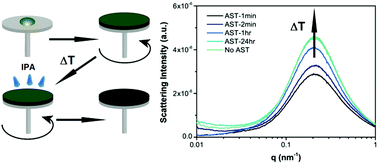
Control of domain purity in polymer/fullerene solar cells is realised through controlling the time that an anti-solvent treatment is applied.
The content of this RSS Feed (c) The Royal Society of Chemistry

29 Jul 06:41
Energy Environ. Sci., 2017, 10,1942-1949
DOI: 10.1039/C7EE01675A, Communication
Fengxian Xie, Chun-Chao Chen, Yongzhen Wu, Xing Li, Molang Cai, Xiao Liu, Xudong Yang, Liyuan Han
Formamidinium (FA)-based perovskite materials show an extended absorption spectrum to 840 nm, which enables high power conversion efficiencies of over 20% compared with normal-structure perovskite solar cells (PSCs).
The content of this RSS Feed (c) The Royal Society of Chemistry

29 Jul 06:37
by Shuixing Li, Wenqing Liu, Chang-Zhi Li, Minmin Shi, Hongzheng Chen
Fullerene-free OSCs employing n-type small molecules or polymers as the acceptors have recently experienced a rapid rise with efficiencies exceeding 12%. Owing to the good optoelectronic and morphological tunabilities, non-fullerene acceptors exhibit great potential for realizing high-performance and practical OSCs. In this Review, recent exciting progress made in developing highly efficient non-fullerene acceptors is summarized, mainly correlating factors like absorption, energy loss and morphology of new materials to their correspondent photovoltaic performance.

Fullerene-free organic solar cells (OSCs) have made great progress in recent years with efficiencies surpassing 12%. In this Review, recent high-performance non-fullerene acceptors developed for OSCs are summarized, mainly correlating factors like absorption, energy loss and morphology of new materials to their correspondent photovoltaic performance. The perspectives for fullerene-free OSCs with efficiency of 15% are briefly discussed.
28 Jul 00:19
by Shanshan Chen, Hye Jin Cho, Jungho Lee, Yankang Yang, Zhi-Guo Zhang, Yongfang Li, Changduk Yang
Abstract
Despite rapid advances in the field of nonfullerene polymer solar cells (NF-PSCs), successful examples of random polymer-based NF-PSCs are limited. In this study, it is demonstrated that random donor polymers based on thieno[2′,3′:5′,6′]pyrido[3,4-g]thieno[3,2-c]isoquinoline-5,11(4H,10H)-dione (TPTI) containing two simple thiophene (T) and bithiophene (2T) electron-rich moieties (PTTI-Tx) can be promising materials for the fabrication of highly efficient NF-PSCs. With negligible influence on optical bandgaps and energy levels, the crystalline behavior of PTTI-Tx polymers was modulated by varying the T:2T ratio in the polymer backbone; this resulted in the formation of different microstructures upon blending with a nonfullerene m-ITIC acceptor in NF-PSCs. In particular, a PTPTI-T70:m-ITIC system enabled favorable small-scale phase separation with an increased population of face-on oriented crystallites, thereby boosting the processes of effective exciton dissociation and charge transport in the device. Consequently, the highest power conversion efficiency of 11.02% with an enhanced short-circuit current density of 17.12 mA cm−2 is achieved for the random polymer-based NF-PSCs thus far. These results indicate that random terpolymerization is a simple and practical approach for the optimization of a donor polymer toward highly efficient NF-PSCs.

Over 11% efficiency random polymer-based nonfullerene solar cell is realized on the donor family of PTPTI-Tx containing various thiophene/bithiophene ratios in the backbone. A small-scale phase separation with an increased fraction of face-on oriented crystallites observed in the PTPTI-T70:m-ITIC blend enables efficient exciton dissociation and charge transport, thereby inducing a remarkably enhanced JSC of 17.12 mA cm−2 through this system.