17 Aug 13:12
by Josef Grenz, Arne Köhler, Alexander Schwarz, and Roland Wiesendanger
Author(s): Josef Grenz, Arne Köhler, Alexander Schwarz, and Roland Wiesendanger
We demonstrate that the magnetic nano-Skyrmion lattice on the Fe monolayer on Ir(111) and the positions of the Fe atoms can be resolved simultaneously using magnetic exchange force microscopy. Thus, the relation between magnetic and atomic structure can be determined straightforwardly by evaluating ...
[Phys. Rev. Lett. 119, 047205] Published Fri Jul 28, 2017
18 Jul 09:31
by Anjan Soumyanarayanan
Tunable room-temperature magnetic skyrmions in Ir/Fe/Co/Pt multilayers
Nature Materials, Published online: 17 July 2017; doi:10.1038/nmat4934
A multilayer system based on Ir/Fe/Co/Pt repetitions is found to host magnetic skyrmions at room temperature, while allowing control of the skyrmions’ properties such as size and density.
11 Jul 12:00
by Krisztián Palotás, Levente Rózsa, Eszter Simon, László Udvardi, and László Szunyogh
Author(s): Krisztián Palotás, Levente Rózsa, Eszter Simon, László Udvardi, and László Szunyogh
The correct identification of topological magnetic objects in experiments is an important issue. In the present paper we report on the characterization of metastable skyrmionic spin structures with various topological charges (Q=−3,−2,−1,0,+1,+2) in the (Pt1−xIrx)Fe/Pd(111) ultrathin magnetic film b...
[Phys. Rev. B 96, 024410] Published Mon Jul 10, 2017
04 Jul 11:08
by Eduard Carbonell-Sanromà, Jeremy Hieulle, Manuel Vilas-Varela, Pedro Brandimarte, Mikel Iraola, Ana Barragán, Jingcheng Li, Mikel Abadia, Martina Corso, Daniel Sánchez-Portal, Diego Peña and Jose Ignacio Pascual

ACS Nano
DOI: 10.1021/acsnano.7b03522

04 Jul 11:03
by Xiaochun Huang, Jiaqi Guan, Zijian Lin, Bing Liu, Shuya Xing, Weihua Wang and Jiandong Guo

Nano Letters
DOI: 10.1021/acs.nanolett.7b01029

30 Jun 14:44
by R. Hiraoka
Single-molecule quantum dot as a Kondo simulator
Nature Communications, Published online: 30 June 2017; doi:10.1038/ncomms16012
Tuning the structure in the atomic scale enables manipulation of the quantum state in a molecular based system. Here, Hiraoka et al. tune the Kondo coupling between molecular spins and the Au electrode by controlling the position of Fe2+ ions in the molecular cage with a tip.

27 Jun 14:26
Phys. Chem. Chem. Phys., 2017, 19,18646-18651
DOI: 10.1039/C7CP04232A, Paper
Hirotaka Mizushima, Harunobu Koike, Kenta Kuroda, Yukiaki Ishida, Mitsuhiro Nakayama, Kazuhiko Mase, Takeshi Kondo, Shik Shin, Kaname Kanai
The modification of the Au(111) Shockley surface state (SS) by an n-alkane molecule (n-tetratetracontane) monolayer was observed by angle-resolved ultraviolet photoemission spectroscopy.
The content of this RSS Feed (c) The Royal Society of Chemistry

27 Jun 14:18
Phys. Chem. Chem. Phys., 2017, 19,18580-18586
DOI: 10.1039/C7CP02949G, Paper
Esteban D. Cantero, Lara M. Solis, Yongfeng Tong, Javier D. Fuhr, Maria Luz Martiarena, Oscar Grizzi, Esteban A. Sanchez
We studied the growth of Ge layers on Au(111) under ultra-high vacuum conditions from the submonolayer regime up to a few layers with Scanning Tunneling Microscopy (STM), Direct Recoiling Spectroscopy (DRS) and Low Energy Electron Diffraction (LEED).
The content of this RSS Feed (c) The Royal Society of Chemistry

27 Jun 09:25
Phys. Chem. Chem. Phys., 2017, 19,18704-18708
DOI: 10.1039/C7CP03862C, Paper
Meiling Bao, Xiaoqing Wei, Liangliang Cai, Qiang Sun, Zhengxin Liu, Wei Xu
The two different hexamer constructions.
The content of this RSS Feed (c) The Royal Society of Chemistry

16 Jun 16:50
by Shiyong Wang, Neerav Kharche, Eduardo Costa Girão, Xinliang Feng, Klaus Müllen, Vincent Meunier, Roman Fasel and Pascal Ruffieux

Nano Letters
DOI: 10.1021/acs.nanolett.7b01244

29 May 11:07
by Hironobu Hayashi, Junichi Yamaguchi, Hideyuki Jippo, Ryunosuke Hayashi, Naoki Aratani, Mari Ohfuchi, Shintaro Sato and Hiroko Yamada

ACS Nano
DOI: 10.1021/acsnano.7b02316

29 May 11:06
by Christian Udhardt, Felix Otto, Christian Kern, Daniel Lüftner, Tobias Huempfner, Tino Kirchhuebel, Falko Sojka, Matthias Meissner, Bernd Schröter, Roman Forker, Peter Puschnig and Torsten Fritz

The Journal of Physical Chemistry C
DOI: 10.1021/acs.jpcc.7b03500

23 May 14:14
Chem. Commun., 2017, 53,6168-6171
DOI: 10.1039/C7CC02960H, Communication
K. Kizaki, H. Ozawa, T. Kobayashi, R. Matsuoka, Y. Sakaguchi, A. Fuyuhiro, T. Fukuda, N. Ishikawa
Does the angular momentum of the 4f system couple with a photo-induced orbital angular momentum L in the cyclic [small pi] system in a lanthanide SMM?
The content of this RSS Feed (c) The Royal Society of Chemistry

19 May 14:31
Chem. Commun., 2017, 53,6347-6350
DOI: 10.1039/C7CC01476G, Communication
Cheng-Xin Wang, Qiao Jin, Chen-Hui Shu, Xin Hua, Yi-Tao Long, Pei-Nian Liu
The dehydrogenative homocoupling of tetrafluorobenzene has been achieved via para-selective C-H activation on Pd(111) to form perfluorinated oligo(p-phenylene)s.
The content of this RSS Feed (c) The Royal Society of Chemistry

18 May 08:42
by Andrea Cornia
Nature Materials 16, 505 (2017).
doi:10.1038/nmat4900
Authors: Andrea Cornia & Pierre Seneor
Molecular spintronics is an interdisciplinary field at the interface between organic spintronics, molecular magnetism, molecular electronics and quantum computing, which is advancing fast and promises large technological payoffs.
17 May 09:30
by Lei Xie, Chi Zhang, Yuanqi Ding, Wei Xu
Abstract
The structural transformation of supramolecular nanostructures with constitutional diversity and adaptability by dynamic coordination chemistry would be of fundamental importance for potential applications in molecular switching devices. The role of halogen doping in the formation of elementary metal–organic motifs on surfaces has not been reported. Now, the 9-ethylguanine molecule (G) and Ni atom, as a model system, are used for the structural transformation and stabilization of metal–organic motifs induced by iodine doping on Au(111). The iodine atoms are homogeneously located at particular hydrogen-rich locations enclosed by G molecules by electrostatic interactions, which would be the key for such an unexpected stabilizing effect. The generality and robustness of this approach are demonstrated in different metal–organic systems (G/Fe) and also by chlorine and bromine.

Safe harbor: The 9-ethylguanine molecule (G) and Ni atoms are used for the structural transformation and stabilization of metal–organic motifs induced by iodine doping on Au(111). The iodine atoms are homogeneously located at particular hydrogen-rich locations enclosed by G molecules by electrostatic interactions. C gray, H white, O red, N blue, I purple, Ni light blue.
09 May 11:31
by Taeyoung Choi
Nature Nanotechnology 12, 420 (2017).
doi:10.1038/nnano.2017.18
Authors: Taeyoung Choi, William Paul, Steffen Rolf-Pissarczyk, Andrew J. Macdonald, Fabian D. Natterer, Kai Yang, Philip Willke, Christopher P. Lutz & Andreas J. Heinrich
Spin resonance provides the high-energy resolution needed to determine biological and material structures by sensing weak magnetic interactions. In recent years, there have been notable achievements in detecting and coherently controlling individual atomic-scale spin centres for sensitive local magnetometry. However, positioning the spin sensor and characterizing spin–spin interactions with sub-nanometre precision have remained outstanding challenges. Here, we use individual Fe atoms as an electron spin resonance (ESR) sensor in a scanning tunnelling microscope to measure the magnetic field emanating from nearby spins with atomic-scale precision. On artificially built assemblies of magnetic atoms (Fe and Co) on a magnesium oxide surface, we measure that the interaction energy between the ESR sensor and an adatom shows an inverse-cube distance dependence (r−3.01±0.04). This demonstrates that the atoms are predominantly coupled by the magnetic dipole–dipole interaction, which, according to our observations, dominates for atom separations greater than 1 nm. This dipolar sensor can determine the magnetic moments of individual adatoms with high accuracy. The achieved atomic-scale spatial resolution in remote sensing of spins may ultimately allow the structural imaging of individual magnetic molecules, nanostructures and spin-labelled biomolecules.

08 May 13:01
by John Tregoning
No researcher is too junior to fix science
Nature 545, 7652 (2017). http://www.nature.com/doifinder/10.1038/545007a
Author: John Tregoning
If young scientists plan to advance their careers before setting the system right, nothing will change, warns John Tregoning.

28 Apr 10:39
by Melissa L. Liriano, Chiara Gattinoni, Emily A. Lewis, Colin J. Murphy, E. Charles H. Sykes and Angelos Michaelides

Journal of the American Chemical Society
DOI: 10.1021/jacs.7b01883

25 Apr 08:25
by Mirko Cinchetti
Nature Materials 16, 507 (2017).
doi:10.1038/nmat4902
Authors: Mirko Cinchetti, V. Alek Dediu & Luis E. Hueso

10 Apr 10:59
Phys. Chem. Chem. Phys., 2017, 19,10602-10610
DOI: 10.1039/C7CP01058C, Paper
G. Galeotti, M. Ebrahimi, J. Lipton-Duffin, J. M. MacLeod, S. Rondeau-Gagne, J.-F. Morin, F. Rosei
Hydrogen bonding controls the intermolecular distances in supramolecular networks - a platform to design molecular patterns at surfaces/interfaces.
The content of this RSS Feed (c) The Royal Society of Chemistry

10 Apr 10:53
Phys. Chem. Chem. Phys., 2017, 19,11549-11553
DOI: 10.1039/C7CP00442G, Paper
Matthias Franke, Daniel Wechsler, Quratulain Tariq, Michael Rockert, Liang Zhang, Pardeep Kumar Thakur, Nataliya Tsud, Sofiia Bercha, Kevin Prince, Tien-Lin Lee, Hans-Peter Steinruck, Ole Lytken
We have investigated the interactions between cobalt(II)-tetraphenylporphyrin molecules and MgO(100) thin films on Ag(100) by means of synchrotron radiation X-ray and ultra-violet photoelectron spectroscopy.
The content of this RSS Feed (c) The Royal Society of Chemistry

28 Mar 08:20
by Tao Wang, Haifeng Lv, Qitang Fan, Lin Feng, Xiaojun Wu, Junfa Zhu
Abstract
Cis-enediyne-type compounds have received much attention as potent antitumor antibiotics. The conventional synthesis of cis-enediynes in solution typically involves multiple steps and various side reactions. For the first time, selective one-step synthesis of cis-enediyne from a single reactant is reported on a Ag(111) surface with a yield up to 90 %. High selectivity for the formation of cis-enediyne originates from the steric effect posed by weak intermolecular interactions, which protect the cis-enediyne from further reaction. A series of comparative experiments and DFT-based transition-state calculations support the findings. The described synthetic approach for directing reaction pathways on-surface may illuminate potential syntheses of other unstable organic compounds.

Selective on-surface synthesis of cis-enediyne-type compounds is reported for the first time. Bromide-substituted terminal alkynes transform into cis-enediynes on a Ag(111) surface at 420 K. Coadsorbed bromide ions help the formed cis-enediynes aggregate into close-packed islands through Br⋅⋅⋅H bonds, which impose a high steric barrier to further reaction of cis-enediyne.
27 Mar 08:34
by Qiwei Chen, Jacob R. Cramer, Jing Liu, Xin Jin, Peilin Liao, Xiang Shao, Kurt V. Gothelf, Kai Wu
Abstract
4,4′-Bis(2,6-difluoropyridin-4-yl)-1,1′:4′,1′′-terphenyl (BDFPTP) molecules underwent dehydrocyclization and covalent coupling reactions on Au(111) according to scanning tunneling microscopy (STM) measurements and density functional theory (DFT) calculations. Self-assembly of the reactants in well-defined molecular domains prior to reaction could greatly enhance the regioselectivity of the dehydrocyclization reaction and suppress defluorinated coupling, demonstrating that self-assembly can efficiently steer on-surface reactions. Such a strategy could be of great importance in surface chemistry and widely applied to control on-surface reactions.

Surface-enhanced selectivity: Randomly distributed 4,4′-bis(2,6-difluoropyridin-4-yl)-1,1′:4′,1′′-terphenyl (BDFPTP) undergoes both dehydrocyclization (DHC) and coupling reactions on Au(111). However, the DHC regioselectivity is greatly enhanced and the coupling reaction is completely suppressed when BDFPTP self-assembles on the surface prior to its reactions.
23 Mar 11:01
Phys. Chem. Chem. Phys., 2017, 19,9417-9423
DOI: 10.1039/C7CP00641A, Paper
Jing Zeng, Ke-Qiu Chen
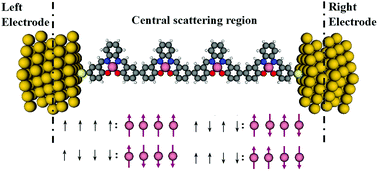
The change of magnetic configurations gives rise to the half-metal-semiconductor phase transition in the Co-salophene based spin chain, which eventually leads to the realization of huge magnetoresistance effect.
The content of this RSS Feed (c) The Royal Society of Chemistry

23 Mar 10:35
by Longji Cui
Thermal transport in individual atomic junctions and chains is of great fundamental interest because of the distinctive quantum effects expected to arise in them. By using novel, custom-fabricated, picowatt-resolution calorimetric scanning probes, we measured the thermal conductance of gold and platinum metallic wires down to single-atom junctions. Our work reveals that the thermal conductance of gold single-atom junctions is quantized at room temperature and shows that the Wiedemann-Franz law relating thermal and electrical conductance is satisfied even in single-atom contacts. Furthermore, we quantitatively explain our experimental results within the Landauer framework for quantum thermal transport. The experimental techniques reported here will enable thermal transport studies in atomic and molecular chains, which will be key to investigating numerous fundamental issues that thus far have remained experimentally inaccessible.
Authors: Longji Cui, Wonho Jeong, Sunghoon Hur, Manuel Matt, Jan C. Klöckner, Fabian Pauly, Peter Nielaba, Juan Carlos Cuevas, Edgar Meyhofer, Pramod Reddy
03 Mar 09:51
by Benjamin E. Feldman
Nature Physics 13, 286 (2017).
doi:10.1038/nphys3947
Authors: Benjamin E. Feldman, Mallika T. Randeria, Jian Li, Sangjun Jeon, Yonglong Xie, Zhijun Wang, Ilya K. Drozdov, B. Andrei Bernevig & Ali Yazdani

27 Feb 15:28
by Julian Gaberle, David Z. Gao, Alexander L. Shluger, Ania Amrous, Franck Bocquet, Laurent Nony, Franck Para, Christian Loppacher, Simon Lamare and Fréderic Cherioux

The Journal of Physical Chemistry C
DOI: 10.1021/acs.jpcc.6b12738

24 Feb 18:52
by Felix Huttmann, David Klar, Nicolae Atodiresei, Carolin Schmitz-Antoniak, Alevtina Smekhova, Antonio J. Martínez-Galera, Vasile Caciuc, Gustav Bihlmayer, Stefan Blügel, Thomas Michely, and Heiko Wende
Author(s): Felix Huttmann, David Klar, Nicolae Atodiresei, Carolin Schmitz-Antoniak, Alevtina Smekhova, Antonio J. Martínez-Galera, Vasile Caciuc, Gustav Bihlmayer, Stefan Blügel, Thomas Michely, and Heiko Wende
We create an interface of graphene with a metallic and magnetic support that leaves its electronic structure largely intact. This is achieved by exposing epitaxial graphene on ferromagnetic thin films of Co and Ni to vapor of the rare earth metal Eu at elevated temperatures, resulting in the interca…
[Phys. Rev. B 95, 075427] Published Thu Feb 23, 2017
24 Feb 15:43
by J. van Bree and M. E. Flatté
Author(s): J. van Bree and M. E. Flatté
The spatial resolution of imaging magnetometers has benefited from scanning probe techniques. The requirement that the sample perturbs the scanning probe through a magnetic field external to its volume limits magnetometry to samples with pre-existing magnetization. We propose a magnetometer in which…
[Phys. Rev. Lett. 118, 087601] Published Thu Feb 23, 2017