
The Journal of Organic Chemistry
DOI: 10.1021/acs.joc.3c02752
Nature, Published online: 29 March 2024; doi:10.1038/d41586-024-00902-2
The evidence is equivocal on whether screen time is to blame for rising levels of teen depression and anxiety — and rising hysteria could distract us from tackling the real causes.

Marnix van der KolkFMOC irrelevant with PyCO now!!!!!

Nature Chemistry, Published online: 28 March 2024; doi:10.1038/s41557-024-01470-8
Lack of standardization, transparency and interaction creates information gaps in scientific publications. Through strategies such as voluntary information management, standardization of reaction set-ups, and smart screening approaches, this Perspective gives guidelines on how to improve data management in publications reporting chemical reactions, focusing on reproducibility, standardization and evaluation of synthetic transformations.Marnix van der KolkIk heb eyebleach nodig na die schemas gezien te hebben

Photoinduced Generation of Aryl Radical and Applications: Generation of aryl radicals under photosensitized, photoinitiated, and direct or indirect photoredox-catalyzed conditions are reviewed. The utilization of aryl radicals in various reactions is demonstrated with examples.
Photoinduced aryl radical generation is a powerful strategy in organic synthesis that facilitates the formation of diverse carbon-carbon and carbon-heteroatom bonds. The synthetic applications of photoinduced aryl radical formation in the synthesis of complex organic compounds, including natural products, physiologically significant molecules, and functional materials, have received immense attention. An overview of current developments in photoinduced aryl radical production methods and their uses in organic synthesis is given in this article. A generalized idea of how to choose the reagents and approach for the generation of aryl radicals is described, along with photoinduced techniques and associated mechanistic insights. Overall, this article offers a critical assessment of the mechanistic results as well as the selection of reaction parameters for specific reagents in the context of radical cascades, cross-coupling reactions, aryl radical functionalization, and selective C−H functionalization of aryl substrates.

Nature Synthesis, Published online: 28 March 2024; doi:10.1038/s44160-024-00507-7
Methods for enzymatic C–F bond formation are rare. Now an enzymatic method for enantioselective C(sp3)–F bond formation is reported, through reprogramming non-haem iron enzyme (S)-2-hydroxypropylphosphonate epoxidase. Mechanistic studies reveal that the process proceeds through an iron-mediated radical fluorine transfer process.

Marnix van der Kolk@karl


Marnix van der KolkVergeten "Display warnings" te ontvinken??


Marnix van der Kolklast of us intensifying
Nature, Published online: 14 March 2024; doi:10.1038/d41586-024-00751-z
Low- and middle-income countries are grappling with widespread shortages of diagnostic tests for infections that kill millions.Marnix van der Kolkshoutout nijmegen!!!!
Synlett
DOI: 10.1055/s-0042-1751569

Over the past two decades, bioorthogonal chemistry has profoundly impacted various chemistry-related fields, including chemical biology and drug delivery. This transformative progress stems from collaborative efforts involving chemists and biologists, underscoring the importance of interdisciplinary research. In this Account, we present the developments in bioorthogonal chemistry within our Institute for Molecules and Materials at Radboud University. The chemistry disclosed here spans from strained alkynes and alkenes to drug release and bioconjugation strategies, mirroring the extensive scope provided by bioorthogonal chemistry. By reflecting on the chemistry originating at Radboud University, this Account emphasizes that teamwork is essential for driving significant progress in bioorthogonal chemistry.1 Introduction2 Providing BCN as a Robust Bioorthogonal Tool for Chemical Biology and Beyond3 Towards Readily Available Click-to-Release trans-Cyclooctenes4 Giving Molecules Guidance5 Next Generation of Bioconjugation Strategies: Dynamic Click Chemistry6 Conclusions
[...]
Georg Thieme Verlag KG Rüdigerstraße 14, 70469 Stuttgart, Germany
Article in Thieme eJournals:
Table of contents | Abstract | open access Full text
Nature, Published online: 18 March 2024; doi:10.1038/d41586-024-00446-5
In organic chemistry, finding conditions that enable a broad range of compounds to undergo a particular type of reaction is highly desirable. However, conventional methods for doing so consume a lot of time and reagents. A machine-learning method has been developed that overcomes these problems.
Marnix van der Kolkneeds more compression

Marnix van der KolkNow this is a study I can get behind
 Decades of intrigue surround psychedelics, with recent research hinting at their mental health therapy potential. Our lab compared chemically synthesized psilocybin (PSIL) to a psychedelic mushroom extract (PME) in mice, exploring the impact of additional compounds on the brain landscape.
Nature, Published online: 13 March 2024; doi:10.1038/d41586-024-00720-6
Clues to a modern mystery could be lurking in information collected generations ago.
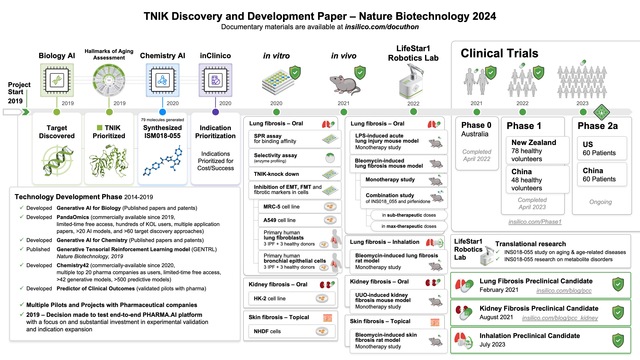 Here, we summarize and contextualize the findings of a recent Nature Biotechnology publication by Insilico Medicine. We discuss the multimodule generative AI pipeline and robotics underlying the discovery, design, development, and in-human clinical testing of INS018_055 TNIK inhibitor
