Scott Lord
Shared posts
23 Oct 00:21
Scandinavian Silent Film: Victor Sjostrom as Seastrom, Mauritz Stiller, John Brunius, Greta Garbo: April 2020
Scott Lord, Scott Lord and 2 others like this
23 Oct 00:21
Scandinavian Silent Film: Victor Sjostrom as Seastrom, Mauritz Stiller, John Brunius, Greta Garbo: 2021
Scott Lord, Scott Lord and 3 others like this
23 Oct 00:21
Scandinavian Silent Film: Victor Sjostrom as Seastrom, Mauritz Stiller, John Brunius, Greta Garbo: December 2020
Scott Lord, Scott Lord and 3 others like this
23 Oct 00:20
Biographer John Drinkwater, in his volume The Life and Adventures of Carl Laemmle perfunctorily puts the career of Thomas Ince into its historical perspective, "Ince died in 1924, before his time,". Writing on the death of Thomas Ince during 1925,the periodical Exhibitor's Trade Review waxed poetic, "He loved the clean, the beautiful, the sublime. He embellished and ornamented everything he touched. But he yet held the life trend true in its course and in that relation opened wide the way for the higher and grander conception of the Screen are to obtain in the future through the work of kindred spirits who will find inspiration and encouragement in the bigger and nobler accomplishements which the devoted his useful years.
Thomas Ince as a producer had formed the Triangle Film Corporation with D.W. Griffith and Mack Sennet during 1915, with him leaving to First National by 1917, joined there by D.W. Griffith in 1919.Exhibitor's Herald during 1924 reported a new stage having been built for Ince's selection of directors, its dimensions seventy two by one hundred and eighty feet.
Silent Film Thomas Ince
Scott Lord Silent Film: Silent Film Studio Tour, Thomas Ince Studios
scottlordpoet
shared this story
from  Scott Lord shared items on The Old Reader (RSS). Scott Lord shared items on The Old Reader (RSS).
|
Biographer John Drinkwater, in his volume The Life and Adventures of Carl Laemmle perfunctorily puts the career of Thomas Ince into its historical perspective, "Ince died in 1924, before his time,". Writing on the death of Thomas Ince during 1925,the periodical Exhibitor's Trade Review waxed poetic, "He loved the clean, the beautiful, the sublime. He embellished and ornamented everything he touched. But he yet held the life trend true in its course and in that relation opened wide the way for the higher and grander conception of the Screen are to obtain in the future through the work of kindred spirits who will find inspiration and encouragement in the bigger and nobler accomplishements which the devoted his useful years.
Thomas Ince as a producer had formed the Triangle Film Corporation with D.W. Griffith and Mack Sennet during 1915, with him leaving to First National by 1917, joined there by D.W. Griffith in 1919.Exhibitor's Herald during 1924 reported a new stage having been built for Ince's selection of directors, its dimensions seventy two by one hundred and eighty feet.
Silent Film Thomas Ince
Scott Lord, Scott Lord Mystery Film and 2 others like this
23 Oct 00:20
Silent Film
silent film
The Moonstone
scottlordpoet
shared this story
from  Scott Lord shared items on The Old Reader (RSS). Scott Lord shared items on The Old Reader (RSS).
|
Silent Film
silent film
Scott Lord, Scott Lord Mystery Film and one other like this
23 Oct 00:20
Tangled Destinies (Strayer, 1932)
SILENT Film
SILENT Film
Scott Lord, Scott Lord Mystery Film and one other like this
23 Oct 00:14
Scott Lord: Sherlock Holmes Speckled Band
Scott Lord, Scott Lord Mystery Film and 2 others like this
23 Oct 00:13
the beautiful Fay Wray in The Evil Mind
Scott Lord, Scott Lord Mystery Film and 2 others like this
23 Oct 00:13
Monogram Studios- The House of Mystery
Please include the six mysteries below from Monogram Studios as a matinee double feature in any way that you see fit.
Scott Lord, Scott Lord Mystery Film and one other like this
23 Oct 00:13
Scott Lord Mystery: Sinister Hands (1932), starring Mischa Auer
SILENT FILM
SILENT FILM
Scott Lord, Scott Lord Mystery Film and 2 others like this
23 Oct 00:12
John Gilbert before Greta Garbo - Greta Garbo
John Gilbert before Greta Garbo - Greta Garbo
Scott Lord, Scott Lord Mystery Film and 2 others like this
23 Oct 00:12
Greta Garbo, Victor Sjostrom as Seastrom, Mauritz Stiller, John Brunius: Scandinavian Silent Film: Scott Lord Silent Film: When Knighthood Was In Flo...
Scott Lord, Scott Lord Mystery Film and 2 others like this
23 Oct 00:12
Blogger: User Profile: Scott Lord on Silent Film, Scott Lord on Mystery Film
Scott Lord
Tags: Scott Lord
Scott Lord, Scott Lord Mystery Film and 2 others like this
13 Jul 05:09
Scott Lord Silent Film: Sage Brush Tom (Tom Mix, 1915)
by Scott Lord on Silent Film, Scott Lord on Mystery Film
Tom Mix was credited as having written, directed and starred onscreen in the 1915 film "Sage Brush Tom", produced by Selig Polyscope. Apearing in the one reel film were actresses Goldie Colwell and Victoria Forde.
Silent Westerns
Scott Lord, Scott Lord and 3 others like this
13 Jul 05:09
Scott Lord Silent Film: Harold Lloyd in Haunted Spooks (Hal Roach, 1920)
by Scott Lord on Silent Film, Scott Lord on Mystery Film

Scott Lord, Scott Lord and 2 others like this
13 Jul 05:09
Silent Film Movie Posters: Comedy
by Scott Lord on Silent Film, Scott Lord on Mystery Film

Scott Lord, Scott Lord and 3 others like this
13 Jul 05:09
Scott Lord Silent Film: The Female of the Species (D.W. Griffith, Biogra...
by Scott Lord on Silent Film, Scott Lord on Mystery Film
Actress Mary Pickford appears with Dorothy Bernard and Charles West in "The Female of the Species", directed by D.W. Griffith and photographed by G.W. Bitzerfor the Biograph Film Company in 1912.
Silent Film
Silent Film
Silent Film
Scott Lord, Scott Lord and 3 others like this
13 Jul 05:09
Scott Lord Silent Film: Silent Film Studio Tours, Life In Hollywood (Del...
by Scott Lord on Silent Film, Scott Lord on Mystery Film
The short subject weekly newsreel "Life in Hollywood" featured as extratextual discourse on the set introductions of actors and actresses that included silent film stars Aileen Pringle, Elinor Glyn, Madge Bellamy and Priscilla Dean.
Silent Film
Silent FIlm
Silent Film
Silent FIlm
Silent Film
Scott Lord, Scott Lord and 3 others like this
13 Jul 05:09
Scott Lord Silent Film: Silent Film Studio Tour, Life In Hollywood (Dell...
by Scott Lord on Silent Film, Scott Lord on Mystery Film
The short subject weekly newsreel "Life in Hollywood" featured on the set extratextural introductions of actors and actresses that inckuded Ruth Roland, Vivien Martin, Kathleen Clifford, and Jack and Lottie Pickford.
Silent Film
Life in Hollywood
Silent Film
Life in Hollywood
Silent Film
Scott Lord, Scott Lord and 3 others like this
13 Jul 05:09
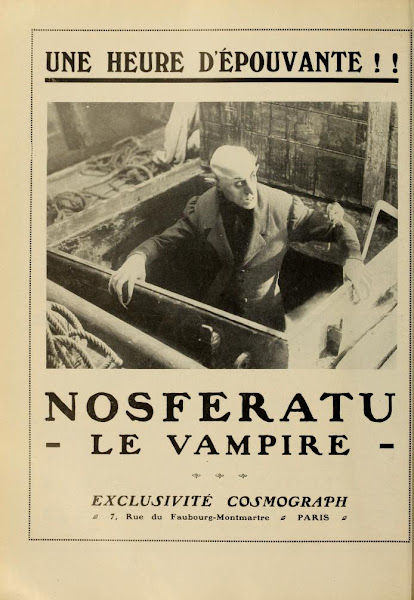
The film adaptation of Robert Louis Stevenson's account of Dr.Jekyll and Mr. Hyde directed by F.W. Murnau during 1920 is presumed to be a lost silent film with no known existing copies of the film. "The Head of Janus" (Der Janus Kopf, Love's Mockery) had starred Conrad Veidt and Bela Lugosi and is credited with having been one of the first films to include the use of the moving-camera shot, "the unchained camera". Silent Horror Film Director F.W. Murnau made 21 feature films, 8 of which are presumed lost, with no surviving copies. Included among them is the 1920 horror film "The Hunchback and the Dancer" (Der Bucklige und die Tanzerin) photographed by Karl Freund. As early as 1973 author Lotte H. Eisner, in her volume Murnau, expressed a concern about Film preservation, "The particular problem which Murnau poses for the film historian is that of the loss of nearly half his work. Of the twenty one films listed in the filmography at the end of this book, nine are missing some of the other twelve are in a very incomplete state. Of course the publication of a book like this can bring films to light and we may be lucky enough to find some of the missing nine." Two of the lost films of F.W. Murnau made chronologically before and after his film "Nosferatu" were the 1921 film "Schnsucht" and the 1923 film "Die Austreibung",
Although the Massachusetts Institute of Technology Open Learning has gone on to join the EDX platform in its production of MOOC internet classes, two of which on art and propaganda I have enjoyed completing, its early open courseware offering of The Film Experience offers a summary of Murnau's relation to Expressionism provided by Professor David Thorburn, who views Expressionism as having employed "principles of distortion and surreal exaggeration". Influenial films, to reword his lecture, emerged from the "cultural center of society" and its "cultural authorities" to create a Golden Age of German Silent Film from between the 1918 armistice through 1927 and the advent of sound film by filmmakers that had brought artistic inentions from the established theater and arts as a modernism, in fact. Thorburn begins by comparing the screen to the canvass by noting the theatrical authority of the static camera as an imagined member of the audience and how characters are situated in space, an ideal observer, almost to the point of asking if there is anything moving within a stationary insert shot. Professor David Thorburn sees F. W Murnau as the director which freed German cinema from the "constraints of high art". He notes F.W. Murnau depating from the concept of "filmed theater" towards something more cinematic through the use of natural sunlight during both interior and exterior shots, the sunlight itself a motif in the film "Nosferatu" and credits Murnau with the discovery toward a more subjective camera. Thorburn, and myself perhaps, see author Lotte Eisner as an "important historical figure' in the historiography of film criticism.
Lotte H. Eisner, in her biography titled Murnau, looks at a scene change to the shooting script of "Nosferatu" written by Henrik Galeen made by the director, F.W. Murnau, but adds that few additons and revisions to the original script were made by Murnau. "Sometimes the film is different than the scenario though Murnau had not indicated any change in the script...But there is a suprising sequence in which nearly twelve pages (thirteen sequences) have been rewritten by Murnau."
Lotte H. Eisner analyzes the film "Nosferatu" in her companion volume to his biography of Murnau, The Haunted Screen. "Nature participates in the action. Sensitive editing makes the bounding waves foretell the approach of the vampire." Eisner later adds, "Murnau was one of the few German film-directors to have the innate love of the landscape more typical of the Swedes (Arthur von Gerlach, creator of Die Chronik von Grieshums, was another) and hes was always reluctant to resort to artifice." Murnau had visited Sweden where the cameras being used were made of metal rather than wood, which aquainted him with techniques that were in fact more modern. Author Lotte H Eisner, in her volume Murnau writes of F.W. Murnau viewing the films of Victor Sjostrom and Mauritz Stiller "when he made 'Nosferatu', the idea of using negative for the phantom forest came from Sjostrom's 'Phantom Carriage', which had been made in 1920. Above all, he had a love-hatred for Mauritz Stiller, whose 'Herre Arne's Treasure' he couldn't stop admiring." Interestingly enough, "Nosferatu" was by all accounts banned from exhibition in Sweden untill 1972 due to its having what was thought to be graphic content.
Not only can we look at Murnau's film to compare and contrast its use of landscape and location to that of Swedish Silent Films, but the Wisconsin Film Society during 1960 pointed out that its narrative was situated in a different century. "Murnau probably felt that by transferring the action to the year 1838 he would have an atmosphere more condusive to the supernatural. Because of the distance in time, an audience is perhaps more willing to employ its 'suspension of disbelief'." The Film Society mentions F.W. Murnau having filmed the Vampire's carriage in fast-motion for effect, an effect which it felt had been lost on the audiences of 1960. It conceded that shooting on location brought the film "far from the studio atmosphere", but hesitated, "Although frequently careless in technical details (camerwork, exposure, lighting, composition, and actor direction) it had variety and pace."
Interestingly, as scholar Janet Bergstrom, UCLA, surveys the work of F.W. Murnau she concerns us with evaluating how "conventions relating to sexual identity, the spectator and modes of abstraction do or do not carry over from one highly conventionalized national cinema to another. She allows that the emigre directors from Germany were less of a school of literaure than perhaps Sjostrom and Stiller were. She alludes to the women in Murnau's films as appearing one-dimensional mostly during a "morbid fascination with the female body"- "sensuality in death".
Lotte H. Eisner, in her volume Murnau, writes, "As always, Murnau found visual means of suggesting unreality". Professor David Thorburn, Massachusetts Institute of Technology, expresses aprreciation and gratitude for the author's writings pointing out that "her arguments in The Haunted Screen are still widely accepted." In regard to the expression of unreality, David Thorburn sees Expressionism as having been typified by "distortion and surreal exaggation" as well as having been "interested in finding equivalents for he inner life, dramatizing not the external world, but the world within us." If not the first horror film, Thorburn delegates "Nosferatu" to being an "origin film" and as "the film in which we can see Murnau freeing the camera.....no one had ever used the camera outdoors more effectively up to this time than Murnau". Lotte H Eisner, in The Haunted Screen writes, "The landscape and views of the little town and the castle in Nosferatu were filmed on location...Murnau, however, making Nosferatu with a minimum of resourses saw all that nature had to offer in the way of fine images...Nature participates in the action."
In Expressionist Film: New Perspectives, author Deitrich Scheunemann looks at the dismissal of Lotte Eisner's expressionist name tag as genre called for by authors Werner Sudendorf and Barry Salt. Salt excludes Murnau's film "Nosferatu" from German Expressionist Film, the criteria being an affinity with expressionist painting and drama. Scheunemann continues later, "Because of the uncanny nature of the protagonist, Nosferatu has often been compared to The Cabinet of Dr. Caligari. However, the uncanny and its various embodiments in the form of doubles,vampires and artificial creatures are not in itself motifs of the expressionist movement." Author Lotte H. Eisner can still be seen comparing Nosferatu with other German Silent Cinema from 1919-1924 and the camera technique used in depicting setting and mood, "When Nosferatu is preparing a departure in the courtyard, the use of unexpected angles gives the vampire's castle a sinister appearance. What could be more expressive than a narrow street, hemmed in between monotonous brick facades, seen from a high window, the bar of which crosses the image?"
Author George A. Huaco, in his volume The Sociology of Film Art, points out that the novel and film differ in plot resolution, "In contrast to the novel Dracula, the plot of Nosferatu deemphasizes the role of Professor VAn Helsing; the final duel is between the heroic bourgeois housewife Nina and the evil aristocratic vampire. Hoaco goes so far as to venture that this reflects the growing economic crisis of the period."
Close-up magazine during 1929 reviewed the film, unaware that the Wisconsin Film Society would later favor the 1931 Tod Browning version, "The film opens with beautifully composed shots typical of Murnau (one spotlight on the hair, now turn the face slightly, and another spotlight)....It is unquestionably a faithful transcription of the book.
During 1926, when Murnau was readying to come to American, the periodical Moving Picture World interviewed his assistant, Hermann Bing, "Murnau's intention is to try to make pictures which will please the American theatre patrons- commercial successes because of their artistry....Murnau's object will be not to describe but to depict the relentless march of realities not for the objective, but from a subjective viewpoint." This almost seems like a nod to Carl Th. Dreyer's later film "Vampyr", other than that Dreyer's film had been made during the advent of sound film while Murnau was in America, shortly before Murnau's death. Fox Film publicity happenned to announce F.W. Murnau's coming to America by withholding the title of his debut American fim, giving the name of the dramatist that wrote its photoplay as Dr. Karl Mayer. "Theater Audiences Everywhere Are Waiting For This Creation".
Silent Film
In regard to the extratextual discourse of movie magazines of the time period, during 1929 the periodical Motion Picture News subtitled their review of "Nosferatu" with "Morbid and Depressing". It deemed Murnau's adaptation of the novel by Bram Stoker to be "a vague yarn hard to follow with several sequences that have a tremendous part to do with the plot introduced most haphazardly." The opinion of the periodical was that "The picture itself is a most morbid and depressing affair without entertainment value. It will not be acceptable anywhere except in the 'arty' houses."
Silent Horror Film
Faust (F.W. Murnau, 1926)
Silent Film
Silent Film
Scott Lord Silent Film: Nosferatu (F.W. Murnau, 1922)
by Scott Lord on Silent Film, Scott Lord on Mystery Film

The film adaptation of Robert Louis Stevenson's account of Dr.Jekyll and Mr. Hyde directed by F.W. Murnau during 1920 is presumed to be a lost silent film with no known existing copies of the film. "The Head of Janus" (Der Janus Kopf, Love's Mockery) had starred Conrad Veidt and Bela Lugosi and is credited with having been one of the first films to include the use of the moving-camera shot, "the unchained camera". Silent Horror Film Director F.W. Murnau made 21 feature films, 8 of which are presumed lost, with no surviving copies. Included among them is the 1920 horror film "The Hunchback and the Dancer" (Der Bucklige und die Tanzerin) photographed by Karl Freund. As early as 1973 author Lotte H. Eisner, in her volume Murnau, expressed a concern about Film preservation, "The particular problem which Murnau poses for the film historian is that of the loss of nearly half his work. Of the twenty one films listed in the filmography at the end of this book, nine are missing some of the other twelve are in a very incomplete state. Of course the publication of a book like this can bring films to light and we may be lucky enough to find some of the missing nine." Two of the lost films of F.W. Murnau made chronologically before and after his film "Nosferatu" were the 1921 film "Schnsucht" and the 1923 film "Die Austreibung",
Although the Massachusetts Institute of Technology Open Learning has gone on to join the EDX platform in its production of MOOC internet classes, two of which on art and propaganda I have enjoyed completing, its early open courseware offering of The Film Experience offers a summary of Murnau's relation to Expressionism provided by Professor David Thorburn, who views Expressionism as having employed "principles of distortion and surreal exaggeration". Influenial films, to reword his lecture, emerged from the "cultural center of society" and its "cultural authorities" to create a Golden Age of German Silent Film from between the 1918 armistice through 1927 and the advent of sound film by filmmakers that had brought artistic inentions from the established theater and arts as a modernism, in fact. Thorburn begins by comparing the screen to the canvass by noting the theatrical authority of the static camera as an imagined member of the audience and how characters are situated in space, an ideal observer, almost to the point of asking if there is anything moving within a stationary insert shot. Professor David Thorburn sees F. W Murnau as the director which freed German cinema from the "constraints of high art". He notes F.W. Murnau depating from the concept of "filmed theater" towards something more cinematic through the use of natural sunlight during both interior and exterior shots, the sunlight itself a motif in the film "Nosferatu" and credits Murnau with the discovery toward a more subjective camera. Thorburn, and myself perhaps, see author Lotte Eisner as an "important historical figure' in the historiography of film criticism.
Lotte H. Eisner, in her biography titled Murnau, looks at a scene change to the shooting script of "Nosferatu" written by Henrik Galeen made by the director, F.W. Murnau, but adds that few additons and revisions to the original script were made by Murnau. "Sometimes the film is different than the scenario though Murnau had not indicated any change in the script...But there is a suprising sequence in which nearly twelve pages (thirteen sequences) have been rewritten by Murnau."
Lotte H. Eisner analyzes the film "Nosferatu" in her companion volume to his biography of Murnau, The Haunted Screen. "Nature participates in the action. Sensitive editing makes the bounding waves foretell the approach of the vampire." Eisner later adds, "Murnau was one of the few German film-directors to have the innate love of the landscape more typical of the Swedes (Arthur von Gerlach, creator of Die Chronik von Grieshums, was another) and hes was always reluctant to resort to artifice." Murnau had visited Sweden where the cameras being used were made of metal rather than wood, which aquainted him with techniques that were in fact more modern. Author Lotte H Eisner, in her volume Murnau writes of F.W. Murnau viewing the films of Victor Sjostrom and Mauritz Stiller "when he made 'Nosferatu', the idea of using negative for the phantom forest came from Sjostrom's 'Phantom Carriage', which had been made in 1920. Above all, he had a love-hatred for Mauritz Stiller, whose 'Herre Arne's Treasure' he couldn't stop admiring." Interestingly enough, "Nosferatu" was by all accounts banned from exhibition in Sweden untill 1972 due to its having what was thought to be graphic content.
Not only can we look at Murnau's film to compare and contrast its use of landscape and location to that of Swedish Silent Films, but the Wisconsin Film Society during 1960 pointed out that its narrative was situated in a different century. "Murnau probably felt that by transferring the action to the year 1838 he would have an atmosphere more condusive to the supernatural. Because of the distance in time, an audience is perhaps more willing to employ its 'suspension of disbelief'." The Film Society mentions F.W. Murnau having filmed the Vampire's carriage in fast-motion for effect, an effect which it felt had been lost on the audiences of 1960. It conceded that shooting on location brought the film "far from the studio atmosphere", but hesitated, "Although frequently careless in technical details (camerwork, exposure, lighting, composition, and actor direction) it had variety and pace."
Interestingly, as scholar Janet Bergstrom, UCLA, surveys the work of F.W. Murnau she concerns us with evaluating how "conventions relating to sexual identity, the spectator and modes of abstraction do or do not carry over from one highly conventionalized national cinema to another. She allows that the emigre directors from Germany were less of a school of literaure than perhaps Sjostrom and Stiller were. She alludes to the women in Murnau's films as appearing one-dimensional mostly during a "morbid fascination with the female body"- "sensuality in death".
Lotte H. Eisner, in her volume Murnau, writes, "As always, Murnau found visual means of suggesting unreality". Professor David Thorburn, Massachusetts Institute of Technology, expresses aprreciation and gratitude for the author's writings pointing out that "her arguments in The Haunted Screen are still widely accepted." In regard to the expression of unreality, David Thorburn sees Expressionism as having been typified by "distortion and surreal exaggation" as well as having been "interested in finding equivalents for he inner life, dramatizing not the external world, but the world within us." If not the first horror film, Thorburn delegates "Nosferatu" to being an "origin film" and as "the film in which we can see Murnau freeing the camera.....no one had ever used the camera outdoors more effectively up to this time than Murnau". Lotte H Eisner, in The Haunted Screen writes, "The landscape and views of the little town and the castle in Nosferatu were filmed on location...Murnau, however, making Nosferatu with a minimum of resourses saw all that nature had to offer in the way of fine images...Nature participates in the action."
In Expressionist Film: New Perspectives, author Deitrich Scheunemann looks at the dismissal of Lotte Eisner's expressionist name tag as genre called for by authors Werner Sudendorf and Barry Salt. Salt excludes Murnau's film "Nosferatu" from German Expressionist Film, the criteria being an affinity with expressionist painting and drama. Scheunemann continues later, "Because of the uncanny nature of the protagonist, Nosferatu has often been compared to The Cabinet of Dr. Caligari. However, the uncanny and its various embodiments in the form of doubles,vampires and artificial creatures are not in itself motifs of the expressionist movement." Author Lotte H. Eisner can still be seen comparing Nosferatu with other German Silent Cinema from 1919-1924 and the camera technique used in depicting setting and mood, "When Nosferatu is preparing a departure in the courtyard, the use of unexpected angles gives the vampire's castle a sinister appearance. What could be more expressive than a narrow street, hemmed in between monotonous brick facades, seen from a high window, the bar of which crosses the image?"
Author George A. Huaco, in his volume The Sociology of Film Art, points out that the novel and film differ in plot resolution, "In contrast to the novel Dracula, the plot of Nosferatu deemphasizes the role of Professor VAn Helsing; the final duel is between the heroic bourgeois housewife Nina and the evil aristocratic vampire. Hoaco goes so far as to venture that this reflects the growing economic crisis of the period."
Close-up magazine during 1929 reviewed the film, unaware that the Wisconsin Film Society would later favor the 1931 Tod Browning version, "The film opens with beautifully composed shots typical of Murnau (one spotlight on the hair, now turn the face slightly, and another spotlight)....It is unquestionably a faithful transcription of the book.
During 1926, when Murnau was readying to come to American, the periodical Moving Picture World interviewed his assistant, Hermann Bing, "Murnau's intention is to try to make pictures which will please the American theatre patrons- commercial successes because of their artistry....Murnau's object will be not to describe but to depict the relentless march of realities not for the objective, but from a subjective viewpoint." This almost seems like a nod to Carl Th. Dreyer's later film "Vampyr", other than that Dreyer's film had been made during the advent of sound film while Murnau was in America, shortly before Murnau's death. Fox Film publicity happenned to announce F.W. Murnau's coming to America by withholding the title of his debut American fim, giving the name of the dramatist that wrote its photoplay as Dr. Karl Mayer. "Theater Audiences Everywhere Are Waiting For This Creation".
Silent Film
In regard to the extratextual discourse of movie magazines of the time period, during 1929 the periodical Motion Picture News subtitled their review of "Nosferatu" with "Morbid and Depressing". It deemed Murnau's adaptation of the novel by Bram Stoker to be "a vague yarn hard to follow with several sequences that have a tremendous part to do with the plot introduced most haphazardly." The opinion of the periodical was that "The picture itself is a most morbid and depressing affair without entertainment value. It will not be acceptable anywhere except in the 'arty' houses."
Silent Horror Film
Faust (F.W. Murnau, 1926)
Silent Film
Silent Film
Silent Film
Scott Lord, Scott Lord and 3 others like this
13 Jul 05:02
Swedish Silent Film, director George af Klercker
Anne-Kristin Wallengren, for Nordic Academic Press, only indirectly refers to the work of Gosta Werner and the restoration of lost silent film in the article, Welecome Home Mr. Swanson-Swedish Emigrants and Swedishness on Film. "There is the still extant film Storstadfaror (Perils of the Big City, Manne Gothson, 1918), in which a young man goes to America and at the end of the film, returns to Sweden, rich; however, while this was one of the very few films made in the 1910's to show America in a positive light, it is also significant that his was only a supporting role." The film Perils of the Big City was written by Gabrielle Ringertz and photographed by Gustav A. Gustavson. Appearing in the film were Mary Johnson, who, having made several films with George af Klerker, would later film under the direction of Mauritz Stiller. Appearing in the film with Johnson were actresses Agda Helin, Tekl Sjoblom and Lilly Cronin.
Peter Cowie, in his volume Scandinavian Cinema, elaborates,"Several of the 27 geatures completed by Klercker at Hasselblad were enhanced by the etheral beauty of Mary Johnson,an actress in the mould of Lillian Gish; she would reachher apogee as ELsalilli in 'Sir Arne's Treasure'" The film apparently was the only film produced at Hasselblad Fotografiska, from its first film in 1915, untill it merged early in 1918 to become Filmindustri Skandia, not to have been directed by George af Klercker, Manne Gothson had previously been Klercker's assistant director. This having been said, scholar Astrid Soderberg Widding points out that Gosta Werner neglects or omits the films made by Af Klercker before he began with Hasselblad, almost to confer with other authors that place Sjostrom and Stiller at the forefront of Swedish Silent Film's Golden Age; Leif Furhammer has advanced that Af Klercker had been an Auteur only to heighten the comparison that can be made between George Af Klercker and Carl Th. Dreyer, despite Dreyer's having entered directing later and his only having scripted melodramas while searching for adaptations.
The fourty one minute film 'Mysteriet natter till den 25ie' proves to be more enigmatic than its director. it stars Swedish actress Mary Johnson with Carl Barklind and was photographed by Sven PeUtersson- one of the first films to demonstrate the need for silent film preservation, it was not shown to audiences until, 1975. Recently a genealogical study on the af Klercker family, which not only includes George af Klercker, but also Birgitta af Klercker and Fredrick af Klercker mentioned the film, but not as a film that had been lost, as many silent films have, or lost and then later found, but as a film that was originally banned by Swedish film censorship. The Swedish Film Institute confirms the film having been originally banned as a "Nick Carter" detective film, but that when the film became no longer lost, in 1975, the elements in the film that were objectionable were no longer able to be censored and the restored version was given a "for all" rating after having been missing for nearly sixty years. Describing the film as a "three act sensational drama", Peter Cowie writes, "Klercker's ingenuity yeilds constant suprises.", there being a sensibility in keeping with the director's eye evident in that "this fascination with mirrors and decor colours all Klercker's cinema".
Clearly George af Klercker was eclipsed by Mauritz Stiller and Victor Sjostrom in that af Klercker left had Svenska Bio before Stiller and Sjostrom had gained renown internationally for films of longer running length. The director Geroge af Klerker is portrayed by actor Bjorn Granath in the film "The Last Scream" ("The Last Gasp", Stig Bjornman, 1995), a two character play in one act lasting almost an hour which depicts a fictional, ie. Imaginary, meeting between the director Klercker and Charles Magnussion, founder of Svensk Filmindustri and which was written by Ingmar Bergman. Actress Anna Von Rossen stars as Miss Holm. The play was published by New Press in the volume, The Fifth Act, in which also appeared Monologue, After the Rehearsal and Presence of a Clown. Stig Bjorkman, noted for his interviews of Ingmar Bergman is also the director of I Am Curious Film, and But Film is My Mistress. It should be noted that Bjorn Granath portrays George af Klercker in the film "Jag ar nyfiken, film" (1999) in which he appears with, of course, Lena Nyman, who interviews Sven Nykvist, Eva Isaksen, Stefan Jarl and Liv Ullman, but it should also be noted that Victor Sjostrom and Ingmar Bergman are listed in the cast of players in the film "Images from the Playground" (Bilder fran Lekstugan,2009), written and directed by Stig Bjorkman, which appeared in the 2022 Cannes film festival- while many noted scholars have chosen to appraise Swedish film through the form of the essay, Stig Bjorkman has brought the interview into the onscreen literature of the documentary.
It is clear that Astrid Soderberg Widding outlines the ostensible difference between the director George af Klercker and his contemporaries Victor Sjostrom and Mauritz Stiller by accurately placing him as a director of "melodrama and sensational adventures" made in Denmark, those which had established the director Viggo Larsen ; he is also apart from the type of film made in Kristianstad before he had began with Svenska Bio at Lindingo. As academic writing among film historians can be cumulative, each seminal text nodding to what is salient in each of its predecessors, it is certain that Soderberg Widding will not only contribute to film history research, but will springboard later film theory. She describes the directing of Af Klercker with, "A purely film-theoretical aspect that becomes evident when looking at Af Klercker's production deserves to be highlighted. it has to do with the relationship between the visual and narrative elements: phenomena which in film-theoretical historiography are not infrequently regarded as counterpoints......Af Klercker's films are in their narratives quite conventional and typical of their time. They provide thrilling stories while expressing a supreme control over film as a medium." In describing this, Astrid Soderberg Widding articulates the interrelationship between content and form while praising the films of Af Klercker for their "stylistic stability and visual extravagance, if only to reiterate that characters are developed within the miss en scene context of their created environment in the narrative plots of both Danish and Swedish silent film "Here one encounters a driven visual narrator who demands a high degree of focus. many of the different narrative devices and stylistic features are noteworthy: his utilization of a qualified depth-of-focus cinematography aw well as the effect of advanced lighting." The author notes that one instance of this was Klerker's use of door frames within the image. In no academic papers already copyrighted, Soderberg Widding looks intricately at technique including the element of editing, so as not to neglect shot structure being in tandem with composition, by distinguishing a signature of Af Klercker's composition, "to use an undivided screen space where dissectons and doubling so takes place within a general frame rather than the introduction of several frames."
Swedish Silent Film director George af Klercker had been the head of the studios of Svenska Bio, Stockhom, his wife, Selma af Klercker often appearing on screen in his films. He was joined there by actorMauritz Stiler and Victor Sjostrom, who was then also leaving the theater. It has been noted that there were aprroximately 325 movie theaters open in Sweden during 1912.
Dodsritten under cirkuskupolen (1912) had been written by Charles Magnusson and photographed by Henrik Jaenzon. George Af Klercker had written his own screenplay to the 1912 film Jupiter pa Jorden, also filmed by Henrik Jaenzon. Although Af Klerker directed a short film photographed by Sven Petterson and starring actress Tyra Leijman Uppstrom during 1913, he that year also directed The Scandal (Skandalen) for Svenska Biographteatern, his photographer again Henrik Jaenzon, as was the case with the film Med Vapen I Hand that year,actress Selma Wiklund Af Klerker also returning for both films. As director, Klercker appeared on screen on camera in front of the lens of cameraman Henrik Jaenzon during "Med Vapen hand", which he did again while directing "For faderneslandent" with Jaenzon as camera man. Ragnar Ring codirected the film and wrote it's screenplay and actress Lilly Jacobsen starred in the film.
It has been noted that George af Klercker had spent time in Copenhagen and Paris after leaving Svenska Bio.
In Goteborg, Sweden, the two films produced by Hasselblads Fotofraphiska during 1915 were both filmed by George af Klerker and Sve Petterson. That year George af Klercker contributed the film "The Rose of Thistle Island" ("Rosen pa Tistelon), the first film in which actress Elsa Carlsson and Anna Lofstrom were to appear. The novel had been filmed previously by director Mauritz Stiller as "Pa livets Odesvager".
Among the films directed by George Af Klercker during 1916 was The Gift of Health (Aktie bolaget Halsams gave), the first film photographed by cinematographer Gustav Gustafson and the first film in which actress Tekla Sjoblom was to appear. Carl Gustaf Florin also is credited as having photographed with Gustafson. One of only two photoplays to be scripted by Gustaf Berg, the film is presumed to be lost with no suviving copies. Also starring in the film were Mary Johnson and Anna Lofstrom.
That year Swedish film director Af Klercker also appeared on screen in the film Under the Spell of Memories (I minnenasband), in which he directed Elsa Carlsson, Tora Carlsson and Elsa Berglund. The film was written and photographed by Sven Pettersson. The 1916 film Hogsta Vinsten, in which director George Af Klercker appeared on screen with actress Gerda Thome Mattsson lasted a brief running time of only sixteen minutes at a time when the average running time had been increased from four reels to six. The film was photographed by Sven Pettersson. Also among the film's directed by George af Klercker in 1916 were "Triumph of Love" ("Karleken segrar") photographed by Carl Gustaf Florin and starring Mary Johnson, Teklas Sjoblom, Selma Wikland Klercker and Lily Cronwin in the first film in which she was to appear and the film "Mother in Law Goes for a Stroll" ("Svar pa rift") photographed by Gustav A. Gustafson and starring Greta Johansson, Maja Cassell and Zara Backman. Peter Cowie contrasts the directing of George af Klercker with that of Mauritz Stiller, "Mood and composition, however, distinguish Klercker's work more than performances."
Af Klercker had gained renown not only for his blending artificial and natural light, but while at Hasselblad he innovated the techniques involved with a lens system that was suited for filming objects at a distance, ranging from a focal length of a few feet to that of a mile.
The Swedish Film Institute credits George af Klercker for having made two films in which actress Olga Hallgren starred whereas databases in the United States credit her with three films, all produced in Sweden during 1917 by Hasselblad studios. Klercker directed the 1917 "Ett Konstnarsode" photographed by Carl Gustaf Florin, in which Hallgren starred with actress Greta Pfeil and Klercker directed the 1917 film "Brottmalsdomanen" ("The Judge"), photographed by Carl Gustaf Florin, also starring Olga Hallgren. Sources from the United States credit Klercker with the film "Det Finns Inga Gudar pa Jordan" ("There are no Gods on Earth") from 1917 in which Olga Hallgren again starred with Greta Pfeil.
It wasn't untill 2017 that there was an unearthed copy of the 1926 film "Flickorna pa Solvik", the last film to be directed by George af Klercker, when it was rediscovered in a private collection. One of only two photoplays scripted by John Larson, the film starred actress Wanda Rothgardt.
During 1918, George af Klercker directed the films "The Lighthouse Keeper's Daughter" (Fryvaktarens Dottar), photographed by Gosta Staring and starring Mary Johnson and Agnes Obergsson, "Night Music" (Nattliga Toner), photographed by Gustaf A. Gustafson and starring Agda Helin, Helge Kihlberg and Tekla Sjoblom, and "Nobelpristagaren".
Danish Silent Film
Victor Sjostrom and Mauritz Stiller
Swedish Silent Film
Swedish Sound Film
Greta Garbo Silent Film
Peter Cowie, in his volume Scandinavian Cinema, elaborates,"Several of the 27 geatures completed by Klercker at Hasselblad were enhanced by the etheral beauty of Mary Johnson,an actress in the mould of Lillian Gish; she would reachher apogee as ELsalilli in 'Sir Arne's Treasure'" The film apparently was the only film produced at Hasselblad Fotografiska, from its first film in 1915, untill it merged early in 1918 to become Filmindustri Skandia, not to have been directed by George af Klercker, Manne Gothson had previously been Klercker's assistant director. This having been said, scholar Astrid Soderberg Widding points out that Gosta Werner neglects or omits the films made by Af Klercker before he began with Hasselblad, almost to confer with other authors that place Sjostrom and Stiller at the forefront of Swedish Silent Film's Golden Age; Leif Furhammer has advanced that Af Klercker had been an Auteur only to heighten the comparison that can be made between George Af Klercker and Carl Th. Dreyer, despite Dreyer's having entered directing later and his only having scripted melodramas while searching for adaptations.
The fourty one minute film 'Mysteriet natter till den 25ie' proves to be more enigmatic than its director. it stars Swedish actress Mary Johnson with Carl Barklind and was photographed by Sven PeUtersson- one of the first films to demonstrate the need for silent film preservation, it was not shown to audiences until, 1975. Recently a genealogical study on the af Klercker family, which not only includes George af Klercker, but also Birgitta af Klercker and Fredrick af Klercker mentioned the film, but not as a film that had been lost, as many silent films have, or lost and then later found, but as a film that was originally banned by Swedish film censorship. The Swedish Film Institute confirms the film having been originally banned as a "Nick Carter" detective film, but that when the film became no longer lost, in 1975, the elements in the film that were objectionable were no longer able to be censored and the restored version was given a "for all" rating after having been missing for nearly sixty years. Describing the film as a "three act sensational drama", Peter Cowie writes, "Klercker's ingenuity yeilds constant suprises.", there being a sensibility in keeping with the director's eye evident in that "this fascination with mirrors and decor colours all Klercker's cinema".
Clearly George af Klercker was eclipsed by Mauritz Stiller and Victor Sjostrom in that af Klercker left had Svenska Bio before Stiller and Sjostrom had gained renown internationally for films of longer running length. The director Geroge af Klerker is portrayed by actor Bjorn Granath in the film "The Last Scream" ("The Last Gasp", Stig Bjornman, 1995), a two character play in one act lasting almost an hour which depicts a fictional, ie. Imaginary, meeting between the director Klercker and Charles Magnussion, founder of Svensk Filmindustri and which was written by Ingmar Bergman. Actress Anna Von Rossen stars as Miss Holm. The play was published by New Press in the volume, The Fifth Act, in which also appeared Monologue, After the Rehearsal and Presence of a Clown. Stig Bjorkman, noted for his interviews of Ingmar Bergman is also the director of I Am Curious Film, and But Film is My Mistress. It should be noted that Bjorn Granath portrays George af Klercker in the film "Jag ar nyfiken, film" (1999) in which he appears with, of course, Lena Nyman, who interviews Sven Nykvist, Eva Isaksen, Stefan Jarl and Liv Ullman, but it should also be noted that Victor Sjostrom and Ingmar Bergman are listed in the cast of players in the film "Images from the Playground" (Bilder fran Lekstugan,2009), written and directed by Stig Bjorkman, which appeared in the 2022 Cannes film festival- while many noted scholars have chosen to appraise Swedish film through the form of the essay, Stig Bjorkman has brought the interview into the onscreen literature of the documentary.
It is clear that Astrid Soderberg Widding outlines the ostensible difference between the director George af Klercker and his contemporaries Victor Sjostrom and Mauritz Stiller by accurately placing him as a director of "melodrama and sensational adventures" made in Denmark, those which had established the director Viggo Larsen ; he is also apart from the type of film made in Kristianstad before he had began with Svenska Bio at Lindingo. As academic writing among film historians can be cumulative, each seminal text nodding to what is salient in each of its predecessors, it is certain that Soderberg Widding will not only contribute to film history research, but will springboard later film theory. She describes the directing of Af Klercker with, "A purely film-theoretical aspect that becomes evident when looking at Af Klercker's production deserves to be highlighted. it has to do with the relationship between the visual and narrative elements: phenomena which in film-theoretical historiography are not infrequently regarded as counterpoints......Af Klercker's films are in their narratives quite conventional and typical of their time. They provide thrilling stories while expressing a supreme control over film as a medium." In describing this, Astrid Soderberg Widding articulates the interrelationship between content and form while praising the films of Af Klercker for their "stylistic stability and visual extravagance, if only to reiterate that characters are developed within the miss en scene context of their created environment in the narrative plots of both Danish and Swedish silent film "Here one encounters a driven visual narrator who demands a high degree of focus. many of the different narrative devices and stylistic features are noteworthy: his utilization of a qualified depth-of-focus cinematography aw well as the effect of advanced lighting." The author notes that one instance of this was Klerker's use of door frames within the image. In no academic papers already copyrighted, Soderberg Widding looks intricately at technique including the element of editing, so as not to neglect shot structure being in tandem with composition, by distinguishing a signature of Af Klercker's composition, "to use an undivided screen space where dissectons and doubling so takes place within a general frame rather than the introduction of several frames."
Swedish Silent Film director George af Klercker had been the head of the studios of Svenska Bio, Stockhom, his wife, Selma af Klercker often appearing on screen in his films. He was joined there by actorMauritz Stiler and Victor Sjostrom, who was then also leaving the theater. It has been noted that there were aprroximately 325 movie theaters open in Sweden during 1912.
Dodsritten under cirkuskupolen (1912) had been written by Charles Magnusson and photographed by Henrik Jaenzon. George Af Klercker had written his own screenplay to the 1912 film Jupiter pa Jorden, also filmed by Henrik Jaenzon. Although Af Klerker directed a short film photographed by Sven Petterson and starring actress Tyra Leijman Uppstrom during 1913, he that year also directed The Scandal (Skandalen) for Svenska Biographteatern, his photographer again Henrik Jaenzon, as was the case with the film Med Vapen I Hand that year,actress Selma Wiklund Af Klerker also returning for both films. As director, Klercker appeared on screen on camera in front of the lens of cameraman Henrik Jaenzon during "Med Vapen hand", which he did again while directing "For faderneslandent" with Jaenzon as camera man. Ragnar Ring codirected the film and wrote it's screenplay and actress Lilly Jacobsen starred in the film.
It has been noted that George af Klercker had spent time in Copenhagen and Paris after leaving Svenska Bio.
In Goteborg, Sweden, the two films produced by Hasselblads Fotofraphiska during 1915 were both filmed by George af Klerker and Sve Petterson. That year George af Klercker contributed the film "The Rose of Thistle Island" ("Rosen pa Tistelon), the first film in which actress Elsa Carlsson and Anna Lofstrom were to appear. The novel had been filmed previously by director Mauritz Stiller as "Pa livets Odesvager".
Among the films directed by George Af Klercker during 1916 was The Gift of Health (Aktie bolaget Halsams gave), the first film photographed by cinematographer Gustav Gustafson and the first film in which actress Tekla Sjoblom was to appear. Carl Gustaf Florin also is credited as having photographed with Gustafson. One of only two photoplays to be scripted by Gustaf Berg, the film is presumed to be lost with no suviving copies. Also starring in the film were Mary Johnson and Anna Lofstrom.
That year Swedish film director Af Klercker also appeared on screen in the film Under the Spell of Memories (I minnenasband), in which he directed Elsa Carlsson, Tora Carlsson and Elsa Berglund. The film was written and photographed by Sven Pettersson. The 1916 film Hogsta Vinsten, in which director George Af Klercker appeared on screen with actress Gerda Thome Mattsson lasted a brief running time of only sixteen minutes at a time when the average running time had been increased from four reels to six. The film was photographed by Sven Pettersson. Also among the film's directed by George af Klercker in 1916 were "Triumph of Love" ("Karleken segrar") photographed by Carl Gustaf Florin and starring Mary Johnson, Teklas Sjoblom, Selma Wikland Klercker and Lily Cronwin in the first film in which she was to appear and the film "Mother in Law Goes for a Stroll" ("Svar pa rift") photographed by Gustav A. Gustafson and starring Greta Johansson, Maja Cassell and Zara Backman. Peter Cowie contrasts the directing of George af Klercker with that of Mauritz Stiller, "Mood and composition, however, distinguish Klercker's work more than performances."
Af Klercker had gained renown not only for his blending artificial and natural light, but while at Hasselblad he innovated the techniques involved with a lens system that was suited for filming objects at a distance, ranging from a focal length of a few feet to that of a mile.
The Swedish Film Institute credits George af Klercker for having made two films in which actress Olga Hallgren starred whereas databases in the United States credit her with three films, all produced in Sweden during 1917 by Hasselblad studios. Klercker directed the 1917 "Ett Konstnarsode" photographed by Carl Gustaf Florin, in which Hallgren starred with actress Greta Pfeil and Klercker directed the 1917 film "Brottmalsdomanen" ("The Judge"), photographed by Carl Gustaf Florin, also starring Olga Hallgren. Sources from the United States credit Klercker with the film "Det Finns Inga Gudar pa Jordan" ("There are no Gods on Earth") from 1917 in which Olga Hallgren again starred with Greta Pfeil.
It wasn't untill 2017 that there was an unearthed copy of the 1926 film "Flickorna pa Solvik", the last film to be directed by George af Klercker, when it was rediscovered in a private collection. One of only two photoplays scripted by John Larson, the film starred actress Wanda Rothgardt.
During 1918, George af Klercker directed the films "The Lighthouse Keeper's Daughter" (Fryvaktarens Dottar), photographed by Gosta Staring and starring Mary Johnson and Agnes Obergsson, "Night Music" (Nattliga Toner), photographed by Gustaf A. Gustafson and starring Agda Helin, Helge Kihlberg and Tekla Sjoblom, and "Nobelpristagaren".
Danish Silent Film
Victor Sjostrom and Mauritz Stiller
Swedish Silent Film
Swedish Sound Film
Greta Garbo Silent Film
Scott Lord, Scott Lord Mystery Film and 2 others like this
13 Jul 05:02
Scott Lord: Sherlock Holmes- A Study In Scarlet
Scott Lord, Scott Lord Mystery Film and 2 others like this
13 Jul 05:01
Scott Lord Mystery: E.G Marshall in CBS Radio Mystery Theater, Sunset to...
Scott Lord, Scott Lord Mystery Film and 2 others like this
13 Jul 05:01
Scott Lord Mystery: Evelyn Ankers in The Villier’s Diamond (Mainwaring, ...
Scott Lord, Scott Lord Mystery Film and 2 others like this