Scott Lord
Shared posts
23 Oct 00:08
Scott Lord Mystery: The Great Alaskan Mystery, Chapter Six (Taylor, Coll...
by Scott Lord on Silent Film, Scott Lord on Mystery Film
Scott Lord, Scott Lord and 3 others like this


23 Oct 00:05
Scott Lord Horror Comedy: Ghost Parade (Mack Sennett, 1931)
Scott Lord, Scott Lord and 2 others like this
23 Oct 00:05
Sherlock Holmes Murder At The Baskervilles
Scott Lord
Scott Lord
Scott Lord, Scott Lord and 2 others like this
23 Oct 00:05
Scott Lord Silent Film: Biblical Drama; Christus (Guilio Antamoro, 1916)
When first read the analytic interpretation of "Christus" (Guilio Antomoro, 1916) by Chandra Han, Pelita Harpan University in the paper Jesus in Film: Representation, Misrepresentation and Denial of Jesus' Agony in Gospels, is fascinating when pointing out the nature of Jesus is depicted as divine in the film in that the dove over him in the portrayal is symbolic of the Holy Spirit, Jesus as "fully God"; this is used to distinguish the divine and human natures of Christ in both the Canonical Gospels and the Apochryphal Gospels and the contrasting agaony of the Savior in both (the human form of Christ having suffered or experienced sorrow for the love of mankind, the divine nature implied to always have existed).
silent film
silent film
Scott Lord, Scott Lord and 2 others like this
23 Oct 00:05
Scott Lord Silent Film: Black Oxen (Frank Lloyd, 1924) - YouTube
Scott Lord, Scott Lord and 3 others like this
23 Oct 00:05
Silent Film (Victor and Griffith 1912): 2021
Scott Lord, Scott Lord and 3 others like this
23 Oct 00:05
Silent Film
by noreply@blogger.com (Scott Lord on Silent Film, Scott Lord on Mystery Film)


Scott Lord, Scott Lord and 3 others like this
23 Oct 00:05
Silent Film silent film film
by noreply@blogger.com (Scott Lord on Silent Film, Scott Lord on Mystery Film)


Scott Lord, Scott Lord and 3 others like this
23 Oct 00:05
Scott Lord Silent Film: The Grand Duchess and the Waiter (Malcom St Clai...
by noreply@blogger.com (Scott Lord on Silent Film, Scott Lord on Mystery Film)
Scott Lord, Scott Lord and 3 others like this
23 Oct 00:05
Scott Lord Silent Film: Frances Howard in The Swan, (Buchowetzki,1925)
by noreply@blogger.com (Scott Lord on Silent Film, Scott Lord on Mystery Film)
Scott Lord, Scott Lord and 3 others like this
23 Oct 00:05
Basil Rathbone in Sin Takes a Holiday
by noreply@blogger.com (Scott Lord on Silent Film, Scott Lord on Mystery Film)

Scott Lord, Scott Lord and 3 others like this
23 Oct 00:05
Scott Lord: Silent Sherlock Holmes starring Ellie Norwood
by noreply@blogger.com (Scott Lord on Silent Film, Scott Lord on Mystery Film)
Scott Lord, Scott Lord and 3 others like this
23 Oct 00:04
Scott Lord The Triumph of Sherlock Holmes
by noreply@blogger.com (Scott Lord on Silent Film, Scott Lord on Mystery Film)
Scott Lord, Scott Lord and 3 others like this
23 Oct 00:04
Sherlock Holmes Fatal Hour
by noreply@blogger.com (Scott Lord on Silent Film, Scott Lord on Mystery Film)
Scott Lord, Scott Lord and 3 others like this
23 Oct 00:04
Sherlock Holmes Murder At The Baskervilles
by noreply@blogger.com (Scott Lord on Silent Film, Scott Lord on Mystery Film)
Scott Lord, Scott Lord and 3 others like this
23 Oct 00:04
Sherlock Holmes
by noreply@blogger.com (Scott Lord on Silent Film, Scott Lord on Mystery Film)
Scott Lord, Scott Lord and 3 others like this
23 Oct 00:04
Fay Wray in The Evil Mind
by noreply@blogger.com (Scott Lord on Silent Film, Scott Lord on Mystery Film)
Scott Lord, Scott Lord Mystery Film and 3 others like this
23 Oct 00:04
The beautiful Fay Wray in The Vampire Bat
by noreply@blogger.com (Scott Lord on Silent Film, Scott Lord on Mystery Film)
Scott Lord, Scott Lord Mystery Film and 3 others like this
23 Oct 00:04
Shadows (Forman, 1922)
by noreply@blogger.com (Scott Lord on Silent Film, Scott Lord on Mystery Film)
Scott Lord, Scott Lord Mystery Film and 3 others like this
23 Oct 00:04
The Sphinx (1933)
by noreply@blogger.com (Scott Lord on Silent Film, Scott Lord on Mystery Film)
Scott Lord, Scott Lord Mystery Film and 3 others like this
25 Sep 04:38
Silent Film Magazine Art: Bluebird Photoplays
by Scott Lord on Silent Film, Scott Lord on Mystery Film


Scott Lord, Scott Lord and 3 others like this
25 Sep 04:34
In the autobiographical reminiscences William N. Selig printed in Photoplay Magazine during 1920, Selig, perhaps almost graciously, credits Edison with the "first single reel picture containing a story in continuity", although he adds that "The Great Train Robbery" was only 800 feet and that he was soon on Edison's coattails with films of his own of length equal to it. Interestingly, Selig recounts in the article director Frank Boggs as "the real pioneer in photographic reproduction", his during 1908 releasing a one reel film every week; Selig claims Boggs was assasinated on the Selig Studios during 1912. Vladimir Petric in A Visual/Analytical History of Silent Film (1895-1930), Carpenter Center for the Visual Arts, notes Porter's "The Great Train Robbery" as a "primitive use of parralel editing to dramatize the narrative". Not only is this in sharp contrast to the earlier cinema of attractions that relegated storytelling to the act of display, but the film is significant as the first film made in the Western genre. It is uncanny that the closing shot, as a subjective shot, is an attraction, something static and something dispalyed, urging the spectatator to draw and shoot back. Patric Vonderau and Vinzenz Hedigar have written, "The visuality of the display, however, is still indispensible to its effect."- albeit their recent volume, Films That Work, is primarily concerned with international industrial films.
Author Nicholas A. Vardac opines that it was the films of Edwin S. Porter that D.W. Griffith aquired the technique of viewing the shot within its context as a "syntax for the melodrama". Whether crosscutting began with Edwin S. Porter and "The Great Train Robbery", a film which is attributed as having used croscutting in the volume The Film Idea, written by Stanley J. Solomon, or whether it was more properly developed by D.W. Griffith around 1908, as with the parallel editing in the 1907 films "The Greaser's Gauntlet" and "The Fatal Hour" (Phillipe Gauthier, Harvard University), author Stanley Solomon points out that crosscutting was intrinsiclly cinematic, rather than dramaturgical or theatrical by describing it as "a technique suitable to the form of cinema but unnatural to the form of nineteenth century stage drama, which was at that time a significant influence on the new media." A recent online film class on how to "read" a film from described the film as being comprised of "seperate shots of non-continuous, non-overlapping action" while being careful to designate the film as an early example of crosscutting. Of "The Great Train Robbery", author Peter Cowie, in his volume Eighty Years of Cinema, writes, "The movement, as well as the narrative, was carried over from one scene to another." Cowie mentions the film "Runaway Match", directed in 1903 by Alf Collins as being an early narrative silent in which "camera movements and positions are exploited to advantage". The film is fast paced, depicting a couple hurriedly en route to their betrothal, but includes a close up insert shot of their wedding rings.
After having defined a seminal theory of the cinema of attractions to fit early examples of pioneer cinema, Tom Gunning goes further to see it surplanted by a cinema of narrative integration-during a discussion on early Biograph films Gunning mentions that the films "A Trip to the Moon" and "The Great Train Robbery" are in fact narrative by virtue of being storytelling, but lack the characterization involved in later films. Tom Gunning goes further to imply that a cinema of narrative integration began with D.W. Griffith, leaving out Edwin S. Porter, Gunning citing two of Porter's films, "College Chums" (1907) and "Cupid Pranks" (1908), which employed a split screen, as having lacked the "articulation of the dramatic content through filmic means." Gunning writes that even Porter's later films, "Although narrative films, they seem more related to the cinema of attractions' display of technological novelties." Athur Knight, as early as 1957 in his volume The Liveliest Art, matter of factly records that Melies' 1902 film "A Trip to the Moon" antedated "our own" "The Great Train Robbery" of 1903 in having "demonstrated the narrative powers of the new medium",but credits the cinema of attractions with adding the novelty of seeing real things in motion, ie. locomotives thundering down the track and ocean waves crashing towards the audience. Knight then credits Edward S. Porter as having eclipsed Melies as a director by his film having "revealed for the first time the function and the power of the cut in telling a story on the screen.....No less important to the success of 'The Great Train Robbery' was its freshness of camera placement." D.W. Griffith would be credited with breaking the standard distance between the actor and authorial camera's view of the actor as seen by the audience, the Vitagraph nine foot line, by changing the placement of the camera mid-scene, as when cutting to a closer angle- characterization integrated with narrativity. It should be noted that prior to 1908, the director at the Biograph Film Company was Wallace McCutcheon, who directed with Edward S. Porter and was responsible for two Westerns filmed during 1903, "The Pioneers" and "Kit Carson" and the 1907 film "Daniel Boone". With its pedestrian lack of plot, the 1906 film "A Winter Straw Ride", filmed by Edward S. Porter with Wallace McCutheon for Edison, features the attraction of movement within the frame, diagnol movement from the background of the shot to the foreground, which intentionally or unintentionally, reverses screen direction from left screen to right to right screen to left and then later in fact reverses screen direction from background to foreground to foreground to background. The entirety of the one reeler is kept in exterior long shot. Tom Gunning has written, "The cinema of attractions, rather than telling stories, bases itself on film's ability to show something". Gunning almost goes so far as to describe it as exhibitionist rather than voyueristic and this nearly accounts for the characters in McCutheon's film quickly approaching the camera and quickly retreating from it. It would be D.W. Griffith that would pioneer the cinema of narrative integration.
Film historian Charles Mussur, looking at "The Great Train Robbery" in Before the Nickelodeon :Edwin S. Porter, writes, "Porter's film meticulously documents a process...The film's narrative structure, as Gaudreault notes, utilizes temporal repetition with an overall narrative progression." As narrative it was essentially a reenactment film. He adds that "Porter exploited procedures that heighten the realism and believabilty of the image" (David Levy).
It is apparent that "The Great Train Robbery" was filmed not only in the studio, but on actual locations, including in fact a train Porter had borrowed in New Jersey; it also apparent that "The Great Train Robbery" released during 1904 by Sigmund Lubin also combined scenes filmed both outdoors and inside the studio, the film also concluding with a close up of an outlaw. Catalougues "free upon request" featuring "Lubin's Latest Hits" list Lubin's "The Great Train Robbery" as running 600 ft, there being sixteen seperate scenes to the film. The 1903 Edison Manufacturing Company catalougue lists the running legnth of Edison's "The Great Train Robbery", a "sensational and highly tragic subject", as 740 ft, the film divided into fourteen scenes.
The sequel to "The Great Train Robbery", titled "The Little Train Robbery" (1905) although directed by Edwin S. Porter for the Edison Company, is a parody, and features an all child actor cast.
In regard to the concluding shot of the film with the outlaw, a shot that quickly reminds us of The Syndics of the Drapers' Guild by Rembrandt, Tom Gunning, writing about Attractions in The Cinema of Attractions Reloaded edited by Wanda Strauven, sees the end shot as an "interruption to narrative coherence". Charles Musser writes that the cinema of attractions was a cinema of astonishment that evolved quivkly into multi-shot narrative having as a common denominator of "actions", the filmed event. He continues that in the "The Great Train Robbery" the action of the bandit pointing at the audience and then later shooting one of the characters in film was intended to bring an occaision of spectatorial identification.
Crosscutting and paralell editing in A Narrow Escape Silent Film D. W. Griffith
Scott Lord Silent Film: The Great Train Robbery (Porter,1903)
by Scott Lord on Silent Film, Scott Lord on Mystery Film
In the autobiographical reminiscences William N. Selig printed in Photoplay Magazine during 1920, Selig, perhaps almost graciously, credits Edison with the "first single reel picture containing a story in continuity", although he adds that "The Great Train Robbery" was only 800 feet and that he was soon on Edison's coattails with films of his own of length equal to it. Interestingly, Selig recounts in the article director Frank Boggs as "the real pioneer in photographic reproduction", his during 1908 releasing a one reel film every week; Selig claims Boggs was assasinated on the Selig Studios during 1912. Vladimir Petric in A Visual/Analytical History of Silent Film (1895-1930), Carpenter Center for the Visual Arts, notes Porter's "The Great Train Robbery" as a "primitive use of parralel editing to dramatize the narrative". Not only is this in sharp contrast to the earlier cinema of attractions that relegated storytelling to the act of display, but the film is significant as the first film made in the Western genre. It is uncanny that the closing shot, as a subjective shot, is an attraction, something static and something dispalyed, urging the spectatator to draw and shoot back. Patric Vonderau and Vinzenz Hedigar have written, "The visuality of the display, however, is still indispensible to its effect."- albeit their recent volume, Films That Work, is primarily concerned with international industrial films.
Author Nicholas A. Vardac opines that it was the films of Edwin S. Porter that D.W. Griffith aquired the technique of viewing the shot within its context as a "syntax for the melodrama". Whether crosscutting began with Edwin S. Porter and "The Great Train Robbery", a film which is attributed as having used croscutting in the volume The Film Idea, written by Stanley J. Solomon, or whether it was more properly developed by D.W. Griffith around 1908, as with the parallel editing in the 1907 films "The Greaser's Gauntlet" and "The Fatal Hour" (Phillipe Gauthier, Harvard University), author Stanley Solomon points out that crosscutting was intrinsiclly cinematic, rather than dramaturgical or theatrical by describing it as "a technique suitable to the form of cinema but unnatural to the form of nineteenth century stage drama, which was at that time a significant influence on the new media." A recent online film class on how to "read" a film from described the film as being comprised of "seperate shots of non-continuous, non-overlapping action" while being careful to designate the film as an early example of crosscutting. Of "The Great Train Robbery", author Peter Cowie, in his volume Eighty Years of Cinema, writes, "The movement, as well as the narrative, was carried over from one scene to another." Cowie mentions the film "Runaway Match", directed in 1903 by Alf Collins as being an early narrative silent in which "camera movements and positions are exploited to advantage". The film is fast paced, depicting a couple hurriedly en route to their betrothal, but includes a close up insert shot of their wedding rings.
After having defined a seminal theory of the cinema of attractions to fit early examples of pioneer cinema, Tom Gunning goes further to see it surplanted by a cinema of narrative integration-during a discussion on early Biograph films Gunning mentions that the films "A Trip to the Moon" and "The Great Train Robbery" are in fact narrative by virtue of being storytelling, but lack the characterization involved in later films. Tom Gunning goes further to imply that a cinema of narrative integration began with D.W. Griffith, leaving out Edwin S. Porter, Gunning citing two of Porter's films, "College Chums" (1907) and "Cupid Pranks" (1908), which employed a split screen, as having lacked the "articulation of the dramatic content through filmic means." Gunning writes that even Porter's later films, "Although narrative films, they seem more related to the cinema of attractions' display of technological novelties." Athur Knight, as early as 1957 in his volume The Liveliest Art, matter of factly records that Melies' 1902 film "A Trip to the Moon" antedated "our own" "The Great Train Robbery" of 1903 in having "demonstrated the narrative powers of the new medium",but credits the cinema of attractions with adding the novelty of seeing real things in motion, ie. locomotives thundering down the track and ocean waves crashing towards the audience. Knight then credits Edward S. Porter as having eclipsed Melies as a director by his film having "revealed for the first time the function and the power of the cut in telling a story on the screen.....No less important to the success of 'The Great Train Robbery' was its freshness of camera placement." D.W. Griffith would be credited with breaking the standard distance between the actor and authorial camera's view of the actor as seen by the audience, the Vitagraph nine foot line, by changing the placement of the camera mid-scene, as when cutting to a closer angle- characterization integrated with narrativity. It should be noted that prior to 1908, the director at the Biograph Film Company was Wallace McCutcheon, who directed with Edward S. Porter and was responsible for two Westerns filmed during 1903, "The Pioneers" and "Kit Carson" and the 1907 film "Daniel Boone". With its pedestrian lack of plot, the 1906 film "A Winter Straw Ride", filmed by Edward S. Porter with Wallace McCutheon for Edison, features the attraction of movement within the frame, diagnol movement from the background of the shot to the foreground, which intentionally or unintentionally, reverses screen direction from left screen to right to right screen to left and then later in fact reverses screen direction from background to foreground to foreground to background. The entirety of the one reeler is kept in exterior long shot. Tom Gunning has written, "The cinema of attractions, rather than telling stories, bases itself on film's ability to show something". Gunning almost goes so far as to describe it as exhibitionist rather than voyueristic and this nearly accounts for the characters in McCutheon's film quickly approaching the camera and quickly retreating from it. It would be D.W. Griffith that would pioneer the cinema of narrative integration.
Film historian Charles Mussur, looking at "The Great Train Robbery" in Before the Nickelodeon :Edwin S. Porter, writes, "Porter's film meticulously documents a process...The film's narrative structure, as Gaudreault notes, utilizes temporal repetition with an overall narrative progression." As narrative it was essentially a reenactment film. He adds that "Porter exploited procedures that heighten the realism and believabilty of the image" (David Levy).
It is apparent that "The Great Train Robbery" was filmed not only in the studio, but on actual locations, including in fact a train Porter had borrowed in New Jersey; it also apparent that "The Great Train Robbery" released during 1904 by Sigmund Lubin also combined scenes filmed both outdoors and inside the studio, the film also concluding with a close up of an outlaw. Catalougues "free upon request" featuring "Lubin's Latest Hits" list Lubin's "The Great Train Robbery" as running 600 ft, there being sixteen seperate scenes to the film. The 1903 Edison Manufacturing Company catalougue lists the running legnth of Edison's "The Great Train Robbery", a "sensational and highly tragic subject", as 740 ft, the film divided into fourteen scenes.
The sequel to "The Great Train Robbery", titled "The Little Train Robbery" (1905) although directed by Edwin S. Porter for the Edison Company, is a parody, and features an all child actor cast.
In regard to the concluding shot of the film with the outlaw, a shot that quickly reminds us of The Syndics of the Drapers' Guild by Rembrandt, Tom Gunning, writing about Attractions in The Cinema of Attractions Reloaded edited by Wanda Strauven, sees the end shot as an "interruption to narrative coherence". Charles Musser writes that the cinema of attractions was a cinema of astonishment that evolved quivkly into multi-shot narrative having as a common denominator of "actions", the filmed event. He continues that in the "The Great Train Robbery" the action of the bandit pointing at the audience and then later shooting one of the characters in film was intended to bring an occaision of spectatorial identification.
Crosscutting and paralell editing in A Narrow Escape Silent Film D. W. Griffith
Silent Film
Scott Lord, Scott Lord Mystery Film and 3 others like this
25 Sep 04:34
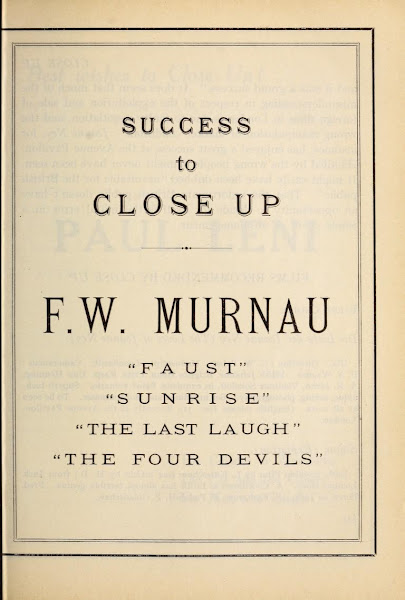
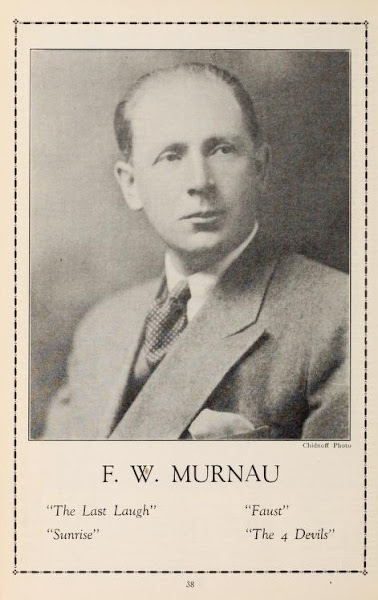
The immanent departure of Silent Horror Film director F.W. Murnau for America had already been announced by the periodical Motion Picture News during late 1925 while Murnau was readying the film "Faust". It was to star Gosta Ekman, "a young Swedish actor who has the title role. He has been a star on the legitimate stage and is now making his first appearance in pictures." Scholar Janet Bergstrom, University of California notes that F.W Murnau had recieced a letter from William Fox during 1925 prompted by the success of "The Last Laugh" (Der Letze Mann) and had already signed a contract to leave for America while filming "Faust" and "Tartuffe".
Janet Bergstrom, University of California , writes that with the film "Faust", among others, Murnau had "unchained the camera" with moving shots that seemed unique...sweeping the audience's emotions with them". Of these moving shots, Bergstrom brings to our attention tracking shots that were photographed above their subject by having rails mounted on the ceiling of the studio.
The use of a mobile camera by Murnau is clearly referred to by Robert Herlth, a designer of sets on the film "Faust", who wrote on the lighting of the film in a chapter entitled "With Murnau on the Set" included in the volume Murnau, published by Lotte H. Eisner. The set designer quotes Murnau as having said, " 'Now how are we going to get the effect of the design? This is too light. Everything must be made much more shadowy.' And so all four of us set about to trying to cut the light...We used them (screens) to define space and create shadows on the wall and in the air. For Murnau, the lighting became part of the actual directing of the film.'"
The periodical Photoplay Magazine during 1927 explained that F.W. Murnau had again resorted to literary adaptation for subject matter, "Goethe's panaoramic poem has been used as its basis and the adaptation was folowed, in the main, as closely as the screen permits...Murnau has caught the medieval atmosphere with suprising success." F.W. Murnau had actually jotted Goethe's name on one of his shootingscripts. Lotte H. Eisner, in his volume Murnau, writes that the script for "Faust", written by poet Hans Kyser, had originally contained a Walpurgisnacht, which may have only reluctantly have been elimanted from a script annotated by the director Murnau in order to "translate the text into visual terms and give directions to actors in terms ofimages."
In regard to whether F.W. Murnau was only on the peripheral of German Expression by definition due to its origins, one idea that supports that if anything F.W. Murnau held that peripheral is the adverse reaction of author Paul Rotha to the subsquent films Murnau made after haveing come to the United States to film. Rotha, in his volume The Film till Now: survey of world cinema, writes, "I find it impossible to accept that the Murnau who made 'Faust' and 'The Last Laugh' are the same man who made 'Sunrise' and 'Four Devils'. Some link between the two pairs of films is sought in vain. They seem the work of seperate persons: the first of an artist working with sincerity among harmonious surroundings; the second of a psuedo artist muddling under extreme difficulties of superabundance." There is a similar discorse concerning the films Swedish silent film director Victor Sjostrom made in Hollywood after having left Svenska Bio, yet it is one that recognizes the film technique od Sjostrom, including the use of ciematic devices such as cutting across the line to a reverse angle and flashbacks.
silent film
Silent Horror Film
Silent Horror
Scott Lord Silent Film: Gosta Ekman in Faust (F.W. Murnau, 1926)
by Scott Lord on Silent Film, Scott Lord on Mystery Film

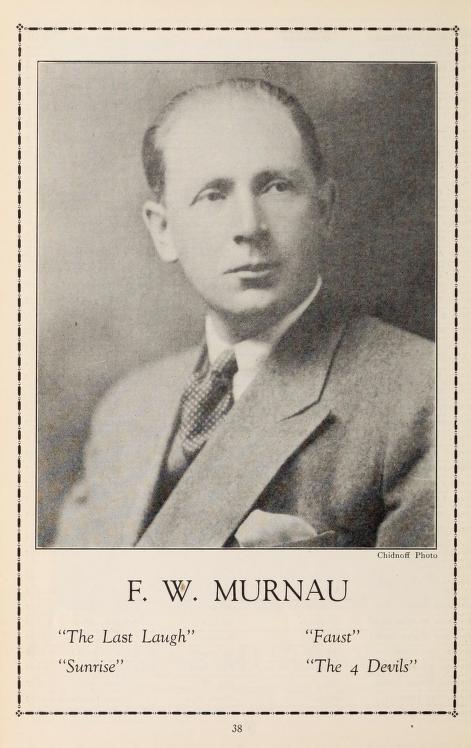
The immanent departure of Silent Horror Film director F.W. Murnau for America had already been announced by the periodical Motion Picture News during late 1925 while Murnau was readying the film "Faust". It was to star Gosta Ekman, "a young Swedish actor who has the title role. He has been a star on the legitimate stage and is now making his first appearance in pictures." Scholar Janet Bergstrom, University of California notes that F.W Murnau had recieced a letter from William Fox during 1925 prompted by the success of "The Last Laugh" (Der Letze Mann) and had already signed a contract to leave for America while filming "Faust" and "Tartuffe".
Janet Bergstrom, University of California , writes that with the film "Faust", among others, Murnau had "unchained the camera" with moving shots that seemed unique...sweeping the audience's emotions with them". Of these moving shots, Bergstrom brings to our attention tracking shots that were photographed above their subject by having rails mounted on the ceiling of the studio.
The use of a mobile camera by Murnau is clearly referred to by Robert Herlth, a designer of sets on the film "Faust", who wrote on the lighting of the film in a chapter entitled "With Murnau on the Set" included in the volume Murnau, published by Lotte H. Eisner. The set designer quotes Murnau as having said, " 'Now how are we going to get the effect of the design? This is too light. Everything must be made much more shadowy.' And so all four of us set about to trying to cut the light...We used them (screens) to define space and create shadows on the wall and in the air. For Murnau, the lighting became part of the actual directing of the film.'"
The periodical Photoplay Magazine during 1927 explained that F.W. Murnau had again resorted to literary adaptation for subject matter, "Goethe's panaoramic poem has been used as its basis and the adaptation was folowed, in the main, as closely as the screen permits...Murnau has caught the medieval atmosphere with suprising success." F.W. Murnau had actually jotted Goethe's name on one of his shootingscripts. Lotte H. Eisner, in his volume Murnau, writes that the script for "Faust", written by poet Hans Kyser, had originally contained a Walpurgisnacht, which may have only reluctantly have been elimanted from a script annotated by the director Murnau in order to "translate the text into visual terms and give directions to actors in terms ofimages."
In regard to whether F.W. Murnau was only on the peripheral of German Expression by definition due to its origins, one idea that supports that if anything F.W. Murnau held that peripheral is the adverse reaction of author Paul Rotha to the subsquent films Murnau made after haveing come to the United States to film. Rotha, in his volume The Film till Now: survey of world cinema, writes, "I find it impossible to accept that the Murnau who made 'Faust' and 'The Last Laugh' are the same man who made 'Sunrise' and 'Four Devils'. Some link between the two pairs of films is sought in vain. They seem the work of seperate persons: the first of an artist working with sincerity among harmonious surroundings; the second of a psuedo artist muddling under extreme difficulties of superabundance." There is a similar discorse concerning the films Swedish silent film director Victor Sjostrom made in Hollywood after having left Svenska Bio, yet it is one that recognizes the film technique od Sjostrom, including the use of ciematic devices such as cutting across the line to a reverse angle and flashbacks.
silent film
Silent Horror Film
Silent Horror
Scott Lord, Scott Lord and 2 others like this
25 Sep 04:33
Scott Lord Silent Film: The Phantom of the Opera (Jullian, 1925)
by Scott Lord on Silent Film, Scott Lord on Mystery Film
Scott Lord, Scott Lord and 3 others like this
25 Sep 04:33
Sherlock Holmes Trailers- House of Fear
by Scott Lord on Silent Film, Scott Lord on Mystery Film
Scott Lord, Scott Lord and 3 others like this
25 Sep 04:33
Scott Lord Mystery: The Mummy’s Hand theatrical trailer
by Scott Lord on Silent Film, Scott Lord on Mystery Film
Scott Lord, Scott Lord and 3 others like this
25 Sep 04:33
Scott Lord Mystery: Werewolf of London theatrical trailer
by Scott Lord on Silent Film, Scott Lord on Mystery Film
Scott Lord, Scott Lord and 3 others like this
25 Sep 04:33
Scott Lord Mystery: She Wolf of London theatrical trailer
by Scott Lord on Silent Film, Scott Lord on Mystery Film
Scott Lord, Scott Lord and 3 others like this