Scott Lord Mystery Film
Shared posts
21 Oct 04:02
Scott Lord Mystery: The Great Alaskan Mystery, Chapter Six (Taylor, Collins, 1944)
by Scott Lord Mystery Film
Scott Lord, Scott Lord and 3 others like this
06 Oct 03:47
Sherlock Holmes Trailers-Scarlet Claw
by Scott Lord on Silent Film, Scott Lord on Mystery Film
Scott Lord, Scott Lord and 3 others like this
21 Sep 22:05
Universal Sherlock Holmes Trailers
by Scott Lord on Silent Film, Scott Lord on Mystery Film
Scott Lord, Scott Lord Mystery Film likes this
21 Sep 22:00
Scott Lord: Silent Sherlock Holmes
by Scott Lord
Scott Lord Mystery Film, Scott Lord likes this
21 Sep 21:37
Sherlock Holmes Trailers- House of Fear
by Scott Lord on Silent Film, Scott Lord on Mystery Film
Scott Lord Mystery Film, Scott Lord likes this
21 Sep 21:29
Scott Lord Mystery: The Purple Monster Strikes (1945) theatrical trailer
by Scott Lord on Silent Film, Scott Lord on Mystery Film
Scott Lord Mystery Film, Scott Lord likes this
21 Sep 21:19
Scott Lord Mystery: The Iron Claw, trailer
by Scott Lord on Silent Film, Scott Lord on Mystery Film
Scott Lord Mystery Film, Scott Lord likes this
21 Sep 21:19
I happen to carry a Basil Rathbone Players Cigarette Card (1938) in my wallet.
Mystery
Mystery scott lord
Sherlock Holmes Trailers-Pearl of Death
by Scott Lord on Silent Film, Scott Lord on Mystery Film
I happen to carry a Basil Rathbone Players Cigarette Card (1938) in my wallet.
Mystery
Mystery scott lord
Scott Lord Mystery Film, Scott Lord likes this
21 Sep 21:19
Sherlock Holmes Speckled Band
by Unknown
Scott Lord Mystery Film, Scott Lord likes this
21 Sep 21:18
Scott Lord: Sherlock Holmes Trailers-ScarletClaw
by Scott Lord
Scott Lord Mystery Film, Scott Lord likes this
17 Sep 01:37
Fay Wray in The Evil Mind
by noreply@blogger.com (Scott Lord on Silent Film, Scott Lord on Mystery Film)
Scott Lord Mystery Film, Scott Lord and one other like this
17 Sep 01:37
Sherlock Holmes Murder At The Baskervilles
by noreply@blogger.com (Scott Lord on Silent Film, Scott Lord on Mystery Film)
Scott Lord, Scott Lord Mystery Film likes this
17 Sep 01:37
Sherlock Holmes The Man WithTheTwisted Lip
by noreply@blogger.com (Scott Lord on Silent Film, Scott Lord on Mystery Film)
Scott Lord, Scott Lord Mystery Film likes this
17 Sep 01:37
Scott Lord:Sherlock Holmes-Sherlock Holmes And The Secret Weapon
by noreply@blogger.com (Scott Lord on Silent Film, Scott Lord on Mystery Film)
Scott Lord, Scott Lord Mystery Film likes this
17 Sep 01:37
Sherlock Holmes Fatal Hour
by noreply@blogger.com (Unknown)
Scott Lord, Scott Lord Mystery Film likes this
17 Sep 01:37
Basil Rathbone as Sherlock Holmes in Dressed to Kill...
by noreply@blogger.com (Scott Lord on Silent Film, Scott Lord on Mystery Film)
Scott Lord, Scott Lord Mystery Film likes this
17 Sep 01:36
Scott Lord Mystery: Basil Rathbone as Sherlock Holmes- Boris Karloff as Mr. Wong; 15 films in Festival
by noreply@blogger.com (Scott Lord on Silent Film, Scott Lord on Mystery Film)
Scott Lord Mystery Film likes this
17 Sep 01:36
: Silent Sherlock Holmes
by noreply@blogger.com (Scott Lord on Silent Film, Scott Lord on Mystery Film)
Scott Lord, Scott Lord Mystery Film likes this
17 Sep 01:36
Basil Rathbone in Sin Takes a Holiday
by noreply@blogger.com (Scott Lord on Silent Film, Scott Lord on Mystery Film)
Scott Lord, Scott Lord Mystery Film likes this
17 Sep 01:36
Scott Lord Mystery: Fay Wray
by noreply@blogger.com (Unknown)
Scott Lord, Scott Lord Mystery Film likes this
17 Sep 01:36
Scott Lord: Dracula- Castle Films 8mm
by noreply@blogger.com (Unknown)
Scott Lord, Scott Lord Mystery Film likes this
17 Sep 01:36
The Black Cat Magazine- Boston 1899;contemporary to The Strand Magazine
by noreply@blogger.com (Scott Lord on Silent Film, Scott Lord on Mystery Film)


Scott Lord, Scott Lord Mystery Film likes this
17 Sep 01:36
Mystery from Monogram Studios
by noreply@blogger.com (Unknown)
Scott Lord, Scott Lord Mystery Film likes this
17 Sep 01:35
Scott Lord Silent Film: Yesterday and Today Newsreel (1929)
by noreply@blogger.com (Scott Lord on Silent Film, Scott Lord on Mystery Film)
Scott Lord Mystery Film, Scott Lord and one other like this
17 Sep 01:34
Scott Lord Silent Film: The New York Hat (D.W. Griffith, Biograph)
by noreply@blogger.com (Scott Lord on Silent Film, Scott Lord on Mystery Film)
Directed by D. W. Griffith for the Biograph Film Company the film features the first photoplay written by Anita Loos. Subsequently, Loos was to write the scenarios and screenplays to films which starred Douglas Fairbanks. The New Movie Magazine during 1930 nostalgically related that the film had also introduced Lionel Barrymore to the screen and that Loos, who had only been sixteen years old at the time of its release, had received “the large sum of $15” for writing the film. Author Iris Barry explains that it was not only Anita Loos that was behind the scenes, “At this period, ideas for films were commonly bought from outsiders and members of the company alike. Mary Pickford, Mack Sennett and others contributed many of the plots Griffith used.” This in part can be taken into consideration when apply Autuer theory to the abrupt difference between the scriptwriting methods of D.W Griffith and Thomas Ince and when reconsidering autuer theory when comparing the directorial efforts of D.W. Griffith and Ingmar Bergman in the mileau of a theatrical acting company.
In the volume D.W. Griffith, American Filmaker, Iris Barry writes that 1912 was a year that D.W. Griffith was an innovator not only in the depiction of social themes and social problems but also in film technique and the uses of the camera as well as the legnthening of the onscreen running time of the two reeler. Barry describes the filmmaking involved in “The New York Hat” (one reel),The film uses cut-backs, close-shots and sharply edited scenes with ease and mastery: close-ups made acting a matter of expresssion and minute guestures instead of the stereotyped guestures of the popular theater.” Peter Cowie, in his volume Eighty Years of Cinema, writes, "Close ups already predominate this film."
In the short scenes of Griffith’s film, Mary Pickford is shown to the right of the screen in medium close shot, trying on a hat, her hands and elbows shown in the frame. Griffith cuts on the action of her leaving the frame to exterior shots. In a later scene, Griffith positions her to the left of the screen, and, his already having shown time having elapsed between the two scenes, then brings the action back to the right of the screen frame. As an early reversal of screen direction, or screen positioning, there is the use of screen editing in between the complimentary positions of showing her in the same interior. During the film the actress is, almost referentially, often kept in profile, facing to the right of the screen's frame. Although Griffith may have been still developing editing techniques, it has been noted that the acting style in the film can be seen as an example of a more naturalistic and less histrionic acting style than that of other contemporary films.
The cinematographer to "The New York Hat" was G.W. Bitzer.
Silent Film D.W. Griffith Biograph Film Company
In the volume D.W. Griffith, American Filmaker, Iris Barry writes that 1912 was a year that D.W. Griffith was an innovator not only in the depiction of social themes and social problems but also in film technique and the uses of the camera as well as the legnthening of the onscreen running time of the two reeler. Barry describes the filmmaking involved in “The New York Hat” (one reel),The film uses cut-backs, close-shots and sharply edited scenes with ease and mastery: close-ups made acting a matter of expresssion and minute guestures instead of the stereotyped guestures of the popular theater.” Peter Cowie, in his volume Eighty Years of Cinema, writes, "Close ups already predominate this film."
In the short scenes of Griffith’s film, Mary Pickford is shown to the right of the screen in medium close shot, trying on a hat, her hands and elbows shown in the frame. Griffith cuts on the action of her leaving the frame to exterior shots. In a later scene, Griffith positions her to the left of the screen, and, his already having shown time having elapsed between the two scenes, then brings the action back to the right of the screen frame. As an early reversal of screen direction, or screen positioning, there is the use of screen editing in between the complimentary positions of showing her in the same interior. During the film the actress is, almost referentially, often kept in profile, facing to the right of the screen's frame. Although Griffith may have been still developing editing techniques, it has been noted that the acting style in the film can be seen as an example of a more naturalistic and less histrionic acting style than that of other contemporary films.
The cinematographer to "The New York Hat" was G.W. Bitzer.
Silent Film D.W. Griffith Biograph Film Company
Silent Film
Scott Lord, Scott Lord Mystery Film likes this
17 Sep 01:34

 Toward the end of 1920, Wid's Daily titled its review of Douglas Fairbanks in "The Mark of Zorro" (eight reels) directed by Fred Niblo, with "Slow Starting But 'Doug' Gets This One Over Well". In regard to the film as a whole, it wrote, "Exceedingly entertaining romance with Doug doing a dual role and his usual acrobatics." Appearing in the film with Douglas Fairbanks is actress Margueritte Del La Motte.
Author Peter Cowie, in his volume Eighty Years of Cinema, described "The Mark of Zorro" as "a finely photographed swashbuckling romance".
Silent Film Douglas Fairbanks Douglas Fairbanks
Scott Lord Silent Film: The Mark of Zorro (Niblo, 1920)
by noreply@blogger.com (Scott Lord on Silent Film, Scott Lord on Mystery Film)

Author Peter Cowie, in his volume Eighty Years of Cinema, described "The Mark of Zorro" as "a finely photographed swashbuckling romance".
Silent Film Douglas Fairbanks Douglas Fairbanks
Scott Lord, Scott Lord Mystery Film and one other like this
17 Sep 01:34
Exhibitor's Herald during 1921 praised the film "The Golem" (Der Golem) for its "ingenious handling of the masses engaged in many of the scenes, persons numbering in the thousands", claiming, "the point of direction and composition" was a "splendid piece of work". It also added, "The lighting, photography and general detail is lacking, and the characters, many of them, are over done in make-up."
Author Lotte H. Eisner, in his volume "The Haunted Screen", explains the contemporaneity of "The Golem", "Paul Wegener always denied having had the intention of making an Expressionist film with his Golem. But that has not stopped people from calling it Expressionist." Seeing the film as an import, or "art film"- an idea particularly important to Scandinavian film companies during that decade almost up to the departure of Charles Magnusson from Swedish Biograph, and therefore an idea frequent in the extratextural film discourse of film critics and reviewers- Picture Play Magazine during 1921 also compared "THe Golem" to "Doctor Caligari" and the theater of Max Reinhardt in its having translated to the screen "the immense imaginative possiblities of the futurist school of dramatic expression". That year periodical highlighted the film with a two page photo dislay, each photo taking up half a page, explaining that "sensational success is predicted" while introducing the "foeign made film", "one of the most important European productions". The photocaptions pointed out the films "curious haunting beauty." The British peridical Pictures and Picturegoer during 1923 did in fact approach genre theory by combining then recent early examples of the mystery thriller, including John Barrymore in his appearance in Dr. Jeckyll and Mr. Hyde, in the article Macabre Movies, distinguishing "The Golem" as a "picturization of a mediaeval legend" but comparing its "Cubist scenery" with that of "Doctor Caligari" with its half-lit ineteriors.
Wegener had given a lecture during 1916 entitled "The Artistic Possibilities of Cinema" as a proponent of "cinematic lyricism" where lines would appear then change as moving surfaces.
Motion Picture World, rather, during 1921 chose to begin with the film's "subject matter" and its "preposteruous story". "He has grasped the most essential fact about his duties as a director- to tell a story in action and develop characters at the same time. Every foot of film advances the progress of the story. There are no cutbacks, no halts for bits of local color or parenthetical description of any of the characters. He knows the meaning of the word drama."
The periodical Motion Picture News during 1921 noted, "Wegener deserves double credit for he also plays the tile role and makes it an unforgettable figure."
Paul Wegener wrote,directed and starred in the his first adaptation of the novel "The Golem" in 1915, presumed to be almost entirely lost with only fragments surviving. Henri Galeen co-wrote and co-directed the photoplay exhibited as "Monster of Fate" in the United States, where Wegener appeared in the 1926 film "The Magician", directed by Rex Ingram.
Silent Film Silent Film Lon Chaney
Scott Lord Silent Film: The Golem, How He Came into the World (Paul Wegener, 1920)
by noreply@blogger.com (Scott Lord on Silent Film, Scott Lord on Mystery Film)
Exhibitor's Herald during 1921 praised the film "The Golem" (Der Golem) for its "ingenious handling of the masses engaged in many of the scenes, persons numbering in the thousands", claiming, "the point of direction and composition" was a "splendid piece of work". It also added, "The lighting, photography and general detail is lacking, and the characters, many of them, are over done in make-up."
Author Lotte H. Eisner, in his volume "The Haunted Screen", explains the contemporaneity of "The Golem", "Paul Wegener always denied having had the intention of making an Expressionist film with his Golem. But that has not stopped people from calling it Expressionist." Seeing the film as an import, or "art film"- an idea particularly important to Scandinavian film companies during that decade almost up to the departure of Charles Magnusson from Swedish Biograph, and therefore an idea frequent in the extratextural film discourse of film critics and reviewers- Picture Play Magazine during 1921 also compared "THe Golem" to "Doctor Caligari" and the theater of Max Reinhardt in its having translated to the screen "the immense imaginative possiblities of the futurist school of dramatic expression". That year periodical highlighted the film with a two page photo dislay, each photo taking up half a page, explaining that "sensational success is predicted" while introducing the "foeign made film", "one of the most important European productions". The photocaptions pointed out the films "curious haunting beauty." The British peridical Pictures and Picturegoer during 1923 did in fact approach genre theory by combining then recent early examples of the mystery thriller, including John Barrymore in his appearance in Dr. Jeckyll and Mr. Hyde, in the article Macabre Movies, distinguishing "The Golem" as a "picturization of a mediaeval legend" but comparing its "Cubist scenery" with that of "Doctor Caligari" with its half-lit ineteriors.
Wegener had given a lecture during 1916 entitled "The Artistic Possibilities of Cinema" as a proponent of "cinematic lyricism" where lines would appear then change as moving surfaces.
Motion Picture World, rather, during 1921 chose to begin with the film's "subject matter" and its "preposteruous story". "He has grasped the most essential fact about his duties as a director- to tell a story in action and develop characters at the same time. Every foot of film advances the progress of the story. There are no cutbacks, no halts for bits of local color or parenthetical description of any of the characters. He knows the meaning of the word drama."
The periodical Motion Picture News during 1921 noted, "Wegener deserves double credit for he also plays the tile role and makes it an unforgettable figure."
Paul Wegener wrote,directed and starred in the his first adaptation of the novel "The Golem" in 1915, presumed to be almost entirely lost with only fragments surviving. Henri Galeen co-wrote and co-directed the photoplay exhibited as "Monster of Fate" in the United States, where Wegener appeared in the 1926 film "The Magician", directed by Rex Ingram.
Silent Film Silent Film Lon Chaney
Scott Lord Mystery Film, Scott Lord and one other like this
17 Sep 01:34
“The King Boda” (“Tyranny of Hate/Boda kungen”, 1920) was the first film to bear the name of Gustaf Molander as director, Molander having also scripted the photoplay. It was also the first film to be photographed by Adrian Bjurman. The film stars Egil Edie. Both Wanda Rothgardt and her mother, Edla Rothgardt appear in the film, as do acresses Winifred Westover, Hilda Castgren, and interestingly enough, actress Vera Schmiterlow, friend of Greta Garbo from when they were at Dramaten, Stockholm together. Produced by Scandinavisk Filmcentral, the film can well be placed within the Golden Age of Swedish Silent Film.
Also appearing in the film "Bodakungen" was Franz Envall, Greta Garbo mentioned in a 1928 Photoplay magazine interview with Ruth Biery, "Then I met an actor...It was Franz Envall. He is dead now, but has a daughter in stage in Sweden. He asked me if they would let me try to get into the Dramatic School of the Dramatic School of the Royal Theater in Stockholm." Envall's daughter was in fact Signe Envall, who, after having appeared in "Gosta Berling's Saga" (Mauritz Stiller, 1924) and "The Kingdom of Rye" (Ivar Johnsson, 1929), was periodically featured in films from 1944 to 1968. Author Forsyth Hardy credits Swedish Silent Film director Gustaf Molander with having introduced actress Greta Garbo to director Mauritz Stiller.
1922 had been the year during which appeared the second film directed by Gustaf Molander, "Amatorfilmen", the first film in which actresses Elsa Ebben-Thorblad and Anna Wallin were each to appear, brought Mimi Pollack to Swedish Film audiences. Written by Bjorn Hodell and photographed by Bjorn Hodell, the film is presumed to be lost, with no surviving copies or fragments. Gustaf Molander
Gustaf Molander would breifly remain in the shadow of Victor Sjostromand Mauritz Stiller again with photographer Adrian Bjurman, during 1922 by directing actress Vera Schmiterlow, who had first appeared on screen in a brief part in Molander's film "Tyranny of Hate", in the film Thomas Graal's Ward (Thomas Graal's myndling), the third in a series of comedies begun by Mauritz Stiller. To modern American audiences and readers of extratextural discourse Schmiterlow may be more famous for being mentioned in biographies as a friend of Greta Garbo than for Molander having given her her first appearance as star of the film.
Scandinavian Silent Film
Swedish Silent Film Gustaf Molander
Swedish Silent Film: Bodakingen, The Tyrrany of Hate (Gustaf Molander, 1920)
by noreply@blogger.com (Scott Lord on Silent Film, Scott Lord on Mystery Film)
“The King Boda” (“Tyranny of Hate/Boda kungen”, 1920) was the first film to bear the name of Gustaf Molander as director, Molander having also scripted the photoplay. It was also the first film to be photographed by Adrian Bjurman. The film stars Egil Edie. Both Wanda Rothgardt and her mother, Edla Rothgardt appear in the film, as do acresses Winifred Westover, Hilda Castgren, and interestingly enough, actress Vera Schmiterlow, friend of Greta Garbo from when they were at Dramaten, Stockholm together. Produced by Scandinavisk Filmcentral, the film can well be placed within the Golden Age of Swedish Silent Film.
Also appearing in the film "Bodakungen" was Franz Envall, Greta Garbo mentioned in a 1928 Photoplay magazine interview with Ruth Biery, "Then I met an actor...It was Franz Envall. He is dead now, but has a daughter in stage in Sweden. He asked me if they would let me try to get into the Dramatic School of the Dramatic School of the Royal Theater in Stockholm." Envall's daughter was in fact Signe Envall, who, after having appeared in "Gosta Berling's Saga" (Mauritz Stiller, 1924) and "The Kingdom of Rye" (Ivar Johnsson, 1929), was periodically featured in films from 1944 to 1968. Author Forsyth Hardy credits Swedish Silent Film director Gustaf Molander with having introduced actress Greta Garbo to director Mauritz Stiller.
1922 had been the year during which appeared the second film directed by Gustaf Molander, "Amatorfilmen", the first film in which actresses Elsa Ebben-Thorblad and Anna Wallin were each to appear, brought Mimi Pollack to Swedish Film audiences. Written by Bjorn Hodell and photographed by Bjorn Hodell, the film is presumed to be lost, with no surviving copies or fragments. Gustaf Molander
Gustaf Molander would breifly remain in the shadow of Victor Sjostromand Mauritz Stiller again with photographer Adrian Bjurman, during 1922 by directing actress Vera Schmiterlow, who had first appeared on screen in a brief part in Molander's film "Tyranny of Hate", in the film Thomas Graal's Ward (Thomas Graal's myndling), the third in a series of comedies begun by Mauritz Stiller. To modern American audiences and readers of extratextural discourse Schmiterlow may be more famous for being mentioned in biographies as a friend of Greta Garbo than for Molander having given her her first appearance as star of the film.
Scandinavian Silent Film
Swedish Silent Film Gustaf Molander
Scott Lord Mystery Film, Scott Lord and one other like this
17 Sep 01:34
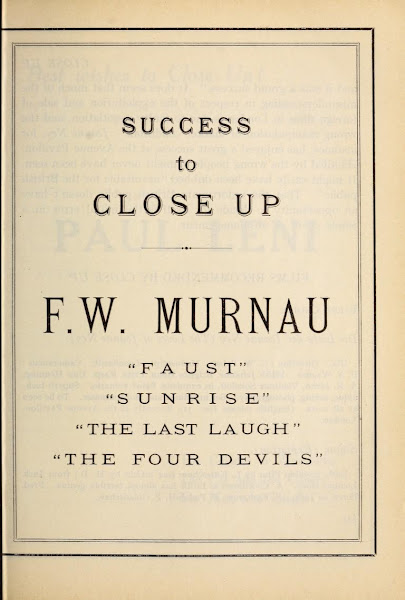
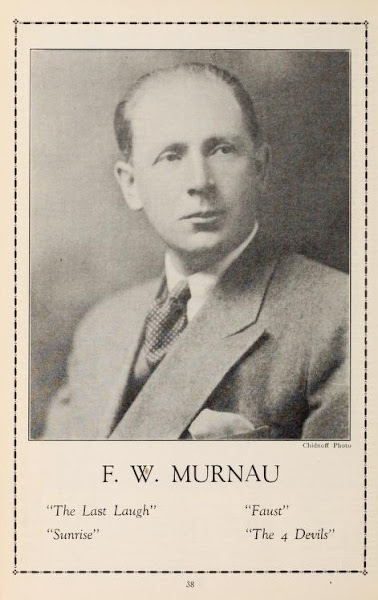
The immanent departure of Silent Horror Film director F.W. Murnau for America had already been announced by the periodical Motion Picture News during late 1925 while Murnau was readying the film "Faust". It was to star Gosta Ekman, "a young Swedish actor who has the title role. He has been a star on the legitimate stage and is now making his first appearance in pictures." Scholar Janet Bergstrom, University of California notes that F.W Murnau had recieced a letter from William Fox during 1925 prompted by the success of "The Last Laugh" (Der Letze Mann) and had already signed a contract to leave for America while filming "Faust" and "Tartuffe".
Janet Bergstrom, University of California , writes that with the film "Faust", among others, Murnau had "unchained the camera" with moving shots that seemed unique...sweeping the audience's emotions with them". Of these moving shots, Bergstrom brings to our attention tracking shots that were photographed above their subject by having rails mounted on the ceiling of the studio.
The use of a mobile camera by Murnau is clearly referred to by Robert Herlth, a designer of sets on the film "Faust", who wrote on the lighting of the film in a chapter entitled "With Murnau on the Set" included in the volume Murnau, published by Lotte H. Eisner. The set designer quotes Murnau as having said, " 'Now how are we going to get the effect of the design? This is too light. Everything must be made much more shadowy.' And so all four of us set about to trying to cut the light...We used them (screens) to define space and create shadows on the wall and in the air. For Murnau, the lighting became part of the actual directing of the film.'"
The periodical Photoplay Magazine during 1927 explained that F.W. Murnau had again resorted to literary adaptation for subject matter, "Goethe's panaoramic poem has been used as its basis and the adaptation was folowed, in the main, as closely as the screen permits...Murnau has caught the medieval atmosphere with suprising success." F.W. Murnau had actually jotted Goethe's name on one of his shootingscripts. Lotte H. Eisner, in his volume Murnau, writes that the script for "Faust", written by poet Hans Kyser, had originally contained a Walpurgisnacht, which may have only reluctantly have been elimanted from a script annotated by the director Murnau in order to "translate the text into visual terms and give directions to actors in terms ofimages."
In regard to whether F.W. Murnau was only on the peripheral of German Expression by definition due to its origins, one idea that supports that if anything F.W. Murnau held that peripheral is the adverse reaction of author Paul Rotha to the subsquent films Murnau made after haveing come to the United States to film. Rotha, in his volume The Film till Now: survey of world cinema, writes, "I find it impossible to accept that the Murnau who made 'Faust' and 'The Last Laugh' are the same man who made 'Sunrise' and 'Four Devils'. Some link between the two pairs of films is sought in vain. They seem the work of seperate persons: the first of an artist working with sincerity among harmonious surroundings; the second of a psuedo artist muddling under extreme difficulties of superabundance." There is a similar discorse concerning the films Swedish silent film director Victor Sjostrom made in Hollywood after having left Svenska Bio, yet it is one that recognizes the film technique od Sjostrom, including the use of ciematic devices such as cutting across the line to a reverse angle and flashbacks.
silent film
Silent Horror Film
Silent Horror
Scott Lord Silent Film: Gosta Ekman in Faust (F.W. Murnau, 1926)
by noreply@blogger.com (Scott Lord on Silent Film, Scott Lord on Mystery Film)

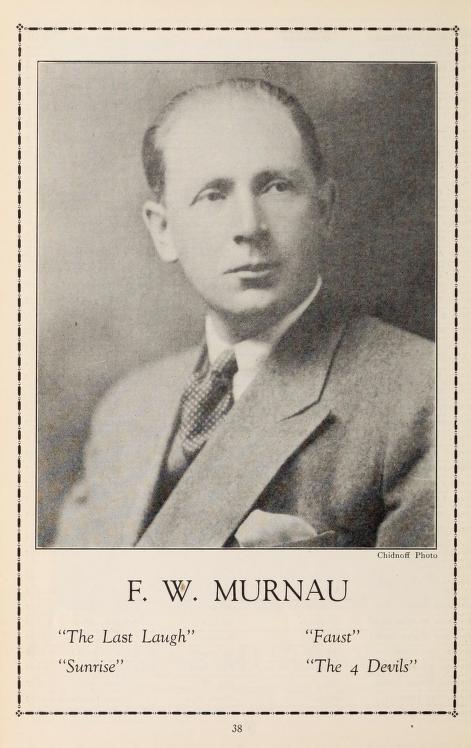
The immanent departure of Silent Horror Film director F.W. Murnau for America had already been announced by the periodical Motion Picture News during late 1925 while Murnau was readying the film "Faust". It was to star Gosta Ekman, "a young Swedish actor who has the title role. He has been a star on the legitimate stage and is now making his first appearance in pictures." Scholar Janet Bergstrom, University of California notes that F.W Murnau had recieced a letter from William Fox during 1925 prompted by the success of "The Last Laugh" (Der Letze Mann) and had already signed a contract to leave for America while filming "Faust" and "Tartuffe".
Janet Bergstrom, University of California , writes that with the film "Faust", among others, Murnau had "unchained the camera" with moving shots that seemed unique...sweeping the audience's emotions with them". Of these moving shots, Bergstrom brings to our attention tracking shots that were photographed above their subject by having rails mounted on the ceiling of the studio.
The use of a mobile camera by Murnau is clearly referred to by Robert Herlth, a designer of sets on the film "Faust", who wrote on the lighting of the film in a chapter entitled "With Murnau on the Set" included in the volume Murnau, published by Lotte H. Eisner. The set designer quotes Murnau as having said, " 'Now how are we going to get the effect of the design? This is too light. Everything must be made much more shadowy.' And so all four of us set about to trying to cut the light...We used them (screens) to define space and create shadows on the wall and in the air. For Murnau, the lighting became part of the actual directing of the film.'"
The periodical Photoplay Magazine during 1927 explained that F.W. Murnau had again resorted to literary adaptation for subject matter, "Goethe's panaoramic poem has been used as its basis and the adaptation was folowed, in the main, as closely as the screen permits...Murnau has caught the medieval atmosphere with suprising success." F.W. Murnau had actually jotted Goethe's name on one of his shootingscripts. Lotte H. Eisner, in his volume Murnau, writes that the script for "Faust", written by poet Hans Kyser, had originally contained a Walpurgisnacht, which may have only reluctantly have been elimanted from a script annotated by the director Murnau in order to "translate the text into visual terms and give directions to actors in terms ofimages."
In regard to whether F.W. Murnau was only on the peripheral of German Expression by definition due to its origins, one idea that supports that if anything F.W. Murnau held that peripheral is the adverse reaction of author Paul Rotha to the subsquent films Murnau made after haveing come to the United States to film. Rotha, in his volume The Film till Now: survey of world cinema, writes, "I find it impossible to accept that the Murnau who made 'Faust' and 'The Last Laugh' are the same man who made 'Sunrise' and 'Four Devils'. Some link between the two pairs of films is sought in vain. They seem the work of seperate persons: the first of an artist working with sincerity among harmonious surroundings; the second of a psuedo artist muddling under extreme difficulties of superabundance." There is a similar discorse concerning the films Swedish silent film director Victor Sjostrom made in Hollywood after having left Svenska Bio, yet it is one that recognizes the film technique od Sjostrom, including the use of ciematic devices such as cutting across the line to a reverse angle and flashbacks.
silent film
Silent Horror Film
Silent Horror
Scott Lord, Scott Lord Mystery Film likes this
17 Sep 01:33
At the time Motion Picture Magazine began publishing publicity stills from the film "Thief of Bagdad" during 1923, actress Evelyn Brent was the only player other than Douglas Fairbanks announced as being included in the cast, the studio having purchased ten acres to be used as sets fir the film.
The periodical Exhibitors Herld during 1924 announced that the film "The Thief of Bagdad", produced by Douglas Fairbanks came with a story written by Elton Thomas, the scenario editor Lotta Woods, "'The Thief of Bagdad' is a conglomeration of every impossible situation that could be dug out of every 'Arabian Nights' tale ever written, interspersed with a few that do not cause a stretch of the imagination to be what might have happenned."
Included with the autobiography of Douglas Fairbanks, Laugh and Live, is a biographical sketch that refers to Fairbanks occaisionally being called "Doug"; the pseudonym of Douglas Fairbanks was Elton Thomas.
SILENT FILM
Douglas Fairbanks SILENT FILM
Scott Lord: The Thief of Bagdad (Walsh, 1924)
by noreply@blogger.com (Scott Lord on Silent Film, Scott Lord on Mystery Film)
At the time Motion Picture Magazine began publishing publicity stills from the film "Thief of Bagdad" during 1923, actress Evelyn Brent was the only player other than Douglas Fairbanks announced as being included in the cast, the studio having purchased ten acres to be used as sets fir the film.
The periodical Exhibitors Herld during 1924 announced that the film "The Thief of Bagdad", produced by Douglas Fairbanks came with a story written by Elton Thomas, the scenario editor Lotta Woods, "'The Thief of Bagdad' is a conglomeration of every impossible situation that could be dug out of every 'Arabian Nights' tale ever written, interspersed with a few that do not cause a stretch of the imagination to be what might have happenned."
Included with the autobiography of Douglas Fairbanks, Laugh and Live, is a biographical sketch that refers to Fairbanks occaisionally being called "Doug"; the pseudonym of Douglas Fairbanks was Elton Thomas.
SILENT FILM
Douglas Fairbanks SILENT FILM
Scott Lord likes this