Scott Lord Mystery Film
Shared posts
18 Sep 23:51
Scott Lord Silent Film: Lon Chaney in The Unholy Three (Tod Browning, 1925)
Scott Lord Mystery Film, Scott Lord likes this
18 Sep 03:28
SILENT FILN
LON Chaney Lon Chaney Lon Chaney silent horror
The Hunchback of Notre Dame (Worsley, 1923)
by noreply@blogger.com (Scott Lord on Silent Film, Scott Lord on Mystery Film)
scottlordpoet
shared this story
from  Blacklight Castle- Mystery Film. Blacklight Castle- Mystery Film.
|
SILENT FILN
LON Chaney Lon Chaney Lon Chaney silent horror
Scott Lord Mystery Film, Scott Lord likes this
27 Aug 05:11
Scott Lord Mystery: The Crimson Ghost, Chapter Two (1946)
by noreply@blogger.com (Scott Lord on Silent Film, Scott Lord on Swedish Film, Scott Lord on Mystery Film)
Scott Lord Mystery Film, Scott Lord likes this
27 Aug 05:04
George Zucco in The Flying Serpent (Sam Newfield, 1946)
Scott Lord Mystery Film, Scott Lord likes this
27 Aug 05:03
Scott Lord Mystery: Mystery of the RIverboat; Chapter SIx, The Fatal Plu...
Scott Lord Mystery Film, Scott Lord likes this
29 Jul 01:43
Mystery from Monogram Studios- A Shriek in the Night (Albert ...
by noreply@blogger.com (Scott Lord on Silent Film, Scott Lord on Mystery Film)
Scott Lord likes this
29 Jul 01:43
Sherlock Holmes Murder At The Baskervilles
by noreply@blogger.com (Scott Lord on Silent Film, Scott Lord on Mystery Film)
Scott Lord likes this
29 Jul 01:43
Swedish Silent Film pioneer Anna Hofmann-Uddren began filming for Orientaliska Teatern in 1911 with the film "Stockholmsdamemas alskling" starring Carl Barklind, Sigurd Wallen, Erica Tomberg and Anna-Lisa Hellstrom. The film is presumed lost, with no surving existing copies. For a brief period of time, actors Victor Sjostrom and Mauritz Stiller, then new to filmmaking, would be rivalled by film versions of the plays of August Strindberg before their having aquired world renown for establishing the Golden Age of Swedish Silent film with the film "Terje Vigen" (Victor Sjostrom,1916), based on Ibsen's poem.
Not quite apart from the account of the use of the proscenium arch in early cinema in Vardac's Stage to Screen, the films directed by Anna Hofmann-Uddgren in 1911 were tranpositions of "Miss Julie" (Froken Julie) and "The Father", the intimate theater of Swedish playwright August Strindberg. "The Father", starring Karin Alexandersson, Karen Thoren and Rene Bjorling featured an admittedly static camera and is an example of filmed theater. And yet cameraman Otto Bjorkman used two exterior shots and cutting that would bring about scene changes during "Miss Julie", a film that had had its premiere at the Orientalisks Teatern, starred Karin Alexandersson and Manda Bjorling. Both films were later remade by Alf Sjoberg and boths films were written by Anna Hofman-Uddgren's husband Gustaf Uddgren.
Ingrid Stigsdotter, Stockholm University, has noted that the reception of the films of Anna Hofman Uddgren was shared with her husband, his being a well known journalist, "Filmmaking was such a new activity that professional designations (the Swedish terms for "director", "producer", "scriptwriter", "actor", "cinematographer"....) had not yet aquired a fixed meaning in relation to the film medium an what was expected for example a director or writer of a film was in the process of fluctuation or negotiation."
To add a feminist historiography to the films, one reason for the films seeming to be overlooked, other than the director's career having had been being brief and not having continued to the 1916 incipience of the Golden Age of Swedish Silent Film, whether having had been being "filmed theater" or not, is primarily the availability of the films; "The Father" is the only film directed by Anna Hofmann-Uddgren known to exist, there being no surviving copies of five of the six films she had directed, those being considered Lost Silent Film.
Anna Hofmann-Uddgren during 1911 also directed acress Edith Wallen in two films, both filmed by cinematographer Otto Bokman, "Single a Dream" (Blott in Drom) and "Sisters" (Systarna). Both are included in the five lost silent films directed by Hofmann-Uddgren, her having scripted the former, Elin Wagner having written the photoplay to the latter.
Actress Karin Alexandersson during 1914 went to Svenska Bio to make film under the direction of Victor Sjostrom and Mauritz Stiller before returning during the 1940's to appear in more than a dozen films. Director Anna Hofmann-Uddgren in fact appeared in front of the camera as an actress twice during 1921 in the films "De Landsflyktige" (Mauritz Stiller) and "Pilgrimage to Kevlaar" (Ivan Hedqvist).
The Blue Tower in Stockholm, where August Strindberg lived bewteen 1908-1912 and where he wrote the play "The Great Highway" is now part of the Strindberg Museum. Strindberg had gladly acquiesced to have his plays adapted into films, almost congradulating Anna Hofmann-Uddgren's husband, Gustav.
Silent Film
Swedish Silent Film
Swedish Silent Film: Anna Hofmann-Uddgren
by noreply@blogger.com (Scott Lord on Silent Film, Scott Lord on Mystery Film)
Swedish Silent Film pioneer Anna Hofmann-Uddren began filming for Orientaliska Teatern in 1911 with the film "Stockholmsdamemas alskling" starring Carl Barklind, Sigurd Wallen, Erica Tomberg and Anna-Lisa Hellstrom. The film is presumed lost, with no surving existing copies. For a brief period of time, actors Victor Sjostrom and Mauritz Stiller, then new to filmmaking, would be rivalled by film versions of the plays of August Strindberg before their having aquired world renown for establishing the Golden Age of Swedish Silent film with the film "Terje Vigen" (Victor Sjostrom,1916), based on Ibsen's poem.
Not quite apart from the account of the use of the proscenium arch in early cinema in Vardac's Stage to Screen, the films directed by Anna Hofmann-Uddgren in 1911 were tranpositions of "Miss Julie" (Froken Julie) and "The Father", the intimate theater of Swedish playwright August Strindberg. "The Father", starring Karin Alexandersson, Karen Thoren and Rene Bjorling featured an admittedly static camera and is an example of filmed theater. And yet cameraman Otto Bjorkman used two exterior shots and cutting that would bring about scene changes during "Miss Julie", a film that had had its premiere at the Orientalisks Teatern, starred Karin Alexandersson and Manda Bjorling. Both films were later remade by Alf Sjoberg and boths films were written by Anna Hofman-Uddgren's husband Gustaf Uddgren.
Ingrid Stigsdotter, Stockholm University, has noted that the reception of the films of Anna Hofman Uddgren was shared with her husband, his being a well known journalist, "Filmmaking was such a new activity that professional designations (the Swedish terms for "director", "producer", "scriptwriter", "actor", "cinematographer"....) had not yet aquired a fixed meaning in relation to the film medium an what was expected for example a director or writer of a film was in the process of fluctuation or negotiation."
To add a feminist historiography to the films, one reason for the films seeming to be overlooked, other than the director's career having had been being brief and not having continued to the 1916 incipience of the Golden Age of Swedish Silent Film, whether having had been being "filmed theater" or not, is primarily the availability of the films; "The Father" is the only film directed by Anna Hofmann-Uddgren known to exist, there being no surviving copies of five of the six films she had directed, those being considered Lost Silent Film.
Anna Hofmann-Uddgren during 1911 also directed acress Edith Wallen in two films, both filmed by cinematographer Otto Bokman, "Single a Dream" (Blott in Drom) and "Sisters" (Systarna). Both are included in the five lost silent films directed by Hofmann-Uddgren, her having scripted the former, Elin Wagner having written the photoplay to the latter.
Actress Karin Alexandersson during 1914 went to Svenska Bio to make film under the direction of Victor Sjostrom and Mauritz Stiller before returning during the 1940's to appear in more than a dozen films. Director Anna Hofmann-Uddgren in fact appeared in front of the camera as an actress twice during 1921 in the films "De Landsflyktige" (Mauritz Stiller) and "Pilgrimage to Kevlaar" (Ivan Hedqvist).
The Blue Tower in Stockholm, where August Strindberg lived bewteen 1908-1912 and where he wrote the play "The Great Highway" is now part of the Strindberg Museum. Strindberg had gladly acquiesced to have his plays adapted into films, almost congradulating Anna Hofmann-Uddgren's husband, Gustav.
Silent Film
Swedish Silent Film
Silent Film
Scott Lord Mystery Film, Scott Lord likes this
29 Jul 01:43
 Bo Florin, Stockholm University, in his volume Transition and Transformation, Victor Sjostrom in Hollywood 1923-1930, points to Victor Sjostrom's use of dissolves in the film "Monastery of Sedomir" as "transformatory devices", to thematiclly link two images. "The dissolve works, in other words, as an independent device, which does not in this context recieve any clarifying support from any other narrative patterns." The character, and the setting in which he placed, change as motif with the dissolve.
Peter Cowie, in his volume Swedish Cinema adds that the film "is not easily recognizable as a film by Sjostrom, for landscape and countryside play no part in it at all."
"The Monastery of Sendomir" (Klostret i Sendomir) was written and directed for Svenska Biografteatern by Victor Sjostrom during 1920. Photographed by Henrik Jaenzon the film starred actresses Rene Bjorling, Jenny-Tschernichin-Larsson and Tora Teje in the first film in which she was to appear during a year in which she would star with actress Mary Johnson in the film "Familjens Traditioner" under the direction of Rune Carlsten, however meteoric her career might seem. The screenplay to "Monastery of Sendomir" was adapted from a short story by Franz Grillparzer that, despite whatever reason Sjostrom had for choosing the material, had been filmed a year earlier, in Germany, by director Rudolph Meinert, starring actress Ellen Richter.
Victor Sjostrom
The Phantom Carriage (Victor Sjostrom, 1920) Please screen the films below directed in Sweden by Victor Sjostrom as any double feature you see fit. Greta Garbo
Swedish Silent Film: Monastery of Sendomir (Klostret I Sendomir, Victor Sjostrom,1920)
by noreply@blogger.com (Scott Lord on Silent Film, Scott Lord on Mystery Film)

Peter Cowie, in his volume Swedish Cinema adds that the film "is not easily recognizable as a film by Sjostrom, for landscape and countryside play no part in it at all."
"The Monastery of Sendomir" (Klostret i Sendomir) was written and directed for Svenska Biografteatern by Victor Sjostrom during 1920. Photographed by Henrik Jaenzon the film starred actresses Rene Bjorling, Jenny-Tschernichin-Larsson and Tora Teje in the first film in which she was to appear during a year in which she would star with actress Mary Johnson in the film "Familjens Traditioner" under the direction of Rune Carlsten, however meteoric her career might seem. The screenplay to "Monastery of Sendomir" was adapted from a short story by Franz Grillparzer that, despite whatever reason Sjostrom had for choosing the material, had been filmed a year earlier, in Germany, by director Rudolph Meinert, starring actress Ellen Richter.
Victor Sjostrom
The Phantom Carriage (Victor Sjostrom, 1920) Please screen the films below directed in Sweden by Victor Sjostrom as any double feature you see fit. Greta Garbo
Scott Lord, Scott Lord Mystery Film likes this
29 Jul 01:43
Greta Garbo before Hollywood- Lars Hanson
by noreply@blogger.com (Scott Lord on Silent Film, Scott Lord on Mystery Film)
The 1927 article "Swedish Hospitality featured in Motion Picture Magazine gave an account of journalist Rilla Page Palmborg, author of "The Private Life of Greta Garbo", being entertained by actor Lars Hanson and his wife, Swedish actress Karin Molander. It began, " 'And now we shall see if you like real Swedish cooking,' said Lars Hanson as he escorted us across the velvety green lawn of his walled garden, where for the past hour we had sat enthralled by the tales he and his charming wife had told us of their native land...This was a Sunday supper to which we had been invited. 'My wife prepared everything when I her that I had promised you real Swedish cooking.' Said Mr. Hanson as we took our places at a long refectory table in a long, rather narrow and dignified dining-room."
Fact may be just as exiciting as fiction to historians when we think that the events of the nineteenth century, depicted in the twentieth, are already culturally different from ours, especially in film the show the humanity that we still do have in common, or rather psychological insights about characters in moral dilemas; in fact Moving Picture World contrasted the character portrayed by Lars Hanson in John Robertson's film with a "more straitlaced" character that Hanson had played earlier for Victor Sjostrom in his depiction of Puritan Colonialism, "The Scarlet Letter". Photoplay reviewed the film. "A well knit drama is this story of how the gospel ship came into being." A ship embarks from the Boston waterfront and is saved from shipwreck off to become apparently a then "floating church" The film might be historically inaccurate about the date triangular trade hade ended in regard to the War of 1812. Motion Picture News subtitled their review with a "Rugged, Well Acted Story of the first Gospel Ship" while the periodical Motion Picture News subtitled their review with "Lars Hanson and Pauline Starke in Gripping Drama of Founding of First Gospel Ship". The subtitles used in Motion Picture World were directed more toward the jazz age- one page announcing the film "Flesh and the Devil" in which Lars Hanson, starred with Greta Garbo and John Gilbert, as being busy "Cleaning Up" at the box office, while "Captain Salvation" was in production for Cosmopolitan with "Wild Crew Now Sails the Main". Motion Picture World announced that the seventy five actors of the studio were filming exterior scenes ar Catalina Island, the "dramatic action" filmed after having "set sail" on the "high seas".
Picture Play magazine during 1927 featured stills from the eight reel film "Captain Salvation", starring Lars Hanson. They were captioned with, "Lars Hanson has another intensely dramatic role in 'Captain Salvation', that of a young New Englander whose heart is in the sea, but who is forced his uncle to go onto the ministry...Marceleine Day as the girl who waits for him at home." Motion Picture News Booking Guide during 1927 provided a brief synopsis of the film, "Theme: Melodrama of the sea. Adaptation of the novel by Fredrick William Wallace, Divinity Student forsakes the pulpit for the sea, forgets his faith and becomes aide of a much feared skipper. His regeneration is brought about through an unfortunate girl he befriends. After her death he is reunited with his sweetheart." The cameraman to the film is listed as William Daniels and the scenarist as Jack Dunningham. Photoplay Magazine reviewed the eight reel silent film, "Pauline Starke is Excellant as the waterfront derelict." In a photo caption to a full page portrait of Pauline Starke, Picture Play magazine introduced her upcoming film, "If you saw 'Captain Salvation' you have no doubt of Pauline Starke's dramatic gifts. If you did not, you will find proof of them in 'Fallen Angles'". Magazine advertisements published by the studio announced that "Captain Salvation" was a Cosmopolitan production for M.G.M. "on a lavish scale" ephasizing that the novel by Frederick William Wallace was soon to be serialized for millions of readers and an "unprecedented promotion campaign" would be launched by Hearst newspapers.
Fact may be just as exiciting as fiction to historians when we think that the events of the nineteenth century, depicted in the twentieth, are already culturally different from ours, especially in film the show the humanity that we still do have in common, or rather psychological insights about characters in moral dilemas; in fact Moving Picture World contrasted the character portrayed by Lars Hanson in John Robertson's film with a "more straitlaced" character that Hanson had played earlier for Victor Sjostrom in his depiction of Puritan Colonialism, "The Scarlet Letter". Photoplay reviewed the film. "A well knit drama is this story of how the gospel ship came into being." A ship embarks from the Boston waterfront and is saved from shipwreck off to become apparently a then "floating church" The film might be historically inaccurate about the date triangular trade hade ended in regard to the War of 1812. Motion Picture News subtitled their review with a "Rugged, Well Acted Story of the first Gospel Ship" while the periodical Motion Picture News subtitled their review with "Lars Hanson and Pauline Starke in Gripping Drama of Founding of First Gospel Ship". The subtitles used in Motion Picture World were directed more toward the jazz age- one page announcing the film "Flesh and the Devil" in which Lars Hanson, starred with Greta Garbo and John Gilbert, as being busy "Cleaning Up" at the box office, while "Captain Salvation" was in production for Cosmopolitan with "Wild Crew Now Sails the Main". Motion Picture World announced that the seventy five actors of the studio were filming exterior scenes ar Catalina Island, the "dramatic action" filmed after having "set sail" on the "high seas".
Picture Play magazine during 1927 featured stills from the eight reel film "Captain Salvation", starring Lars Hanson. They were captioned with, "Lars Hanson has another intensely dramatic role in 'Captain Salvation', that of a young New Englander whose heart is in the sea, but who is forced his uncle to go onto the ministry...Marceleine Day as the girl who waits for him at home." Motion Picture News Booking Guide during 1927 provided a brief synopsis of the film, "Theme: Melodrama of the sea. Adaptation of the novel by Fredrick William Wallace, Divinity Student forsakes the pulpit for the sea, forgets his faith and becomes aide of a much feared skipper. His regeneration is brought about through an unfortunate girl he befriends. After her death he is reunited with his sweetheart." The cameraman to the film is listed as William Daniels and the scenarist as Jack Dunningham. Photoplay Magazine reviewed the eight reel silent film, "Pauline Starke is Excellant as the waterfront derelict." In a photo caption to a full page portrait of Pauline Starke, Picture Play magazine introduced her upcoming film, "If you saw 'Captain Salvation' you have no doubt of Pauline Starke's dramatic gifts. If you did not, you will find proof of them in 'Fallen Angles'". Magazine advertisements published by the studio announced that "Captain Salvation" was a Cosmopolitan production for M.G.M. "on a lavish scale" ephasizing that the novel by Frederick William Wallace was soon to be serialized for millions of readers and an "unprecedented promotion campaign" would be launched by Hearst newspapers.
Child actor Jackie Coogan was employed in the title role of the seven reel film "Buttons" (1927, George W. Hill), in which he starred with Lars Hanson, Gertrude Olmstead and Polly Moran. Photoplay provided a brief synopsis of the film during its review, "the ship strikes an iceberg and then founders, with little Jackie standing by on the bridge with the captain to the last. Both are saved, however."
With the advent of sound, Picture Play magazine in 1929 featured an article titled "Have foreigners a Chance Now?", written by Myrtle Gebhart, evaluating the inconstant position of foreign stars in the firmament "defeated by the microphone", including British actors that had already returned to England. The author turned to Sweden, "Greta Garbo's first out loud. 'Anna Christie' is fogged with her native accent...Enchanting Greta Nissen is routined with an obscure stock company to acquire English dexterity...Lars Hanson and Mona Martenson, better known abroad than Garbo did not click. That was prior to the accent age."
On his return to Sweden, Photoplay Magazine recorded,"Contentment meant more to Lars than money. He writes that he is happier than he has ever been in the Royal Dramatic Theater in Stockholm." Katherine Albert of Photoplay in 1932 seemed to feel she had the definitive account of Lars Hanson having had been excluded from sound film, although Hanson had returned to Sweden and would not much later costar with Victor Sjostrom who had relinquished directing upon his return to Sweden to continue only as an actor, the film having been shot by director Gustav Edren. She wrote, "And there was a Swedish Girl who had just been brought over with a great director. None of us could see why they had been given a contract. She was too tall, too gawky and had none of the requirements of a great actress. She just wandered about the lot and nobody paid her any attention. her name was Greta Garbo. No, we were concerned with the artists Lillian Gish and that marvelous actor Lars Hanson. And now who knows anything about Lars Hanson and where is Lillian Gish? While...well, if we had had sense enough to see what the girl had we wouldn't have been working in the publicity department."
Greta Garbo
Greta Garbo
Greta Garbo Love
Greta Garbo
With the advent of sound, Picture Play magazine in 1929 featured an article titled "Have foreigners a Chance Now?", written by Myrtle Gebhart, evaluating the inconstant position of foreign stars in the firmament "defeated by the microphone", including British actors that had already returned to England. The author turned to Sweden, "Greta Garbo's first out loud. 'Anna Christie' is fogged with her native accent...Enchanting Greta Nissen is routined with an obscure stock company to acquire English dexterity...Lars Hanson and Mona Martenson, better known abroad than Garbo did not click. That was prior to the accent age."
On his return to Sweden, Photoplay Magazine recorded,"Contentment meant more to Lars than money. He writes that he is happier than he has ever been in the Royal Dramatic Theater in Stockholm." Katherine Albert of Photoplay in 1932 seemed to feel she had the definitive account of Lars Hanson having had been excluded from sound film, although Hanson had returned to Sweden and would not much later costar with Victor Sjostrom who had relinquished directing upon his return to Sweden to continue only as an actor, the film having been shot by director Gustav Edren. She wrote, "And there was a Swedish Girl who had just been brought over with a great director. None of us could see why they had been given a contract. She was too tall, too gawky and had none of the requirements of a great actress. She just wandered about the lot and nobody paid her any attention. her name was Greta Garbo. No, we were concerned with the artists Lillian Gish and that marvelous actor Lars Hanson. And now who knows anything about Lars Hanson and where is Lillian Gish? While...well, if we had had sense enough to see what the girl had we wouldn't have been working in the publicity department."
Greta Garbo
Greta Garbo
Greta Garbo Love
Greta Garbo
Scott Lord, Scott Lord Mystery Film likes this
29 Jul 01:43
 The 1912 directorial debut of Mack Sennett for the Keystone Film Company, "The Water Nymph" starred actress Mabel Normand. Film historian Arthur Knight, in his volume The Liveliest Art, "At first Sennett was Keystone's director, star, idea man, and sometimes he even helped out on the camera. Stories were improvised on the spot...The key scenes, the scenes involving incident, would be caught almost on the fly...Before long Sennett, like Ince, was forced to withdraw from direct participation in his comedies and become producer."
Silent Film
The 1912 directorial debut of Mack Sennett for the Keystone Film Company, "The Water Nymph" starred actress Mabel Normand. Film historian Arthur Knight, in his volume The Liveliest Art, "At first Sennett was Keystone's director, star, idea man, and sometimes he even helped out on the camera. Stories were improvised on the spot...The key scenes, the scenes involving incident, would be caught almost on the fly...Before long Sennett, like Ince, was forced to withdraw from direct participation in his comedies and become producer."
Silent Film
Scott Lord Silent Film: The Water Nymph (Sennett, Keystone, 1912)
by noreply@blogger.com (Scott Lord on Silent Film, Scott Lord on Mystery Film)

Scott Lord, Scott Lord Mystery Film likes this
29 Jul 01:43
Scott Lord Silent Film: The Lonedale Operator (Griffith, 1912)
by noreply@blogger.com (Scott Lord on Silent Film, Scott Lord on Mystery Film)
In her autobiography, Lillian Gish discusses D.W. Griffith's cutting between camera distances in "The Lonedale Operator" (one reel). The photoplay was written by Mack Sennett and photographed by G.W. Bitzer for the Biograph Film Company durin 1912.
Linda Arvidson, writing as Mrs. D. W. Griffith, in her autobiography entitled "When the Movies Were Young" recounts the importance of "The Lonedale Operator" to the career of actress Blanche Sweet, "Mr. Griffith, as of yet unwilling to grant that she had any soul or feeling in her work, was using her for 'girl' parts. But he changed his opinion with 'The Lonedale Operator'. That was the picture in which he first recognized ability in Miss Sweet." Arvidson later phrases it as "screen acting that could be recognized as a portrayal of human conduct". In another account contained in the volume, Arvidson chronicles D.W. Griffith having met with Blanche Sweet "on the road" with an offer to film two reelers in Calfornia neccesitated by the departure of Mary Pickford to the IMP Studios.
The account Lillian Gish gives of the "Lonedale Operator" in her autobiography The Movies, Mr. Griffith and Me includes D.W. Griffith being preemptive of his film's editor, "he refined the devices for building suspense...To increase suspense and build up to the climax, Mr. Griffith again employed crosscutting, switching from the girl to the sweetheart in evershortening intervals."
Arthur Knight, in his volume The Liveliest Art, describes Griffith's use of the insert shot in "The Lonedale Operator" when Blanche Sweet uses a wrench that is thought to be a pistol. "It was the close up that let us in on the secret, when the director was ready to reveal it. Griffith discovered that one basic function of the close up was to emphasize the inanimate, to make tings a dynamic part of the world through which the actors move. But the close up does more than emphasize what is in a scene, it elimantes everything else."
Magazine advertisements paid for by the Biograph Film Company described "The Londale Operator", reading: "With this Biograph subject is presented without a doubt the most thrilling melodramatic story ever produced." Silent Film
D.W. Griffith
Biograph Film Company
The account Lillian Gish gives of the "Lonedale Operator" in her autobiography The Movies, Mr. Griffith and Me includes D.W. Griffith being preemptive of his film's editor, "he refined the devices for building suspense...To increase suspense and build up to the climax, Mr. Griffith again employed crosscutting, switching from the girl to the sweetheart in evershortening intervals."
Arthur Knight, in his volume The Liveliest Art, describes Griffith's use of the insert shot in "The Lonedale Operator" when Blanche Sweet uses a wrench that is thought to be a pistol. "It was the close up that let us in on the secret, when the director was ready to reveal it. Griffith discovered that one basic function of the close up was to emphasize the inanimate, to make tings a dynamic part of the world through which the actors move. But the close up does more than emphasize what is in a scene, it elimantes everything else."
Magazine advertisements paid for by the Biograph Film Company described "The Londale Operator", reading: "With this Biograph subject is presented without a doubt the most thrilling melodramatic story ever produced." Silent Film
D.W. Griffith
Biograph Film Company
Silent Film
Scott Lord, Scott Lord Mystery Film likes this
29 Jul 01:43
The 1923 Clara Bow film "The Pill Pounder" (two reels) was discovered to exist when a 35 millimeter print was found in 2024, it evidently having been purchased unknowingly at an auction for twenty dollars.
Directed in 1925 by Charles Giblyn, the six reel film "The Adventurous Sex", starring Clara Bow is presumed to be a lost silent film, with no surviving copies existing.
Motion Picture News avoided flattering the direction of "Parisian Love", "Weak and wandering. Thrill stuff poorly executed, action draggy, footage wasted."
silent Film Lost Silent Film
Scott Lord Silent Film: Clara Bow in Parisian Love (Louis J. Gasnier, 1925)
by noreply@blogger.com (Scott Lord on Silent Film, Scott Lord on Mystery Film)
The 1923 Clara Bow film "The Pill Pounder" (two reels) was discovered to exist when a 35 millimeter print was found in 2024, it evidently having been purchased unknowingly at an auction for twenty dollars.
Directed in 1925 by Charles Giblyn, the six reel film "The Adventurous Sex", starring Clara Bow is presumed to be a lost silent film, with no surviving copies existing.

Motion Picture News avoided flattering the direction of "Parisian Love", "Weak and wandering. Thrill stuff poorly executed, action draggy, footage wasted."
silent Film Lost Silent Film
Scott Lord, Scott Lord Mystery Film likes this
29 Jul 01:43


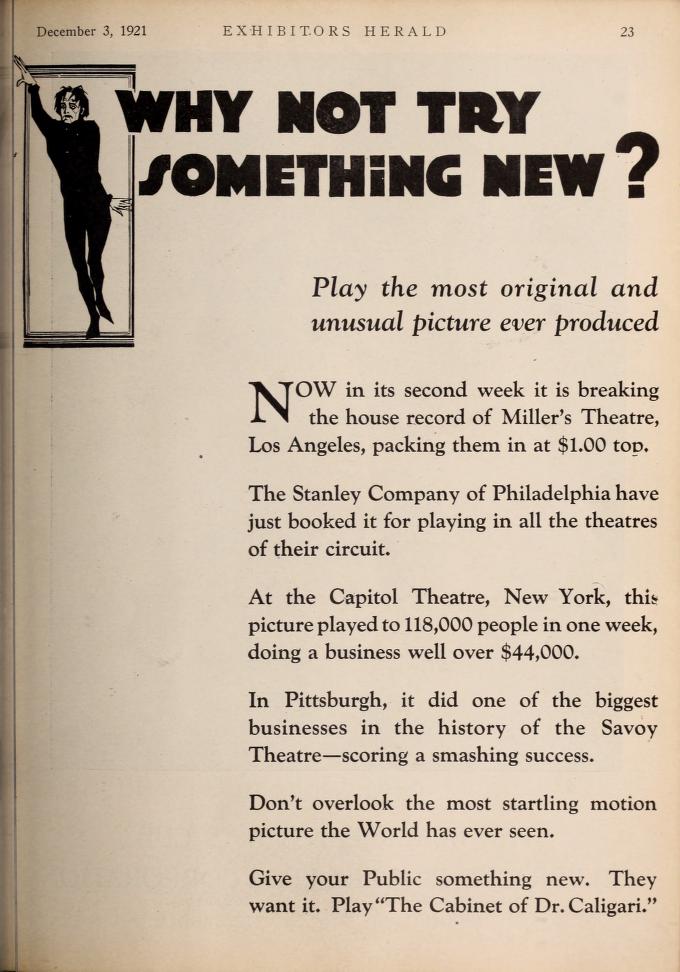
 Arthur Knight, in his volume The Liveliest Art, views "The Cabinet of Dr. Calgari" as one of the most famous silent films ever made. Knight explains, "Two things distinguished 'Caligari' as a film: the daring of the story-within-a-story and the startling originality of its decor." Knight implies the thematic elements are articulated in the mise-en-scene of the film, remarking upon its "obviously 'artistic' settings (related nith to the stage work of the expressionists and to the experiments of the cubist painters". Leo Braudy, in his volume The World in a Frame, gives The Cabinet of Caligari, directed by Robert Wiene during 1921, as an example of a "closed film", where the director creates his own space, a unique and specific diegetic backdrop, as opposed to an "open film" where the story finds it own enviornment in which events are to take place. Not only is characterization what allows narrativity, but where the stage us set allows theme and mood to carry the storyline.
Silent Horror Film
Silent Horror Film
Silent Horror Film Movie Posters
Arthur Knight, in his volume The Liveliest Art, views "The Cabinet of Dr. Calgari" as one of the most famous silent films ever made. Knight explains, "Two things distinguished 'Caligari' as a film: the daring of the story-within-a-story and the startling originality of its decor." Knight implies the thematic elements are articulated in the mise-en-scene of the film, remarking upon its "obviously 'artistic' settings (related nith to the stage work of the expressionists and to the experiments of the cubist painters". Leo Braudy, in his volume The World in a Frame, gives The Cabinet of Caligari, directed by Robert Wiene during 1921, as an example of a "closed film", where the director creates his own space, a unique and specific diegetic backdrop, as opposed to an "open film" where the story finds it own enviornment in which events are to take place. Not only is characterization what allows narrativity, but where the stage us set allows theme and mood to carry the storyline.
Silent Horror Film
Silent Horror Film
Silent Horror Film Movie Posters
Scott Lord Silent Film: Lili Dagover in The Cabinet of Dr. Caligari (Rob...
by noreply@blogger.com (Scott Lord on Silent Film, Scott Lord on Mystery Film)


Scott Lord Mystery Film likes this
29 Jul 01:42


Goldwyn in 1923 released an eight reel adaptation of Vanity Fair with actress Mabel Balin starring as Becky Sharp, written, directed and produced by Hugo Balin. The film is presumed lost, with no existing copies surviving. A 1922 film adaptation was directed by W.C. Rowden during 1922. Thomas A. Edison Incorporated released Vanity Fair in seven reels, directed by Eugene Nowland, in 1915. Silent Film Hollywood, Color and Tint in Film
Scott Lord Film: A Star is Born (William A Wellman, 1937) - Becky Sharp (Mamoulian, 1935) double feature
by noreply@blogger.com (Scott Lord on Silent Film, Scott Lord on Mystery Film)


Goldwyn in 1923 released an eight reel adaptation of Vanity Fair with actress Mabel Balin starring as Becky Sharp, written, directed and produced by Hugo Balin. The film is presumed lost, with no existing copies surviving. A 1922 film adaptation was directed by W.C. Rowden during 1922. Thomas A. Edison Incorporated released Vanity Fair in seven reels, directed by Eugene Nowland, in 1915. Silent Film Hollywood, Color and Tint in Film
Scott Lord, Scott Lord Mystery Film likes this
29 Jul 01:42
Scott Lord Silent Film: Scaramouche (Rex Ingram, 1923)
by noreply@blogger.com (Scott Lord on Silent Film, Scott Lord on Mystery Film)
Scott Lord, Scott Lord Mystery Film likes this
29 Jul 01:42
Scott Lord Silent Film: Beau Brummel (Beaumont, 1924)
by noreply@blogger.com (Scott Lord on Silent Film, Scott Lord on Mystery Film)
Scott Lord, Scott Lord Mystery Film likes this
29 Jul 01:42
Scott Lord on Silent Film Hollywood, Lost Silent Film, Swedish Silent Film, Danish Silent Film: Scott Lord Swedish Silent Film: Synnöve Solbakken (Brunius, 1919)
Scott Lord, Scott Lord Mystery Film and 2 others like this
29 Jul 01:42
Scott Lord on Silent Film Hollywood, Lost Silent Film, Swedish Silent Film, Danish Silent Film: Scott Lord Swedish Silent Film: Synd (Gustaf Molander, 1928)
Scott Lord, Scott Lord Mystery Film and 2 others like this
29 Jul 01:42
Scott Lord on Silent Film Hollywood, Lost Silent Film, Swedish Silent Film, Danish Silent Film: Silent Garbo
Scott Lord, Scott Lord Mystery Film and 2 others like this
29 Jul 01:42
Scott Lord on Silent Film Hollywood, Lost Silent Film, Swedish Silent Film, Danish Silent Film: Under the Red Robe (Victor Sjostrom, 1937)
Scott Lord, Scott Lord Mystery Film and 2 others like this
29 Jul 01:42
Scott Lord on Silent Film Hollywood, Lost Silent Film, Swedish Silent Film, Danish Silent Film: Greta Garbo in The Mysterious Lady (Fred Niblo, 1928)
Scott Lord, Scott Lord Mystery Film and 2 others like this
29 Jul 01:42
Scott Lord on Silent Film Hollywood, Lost Silent Film, Swedish Silent Film, Danish Silent Film: Scott Lord Swedish Silent Film: Thomas Graal's Best Film (Mauritz Stille...
Scott Lord, Scott Lord Mystery Film and 2 others like this
29 Jul 01:42
Scott Lord on Silent Film Hollywood, Lost Silent Film, Swedish Silent Film, Danish Silent Film: Greta Garbo in Flesh and the Devil (Clarence Brown, 1926)
Scott Lord, Scott Lord Mystery Film and 2 others like this
29 Jul 01:42
Scott Lord on Silent Film Hollywood, Lost Silent Film, Swedish Silent Film, Danish Silent Film: Victor Sjostrom 1920
Scott Lord, Scott Lord Mystery Film and 2 others like this
29 Jul 01:42
Scott Lord on Silent Film Hollywood, Lost Silent Film, Swedish Silent Film, Danish Silent Film: Scott Lord Silent Film: Linda Arvidson in The Adventures of Dollie (D.W....
D.W. griffin
Tags: silent film
Scott Lord, Scott Lord and 2 others like this
29 Jul 01:42
Scott Lord on Silent Film Hollywood, Lost Silent Film, Swedish Silent Film, Danish Silent Film: Silent Film Biblical Drama
Scott Lord, Scott Lord and 2 others like this
29 Jul 01:41
Scott Lord on Silent Film Hollywood, Lost Silent Film, Swedish Silent Film, Danish Silent Film: Scott Lord Silent Film: The Lonedale Operator (Griffith, 1912)
Scott Lord, Scott Lord and 2 others like this
29 Jul 01:41
Scott Lord on Silent Film Hollywood, Lost Silent Film, Swedish Silent Film, Danish Silent Film: Scott Lord Silent Film: Greta Garbo In The Joyless Street (G.W. Pabst, 1...
Scott Lord, Scott Lord and 2 others like this